

Introduction
Effective leadership strongly impacts employee motivation, engagement, and organizational success. Traditional approaches to leadership and human resource management (HRM) have primarily relied on behavioral and social theories to explain leaders’ influence (Redcay & Warnell, Reference Redcay and Warnell2018). While these perspectives have generated valuable insights, they provide limited explanation into the underlying cognitive and emotional mechanisms through which leadership effects occur (Aithal & Satpathy, Reference Aithal and Satpathy2024).
Responding to this limitation, neuroleadership has emerged as an interdisciplinary approach that integrates neuroscientific and neurocognitive insights into leadership behaviors and HRM research. Rather than adopting neural and biological definitions rooted in clinical or psychological settings, neuroleadership in this study is defined as an approach that explains how leaders’ cognitive, emotional, and regulatory processes shape leadership behaviors and influence employees’ cognition, motivation, well-being, and performance (Rock, Reference Rock2009; Waldman, Balthazard & Peterson, Reference Waldman, Balthazard and Peterson2011). Moving beyond a sole focus on observable behavior, neuroleadership emphasizes the neurocognitive mechanisms underlying decision-making, emotional regulation, social interaction, and stress management in organizational contexts (Ringleb & Rock, Reference Ringleb and Rock2008; Lee, Senior & Butler, Reference Lee, Senior and Butler2012; Tursunbayeva, Alvino, Pavone & Moschera, Reference Tursunbayeva, Alvino, Pavone and Moschera2025).
Neuroscience-informed leadership research seeks to enhance leadership effectiveness at the individual, team, and organizational levels by improving understanding of human behavior and brain-based cognitive functions (Rock, Reference Rock2009; Ruiz-Rodríguez, Ortiz-de-Urbina-Criado & Ravina-Ripoll, Reference Ruiz-Rodríguez, Ortiz-de-Urbina-Criado and Ravina-Ripoll2023; Bratianu & Staneiu, Reference Bratianu and Staneiu2024; Tursunbayeva et al., Reference Tursunbayeva, Alvino, Pavone and Moschera2025). Despite its growing relevance in neuroscientific research, neuroleadership research within the HRM domain remains fragmented and conceptually underdeveloped. This fragmentation reflects the uneven translation of advances from cognitive and clinical neuroscience into management and HRM research, where theoretical consolidation and systematic empirical examination remain limited. Consequently, existing studies provide only partial and inconsistent insights into how leaders’ neurocognitive processes affect employees’ emotional and cognitive functioning (Kuhlmann & Kadgien, Reference Kuhlmann and Kadgien2018).
These limitations highlight the critical need for a deeper and more systematic understanding of the neurocognitive foundations of leadership within HRM. In particular, new evidence-based insight is required to clarify how leaders’ cognitive and emotional processes relate to employee motivation, decision-making, problem-solving, well-being, and performance, and advance both theory and practice (Waldman et al., Reference Waldman, Balthazard and Peterson2011). Addressing this gap requires a structured synthesis that consolidates core neuroleadership concepts, applies consistent terminology, and situates neuroleadership research within established HRM domains.
This systematic review contributes in several ways. First, it systematically maps neuroleadership themes across key HRM domains, offering a comprehensive overview of how neuroscience principles have been incorporated into HRM research. Second, it integrates neurocognitive insights with established HRM theories, developing a conceptual framework that explains how leadership behaviors influence employee cognition, motivation, and performance. Third, it provides practical guidance for HR leaders seeking to design evidence-based strategies that enhance decision-making, emotional regulation, and employee well-being in organizational contexts. By synthesizing neuroscience and HRM, this review advances both theoretical and practical understanding of neuroleadership’s role in contemporary organizational management and identifies directions for future research.
The study identifies major trends in neuroleadership research between 2005 and 2025 across ten well-regarded journals using a theory-driven systematic content analysis, with the sample bounded by specific parameters explained in the methods section, to enhance analytical depth and feasibility and to minimize limited incremental thematic gain. Neuroleadership themes are derived from an integrated neuroleadership model originally proposed by Rock (Reference Rock2006, Reference Rock2009) and subsequently expanded by Waldman et al. (Reference Waldman, Balthazard and Peterson2011), Teboul and Damier (Reference Teboul and Damier2017, Reference Teboul and Damier2023), Agarwal and Shree (Reference Agarwal and Shree2021), and Ruiz-Rodríguez et al. (Reference Ruiz-Rodríguez, Ortiz-de-Urbina-Criado and Ravina-Ripoll2023). The analysis identifies prevailing themes such as decision-making, emotional regulation, motivation and reward processing, social cognition, stress resilience, and attentional control.
The analysis examines how neuroleadership themes are expressed across six core HRM domains (talent management, learning and development, performance management, employee engagement and well-being, organizational development and HR strategy, and work design and productivity). These domains were identified based on their consistent presence in foundational HRM frameworks, including the Harvard model (Beer et al., Reference Beer, Spector, Lawrence and Mills1985), Ulrich’s model (Reference Ulrich1997), and the ability–motivation–opportunity (AMO) framework (Appelbaum, Bailey, Berg & Kalleberg, Reference Appelbaum, Bailey, Berg and Kalleberg2000), which conceptualize these areas as the primary mechanisms through which HR practices influence individual and organizational outcomes.
These HRM domains are subsequently interpreted through two broad conceptual generations of HRM: performance-driven HRM models (such as high-performance work practices [HPWP] and strategic human resource management [SHRM]), which emphasize efficiency, control, and performance optimization, and, in contrast, sustainability-oriented HRM (Aust, Matthews & Muller-Camen, Reference Aust, Matthews and Muller-Camen2020) and common good human resource management (CGHRM) (Lu, Zhang, Yang & Li, Reference Lu, Zhang, Yang and Li2025) models, which highlight employee well-being, ethical governance, inclusiveness, and long-term value creation. This distinction allows the study to examine how neuroleadership–HRM research reflects competing HRM logics and an ongoing paradigmatic shift in the purpose and evaluation of HRM outcomes.
Accordingly, the aim of this study is to identify emerging trends, research gaps, and practical implications by systematically reviewing and synthesizing neuroleadership applications within HRM. The research is guided by the following three questions: (i) What are the dominant neuroleadership themes examined in HRM research? (ii) What HRM domains are most frequently associated with neuroleadership studies? (iii) What emerging trends and applications can be identified at the intersection of neuroleadership and HRM?
Theoretical foundations
Neuroleadership: core models and mechanisms, and theme derivation
The integration of neuroscience into leadership and organizational research has developed alongside advances in neurophysiology and computational neuroscience, supported by technological and methodological progress that has enabled more refined investigations of cognitive, emotional, and social processes relevant to leadership and organizational behavior (Guarnier & Chimenti, Reference Guarnier and Chimenti2024; Nayyar, Saluja & Vousinas, Reference Nayyar, Saluja and Vousinas2024). In this broader environment, organizational cognitive neuroscience and neuroleadership have developed as practical fields aiming to apply neuroscientific findings to leadership and HRM (Stăneiu, Stratone, Dabija & Mititean, Reference Stăneiu, Stratone, Dabija and Mititean2024; Tursunbayeva et al., Reference Tursunbayeva, Alvino, Pavone and Moschera2025).
The concept of applying neuroscience to leadership was first proposed by David Rock in the mid-2000s, highlighting the potential of brain-based insights to improve leadership effectiveness (Rock & Ringleb, Reference Ringleb and Rock2008). This perspective shifted leadership research beyond an exclusive focus on observable traits and behaviors toward underlying neurocognitive processes related to decision-making, emotional regulation, motivation, and social interaction. Foundational neuroleadership frameworks, including the SCARF and four-domain models, articulate how core social–cognitive processes shape leadership behavior and employee experience. The SCARF model identifies five core social domains (status, certainty, autonomy, relatedness, and fairness) that influence motivation, engagement, and behavior at work (Rock, Reference Rock2008; Jeni & Reddy, Reference Jeni and Reddy2024, Reference Rock2009). Within the neuroleadership literature, the SCARF model plays a formative role in shaping core concepts, with several of the themes synthesized in this review, particularly social cognition, emotional regulation, motivation and reward processing, and attentional control, being conceptually informed by SCARF alongside other established neuroleadership and organizational neuroscience models.
Beyond SCARF, neuroleadership research has evolved to incorporate insights from emotional and social intelligence (Boyatzis, Reference Boyatzis2011), organizational neuroscience (Waldman et al., Reference Waldman, Balthazard and Peterson2011), and integrative multi-domain frameworks that link neurocognitive processes more explicitly to organizational outcomes (Agarwal & Shree, Reference Agarwal and Shree2021; Guarnier & Chimenti, Reference Guarnier and Chimenti2024). Across this body of work, leadership effectiveness is increasingly understood as grounded in a limited set of recurring neurocognitive mechanisms, rather than in isolated neural traits or behaviors.
Building on this literature, the present study derives six core neuroleadership themes through a deductive synthesis of established models, rather than introducing new constructs. As summarized in Table 1, these themes (decision-making, emotional regulation, motivation and reward processing, social cognition and trust, stress resilience, and attentional control) were identified by systematically comparing influential neuroleadership and organizational behavior models (e.g., Rock, Reference Rock2006, Reference Rock2009; Boyatzis, Reference Boyatzis2011; Waldman et al., Reference Waldman, Balthazard and Peterson2011; Deci & Ryan, Reference Deci and Ryan2012; Teboul & Damier, Reference Teboul and Damier2017, Reference Teboul and Damier2023; Tafet, Reference Tafet2022; Ruiz-Rodríguez et al., Reference Ruiz-Rodríguez, Ortiz-de-Urbina-Criado and Ravina-Ripoll2023). This synthesis consolidates existing conceptualizations into a coherent analytical structure for reviewing neuroleadership research within HRM.
Core neuroleadership themes and descriptions

Consistent with prevailing neuroleadership research practices, these themes are most often examined through behavioral, cognitive, and self-reported measures, with relatively limited use of direct neuroscientific or experimental designs, a pattern that informs the analytical approach adopted in this review.
Core HRM domains and conceptual generations
HRM research consistently identifies a set of core functional domains through which HR practices influence employee attitudes, behaviors, and organizational outcomes. These domains represent what HRM does in practice, regardless of the underlying theoretical or philosophical orientation. Six domains (talent management, learning and development, performance management and rewards, employee engagement and well-being, organizational development and HR strategy, and work design, productivity, and collaboration) recur as key mechanisms connecting HR practices to individual and organizational performance in both traditional and more recent sustainable HRM frameworks.
The selection of these six domains is grounded in their consistent prominence across foundational HRM frameworks. The Harvard model (Beer et al., Reference Beer, Spector, Lawrence and Mills1985), Ulrich’s model (Reference Ulrich1997), and the AMO framework (Appelbaum et al., Reference Appelbaum, Bailey, Berg and Kalleberg2000) all emphasize HR practices that link employee capabilities, motivation, and organizational outcomes. Together, these models provide a robust theoretical basis for consolidating the six HRM domains summarized in Table 2, which illustrates how each domain is examined across both performance-driven and sustainability-oriented HRM perspectives.
Core HRM domains and theoretical foundations across generations

The first generation, commonly described as performance-driven HRM or traditional trend of HR, conceptualizes employees primarily as organizational resources whose skills, motivation, and effort can be optimized to enhance efficiency and competitive advantage. This generation encompasses approaches such as hard and soft HRM (Guest, Reference Guest1987; Storey, Reference Storey2014), HPWP (Huselid, Reference Huselid1995; Tamkin, Reference Tamkin2004), strategic HRM (Wright & McMahan, Reference Wright and McMahan1999; Jiang & Messersmith, Reference Jiang and Messersmith2018), and Ulrich’s business partner model (Ulrich, Reference Ulrich1997). Within this perspective, HRM domains are primarily oriented toward performance control, productivity improvement, and alignment of human capital with organizational goals.
In contrast, a second generation of HRM, generally referred to as sustainability-oriented HRM or new trend of HR, introduces a new paradigm that fundamentally challenges and replaces the dominant performance-driven logic of short-term efficiency and control. This paradigm expands the definition of organizational success by incorporating employee well-being, ethical governance, and environmental sustainability alongside economic outcomes. This shift positions HRM not merely as a mechanism for resource optimization, but as a central driver of sustainable employability, inclusiveness, ethical responsibility, and long-term societal value creation. This generation encompasses frameworks such as sustainable HRM (Ehnert, Reference Ehnert2009; Kramar, Reference Kramar2014; Gomes, Coelho & Ribeiro, Reference Gomes, Coelho and Ribeiro2025), socially responsible HRM (Shen & Benson, Reference Shen and Benson2016; Altassan, Reference Altassan2025), green HRM (Jackson, Renwick, Jabbour & Muller-Camen, Reference Jackson, Renwick, Jabbour and Muller-Camen2011), triple bottom line HRM (Bush, Reference Bush2020), and CGHRM (Aust et al., Reference Aust, Matthews and Muller-Camen2020, Reference Aust, Cooke, Muller-Camen and Wood2024; Pham et al., Reference Pham, Jabbour, Pereira, Usman, Ali and Vo-Thanh2023). Within this perspective, HRM functions provide the frameworks for achieving sustainable employability, inclusiveness, ethical responsibility, and societal impact.
CGHRM, in particular, positions HRM as a normative and socially embedded system of governance that derives legitimacy from the United Nations Sustainable Development Goals (UN SDGs) and their emphasis on inclusive and responsible value creation (Chams & García-Blandón, Reference Chams and García-Blandón2019; Pham et al., Reference Pham, Jabbour, Pereira, Usman, Ali and Vo-Thanh2023; Lu et al., Reference Lu, Zhang, Yang and Li2025). Within this framing, diversity, equity, and inclusion is treated as a foundational mechanism of sustainability-oriented HRM, aligned with SDG-informed expectations for organizational practice. Accordingly, the six HRM domains identified in this study are examined through both performance-driven and sustainability-oriented lenses to assess how neuroleadership research reflects shifting assumptions about the purpose and impact of HRM.
Linking neuroleadership and HRM theories
Neuroleadership conceptualizes leadership as a neurocognitive process through which brain-based mechanisms influence behavior, problem-solving, and emotional responses at work (Rock, 2008; Waldman et al., Reference Waldman, Balthazard and Peterson2011). When integrated with HRM theory, these mechanisms explain how leadership themes shape employee motivation, engagement, well-being, and performance by influencing cognitive, emotional, and social processes at individual and collective levels. Accordingly, the six neuroleadership themes represent underlying neurocognitive mechanisms that operate across all HRM domains rather than being confined to specific HR functions (Boyatzis, Reference Boyatzis2011; Chowhan, Reference Chowhan2016; Dimitriadis & Psychogios, Reference Dimitriadis and Psychogios2020; Rock, 2008; Stăneiu et al., Reference Stăneiu, Stratone, Dabija and Mititean2024; Waldman et al., Reference Waldman, Balthazard and Peterson2011).
These mechanisms manifest differently across HRM domains depending on organizational context and HRM philosophy. For example, decision-making influences performance management, work design, and strategic HR planning by shaping judgment under cognitive load and uncertainty (Chowhan, Reference Chowhan2016; Salas‐Vallina & López‐Cabrales, Reference Salas‐Vallina, Alegre and López‐Cabrales2021). Emotional regulation, motivation, and reward processing are particularly salient within learning and development, performance management, and talent management, highlighting how intrinsic and extrinsic motivators affect engagement, capability development, and retention (Haver, Akerjordet & Furunes, Reference Haver, Akerjordet and Furunes2013; Agarwal & Shree, Reference Agarwal and Shree2021; Gkintoni, Halkiopoulos & Antonopoulou, Reference Gkintoni, Halkiopoulos and Antonopoulou2022). The prominence of learning and development within neuroleadership research reflects the field’s emphasis on cognitive adaptation, self-regulation, and neuroplasticity (Bratianu & Stăneiu, Reference Bratianu and Staneiu2024). Learning and development is a central HRM domain in which leadership cognitive behaviors (such as self-control, fairness perception, and cognitive flexibility) influence employees’ attention, motivation, emotional regulation, and capacity to learn and adapt (Kolb, Boyatzis & Mainemelis, Reference Kolb, Boyatzis and Mainemelis2014). Sustainability-oriented HRM frameworks further position learning and development as a central lever for inclusive capability development and long-term value creation aligned with broader societal goals (Chams & García-Blandón, Reference Chams and García-Blandón2019). Stress resilience and attentional control are closely linked to work design, productivity, and organizational development, shaping adaptability, burnout prevention, and sustainable performance (Ruiz-Rodríguez et al., Reference Ruiz-Rodríguez, Ortiz-de-Urbina-Criado and Ravina-Ripoll2023; Stăneiu et al., Reference Stăneiu, Stratone, Dabija and Mititean2024). Finally, social cognition and trust underpin relational dynamics and organizational culture, supporting inclusive, ethical, and cooperative leadership behaviors (Ringleb & Rock, Reference Ringleb and Rock2008).
These neuroleadership themes are examined through the lens of two conceptual HRM generations, as outlined in the section ‘Core HRM domains and conceptual generations’, to capture how shared neurocognitive mechanisms are interpreted and operationalized differently under performance-driven and sustainability-oriented HRM assumptions.
Research method
Content analysis
This study adopts a theory-driven journal-based content analysis to examine how neuroleadership and neuroscience-informed concepts have been incorporated into HRM research over time. Content analysis enables the systematic, transparent, and replicable examination of both manifest and latent patterns in published research (Neuendorf, Reference Neuendorf2018; Krippendorff, Reference Krippendorff2018), while supporting cumulative theory development in management and organizational studies (Tranfield, Denyer & Smart, Reference Tranfield, Denyer and Smart2003; Short, Reference Short2009; Paul & Criado, Reference Paul and Criado2020).
The review process followed four sequential steps: (1) identification of relevant journals and time boundaries; (2) structured keyword searching within the selected journals; (3) multi-stage screening of titles and abstracts for relevance; and (4) deductive coding of eligible studies using a predefined analytical framework comprising neuroleadership themes and HRM domains developed a priori. Although the review is journal-bounded, each step was conducted using explicit inclusion rules and consistent coding anchors, ensuring transparency and replicability across the analytical process (Tranfield et al., Reference Tranfield, Denyer and Smart2003; Krippendorff, Reference Krippendorff2018; Paul & Criado, Reference Paul and Criado2020).
A structured search was conducted within the selected journals indexed in Scopus and Web of Science (Harzing & Alakangas, Reference Harzing and Alakangas2016) using predefined HRM and neurocognitive keywords combined with Boolean operators (e.g., neuroleadership OR social cognition AND talent management OR training). Titles and abstracts were screened for relevance and served as the primary unit of analysis for coding. Where abstracts lacked sufficient detail, the introduction and methodology sections were consulted for clarification. However, final coding decisions were consistently anchored at the abstract level to ensure replicability.
Journal selection
The analysis of neuroleadership–HRM research trends was conducted by examining articles published in ten high-ranked journals. The selection of journals was based on clearly articulated and transparent criteria. First, journals were required to regularly publish research on leadership, HRM, organizational behavior, or neuroscience-informed organizational phenomena, ensuring substantive alignment with the study’s objectives. A preliminary investigation of HRM and organizational journals indicated that only a small number consistently published neuroleadership-relevant studies, making a focused journal set both feasible and methodologically appropriate. Second, objective metrics including quartile rankings (Q1–Q2), Scimago Journal Rank (SJR) scores, and consistent indexing in Scopus and Web of Science were used to operationalize journal reputation and scholarly influence, following Mingers and Yang (Reference Mingers and Yang2017) and Harzing and Alakangas (Reference Harzing and Alakangas2016). Applying these criteria further reduced the pool of relevant journals to be examined. Using the two criteria reduced the relevant journals to ten. These selected journals and their relevance to the study are presented in Table 3.
Selected journals and their academic rankings

Third, interdisciplinary publications that specifically link neuroscience and management research were balanced with core HRM and organizational behavior journals. Journals focused primarily on clinical or medical neuroscience were excluded after screening revealed limited relevance to workplace behavior or HRM processes. This strategy was intentionally adopted to reduce conceptual dilution in an interdisciplinary field characterized by fragmentation. Similar focused approaches have been widely used in theory-driven reviews to enhance transparency, rigor, and replicability.
The decision to focus on ten key journals sought to achieve analytical depth and theoretical saturation rather than numerical representativeness. Preliminary screening indicated that expanding the journal set beyond this threshold yielded diminishing conceptual returns, with limited introduction of new neuroleadership–HRM themes. Similar journal-bounded strategies have been widely adopted in theory-driven and structured reviews to balance rigor, feasibility, and interpretive depth in management and organizational research (Short, Reference Short2009; Mingers & Yang, Reference Mingers and Yang2017; Paul & Criado, Reference Paul and Criado2020). Consequently, the ten-journal sample was deemed sufficient to capture dominant theoretical patterns while maintaining analytical coherence.
The 20-year review period was selected because neurocognitive leadership concepts began to emerge around 2005–2006, marking the formal rise of neuroleadership as a research stream. This timeframe also captures major contextual developments relevant to HRM, including digitalization, predictive analytics, the COVID-19 pandemic, and growing emphasis on ethical leadership, employee engagement, and well-being.
Data screening and analytical framework
Following the search procedure described in the section ‘Content analysis’, retrieved records were subjected to a multi-stage screening process. A total of 1,728 articles were identified through database searching. Of these, 720 records were removed as clearly irrelevant. The remaining 1,008 records were screened based on titles and abstracts. During this stage, 230 articles were assessed as potentially eligible, while 778 records required further review due to ambiguity regarding relevance or classification. These cases were resolved through discussion among the research team, resulting in a final sample of 422 studies. This process followed a PRISMA-informed logic and is summarized in Fig. 1.
PRISMA flow diagram of study selection for systematic review.

To ensure consistency and analytical rigor, a structured framework for data extraction and coding was developed. The coding framework was grounded in the a priori conceptual synthesis presented in the sections ‘Neuroleadership: core models and mechanisms, and theme derivation’ and ‘Core HRM domains and conceptual generations’. So, the six neuroleadership themes and six HRM domains were specified prior to coding through a deductive process based on established neuroleadership and HRM models summarized in Tables 1 and 2. Coding was conducted using QualCoder to support transparent and systematic analysis across all selected publications.
• Country of study, which provides information about the geographic setting and research focus.
• Research type and methodology, identifying whether the study was conceptual, empirical, or experimental and the method was quantitative, qualitative, or mixed-methods approach.
• Neuroleadership themes, which are key neurocognitive functions, including decision-making, trust, empathy, and emotional control and other principles, which were mentioned in Table 1.
• HRM domains, which demonstrate how neuroleadership concepts are incorporated into HR procedures, including performance management, talent development, and learning and development; these are also covered in Table 2.
• Contextual theme codes, representing the intersection of neuroleadership themes and HRM domains. Codes combined HRM orientation and neuroleadership theme (e.g., O_NDM_TM = performance-driven HRM × neuro-decision-making × talent management; S_NER_PM = sustainability-oriented HRM × neuro-emotional regulation × performance management).
• Citation counts, as an indicator of scholarly prominence.
This staged screening process ensured consistent application of inclusion criteria and minimized subjective bias in study selection. Section 4 presents the detailed findings.
Results
This section presents the findings derived from the systematic literature review of neuroleadership research within HRM. It reports descriptive characteristics of the selected studies, examines methodological and geographic patterns, and analyzes how neuroleadership themes intersect with HRM domains across traditional and sustainability-oriented perspectives. In line with the conceptual framework, results are reported using consistent terminology distinguishing neuroleadership themes (neurocognitive mechanisms) and HRM domains (organizational application areas).
Descriptive overview of the selected studies
The final sample comprises 422 articles published between 2005 and 2025 across the ten selected journals. Notably, the Academy of Management Discoveries began publication in 2015, which naturally limits its cumulative citation count and the number of neuroleadership-related studies available for inclusion. The review explicitly coded each article for six core neuroleadership themes (decision-making, emotional regulation, motivation & reward processing, social cognition & empathy, stress resilience, and attentional control) and for study attributes such as publication year, country, research type, and methodology. Table 4 summarizes the descriptive distribution of the sample by journal, research type, and the presence of neuroleadership themes and HR domains.
Descriptive summary of the reviewed articles (by journal and study attributes)

As shown in Table 4, The Leadership Quarterly (86 articles), Journal of Management (68), Journal of Business and Psychology (64), and Journal of Applied Psychology (44) contribute over 60% of the sample. Most studies are empirical, although conceptual contributions remain prominent in Human Resource Management Review and Journal of Applied Psychology. Methodologically, quantitative approaches dominate across seven of the ten journals.
Regarding thematic emphasis, decision-making, emotional regulation, and social cognition are the most frequently examined neuroleadership themes, commonly linked to HRM domains such as learning and development, employee engagement and well-being, and performance management. In contrast, motivation and reward processing, attentional control, and stress resilience are less frequently addressed, indicating uneven development across neurocognitive mechanisms. This pattern reflects both theoretical maturity and empirical accessibility within the field and provides a foundation for the thematic analyses that follow.
Temporal distribution of publications (2005–2025)
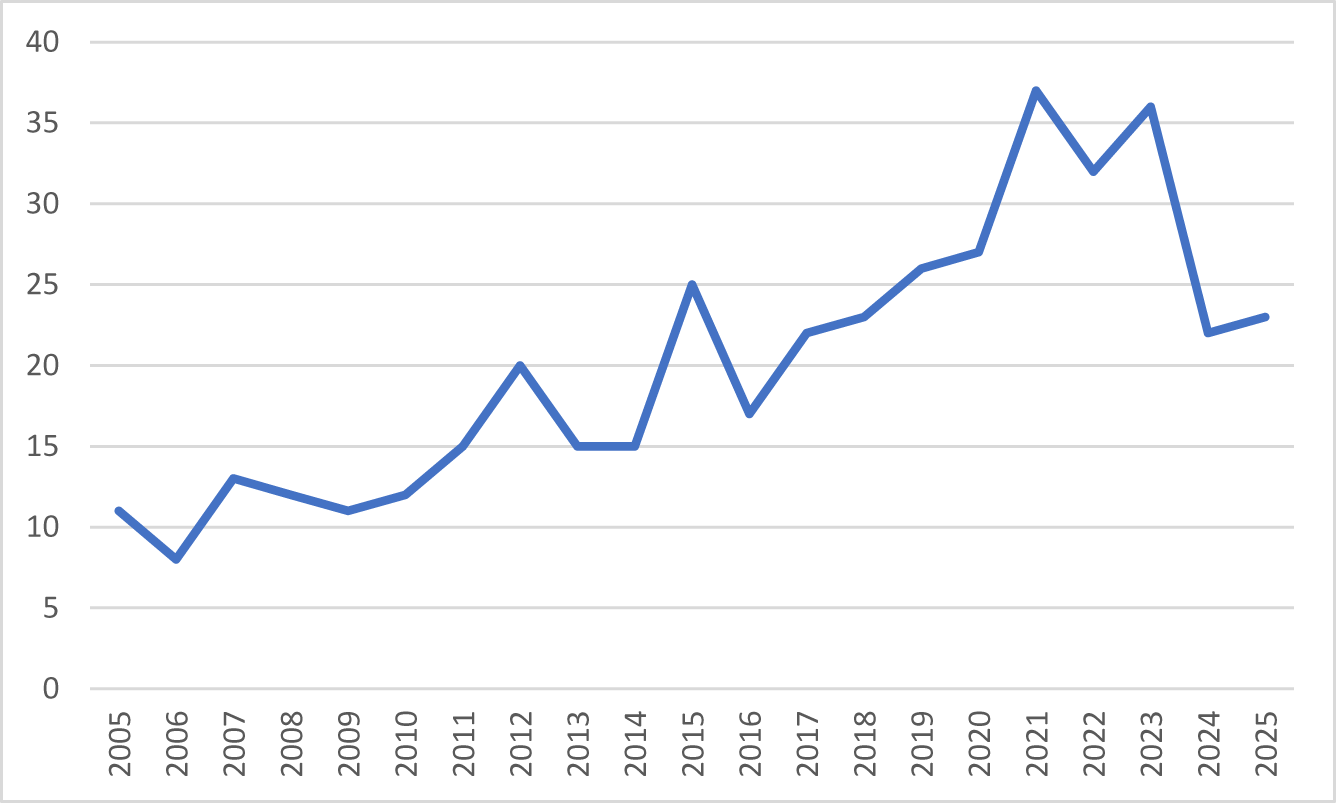
Between 2005 and 2025, the annual volume of neuroleadership-related HRM publications shows a clear upward trajectory (Fig. 2), indicating growing scholarly recognition of brain-based approaches to leadership and people management.
Number of neuroleadership-related publications in HRM journals (2005–2025).

Although slight declines were observed in 2006, 2014, 2016, and 2022, the overall trend across the decade, especially between 2016 and 2021, reflects continuous scholarly interest. The increase observed during 2020–2022 coincides with the COVID-19 period, a time when stress management, emotional regulation, and employee well-being received heightened attention in organizations. This pattern is treated as a contextual observation rather than a primary explanatory factor in the review. The apparent decline in publications after 2024 should be interpreted cautiously, as it may reflect publication lags or a temporary consolidation of research activity rather than a substantive reduction in scholarly interest.
Research designs and methodological approaches
As summarized in Table 5, quantitative methods account for half (212) of all studies, followed by qualitative (140; 33%) and mixed-methods (70; 17%) approaches. Empirical research designs dominate the sample (287 studies; 68%), reflecting a strong trend toward evidence-based investigations of neuroleadership and its HRM implications. Conceptual studies remain influential (92; 22%), while mixed conceptual–empirical work and systematic reviews together represent 10% of the dataset. Across the reviewed empirical studies, samples were predominantly drawn from employees and managers, with fewer studies examining executive leaders, teams, or organizational-level samples.
Distribution of studies by research type and methodology

Taken together, these patterns demonstrate that neurocognitive leadership research in HRM has developed from early conceptual investigations into a subject that is mostly empirical and quantitatively driven. Although mixed-methods and review studies are still relatively rare, their increasing prevalence indicates a small but growing trend toward methodological diversity and interdisciplinary involvement.
Geographic distribution of studies by continent
As shown in Table 6, research output is heavily concentrated in North America (218 studies; 52%), followed by Europe, Asia, and Oceania, with limited representation from South America. Within Europe, the Netherlands features prominently, while China leads among Asian countries. This distribution highlights both geographic concentration and emerging regional engagement with neuroscience-informed leadership research.
Distribution of studies by continent

Citation and impact analysis
Citation patterns reported in Table 7 indicate that Academy of Management Journal, The Leadership Quarterly, and Journal of Applied Psychology exert the greatest scholarly influence, together accounting for more than half of all citations (20,820, 16,566, and 15,090, respectively). Human Resource Management Review (341 citations per paper) and the Journal of Applied Psychology (343 citations per paper) also show strong citation performance, reflecting their role in shaping scholarly discourse at the intersection of psychology, HRM, and emerging organizational neuroscience topics.
Citation impact across HRM journals

The Journal of Business and Psychology and the Personal Psychology Journal exhibit the lowest average citations, likely reflecting their more recent publications or relatively limited focus on neuroleadership. The lower citation count observed for the Academy of Management discoveries is due to the restricted 10-year publication window (2015–2025) applied in this analysis, as noted earlier. This pattern highlights an increasing trend in academics to develop leadership theory and integrate neuroscience insights into practical HRM applications.
Thematic clustering of neuroleadership and HRM integration
To capture the conceptual breadth of neuroleadership research, neurocognitive concepts identified across the reviewed studies were systematically coded and clustered into six overarching neuroleadership themes. Table 8 presents the coding structure, clarifies the analytical logic underpinning the thematic classification, and demonstrates how diverse neurocognitive constructs were consolidated into a coherent framework.
Neuroleadership themes and associated coding structure

Building on this coding structure, Table 9 reports the frequency and percentage distribution of the six neuroleadership themes across the full dataset. As shown in Table 9, social cognition is the most frequently represented theme, accounting for 34% of all coded keywords, followed by emotional regulation (23%) and decision-making (16%). These themes reflect leadership processes associated with relational intelligence, empathy, emotional awareness, and judgment under uncertainty (Haver et al., Reference Haver, Akerjordet and Furunes2013).
Frequency distribution of neuroleadership themes

In contrast, attentional control (11%), motivation and reward processing (8%), and stress resilience (7%) appear less frequently in the literature, indicating areas where neuroleadership research within HRM remains comparatively underdeveloped. Their lower empirical prevalence suggests areas where neuroleadership research within HRM remains underdeveloped, pointing to important opportunities for future theoretical and empirical advancement.
To examine how these neurocognitive mechanisms are operationalized within organizational practice, HRM-related concepts were subsequently classified into six core HRM domains. Table 10 outlines the HRM domain coding framework, specifying the keywords and practices associated with each domain. This classification illustrates how leadership-related neurocognitive themes are embedded within core HRM functions and provides a structured basis for analyzing the intersection of neuroleadership and HRM practice.
HRM domains and associated coding structure

The frequency and percentage distribution of HRM domains are reported in Table 11. The results indicate that employee engagement and well-being represents the largest share of HRM-related keywords (31%), followed by learning and development (24%) and performance management (16%). Organizational development and HR strategy accounts for 12%, while talent management and work design and productivity each represent 9%. This distribution highlights a strong emphasis on employee-centered and developmental HRM practices within neuroleadership research, alongside continued, though comparatively lower attention to performance control and productivity-oriented domains.
Frequency distribution of HRM domains

Taken together, Tables 8–11 provide a transparent and systematic account of how neuroleadership themes and HRM domains were defined, coded, and distributed across the reviewed literature. Although some neuroleadership themes are less frequently examined empirically, they were retained in this review due to their central role in established neuroleadership models and their practical relevance for HRM, particularly in leadership development, employee well-being, and sustainable workforce design.
The transformation of HRM models: from traditional efficiency to sustainable development
Table 12 illustrates a dominant orientation toward sustainability-oriented HRM models, with 77% of the coded neuroleadership–HRM intersections reflecting sustainable or new dimensions (S), compared to 23% representing traditional, performance-driven (O) practices.
Frequency of neuroleadership-related HRM codes by model dimension

This marked difference (S = 414; O = 126) indicates a clear shift in contemporary HRM scholarship toward models emphasizing employee well-being, learning, adaptability, and long-term value creation. Rather than focusing primarily on efficiency, control, and short-term performance outcomes, neuroleadership research increasingly aligns with HRM perspectives concerned with resilience, human capital development, and sustainable organizational performance.
It is important to note that the magnitude of this difference reflects the nature of thematic synthesis rather than simple article counts. Many studies simultaneously address multiple HRM domains and neurocognitive mechanisms. For example, a single article may examine employee engagement and learning and development while drawing on leadership-related neurocognitive constructs such as emotional regulation or cognitive flexibility. To preserve analytical coherence, each study was ultimately classified according to its most dominant HRM orientation, even when multiple conceptual layers were present. As a result, individual studies may contribute to multiple underlying codes while being represented once at the model-orientation level.
These findings suggest that neuroleadership research does not merely supplement existing HRM frameworks but is increasingly embedded within sustainability-oriented HRM logics, reinforcing a broader paradigmatic transition in the field rather than a simple methodological trend.
Thematic distribution of neuroleadership-driven HRM constructs
To further examine how this transformation manifests across specific HRM functions, Table 13 presents the distribution of 540 coded neuroleadership–HRM intersections, clustered by major HRM domains and differentiated between sustainable (S) and traditional (O) HRM orientations.
Neuroleadership–HRM thematic code distribution by HRM model orientation

Note: For readability, the table shows selected codes by cluster, so the listed counts do not reflect the full 540 coded intersections.
Learning & development (LD) emerges as the most dominant cluster, led by high-frequency sustainable HRM codes such as S_NSC_LD (49), S_NER_LD (40), and S_NDM_LD (28). These patterns highlight the pivotal role of social cognition, intrinsic and extrinsic motivation, and decision-making in leadership-driven learning processes. In contrast, traditional LD codes (e.g., O_NSC_LD = 8; O_NDM_LD = 7) occur less frequently, suggesting a shift away from training models focused solely on skill acquisition toward developmental approaches emphasizing cognitive adaptability, self-regulation, and continuous learning.
A similar pattern is observed in employee engagement and well-being (EE). Sustainable codes, most notably S_NER_EE (39) and S_NSC_EE (29), highlight the growing importance of psychological safety, emotional intelligence, and relational leadership in HRM research. Traditional engagement-related codes appear only sporadically (e.g., O_NMR_EE = 5; O_NSC_EE = 2), indicating limited reliance on classical motivational or compliance-based engagement frameworks.
Additionally, organizational development (OD) also shows strong alignment with sustainability-oriented HRM. High-frequency codes such as S_NSC_OD (37) and S_NDM_OD (16) reflect increasing attention to relational intelligence, adaptive change, and human-centered organizational design. Traditional OD codes remain present but comparatively marginal, supporting a move away from hierarchical and control-based models toward more dynamic and capability-driven approaches.
In domains related to performance management, talent management, and work design and productivity (PM, TM, WP), sustainable HRM codes continue to dominate (e.g., S_NSC_PM = 15; S_NER_TM = 10; S_NSC_WP = 11), indicating that neuroleadership is increasingly associated with strategic capability building rather than transactional oversight. Nevertheless, several traditional codes retain moderate presence (e.g., O_NMR_TM = 8; O_NSC_TM = 7; O_NER_PM = 5), suggesting that performance-oriented practices have not disappeared but are being selectively integrated into broader, sustainability-focused HRM frameworks.
Overall, these patterns demonstrate that while certain neuroleadership themes and HRM domains vary in prominence when examined in combination, the dominant alignment of neurocognitive leadership mechanisms with sustainability-oriented HRM remains consistent. This distribution highlights both the evolving priorities of HRM research and the areas, such as motivation, stress resilience, and attentional control, where further empirical development is needed.
Discussion
This study examined how neuroleadership research has been incorporated into HRM scholarship over two decades (2005–2025) across ten selected journals. Findings reveal uneven but discernible growth in the integration of neuroscience-informed leadership research into HRM, confirming earlier observations that organizational neuroscience has progressed incrementally rather than uniformly across HRM domains (Waldman et al., Reference Waldman, Balthazard and Peterson2011; Guarnier & Chimenti, Reference Guarnier and Chimenti2024). In line with the study’s aim to provide an integrative overview, conceptual structuring, and practice-relevant insights, this discussion interprets the results by linking neuroleadership themes (i.e., neurocognitive mechanisms) to HRM domains and sustainability-oriented HRM frameworks.
Taken together, the results suggest that neuroleadership–HRM scholarship is currently at a disciplinary crossroads, shaped by two competing logics. On the one hand, much of traditional HRM and business research remains anchored in an efficiency-driven paradigm emphasizing control, optimization, and short-term performance outcomes. On the other hand, an emerging sustainability-oriented stream is increasingly visible, introducing a new paradigm that redefines HRM success in terms of human well-being, ethical governance, inclusiveness, and long-term organizational resilience.
Across the reviewed literature, neuroleadership themes related to social cognition, emotional regulation, and decision-making are most strongly associated with sustainability-oriented HRM domains, particularly learning and development, employee engagement and well-being, and organizational development. In contrast, traditional performance-driven HRM domains, such as performance management, efficiency-focused work design, and output-oriented talent practices, are comparatively underrepresented. This distribution reflects a disciplinary shift toward people-centered, adaptive HRM approaches that prioritize psychological safety, capability development, and long-term organizational resilience (Aust et al., Reference Aust, Cooke, Muller-Camen and Wood2023, Reference Aust, Cooke, Muller-Camen and Wood2024; Bratianu & Staneiu, Reference Bratianu and Staneiu2024).
This emergent pattern is coherently interpreted through the lens of CGHRM, which positions HRM within a sustainability-oriented logic grounded in employee dignity, ethical responsibility, inclusiveness, and long-term societal contribution (Aust et al., Reference Aust, Matthews and Muller-Camen2020, Reference Aust, Cooke, Muller-Camen and Wood2024; Pham et al., Reference Pham, Jabbour, Pereira, Usman, Ali and Vo-Thanh2023). Importantly, this approach does not simply broaden the traditional performance-driven logic; rather, it reflects a paradigmatic shift toward HRM models that gain legitimacy through alignment with broader sustainability expectations, including the UN SDGs (Jackson et al., Reference Jackson, Renwick, Jabbour and Muller-Camen2011; Altassan, Reference Altassan2025; Lu et al., Reference Lu, Zhang, Yang and Li2025). From a neuroleadership perspective, CGHRM is operationalized through micro-level neurocognitive mechanisms, such as emotional regulation, social cognition, attentional control, motivation, and stress resilience, that translate sustainability values (e.g., dignity, participation, solidarity, and long-term value creation) into everyday leadership behaviors. In this way, neuroleadership provides the explanatory bridge between leadership cognition and sustainability-oriented HR practices, particularly in domains related to learning, well-being, and inclusive capability development. These priorities align with SDG-informed HR outcomes, including employee health and well-being (SDG 3), gender equality and inclusive, decent work (SDG 5 and SDG 8), and responsible and environmentally sustainable organizational conduct (SDG 12 and SDG 13) (Pham et al., Reference Pham, Jabbour, Pereira, Usman, Ali and Vo-Thanh2023; Gomes et al., Reference Gomes, Coelho and Ribeiro2025).
Despite this emerging shift, the review identifies substantive theoretical and empirical gaps across several neuroleadership themes and HRM domains. While emotional regulation and social cognition are well represented, especially in crisis and change contexts, other theoretically central neuroleadership themes, including motivation and reward processing, attentional control, and stress resilience, remain underdeveloped across several HRM domains, notably talent management, work design, and productivity (Avey, Avolio & Luthans, Reference Avey, Avolio and Luthans2011; Slater, Turner, Evans & Jones, Reference Slater, Turner, Evans and Jones2018; Berger & Czakert, Reference Berger, Czakert, Berger, Dalluege and Franz2022; Shelton, Hein & Phipps, Reference Shelton, Hein and Phipps2022). These gaps limit understanding of how leadership cognition supports sustained engagement, commitment, and adaptive performance, all of which are foundational to sustainability-oriented HRM (Tewari & Mahapatra, Reference Tewari and Mahapatra2018; Zawan et al., 2019; Gómez-Leal, Holzer, Bradley, Fernández-Berrocal & Patti, Reference Gómez-Leal, Holzer, Bradley, Fernández-Berrocal and Patti2022; de la Nuez, Nieves & Osorio, Reference de la Nuez, Nieves and Osorio2023; Nayyar et al., Reference Nayyar, Saluja and Vousinas2024).
Moreover, the geographic concentration of research, predominantly in North America, parts of Europe, and China, raises concerns about contextual bias and limits the generalizability of current findings. Leadership cognition and behavioral responses are shaped by cultural, institutional, and societal factors (Dawood & Butt, Reference Dawood and Butt2018; Oc, Reference Oc2018), suggesting the need for greater empirical attention to underrepresented regions. Expanding research beyond dominant contexts would not only enhance external validity but also deepen understanding of how neuroleadership interacts with different HRM systems and sustainability challenges.
Conclusion
This review advances understanding of how neuroleadership has been theorized and empirically examined within HRM research over the past two decades. By systematically integrating neuroleadership themes with core HRM domains through a sustainability-oriented lens, the study demonstrates that contemporary neuroleadership research converges around social, emotional, and cognitive mechanisms of leadership, particularly in learning and development and organizational development contexts. At the same time, the review reveals persistent theoretical and empirical imbalances, with limited integration of motivation, reward processing, attentional control, and stress resilience into several mainstream HRM domains.
The primary theoretical contribution of this study lies in clarifying how neuroleadership functions as a micro-level explanatory foundation for sustainability-oriented HRM, including CGHRM. By showing how neurocognitive mechanisms underpin leadership behaviors that support employee well-being, inclusiveness, ethical governance, and long-term value creation, the review connects leadership cognition to broader HRM and societal outcomes.
More broadly, the review provides evidence that HRM scholarship is at a paradigmatic turning point. It highlights a disciplinary transition from an efficiency-driven logic, traditionally focused on control and short-term performance optimization, toward a sustainability-oriented logic that aligns HRM outcomes with SDG-informed expectations for responsible and people-centered organizational practice. In this emerging paradigm, neuroleadership is not a peripheral addition to HRM theory, but a core mechanism through which sustainability values become enacted through everyday leadership decisions and workforce practices. Accordingly, these findings reposition neuroleadership as a theoretically central pathway for translating sustainability values into HRM-relevant leadership practice.
Limitations
Like other research, this study has some limitations that must be acknowledged. First, the review scope was intentionally bounded to articles published in ten high-ranked journals selected for their relevance to HRM and neuroleadership. While this strategy supported analytical depth and ensured high-quality sources, it may have excluded additional relevant work published in adjacent psychology, neuroscience, or organizational behavior outlets. As a result, some conceptual developments and empirical contributions may not be fully represented. In addition, the review was limited to English-language publications, which may have excluded relevant regional studies and introduced language bias (Egger et al., Reference Egger, Zellweger-Zähner, Schneider, Junker, Lengeler and Antes1997).
Second, limitations arise from the coding and thematic classification process. Although a systematic, theory-driven framework was applied, qualitative coding involves interpretive judgment and may be subject to coder bias (Campbell, Quincy, Osserman & Pedersen, Reference Campbell, Quincy, Osserman and Pedersen2013), meaning that some subjectivity in theme classification cannot be entirely eliminated. Finally, the review relied exclusively on published peer-reviewed journal articles, which may introduce publication bias, as studies reporting non-significant or exploratory findings may be less likely to appear in high-ranked outlets, potentially shaping the observed patterns in the literature.
Directions for future research
Future research in neuroleadership and HRM would benefit from a more balanced and comprehensive integration of neurocognitive mechanisms across HRM domains. Although current research has provided significant insights into social–emotional cognition, including empathy, emotional regulation, and social perception, greater scholarly attention is needed for other essential neurocognitive processes such as attentional control, reward processing, cognitive load, and stress resilience. Expanding the neurocognitive framework in this way would enable a more comprehensive understanding of how leadership cognition shapes skill development, job design, workforce segmentation, recruitment strategies, and overall HR system effectiveness.
Further progress in the field would also be supported by increased methodological pluralism. Mixed-methods research designs represent a particularly promising avenue, as they allow scholars to combine the explanatory strength of quantitative approaches with the contextual depth and interpretive richness of qualitative inquiry. By integrating surveys, experiments, and neuroscientific tools (e.g., EEG, fMRI, and biometric measures) with interviews (Murray & Antonakis, Reference Murray and Antonakis2019), case studies, and observational methods, future studies can more effectively capture the complex cognitive–emotional processes through which neuroleadership is enacted in real organizational settings.
Future research should also extend neuroleadership inquiry across a wider range of cultural and institutional contexts. Cross-cultural studies can enhance theoretical robustness by examining how leadership cognition, emotional expression, and decision-making processes vary across regions and organizational environments, thereby strengthening the global relevance of HRM–neuroscience integration.
In addition, further investigation of neuroleadership within sustainable HRM and CGHRM frameworks offers a valuable direction for theory development. Examining how neurocognitive mechanisms support sustainable workforce strategies may deepen understanding of how leadership contributes to well-being, inclusivity, and long-term organizational resilience in alignment with key SDGs. Lastly, future research should adopt multilevel perspectives to examine how neurocognitive processes extend beyond the individual leader, shaping team dynamics, shared meaning, organizational culture, and strategic HR alignment in capability building and organizational transformation.
Elahe Kavousi is a PhD candidate at SCU and holds a prior PhD in Governmental Management (Human Resource Management) from Tarbiat Modares University. She has over 10 years of experience in the HR field, with research expertise in organizational behavior, employee turnover, leadership, and HRM systems. Her forthcoming doctoral research examines neuroleadership and lean management, with a focus on applying machine learning to predict talent retention – an area that naturally extends the insights presented in this manuscript.
Michael T. Ewing is Executive Dean of the Faculty of Business, Law & Arts at Southern Cross University. He received his doctorate from the University of Pretoria. His research interests include marketing communications, the marketing-technology interface, and strategic management. He has published in the Journal of the Academy of Marketing Science, Information Systems Research, the International Journal of Research in Marketing, the Academy of Management Perspectives and Social Science & Medicine (among others).
Yvonne Brunetto is Professor of Management and HRM, in the Faculty of Business, Law & Arts at Southern Cross University. She received her doctorate from Griffith University, Queensland. Her research areas are public management HRM and the management of healthcare and emergency services employees. I publish in Public Management Review, Public Money and Management, Public Administration Quarterly, Australian Journal of Public Administration, Journal of Management & Organisation, and Personnel Review (among others).




 Open access

