





1. Introduction
There are many instances where groups agree that change needs to occur, but disagree about the best way forward. Examples include climate change, immigration, voting rights, gun reform, social security reform, primary elections, shareholder voting, and constitutional amendments. In many settings, the status quo is something that the group as a whole wishes to avoid. However, subgroups within the voting population may have different values and views about the best alternative. Coordination on an alternative to the status quo can be further complicated by the information that individuals receive and their beliefs about the state of the world.
We use both theory and a laboratory experiment to examine settings where the status quo is undesirable, but moving away from it requires agreement by more than just a simple majority. While our framework is necessarily abstract, it includes key features that provide insight into settings where groups with differing values and information need to work together to avoid a harmful outcome. In our framework, voters are uncertain about the relative social efficiency of alternatives but observe noisy private and public information about these alternatives. Public information may serve as a natural coordination device, whether or not it is accurate. However, the coordination problem may be more difficult when voters have heterogeneous private information and heterogeneous preferences over alternative outcomes.
Our study thus adds to the literature on divided-majority voting games with a coordination incentive to avoid an inefficient default outcome (e.g. Bouton et al., Reference Bouton, Castanheira and Llorente-Saguer2016; Forsythe et al., Reference Forsythe, Myerson, Rietz and Weber1993; Forsythe et al., Reference Forsythe, Rietz, Myerson and Weber1996) by examining the role of public information. Importantly, the incentive to coordinate on public information could potentially crowd out valuable private information, as shown in a different environment in the global game model of Morris and Shin (Reference Morris and Shin2002). Experiments on the Morris and Shin model find that participants put less weight on public information than equilibrium predicts (Cornand and Heinemann, Reference Cornand and Heinemann2014; Shapiro et al., Reference Shapiro, Shi and Zillante2014). However, in a two-outcome, majority-rule voting game with public and private information, Kawamura and Vlaseros (Reference Kawamura and Vlaseros2017) and Invernizzi (Reference Invernizzi2020) find that voters put too much weight on the public information, despite there being no incentive to coordinate in this case. Coordination incentives in a divided-majority voting game might exacerbate this effect. The question of how much weight voters put on public information is central to the issue of equilibrium selection at the core of this experiment.
As an example, consider climate change. The “do nothing” status quo is not favorable. However, multiple factors complicate action. Among these, there is uncertainty about the consequences of various policy responses, the parties at the bargaining table have values that differ from each other, and they may have different information. To avoid the status quo, the parties must nonetheless coordinate on an alternative, and there is tension between selecting the best possible alternative and achieving sufficient agreement.
As another example, consider a presidential primary election where the majority of a party views one option as unfavorable (such as a candidate so extreme that the majority believes they could not win the general election), but where there is disagreement around who the most suitable alternative should be. While a simple majority is all that is needed to advance a candidate in any given state election, the party would want significant support to coalesce around a candidate in advance of the general election. Alternatively, if there is a share of primary voters who will support an extreme candidate for sure, the remaining primary voters need to achieve sufficient agreement to outvote the extreme candidate’s supporters. As with the climate change example, uncertainty about the relative merits of the alternatives, heterogeneous values of voters, and private information all complicate the ability of groups to coordinate and avoid the undesirable outcome.
As a simple model of these collective action problems, we study coordination and information aggregation in a divided-majority voting game with public information and conflicting preferences. We begin by building a theoretical framework with three alternatives, two of which are preferred by everyone ( $A$ and $B$) to the outside option ( $C$). A supermajority is required for the vote to pass. Individuals receive a public signal and private signals correlated with the state of the world. Each individual’s utility for $A$ or $B$ depends on the state. We then characterize the conditions for multiple equilibria, including voting for $A$, voting for $B$, voting with the public signal, voting with the private signal, and deadlock.
Because preferences and information cannot be cleanly manipulated or measured in the field, we examine behavior in a laboratory experiment. In the lab, eight voters observe private signals and a public signal about whether alternative  $A$ or $B$ is socially optimal. Unless six or more voters agree, an inferior default $C$ occurs. All individuals receive a private signal that is accurate 80% of the time. We test the impact of private values and the accuracy of a public signal on the ability of groups to coordinate on an alternative $A$ or $B$ to avoid the undesirable default $C$.
$C$.
We find that when the public signal is more accurate than the private signals, most voters coordinate on the alternative indicated by the public signal. However, when public-signal accuracy is reduced or preferences conflict, voters tend to follow their private signals more often. While reduced public-signal accuracy substantially increases the frequency of coordination failure (resulting in outcome  $C$), conflicting preferences between subgroups have little effect on the frequency of coordination on $A$ or $B$. Thus, we find that high-accuracy public information can help voters coordinate on alternative $A$ or $B$ and achieve high efficiency, while low-accuracy public information does not crowd out valuable private information.
We contribute to the literature on information aggregation and divided-majority voting by showing that public information can serve as a coordination device, but only when it is more accurate than private information. These results highlight the importance of accurate public information, such as reliable news media, in achieving collective action.
2. Related literature
This paper contributes to a broad theoretical and experimental literature on information aggregation in voting games (see, e.g., Ali et al., Reference Ali, Goeree, Kartik and Palfrey2008; Austen-Smith and Banks, Reference Austen-Smith and Banks1996; Battaglini et al., Reference Battaglini, Morton and Palfrey2008; Bhattacharya, Reference Bhattacharya2013; Buechel and Mechtenberg, Reference Buechel and Mechtenberg2019; Denter et al., Reference Denter, Dumav and Ginzburg2021; Fehrler and Hughes, Reference Fehrler and Hughes2018; Feddersen and Pesendorfer, Reference Feddersen and Pesendorfer1997; Garro, Reference Garro2019; Goeree and Yariv, Reference Goeree and Yariv2011; Herrera et al., Reference Herrera, Llorente-Saguer and McMurray2019; Ladha et al., Reference Ladha, Miller and Oppenheimer1996; Liu, Reference Liu2019; Mandler, Reference Mandler2012; McMurray, Reference McMurray2013; Mengel and Rivas, Reference Mengel and Rivas2017; Morton and Tyran, Reference Morton and Tyran2011). In particular, this paper brings together key features of two related studies: coordination incentives with a divided majority and private information as in Bouton et al. (Reference Bouton, Castanheira and Llorente-Saguer2016) and public information as in Kawamura and Vlaseros (Reference Kawamura and Vlaseros2017).
Bouton et al. (Reference Bouton, Castanheira and Llorente-Saguer2016) examine a setting with three possible voting outcomes: blue, red, and gray. The gray outcome is always the worst for everyone, while either blue or red may be the best outcome. Individual voters privately see partial information suggestive about whether blue or red is the best outcome. There is a chance that this information is mistaken, and this chance is known to individual voters. A number of voters strictly greater than a majority must agree on either blue or red to achieve one of these outcomes (either 7 or 9 out of 12 depending on the experimental condition). Otherwise, the worst outcome, gray, occurs. In this setting, individual voters face a dilemma between trying to reach the best outcome by voting according to the information they see and trying to achieve sufficient agreement to avoid the worst outcome. Unlike our study, this paper focuses on comparing alternative voting rules, finding that approval voting (i.e., voting for as many outcomes as you wish) outperforms plurality voting.
The second closely related study is Kawamura and Vlaseros (Reference Kawamura and Vlaseros2017). They consider majority voting with two potential outcomes, blue and yellow. Like the previous study, voters do not know for certain which outcome is best, but they have privately observed, partial information, which may be mistaken. However, unlike the previous study, Kawamura and Vlaseros introduce public information, which is still imperfect, but can be seen by all voters simultaneously. This public information can be used to achieve agreement between individuals in the group, since everyone sees the same public information. However, the results show that individual voters often give too much weight to the public information, following it even when voting according to their private information would likely lead to a better outcome. Invernizzi (Reference Invernizzi2020) also finds overweighting of public information in a similar environment, especially when public information is provided closer to the vote.
Our study combines the public information aspect of Kawamura and Vlaseros (Reference Kawamura and Vlaseros2017) with the strong coordination incentives with private information and multiple outcomes as in Bouton et al. (Reference Bouton, Castanheira and Llorente-Saguer2016). The coordination motive to avoid the inefficient default outcome enhances the potential of public information to drive voter decisions, as the public information can serve as a natural coordination device, even when its accuracy is low. The incentive to coordinate on the alternative indicated by the public signal creates the potential for private information to be crowded out, which might reduce information aggregation. Moreover, while individual voters in Bouton et al. (Reference Bouton, Castanheira and Llorente-Saguer2016) and Kawamura and Vlaseros (Reference Kawamura and Vlaseros2017) had aligned incentives, we examine the further dimension of conflicting incentives that may act as a barrier to achieving agreement in groups.
Two other related studies are Forsythe et al. (Reference Forsythe, Myerson, Rietz and Weber1993), who examine a divided-majority voting game with complete information, and Forsythe et al. (Reference Forsythe, Rietz, Myerson and Weber1996), who compare voting rules in a similar environment. They consider a different kind of public information in the form of polling results. As in our design, their voters have heterogeneous preferences, but can signal voting intentions through polling, which their results show improves coordination with plurality voting. Importantly, in our setting there is incomplete information, and public information is exogenous and informative about the value of alternatives. In contrast, in their setting, the value of alternatives is common knowledge, and the public information of polling results is instead informative about the intentions of other voters.
Guarnaschelli et al. (Reference Guarnaschelli, McKelvey and Palfrey2000) also examine the effect of polling in a jury-voting environment with incomplete information and private signals, comparing unanimity and majority rules. They find that polling improves the frequency of correct jury decisions. In addition to the different kind of public information we consider, an important distinction is that our setting includes a third inefficient outcome, which voters must coordinate to avoid.
The environment we study is also related to the literature on global games (Carlsson and Van Damme, Reference Carlsson and Van Damme1993), as payoffs depend on an unknown state of the world, observed with noise.Footnote 1 As in Morris and Shin (Reference Morris and Shin2002), players in our game must balance incentives to match the state of the world and to coordinate with others in light of imperfect public and private information. Experiments on the effect of public information in an environment based on the model of Morris and Shin (Reference Morris and Shin2002) show that laboratory subjects tend to underweight public information. Cornand and Heinemann (Reference Cornand and Heinemann2014) find that experimental participants put more weight on public information than private information, but less than equilibrium predicts. Shapiro et al. (Reference Shapiro, Shi and Zillante2014) vary the presence of private information and the strength of the coordination incentive, and also find under-weighting of public information compared to equilibrium. These studies consider environments very different from ours, as they are not voting games and have a continuum of possible states and actions. However, we examine a similar tension between private and public information in a voting environment, as well as the potential for the incentive to coordinate on the alternative indicated by public information to crowd out private information.
We examine some treatments in which public information is available, but uninformative about the value of alternatives. These treatments are related to the literature on sunspots (e.g. Azariadis, Reference Azariadis1981; Cass and Shell, Reference Cass and Shell1983; Farmer, Reference Farmer1999). An experimental study by Duffy and Fisher (Reference Duffy and Fisher2005) finds that sunspots reliably influence equilibrium selection in a centralized, closed-book call market, where other feedback is limited, but not in double auction markets where more information is available to participants. In a pure coordination game experiment, Fehr et al. (Reference Fehr, Heinemann and Llorente-Saguer2019) find that sunspot public signals influence equilibrium selection, and similar effects occur with highly-correlated private signals. However, the presence of both private and public signals reduces the influence of sunspots in their environment. In contrast to their setting, the private signals in our experiment are always informative, though the public signal is a sunspot in some treatments. Moreover, our setting is not a pure coordination game, as different equilibria vary in relative efficiency, and preferences may be heterogeneous.
Finally, our work is also related to the broader literature on coordination games in the laboratory (Cooper and Weber, Reference Cooper, Weber, Capra, Croson, Rigdon and Rosenblat2020; Devetag and Ortmann, Reference Devetag and Ortmann2007; Ochs, Reference Ochs, Kagel and Roth1995). Our treatments with conflicting preferences are related to previous research on payoff asymmetry. Crawford et al. (Reference Crawford, Gneezy and Rottenstreich2008) show that payoff asymmetry tends to increase coordination failure. The uncertain state of the world in our environment is also related to Agranov and Schotter (Reference Agranov and Schotter2012), who find that an announcer who is informed about the state of the world can sometimes improve coordination by sending a vague message.
3. Theory
There are three alternatives:  $A$,
$A$,  $B$, and $C$. There are an even number $N \geq 4$ of voters. At least $K \in \{\frac{N}{2}+1, ... , N\}$ votes are required to obtain alternative $A$ or $B$, otherwise the outcome is $C$.
$C$.
The state  $S$ is a random variable, drawn with equal probability from $\{A,B\}$. Each voter’s preferences are represented by a utility function $u_i$, which depends on the alternative, the state, and the voter’s team $t_i \in \{A,B\}$. There are $\frac{N}{2}$ voters of each team, which is common knowledge.Footnote 2 We normalize $u_i(C|S,t_i)=0$ for each voter of each team in each state. The utility of the realized alternative depends on the state of the world and the voter’s team, and equals the sum of a common-value component and a private-value component. The common-value component for the alternative matching the state is normalized to 1, while the common-value component for the other alternative is $\gamma \in (0,1)$. Thus, the common-value component of the alternative that does not match the state is strictly greater than the value of the worst outcome $C$, but strictly lower than the common-value component of the alternative that matches the state. The private-value component for the alternative matching a voter’s team is $\delta \geq 0$, and otherwise 0.Footnote 3 Thus, letting $\mathbb{1}(\cdot)$ denote an indicator function, voter $i$’s utility as a function of the realized alternative $X$, the state $S$, and team $t_i$ is given by: $u_i(X|S,t_i) = \mathbb{1}(X=S) + \gamma (1-\mathbb{1}(X=S))+\delta \mathbb{1}(X=t_i)$
Before voting, each voter observes a private signal  $s_i$ correlated with the state. The signals are random variables, i.i.d. conditional on the state, and drawn from support $\{A,B\}$. Each signal accurately reflects the state with probability $p$, that is $Pr(s_i=A|S=A)=Pr(s_i=B|S=B)=p \gt 0.5$.
Additionally, before voting, all voters observe a public signal  $z$ drawn from support $\{A,B\}$, independently of the private signals, conditional on the state. The public signal accurately reflects the state with probability $q$, that is $Pr(z=A|S=A)=Pr(z=B|S=B)=q \geq 0.5$.Footnote 4
After observing the private and public signals, each voter simultaneously chooses a vote  $v_i(s_i,z,t_i) \in \{A,B\}$. If at least $K$ voters choose $A$ (or $B$), then the outcome is $A$ (or $B$). Otherwise, the outcome is $C$.
$C$.
First, we consider simple Bayesian Nash equilibria that exist for all parameter values. In each of these equilibria, all voters coordinate either on a particular alternative, or on the alternative indicated by the public signal.Footnote 5
Proposition 1. The following are Bayesian Nash equilibria.
(1) $v_i(s_i,z,t_i)=A$ for all voters, regardless of signals or team.
(2)
$v_i(s_i,z,t_i)=B$ for all voters, regardless of signals or team.(3)
$v_i(s_i,A,t_i)=A$ and
$v_i(s_i,B,t_i)=B$ for all voters regardless of private signals or team.


Proof. First, suppose  $K \lt N$. Then, in each of the three cases, no individual voter is ever pivotal. Thus, every voter is indifferent, so that no voter has an incentive to deviate.
Suppose instead that  $K=N$. Then in all three cases, each voter is pivotal. However, deviating would result in the outcome $C$. All voters strictly prefer both $A$ and $B$ to $C$, regardless of the state or the voter’s team. Thus, deviation is not profitable. $\square$
We refer to the three equilibria listed in Proposition 1 respectively as the  $A$ equilibrium, the $B$ equilibrium, and the public-signal equilibrium.
Next, we consider another simple equilibrium, which exists for some values of  $N$ and $K$.
$K$.
Proposition 2. If  $K \gt \frac{N}{2}+1$ there is a Bayesian Nash equilibrium in which $v_i(s_i,z,A)=A$ and $v_i(s_i,z,B)=B$ regardless of signals.
Proof. Given this strategy profile, there are  $N/2$ votes for each of $A$ and $B$, and the outcome is $C$. Since $K \gt \frac{N}{2}+1$, no individual voter is pivotal. Thus, no individual voter can profitably deviate. $\square$
We refer to the equilibrium described in Proposition 2 as the deadlock equilibrium.Footnote 6
So far, we have focused on equilibria in which votes do not depend on private signals. Next, we establish the condition under which voting according to the private signal is an equilibrium.
Proposition 3. Voting according to the private signal, that is  $v_i(A,z,t_i)=A$ and $v_i(B,z,t_i)=B$, is a Bayesian Nash equilibrium if and only if: $\delta \leq \frac{r [p^{2K-N-1} - (1-p)^{2K-N-1} \gamma] + (1-r) [(1-p)^{2K-N-1} \gamma - p^{2K-N-1}]}{r (1-p)^{2K-N-1} + (1-r) p^{2K-N-1}}$
where  $r= Pr(S=A|s_i=A,z=B) = \frac{p(1-q)}{p(1-q)+(1-p)q}$
Proof. See Proofs Appendix.
Intuitively, voting with the private signal can be an equilibrium strategy as long as the private-value component is not too large. If the private-value component exceeds the threshold, then given a private signal of  $B$ but a public signal of $A$, a team- $A$ voter could profitably deviate to voting $A$.
$A$.
The next proposition establishes that voting according to the private signal is not an equilibrium if the private signal is less accurate than the public signal.
Proposition 4. If  $p \lt q$, then $v_i(A,z,t_i)=A$ and $v_i(B,z,t_i)=B$ is not a Bayesian Nash equilibrium. Moreover, if $\delta=0$, then $v_i(A,z,t_i)=A$ and $v_i(B,z,t_i)=B$ is a Bayesian Nash equilibrium if and only if $p \geq q$
Proof. See Proofs Appendix.
The intuition is that if the public signal is more accurate than the private signal, then even if others vote with their private signals, an individual voter’s best response is to vote with the public signal because its higher accuracy makes it more likely to match other voters as well as more likely to match the state. Thus, voting with the private signal cannot be an equilibrium in this case.
We refer to the equilibrium in which all voters vote according to their private signals as the private-signal equilibrium. Note that the existence of the private-signal equilibrium when  $q=0.5 \lt p$ and $\delta$ is sufficiently small implies its existence in a similar environment without a public signal, as considered in some of our experimental treatments.
Table 1 summarizes the equilibria discussed above. We focus on type-symmetric, pure-strategy Bayesian Nash equilibria.Footnote 7
Summary of type-symmetric, pure-strategy bayesian nash equilibria

Table 1 Long description
The table presents a summary of type-symmetric, pure-strategy Bayesian Nash equilibria, focusing on different voting scenarios and their existence conditions. It highlights that equilibria following public signals always exist, while those following private signals require the probability of one event to be greater than or equal to another and a sufficiently small delta. Deadlock equilibria exist when a certain threshold is exceeded. The table provides insights into how different signals influence the existence of equilibria, emphasizing the role of specific conditions in private signal scenarios.
It is possible to make efficiency comparisons between the various equilibria discussed above. Clearly, the deadlock equilibrium is the least efficient, since all voters receive 0 utility. It is also easy to see that the  $A$ and $B$ equilibria are weakly less efficient than the public-signal equilibrium since $q\geq0.5$, and strictly less efficient if $q \gt 0.5$, since an informative public signal leads to an outcome matching the state more frequently. Thus, the public-signal equilibrium is always at least as efficient as the $A$ and $B$ equilibria, and each of these equilibria are more efficient than deadlock.
The comparison of the public-signal equilibrium with the private-signal equilibrium is non-trivial, as the public-signal equilibrium always avoids outcome  $C$, but may, in some cases, select the outcome matching the state less often than the private-signal equilibrium. The next proposition establishes the condition under which the private-signal equilibrium is more efficient than the public-signal equilibrium.
Proposition 5. Let  $Pr(A|S)$, $Pr(B|S)$, and $Pr(C|S)$ denote the probabilities of each voting outcome in state $S$ under the private-signal equilibrium. The private-signal equilibrium is more efficient than the public-signal equilibrium if and only if it exists and: $q \lt Pr(A|S=A) - Pr(C|S=A) \frac{2\gamma +\delta}{2(1-\gamma)}$
where  $Pr(A|S=A) = Pr(B|S=B) = \sum\limits_{j=K}^{N} \binom{N}{j} p^j (1-p)^{N-j}$
and  $ Pr(C|S=A) = Pr(C|S=B) = 1-\sum\limits_{j=K}^{N} \binom{N}{j} [p^j (1-p)^{N-j} + (1-p)^j p^{N-j}]$
Proof. See Proofs Appendix.
Notice that as  $\gamma$ or $\delta$ increases, the upper bound for $q$ shown in Proposition 5 becomes smaller. Intuitively, increasing these parameters raises the relative value of avoiding outcome $C$. As the public-signal equilibrium always avoids $C$, increasing these parameters widens the range of values of $q$ for which the public-signal equilibrium is more efficient than the private-signal equilibrium.
Furthermore, the condition in Proposition 5 can be modified slightly by setting  $q=0.5$ to yield the condition under which the private-signal equilibrium is more efficient than either the $A$ or the $B$ equilibrium. Indeed, it is possible for the private-signal equilibrium to be less efficient than the $A$,
$A$,  $B$, or public-signal equilibria if the condition in Proposition 5 is not satisfied.
To summarize the efficiency comparisons, the  $A$ and $B$ equilibria Pareto dominate the deadlock equilibrium, but they are never more efficient than the public-signal equilibrium. The private-signal equilibrium may be more efficient than the public-signal equilibrium under the condition in Proposition 5, but may also be less efficient if the reverse inequality holds. Similarly, the private-signal equilibrium may be more efficient than the $A$ or $B$ equilibria if the inequality in Proposition 5 holds for $q=0.5$, but may be less efficient if the reverse inequality holds. When it exists, the private-signal equilibrium is always more efficient than deadlock, as private signals being conditionally $i.i.d.$ imply there is always a strictly positive probability of at least $K$ matching private signals.
While we focus on type-symmetric, pure-strategy Bayesian Nash equilibrium, mixed-strategy equilibria may exist for some parameters. These equilibria can be characterized by the roots of higher-degree polynomials, but no general closed-form solution is possible. Mixed-strategy equilibria are discussed in more detail in Online Appendix Section 3.
4. Experimental design and procedures
In all treatments, there are three alternatives,  $A$,
$A$,  $B$, and $C$.Footnote 8 The group size is 8, with a supermajority threshold of 6. Alternatives $A$ and $B$ are equally likely ex ante to have the highest common value. We scale the common-value component of the highest-value alternative to 10, and the common-value component of the other alternative is 4. Each voter observes a private signal indicating which alternative has the highest common value, with 80% accuracy, $i.i.d.$ conditional on the state. Each voter has the option to vote for either $A$ or $B$. If the threshold of 6 votes is not reached, then the outcome defaults to alternative $C$.
$C$.
We consider two treatment variables: the presence of private-value teams and the accuracy of the public signal. The presence of private values is varied between subjects. In sessions with teams, there are 4 team- $A$ voters and 4 team- $B$ voters. The private-value component of the alternative matching a voter’s team is 8. That is, if alternative A is chosen, a team- $A$ voter would receive the common-value component of alternative $A$ plus a private-value component of 8, while a team- $B$ voter would receive only the common-value component of alternative A. Payoffs are similar in the case that alternative B is chosen. In sessions without teams, there is no private-value component.Footnote 9
Like the private signals, the public signal is observed before voting (when available) and indicates which alternative has the highest common value. However, the public signal is observed by all group members. Public-signal accuracy is either 90%, 70%, 50%, or None. The 90%-accuracy level is a case in which the private-signal equilibrium does not exist, as the public signal is more accurate than the private signals. In the case of 70% accuracy, the private-signal equilibrium exists without teams but not with teams. At 50% accuracy, the public signal is uninformative, but may serve as a sunspot coordination device (see, e.g. Duffy and Fisher, Reference Duffy and Fisher2005; Fehr et al., Reference Fehr, Heinemann and Llorente-Saguer2019). This case allows us to examine whether the mere presence of the public signal as a coordination device crowds out private information in comparison to the case with no public signal.
Public-signal accuracy is varied within subjects, in 4 blocks, each consisting of 10 rounds of repeated play.Footnote 10 Groups are fixed across all blocks (i.e., partners matching for the entire experiment). The order of public-signal accuracy is varied in a cycle across sessions. We use the orders 90-70-50-None, 70-50-None-90, 50-None-90-70, and None-90-70-50, both with and without teams.Footnote 11 We ran 4 sessions with teams and 4 sessions without teams. In each session, there were 2 fixed groups of 8 participants, for a total of 128 participants.
The state, signals, and teams (where applicable) were randomly drawn in each round. At the end of each session, 1 of the 4 blocks was randomly selected for payment, and each participant in the session was paid for the 10 rounds in the selected block. Participants also completed a demographic survey, the cognitive reflection test (Frederick, Reference Frederick2005), and a risk attitude questionnaire (Dohmen et al., Reference Dohmen, Falk, Huffman, Sunde, Schupp and Wagner2011).Footnote 12
To closely examine individual stage-game strategies, all voting decisions were made using the strategy method. That is, each group member chose a conditional vote for each possible combination of public and private signals that might be observed. Thus, when the public signal is available, each voter chooses four conditional votes. In the Public Signal None condition (public signal unavailable), votes are conditioned only on the private signal, thus choosing two conditional votes. Importantly, the strategy method allows us to distinguish individual strategies by observing voting decisions when the public and private signals conflict. In such cases, voters might follow the public signal, the private signal, or vote according to their team. When both signals are fairly accurate, there will be few observations when they actually conflict. Using the strategy method allows us to observe individual voting decisions for such cases in every round, rather than restricting the sample to a subset of observations.
All sessions were run at the University of Massachusetts Amherst in the Fall of 2021 with 128 subjects.Footnote 13 Participants earned a $5 show-up fee, plus $1 for every four experimental currency units (called “points” in the instructions). The average total payment per participant was approximately $26. On average, sessions lasted approximately 75 minutes. Participants were recruited by email using ORSEE (Greiner, Reference Greiner2015). At the start of each session, participants received printed instructions, which the experimenter read aloud. Subjects completed a comprehension quiz after reading the instructions, and could not proceed with the experiment until all questions were answered correctly. Participants made all decisions privately on computers. The experiment was programmed and conducted using zTree (Fischbacher, Reference Fischbacher2007). Online Appendix Section 8 includes full experimental instructions and screenshots.
5. Hypotheses
As there are multiple equilibria in every treatment, part of our focus in the results will be an examination of equilibrium selection. Table 2 summarizes the existence and relative efficiency of various equilibria in each treatment. The  $A$,
$A$,  $B$, and deadlock equilibria, in which votes do not depend on signals, exist in all treatments. The public-signal equilibrium exists in every treatment where the public signal is available, and is the most efficient equilibrium when the public signal is 90% or 70% accurate. The private-signal equilibrium exists and is the most efficient equilibrium when the public signal is pure noise (50% accurate) or unavailable. The private-signal equilibrium also exists when the public signal is 70% accurate and there are no teams. Efficient equilibrium selection would lead to the public-signal equilibrium when the public signal is 90% or 70% accurate, and the private-signal equilibrium otherwise. However, a variety of other equilibria are possible. In our experiment, we examine whether and how equilibrium selection changes with public-signal accuracy and teams. In particular, we examine the degree to which these environmental factors affect the ability to avoid outcome $C$ and to aggregate information to coordinate on the socially efficient outcome.
Existence of equilibria by treatment

Table 2 Long description
The table examines the existence of equilibria under different public-signal accuracy levels and team configurations. At 90% accuracy, private signal equilibrium does not exist regardless of team presence, while at lower accuracy, private signal equilibrium exists, except at 70% with teams . Deadlock and A or B equilibria are consistently present across all treatments. The absence of private signal equilibrium at higher accuracy levels suggests a reliance on public signals, whereas lower accuracy levels incorporate private signals, indicating a shift in strategy. This pattern highlights the role of signal accuracy in determining equilibrium strategies, with no treatment showing a lack of equilibria.
Note: Underlining indicates the most efficient equilibrium in each treatment.
Due to the multiplicity of equilibria, comparative-static predictions are ambiguous. However, the existence of the private-signal equilibrium in some treatments but not others suggests the rate of voting with the private signal should be higher when doing so is consistent with equilibrium. Since voting with the private signal leads to more disagreement compared to voting with the public signal, we would also expect lower rates of successful coordination on  $A$ or $B$ in such treatments.
Hypothesis 1. In treatments for which the private-signal equilibrium exists (public signal unavailable, 50% accurate, or 70% accurate with no teams) compared to treatments for which it does not exist (public signal 90% accurate or 70% accurate with teams):
a. The rate of following the private signal will be higher when the private-signal equilibrium exists.
b. The rate of coordination on
$A$ or
$B$ will be lower when the private-signal equilibrium exists.


Furthermore, in light of previous experimental results on coordination with asymmetric payoffs (see, e.g.
Agranov and Schotter, Reference Agranov and Schotter2012; Crawford et al., Reference Crawford, Gneezy and Rottenstreich2008; Parravano and Poulsen, Reference Parravano and Poulsen2015), we expect that conflicting preferences between subgroups will make successful coordination on  $A$ or $B$ more difficult.
Hypothesis 2. The rate of coordination on  $A$ or $B$ will be lower with teams than without teams.
5.1. Alternative benchmarks and selection criteria
This game meets the basic definition of a global game, because the payoffs are observed with noise. Carlsson and Van Damme (Reference Carlsson and Van Damme1993) find a unique equilibrium in a class of global games where the equilibrium structure with full information varies over possible states of the world, e.g. a dominant strategy exists in some states but not others. However, in our game there are multiple equilibria because the underlying equilibrium structure of the game with full information remains the same in both states A and B. For example, if the state is known to be A, everyone voting A is a Nash equilibrium, but it is also a Nash equilibrium for everyone to vote B. The same is true in state B. Neither voting A nor B is dominant or dominated in either state, so the process of iterated elimination of dominated strategies discussed by Carlsson and Van Damme never starts in this case.
An interesting alternative benchmark is the Level-k model of limited strategic thinking (Stahl and Wilson, Reference Stahl and Wilson1994).Footnote 14 First consider the case of No Teams, and suppose that level-0 players vote randomly for A or B, with equal probability. Since the vote of any individual player is pivotal only when exactly 5 of the other 7 voters choose A or B, a level-1 player would believe the chance of swinging the vote from C to A or from C to B is approximately 16.4% in either case. Thus, a level-1 player’s best response is to vote for the alternative with the higher expected value given the available information. A level-1 player would thus vote according to the public signal when it is more accurate than the private signal, but otherwise vote with the private signal. Note that these strategies are consistent with the public-signal equilibrium with 90%-accurate public signal and consistent with the private-signal equilibrium otherwise. Thus, level-2 and higher players also best respond by voting in the same way. The same is true for the cognitive hierarchy version of the model (Camerer et al., Reference Camerer, Ho and Chong2004). In this model, level-2 players best respond to some distribution of level-0 and level-1 players. Voting with the more accurate signal is a best response to both the level-0 and level-1 strategies, and thus a best response to any distribution over these strategies.
Next, consider the Level-k benchmark in the case with Teams. Again, suppose that level-0 players vote for  $A$ or $B$ randomly and with equal probability. A level-1 player believes the chance of swinging the vote from $C$ to $A$ or $C$ to $B$ is approximately 16.4% in either case, and so a level-1 player best responds by voting for the alternative with the higher expected value given the available information. In the case of Teams with our parameters, however, this alternative is always the alternative favored by the level-1 player’s team, because ordinal preferences are state-independent. Thus, a team- $A$ level-1 player votes $A$, and a team- $B$ level-1 player votes $B$, regardless of the public or private signals. Note that these voting strategies are consistent with the deadlock equilibrium, so that voting in the same way is also a (weak) best response for level-2 and higher players. Again, the same is true for the cognitive hierarchy version of the model, as voting according to one’s team is a best response to both level-0 and level-1 voting strategies. Moreover, in the cognitive hierarchy model, voting for your team’s favored alternative is a strict best response for level-2 and higher due to the belief that other players may be level-0.
Thus, while the Level-k benchmark is generally a non-equilibrium model, in this case its predictions correspond with particular equilibria of the game: the public-signal equilibrium with No Teams and 90%-accurate public signal, the private-signal equilibrium with No Teams and less accurate or no public signal, and the deadlock equilibrium with Teams. Thus, the Level-k benchmark can serve as a potential equilibrium selection criterion in this game.
6. Results
We next turn to the results. We first examine the effect of the experimental treatments on individual voting strategies. We then examine the impact of the treatments on overall group coordination on  $A$ or $B$ and avoidance of $C$.
$C$.
6.1. Strategies
We begin by examining the voting strategies that individuals select. Recall that, with the exception of the treatment with no public signal, individuals receive two signals. Individuals indicate their vote for each possible combination of signals in their treatment. We therefore classify individuals according to their voting strategy. Table 3 shows the frequencies of stage-game strategies by treatment.Footnote 15 Key strategies of interest are following the public signal and following the private signal. Importantly, these strategies represent contingent plans to vote according to a particular signal for every possible profile of signal realizations. Additional observed strategies include always voting for A (B) unless both signals show B (A) and always voting for A or B, no matter what information is observed. We include an “Other” category for the individual strategies that are not consistent with any of the strategies listed in the table.
Frequencies of stage-game strategies by treatment

Table 3 Long description
The table measures the frequency of stage-game strategies based on public signal accuracy and team presence. At 90% accuracy, groups without teams predominantly follow public signals, while groups with teams show a more diverse strategy distribution. As accuracy decreases to 70% and 50%, there is a marked increase in the 'Follow Private' strategy, with and without teams. When no public signal is present, the 'Follow Private' strategy dominates, with a significant portion also choosing 'Always A or Always B'. The data suggests that higher public signal accuracy leads to a stronger reliance on public signals, while lower accuracy encourages more varied strategies. The presence of teams influences strategy diversity, particularly at lower accuracy levels.
Note: The tables below each stage-game strategy depict the corresponding set of contingent votes for each possible realization of the public and private signals. The top and bottom rows represent cases where the public signal is A or B, respectively. The left and right columns represent cases where the private signal is A or B, respectively.
When public-signal accuracy is higher than private-signal accuracy, following the public signal is by far the most frequent strategy. Further, following the public signal is more frequent without private-value teams than with teams (p-value  $=$ 0.003).Footnote 16 Following the public signal becomes much less frequent when the public-signal accuracy is reduced to 70% both with and without private-value teams (both p-values $ \lt $ 0.001). The frequency of following the public signal is further reduced when the public-signal accuracy falls from 70% to 50% (p-value $ \lt $ 0.001 with teams, p-value $=$ 0.031 without teams).
Following the private signal is a rarely-chosen strategy when the public signal is 90% accurate, but it is the modal strategy in all other cases. When the public-signal accuracy falls from 90% to 70%, the frequency of following the private signal increases significantly both with and without teams (both p-values  $ \lt $ 0.001). There is a marginally significant increase in following the private signal when the public-signal accuracy falls from 70% to 50% (p-value $=$ 0.051 with teams, p-value $=$ 0.073 without teams), but not when the public signal is unavailable compared to when it is uninformative (p-value $=$ 0.107 with teams, p-value $=$ 0.742 without teams).
Some participants follow a strategy of voting for A (B) unless both the public and private signals indicate B (A). This class of strategies is somewhat more frequent with teams (p-value  $=$ 0.035). Constant voting strategies of always voting for A or always voting for B regardless of the signals are rare when there is a public signal, but occur more frequently without a public signal (p-value $ \lt $ 0.001). Perhaps surprisingly, such constant strategies are no more frequent with teams than without teams (p-value $=$ 0.320).
Overall, these results suggest that voters tend to vote according to the more accurate of the two signals. The frequencies of such voting strategies can be seen in the Follow Public column of Table 3 for 90%-accurate public signal, or the Follow Private column in all other cases. In every treatment, voting with the more accurate signal is the modal strategy, and the majority strategy in every treatment except Public Signal 70% with Teams, where following the private signal is not an equilibrium.
6.2. Choosing to follow public or private signals
We next focus more closely on the two most commonly observed strategies, following the public signal and following the private signal. We begin by examining the trend in choosing these strategies over rounds of repeated play before exploring the predictors of selecting one of these strategies.
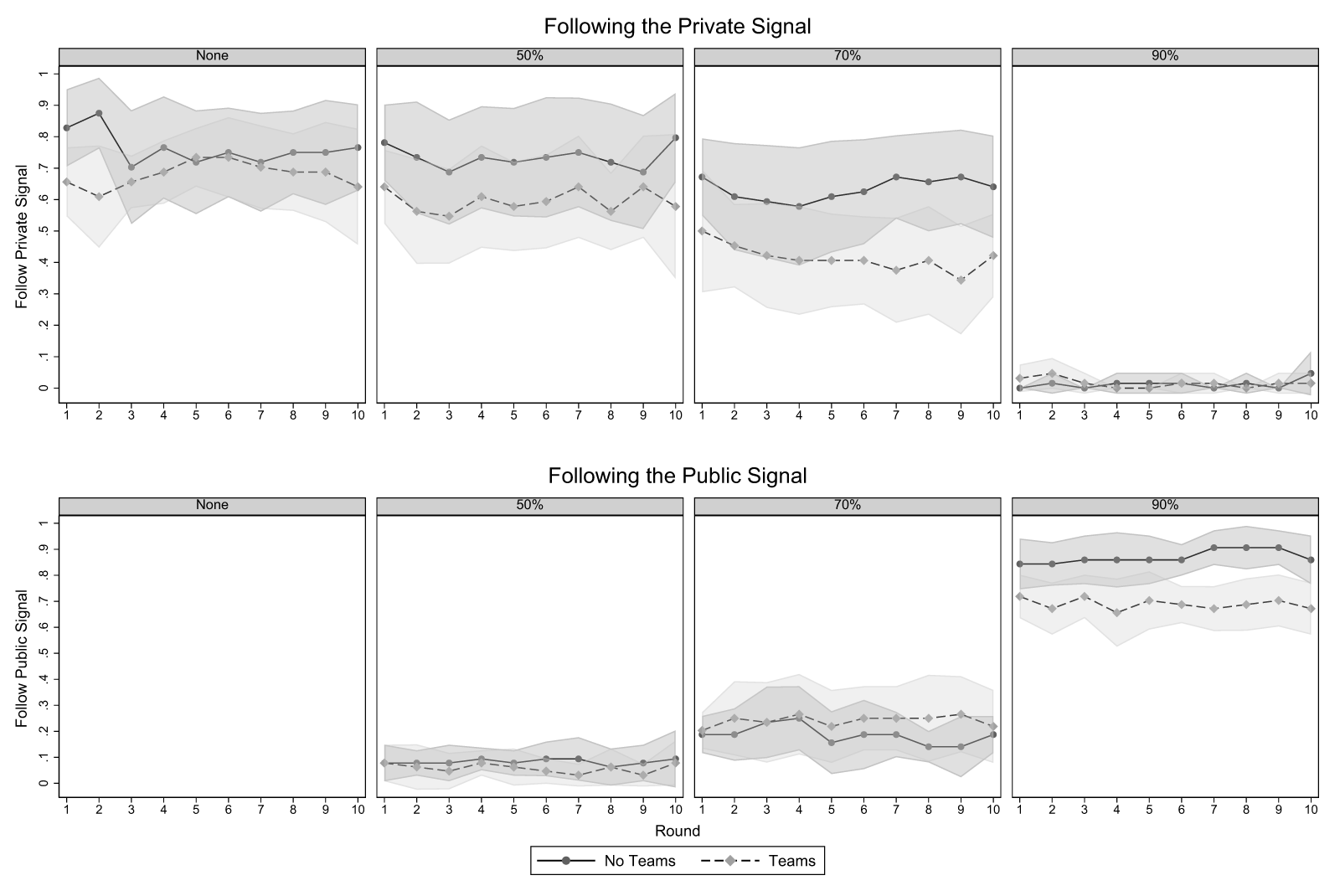
Figure 1 shows the rates of following the private and public signals, respectively, by treatment and round. The vertical axis shows the rate and the horizontal axis shows the round. In all cases, rates appear flat, with little or no trend across rounds. This result suggests that, in this setting, the voting choices are largely driven by structural factors and not group dynamics or learning.
Rates of following the private and public signals by treatment and round with 95% confidence intervals using standard errors clustered by group

Figure 1 Long description
The image contains two line graphs. The top graph shows the rates of following the private signal across ten rounds, divided into four sections based on public signal percentages: None, 50 percent, 70 percent and 90 percent. The y-axis is labeled 'Follow Private Signal' and the x-axis is labeled 'Round'. Each section displays two lines representing 'No Teams' and 'Teams', with shaded areas indicating confidence intervals. The bottom graph shows the rates of following the public signal across ten rounds, similarly divided into four sections with public signal percentages: None, 50 percent, 70 percent and 90 percent. The y-axis is labeled 'Follow Public Signal' and the x-axis is labeled 'Round'. Each section also displays two lines for 'No Teams' and 'Teams', with shaded areas for confidence intervals.
We next examine predictors of whether an individual will choose to follow either the public or private signal. Table 4 shows linear probability model estimates for the strategies Follow Public and Follow Private, predicted by treatment indicators and controls for Block and Round, as well as individual risk tolerance and cognitive reflection test (CRT) score. In models 1 and 2, the dependent variable equals 1 if the individual participant’s strategy for the round was to follow the public signal, and 0 otherwise. Data from the treatments without a public signal are excluded from these regressions. In models 3 and 4, the dependent variable is equal to 1 if the individual participant’s strategy for the round is to follow the private signal, and 0 otherwise. In model 5, the dependent variable is equal to 1 if the individual participant’s strategy for the round is to vote for their team’s preferred alternative unless both signals indicate the other alternative, and 0 otherwise. For model 5, we include only the data with teams and a public signal available. Standard errors are clustered by group to allow for correlation between group members due to repeated interaction with feedback.Footnote 17
Linear probability-model regressions for the follow public, follow private, and team unless strategies

Table 4 Long description
The table presents linear probability-model regressions analyzing the impact of decreasing public signal accuracy on different strategies: following public, following private, and team unless. Key findings include significant negative effects of decreasing public signal accuracy on following public signal strategies, while positive effects are observed for following private signal strategies. Team interactions show mixed results, with some interactions indicating negative effects and others showing no significant impact. The data suggests that public signal accuracy influences decision-making differently across strategies, with robust standard errors clustered by group. Observations range from 1920 to 5120, and the R-squared values indicate varying levels of model fit across strategies. Statistical significance is marked at different levels.
*** Note: Robust standard errors clustered by group are shown in parentheses. Statistical significance at the 1%, 5%, and 10% levels is indicated by **, and *, respectively.
Public-signal accuracy below 90% is negatively correlated with following the public signal and positively correlated with following the private signal. With public-signal accuracy of 70%, following the private signal is also significantly less frequent with teams than without teams. There is no significant trend across rounds, but following the private signal is significantly more frequent in later Blocks compared to earlier Blocks.
We find that participants who indicate a greater willingness to take risks in general are significantly less likely to follow the public signal and more likely to choose the team-unless strategy. We find no significant correlation between risk attitude and following the private signal. Intuitively, these results are consistent with the low-risk nature of the public-signal equilibrium, which minimizes coordination failure at the cost of a greater chance of choosing the less valued alternative between  $A$ and $B$. The team-unless strategy is consistent with greater willingness to risk coordination failure, as this strategy is biased toward the team’s favored alternative in the case that the public and private signals disagree.
We find a positive and significant correlation between CRT score and following the private signal, indicating that more reflective participants are more likely to vote with the private signal. The coefficient of CRT score in the regression for following the public signal is also positive, but not significant.Footnote 18
The overall pattern of these results is broadly consistent with Hypothesis 1.a. However, voting with the private signal being the modal strategy with a 70%-accurate public signal and teams is unexpected, as the private-signal equilibrium does not exist in this treatment. The first two main results summarize the findings on voter strategies.
Result 1. When the public signal is 90% accurate, a majority of voters follow it. When the public signal is less accurate or unavailable, following the private signal becomes the modal strategy. This result is partially consistent with Hypothesis 1.a.
Result 2. Given a public-signal accuracy of 70%, following the private signal is more frequent without teams than with teams. This result is consistent with Hypothesis 1.a.
6.3. Coordination
We next examine coordination, i.e. successfully reaching the threshold number of votes to select  $A$ or $B$ and thus avoid the undesirable outcome $C$. Table 5 shows the realized frequencies of successful coordination matching the state, mismatching the state, and coordination failure.Footnote 19 As realized frequencies depend on the randomly-drawn state and signals, we also report expected frequencies based on the individual-level strategies chosen by participants. For the strategy profile of each group in each round, we determine what their outcome would be for each possible realization of the state and signals, and then we take the probability-weighted frequency of each outcome over all possible realizations.Footnote 20
Realized and expected frequencies of coordination success matching or mismatching the state and coordination failure by treatment

Table 5 Long description
The table compares realized and expected frequencies of coordination success and failure across different public signal accuracies and team settings. At 90% signal accuracy, both teams and non-teams have high realized success rates matching the state, with teams showing slightly higher coordination failure rates. At lower accuracies, realized coordination success decreases, with significant coordination failures at 70% and 50% accuracies and with no public signal. Expected frequencies generally predict higher success rates than realized, except for coordination failures, which are often higher than expected. The presence of teams tends to increase coordination failure slightly, but not consistently across all public signal accuracies.
With a 90%-accurate public signal, high rates of following the public signal lead to very low rates of coordination failure and rates of matching the state close to the public-signal accuracy. When the public signal is less accurate than the private signal, or unavailable, coordination failure is much more frequent (p-value  $ \lt $ 0.001). However, coordination failure is no more frequent with teams than without teams (p-value $=$ 0.882). This result is contrary to Hypothesis 2, but consistent with the largely similar strategies chosen by participants with and without teams as previously shown in Table 3.
Figure 2 shows the realized and expected rates of coordination on either  $A$ or $B$ by treatment and round. Coordination rates are relatively flat, with the possible exception of the case of teams with public-signal accuracy 70%, where coordination appears to trend upward somewhat across rounds. However, no such trend appears for expected coordination success.
Realized and expected rates of coordination on either  $A$ or $B$ by treatment and round with 95% confidence intervals

Figure 2 Long description
The image contains two sets of graphs. The top set shows realized coordination success across ten rounds with varying public-signal accuracy: none, 50 percent, 70 percent and 90 percent. Each graph has the x-axis labeled 'Round' and the y-axis labeled 'Coordination Success'. The graphs depict fluctuating coordination success rates, with notable variations in the 70 percent accuracy graph. The bottom set shows expected coordination success across the same rounds and signal accuracies. The x-axis is labeled 'Round' and the y-axis is labeled 'Expected Coordination Success'. These graphs show relatively stable success rates, with slight variations in the 70 percent accuracy graph. Both sets include data for 'No Teams' and 'Teams', represented by different line styles.
Table 6 shows linear probability model regression estimates for realized and expected coordination on either  $A$ or $B$ predicted by treatment indicators and controls for Block and Round. Consistent with the results reported above in Table 5 and Figure 2, realized and expected coordination success is significantly less frequent when the public signal is less accurate than the private signal, or is unavailable. The presence of private-value teams shows no significant correlation with realized coordination success, and shows a small but (marginally) statistically significant negative correlation with expected coordination when the public signal is unavailable. We find no significant trend in realized or expected coordination success across Rounds or Blocks.
Linear regression for group-level realized and expected coordination on either  $A$ or $B$
$B$

Table 6 Long description
The table presents a linear regression analysis of group-level realized and expected coordination under different public signal conditions. Public signals at 70% and 50% levels significantly decrease both realized and expected coordination, with coefficients of -0.412 and -0.425 for realized coordination, and -0.292 and -0.337 for expected coordination, respectively. The absence of a public signal also results in a significant reduction in coordination. Team interactions with public signals show varied effects, with a notable non-significant increase in realized coordination at the 70% signal level. The constant terms are significantly positive, indicating a baseline level of coordination. The model explains 14.7% of the variance in realized coordination and 70.2% in expected coordination, with 640 observations and 16 group-level clusters. Robust standard errors are used, and statistical significance is indicated at different levels.
*** Note: Robust standard errors clustered by group are shown in parentheses. Statistical significance at the 1%, 5%, and 10% levels is indicated by **, and *, respectively.
The third and fourth main results summarize the findings on coordination.
Result 3. Partially consistent with Hypothesis 1.b, coordination on either on either  $A$ or $B$ is lower when the public-signal accuracy is 70%, 50%, or unavailable compared to 90%.
Result 4. Contrary to Hypothesis 2, the presence of teams with conflicting preferences has little effect on the frequency of coordination on  $A$ or $B$.
$B$.
We find that the public-signal equilibrium is most likely to be selected when the public signal is 90% accurate. Equilibrium selection moves toward the private-signal equilibrium as the public-signal accuracy falls.Footnote 21 This pattern is consistent with the Level-k or cognitive hierarchy benchmark with no teams, but not with teams. The pattern is also partially consistent with efficient equilibrium selection, except with a 70%-accurate public signal. Voting with the private signal is not efficient in this case, but is efficient when the public-signal accuracy is lower.Footnote 22
Furthermore, we do not see evidence for groups reaching a deadlock equilibrium, contrary to the Level-k or cognitive hierarchy benchmark with teams. We see very few instances of individuals choosing the strategies Always A or Always B when a public signal is available, limiting the instances where voting behavior could stabilize on that equilibrium. These strategies are more frequent in absence of a public signal, with and without teams, but remain too infrequent to result in convergence to a deadlock equilibrium.
7. Discussion
We find that when public information is available and highly accurate (90%) voters largely follow it. This behavior yields very high coordination rates, but sometimes leads to coordination on the less socially valuable alternative when the public signal is inaccurate. We find that less accurate public information is largely ignored in favor of private information, and does not serve as a coordination device. Thus, less accurate public information does not crowd out private information. While voting according to private information leads to a greater risk of coordination failure, it also results in more frequent selection of the alternative that matches the state, conditional on coordination success.
We further find that conflicting preferences between private-value teams lead to some differences in individual voting strategies. However, the rate of coordination on  $A$ or $B$, as well as the likelihood of selecting the most socially-valuable alternative, are similar with and without teams. These results suggest coordination failure and inefficient group choices in our setting are primarily driven by differences in private information and failures of information aggregation rather than conflicting preferences per se.
This paper complements previous laboratory studies by illuminating the role of public and private information with coordination incentives. Previous voting experiments with public and private information (e.g. Guarnaschelli et al., Reference Guarnaschelli, McKelvey and Palfrey2000; Kawamura and Vlaseros, Reference Kawamura and Vlaseros2017; Invernizzi, Reference Invernizzi2020) focus on two-outcome settings without coordination incentives to avoid an inefficient default outcome. Studies examining this divided-majority setting focus on private information (Bouton et al., Reference Bouton, Castanheira and Llorente-Saguer2016) or complete-information settings with polls signaling voter intentions, rather than the value of alternatives (Forsythe et al., Reference Forsythe, Myerson, Rietz and Weber1993; Forsythe et al., Reference Forsythe, Rietz, Myerson and Weber1996). We add to this literature by showing that public information about the value of alternatives plays an important role as a coordination device in a divided-majority setting, but only when it is more accurate than private information.
Our main results are broadly consistent with participants voting according to a simple rule of following the more accurate of the public and private signals, as a large majority of participants vote in this way in all treatments except Public Signal 70% with Teams (where a plurality still vote according to the more accurate private signal). These results are consistent with either the public-signal equilibrium or the private-signal equilibrium in most treatments, but not in Public Signal 70% with Teams, where voting with the private signal is not an equilibrium. Our results are also largely consistent with the Level-k or cognitive hierarchy predictions without Teams, in which level 1 and above vote according to the more accurate signal. However, with Teams, these models predict deadlock for levels 1 and above, inconsistent with our findings.
A number of interesting potential directions remain for future research. Variation of several of the parameters fixed in our experiment might stress-test the rule of voting with the more accurate signal and provide additional insight. Such parameters include the accuracy of private information, the private-value incentive to vote with one’s team, group size, and threshold size. Examining treatments where the difference between public-signal accuracy and private-signal accuracy is small could provide a sharp test of the rule of following the more accurate signal. Another possibility is a higher agreement threshold, such as unanimity in the extreme case. This change could make the public-signal equilibrium more attractive because of the higher risk of coordination failure from following the private signals, even if the accuracy of the public signal is low. Other potential extensions might allow for uncertainty about the number of voters of each team or about the preferences of other voters. It might also be interesting to examine the effects of context and group identity on coordination with conflicting preferences.
The tendency to follow the more accurate signal might also partly explain the apparent lack of learning dynamics with repeated play in this experiment. In every treatment except Public Signal 70% with Teams, following the more accurate signal is consistent with equilibrium. Moreover, limited feedback about the strategies of others might slow social learning, as individual voters observe only the aggregate voting outcome, not the individual votes or strategies of the other voters (see studies on limited feedback in coordination games, e.g. Banerjee et al., Reference Banerjee, De Vries, Hanley and Van Soest2014; Berninghaus and Ehrhart, Reference Berninghaus and Ehrhart2001; Brandts and Cooper, Reference Brandts and Cooper2006; Deck and Nikiforakis, Reference Deck and Nikiforakis2012). Similarly, the noisy relationship between an individual vote and the overall outcome might slow reinforcement learning. We view these features as natural and consistent with many applications. However, future research might examine the potential for stronger learning dynamics by providing more detailed feedback and perhaps decreasing the group size to strengthen the link between individual votes and outcomes.
The issue of coordination in groups with divided majorities and incomplete information is an important one for our time: immigration reform, voting rights, and climate change action all have elements of this underlying structural problem. The importance of accurate public information, and faith in that accuracy, cannot be overstated here. With and without conflicting preferences, we find that both expected and actual coordination are near perfect when the public signal is 90% accurate. Coordination failure increases to 30%-46% for all of the other settings. This result highlights the importance of trustworthy and widely available public information. Information silos and distrust of the media can thus directly harm coordination, even if the information they share is accurate.
Supplementary material
The supplementary material for this article can be found at https://doi.org/10.1017/eec.2026.10051.
Replication material
The replication material for the study is available at https://doi.org/10.17605/OSF.IO/8AEY9
Acknowledgements
The authors are grateful for helpful comments from the editor and anonymous referees, as well as Micael Castanheira, Laurent Bouton, Radovan Vadovič, the participants of the 2024 ESA North American Meeting, 2023 New England Experimental Economics Workshop, 2022 ESA World Meeting, 2022 BEEMA Conference, 2022 Appalachian Experimental and Environmental Economics Workshop, 2022 ESA Asia-Pacific Virtual Meeting, and economics department seminar participants at The Ohio State University, the University of Massachusetts Lowell, and the University of Central Florida. Funding for this research was generously provided by the University of Massachusetts Amherst. The collection of experimental data from human subjects for this research has been approved by the IRB at the University of Massachusetts Amherst. MS Copilot was used in debugging code and checking grammar.




 Open access

