





Introduction
Within the Nordic countries, life expectancy is increasing, and the population above the age of 65 years will double in the coming decades (Bodin et al., Reference Bodin, Kumlin and Tengqvist2020). Age is a well-known determinant of health (Dahlgren and Whitehead, Reference Dahlgren and Whitehead1991), and with higher age, the risk of diseases and physiological decline increases (Clegg et al., Reference Clegg, Young, Iliffe, Rikkert and Rockwood2013; Chang et al., Reference Chang, Skirbekk, Tyrovolas, Kassebaum and Dieleman2019). The increased risk of diseases can result in a higher demand for health services, thereby raising societal costs (Bloom et al., Reference Bloom, Chatterji, Kowal, Lloyd-Sherlock, McKee, Rechel, Rosenberg and Smith2015). However, due to older adults’ knowledge and experience they are a valuable resource for society. Older adults make significant contributions through informal caregiving for relatives (Sahlen et al., Reference Sahlen, Löfgren, Brodin, Dahlgren and Lindholm2012). Additionally, many older adults remain active in the workforce. Their contributions also extend to volunteer work but also to organizations, and associations, and politics (Vercauteren et al., Reference Vercauteren, Van Regenmortel, Näsman, Nyqvist, Brosens, serrat and Dury2024). The World Health Organization’s (WHO) definition of older adults in developed world economies as individuals aged 65 years and above (Eurostat, 2020) was used in this study.
To maintain older adults’ capabilities, increase good quality of life in older age, and tackle challenges that come with increased age, it is important to focus on health promotion, which has the potential to maintain and improve health. The Ottawa Charter for Health Promotion (WHO, 1986) has provided a basis for the development of health promotion (Rootman et al., Reference Rootman, Goodstadt, Potvin and Springett2001), which, in the Charter, is defined as ‘the process of enabling people to increase control over, and to improve, their health’ (WHO, 1986: 1). Health promotion actions optimize the social, environmental, and economic determinants of health and can positively impact individual and population health (WHO, 1986). Health promotion is regarded as a cornerstone of primary health care, and addressing the health needs of older adults within this framework has been underscored (WHO, 2018). To meet the present challenges with an aging population, it is crucial to increase the knowledge about health promotion research in aging and health.
According to McQueen et al. (Reference McQueen, Kickbusch, Potvin, Pelikan, Balbo and Abel2007), theories of health promotion often fall short of describing health promotion as a field of study and practice. Additionally, there is a lack of consensus on the benefits of theory-based interventions (Cummins, Reference Cummins2022). Health promotion can thus be considered a ‘fuzzy concept’. However, looking at health as a resource provides the basis for health promotion theory (Clancy, Reference Clancy2010). This perspective emphasizes a positive view of health, which aligns with the concepts of salutogenesis and wellbeing (Haugen and Eriksson, Reference Haugan and Eriksson2021). It can be surmised that several theoretical frameworks can support the practice of health promotion.
Participation and empowerment are two core principles in health promotion (Rootman, Reference Rootman2001). Empowerment focuses on enabling people to gain more power over factors that affect their health (Rootman et al., Reference Rootman, Goodstadt, Potvin and Springett2001). Participation in health promotion initiatives refers to ‘involving all concerned at all stages of the process’ (Rootman et al., Reference Rootman, Goodstadt, Potvin and Springett2001: 4). Recent research from the Nordic countries has highlighted the importance of the involvement of ‘users’ in the research process (Blix and Hamran, Reference Blix and Hamran2021; Koski and Pihlainen, Reference Koski and Pihlainen2022; Kylén et al., Reference Kylén, Slaug, Jonsson, Iwarsson and Schmidt2022; Pedersen et al., Reference Pedersen, Beck, Boateng, Brorholt and Overgaard2022). Kylén et al. (Reference Kylén, Slaug, Jonsson, Iwarsson and Schmidt2022) showed in their study, from the perspective of researcher, that the most important reason for involving users in the research process was to make the research relevant for practice. User involvement has the potential to improve the quality of health research and can also empower users of health and social care services (Shippee et al., Reference Shippee, Domecq Garces, Prutsky Lopez, Wang, Elraiyah, Nabhan, Brito, Boehmer, Hasan, Firwana, Erwin, Montori and Murad2015). For example, older adults could be involved in formulating research questions, collecting data, and analyzing data (Iwarsson et al., Reference Iwarsson, Edberg, Ivanoff, Hanson, Jönson and Schmidt2019; Kylén et al., Reference Kylén, Slaug, Jonsson, Iwarsson and Schmidt2022). A practical example from Denmark shows that user involvement greatly benefits and advances the project (Pedersen et al., Reference Pedersen, Beck, Boateng, Brorholt and Overgaard2022).
Research focusing on health promotion interventions among older adults has increased significantly over the past years (Chiu et al., Reference Chiu, Hu, Lo and Chang2020). Various types of health promotion interventions have been identified in scoping reviews (Duplaga et al., Reference Duplaga, Grysztar, Rodzinka and Kopec2016; Chiu et al., Reference Chiu, Hu, Lo and Chang2020). However, these reviews often lack details on the theories and definitions of health promotion. Since theories play a crucial role in health promotion, research is needed to identify the specific theories and definitions applied in this field. Health promotion is context-dependent, and as the Nordic countries share many similarities in history and legislation (Thualagant et al., Reference Thualagant, Simonsen, Sarvimäki, Stenbock-Hult, Olafsdottir, Fosse, Torp, Ringsberg, Forrinder and Tillgren2023), it is valuable to explore research focused on health promotion and older adults within the Nordic context. Doctoral theses provide deeper insights into the theories and definitions used in research articles, therefore it is beneficial to examine recent theses rather than peer reviewed scientific articles (Eriksson et al., Reference Eriksson, Andersen, Eriksson, Johannessen, Simonsen-Rehn, Thualagant, Torp, Trollvik and Haglund2020). The doctoral degree is the highest academic qualification. In the Nordic countries, full-time doctoral education spans three to four years, awarding 180 to 240 ECTS (European Credit Transfer and Accumulation System). During this period, a thesis is written, either as a monograph or, more commonly nowadays, as a compilation thesis. A compilation thesis consists of approximately three to five scientific articles summarized in a comprehensive report. This study aimed to explore how research concerning older adults under the label ‘health promotion’ is conducted in doctoral theses within a Nordic context, with a specific focus on theoretical frameworks and the principles of participation and empowerment, which guide health promotion. This knowledge can help identify future research directions and guide researchers in their work.
Methods
Design
A scoping review design was used in this study as it is an appropriate method to determine the breadth and volume of research in the area and identify possible knowledge gaps (Munn et al., Reference Munn, Peters, Stern, Tufanaru, McArthur and Aromataris2018). The review process was inspired by the methodological framework proposed by The Joanna Briggs Institute (JBI) (Peters et al., Reference Peters, Godfrey, McInerney, Munn, Tricco, Khalil, Aromataris and Munn2020). To guide the process and to increase methodological transparency and the comprehension of our findings, we used the PRISMA-ScR (Preferred Reporting Items for Systematic Reviews and Meta-Analysis extension for Scoping Reviews) (Tricco et al., Reference Tricco, Lillie, Zarin, O’Brien, Colquhoun, Levac, Moher, Peters, Horsley, Weeks, Hempel, Akl, Chang, McGowan, Stewart, Hartling, Aldcroft, Wilson, Garritty, Lewin, Godfrey, Macdonald, Langlois, Soares-Weiser, Moriarty, Clifford, Tunçalp and Straus2018).
Inclusion criteria
Participants
Theses with participants aged 65 years and above were included in the study. Theses focusing on healthcare personnel were excluded. The motivation for including only theses with a focus on the views of older adults was to empower their perspectives.
Concept
The focus of our search was to locate doctoral thesis research with the concept ‘health promotion’ and variations of the term (e.g., health promoting, promoting health), to be found in either title, abstract or keywords.
Context
Only theses with empirical studies where data collection was conducted in the Nordic countries – Denmark, Finland, Norway, and Sweden – were included in the review.
Search strategy
The search strategy was planned and conducted by all authors between January to December 2022. All searches were made with guidance from research librarians. Different databases were used in different countries to find eligible theses. In Denmark, there is no longer a joint database for identifying doctoral theses from the different universities. The search was thus limited to searches conducted in databases at three institutions (Aalborg University, The Royal Danish Library and University College Lillebælt), which at that point were the only databases providing information on doctoral theses. In Finland, the searches were carried out in two databases, Finna and Medic. In Norway, the searches were carried out in the databases Nora and Oria. In Sweden, the databases Diva, Libris and SwePub were used to identify theses.
The authors agreed on English and Scandinavian search terms and conducted an initial search in databases relevant to each of the included countries. After the initial search, any considerations regarding the search strategy were discussed and resolved and a final search was conducted. We searched for the concepts; health promot* AND old* OR age* OR aging OR senior* OR elder* and similar terms in the Scandinavian languages. Danish terms: ‘Sundhedsfremme’ and ‘ældre’, Norwegian search terms: Helsefrem* eldre* og aldring, Finnish and Swedish terms: ‘Terveyden edistäminen’/’Terveyttä edistävä’/’Terveydenedist*/‘Hälsofrämjande’ and ‘vanh*’, ‘ikä’/’äldre’.
The search was limited to theses published between 2011 and 2021 as we aimed to incorporate contemporary research that mirrors today’s society. In the Swedish and Finnish databases, additional limitations were set to include only doctoral thesis. Theses published in the Scandinavian languages, Danish, Finnish, Norwegian and Swedish as well as English were considered for inclusion since the authors are proficient in these languages.
Source of evidence screening and selection
All authors independently reviewed the title and abstract of the theses found in their own country (the authors origin from Denmark, Finland, Norway, or Sweden) and excluded theses that did not meet the inclusion criteria. Subsequently, full-text theses were divided between the authors and screened for relevance to ensure that they met the inclusion criteria. Any questions regarding the included theses were discussed in the author group and resolved.
Data extraction
Both monographs and compilation theses were found eligible for this study. A compilation thesis normally includes a comprehensive summary and the scientific manuscripts written during the doctoral education. Data was extracted only from the comprehensive summary. Data from all included theses were extracted by a minimum of two authors independently. The extracted data included author, university, year of doctoral defense, aim, research method(s) used, main theory applied and definition of health promotion, the context in which the thesis was conducted, the population studied, data collection method(s) and conclusion(s) of the theses.
Data analysis and presentation of results
The abstracts of the theses were read several times and the characteristics of the theses: aim/focus, methods, context/population, and conclusions were examined and extracted. To find theories used and definitions of health promotion, the entire thesis was searched for the terms: ‘theory’ and ‘health promotion’. Moreover, we searched for the terms ‘empow*’, and ‘enabl*’ and counted the number of times and in which section of the thesis the terms were mentioned. Thereafter we searched for ‘participant*’, and ‘involv*’ within each thesis to find out if a participatory design was used. Data extracted from the included theses were then described in figures and text. The included theses were summarized based on the aim/focus, methods, context/population, and conclusions as well as theory and how health promotion was defined.
Results
Literature search
The search for relevant theses resulted in a total of 28 theses from Denmark, Finland, Norway and Sweden. See flow chart Figure 1 for an illustration of the selection process.
Flow chart, an illustration of the selection process.

From the Danish institutions, first a total of 53 theses were identified: University College Lillebælt (n = 1), The Royal Danish Library (n = 1), and Aalborg University (n = 51). No duplicates were identified, but five theses were removed before screening as they were published before 2011. Forty-eight theses were screened by title/abstract, and 46 theses were removed. This left two theses for full-text reading included from Denmark.
In the Finnish databases, first a total of 126 theses were found: Medic (n = 35) and Finna (n = 91). Fifteen duplicates were removed. One hundred eleven theses were screened by title/abstract, and 104 theses were removed. This left seven theses for full-text reading. Three were excluded, resulting in four included theses from Finland. One of the excluded Finnish theses was included among the Swedish theses as the doctoral studies were conducted at the Nordic School of Public Health, located in Sweden.
In the Norwegian databases Oria and Nora, first a total of 1164 theses were found. Duplicates were removed (n = 1110). The remaining 54 theses were screened by title/abstract, and 30 were removed. This left 24 theses for full-text reading. Twenty-one were excluded, resulting in three included theses from Norway.
In the Swedish databases, first a total of 591 theses were found: Libris (n = 129), Diva (n = 67), and SwePub (n = 395). Sixty-three duplicates were removed. The remaining 528 theses were screened by title/abstract, with 500 theses removed. This left 28 theses for full-text reading. Nine were excluded, resulting in 19 included theses from Sweden.
Characteristics of theses
The theses were published between 2012 and 2021 and conducted in Denmark at the University of Copenhagen (n = 2); in Finland at Aalto University (n = 1), Åbo Akademi University (n = 1), University of Eastern Finland (n = 1), and the University of Turku (n = 1); in Norway at the University of Oslo (n = 2) and the Norwegian University of Science and Technology (n = 1); and in Sweden at the University of Gothenburg (n = 6), Luleå University of Technology (n = 3), Umeå University (n = 3), Karolinska Institutet (n = 3), Malmö University (n = 1), Linköping University (n = 1), and the Nordic School of Public Health (n = 2). The Nordic School of Public Health (1959–2014), which was financed by all the Nordic countries (Suominen, Reference Suominen2014), was situated in Sweden and is here included among the Swedish universities. Characteristics of the theses are presented in Table 1. The included theses represented various health sciences disciplines (nursing, health and social work, oral health, public health, rehabilitation, occupational health, neurobiology/neuroscience, and physiology as well as nutrition, exercise, and sports). The fields of technology and engineering were also represented (Table 1).
Study characteristics of included theses (n = 28). Denmark(D), Finland (F), Norway(N) and Sweden(S)

The main aims in the included theses
The main aims of the included theses were examined to identify their focus (Table 1). In most of the theses, the contribution of knowledge was directly related to strengthening health promotion among older adults. However, there was also an interest in promoting an understanding of different phenomena related to aging. Most of the theses aimed to explore and/or evaluate health promotion interventions or programs, and their effects on various outcomes among older adults. These included both newly developed interventions as well as existing or adapted health promotion programs. The focus of the remaining theses was to gain a deeper understanding of factors associated with healthy aging, including different phenomena related to health and well-being among older adults, personal health resources, ethical questions, and the influence of the physical or social environment – only one thesis aimed to study the effects of health policies. The focus of the included theses is described in more detail below.
Based on their focus, the theses were divided into two main categories:
-
Health promotion interventions (15 theses)
-
○ Comprehensive interventions (9 theses)
-
○ Healthy lifestyle interventions (6 theses)
-
-
Determinants of healthy aging (13 theses)
-
○ Personal resources and different phenomena related to healthy aging (7 theses)
-
○ Influence of the environment on health (3 theses)
-
○ Ethics and policies (3 theses)
-
Theses focusing on health promotion interventions
According to the main aims, different health promotion programs or interventions were explicitly studied in 15 theses. The interventions/programs could be characterized as Comprehensive interventions (n = 9) and Healthy lifestyle interventions (n = 6).
Comprehensive interventions included a range of (multicomponent) health promotion efforts. Three theses focused on interventions related to frailty and/or the end of life (Gustafsson, Reference Gustafsson2012; Behm, Reference Behm2014; Kleijberg, Reference Kleijberg2021), with outcomes including health, frailty, Activities of Daily Living, end-of-life issues, and/or intergenerational interactions. Two theses studied preventive home visits (Fjell, Reference Fjell2021; Tøien, Reference Tøien2019) and occupation-focused and-based interventions (Zingmark, Reference Zingmark2015; Larsson, Reference Larsson2016). The outcomes encompassed health, the possibility of a good life in one’s own home, occupational engagement, and/or participation in society. Furthermore, two theses focused on interventions for older adults aging in migration (Barenfeld, Reference Barenfeld2016; Arola, Reference Arola2018). Arola (Reference Arola2018) examined outcomes such as sense of coherence, life satisfaction, and engagement in activities, whereas Barenfeld (Reference Barenfeld2016) was interested in how to support the development of a health promotion program for older adults aging in migration. In addition to Barenfeld (Reference Barenfeld2016), three other theses studied the intervention process itself: Kleijberg (Reference Kleijberg2021) investigated the processes of developing the intervention (DöBra) for the end of life, and Fjell (Reference Fjell2021) examined the content of the preventive home visits. Within an occupational science framework, Zingmark (Reference Zingmark2015) evaluated the cost-effectiveness of occupation-focused interventions.
Healthy lifestyle interventions focused on oral health interventions (Mårtensson, Reference Mårtensson2012; Komulainen, Reference Komulainen2013), physical activity interventions (Vorup, Reference Vorup2017; Pyae, Reference Pyae2020), prevention of undernutrition in-home care (Aure, Reference Aure2021), and sustainable lifestyle changes among older adults with obesity (Wiklund-Axelsson, Reference Wiklund-Axelsson2015).
We also found that information and communication technology (ICT) was used in health promotion research among older adults. ICT was part of the health promotion intervention in four of the 15 theses (Wiklund-Axelsson, Reference Wiklund-Axelsson2015; Larsson, Reference Larsson2016; Pyae, Reference Pyae2020; Aure, Reference Aure2021). Three of these theses focused on healthy lifestyles: there was interest in how lifestyle changes can be supported by ICT (Wiklund-Axelsson, Reference Wiklund-Axelsson2015), how digital games can be used as a physical activity intervention (Pyae, Reference Pyae2020), and the feasibility of introducing an app to prevent undernutrition in home care (Aure, Reference Aure2021). However, one of the theses using ICT focused on how support from a social internet-based occupational therapy intervention can contribute to social participation and healthy aging (Larsson, Reference Larsson2016).
Theses focusing on determinants of healthy aging
The rest of the 28 included theses (13 theses) focused on personal resources and different phenomena related to healthy aging (7 theses), the influence of the environment on health (3 theses), and ethical questions and policies (3 theses).
Seven theses investigated personal resources and various phenomena related to healthy aging, such as individual life experiences and health resources, and their relation to health, well-being, and health promotion (Mahler, Reference Mahler2012; Björklund, Reference Björklund2015; Grundberg, Reference Grundberg2015; Sundsli, Reference Sundsli2015; Boman, Reference Boman2016; Wennerberg, Reference Wennerberg2017; Sjöblom, Reference Sjöblom2020). There was interest in the phenomenon of the ‘inner child’ (Sjöblom, Reference Sjöblom2020), inner strength as a health resource among older women (Boman, Reference Boman2016), and informal caregivers’ health resources (Wennerberg, Reference Wennerberg2017). Moreover, there was a focus on gaining a deeper understanding of mental health and its promotion among older adults (Grundberg, Reference Grundberg2015). The phenomenon of self-care (Sundsli, Reference Sundsli2015) and the contextual phenomenon and experience of falling (Mahler, Reference Mahler2012) were studied, as well as the significance of temporal patterns of daily occupations and personal projects for older adults’ health and well-being (Björklund, Reference Björklund2015).
The influence of the environment on health was the focus in three theses (Forsman, Reference Forsman2012; Olofsson, Reference Olofsson2012; Laatikainen, Reference Laatikainen2019). Laatikainen (Reference Laatikainen2019) examined how multiple levels of factors, i.e., different physical environments together with individual factors, can support healthy and active aging, whereas Olofsson (Reference Olofsson2012) studied the relation between exposure to violence or threats of violence and ill health. Forsman (Reference Forsman2012) investigated the promotion of mental health and well-being among older adults, with an interest in the influence of the social environment in terms of social capital and psychosocial interventions.
Three theses elucidated ethical questions and policies. Lood (Reference Lood2015) explored ethical and empirical points of departure for health promotion in relation to aging persons who have experienced international migration, whereas Ljungquist (Reference Ljungquist2018) aimed to deepen the understanding of ethics and describe the actions and habits that are important in the ‘acts of caring’. Clotworthy (Reference Clotworthy2017) was the only doctoral student to study policies and investigated how political goals and individualized health policies influence the provision of in-home health services for older adults.
Theoretical perspectives
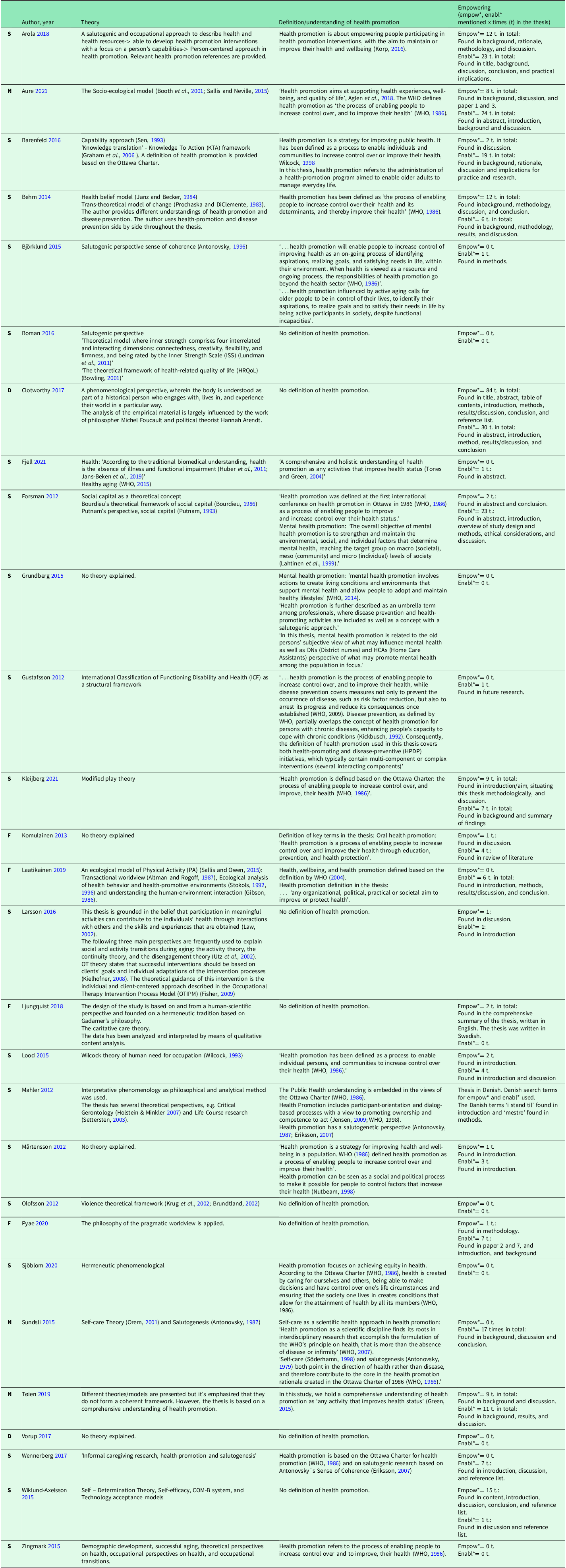
The included theses were examined for their main theoretical perspective (Table 2). This provided information on (a) whether the thesis had a health promotion approach, (b) the theoretical foundations for the chosen perspective, and (c) if the chosen theory was compatible with a health promotion ideology. Of the 28 included theses, three used a comprehensive and very broad understanding of health promotion, referring to it as any activity that improves health status (Laatikainen, Reference Laatikainen2019; Tøien, Reference Tøien2019; Fjell, Reference Fjell2021). Fourteen theses had a health promotion approach based on the Ottawa Charter (Forsman, Reference Forsman2012; Gustafsson, Reference Gustafsson2012; Mårtensson, Reference Mårtensson2012; Mahler, Reference Mahler2012; Komulainen, Reference Komulainen2013; Behm, Reference Behm2014; Björklund, Reference Björklund2015; Lood, Reference Lood2015; Zingmark, Reference Zingmark2015; Barenfeld, Reference Barenfeld2016; Wennerberg, Reference Wennerberg2017; Sjöblom, Reference Sjöblom2020; Aure, Reference Aure2021; Kleijberg, Reference Kleijberg2021). Eight theses did not define health promotion (Olofsson, Reference Olofsson2012; Wiklund-Axelsson, Reference Wiklund-Axelsson2015; Boman, Reference Boman2016; Larsson, Reference Larsson2016; Clotworthy, Reference Clotworthy2017; Vorup, Reference Vorup2017; Ljungquist, Reference Ljungquist2018; Pyae, Reference Pyae2020). Three theses (Grundberg, Reference Grundberg2015; Sundsli, Reference Sundsli2015; Arola, Reference Arola2018) used other definitions for health promotion (see Table 2). Several theses had supplementary theoretical perspectives. A salutogenic approach, where health is viewed as a resource and ongoing process, was applied in four theses (Mahler, Reference Mahler2012; Björklund, Reference Björklund2015; Boman, Reference Boman2016; Wennerberg, Reference Wennerberg2017; Arola, Reference Arola2018).
Theory, definition of health promotion, and selected guiding principles of health promotion recommended by the World Health Organization European working group on health promotion evaluation (Rootman, Reference Rootman2001). (D = Denmark, F = Finland, N = Norway, S = Sweden)
Theories compatible with a health promotion ideology
Some of the included theses had a health promotion focus throughout the comprehensive summary of the thesis and referred to central health promotion theorists. Mårtensson (Reference Mårtensson2012) and Sjöblom (Reference Sjöblom2020) referred to empowerment ideologies and central health promotion theorists such as Kickbusch et al. (Reference Kickbusch, Wait and Maag2005) and Nutbeam (Reference Nutbeam2008). Several authors used supplementary theoretical perspectives, which were either compatible with health promotion principles (Forsman, Reference Forsman2012; Komulainen, Reference Komulainen2013; Grundberg, Reference Grundberg2015; Sundsli, Reference Sundsli2015; Boman, Reference Boman2016; Barenfeld, Reference Barenfeld2016; Arola, Reference Arola2018) or used a theoretical model to provide a descriptive framework (Gustafsson, Reference Gustafsson2012; Laatikainen, Reference Laatikainen2019) that was not in conflict with health promotion ideologies.
Self-care, as an approach to health promotion, provided the theoretical background in Sundsli’s (Reference Sundsli2015) research. This approach was based on the WHO’s definition of health as more than the absence of disease (WHO, 2007). The capability approach provided the theoretical background in Arola’s (Reference Arola2018) thesis, which related to empowering individuals to participate in health promotion interventions and to maintain or improve their health and well-being, with Korp (Reference Korp2016) used as a reference. Barenfeld (Reference Barenfeld2016) also referred to the capability approach and regarded health promotion as a strategy for improving public health.
Laatikainen (Reference Laatikainen2019) focused on an ecological model of health (Sallis et al., Reference Sallis, Cervero, Ascher, Henderson, Kraft and Kerr2006), whereas Boman (Reference Boman2016) referred to a theoretical model based on inner strength within a framework of health-related quality of life. Forsman (Reference Forsman2012) referred to social capital as a theoretical concept and applied a definition of health promotion based on the Ottawa Charter (WHO, 1986) and a definition of mental health promotion created by Lahtinen et al. (Reference Lahtinen, Lehtinen, Riikonen and Ahonen1999). Mental health promotion was also the focus of Grundberg’s (Reference Grundberg2015) thesis and was defined as ‘actions to create living conditions and environments that support mental health and allow people to adopt and maintain healthy lifestyles’ (197). Gustafsson (Reference Gustafsson2012) used the International Classification of Functioning, Disability, and Health (ICF) as a structural framework. Kleijberg (Reference Kleijberg2021) used modified play theory. Zingmark (Reference Zingmark2015) had a health promotion focus throughout and referred to health, occupational perspectives on health, and occupational transitions. Komulainen (Reference Komulainen2013) defined oral health promotion as ‘enabling people to increase control over and improve their health through education, prevention, and health protection’.
The concept of health promotion is poorly defined
Several of the included theses did not define the concept of health promotion (Olofsson, Reference Olofsson2012; Wiklund-Axelsson, Reference Wiklund-Axelsson2015; Boman, Reference Boman2016; Larsson, Reference Larsson2016; Clotworthy, Reference Clotworthy2017; Vorup, Reference Vorup2017; Ljungquist, Reference Ljungquist2018; Pyae, Reference Pyae2020). Wiklund-Axelsson (Reference Wiklund-Axelsson2015) referred to self-determination theory, self-efficacy, the COM-B system, and the Technology Acceptance Model. Clotworthy (Reference Clotworthy2017) was largely influenced by the works of philosopher Michel Foucault and political theorist Hannah Arendt. Vorup (Reference Vorup2017) did not provide a theoretical framework or a definition of health promotion. Others referred briefly to a definition but did not use the concept as a theoretical framework. Larsson (Reference Larsson2016) used several theoretical approaches, and although health promotion was not defined, there was a focus on healthy aging. Ljungquist (Reference Ljungquist2018) did not define health promotion but applied caritative care theory (Eriksson, Reference Eriksson1995), which is based on health promotion ideologies within a caring science tradition. Pyae (Reference Pyae2020) provided a pragmatic worldview as a theoretical perspective and referred to different reports written by the WHO, emphasizing the importance of participation and the promotion of a healthy and independent lifestyle. The pragmatist worldview could be seen as compatible with health promotion principles.
The use of the concepts ‘participation’ and ‘empowerment’
Participation is an important guiding principle in health promotion. However, it appears that the older adults involved in the various research projects did not participate in designing the interventions or provide input on what they considered relevant research focuses. Only one thesis (Kleijberg, Reference Kleijberg2021) among the 28 noted their participation. Furthermore, only one thesis explicitly related its results to empowerment (Clotworthy, Reference Clotworthy2017) – another key principle in health promotion. In more than half of the theses, empowerment was mentioned, but mainly in the introduction and/or discussion sections. A few theses drew conclusions related to empowerment (see Table 2).
Methods used in the theses
The research methods used in the theses were a combination of qualitative and quantitative approaches (n = 12), followed by qualitative methods alone (n = 7), quantitative methods alone (n = 5), and mixed methods (n = 4).
Context/Population
Most participants were healthy, home-dwelling individuals older than 65 years, both men and women, living either in urban or rural areas. Only one focus group interview took place in a nursing home, in Finland (Forsman, Reference Forsman2012). The sample sizes in these theses ranged from around ten participants (Mahler, Reference Mahler2012; Grundberg, Reference Grundberg2015; Sjöblom, Reference Sjöblom2020) to thousands (Olofsson, Reference Olofsson2012).
The studies were conducted in a Nordic context with predominantly Nordic participants. However, three Swedish theses included migrants from the Western Balkans (Barenfeld, Reference Barenfeld2016; Arola, Reference Arola2018) and migrants from Bosnia, Herzegovina, Croatia, Montenegro, and Serbia (Lood, Reference Lood2015), in addition to migrants from Finland.
Key conclusions drawn in the theses
The main conclusions sections were examined in the theses (Table 1). Primarily positive conclusions were drawn and related mainly to various health promotion interventions.
Theses on health promotion interventions such as preventive home visits, senior meetings, digital interventions, and interventions focusing on oral health, occupation, and falls concluded that the interventions could postpone frailty and declining health (Behm, Reference Behm2014), and occupational engagement (Zingmark, Reference Zingmark2015), delay deterioration and reduce dependency (Gustafsson, Reference Gustafsson2012). Furthermore, positive conclusions were related to improved self-rated health (Zingmark, Reference Zingmark2015), oral health status (Komulainen, Reference Komulainen2013), mental health, self-care (Sundsli, Reference Sundsli2015), feeling safer, increased self-worth, ability to manage everyday life (Behm, Reference Behm2014), and sustainable lifestyle changes (Wiklund-Axelsson, Reference Wiklund-Axelsson2015). Other conclusions were the importance of promoting physical activity (Pyae, Reference Pyae2020), prevention of undernutrition (Aure, Reference Aure2021), motivation of healthier behavior (Behm, Reference Behm2014), identifying capabilities (Arola, Reference Arola2018), support of social activities and contacts (Larsson, Reference Larsson2016), and cost-effectiveness (Zingmark, Reference Zingmark2015).
Aspects that are important to reflect upon in health-promotive interventions to promote health and well-being were also emphasized in the conclusions. It seemed important to tailor interventions to suit the personal needs of older adults (Tøien, Reference Tøien2019) and address older adults’ perspectives (Forsman, Reference Forsman2012; Grundberg, Reference Grundberg2015; Larsson, Reference Larsson2016). Examples were given to involve older adults in planning initiatives and creating a health-promoting dialog based on the person’s wishes and needs (Grundberg, Reference Grundberg2015). Moreover, important aspects were to bring the intervention home to the person (Komulainen, Reference Komulainen2013), have a good attitude as personnel (Ljungquist, Reference Ljungquist2018) and create a good relationship (Mårtensson, Reference Mårtensson2012). Furthermore, one thesis concluded that the interplay between personal choices and normative power was important in promoting health (Lood, Reference Lood2015). Other aspects important in health promotion were identifying risks (falls, malnutrition, polypharmacy, and cognitive impairment), self-rated health, social networks, activity (Fjell, Reference Fjell2021), physical training (Vorup, Reference Vorup2017), mapping occupations during 24-hour sequences (Björklund, Reference Björklund2015), rating inner strength (Boman, Reference Boman2016), contextualizing falling accidents (Mahler, Reference Mahler2012) and assessing the physical environment (Laatikainen, Reference Laatikainen2019).
Discussion
This study explored how research about older adults, under the label ‘health promotion’, was undertaken in doctoral theses within a Nordic context. The focus was on the theoretical framework, participation, and empowerment, two main guiding principles for health promotion. We found 28 theses focusing on health promotion among older adults from the years 2011 to 2021. Most of the theses involved participants living in their own homes and utilized both qualitative and quantitative research methodologies. The major focus in all theses was on health promotion interventions for older adults or on the determinants of healthy aging, ranging from personal resources to ethics and policies. The findings reveal that health promotion is predominantly defined in line with the Ottawa Charter (WHO, 1986). However, only one of the theses involved older adults in the research process (Kleijberg, Reference Kleijberg2021), and empowerment was mentioned in the results section of only one thesis (Clotworthy, Reference Clotworthy2017).
The findings have the potential to shape future research and health-promoting interventions for older adults in the Nordic countries. Researchers may find these insights particularly valuable, given the lack of clear definitions of health promotion in many theses and the inconsistent application of supporting theories. Key concepts like empowerment and participation were seldom implemented, indicating a gap between theoretical frameworks and practice. Only one doctoral thesis actively engaged older adults (in the research process) and only one linked outcome to empowerment. While most theses focused on community-dwelling older adults, only one addressed those in assisted living. Thus, this overview highlights the need for precise definitions, better integration of theory into practice, and broader research that includes populations beyond community-dwelling older adults. These findings could guide future researchers by emphasizing the need for clearer definitions and more consistent use of theories in theses. Additionally, the results identify research gaps, such as the predominant focus on health promotion interventions for community-dwelling older adults.
The main aims of doctoral theses may vary over time. The findings show that research in doctoral theses on health promotion and aging in Nordic countries encompasses both evaluations of interventions and more exploratory studies on various determinants of healthy aging. Less than half of the interventions focused on promoting healthy lifestyles, while more than half assessed comprehensive interventions, such as preventive home visits. In the included theses the lifestyle interventions in the Nordic doctoral theses addressed various aspects, such as physical activity, oral health, nutrition, and sustainable lifestyle changes based on psychosocial support and enjoyable physical activity. In contrast, the comprehensive interventions focused on diverse health-related outcomes, including general health, sense of coherence, life satisfaction, occupational engagement, participation in society, end-of-life issues, and frailty. According to earlier reviews on health promotion interventions among older adults (Duplaga et al., Reference Duplaga, Grysztar, Rodzinka and Kopec2016), the most common target area was physical activity, followed by general health and quality of life. This trend was also observed in a subsequent review on health promotion and primary prevention by Chiu et al. (Reference Chiu, Hu, Lo and Chang2020), excluding the ‘disease-oriented’ target area. Thus, it appears there has been less emphasis on physical activity in Nordic theses compared to earlier reviews on health promotion interventions for older adults during the same period. However, the present results provide a snapshot of the topics addressed in these theses during the period 2011–2021. Since then, additional theses have been produced in the field (Nivestam, Reference Nivestam2022; Löfvendahl, Reference Löfvendahl2025; Dinse, Reference Dinse2026), highlighting the ongoing exploration of new research areas. Therefore, the results should not be considered comprehensive, but rather as an overview that may inform and stimulate future discussion and research development.
The results indicated that the interpretation of health promotion varies significantly among the authors of the 28 included theses, and their theoretical perspectives exhibit considerable diversity. Certain guiding principles of health promotion are present in all the theses reviewed, based on enabling people to increase control over and improve their health. Rootman et al. (Reference Rootman, Goodstadt, Potvin and Springett2001) suggested, based on a review of various definitions of health promotion, that ‘empowering activities’ could be regarded as the primary criterion for determining whether an initiative should be termed health promotion. Empowerment is considered both an outcome in itself and a significant step toward other health-related outcomes (Wallerstein and Duran, Reference Wallerstein and Duran2006). However, in practice, health promotion often encompasses a range of activities aimed at improving or maintaining health (Rootman et al., Reference Rootman, Goodstadt, Potvin and Springett2001). The theoretical literature and research emphasize the importance of using a theory in the development of health promotion interventions to achieve efficient outcomes (Haugan and Eriksson, Reference Haugan and Eriksson2021). To improve the quality of health promotion research within the field of aging and health, researchers may need to be clearer about the definition, how theory is underpinned in their research, and how it is connected to related concepts.
The participation of older adults in the development of health-promotive interventions was highlighted as a crucial factor in some of the theses’ conclusions sections. By involving older adults in the design and planning stages, interventions can be more effectively tailored to meet their specific needs and preferences (Malengreaux et al., Reference Malengreaux, Doumont, Scheen, Van Durme and Aujoulat2022). A participatory approach can enhance the relevance and acceptability of the intervention. However, a recent review (Cowdell et al., Reference Cowdell, Dyson, Sykes, Dam and Pendleton2022) shows, in line with our results, that older adults seldom participate throughout the entire process. Usually, they are only involved in providing information to develop the intervention. It is worth reflecting on how older adults could be involved in different stages of the development process.
Being involved in the research process may be one way of empowering people. In all included theses, older adults were invited to participate, but only (primarily) as informants and respondents during interviews and questionnaires. The relatively recent emergence of involving laypeople in the research process may explain this finding (Dengsø et al., Reference Dengsø, Lindholm, Herling, Pedersen, Nørskov, Collet, Nielsen, Christiansen, Engedal, Moen, Piil, Egerod, Hørder and Jarden2023). Several authorities in the Nordic countries now emphasize that patients and the public should be involved in the research process from formulating the research question to the final product (Aas et al., Reference Aas, Distefano, Pettersen, Gravrok, Nordvoll, Bjaastad and Grimsgaard2023), to ensure that research is tailored to the needs of practice (Pedersen et al., Reference Pedersen, Beck, Boateng, Brorholt and Overgaard2022). However, research shows that stakeholders are more frequently involved in the planning and conduct of the studies and less in disseminating and implementing research results (Aas et al., Reference Aas, Distefano, Pettersen, Gravrok, Nordvoll, Bjaastad and Grimsgaard2023). Additionally, there is a risk of overrepresentation from better socio-economic environments (Pii et al., Reference Pii, Schou, Piil and Jarden2019). It is important to also include a diversity of older adults, for example, persons who are ‘hard to reach’ (e.g., older persons from minority ethnic groups) (Liljas et al., Reference Liljas, Walters, Jovicic, Iliffe, Manthorpe, Goodman and Kharicha2017) in health promotion interventions. This inclusion matters because these groups generally face higher health risks than the overall population (Liljas et al., Reference Liljas, Walters, Jovicic, Iliffe, Manthorpe, Goodman and Kharicha2017). Despite a growing interest in involving older adults in research projects, researchers often find their participation challenging, which can lead to their exclusion (Haak et al., Reference Haak, Ivanoff, Barenfeld, Berge and Lood2021).
Another notable finding is that doctoral research on older adults in a Nordic context, specifically under the label of health promotion, was predominantly conducted in Sweden. An earlier scoping review shows a dramatic increase in systematic reviews focusing on health promotion among older adults since 2009 (Duplaga et al., Reference Duplaga, Grysztar, Rodzinka and Kopec2016). Conversely, research indicates a decline in the practice and discipline of health promotion (Woodall et al., Reference Woodall, Warwick-Booth, South and Cross2018). Woodall and Freeman (Reference Woodall and Freeman2020) argue that health promotion is an ambiguous concept, which might explain its reduced utilization. Despite its ambiguity, the term is frequently used in Swedish policies (SOU, 2020: 19) and in a recently published thesis with a particular focus on older adults (Nivestam, Reference Nivestam2022). A similar focus on promoting health and well-being among older adults has been highlighted in Denmark (Sundhedsstyrelsen, 2024), Finland (Act for Elderly Care and Services 980/2012), and Norway (Regjeringa.no 2023). Our results showed that in Denmark, Finland, and Norway, the label health promotion was less frequently used in theses related to aging and health compared to Sweden. The same pattern was observed in a study by Eriksson et al. (Reference Eriksson, Andersen, Eriksson, Johannessen, Simonsen-Rehn, Thualagant, Torp, Trollvik and Haglund2020), which explored theses in the Nordic countries focusing on ‘health promotion’ in general and found that more than double the number of theses were from Sweden. There could be several reasons for this, such as the use of related concepts instead of health promotion, like empowerment and well-being. Additionally, Sweden is a larger country with more universities compared to other Nordic countries. The Nordic School of Public Health (Suominen, Reference Suominen2014) was located in Sweden from 1953 to 2014, which may have inspired more researchers from Sweden to continue working with the concept of health promotion.
Strengths and limitations
Conducting a scoping review has both strengths and limitations (O’Brien et al., Reference O’Brien, Colquhoun, Levac, Baxter, Tricco, Straus, Wickerson, Nayar, Moher and O’Malley2016). The scoping review provided a good overview of the topic, and the results include theses with different kinds of methodologies. The study is an important contribution to the research field. Ericsson et al. (Reference Eriksson, Andersen, Eriksson, Johannessen, Simonsen-Rehn, Thualagant, Torp, Trollvik and Haglund2020) highlighted that there are a limited number of reviews of Nordic health promotion research, including doctoral theses performed in a Nordic context. The study serves as a reminder to researchers in the field of health promotion to provide a clear definition of the concept.
The limitation of the scoping review is that there is no quality assessment made on the theses included, however, all theses have been assessed during a doctoral defense. Moreover, the aim of a scoping review is not to critically evaluate and synthesize results but rather to provide an overview of the evidence (Munn et al., Reference Munn, Peters, Stern, Tufanaru, McArthur and Aromataris2018).
There are three major limitations in the searches made. First, to improve the search strategy, synonyms for ‘health promotion’ could be used. However, this study aimed to focus on the label ‘health promotion’. Still, to further investigate the reasons for a limited number of theses found in Denmark, Finland, and Norway, a broader search strategy could be applied, including synonyms and related concepts. Second, there was no standardized database for theses in the Nordic countries but different databases in each country, with some databases having limited search functions. The search processes were adapted for each available database. No search is exhaustive, and there is always the possibility that not all relevant theses were included in the analysis. Third, the searches were conducted in 2022, which means that more recent doctoral theses have been published since then, not included in the present results. We argue that the research has novel findings that provide a valuable snapshot of relevant health promotion research for the period 2011–2021 and provides a starting point for future research reviews focusing on new time frames. To further enhance the search strategy and obtain a more comprehensive overview, it may be beneficial to include searches of reference lists and gray literature, as well as theses from Iceland. Iceland was not included in the presents study because there was no researcher from Iceland in the group, and conducting database searches for theses requires local knowledge.
Conclusions
In conclusion, this study illuminates doctoral thesis research on health promotion, particularly focusing on aging and health, in the Nordic countries. The analysis of theoretical frameworks shows varying approaches, from adherence to established models like the Ottawa Charter for Health Promotion to broader interpretations lacking clear definitions. While some theses have strong theoretical foundations, others lack clarity, indicating a need for coherence in conceptual frameworks. Despite the recognized importance of participation and empowerment, older adults often play passive roles in research. Few theses explicitly address empowerment, suggesting a possible gap in engaging older adults meaningfully. Greater emphasis on active participation and empowerment is necessary to ensure interventions meet older adults’ needs. Moving forward, research should prioritize the active involvement of older adults and clearer conceptual definitions. By fostering meaningful engagement, future research can develop more effective interventions tailored to older adults’ needs, improving health promotion outcomes in the Nordic context. Overall, integrating participatory approaches and robust theoretical frameworks is crucial for advancing understanding and improving outcomes in promoting the health and well-being of older adults in the Nordic region.
Data availability statement
No new data were generated or analyzed in support of this research.
Acknowledgements
Generative AI (Copilot) was utilized to enhance grammatical accuracy during manuscript preparation. The authors take full responsibility for the final content.
Author contributions
All authors have made significant contributions to every part of the research process: conceptualization, investigation, formal analysis, validation, methodology, writing – original draft, visualization, and writing – review and editing.
Competing interests
No competing interest to declare.
Ethical standards
Not applicable.


 Open access

