


Introduction
The 2022 climate change report from the International Panel on Climate Change sounds a call for urgent and immediate policy action to mitigate climate change (IPCC, Reference Shukla, Skea, Slade, Al Khourdajie, van Diemen, McCollum, Pathak, Some, Vyas, Fradera, Belkacemi, Hasija, Lisboa, Luz and Malley2022). Public support and acceptance greatly facilitate far-reaching policy initiatives, yet popular support is often lacking, and important questions remain regarding the factors that explain and induce public support.
In the literature, public support for climate policies and environmental protection is often found to be associated with individual-level variables such as political ideologyFootnote 1 (i.e., whether people consider themselves to be more to the left or the right of the political spectrum) (McCright et al., Reference McCright, Xiao and Dunlap2014; Harring & Sohlberg, Reference Harring and Sohlberg2017; Jagers et al., Reference Jagers, Harring and Matti2018), pro-environmental value orientation (i.e., whether people care for nature and are environmentally concerned in general) (Stern et al., Reference Stern, Dietz, Abel, Guagnano and Kalof1999; Poortinga et al., Reference Poortinga, Steg and Vlek2004; Harring et al., Reference Harring, Jagers and Matti2017), and social and political trust (i.e., whether people trust other people in general and political institutions and implementing authorities) (Konisky et al., Reference Konisky, Milyo and Richardson2008; Kollmann & Reichl, Reference Kollmann, Reichl, Schneider, Kollmann and Reichl2015; Fairbrother, Reference Fairbrother2016). Research also shows that people’s attitudes towards state intervention in general (Aghion et al., Reference Aghion, Algan, Cahuc and Shleifer2010; Dimitrova-Grajzl et al., Reference Dimitrova-Grajzl, Graljz and Guse2012; Daniele & Geys, Reference Daniele and Geys2015; Svallfors, Reference Svallfors2013; Charron et al., Reference Charron, Harring and Lapuente2021) and attitudes towards environmental policies in particular (Harring, Reference Harring2014, Reference Harring2016; Davidovic et al., Reference Davidovic, Harring and Jagers2020) are associated with institutional factors such as levels of corruption and quality of government (QoG).Footnote 2
However, very few studies examine moderating effects between individual- and contextual-level factors (Smith & Mayer, Reference Smith, Keith and Mayer2018; Tam & Chan, Reference Tam and Chan2018; Fairbrother et al., Reference Fairbrother, Sevä and Kulin2019; Davidovic et al., Reference Davidovic, Harring and Jagers2020 are a few exceptions, examining the interplays between trust, environmental and climate change concerns, pro-environmental behaviors, and climate policy support). In this paper, the main research puzzle under investigation is why people who are generally concerned by climate change and the environment or who are generally supportive of state regulation and intervention, are less willing to support climate policy instruments in contexts with low QoG (i.e., widespread corruption, weak rule of law, and bureaucratic ineffectiveness) (Davidovic et al., Reference Davidovic, Harring and Jagers2020). Although crucial for attaining public support for climate policy instruments, the role of institutional factors has been largely left unexplored. Generally, cross-sectional studies focusing on contextual-level factors like institutional quality (QoG) in the climate policy literature are few and based on a limited number of countries, and have not empirically investigated the individual-level mechanisms behind observed relationships.
This study examines whether within-country variation in public support for climate policy is associated with regional-level QoG. Specifically, it tests whether regional-level QoG moderates the relationship between people’s pro-environmental and political value orientations, respectively, and their support for climate taxes (i.e., carbon taxes,Footnote 3 which economists and policy experts have long promoted as the most cost-efficient way to enhance environmental protection and climate change mitigation globally).Footnote 4 Moreover, underlying individual-level mechanisms behind these moderating relationships are explored by studying the mediating role of trust and disaggregating the regional-level QoG measure. Multilevel models and generalized structural equation models are employed, utilizing individual data from the European Social Survey (ESS ERIC, 2016) combined with regional data from the European Quality of Government Index (EQI) (2017) measuring citizens’ perceptions of and experiences with QoG in 135 European regions (Charron et al., Reference Charron, Victor and Annoni2019).Footnote 5
This is the first cross-sectional study to explore the role of regional-level QoG in explaining variation in climate policy support, and that aims at getting closer to underlying individual-level mechanisms. Measuring QoG at the regional level allows for capturing variation in both QoG perceptions and policy attitudes otherwise omitted in analyses at the country level. Previous studies suggest that considerable regional-level variation in QoG exists within Europe (e.g., Barca et al., Reference Barca, McCann and Rodríguez-Pose2012; Charron et al., Reference Charron, Dijkstra and Lapuente2014; Charron et al., Reference Charron, Victor and Annoni2019; Drápalová & Di Mascio, Reference Drápalová and Di Mascio2020; Rodríguez-Pose & Garcilazo, Reference Rodríguez-Pose and Garcilazo2015), meaning that citizens of the same country can have quite different experiences with and perceptions of government institutions. Moreover, climate change is a global problem that in practice needs to be tackled not only at the national level, but also requires action at the regional and local levels. We can expect regional differences in climate policy support, influenced by institutional quality at the regional level. Analyses on the country level miss this potential variation, while at the same time they also introduce several more sources of potential bias and confounding factors.
Regional-level data has shown that there, at times, are larger variations in QoG within countries than between countries (Charron et al., Reference Charron, Dijkstra and Lapuente2014; Charron et al., Reference Charron, Victor and Annoni2019). Employing regional-level data thus enables a more robust test Footnote 6 of the theorized moderating relationships. There are two ways in which this study provides a more robust test. Firstly, focusing the analyses on the regional level, we move from an average of 15–30 countries in studies on climate policy support to 135 regions, which is an advantage since estimating cross-level interactions in multilevel models is difficult even with 20 or more countries and may provide biased results (Stegmueller, Reference Stegmueller2013). Secondly, conducting the analyses on the regional level allows for holding variation in country-level characteristics – including national institutional and political conditions, as well as legal and regulatory frameworks and policy approaches – constant using a fixed-effects modeling approach, which limits the risk of omitted variable bias more likely in previous cross-sectional country-level studies.
The paper contributes to existing literature by enhancing our understanding of climate policy support in particular, but also of the effects of QoG and trust on people’s attitudes towards state intervention and government regulation in general. The paper identifies largely unresearched and ignored institutional factors as significant determinants of climate tax support, and lays the groundwork for the research agenda to develop specific policy implications for policymakers.
Theoretical framework and previous research
The moderating effect of QoG on the relationship between values and climate tax support
Pro-environmental values and political ideological preferences have been found to be significant predictors of support for climate policies and environmental protection (e.g., Neumayer, Reference Neumayer2004; Poortinga et al., Reference Poortinga, Steg and Vlek2004; Steg et al., Reference Steg, Dreijerink and Abrahamse2005; Eriksson et al., Reference Eriksson, Garvill and Nordlund2006; Konisky et al., Reference Konisky, Milyo and Richardson2008; De Groot & Steg, Reference De Groot, Judith and Steg2009; Steg & Vlek, Reference Steg and Vlek2009; McCright et al., Reference McCright, Xiao and Dunlap2014). However, their effects have also been found to vary cross-nationally (e.g., Fairbrother, Reference Fairbrother2016; Harring & Sohlberg, Reference Harring and Sohlberg2017; McCright et al., Reference McCright, Dunlap and Marquart-Pyatt2016; Tam & Chan, Reference Tam and Chan2018). Environmental values and concerns do not automatically translate into support for environmental policy, and similarly, support for environmental protection appears to be a political ideological issue in some countries but not in others (e.g., Fairbrother, Reference Fairbrother2016; McCright et al., Reference McCright, Dunlap and Marquart-Pyatt2016).
One recent study suggests that varying levels of QoG cross-nationally can help explain these findings (Davidovic et al., Reference Davidovic, Harring and Jagers2020). This study finds that people who hold pro-environmental values (i.e., who are environmentally concerned and hold deeper ‘green’ values) are less willing to support environmental taxes if they live in low-QoG countries. Similarly, leftists who generally support state intervention and are more prone to be environmentally concerned than rightists (e.g., Dunlap & McCright, Reference Dunlap and McCright2008; Hinich et al., Reference Hinich, Liu, Vedlitz and Lindsey2013; Liu et al., Reference Liu, Vedlitz and Shi2014; Hamilton & Saito, Reference Hamilton and Saito2015) are not willing to support green taxes in low-QoG countries. Presumably, citizens will find it meaningless to pay taxes if they cannot expect them to be properly and efficiently enforced, or if they suspect that tax revenues may be lost due to inefficiency, corruption, and partiality among state officials.
Low QoG has been found to generate public preferences in favor of stricter regulations and aversion towards taxation, regardless of whether the instrument targets citizens or business actors. The explanation provided is that if people can neither trust the government to manage environmental taxes effectively and without corruption nor other actors to comply with them, they are more likely to prefer regulations and punishing instruments (Harring, Reference Harring2016). These tendencies may be even more profound among individuals who strongly care about the environment or are otherwise typically in favor of taxation. Thus, we can expect the association between climate tax support and pro-environmental and leftist values to be weaker where QoG is low, and that the association will be stronger when QoG is high.
Existing research shows that support for climate taxes in particular (as opposed to other types of climate policies such as subsidies and bans) seems to be related to national levels of QoG (e.g., Davidovic & Harring, Reference Davidovic and Harring2020). Therefore, this study builds on the research showing that the effects of people’s values vary across countries, and pays particular attention to the role of QoG in explaining policy support (Harring, Reference Harring2016; Davidovic et al., Reference Davidovic, Harring and Jagers2020; see also Svallfors, Reference Svallfors2013), with a focus on climate taxes. In contrast to previous studies, it examines the effect of QoG at the regional level, for several reasons. One is that it provides a more robust test of the moderating relationship between value orientations and QoG. The next section summarizes the methodological advantages and theoretical reasons for analyzing the postulated relationships on the regional-level and demonstrates why regions are important from a climate change mitigation policy perspective.
Analyzing the role of institutional context for climate policy attitudes at the regional level
Studies employing country-level data run the risk of masking potentially crucial differences within countries and across regions (Charron et al., Reference Charron, Lapuente, Bauhr and Annoni2022), and may struggle to separate the effect of institutions from other country-level factors. This is true also for existing research on the current moderating relationship under study. Measures of institutional quality employed in studies of QoG and climate policy attitudes on the country-level may, as mentioned earlier, unintentionally capture other features of the institutional context that are not of main theoretical interest (such as national institutional and political conditions in the country context at hand, as well as legal and regulatory frameworks and approaches), which in a regional-level analysis are more likely to be held constant by adopting a fixed-effects approach. Individuals’ perceptions of QoG may be shaped by differences in national, regional, and local-level characteristics.Footnote 7 Moreover, citizens are also likely to generalize and make inferences from their experiences and perceptions across different levels. While the regional analysis does not satisfactorily take these things into account, which introduces background noise, adopting the regional level as the main level of analysis has some advantages both from a methodological and theoretical perspective.
Given the presumably closer and more frequent interactions of citizens with regional and local-level bureaucrats than national-level officials and the greater likelihood of experiencing maltreatment by subnational-level authorities,Footnote 8 we can also expect the observed relationship to be stronger. The assumed underlying mechanism behind the effect of low QoG on policy support is that it lowers individuals’ trust in political actors and institutions and people in general (Harring, Reference Harring2016; Davidovic et al., Reference Davidovic, Harring and Jagers2020; see Rothstein & Stolle, Reference Rothstein and Stolle2008), and trust may be more shaped by institutions citizens encounter locally. It is also on this level where citizens experience policies and what they get from them.
Studying the regional level thus not only provides for a unique contribution to the cross-national research on climate policy attitudes, which has primarily adopted national-level expert-based measures of QoG and corruption (Harring, Reference Harring2014, Reference Harring2016; Davidovic et al., Reference Davidovic, Harring and Jagers2020; Davidovic & Harring, Reference Davidovic and Harring2020; Kulin & Sevä, Reference Kulin and Johansson Sevä2021; cf. Davidovic, Reference Davidovic2024), but is also interesting from a theoretical perspective. The analysis may show whether regional-level QoG matters for climate policy attitudes, and allows us to get closer to determining what role people’s QoG perceptions rather than actual levels of QoG (as captured by expert-based QoG measures) play in explaining such attitudes, and to unpack and identify what specific aspects of QoG that matter for climate policy support. Expert-based measures of QoG are much less suited for this particular endeavor.
While expert-based assessments of institutional quality may provide balanced interpretations of the actual level of QoG in a country, which is useful in analyses aimed at observing patterns in associations between contextual-level variables and individual-level characteristics and may be employed as proxies for QoG perceptions on the individual level, subjective measures of QoG provide insights on the associations between the main individual-level variables of interest more directly, in this case citizens’ QoG perceptions and their attitudes towards climate taxes.Footnote 9
While exploring the relationships between national and regional QoG perceptions is beyond the scope of this paper, the aim of the paper is to provide a more fine-grained empirical analysis of whether QoG affects the strength of the association between people’s value orientations and climate tax support and, in addition, to examine why QoG has this moderating effect. In doing so, it tackles the question of how institutions may affect climate policy attitudes from a novel approach and employing unique regional level data on citizens’ experiences and perceptions of QoG, while providing useful insights for policymakers and researchers.
The following section unpacks the underlying dimensions of QoG theoretically to generate expectations of what aspects matter for climate policy support, and what underlying individual-level mechanisms may be at play.
QoG and its three dimensions: bureaucratic effectiveness, rule of law, and corruption
Institutional quality or QoG, broadly defined as the level of corruption and impartiality in the exercise of public power, and the quality of public services (Holmberg et al., Reference Holmberg, Rothstein and Nasiritousi2009; Rothstein & Teorell, Reference Rothstein and Teorell2008), can be argued to consist of three underlying dimensions: bureaucratic effectiveness (or bureaucracy quality), rule of law (or impartiality), and corruption. Although QoG as a concept and what it entails is contested and continuously explored in the literature (see, e.g., Agnafors, Reference Agnafors2013; Rothstein, Reference Rothstein, Bågenholm, Bauhr, Grimes and Rothstein2021), this is the definition of QoG taken as the point of departure in this paper.
Bureaucratic effectiveness refers to the capacity of the public administration or civil service to perform its activities in an efficient, effective, and rule-bound way, according to established formal and informal rules (Rothstein & Teorell, Reference Rothstein and Teorell2008). In order for bureaucrats to effectively implement policies such as climate taxes, they need to have the necessary competence and skills, as well as bureaucratic discretion (Dahlström et al., Reference Dahlström, Lindvall and Rothstein2013; Svallfors, Reference Svallfors2013). In corrupt contexts, where bureaucrats are not meritocratically recruited (i.e., not hired based on skills and experience), where hiring is subject to political influence and bureaucrats therefore lack predictability in their careers (Ujhelyi, Reference Ujhelyi2014; Charron et al., Reference Charron, Dahlström, Fazekas and Lapuente2017; Dahlström & Holmgren, Reference Dahlström and Holmgren2019), civil servants may lack the ability and incentives to implement climate policies effectively (Povitkina & Matti, Reference Povitkina, Matti, Bågenholm, Bauhr, Grimes and Rothstein2021). This can ultimately decrease policy support, even among those who express concern about climate change or otherwise are in favor of state intervention.
Rule of law refers to the degree to which both citizens and the state itself comply with state laws and regulations (Raz, Reference Raz1979; Møller & Skaaning, Reference Møller and Skaaning2012; Fukuyama, Reference Fukuyama2014). This implies that citizens obey laws and are treated equally under the law before courts (Skaaning, Reference Skaaning2010), and that the state itself obeys laws too (Rothstein & Teorell, Reference Rothstein and Teorell2008). If the rule of law is weak, it is easier for public officials to selectively enforce laws, misuse their power in office for private gain, and engage in corrupt activities (Povitkina & Matti, Reference Povitkina, Matti, Bågenholm, Bauhr, Grimes and Rothstein2021), with impunity, and revenues from a climate tax can easily be diverted away from climate protective purposes and public goods provision to politicians’ own pockets or interests. The degree of rule of law and perceived prevalence of corruption also impact the state’s ability to enforce compliance with rules, regulations, and laws (Damania et al., Reference Damania, Fredriksson and List2003; Sundström, Reference Sundström2015, Reference Sundström2016), which is crucial for citizens’ voluntary compliance with climate policies. If citizens believe that others will not comply with the policies, by, for example, evading taxes, they will be less likely to support them (see, e.g., Scholz & Lubell, Reference Scholz and Lubell1998).
Corruption, often defined as ‘the abuse of entrusted power for private gain’ (see, e.g., Pozsgai-Alvarez, Reference Pozsgai-Alvarez2020; Rothstein & Teorell, Reference Rothstein and Teorell2008), is detrimental for climate policies in several ways. Corruption lowers the probability of climate policies being implemented in the first place, since if citizens perceive state authorities as corrupt this can lower demand for policies from the state that may refrain from imposing policies that are disliked. We can expect corruption to decrease demand for climate policies by lowering trust in political and implementing institutions and generalized trust in other people (Rothstein & Uslaner, Reference Rothstein and Uslaner2005; Uslaner, Reference Uslaner and Uslaner2018; You, Reference You and Uslaner2018; see also Rafaty, Reference Rafaty2018). If citizens do not trust that the revenues from a climate tax will go to their intended purposes, for example, be given back to citizens or allocated for climate purposes (Kallbekken & Aasen, Reference Kallbekken and Aasen2010; Kallbekken & Sælen, Reference Kallbekken and Sælen2011), or think that the state will allow certain actors to avoid paying their taxes in exchange for a bribe (Wilson & Damania, Reference Wilson and Damania2005; Fairbrother, Reference Fairbrother2016), they will be less willing to support climate taxes.
While the three QoG dimensions correlate strongly with one another (Charron et al., Reference Charron, Victor and Annoni2019), we can, at least theoretically, think of them as what state institutions or actors can do in terms of capacity and skills (bureaucracy quality), what they do in terms of impartiality and fairness (impartiality), and what they want to do in terms of misusing power for private gain (corruption) when implementing climate policies such as climate taxes. Thus, from a theoretical perspective it is worthwhile separating them as three distinct dimensions of QoG, since they may affect citizens’ attitudes towards climate taxes in different ways, although empirically disentangling them completely is difficult since they are highly interrelated (Rothstein & Teorell, Reference Rothstein and Teorell2008).
The underlying mechanisms: trust as a mediator of the moderating relationship
While trust, and political trust in particular, has been shown to influence people’s attitudes towards state intervention (e.g., Aghion et al., Reference Aghion, Algan, Cahuc and Shleifer2010; Dimitrova-Grajzl et al., Reference Dimitrova-Grajzl, Graljz and Guse2012; Daniele & Geys, Reference Daniele and Geys2015; Svallfors, Reference Svallfors2013; Charron et al., Reference Charron, Harring and Lapuente2021), the climate policy literature has, to date, mainly examined the direct effects of political trust on policy attitudes. Lower levels of political trust have consistently been found to relate to lower public support for and acceptance of environmental taxation (e.g., Hammar & Jagers, Reference Hammar and Jagers2006; Konisky et al., Reference Konisky, Milyo and Richardson2008; Harring & Jagers, 2013; Kollmann & Reichl, Reference Kollmann, Reichl, Schneider, Kollmann and Reichl2015; Davidovic et al., Reference Davidovic, Harring and Jagers2020; Umit & Schaffer, Reference Umit and Schaffer2020). More recent studies examine political trust, institutional trust, and social trust as both mediators and moderators of theorized relationships between climate change concern, risk perceptions, and institutional quality on the one hand, and pro-environmental behaviors and support for climate change mitigation policies on the other.
Smith and Mayer (Reference Smith, Keith and Mayer2018), for example, only find weak support for their hypothesis that the relation between climate change risk perceptions and pro-environmental behavior and support for climate change policies is moderated by social and institutional trust at the contextual level. Tam and Chan (Reference Tam and Chan2018), on the contrary, posing social trust as a moderator of the relation between environmental concern and pro-environmental behavior (including policy support as one behavior), find that the association between environmental concern and pro-environmental behavior is stronger among individuals in societies with higher levels of social trust.
Fairbrother et al. (Reference Fairbrother, Sevä and Kulin2019), posing political trust as a moderator of the link between climate change risk perceptions and policy support, find that climate change awareness and concern are only weakly associated with support for fossil fuel taxes. Davidovic and Harring (Reference Davidovic and Harring2020) in contrast, examining social, political, and institutional trust as mediators of the link between institutional quality and support for climate policies, find that political and social trust mediate the effect of a contextual factor (i.e., QoG) on climate tax support.
Hence, while trust may play a moderating role in determining the relationships between pro-environmental concerns and attitudes towards climate policies, the research findings are so far inconclusive. Particularly, with regard to whether the role of trust in explaining climate policy attitudes is mainly as a moderator or as a mediator (or both). This paper aims to bring more clarity to this, and examines trust mainly as a mediator of the moderating effect of QoG on value orientations and policy support.
Theoretical model and hypotheses
The theoretical discussion highlights the possibility of an interaction effect between QoG and pro-environmental and political value orientations, respectively. This paper argues that the effects of these value orientations on support for climate taxes are moderated by a country’s level of QoG, and tests this proposition across regions within countries. The moderating effect of QoG is presumed to be mediated by individual-level trust. Regional-level QoG is also expected to have a direct effect on public support for climate taxes. These relationships are illustrated in Figure 1. While we can expect low-QoG perceptions to undermine support among the public in general for any policy measure that entails extracting revenues from citizens’ own pockets to the government, those who hold pro-environmental values or concerns and who are generally supportive of state intervention could be expected to be more susceptible to such perceptions than others.
Theoretical model: quality of government and climate policy support. Note: The figure shows the hypothesized direct effects of value orientations and regional QoG on climate tax support and the moderating effect of regional QoG on the relationship between pro-environmental and political value orientations and support for climate taxes. It also depicts the presumed mediating effect of trust behind the moderating effect of regional QoG. The individual-level trust mechanisms underlying the moderating relationship are depicted on the left-hand side of the model, and the underlying three QoG dimensions of the regional QoG measure are depicted on the right-hand side of the model, and they are examined in a separate exploratory analysis.
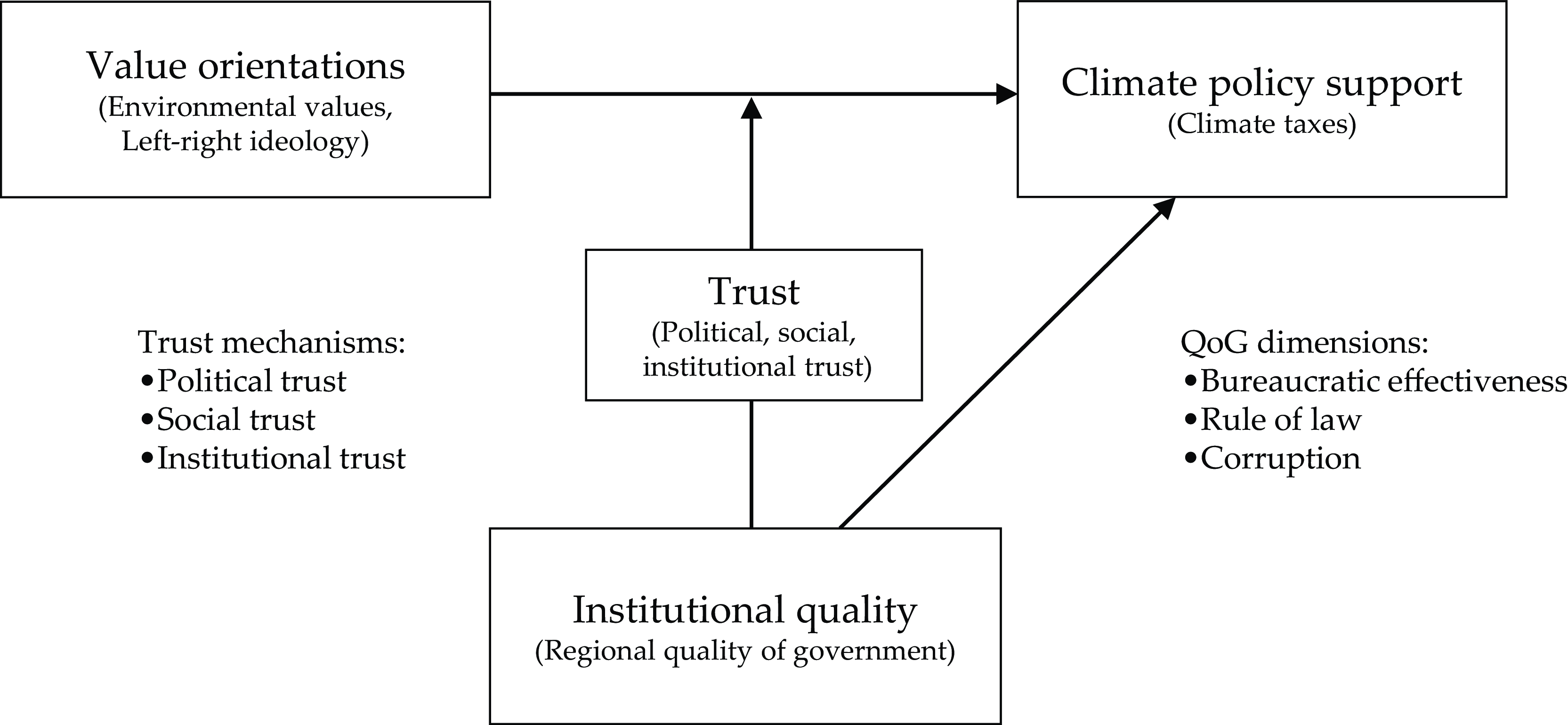
The presumed individual-level mechanisms behind the direct and moderating effect of QoG include levels of social, political, and institutional trust, which are intrinsically linked to one of the three aspects of QoG – corruption. Corruption is expected to be the most important aspect of QoG that may severely impact climate tax support. It can be argued to be detrimental for the successful implementation of a climate tax and perceived as the most damaging in the eyes of the public since tax revenues would be lost to self-interested (as opposed to simply less skilled or inefficient) public officials instead of being used for public goods provision.
The other two aspects of QoG, rule of law and bureaucratic effectiveness, are also expected to matter. They relate to mechanisms such as the perceived competence and efficiency of bureaucrats and equality of everyone under the law, implying beliefs that the revenues of a climate tax will be properly and efficiently handled and used for public goods provision, and that all who are subject to the tax will have to comply with it. These mechanisms can be assumed to be interrelated with and affected by the corruption aspect and, similarly to the corruption aspect, are related to perceptions of trust in other people and trust in political and implementing authorities.
To summarize, while the mechanisms related to each of the three dimensions of QoG are admittedly highly intertwined with one another, they are nonetheless distinguishable, and each can be argued to affect trust – in politicians, bureaucrats, and other people, respectively. In order to support climate taxes, citizens need to believe that the tax revenues will be decided upon and handled by politicians without corruption, that other people will pay the taxes, and that the taxes will be properly and efficiently enforced by competent bureaucrats.
The above theoretical model graphically depicts the following three hypotheses:
H1(A): Individuals holding pro-environmental value orientations are generally more supportive of climate taxes than individuals without such orientations.
H1(B): Individuals holding leftist political-ideological value orientations are generally more supportive of climate taxes than individuals holding rightist political value orientations.
H2: Individuals living in regions with high levels of QoG are generally more supportive of climate taxes than individuals living in regions with low levels of QoG.
H3(A): The positive association between pro-environmental value orientations and support for climate taxes is stronger in regions with high levels of QoG.
H3(B): The positive association between leftist political-ideological value orientations and support for climate taxes is stronger in regions with high levels of QoG.
Methodology, data, and operationalization
Data
Since regional-level data on climate policy attitudes is missing, this paper combines individual-level data on climate policy attitudes from the European Social Survey and regional-level data on institutional quality from the Quality of Government Institute. Specifically, the paper employs data from the ESS Round 8 (ESS8) (2016) and the QoG EQI survey (2017) to test the three hypotheses.
The ESS8 data was collected through hour-long face-to-face interviews and includes various survey questions on public attitudes to climate change. The individual-level ESS8 data was merged with the QoG EQI data containing measures of perceptions of institutional quality at the regional level in Europe. In merging the two datasets, 135 regions from the QoG EQI survey were matched to 20,433 individuals in 15 countries in the ESS8 data.Footnote 10
While the sampled data are from different individuals, they come from largely representative samples. Survey weights are applied at both levels of analysis – design weights to control for unequal probability of selection, thus avoiding obtaining estimates that are affected by possible sample selection bias, and population weights to ensure that regions are represented in a fair proportion to their original population size. Conducting the analyses without the weights does not substantively change the observed effects and generates largely the same results, however.Footnote 11
Operationalization of variables
Climate tax support
The dependent variable is public support for climate taxes, captured using one survey item from the following survey question: ‘To what extent are you in favor or against the following policies in [country] to reduce climate change?’. ‘Increasing taxes on fossil fuels, such as oil, gas and coal,’ with five response categories ranging from ‘Strongly in favor’ (1) to ‘Strongly against’ (5). The scale for the item was reversed so that higher scores indicate higher levels of support for the policy. Fossil fuel taxes are typically labeled as energy taxes, but given their climate change mitigation purpose here, they may be considered as one specific kind of climate taxes.
While this survey question can be said to be a concrete measure of attitudes towards climate taxes, it should be noted that the question could be capturing mere ‘acceptability’ or ‘acceptance’ of such taxes rather than actual ‘support’ (Kyselá et al., Reference Kyselá, Ščasný and Zvěřinová2019). Provided that most countries and regions in the sample do not have energy taxes with a specified climate change mitigation purpose in place, it is likely to be measuring acceptability of proposed climate taxes.
Pro-environmental value orientation
To capture pro-environmental value orientation, a survey item asking if respondents identify themselves with a person that cares for nature is employed: ‘Tell me how much each person is or is not like you. She/he strongly believes that people should care for nature. Looking after the environment is important to her/him,’ with response categories ranging from ‘Very much like me’ (1) to ‘Not like me at all’ (6). The scale for this item was reversed so that higher values imply greater care for nature. As an alternative measure, an item capturing respondents’ general concern with climate change is also employed: ‘How worried are you about climate change?’ with response categories ranging from ‘Not at all worried’ (1) to ‘Extremely worried’ (5).
The items were transformed into dummy variables prior to running the multilevel ordered logit analysis (not for the linear multilevel analysis), for methodological reasons. Specifically, to be able to estimate random slopes (i.e. the varying effects of value orientations) and cross-level interactions (between values and regional QoG) simultaneously (see the methods section). This also facilitates hypothesis testing by allowing us to model and compare the policy attitudes of individuals with ‘strong’ versus ‘weak’ environmental values and climate change concern, respectively. Respondents with scores above 3 (i.e., 4–6) on the original scale were assigned to the former category, and those with scores below 4 (i.e., 1–3) to the latter category. Respondents scoring 4 or 5 on the second item were labelled as having ‘strong’ climate change concern, while remaining respondents scoring between 1 and 3 were labeled with ‘weak’ climate change concern.
Though somewhat vague, these measures are clearly distinct from the dependent variable since care for nature and environmental or climate change concern do not automatically translate into willingness to pay for environmental protection (see, e.g., Fairbrother, Reference Fairbrother2016; Smith & Mayer, Reference Smith, Keith and Mayer2018).
Political-ideological value orientation
Political value orientation is measured using a survey question asking respondents about their self-placement on the left–right political spectrum: ‘In politics, people sometimes talk of ‘left’ and ‘right.’ Using this card, where would you place yourself on this scale, where 0 means the left and 10 means the right?’. The scale for the item was reversed so that higher values imply a left-leaning political value orientation, and lower values imply a right-leaning political value orientation.
Similar to the items used to measure pro-environmental value orientation, the item for political value orientation was dichotomized for the multilevel ordered logit analysis for methodological reasons, which facilitates theory testing by allowing us to more easily contrast the policy attitudes of leftist and rightist individuals and those in the middle. Respondents with scores above 5 (i.e., scoring 6–10 on the original scale) were assigned to the category ‘left’ and respondents with scores below 6 (i.e., scoring 0–5 on the original scale) were assigned to the category ‘right/middle.’ The item was not dichotomized for the linear multilevel analysis, and these analyses (including those with environmental values) show substantively the same results.
Political trust and institutional trust
To capture political and institutional trust, items from the survey question: ‘Please tell me on a score of 0–10 how much you personally trust each of the institutions that I read out’ were used. Two measures were created: mean-based indices of political trust (parliament, politicians, and political parties: Cronbach’s α = 0.91) and institutional trust (the legal system, and the police: Cronbach’s α = 0.75), respectively. A measure of trust in the civil service is unfortunately lacking in the ESS8 dataset.
Trust in political actors and institutions (including parliament, political parties, and politicians in general) and trust in more impartial and nonpartisan institutions (such as courts, the police, and the civil service) may partly measure different things, and the five items do appear to load on two different latent variables in a principal component analysis (see also Rothstein & Stolle, Reference Rothstein and Stolle2008; Zmerli & Newton, Reference Zmerli, Newton, Zmerli and van der Meer2017). Therefore, political and institutional trust are measured separately. Higher values on each of the trust indices indicate higher levels of trust.
Social trust
To capture generalized trust in other people, a mean-based index combining data from two survey questions is employed: ‘Generally speaking, would you say that most people can be trusted, or that you can’t be too careful in dealing with people?’ with response categories ranging from ‘You can’t be too careful’ (0) to ‘Most people can be trusted’ (10), and ‘Do you think that most people would try to take advantage of you if they got the chance, or would they try to be fair?’ with response categories ranging from ‘Most people try to take advantage of me’ (1) to ‘Most people try to be fair’ (10) (Cronbach’s α = 0.73).
Regional institutional quality
To capture perceptions of regional-level institutional quality, the only measure currently available of QoG at the regional level in Europe – the QoG EQI Data (2017) – is employed (Charron et al., Reference Charron, Victor and Annoni2019). One advantage with this data compared to the national-level measures used in previous research (e.g., the Corruption Perceptions Index (CPI), the World Bank Estimate of Government Efficiency (WGI), and the International Country Risk Guide (ICRG) indicator of QoG), is that they measure citizens’ perceptions and experiences with QoG, which are central to the theoretical argument, rather than relying on expert assessments. However, it should be noted that citizen-based and expert-based measures of QoG have been found to be largely congruent with one another (see, e.g., Svallfors, Reference Svallfors2013; Charron, Reference Charron2016).
The EQI includes 18 survey questions providing data along three dimensions (or pillars): ‘Quality,’ ‘Impartiality,’ and ‘Corruption’; the latter containing measures of both perceptions and experiences with corruption.Footnote 12 The survey items are limited to three policy areas that are often either governed or administered by sub-national authorities: health care, education, and law enforcement. Hence, climate policy is not among these policy areas, but the survey items capturing corruption perceptions, perceptions of the quality of and impartiality in public services, and whether everyone is treated equally in law enforcement and by tax authorities are all relevant to climate tax support (e.g., where or how tax revenues are spent by government and for the benefit of whom – politicians, the public, the climate – and if the tax applies equally to everyone or if some are able to escape it).
Moreover, we can assume that if citizens perceive corruption as prevalent in health care, education, and law enforcement, through first-hand experiences of corruption in the public sector, they may extrapolate from those experiences and expect corruption to be prevalent in other policy areas. The aggregate EQI measure gives a sense of individuals’ overall perceptions of institutional quality, covering the presumed three dimensions of QoG, defined as the capacity of the state to perform its activities in an efficient (‘Quality’), fair and impartial (‘Impartiality’) manner, and without corruption (‘Corruption’) (Rothstein & Teorell, Reference Rothstein and Teorell2008) – the definition of QoG employed in this paper. Higher values on the index indicate higher levels of regional QoG.
Controls
Three socio-demographic variables (age, household income, and education) and gender are included as individual-level controls. These variables have been shown, in previous research, to have an impact on attitudes to climate change and public support for environmental protection and climate policy instruments (Shwom et al., Reference Shwom, McCright, Brechin, Dunlap, Marquart-Pyatt, Hamilton, Dunlap and Brulle2015).
Higher taxes on fossil fuels can affect regions differently depending on what type of industries form the basis of the economy, and which alternative energy sources that are available. In extension, it also determines the economic impact of such taxes on individuals. Thus, on the individual level, two measures for worrying about the fossil fuel dependency of one’s country and energy being too expensive for many people are also included. In addition, a measure for general political interest is included since this may impact citizens’ knowledge about and support for suggested climate policy instruments.
Two other factors that may affect climate tax support and the theorized moderating effect of QoG include satisfaction with the current government and the economy. These controls may help ameliorate potential bias by avoiding capturing support for current incumbents and citizens’ ideologically preferred parties and concerns about the economy rather than the climate change mitigation purpose of the proposed taxes (particularly among rightists). These factors are employed as additional controls.
The additional individual-level controls are excluded from the main models to avoid overloading them and are instead included together with three regional-level controls, for which data on only a subset of regions are available, in a separate set of models (reported in online Appendix F). The controls include economic development measured as regional gross domestic product (GDP) at purchasing power standard per inhabitant, the number of persons employed in the mining and quarrying sector (in thousands), and regional population density (Eurostat, 2017a; Eurostat, 2017b; ESS ERIC, 2018).
While economic development may be partly endogenous to QoG (low-QoG territories often exhibit lower levels of economic development), it can still be a key confounding factor to control for considering its probable effect on the general population’s ability to pay higher taxes and the prevalence of pro-environmental value orientations in society. Population density is included as a proxy for urban and rural differences across regions, since having a larger rural population (with citizens more likely to be dependent on cars and hence more affected by fossil fuel taxes) may generate aversion to such taxes. Regions with higher employment in the mining sector, including extraction of fossil fuels such as coal, crude petroleum, and natural gas, may have lower levels of support for fossil fuel taxes by posing a threat to jobs in this sector.
Introducing more regional-level controls (e.g., environmental quality) may introduce endogeneity into the models, due to high correlations with QoG or being an outcome of existing policies.Footnote 13 Other confounding contextual-level factors, such as current policy context, are controlled for by including country-fixed effects.Footnote 14
Method: Multilevel regression analysis
The analysis consists of two parts. First, the three hypotheses outlined in the paper on the links between climate policy support and value orientations and QoG, respectively, are probed through hypothesis testing. Second, the paper examines potential mechanisms by dissecting the regional QoG measure and examining the mediating role of trust in an exploratory analysis.
To test the research hypothesis on the interaction effects, multilevel regression models are applied. The intraclass correlation coefficient shows that a substantial amount of the total variation in public support for climate taxes, about 7% in the sample, is between regions and can be explained by clustering effects at the regional level. Ignoring these effects may result in biased regression parameters, underestimated standard errors, and overestimated significance levels (Guo & Zhao, Reference Guo and Zhao2000; Allison, Reference Allison2009).
Given the rather few countries at the highest level, and the complex models estimating both random slopes and cross-level interactions,Footnote 15 two-level multilevel ordered logit models with country-fixed effects are estimated (see Stegmueller, Reference Stegmueller2013; Allison, Reference Allison2009).Footnote 16 Since there is no credible way to test whether the proportional odds assumption in ordinal regression holds in the multilevel modeling framework, linear multilevel models as an alternative modeling approach are also estimated to assess the sensitivity of the results to the model specification. The linear multilevel models are presented in Appendix D, and the results are substantively the same.
To explore potential mediating mechanisms behind the impact of QoG, and whether its effect is mediated through any of the trust variables, generalized structural equation models (GSEM) are adopted to run mediation analyses on observed variables in Stata. Following Zhao et al. (Reference Zhao, Lynch and Chen2010), we move away from Baron and Kenny’s (Reference Baron and Kenny1986) widely used criteria for establishing ‘full, partial or no mediation,’ in interpreting the results of the mediation analyses. Accordingly, a mediation effect is interpreted as present if it fulfills the one and only requirement that the indirect path(s) from the independent variable (in this case QoG) to the dependent variable (in this case climate tax support) is statistically significant. The strength of the mediation is evaluated based on the size of the indirect effect (Zhao et al., Reference Zhao, Lynch and Chen2010).
Finally, the regional QoG measure is disaggregated and separate models are estimated with interactions between pro-environmental and political value orientations and each of the 18 EQI items to identify what dimensions of QoG matter and potential underlying mechanisms.
Results
Descriptive results
Figure 2 shows key descriptive statistics, including the mean support for climate taxes and the regional levels of QoG across the 135 European regions included in the models. While the mean level of support for climate taxes is generally low across regions (see Appendix C, for descriptive statistics), it seems to be positively related to regional QoG. Regions in countries with the highest levels of QoG, including Sweden, Finland, and the Netherlands, score the highest on the mean level of support for climate taxes, whereas regions in countries with the lowest levels of QoG, including Italy, Hungary, and Poland, score the lowest.
Regional quality of government and support for climate taxes. Note: The graph shows the mean level of support for climate taxes by region across different levels of regional QoG. Source: European Social Survey 2016; European Quality of Government Index 2017.
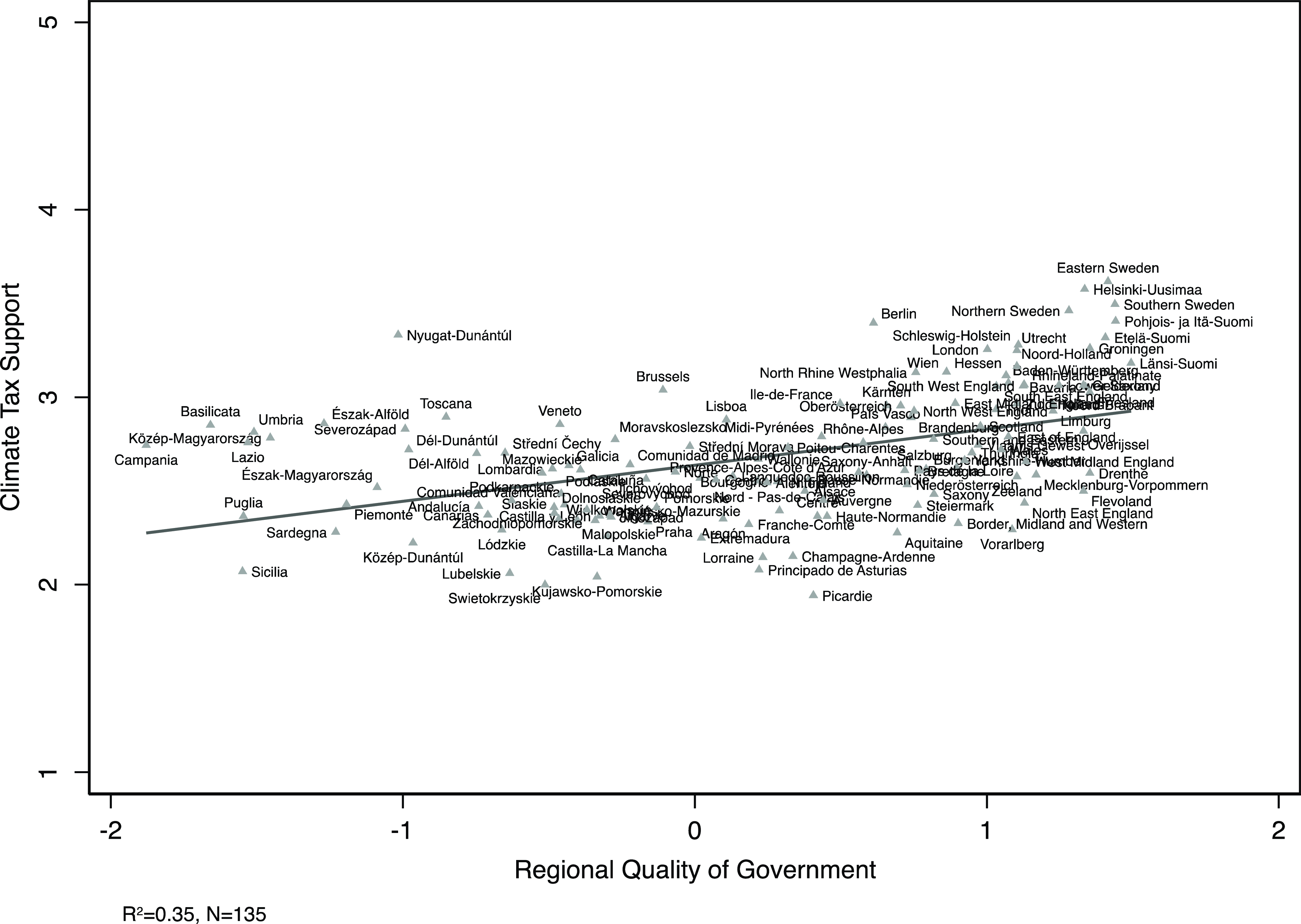
While support for climate taxes across regions is low on average, with the mean level of support being somewhere near ‘somewhat in favor’ of climate taxes (out of five response categories ranging from ‘strongly against’ to ‘strongly in favor’), there appears to be some regional variation. A model with QoG as the only explanatory variable explains about 35% of the variation in the dependent variable (see Figure 2).
Hypothesis testing
The results of the multilevel regression analysis using support for climate taxes as the dependent variable are presented in Table 1. These models are two-level multilevel ordered logit models with country-fixed effects (for the linear multilevel models, see Appendix D). Model 1 is an empty model showing the amount of variance in the dependent variable at the regional level. Model 2 includes regional-level QoG and individual and regional-level controls. Model 3 then includes random slopes for pro-environmental values, whereas model 4 includes random slopes for political value orientation. Models 6 and 7, in turn, add cross-level interactions between regional QoG and environmental values and left-right placement respectively. Reported estimates are odds ratios. An odds ratio higher than 1.00 indicates an increased probability, while an odds ratio lower than 1.00 indicates a decreased probability of being supportive of climate taxes as an independent variable in the model increases by one unit.
Multilevel ordered logit models with country-fixed effects: regional QoG, value orientations and climate tax support
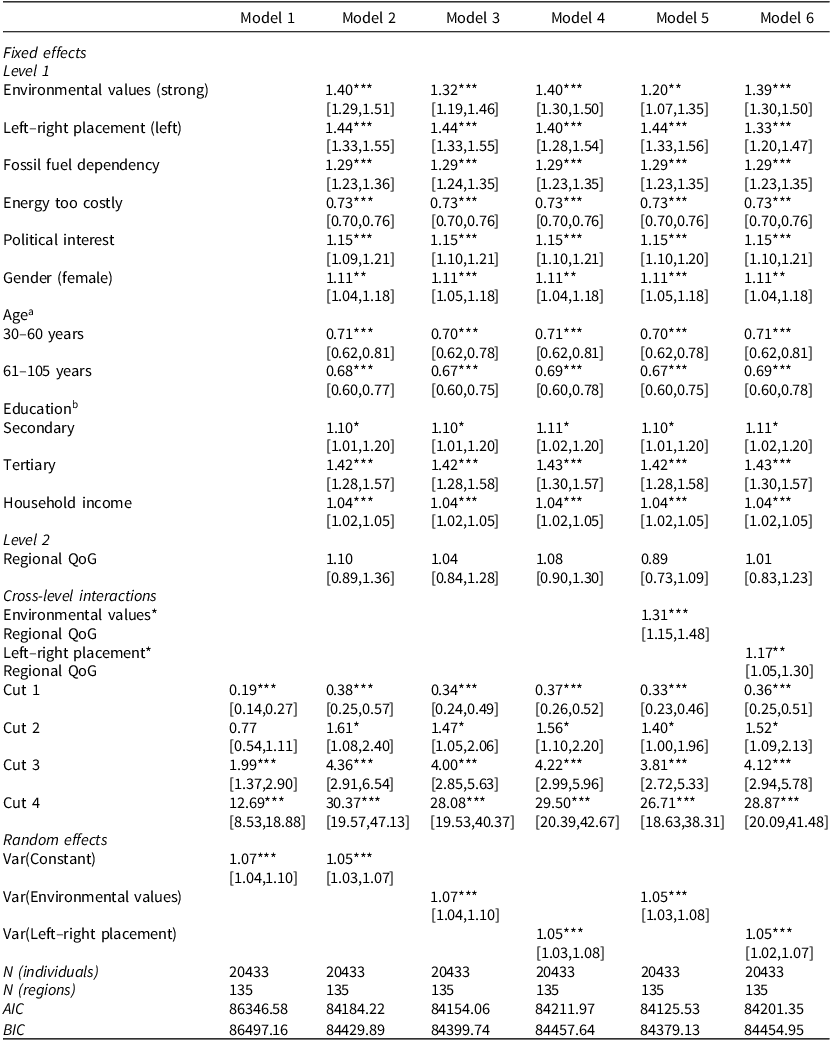
Note: Multilevel ordered logit models estimated using Stata’s meologit command. Estimates reported are odds ratios. Left-right placement and environmental values are dummy variables.
a Reference category: ‘15–29 years,’
b Reference category: ‘Primary.’ Country dummies are included in all of the models, but they are not reported in the table. 95% confidence intervals in brackets. Source: European Social Survey 2016; European Quality of Government Index 2017.
* p < 0.05, ** p < 0.01, *** p < 0.001.
Similar to previous studies, this study finds that individuals holding pro-environmental value orientations are more likely to be supportive of climate taxes than individuals who lack such orientations. It also finds that individuals holding leftist political value orientations are more likely to be supportive of climate taxes than individuals holding rightist political value orientations. Hence, the first hypothesis (H1(A) and H1(B)) is supported by the data. However, it does not find that individuals living in high-QoG regions are more likely to be supportive of climate taxes than people in low-QoG regions. Hence, the second hypothesis (H2) is not supported by the data. This indicates that it is not regional-level QoG per se that matters for public support of a tax policy that in most instances is decided upon on the national level (without room for negotiation whether a climate tax should be implemented or not as opposed to how it should be implemented, which is where regions at least in decentralized countries can be expected to have influence), rather national-level QoG is more important for environmental tax support among populations in general as shown in previous work (Davidovic et al., Reference Davidovic, Harring and Jagers2020).
However, regional QoG appears to matter for certain groups. The data suggest, similar to Davidovic et al.’s (Reference Davidovic, Harring and Jagers2020) study, that there is an interaction effect between pro-environmental value orientation and QoG. Here, the expected positive association between care for nature and climate tax support becomes stronger as the regional-level QoG increases. Similar results are found when using climate change concern as an alternative measure of pro-environmental value orientation (see Appendix E) and including additional controls in the models (see Appendix F).
Figure 3 illustrates this interaction effect, showing the average marginal effects of pro-environmental values at various regional-QoG levels.Footnote 17 While there is no statistically significant difference in climate tax support between individuals with ‘strong environmental values’ and ‘weak environmental values’ at low regional-QoG levels (and individuals with weak environmental values are likely to oppose climate taxes regardless of the level of QoG), ‘strong environmental values’ appear to have a larger effect on increasing support and ‘weak environmental values’ appear to have a larger effect on decreasing support for climate taxes at higher regional-QoG levels when examining their marginal effects.
Marginal effects of pro-environmental values on support for climate taxes. Note: The left-hand graph displays the predicted probabilities of being ‘somewhat in favor’ of ‘increasing taxes on fossil fuels, such as oil, gas and coal’ among respondents with ‘weak’ environmental values and ‘strong’ environmental values respectively at different levels of regional QoG. The right-hand graph displays the average marginal effects of holding strong versus weak environmental values on policy support (i.e., the estimated difference between the two probabilities) with 95% confidence intervals. The marginal effects were estimated from a two-level multilevel ordered logit model with country-fixed effects (Model 5 in Table 1). The employed measure of pro-environmental value orientation has been transformed into a dummy variable where respondents with scores above 3 (i.e., 4–6) have been assigned to the category ‘strong environmental values’ and those with scores below 4 (i.e., 1–3) have been assigned to the category ‘weak environmental values.’ Source: European Social Survey 2016; European Quality of Government Index 2017.
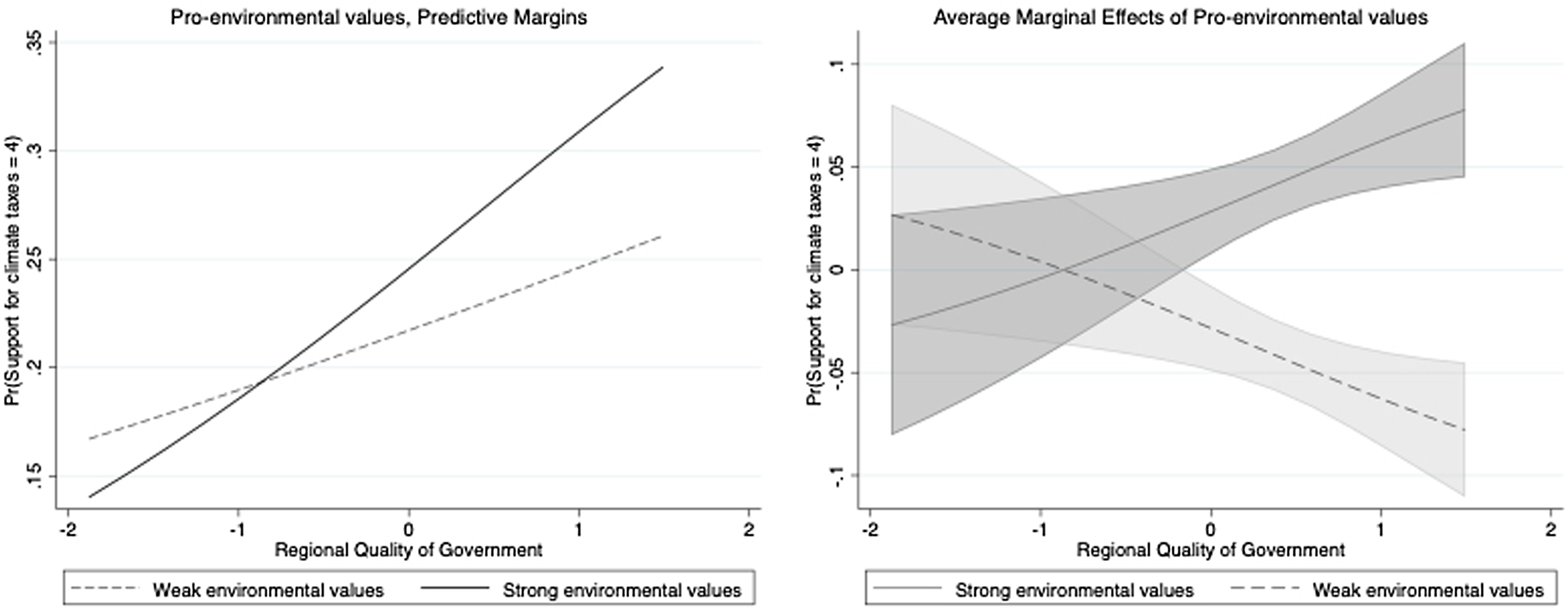
This result can be explained as follows. While people with pro-environmental value orientations are supportive of climate taxes, they do not want to support and provide corrupt, inefficient, and untrustworthy institutions with additional financial resources (i.e., tax revenues) that can end up being used for climate detrimental rather than climate protective purposes. Those with weak environmental values, who do not want tax revenues to go to climate protective purposes (i.e., since they do not support their cause), are less supportive of climate taxes when government institutions are perceived as efficient, uncorrupt, and trustworthy enough to properly implement and enforce, and handle the revenues of, such taxes. When QoG is low and corruption is high, people with strong pro-environmental values appear to be similarly unsupportive of taxes as people with weak environmental values. The latter are unsupportive of the taxes to begin with (and similarly so when corruption is high), whereas the former who are normally supportive of climate taxes and their environmental cause are significantly less supportive in corrupt settings.
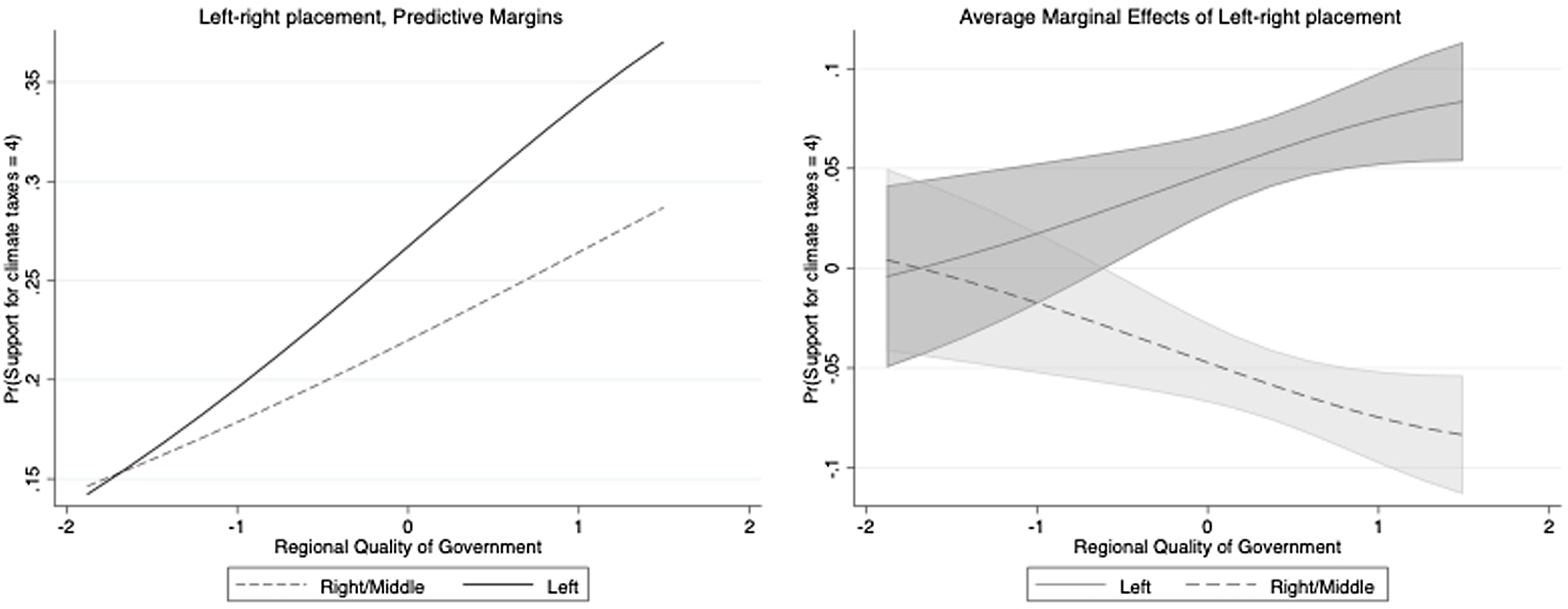
Similarly, it is found that the positive association between leftist political value orientation and climate tax support becomes stronger as the regional-level QoG increases. Figure 4 illustrates this interaction effect, showing the average marginal effects of left–right placement. While there is no statistically significant difference in climate tax support between leftists and rightists and those in the middle at low regional-QoG levels,Footnote 18 ‘leftist’ orientation appears to have a larger effect on increasing support and ‘rightist’ or ‘middle’ orientation appear to have a larger effect on decreasing support for climate taxes at high regional-QoG levels, when examining their marginal effects.
Marginal effects of left–right placement on support for climate taxes. Note: The left-hand graph displays the predicted probabilities of being ‘somewhat in favor’ of ‘increasing taxes on fossil fuels, such as oil, gas and coal’ among respondents who identify themselves as being more towards the ‘right/middle’ and the ‘left’ on the left–right political-ideological scale at different levels of regional QoG. The right-hand plot displays the average marginal effects of holding rightist/middle vs. leftist political-ideological orientations on policy support (i.e., the estimated difference between the two probabilities) with 95% confidence intervals. The marginal effects were estimated from a two-level multilevel ordered logit model with country-fixed effects (Model 6 in Table 1). The employed measure of political ideology was transformed into a dummy variable where respondents with scores above 5 (i.e., 6–10) have been assigned to the category ‘left’ and respondents with scores below 6 (i.e., 0–5) have been assigned to the category ‘right/middle.’ Source: European Social Survey 2016; European Quality of Government Index 2017.
This is unsurprising given that leftists are generally in favor of government regulation and could be expected to be even more so if they perceive government authorities as efficient, impartial, and uncorrupt. Leftists are on average also more environmentally concerned than rightists,Footnote 19 and may therefore show greater support for climate taxes than rightists. Rightists, who are generally in favor of less government intervention and less environmentally concerned than leftists, may, similar to people with weak environmental values, become less supportive of climate taxes when institutional quality is high since they are less supportive of their environmental cause. However, environmental concern is controlled for in the interaction models, which means they are portraying the role of individuals’ ideological stances for support separate from any pro-environmental values they may hold. Hence, the third and final hypothesis (H3(A) and H3(B)) is supported by the data.
The significant interaction effects between regional QoG and environmental values and left-right placement respectively support the theory that people’s perceptions of (sub)national government authorities as reliable, efficient, uncorrupt, fair, and trustworthy, matters for climate tax support, and corroborates previous research findings on the country level. That regional QoG does not appear to have a direct effect, but still has a moderating effect indicating that individuals in general might not be supportive of climate taxes if they live in high-QoG regions, but that QoG conditions the impact of their values on tax support.
However, it is important to point out that the moderating effect of regional QoG is quite modest. While regional-level institutional quality explains some of the variation in support for climate taxes across regions and the varying effects of people’s value orientations on policy support, it does not explain all of the variation.Footnote 20 However, the results do show that regional-level QoG to some extent determines the strength of the association between individuals’ value orientations and their support for climate taxes. More investigations are needed to confirm the potential reasons why various value groups are (un)supportive of taxes in institutional settings with varying levels of institutional quality. Which aspects of QoG that matter for climate tax support, and if individual-level trust mediates these moderating relationships is explored next.
Exploratory analyses
Mediation analyses: trust as mediator of the moderating effect of QoG
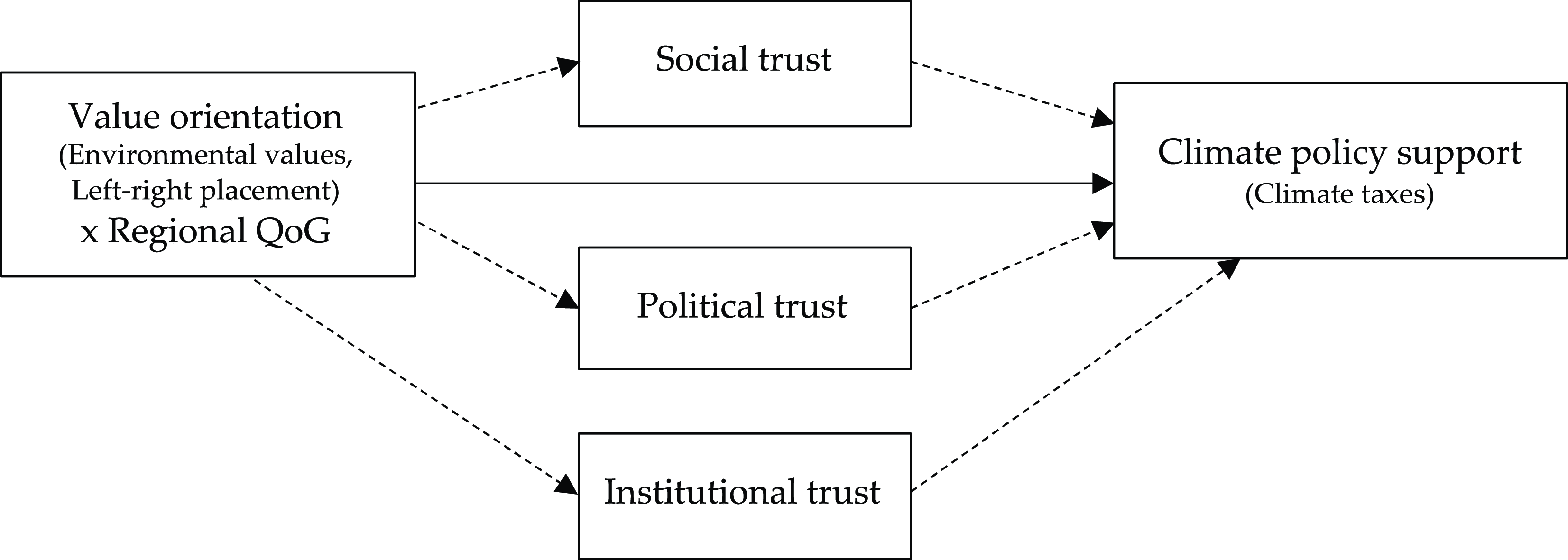
Conducting mediation analysis using two-level multilevel generalized structural equation models, evidence of mediated moderation for both interaction effects is found (a simplified illustration of the mediation model is depicted in Figure 5; for the estimates of the full structural equation models see Appendix G). The moderating effect of regional QoG has an indirect effect on climate tax support through political, social, and institutional trust (Table 2). All three indirect effects are statistically significant, indicating a mediating effect. However, from their rather small effect sizes it appears the mediation is rather weak (Zhao et al., Reference Zhao, Lynch and Chen2010), particularly for institutional and social trust. The mediating effect of political trust appears larger than that of social trust.
The mediated moderation SEM model: a simplified illustration. Note: The figure shows the mediated moderation between regional QoG and value orientations through three types of trust on support for climate taxes. It depicts both the direct effect of the interaction between value orientation and regional QoG and the indirect effect of the interaction through social, political, and institutional trust.
Mediated moderation: regional QoG, values, trust, and climate tax support
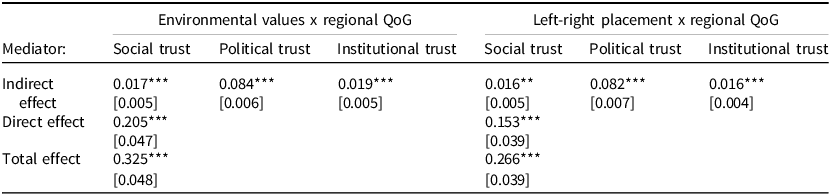
Note: Calculated indirect, direct, and total effects from estimates reported in the multilevel ordered logit SEM models in Appendix G. Robust standard errors in brackets. Direct effect denotes the effect of the interaction on climate tax support. Indirect effect denotes the mediating effect of each type of trust. Total effect denotes the direct and indirect effects combined. Source: European Social Survey 2016; European Quality of Government Index 2017.
* p < 0.05, ** p < 0.01, *** p < 0.001.
It is important to note that the moderate to high correlations between the trust variables, and in particular the correlation between political and institutional trust, can be compromising the significance of their indirect effects due to multicollinearity issues (Preacher & Hayes, Reference Preacher and Hayes2008). One could test each survey item measuring various types of trust one at a time, but this generally requires that the mediators in question do not affect one another (VanderWeele & Vansteelandt, Reference VanderWeele and Vansteelandt2014), which in this case (theoretically) seems unlikely. The effect sizes are also quite small, suggesting that further investigations are needed. Hence, the results of the reported mediation analyses should be interpreted with caution.
That political trust matters more than social trust for climate tax support is consistent with a large literature demonstrating the importance of political trust for environmental and climate policy support (e.g., Hammar & Jagers, Reference Hammar and Jagers2006; Konisky et al., Reference Konisky, Milyo and Richardson2008; Kollmann & Reichl, Reference Kollmann, Reichl, Schneider, Kollmann and Reichl2015; Fairbrother, Reference Fairbrother2016). In contrast to the findings of one study (Fairbrother et al., Reference Fairbrother, Sevä and Kulin2019), the current study does not find any evidence of an interaction effect between political trust and neither environmental values nor climate change concern. However, political trust appears to be a mediator, that is, an underlying mechanism behind the moderating effect of a higher-level contextual factor (QoG), rather than a moderator.
The findings, however, do go in line with the findings of another study that showed weak support of a moderating effect of social and institutional trust on the relationship between climate change risk perceptions and support for climate policies (Smith & Mayer, Reference Smith, Keith and Mayer2018), suggesting that trust may indeed be a mediator instead. Nevertheless, social trust has also been found to strengthen the association between environmental concern and pro-environmental behavior (Tam & Chan, Reference Tam and Chan2018). One plausible explanation for these varying research findings, apart from that they depend on the specific theoretical model in question, is the way trust is measured. The traditional survey questions capturing trust are quite blunt and perhaps measuring trust in a relational and behaviorally specific way (i.e., measuring trust in other people and political institutions to do what – see Bauer & Freitag, Reference Bauer, Freitag and Eric2018) may improve theory testing and facilitate a more accurate interpretation of results.
Dissecting the regional QoG measure
Exploring the 18 individual survey items that make up the three pillars of the EQI (i.e., corruption, impartiality, and quality) (see Appendix B for the individual items) in separate models, between eight and twelve items emerge as statistically significant.
Looking at the interactions of each item with environmental values and left–right placement respectively (see Appendix H and Appendix I, respectively), the following EQI items are statistically significant: impartiality in public education, quality of and impartiality in public health care and law enforcement, corruption in the police force and in public education and health care systems, corruption used to gain access to basic public services (need corruption) and special unfair privileges and wealth (greed corruption), paying a bribe and being asked to pay a bribe.
Based on the effect sizes of the items, their significance levels, and the relative number of statistically significant items among the three pillars, the corruption dimension of QoG sticks out as a significant predictor of climate tax support both among people with pro-environmental value orientations and leftist political value orientations, but more analyses to confirm this are needed. Interactions with EQI items that did not turn out statistically significant, neither for environmental values nor left–right placement, include the quality of and impartiality in public education, impartiality in treatment of citizens by tax authorities, and the prevalence of corruption in elections.
These correlations suggest that trust in authorities to which tax revenues can be expected to trickle down and trust in enforcing government authorities like the police, are more important for climate tax support than trust in the tax authorities collecting the revenues. Alternatively, they indicate that trust in political institutions and that tax revenues will be used for public goods provision, including the provision of high quality and impartial health care and education, matters. They suggest that where corruption is prevalent in society – and citizens cannot expect proper and impartial enforcement of laws and regulations, and corruption is needed to attain basic public services and can be used to attain special advantages through, for example, bribing the police, education and health services, and governmental agencies – support for climate taxes even among those who care for nature and are concerned about climate change, and those who are typically in favor of government regulation can be expected to be low.
Conclusion
To date, carbon taxes have mainly been implemented on the national level. However, to scale up and harmonize climate change mitigation efforts, policy initiatives at the regional and local levels will be imperative. Climate change mitigation taxes may increasingly be implemented on the sub-national level to reach emission targets and close the climate policy gap. Moreover, to ensure the effectiveness and fairness in the implementation of such taxes they may need to be tailored to the institutional context at hand and combined with other climate policy instruments at different levels.
That regions have been largely missing in analyses of climate policy attitudes, perhaps due to the unavailability of regional data but also to the disregard of the importance of this level in public opinion research, is unfortunate. Regions have varying degrees of administrative capacity and quality to impose various climate change mitigation policies. Some regions may offer ‘pockets of effectiveness’ (McDonnell & Vilaça, Reference McDonnell, Vilaça, Bågenholm, Bauhr, Grimes and Rothstein2021) or ‘islands of good government’ (Drápalová & Di Mascio, Reference Drápalová and Di Mascio2020), that may help to enhance public support for climate change taxes and ensure their successful and effective implementation in otherwise corrupt and inefficient institutional settings.
Building on recent findings in the literature providing initial evidence of that individuals’ value orientations may not translate into favorable attitudes towards climate policy (e.g., Smith & Mayer, Reference Smith, Keith and Mayer2018; Tam & Chan, Reference Tam and Chan2018; Fairbrother et al., Reference Fairbrother, Sevä and Kulin2019), and that lacking trust and QoG may explain this (Davidovic et al., Reference Davidovic, Harring and Jagers2020; Davidovic & Harring, Reference Davidovic and Harring2020), this paper set out to test the direct and moderating effect of QoG on the regional level. With the larger level-two N in the form of regions and lower risk of omitted variable bias than in previous country-level studies (e.g., Harring, Reference Harring2016; Davidovic et al., Reference Davidovic, Harring and Jagers2020; Kulin & Johansson Sevä, Reference Kulin and Johansson Sevä2021), this study provides a more robust test of whether the theorized moderating relationship exists. The study confirms that QoG moderates the strength of the association between value orientations and climate tax support (Davidovic et al., Reference Davidovic, Harring and Jagers2020), showing that pro-environmental and leftist political value orientations are more strongly linked with public support for climate taxes in high-QoG regions than in low-QoG regions. In low-QoG regions, the links between these value orientations and tax support are weakened. Further analyses are needed to confirm the observed interactions.
Taking the analysis one step further and examining which aspects of QoG that matter and why QoG has this moderating effect, it is found that corruption may have a particularly detrimental impact on the presumed positive influences of such value orientations on climate tax support. The results of the mediation analyses suggest that trust, and political trust in particular, may explain the moderating effect of QoG. The analysis demonstrates that separating out the effects of political and institutional trust in particular is difficult, however, suggesting that adopting behavior-specific measures of trust in political actors and institutions and other people may facilitate interpretation of results (see Bauer & Freitag, Reference Bauer, Freitag and Eric2018). Examining all the possible causal pathways through which QoG may impact the effect of value orientations (and other individual-level factors not explored here) on climate tax support is beyond the scope of this paper, and which exact individual-level mechanisms explain the moderating effect of QoG needs further investigation. Both quantitative and qualitative research is needed, and potential approaches are elaborated further below. This is the first study to explore if regional-level QoG explains variation in climate policy support, and as demonstrated, it can be a useful strategy for analyzing the role of contextual-level factors in determining citizens’ policy attitudes, perhaps also beyond the climate policy domain. Whether similar moderating effects hold for other types of climate policy instruments and in other policy domains and institutional settings is an avenue for future research. Cross-sectional analyses in European countries and beyond, at national-, regional-, and local levels, may further help in identifying additional patterns in policy attitudes.
That said, with analyses using cross-sectional data the ability to make causal inferences and draw conclusions across both space and time is limited. In fact, they do not allow us to draw causal inferences. This is the main limitation of the current study; the observed relationships are correlational. Further explorations of the interactions investigated in this paper and other potential moderating effects, including attitudes towards other policy instruments, are needed using data over time. Attitudinal data containing appropriate measures of policy support are still missing (Oehl et al., Reference Oehl, Schaffer and Bernauer2017). This paper encourages the collection of more individual-level data on citizens’ attitudes towards climate policies and institutional quality over time and across regions. Other methodological approaches, including time-series analyses and experiments may be adopted, in order to establish causality and identify underlying individual-level mechanisms behind observed relationships (see, e.g., one recent survey experiment on corruption and carbon taxes by Davidovic, Reference Davidovic2024). Qualitative approaches, such as interviews with focus groups or text analyses of open-ended survey questions, can help provide both complementary and in-depth insights on the individual-level mechanisms at play, and potential interaction effects between, for example, respondents’ QoG perceptions and their value orientations in various institutional settings.
The study corroborates previous research findings that both QoG and political trust are significant predictors of public attitudes towards climate change mitigation policies, and climate taxes in particular, and need to be taken into account when designing and implementing climate taxes. In corroborating theoretical expectations, and adding several new layers, it shows that QoG is a factor that needs more attention since it also plays a role in moderating the effects of individual-level factors. Until now, QoG has been largely ignored by both economists and political scientists studying public opinion and climate policy support,Footnote 21 possibly because such institutional factors are difficult to change. While improvements of institutional quality take time, political trust fluctuates more over time and can perhaps be improved in a shorter period of time. The study shows theoretically and empirically that QoG cannot and should not be separated from research endeavors on how to increase public support for climate change mitigation policies, particularly given the progressively declining levels of political trust in Europe and worldwide (Lamb & Minx, Reference Lamb and Minx2020).
The findings in this study suggest that without a sufficient level of institutional quality (QoG), imposing climate taxes internationally might not be politically feasible despite the public’s otherwise pro-environmental values and concerns and favorable preferences for state intervention. This has important policy implications. Without a sufficient level of public support, climate taxes (a form of state intervention and government regulation of the behaviors of individual consumers, business actors and industries) may not be effectively or at all implemented if citizens perceive the state as inefficient, partial, and unfair, but most importantly it seems, as untrustworthy and corrupt. This does not mean that taxes should be abandoned altogether in corrupt settings, but suggests that other combinations of climate policy instruments to mitigate climate change are more appropriate. Democratic leaders who choose to implement policies going against public opinion face the risk of electoral punishment and of undermining their political legitimacy in the long-term (Wallner, Reference Wallner2008). This also potentially jeopardizes the ability of policymakers to implement and pair carbon taxes with other sufficiently stringent policy instruments in long-term climate policy programs.
The current study has focused on examining attitudes towards carbon or fossil fuel taxes, but there are many other types of environmental and climate taxes (including, e.g., energy taxes on energy consumption, transportation taxes on aviation tickets and vehicle use, pollution taxes on the use of plastic bags, and environmental taxes on meat and dairy consumption). The findings of this study may not be directly generalizable to these other types of climate and environmental taxes, despite their collective goals of generating environmental protection and inducing more climate-friendly behaviors. While carbon taxes may be directed at businesses or industries rather than individual consumers, public aversion towards environmental taxes directed at consumers specifically may be higher. Future studies may want to explore if varying targets of the climate taxes impacts policy support (see Harring, Reference Harring2016), and if similar patterns observed in this paper hold for other types of taxes. They may also want to examine the individual-level mechanisms behind public support for various types of policy instruments and among different value groups.
This study, by dissecting the various components of QoG, and analyzing trust as a mediating mechanism, provides a better understanding of the role of QoG in explaining public attitudes towards climate taxation and sets the stage for more nuanced analyses of climate policy support. It demonstrates that QoG plays a moderating role in the relationship between value orientations and support for climate taxes, highlights the potentially significant role of corruption, and that low political trust may explain the observed moderating relationship. In continuing this research agenda, more specific practical advice for policymakers on how to increase public support for climate taxes and improve policy designs to mitigate policy concerns across different segments of the population can be developed. This can increase policy legitimacy, support, and political feasibility as well as guarantee more longevity of policy programs, or provide an indication of when policymakers should simply resort to other policy solutions. While climate taxes are considered as one way to efficiently decrease carbon emissions, they also need to work properly and in combination with other climate policy instruments. In some cases, climate taxes may simply not work as efficiently or be politically infeasible depending on institutional factors.
Supplementary material
The supplementary material for this article can be found at https://doi.org/10.1017/S1755773924000365.
Acknowledgements
The author would like to thank Natalia Alvarado Pachon and Richard Karlsson at the Quality of Government Institute for data assistance. She would also like to thank Sverker C. Jagers and Marcia Grimes for their guidance and continued support, Nicholas Charron, Monika Bauhr, Anna Bendz, and other scholars affiliated with the Quality of Government Institute for helpful comments on various versions of the manuscript, and several anonymous reviewers and editors for their comments and suggestions, which significantly helped improve the paper.
Competing interests
The author declares that she has no known competing financial interests or personal relationships that could have appeared to influence the work reported in this paper.


 Open access

