



INTRODUCTION
Salmonellosis is a common infectious disease occurring individually and in outbreaks worldwide. Every year, Salmonella enterica is estimated to cause 1·2 million illnesses in the United States and to be the leading cause of hospitalizations and deaths from foodborne disease [Reference Scallan1]. In China and Sichuan Province, salmonellosis is the most common infectious bacterial diarrhoeal disease [Reference Zhou2, Reference Liu3]. The main serovar types are S. Enteriditis and S. Typhimurium [Reference Jackson4, Reference Chen5]. Outbreaks of S. Typhimurium infection occur frequently in schools in Sichuan Province [Reference Chao6, Reference Xu7]. On 13 June 2013, a local hospital reported to the Dongpo District Center for Disease Control (CDC) that about 70 students in one school were admitted to the hospital with an illness characterized by fever and diarrhoea. We immediately took the following actions to control the outbreak: sent the cases to the hospital for further diagnosis and treatment; cleaned and disinfected the school dormitory and canteen; conducted an investigation to identify the source of infection, mode of transmission, and risk factors for this outbreak; and collected samples from nine cases, 18 reserved foods of the last 6 meals, and 34 drinking fountains. All samples were inoculated on Shigella-Salmonella and common agar cultures of enteric bacterial pathogens, including Shigella, Salmonella, and Escherichia coli. Slide agglutination tests were used to identify the suspected bacteria, and later the serotype of Salmonella. At the same time, we fulfilled a case-control study; six stool and two food (cowpea salad and sticky rice dumpling) samples were discovered to be culture-positive for S. enterica serotype Typhimurium [Reference Yang8]. The outbreak was therefore diagnosed as salmonellosis. The later DNA analysis of all eight S. Typhimurium strains were cut by XbaI enzyme, and cluster analysis was performed by pulsed-field gel electrophoresis (PFGE), and showed the same PFGE patterns [Reference Yang8].
SUBJECTS AND METHODS
Case definition
A suspected salmonellosis case was defined as the onset of diarrhoea (>2 times per day), vomiting, or abdominal pain occurring in students, teachers, or staff members of the school during 10–17 June 2013. A probable case was defined as the onset of diarrhoea (>3 times per day) or fever (>37·5 °C) plus at least one of the following symptoms: nausea, vomiting, or abdominal pain. A confirmed case was a suspected or probable case plus culture confirmation of S. Typhimurium infection from stool specimen or rectal swab. We searched cases by reviewing medical records in hospitals and interviewing staff and students.
Case-control study
We enrolled 81 probable or confirmed case students and 104 asymptomatic control students in years 7 and 8. We conducted face-to-face interviews and collected data regarding the time of onset, symptoms, and suspected water and food exposure on 12 June.
Statistical method
Univariate analysis was used to compare the age and gender distributions between the case and control students. The odds ratio (OR) was calculated to assess risk factors. Statistical analyses were performed using Epi Info v. 3.3 (CDC, USA). Statistical significance was defined as P < 0·05, and all P values were two-tailed. Respondents who did not answer a specific question were not included in the analysis for that exposure.
Field investigation
A food hygiene survey was conducted to identify the possible factors that were associated with the outbreak, especially regarding the food preparation process in the school canteen. We asked the cooks how the food was prepared and stored, including how the food containers and utensils were cleaned.
RESULTS
Of 1246 students and 22 cooks in the school, 399 students [attack rate (AR) 32%] and two cooks (AR 9·1%) had an illness consistent with the case definition (208 suspected, 187 probable, 6 confirmed). No case was found among the teachers. Of 401 cases, the most common clinical symptoms were fever (95%), dizziness (72%), diarrhoea (56%), headache (51%), fatigue (39%), abdominal pain (38%), and nausea (22%). All cases were sent to one of three hospitals for diagnosis and treatment, and recovered fully in 1–4 days without any deaths.
The first case (a student) was reported on 12 June. The number of cases increased quickly and reached a peak on 13 June, then decreased on 14 June. The epidemic curve suggested a point-source exposure. After being notified about the outbreak, the local public health authority disinfected the school canteen and dormitory on 13 and 14 June (Fig. 1).
Epidemic curve at 4-h intervals in a school with a Salmonella Typhimurium outbreak in Sichuan Province, China, 2013. CFETP, Chinese Field Epidemiology Training Programme.

All of the case students were enrolled in the nursery to year 9. There were no cases reported among students enrolled in years 10–11 (high school; Table 1). The ARs differed between years and departments (χ 2 = 198, P < 0·01), but did not differ significantly between male (AR 42%, 262/629) and female students [AR 43%, 137/315; relative risk 0·96, 95% confidence interval (CI) 0·82–1·1] from years 0 to 9.
Attack rates by school grade in a salmonellosis outbreak at a school in Sichuan Province, China 2013

* Year 12 students have graduated.
The students and teachers drank city water from water fountains installed in the teaching building and dormitory rooms. The water fountains provide boiling water (>90 °C) and boiled water (40 °C).
The school is a boarding school and has a canteen for all students and some teachers. The canteen provides three or four dishes for each meal. After preparation in the same place, each dish or food is kept in two containers (one for the high-school students and one for the other students), and then transported to three different food halls before the set mealtime. The three food halls were designated for high school (years 10–12) students, secondary school (years 7–9) students and teachers, and nursery and primary school (years 0–6) students, respectively.
Subtracting a 12–36 h incubation period for S. Typhimurium from the median onset at 19:00 hours on 13 June, the most probable exposure period for the cases was 07:00 hours on 12 June to 07:00 hours on 13 June. Thus, the suspected meals included breakfast, lunch, and dinner on 12 June. A total of 10 dishes (not including rice) were provided on 12 June.
Based on univariate analysis of the case-control study, 85% of case students consumed cowpea salad compared to 60% of control students (OR 3·1, 95% CI 1·3–7·8). Forty-six percent of case students had sautéed cabbage compared to 27% of control students (OR 2·0, 95% CI 0·97–4·0; Table 2). The other foods did not appear to have an apparent relationship with the onset of the disease. Based on multivariate analysis, we stratified the two suspected risky foods and compared them alone to the reference group. Cowpea consumption was associated with the illness (OR 4·3, 95% CI 1·2–19); however, the cabbage was not (OR 3·5, 95% CI 0·53–24; Table 3).
Risk of salmonellosis by exposure in 81 cases and 104 controls at a school in Sichuan Province, China, 2013

OR, Odds ratio; CI, confidence interval.
Stratified analysis comparing cowpea salad to cabbage in Meishan City, Sichuan Province, China, June 2013
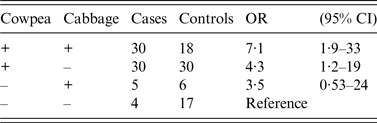
OR, Odds ratio; CI, confidence interval.
We interviewed the cooks about the process of preparing the cowpea salad. The cowpea salad was prepared at 08:00 hours on 12 June. After boiling for 2–3 min, the cooked cowpeas were transferred into two containers (buckets), mixed with garlic, salt, and other condiments, and then stored at room temperature (>27 °C) for about 3 h before lunch. The buckets were 70–80 cm in diameter and 100 cm deep. One bucket of cowpea salad was provided to the high-school students in one food hall, and another bucket was provided to the other students and teachers in the other food halls. Only tap water was used to clean the buckets that day (12 June). The cook could not remember clearly what the containers were used for previously, but admitted that it was possible that the buckets were used to store uncooked food (raw meat or chicken) because of the limited number of containers available. The school canteen did not have any strict rules regarding food hygiene.
DISCUSSION
The case-control study showed that cowpea salad was most likely the major food implicated in the salmonellosis outbreak. Indeed, 85% of the cases consumed cowpea salad before illness onset. We cultured the same S. Typhimurium from the sample of the cases and the cowpea salad, which was provided to the students for lunch on 12 June [Reference Yang8]. These two pieces of evidence support that cowpea salad was the major food vehicle of this outbreak.
The cooked cowpea salad was kept in two separate buckets for 3 h at room temperature until lunchtime. Only one bucket of the cowpea salad (which was provided to year 0–9 students) caused the outbreak, thus it is apparent that this bucket was contaminated by S. Typhimurium. Inevitably, the Salmonella had 3 h to multiply in the cowpea salad. The literature shows that raw pork or chicken can carry Salmonella [Reference Kuhn9–Reference Wang12]. We suspect that the bucket was used to store raw meat or vegetables [Reference Horby13] and was not disinfected prior to use for the cowpea salad. Therefore the original contamination of S. Typhimurium probably came from raw pork or chicken or vegetables. We also collected samples from the same pork and chicken sellers after the case-control study results, but did not achieve a positive result.
In China, regulations on food preparation in school canteens exist. In fact these regulations prohibit school canteens supplying cold food, like cowpea salad, and specify the use of separate containers for raw and cooked foods. However, these regulations have not been fully implemented due to insufficient enforcement and lack of coordination between the public health and educational departments. In this outbreak, we found that the canteen in this school not only supplied cold food (cowpea salad) to students, but also used food containers for both raw and cooked food at different times without complete disinfection.
S. Typhimurium was isolated from another food sample (sticky rice dumpling) at the same time. The dumplings are usually eaten during the Dragon Boat Festival (12 June 2013). Sticky rice dumpling is made of sticky rice and red beans, wrapped in bamboo leaves, and boiled for several hours. The school canteen bought the dumplings in the afternoon on 11 June, and stored them at room temperature for 15 h. Before breakfast on 12 June, the dumplings were steamed for more than 30 min. The students recalled that the dumplings were still warm when eaten. When heated twice prior to consumption, bacteria, like Salmonella, might not survive and multiply. Our case-control study also shows that dumplings were not the risky food (OR 0·50, 95% CI 0·11–2·1). High-school students ate the same dumplings, but did not develop any illness. Thus, the traditional sticky rice dumpling was not the source of this outbreak. But why and when did the reserved food become contaminated? We suspect that it was probably cross-contaminated by the hands of a kitchen worker, flies, or utensils. This proves that on the morning of 12 June, the S. Typhimurium polluted not only one container, but also other utensils or kitchen workers. Cross-contamination of utensils and containers has been documented in Chinese school canteens [Reference Du14], and in fact, some studies have shown that large containers, such as buckets in this case, are contaminated more often compared to small utensils [Reference Qi15].
Reserving samples from every dish for 72 h is another provision for school canteens, which enables us to isolate S. Typhimurium from reserved dishes, and to obtain additional evidence to confirm the risky dish. The provision applies to canteens, restaurants, and special activities in China, and according to our experience it is useful when positive results are generated, but not useful with negative results. In this outbreak, if the reserved cowpea salad sample had been taken from the bucket sent to the high-school students (mostly negative results) and the only positive result had been from the sticky rice dumpling, the microbial and case-control data would have been diametrically opposed, making interpretation difficult.
The high risk for illness from eating both cowpea salad and sautéed cabbage compared to the absence of risk for eating sautéed cabbage alone, indicates that the cabbage might have had a synergistic effect on the occurrence of the illness. Although the method of preparing cabbage would not permit Salmonella survival to occur once, there is little chance that cabbage would be contaminated by multi-use buckets and cause the remaining 15% of cases who were not exposed to cowpea salad.
The findings in this report are subject to the following limitations. First, no materials, like raw pork or chicken, remained available for testing, and the pork samples we collected at the seller after the outbreak tested negative for S. Typhimurium. Second, some students could not recall exactly which foods they had or had not consumed. Third, other possible routes of contamination (dumplings and food handlers) could not be excluded. Fourth, the case numbers may appear inflated in comparison to other similar outbreaks with stricter case definitions.
In light of the findings from this investigation, we recommend that all school canteens in China should follow all health provisions and be provided with safe dishes. Utensils should be cleaned carefully before and after use with hot water and soap. Further, buckets or food containers should be used exclusively for uncooked or cooked foods and clearly marked. Additionally, school canteens staff should pay more attention to the preparation and storage of dishes.
ACKNOWLEDGEMENTS
We are indebted to Jun Len, Xiaoping Zhu, and Dan Chen for their help during the outbreak investigation and to George Conway for his comments and suggestions on manuscript preparation.
DECLARATION OF INTEREST
None.



