





Introduction
In a time marked by multiple concurrent crises, the world faces a growing number of displaced people (UNHCR, 2024). Refugees and asylum seekers (RAS) are confronted with numerous stressors, such as exposure to conflict, unsafe migration conditions, separation from social networks, or uncertain asylum procedures (Priebe, Giacco, & El-Nagib, Reference Priebe, Giacco and El-Nagib2016). Research on the mental health of RAS consistently shows substantial rates of post-traumatic stress disorder (PTSD) and depression (Blackmore et al., Reference Blackmore, Boyle, Fazel, Ranasinha, Gray, Fitzgerald and Gibson-Helm2020; Fazel, Wheeler, & Danesh, Reference Fazel, Wheeler and Danesh2005; Hoell et al., Reference Hoell, Kourmpeli, Salize, Heinz, Padberg, Habel and Bajbouj2021; Lushchak et al., Reference Lushchak, Velykodna, Bolman, Strilbytska, Berezovskyi and Storey2024; Morina, Akhtar, Barth, & Schnyder, Reference Morina, Akhtar, Barth and Schnyder2018; Steel et al., Reference Steel, Chey, Silove, Marnane, Bryant and van Ommeren2009). Impaired mental health can hinder integration processes (Hoell et al., Reference Hoell, Kourmpeli, Salize, Heinz, Padberg, Habel and Bajbouj2021). The host country's complex healthcare system lacking culturally sensitive treatment options also constitutes a potential post-migration stressor (Langlois, Haines, Tomson, & Ghaffar, Reference Langlois, Haines, Tomson and Ghaffar2016; Priebe et al., Reference Priebe, Giacco and El-Nagib2016). Conversely, health systems can become burdened by an increasing number of patients with specific mental health needs they are not prepared for (Berwick & Shine, Reference Berwick and Shine2020; Jefee-Bahloul, Bajbouj, Alabdullah, Hassan, & Barkil-Oteo, Reference Jefee-Bahloul, Bajbouj, Alabdullah, Hassan and Barkil-Oteo2016). In Germany, RAS show elevated levels of psychological distress, with higher rates in older refugees, those living in refugee accommodation and those under threat of deportation (Walther et al., Reference Walther, Kröger, Tibubos, Ta, von Scheve, Schupp and Bajbouj2020). Anxiety and depressive symptoms are associated with specific post-migration stressors, such as material stressors, dire current living conditions, and/or discrimination (Behrendt et al., Reference Behrendt, Vervliet, Rota, Adeyinka, Uzureau, Rasmussen and Derluyn2023; Schilz et al., Reference Schilz, Kemna, Karnouk, Böge, Lindheimer, Walther and Bajbouj2023).
Additionally, help-seeking behavior of RAS is often relatively low (Byrow, Pajak, Specker, & Nickerson, Reference Byrow, Pajak, Specker and Nickerson2020). Barriers to service-seeking include limited mental health literacy, stigma, and structural reasons such as language barriers, financial hardship, lack of health insurance or unfamiliarity with local support systems (Byrow et al., Reference Byrow, Pajak, Specker and Nickerson2020). Moreover, lacking trust in authorities can impair help-seeking behavior (Byrow et al., Reference Byrow, Pajak, Specker and Nickerson2020). This underlines the need for accessible, culturally sensitive treatment options for RAS (Jefee-Bahloul et al., Reference Jefee-Bahloul, Bajbouj, Alabdullah, Hassan and Barkil-Oteo2016; Priebe et al., Reference Priebe, Giacco and El-Nagib2016). Such treatments - e.g. Self-Help Plus (SH+), Group Problem Management Plus (gPM+), and the Step-by-Step digital intervention - have been tested in large randomized, controlled trials (RCT) for RAS from the Middle East/North Africa (MENA) region resettled in various countries, such as Turkey, Jordan, Lebanon, and Western European countries (Acarturk et al., Reference Acarturk, Uygun, Ilkkursun, Yurtbakan, Kurt, Adam-Troian and Fuhr2022; Cuijpers et al., Reference Cuijpers, Heim, Ramia, Burchert, Carswell, Cornelisz and El Chammay2022; Purgato et al., Reference Purgato, Carswell, Tedeschi, Acarturk, Anttila, Au and Barbui2021).
The Mental Health in Refugees and Asylum Seekers (MEHIRA) study, a multicentered, randomized, controlled trial evaluated the effectiveness of a Stepped Care and Collaborative Model (SCCM), in which participants were allocated to different mental health interventions explicitly developed for refugees in Germany according to the severity of depressive symptoms (Böge, Karnouk, Hahn, Demir, & Bajbouj, Reference Böge, Karnouk, Hahn, Demir and Bajbouj2020a, Reference Böge, Karnouk, Hahn, Schneider, Habel, Banaschewski and Bajbouj2020b; Böge et al., Reference Böge, Karnouk, Hoell, Tschorn, Kamp-Becker, Padberg and Bajbouj2022). These included a watchful waiting approach at Level 1, app-based or peer-to-peer interventions at Level 2, group therapy at Level 3, and individual psychotherapy and/or psychotropic medication at Level 4. SCCM combines various high- and low-threshold interventions with collaborative elements, resulting in more individualized treatment schemes (Bower & Gilbody, Reference Bower and Gilbody2005). This follows the recommendations of the pyramid for mental health care provision of the World Health Organization (WHO), which aims to reduce stigma and improve access resource-efficiently (Funk et al., Reference Funk, Lund, Minoletti, Pathare, Flisher, Drew and Hughes2009). The MEHIRA study showed a significant, cost-effective reduction of depressive symptoms, demonstrating a model for providing mental health services in circumstances where resources are limited (Böge et al., Reference Böge, Karnouk, Hoell, Tschorn, Kamp-Becker, Padberg and Bajbouj2022).
Nonetheless, the dropout rate in MEHIRA was high, with 41.7% of participants attending less than 50% of treatment sessions (Böge et al., Reference Böge, Karnouk, Hoell, Tschorn, Kamp-Becker, Padberg and Bajbouj2022). Dropout is a common challenge in clinical studies and health system research, hindering a broader dissemination of treatments that would otherwise be effective (Swift & Greenberg, Reference Swift and Greenberg2012). It has been investigated widely in Western populations, with an average of 20% of participants dropping out of psychological interventions, although rates vary enormously (0% to 74%) (Swift & Greenberg, Reference Swift and Greenberg2012). Reasons for dropout are manifold and can be divided into patient, treatment, therapist, or study design-related variables (Semmlinger & Ehring, Reference Semmlinger and Ehring2022). In Western populations, dropout from cognitive-behavioral therapy (CBT) based interventions have been shown to depend on the patient's diagnosis, medium and setting of treatment delivery, and the number of sessions (Fernandez, Salem, Swift, & Ramtahal, Reference Fernandez, Salem, Swift and Ramtahal2015). Dropout rates from psychotherapy studies have been estimated to be at around 20% (Cooper & Conklin, Reference Cooper and Conklin2015).
Dropout negatively affects patients, healthcare providers, and the health system (Semmlinger & Ehring, Reference Semmlinger and Ehring2022). In patients, chronification or exacerbation of symptoms and decreased trust in healthcare systems may occur (Barrett et al., Reference Barrett, Chua, Crits-Christoph, Gibbons, Casiano and Thompson2008). Additionally, treatment withdrawal can strain health system resources (Barrett et al., Reference Barrett, Chua, Crits-Christoph, Gibbons, Casiano and Thompson2008; Swift, Greenberg, Whipple, & Kominiak, Reference Swift, Greenberg, Whipple and Kominiak2012), an issue especially relevant in the resource-limited context of healthcare provision for RAS (Jefee-Bahloul et al., Reference Jefee-Bahloul, Bajbouj, Alabdullah, Hassan and Barkil-Oteo2016; Priebe et al., Reference Priebe, Giacco and El-Nagib2016).
Generally, current studies investigate dropout in psychological interventions for RAS as a secondary outcome in treatment efficacy studies (Semmlinger & Ehring, Reference Semmlinger and Ehring2022). However, assessed dropout rates in RAS vary enormously between studies (Hinton et al., Reference Hinton, Chhean, Pich, Safren, Hofmann and Pollack2005; Renner, Baenninger-Huber, & Peltzer, Reference Renner, Baenninger-Huber and Peltzer2011). Several factors have been considered to influence treatment adherence. Specifically, post-migration stressors such as language barriers or cultural differences in beliefs about mental health and psychological treatment can impede staying in treatment (Jefee-Bahloul et al., Reference Jefee-Bahloul, Bajbouj, Alabdullah, Hassan and Barkil-Oteo2016; Priebe et al., Reference Priebe, Giacco and El-Nagib2016; Semmlinger & Ehring, Reference Semmlinger and Ehring2022; Slobodin & de Jong, Reference Slobodin and de Jong2015). Against this background, the present study aimed to investigate dropout predictors in the MEHIRA study.
Methods
The Mehira trial was a multicenter, clinician-blinded, randomized controlled trial conducted between 05/2018 and 03/2020 involving seven German university hospitals, including Berlin, Aachen, Marburg, Mannheim, Munich, Tübingen, and Ulm. The aim was to evaluate the effectiveness and cost-effectiveness of a culturally sensitive SCCM compared to the German routine mental health-care system (Treatment-As-Usual, TAU) in a population of RAS (Böge et al., Reference Böge, Karnouk, Hahn, Schneider, Habel, Banaschewski and Bajbouj2020b). The study period was three months, with follow-up assessments at 24 and 48 weeks. Inclusion criteria were male and female RAS between 14–65 years of age, Arabic/Farsi native-speakers and/or fluent in English/German, with at least mild depressive symptoms and relevant psychological distress assessed by the Refugee Health Screener-15 (RHS-15) (Hollifield et al., Reference Hollifield, Verbillis-Kolp, Farmer, Toolson, Woldehaimanot, Yamazaki and SooHoo2013), the Patient Health Questionnaire-9 (PHQ-9) (Kroenke, Spitzer, & Williams, Reference Kroenke, Spitzer and Williams2001) and the PHQ-A for adolescents (Johnson, Harris, Spitzer, & Williams, Reference Johnson, Harris, Spitzer and Williams2002). Exclusion criteria were absent informed consent, diagnosis of a psychotic disorder assessed by the Mini-International Neuropsychiatric Interview (MINI) (Sheehan et al., Reference Sheehan, Lecrubier, Sheehan, Amorim, Janavs, Weiller and Dunbar1998), degenerative disorder, and current risk of suicidality, assessed by item 10 of the Montgomery-Asberg-Depression-Rating Scale (MADRS) (Montgomery & Asberg, Reference Montgomery and Asberg1979). Ethics approval was obtained from institutional ethics boards at each site. A detailed description of the study protocol and interventions can be found in Böge et al. Reference Böge, Karnouk, Hahn, Demir and Bajbouj2020a, Reference Böge, Karnouk, Hahn, Schneider, Habel, Banaschewski and Bajbouj2020b (Böge et al. Reference Böge, Karnouk, Hahn, Schneider, Habel, Banaschewski and Bajbouj2020b), while the primary study results demonstrate the clinical and cost-effectiveness published in Böge et al. Reference Böge, Karnouk, Hoell, Tschorn, Kamp-Becker, Padberg and Bajbouj2022 (Böge et al. Reference Böge, Karnouk, Hoell, Tschorn, Kamp-Becker, Padberg and Bajbouj2022). The MEHIRA trial was preregistered (clinicaltrials.gov; NCT03109028).
Interventions
Participants in the SCCM arm were allocated to intervention levels according to the PHQ-9 score at baseline. With a PHQ-9 score of ⩾9, participants were included in the ‘watchful waiting’ condition where no intervention was administered (Level 1). With a PHQ-9 score of 10–14, participants were included in the non-expert invention condition (Level 2). Here, participants either received a smartphone app with psychoeducational content and CBT interventions (BALSAM app) (Böge et al., Reference Böge, Karnouk, Hahn, Schneider, Habel, Banaschewski and Bajbouj2020b) or in-person peer-to-peer group intervention (Böge et al., Reference Böge, Karnouk, Hoell, Tschorn, Kamp-Becker, Padberg and Bajbouj2022). With a PHQ-9 score of 15–19, participants were included in Level 3 to participate in the Empowerment CBT-based group therapy (Wiechers et al., Reference Wiechers, Strupf, Bajbouj, Böge, Karnouk, Goerigk and Padberg2023) aiming at supporting participants in coping with depressive symptoms and stressors such as homesickness (Höhne et al., Reference Höhne, Böge, Karnouk, Tschorn, Banaschewski, Hoell, Bajbouj and Kamp-Becker2024; Strupf et al., Reference Strupf, Hoell, Bajbouj, Böge, Wiechers, Karnouk and Padberg2023a, Reference Strupf, Wiechers, Bajbouj, Böge, Karnouk, Goerigk and Padberg2023b; Wiechers et al., Reference Wiechers, Strupf, Bajbouj, Böge, Karnouk, Goerigk and Padberg2023). With a PHQ-9 score of 20–27, participants received an in-person expert intervention (Level 4) with pharmacological treatment and/or psychotherapy by a licensed psychotherapist/psychiatrist (Böge et al., Reference Böge, Karnouk, Hahn, Schneider, Habel, Banaschewski and Bajbouj2020b).
Predictors
Predictors Were chosen from the pool of measurement instruments employed in the MEHIRA study (Böge et al., Reference Böge, Karnouk, Hahn, Schneider, Habel, Banaschewski and Bajbouj2020b), which covers a vast range of general psychopathological and psychological aspects, as well as aspects particularly relevant to the RAS population. Within this pool, predictors were pre-selected for statistical analysis with the aim of retaining a broad set of parameters that are nevertheless relevant for the question at hand. Sociodemographic variables (e.g. gender, age, occupation; see Semmlinger et al., Reference Semmlinger, Takano, Schumm and Ehring2021), psychopathological variables (e.g. baseline symptom severity; see for instance Buhmann, Mortensen, Nordentoft, Ryberg, & Ekstrøm, Reference Buhmann, Mortensen, Nordentoft, Ryberg and Ekstrøm2015; Sonne, Mortensen, Silove, Palic, & Carlsson, Reference Sonne, Mortensen, Silove, Palic and Carlsson2021), flight-related variables (e.g. housing conditions; see Byrow et al., Reference Byrow, Pajak, Specker and Nickerson2020), psychological resources (e.g. resilience, self-efficacy, self-worth; see for instance Ahnis et al., Reference Ahnis, Riedl, Figura, Steinhagen-Thiessen, Liebl and Klapp2012; Davis, Hooke, & Page, Reference Davis, Hooke and Page2006), and social variables and interpersonal traits (e.g. antisocial behavior; see for instance Bennemann, Schwartz, Giesemann, & Lutz, Reference Bennemann, Schwartz, Giesemann and Lutz2022; Raghavan, Rasmussen, Rosenfeld, & Keller, Reference Raghavan, Rasmussen, Rosenfeld and Keller2013; Sonne et al. Reference Sonne, Mortensen, Silove, Palic and Carlsson2021) have all been shown to be relevant to treatment outcomes and drop-out in refugees. Any variable belonging to these categories was included in the analysis. All pre-selected variables are listed in Table 1; variable coding is outlined in the Appendix.
Descriptive statistics with non-imputed variables used in the statistical analysis
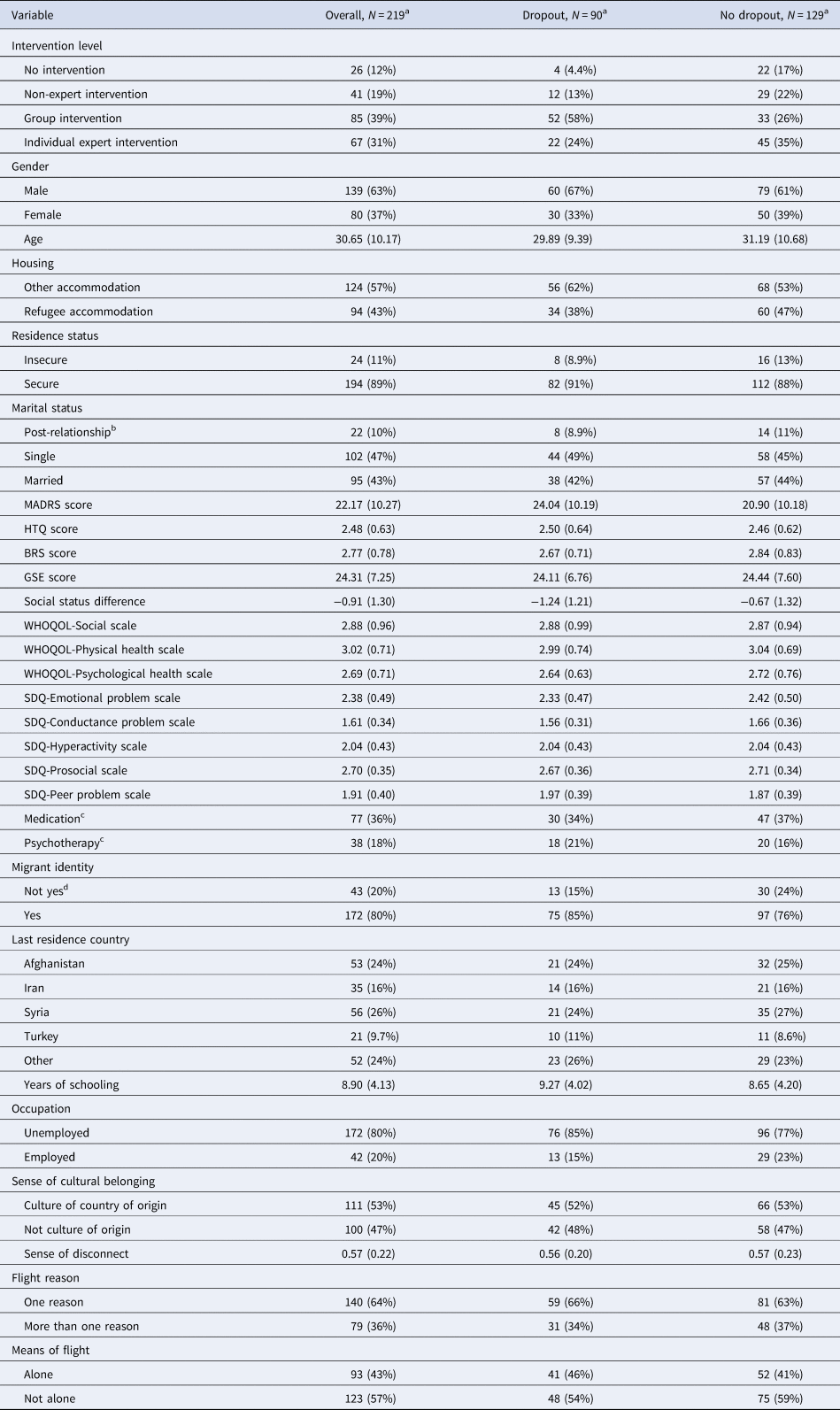
n, Number; s.d.,Standard deviation; MADRS, Montgomery Asberg Depression Rating Scale; HTQ, Harvard Trauma Questionnaire; BRS, Brief Resilience Scale; GSE, Generalized Self-Efficacy Scale; SDQ, Strengths and Difficulties Questionnaire; WHOQOL, World Health Organisation Quality of Life. Number of observations does not add up to overall sample size for all variables since descriptive statistics are computed for non-imputed data.
a n (%) for categorical variables; mean (s.d.) for metric variables.
b Includes response options ‘divorced/separated’ and ‘widowed’.
c Reflects the number and percentage of people answering ‘yes’ to this question.
d Contains the response options ‘No’, ‘Rather not’, and ‘Undecided’.
Sample selection
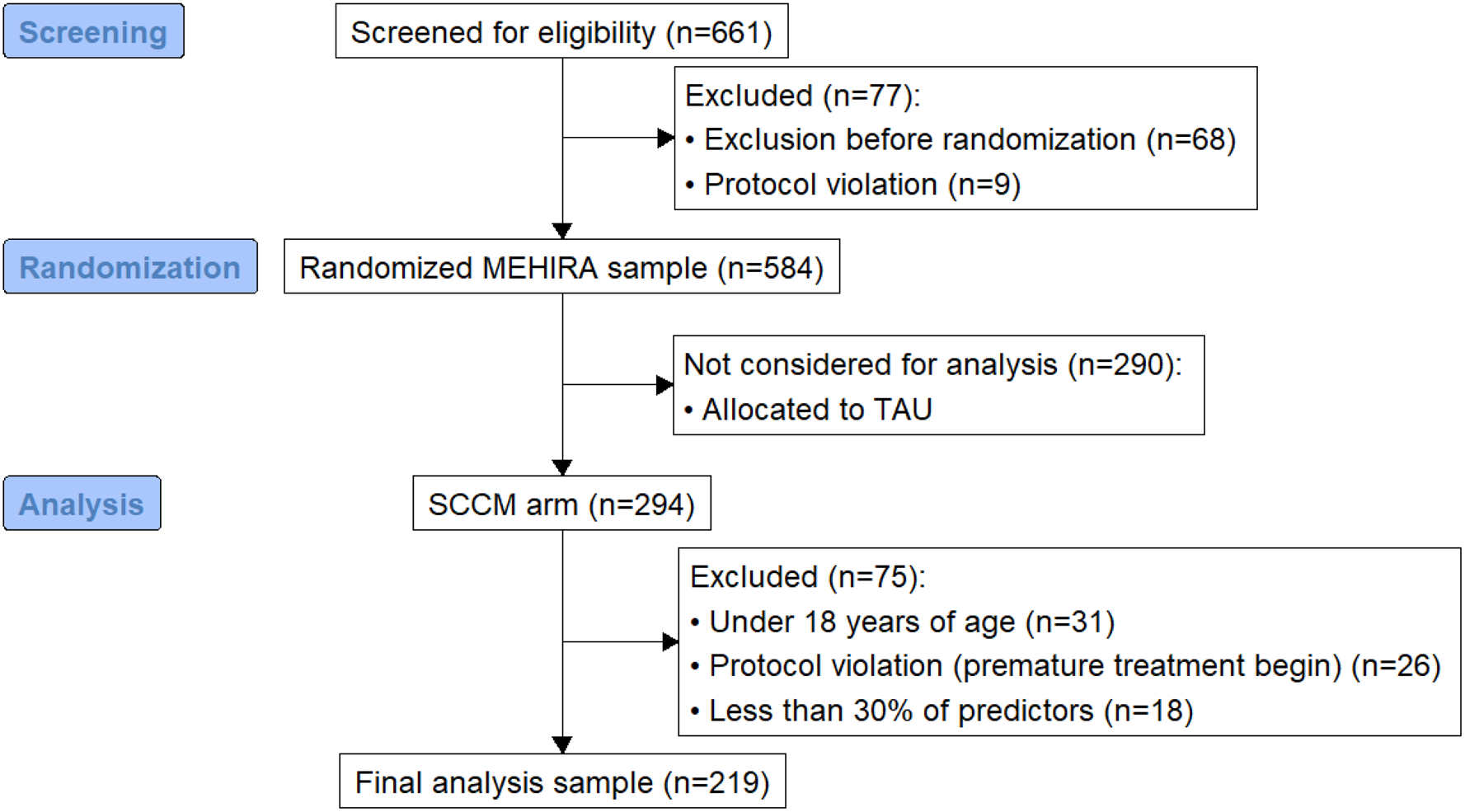
This dropout analysis included participants aged ⩾18 years assigned to the intervention group (SCCM), excluding 31 participants younger than 18 years from the initial SCCM arm of the MEHIRA study. 26 participants were excluded due to participation in an intervention they had yet to be assigned to at screening. Additionally, only participants with <30% of predictors missing were included (in line with recent studies excluding participants with missings within the range of 25%; see for instance Betz, Rosen, Salokangas, & Kambeitz, Reference Betz, Rosen, Salokangas and Kambeitz2022; Schilz et al., Reference Schilz, Kemna, Karnouk, Böge, Lindheimer, Walther and Bajbouj2023), excluding another 18 participants. Overall, the analysis included 219 participants. Dropout was defined as attending <50% of the intervention sessions (Böge et al., Reference Böge, Karnouk, Hoell, Tschorn, Kamp-Becker, Padberg and Bajbouj2022) Fig. 1.
Flow chart of participant recruitment, allocation, and inclusion in present statistical analysis.
MEHIRA, Mental Health in Refugees and Asylum Seekers; SCCM, Stepped and Collaborative Care Model.
Statistical analysis
Statistical analyses were calculated with R (Version 4.3.1, 2023) to characterize dropout through descriptive logistic regression models (Shmueli, Reference Shmueli2010). Multiple imputations accounted for missing data points using the multiple imputations by chained equations (MICE) packages (van Buuren & Groothuis-Oudshoorn, Reference van Buuren and Groothuis-Oudshoorn2011). Predictors were imputed to create m = 10 complete datasets to strike a balance between accounting for variance and improving feasibility in performing model diagnoses separately for each imputed dataset. Imputation of given predictors was done by utilizing all other n-1 predictors. Numeric data was imputed by predictive mean matching (PMM), binary categorical data by logistic regression, polytomous regression imputation was used for unordered, categorical data with more than two levels, and a proportional odds model for ordered categorical data with more than two levels. Finally, density plots were used to examine the imputation results. Line plots were used to examine convergence.
To determine a subset of relevant variables for our final regression model, predictors were determined by backward elimination (Heinze, Wallisch, & Dunkler, Reference Heinze, Wallisch and Dunkler2018). Here, predictors are iteratively removed from a given model and compared to the previous model iteration regarding an information criterion until an optimal solution is reached. Specifically, the Akaike information criterion (AIC) was used to penalize model fit for model complexity (Akaike, Reference Akaike1973). Backward elimination was preferred to other methods such as Least Absolute Shrinkage and Selection Operator (LASSO) since it provides clearly interpretable regression coefficients, making it suitable to our descriptive analysis; compared to forward selection, it starts with an unbiased global model (Heinze et al., Reference Heinze, Wallisch and Dunkler2018). Moreover, the AIC corresponds to a significance threshold of α = 0.157 (Heinze et al., Reference Heinze, Wallisch and Dunkler2018), striking a balance between removing redundant variables and including relevant predictors and covariates in the final model. Twenty nine variables were used as predictors for backward elimination with AIC (see Appendix), which was implemented using the step function in R (R Core Team, 2023).
Backward elimination with logistic regression was performed for each of the ten data sets, resulting in an optimal solution for each data set. Variables for the final logistic regression model were determined by the frequency of variable selection across datasets: Variables included in more than half of the ten optimal solutions were chosen for the final regression model in accordance with the majority vote method (Wood, White, & Royston, Reference Wood, White and Royston2008). The following predictor variables were selected: intervention level, refugee accommodation v. other accommodation, MADRS score, difference in social status before and after flight, age, BRS score, have a secure v. insecure residence status, WHOQOL-Social scale, SDQ-Peer problem scale, SDQ-Conductance problem scale, and SDQ-Emotional problem scale.
Finally, selected variables were used to calculate logistic regression models separately for every imputed dataset. To combine results, the pool function from the MICE packages was used, which averages the estimates across the models and computes the total variance over the repeated analyses by Rubin's rules (Buuren & Groothuis-Oudshoorn, Reference van Buuren and Groothuis-Oudshoorn2011; Rubin, Reference Rubin1987). Regression diagnostics were run for each imputed data set. Linearity between predictors and outcomes was examined through scatterplots for each predictor and the model's logit values. Variance inflation factors were calculated to rule out multicollinearity. Standardized residuals were visualized to identify potential outliers. However, no data point was excluded based on these analyses.
Furthermore, we computed group differences (dropout v. non-dropout) across all variables separately for each intervention level to provide tentative evidence on level-specific characteristics. Here, Pearsons's χ2 tests or Fisher's exact tests (for small cell sizes) were calculated for categorical and Welch Two Sample t tests for metric variables. All comparisons were computed on non-imputed data. Significant comparisons are reported in ‘Results’. The complete secondary analysis can be found in the Appendix. For all analyses, p values below or equal to a false-discovery threshold of 0.05 were considered significant and p values below or equal to a threshold of 0.1 were considered marginally significant.
Results
The Current sample of refugees and asylum seekers was predominantly male, with 37% female participants. The average age was 31. Most participants (89%) reported having a currently secure residence status in Germany. 80% were unemployed. The largest group of migrants indicated Syria (26%) as their last country of residence, followed by Afghanistan (24%) and Iran (16%). These data are similar to results from two recent, large, cross-sectional surveys on the health of non-treatment-seeking refugees in Germany (Grabo & Leavey, Reference Grabo and Leavey2023; Walther et al., Reference Walther, Kröger, Tibubos, Ta, von Scheve, Schupp and Bajbouj2020), making our analysis sample representative of RAS in Germany regarding key variables, though Syrian refugees were more represented in these surveys (>50% of overall study sample). The detailed sample characteristics can be found in Table 1.
Of the 219 participants included in this dropout analysis, 26 had been allocated to a watchful waiting approach at Level 1, 41 to app-based or peer-to-peer interventions at Level 2, 85 to group therapy at Level 3, and 67 to individual psychotherapy and/or psychotropic medication at Level 4. In total, 90 of 219 participants fulfilled the dropout criteria, defined as attending 50% or less of the intervention sessions, leading to an overall dropout rate of 41,1%. In Level 1, the dropout rate was 4.4%, defined as patients not attending the post-intervention visit. In Level 2, where participants received non-expert interventions, the dropout rate amounted to 12%. In Level 3, 58% of participants were characterized as dropouts. In level 4, where participants received individual expert interventions, the dropout rate was 24%.
All variables included in the predictor analysis can be found in Table 2. Overall, the logistic regression model was significant (χ2 = 3.43, p < 0.001) and showed a positive correlation with dropout for the following variables: participation in Level 3 (p = 0.001; OR = 10.7), satisfaction with personal relationships, sex life, and support from friends (WHOQOL-Social scale; p = 0.017; OR = 1.87), difficulties in building and maintaining personal relationships (SDQ-Peer problem scale; p = 0.005; OR = 4.27), and depressive symptoms (MADRS score; p = 0.029; OR = 1.05). This implies that participants included in Level 3, those with a larger satisfaction with social relationships, those with difficulties in building and maintaining personal relationships, and those with higher depressive symptoms were more likely to drop out of the study.
Results of logistic regression on treatment dropout v. completion
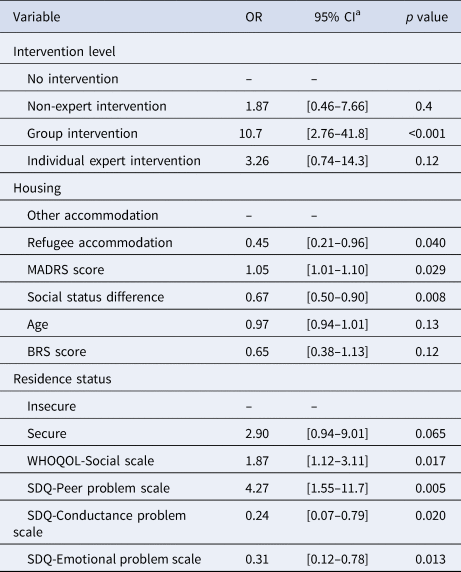
OR, Odds ratio; CI, Confidence interval; MADRS, Montgomery Asberg Depression Rating Scale; BRS, Brief Resilience Scale; SDQ, Strengths and Difficulties Questionnaire; WHOQOL, World Health Organisation Quality of Life. OR above 1 implies higher probability of dropout with increasing variable value; OR below 1 implies lower probability of dropout with increasing variable value.
a Confidence interval for a given variable's odds ratio.
The following variables showed an inverse significant correlation with dropout: housing in refugee accommodation (p = 0.040; OR = 0.45), difference in social status before and after flight (p = 0.008; OR = 0.67), SDQ-Conductance problem scale (p = 0.020; OR = 0.24), and SDQ-Emotional problem scale (p = 0.013; OR = 0.31). This implies that participants living in refugee accommodation, with a larger difference in social status before and after flight, with conduct and emotional problems are less likely to drop out of treatment.
The analysis also showed tentative evidence for a positive association between secure residence status and dropout (p = 0.065; OR = 2.90), implying that those with secure residence status were more likely to drop out.
Discussion
The Present study aimed to characterize dropout v. non-dropout participants in the MEHIRA study. The overall study sample consisted of 584 RAS (Böge et al., Reference Böge, Karnouk, Hoell, Tschorn, Kamp-Becker, Padberg and Bajbouj2022), constituting one of the largest samples investigating mental health and psychotherapy in this population (Acarturk et al., Reference Acarturk, Uygun, Ilkkursun, Yurtbakan, Kurt, Adam-Troian and Fuhr2022; Cuijpers et al., Reference Cuijpers, Heim, Ramia, Burchert, Carswell, Cornelisz and El Chammay2022; Purgato et al., Reference Purgato, Carswell, Tedeschi, Acarturk, Anttila, Au and Barbui2021).
The initial study design assumed a dropout rate of 50% (Böge et al., Reference Böge, Karnouk, Hahn, Schneider, Habel, Banaschewski and Bajbouj2020b). Overall, measured dropout was lower at 41.7%, albeit still high, compared to around 20% in Western populations (Edlund et al., Reference Edlund, Wang, Berglund, Katz, Lin and Kessler2002; Swift & Greenberg, Reference Swift and Greenberg2012) and to previously observed dropout rates of 19% in a meta-analysis of dropout from psychological interventions in RAS (Semmlinger & Ehring, Reference Semmlinger and Ehring2022). This may be partially due to the complexity of delivering therapy through a novel SCCM, while individual intervention arms in SCCM take longer to fill. Thus, recruitment phases are prolonged (Böge et al., Reference Böge, Karnouk, Hoell, Tschorn, Kamp-Becker, Padberg and Bajbouj2022), which may lead to higher attrition. Participants in Level 3 were significantly more likely to drop out. This may be partially due to the longer waiting time until the completion of recruitment for an intervention, due to the closed group format. Therefore, open group formats might be more suitable for this population in upcoming trials, and more extensive research is needed in this mobile population. Despite these organizational issues, we cannot rule out that other aspects of intervention 3 – such as a reluctance to open up in a group setting – are responsible for the high drop-out. Notably, though, other studies in RAS have not shown group therapy to influence dropout (Semmlinger & Ehring, Reference Semmlinger and Ehring2022), however, future research should examine this topic.
Moreover, specific post-migration stressors have been discussed to increase dropout (Sandhu et al., Reference Sandhu, Bjerre, Dauvrin, Dias, Gaddini, Greacen and Priebe2013; Semmlinger & Ehring, Reference Semmlinger and Ehring2022; Slobodin & de Jong, Reference Slobodin and de Jong2015). The present study partially confirms these hypotheses. Overall, social relationships seem to influence attrition. Patients with high satisfaction with personal relationships, sex life, and support from friends, measured by the WHOQOL-Social scale, were more likely to drop out. Conversely, difficulties in building and maintaining personal relationships assessed by the SDQ-Peer problem scale were also associated with higher dropout. The WHOQOL Social Scale measures satisfaction with personal relationships, social support, and sexual activity (Development of the World Health Organization WHOQOL-BREF quality of life assessment, 1998) whereas the SDQ-Peer problem scale assesses the ability to build and maintain relationships with peers (Brann, Lethbridge, & Mildred, Reference Brann, Lethbridge and Mildred2018; Goodman, Reference Goodman1997). These results may indicate that higher satisfaction with personal relationships lowers the need for mental health care, while experiencing difficulties with peers may impair adherence to a predefined treatment scheme involving, among others, peer-to-peer, and group interventions. Put differently, both social resources and difficulties seem to influence dropout in the MEHIRA trial. Conversely, higher scores on the SDQ-Conduct problems scale assessing (Brann et al., Reference Brann, Lethbridge and Mildred2018; Goodman, Reference Goodman1997) are associated with lower dropout. Additionally, a person with social issues who tends to be solitary and with few friends may receive less external encouragement to continue treatment. Therefore, the type of interpersonal issue may matter when explaining dropout. The negative association between the SDQ-Emotional problem scale and dropout may indicate that participants with issues such as somatic symptoms, worries, and low confidence are more likely to see a need for treatment. Furthermore, social status loss predicted dropout. The loss of financial resources and recognition might be a challenge that needs to be addressed within the study interventions, leading to increased dropout. Interestingly, previous studies have argued that losing the social environment due to flight may increase dropout (Sandhu et al., Reference Sandhu, Bjerre, Dauvrin, Dias, Gaddini, Greacen and Priebe2013; Semmlinger & Ehring, Reference Semmlinger and Ehring2022). While the present study provides evidence for the importance of social relationships and behavioral aspects for attrition, this relation seems to be more complex than previously hypothesized. Issues regarding social status loss, and relationships with peers, friends, and family, seem to have a multifaceted influence on treatment-seeking behavior, going beyond the hypothesis that more social stressors lead to a higher dropout rate. This should be considered in the design of future studies and psychotherapeutic interventions that could specifically address the topic of shaping relationships with peers and fostering social support.
Additionally, significantly lower dropout rates occurred among those living in refugee accommodation. This might be due to a higher need for therapy for those living in more dire conditions, as refugee housing tends to lack privacy, residents are burdened with higher noise levels, and usually have an uncertain residence status (Babka von Gostomski et al., Reference Babka von Gostomski, Böhm, Brücker, Fendel, Friedrich, Giesselmann and Richter2016). This aligns with previous research suggesting an association between quality of living conditions and negative mental health outcomes (Schilz et al., Reference Schilz, Kemna, Karnouk, Böge, Lindheimer, Walther and Bajbouj2023). Previous studies, however, have also hypothesized that difficult living conditions may hinder treatment-seeking (Slobodin & de Jong, Reference Slobodin and de Jong2015). Furthermore, the analysis showed tentative evidence for a positive association between residence status and dropout, meaning those with secure residence status were more likely to stop treatment. These results point towards the resilience of these subjects in the face of difficult living conditions. Lastly, patients with higher depressive symptoms were more likely to drop out. This may indicate high symptom burden prevents patients from finishing treatment and is in line with several findings from RCT conducted with Western populations (Barrett et al., Reference Barrett, Chua, Crits-Christoph, Gibbons, Casiano and Thompson2008; Zimmermann, Rubel, Page, & Lutz, Reference Zimmermann, Rubel, Page and Lutz2017).
The study has several limitations. Most importantly, it was only sufficiently powered to provide tentative evidence for within-treatment-level dropout characteristics (see Appendix). An in-depth analysis is necessary to understand the challenges of the individual interventions, especially Level 3, and adapt them appropriately. Additional, sufficiently powered studies investigating post-migration stressors, social factors, and organizational issues are needed. Moreover, while questionnaires in this study had been previously validated (Böge et al., Reference Böge, Karnouk, Hahn, Schneider, Habel, Banaschewski and Bajbouj2020b) and were translated according to WHO guidelines to Arabic and/or Farsi for this study, a minor number of instruments had not been validated in these languages (e.g. SDQ), particularly for refugees, and must therefore be interpreted with caution. Additionally, it needs to be noted that participants under the age of 18 and with psychotic disorders were excluded from the analysis, limiting the generalizability of the results. It is also important to consider here that the present population consists of refugees who were initially willing to participate in a trial; thus, drop-out rates for refugees in routine treatment may be even higher and should, therefore, be investigated in future studies. Further limitations pertain to the definition and assessment of drop-out. For one, assessing the time point of dropout would help to understand whether treatment was discontinued right after starting treatment or only after multiple weeks. Secondly, the original study's definition of drop-out (i.e. attending half of the intervention sessions) is a pragmatic solution within the resource-intense context of a randomized controlled trial with different treatment modalities comprising the SCCM all requiring different definitions of drop-out. However, future studies should explore more fine-grained measures of drop-out, such as user engagement and their associations with drop-out predictors in refugees. Regarding methodology, the exploratory nature of the analysis is another limitation of this study. While this approach seems appropriate given the relative dearth of data on drop-out in RAS, future studies should probe the robustness of the significant predictors mentioned here using confirmatory analysis techniques. At the same time, variables that only approached statistical significance but displayed meaningful effect sizes - such as the WHOQOL-Physical health scale - may warrant future investigation despite their lack of statistical significance. Furthermore, preexisting stigma may negatively influence treatment adherence (Barrett et al., Reference Barrett, Chua, Crits-Christoph, Gibbons, Casiano and Thompson2008) and should be accounted for by assessing the participants' expectations and individual attitudes. Finally, although Patient and Public Involvement (PPI) approaches were included in the study (Böge et al., Reference Böge, Karnouk, Hoell, Tschorn, Kamp-Becker, Padberg and Bajbouj2022), such involvement was limited due to financial and time constraints. PPI approaches have been shown to lower dropout rates by including individuals with lived experience more extensively in the study and intervention design (Dziobek & Lipinski, Reference Dziobek and Lipinski2021). Sufficient funding and time to increase PPI approaches may improve adherence.
Conclusion
The Assessment of dropout predictors should inform mental health professionals in designing interventions and treatment planning. This is especially relevant in contexts with high disease burden and limited resources. Stepped Care and Collaborative Models are complex in design and implementation to ensure cost-effective measures tailored to specific patient needs. Overall, the outcomes of this study suggest that social relationships, social status, living conditions, and intervention design are multifaceted in influencing dropout in RAS. One way that these findings may impact mental health service provision to refugees is by influencing content discussed in psychotherapeutic interventions. Specifically, there may be a need for an increased focus on social issues, which previous studies have also been found to be relevant for refugee mental health (Böge et al., Reference Böge, Karnouk, Hahn, Demir and Bajbouj2020a). For instance, the present findings might engender an increased discussion of social status loss in psychotherapy with refugees; consequently, a larger number of refugees may feel their mental health concerns addressed and become less likely to drop out of treatment. Future research on attrition on the intervention level is needed in this population, specifically group interventions, to improve intervention design in this mobile population faced with particular stressors.
Supplementary material
The supplementary material for this article can be found at https://doi.org/10.1017/S0033291724003179.
Data availability statement
The trial data can be requested deidentified and anonymized by researchers for future usage in independent scientific research projects. These requests should be addressed to the corresponding author to negotiate a data-sharing agreement with the Charité-Universitätsmedizin Berlin.
Funding statement
This project is funded by the Innovationsfond and the German Ministry of Health [grant number 01VSF16061]. The present trial is registered under Clinical-Trials.gov under the registration number: NCT03109028. https://clinicaltrials.gov/ct2/show/NCT03109028.
Funding statement
The authors declare the following financial interests/personal relationships which may be considered as potential competing interests:
Tobias Banaschewski reports a relationship with Lundbeck LLC that includes: consulting or advisory. Tobias Banaschewski reports a relationship with Medice that includes: consulting or advisory and speaking and lecture fees. Tobias Banaschewski reports a relationship with Neurim Pharmaceuticals Ltd that includes: consulting or advisory. Tobias Banaschewski reports a relationship with Oberberg GmbH that includes: consulting or advisory. Tobias Banaschewski reports a relationship with Takeda that includes: consulting or advisory and speaking and lecture fees. Tobias Banaschewski reports a relationship with InfectoPharm Medicines and Advice GmbH that includes: consulting or advisory. Tobias Banaschewski reports a relationship with Eli Lilly and Company that includes: speaking and lecture fees. Alkomiet Hasan reports a relationship with AbbVie Ltd. that includes: speaking and lecture fees. Alkomiet Hasan reports a relationship with Advanz that includes: speaking and lecture fees. Alkomiet Hasan reports a relationship with Janssen-Cilag that includes: board membership and speaking and lecture fees. Alkomiet Hasan reports a relationship with Lundbeck LLC that includes: board membership and speaking and lecture fees. Alkomiet Hasan reports a relationship with Recordati that includes: board membership and speaking and lecture fees. Alkomiet Hasan reports a relationship with Rovi that includes: board membership and speaking and lecture fees. Alkomiet Hasan reports a relationship with Otsuka Pharmaceutical Co Ltd that includes: board membership and speaking and lecture fees. Paul Plener reports a relationship with Shire that includes: speaking and lecture fees. Paul Plener reports a relationship with InfectoPharm Medicines and Advice GmbH that includes: speaking and lecture fees. Frank Padberg reports a relationship with Brainsway Inc that includes: board membership and non-financial support. Frank Padberg reports a relationship with Mag&More GmbH that includes: non-financial support and speaking and lecture fees. Frank Padberg reports a relationship with neuroCare Group GmbH that includes: speaking and lecture fees. Frank Padberg reports a relationship with neuroConn GmbH that includes: non-financial support. Malek Bajbouj reports a relationship with Bayer AG that includes: board membership. Malek Bajbouj reports a relationship with GH Research that includes: board membership. Alkomiet Hasan is editor of the German (DGPPN) schizophrenia treatment guidelines and first author of the WFSBP schizophrenia treatment guideline. Paul Plener was involved in clinical trials of Lundbeck and Servier. If there are other authors, they declare that they have no known competing financial interests or personal relationships that could have appeared to influence the work reported in this paper.
Competing interests
Dr Banaschewski served in an advisory or consultancy role for Lundbeck, Medice, Neurim Pharmaceuticals, Oberberg GmbH, Takeda, and Infectopharm. He received conference support or speaker's fees from Lilly, Medice, and Takeda. He received royalties from Hogrefe, Kohlhammer, CIP Medien, Oxford University Press; the present work is unrelated to these relationships. Alkomiet Hasan is editor of the German (DGPPN) schizophrenia treatment guidelines, first author of the WFSBP schizophrenia treatment guidelines; on advisory boards of and speaker fees from AbbVie (speaker fees only), Advanz (speaker fees only), Janssen-Cilag, Lundbeck, Recordati, Rovi, and Otsuka. Paul Plener was involved in clinical trials of Lundbeck and Servier. He received a speaker's honorarium from Shire and Infectopharm. Frank Padberg is a member of the European Scientific Advisory Board of Brainsway Inc., Jerusalem, Israel, and has received speaker's honoraria from Mag&More GmbH and the neuroCare Group. His lab has received support with equipment from neuroConn GmbH, Ilmenau, Germany, and Mag&More GmbH and Brainsway Inc., Jerusalem, Israel. Malek Bajbouj is member of advisory boards for Bayer and GH Research. The other authors declare no competing interests.
Ethical standards
All procedures were performed in compliance with relevant laws and institutional guidelines. Ethics approval was obtained from institutional ethics boards at each site. As part of the MEHIRA study, this study was conducted in accordance with the latest version of the Declaration of Helsinki and has been approved by the Ethical Committee of Charité-Universitätsmedizin Berlin (EA2/070/17).


 Open access

