


Climate change, characterized by rising global temperatures, presents a significant threat to public health.Reference Marchetti, Capone and Freda 1 – 4 This escalation has led to a surge in the frequency, duration, and severity of heat waves, with predictions indicating a continuation of this trend.Reference Gosling, McGregor and Páldy 5 Over the last 2 decades, there has been a notable 54% rise in heat-related mortality and morbidity among individuals aged 65 and above.Reference Liu, Varghese and Hansen 6 Additionally, climate change has been identified as the cause of more than one third of all heat-related deaths during the warm seasons worldwide.Reference Sorensen and Hess 7
Despite the increasing awareness of possible heat stress and its detrimental impact on the population, especially those vulnerable to its effects, the diagnosis of heat illness (HI) often relies on a “diagnosis of exclusion.”Reference Schlader, Davis and Bouchama 8 , Reference Saenz, Prine, Smith and Smith 9 Heat injuries encompass a range of conditions, spanning from milder forms like heat syncope and heat exhaustion to severe and life-threatening conditions such as heat stroke.Reference Leiva and Church 10 Early diagnosis is crucial for severe heat related illness (HRI), as effective and feasible treatment with rapid cooling, commonly referred to as the “golden hour,” yields optimal clinical outcomes.Reference Heled, Rav-Acha and Shani 11 , Reference Wang, Chen and Li 12
In recent years, the significance of biomarkers in clinical medicine has increased. According to the Food and Drug Administration (FDA), biomarkers are a measurable indicator with extensive potential applications, including research, therapy development, diagnosis, prognosis, disease progression monitoring, and treatment response assessment.Reference Goodsaid and Frueh 13 The identification of ideal biomarkers holds the possibility for early diagnosis and treatment that overall enhance clinical outcomes. The use of biomarkers in oncology trialsReference Hayashi, Masuda and Kimura 14 has been linked to increased success rates, particularly in breast, melanoma, and lung cancer trials.Reference Parker, Lushina and Bal 15 –Reference Rubinger, Hollmann and Serdetchnaia 17 Parker et al.’s study on 4 cancer indications revealed that employing biomarkers, such as HER2 in breast cancer, led to a remarkable 5-fold reduction in the risk of clinical trial failure.Reference Parker, Kuzulugil and Pereverzev 18 However, for the ideal utilization of biomarkers, they must be both disease-specific and universal for a condition for reliable and accurate measurement across a range of patients.Reference Byrnes and Weigl 19
The role of biomarkers in the diagnosis and management of severe HRI is poorly understood. Our primary objective is to conduct a comprehensive review of existing literature on HRI biomarkers applicable in acute care settings.
Methods
Search Strategy
The review was conducted using a scoping review framework outlined by Arksey and O’MalleyReference Arksey and O’Malley 20 and adhering to the guidance provided by the Joanna Briggs Institute.Reference Peters, Godfrey and McInerney 21 The PRISMA-ScR checklistReference Tricco, Lillie and Zarin 22 was used to ensure standardization of reporting. Furthermore, the protocol has been registered in Open Science for review.Reference Jedlicka 23
A systematic search was conducted on MEDLINE, Embase, and The Cochrane Library (Wiley) databases on October 11, 2022, and a final search was repeated on January 15, 2024. The search period was from 1946 to January 2024 and utilized a combination of subject headings and keywords related to heat disorders and biomarkers. The complete list of search terms can be found in the Supplemental Table 1 (Appendix). The search was conducted by a specialist librarian at the Weill Cornell Library.
The search results, consisting of the identified citations, were imported into Covidence, a tool utilized for systematic or scoping reviews to facilitate screening and data extraction. All included papers underwent a review and selection process conducted by at least 2 independent reviewers (JP, WF, and MBM). The reviewers carried out the screening process, evaluating titles, abstracts, and full texts of the selected citations according to the predefined inclusion criteria. Exclusion reasons for sources of evidence during the full-text screening were documented. Any discrepancies between the reviewers were resolved through discussion and reaching a consensus. The search results and the study inclusion process are visually depicted in a PRISMA-ScR flow diagram Figure 1.
PRISMA.

Study Selection
We included experimental studies, case studies, case-control studies, prospective, and retrospective cohort studies reporting candidate biomarkers for diagnosis or prognosis identified during exposure to heat. We excluded studies that primarily aimed to understand the pathogenesis of heat stress and did not investigate chemical markers with the potential for use in the clinical setting. Both human and animal studies with all types of HRI were included. Pre-prints, non-English studies, book chapters, conference proceedings, editorials/letters, and reviews were excluded.
Data Extraction and Synthesis of Results
Two independent reviewers utilized an extraction chart they developed to extract data from the studies included. The extracted data were added to Covidence. The following information was extracted: authors, study country, publication date, study design, whether the study involved animals or humans, number of subjects included, biomarker investigated, findings, and if the primary the marker could function as diagnostic and prognostic biomarker for HRI.
The extracted data was exported from Covidence to an Excel spreadsheet for further analysis.
Participations/Population
The study includes both human and animals subjects. Human participants consisted of patients across diverse age groups, genders, and racial/ethnic backgrounds diagnosed with heat-related disorders, including but not limited to heat stroke (HS), sunstroke, and heat exhaustion (HE). Nevertheless, individuals who experienced hyperthermia attributable to infectious causes (such as extreme fever resulting from viral or bacterial infections), medication-induced heat stroke (inclusive of pharmaceuticals and psychotropic substances), or extreme environmental conditions (e.g., confined spaces, saunas, cars, Bikram Yoga sessions, or electric blankets) were intentionally excluded from the scope of consideration in this review.
Selection of Biomarkers
Considering the broad spectrum of biomarkers highlighted in different studies, we selected the most pertinent markers when multiple options were available. Our decision-making was guided by the markers’ relevance to the investigation and their central emphasis in the paper.
Ethics Statement
Ethical approval was not required.
Results
Summary of Extracted Studies
Initially, we identified 2877 articles. Following deduplication, 1845 unique articles underwent screening based on title and abstract. Subsequently, 228 progressed to full-text evaluation. Of these, 183 were excluded for various reasons outlined in Figure 1, including lack of relevance to heat biomarkers and focus on non-medical aspects such as animal or environmental research. Ultimately, 45 articles met the eligibility criteria (Figure 1, Prisma).
Study characteristics
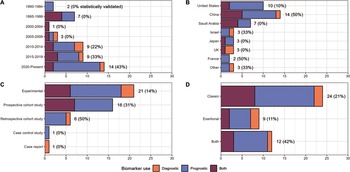
Of the 45 studies, 14 were published from China followed by 9 from the US. Study designs predominantly included experimental research (n = 21),Reference Dervišević, Hasić and Katica 24 –Reference Snape, Wainwright and Woods 44 followed by prospective cohort studies (n = 16),Reference Alzeer, Al-Arifi and Warsy 45 –Reference Goto, Shoda and Nakashima 60 retrospective cohort studies (n = 6),Reference Tang, Gu and Wei 61 –Reference Ward, King and Gabrial 66 1 case report,Reference Whiticar, Laba and Smith 67 and 1 case controlReference Bouchama, Bridey and Hammami 68 (Figure 2). Of the experimental studies, 15 studies involved animal models,Reference Dervišević, Hasić and Katica 24 , Reference Hadzi-Petrushev, Mladenov and Sopi 25 , Reference King, Leon and Mustico 27 –Reference Bruchim, Ginsburg and Segev 37 , Reference Permenter, McDyre, Ippolito and Stallings 40 , Reference Proctor, Dineen and Van Nostrand 41 while 4 studies focused on human participants,Reference McKenna, Houck and Ducharme 26 , Reference Stacey, Delves and Britland 38 , Reference Hess, Stooks and Baker 43 , Reference Snape, Wainwright and Woods 44 1 on human autopsies,Reference Ikeda, Tani and Watanabe 42 and 1 study on human cells.Reference Chen, Tong and Zhao 69 The predominant use of rodent models, particularly rats and mice, is observed in most animal studies. Out of the remaining 30 human studies, 21 concentrated on normal population samples,Reference McKenna, Houck and Ducharme 26 , Reference Hess, Stooks and Baker 43 , Reference Alzeer, Al-Arifi and Warsy 45 –Reference Bouchama, al-Sedairy and Siddiqui 49 , Reference Bouchama, Hammami and Haq 51 –Reference Hausfater, Doumenc and Chopin 54 , Reference Zhang, Fan and Zhong 57 –Reference Nakamura, Sueyoshi and Miyoshi 59 , Reference Tang, Gu and Wei 61 –Reference Hausfater, Hurtado and Pease 64 , Reference Whiticar, Laba and Smith 67 , Reference Bouchama, Bridey and Hammami 70 , Reference Fan, Zhao and Zhu 71 with the rest involving military recruits (n = 5),Reference Stacey, Delves and Britland 38 , Reference Shieh, Shiang and Lin 50 , Reference Tong, Liu and Wen 55 , Reference Goto, Shoda and Nakashima 60 , Reference Ward, King and Gabrial 66 athletes (n = 2),Reference Snape, Wainwright and Woods 44 , Reference Dahan, Dichtwald and Amar 65 human autopsy cases (n = 1)Reference Ikeda, Tani and Watanabe 42 and human cells (n = 1).Reference Chen, Tong and Zhao 39 The scope of studies involving human participants exhibited significant variability, ranging from 1-2216 individuals (Figure 3). Most studies examined blood-based biomarkers in either plasma, serum, or whole blood. Other fluid types included urine (n = 3)Reference Hess, Stooks and Baker 43 , Reference Dematte, O’Mara and Buescher 46 , Reference Goto, Shoda and Nakashima 60 and CSF (n = 1).Reference Ikeda, Tani and Watanabe 42 Finally, 12 studies investigated biomarkers in tissue (cardiac, intestinal, liver).Reference Hadzi-Petrushev, Mladenov and Sopi 25 , Reference King, Leon and Mustico 27 –Reference Liu, Liu and Liu 32 , Reference Cheng, Sun and Chen 34 , Reference Permenter, McDyre, Ippolito and Stallings 40 –Reference Ikeda, Tani and Watanabe 42 , Reference Chen, Tong and Zhao 69
Study details.

Biomarker details.

Diagnostic Perspectives
Only 5 studies focused on identifying diagnostic biomarkers,Reference Hadzi-Petrushev, Mladenov and Sopi 25 , Reference Chen, Tong and Zhao 39 , Reference Snape, Wainwright and Woods 44 , Reference Dahan, Dichtwald and Amar 65 , Reference Whiticar, Laba and Smith 67 while 27 studies focused on prognostic biomarkers and 13 on biomarkers that could potentially assist with both diagnosis and prognosis.Reference Bouchama, Roberts and Al Mohanna 29 , Reference Liu, Sun and Tang 31 , Reference Cheng, Sun and Chen 34 , Reference Audet, Quinn and Leon 35 , Reference Stacey, Delves and Britland 38 , Reference Hess, Stooks and Baker 43 , Reference Alzeer, Al-Arifi and Warsy 45 , Reference Li, Li and Ma 47 , Reference Shieh, Shiang and Lin 50 –Reference Wu, Chen and Xiao 53 , Reference Zhang, Fan and Zhong 57 , Reference Nakamura, Sueyoshi and Miyoshi 59 Those biomarkers with diagnostic value were the following: IL-6, TNF-a, 15-keto-13,14-dihydro-PGF2α, 8-iso-PGF2α, MDA; CRP; lncRNA, miRNA; troponin I; NMET, MET, serum osmolarity, copeptin, KIM1, and NGAL. A detailed overview of these biomarkers can be found in Table 1.
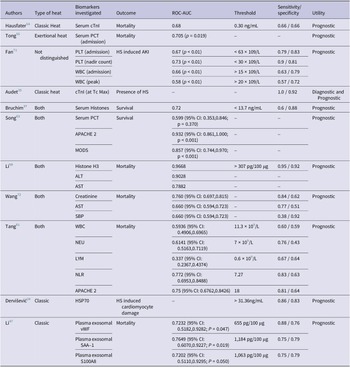
List of all included studies with biomarkers investigated, summary of findings, and biomarker use (diagnostic/prognostic utility)

Validation
The statistical analysis in most of the studies predominantly focused on variations in biomarker levels and their correlation with elevated temperatures, lacking comprehensive validation. Thirty-five studies evaluated only the differences in mean and a P value, without analytic validation (determine by sensitivity, specificity, accuracy, precision, or AUC values). Of the 107 biomarkers, only 15 biomarkers and 2 scores (MODS, APACHE 2)Reference Tang, Gu and Wei 61 , Reference Song, Liu and Wang 63 used statistical validation to determine their accuracy and reliability for diagnosis or prognosis for HRI (Table 2). These validated biomarkers include troponin I,Reference Audet, Quinn and Leon 35 , Reference Hausfater, Doumenc and Chopin 54 histones,Reference Bruchim, Ginsburg and Segev 37 , Reference Li, Liu and Shi 58 procalcitonin,Reference Tong, Liu and Wen 55 , Reference Song, Liu and Wang 63 HSP 70,Reference Dervišević, Hasić and Katica 24 WBC count,Reference Tang, Gu and Wei 61 , Reference Fan, Zhao and Zhu 71 NEU,Reference Tang, Gu and Wei 61 LYM,Reference Tang, Gu and Wei 61 AST,Reference Li, Liu and Shi 58 , Reference Wang, Fu and He 72 ALT,Reference Li, Liu and Shi 58 Creatinine,Reference Wang, Fu and He 72 platelets,Reference Fan, Zhao and Zhu 71 vWF,Reference Li, Li and Ma 47 S100A8,Reference Li, Li and Ma 47 and SAA-1.Reference Li, Li and Ma 47 Furthermore, none of the studies with proper statistical validation demonstrated potential for diagnosing HRI; instead, they were primarily utilized to evaluate severity or assess the likelihood of mortality after heat stress. However, it is important to note that in recent years there has been a modest increase in the number of such validated studies.
List of studies with statistically validated biomarkers

WBC: white blood cell, Tc: core temperature, APACHE 2: Acute Physiology and Chronic Health Evaluation 2, MODS: Multi-organ Dysfunction Score, ALT: alanine transaminase, AST: aspartate aminotransferase, NEU: neutrophil count, LYM: lymphocyte count, NLR: neutrophil-lymphocyte ratio, HSP: heat shock protein, vWF: von Willebrand factor, SAA-1: serum amyloid A-1, PCT: procalcitonin, SBP: systolic blood pressure, PLT: platelets, cTnI: cardiac troponin I.
Biomarkers
Cytokines and inflammatory biomarkers
Cytokine IL-6 was one of the most frequently investigated HRI biomarkers and demonstrated diagnosticReference Hadzi-Petrushev, Mladenov and Sopi 25 , Reference Bouchama, Roberts and Al Mohanna 29 , Reference Liu, Sun and Tang 31 , Reference Zhang, Fan and Zhong 57 and prognosticReference Bouchama, Roberts and Al Mohanna 29 , Reference Liu, Sun and Tang 31 , Reference Ikeda, Tani and Watanabe 42 , Reference Bouchama, al-Sedairy and Siddiqui 49 , Reference Zhang, Fan and Zhong 57 utility. Bouchama’s investigations in 1993 and over a decade later highlight the association between IL-6 alterations and HI severity, suggesting its potential to predict HS mortality.Reference Bouchama, Roberts and Al Mohanna 29 , Reference Bouchama, al-Sedairy and Siddiqui 49 Zhang et al. identified elevated IL-6 levels in HS patients, supporting its role in intensive care settings.Reference Zhang, Fan and Zhong 57 Similarly, Hadzi-Petrushev et al. observed increased plasma IL-6 levels following acute heat exposure in mice, further reinforcing its diagnostic relevance.Reference Hadzi-Petrushev, Mladenov and Sopi 25
Another proinflammatory cytokine with potential diagnostic value was TNF-α;Reference Liu, Sun and Tang 31 , Reference Zhang, Fan and Zhong 57 however, only 1 study was diagnostic and found an increase in TNF-a in response to heat.Reference Hadzi-Petrushev, Mladenov and Sopi 25
Apart from cytokine-mediated inflammation, systemic inflammatory markers such as CRPReference Zhang, Fan and Zhong 57 , Reference Dahan, Dichtwald and Amar 65 and procalcitonin (PCT)Reference Nylen, Al Arifi and Becker 52 , Reference Tong, Liu and Wen 55 , Reference Zhang, Fan and Zhong 57 , Reference Song, Liu and Wang 63 , Reference Hausfater, Hurtado and Pease 64 were examined in multiple studies. Dahan et al. revealed that the presence of a normal-to-low CRP in patients admitted to the hospital with hyperpyrexia and neurological deficits strongly indicates HS.Reference Dahan, Dichtwald and Amar 65 This contrasts with the observation made by Zhang et al., who reported significantly higher levels of both CRP and PCT in individuals with HS compared with their controls.Reference Zhang, Fan and Zhong 57 The majority of studies included in this review, reported an increase in PCT levels, suggesting its potential usefulness in predicting a less favorable prognosis in patients with heat exposure. However, an exception was noted in the recent study by Song et al., as their analysis indicates no significant correlation between PCT levels and the prognosis of HS.Reference Song, Liu and Wang 63
White blood cell (WBC) count and lymphocyte ratios were also explored as prognostic markers. One study found that WBC count predicted HS-induced acute kidney injury (AKI) (ROC-AUC: 0.66, sensitivity: 63%, specificity: 79%).Reference Fan, Zhao and Zhu 71 Additionally, the neutrophil-to-lymphocyte ratio (NLR) exhibited high sensitivity (83%) and specificity (63%) for predicting severe HS cases in emergency settings.Reference Tang, Gu and Wei 61
Coagulation and endothelial injury biomarkers
Apart from cytokine-mediated systemic inflammation, severe HRI also frequently promotes excessive coagulation response and endothelial cell injury. It is not surprising that platelets were the frequently included biomarkers amongst this category, followed by other markers related to coagulation and endothelial injury. Two studies investigated markers linked to the raised incidence of disseminated intravascular coagulation (DIC) due to heat stress,Reference Proctor, Dineen and Van Nostrand 41 , Reference Dematte, O’Mara and Buescher 46 while others concentrated on endothelial injury, changes in platelet counts, and incidence of acute kidney injury (AKI).Reference Fan, Zhao and Zhu 71
Cardiac biomarkers
Another focus of investigations centered on specific organ systems and markers clinically utilized to identify pathological changes within these organs. Interestingly, troponin I emerged as the most frequently evaluated cardiac biomarker, with 6 articles assessing its alterations in response to heat exposure.Reference Dervišević, Hasić and Katica 24 , Reference Quinn, Duran and Audet 33 , Reference Audet, Quinn and Leon 35 , Reference Hausfater, Doumenc and Chopin 54 , Reference Tang, Gu and Wei 61 , Reference Whiticar, Laba and Smith 67 In all studies, elevated troponin levels were noted in response to heat exposure, suggesting its diagnostic potential for organ damage, as well as potentially predicting severe cases of HRI.Reference Audet, Quinn and Leon 35 , Reference Hausfater, Doumenc and Chopin 54 Dervišević’s recent animal study demonstrated a positive correlation between hyperthermic myocardial damage and the values of troponin I and HSP70, with a PPV 96% and NPV 55%.Reference Dervišević, Hasić and Katica 24 Similar to the prospective study by Hausfater at el. where survival rates were notably lower in patients with elevated troponin with a sensitivity and specificity of 66%.Reference Hausfater, Doumenc and Chopin 54 These findings further highlight the potential of troponin as a prognostic biomarker for HRI.
Further studies assessed point-of-care cardiac troponin testing for HRI diagnosis, including an animal model study by Audet et al.Reference Audet, Quinn and Leon 35 and a clinical study by Whiticar,Reference Whiticar, Laba and Smith 67 which observed increased troponin levels 24 hours post-admission in HS patients. These findings suggest that troponin may serve as a valuable biomarker for both diagnosis and severity assessment of HRI.
Renal, hepatic, and interstitial biomarkers
Renal biomarkers were extensively examined, with 18 studies investigating kidney injury markers in the context of HRI.Reference McKenna, Houck and Ducharme 26 , Reference Flanagan, Ryan and Gisolfi 28 , Reference Hess, Stooks and Baker 43 , Reference Snape, Wainwright and Woods 44 , Reference Goto, Shoda and Nakashima 60 , Reference Fan, Zhao and Zhu 71 , Reference Wang, Fu and He 72 These markers ranged from common ones such as creatinine (Cr) and BUN to less common biomarkers for acute and tubular kidney injury, including L-FABP (Liver-type Fatty Acid-Binding Protein), NAG (N-Acetyl-beta-D-Glucosaminidase), NGAL (Neutrophil Gelatinase-Associated Lipocalin), and KIM-1 (Kidney Injury Molecule-1).Reference Goto, Shoda and Nakashima 60 Furthermore, markers of oxidative stress in the kidneys, such as TBARS (Thiobarbituric Acid Reactive Substances), TIMP-2 (Tissue Regeneration Inhibitor of Metalloproteinases-2), and TRAX (Urinary Truncated AlphaX-I),Reference Hess, Stooks and Baker 43 were also subjects of investigation. However, only NMET, MET, copeptin, KIM-1, NGAL, and osmolarity demonstrated alterations consistent with prior heat stress exposure, though statistical validation of their accuracy for HRI diagnosis remains lacking.Reference Snape, Wainwright and Woods 44 Wang et al. assessed the hospital mortality in patients with HS admitted to intensive care units (ICUs) and found a significant association with three risk factors: Cr, aspartate aminotransferase (AST), and systolic blood pressure (SBP).Reference Wang, Fu and He 72 Additionally, AST predicted liver failure with a sensitivity of 77% and specificity of 51%, while SBP acted as an independent risk factor for overall prognosis in heat-exposed patients (sensitivity 38% and specificity 92%).
Other liver markers assessed for the diagnosis of heat exposure were 15-keto-13,14-dihydro-PGF2α, 8-iso-PGF2α, and malondialdehyde; however, their reliability as indicators of heat exposure was not established.Reference Hadzi-Petrushev, Mladenov and Sopi 25
Interstitial damage was evaluated through 7 markers, including I-FABP, LBP, CLDN-3, FGF-21, FFA, FBP, and DAO, though none demonstrated strong diagnostic or prognostic potential. Additionally, only 1 study assessed biomarkers in the CNS namely Neuron-Specific Enolase (NSE) and Myelin Basic Protein (MBP) for the prognosis after heat stress.Reference Ikeda, Tani and Watanabe 42 Interestingly, While IL-6 and IL-8 in cerebrospinal fluid (CSF) were linked to survival rates, NSE and MBP did not correlate with outcomes.
Proteins and molecular biomarkers
Circulating heat-inducible heat-shock proteins (HSPs) have also emerged as a promising point in studies investigating responses to heat stress, frequently examined as potential prognostic or dual prognostic and diagnostic biomarkers indicative of susceptibility to HRI. Six studies explored the potential of HSP as biomarkers of heat exposure, specifically HSP-60, HSP-70, HSP-71, HSP-72a, and HSP-90.Reference Dervišević, Hasić and Katica 24 , Reference Flanagan, Ryan and Gisolfi 28 , Reference Dehbi, Baturcam and Eldali 30 , Reference Cheng, Sun and Chen 34 , Reference Bruchim, Segev and Kelmer 36 , Reference Wu, Chen and Xiao 53 However, none demonstrated their utility in diagnosing heat-related conditions and only 1 study included human participants. Wu et al. assessed the increase in HSP antibodies in young males during training.Reference Wu, Chen and Xiao 53 Overall, elevation in HSP expression was predominantly associated with tissue damage.Reference Dehbi, Baturcam and Eldali 30 Increased levels of HSPs were identified in various organs, including the liver, kidney, small intestines,Reference Flanagan, Ryan and Gisolfi 28 and myocardial tissue.Reference Cheng, Sun and Chen 34 These findings provided evidence that the upregulation of HSPs may be an important marker for HS prognosis. However, as noted earlier, only the study by Dervišević et al. assessed the accuracy of HSP70 for HRI.Reference Dervišević, Hasić and Katica 24
Additionally, epigenetic molecules such as histones and RNAReference Bruchim, Ginsburg and Segev 37 , Reference Chen, Tong and Zhao 39 , Reference Permenter, McDyre, Ippolito and Stallings 40 , Reference Li, Li and Ma 47 , Reference Li, Liu and Shi 58 were assessed as potential diagnostic or prognostic biomarkers for heat exposure. lnc-RNA and miRNA both showed diagnostic value as a marker for HS,Reference Chen, Tong and Zhao 39 and miRNA exhibited additional potential of detecting organ injury after heat exposure.Reference Permenter, McDyre, Ippolito and Stallings 40 Permenter et al. propose miRNA not only as a potential biomarker for organ injuries but also as pharmacological target for preventing heat injury resulting from heat stress.Reference Permenter, McDyre, Ippolito and Stallings 40 In contrast, both Bruchim et al. and Li et al. revealed that elevated histone 3 (H3) levels correlated with increased mortality in HS.Reference Bruchim, Ginsburg and Segev 37 , Reference Li, Liu and Shi 58 Li showed that at a cut-off value of 307 pg/100 μg, H3 was found to be sensitive (95%) and specific (91.67%) in predicting mortality in HS patients.Reference Li, Liu and Shi 58
Moreover, proteomics has also been used to identify potential proteins for HRI, as investigated in the study by Liu et al. and Li et al.Reference Liu, Liu and Liu 32 , Reference Li, Li and Ma 47 Liu et al. showed differential expressions of 14 different proteins due to HS, while down-regulation of intestinal FBP emerged as a potential prognostic marker for gut dysfunction during heat stroke.Reference Liu, Liu and Liu 32 Li et al. employed a proteomic investigation and revealed an enrichment of exosomal vWF, SAA, and S100A8 in patients with HS, particularly in severe cases. The concentration of these proteins exhibited a positive correlation with disease severity and organ dysfunction. This discovery supports the differentiation between mild and severe HS and contributes to determining the prognosis of individual cases. vWF exhibited a sensitivity of 88% and specificity of 76%. For SAA-1, the sensitivity and specificity were 75% and 79%, respectively, and for S100AB, the values were 75% and 79%.Reference Li, Li and Ma 47
Discussion
With an increase in excessive heat exposure on humans, a conclusive diagnostic test that could adequately diagnose HRI at initial presentation is urgently needed. Implementing the use of heat biomarkers as a simple diagnostic test could help quickly identify patients exposed to threateningly high temperatures. This could ultimately help provide adequate management that is not only simple but also highly efficient, thereby decreasing morbidity and mortality in these often already vulnerable populations.
We identified 45 articles with a total of 113 markers that were differentially expressed in subjects exposed to heat stress. Although 30 of these were human studies, the diverse study designs with an overall small sample size, inappropriate clinical and statistical validation, different types of heat exposure, and a variety of biomarkers prevent direct comparisons. Furthermore, the lack of universal gold standards and cutoff values hinders conclusive statements, resulting in inconsistencies when interpreting test results and raising uncertainties about their clinical significance.
Only 5 studies focused on biomarkers primarily for diagnosing HRI, and none of these studies conducted analytic validation. Snape et al. investigated the reliability of the biomarkers involved using Bland-Altman plots to evaluate dependability in post-Exercise Heat Stress Test (EHST) concentration. However, this method proved inadequate for assessing new biomarkers as it lacked comprehensive clinical validation. While the results suggested good reliability for NMET, copeptin, and NGAL, the analysis was constrained to a single time point and included only patients after EHST. This limitation is a significant weakness when it comes to biomarker research, particularly for new markers, as it does not provide a comprehensive evaluation over multiple time points or a diverse patient population.
Troponin has been one of the most investigated biomarkers, but only 1 study specifically assessed its diagnostic value, while the remaining used troponin for HRI prognosis. Whiticar’s case report, included only a single participant, and observed elevated troponin levels, with a peak 2 days after admission following EHS. However, most reviewed studies assessed troponin to identify myocardial injury due to heat, using troponin as a prognostic marker which appears more intuitive. Audet et al. suggested using troponin for both diagnosis and prognosis of HS. Their study reported elevated levels in all groups exposed to heat compared to controls. Conversely, Dervišević’s study emphasized that troponin lacks specificity for heat and recommended considering an additional marker, such as HSP 70 in HS assessment. Moreover, a correlation suggests that patients with known cardiac disease are often more susceptible to HRI, adding complexity to the biomarker’s applicability.
Despite the lack of analytic validation, microRNA markers show the high potential among biomarkers for diagnosis and prognosis of HRI. This is attributed to the stability of microRNAs in various bodily fluids, including blood, and their crucial roles in gene expression regulation. Their stability in extreme conditions and specific expression patterns in response to heat stress make them promising candidates for reliable HS biomarkers.Reference Mitchell, Parkin and Kroh 73 The experimental study by Chen et al. examined the expression of lncRNA and miRNA in human cells, proving that sequencing is a powerful method for identifying novel RNAs with potential as diagnostic biomarkers for HS.
A total of 27 reviewed articles identified potential biomarkers for prognostic assessment in patients with HRI. Among the examined biomarkers, platelets, troponin, IL-6, ALT, CRP, and procalcitonin were frequently investigated, showing primary prognostic significance. However, these markers are widely employed for various other conditions, leading to potential variability in their specificity and sensitivity as heat biomarkers in clinical settings. Therefore, the interpretation of these markers in the context of HRI requires careful consideration of their limitations and potential confounding factors. IL-6 cytokines, one of the most studied biomarkers,Reference Hadzi-Petrushev, Mladenov and Sopi 25 , Reference Bouchama, Roberts and Al Mohanna 29 , Reference Liu, Sun and Tang 31 , Reference Ikeda, Tani and Watanabe 42 , Reference Bouchama, al-Sedairy and Siddiqui 49 , Reference Zhang, Fan and Zhong 57 remains non-specific for HRI. Similarly, lack of specificity was noticed for markers for coagulation and endothelial injury. Previous literature observed that HS was associated with DIC, resulting in progressive decline in PLT and fibrinogen (Fib), elevated D-dimer, and prolonged PT and APTT.Reference Hemmelgarn and Gannon 74 , Reference Iba, Connors and Levi 75 However, DIC has been recognized as a prognostic indicator in other conditions, including sepsisReference Gando, Saitoh and Ogura 76 and trauma,Reference Sawamura, Hayakawa and Gando 77 which raises questions about its reliability as a biomarker for heat exposure. Additionally, while platelets have been explored in numerous studies as a potential biomarker for heat exposure, their widespread clinical use introduces a significant challenge as a definitive marker unique to HRI.Reference Chen, Zhong and Zhao 78
Several studies have targeted specific organs and organ systems known for their sensitivity to heat stress, investigating biomarkers such as ALT and or CK to identify these effects.Reference Thongprayoon, Qureshi and Petnak 79 , Reference Roberts, Ghebeh and Chishti 80 However, the validation for heat specificity and accuracy is still in progress, and the use of these markers as diagnostic tools for HRI remains questionable. It is important to recognize that these measurements need to be viewed with caution, as elevations may indicate other pathologies not necessarily a direct consequence of heat related organ injury itself. This is particularly important given that many HRI patients belong to a vulnerable population with comorbidities affecting these organ systems.Reference Kenny, Yardley and Brown 81 We also found a significant focus on kidney function in HS, aligning with prior research highlighting the effect of heat exposure on kidney functions.Reference Chapman, Johnson and Parker 82 Frequently observed among critically ill HS patients are potential complications such as AKI, ALI, and shock. Wang et al. focused on a single-factor analysis identifying Cr, AST, and SBP as practical indicators for severe heat stroke, introducing a tool for clinical evaluation.Reference Wang, Fu and He 72 There is also a known correlation between inflammation and heat stress.Reference Leon and Helwig 83 PCT showed potential relevance in exertional HS prognosis, while CRP lacked statistical validation and showed conflicting results. However, Dahan et al.’s study showed promising findings, suggesting potential support for early diagnosis, which can be challenging to differentiate from infections.Reference Dahan, Dichtwald and Amar 65 Finally, PCT was examined across 4 distinct investigations for predicting HRI severity, but only 2 studies statistically validated their findings and the more recent study by Song et al. concluded that PCT was not a reliable biomarker for HS prognosis.Reference Song, Liu and Wang 63
Markers like HSP and epigenetic biomarkers, while promising, often require expensive assessmentsReference Flanagan, Ryan and Gisolfi 28 , Reference Dehbi, Baturcam and Eldali 30 , Reference Cheng, Sun and Chen 34 , Reference Chen, Tong and Zhao 39 , Reference Permenter, McDyre, Ippolito and Stallings 40 and use impractical tissue samples, making them less than ideal for clinical settings, particularly in the ER.Reference Mayeux 84 H3 demonstrated promising sensitivity and specificity in predicting mortality risk, suggesting its potential as a clinical biomarker for HRI. This observation aligns with the recent review by Iba et al., which emphasized the use of H3, along with other inflammatory markers, as a promising indicator for the severity of HS75 establishing histones as prognostic markers. Ultimately, the heat shock response triggers an increase in protein synthesis and regulation, highlighting the diverse roles of HSPs in the body.Reference Hu, Yang and Qi 85
Identifying reliable biomarkers for heat stroke is crucial for enhancing clinical decision-making.Reference Schlader, Davis and Bouchama 86 An ideal biomarker would be easily accessible, cost-effective, and rapidly measurable, allowing for real-time decision-making in emergency settings. It should be detectable in readily available biological fluids such as blood, urine, or saliva, eliminating the need for invasive sampling. Additionally, it must exhibit high sensitivity and specificity to differentiate heat stroke from other hyperthermic conditions and predict severity with accuracy.Reference Parikh and Vasan 87 A clinically useful biomarker should provide actionable information, guiding interventions like fluid resuscitation, antibiotic administration, or critical care admission decisions.Reference Strimbu and Tavel 88 Current candidates, including IL-6, troponin, and procalcitonin, show promise but lack specificity for heat related conditions. These and other potential biomarkers need to be validated using clear diagnostic and prognostic thresholds, through large-scale, multicenter clinical trials in emergency settings.
Limitations
The primary limitation of this scoping review is the heterogeneity of the research including variable study designs, participant characteristics, and data analyses. The variation extended to the inclusion of both human patients and animal studies, rendering direct comparisons challenging. Moreover, limited analytic and clinical validation procedures conducted across the selected papers, affecting the comprehensive assessment of marker accuracy and reliability. Finally, scoping reviews generally lack quality assessment of the papers while potentially introducing bias and affecting the overall reliability of the review’s findings.
Conclusion
In summary, our findings underscore the limitation of the current body of knowledge on the available biomarkers for the diagnosis and prognosis of HRI. The current literature lacks robust study designs, including limited number of large experimental investigations, trials, or prospective cohort studies, required for comprehensive biomarker evaluation.
Data availability
The author declares that data supporting the findings of this study are available within the article.
Supplementary material
The supplementary material for this article can be found at https://doi.org/10.1017/dmp.2025.10069.
Author contribution
JR designed the research, critically reviewed, and revised the manuscript for important intellectual content. JP conducted screening, data collection, and data analysis. She drafted the initial manuscript and edited it. MBM also conducted screening, data collection, and data analysis, and drafted the manuscript. WF critically reviewed and revised the manuscript and participated in the screening process. BR created the tables and figures and provided support for the analysis. Finally, CJ conducted the literature search strategies.
Acknowledgments
We thank the Weill Cornell Library team for supporting the literature search and protocol development.
Funding statement
Authors have no financial disclosure to report.
Competing interests
The authors declare that they have no conflict of interest concerning this article.





 Open access

