

Although the U.S. private sector labor movement has been in decline since its peak in the immediate post-war period, until recently the state and local public sector labor movement offered union advocates grounds for optimism. Governed by a separate legal system from private sector workers, state and local employees enjoyed a relatively large and steady membership base since efforts to unionize the public sector began in earnest in the 1960s. As of 2017, 34% of the public sector workforce belonged to a union, compared to just 6% of their private sector counterparts.Footnote 1 But beginning in the early 2000s and accelerating with Wisconsin in 2011, a number of states considered and enacted restrictions on the rights of public sector workers to organize, collectively bargain with state and local governments, collect dues from their members, and participate in politics.Footnote 2
What explains this turn against the public sector labor movement, a force that includes long-time political heavyweights like teachers unions that some have described as “among the most powerful interest groups of any type in any area of public policy”?Footnote 3 Answering this question is important because the recent state-level changes in union policy represent a redistribution of political resources away from the labor movement, with potentially large consequences for the American political economy. Unions, even in their weakened state, increase workers’ wages and benefits.Footnote 4 In addition, greater unionization lowers income inequality and poverty.Footnote 5 Turning to politics, unions have long supported the Democratic Party, providing mobilized voters and campaign funds to elect Democratic candidates and promote left-wing economic policies.Footnote 6 Unions also boost political participation, especially for lower- and middle-income workers, and even shape how their members construct political and economic preferences.Footnote 7 Changes in the distribution of labor strength, then, have the potential to have far-reaching implications for a range of economic and political outcomes.
I argue that recent declines in the strength of public sector unions are best understood as a consequence of conservative political advocacy. Specifically, I focus on advocacy by the American Legislative Exchange Council (ALEC), which drafted model bills promoting the retrenchment of public sector union law and distributed those proposals among state lawmakers; the State Policy Network (SPN) of state-level conservative think tanks, which produced research and media commentary in support of ALEC proposals; and the federated advocacy group Americans for Prosperity (AFP) that encouraged its grassroots members to lobby on behalf of ALEC model bill proposals.
Building on the concept of policy feedback effects, or the ways that policies, once in place, can change future political battles, I argue that a crucial objective of these three cross-state networks was to weaken the political strength of public sector labor unions, a strategy I describe as using policy feedback as political weapon.Footnote 8 While much of the policy feedback literature focuses on the unintentional feedback effects generated by legislation, or on the ways that feedback entrenches public policy, policy feedback as political weapon instead emphasizes how organized interest groups or politicians can deliberately press for changes in policy that eventually diminish the political resources available to their opponents.
After explaining the strategy of policy feedback as political weapon in more detail, I examine the consequences of conservative advocacy against public labor unions, using this case study as an opportunity for exploring the theory of weaponized policy feedback. Looking over the period from 1996 to 2016, I find that the passage of legislation drafted by ALEC and supported by SPN and AFP led to declines in public sector union density and revenue. Assessing individual-level data from the National Election Studies, I further show that by weakening public employee unions, the passage of conservative network-backed legislation led to declines in political participation among public sector employees. These results suggest that conservative advocacy in recent years has produced a mirror image of the surge in political participation among public employees that accompanied the rise of public sector unions in the 1960s and 1970s.Footnote 9
These results have implications for our understanding of the American political economy, especially the study of parties, interest groups, and policymaking. They illuminate the reasons why public unions—once unquestionable political powerhouses—are now increasingly on the defensive across many states. In so doing, I help to address the omission of public unions from the study of interest groups, contributing to our understanding not only of the rise of public unions, but their more recent political decline in many states.Footnote 10 More generally, the results from this case broaden our understanding of policy feedback effects by focusing on cases where political actors deliberately use policy to demobilize political opponents, with attendant consequences for both organizational strength and mass political participation.
Considering Policy Feedback as Political Weapon
Political scientists now widely recognize that public policies can reshape politics, which in turn has implications for the outcomes of future political battles. Paul Pierson, building on the work of Theda Skocpol and others, has helpfully distinguished between several varieties of feedback effects.Footnote 11 Subsequent work has explored these varieties in more detail and documented the conditions under which particular kinds of feedback are more or less likely to occur.Footnote 12 More recently, Sarah Anzia and Terry Moe have explored the conditions under which politicians actually choose to enact legislation that creates feedback processes, moving past the traditional focus in the feedback effects literature on unintentional policy choices and ironies (also relevant is Jacob Hacker and Paul Pierson’s call for political scientists to consider policy “as prize” for organized interest groups).Footnote 13
Together, this scholarship has greatly expanded our understanding of the use of feedback processes in American politics. Yet one area of the feedback effects literature remains relatively under-explored: how politicians can deliberately use policy to dampen the political mobilization of particular interest groups and mass publics, what I term using policy feedbacks as political weapon. While other research has documented the presence of feedback effects that demobilize certain constituencies—for instance, how the receipt of cash welfare assistance dampens the political participation of beneficiaries or how contact with the carceral state reduces individuals’ sense of political efficacy and engagement—these are feedback processes that, by and large, were not intended by lawmakers when designing welfare or criminal justice policy.Footnote 14 Instead, policy feedback as political weapon draws our attention to the ways that politicians can “make politics” (to use Anzia and Moe’s phrasing) in ways that explicitly disadvantage their rivals.
What options do politicians have when seeking to hobble their opponents? Building on the original typology of feedback effects outlined by Pierson and Skocpol and expanded in later work, we can imagine at least three different varieties of weaponized policy. First, politicians can pass legislation that makes it harder for opposing interest groups to attract and retain members. Thinking about organizational strength in an Olsonian framework, politicians might consider raising the costs of group membership, or lowering the benefits group membership conveys.Footnote 15 Second, lawmakers could set their sights on individual civic engagement and create barriers for opposing political constituencies to engage in politics through voting or contributing time, money, and effort to political campaigns. And lastly, politicians seeking to deploy weaponized policy can take aim at the state itself, weakening state capacity in ways that limit the government’s ability to carry out policies and programs that benefit political opponents.
Importantly, there is no reason to expect that the strategy of using policy feedback as political weapon is one that is necessarily restricted to one side of the political spectrum or the other. Though the case here draws on conservative political actors seeking to disempower liberal pressure groups, we could just as easily imagine liberal organizations or politicians pursuing a similar approach. Table 1 summarizes these various strategies to use policy feedback as political weapon and gives real-world examples of each one with public labor unions.
A typology of feedback as political weapon

One issue in defining the scope of weaponized policy feedback is distinguishing between the immediate effects of public policy change and later, knock-on effects. Policy feedback typically refers to the knock-on effects of policy—not its immediate, first-order consequences. That distinction is useful to prevent stretching the concept of feedback effects to encompass nearly all policy change. What sets policy feedback, including weaponized feedback, apart from merely stating that “policy changes politics” is documenting how initial shifts in government rules and programs have downstream, second-order political consequences.
Of course, sometimes this distinction is difficult to draw in practice. Take the example of voter ID laws. Some political analysts have argued that these laws will make it more challenging for liberal constituencies to register or turn out to vote.Footnote 16 Do these laws count as demobilizing feedback effects? The potential dampening effects of the laws are, in some ways, part of their first-order consequences. Proponents of voter ID laws argue that ineligible individuals might be voting, so tighter restrictions are necessary to ensure the integrity of elections. And in private, some conservative politicians have justified voter ID laws on the basis that they disadvantage liberal opponents.Footnote 17 Yet there is an argument to be made that the implementation of these laws, on their face, is not done on the basis of partisanship or ideology; the legislative language of the proposals does not explicitly target these constituencies. A similar issue applies to whether Jim Crow laws in the American South could be thought of as feedback effects, or simply using policy to directly shut out citizens from the political process.
Fortunately, the policies I examine offer a more clear-cut case of feedback effects. The immediate, first-order consequences of the changes to collective bargaining and dues collection were intended to shift the ways that the unions represented their members, not necessarily the political strength or participation of unions or members. What I am testing is whether these changes to union organization ultimately shift the political clout and engagement of the unions and their individual members—the downstream consequences of these reforms. Put differently, the initial effect from these labor law reforms involves changes in how the unions interact with the state, recruit and retain members, and collect dues. The downstream, second-order “feedback effects” I test involve the political clout of the unions and the political mobilization of their members.
Mobilization against Unions as Weaponized Policy Feedback
Although the most visible and dramatic set of legislative skirmishes against public unions occurred in the wake of the Great Recession, political backlash against public sector workers began some forty years ago, just as the public sector labor movement was gaining a foothold across the states. Unlike private sector workers, who organize and bargain with their employers under the federal, New Deal-era National Labor Relations Act, state and local workers depend on state laws for their rights to organize and bargain, and it was not until the late 1950s and early 1960s that states began to recognize the legal authority of public unions to do so.Footnote 18 Starting with Wisconsin, a number of states began to permit collective bargaining for some or all of their workers in an effort to shore up their political support and curb public employee uprisings.Footnote 19 These new laws not only increased public union density as state and local workers flocked to professional associations that now had the power to bargain with the government to bid up wages, benefits, and working conditions. In strengthening the power of public sector unions, these laws also increased the political participation of government employees, like teachers, who were now the target of political recruitment efforts by the newly-empowered unions.Footnote 20 As of the mid to late 2000s, 27 states allowed collective bargaining with all workers, 19 allowed bargaining with some workers, and five states did not allow any collective bargaining.Footnote 21
Today, organizations representing public workers are among the largest unions in the United States, as density has steadily declined in the private sector. The left plot of figure 1 shows the overall levels of public sector union density in the United States contrasted with diminishing private sector union strength. The recent stability in public union density in the left plot, however, masks considerable declines in many states, and the right plot of figure 1 graphs the distribution of changes in state public union density from 1996 to 2016. The right plot indicates that public union density fell in 37 states, and the average change was a decline of about three percentage points over this period. Fifteen states registered declines of at least five percentage points, and four states registered declines of at least ten percentage points. What explains the sharp drops in public union strength in these states? To answer this question, we need to return to the period when public employees were first gaining the right to bargain collectively with state and local governments and focus on counter-mobilization against public labor unions from the right.
The evolution of public sector labor unions in the United States

The expansion of public sector labor unions in the 1960s and 1970s did not go unnoticed by opponents of the labor movement. In particular, conservative political activists worried about the implications of this new liberal interest group for state politics. As one conservative activist and founder of ALEC explained in an interview, groups like the newly organized teachers unions “came up with model legislation, which [they] would push in several states at the same time” and then they would use the argument
Well, if so-and-so passed it, it must be okay. And so the bill would go forward, sometimes in 30 states and more. Usually the liberal bill moved from committee to floor vote before you [the conservative activists] got prepared and marshaled your arguments, if then. The local [conservative activists] were on their own in each state—and they were overwhelmed.Footnote 22
Another right-leaning political leader and later ALEC head bemoaned that the “most effective lobby in the state legislatures” shortly after ALEC’s founding was “the National Education Association,” the union representing public school teachers.Footnote 23 She continued: “Many people are deceived by believing that the National Education Association lobbies only for education-related legislation, but they don’t. They oppose right to work laws, they oppose balanced budget resolutions, they support comparable work bills, they get involved in just about every piece of major legislation in the state legislature. They are very well organized, extremely well funded.”Footnote 24
In response, a group of conservative state and national politicians founded a new organization in 1973 that could offer the same capabilities of cross-state policy advocacy—but for their right-leaning legislative priorities. That organization, the American Legislative Exchange Council, brought conservative activists, state legislators, policy experts, and private sector firms together to press their own policy demands on state governments that went against liberal causes, especially cuts to taxes and regulations. Though it started on a relatively small scale with only a handful of legislative and corporate members, in recent years ALEC has grown to encompass, at its peak, nearly one-third of all state lawmakers and several hundred of the largest private sector firms in the United States, including Kraft, Coca-Cola, Microsoft, UPS, and Visa, and now possesses an annual budget of about $6 to $8 million per year to publish model bills for state legislatures, convene meetings between its members, and provide research assistance and political support to state lawmakers seeking to pass ALEC-drafted model bills.Footnote 25
Crucially, ALEC has made defeat of public sector labor unions a central priority, recognizing the value of eliminating the public sector labor movement for advancing their political causes across state governments, as the preceding quotes from ALEC’s historical leaders made clear. ALEC’s contemporary leaders have also recognized the political value of defeating public unions by making it harder for unions to attract members, collect dues, and participate in politics. As one state leader wrote in an ALEC publication in 2011: “[Public sector] unions often have hoards of money to spend in political campaigns because they can use automatically deducted dues from government employee paychecks. . . Public employee unions will continue being the [political] ‘big dog’ as long as they have access to the taxpayer provided salaries of their members. Lawmakers should adopt [ALEC] legislation to block this process.”Footnote 26
Accordingly, ALEC published model bills to reduce the power of labor unions both indirectly and directly. For instance, ALEC generated proposals to make it more difficult for public employee unions to collect dues from their members through automatic payroll deductions, making it harder for unions to build revenue. ALEC has also sought to limit public unions’ interventions in politics by restricting union members’ abilities to perform political activities on the job, or to spend member dues on politics or lobbying. Model bills also include proposals to contract out or privatize state services, thereby reducing the unionized public sector workforce. Most significantly, ALEC has sought to limit the ability of public unions to collectively bargain over state employee wages and benefits. The last proposal is most sweeping, because it removes a crucial function of public sector unions that make those unions appealing to workers.Footnote 27
Since its creation in 1973, ALEC’s model bills targeting public sector unions have become more successful over time as its efforts have been supported by two other cross-state networks of conservative political activists. These include the State Policy Network (SPN), an association of state-level conservative and free-market oriented think tanks, as well as Americans for Prosperity (AFP), a federated yet centrally directed advocacy group that intervenes in both state elections and policy debates to promote a conservative and libertarian agenda.
Founded in 1986, SPN has over sixty affiliates in all fifty states that now command budgets surpassing $78 million and average about 267 citations apiece in local, state, and national newspapers as of 2013.Footnote 28 SPN affiliates focus this media commentary and their policy research on bolstering many of the same legislative proposals that ALEC develops. For instance, during GOP Governor Scott Walker’s push for cuts to public sector collective bargaining in Wisconsin (themselves based on ALEC model bill proposals), the MacIver Institute, one of the two SPN members in the state, published an editorial just weeks after Walker’s election in 2010 calling for a repeal of collective bargaining for public employees.Footnote 29 MacIver’s prescient backing of the measure should not come as a surprise, however, since the organization had been supporting and working with Republicans for years. As one journalist explained, “MacIver not only helped lay the policy groundwork for [cutting public employee bargaining], it also helped manage its aftermath.”Footnote 30
Aside from SPN, ALEC is also strongly supported by AFP, the newest addition to the set of three conservative cross-state networks. Started in 2004 from the remains of an older group, AFP is now the “800 pound gorilla” in the political network constructed by wealthy libertarians Charles and David Koch, combining a grassroots activist base of over 2 million conservative supporters, at least 500 paid staffers in over 34 states, and a campaign war chest of over $150 million.Footnote 31 AFP directs these resources towards ensuring the election of its favored right-leaning candidates, as well as the pursuit of its libertarian economic policies at the state and federal levels.Footnote 32 Given AFP’s size, some political journalists have described it as America’s “third biggest political party.Footnote 33
Like ALEC, AFP has long recognized the importance of defeating public employee unions to advance its policy goals. Accordingly, AFP has backed ALEC initiatives to scale back public union strength across the states by organizing grassroots protests against public unions, threatening to run ads against politicians opposed to cutbacks to public unions, and defending lawmakers who vote in favor of public union retrenchment from labor mobilization. As AFP’s current head Tim Phillips has described it, the reason that conservatives have historically failed to promote their policy objectives in the states and in the federal government was that the political right did not “have an army on the ground [while] the left did,” in the form of “public employee unions, which have only gotten stronger, have only gotten better-funded, have only gotten better organized.”Footnote 34 To promote their broader policy agenda, then, Phillips concluded, AFP would need to demobilize the public sector labor movement.Footnote 35
To be sure, these networks represent slightly different constituencies and engage in very different activities. ALEC is an association of state lawmakers, businesses, and conservative political activists; SPN is a network of think tanks, and AFP is a federated advocacy group comprised of paid staff and millions of grassroots volunteers. Yet the three groups have, over time, established a division of labor in which each group pursues slightly different—albeit complementary—strategies in the pursuit of the same policy proposals.Footnote 36
For instance, in the case of the implementation of the Affordable Care Act, the three networks worked closely with one another to stymie states from expanding Medicaid coverage.Footnote 37 ALEC produced model legislation that would prevent state agencies from accepting new federal dollars to expand Medicaid, SPN worked with ALEC to produce research and media commentary to convince legislators to vote to reject Medicaid expansion legislation, and AFP ran political advertising campaigns threatening electoral retaliation against state legislators who supported expansion. In many cases, the collaboration between the three networks was explicitly engineered, for instance, as SPN policy experts spoke at ALEC events intended to help lawmakers to defend their choices to reject Medicaid expansion, or when AFP collaborated with SPN affiliates to hold public events. The end result was that states where the three networks were stronger and operating more closely with one another were more likely to reject the Medicaid expansion.
All three networks have worked closely with one another to prioritize the defeat of public sector labor unions as well, both as a substantive policy objective and as a means of weakening or even removing a political opponent in the states. But documenting that these organizations have sought cutbacks in public unions to boost their political power is only half of the story. Do ALEC-drafted and SPN- and AFP-promoted bills actually succeed in their aim of weakening the political clout of public sector unions and demobilizing government employees, thus qualifying as weaponized policy?
Finding evidence that legislation backed by all three networks resulted in the political demobilization of public unions would provide a clear-cut case of weaponized policy. This is an especially appealing test of weaponized policy because it involves organizations and individuals which, on their face, seem unlikely to be affected by changes in legislation. The employees that public unions represent are typically much better-off economically, have higher levels of education, and are more politically liberal and active than are average private sector workers.Footnote 38 This means that state and local employees may be strongly motivated to stay involved in their union and the political process more generally, and have the economic means and political skills to do so, regardless of conservative network-backed legislation and its effects on unions.
Conservative Network-Authored Bills and Public Union Strength
To identify whether conservative cross-state network-backed legislation was indeed able to accomplish the objective of weakening the public sector labor movement, I searched through the model legislation of the American Legislative Exchange Council to identify all proposals related to public sector labor unions. I then systematically searched Lexis Nexis State Capital, a database of enacted state legislation available from 1996 onward, for matches to ALEC model bills based on bill titles and texts.Footnote 39 I next examined archived versions of the SPN and AFP websites using the Internet Archive to see if either organization was involved in promoting the passage of those particular bills. In all, I identified eight states in which ALEC legislation related to public sector labor unions had been enacted into law, and in which either SPN or AFP (or both groups) were involved in promoting the passage of that particular legislation. These include Arizona, Colorado, Georgia, Idaho, North Dakota, Tennessee, Utah, and Wisconsin.
This list should be taken as a very limited estimate of cross-state conservative activity on public union policy, as it only includes instances where state legislatures enacted policy copied either in whole or part from ALEC model bill language, and where ALEC’s advocacy was backed up by either SPN or AFP (or both). There are likely other cases where state legislatures considered and enacted legislation based on ALEC, SPN, and AFP ideas but did not copy sufficient text for me to identify the legislation searching through the LexisNexis database. The reason to focus on these eight states out of the full universe of possible cases of conservative cross-state activity is that these eight states represent instances where ALEC proposals were clearly the source—buoyed by SPN and AFP—of state legislative initiatives. I also note here that I am not examining why ALEC-inspired legislation passed in these particular states. Studying the diffusion of these proposals is beyond the scope of this paper. Instead, my focus is on the effects of this legislation on union clout and government worker political participation.
The ALEC proposals enacted in these eight states took aim at public sector unions in a variety of ways. The Arizona, Idaho, and Utah measures enacted variants of an ALEC proposal to make it more challenging for unions to automatically deduct dues from workers’ paychecks (often called “paycheck protection” measures). These provisions are important because decades of research in behavioral psychology indicates that individuals have a strong bias towards the status quo, meaning that setting the default option to “not paying dues” will nudge many workers away from contributing to a union.Footnote 40 Even when these dues provisions only apply to political contributions, I still expect to find effects on density and revenue to the extent that unions use their political coffers to lobby for a more favorable environment in which to recruit and retain members.Footnote 41
The Wisconsin provision set limits on the scope of public employee collective bargaining in the states, as explained earlier. By restricting the ability of unions to bargain collectively, the conservative networks can make it less appealing for any individual worker to join a union, since the union cannot offer as broad a range of benefits. The Colorado law required unions to publicly release their collective bargaining agreements, intended to provide pressure to restrain their negotiations and especially negotiations over more political components of union activity.Footnote 42 The Georgia provision limited automatic dues collection by unions and reinforced the state’s right-to-work status by clarifying the permissible legal activities of employees and employers.
Lastly, the North Dakota and Tennessee legislation limited state and city governments from setting stipulations about union membership when contracting state services, which ought to encourage greater contracting out or privatization of public activities, reducing the number of potentially unionized workers. This legislation takes direct aim at private sector unions, but should also affect public sector workers to the extent that it incentivizes greater contracting of public services.Footnote 43
If my hypothesis about the conservative cross-state networks was correct, then we ought to expect that each of these provisions will have weakened the political clout of public sector unions in these states following ALEC bill passage. The alternative explanation is that these provisions do not, on their own, drive individual worker decisions about whether to join (or remain in) a union, and thus do not affect overall levels of public union membership or public union strength given the existing civic participation, interest, and ideology of public employees.
To test these hypotheses, I examine the change in public union political strength in states over time associated with these eight pieces of legislation. I measure two dimensions of public union political strength: membership density, or the share of wage and salaried public sector workers who report that they are union members (data from the Bureau of Labor Statistics) and public union revenue, which I operationalize with the state budgets of National Education Association (NEA) affiliates. I focus on the NEA because it is the largest union in the United States, representing nearly 3 million teachers and educational professionals as of 2015, and because the NEA is also one of the most active organizations in American politics, giving nearly $30 million in direct federal electoral contributions from 2013 to 2014 (data from the Center for Responsive Politics). That giving put the NEA in third place for all contributions made during the 2014 election. Finding that conservative cross-state network legislation weakened the budgets of NEA state affiliates would offer strong evidence that ALEC, AFP, and SPN advocacy has a significant impact on the political clout of the public labor movement. To standardize NEA state affiliate budgets, which I gathered from Internal Revenue Service filings, I estimate revenue per wage and salary worker in a state.Footnote 44 NEA budgets ranged from about $1 per worker (in South Carolina) to $34 per worker (in New Jersey) in 2014, and averaged about $9 per worker overall.
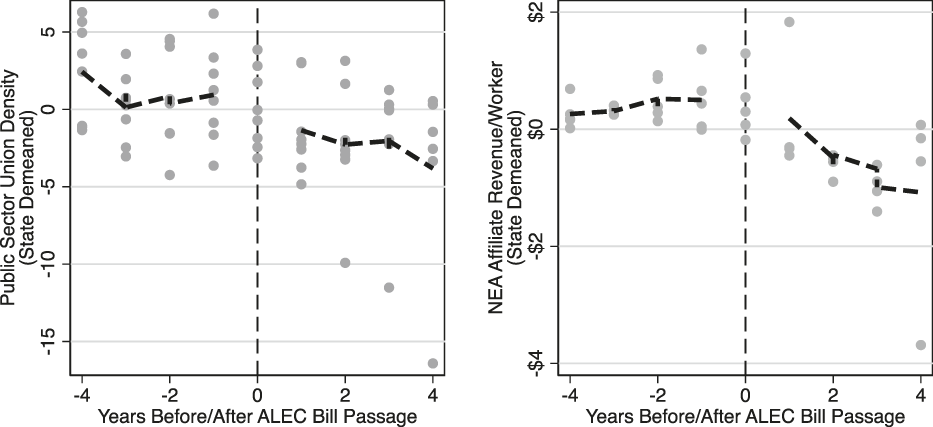
Figure 2 presents a first look at the relationship between the passage of conservative legislation and public union strength, plotting the change in public sector union density (left side) and NEA state affiliate revenue (right side) over time in the eight states in which the conservative networks enacted legislation. I have demeaned both variables by state so that their values are comparable across the eight different states in the sample. The horizontal axis indicates the number of years either before or after the passage of the ALEC legislation addressing public sector labor unions, and the dashed black lines indicate locally-weighted regressions. As the plots suggest, both public sector union density and NEA affiliate revenue fell sharply following the passage of ALEC-authored legislation in these states. Importantly, figure 2 also suggests the absence of a decline in public union strength immediately before the passage of ALEC-authored legislation. Public union density is stable in the years preceding bill passage and NEA revenue actually slightly increases in pre-passage years, on average. The absence of pre-passage trends in union strength indicates that it was likely not a decline in public union strength that led to bill passage in these states.
Conservative cross-state network bill passage and public union strength
Notes: Figure shows state-demeaned public sector union density four years before and four years after the passage of ALEC model bill legislation related to public sector unions. States include Arizona, Colorado, Georgia, Idaho, North Dakota, Tennessee, Utah, and Wisconsin.
To more rigorously test the relationship suggested by figure 2, I estimate a time-series, cross-sectional OLS regression with either public union density or NEA revenue as the outcome and with a binary indicator for whether a conservative network-backed bill has passed in a particular state as the main explanatory variable. The sample consists of all states from 1996 to 2016 for the analysis of public union density and 2004 to 2014 for the analysis of NEA revenue. The time frame for this analysis is necessarily restricted by data availability: the LexisNexis database of state legislation is only available from 1996 onward, and NEA state affiliate revenue data is only available in digitized form from the IRS from 2004 to 2014.
To account for potential confounders that could explain both state decisions to enact conservative network-backed legislation and changes in public sector labor union strength, I include a variety of additional variables. I add state and year fixed effects to account for state-specific time-invariant factors (such as political culture or union attitudes) as well as common shocks to all states, such as partisan control of national government or the national economy. I also add in partisan control of state government (on a zero through three scale indicating Democratic control of the lower chamber, upper chamber, and governorship; from Carl Klarner’s state partisan data), private sector union density (data from the Bureau of Labor Statistics), and state unemployment (data from the Bureau of Labor Statistics).Footnote 45 Partisanship is an important factor to include in these models given that GOP-controlled legislatures may be more likely to enact ALEC models and to introduce other cutbacks to public union rights; similarly private sector union strength may explain both ALEC bill reliance and public sector union strength.Footnote 46 Unemployment, in turn, might lead some states to control public sector costs by curbing the power of public unions and might also weaken public unions by putting fiscal pressure on the states (indeed; this was a common refrain in statements from politicians seeking such cutbacks during the Great Recession).Footnote 47 In some models I add in a lagged dependent variable to permit public sector union strength to vary as a function of past public union strength while recognizing that lagged dependent variable models with unit fixed effects can be biased with shorter time series. Lastly, I also permit different regions to have their own linear time trends of public sector union strength, accounting for geographic clustering, for instance due to policy diffusion or regional political economies.
Table 2 summarizes the various regression specifications with public union density as the outcome. In the simplest model, with only state and year fixed effects (column 1), the model implies that the passage of an ALEC model bill backed by the other conservative cross-state networks is predicted to reduce public sector union density by five percentage points (p<0.05). Adding in partisanship, unemployment, and private sector union density does not appreciably change the results (column two), nor does using a lagged dependent variable model (column three), nor adding in region-specific trends (column four). Column five subsets the analysis to only the eight “treated” states and reveals a similarly-sized coefficient. Five percentage points is a significant persistent decline in public union density, representing nearly one-third of a standard deviation and about 15% of the average value of public sector union density. That coefficient size is also about the same size as the average decline in public union density across the states from 1996 to 2016. In the appendix, I show that the results are robust to excluding North Dakota and Tennessee, leaving out each observation in turn, including biennium fixed effects, controlling for earlier levels of union strength, and using a differenced dependent variable.
Conservative cross-state network bill passage and public union density
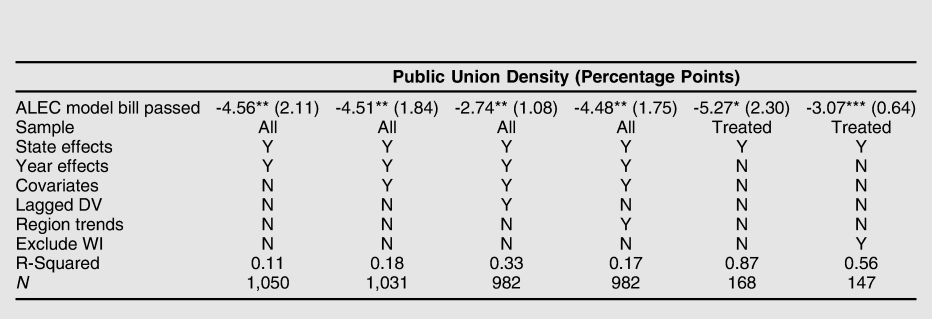
Notes: OLS regressions; standard errors clustered by state; * p<0.10, ** p<0.05, *** p<0.01. Outcome is public sector union density, in percentage points (0-100).
Moving next to the analysis of NEA state affiliate revenue in table 3, I find very similar results: across a variety of specifications identical to those employed in table 2, the presence of an ALEC-authored model bill relating to public unions is predicted to lower revenue collected by the NEA’s state affiliates. Estimates of the correlation between ALEC model bill passage and NEA affiliate revenue decline range from $0.87/worker (looking only at changes within the seven “treated” states, excluding Wisconsin; column five) to $1.67/worker (in the model with only state and year fixed effects; column one). My preferred specification (column 2) indicates a $1.51/worker decline in revenue (p<0.01), which is equivalent to a decrease of about one-fifth of a standard deviation and about 17% of the average level of NEA state revenue in the sample. To further put the change in context, a decline of $1.51 per worker represents the difference between average NEA revenue in North Carolina and in Texas over the period from 2004 to 2014. The results are robust to excluding North Dakota and Tennessee, including biennium fixed effects, leaving out each state-year observation in turn, including state-specific time trends, and other alternative modeling choices (refer to the online appendix).
Conservative cross-state network bill passage and NEA affiliate revenue
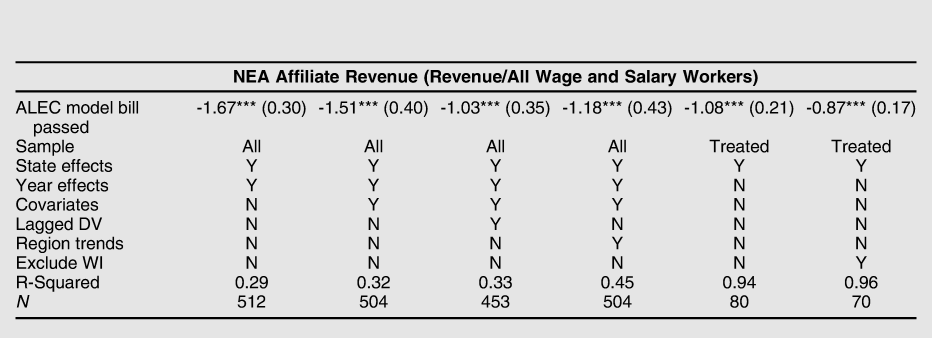
Notes: OLS regressions; standard errors clustered by state; * p<0.10, ** p<0.05, *** p<0.01. Outcome is NEA state affiliate revenue expressed as a proportion of all wage and salary workers in a state.
Barring random assignment of the enactment of ALEC-authored legislation relating to public unions, we cannot be certain that the relationships identified in tables 2 and 3 represent causal effects. It may well be the case that there are other factors that are jointly causing both the passage of ALEC-drafted legislation and large declines in public union strength. Still, the analysis offered strong observational evidence that public unions are indeed weaker—both in their membership rolls and budgets—after the passage of conservative network-backed initiatives targeting public unions, even when restricting the analysis to variation within states, and controlling for the changing political landscape. One reason that public unions are increasingly on the defensive, then, may be the mobilization of groups like ALEC, SPN, and AFP and the legislation they have passed making it more challenging for public unions to gather dues and collectively bargain with government, as well as encouraging the contracting-out of previously public services.
Conservative Network-Authored Bills and Public Employee Political Participation
So far I have documented the relationship between conservative network-backed legislation and measures of the organizational clout of public unions. But one important reason why unions are powerful is not simply the fact that their organizations have deep coffers to spend on candidates and can boast about large memberships to politicians. Unions are powerful because they facilitate political action among their members, using the social ties they have developed with rank-and-file employees to encourage those workers to participate in politics, for instance by contacting legislators, donating to campaigns, or volunteering for political causes and candidates.Footnote 48 By removing union resources, then, conservative network-backed legislation might also stymie the political mobilization of individual public sector employees. In this way, conservative network-backed legislation authored by ALEC and promoted by SPN and AFP might be causing the reverse of what Patrick Flavin and Michael Hartney uncovered in their study of the political mobilization of teachers after the passage of state collective bargaining laws.Footnote 49 Flavin and Hartney found that the passage of laws permitting teachers unions to collectively bargain with state and local governments greatly increased the political participation of teachers – but not other workers. The authors argue that by increasing the organizational strength of teachers unions, collective bargaining laws made it easier for those unions to mobilize their rank-and-file members.
Of course, as I argued earlier, this dampening effect of conservative network-backed legislation is far from a foregone conclusion. Political activity is often habit-forming, and it might be the case that once public sector unions began mobilizing workers—including teachers—then those workers would become more likely to participate in politics regardless of the presence of a union.Footnote 50 It is an open question, then, whether efforts to weaken unions can actually dampen political participation of members.
To test the relationship between conservative network-backed legislation and government worker political participation, I follow the same approach to Flavin and Hartney and turn to the National Election Studies (NES), which provide high-quality, nationally representative samples of Americans and, crucially, contain information on respondents’ industry of employment and political participation. I use data from the 1996, 1997, 1998, 2000, 2004, 2008, 2012, and 2016 NES surveys to match the time period employed in tables 2 and 3. Within those surveys, I identify 2,295 respondents who were employed by the government and 8,894 respondents who were employed in the private sector, which form the samples I use in the analysis. Unfortunately, the NES do not distinguish between state, local, and federal public workers, and I should only expect effects on the participation of state and local workers, not federal government workers. That said, state and local workers represent most of the government workforce (about 90%), according to 2017 Current Employment Survey statistics.
My main outcome is an additive index of the five-act battery of political participation that the NES has included on each of its surveys (this is the same outcome employed by Flavin and Hartney). The battery asks if respondents (1) tried to influence the votes of others, (2) worked for a political campaign, (3) displayed a button or sign to support a candidate, (4) donated money to a political campaign, or (5) attended a meeting or rally in support of a candidate (refer to the online appendix for the full question text). Together, these questions capture a broad range of electoral participation. On average, government workers reported a total of 0.97 acts (standard deviation: 1.23) and private sector workers reported a total of 0.89 acts (standard deviation: 1.09). These descriptive statistics are consistent with the higher levels of political participation among public sector workers we would expect given their union membership and higher socioeconomic status.
The main explanatory variable is, as before, a binary indicator of whether a state had passed an ALEC-drafted and SPN or AFP-supported bill related to public sector labor unions. Aside from that variable, I generally follow Flavin and Hartney’s empirical strategy, and include state and year fixed effects to net out state-specific factors or common shocks that might explain changes in participation and the passage of ALEC-drafted model bills, as well as individual-level control variables that might alternatively explain participation, including age (and age squared), gender, race (with indicator variables for white, black, and Hispanic respondents; the excluded category consists of “other” respondents), family income (in survey-year deciles), education (measured with indicators for some college and college or more; the excluded category consists of high school or less), union membership, whether the respondent reported strong partisanship, and self-reported interest in campaigns (on a 1 to 3 scale).
I estimate OLS regressions, which I prefer to negative binomial count models because of the inclusion of state and year fixed effects. The primary variables of interest are the binary indicator for the enactment of an ALEC-drafted bill, whether an individual is employed in the public sector, and the interaction of those two terms. I cluster standard errors by state and apply ANES survey weights.
Figure 3 summarizes the substantive results of the OLS regressions for government and private sector workers, with and without the individual-level demographic controls (the online appendix provides full regression results and also includes robustness checks that exclude North Dakota and Tennessee). Regardless of the inclusion of individual-level control variables, the political participation of government workers falls sharply following the passage of conservative network-backed legislation.
Conservative network bill passage and worker political participation
Notes: Participation data from 1996, 1997, 1998, 2000, 2004, 2008, 2012, and 2016 National Election Studies. Individual controls include age/age squared, gender, race, ethnicity, education, family income, union membership, interest in campaigns, and strength of partisanship. All models include state and year fixed effects. Each line represents results from a separate regression. Lines indicate 90% confidence intervals. Sample sizes: 10,014 (without controls) and 8,620 (with controls). Outcome is additive index of five participatory acts: influencing the votes of others, working for a political campaign, displaying a button or sign to support a candidate, donating money to a political campaign, or attending a meeting or rally in support of a candidate. Survey weights applied.
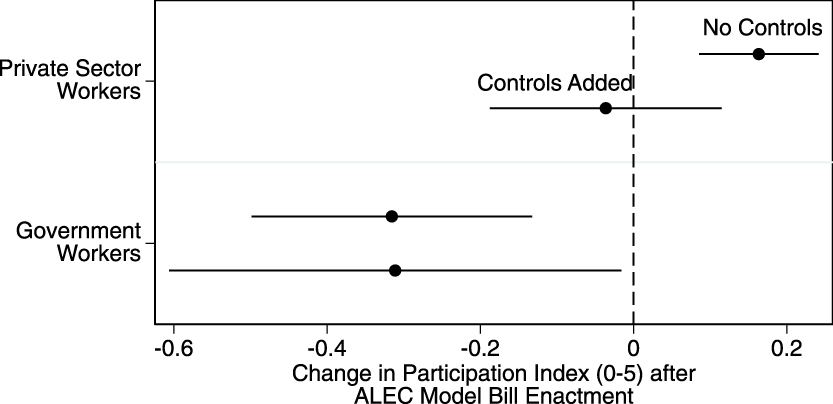
On average, government workers reported about 0.31 fewer political acts following the passage of an ALEC-drafted model bill relating to public unions. The size of the conservative network legislation coefficient is roughly equivalent to moving from a worker with some college education to one with only a high school degree. That is a relatively large effect, representing nearly one-third of the average number of acts reported by government workers. The effect of ALEC-drafted model legislation is about the same compared to Flavin and Hartney’s estimates of the effect of mandatory collective bargaining laws on teacher participation (0.27 civic acts).Footnote 51
As expected, there was no consistent relationship between ALEC bill passage and the participation of private workers. In the model without individual-level controls ALEC bills are associated with a slight increase in participation among private workers, but adding controls reduces this effect essentially to zero. Figure 3 thus suggests that conservative network-backed legislation, by weakening public unions, has caused a decline in the political participation of government—but not private sector—employees. Further analysis, documented in the appendix, shows that government worker participation fell following, but not before, the passage of ALEC model bills.
In results reported in the online appendix, I show that the passage of ALEC-authored legislation lowered the political participation of both unionized and non-unionized government workers alike, suggesting that weakened public sector unions not only have fewer members to engage in politics, but also that they may do less to engage their remaining members. I also find the decline in government worker political participation cannot be explained by changes in the political interest of government workers. Levels of political engagement among government workers remained unchanged before and after the passage of conservative network-backed legislation. This may be because political engagement and interest is much harder to manipulate than mobilization of workers who are already following the political process. Political interest tends to be much “stickier” and enduring over an individual’s life.Footnote 52
Instead, it appears that the main mechanism driving the decline of government employee political participation is similar to that which drove the original increase of political participation of teachers: political recruitment by non-party groups, which would include contact from organized labor. Government employees were about twelve percentage points less likely to indicate that they had been contacted by non-party groups following the passage of conservative network-backed legislation. Facing tighter budgets, public sector unions appear to reach fewer state and local workers after the passage of bills backed by ALEC, AFP, and SPN.
Conservative Advocacy, Weaponized Policy Feedbacks, and the American Political Economy
Until recently, labor experts contrasted the challenges faced by American private unions with the much more favorable environment in the public sector.Footnote 53 Unlike their counterparts in the private sector, public unions have enjoyed a much more amenable context for organizing and bargaining, explaining the relatively high—and steady—rates of unionization in the public sector compared to private workplaces.
That consensus may be crumbling, however, as I have documented here. In the face of sustained cross-state advocacy by conservative policy networks, including the American Legislative Exchange Council, the State Policy Network, and Americans for Prosperity, state governments are beginning to retrench the ability of public unions to organize, bargain collectively, build their membership rolls, collect dues, and participate in politics. My results show that the advocacy efforts of the three cross-state networks helps to explain why public sector unions are declining in political strength in some states, and further, that conservative advocacy may have not only reduced the organizational strength of public unions, but the participation of individual public workers, too.
This analysis backs up the assessment of one New York Times political reporter, who visited Wisconsin five years after that state passed legislation cutting back public union bargaining rights. The title of the article summed up the consequences of the ALEC-written and AFP- and SPN-supported legislation quite succinctly: With Fewer Members, a Diminished Political Role for Wisconsin Unions.Footnote 54 One public sector union leader in Wisconsin quoted in the article reflected on the legislation in the following way: “Do we have less boots on the ground? Yeah. Do we give the same amounts of money to the candidates? No.”Footnote 55 As we have seen, those political consequences were precisely the ones that were intended by ALEC, AFP, and SPN—and by all accounts those groups have succeeded.
Of course, the findings are not without important limitations. The analyses I have presented are based on observational data that do not lend themselves to clean causal identification in the absence of random (or quasi-random) assignment of conservative network advocacy. Nevertheless, I have shown the robustness of my analysis across a range of specifications leveraging variation within states over time and using multiple levels of analysis, including across public unions as organizations and individual state and local government workers. More generally, given the importance of the public labor movement for the American political economy, these results still represent substantive and useful contributions in their own right even without opportunities for more systematic causal identification.
First, my findings offer an important bookend to work examining the origins of public unions across the states, which shows that the rise of public unionism was fundamentally political in nature, as politicians sought to shore up their support and curb labor protests.Footnote 56 In a similar vein, I described how the political strength of public unions prompted conservative activists to seek cutbacks to the laws governing public employee union organizations and bargaining.
In this way, my paper answers recent calls for scholars of interest groups and public policy to more centrally focus their attention on unions—and public sector unions in particular—given their prominent role in state and local politics.Footnote 57 My analysis also emphasizes the importance of studying not just public unions themselves, but also counter-mobilizations on the political right. Any account of the political activities of public unions is incomplete without also including the right-leaning groups formed in response to those unions. While I focused on the consequences of right-network advocacy, future research ought to tackle the broader questions of how these networks developed, where they have been most successful at achieving policy change, and why they have had more success in some states and not others.
My findings have additional implications for our understanding of political equality in an era of high and rising economic inequalities. Unions are a relatively unique kind of organization in the constellation of American interest groups. Not only do they span both economic and political domains, but they are one of the few political advocacy groups directly representing the interests of working-class Americans that retain a federated, membership-oriented structure.Footnote 58 Unions have long pushed politicians to adopt policies preferred by working class Americans, and there is evidence that the striking class inequalities in political representation that have been identified by scholars such as Martin Gilens and Larry Bartels are attenuated in states with stronger unions.Footnote 59 If conservative cross-state advocacy – and the corresponding demobilization of public employee unions—that I have highlighted continues, it may well exacerbate economic and political inequalities across the states.Footnote 60
Beyond the specific case of public unions in the United States, my analysis has underscored the concept of policy feedback as political weapon, showing how groups and politicians can use legislation as a means of disadvantaging their opponents in durable ways over time, above and beyond the traditional focus in the study of policy feedback on self-reinforcing policies or unintentional policy ironies. Policy changes that shift the costs and benefits of group membership—for instance, removing benefits or raising costs—can substantially alter the strength of individual interest groups. Indeed, these policy shifts might potentially even alter entire ecosystems of interest groups.Footnote 61
But policy feedback as political weapon does not only affect organizations. This strategy has implications for the political participation of individual citizens. The individual-level results that I report emphasize that policy can be a means of deliberately and persistently lowering the political participation of citizens, in this case state and local government employees. These results also remind us that organizations are often crucial in spurring sustained political action in the mass public.Footnote 62
Although it is too soon to fully trace out the long-run consequences of this strategy, with the benefit of additional data future work might look to see if by weakening public sector unions, ALEC, AFP, and SPN have been able to secure further policy victories in areas unrelated to union policy. For instance, are measures weakening labor regulations or enacting tax cuts—two sets of policies pursued by the conservative networks—easier to pass in states once public sector unions are on the defensive?
Future research might also fruitfully deploy the concept of policy feedback as political weapon to explain how other organized interest groups have thrown up roadblocks to their opponents. Other scholars might examine specific institutional strategies that work best for shutting out or weakening political opponents in particular venues, such as bureaucracies, the judiciary, or Congress. A similar line of research might explore whether there are trade-offs that political actors must make between weakening their opponents and achieving substantive policy gains. Although conservative groups were able to accomplish both objectives by weakening public unions, this may not always be the case.
Perhaps the most significant payoff of a focus on policy feedback as political weapon, however, is simply to remind political scientists that public policies are not neutral outcomes but rather deeply contested objects laden with power. Doing so can help move political science away from what Paul Pierson has described as a discipline “unable to detect inequalities of power,” to one that looks carefully at the ways that organized interests use public policy as a means of entrenching their political advantage for many years to come.Footnote 63
Supplementary Materials
• Descriptive statistics for variables used in analysis
• ALEC model bill list
• State legislation
• NES items used in analysis
• Robustness checks for regression models
• Replication materials



