


Introduction
The European Union (EU) has undergone a remarkable transformation over the past decades. Once a polity operating largely under the radar, the Union and its policies have moved into the political limelight across member states. European affairs have become more salient, are scrutinised by ever wider audiences, and polarise public and political opinion (De Wilde et al. Reference De Wilde, Leupold and Schmidtke2016: 4). The politicisation of ‘Europe’ is reflected, in particular, in rising levels of both visibility and contestation – in public opinion, elections and referendums, in party manifestos and political discourse (e.g., Hobolt Reference Hobolt2016; Hoeglinger Reference Hoeglinger2016). As Hooghe and Marks (Reference Hooghe and Marks2009) succinctly put it, the ‘permissive consensus’ of the first decades of European integration has given way to a ‘constraining dissensus’.
This transformation is putting EU‐level actors under considerable pressure. Politicisation is, predominantly, seen as a constraint. Yet, increased visibility – often coinciding with the expectation of supranational problem‐solving – also offers actors new opportunities to respond, and to enhance their reputation and legitimacy in the eyes of Europe's citizens (Bressanelli et al. Reference Bressanelli, Koop and Reh2020). Either way, EU‐level actors cannot do ‘business as usual’: the fundamental change in their political environment calls for new responses and adaptive strategies. Nowhere has the transformation – and the functional and political pressures underlying it – been felt more strongly than in the European Commission. In the first decades of integration, the Commission was seen as the epitome of supranational technocracy: unelected, neutral, expertise driven. Long gone are those days. Not only has the Commission, along with the political system it both serves and drives, come to attract more attention and contention; it has also become self‐proclaimed ‘political’ (see Kassim & Laffan Reference Kassim and Laffan2019).
Against this backdrop, we ask whether the European Commission responds to domestic politics, and why. Under what conditions does the Commission react to public opinion, party politics and electoral pressure? What does it mean for the Commission to be ‘political’? To address these questions, we focus on the actor's main role in EU policy making: agenda‐setting and the prioritisation of legislative proposals. Understanding how the newly political environment affects the Commission's agenda choices can shed light on responsiveness in the EU's political system more generally.
Drawing from the literatures on politicisation, responsiveness and non‐majoritarian institutions, we expect the Commission to use legislative priorities as signals in response to pressure from domestic politics. Unlike a national government's, the Commission's responsiveness is not driven by re‐election. Yet, in the era of politicisation, the Commission cannot afford to focus on a narrow audience of experts, stakeholders and insider networks only. As the EU's agenda‐setter and public face of ‘Brussels’, the Commission sits at the centre of both Eurosceptic attacks and calls for supranational action. We suggest that the Commission uses its legislative agenda as a signal in response to these – sometimes countervailing – pressures from its ‘new audience’: political parties and the public. In doing so, the Commission is motivated, first, by policy output under salience, and, second, by bureaucratic survival under threat. Both motivations drive agenda responsiveness; the former works through targeted performance, and the latter works through aggregate restraint. Bottom‐up pressure and agenda‐responsiveness increase with the domestic visibility of ‘Europe’; visibility, in turn, is driven by Euroscepticism and issue salience, at party, mass and electoral level.
We test our argument using new data on the prioritisation of Commission proposals under the ordinary legislative procedure (OLP, or co‐decision) from 1999 to 2019. To capture prioritisation, we use the Commission's annual strategic work programmes (WPs). Our analysis shows that the choice to prioritise is driven by the salience of policy issues for Europe's citizens. By contrast, we find little evidence for an independent effect of party‐political salience. Moreover, contrary to our expectations, Euroscepticism – either at electoral or mass level – does not constrain prioritisation.
Our analytical focus speaks to three literatures. First, we shed light on the bottom‐up consequences of domestic politicisation. The top‐down impact of the politicised EU for the national arena is well‐covered (e.g., De Wilde et al. Reference De Wilde, Leupold and Schmidtke2016; Hutter et al. Reference Hutter, Grande and Kriesi2016). Yet, institutional and substantive responses at the supranational level, the motivations driving these responses, and the impact on the EU as a political system remain under‐explored (but see Rauh Reference Rauh2016; Schneider Reference Schneider2018; Reh et al. Reference Reh, Bressanelli and Koop2020). Analysing how national politics ‘travels’ across multiple levels, our paper thus adds to the scholarship that asks whether and why domestic dynamics shape supranational – and international – institutions, decision making and legitimacy (e.g., Hooghe et al. Reference Hooghe, Lenz and Marks2019).
Second, politicisation does not only generate pressure; it also broadens the Commission's audience beyond traditional experts, stakeholders and insider networks to mass publics (Rauh Reference Rauh2016: 30–40). To explain the Commission's responsiveness, we, therefore, draw on scholarship about the link between public attitudes and policy choices (e.g., Soroka & Wlezien Reference Soroka and Wlezien2010; Rasmussen et al. Reference Rasmussen, Reher and Toshkov2019), including agenda priorities (e.g., Jones & Baumgartner Reference Jones and Baumgartner2004). Recently, scholars have asked whether responsiveness also works across levels of governance, and explored whether public opinion affects the behaviour and choices of electorally connected actors. Studies have focused on the European Council's agenda‐responsiveness (Alexandrova et al. Reference Alexandrova, Rasmussen and Toshkov2016), and on votes as signals to domestic audiences, by national parties in the European Parliament (EP) and by governments in the Council of the EU (Hagemann et al. Reference Hagemann, Hobolt and Wratil2017; Wratil Reference Wratil2018; Schneider Reference Schneider2020).
Yet, responsiveness is not limited to majoritarian actors; politicisation can also drive the choices of non‐majoritarian institutions. National‐level agencies, originally created to insulate certain policies from electoral and political pressures, respond to party politics and media attention in their decision‐making, in substance and speed (e.g., Carpenter Reference Carpenter2010; Koop & Lodge Reference Koop and Lodge2020). Similarly, scholars have asked whether political pressure changes the European Commission's agenda‐setting and policy‐choices. Drawing on the Commission's annual work programmes, studies have shown the agenda‐setter's (limited) political influence over legislation (Kreppel & Oztas Reference Kreppel and Oztas2017), and demonstrated that legislative proposals are more likely to be withdrawn under electoral and procedural uncertainty (Boranbay‐Akan et al. Reference Boranbay‐Akan, König and Osnabrügge2017), and under high levels of Euroscepticism (Reh et al. Reference Reh, Bressanelli and Koop2020).
With the EU's increasing visibility at the national level, the Commission also begins to actively seek public opinion, in specialised Eurobarometer surveys, particularly on policies where competences are shared between the Union and its member states (Haverland et al. Reference Haverland, Ruiter and Van de Walle2018). The most comprehensive analysis yet of the Commission's responsiveness to politicisation focuses on regulatory choices and policy formation in consumer policy (Rauh Reference Rauh2016). Results for the 1999 to 2008 period show that the Commission responds to a context of greater media coverage, polarisation and protests, combined with high policy‐specific salience, by proposing laws that redistribute rights from producers to Europe's consumers. By analysing whether and why domestic public opinion, party salience and electoral outcomes drive the Commission's priority‐setting, across all legislative initiatives on the agenda, from 1999 until 2019, our paper generates new and complementary insights into how supposedly insulated actors respond when ‘their’ political system comes under attack, when their policy choices become visible, and when new partisan and mass audiences gain relevance.
Third, we aim to understand what the Commission means when it calls itself ‘political’. A priori, the actor is an unlikely case for responsiveness. Delegation theorists argue that the Commission holds powers precisely to insulate policy making from political pressure (Majone Reference Majone2002). The Commission should ‘promote the general interest of the Union’ (Art. 17.II TEU(L)), and provide legitimacy through balanced, non‐partisan, non‐national leadership. The monopoly of initiative, more specifically, is to protect the legislative agenda from constituency‐level pressure, political bias and ‘cycling’ (Pollack Reference Pollack2003). Yet, the ‘insulated Commission’ – an agent designed to provide expertise and information, to lower transaction costs, and to facilitate credible commitments – has always been contested. Indeed, the Commission has been shown to shape the Union's agenda politically and, to an extent, independently (Sandholtz & Zysman Reference Sandholtz and Zysman1989; Egeberg et al. Reference Egeberg, Gornitzka and Trondal2014; Becker et al. Reference Becker, Bauer, Connolly and Kassim2016; Nugent & Rhinard Reference Nugent and Rhinard2016). We add to this debate by providing in‐depth empirical analysis of whether the Commission uses its agenda‐priorities in response to bottom‐up political pressure.
Our paper proceeds in the following steps. The next sections introduce the Commission's annual programming and legislative prioritisation, and develop our theoretical argument. We then present our dataset and operationalisation, before discussing our statistical models and empirical results. The final section concludes and assesses the paper's wider relevance for the study of multilevel politics and the responsiveness of non‐majoritarian actors under increasing visibility and contestation.
Agenda‐setting, political programming and priorities in EU law‐making
To explore the Commission's responsiveness to domestic pressure, we focus on agenda‐setting. In the increasingly contested context of EU law‐making, the Commission continues to hold the formal monopoly of initiative (Art. 17.II TEU(L)).Footnote 1 We analyse the Commission's political programming and legislative prioritisation. The political programme is the Commission's overall strategic plan for office; legislative priorities single out specific proposals for ‘promotion’ in the year to come. We suggest that the Commission, similar to a national executive, uses programming and priorities to structure the agenda and to signal intentions to the co‐legislators and the public. The Commission can propose legislation and prioritise proposals, but it cannot decide laws; hence, publicising its priorities is a transparent and visible way to show what matters most to the agenda‐setter in ‘downstream’ legislative decision making between Council and Parliament.
A look at the context in which strategic and annual planning was introduced may help us gage its relevance for the Commission. Originating in the late 1990s, programming was part of a wider push for intra‐organisational reform and better EU governance (Tholoniat Reference Tholoniat2009: 228). The Commission had just taken a visible political blow over the resignation of Santer's college; more generally, public support began to drop post‐Maastricht. A decade later, the Lisbon Treaty – succeeding the ill‐fated ‘constitution’ – introduced the ‘State of the Union’ speech. Juncker, a successful Spitzenkandidat, promptly used the first such speech to pitch a ‘political’ Commission, committed to setting priorities and to monitoring their implementation (Juncker Reference Juncker2014). In short, the introduction of the Commission's annual WPs coincided with a crumbling ‘permissive consensus’ (Hooghe & Marks Reference Hooghe and Marks2009), a rise in public politicisation (see Rauh Reference Rauh2016: 7–25), and an explicit quest by the Commission to elicit public opinion, in addition to expert and stakeholder input (Haverland et al. Reference Haverland, Ruiter and Van de Walle2018).
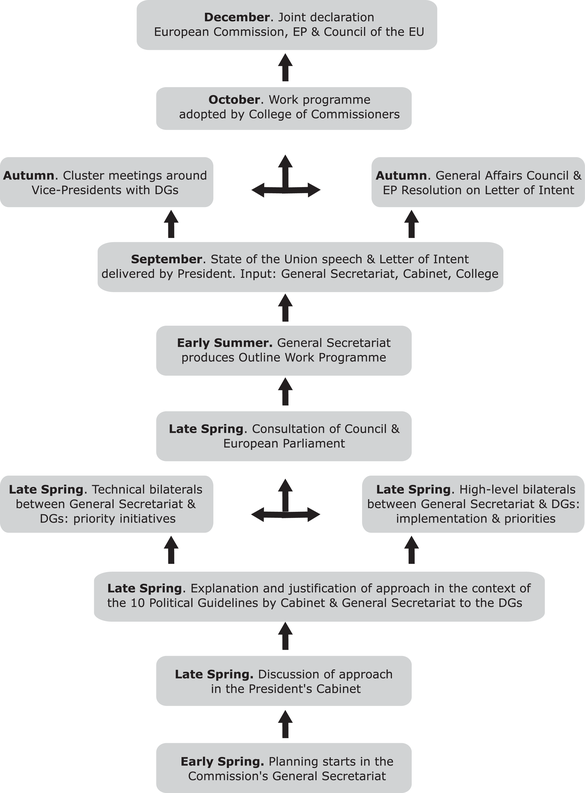
Political programming and a targeted follow‐up legislative agenda are key executive tools across political systems. In the EU, too, prioritising legislation is part of the Commission's wider programming cycle, and priorities are expressed at different stages throughout the term in office. After European elections, the new Commission, in a process known as ‘(dis)continuation’, reviews the legislative pipeline left by the previous Parliament and Commission, and decides which dossiers to withdraw and which to keep (Corbett et al. Reference Corbett, Jacobs and Neville2016: 313–315). At the start of its term, the Commission publishes ‘Political Guidelines’, previously known as ‘Multi‐Annual Strategic Objectives’ (Tholoniat Reference Tholoniat2009); these set the overall parameters and political structure for the next five years. Through more fine‐tuned annual programming, involving the State of the Union address as well as extensive intra‐ and inter‐institutional coordination, the Commission arrives at its annual WP (Hartlapp et al. Reference Hartlapp, Metz and Rauh2014: 247–252; Lupo Reference Lupo2018: 319–322). WPs translate the multiannual political goals into concrete legislative agendas for the 12 months ahead; offer and justify a framework of legislative activity; and contain an annex that lists priority files. For instance, under the general title ‘No Time for Business as Usual’, and categorised under ‘Ten Political Guidelines’, the Juncker Commission's 2016 WP listed 17 legislative initiatives as priorities (European Commission 2015). Figure 1 offers a stylised visualisation of the programming cycle under Juncker.
Stylised programming process in the Juncker Commission (2014‐2019).
Sources: Interviews 2, 3, 4, and 5; Corbett et al. Reference Corbett, Jacobs and Neville2016: 313–315; Hartlapp et al. Reference Hartlapp, Metz and Rauh2014: 250–252. For a graphic presentation of the process in 2004–2009, see Tholoniat Reference Tholoniat2009: 229.

To gain a better understanding of the programming process and to gage the appropriateness of using priorities to measure responsiveness, we conducted semi‐structured interviews in Brussels in April 2018; five interviews with a total of 10 officials across the legislative institutions gave us insights into programming at different stages and from different perspectives (cf. Supporting Information Appendix A). Over the past decade, our interviewees suggested, the politics of EU agenda‐setting has undergone two major developments: first, centralisation and a focus on political communication within the Commission; second, deepening inter‐institutional relations with the EP and, recently, the Council. Particularly under Juncker, programming became more systematically coordinated, top‐down and visible (Interview 3). As Figure 1 shows, structured overall by the President's political guidelines, the process built on strategic leadership by the General Secretariat and the President's Cabinet; relied on technical and political input on priority preferences from Directorates‐General (DGs); and involved input from the Council and the EP. What's more, priorities became part of the Commission's communication strategy and political narrative (Interviews 2, 3, 4), aimed at informing the public in an accessible way (Interview 3). Used to showcase that Europe acts and delivers where it matters for citizens (Interviews 1, 3, 4), some interviewees directly referred to Euroscepticism – and public opinion in general – as drivers of streamlining and prioritisation under Juncker (Interviews 2, 4). Indeed, the President himself explicitly stated that the ‘ideas of our citizens, their engagement, their expectations’ guided his Commission's mandate (Juncker Reference Juncker2019).
In addition, with the ‘Framework Agreement on Relations between the European Parliament and the European Commission’ (European Parliament & European Commission 2010) and the ‘Inter‐Institutional Agreement on Better Law‐Making’ (European Parliament, Council of the European Union & European Commission 2016) as new regulatory framework, programming – per year and per legislature – has become more inter‐institutional (Corbett et al. Reference Corbett, Jacobs and Neville2016: 313–315). We know that the Commission consults widely on the timing and substance of its proposals, including across member states (Rauh Reference Rauh2016: 46–47; Interview 2). We also know that the Commission depends on national governments and parties in Parliament to turn its proposals into laws. Yet, priority‐setting in the WPs themselves continues to be Commission‐driven; the WPs publicise what the Commission aims to promote downstream; and the inter‐institutional declarations follow and build on these programmes (Interviews 4, 5). Priorities are also good indicators of actual output. An assessment of Juncker's ten political priorities shows agreement on two thirds of the Commission's proposals by the end of his term, if not yet formal adoption; ‘collectively’ the EU institutions ‘enacted the “Juncker plan”’ (European Parliament 2019: 2).
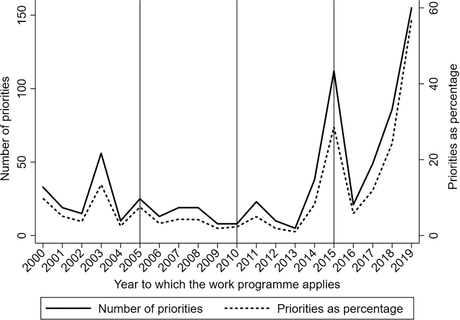
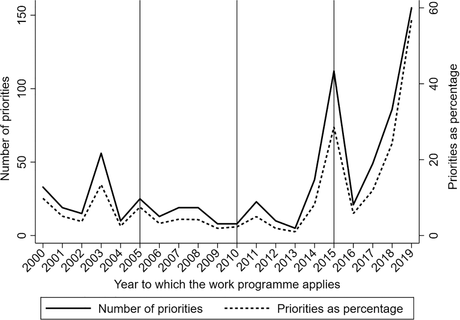
In short, within and beyond the Commission, programming matters: at the level of individual files or packages, WP inclusion means ‘a license to work’ for the lead DG (Interviews 2, 3); at the level of political messaging, the EU's agenda‐setter uses programming and prioritisation to translate abstract prerogatives into concrete and visible plans for legislative years; at the systemic level, the Commission's WP feeds into the inter‐institutional ‘Joint Declaration’, that has added visible commitments on ‘top priorities’ since December 2016 (Interviews 2, 5). Legislative priorities annexed to the WPs are the ‘best case scenario’ for the Commission's ‘agenda‐setting power’ (Kreppel & Oztas Reference Kreppel and Oztas2017: 1127) and continue to be the most explicit expression we have of what matters to the Commission in EU law‐making (Interview 4). As an under‐exploited source of data, WPs thus offer us the most direct insights available into the Commission's choice of agenda strategies. Figure 2 shows all legislative files that were on the agenda at any point in time between autumn 1999 and spring 2019, under either the Prodi, Barroso I, Barroso II or Juncker Presidencies. As the dotted line demonstrates, prioritisation is relatively uncommon. In the most recent periods, however, and in the Juncker Commission's last year in particular, more than half of all ongoing files were prioritised (and typically linked to the ten political priorities).
The number and percentage of announced priorities, by WP.
The politics of legislative priority: The theoretical argument
Politics in Europe's multilevel system has transformed over the last decades. The EU's politicisation across member states is well‐explored along the dimensions of (1) increased visibility; (2) greater contestation; and (3) broader engagement (De Wilde et al. Reference De Wilde, Leupold and Schmidtke2016). Contestation is expressed in electoral and mass Euroscepticism; broader engagement and attention show in the salience of EU policies. Both contestation and salience increase the EU's domestic visibility. Subsequently, pressure travels bottom‐up. We ask whether the Commission – the closest actor Europe has to an executive – responds by using its main prerogative: setting the agenda and prioritising legislative dossiers.
In a nutshell, we argue that the Commission uses legislative priorities as signals in response to bottom‐up pressure. Politicisation has made the EU and its policies more visible across member states, and to broader audiences, including national publics and political parties. We propose that the Commission is agenda‐responsive to these new audiences. Prioritisation is the Commission's key tool to signal what matters most on the agenda it sets, and to focus downstream decision‐making. Unlike governments and parliamentarians, the Commission is not driven by vote‐seeking or fear of electoral punishment. Instead, the Commission's responsiveness is motivated by bureaucratic survival under threat, and by policy‐output under salience. The Commission, we argue, uses legislative priorities to signal aggregate restraint in response to threats, and targeted performance in response to salience. Pressure from domestic public opinion and parties are key in both mechanisms. Pressure and agenda‐responsiveness increase with visibility; visibility is driven up by Euroscepticism and issue‐salience.
Indeed, beginning with encroachment into ‘core state powers’ (Genschel & Jachtenfuchs Reference Genschel and Jachtenfuchs2014) and dropping levels of support post‐Maastricht (Hooghe & Marks Reference Hooghe and Marks2009), attention to EU policies and their consequences increased further in the ‘polycrisis’ of the 2010s (Zeitlin et al. Reference Zeitlin, Nicoli and Laffan2019). The EU is not only visible; it is confronted with juxtaposing claims: calls for EU‐level problem‐solving often clash directly with attacks on the very existence of supranational policy making (cf. Rauh Reference Rauh2016: 30). In times of the ‘regulatory state’ (Majone Reference Majone1996), the Commission's main audiences were insider networks, stakeholders and experts; in this new environment, the Commission faces expectations and attacks from much broader audiences (Rauh Reference Rauh2016: 2; 33–40; Busuioc & Rimkutė Reference Busuioc and Rimkutė2020: 1259).
The relevance of politicisation for electorally connected actors may be intuitively plausible. Yet, why should domestic pressures ‘travel up’ to a non‐majoritarian actor, mandated to promote the Union's ‘general interest’ – not least by not responding to national, electoral and ideological influence? Why should the Commission use its agenda to signal responsiveness, when deciding on whether to propose and prioritise legislation, how much, and on what issues? We argue that the Commission, when taking these decisions, is driven by two motivations: (1) output under salience, and (2) survival under threat. Targeted performance and aggregate restraint will be sent as reputation‐boosting signals, in response to pressures from the new audiences: domestic publics and governing parties.
We assume that the European Commission, like other non‐majoritarian institutions, draws its legitimacy, first and foremost, from the policy output it helps to generate (Majone Reference Majone1996). Yet, in a politicised environment, relying on output will meet with particular challenges. First, output is more difficult to deliver when economies produce high inequality and low growth (Piketty Reference Piketty2014). Second, the Commission's failure to deliver will be more visible to domestic publics (Rauh Reference Rauh2016: 28–33). Third, governing parties may be incentivised to blame ‘Brussels’, with the Commission at its core (Hobolt & Tilley Reference Hobolt and Tilley2014). What is more, in a contested context, Europe's citizens have become willing to not simply express Eurosceptic attitudes, but cast Eurosceptic votes at the ballot box. Studies show that public attitudes matter for the Commission in such a context. Under contestation, the Commission's regulatory choices in consumer policy disperse benefits from narrow producers to broader groups of consumers (Rauh Reference Rauh2016: 238–239). Under salience, the Commission has begun to seek public opinion in issue‐specific surveys, with citizen support becoming ‘an important resource in agenda‐setting’ (Haverland et al. Reference Haverland, Ruiter and Van de Walle2018: 330). During policy formation, the Commission has broadened its consultation processes to include ‘outside’ stakeholders beyond its established networks and audiences (Bunea Reference Bunea2017).
We propose that the Commission perceives bottom‐up pressure from these audiences, first, as a policy‐seeker and, second, as a survival‐oriented bureaucracy. Aware that the EU and its policies have moved into the domestic limelight, with governments, parties and citizens incentivised to pay attention to ‘Brussels’, the Commission will be agenda‐responsive (cf. Rauh Reference Rauh2016). Responsiveness will show in different ways: the policy‐seeker will target issues of salience for publics and governing parties; the survival‐seeker will exercise aggregate restraint.
First, in line with the comparative literature, public attitudes should drive responsiveness – be these issue priorities (e.g., Jones & Baumgartner Reference Jones and Baumgartner2004), policy preferences (e.g., Soroka & Wlezien Reference Soroka and Wlezien2010) or public support for policy alternatives (e.g., Rasmussen et al. Reference Rasmussen, Reher and Toshkov2019). Congruence between the public's policy preferences and governments’ policy agendas is a well‐established argument (e.g., Jones & Baumgartner Reference Jones and Baumgartner2004). Hence, the Commission's quest for reputation should incentivise agenda‐congruence. Performance has always been at the core of the Commission's reputation. We propose that in a politicised environment – where threats to and calls for supranational action coincide and collide – reputation will be bolstered particularly if the Commission targets those challenges that matter most for Europe's citizens (e.g., Becker et al. Reference Becker, Bauer, Connolly and Kassim2016; Peterson Reference Peterson2017; Nugent & Rhinard Reference Nugent and Rhinard2016).
Yet, as agenda‐setter, the Commission can only propose and prioritise legislation; it cannot adopt and implement policy. To adopt laws, the Commission depends on the EU's co‐legislators; to implement policies, it relies on the member states. Therefore, governing parties, too, are a relevant audience. Governing parties are key in legislative decision making and national implementation, and the Commission depends on them not to set, but to deliver on, its priorities. In addition, governing parties play a crucial role in connecting the national and supranational democratic arenas. The EU and its policies have become electorally salient and visible in domestic discourse (e.g., Hutter et al. Reference Hutter, Grande and Kriesi2016). Where such a context coincides with expectations for supranational problem‐solving, and where governments are seen (not) to work towards joined solutions, governing parties may be incentivised to promote their own issue‐priorities via the EU‐level. The Commission will respond to their issue‐salience – to increase the chances of delivery, and to see delivery promoted by governments domestically. In sum, if the Commission aims to boost reputation through targeted performance, it should respond to governments’ issue‐salience.
By prioritising these salient issues, the Commission can begin to address the above‐identified challenges to its output legitimacy. Priorities in line with citizens’ attitudes show a Commission attending to Europe's public; in turn, citizens will pay attention to salient issues. Priorities responding to governing parties’ salient issues increase the chance that governments will support delivery downstream, avoid visible failure, and even ‘sell’ the output to domestic electorates.
In sum, issue‐specific salience drives up responsiveness by bureaucracies, governments or parties (e.g., Page & Shapiro Reference Page and Shapiro1983: 181–183; Soroka & Wlezien Reference Soroka and Wlezien2010: 43–45; Esaiasson & Wlezien Reference Esaiasson and Wlezien2017). Issue‐salience varies with the attention a policy area attracts. Attention stems from the importance of an issue to the public and partisan commitment; both make proposed EU legislation more salient (cf. Hagemann et al. Reference Hagemann, Hobolt and Wratil2017; Wratil Reference Wratil2018). A Commission aiming at targeted performance should, therefore, prioritise those policy fields that are salient for citizens and governing parties (cf. Klüver & Spoon Reference Klüver and Spoon2015). These will be more visible, more widely followed and more carefully monitored, and the Commission can use priorities on those issues as response‐signals. We therefore submit:
H1: The likelihood of a legislative file to become a Commission priority is higher in policy areas that are salient for citizens in the EU.
H2: The likelihood of a legislative file to become a Commission priority is higher in policy areas that are salient for governing parties in the EU.
Second, the Commission perceives bottom‐up pressure as a survival‐oriented bureaucracy. In the new environment, non‐majoritarian institutions are ‘under attack’; delegation to technocracies in general, and to technocrats beyond the state in particular, is contested (e.g., Norris & Inglehart Reference Norris and Inglehart2018). At the national and global level, technocracies are no longer shielded from public, partisan and electoral pressure by their expertise and regulatory focus (e.g., Hooghe et al. Reference Hooghe, Lenz and Marks2019; Koop & Lodge Reference Koop and Lodge2020). As the ‘public face’ of ‘Brussels’, the non‐majoritarian Commission is at the centre of attacks. Hence, sheer survival is on the line: of the Commission and of the system it serves.
Bottom‐up threats reach the Commission through two channels: a public and a partisan one. Domestic audiences ‘sustain or erode’ actors’ existence, autonomy and authority (Busuioc & Rimkutė Reference Busuioc and Rimkutė2020: 1259), and the Commission will attempt to restore its reputation to protect its ‘turf’ (Carpenter Reference Carpenter2010). Under salience, a policy‐seeker gains reputation through agenda‐congruence; under contestation, a survival‐seeker boosts reputation by signalling agenda‐restraint. This argument is in line with the comparative literature on independent agencies: when their systemic roles come under attack, when their policy choices become salient, when new partisan actors become involved, and when public support is dwindling, restraint is a key way to respond to public concerns (e.g., Whitford Reference Whitford2002; Koop Reference Koop2014; Maor & Sulitzeanu‐Kenan Reference Maor and Sulitzeanu‐Kenan2016). This argument should hold in particular when the EU's visibility and electoral salience coincide with contestation, and when national parties will fear punishment over EU policies at the ballot box.
Indeed, the more Europe matters, and the more it matters visibly, the more will citizens and parties pay attention to the EU and its policies, both ‘at home’ and in Brussels and Strasbourg. Visibility should increase in particular with contestation, expressed through mass Euroscepticism and the electoral success of Eurosceptic parties (cf. Hagemann et al. Reference Hagemann, Hobolt and Wratil2017; Wratil Reference Wratil2018). Both put the Commission – the epitome of the EU and its policies – at the core of attacks. The Commission is acutely aware of the degree of domestic contestation, of being its prime target, and of the need to be seen to ‘listen’ (cf. Rauh Reference Rauh2016: 27; Sternberg Reference Sternberg2016). The legislative agenda is one strategic ‘tool’ to react, and the Commission has been shown to use this tool in response to Euroscepticism (Reh et al. Reference Reh, Bressanelli and Koop2020). In sum, under public and electoral threat, the survival‐oriented Commission should signal aggregate restraint, to shore up reputation and protect turf. We therefore submit:
H3: The likelihood of a legislative file to become a Commission priority is lower under higher levels of public Euroscepticism.
H4: The likelihood of a legislative file to become a Commission priority is lower when Eurosceptic parties receive a higher vote share in national elections.
Data and operationalisation
To analyse the conditions under which the Commission prioritises legislative proposals, we created a dataset of OLP (co‐decision) files, by year of being ‘at risk’ of prioritisation. We included all files on the legislative agenda, at any time, between autumn 1999 and spring 2019; hence, our focus is on the Prodi, Barroso I, Barroso II and Juncker Commissions.Footnote 2 As prioritisation takes place once a year, and as the Commission's annual WPs are typically published in early October, the annual periods in our dataset run from the beginning of October to the end of September in the next calendar year.Footnote 3
We considered a legislative file to be ‘at risk’ of prioritisation in each year between its ‘conception’ and conclusion. As files may be mentioned and prioritised in WPs before they are officially proposed (‘priority initiatives’), we treat the year before a proposal is published as the year of conception; this is the first year in which the file is ‘at risk’ of being prioritised. Our dataset consists of file‐years; it includes 8,098 file‐year observations for 2,077 co‐decision files concluded between July 1999 and April 2019 and, on average, 3.9 observations per legislative dossier.
Our dependent variable priority is dichotomous and takes the value of 1 when a legislative file is mentioned as a priority in a Commission WP in a given year. Prioritisation is relatively infrequent: only 724 of the 8,098 observations in our dataset take the value of 1 (8.9 per cent). It is, in principle, possible for a file to be prioritised more than once, but this was rare until 2014. Under the Prodi, Barroso I and Barroso II Commissions, 16 files were prioritised twice and only one file was prioritised three times. By contrast, of the 423 files listed as priorities by the Juncker Commission, 76 were prioritised twice and 44 (at least) three times.
A first set of independent variables capture issue salience. Public issue salience tests whether the Commission is more likely to prioritise legislation which matters for Europe's citizens (H1). The variable is based on the Eurobarometer question: ‘What do you think are the two most important issues facing (your country) at the moment?’ This question has been asked since 2002; hence, we have missing values for the first periods (see Supporting Information Appendix B for details of the operationalisation).Footnote 4 The survey presents respondents with around fourteen ‘important issues’ (e.g., crime, immigration, unemployment), though not all issues are included in all waves. We calculated EU‐wide salience scores for all issue areas and periods, divided by two to correct for the fact that respondents can choose two issues. We log transformed the values to deal with the variable's positive skewness.
To assign salience scores to files, we linked legislative proposals to issue areas. Most proposals (60 per cent) could not be linked to any of the important issues; we assigned a value of 0 to these files (see Supporting Information Appendix B for details). Some of these touch on issues that citizens may consider important but that are not included in the survey. We therefore ran robustness checks with (1) an alternative public issue salience measure, where the value of 0 is turned into missing for those files that had attracted domestic media attention, and (2) a media attention measure as an alternative to public issue salience (available for all proposals; see Tables C4, C5 and Appendix B in the Supporting Information for details). The main salience measure is lagged by one year, as it should take some time for the Commission to identify and respond to national‐level salience.
To test our second hypothesis (H2), we created the variable governing parties’ issue salience (henceforth: government issue salience). The variable aims to capture the importance that political parties in government attribute to the policy area of a co‐decision file. Our measure links the file's substantive policy area to the corresponding Comparative Manifesto Project (CMP) policy categories.Footnote 5 The identification of the policy categories and their link to the CMP policy items was inspired by Hagemann et al. (Reference Hagemann, Hobolt and Wratil2017), Wüst and Faas (Reference Wüst, Faas, Marsh, Mikhaylov and Schmitt2007) and Klüver and Spoon (Reference Klüver and Spoon2015) (see Table B2 in the Supporting Information Appendix). We assigned each file to one of 17 policy categories. Subsequently, we matched these with specific CMP items (either a single item or a combination), identifying the share of party manifesto data devoted to that specific policy area. As the CMP data are measured at the party‐level, we first aggregated the data to create country‐level measures. We used weighted averages of the CMP scores, for each of the 17 policy categories, and for each party in government. The weighting is based on parties’ seat share in the lower house, using the ParlGov dataset (Döring & Manow Reference Döring and Manow2016). We then created an EU‐level measure, taking the weighted average of all country measures.Footnote 6 The weighted average is based on the population share in a given period, using the Penn World Table (Feenstra et al. Reference Feenstra, Inklaar and Timmer2015). We lagged this measure, too, by one year (cf. Supporting Information Appendix B for details and alternative operationalisations).
A second block of independent variables captures Euroscepticism. To explore whether the growing public contestation of Europe matters for the European Commission (H3), the variable public Euroscepticism captures the percentage of respondents in Europe who answer ‘a bad thing’ to the Eurobarometer question: ‘Generally speaking, do you think that (your country)’s membership of the EU is …?’ (a good thing/a bad thing/neither good nor bad). The measure is lagged by one year. For example, the Commission's 2011 WP, published in October 2010, is linked to levels of Euroscepticism from the 2009 autumn wave.
Finally, we assess the influence of Eurosceptic vote share in national elections on prioritisation (H4). The Chapel Hill Expert Surveys give us party positions on European integration (Bakker et al. Reference Bakker, Vries and Edwards2015; Polk et al. Reference Polk, Rovny and Bakker2017). Following Mair (Reference Mair2000: 32), we consider parties opposed or strongly opposed to integration as Eurosceptic (rounded scores 1 or 2 on a seven‐point scale). We, first, calculated the vote share of all Eurosceptic parties in each national election. Then, we calculated the EU average by weighting the vote share by countries’ population share, again relying on the Penn World Table (15 states from 1999, 25 from 2004, 27 from 2007 and 28 from 2013).Footnote 7 We lagged the variable by one year.Footnote 8
We also included a number of control variables. First, national elections counts the number of elections – parliamentary elections and, in presidential and semi‐presidential systems, presidential elections – that took place in a given year period, weighted by population. Population weighted scores allow us to explore whether upcoming elections in large member states affect the Commission more than elections in smaller states, increasing legislative uncertainty and, thus, making the Commission more hesitant to prioritise legislation (cf. Kleine & Minaudier Reference Kleine and Minaudier2019).
Second, EU expansion captures whether legislation in any way expands the competences of the EU and of the Commission itself. In line with Majone (Reference Majone1996), we expect the Commission to seek maximum influence and, thus, to be keen on prioritising ‘expansive’ legislation. Using the operationalisation introduced by Reh at al. (Reference Reh, Bressanelli and Koop2020), we assign a value of 1 to legislation that increases (1) the level, (2) the scope, or (3) the inclusiveness of EU action (see Table C in the Supporting Information Appendix; cf. De Wilde & Zürn Reference De Wilde and Zürn2012; Wratil Reference Wratil2018). Otherwise, the file takes the value of 0. Such files include, for instance, amendments of standards that were already set at the EU‐level, requirements for countries to submit certain statistics, and programme renewals.
Third, the variable redistribution is dichotomous and captures whether legislation has redistributive implications or not; that is, whether legislation allocates funds to a particular group in the EU. We updated the data collected by Reh et al. (Reference Reh, Héritier, Bressanelli and Koop2013) to 2019. We expect the Commission to be more hesitant to prioritise redistributive legislation due to contention potential.
Fourth, to capture the complexity of legislation, a continuous variable measures the number of recitals in the Commission proposal. The variable updates data of Reh et al. (Reference Reh, Héritier, Bressanelli and Koop2013) for 2009–2019. We expect that more complex files are more likely to be prioritised: ‘non‐complex’ legislation should move smoothly through the legislative process, without a ‘prioritisation push’. As the variable is strongly positively skewed, we log transformed it.
Fifth, we control for inter‐institutional dynamics. The Commission should hesitate to prioritise files when the policy positions of Council and EP are far apart. Such positions make it hard to reach a compromise, and the Commission, anticipating the risk of legislative failure, will refrain from prioritisation. Our distance measure captures the Euclidean distance between actors’ positions on the two most important conflict dimensions in EU politics: left‐right and pro‐anti integration. We first computed the left‐right and pro‐anti‐integration distance on the dimension (average distance between Council and EP in the relevant year‐period). The final Euclidean distance was calculated as
 where p and q are, respectively, the EP's and Council's positions. Data on actors’ positions were provided by Broniecki et al. (Reference Broniecki, Obholzer and Reh2018), who calculated them using national party position data from the Chapel Hill Expert Survey (Bakker et al. Reference Bakker, Vries and Edwards2015; Polk et al. Reference Polk, Rovny and Bakker2017). A two‐step procedure estimates the Council's position: (1) average positions of governing parties were calculated, weighted by parliamentary seat share; (2) average member state positions were calculated, weighted by population. The EP position was calculated by using the median MEP's party position.
Sixth, the variable final year captures a Commission's last year in office. Be it for functional, reputational or political reasons – or a mix of all three – an outgoing Commission should prioritise more legislation in its final year, to conclude the procedures it conceived (cf. Figure 2). The dichotomous variable distinguishes the last year of the legislative cycle from the first four years.
Finally, we included dummy variables for each Commission. Driven by specific dynamics, different Commissions might use WPs differently (cf. Kreppel & Oztas Reference Kreppel and Oztas2017: 1132ff.). Dummies also allow us to control for other factors specific to legislative terms. All descriptive statistics are included in Table B4 in the Supporting Information Appendix; Table B5 shows the correlation matrix for all independent and control variables.
Analysis
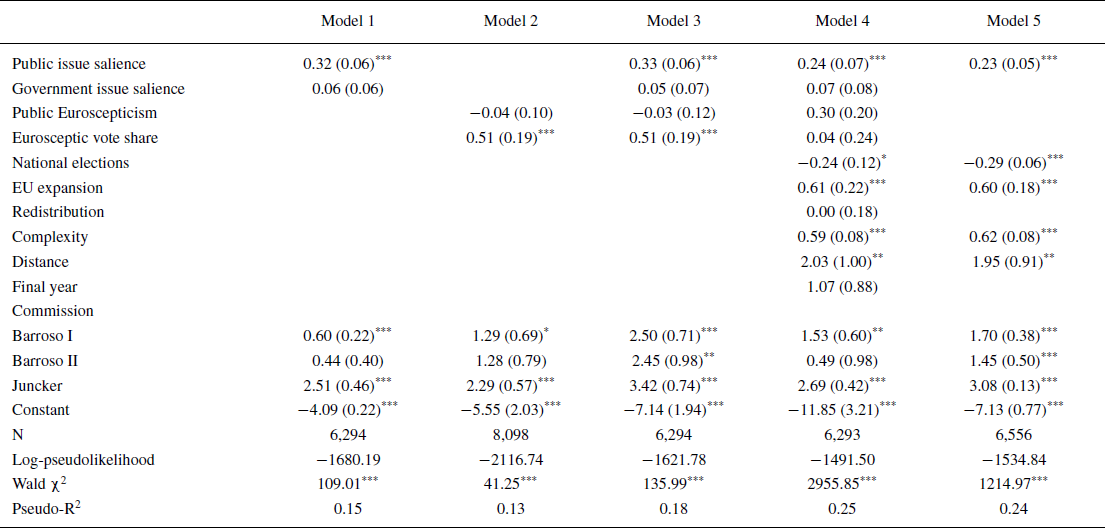
As our dependent variable is dichotomous, we estimated the likelihood of prioritisation using logistic regression.Footnote 9 Our unit of analysis is pending legislation in a specified time‐interval (1 October to 30 September). We therefore used two‐way (non‐nested) standard errors, clustered by legislative procedure and period.Footnote 10 We estimated five main models (Table 1). Model 1 includes the independent variables capturing salience both at the mass and at the party‐level (public issue salience and government issue salience); Model 2 includes the variables for Euroscepticism (public and vote share); Model 3 includes all independent variables; Model 4 is a fully specified model including control variables; Model 5 is a reduced model including all variables that had a significant effect in Model 4. All models include fixed effects for individual Commissions.Footnote 11
Explaining the Commission's legislative priorities

Note: Logistic regression coefficients with robust standard errors clustered by period and legislative file.
*p < 0.10; **p < 0.05; ***p < 0.01 (two‐tailed).
Our first hypothesis on the influence of public issue salience on priority‐setting is unambiguously supported. The effect is strong and robust across different model specifications. In deciding which legislative files to prioritise, the Commission appears to pay close attention to what European citizens consider important. The effect is even stronger when using our alternative – more restricted – operationalisation of public issue salience (see Table C4 in the Supporting Information Appendix).
However, we find no support for our hypothesis on government issue salience (H2). The effect of our variable is always positive, but not significant. This is not to say that government issue salience does not matter: our measures do not strongly correlate, but government issue salience may, at least partially, capture those issues that matter for citizens.Footnote 12 Yet, our analysis suggests that issue salience for governing parties does not have an independent effect on priority‐setting.
Moving to our hypotheses on Euroscepticism, public Euroscepticism is never significant, and its sign actually changes when we include our control variables. Moreover, contrary to our expectations, the effect of Eurosceptic vote share is positive (and significant) in Models 2 and 3; yet, the effect disappears when we add our control variables. Hence, overall, we do not find support for the argument that the Commission displays self‐restraint in response to Euroscepticism. To illustrate this, the Juncker Commission set only a small number of political priorities under high levels of Euroscepticism, but this actually translated into a high number of legislative priorities.
Turning to our control variables, most relationships are as expected. Under higher uncertainty, the Commission is more hesitant to prioritise: the effect of national elections is negative and significant. Moreover, the effect of EU expansion suggests that the Commission, indeed, prioritises files that expand the EU's – and its own – competences. Similarly, more complex files are more likely to be prioritised, supporting our expectation that prioritisation can be used to ‘push’ more difficult files. Redistribution, by contrast, does not seem to play a role. The effect of our distance variable is the opposite of what we expected. Instead of shying away from prioritisation under potential conflict between Council and EP, the Commission becomes more likely to prioritise. We expected that conflict potential would make the Commission hesitant; instead, the Commission seems to invest more resources in legislative files under such conditions, potentially because inclusion in a WP can ‘boost’ a law's chances of approval.
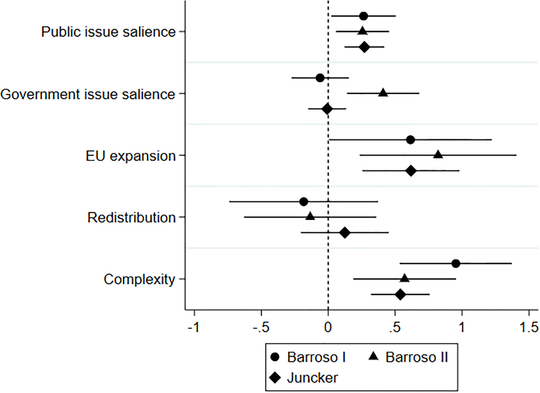
Finally, prioritisation varies across commissions. Controlling for other factors, Barroso I and, especially, Juncker prioritised more than Prodi (the baseline). Figure 3 further explores prioritisation by different commissions. We did not run a model for the Prodi Commission because we only have public issue salience data for the last annual period of that commission. As each Commission model only captures a small number of years, we excluded variables that varied over time only; instead, we added fixed effects for different yearly periods.
Prioritisation by the Barroso I, Barroso II and Juncker Commissions. [Colour figure can be viewed at wileyonlinelibrary.com]
Notes: Logistic regression coefficients with robust standard errors clustered by legislative file; intercept and fixed effects for yearly periods not reported; 95 per cent confidence intervals; number of observations is 1,910, 2,254 and 1,753, respectively.

Most importantly, Figure 3 confirms that public issue salience drives up the likelihood of prioritisation: its effect is positive and significant for all commissions.Footnote 13 Also, in line with the main models, the effects of EU expansion and complexity are always positive and significant. The findings for government issue salience raise more questions. Similar to the main findings, the variable does not increase the likelihood of prioritisation by Barroso I and Juncker; by contrast, the effect for the Barroso II Commission is positive and significant. This finding deserves follow‐up qualitative research, to explore what exactly drove this Commission. Yet, preliminary inspection of priorities and government issue salience suggests that the Barroso II era was characterised by a strong concern – shared between national governments and the Commission – with business regulation as well as employment and social policy. As the period was primarily characterised by the financial and Eurozone crises, the finding should not surprise.
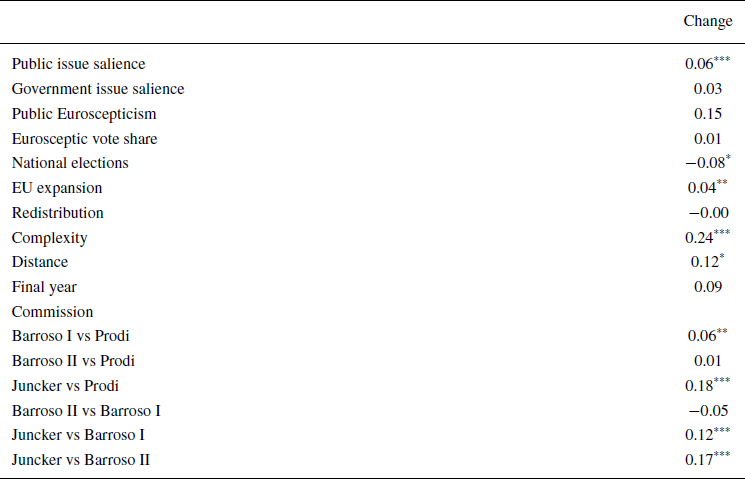
Finally, to better appreciate the magnitude of the effects of our independent variables, we used (the full) Model 4 to compute marginal changes (Table 2). The model estimates the probability of observing the outcome as a specified variable moves from its minimum to its maximum value, whilst other variables are kept at their observed values. Complexity makes the biggest difference by far: the most complex files are about 24 percentage points more likely to be prioritised than the least complex ones. In addition, as public issue salience moves from minimum to maximum, the odds of prioritisation increase by about six percentage points. Looking at the commissions, strikingly, legislation is 17 percentage points more likely to be prioritised under Juncker than under Barroso II and Prodi, and 12 percentage points compared to Barroso I.
Commission prioritisation: marginal changes
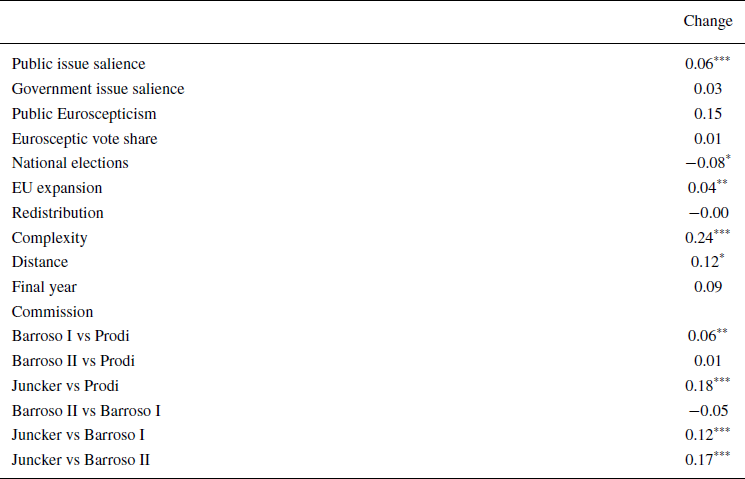
Notes: Change from minimum to maximum value, based on Model 4;
*p < 0.10; **p < 0.05; ***p < 0.01.
Conclusions
The EU – its institutions, its law‐making, its policies – has become politicised in the domestic democratic arena. This paper asked whether the Commission uses agenda‐setting and legislative priorities in response to bottom‐up political pressure. Politicisation has made the EU more visible, and, in so doing, has broadened the Commission's audiences. Prioritisation signals what matters most to the Commission on the agenda it sets; we argued that two motivations drive the Commission's use of this signal: policy‐output and bureaucratic survival. To bolster its reputation in the ‘new environment’ of EU law‐making, we expected the Commission to demonstrate targeted performance in response to public and party issue salience, and to signal aggregate restraint in response to mass and electoral Eurosceptic threats.
We tested our argument using new data on legislative priorities, based on the Commission's WPs from 1999 to 2019, and covering four Presidents (Prodi, Barroso I, Barroso II, Juncker). The analysis of more than 2,000 co‐decided laws confirms that the Commission prioritises legislation in those policy areas that matter most to citizens. This effect holds under each and every Commission; Juncker prioritises legislative proposals more than his predecessors, but public issue salience has shaped the Commission's agenda at least since the early 2000s. This finding is important: with permissive consensus ending and public support dropping, agenda‐congruence sends a clear signal into the legislative process: the Commission continues to strive for policy‐delivery and will promote legislation that matters to citizens. In doing so, the actor shows that politicisation can enable – and not just constrain – supranational action.
Yet, even a self‐declared ‘political’ Commission is responsive to public priorities only; governing parties’ issue salience does not seem to drive agenda‐priorities. The exception of Barroso II is interesting and calls for follow‐up research into the conditions under which governing parties choose to push their salient issues up to the supranational level, and implement – and, potentially, communicate – jointly solved problems domestically. Overall, however, salience makes the Commission more responsive, if in a decidedly non‐partisan way.
Whilst we find that public issue salience drives the Commission, Euroscepticism – at either mass or political level – does not seem to constrain it: even under high levels of threat, the Commission strives to shore up reputation through targeted performance, not through restraint. This is particularly interesting given the results on one of our control variables: The Commission is more likely to prioritise legislation that expands the competences of the EU (and, thereby, of the Commission itself). A prior study showed that Euroscepticism does increase the likelihood of proposals to be withdrawn (Reh et al. Reference Reh, Bressanelli and Koop2020). Read together, these findings show us a European Commission that is not deterred from prioritising – yet incentivised to withdraw – legislation under systemic contestation; that aligns its priorities to those of the public; and that does not shy away from prioritising expansive legislation.
Finally, our analysis demonstrates that prioritisation is more likely when legislation is complex and when the positions of Council and EP are far apart. Hence, agenda‐responsiveness to public issue salience does not seem to supersede but, rather, to complement the Commission's ‘classic’ roles in EU law‐making: the provision of technical expertise, and the brokerage of compromise.
Overall, our article shows that a focus on bottom‐up politicisation is analytically fruitful and that the visibility of ‘Europe’ need not be a constraint: The Commission uses its legislative agenda to signal its quest for output on what matters most to EU citizens. In doing so, the Commission does not seem constrained by systemic contestation, and uses its well‐honed roles as provider of expertise and broker of comprise to overcome complexity and inter‐institutional conflict. Ursula von der Leyen's May 2020 adjustment of her first WP – released in January 2020 – to prepare a better supranational response to the then unfolding COVID‐19 crisis, and to take ‘on board the views of citizens’ (European Commission 2020) is one of the latest and most dramatic examples of agenda‐responsiveness. In sum, non‐majoritarian actors and supranational decision‐making are no longer insulated from the pressures of multilevel politics. Analysing the Commission's legislative programming and prioritisation sheds new light on this crucial but often overlooked aspect of EU policy making.
Acknowledgements
We would like to thank Niccolò Massei, Francesca Minetto, Michele Scotto di Vettimo and Nina Weber for their assistance with the data collection. We are grateful to Giacomo Benedetto, Adriana Bunea, Sofia Collignon, Thomas König, Rubén Ruiz‐Rufino and two anonymous reviewers for their constructive comments. Earlier versions of this article benefitted from feedback provided by audiences at Royal Holloway and IBEI, as well as at the KCL workshop on ‘Politicising and De‐Politicising the European Union’ (December 2017), the ECPR‐SGEU Conference in Paris (June 2018), the ECPR General Conference in Hamburg (August 2018), the UACES Conference in Bath (September 2018), and the EUSA Conference in Denver (May 2019). The authors would like to acknowledge their equal contribution. This article is part of a broader research project on ‘Politicising Europe’, funded by a British Academy/Leverhulme Small Research Grant (SG160582).
Online Appendix
Additional supporting information may be found in the Online Appendix section at the end of the article:
Table A: Interviews and type of interviewees
Table B1: Issues included in Eurobarometer surveys used
Figure B1: The policy agenda of the European Commission, by Eurobarometer categories
Table B2: Policy categories and CMP codes
Figure B2: The policy agenda of the European Commission, CMP categories
Table B3: Operationalisation of EU expansion
Table B4: Descriptive statistics
Table B5: Correlation matrix: Independent and control variables
Table C1: Explaining the Commission's legislative priorities, one‐way clustering
Table C2: Explaining the Commission's legislative priorities, using alternative operationalisations of public issue salience (based on Model 4)
Table C3: Explaining the Commission's legislative priorities, using alternative operationalisations of party issue salience (based on Model 4)
Table C4: Explaining the Commission's legislative priorities, using a more restricted public issue salience operationalisation
Table C5: Explaining the Commission's legislative priorities, using media attention instead of public issue salience
Table C6: Explaining legislative priorities, excluding ‘straightforward’ files†
Table C7: The effect of government issue salience on prioritisation, excluding public issue salience
Table C8: Explaining legislative priorities, using change in Euroscepticism


 Open access

