





Introduction
Across much of the United States, unsheltered homelessness is effectively criminalized (NHLC, 2021).Footnote 1 Rates of homelessness continue to rise, reaching a record 23 individuals experiencing homelessness per 10,000 people in 2024 (NHLC, 2025). This increase is largely driven by housing costs (NHLC, 2025), making it an urgent issue for social work (Henwood et al., Reference Henwood, Wenzel, Mangano, Hombs, Padgett, Byrne, Rice, Butts and Uretsky2015; Larkin et al., Reference Larkin, Henwood, Fogel, Aykanian, Briar-Lawson, Donaldson, Herman, Little, Meyer-Adams, Padgett, Patchner and Streeter2016). In 2024, a 6-3 Supreme Court decision ruled that cities can ban public camping and sleeping (Ludden, Reference Ludden2024a), affirming that local governments can coordinate their own homelessness responses. Subsequently, over 100 jurisdictions banned public camping (Ludden, Reference Ludden2024b), fostering a crisis in homelessness criminalization (Udvarhelyi, Reference Udvarhelyi2014). In her dissent, Supreme Court Justice Sotomayor highlighted the tension at the heart of the Court’s ruling: “the needs of local governments” versus “the most vulnerable in society” (City of Grants Pass v. Johnson Et Al., 2024, p. 46). Her remarks underscore a key dilemma: public and nonprofit social service organizations provide care to vulnerable homeless individuals, but the nature of that service may vary depending on an organization’s entanglement with state entities implementing punitive, criminalizing measures. A growing body of critical social work scholarship highlights this variation in service provision, warning that close collaboration with state actors implementing punitive measures may deepen criminalization (Bakko et al., Reference Bakko, Murray and Jacobs2025; Jacobs et al., Reference Jacobs, Kim, Whitfield, Gartner, Panichelli, Kattari, Downey, McQueen and Mountz2021; Rasmussen & Kim, Reference Rasmussen and Kim2024). Given these realities, this article investigates two central questions: how does escalating crisis acuity—as intensifying homelessness criminalization—shape crisis response coordination and organizational adaptation? And how do these adaptations differ depending on an organization’s relationship to state entities?
Globally, scholars have recently called attention to street-level organizations and providers during crises (Gofen & Lotta, Reference Gofen and Lotta2021). Brodkin (Reference Brodkin2021, p. 17) observes that most street-level research focuses on organizations “under ordinary conditions,” noting that governance arrangements and organizational responses may differ during crises. International scholarship, often on the COVID-19 pandemic, shows that crises can prompt sudden structural shifts in policy, system coordination, and service practices (Lotta et al., Reference Lotta, Coelho and Brage2021; Meza et al., Reference Meza, Pérez-Chiqués, Campos and Varela Castro2021; Møller, Reference Møller2021; Oscarsson et al., Reference Oscarsson, Alirani, Danielsson, Olausson and Öhman2025).
This article builds on and extends this literature. First, prior studies pay limited attention to crisis temporality, namely how shifts in acuity shape response efforts (Brodkin, Reference Brodkin2021). Drawing on Brodkin (Reference Brodkin2021, p. 18), crises can be understood as destabilizing events, with “acute crises” as those that “emerge urgently and unexpectedly.” While homelessness is a “chronic” type of crisis rooted in structural inequities, the “underlying frictions” of chronic crises “may burst into acute crises” due to exacerbating events, “producing particularly problematic conditions for frontline responders” (Brodkin, Reference Brodkin2021, p. 18). Homelessness persists as a chronic crisis rooted in structural economic inequities, yet prior scholarship identifies surges in punitive governance, or what Udvarhelyi (Reference Udvarhelyi2014, p. 816) terms “radical intensification[s] of criminalization.” This article examines one such acute moment on the level of service coordination and provision: a period of rapidly escalating criminalization of homelessness and its effects on coordination and frontline action.
Second, organizational adaptations may vary by their ties to state entities coordinating crisis responses. Nonprofit research emphasizes the importance of state relational dynamics (Smith & Lipsky, Reference Smith and Lipsky1993; Van Slyke, Reference Van Slyke2007), encouraging comparisons between public and private agencies. Nonprofit adaptations to homelessness may be impacted by governmental pressures (Mullins & Acheson, Reference Mullins and Acheson2014) and may involve street-level interorganizational partnerships, including collaborations with police (Flanigan, Reference Flanigan2024). Meanwhile, social work, often on the frontlines of homelessness response, has recently debated the profession’s relationship to a state that perpetuates violence and criminalization, with critical scholarship treating state-provider entanglements as analytically suspect (Bakko et al., Reference Bakko, Murray and Jacobs2025; Bakko, Reference Bakko2026; Jacobs et al., Reference Jacobs, Kim, Whitfield, Gartner, Panichelli, Kattari, Downey, McQueen and Mountz2021; Rasmussen & Kim, Reference Rasmussen and Kim2024).
By integrating these perspectives, this article bridges nonprofit studies and social work, comparing public and nonprofit adaptations to the homelessness criminalization crisis and highlighting how social workers and related professionals, employed by both types of organizations, navigate differing relationships to state entities. It contributes to a turn in street-level bureaucracy research toward crisis (Brodkin, Reference Brodkin2021; Gofen & Lotta, Reference Gofen and Lotta2021), addressing gaps in social work and street-level scholarship on how environmental conditions shape frontline practice (Chang & Brewer, Reference Chang and Brewer2023; Hupe & Buffat, Reference Hupe and Buffat2014).
This article uses an ethnographic case study of homelessness criminalization in Austin, Texas to show that tracking shifts in crisis acuity and organizational-state relationships helps explain crisis coordination and frontline adaptation. Political and community pressures for visible homelessness reduction introduced an enforcement-driven, criminalizing approach, which conflicted with the city’s existing care-oriented approach. These tensions were exacerbated by escalating police enforcement, intensifying crisis acuity, which fractured coordination efforts and generated ambiguity. Public providers, more tightly tied to city efforts, prioritized visible homelessness and sometimes mitigated harm, but risked complicity as enforcement escalated. Nonprofit providers remained focused on the most vulnerable, yet their separation from state entities paradoxically limited their ability to influence outcomes or reduce harm. These findings reveal how rapidly intensifying crisis acuity and differential organizational-state relationships shaped frontline adaptation and coordination.
Homelessness in the U.S. context
Homelessness persists globally (UNDESA, 2025), driven by neoliberal socioeconomic policies, resource scarcity, and states’ efforts to regulate marginalized populations, with some states, particularly Hungary, adopting criminalizing approaches to homelessness (Bence & Udvarhelyi, Reference Bence and Udvarhelyi2013; Florea et al., Reference Florea, Gagyi and Jacobsson2018; Udvarhelyi, Reference Udvarhelyi2014). In the United States, homelessness has surged over the last several decades. Since the 1980s, some of the major drivers of this surge have included economic downturns, deinstitutionalization of mental health care, welfare reform, urban gentrification, cuts to health and social welfare budgets, and a housing affordability crisis (USICH, n.d.; Fowler et al., Reference Fowler, Hovmand, Marcal and Das2019; NLCHP, 2015). Today, a persistent lack of affordable housing, combined with low wages and economic inequality (NLCHP, 2015), has led to the highest ever recorded number of homeless people as of 2024, at approximately 770,000 people nationally (de Sousa & Henry, Reference de Sousa and Henry2024). Moreover, homelessness is racialized (NHLC, 2025), with Black people comprising an over-represented 32% proportion of the homeless population (de Sousa & Henry, Reference de Sousa and Henry2024; Welsh Carroll et al., Reference Welsh Carroll, Flanigan and Gutierrez2023).
An array of policies, networks, and organizations at the federal, state, and local levels work to end or reduce homelessness and provide services to those impacted. Increasingly guided by a “Housing First” framework, which holds that housing is the first and primary intervention for homelessness, policies support a range of facilities and homelessness services, including outreach activities, temporary and transitional shelters, and permanent or permanent supportive housing (Fowler et al., Reference Fowler, Hovmand, Marcal and Das2019). The federal Department of Housing and Urban Development (HUD) supports these interventions and promotes the Continuum of Care (CoC) program, providing funding to local communities, including public and government-contracted nonprofit service organizations, to coordinate, implement, and evaluate services for those experiencing homelessness (HUD, 2025). Fundamentally, despite these programs, there exists a lack of affordable housing and related social services that continues to drive homelessness rates (USICH, n.d.; NLCHP, 2015). Moreover, at the federal level, Housing First has come under attack since 2025, with proposed threats to funding (Brzovic, Reference Brzovic2025).
Nonprofit scholars note that strong government–nonprofit partnerships are critical in addressing homelessness, with government providing critical resources and guidance to local CoCs, while CoCs develop local solutions to compensate for limits in government support (Jang et al., Reference Jang, Valero and Ford2023). For instance, the federal government granted emergency CoC funding to states and localities during the COVID-19 pandemic to address intensified housing and homelessness issues, while CoCs collaborated with local funders to address delays and inequities in federal disbursements (Jang et al., Reference Jang, Valero and Ford2023). Given the multitude of policies, agencies, and programs, strong interagency coordination to address homelessness has been noted as essential for effectively addressing the complexity of the issue (Fowler et al., Reference Fowler, Hovmand, Marcal and Das2019).
In the United States, social workers are involved in homelessness prevention and intervention across nonprofit, public, and policy arenas. Their roles span case management, clinical interventions and other direct services, and policy advocacy. Yet their positions within homelessness services are typically not formally institutionalized, and many non-social workers assume social-work-like roles. Current efforts seek to strengthen social work’s role in homelessness, including in direct service interventions and cross-system collaborations that can mitigate criminalization (Larkin et al., Reference Larkin, Henwood, Fogel, Aykanian, Briar-Lawson, Donaldson, Herman, Little, Meyer-Adams, Padgett, Patchner and Streeter2016). The American Academy of Social Work & Social Welfare has identified ending homelessness as one of the 14 Grand Challenges of Social Work (Henwood et al., Reference Henwood, Wenzel, Mangano, Hombs, Padgett, Byrne, Rice, Butts and Uretsky2015).
Street-level organizations and crisis response
Street-level bureaucracy theory examines how organizations, managers, and frontline providers adapt policy implementation in complex environments (Lipsky, Reference Lipsky2010). Policy mandates, institutional and organizational conditions, and provider schemas and resources constrain but do not determine street-level practices (Brodkin, Reference Brodkin2011; Hupe & Buffat, Reference Hupe and Buffat2014; Lipsky, Reference Lipsky2010; Soss et al., Reference Soss, Fording and Schram2011). Research shows how frontline practices shape and are shaped by these factors, affecting “the content of policy as they have produced it” (Brodkin, Reference Brodkin2008, p. 326). Providers not only implement formal policy but also develop informal routines and adaptations that are agentic and responsive to service environments (Brodkin, Reference Brodkin2011; Maynard-Moody & Musheno, Reference Maynard-Moody and Musheno2012), including exercising discretion in determining who is deserving of services, sometimes acting against formal rules (Welsh Carroll et al., Reference Welsh Carroll, Flanigan and Gutierrez2023).
Crises are one environmental factor that can affect street-level practices (Gofen & Lotta, Reference Gofen and Lotta2021), yet remain understudied compared to routinized service contexts (Brodkin, Reference Brodkin2021). Acute crises are defined as periods “marked by rapid and unanticipated change, urgency, and uncertainty…without time for the deliberation, planning, and preparation that accompanies more routine shifts in policy or administration” (Brodkin, Reference Brodkin2021, p. 18). They may introduce rapid and unpredictable shifts in service systems that increase ambiguity, which refers to reduced clarity about organizational goals, limits on accurate and timely information, shifts in worker roles, and erosions of established routines or situational knowledge that guides decision-making and coordination during ordinary times (Gofen & Lotta, Reference Gofen and Lotta2021; Møller, Reference Møller2021; Wong, Reference Wong2025). For example, in Sweden, pandemic-related ambiguity created coordination difficulties stemming from vague mandates and decision-making structures, negatively impacting frontline managers (Oscarsson et al., Reference Oscarsson, Alirani, Danielsson, Olausson and Öhman2025). Resource scarcity also poses a key challenge (Lotta et al., Reference Lotta, Coelho and Brage2021). In Mexico, healthcare providers rationed resources during the pandemic under a dominant population-level public health frame despite individual client needs (Meza et al., Reference Meza, Pérez-Chiqués, Campos and Varela Castro2021).
When analyzing crises, Brodkin (Reference Brodkin2021) urges attention to two levels: (1) informal organizational practices, such as frontline routines that adapt to crises and (2) structural conditions, such as realigned governance and interagency coordination. Brodkin (Reference Brodkin2021, p. 26) further critiques the static nature of many street-level studies, encouraging scholars to see “organizations-in-time” and how crisis dynamics “evolve over time.” This article takes up that call by tracking shifting acuity during a single overarching acute crisis.
For street-level studies, acute crises are analytically valuable for their temporal dimension, as they reveal how rapid, unanticipated shifts in conditions—often exceeding providers’ preparedness—intensify ambiguity and resource constraints and shape both systems’ and providers’ adaptations over a compressed timeframe (Brodkin, Reference Brodkin2021). While street-level research on crises is nascent, systems may realign policies and coordination networks or introduce new organizational roles in response to crises. Meanwhile, service organizations, managers, and providers may innovate, adapt, or resist system demands (Brodkin, Reference Brodkin2021; McCoyd et al., Reference McCoyd, Curran, Candelario, Findley and Hennessey2023; cf. Wong, Reference Wong2025). Crisis and disaster management research emphasizes interagency coordination as central to effective response, including for service organizations (Curnin & O’Hara, Reference Curnin and O’Hara2019; McCoyd et al., Reference McCoyd, Curran, Candelario, Findley and Hennessey2023).
Yet service organizations’ responses to external crises may differ by whether they are public or nonprofit. While government agencies provide many social services, nonprofits often deliver them under contract (Smith & Lipsky, Reference Smith and Lipsky1993). Crisis and disaster management literature highlights strong government–nonprofit collaboration, through role clarity, trust, joint planning, and communication, as key to effective response (Curnin & O’Hara, Reference Curnin and O’Hara2019; Jang et al., Reference Jang, Valero and Ford2023; Nolte & Boenigk, Reference Nolte and Boenigk2011; Simo & Bies, Reference Simo and Bies2007). This emphasis on collaboration echoes broader research on cross-sector effectiveness (Bryson et al., Reference Bryson, Crosby and Stone2015; Gazley, Reference Gazley2010). Some nonprofit research also suggests tensions in government partnerships, including how governments may exert directive control via contract and management practices (e.g., Van Slyke, Reference Van Slyke2007). Homelessness nonprofits may adapt locally in the face of these powerful state pressures (Mullins & Acheson, Reference Mullins and Acheson2014), and may engage in interorganizational partnerships, including street-level collaborations with police, when problems are particularly complex or outside their usual expertise (Flanigan, Reference Flanigan2024).
Contrary to scholarship emphasizing the benefits of government–nonprofit partnership (e.g., Jang et al., Reference Jang, Valero and Ford2023), emerging critical social work scholarship cautions against provider entanglements with the state, highlighting how such partnerships risk complicity in state-sponsored criminalization and violence against marginalized groups (Bakko, Reference Bakko2026; Bakko et al., Reference Bakko, Murray and Jacobs2025; Jacobs et al., Reference Jacobs, Kim, Whitfield, Gartner, Panichelli, Kattari, Downey, McQueen and Mountz2021; Rasmussen & Kim, Reference Rasmussen and Kim2024). Social work has a history of partnering with the state, including criminal-legal entities like the police, to socially control marginalized populations in line with oppressive state aims (Bakko et al., Reference Bakko, Jacobs, Fixler, Murray, Leotti, Erwin, Allen, Tomczak and HostetterForthcoming; Chapman & Withers, Reference Chapman and Withers2019; Harrell, Reference Harrell2023). Some nonprofits operate in ways that align with state control of criminalized populations (Cate, Reference Cate2023), blending social control with care during service provision (Jindra et al., Reference Jindra, Paulle and Jindra2020). Others challenge criminalizing discourses and practices (Anasti, Reference Anasti2020, Reference Anasti2023) or explicitly reject state ties to advance alternative approaches grounded in self-determination and liberation (Jacobs et al., Reference Jacobs, Kim, Whitfield, Gartner, Panichelli, Kattari, Downey, McQueen and Mountz2021; Rasmussen & Kim, Reference Rasmussen and Kim2024). Marginalized groups may also place greater trust in nonprofits than state-aligned entities (Park et al., Reference Park, Mosley and Grogan2018), underscoring the public value of maintaining distance. Given these insights, how does an organization’s relationship to the state, as captured by their public or nonprofit status, affect responses to crises involving the criminalization of marginalized groups?
The criminalization of homelessness
Homelessness criminalization has increased recently, including bans on public camping and sleeping, loitering, and begging (NHLC, 2025). These policies target homelessness visibility while marginalizing the needs of homeless individuals and criminalizing life-preserving behaviors (NHLC, 2025). As homelessness has grown (de Sousa & Henry, Reference de Sousa and Henry2024), state and local jurisdictions have increasingly coupled housing programs with punishment and policing. Yet research indicates that local criminalization does not reduce homelessness (Lebovits & Sullivan, Reference Lebovits and Sullivan2025).
Poverty governance scholarship emphasizes the role of policing in the lives of the poor (Soss & Weaver, Reference Soss and Weaver2017). Police are the most common street-level bureaucrat that homeless individuals encounter (Welsh Carroll et al., Reference Welsh Carroll, Flanigan and Gutierrez2023). Policing the poor or homeless can take multiple forms: aggressive citations and arrests ordered by police command, discretionary approaches that coerce individuals into therapeutic reform, or complaint-oriented policing, which resolves public complaints about homeless people by displacing them (Herbert et al., Reference Herbert, Beckett and Stuart2018; Herring, Reference Herring2019). In explicating this latter form, Herring (Reference Herring2019) found that, in lieu of arrest or pushing homeless people into social services, police responded to complaints by spatially dispersing homeless individuals—merely relocating them—or passing complaints to nonpolice agencies, such as sanitation. The cumulative effect of spatial shuffling was persistent forced movement, arrest, property destruction, and barriers to accessing health and social services. When police passed off complaints to service providers, providers were frustrated that those receiving services were those most complained-about rather than the most vulnerable (Herring, Reference Herring2019). As a result of their punitive treatment by police, homeless individuals may associate public service providers with police actions (Welsh Carroll et al., Reference Welsh Carroll, Flanigan and Gutierrez2023), avoiding service interactions altogether.
What role do service delivery systems and social service organizations and providers—public agencies or contracted nonprofits—play in homelessness criminalization? Robust delivery systems provide an alternative to criminalization, yet can inadequately address or even exacerbate threats for those most at-risk. For example, scholars and practitioners have criticized the primary assessment tool used to prioritize service users in resource-scarce environments for perpetuating inequities among racialized minorities (Fowle, Reference Fowle2022), groups already at heightened risk for criminalization (NHLC, 2025). At the provider level, street-level bureaucracy research has explored the spectrum of worker actions, from resisting to being complicit in criminalizing marginalized groups (Bhatia, Reference Bhatia2020; Slee, Reference Slee2023), echoing critical social work scholarship that cautions against state-provider entanglements (e.g., Rasmussen & Kim, Reference Rasmussen and Kim2024). Providers may engage in criminal-legal collaborations for multiple reasons including proximity, funding ties, or a desire to mitigate harms by mediating the relationship between service users and criminal-legal entities (Simes & Tichenor, Reference Simes and Tichenor2022).
Methods
I pursued this article’s aims through an interpretivist ethnographic case study that conceptualizes crises as events. Ethnography, through observation and interviews, enables researchers to capture rich contextual detail, understand participants’ meanings, and trace events over time (Marcus, Reference Marcus1995; Zilber, Reference Zilber2014). Case studies similarly allow in-depth examination of phenomena with attention to context (Yin, Reference Yin2017).
This attention to context and temporality complements an event-based approach to crises. As events, crises involve historically contingent and contextual “transformation of structures” (Sewell, Reference Sewell and McDonald1996, p. 262), producing notable material and social change. Events are also path dependent, shaping and constraining future possibilities (Sewell, Reference Sewell and McDonald1996). To analyze the temporal unfolding of a crisis, I attend to subevents as analytically significant occurrences that alter crisis acuity and affect how it is experienced or addressed, building on Brodkin (Reference Brodkin2021). This approach enables construction of a chronology of the broader case event (Yin, Reference Yin, Bickman and Rog2009), while analyzing dynamics shaping outcomes. Findings are organized according to subevents.
Data were collected over 21 months, from June 2020 to March 2022, as part of a broader project exploring institutional change in public safety in cities following the police killing of George Floyd, with attention to social service organizations. In Austin, public debates on noncriminalizing approaches to homelessness positioned it as a key public safety concern, directing ethnographic observation and interviews toward homelessness and organizational responses.
Observation occurred throughout the study, totaling approximately 750 hours. I attended and took detailed field notes of meetings of city council, public safety and health committees, housing and homelessness task forces, and neighborhood gatherings, involving elected officials, city staff, police, providers, advocates, and community members. When relevant, I collected meeting minutes, reports, and media coverage to provide context and track longer-term dynamics. News media also verified historical context prior to field entry, and I continued scanning coverage after fieldwork to capture longer-term dynamics. Most meetings were virtual due to COVID-19, enabling online observation and later review (Hine, Reference Hine, Fielding, Lee and Blank2008). Observations and field notes helped identify key public and nonprofit organizations in the homelessness services ecosystem for interview recruitment using purposive sampling, prioritizing actors centrally involved in homelessness services and coordination.
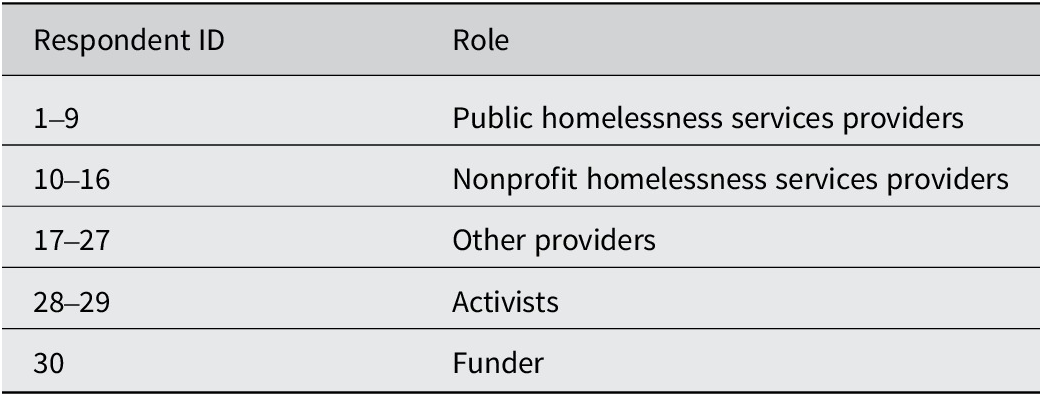
Consistent with case study sampling approaches oriented toward achieving saturation and theoretical insight, rather than statistical generalizability (Small, Reference Small2009), I conducted 28 interviews with 30 participants (see Table 1), including 16 managers and providers in housing and homelessness services (nine public, seven nonprofit). Six providers were social workers. One public provider was a police officer embedded in a homeless outreach team. To contextualize broader public safety efforts, I also interviewed a philanthropic funder, 2 activists, and 11 providers in other service areas. Interviews were conducted from July 2021 to March 2022, following the encampment ban and during escalating enforcement. I used a semi-structured guide focused on public safety issues, homelessness, the encampment ban and enforcement, and interorganizational relationships. Interviews averaged 90 minutes; professional connections facilitated access.
Interviewees

Table 1. Long description
The table consists of two columns titled Respondent I D and Role.
* Row 1: Respondent I D 1 through 9 are Public homelessness services providers.
* Row 2: Respondent I D 10 through 16 are Nonprofit homelessness services providers.
* Row 3: Respondent I D 17 through 27 are Other providers.
* Row 4: Respondent I D 28 through 29 are Activists.
* Row 5: Respondent I D 30 is a Funder.
A note below the table indicates that Respondent I D numbers correspond to interviewee quotes in the text and that all identifiers are anonymized.
Note: Respondent IDs correspond to interviewee quotes in the text. All identifiers are anonymized.
To build the case study, I organized and analyzed field notes chronologically (Yin, Reference Yin, Bickman and Rog2009). Using an interpretive lens, I observed that homelessness and criminalization were framed by actors as a crisis of growing acuity. Drawing on an eventful, temporal approach to crisis (Brodkin, Reference Brodkin2021; Sewell, Reference Sewell and McDonald1996), I identified key chronological inflection points and grouped notes into subevents, forming the three periods in the findings. In parallel, I conducted thematic analysis of interview transcripts (Gibson & Brown, Reference Gibson and Brown2009), focusing on homelessness, criminalization, and service system responses, which provided firsthand texture to ethnographic observations. Initial codes captured service coordination, frontline adaptation, interorganizational relationships, and shifts in criminalization; these were refined through analytic memoing and systematically compared with field notes to identify patterns.
Across all data, I identified patterns in how both the city and social service organizations responded to the overall crisis, as well as how they responded to changes in its acuity across subevents. Differences between public and nonprofit organizations emerged through this process. To enhance rigor (Tracy, Reference Tracy2010), I triangulated field notes, interviews, and news media, constructing a robust, corroborated account. Field notes provided insight into city-level coordination and organizational actors’ discussions, interviews captured actors’ perspectives and reflections, and media sources contextualized event timelines. Comparing across sources systematically revealed convergent patterns, strengthened analytical credibility, and illuminated how shifts in criminalization dynamics interacted with frontline adaptations. For example, discussions of escalating criminalization observed in city council meetings were corroborated in interviews with providers, which also provided richer detail on frontline responses. Findings quote observations and interviews. I indicate professional roles of participants in the findings and use organizational and individual pseudonyms to protect confidentiality.
Period 1: Coordination in a decriminalized environment
In summer 2019, the Austin city council lifted the city’s 23-year-old public camping ban that had criminalized visible homelessness. While the ban was enforced variably by police, in lifting it the council cited a chronic lack of affordable housing and the harms that criminalization can bring, including barriers to employment and long-term housing. The council later added limited restrictions in the name of safety for both the public and homeless population, prohibiting camping near sidewalks and wildfire-prone areas. But they also emphasized nonenforcement approaches in line with decriminalization, directing police to involve social service providers and mandating coordinated efforts to prioritize visible and populated camps for services, shelter, and housing. Decriminalization drew controversy, including threats of state intervention from Texas Governor Greg Abbott if the ban was not reinstated.
Within this context, street outreach services in Austin are provided by public and nonprofit organizations within the homelessness services ecosystem. Using HUD’s Coordinated Entry approach, frontline providers assess and prioritize individuals based on vulnerability to death. This prioritization reflects a scarcity of affordable housing and related social services, which, as in other cities, cannot meet the needs of all individuals experiencing homelessness. Outreach teams, often mobile, bring services to encampments and often include mental health and medical professionals. The primary public team is an interagency collaboration of clinicians, medics, social workers, and police trained in mental health who also ensure safety during outreach. Both public and nonprofit providers aim to combat criminalization by facilitating criminal-legal diversion and addressing structural and individual barriers to housing.
The COVID-19 pandemic exacerbated visible homelessness. While overall homelessness did not substantially increase, local estimates report unsheltered homelessness rose from 1,855 in 2019 to 2,262 in 2020 (Davis, Reference Davis2021). Reduced shelter capacity due to pandemic distancing requirements pushed more people into public spaces. Providers distributed tents and supplies for safer outdoor sheltering, which created larger and more visible camps. Following national health guidance, the city also allowed camping in park areas that would otherwise be restricted. These changes increased the number and visibility of unsheltered homeless individuals and amplified public concern.
In response, the city advanced several measures consistent with a decriminalized, care-based approach: committing to building 3,000 affordable housing units, converting motels into temporary bridge shelters, appointing a long-vacant homeless strategy officer, and launching the Homeless Encampment Assistance Link (HEAL) initiative. HEAL coordinated multiple public agencies to assess and close highly visible, risky camps, linking individuals to temporary shelters and permanent supportive housing. According to city staff, it began with four pilot camps deemed hazardous to health and safety, emphasizing “voluntary compliance” in relocation efforts (e.g., an individual is offered shelter, but declines and remains in place). Prioritizing visible camps was responsive to wide media coverage and resident complaints about camps.
HEAL was heavily promoted by the city, but faced criticism for targeting the most visible camps, diverging from prior and parallel approaches that prioritized the most vulnerable instead. As one public provider (ID:7) involved in HEAL explained:
We moved 20 people last week into those hotels…It [the camp] ranked high on dangerous, because it was close to an intersection. Even if you have people that you don’t think are the most vulnerable living at that location, they’re going into those hotels, based on just proximity and where they’re located. They’re located near an intersection, as opposed to a 90-year-old man who’s in a tent and can’t ambulate.
Despite such concerns, public providers were tied to the city’s strategy and oriented their work toward visible camps accordingly.
Public facing city staff described HEAL as an additive approach that complemented the usual focus on “need or vulnerability,” claiming it added “resources rather than replacing them,” and addressed camps that raised “concern around safety for the people in the encampment, as well as potentially the surrounding community.” According to the city, most homeless individuals offered services voluntarily complied. Still, HEAL’s visibility-based targeting contrasted with other citywide approaches that focused on individual vulnerability, and this tension deepened as homelessness became abruptly re-criminalized.
Period 2: Rising crisis acuity and public–nonprofit adaptations
In May 2021, over a year into the pandemic, Austin residents voted to reinstate the encampment ban, making public camping an enforceable misdemeanor citywide. The vote followed increasing public concern about the visibility of unsheltered homeless people, shaped in part by a lack of available housing and shelter alternatives, and a political campaign highlighting the city’s lack of enforcement in parks and public spaces. After it passed, the city council and staff—still opposed to criminalization given the shortage of housing—scrambled to find the most humane way to enforce the ban. They quickly developed a coordinated four-phase enforcement rollout. This plan, a middle ground between the now competing approaches of compassionate care and criminalization, would target hundreds of camps and thousands of individuals not under the HEAL initiative.
In the initial phase, city staff and police officials emphasized gradual enforcement. Police administrators announced they would take a “compassionate approach” focused on “voluntary compliance,” beginning with verbal notifications and, in subsequent phases, moving to written warnings, citations, and arrests if necessary. However, police stated that they would direct those violating the ban to the local Community Court whenever possible, which prioritized social service alternatives to incarceration. As a police administrator told the Public Safety Commission:
We want to ask in everything we do: “What harm are we going to cause and how can we best mitigate that harm?”…We don’t want to be taking folks up solely to lock them up. We want to be connecting them with services…We need to have a diversionary program. We don’t want to be punitive. We just want to enforce the law and bring folks into voluntary compliance.
Over several months, police sought to close camps as humanely and voluntarily as possible. The general tenor among city officials, police, and service providers was to minimize harm while connecting people to services.
However, the acuity of the homelessness criminalization crisis escalated in later phases as police increased warnings and citations without necessarily facilitating connections to services. Although arrests were rare, this escalation unfolded in a context of profound housing scarcity, where insufficient alternatives meant that enforcement actions carried heightened consequences. As housing options remained unavailable, concerns grew about criminalization and the city’s focus on visibility rather than vulnerability.
First, the scarcity of alternative housing resources produced visible homelessness and structured the consequences of displacement, reinforcing cycles of homelessness and exposing homeless individuals to further criminalization. The city’s plan to build 3,000 units would take years and shelters remained at COVID-restricted capacity. As one housing advocate told city council: “There are no shelter beds. There is no housing available to people outside of the HEAL initiative right now.” In the absence of housing alternatives, displacement was a spatial redistribution. Not only did homeless individuals often move to other camps after they were cleaned, or “sweeped,” but many were spatially shuffled into the woods. Whereas providers previously knew the location of service users, they were now difficult to find, making outreach and care provision more challenging.
Second, in the absence of adequate housing resources, the ban reinforced cycles of criminalization, undermining diversion. As one nonprofit outreach administrator and worker (ID:11) explained, the ban made camping “illegal, which then, of course, lends itself to citations and misdemeanors and…just a big cycle of you wanna get people housed, but you’re charging them with fines that are gonna prevent them from potentially getting housed.” Criminal records complicated access to housing, counter to the city’s stated goals.
Third, city staff—much like with the HEAL initiative—prioritized clearing highly visible camps, rather than those where individuals more vulnerable to health or other risks lived. As temporary shelter was taken by those pushed out of camps during initial sweeps, individuals with potentially more vulnerabilities faced even more constrained access to scarce housing resources. A legal advocate recounted to city council a woman with cancer, waiting for housing but fearing she would “die on the street before she’s housed…she wanted to know why she isn’t a priority…she doesn’t know what she’s going to do when law enforcement comes to arrest her.” Another speaker noted: “70% of [homeless] people have a disability and we want to criminalize it.” The ban’s visibility-first implementation, operating within a constrained housing and services environment, heightened risks of both criminalization and health harms. These dynamics intensified ambiguity for providers, although unevenly, as differential organizational-state relationships shaped access to information, coordination, and influence, producing distinct adaptations.
Public and nonprofit providers adapted differently to escalating enforcement. Public providers were aligned with the city’s visibility-focused strategy. They continued HEAL’s work in priority encampments, connecting individuals to robust services. Providers, to mitigate criminalization as police ramped up enforcement, also warned individuals in many other visible camps throughout Austin of impending enforcement and offered them limited services. Yet, due to increased stress on the housing system brought on by the ban, resources were insufficient to meet demand.
Public providers described benefits of police collaboration during increased enforcement, including improving coordination and reducing ambiguity. Police gave advance notice of enforcement, allowing providers to prepare. For instance, close communication with police could provide service providers with a minimal “heads up” when camps would be targeted for enforcement, allowing providers to prepare the appropriate type and location of care. A public provider and administrator (ID:4) illustrated how coordination with police could prevent unnecessary enforcement:
One time one guy that had a lot of history of difficulty with law enforcement and going to jail. Joe was—this is the officer—was about ready, but I was able to deescalate and redirect the guy. Joe was just like, ‘I was ready to arrest him…I would have just arrested him if you weren’t there.’ I’m like, ‘Thank you for not arresting him.’ Because that would’ve just totally broken the trust that we’re developing…It helped with the relationship with this person because his interaction didn’t end up with him going to jail, which was what he was so used to…I truly believe…he’s more receptive to our help right now.
In real time, this provider gave an alternative to Joe’s enforcement. Her intervention staved off criminalization and seemingly improved receptivity to services.
Nonprofit providers, by contrast, felt confused and disempowered. The city’s approach conflicted with HUD’s Coordinated Entry approach, which prioritized vulnerability, leaving campers without recourse and providers without resources. A nonprofit mutual aid director told city council:
We’re hearing from a lot of people who are not in those main camp areas that are wondering what they’re supposed to do…There is a gap between what the government is currently able to offer…and grassroots organizations are stepping in…We’re actually just prioritizing the most vulnerable people who have not, at this point, been offered any services.
As public providers prioritized HEAL initiative camps and warning individuals in other visible encampments, nonprofits, left out of the city’s strategy, adapted by serving the most vulnerable still at risk of criminalization.
As with city strategy, nonprofit providers were also outsiders to police decision-making. They experienced increased ambiguity over when, where, and how enforcement would occur, and tried to mitigate the harms of criminalization. This dynamic occurred in part because nonprofit providers adapted by continuing to limit their interactions with police, aware that homeless individuals widely distrusted law enforcement. A nonprofit street medicine provider (ID:10) explained:
We don’t work with the police or any law enforcement or anything like that. We try to stay away from that just for our patients. We don’t want to blur the lines. We are getting a lot of personal information. Patients are sometimes scared like, “I have warrants out. I don’t wanna give you my information.” They’ll give us fake names because of this. We just don’t want to blur the lines.
Amid increased enforcement, adapting by distancing from police was especially crucial to maintain the trust required to care for vulnerable and criminalized service users. Yet this distance left them uninformed of police actions, limiting their ability to intervene or mitigate enforcement harms.
During this period, the acuity of the homelessness criminalization crisis grew, which included low- to moderate-level enforcement of the camping ban. Austin faced competing approaches: compassionate care for the homeless versus political and community pressures to quickly reduce visible homelessness through criminalization, as evidenced by the passage of the camping ban. These tensions unfolded in a context of persistent housing scarcity, shaping both criminalization dynamics and prioritization decisions as decision-makers and service providers navigated escalating enforcement and the prioritization of the most visible over the most vulnerable. The camping ban created immediate harms despite phased enforcement, HEAL, and long-term housing plans. Providers relied upon their insider or outsider status with the city when adapting to increased enforcement. Public providers, as insiders to city strategy, focused on visible camps and leveraged limited resources and police collaboration to mitigate enforcement harms. Nonprofit providers, as outsiders facing persistent ambiguity over city strategy and police enforcement, scrambled to care for the most vulnerable amid scarce resources and lack of information. As discussed in the final period below, as enforcement rapidly and unexpectedly increased, ambiguity grew for all service providers.
Period 3: Provider adaptation under intensified enforcement
The acuity of the homelessness criminalization crisis escalated further in fall 2021. In the same month that Austin voters passed the local ban, Governor Abbott followed through on his threats of state intervention, signing a bill outlawing public camping statewide, but with explicit reference to Austin. The bill imposed financial penalties on cities that discouraged full enforcement. It went into effect in September 2021. Local pro-ban advocates, including business owners, also filed suit against Austin for insufficient enforcement. These measures heightened pressure on the city and police to apply the camping ban more thoroughly, challenging Austin’s phased “compassionate” approach.
In October 2021, service providers reported a sharp increase in punitive enforcement. Police issued more citations, threatened arrest, confiscated belongings, and cleared camps forcibly and completely to prevent “repopulation,” ensuring homeless displacement. One nonprofit provider (ID:16) described the trauma caused by these sweeps:
I recently attended the memorial for a woman whose body was left laying as the camp she was in was sweeped. Her body was in full view of everyone as they had to pack up their belongings for multiple hours. It was a very hard day. It should have never happened…how do we prevent these things from happening? So much of our time that could be spent doing positive things is spent dealing with the new messes that we have to clean up.
The escalation shocked many providers. A public provider and administrator (ID:2) expressed dismay that police began ramping up enforcement without warning, despite ongoing police collaborations: “They had an opportunity to partner with agencies doing this work and they chose not to. They could have reached out. They could have given us a heads up.” Providers had expected continued softer enforcement, especially given the chief’s ongoing public commitment to a “compassionate” approach. Now, contrary to public providers’ usual inclusion in coordinated efforts with the city and police, they too faced greater ambiguity around intensified enforcement while shelter and housing remained scarce.
This left public providers in a bind. Previously, they had argued collaboration could soften enforcement harms. But under aggressive clearings, collaboration risked eroding providers’ trust among homeless individuals, who might conflate all workers with enforcement and losing their homes, especially without shelter or housing alternatives available to offer. One public provider (ID:4) explained this bind and how they adapted by keeping their distance from police enforcement:
We were with them [camp residents] all the way up until the day that they were going to be asked to move and they have to leave…I don’t think anybody was there that day…There’s been talks about having the behavioral health support when they’re being asked to leave but our sense is like, we didn’t want to be associated with that [camp clearings]…Just feeling like we’d be seen as enforcing it and not giving any solution.
During aggressive sweeps, collaboration without resources became a liability. Providing meaningful housing solutions could help mitigate enforcement-related harms, yet without these, service providers risked complicity in punitive enforcement.
Meanwhile, the city continued their coordinated strategy of targeting the most visible encampments and expanded its HEAL initiative. Having completed the pilot at four camps, it announced new targeted sites but kept locations confidential to avoid overwhelming HEAL’s robust resources. City staff reported that publicizing pilot sites had encouraged migration of homeless individuals seeking services unavailable in other camps. A city administrator explained to city council:
There are folks who move between encampments…it can be difficult to tell who is a permanent occupant…to varying degrees we had migration at each of these sites…understanding they may be able to access shelter and housing… Not only does it create confusion and tension, it may mean that we can’t move everyone because we don’t have enough rooms at the shelter.
The administrator also stressed the need to “complete the cleanup quickly” to prevent repopulation. Non-HEAL public and nonprofit providers reported that homeless individuals’ confusion about which providers were tied to HEAL created mistrust of all service providers, who were perceived as gatekeepers to housing services amid intensifying camping ban enforcement.
During this intensified enforcement, nonprofits providers continued their focus on mitigating harm for the most vulnerable individuals affected by camp clearings. One provider (ID:16) criticized the city’s visibility-driven sweep strategy:
The way that camps are prioritized for sweeps is not based solely on health and risk factors. It’s also based on visibility, where they’re located, which districts, how hard a city councilor is going to push for it…the harm reduction work that we have to do just feels so basic…why are we focusing our attention on a camp that presents no health risk to anyone because it just happens to be along the park trail where people call the cops?
This provider argued the city should focus instead on those “most at risk for dying,” consistent with Coordinated Entry principles.
Nonprofits banded together to coordinate a parallel effort focused on vulnerable populations. They first conducted an equity assessment of the Coordinated Entry system and improved its assessment tool to reduce racial and gender disparities. Building on this, a local foundation granted funding to expand nonprofit capacity to serve racial and gender minorities experiencing homelessness. These efforts aimed to fill the gaps in the city’s visibility and camp-focused approach.
Toward the end of the study period, the city acknowledged the chaos of enforcement and promised reforms. In a city council meeting, the homeless strategy officer called for “a unified response structure” with transparent decision-making, resource deployment, and enforcement prioritization. The strategy officer also emphasized the need to boost nonprofit capacity, noting their role in filling service gaps for “communities of color.” Still, local news in 2023 and 2024 reported persistent problems: harsh and opaque enforcement, resource gaps, displacement, and continued lawsuits from pro-ban advocates. Rising estimates of both unsheltered and sheltered homeless individuals from pre-camping ban levels underscored the persistence of the crisis.
During this period, political conditions shifted decisively toward criminalization, worsening crisis acuity without adequate housing alternatives. Under clear political pressures, police rapidly and unexpectedly intensified ban enforcement, exacerbating displacement and reshaping interorganizational relations between public providers and police. In response, public providers—despite their insider ties to the city and its strategy—had to adapt to heightened ambiguity and navigate increased risks of being perceived as complicit in punitive enforcement with no viable housing alternatives they could offer. Meanwhile, nonprofit providers continued their efforts to mitigate harms and coordinated new initiatives to care for the most vulnerable.
Discussion
This case demonstrates how crisis response coordination and adaptation are shaped by rising acuity and state-provider relationships. Three interrelated insights emerged: (1) intensifying crisis acuity can fracture coordination and increase provider ambiguity; (2) public providers’ ties to state entities can reduce ambiguity but increase the risk of complicity in state harms; and (3) nonprofit separation from state entities may preserve service goals but limit their ability to influence outcomes or reduce harm. These findings offer insights for researchers and practitioners globally on how public and nonprofit actors navigate state relationships amid crises (Gofen & Lotta, Reference Gofen and Lotta2021), particularly those involving rapid intensification.
First, intensifying crisis acuity fractured coordination and increased provider ambiguity. Austin initially launched coordinated efforts grounded in compassionate care, including long-term housing plans and the HEAL initiative. Yet political and community pressures demanding immediate reductions in visible homelessness produced an encampment ban and a turn toward criminalization. In response, the city sought a middle ground, gradually increasing enforcement while attempting to preserve compassion.
Yet pressures to criminalize strained this middle-ground strategy and intensified crisis acuity, with police diverging further from the compassionate approach and rapidly escalating enforcement. Increased enforcement depleted already limited housing resources, while criminalization harmed and displaced vulnerable populations (Herring, Reference Herring2019). The city maintained its visibility-focused priorities and protected housing resources for the HEAL initiative, reflecting resource-preserving strategies noted in crisis research (Lotta et al., Reference Lotta, Coelho and Brage2021; Meza et al., Reference Meza, Pérez-Chiqués, Campos and Varela Castro2021). These actions fractured coordination and heightened ambiguity, frustrating and confusing providers who long prioritized vulnerability over visibility. While prior street-level research suggests crises can catalyze new coordination strategies (Brodkin, Reference Brodkin2021; Gofen & Lotta, Reference Gofen and Lotta2021), they can also generate ambiguity from unclear mandates and decision-making structures (Oscarsson et al., Reference Oscarsson, Alirani, Danielsson, Olausson and Öhman2025). This case illustrates how crisis acuity, compounded by competing approaches, can complicate coordination, undermine shared strategy, and increase ambiguity.
Second, public providers’ insider ties to state entities initially reduced ambiguity but increased the risk of complicity. Public providers were attached to the city’s strategy of targeting visible encampments before and after the ban and throughout intensified enforcement. As crisis management and street-level literatures would suggest (Curnin & O’Hara, Reference Curnin and O’Hara2019; Gofen & Lotta, Reference Gofen and Lotta2021; Oscarsson et al., Reference Oscarsson, Alirani, Danielsson, Olausson and Öhman2025), alignment with coordinated municipal strategy initially reduced ambiguity. For example, in earlier enforcement phases, public providers adapted by notifying homeless individuals of sweeps and offered services, leveraging formal relationships with police to mitigate harm (Simes & Tichenor, Reference Simes and Tichenor2022). Yet these ties had limits. As enforcement rapidly and unexpectedly escalated—intensifying crisis acuity—and police diverged further from the city’s compassionate approach, resources were strained, and public providers adapted by maintaining careful distance from police enforcement to preserve trust with homeless individuals. Close state ties can thus improve coordination but expose providers to complicity in state-sanctioned harms.
Third, nonprofit separation preserved service goals but limited their influence. Nonprofit providers adapted to criminalization by consistently prioritizing the most vulnerable, aligning with the homelessness service system’s longstanding orientation. Yet they operated with greater uncertainty when enforcement escalated on the ground, often excluded from city coordination and left uninformed about police actions. Nonprofit scholarship tends to extol the benefits of strong nonprofit–government partnerships (Curnin & O’Hara, Reference Curnin and O’Hara2019; Jang et al., Reference Jang, Valero and Ford2023; Nolte & Boenigk, Reference Nolte and Boenigk2011; Simo & Bies, Reference Simo and Bies2007); in contrast, social work scholars caution that providers’ state ties can enable complicity in criminalization (Bakko, Reference Bakko2026; Bakko et al., Reference Bakko, Murray and Jacobs2025; Jacobs et al., Reference Jacobs, Kim, Whitfield, Gartner, Panichelli, Kattari, Downey, McQueen and Mountz2021; Rasmussen & Kim, Reference Rasmussen and Kim2024). In this case, public providers risked such complicity—especially during Period 3’s intensified enforcement—while nonprofit providers, as relative outsiders to the city’s coordination efforts, were more insulated. Yet this separation also limited their ability to intervene or mitigate enforcement harms.
These findings highlight a paradox in nonprofit versus public service provision by showing how service delivery is shaped by providers’ entanglements with state entities that may enact harm. Nonprofits can preserve commitments to the vulnerable and avoid entanglements with criminalizing practices, but their distance limits access to information and influence that could reduce harm. In this sense, nonprofit separation during a crisis involving state harms can be a mixed blessing. In contrast, public providers may mitigate certain harms through coordination but risk complicity when enforcement escalates. These findings illustrate how rapid, unanticipated shifts in crisis conditions differentially shape public and nonprofit street-level adaptations (Brodkin, Reference Brodkin2021; McCoyd et al., Reference McCoyd, Curran, Candelario, Findley and Hennessey2023). Moreover, they show that government responses during crises are challenging not merely because they are “slow, inflexible, and complex” (Jang et al., Reference Jang, Valero and Ford2023, p. 303), but also because they can involve targeted oppression of marginalized groups, as in the criminalization of homelessness. These tensions indicate tradeoffs in public provision and government–nonprofit collaboration (Bryson et al., Reference Bryson, Crosby and Stone2015; Curnin & O’Hara, Reference Curnin and O’Hara2019; Gazley, Reference Gazley2010), warranting further study.
Overall, the findings underscore the importance of capturing shifts in crisis acuity over time (Brodkin, Reference Brodkin2021). Methodologically, conceptualizing the crisis not as a singular moment, but as an event composed of subevents (Sewell, Reference Sewell and McDonald1996), illuminated dynamics that might otherwise be overlooked, including rising political pressures that introduced competing approaches, evolving tensions between visibility and vulnerability, and enforcement practices. It also revealed how public and nonprofit providers adapted differently, shaped by external forces, constraints of city coordination, and shifting police practices. Future research might examine how other chronic inequities intensify into acute episodes and shape service coordination and adaptation.
This study has several limitations. Virtual methods constrained observable dynamics, particularly those that might emerge in in-person settings. To mitigate this, I triangulated data across sources. While the study focused on service providers, future research could expand perspectives by interviewing other stakeholders, including elected officials and more police officers. Finally, although the analysis compared public and nonprofit organizations, future work could examine variation within each sector, including differences in organizational goals and practices.
Criminalizing homelessness harms both homeless individuals and the service systems designed to support them. In Austin, criminalization constrained the city’s capacity to govern through compassionate strategies. Without sufficient housing and service infrastructure to accompany the encampment ban, the city spatially shuffled homeless individuals (Herring, Reference Herring2019), displacing them without addressing root causes or barriers. These dynamics deepened divisions between public and nonprofit providers, who had previously shared greater alignment around prioritizing vulnerability. While Housing First remains a widely endorsed strategy among homelessness advocates and practitioners (Brzovic, Reference Brzovic2025; NHLC, 2025; Urban Institute, 2024), Austin’s approach diverged from this ideal. In contrast, neighboring Houston may offer a compelling example of citywide coordination under Housing First, with diverse stakeholders collaborating to reduce homelessness (Kimmelman, Reference Kimmelman2023). In contexts shaped by state-level criminalization, sustained progress requires accessible housing, robust supportive services, and coordination among cities, service providers, and communities.
Acknowledgments
This article benefited greatly from the insights of Bridgette Davis, Rachel Fyall, Sunggeun (Ethan) Park, Minwoo Ahn, Youjung Song, and Jade Wong. I am also grateful to Sandra Levitsky, Katie Richards-Schuster, and Celeste Watkins-Hayes for feedback on earlier versions of the paper and the editors and anonymous reviewers of VOLUNTAS.
Funding statement
This work was supported by research grants from the Robert Wood Johnson Foundation and its Health Policy Research Scholars program, as well as the University of Michigan Rackham Graduate School, School of Social Work, and Department of Sociology.

 Open access

