


1. Introduction
New products and system concepts are essential for overcoming global challenges such as the climate crisis and digital transformation (Reference WestkämperWestkämper, 2024). The knowledge and competences of product development engineers has a significant influence on the efficiency of development processes and the quality of development results (Reference Lindemann, Birkhofer and GrabowskiLindemann & Birkhofer, 1998). Accordingly, university engineering programmes include a variety of courses aimed at acquiring relevant competences to develop systems and products (Reference Albers, Denkena, Matthiesen, Albers, Denkena and MatthiesenAlbers et al., 2012). To this end, various teaching and learning formats are used, including traditional lectures, accompanying exercises and digital self-study options (Reference Bender, Husung, Kirchner, Kletzing, Kossack, Lohrengel, Mayar, Riedel and StahlBender et al., 2025) such as e-learning videos. Project-based teaching formats in particular play a central role in the education of future engineers (Reference Denkena, Dengler, Hoppen, Albers, Denkena and MatthiesenDenkena et al., 2012).
Project-based learning reflects the reality of professional practice and typically involves transfer tasks in which knowledge and methods must be transferred to new application contexts (Reference RummlerRummler, 2012). Students work on the tasks largely independently, while teachers take on an accompanying, supportive role (Reference Wildt, Wildt, Behrendt, Voss and WildtWildt & Wildt, 2011). However, a key challenge of this approach is that students often lack both the necessary prior knowledge and the ability to learn independently in order to work on projects in a structured and goal-oriented manner (Reference PfäffliPfäffli, 2015).
Project-based learning is particularly suitable for teaching mechatronic content, as it promotes the acquisition of transversal skills such as problem-solving and critical thinking (Reference Llopis-Albert, Rubio, Mata-Amela, Devece, Palacios-Marqués and ZengLlopis-Albert et al., 2025). Mechatronics combines content from mechanical engineering, electronics and computer science (Reference RoddeckRoddeck, 2023; Reference Ajay, Rathee and KumarAjay et al., 2025). Accordingly, students need knowledge and skills in all these areas in order to successfully develop mechatronic systems. However, since these skills are not always taught in a single course but are often spread across different courses, there are gaps in skills, especially when it comes to integrating the sub-disciplines.
Empirical observations from several years of mechatronics courses at Ruhr University Bochum, supported by course evaluations, show that students with very heterogeneous prior knowledge begin the project-based mechatronics courses. In particular, the basic skills required for independent work on mechatronic development projects are often insufficiently developed.
A significant portion of engineering education takes the form of self-study phases. However, these phases are often unguided (Reference Kossack and BenderKossack & Bender, 2024). E-learning represents a promising solution to this problem, as it enables individual learning paths and offers flexibility in terms of time and content (Reference Arnold, Kilian, Thillosen and ZimmerArnold et al., 2018). E-learning has proven to be particularly suitable for effectively teaching the necessary basic skills in engineering design education, especially when learning prerequisites are heterogeneous (Reference KossackKossack, 2025).
Against this background, we designed and integrated e-learning content as a course-specific intervention. Accordingly, the paper presents an exemplar analysis of its use and effects in our course context. The underlying research question is:
-
• To what extend can e-learning content support project-based learning for acquiring competences to develop mechatronics system?
To answer this question, we developed e-learning content to support self-study time for the course Mechatronic Systems at the Ruhr University Bochum. The course comprises a lecture and a practical project work to develop a self-balancing robot. The e-learning content was used by the participating students and evaluated in terms of its effectiveness.
This article is structured as follows: Section 2 describes the course and the underlying project and presents the learning content provided on Moodle. Section 3 explains the data collection and presents the results. The first subsection is devoted to the learning needs of the students, the second to feedback on the e-learning content, and the third analyses the influence of usage on competence acquisition based on self-assessments and exam results. Finally, the results are discussed, limitations are identified, and implications for future developments are formulated.
2. Self-balancing robot project in a mechatronic design course
The course Mechatronic Systems is an elective course in the bachelor’s degree program in Mechanical Engineering at Ruhr University Bochum and is aimed at students in their third year of study. It systematically links theoretical fundamentals with application-oriented development practice to prepare students for the interdisciplinary character of mechatronics. In line with Bolton’s definition that “Mechatronics brings together the technology of sensors and measurement systems, embedded microprocessor systems, actuators and engineering design” (Reference BoltonBolton, 2015), the course focuses on exactly this integration: after the course the students should know and understand the interplay of mechanical structures, electrical/electronic components and software-based control. They should also be able to use this understanding for the implementation of functioning mechatronic systems. Figure 1 illustrates exemplary intended learning outcomes of the course according to Bloom’s taxonomy levels further developed by Reference KrathwohlKrathwohl (2002).
The courses presence study time is divided into two complementary parts: (i) a one-month lecture block with accompanying exercises, which addresses primarily the taxonomy level 1 to 3, and (ii) a project-based practical seminar that additionally addresses the higher levels. In addition to the presence study time, students are expected to spend approximately the same amount of time preparing and reviewing the course content during their self-study time (see Figure 2). The course concludes with a written exam that mirrors the structure of the course and is therefore divided into two parts. Part one assesses the fundamental knowledge about mechatronic systems that was covered during the one-month lecture. Part two consists of exercises that address the content taught during the project work, like e.g. the modelling of a mechanical system, the interpretation of specific sensor data or short programming questions.
2.1. Presence study time
The lectures during the first part of the course systematically introduces terms, structures and methods of mechatronics. The starting point is a systems engineering perspective, according to which technical systems implement energy, material and information conversions as well as central concepts of system and product development, which are taught using the V-model in accordance with VDI 2206 (see Figure 1: ILO1.1). Those lectures establish theoretical and experimental modelling as the basis for system analysis and synthesis. Students learn to abstract system and process elements, question model assumptions and parameterise simple component models (ILO3.3). Subsequent lectures provide further insights into key mechatronic subsystems, such as electrical and hydraulic actuators and sensors based on resistive, inductive and capacitive measurement principles (ILO1.2 and ILO2.1). Together with accompanying exercises, part one of the course provides a targeted preparation for the second part, the practical project work. Here, content on signal processing and data evaluation is explored in greater depth and with an application-oriented focus.
Intended learning outcomes (ILO) of the mechatronics course

Figure 1 Long description
A diagram of the intended learning outcomes of a mechatronics course. The diagram is structured into six cognitive levels: remember, understand, apply, analyze, evaluate, and create. Each level contains specific intended learning outcomes (ILOs) labeled as ILO1, ILO2, ILO3, ILO4, ILO5, and ILO6. Level 1, remember, includes ILO1 with subpoints focusing on key terms and elements of mechatronic systems. Level 2, understand, includes ILO2 with subpoints describing typical components, principles, and programming fundamentals. Level 3, apply, includes ILO3 with subpoints on implementing functions, measuring, calibrating, and deriving models. Level 4, analyze, includes ILO4 with subpoints on breaking down systems, comparing modeling approaches, and analyzing control concepts. Level 5, evaluate, includes ILO5 with subpoints on comparing component selection and evaluating parameter suitability. Level 6, create, includes ILO6 focusing on combining subsystems into a coherent mechatronic system.
As part of the project work, students apply the concepts taught in the lecture to combine subsystems into a real mechatronic reference system (ILO6): a two-wheeled robot that either drives horizontally or drives in an upright position while balancing itself. The robot is able to sense its environment, calculate internal state variables and communicate with external systems. Numerous elements of this robot are found in real-world applications, where they often form the basis of modern mechatronic systems, such as self-navigating vacuum cleaner robots, autonomous delivery robots in urban areas, or telepresence-capable service robots in medical facilities. In the project, students work on central functional areas of mobile mechatronic systems and integrate them into a coherent overall system. These include:
-
• Environment perception: via obstacle detection using a distance sensor to avoid collisions or to map the robots surrounding.
-
• State estimation: through odometry based position estimation for a future navigation implementation or IMU-based tilt determination for closed loop control of the upright balancing.
-
• Movement and control: via drive systems, power electronics and the closed-loop control of the unstable, inverse pendulum.
-
• Communication: via Wi-Fi or Bluetooth for connection to other systems or mobile devices.
The practical implementation during the project work follows a step-by-step process that is divided into different units and accessible to beginners. All units are guided by tutors with a short introduction and support in the presence study time. The first units focus on providing a general understanding of the hardware system. Students interpret provided circuit diagrams, translate them into clear wiring diagrams, add any missing components or wiring, learn more about the role of key components (such as sensors, motor drivers and microcontrollers), solder a prepared circuit board and assemble the entire system (frame, motors, wheels, sensors). The assembled system is then gradually put into operation during the following units through programming of the microcontroller. In the first units, students are introduced to the basics of microcontroller programming (ILO1.4) by performing simple “Hello World” tasks (switching an LED, reading a button, measuring distances). As programming tasks gradually become more complex, students develop modular subroutines to perform central system functions (ILO2.3), such as motor control (safe and reproducible control of speed and direction) and the evaluation of wheel sensors that can be used to determine the distance travelled and speed of the robot (ILO3.2). Students then further develop their subprogrammes for calculating odometry, i.e. the estimation of position and orientation based on wheel movements and discuss their limitations, e.g. drift due to slippage or measurement errors (ILO4.2). Another example is the integration of the inertial measurement unit (IMU), where students learn about typical measurement errors (e.g. noise and drift). We then demonstrate the necessary calibration steps, show the effects on the sensor output and combine acceleration and rotational velocity information with a simple sensor fusion to obtain a reliable tilt estimate (ILO4.3). This is a crucial part for the closed-loop control to maintain an upright position. These units provide an opportunity for the students to delve deeper into different aspects of the function and use of individual system components (ILO5.1).
Parallel to this step-by-step expansion of the robot functionality, the students derive a mathematical model of the dynamic behaviour of the robot and transfer it to a simulation environment in MATLAB (ILO3.3). Initially, this simulation model is used to design a basic controller that can stabilise the unstable equilibrium position (“balancing”). The controller is then extended to a cascade control system, where an inner control loop ensures stable balance based on the tilt of the robot, while an outer control loop regulates the system speed or position so that the robot can come to rest independently or execute simple driving commands (ILO4.3). Students are then tasked to programmatically implement the simulated controllers in their physical system, tune them and check the real-world system behaviour in comparison to the simulation, e.g. stable position over several seconds, defined speeds and reproducible reactions to disturbances (ILO5.2). In this process, students learn how to model and design a complex dynamic system, e.g. by changing mass inertia, motor or control parameters while also learning about the limitations of transferring simulation results to real systems, as the simulated system always represents a simplified version of the original.
Mechatronics course overview

In summary, during the project work, students go through the entire process of setting up a mechatronic system, from hardware-oriented system development to model-based analysis and controller synthesis to real-time implementation. They link sensor technology, actuators, data processing, control and communication not only conceptually, but also in a functioning real system.
2.2. Self-study time with supplementary e-learning content
For the first time, students in the summer semester of 2025 are provided with additional e-learning content to support their self-study time as an additional teaching and learning activity in accordance with the constructive alignment by Reference Biggs and TangBiggs & Tang (2011). The e-learning content of the course is available in the Moodle learning management system (Moodle Contributors, 2023) and can be accessed by students for repeated, self-directed use. The content is divided into two clearly separate areas. The first area is for general preparation and levelling of knowledge in the programming basics of C++ and the use of microcontrollers. This is based on experience from previous courses, where we found that prior knowledge in these areas is highly heterogeneous and that students without relevant prior experience have had difficulty following the practical parts of the course. C++ as a programming language was chosen as it is well established in the embedded systems sector, even though it has a significantly steeper learning curve than many other programming languages. The second area of the e-learning content supports the preparation, accompaniment and follow-up of the project work of the course. Specifically tailored tasks are provided for each content unit (usually corresponding to one week of attendance). Key concepts are introduced and repeated in the Moodle activity “Text Page”. The Moodle activity “Quiz” is also used, especially for calculation and programming tasks. These activities include embedded comprehension questions for self-assessment as well as detailed feedback that addresses not only the correct solution but also typical misconceptions. The STACK plugin is used for this purpose, which enables the automatic evaluation of formula- or code-based answers while recognising frequent (e.g. systematic sign or scaling mistakes) and anticipated mistakes to provide targeted feedback (see STACK Contributors, 2024).
Figure 3 shows two sample questions from a quiz of a learning unit that students can work on about halfway through the project work. In this unit, students learn about the odometry of a two-wheeled robot with differential drive and the relationship between geometric modelling and sensor-based motion data. The starting point is a schematic representation of the robot geometry with the two drive wheels, the wheelbase and the turning radius. This visualisation serves as a bridge between physical observation and mathematical abstraction. The basic equations of odometry, which a robot uses to determine its position and orientation in space from the measured wheel movements, can be derived step by step from the drawing. In the learning concept, students are guided to discover key relationships by themselves, such as how different wheel rotations affect both the position and orientation of the robot. The exercise is designed so that students reconstruct the equations independently based on geometric considerations. Support questions, graphical aids and targeted intermediate results structure the process and make the transition from physical observation to symbolic description comprehensible.
Odometry of two-wheeled robots as an example e-learning unit

3. Impact of using e-learning content during the project work
3.1. Data collection and analysis
To answer our research question, we evaluated the exam results, and we collected quantitative data using two complementary questionnaires, which the students completed during presence times. The first questionnaire was distributed at the beginning of the project work and served, on the one hand, to record existing knowledge and experience, particularly regarding typical activities in the context of mechatronic development processes (e.g. reading a circuit diagram, programming an MCU, setting up a system). The questionnaire also included an initial question about the students’ confidence in their ability to develop a mechatronic system. The first questionnaire therefore aims to examine the hypothesis that participants have different prerequisites for developing a mechatronic system and acquiring competences in this field. We distributed the second questionnaire on the day of the written exam, where we again asked the students about their self-confidence in developing a mechatronic system and added questions about usage behaviour and the perceived usefulness of the e-learning materials. The questions regarding self-confidence were identical to those asked in the first questionnaire, allowing us to assess whether the teaching concept, including the e-learning content, had led to a change in the students’ perceived confidence in their abilities.
Both questionnaires used established question formats with five-point Likert scales according to Reference Rasch, Friese, Hofmann and NaumannRasch (2021) and Reference HollenbergHollenberg (2016). Depending on the item, different scales were used to measure agreement (1 = strongly agree to 5 = strongly disagree) or frequency (1 = always to 5 = never). Since some students did not answer all questions, the number of responses may vary between individual questions, and the evaluation is therefore item-based.
To investigate the influence of using e-learning content on competences acquisition, the results of the written exam were analysed. For this purpose, we divided the data sets into two groups: students who used the digital learning resources and students who did not use them. Since the survey took place in a real teaching scenario, the groups are not randomised and there is no traditional control group. To test the null hypothesis that there is no difference between the two groups, we used the Mann-Whitney U test (Reference Döring and BortzDöring & Bortz, 2016), as the samples were not random but independent and the data was not assumed to be normally distributed. We set the significance at 5% (Reference HollenbergHollenberg, 2016). We performed the quantitative evaluation in SPSS for Windows (version 31). As no separate control group was available, we used the results of the theoretical part of the exam, which was not directly covered by the e-learning content, for comparison.
3.2. Results
The evaluation of the responses from 26 students to the first questionnaire on typical mechatronics tasks shows a clearly heterogeneous starting level: 12 students stated that they had already designed a mechanical system and 12 had already read an electrical circuit diagram. Only eight students had previously built and tested a mechatronic system. Nine students reported having performed practical tasks such as soldering, eight had programmed a microcontroller unit (MCU), and seven had read and evaluated sensor data and implemented a control or regulation system. We also asked the students to what extent they believe that their prior knowledge in the three technical domains is sufficient for developing a mechatronic system. This shows that the majority consider their prior knowledge of mechanical engineering to be “quite likely sufficient” (scale value 4). In contrast, the areas of electrical engineering and information technology were predominantly rated as “maybe sufficient” (scale value 3).
3.2.1. Students’ feedback about the e-learning content
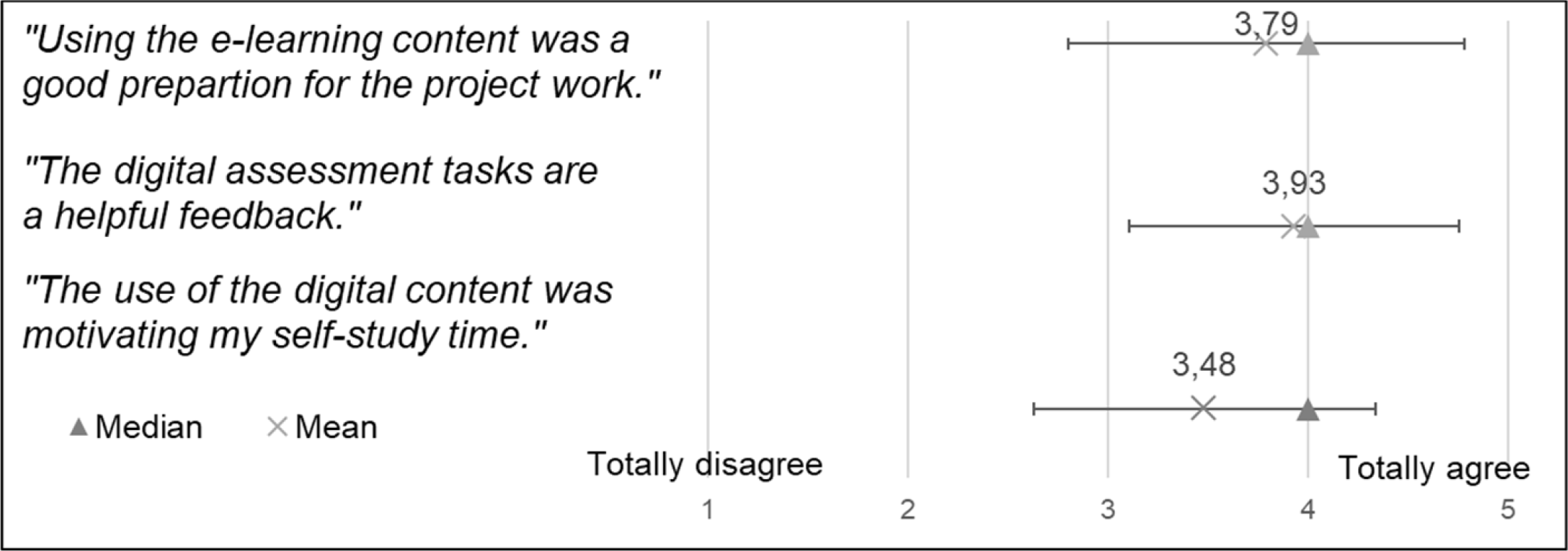
Figure 4 shows the items from the second questionnaire relating to perceived support from the e-learning content. Most students agreed (4) that the provided content was suitable to prepare for the practical project work and that helpful, task-related feedback was provided. The contribution of the content to motivating the intended self-study time was also rated positively. However, this effect was slightly lower and ranged between “maybe” (3) and “agree” (4). Students who used the e-learning content “always” or “frequently” tended to rate its usefulness higher.
Students feedback about the e-learning content

The second questionnaire also included a free text field in which specific suggestions for improving the course and the learning environment could be made. Some students noted that despite using the e-learning content, they still had difficulty following the content of the practical project work. They suggested linking the e-learning content even more closely to the content of the project work.
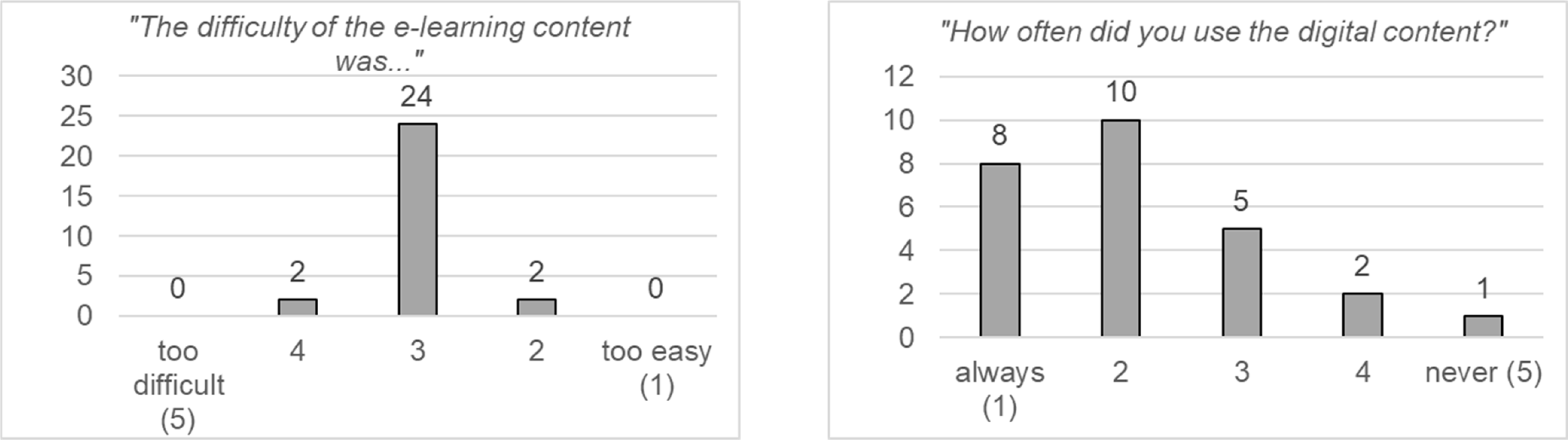
In the survey, students rated the difficulty level of the e-learning units on a scale from “too difficult” (5) to “too easy” (1) and the majority rated the materials as “appropriate” (3) (see Figure 5). Regarding frequency of use, 18 of the 26 students stated that they had used the digital materials at least frequently (‘always/often’).
Difficulty and usage of the e-learning content

3.2.2. Changes in Students’ self-confidence about developing mechatronic systems
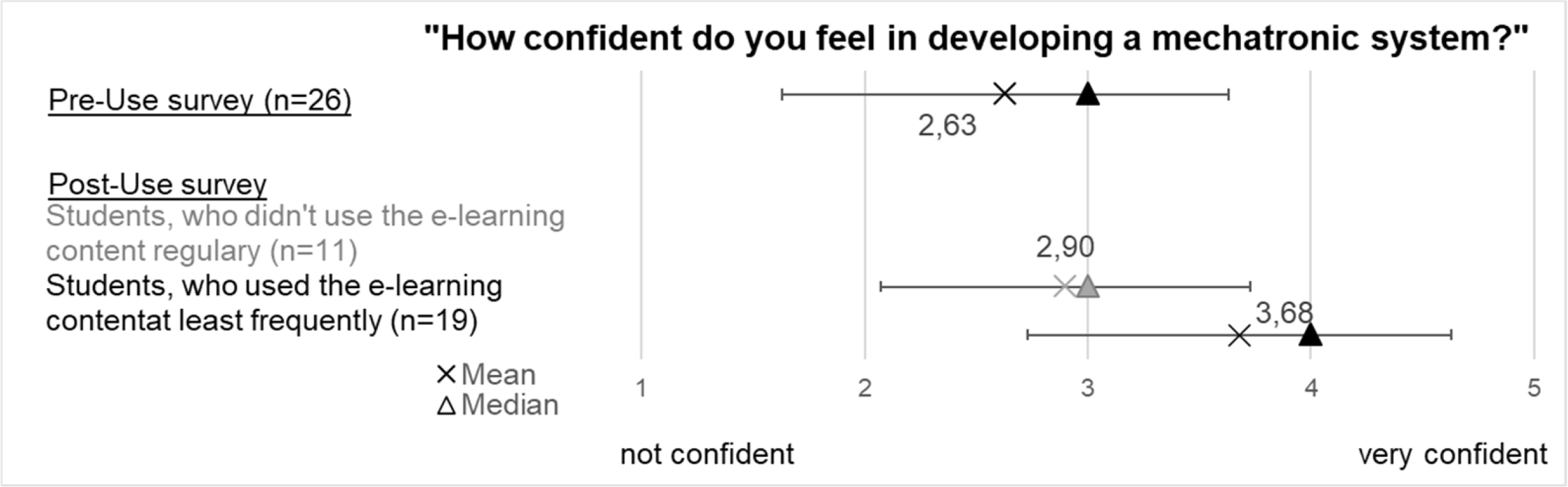
To assess the impact of the e-learning units on students’ confidence in developing mechatronic systems, we asked them to complete a self-confidence question at the beginning and end of the project work. The final survey was then evaluated in two groups: students who had only participated in the project work and students who had regularly used the e-learning content as a supplement to the project work (see Figure 6). Before using the e-learning content, the average self-confidence was 2.63 (median = 3; SD = 0.89), which is in the lower to middle range. The final survey shows a differentiated situation depending on the use of the e-learning content. Students who had not used the content or had used it only to a limited extent increased their self-confidence only moderately to a mean value of 2.90 (median = 3; SD = 0.83). In contrast, students who actively used the provided Moodle units achieved a significantly higher value of 3.68 (median = 4; SD = 0.94).
Comparison of the confidence in developing mechatronic systems

3.2.3. Impact on the achievement of learning outcomes when using the digital content
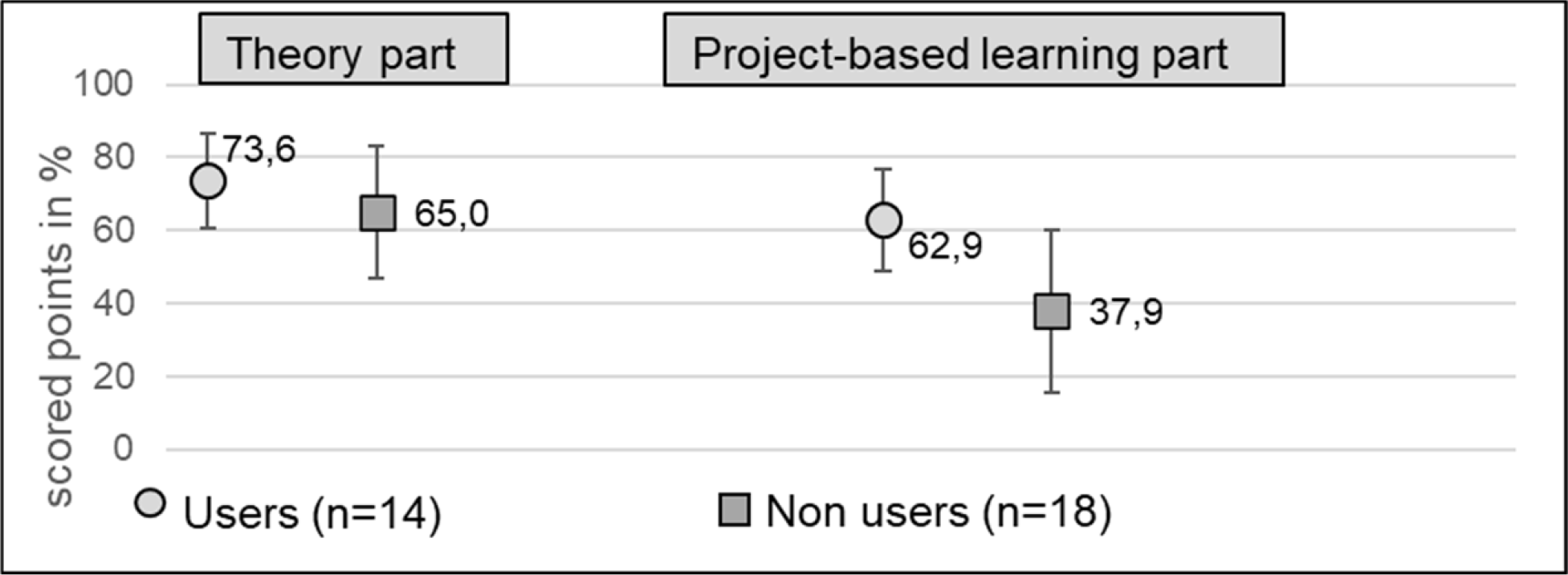
To verify whether the use of e-learning units is reflected not only in self-assessment but also in objective performance, we compared the examination results of students who regularly used e-learning content to those who only participated in the presence-based part of the course. Figure 7 shows this comparison separately for the lecture-based theory (i) and project-based (ii) learning parts. We use the Mann-Whitney U test for a detailed analysis of statistical significance. This test is suitable for data with similar standard deviations and independent samples. In the first part of the exam (“theory”), users achieved an average score of 73% (SD = 13.12), which was higher than that of non-users, whose average score was 65% (SD = 18.1). However, this difference is not statistically significant (Mann-Whitney U test: U (n1 = 14, n1 = 18) = 90, z = -1.370, p = 0.180; with a rejection range of p = 0,05). The difference is more pronounced in the second part of the exam, which examines the learning outcomes covered in the practical project work and that is specifically supported by e-learning content. Here, users of the e-learning content achieved a mean of 62.9% (SD = 13.85), while non-users achieved only 37% (SD = 22.1). This difference is statistically significant (Mann-Whitney U: U (n1 = 14, n1 = 18) = 42.5, z = −3.172, p < 0.001).
Comparison of exam results

4. Discussion and outlook
The study confirms our initial assumption that there is a clear heterogeneity of knowledge within the student group, which causes a challenge for the project work. The initial survey showed that only some of the participants had already made experiences with typical work steps in mechatronics, such as setting up and testing mechatronic systems, programming microcontrollers or reading out sensors. At the same time, all students rated themselves as more confident in the field of mechanical engineering than in electrical engineering and information technology. It was particularly these two latter domains that were addressed by the e-learning content, meaning that the content evidently met a real need and provided targeted support for the technical “breakpoints” of the course.
Overall, the students’ feedback on the e-learning content was positive. The majority of students perceived the e-learning content as a helpful preparation for the project work of the course, the level of difficulty was generally considered appropriate, and a large proportion of students regularly integrated the materials into their learning activities. Only the aspect of motivation to use the self-study time was rated somewhat more cautiously, which indicates that the learning content was used primarily when there was a direct connection to the tasks at hand during the project work, but less so as a general self-study format.
The students’ answers about their self-confidence about the development of a mechatronic system reveal a clear pattern: students who used the e-learning environment regularly increased their perceived ability to develop mechatronic systems by an average of about one scale level, while those who did not use it showed only a slight but not significant improvement. This pattern is also reflected in the exam results. Although there was no significant difference between the two groups in the theory-based part of the exam, users of the e-learning content achieved significantly better results in the part that is related to the project work, i.e. the part addressed by the e-learning content. In addition, all e-learning users passed the exam, whereas this was not the case for some non-users. This suggests that the e-learning content was helpful in the part of the course where several areas had to be brought together, i.e. in the practical implementation of subsystems and their integration into a functioning overall system.
We can therefore assume that the supplementary e-learning content contributed to a noticeable and measurable increase in competence. The research question of the extent to which digital content can support project-based learning for the acquisition of competences for the development of mechatronic systems is answered positively by the present results. This is evident both in the students’ increased self-assessment of their competences and in their improved exam results. However, the results of both exam parts show that not all students have yet reached the desired level of competence. This may indicate the need for improvement in the teaching and learning activities (lectures as well as project-work) for the different intended learning outcomes. In addition, the alignment of the intended learning outcomes to the teaching and learning activities and assessment format is maybe not adequate. A written examination task might be unsuitable, particularly for the desired learning outcomes at high taxonomy levels.
Nevertheless, the limitations of the study must be considered. The two comparison groups were not formed by a predetermined assignment, but rather by the fact that some students voluntarily used the e-learning content while others did not. Randomisation or a genuine control group was therefore not possible in this setting. It cannot be ruled out that the groups already differed before use, for example, because more motivated or less confident students specifically took advantage of the e-learning content.
This leads to several starting points for further enhancements of the e-learning content. On the one hand, the e-learning units should be linked even more closely to the specific project work steps so that early mistakes in the hardware or programming part do not block further progress in the project work. On the other hand, greater individualisation would be useful, for example through adaptive paths for students with little prior knowledge and additional in-depth content for advanced students. It should also be investigated why some students did not use the digital environment or only used it rarely, despite positive evaluations, to derive specific measures to increase usage (e.g. clearer task links, small bonuses, greater integration into the presence study time). Finally, the concept opens potential beyond the current course, as the skills taught are relevant in many engineering degree programs, making modularisation and interdisciplinary use an obvious choice. Collaborative extensions (joint mistake collections, peer feedback from supervisors or students themselves on code or structure) would also be conceivable.
5. Conclusion
This study shows that well-structured, supplementary e-learning content is an effective way of compensating for the heterogeneous starting points of students in a practical project-based mechatronics course and facilitating their introduction to cross-domain system integration. Students liked to work with the e-learning content and found it helpful for the project work. Our analysis of the exam results shows that the use of e-learning content has a positive effect on the acquisition of professional competences. In addition, those students who actively used the e-learning content were able to significantly increase their self-assessed confidence in their abilities regarding the development of mechatronic systems. This shows that repeatable e-learning content is particularly effective when only limited individual support can be provided in a practice-oriented course due to limited supervision resources. The findings support the idea to offer e-learning content for more successful project-based learning especially for expected knowledge heterogenous groups of students. For future courses, it would be advisable to link the e-learning content even more closely to the project work steps to avoid mistakes at an early stage. Overall, the results show that the combination of guided project work and e-learning content is a viable approach for interdisciplinary engineering education.



 Open access

