

1. Introduction
Treaty amendments constitute a growing source of international law.Footnote 1 For every two new treaties entering into force, an existing one is modified.Footnote 2 Some treaties are amended multiple times. For instance, the Articles of Agreement of the International Monetary Fund, originally adopted at Bretton Woods, have gone through seven rounds of amendments.Footnote 3 Similarly, the 1974 International Convention for the Safety of Life at Sea was amended 58 times, and its codes and other mandatory instruments 115 times.Footnote 4 Agreements geared with amendment procedures typically involve multiple parties, making amendments even more impactful.Footnote 5
Although treaty amendments contribute significantly to the expansion and adaptability of international law, they can also lead to its fragmentation. The amendment procedures outlined in most treaties provide states with different – often intricate – ways to evade newly adopted obligations. For example, the 2001 Stockholm Convention on Persistent Organic Pollutants was amended several times to add new substances to the initial list of 12 prohibited substances, but many parties did not consent to these additions. Australia, for instance, has not accepted any of the 20 new substances, while India and China have accepted only eight and 11, respectively.Footnote 6 Consequently, amending treaties can create differentiated bundles of obligations split among subsets of member states, with some adhering to the modified text and others following the original.
While some treaties allow states to opt-out of newly created obligations resulting from amendments, others have more restrictive rules. Therefore, treaty amendments are frequently cited as a source of loss of control for individual states. Some analysts are concerned that states, especially those with limited diplomatic capabilities, could find themselves bound by treaty obligations without their consent.Footnote 7 Other analysts welcome the possibility of bypassing the constraining tyranny of consensus.Footnote 8
In sum, the fabric of international law, including its width, texture and possible flaws is largely woven by means of treaty amendments. However, compared to other key institutional features thread in treaties, such as dispute settlement mechanisms or escape clauses, amendment provisions have received little empirical scrutiny. According to Bernhard Boockmann and Paul Thurner, ‘despite the existence of a series of case studies, little work has been done on the existing varieties of [amendment] provisions and the frequency of their use’.Footnote 9 Since this assessment was made in 2006, some significant contributions (discussed below) have been made. Nevertheless, the empirical and theoretical examination of treaty amendment procedures remains in its infancy and suffers, in particular, from a lack of clear categorization of the different forms they can take. This article seeks to address this lack.
This article makes three contributions to the literature: an empirical one, a typological one, and a methodological one. First, we provide a systematic empirical survey of amendment procedures in multilateral environmental agreements (MEAs). Many scholars stress that environmental protection is an area of international co-operation that requires adaptability because of the rapid advances in scientific knowledge, social norms, and the changing conditions on the ground.Footnote 10 Our survey addresses two different sets of questions about amending clauses in MEAs. The first examines the frequency of amendment procedures in the overall population of MEAs. The second considers the variation in the design of amendment procedures, focussing particularly on issues of control, adaptability, flexibility, and consent. To address these questions, we introduce a novel dataset of 491 amendment procedures extracted from a population of 691 MEAs. Although our analysis is primarily descriptive, we explore some correlations between variations in the occurrence and types of amendment procedures with key features of MEA membership.
This article’s second contribution is a typological one. Treaty provisions dealing with amendments assemble different rules pertaining to adoption, entry into force, as well as opt-in and opt-out clauses. To complicate things further, those provisions (as any treaty provision) are written in the shadow of the residual rules set out in the Vienna Convention on the Law of Treaties (VCLT). To better understand the variations in the design of treaty amendment provisions, we build a new typology and classify the diverse procedures into four basic families: Hard Veto, Soft Veto, Soft Majority and Hard Majority. Each family involves a different mix of control, adaptability and flexibility. This typology-building effort combines both inductive and deductive reasoning: using our dataset, we demonstrate how provisions interact empirically, then we interpret these interactions, and we combine them into types based on theoretical assumptions. These assumptions are grounded in rational-choice theory, conceptualizing amendment procedures as decision-making rules that states rationally choose to fulfil their interests.
The third contribution is methodological. In order to combine inductive and deductive operations, we introduce the qualitative method of property space reduction as a useful typology-building tool for the empirical study of international institutions.Footnote 11 The property space reduction methodology provides techniques to extract clear, theory-relevant, and mutually exclusive types from datasets. We apply this method to reduce the wide variety of amendment procedures found in our dataset, which include 52 combinations of rules, to the four basic types we use in our descriptive analysis.
Following this introduction, the article is divided into five parts. Section 2 explains how a better understanding of treaty amending procedures can help answer some of the core questions in the literature on international institutions. Section 3 presents our dataset and compares treaties with amendment provisions to those without. In Section 4, we explore the various forms taken by the amendment procedures included in MEAs. In Section 5, we use the property space reduction method to create a simple typology and we present the resulting four families of amendment procedures. Section 6 uses the typology to examine empirical variations in the design of amendment provisions. The conclusion summarizes our main findings and suggests avenues for future research.
We find evidence of a clear trend showing that MEAs increasingly include amendment procedures. However, the presence of such provisions in a treaty does not necessarily facilitate adaptation. On the contrary, treaty amendment provisions tend to be highly protective of the capacity for each state to oppose modifications. In most cases, this means securing a veto power on the adoption of amendments to all parties to the treaty. Moreover, we find that this has not significantly changed over the past few decades. Amendment procedures have evolved quantitatively, but not qualitatively. When amendment procedures do loosen state control in favour of adaptability, they often provide reluctant minorities with the right to opt out, and permit treaties to become increasingly fragmented into differentiated bundles of obligations that are split among subsets of members. We also find interesting correlation between power asymmetry and the introduction of amendment procedures in MEAs. Treaties with relatively asymmetric membership are less likely to include amendment provisions. When they do, these provisions tend to be more protective of state control and consent than in treaties with greater power symmetry between members. These findings suggest that materially dominant states are reluctant to trade the bargaining power they enjoy in a non-institutionalized setting for contractual arrangements that can be amended without their assent.
2. Amendment procedures and the literature on international institutions
Amendment procedures are set of rules for making new rules. They are ‘constitutional’ decision-making procedures as opposed to merely ‘operational’ ones.Footnote 12 Although this should make them particularly consequential from an institutional point of view, amendment procedures have received scant attention from the research programs that dominated the study of international institutions over the past decades, and have largely eluded the data-gathering enterprises these programs have generated. We can benefit from excellent commentaries on specific examples of treaty amending procedures.Footnote 13 However, these procedures have not been comprehensively inventoried, classified and analysed the way other key features of international institutions have.
Much of the attention given to treaty amendment procedures one can find in the literature on international institutions is buried in treatments of more generic phenomena like ‘international legalization’, ‘international delegation’, or ‘organizational authority’. A common assumption underlying this body of work is that states have transferred to international institutions some capacity to make and enforce international rules. In this context, amendment procedures have been considered as one among different rule-making mechanisms through which this loosen of state control may happen. Surprisingly, despite their potentially unique contribution to the deflection of states’ control over rule-making, treaty amendment mechanisms have rarely been investigated in their own right by this literature. They have mainly been assigned indicator-level status, along with more operational features in aggregated measures of institutionalization.
Several scholars argue that some international institutions have reached unprecedented levels of ‘legalization’.Footnote 14 In highly legalized institutions, states delegate the authority ‘to implement, interpret, and apply rules; to resolve disputes; and (possibly) to make further rules’.Footnote 15 Amendment procedures should therefore contribute, along with other institutional features like dispute settlement mechanisms, monitoring bodies, or secretariats, to make an international institution a relatively ‘legalized’ one. However, the ‘legalization’ research program has never focused its attention on amendment procedures the way it did for these other features, like dispute resolution mechanisms.
Another prolific research program is specifically interested in ‘international delegation’;.i.e., instances where states delegate decision-making authority to international bodies. Amending treaty obligations was initially identified by this research program as a key function delegated by states.Footnote 16 However, further investigations later revealed that few, if any, properly defined ‘delegation’ could be found in the way treaty amending procedures are actually framed.Footnote 17 ‘Pooling’, i.e., the transfer of authority to a collective decision-making body made of peers, was suggested, as a more appropriate concept for the analysis of treaty amendment than ‘delegation’.Footnote 18 Today, ‘pooling’ is considered to be a key contributor to the level of ‘organizational authority’ granted to an international institution.Footnote 19 The less individual states retain control over decision-making in an international institution (the more it is ‘pooled’), the more this institution is said to have ‘authority’. Here again, however, while amendment procedures would seem to be a critical place to investigate the significance and functioning of pooling, this research program has treated them as indistinctive decision-making mechanisms where pooling can occur and be measured.Footnote 20
Another important strand of literature from which an interest for amendment procedures would have been expected is the one associated with the ‘Rational Design of International Institutions’ research program. This literature is more interested by variations in the flexibility of treaties than by issues of control.Footnote 21 In their oft-cited International Organization’s special issue, Barbara Koremenos, Charles Lipson and Duncan Snidal identify ‘transformative flexibility’ (rules for changing the rules) as a key feature of international institutional design.Footnote 22 Although this clearly relates to amendment processes,Footnote 23 none of the contributing articles investigate them. Likewise, in a recent monograph on treaty flexibility and adaptability, Koremenos provides an in-depth analysis of provisions dealing with duration, escape, withdrawal, reservations, dispute resolution, punishment, monitoring and decision-making in various bodies. However, her book seldom mentions amendments.Footnote 24
We found two notable exceptions to this otherwise neglect of amendment procedures among large-N studies of international institutions. Boockmann and Thurner include a detailed construct of amendment procedures in their measure of flexibility for a collection of MEAs.Footnote 25 However, their study suffers from some limitations for scholars interested in amendments per se. Because it blends scores for amendment attributes and arbitration attributes to produce an aggregated statistical value for treaty flexibility, it prevents a separate analysis of amendment procedures. In addition, it does not consider negative cases, which precludes comparisons between MEAs with and without amendment procedures. Other significant contributions, from Malgosia Fitzmaurice, and Panos Merkouris, also focus on amendment procedures in MEAs.Footnote 26 Their studies are more similar to ours, but with two key distinctions. First, they treat modalities for the adoption of amendments and for their binding effects separately, and do not consider how the two interact in a given procedure. Second, they ignore what we consider to be an important feature of amending procedures: the threshold set for entry into force for any party.Footnote 27
A common, and fundamental problem that arises from these pioneering studies, though, is related to what Jutta Brunnée calls the ‘almost infinite range of variations’Footnote 28 in the form in which amending rules are designed. By combining four kinds of rules for adoption and five kinds of rules for entry into force, Boockmann and Thurner classify agreements according to 20 different types of amendment procedure.Footnote 29 Fitzmaurice and Merkouris break down their concept of adoption procedure into seven or nine categories and their concept of entry into force procedure into seven categories.Footnote 30 If combined, this would generate at least forty-nine different types of amendment mechanism. In the following pages, we build on these studies and the overall literature on international institutions to construct a more practical, theoretically relevant typology.
3. A new dataset on MEA amendment procedures
Our dataset contains 691 MEAs signed between 1857 and 2015.Footnote 31 This collection of MEAs is largely drawn from the International Environmental Agreements Database (IEADB) Project led by Ronald B. Mitchell,Footnote 32 with a few additional agreements. Following the IEADB criteria, all agreements from this collection share three characteristics: (i) they are ‘treaties’ under international law, i.e., all non-binding agreements and supplemental texts are excluded; (ii) they are ‘multilateral’, i.e., involve three or more states;Footnote 33 and (iii) they are ‘environmental’, i.e., one of their primary purposes is to manage or prevent human impacts on natural resources or elements of the natural world that provide ecosystem services. MEAs include treaties governing air pollution, agriculture, animal species, shared freshwater resources, fish stocks, nuclear testing, and other environmental issues.Footnote 34
We use a two-step approach to identify which of the 691 agreements include an amendment procedure. The first step involves carefully reading every agreement for any references to possible amendments to the main text or annexes. We include amendments to annexes because they are often fundamental in MEAs: they typically include lists of species, substances, hazards, zones, limits, which clearly impact the scope of states’ obligations.Footnote 35 We then determine whether the provisions referring to a possible amendment include actual procedures for the adoption and/or entry into force of the said amendment. Thus, we identified ‘amendment-related provisions’ in 335 MEAs, which corresponds to almost half of all MEAs (48.5 percent).Footnote 36 The resulting dataset is available as an online appendix on the journal website.
These specific amending procedures indicate a willingness by the negotiating states to affirm, clarify, complement, or supplant the rudimentary customary rules codified by the Vienna Convention. The default rules set by the VCLT for amendments essentially protect state parties from any infringement to the principle of consent.Footnote 37 The Convention first states that unanimous consent is required for adopting an amendment, except when the amendment is voted at an ‘international conference’, in the case of which a majority of two thirds suffices.Footnote 38 It then, again, requires unanimous ratification or acceptance before any adopted amendment enters into force, or the same level of approbation as the one set for the entire treaty when originally concluded, and it limits entry into force to accepting parties.Footnote 39 In the next parts, we will see in greater details how exactly, and to what extent, specific procedures depart from this baseline. It is important here to simply stress that the 356 MEAs left without specific procedures should not be interpreted as unamendable, but as treaties for which parties have considered the addition of such procedures unnecessary or too costly.
Including amendment-related provisions in MEAs is a relatively recent practice. For the entire period from 1875 to 1944, the only case we found was the 1911 Convention respecting measures for the preservation and protection of the fur seals in the North Pacific Ocean signed by Japan, Russia, the United States, and Great Britain (acting for Canada).Footnote 40 Interestingly, this treaty offers a perfect example of a technical MEA that requires adaptability. After establishing a rather sophisticated co-operation mechanism to share stocks of seals and otters in the North Pacific waters, the Convention provides that a conference of the parties can agree on ‘additions and modifications’ to the treaty after an initial 15-year period.Footnote 41
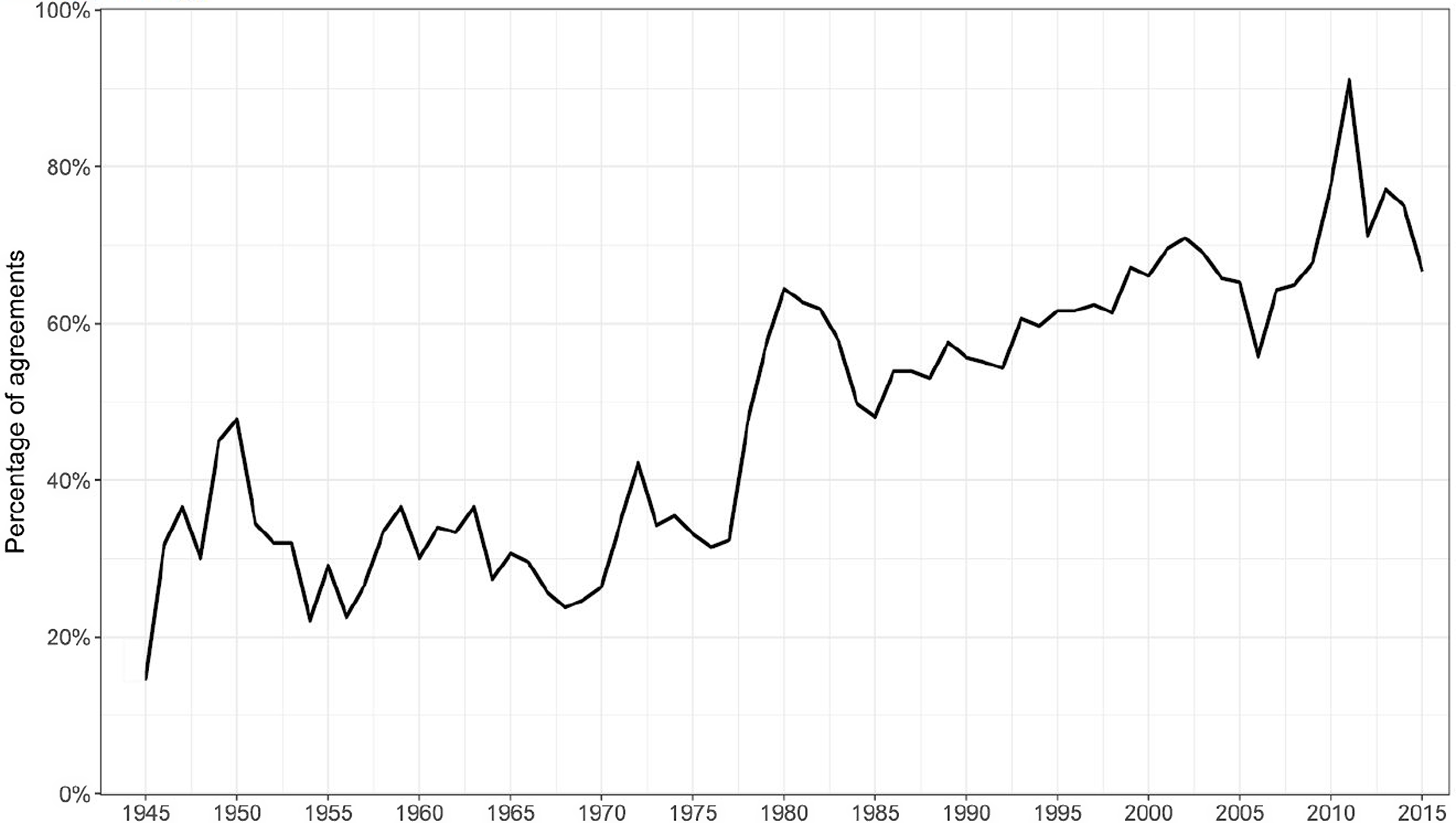
Apart from this pioneering case, the practice of including amendment procedures in MEAs gradually developed after Second World War. Figure 1 shows the evolution of this practice in absolute terms. Figure 2 shows the trend in relative terms. Until the end of the 1960s, states concluded agreements with an amendment procedure once or twice a year, representing roughly a third of all MEAs. Then, in the 1970s and 1980s, there is a significant increase in both absolute and relative terms. During this period, four or six new MEAs with amendment procedures were signed every year, representing a growing percentage of all MEAs. This suggests that the conclusion of the VCLT in 1969 and its entry into force in 1980 did not reduce the need to specify an amendment procedure in MEAs, even if default rules were now codified. From the early 1990s to the early 2000s, there is a radical increase in the absolute number of new agreements with amendment procedures. In relative terms, the increase is less spectacular, but remains constant. At the end of this period, almost 70 percent of new MEAs contain rules relative to their amendment. From 2004 to 2015, we see a steep decline in the absolute number of newly signed MEAs, including those with amendment provisions. In relative terms, however, the frequency of amending procedures among all new MEAs remains relatively stable. Overall, the practice of including explicit amendment procedures in new MEAs went from being the exception in the 1950s to being the norm today.
MEAs with amendment procedures according to date of signature (1945–2015)

Presence of amendment procedures in MEAs according to date of signature (1945–2015), two-year moving average
Including amendment procedures in a treaty seems to be useful. Thanks to the IEADB Project’s database,Footnote 42 we know for 664 out of our 691 MEAs which ones have been amended. The average number of amendments is 0.10 for MEAs without explicit amendment rules and rises to 1.42 for MEAs with. In addition, MEAs that have been amended at least once have been amended on average 2.33 times when they lack explicit rules, but 5.58 times when explicit amendment procedures exist.
Figure 3 shows that MEAs with an amendment procedure include more parties on average than MEAs with no amendment procedure. Half of the agreements with amendment procedures involve between 6 and 39 parties (median membership = 13), while the number of member states drops to 4 and 14, respectively (median = 6) for the lower and upper limits of the interquartile range for agreements with no amendment procedure. The inclusion of amending clauses may reduce the costs of proceeding with amendments in the future, but it adds costs to the initial negotiation of the treaty. Small groups of states may want to avoid these costs when they are confident that, if needed, they can easily modify the agreement in the future by simply renegotiating or relying on the VCLT. However, with a larger membership, future renegotiation may appear difficult and establishing clear rules for amendment ex ante is obviously an advantage.
Number of parties in MEAs with and without an amendment procedure

Figure 4 provides evidence that MEAs with an amendment procedure are also more frequently concluded among parties with roughly similar power, measured by GDP.Footnote 43 In contrast, MEAs with no amendment procedure have a higher average score for power asymmetry. Our indicator of asymmetry between parties is lower when agreements include amendment procedures (median value is 0.23), than when they do not (median value is 0.30). While the upper limit of the interquartile range is almost the same in both cases (0.47 and 0.48, respectively), the lower limit is significantly lower for agreements with amending procedures (0.13) than without (0.21). This finding is in line with the literature.Footnote 44 Amendment procedures should be easier to negotiate among relatively equal partners than when asymmetry is high. If an agreement needs adjustments, the prospects of reverting to a situation where the parties’ original bargaining power comes to the fore is particularly attractive for powerful parties involved in asymmetric partnerships. Powerful parties seem reluctant to trade their original bargaining power for a more procedural one.
Power asymmetry between parties in MEAs with and without an amendment procedure

4. The variety of amendment procedures
After identifying the MEAs with explicit rules pertaining to amendments, we now turn to our second round of coding. Here, the aim is to describe the variations in the specific design of the amendment rules. The ‘amendment procedure’ itself is a more appropriate unit of analysis for this task than the treaty as a whole. When a given treaty or its annexes are provided with a set of interconnected amending rules related to adoption and/or entry into force and/or coverage, we consider this set of rules as an ‘amendment procedure’. In situations where more than one rule for adoption, entry into force or coverage is attached to the same agreement, we consider that it has more than one amendment procedure. This happens, for example, when treaties provide an amendment procedure for annexes that is different from the one pertaining to the main body of the text. We found 163 amendment procedures specifically dedicated to annexes.Footnote 45 In other cases, different procedures are provided for different articles or different types of issues. We found 56 cases, where one treaty or its annexes are governed by two or more amending procedures. Overall, we identified 491 different amendment procedures in the 335 agreements that include at least one specific amendment rule.Footnote 46
In this section, we conduct a micro-classification of these amendment procedures. We look at all the moving parts states use when they assemble a specific amendment procedure, and at the different combinations of parts they have actually used in MEAs. This micro-classification is performed through the completion of an extended ‘property space’, i.e., a cross-tabulation of the key descriptive features of amendment procedures. In the next section, this property space will be compressed to create a simplified, analytically amenable typology.
We isolate three constituent parts of amendment procedures: adoption, entry into force, and coverage. For each, we identify the main variations in the rules found in the actual provisions of the agreements. (See Table 1, where values for adoption appear on different planes, values for entry into force on different columns, and values for coverage on different rows). We order the different rules based on the level of control they provide to individual states. This is done under the premise that unanimity maximizes control, but it involves costs. Unanimity is costly at the individual level because negotiation is extremely difficult when every party has a veto (decision-making costs), and because profitable agreements are thus often unachievable (opportunity costs).Footnote 47 These costs motivate states to accept less-than-unanimity amendment rules in order to make treaties more adaptable. However, less-than-unanimity amendment rules also involve costs. For example, reputation costs are involved when a state must publicly signal its opposition to adoption, or when it has to break ranks and opt out – or withdraw from the whole treaty – to evade the commitments brought by amendments.Footnote 48 Our ordering takes these costs into account. When a rule makes it costly for states to exercise control, we assume that it lowers the value of this control. It often happens that a procedure remains silent about one or two of the three possible components. Customary international law, as codified in the VCLT, provides us with fallback amendment rules in these cases.Footnote 49 We interpret an absence of explicit rules pertaining to adoption, entry into force or coverage based on the VCLT in light of the way this absence logically interacts with the rules that do have been specified.
Extended three-dimensional property space for amendment procedures
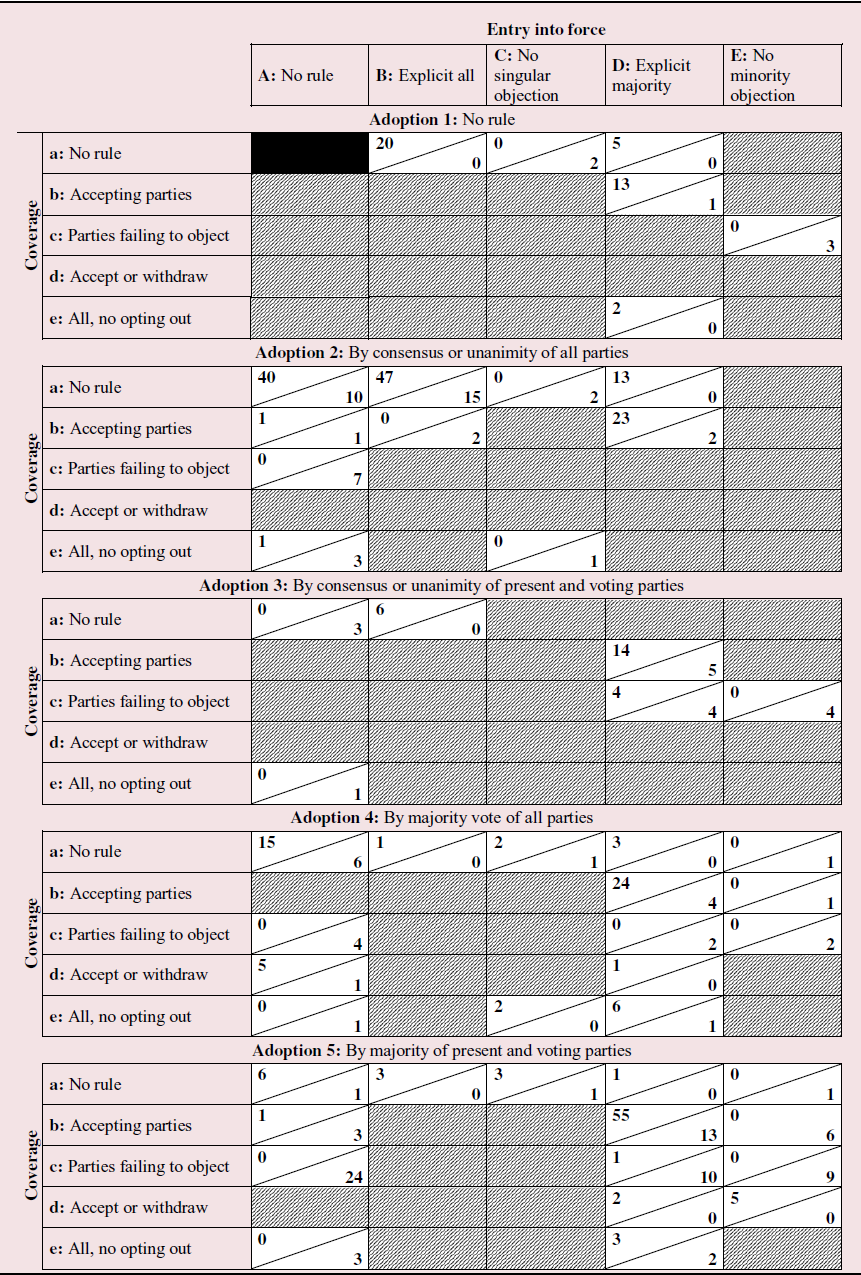
Notes: (1) Numbers on left-hand side of cells indicate sum of procedures for amending the main text of the treaty. Numbers on right-hand side of cells indicate sum of procedures solely applicable to annexes. (2) Cells with cross-hatch pattern indicate combinations for which no cases were found. (3) The black cell shows the location of treaties with no specific amendment procedures.
Rules for adoption are a critical constituent part of amendment procedures even if, in practice, votes are often avoided in favour of an informal norm of consensus.Footnote 50 In such cases, consensus is nevertheless reached in the shadow of voting rules; i.e., everyone figuring out what the likely outcome of a vote would be.Footnote 51 We first coded adoption rulesFootnote 52 along two dimensions: whether parties adopt amendments by either unanimous consent or consensus,Footnote 53 or by a majority vote;Footnote 54 and whether this requirement applies only to parties ‘present and voting’ or to all parties to the agreement. We rank the four resulting combinations assigning greater control to consensus or unanimity rules, and considering the requirement of being ‘present and voting’ as adding costs to the exercise of both individual and collective veto. We tentatively put the ‘no rule’ option first in our ranking, despite the fact that, as mentioned earlier, the VCLT default rule for adoption is the unanimous consent of all members or, when the amendment is voted at an international conference, a majority of two thirds.Footnote 55 Theoretically, a treaty that is sophisticated enough to set the rules for an international conference could omit explicit decision-making rules for the adoption of amendments. However, this scenario is rare. Logically, when a treaty has an amendment procedure remaining silent on adoption, the applicable residual rule is most likely to be unanimous consent.
For entry into force, the default VCLT rule is the explicit consent of all parties or a qualified majority if such was the rule for entry into force when the treaty was initially concluded.Footnote 56 Thus, we assign the first column to the absence of rules, taking note that this absence of rules takes on different meanings when combined with other provisions. Next, we assign the second column to the actual requirement of a unanimous explicit approval. The third column indicates the requirement of an absence of objection at the end of a determined period, which is a tacit and slightly less demanding version of the unanimity rule. The fourth is assigned to the requirement of acceptance by a qualified majority of the members. In the last column, we put procedures requiring the absence of objection by a qualified minority of states at the end of a determined period, which is the tacit, and slightly less demanding version of the explicit majority rule.
The third constituent part concerns amendment coverage. Once an amendment has been approved and met the conditions for entry into force, who does it apply to? The first, and more control-inducing possibility is when there are no explicit rules for coverage. The VCLT states that, as a general principle, it is then up to individual states to decide if they become party to the amendment.Footnote 57 The second row in the matrix is assigned to the rule that limits the coverage of the amendment to accepting or ratifying parties (opting in). The third goes to the rule that limits coverage to states that have not explicitly expressed their objection (opting out). This process adds costs for recalcitrant states wishing to evade the new obligations. The fourth row is assigned to the rule that forces recalcitrant, non-accepting, parties to choose between adhering to the amendment or being expelled from the treaty by an automatic withdrawal mechanism. This mechanism significantly raises the cost of opting out, but prevents states from being bound by new obligations they have not formally consented to. The fifth and last row corresponds to the rule, whereby all parties are bound by the amendment once it has entered into force, i.e., there is no opt-out clause. Here, recalcitrant states have to choose between initiating withdrawal from the treaty or accepting an obligation that they have not consented to.
With three constituent parts and five different qualitative values for each (four possible rules plus absence of a specific rule), we end up with a three-dimensional property space containing 124 different possible combinations (Table 1). We find empirical cases for 52 of these combinations. If the institutional diversity of international treaty-making is likened to a ‘continent’,Footnote 58 amendment provisions are a particularly diverse ‘subcontinent’.
5. Typology: Between control, adaptability, and flexibility
In this section, we apply the method of property space compression outlined by Allen BartonFootnote 59 and Colin ElmanFootnote 60 to build a simplified typology out of our initial classification of cases. The property space compression (or ‘reduction’) methodology brings rigor, transparency, and self-consciousness to the operations by which scholars transform an initial classification of cases that is too large to be useful in a simplified, analytically amenable set of types.Footnote 61 It combines inductive reasoning based on observations of the similarities and differences among cases populating the original property space, and deductive reasoning based on pre-existing descriptive theories (or concepts). We first go through the sequence of typological techniques prescribed by the method, and then present the resulting four simplified types of amendment procedures.
Our typology-building effort is theoretically informed by rational choice assumptions about decision-making and core concepts borrowed from the literature on international institutions. We conceptualize amendment procedures as decision-making rules that are chosen rationally by states. To borrow the words of James Buchanan and Gordon Tullock, the state is the unit that ‘both makes the choices and constitutes the entity for whom the choices are made’.Footnote 62 We theorize that when states choose a specific amendment procedure, they essentially make a trade-off between control, adaptability and flexibility. We understand control as the extent to which a procedure provides individual states with power over alterations to a treaty. Control includes, but is not reducible to consent, which is the exercise of control by a state over changes only affecting its own set of binding commitments. We define adaptability as the ease with which individual states can secure desired changes to a treaty. We use flexibility to designate the ease with which states can obtain dispensation, allowing for different sets of commitments for different parties. How states calibrate control, adaptability and flexibility derives from the constitutional character of amendment procedures, which are rules for deciding changes to rules. When states decide on amendment procedures, their main concern is to maintain the control they exercise at the time of contracting. They will only accept ceding some of that control in exchange for gains provided by adaptability and for protection against adverse decisions brought by flexibility.Footnote 63
The first round of compression is called rescaling. This operation involves reducing the number of categories for one or more of our attributes, or constituent parts by merging together entire columns, rows or planes.Footnote 64 The aim is to keep the most ontologically important variations and make sure that theoretically significant distinctions are maintained.Footnote 65 Our first rescaling decision was to reduce the number of planes for adoption from five to three, by merging the two rules that require consensus and the two that require a qualified majority. Our second rescaling move reduces the number of columns for entry into force from five to three. We merge the two rules granting each individual state a veto, and the two rules granting this veto to a qualified minority. Finally, we rescaled the ‘coverage’ dimension by combining explicit and tacit modes of opting out of the obligations carried by an amendment that has met the requirement for adoption and entry into force.
We then proceed with an empirical and logical compression of the property space. Empirical compression involves removing cells for which no cases were found. This operation is delicate, because we risk brushing aside empirically empty, but theoretically relevant combinations. Therefore, we combine empirical compression with logical compression. In other words, before deleting an empty cell, we make sure that the corresponding combination of rules can reasonably be considered, ‘impossible or highly improbable’.Footnote 66 An online appendix provides a detailed account of this operation.
These first rounds of compression reduce the number of cells in our property space from 124 to 23 (see Table 2), and facilitates its ultimate collapsing into types. The last operation of our typology-building strategy is a theory-driven pragmatic compression, which yields our four types of amendment procedures. This involves further reducing the number of divisions in the property space, by merging cells whose separation ‘serves no useful theoretical purpose’.Footnote 67 Different shades of grey are used in Table 2 to indicate which cells in the reduced property space are merged into each of our four types.
Reduced three-dimensional property space for amendment procedures in treaties
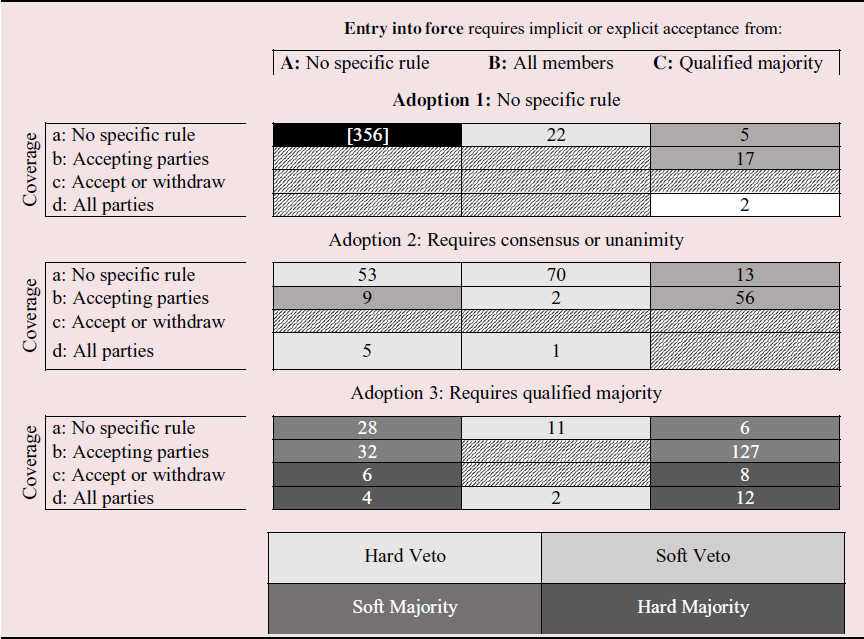
Notes: (1) Numbers in cells indicate sum of procedures corresponding to combinations. (2) Cells with cross-hatch pattern indicate empty cells subjected to empirical and logical compression. (3) The black cell shows the location of treaties with no specific amendment procedures.
5.1 Hard Veto
The first type, the Hard Veto, covers the family of procedures whose combined rules prevent an amendment unless all parties have consented. If the treaty is ever amended, all member states without exception will be bound by the amendment and all members will have consented to it. A Hard Veto procedure therefore maximizes states’ control, but provides a treaty with a very low level of adaptability, and absolutely no flexibility. When a new rule has won the support of all parties, the old rule is thrown out and replaced for all parties. The treaty may adapt, but its framework does not allow for different sets of rules to be applied to different subsets of parties. A group of states keen to go further than the lowest common denominator has to find alternative venues, which can lead to competitive regime creation.Footnote 68
The quintessential combination corresponding to this type (cell 2Ba),Footnote 69 requires consensus or unanimity for adoption and consent from all parties before entry into force, and remains silent on coverage, which is coherent with the one-size-fits-all logic at play.Footnote 70 A good example of this procedure can be found in Article 19 of the Agreement on Cooperation on Marine Oil Pollution Preparedness and Response in the Arctic:
1. This Agreement may be amended by written agreement of all the Parties.
2. An amendment shall enter into force 120 days after the date on which the depositary has received the last written notification through diplomatic channels that the Parties have completed the internal procedures required for its entry into force.Footnote 71
The Hard Veto type also includes cell 1Ba because unanimity is the residual rule for adoption. As well as 2Aa, because silence on entry into force obviously means unanimous consent, otherwise coverage would have been addressed, in which case the latter would specify that an amendment requiring unanimous acceptance necessarily applies to all parties (cell 2Ad). We also include in this type cases combining a majoritarian rule for adoption and unanimous consent for entry into force (cells 3B).
5.2 Soft Veto
The second type is called Soft Veto. Here, every single party retains its veto over adoption, which requires unanimity or consensus. However, once an amendment has been adopted, a single party can still opt out, i.e., not subject to the amendment’s entry into force. While this may require an official objection, the party can generally object passively, by simply not proceeding with approval. The procedures allow for two-speed sets of obligations: the first applies to the majority of states that adheres to ratification or acceptance; the second applies to a reluctant minority that has not objected adoption, but has proved unable or unwilling to secure ratification. Thus, procedures belonging to the Soft Veto type slightly loosen states’ control, and provide limited flexibility and a low level of adaptability. The adaptability comes from the fact that an adopted amendment does not require ratification (or other forms of acceptance) from all parties to enter into force. Flexibility is limited compared to the Soft Majority type (see below) because while old and new obligations can cohabit in the treaty’s binding rules, new obligations are subject to such stringent requirements at the adoption phase (consensus or unanimity, rather than majority), that in reality cohabitation only involves relatively consonant norms (norms that not a single state has bothered to oppose at the adoption stage). That said, Soft Veto provisions open the way for, and may favour, the practice of ‘empty promises’, when a state approves the adoption of an amendment knowing it will opt out at the entry-into-force phase.Footnote 72 Not joining the decision-making group can be politically costly for a state. It may be under intense peer pressure, especially when the rule of adoption is unanimity or consensus. Soft Veto provisions permit states who anticipate the costs of vetoing adoption to eschew them, as well as the unwanted costs of actual implementation.
This type mainly includes the two cells in the top right corner of plane 2. They combine rules that require a qualified majority of acceptance for entry into force and rules that require unanimity or consensus for adoption. It also includes the contiguous cells beneath, in the top right corner of plane 1, where no rules are specified for adoption and the residual unanimity rule should apply. We also add cases where the unanimity requirement for adoption is coupled with the absence of specific rules for entry into force, but where a rule restricting coverage to accepting parties clearly allows a two-speed set of obligations (cell 2Ab). The International Treaty on Plant Genetic Resources for Food and Agriculture provides a good example of the Soft Veto type. Its amendment clause first states that ‘[a]ll amendments to this Treaty shall only be made by consensus of the Contracting Parties present at the session of the Governing Body’,Footnote 73 which is composed of all treaty members. It then establishes a threshold for entry into force: an adopted amendment will bind no one before two thirds of the membership have ‘ratified, accepted or approved it’.Footnote 74 Then, it limits coverage to consenting parties by specifying that the amendment will enter into force only ‘among Contracting Parties having ratified accepted or approved it’.Footnote 75
5.3 Soft Majority
The third type, Soft Majority, covers cases where states’ control over adoption is loosened, and opting-out is still permitted. This provides greater adaptability, while maintaining flexibility. For procedures of this type, a qualified majority is sufficient to adopt an amendment, which means a single recalcitrant state, or a minority can no longer veto a proposal. However, a reluctant minority can still prevent the entry into force of the amendment for itself, as for the preceding type. Here again, non-adhering states can benefit from the flexibility of a two-speed system, where a new rule applies to the relations between other parties and the old rule continues to apply to their relations with them.Footnote 76 This flexibility lowers the risk associated with less-than-unanimity constitutional rules, by offering protection to potentially reluctant minorities. It allows parties with conflicting views on amendments to cohabit in the framework of the treaty.
The quintessential and most common combination of this type requires a qualified majority for both adoption and entry into force, while coverage is limited to accepting parties (cell 3Cb). The amendment clause of the United Nations Framework Convention on Climate Change (UNFCCC),Footnote 77 relayed in the 2015 Paris Agreement,Footnote 78 provides a good example for this combination. It states that an amendment can be adopted during an ordinary session of the Conference of the Parties by a three-fourths majority vote ‘[i]f all efforts at consensus have been exhausted’.Footnote 79 The same majority threshold is set for the number of ratifications necessary to trigger entry into force. However, this entry into force is limited to state parties that have actually communicated their instrument of acceptance.Footnote 80 We merge this cell with the one above (3Ca) because when coverage is not addressed, the fallback rule is that only accepting parties are bound by the amendment. Silence on entry into force, when a majority rule is put in place, causes the adoption and acceptance procedures to be ‘collapsed’ into a single decision-making procedure, e.g., a vote by the plenary body set up by the treaty.Footnote 81 Therefore, the same logic also applies to the two cells (3Aa and 3Ab) that form the top left corner of plane 3.
5.4 Hard Majority
The fourth and last type of amendment procedure is the Hard Majority. It comprises cases where no single state can veto either adoption or entry into force and opting out is not allowed. A recalcitrant state that fails to prevent a majority from adopting an amendment can proceed to ultimately communicate its acceptance (or decide not to communicate an objection to entry into force), which allows it to remain party to the treaty. Alternatively, it can decide to withhold ratification (or communicate an objection to entry into force). It then either withdraws from the agreement or is subject to obligations that it did not consent to. Hard Majority procedures have, in a sense, exit provisions built into them. They replace the insurance policy provided by opt-out clauses in other types. This clearly has an impact on adaptability. It drastically increases the cost of the non-unanimous decisions that the procedure otherwise authorizes, particularly in cases where states in the reluctant minority are important for the co-operative equilibrium. Hard Majority procedures are not more conducive to adaptability than the Soft Majority type. As far as flexibility is concerned, it has collapsed. On completion, the treaty integrates the new amendment, entirely replacing the status quo ante. The amended treaty remains whole, i.e., one set of rights and obligations is decided by the qualified majority and applies to all parties.
The archetypal Hard Majority procedure combines a majority requirement for both adoption and entry into force with a rule indicating that when an amendment has met these requirements, it becomes binding for all parties (cell 3Cd). It also includes similar instances where, if a state has not communicated its explicit or tacit approval, it is considered as having withdrawn from the treaty (cell 3Cc). Collapsing the adoption and acceptance procedures described for the Soft Majority type also applies here. Therefore, the two cells that form the bottom left corner of plane 3 are included in this type.Footnote 82 Amendment procedures included in this type can be quite complex. Decision-making under the International Tropical Timber Agreement is a case in point. Its membership is divided between ‘producer’ and ‘consumer’ members, who hold 1,000 votes each. Votes are partly allocated according to the members’ share of the global tropical timber market.Footnote 83 Its Council can approve amendment proposals by ‘special vote’,Footnote 84 i.e., a combination of two thirds of the votes cast by producer members and 60 percent of the votes cast by consumer members, ‘on the condition that these votes are cast by at least half of the producer members … and at least half of the consumer members …’.Footnote 85 Once approved, the amendment enters into force when a majority of members have communicated their instrument of acceptance. This majority must represent two thirds of members accounting for 75 percent of the votes, in both blocs.Footnote 86 When this threshold is met, members who have not yet sent their ratification have 90 days to do so, after which the amendment enters into force and members who have failed to ratify cease to be a party to the agreement.Footnote 87
The Hard Majority type includes 16 amendment procedures that potentially allows for non-consensual law-making. This situation occurs when, at the end of the amendment process, non-adhering states are not automatically subjected to a provision stipulating the ‘withdrawal’ of parties who fail to accept or ratify the amendment (3Cd and 3Ad). Therefore, a state that objects to a contested amendment becomes bound by it, unless it chooses to withdraw from the entire treaty. For instance, one amendment clause of the Agreement for the Establishment of the Global Crop Diversity Trust simply states that amendments ‘shall come into force for all Parties on the deposit of instruments of ratification, acceptance or approval by two thirds of the Parties to this Agreement’.Footnote 88 It provides no opt-out or exit clause for non-consenting members. A close examination shows that when such non-consensual rulemaking is allowed, it generally concerns limited domains, or rather inconsequential decisions. For instance, the International Plant Protection Convention provides that amendments adopted and ratified by a two-thirds majority are binding for all, but only if the amendments do not create new obligations. In some cases, a potential non-consensual approach is only possible for states with no real stakes in the matter. For example, amendments to the 1963 Partial Test Ban Treaty can bind a state that has not voted in its favour or expressed acceptance. However, this does not apply to the ‘Original Parties’, which are the only states capable of conducting the prohibited nuclear tests and have a veto. Nevertheless, a few of these procedures make consequential amendments binding for all parties, following a simple two-thirds majority vote, and a ratification threshold fixed at two thirds of the parties (Convention on the International Hydrographic Organization), a simple majority (African Nuclear-Weapons-Free Zone Treaty), or not even requiring ratification (Convention for Co-operation in the Protection and Development of the Marine and Coastal Environment of the West and Central African Region, or Abidjan Convention). However, none of these treaties have ever effectively been amended.Footnote 89
Table 3 presents a summary of the key attributes of each type.
Types of amendment procedures in MEAs and their properties

6. Variations in types of amendment procedures in MEAs
More than 39 percent of all the amendment procedures in MEAs belong to the Soft Majority type. Hence, the type of amendment procedures that allows for greater adaptability, and flexibility is the most common (see Table 3). It is also by far the most widely used. As of 2015, treaties provided with a Soft Majority type of procedure have been amended 2.75 times on average, compared to 1.42 time for all treaties with procedures.Footnote 90 The high frequency of the Soft Majority type is partly due to the extensive use of this family of procedures for amending annexes. No less than 53 percent of all amendment procedures specifically dedicated to technical annexes, appendices, etc. fall into this type. Annexes are the specific object of procedures for about 45 percent of the cases in the Soft Majority type, compared to 25 percent for the other types. The association between annexes and flexibility is logical. Maintaining different sets of rules for different parties is less problematic when it is confined to quotas, schedules or technical standards than when it involves the more structural obligations and institutional rules found in core parts of a treaty.
The Hard Veto type is the second most common family of amendment procedures, accounting for a third of the total. Its relative importance shows that states do not necessarily resort to explicit amendment provisions to break with the customary model enshrined in the VCLT. Procedures in the Hard Veto type revere the principle of state consent and, consequently, provide a level of adaptability that differs little from the negotiation of a brand-new treaty. In terms of flexibility, it sets the bar below the VCLT, by requiring unanimity or consensus for entry into force. Yet treaties with Hard Veto procedures are amended more frequently (0.87 times on average since 2015) than treaties with the default rules set by the VCLT (0.10 on average). This score is still much lower than for treaties with Soft Majority procedures (2.75).
The third most frequently used type of procedures is the Soft Veto, with 20 percent of cases. It offers a slightly more flexible option than the Hard Veto type because it provides an opt-out mechanism to parties who have consented on adoption, but are unwilling or unable to ratify an amendment (already granted in the VCLT). Therefore, it is worth noting that Hard Veto and Soft Veto types, which provide individual states with a high level of control over the amending process, make up the majority (54.2 %) of all procedures. MEAs featuring procedures of the Soft Veto type are amended the least, with an average of 0.62 amendments per treaty.
Lastly, the Hard Majority family of amendment procedures is by far the least common. Only 30 amendment procedures (6 %) belong to this extreme type, which deviates the most from the rules codified in the VCLT. With this type, adoption and entry into force require majorities and, most importantly, no opt-out mechanism is available for recalcitrant minority states. The average number of amendments for treaties with this type of procedure is similar to that found for the whole group of MEAs with various types of procedures (1.40).
We find no discernible trend in how amendment procedures have evolved over time. As shown in Figure 5, the longitudinal distribution of the amendment procedures does not significantly vary according to types. The median year for each one is roughly the same (1993 or 1994). Some of these amendment procedures provide higher levels of adaptability and flexibility than customary law, which has helped build a more adaptable international environmental regime. However, and perhaps surprisingly, the design of procedures has not actually evolved towards higher levels of adaptability.
Amendment procedures in MEAs according to type and date of signature (1945–2015)

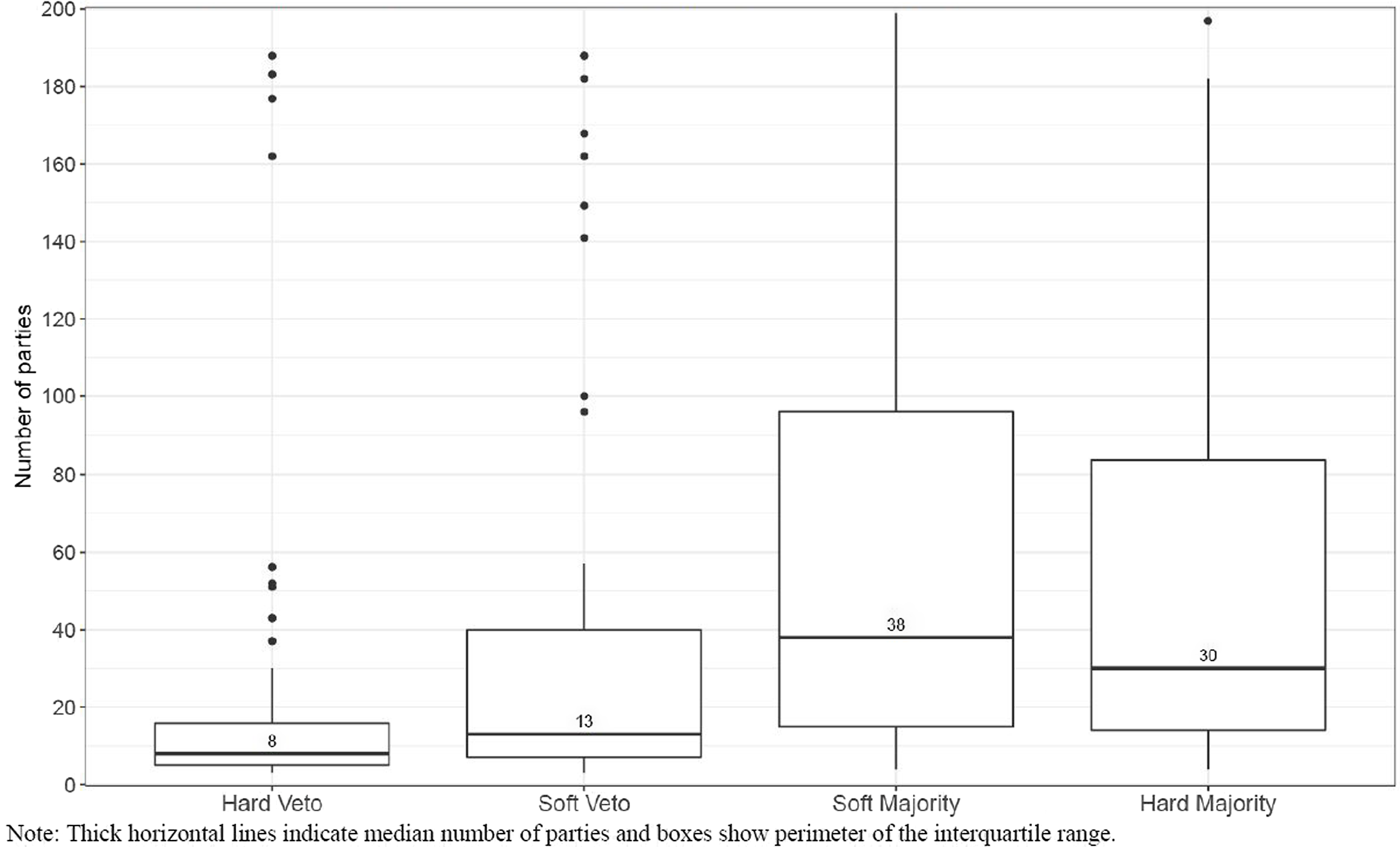
As reported in Figure 6, there are major differences in terms of membership when we compare treaties belonging to different families of amendment procedures. In the case of treaties featuring Hard Veto and Soft Veto procedural types, the median number of parties is 8 and 13, respectively. For treaties featuring Soft Majority and Hard Majority procedural types, the median number of parties rises to 38 and 30, respectively.
Number of parties in MEAs according to type of amendment procedure
Significant differences also appear in power distribution among parties to these treaties. As reported in Figure 7, the median level of power asymmetry for agreements featuring Hard Veto procedures is 0.20, the highest of the four types. The difference in interquartile ranges is even more striking. Its highest value is 0.51 in Hard Veto cases, compared to a maximum of 0.30 for other types. This suggests that negotiators are more likely to adopt mechanisms to maximize states’ control and suppress adaptability and flexibility when power asymmetry is high and there are few signatory parties.
Power asymetry among parties in MEAs according to type of amendment procedure
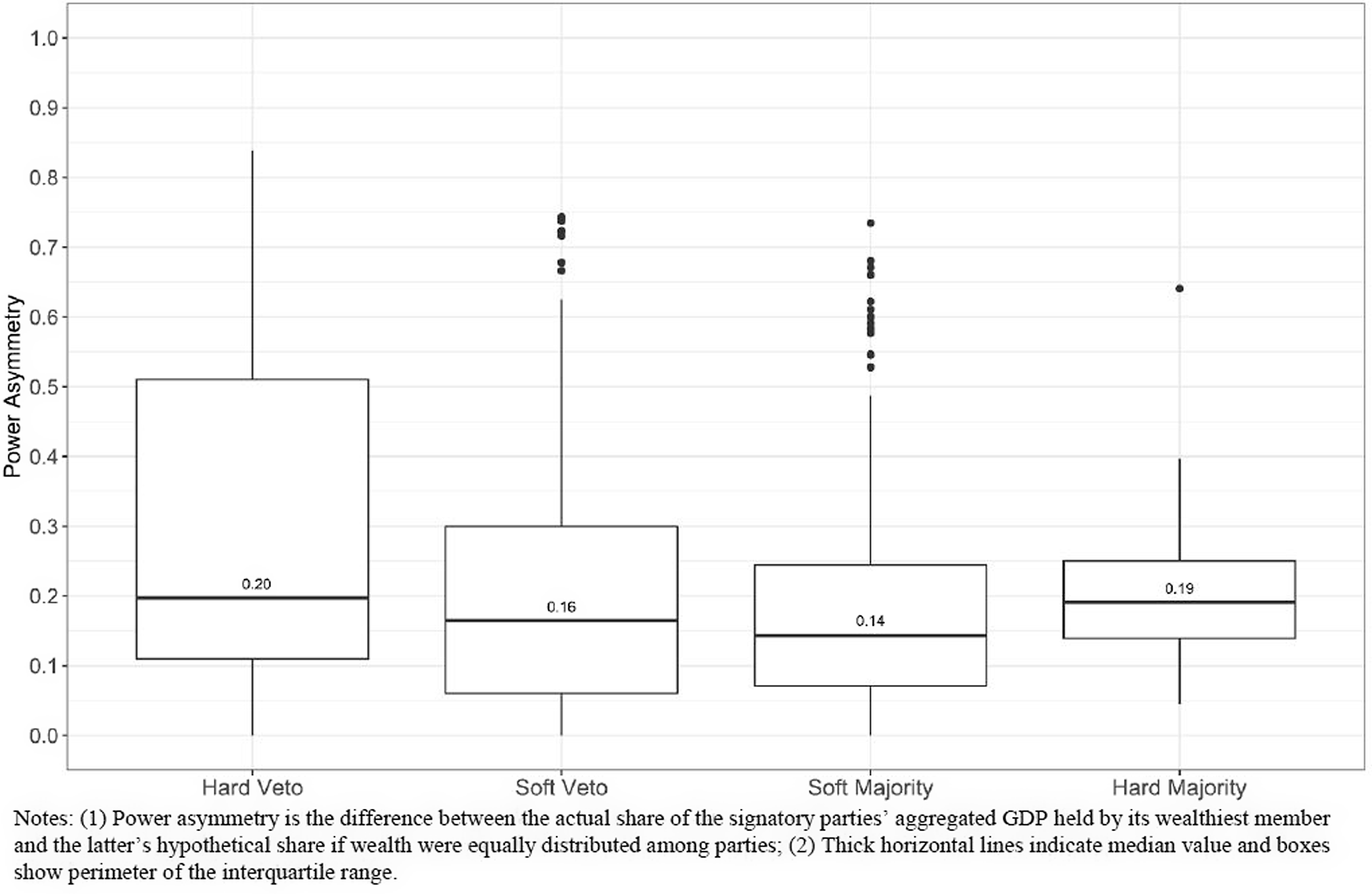
Agreements with amendment procedures of the Soft Majority type, which offer the highest levels of both adaptability and flexibility, have on average more members and more symmetric membership than agreements belonging to other categories. Fifty percent of agreements featuring Soft Majority procedures have between 15 and 96 members and a level of power asymmetry between 0.07 to 0.24. Treaties with intermediate Soft Veto procedures lie in-between the two extremes in terms of membership numbers and asymmetry. When it comes to asymmetry, the Hard Majority type shows some similarity with the Hard Veto type. When it comes to membership, it has an affinity with the Soft Majority type; both types are favoured when the number of state parties is high. This suggests that power asymmetry reduces treaty flexibility, while increased membership is conducive to treaty adaptability.
The association between size of membership and adaptability is coherent with Buchanan and Tullock’s model, which predicts that decision-making costs for individual participants increase exponentially as the size of the decision-making group increases, both in relative terms (as the proportion of favourable participants required for a decision increases) and in absolute terms (as the total number of participants needed to be rallied increases).Footnote 91 Therefore, mixing unanimity rules with a large number of participants pushes the costs of decision-making to levels exceeding what a rational individual agent is willing to pay.Footnote 92 Moving towards less-than-unanimity rules is the only way to reduce these costs to acceptable levels so that an amendment procedure is affordable.
The association between power symmetry and flexibility is more puzzling. In the case of the Hard Veto type, it is reasonable to think that asymmetry and low flexibility are connected through adaptability: states benefitting from an asymmetrical power relation have a lot to lose by entering into an agreement that can be amended without their assent, so they prefer to keep unanimity.Footnote 93 When they enjoy the protection brought by unanimity, states have no need for flexibility measures.
The situation is more complicated with the Hard Majority type. Why would a relatively powerful state accept to renounce the control brought by unanimity without securing the insurance policy provided by flexibility? One possible answer is that, by ruling out flexibility as we understand it, a Hard Majority procedure dramatizes the stake and makes treaty exit the only solution for non-consenting parties. Thus, a threat of withdrawal is built into the negotiation over amendments, and powerful states are in a better position to benefit from the exit strategy ‘since their deviation from an existing equilibrium is likely to be more widely felt’.Footnote 94
Figure 8 reports the distribution of the different types of amendment procedures that occur when a specific state is one of the parties of the related treaty.Footnote 95 For example, the presence of the United States and Russia, both superpowers during a significant part of the period under investigation, is positively associated with the use of Hard Veto type procedures and negatively associated with Hard Majority type procedures. Therefore, they are both more strongly associated with amendment mechanisms that favour individual state’s control. Conversely, several developing countries, like Senegal, Peru, Mexico and, interestingly, China, tend to be more strongly associated with the use of Soft Majority amendment procedures. The amendment procedures favoured by China seem strikingly different from the other major powers. This can partly be explained by the fact that China has signed far fewer agreements (90) than other states in the selection (174 on average). Moreover, Chinese treaty-making activity in environmental governance is geared towards major multilateral agreements. The average membership for treaties signed by China is 102 compared to an average of 67 for other countries. Therefore, China seems to avoid involvement in small-scale agreements which, as we have seen, are more conducive to the Hard Veto and Soft Veto types of amending mechanisms. Agreements signed by European states, like Denmark, France and the United Kingdom, show distributions that come midway between those of historic superpowers and developing countries. Germany, a regional power, has a portfolio of engagements that is slightly more in line with Russia and the United States, if we consider its considerable use of procedures of the Hard Veto type. It shares this characteristic with Japan, which has also been a regional power for a long time.
Amendment procedures in MEAs according to type for selected signatory parties
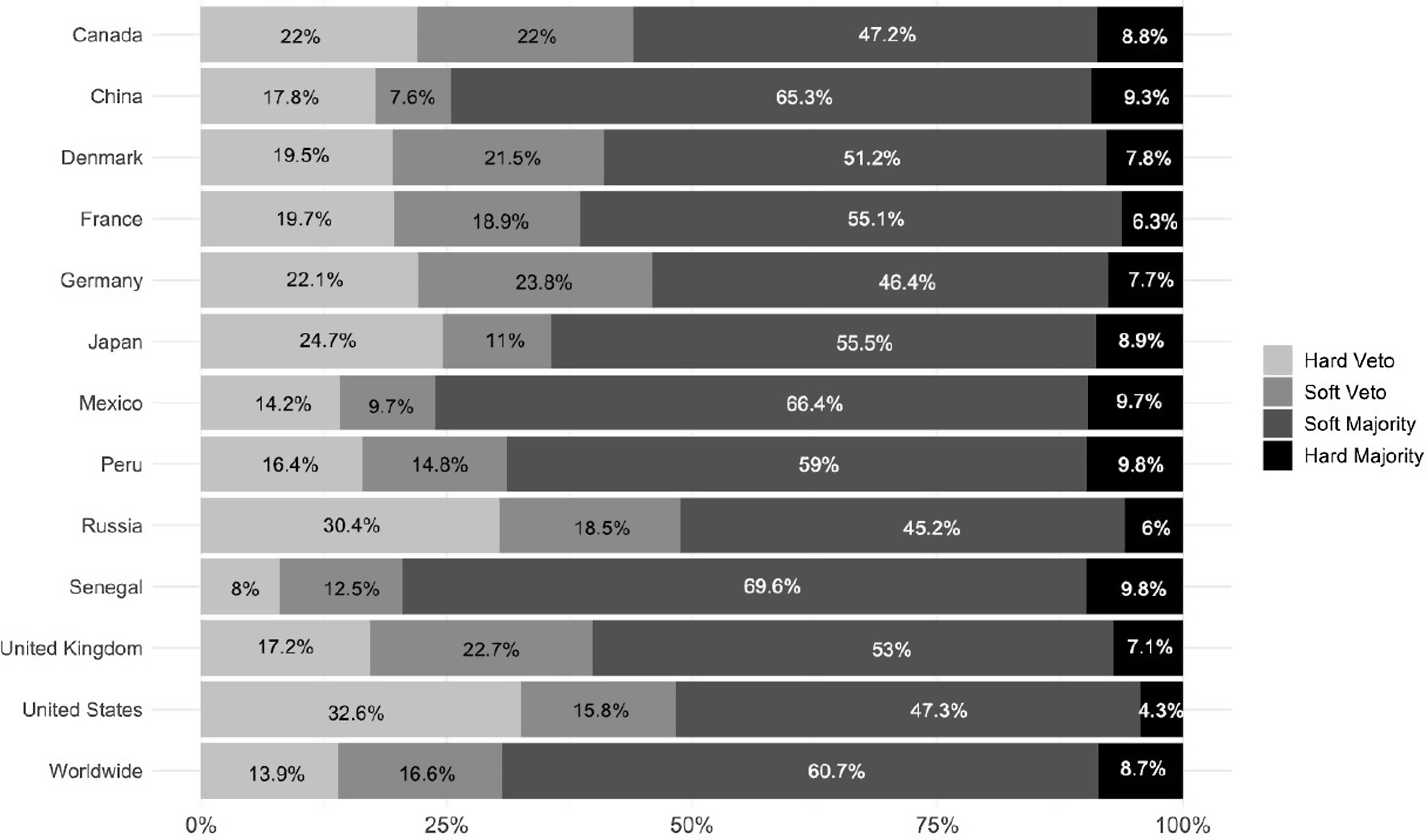
This depiction of individual states’ association with the different types of amendment procedures converges with our findings with respect to power asymmetry. When a major power is party to an agreement, amendment procedures belonging to the Hard Veto type are far more likely because they maximize individual states’ control to the detriment of adaptability and flexibility.
7. Conclusion
In this article, we map the under-explored ‘subcontinent’ of treaty amendment mechanisms, using MEAs as waypoints. We began by delineating the subcontinent’s external borders and found that it covers almost half the landmass inhabited by MEAs. This proportion has grown rapidly over the years. Amendment procedures have become a prevalent feature of MEAs, and are particularly frequent among treaties with large membership. New MEAs settle in amendment procedure territory, which is expanding and inhabited by more densely-populated communities. While a small amount of treaty amending activity occurs outside the subcontinent’s borders, MEAs with their own amending rules are on average amended 14 times more than those without. Amendment procedures are not ornamental.
We then focused our attention on the subcontinent’s internal borders and demography. We first used the qualitative method of property space reduction to draw clear conceptual boundaries between four different domains of treaty amendment procedures, each governed by a distinct type of decision-making rules. Then, we turned to quantitative techniques to map the similarities and differences observable in the population and environment of treaties belonging to each domain. We were surprised by the vast expanse of the dominion of amendment procedures governed by unanimity or consensus rules. Amendment procedures are definitely not, per se, conducive to greater adaptability or flexibility. Hence, more than half of the amendment procedures found in MEAs fall under the Soft Veto (which provides each state with a veto on adoption) or the Hard Veto type (which provides each state with a veto on adoption and entry into force). We infer from this observation that several states prefer amendment rules that provide them with levels of control at par (if not above) what is offered by the VCLT’s default rules. However, we discovered that procedures of these types are generally found in treaties with few members, which helps put their popularity and impact in perspective. Thus, the territory occupied by MEAs featuring procedures of the Soft Veto and Hard Veto types is vast if measured by number of treaties, but it is far less densely populated by states than others. Conversely, when weighted for treaty size, the types of amendment procedures that effectively loosen states’ control to increase treaty adaptability clearly dominate the subcontinent’s landscape. For instance, the Soft Majority type does not provide a veto to members for amendment adoption or entry into force, and ranks not only first by the number of cases, but is found in MEAs with a median number of parties almost five times that of treaties with Hard Veto procedures.
One important finding of this research is that, although there is a clear historical trend towards the inclusion of amendment procedures in MEAs, no similar trend is discernible regarding the design of amendment procedures. Types of procedures that are most conducive to adaptability and flexibility are no more (or less) in vogue today than they were before. Since most new MEAs include amendment provisions and the rate of new MEAs is in sharp decline, the overall level of adaptability and flexibility of the body of international environmental law is likely to plateau at its current level.
Perhaps unsurprisingly, a clear limit to the adoption of amendment procedures that are more conducive to adaptability is imposed by compliance with the principle of states’ consent. Our typology sheds light on the distinction between control and consent. It shows that amendment procedures can provide states with varying levels of control over the collective outcome of the decision-making process, without necessarily affecting their consent privilege. Hence, the Soft Majority type of amendment procedure, which is used the most frequently, especially among MEAs with large membership, dissolves the control a state could otherwise exert to prevent the integration of a new norm into a treaty. However, it does not infringe on consent because the state retains ultimate control over its own adhesion to the norm at the entry into force level.
This flexibility comes at the price of fragmentation: MEAs amended under Soft Majority and Soft Veto rules offer reluctant states opting-out options that segment treaties into a subset of different commitments. In fact, an amended treaty that allows some parties to opt out creates two treaties: one, the amended one, applies to the majority of states having consented to the amendment; another, the original unamended one, applies to the minority of states having withheld their consent, and to their relations with all other state parties. To correctly assess the significance and risk of fragmentation by amendment, a dyadic perspective on treaty commitments is useful.Footnote 96 If, for example, a treaty between six member states can be thought as consisting a set of 15 dyadic commitments, then we can see that having a single one of these states opting out from an amendment creates a subset of dyadic commitments, governed by the unamended version of the treaty, covering a third (5 out of 15) of the treaty dyads. If two states opt out, a mere third of the membership will keep a large majority of the dyadic relations (9 out of 15)Footnote 97 under the purview of the unamended version. The Hard Veto and Hard Majority types of procedure both prevent fragmentation, but with very different consequences. A treaty amended following a Hard Veto procedure has necessarily secured the consent of all parties, so it will retain its original membership unless harsh bargaining causes voluntary departures. Treaties of the Hard Majority type prevent fragmentation by forcing non-consenting states to leave the agreement if they wish to avoid unwanted new obligations. Withdrawal is in most cases automatic for non-consenting parties. Hard Majority amending procedures that do not include automatic withdrawal, and would thus open the door for unconsented obligations are rare. They generally apply to non-consequential issues, or are simply ignored. These interactions between amendment procedures and treaty fragmentation would certainly merit further empirical investigations.
Our dataset and typology of amendment procedures open other avenues for empirical research. For example, one promising line of inquiry concerns the relation between power asymmetry and variations in the occurrence and types of amendment procedures. We find that power asymmetry is lower on average between parties to agreements that have amendment procedures than for agreements without. When agreements do contain amendment procedures, the latter tend to protect individual states’ control and consent in cases where power asymmetry between participants is relatively high or when a major power is a signatory. These descriptive observations suggest a causal relation between power asymmetry and the design of the amendment procedure. It seems that when powerful states are in a favourable bargaining position, they negotiate treaties that will leave their bargaining power unaltered by procedural rules. They appear to prefer treaties operating under the conservative default rules of the Vienna Convention rather than under customized amendment procedures. When they negotiate treaties that do contain specific amendment rules, they seem to prefer procedures of the Hard Veto type, which is even firmer than the VCLT in its affirmation of the unanimity rule. These hypotheses should be tested in future research to better understand how power relation shape the design of international institutions.
Supplementary material
For supplementary material accompanying this paper visit https://doi.org/10.1017/S0922156523000341


 Open access

