


The East Flanders Prospective Twin Survey (EFPTS) was started in July 1964 at Ghent University, Department of Obstetrics, by Robert Derom and Michel Thiery, a twin himself. At present it is hosted by ‘Twins’, a non-profit association for scientific research in multiple births, and is now partly funded by the department of Human Genetics of the University of Leuven (Belgium), ‘Twins’, and the University of Maastricht (Netherlands).
The main aims of EFPTS are:
-
1. the determination of the prevalence of multiple births in a well-defined geographic area and the recording of the obstetrical (duration of pregnancy, pregnancy and birth complications, birth weight, induction of ovulation, placental weight, insertion of the cord) and obstetrico-pediatric outcomes (intrauterine growth, congenital malformations, and perinatal and infant morbidity and mortality)
-
2. the investigation of the causes of the multiple pregnancy and the influence of zygosity and moment of zygotic division on the investigated traits on later age such as behavior, learning- and school problems, intelligence, postnatal somatic growth, sexual maturation, blood pressure, stress, (sub)clinical depression, and psychotic symptoms
-
3. the determination of the genetic predisposition of the investigated phenotypes and the role of the environment (with special emphasis on the prenatal environment) both individual-specific as well as common environmental influences.
Sample Characteristics
The inclusion criteria are the following: all multiple births in the Province of East Flanders, Belgium (15,800 births per year) from whom at least one of the children, live or stillborn, weighs 500 g or more or, when birth weights are unknown, the gestational age is at least 22 weeks. The specific methodology of this survey includes: the determination of the zygosity of each multiple birth with near certainty to certainty through examination of the placental membranes and vascular anastomoses, blood groups and DNA fingerprints (if necessary), the collection of medical data from gynaecologists and neonatologists, follow-up of the multiples through one of the studies and/or questionnaires.
Contact with the families of the multiples is maintained by a biannual newsletter and a TWIN hotline for the public and the parents of twins with psychological, educational, medical, or practical problems, and the organization of evening meetings where the parents of multiples just meet with each other and exchange experiences. These services to families with multiple births are a joint venture of EFPTS and the Association for Scientific Research in Multiple Births (Twins) and are mainly based on the work of volunteers.
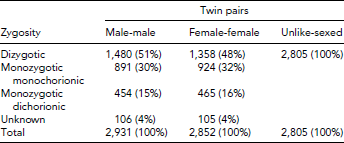
Between 1964 and 2011, 8,588 twin pairs and 238 triplets were registered and investigated (see Table 1). The EFPTS sample is representative of the total twin population of East Flanders, with more than 95% registered multiple births since the 1990s (Loos et al., Reference Loos, Derom, Vlietinck and Derom1998). Presently, more than 3,000 twin pairs have been enrolled in more than 10 major studies, and some 2,000 DNA extractions have been performed. In some of these studies, the parents and sibs of the twins were also examined.
The Number of Twin Pairs in the EFPTS Born Between 1964 and 2011 by Zygosity, Chorion Type, and Sex
A Summary of Major Findings
Some of the most important results are reported to illustrate the scope of our studies.
-
• Twin surveys are a valuable method in the study of malformations. In monozygotic (MZ) twin pairs most malformations are discordant (Cameron et al., Reference Cameron, Edwards, Derom, Thiery and Boelart1983).
-
• A method to determine the zygosity of same-sexed twins, even macerated, through DNA fingerprinting (Derom et al., Reference Derom, Bakker, Vlietinck, Derom, Thiery and Pearson1985, Reference Derom, Vlietinck, Derom, Boklage, Thiery and Van den Berghe1991) was developed.
-
• The MZ monochorionic–monoamnionic (MC-MA) twin pairs are predominantly girls (Derom et al., Reference Derom, Vlietinck, Derom, Van den Berghe and Thiery1988). The MZ monochorionic–diamnionic (MC-DA) twin pairs have a higher mortality rate than DC MZ and DZ twin pairs. If the division takes place after the eighth day, the mortality risk increases even more dramatically (Loos et al., Reference Loos, Derom, Vlietinck and Derom1998).
-
• After standardization for gestational age, the birth weight of twins is mainly determined by maternal factors, especially the mother's genetic make-up, and to a lesser extent by the chorion type and the genes of the foetuses and their common environment (Vlietinck et al., Reference Vlietinck, Derom, Neale, Maes, Van Loon, Derom and Theiry1989).
-
• Since the mid-1980s there has been a real explosion in the rate of multiple births, primarily caused by the increasing administration of ovulation stimulating agents and the use of other assisted reproduction techniques (ART). We were the first to draw attention to the importance of this epidemic. This increase in the rate of multiple pregnancies represents an important public health problem because, if this trend continues, the rate of very preterm births and very low birth weight infants in the population will undoubtedly continue to rise (see Figure 1; Derom et al., Reference Derom, Maes, Derom, Van den Berghe and Vlietinck1993). Recently, there has been a steep decrease of the rate of higher order multiple births and twins because of a selective feticide (selective abortion of one or more embryos or fetuses) policy and the single embryo transfer in in vitro fertilization (IVF) (Gerris, Reference Gerris2003). The frequency of zygotic splitting is higher after artificial induction of ovulation than after naturally occurring ovulation, which is of fundamental unexplained biological importance (Derom et al., Reference Derom, Vlietinck, Derom, Van den Berghe and Thiery1987). Among iatrogenic MZ twins, the ratio of MC to DC pairs is higher compared with spontaneous twins. A greater proportion of MZ twins is observed with clomiphene citrate as the sole treatment compared with other ovulatory drugs (Derom et al., Reference Derom, Jawaheer, Chen, McBride, Xiao, Amos and Vlietinck2006a).
-
• The inheritance of spontaneous DZ twinning has been studied in collaboration with the Netherlands Twin Register (NTR) by segregation analysis of 1,422 three-generation pedigrees; the parity-independent phenotype of 'having DZ twins’ was consistent with an autosomal monogenic dominant model, with a gene frequency of 0.035 and a female-specific lifetime penetrance of 0.10 (Meulemans et al., Reference Meulemans, Lewis, Boomsma, Derom, Van den Berghe, Orlebeke and Derom1996). However, the results of a genome-wide scan of 14 Flemish families containing 57 mothers of spontaneous DZ twins gave suggestive evidence that the mode of inheritance of DZ twinning is probably more complex than was originally expected (Derom et al., Reference Derom, Leroy, Vlietinck, Fryns and Derom2006b).
-
• The assumption that the division of the zygote occurs stepwise later in, respectively, DC-MZ, MC-DA, and MC-MA pairs has been demonstrated to be highly probable by studying X-inactivation within MZ female pairs: X-inactivation is totally symmetrical in MC-MA pairs, almost symmetrical in MC-DA pairs and asymmetrical in DC-MZ pairs (Chitnis et al., Reference Chitnis, Derom, Vlietinck, Derom, Monteiro and Gregerson1999; Monteiro et al., Reference Monteiro, Derom, Vlietinck, Kohn, Lesser and Gregerson1998; Puck, Reference Puck1998).
-
• The belief that discordant handedness in MZ twins represents mirror-imaging is mythical: the often observed higher frequency of left-handedness in twins is confirmed, but seems to be independent of zygosity and chorion type (Derom et al., Reference Derom, Thiery, Vlietinck, Loos and Derom1996).
-
• A significant effect of chorion type on the heritability of two IQ subtests was found: the MC twins resembled each other more than the DC-MZ twins on the subscales of Arithmetic and Vocabulary. The effect accounts for, respectively, 14% and 10% of the total variance (Jacobs et al., Reference Jacobs, Van Gestel, Derom, Thiery, Derom, Vernon and Vlietinck2001). X-inactivation, however, is not likely involved as no significant interaction was found between sex and chorionicity (Peerbooms et al., Reference Peerbooms, Wichers, Jacobs, Kenis, Derom, Vlietinck and Rutten2010).
-
• In unlike-sexed twins, the length of gestation and the birth weight of the male co-twin are influenced by his female co-twin and not the other way around (Loos et al., Reference Loos, Derom, Eeckels, Derom and Vlietinck2001c).
-
• An adverse prenatal environment during twin pregnancies has small but permanent effects on health in adult life: adult body composition, blood pressure, glucose-metabolism, and renal function have part of their origins in utero, but they are programmed through different prenatal environmental influences. Furthermore, the prenatal environment seems to program men and women in a different way (Gielen et al., Reference Gielen, Pinto-Sietsma, Zeegers, Loos, Fagard, de Leeuw and Vlietinck2005; Loos et al., Reference Loos, Beunen, Fagard, Derom and Vlietinck2001a, Reference Loos, Beunen, Fagard, Derom and Vlietinck2001b). The satiety signal leptin, which regulates food intake and energy expenditure, may act as a growth-promoting signal during fetal development, and the leptin receptor could have a possible role in explaining the inverse relationship between birth weight and the development of metabolic diseases in adulthood (Souren et al., Reference Souren, Paulussen, Steyls, Loos, Stassen, Gielen and Zeegers2008).
-
• Growth during infancy is associated with birth weight and gestational age. From 0 to 1 month, environmental factors are most important for growth, whereas genetic factors become more important over time. This is a first step in identifying age windows for future counseling and interventions on the effects of accelerated growth (Touwslager et al., Reference Touwslager, Gielen, Derom, Mulder, Gerver, Zimmermann and Zeegers2011).
-
• From early adolescence until young adulthood (10–18 years of age), static strength, explosive strength, and the somatotype (Peeters et al., Reference Peeters, Thomis, Claessens, Loos, Maes, Lysens and Beunen2003) are under moderately strong genetic influence. Sex differences are significant from 14 years onwards. Genetic factors are the most important causes for the observed phenotypic stability in explosive strength (Peeters et al., Reference Peeters, Thomis, Maes, Loos, Claessens, Vlietinck and Beunen2005a), while for static strength both genes and environment contribute to the phenotypic stability (Peeters et al., Reference Peeters, Thomis, Maes, Beunen, Loos, Claessens and Vlietinck2005b).
-
• Twins conceived through ovulation induction, IVF, or intracellular sperm injection (ICSI) are at significantly elevated risk of preterm birth and, to lesser extent, of low birth weight. The observed risks associated with assisted reproduction are dampening down by predominantly dizygotic twinning following assisted reproduction and by differential maternal characteristics (Verstraelen et al., Reference Verstraelen, Goetgeluk, Derom, Vansteelandt, Derom, Goetghebeur and Temmerman2005).
-
• In recent decades, gestational age decreased in a linear fashion from 1964 to 2007 in a similar way for MZ and DZ twins. Changes in birth weight depended on gestational age. The decrease in gestational age and change in birth weight in twins are sources of concern, especially for very preterm twins, for whom birth weight decreased (Gielen et al., Reference Gielen, van Beijsterveldt, Derom, Vlietinck, Nijhuis, Zeegers and Boomsma2010).
-
• Under the assumption that the spontaneous DZ twinning rate is a sensor of fecundity, our population-based data and after age-adjustment indicates a stable, ‘high’ fecundity for the East Flanders population (Derom et al., Reference Derom, Gielen, Peeters, Frijns and Zeegers2011).
-
• DNA methylation variability at growth-related imprints does not contribute to overweight in MZ twins discordant for BMI (Souren et al., Reference Souren, Tierling, Fryns, Derom, Walter and Zeegers2011).
-
• Lower birth weight is a causal risk factor for child problem behavior, the effects of which may well extend into adulthood (van Os et al., Reference Van Os, Wichers, Danckaerts, Van Gestel, Derom and Vlietinck2001; Wichers et al., Reference Wichers, Van Os, Danckaerts, Van Gestel, Derom and Vlietinck2001).
-
• Stress-induced increase in negative affect regulates the individual sensitivity to small daily stress, is associated with elevated cortisol levels, (sub)clinical depression, and (sub)clinical psychotic symptoms and influenced by genes, which is indicative of gene–environment interaction. The serotonin transporter gene can be considered as the most attractive candidate gene (Jacobs, Reference Jacobs, Kenis, Peeters, Derom, Vlietinck and van Os2006). Neuroticism, as measured by Eysenck questionnaire, may index an environmental risk for decreased daily life positive affect levels and a genetic as well as an environmental risk for increased negative affect variability (Jacobs et al., Reference Jacobs, van Os, Derom, Thiery, Delespaul and Wichers2011). The findings are also consistent with the hypothesis that adult daily life stress-sensitivity is the result of sensitization processes initiated by developmental stress exposures. Genes associated with depression may act by accelerating the process of stress-induced sensitization (Wichers et al., Reference Wichers, Geschwind, Jacobs, Kenis, Peeters, Derom and van Os2009).
-
• Currently, more than 400 twin pairs, age range 18–30 years, and their siblings are taking part in a project that aims to examine dopaminergic mechanisms underlying aberrant salience attribution and disturbed neurocognition and their predictive validity for subclinical psychotic experiences. The hypotheses will be tested that physical fitness and experience of positive emotions positively influence resilience and are mediated by epigenetic changes.
Yearly numbers of spontaneous and iatrogenic twin maternities: EFPTS 1985–2011.

Discussion
Criticism has been addressed to the classical twin studies with regard to the assumption of equal intrauterine environments of MZ twins. The most important examples of potentially unequal intrauterine environments are undoubtedly chorionicity, zygosity, and the origin of the pregnancy, spontaneous or ART. Other factors, however, must also be considered: gestational age, birth sequence, birth weight, the mode of delivery, and presentation of both twins.
With a sizeable group of more than 900 DC-MZ, 1,800 MC-MZ, and 2,450 ART twin pairs the EFPTS can perform classic twin studies with no biases, that is, studies that are based on the crucial assumption that MZ and DZ twins, spontaneous and ART twins, have a similar intrauterine environment. Previous results have indicated that this could not be the case (Delbaere et al., Reference Delbaere, Goetgeluk, Derom, Bacquer, Sutter and Temmerman2007; Loos et al., Reference Loos, Beunen, Fagard, Derom, Vlietinck and Phillips2001d; Verstraelen et al., Reference Verstraelen, Goetgeluk, Derom, Vansteelandt, Derom, Goetghebeur and Temmerman2005). Comparison of DC-MZ, MC-MZ, and DZ twins will allow to evaluate the degree of gene–environment interactions as the prenatal environment is concerned. In contrast to all DC-MZ and DZ twins, MC-MZ twins share their chorion, most of them share their blood supply and, therefore, their immune system during intrauterine life. This could have long-term effects on phenotypes in later life (Martin et al., Reference Martin, Boomsma and Machin1997; Phillips, Reference Phillips1993).
There is now growing evidence that ART can induce epigenetic variation that might be transmitted to the next generation and that subfertility itself is a risk factor for imprinting diseases (van Montfoort et al., Reference van Montfoort, Hanssen, De Sutter, Viville, Geraedts and de Boer2012). With more than 2,450 twins and 200 triplets being born after various techniques of ART, whether born after fertility treatment without further intervention (ovulation induction only) or after IVF/ICSI or related techniques, EFPTS is the ideal resource for the long-term follow-up study of these multiples on a population-based manner.
As retrospective analysis of the placentation is still impossible to carry out and multiples born after ovulation induction only are hard to detect retrospectively, the effect of chorion type, origin of the pregnancy, and the epigenetic phenomena on phenotypes in later life will remain one of the primary goal of the research with EFPTS.
Acknowledgments
Research projects were aided by grants coming mainly from the Fund for Scientific Research — Flanders, the Praeventiefonds (The Netherlands), the Dutch Foundation for Scientific Research, the Bertarelli Foundation, and the Marguerite-Marie Delacroix Foundation.



