

Introduction
Panic disorder (PD) commonly affects adolescents and has a substantial negative impact upon their ability to function. PD is characterised by repeated panic attacks during which an individual experiences distressing physical and cognitive symptoms. While panic attacks occur across a range of anxiety disorders, in PD these attacks are unexpected, and are accompanied by persistent fears about future attacks, leading to behaviour change to prevent these from occurring. Onset typically occurs during adolescence or early adulthood (Solmi et al., Reference Solmi, Radua, Olivola, Croce, Soardo, Salazar De Pablo, Il Shin, Kirkbride, Jones, Kim, Kim, Carvalho, Seeman, Correll and Fusar-Poli2022), with a peak age at onset of 15.5 years and between 1 and 3% of 11- to 19-year-olds meeting diagnostic criteria (Sadler et al., Reference Sadler, Vizard, Ford, Goodman, Goodman and McManus2018). PD has been linked to high rates of school non-attendance, depression, substance abuse, and suicidal behaviour during adolescence (Beesdo et al., Reference Beesdo, Knappe and Pine2009; Kearney et al., Reference Kearney, Albano, Eisen, Allan and Barlow1997). Despite this, there has been a paucity of research focusing on adolescent PD. Encouragingly, an effective panic disorder-specific treatment has been developed for adolescents, delivered over 11 weeks or intensively over 8 days (Angelosante et al., Reference Angelosante, Pincus, Whitton, Cheron and Pian2009; Pincus et al., Reference Pincus, May, Whitton, Mattis and Barlow2010). However, improved understanding of key maintaining mechanisms of PD may allow us to develop more targeted, effective and efficient treatments, and to better understand how existing treatments work.
Clark’s cognitive model of PD developed for use in adults (Clark, Reference Clark1986; Clark, Reference Clark and Salkovskis1996) outlines a series of cognitive and behavioural processes thought to be central to the onset and maintenance of the disorder. Clark suggests that panic attacks arise when an individual responds fearfully to normal body sensations and anticipates an oncoming catastrophe, having a ‘catastrophic cognition’. As this cognition is in response to a harmless body sensation that the individual is misinterpreting as dangerous, this is called a ‘catastrophic misinterpretation’. For example, a young person experiencing light-headedness while feeling anxious in a crowded school canteen may ‘catastrophically misinterpret’ this as a sign that they will faint. Here, the catastrophic cognition would be ‘I am going to faint’, and the catastrophic misinterpretation would be ‘my light-headedness means I am about to faint’. This makes the person hypervigilant towards bodily sensations; future sensations are taken as evidence that a catastrophe is oncoming. They carry out ‘safety-seeking behaviours’ to attempt to prevent this catastrophe, including in-situation behaviours (e.g. sitting down and modifying their breathing to try to prevent fainting), and avoidance behaviours (e.g. avoiding going to the school canteen in the future). These behaviours alleviate short-term distress but prevent the formation of new information in the long-term, as the non-occurrence of the catastrophe is misattributed to the safety-seeking behaviour. This model suggests that catastrophic misinterpretations and associated safety-seeking behaviours are specific to PD over and above other anxiety disorders. A substantial body of evidence supports this model and the treatment targeting these mechanisms in adults: a recent systematic review by Aslam et al. (Reference Aslam, Zortea and Salkovskis2024) identified 45 studies providing support for the relevance of catastrophic misinterpretations to adult PD maintenance (e.g. Clark et al., Reference Clark, Salkovskis, Öst, Breitholtz, Koehler, Westling, Jeavons and Gelder1997; Teachman et al., Reference Teachman, Smith-Janik and Saporito2007), and treatment (e.g. Clark et al., Reference Clark, Salkovskis, Hackmann, Middleton, Anastasiades and Gelder1994; Clark et al., Reference Clark, Salkovskis, Hackmann, Wells, Ludgate and Gelder1999; Teachman et al., Reference Teachman, Marker and Clerkin2010). The review also identified eight studies establishing the relevance of safety-seeking behaviours to adult PD (e.g. Ehlers, A, 1995; Salkovskis, Reference Salkovskis1991; Salkovskis et al., Reference Salkovskis, Clark and Gelder1996; Salkovskis et al., Reference Salkovskis, Clark, Hackmann, Wells and Gelder1999). This review did not, however, include studies where participants were younger than 18 years.
Adolescence is a unique period of biological and psychological development, and such differences may impact body-related cognitions and subsequent safety-seeking behaviours outlined in Clark’s model. It is therefore important to investigate these key maintenance processes in adolescence specifically. At the cognitive level, bodily changes during puberty are accompanied by the development of higher-order cognitions such as abstraction, consequential thinking, and hypothetical reasoning skills (Holmbeck et al., Reference Holmbeck, Colder, Shapera, Westhoven, Kenealy, Updengrove and Kendall2012). This could facilitate misinterpretation of body sensations and the desire to engage in safety-seeking behaviours to avoid feared consequences. The cognitive model of panic may therefore be particularly relevant in adolescence and these developments may increase an adolescent’s likelihood of developing PD (Doerfler et al., Reference Doerfler, Connor, Volungis and Toscano2007). The neural circuitry implicated in adult PD also develops through adolescence. Decreased connectivity between the amygdala and the prefrontal cortex (PFC) has been associated with both adult PD (Wang et al., Reference Wang, Zhang, Guan, Wang, Zhang, Ni, Miao and Zhang2024) and the normative adolescent brain (Xie et al., Reference Xie, Zhang, Cheng and Yang2021). The amygdala is involved in immediate fear responses to perceived threats, while the PFC is implicated in the cognitive reappraisal of these responses via down-regulation of the amygdala (Ochsner et al., Reference Ochsner, Silvers and Buhle2012). This decreased connectivity again may suggest that catastrophic cognitions are particularly common in adolescence, given decreased top-down regulation of fearful responses to body sensations. It will be particularly important to establish whether catastrophic cognitions and safety-seeking behaviours are indeed a feature of adolescent PD over and above other anxiety disorders in this age group and healthy controls (rather than simply a normal feature of the adolescent brain given the outlined differences in brain functioning).
While a substantial body of evidence establishes the importance and specificity of catastrophic misinterpretations to adult PD, evidence regarding adolescents is highly limited. A meta-analysis by Ohst and Tuschen-Caffier (Reference Ohst and Tuschen-Caffier2018) identified seven studies establishing increased catastrophic misinterpretations in adults with a diagnosis of PD vs other anxiety disorders/no disorder. In contrast, no studies have compared adolescents with PD to others on any measure of catastrophic misinterpretations or related cognitions.
We identified only one study investigating a cognitive factor within a clinical sample of adolescents with PD. Elkins et al. (Reference Elkins, Pincus and Comer2014) found a significant positive association between anxiety sensitivity and PD symptom severity with a medium effect size. Anxiety sensitivity is the fear of bodily sensations associated with anxiety due to the concern that they are potentially dangerous (Reiss et al., Reference Reiss, Peterson, Gursky and McNally1986), and is thus relevant to Clark’s cognitive model of PD. One further study investigated body sensation interpretation and panic symptoms in a broader clinical sample of anxious adolescents: Micco et al. (Reference Micco, Hirshfeld-Becker, Henin and Ehrenreich-May2013) established a positive relationship between negative interpretation of body sensations and higher levels of panic symptoms, with a medium effect size. However, only three of their 40 participants had PD. Neither of these studies compared adolescents with PD to other groups. The remaining studies included non-clinical community populations and focused exclusively on anxiety sensitivity (e.g. Ginsburg et al., Reference Ginsburg, Lambert and Drake2004; Hensley-Maloney and Varela, Reference Hensley-Maloney and Varela2009). This evidence is limited regarding the relevance of cognitive factors to the treatment of clinical PD in adolescence.
Additionally, very few studies examine the association between safety-seeking behaviours, including avoidance, and PD in adolescents. Two studies have examined the role of avoidance behaviours in adolescent panic. Wilson and Hayward (Reference Wilson and Hayward2006) used a longitudinal design to find no significant relationship between behavioural avoidance and panic attacks in a community population of adolescents (although only 9% had experienced a panic attack). Elkins et al. (Reference Elkins, Gallo, Pincus and Comer2016) did find a significant association between avoidance and panic symptom severity with a small effect size in adolescents receiving intensive treatment for PD. Notably, this study did not investigate avoidance related to pre-treatment symptom severity and therefore the results may under-estimate the strength of association between the two, given that we might expect their association to be diminished following treatment. These results suggest that avoidance does play a clinically significant role in adolescent PD. Again, no studies have compared adolescents with PD to those with other disorders on any measure of safety-seeking behaviours, and to our knowledge, no studies have examined the broader range of in-situation safety-seeking behaviours outlined in Clark’s model in this age group. It will be important to establish whether safety-seeking behaviours are elevated in adolescent PD compared to other anxiety disorders and whether these behaviours predict symptom severity.
This study therefore aims to establish whether three components of Clark’s cognitive model of panic (panic-related cognitions, fear of body sensations, and panic-related safety-seeking behaviours) are present to a significantly greater extent in adolescents (aged 12–17 years) with PD, compared to adolescents with other anxiety disorders and those from a non-anxious community group, and whether these factors are associated with symptom severity. Given that the focus of this study is PD, we did not perform comparisons between the two non-PD groups, as they were both included as controls. Age and gender may play a role in the mechanisms of panic disorder given their links to the biological and cognitive developments outlined previously, but these factors are not the focus of the current study. These were included as covariates in our analyses to account for this possible variance.
We hypothesised that:
-
(1) Adolescents with PD will report significantly higher levels of catastrophic cognitions, fear of bodily sensations, and panic-related safety-seeking behaviours than a clinical control group of adolescents with other anxiety disorders and those from a non-anxious community control group.
-
(2) Levels of catastrophic cognitions, fear of bodily sensations, and panic-related safety-seeking behaviours will predict concurrent PD symptom severity across the sample.
Method
Study design
This study had a cross-sectional, between-subjects design. Participants completed five self-report questionnaires measuring levels of catastrophic cognitions, fear of bodily sensations, safety-seeking behaviours, avoidance behaviours, and PD symptom severity.
We pre-registered our study design and analysis plan on the Open Science Framework (https://doi.org/10.17605/OSF.IO/FVJ2Q). Any changes we made to the analyses following pre-registration are outlined in the ‘Analysis plan’ section below.
Participants
We recruited three groups of participants (N=101, 12–17 years). Demographic data for the three groups and clinical characteristics for the two clinical groups can be found in Table 1. The ‘Clinical PD group’ consisted of 34 adolescents with PD as their primary (n=30) or secondary (n=4) diagnosis (the small number of participants with a secondary diagnosis of PD were included in this group as we would expect panic-related cognitions and behaviours to be present where a young person meets the diagnostic criteria for PD, regardless of whether the diagnosis is primary or secondary). The ‘Clinical control group’ consisted of 33 adolescents with an anxiety disorder (including social anxiety disorder, a specific phobia, generalised anxiety disorder, illness anxiety disorder, or separation anxiety disorder) that excluded panic disorder. The ‘Community control group’ consisted of 34 adolescents who scored below the clinical cut-off for anxiety on the Revised Child Anxiety and Depression Scale (RCADS; Chorpita et al., Reference Chorpita, Yim, Moffitt, Umemoto and Francis2000). Participants in this group were from two earlier studies (Robinson and McMahon, Reference Robinson and McMahon2019, or Plaisted, Reference Plaisted2021) and matched, as far as possible, on demographic data to the clinical PD group.
Descriptive statistics for the panic disorder, anxiety control and community control groups
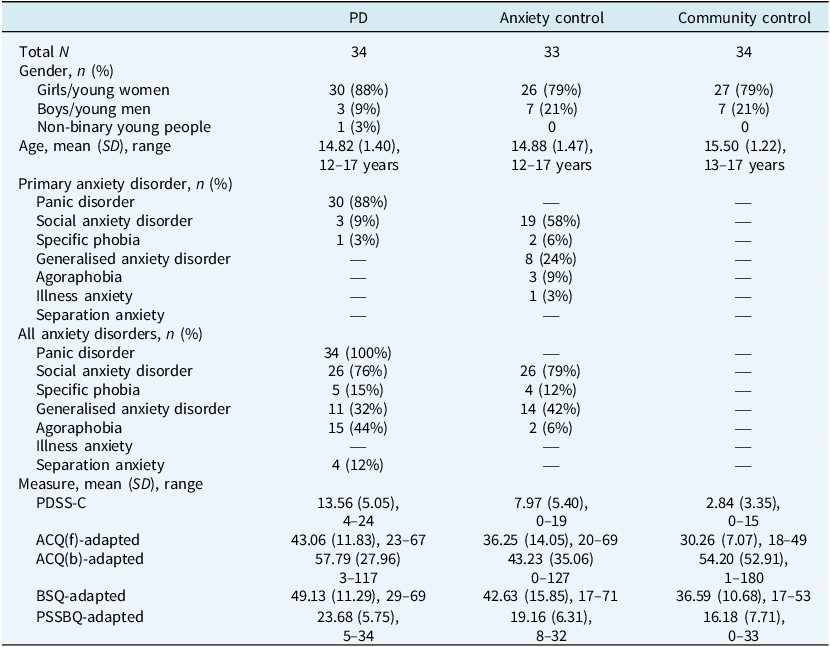
SD, standard deviation; ACQ(f), Agoraphobia Cognitions Questionnaire-adapted (frequency subscale); ACQ(b), Agoraphobia Cognitions Questionnaire-adapted (belief subscale); BSQ, Bodily Sensations Questionnaire-adapted; PSSBQ, Panic Safety Seeking Behaviours Questionnaire-adapted; PDSS, Panic Disorder Symptom Severity for Children and Adolescents.
Procedure
Clinical PD group, and anxiety clinical control group
The two clinical groups (clinical PD group and anxiety clinical control group) were invited to take part through the National Health Service-commissioned Anxiety and Depression in Young People (AnDY) Research Clinic, University of Reading. Participants were recruited from October 2019 to March 2022 and therefore partially during the COVID-19 restrictions. Participants were referred for treatment by primary and secondary care services. In addition, local advertising (e.g. in schools, GP surgeries, and on social media) was conducted to identify potentially eligible adolescents. To be eligible for the service, adolescents needed to experience anxiety symptoms at a level that was likely to meet diagnostic criteria and not meet any of the service exclusion criteria (i.e. having an established autistic spectrum disorder, taking medication for the treatment of anxiety/depression, having immediate suicidal intent, or identified by social care as currently ‘at risk’ due to significant child protection concerns). Potential participants were sent information sheets about this study prior to diagnostic assessment to determine eligibility for the service and study. Diagnostic assessments were conducted (face-to-face or over a telephone/video call) by a member of the team trained to reliability. The Anxiety Disorders Interview Schedule (ADIS-C/P; Silverman and Albano, Reference Silverman and Albano1996) and the Kiddie Schedule for Affective Disorders and Schizophrenia (K-SADS; Kaufman et al., Reference Kaufman, Birmaher, Brent, Rao, Flynn, Moreci, Williamson and Ryan1997) were used for these assessments. They received supervision for all assessments with a senior assessor who had extensive experience of the delivery and supervision of diagnostic assessments.
If the adolescent met diagnostic criteria for a primary anxiety disorder, the study was discussed during or after their following clinical appointment. Participants in the PD group took part in this study through their recruitment to a NIHR-funded feasibility randomised controlled trial (RCT) investigating the efficacy of brief cognitive therapy for panic disorder in adolescents (Waite, Reference Waite2022). If consent/assent was given, participants completed the questionnaires either online or in person in the clinic prior to receiving treatment. Participants were reimbursed for their time with a £10 voucher.
Community control group
Participants in this group were recruited through schools and extra-curricular clubs via a newsletter, email or presentation from November 2018 to January 2019. Recruitment materials invited young people to take part in research which aimed ‘to explore the relationship between anxious, panicky feelings and how adolescents think and what they do’. Questionnaires were distributed through an online link via email or completed in person. Participants in this group were required to have a t-score of <65 for anxiety symptoms on the Revised Child Anxiety and Depression Scale (RCADS; Chorpita et al., Reference Chorpita, Yim, Moffitt, Umemoto and Francis2000). These participants were reimbursed for their time with a £10 voucher or entered into a prize draw for a £50 voucher.
Measures
All participants provided demographic information (age, gender, ethnicity, and parent/carer occupation as a measure of socio-economic status) and completed all measures, except for the diagnostic assessment which was completed by the two clinical groups. Table 3 shows the mean, standard deviation, and observed range for the three groups on the five included measures (ACQ-adapted frequency subscale, ACQ-adapted belief subscale, BSQ-adapted, PSSBQ-adapted, and PDSS-C). Table S1 (Supplementary material) provides individual item means for each measure by group.
Test statistics for the component regressions of Analyses 1 and 2
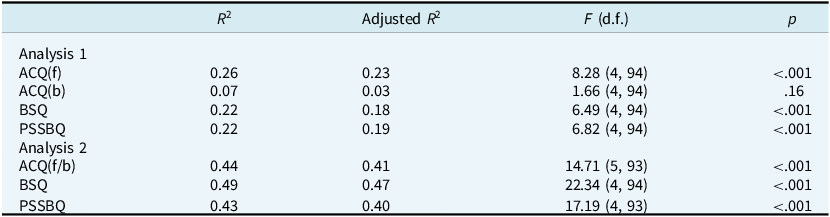
ACQ(f), Agoraphobia Cognitions Questionnaire-adapted (frequency subscale); ACQ(b), Agoraphobia Cognitions Questionnaire-adapted (belief subscale); BSQ, Bodily Sensations Questionnaire-adapted; PSSBQ, Panic Safety Seeking Behaviours Questionnaire-adapted. Alpha level of .05 used to determine statistical significance of p-values. NB: the two ACQ subscales were included in the same model for Analysis 2.
Diagnoses
The Anxiety Disorders Interview Schedule (ADIS-C/P; Silverman and Albano, Reference Silverman and Albano1996) and the Kiddie Schedule for Affective Disorders and Schizophrenia (K-SADS; Kaufman et al., Reference Kaufman, Birmaher, Brent, Rao, Flynn, Moreci, Williamson and Ryan1997) were administered to assess diagnoses of anxiety and/or depressive disorders. Assessors used information from both the young person and their parent/carer to assign a Clinical Severity Rating (CSR) to diagnoses. CSRs are on a 9-point scale, where 0 indicates no impairment and 8 indicates severe impairment. A CST of ≥4 signified a clinical diagnosis. If a participant met the criteria for more than one disorder, the higher CSR indicated primary diagnosis. The ADIS has excellent test–retest reliability (Silverman et al., Reference Silverman, Saavedra and Pina2001), concurrent validity (Wood et al., Reference Wood, Piacentini, Bergman, McCracken and Barrios2002) and inter-rater reliability (Lyneham et al., Reference Lyneham, Abbott and Rapee2007). The K-SADS has excellent inter-rater reliability and test–retest reliability, and good concurrent validity of screens and diagnoses (Kaufman et al., Reference Kaufman, Birmaher, Brent, Rao, Flynn, Moreci, Williamson and Ryan1997).
In this study, inter-rater reliability was good overall (see Table S2 in the Supplementary material). For all disorders bar one, inter-rater reliability was good on both diagnosis (k=.73–1.00) and CSR (adjusted k=.73–1.00). The exception was agoraphobia without PD, where inter-rater reliability was below accepted levels for both diagnosis (k=.40) and CSR (adjusted k=.45). However, only 7% of participants were given this diagnosis, meaning any disagreement between raters would have a large impact on inter-rater reliability statistics. Therefore, overall inter-rater reliability was good.
Anxiety symptoms
The Revised Children’s Anxiety and Depression Scale (RCADS; Chorpita et al., Reference Chorpita, Yim, Moffitt, Umemoto and Francis2000) measures symptoms of anxiety and depression in children and adolescents. To be included in the non-anxious community control group, participants had to score within the ‘normal’ range (t-score <65) for the total anxiety score. (For reference, the clinical cut off score is 70+, with scores between 65 and 69 deemed in the ‘borderline’ range.) The RCADS has been found to have a favourable convergent, discriminant and factorial validity (Chorpita et al., Reference Chorpita, Moffitt and Gray2005), and had excellent internal consistency within our sample (Cronbach’s alpha=0.96, McDonald’s omega=0.96).
Panic disorder symptom severity
The Panic Disorder Severity Scale for Children and Adolescents (PDSS-C; Elkins et al., Reference Elkins, Pincus and Comer2014; Shear et al., Reference Shear, Brown, Barlow, Money, Sholomskas, Woods, Gorman and Papp1997) is a self-report measure used in the assessment of the severity of PD symptoms. It is scored as a total of 7 items each rated on a 5-point scale (0–4), where a higher score indicates greater severity, with total scores ranging from 0 to 28. The PDSS-C has good psychometric properties in adolescents, including convergent and discriminant validity, internal consistency, test–retest reliability and sensitivity to treatment-related change (Elkins et al., Reference Elkins, Pincus and Comer2014). The original PDSS has a sensitivity of 83.3% and a specificity of 64% for PD in adults (Shear et al., Reference Shear, Rucci, Williams, Frank, Grochocinski, Vander Bilt, Houck and Wang2001; these data are not available for adolescents specifically). Within our sample the PDSS-C had excellent internal validity (Cronbach’s alpha=0.90, McDonald’s omega=0.94).
Catastrophic cognitions
The Agoraphobia Cognitions Questionnaire (ACQ; Chambless et al., Reference Chambless, Caputo, Bright and Gallagher1984) assesses how frequently an individual experiences certain panic-related thoughts when they are nervous or frightened on a scale from 1 to 5. We used a modified version of the ACQ (Clark and Salkovskis, Reference Clark and Salkovskis2009), with several extra items and a belief subscale where participants rate their belief in a thought from 0 to 100.
The original measure has good psychometric properties in adults (Chambless et al., Reference Chambless, Caputo, Bright and Gallagher1984); these properties remain unknown for adolescents. The frequency subscale had good internal consistency (Cronbach’s alpha=0.88, McDonald’s omega=0.90) and the belief subscale had excellent internal consistency (Cronbach’s alpha=0.94, McDonald’s omega=0.95) within our sample.
Fear of bodily sensations
The Bodily Sensations Questionnaire (BSQ; Chambless et al., Reference Chambless, Caputo, Bright and Gallagher1984) assesses how worried or afraid an individual feels when they experience bodily sensations brought on by feeling nervous/being in a feared situation. Items relate to how worried/afraid the respondent feels when experiencing certain sensations and are rated from 1 to 5.
While this measure has good psychometric properties in adults (Chambless et al., Reference Chambless, Caputo, Bright and Gallagher1984), these properties remain unknown for adolescents. However, the scale had excellent internal consistency within our sample (Cronbach’s alpha=0.91, McDonald’s omega=0.94).
Panic safety-seeking behaviours
The Panic Safety Seeking Behaviours Questionnaire-adapted (PSSBQ-adapted; Clark and Salkovskis, Reference Clark and Salkovskis2009) measures how frequently the respondent engages in panic-related safety-seeking behaviours. Participants rate how often they engage in each behaviour when anxious on a scale from 0 to 3.
The psychometric properties of the PSSBQ-adapted are unknown for both adult and adolescent populations. However, the scale had good internal consistency within our sample (Cronbach’s alpha=0.76, McDonald’s omega=0.82).
Avoidance behaviours
The Mobility Inventory-adapted (MI-adapted; Chambless et al., Reference Chambless, Caputo, Jasin, Gracely and Williams1985) assesses how frequently an individual engages in avoidance behaviours. Respondents rate the degree to which they avoid a range of locations and situations when alone and accompanied on a scale from 1 to 5.
While this measure has good psychometric properties in adults (Chambless et al., Reference Chambless, Caputo, Jasin, Gracely and Williams1985), these properties remain unknown for an adolescent population. The scale had a high level of internal consistency within our sample (Cronbach’s alpha=0.97, McDonald’s omega=0.98).
Adaptations to measures based on PPIE feedback
Based on input from young people during PPIE consultations, we made several adaptations to make the four process measures more acceptable to adolescents. We reworded multiple items and removed one item from the ACQ, added one item to the PSSBQ, and added two items to the MI. Details of adaptations can be found in Table S3 (Supplementary materials).
Analysis plan
Analysis was undertaken in R version 2023.03.0+386. Where data were missing, mean substitution was performed at the participant level where ≥80% of the measure had been completed, whereby missing items were replaced with the participant’s mean score on the remainder of that scale. Where a participant had completed less than 80% of a measure, they were removed from the analysis for that measure. Of 101 participants, one participant was removed from all analyses as they completed less than 80% of items on all measures. Two more were removed from analyses on one measure each (one on the PDSS-C, one on the PSSBQ-adapted).
Initially, we planned to examine avoidance using the MI. When we examined levels of missing data, we found that a quarter of items had more than 20% of responses recorded as missing or ‘not applicable’, and 27% of participants (including 41% of the PD group) did not respond/responded ‘not applicable’ to over 20% of the MI items. When reviewing the dates of data collection, it was evident that data for many of the participants in the two clinical groups were collected during COVID-19 restrictions. It is highly likely that participants’ reported levels of avoidance would be impacted by these restrictions over and above their impact on the other measures, given effective government-mandated avoidance during this time. We decided that it would be difficult to interpret results relating to this measure in a meaningful way and excluded this measure from the analyses.
After accounting for missing data, we calculated correlations between the four continuous variables included in the analyses: the ACQ-adapted frequency and belief subscales, the BSQ-adapted, PSSBQ-adapted, and PDSS-C. Correlation coefficients are reported in Table 2.
Correlation matrix for continuous variables

ACQ(f), Agoraphobia Cognitions Questionnaire-adapted (frequency subscale); ACQ(b), Agoraphobia Cognitions Questionnaire-adapted (belief subscale); BSQ, Bodily Sensations Questionnaire-adapted; PSSBQ, Panic Safety Seeking Behaviours Questionnaire-adapted; PDSS, Panic Disorder Symptom Severity for Children and Adolescents. *p<.05.
To test Hypothesis 1, we carried out a multivariate multiple linear regression analysis. We examined whether group (three levels) predicted scores on measures of panic cognitions (ACQ-adapted), fear of bodily sensations (BSQ-adapted), and safety-seeking behaviours (PSSBQ-adapted), controlling for age and gender.
We then carried out three multiple linear regression analyses to test Hypothesis 2, examining whether panic cognition scores (ACQ-adapted), bodily sensation fear scores (BSQ-adapted), and safety-seeking behaviour (PSSBQ-adapted) scores predicted concurrent panic disorder symptom severity (PDSS-C) across the sample. These were run as separate regressions (rather than one analysis including all variables of interest). We deviated from our original plan to account for the high correlation between scores on the ACQ-adapted (f) and BSQ-adapted (r=0.77).
We carried out sensitivity analyses whereby we ran all regression analyses again excluding the four participants in the PD group with PD as a secondary (rather than primary) anxiety disorder diagnosis. This was to examine whether including these participants changed the direction or significance of results.
Results
The groups did not significantly differ in terms of gender (c 2(4)=4.71, p=.32), and there was no significant difference in age between the PD group and the clinical control group (t(63.14)=1.29, p=.20). However, the PD group was significantly younger than the community control group (t(64.82)=3.37, p=.001).
Sensitivity analyses indicated that including four participants in the PD group where PD was a secondary (rather than primary) anxiety disorder diagnosis did not affect the direction or significance of results for the following analyses. We have therefore reported the analyses results where these participants were included.
Descriptive statistics for the measures of interest can also be found in Table 3. Mean individual item scores on the ACQ-adapted, BSQ-adapted, and PSSBQ by group can be found in Table S1 in the Supplementary material.
Hypothesis 1: Adolescents with PD will report significantly higher levels of panic cognitions, fear of bodily sensations, and safety-seeking behaviours than the two control groups
As hypothesised, group significantly predicted one or more of the four dependent variables (V=.27, F(8,184)=3.66, p<.001), controlling for age and gender. Test statistics for the univariate regressions for each dependent variable (DV) are included in Table 3, demonstrating that the overall regression models for three of the four DVs were statistically significant: frequency of panic-related cognitions, fear of bodily sensations, and safety-seeking behaviours. The model including level of belief placed in panic-related cognitions was not statistically significant.
Table 4 contains test statistics concerning the relationship between group and these three DVs. Group was significantly associated with frequency of panic-related cognitions: the PD group had significantly higher scores on this measure than both the clinical control group (b=–6.51, SE=2.67, p<.05) and the community control group (b=–11.37, SE=2.61, p<.001). A similar pattern was observed for the measure of safety-seeking behaviours (b=–4.01, SE=1.67, p<.05, b=–6.96, SE=1.63, p<.001). On the measure of fear of bodily sensations, the PD group had significantly higher scores than the community control group (b=–11.02, SE=3.02, p<.001), but no significant difference was observed between the PD group and the clinical control group (b=–5.89, SE=3.09, p=.06).
Test statistics for the component regressions of Analyses 1 and 2
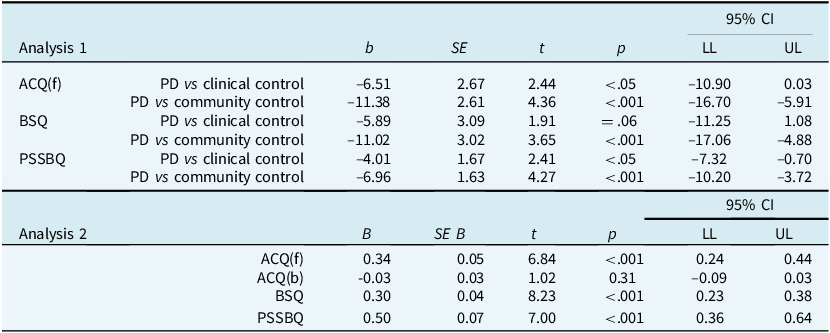
ACQ(f), Agoraphobia Cognitions Questionnaire-adapted (frequency subscale); ACQ(b), Agoraphobia Cognitions Questionnaire-adapted (belief subscale); BSQ, Bodily Sensations Questionnaire-adapted; PSSBQ, Panic Safety Seeking Behaviours Questionnaire-adapted. Alpha level of .05 used to determine statistical significance of p-values. NB: Analysis 1: given that heteroscedasticity was detected in the BSQ data using a Breusch-Pagan test, a sandwich estimator was used for this part of the model to mitigate the increased risk of Type I error; Analysis 2: the two ACQ subscales were included in the same model.
Hypothesis 2: Levels of panic cognitions, fear of bodily sensations, and safety-seeking behaviours will predict concurrent PD symptom severity across the sample
We found the three multiple linear regression models to be significant (see Table 3). Test statistics are included in Table 4. Frequency of panic cognitions, fear of bodily sensations, and safety-seeking behaviours scores were significantly positively associated with higher concurrent PD symptom severity. The belief subscale of the measure of panic cognitions was not significantly associated with PD symptom severity.
Discussion
This study investigated whether the cognitive and behavioural processes outlined in Clark’s cognitive model of panic disorder (Clark, Reference Clark1986; Clark, Reference Clark and Salkovskis1996) distinguish between adolescents with PD and adolescents with other or no anxiety disorders. In line with our hypotheses, we found that adolescents with PD showed significantly greater frequency of catastrophic cognitions relating to body sensations and higher levels of safety-seeking behaviours than both adolescents with other anxiety disorders (the clinical control group) and those with no anxiety disorder (the community control group). We also found that adolescents with PD showed significantly higher levels of fear of their body sensations than the community control group. Contrary to our hypotheses, we found no significant difference in body sensation fears between the PD and clinical control group, and no significant differences between the PD group and either control group on belief ratings of catastrophic cognitions. When grouping all participants, again consistent with our hypotheses, we found that catastrophic cognitions relating to body sensations, fear of body sensations, and safety-seeking behaviours positively predicted concurrent PD symptom severity.
In line with Clark’s cognitive model of PD, we found that frequency of panic-related cognitions discriminated between groups and predicted concurrent PD symptom severity. Catastrophic cognition frequency was significantly higher in adolescents with PD than both other groups, and positively predicted symptom severity. These findings provide preliminary support for Clark’s cognitive model in adolescents, positing that catastrophic cognitions are central to the maintenance of PD.
Interestingly, degree of belief in the catastrophic cognitions did not predict concurrent PD symptom severity or differ significantly between groups. Against our expectations, this ACQ subscale did not correlate highly with the frequency subscale. While we did not make any explicit hypotheses regarding this correlation, we did expect that these would be highly correlated as two subscales of the same measure. It appears that while adolescents with PD experience more frequent catastrophic cognitions compared to those without PD, if and when the thoughts arise, the groups do not significantly differ in the belief that the thought may be true. This might suggest that placing belief in occasional catastrophic cognitions is normative within adolescence but does not in itself lead to a problem with panic when such thoughts are infrequent.
Fear of bodily sensations was significantly higher in adolescents with PD compared to those with no anxiety disorder, but not when compared to those with another anxiety disorder. This might suggest that bodily sensation fear plays a role in adolescent anxiety disorders more broadly. Our clinical control group had high levels of social anxiety disorder (79%), and prominent cognitive models of SAD (e.g. Clark and Wells, Reference Clark, Wells, Heimberg, Liebowitz, Hope and Schneier1995; Rapee and Heimberg, Reference Rapee and Heimberg1997), relevant to adolescent SAD (Leigh et al., Reference Leigh, Percy, Clark, Creswell and Waite2023), including self-monitoring of somatic sensations. This specifically pertains to worry around others interpreting physical symptoms as signs of social inadequacy (e.g. blushing or sweating) but would be picked up by our measure of bodily sensation fear as the BSQ asks participants to rate how frightening they find a sensation ‘when nervous or in a feared situation’.
Our overall findings from the measures of catastrophic cognitions and body sensation fear broadly align with the adult PD literature regarding the relevance of catastrophic misinterpretations to the maintenance of the disorder (Aslam et al., Reference Aslam, Zortea and Salkovskis2024). Catastrophic cognitions and body sensation fear are both cognitive factors highly relevant to the process of catastrophic misinterpretation. However, we did not include a specific measure of catastrophic misinterpretation such as the Body Sensations Interpretation Questionnaire (BSIQ; Clark et al., Reference Clark, Salkovskis, Öst, Breitholtz, Koehler, Westling, Jeavons and Gelder1997) where respondents interpret a range of ambiguous situations. Future work validating and using the BSIQ with adolescents will be important for establishing the role of catastrophic misinterpretation specifically. This will provide further evidence for the relevance and applicability of Clark’s cognitive model to adolescent PD.
We also found support for the role of safety-seeking behaviours (including avoidance) in adolescent PD. Our behavioural measure discriminated between adolescents with PD and both those with other anxiety disorders and no anxiety disorders. This suggests that behaviours in this measure are specific to PD over and above other anxiety disorders. Additionally, levels of safety-seeking behaviours positively predicted concurrent PD symptom severity. These findings align with evidence for the relevance of safety-seeking behaviours to adult PD (Salkovskis et al., Reference Salkovskis, Clark and Gelder1996; Salkovskis et al., Reference Salkovskis, Clark, Hackmann, Wells and Gelder1999).
Our findings broadly support the relevance and specificity of the cognitive model of panic to adolescent PD and suggest that targeting specific panic cognitions and safety-seeking behaviours may be an effective treatment approach. Our finding that bodily sensation fear did not significantly differ between PD and other anxiety disorders provides support for targeting this process in adolescent anxiety interventions more broadly.
This study has several other strengths and limitations. Regarding strengths, it is well-powered and is the first study to examine the cognitive model in a clinical group of adolescents with panic disorder. Participants in the clinical groups were recruited through clinical services and received gold standard diagnostic interviews administered in a clinical setting with experienced assessors. By including a clinical control group as well as a community comparison group, we investigated the degree to which these constructs were distinct to panic disorder rather than anxiety disorders more broadly.
In terms of limitations, we included a large age range (12–17 years) and given the rapid biopsychosocial development that occurs during this developmental stage, there may be important differences in how the factors of the cognitive model develop across adolescence. Within our participants there was a significant difference in age between the PD group and the non-clinical control group, whereby the former was significantly older. Given the later age of onset for panic disorder compared to other anxiety disorders (Solmi et al., Reference Solmi, Radua, Olivola, Croce, Soardo, Salazar De Pablo, Il Shin, Kirkbride, Jones, Kim, Kim, Carvalho, Seeman, Correll and Fusar-Poli2022), this is not unexpected. While we controlled for age in our analyses to adjust for this, we were not sufficiently powered to investigate how age might interact with group to impact the development of panic cognitions and safety-seeking behaviours. This would be an interesting and valuable direction for future research to take.
Additionally, our measures of cognitive and behavioural factors were originally developed for and validated with adults. While these measures did have good internal validity within our sample, it will be important to validate them with a larger adolescent population to ensure they are appropriate for use with this age group. We also made some small adaptations to the measures based on PPI input from young people. While the changes made were minimal and largely pertaining to wording, it will be important to verify whether these changes impact the psychometric properties of the measures when used with adolescents. Additionally, we planned to investigate avoidance behaviours using the Mobility Inventory but were unable to do so due to high levels of missing data. While the measure of panic symptoms (the PDSS-C) has good psychometric properties in adolescents, going forward it would be good to examine the sensitivity and specificity of the measure in adolescents and to establish clinical cut-offs for this population. Finally, there was a lack of diversity among our participants, with 85% being White British and 81% identifying as a girl/young woman. It will be important to investigate whether findings generalise to other ethnicities and genders.
Importantly, while this study has evaluated the relevance of factors within the adult cognitive model of PD to adolescents, future research should investigate possible adolescence-specific factors. For example, peer and family factors may interact with the cognitive factors included in our analyses. As discussed previously, including a measure of catastrophic misinterpretation (rather than catastrophic cognition and body sensation fear) such as the BSIQ in future studies with adolescents will further improve our understanding of how Clark’s cognitive model of panic relates to adolescent PD. Exploring the relationship between panic symptoms and these factors across adolescence would allow us to build an adolescent-specific model of PD. The involvement of young people through PPIE activities will be important for the development of such a model.
This study establishes that the processes outlined in Clark’s cognitive model of PD are observed in adolescents with PD. We demonstrate that catastrophic cognitions, panic safety-seeking behaviours, and fear of bodily sensations predict PD symptom severity, and that the former two processes are specific to PD over and above other anxiety disorders. In keeping with the large body of adult PD research, these results support the clinical relevance of this model to adolescents with PD, providing initial support for a treatment approach targeting the mechanisms outlined in the cognitive model of PD.
Supplementary material
The supplementary material for this article can be found at https://doi.org/10.1017/S1352465825000049
Data availability statement
The data that support the findings of this study are available from the corresponding author, A.M., upon reasonable request.
Acknowledgements
We would like to thank Dr Hannah Plaisted for her help with data collection for this study. We would also like to thank the young people who participated in the study.
Author contributions
Amy McCall: Conceptualisation, Methodology, Formal analysis, Writing – original draft; Felicity Waite: Conceptualisation, Methodology, Writing – reviewing & editing; Ray Percy: Investigation, Writing – reviewing & editing; Laura Turpin: Conceptualisation, Methodology, Investigation, Writing – reviewing & editing; Kate Robinson: Investigation, Writing – reviewing & editing; Jennifer McMahon: Investigation, Writing – reviewing & editing; Polly Waite: Conceptualisation, Methodology, Investigation, Writing – reviewing & editing.
Financial support
Amy McCall is funded by an Oxford-Medical Research Council Doctoral Training Partnership studentship in partnership with a St John’s College Oxford Alumni Fund Scholarship. For this work, Polly Waite was funded by a National Institute for Health and Care Research Postdoctoral Research Fellowship (PDF-2016-09-092). Felicity Waite is supported by a Wellcome Trust Doctoral Fellowship (award number 102176/B/13/Z). Ray Percy and Polly Waite are currently funded through the National Institute for Health and Care Research Oxford Health Biomedical Research Centre (NIHR OH BRC). The views expressed are those of the authors and not necessarily those of the National Health Service, the National Institute for Health and Care Research, or the UK Department of Health and Social Care. Project materials can be accessed by contacting the corresponding author.
Competing interests
The authors have no competing interests to declare that are relevant to the content of this article.
Ethical standards
Authors have abided by the Ethical Principles of Psychologists and Code of Conduct as set out by the BABCP and BPS. Study procedures were assessed and approved by the University of Reading Research Ethics Committee (reference: 18/34), the University of Birmingham Research Ethics Committee (reference: 19-1747) and the National Research Ethics Service South Central – Berkshire B Committee (reference: 19/SC/0287). Participants aged 12–15 years provided written assent and those aged 16–17 years provided written informed consent. For participants aged 12–15 years, their parent/carer also provided written informed consent.


 Open access


Comments
No Comments have been published for this article.