

Introduction
During July 2004, the Petnica Science Center, the National Museum in Belgrade and the Institute for the Protection of Cultural Monuments in Valjevo (Serbia and Montenegro) jointly organised the archaeological excavation at the Bronze Age mound necropolis. The Illyrian Graveyard site had been discovered during the 2003 field-survey campaign, when nine well-preserved prehistoric earth-mounds had been recorded. Numerous fragments of ceramic vessels, bronze jewellery, flint-tool artefacts and fragmented human bones were discovered and collected from the surface.
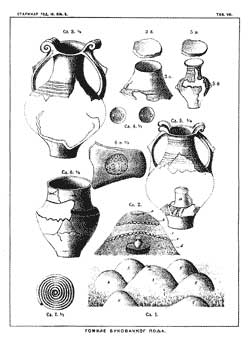
Valtrovic's finds from his 1892 excavation of the Bukovac and Golubac sites (Valtrovicc 1893: Pl. VIII).

The site is located at the Bukovac and Golubac Fields, the very same territory where the Serbian professor of archaeology Mihajlo Valtrovic began the first authorised excavations 112 years ago. The artefacts and complete documentation from Valtrovic's excavations disappeared during World War I and II; leaving only a few short papers as the only record of the excavations (Reference ValtrovicValtrovic 1893, Reference JovanovicJovanovic 1892). The archaeological material discovered in 2003 seems to be directly associated with Valtrovic's excavations, based on the geographical location of the discovery and the cultural designation of artefacts to the so-called Vatin culture of Middle Bronze Age of Balkans (2000-1700 BC).
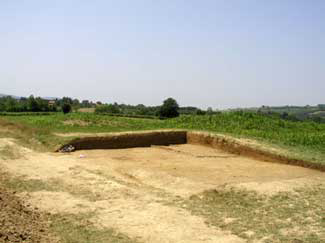
The site occupies approximately 5000 square metres. The mounds are positioned in two organised rows, with the largest mound located centrally between the two rows. The mounds are between 15 to 25m in diameter, with the maximum height of 2m. Two out of nine mounds have been damaged in the past 50 years during the construction of local roads.
In the 2004 field season, we excavated Mound 2, which was 18m in diameter, and slightly higher than Mound 1. We employed the classic method of mound excavations - the mound was divided into four segments, with 1m wide control baulks between each segment.
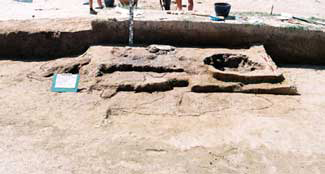
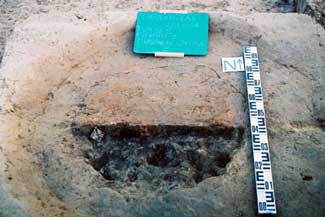
A round zone of compacted earth, 5m in diameter, was discovered in the centre of the mound. This zone probably presents some kind of platform for the central grave. One pit (80cm in diameter and 25cm deep) was dug under the platform where we observed burnt wood, charcoal and small fragments of bones, all suggesting the existence of a cremation site. At the same location, the cremated human bones had been collected with great care and placed in an urn. The urn was situated underneath the soil platform and was covered with two big plaque-like white stones. The urn contained remains of an adult individual, pending anthropological analysis, of unknown age and sex, without any grave goods.
View of the site: mound 6 on the right, mound 3 on the left.

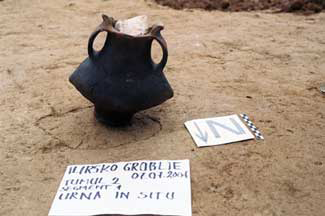
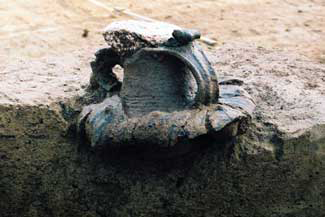
Urn 1 in situ. Compare with urns on Valtrovi_ plate.

Central platform. To the right is the pit containing remains from the burial site. In the centre is the white stone under which was found urn 3.

Beside the urn discovered under the central platform, two additional urns were unearthed. Both urns contain cremated human remains without any grave goods. Urn 2 was fragmented, but we collected all its parts for future reconstruction. Urn 1 was found in its original condition and in the same position as it was placed in the soil some 4000 years ago. The remains of a five year old child were found in it. The south portion of the mound revealed a large zone of the burnt soil with pottery containers for food preparation, as well as fragments of animal bones.
All the ceramic vessels show typical ornamentation for Middle Bronze Age of the Central Balkans, and were assigned to the so-called Vatin Culture. All three urns are typologically very similar. The urns have long necks, spherical bellies and two handles with tongue-shaped upper ends.
As for the sequence of the deposition of urns, preliminary results suggest that Urn 3 was buried first underneath the central platform, while Urn 1 was deposited sometimes later in the proximity of the platform. Urn 2 was the last to be buried and was situated just below the surface of the mound.
The most surprising discovery of the season was the copious quantity of lithic artefacts. We have collected more than 450 flint-tools of various types, functions and raw materials in all sections of the mound. The flint flakes were found in the highest frequency, but we also located some blades, end-scrapers, side-scrapers, cores, burins, arrowhead and a microlith blade made of glass-like crystal. The frequency of retouched tools was about 5 per cent. The concentration of flint tools was not specific to any particular zone. The importance of such a large number of flint tools cannot be underestimated, since we are not aware of any previously excavated mound in the central Balkans area which contained more than 70 lithic pieces.
Top layers of the pit from the central platform.

Central urn - urn 3 in situ.

We strongly believe that the previous and the next five-planned field seasons will provide invaluable information about the cultural context of the Bronze Age in the Central Balkans. The human osteological material might provide the information about the population structure and possible migration patterns in the region. Depending on the DNA preservation, we want to test the widely accepted hypothesis that the mounds were used as burial places for family members. Finally, we are in process of establishing the field school for local and international students of archaeology and anthropology, who will have the opportunity to participate in excavation as well as in the laboratory analysis of human osteological material and archaeological artefacts.