




Introduction
Let me tell you something about these building collapses. You see, one of the problems is we have all these high-rise structures built on empty foundations. It’s not stable. You move in there, but you can’t see what’s going on. But then the heavy rains come, or another guy starts building another block next door, and that’s when things start to move. It turns out the foundations are weak. It’s like what they say about icebergs: most of the problem is below the surface.Footnote 1
The city of Nairobi is in the midst of a high-rise construction boom that is rapidly changing the urban skyline. Simultaneously, a spate of building collapses has rocked the city, tragically killing scores of residents. Associated with poor-quality materials, substandard construction methods and disregard for regulation and planning, these structural failures have predominantly occurred in poor-quality tenement housing, which increasingly dominates the city’s low-income rental housing market. Since 2010, approximately three or four collapses have occurred per year, with very few repercussions for building owners nor any effective overhaul of regulations or site inspection (Mutambo Reference Mutambo2016; Smith Reference Smith2020).
Discussing the issue of collapsing tower blocks with me in 2019, a planning officer from Nairobi County government raised several significant aspects of Nairobi’s precarious skyline. As his words above indicate, he described how inadequate foundations mean that the very bases of these buildings are unstable, and how the rapid construction of poor-quality tenement blocks on adjacent plots can have a domino effect in which structural defects are magnified. The civil servant’s remarks about icebergs and that ‘you can’t see what’s going on’ provided a stark commentary on the frail materiality of Nairobi’s housing, indicating that the visible realm of the city is only part of the story, and that powerful material dynamics that shape life and death are hidden beneath the surface. As well as commenting on structural inadequacy, his words also point to the opaque political economy of Nairobi’s rental housing sector: an urban landscape generated by semi-licit property speculation and a shadowy construction industry that has ambiguous links to figures of power (Pitcher Reference Pitcher2017).
The planning officer’s observations also resonate – unintentionally – with a much larger set of debates about power, trust and (in)visibility that have occupied Africanist anthropology for many decades, and that have underpinned influential approaches to thinking about African urbanism. Africanist scholars have observed how, in the same era that transparency became a watchword for good governance, the inner workings of authority in Africa remained opaque to many, with fears about how hidden power operates beneath a visible surface (West and Sanders Reference Sanders, West and Sanders2003). Themes of invisibility, deception and concealment have also been formative in urbanist scholarship, which has emphasized the spectral character of African urbanism (De Boeck and Plissart Reference De Boeck and Plissart2004; Simone Reference Simone2004a). More recently, surface, depth and extraction have re-emerged in African fiction, art and scholarship via an attentiveness to the ‘subterranean’ character of urban life in Africa and the workings of the ‘underground’ (Garnier Reference Garnier2021; De Boeck and Baloji Reference De Boeck and Baloji2017).
In Nairobi, such concerns manifest in the subterranean fragility of its ‘iceberg’ buildings, but also in critiques of the industry that constructs them. The excavations of insatiable property development literally undermine Nairobi’s emerging skylines, putting buildings at risk of collapse, while the sector’s aggressive economic extraction undermines neighbourhood sociality and public trust. Substandard buildings that are prone to collapse are often described as ‘fake’, a diagnosis that links to wider anxieties in Kenya about fake goods, counterfeits and corrupt practices. Deciphering whether something is fake or not can become an attempt to identify hidden economic trickery and the invisible operations of the powerful (Smith and Wiegratz Reference Smith and Wiegratz2020). In such ways, debates about illegitimacy, concealment and what lies under the surface are rooted in the materiality of the city. Urban landscapes, although they may be fragile, are nevertheless vibrant, animating action and critique.
In this article, I consider the materiality and substance of the built environment in Nairobi in light of concerns about surface, depth and the power of the unseen. Taking Nairobi’s voracious construction industry as a starting point, I argue that longstanding ideas about the hidden and invisible dynamics of life in Africa do not operate in a realm distinct from the material world, but often stem from it: the stuff from which the city is made generates thought and action. Since the turn of this century, literatures on materiality (Miller Reference Miller2005), active landscapes (Bender Reference Bender2002) and the entanglement of humans and non-humans in shifting networks and assemblages (Bennett Reference Bennett2009; Farías and Bender Reference Farías and Bender2012) have been widely influential in the social sciences and humanities, foregrounding a vital material world and undoing distinctions between lively subjects and dull objects. Such approaches have made fewer inroads in Africanist scholarship, as the Introduction to this issue examines (Fontein and Smith Reference Fontein and Smith2023). In this article, I take up this literature to explore the vibrant powers of the material in the formation of urban worlds.
Rather than presuming that fake buildings are simply representative of corrupt practices or inert manifestations of a murky political economy, I explore what it is that materials, stuff and substances do: how they intervene in urban possibilities and limitations, shaping not only the character of urban growth but also forms of public critique. The allusions to icebergs and the hidden depths of Nairobi’s construction industry reveal a vertical dimension to this process, further problematizing topics of concealment and invisibility in the shift from a horizontal plane to the perpendicular, from the subterranean to the high-rise (Cane Reference Cane2021). I show how an emerging vertical materiality in Nairobi’s built environment drives debates about deception, (im)moral economies and popular suspicions of power, complicating longstanding discourses in African studies about the power of the double and the relationship between surface and underneath (Mbembe Reference Mbembe2001). Nairobi’s frail buildings induce anxieties about the seen and the unseen, illuminating how the materials of verticality are entangled in economies of deception.
Hidden materialities and grey development
In 2018, over the course of several weeks in March and April, I visited two sites of building collapse in the Zimmerman area of Nairobi, a low-income neighbourhood where informal corrugated iron (mabati) structures have increasingly been replaced with six- to eight-storey tenement buildings, known as maghorofa. Both collapses occurred after very heavy rains and localized flash flooding, which were understood to have undermined the buildings’ foundations, although no official investigation of the disasters has been forthcoming. The first time I visited one of the sites was the morning after the collapse; there, I met Angela, a woman who had been living on the third floor. The previous day, she, along with other residents, had been alerted by local police that the building was destabilizing. They were banned from re-entering and had not been able to remove their belongings before the building collapsed overnight. Now, standing amid a scene of twisted metal and concrete debris, we watched as small groups of young men started to clamber onto the rubble, armed with hacksaws and sledgehammers (Figure 1). ‘What are they doing?’ I asked. ‘Recycling,’ Angela replied:
They are removing the chuma [steel reinforcing bars], the glass, even the stone blocks. They will sell [them]. But you know, all these materials are fake. These people [i.e. property owners] they just want money. They don’t care. This ghorofa [tenement block] looked so nice, but underneath they were taking shortcuts. It is us wananchi [ordinary people] who are suffering.
‘Harvesting’ materials from a site of building collapse, for recycling and resale in Zimmerman, Nairobi, 2018.

Angela’s account of how the visible surface of the building did not match what was going on ‘underneath’ echoes the words of the Nairobi County planning officer, and his likening of poor-quality housing to icebergs. Angela’s use of the word refers to the building’s underground foundations – understood to be insufficient to withstand Nairobi’s flooding – as well as to the hidden material properties of ‘fake’ building materials, which fundamentally weakened the construction. Also out of sight were the ‘shortcuts’ taken by the building’s developers: fundamental defects that could not be diagnosed from the visible surface of the building but which, in the aftermath of the collapse, revealed the developers’ prioritization of profit accumulation over building safety.
The drastic precarity of Nairobi’s building collapses is a striking example of how the materialities and substances of African urban landscapes shape possibilities for how life is lived in the city. The contingent assemblage of rental housing is constantly shifting, revealing how, just because something is out of sight – foundations below ground, or internal construction materials – it does not mean that it is any less materially dynamic. This points to the way in which the murky, underground political economy of housing is fundamentally entangled with the stuff and substance of Nairobi’s foundations in ways that are forcefully felt above ground, as extractive property speculation radically reshapes the landscape of the city.
Over the last two decades, Nairobi’s built environment has undergone drastic changes. From a city of approximately 2.2 million in 2000, the population was estimated at around 5.1 million in 2022. Since the colonial period, Nairobi’s housing stock has failed to keep pace with population growth, resulting in serious overcrowding, a proliferation of unauthorized housing options and high housing costs (Hake Reference Hake1977). This has produced stark inequalities of urban space, with around 60 per cent of Nairobi residents occupying just 6 per cent of the city’s land (UN-Habitat 2005). Since the turn of this century, such urban growth has further intensified. As the ‘real estate frontier’ (Gillespie Reference Gillespie2020) has taken hold in Kenya, as it has elsewhere in Africa, land has become increasingly commoditized and Nairobi has simultaneously experienced a construction boom and a persistent housing crisis. Property markets have escalated and the soaring cost of housing crosscuts all sectors of the market, from high-end real estate to low-quality rental housing. According to JLL’s City Momentum Index, which ranks real estate markets across the globe, Nairobi’s real estate sector is the most rapidly growing in Africa (JLL 2019).
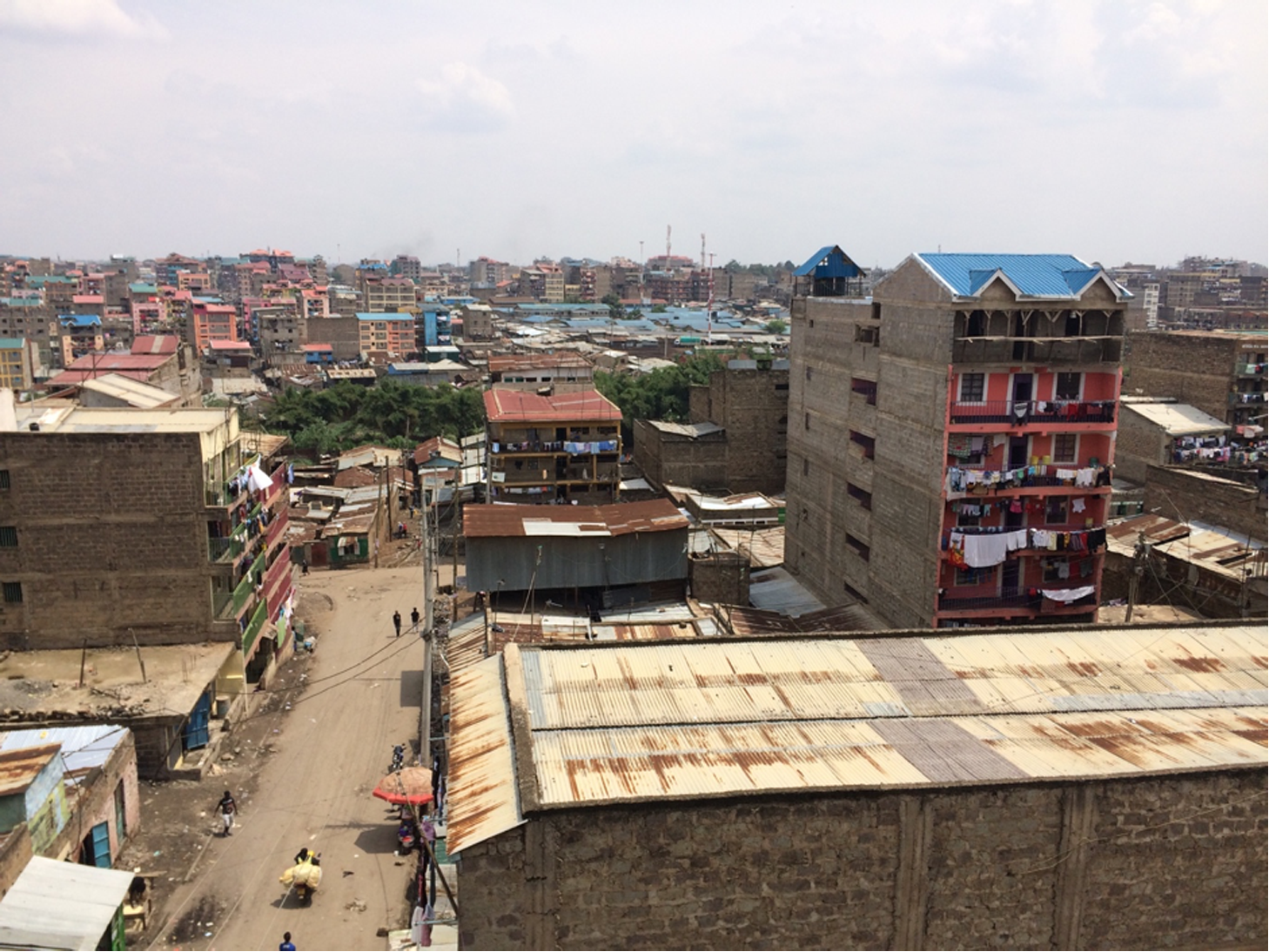
Accompanying horizontal urban expansion has been rapid growth along a vertical axis: as the financialization of housing has escalated, so too has high-rise construction. Nairobi’s construction boom, combined with a desire to extract greater value from land investments, has put enormous pressure on affordable housing, encouraging taller buildings as well as higher densities. Although President Uhuru Kenyatta made housing one of the so-called Big Four pillars of his 2017 development agenda, the goal of 500,000 affordable units to be built by 2022 has fallen well short. Since the 1970s, the shortfall in housing has been predominantly met through an unauthorized – though commercialized and sophisticated – rental property market of corrugated iron (mabati) structures built in large numbers by absentee landlords (Amis Reference Amis1984). Now, however, low-income rental housing has become more heterogeneous (Mwau and Sverdlik Reference Mwau and Sverdlik2020). Constructing single-storey dwellings no longer makes economic sense and many neighbourhoods are seeing a transition from mabati housing to maghorofa: low-quality tenement blocks of eight to ten storeys, constructed in extremely high densities (Huchzermeyer Reference Huchzermeyer2008) (Figure 2).
Nairobi’s densifying tenement skyline, as seen from Mathare North, Nairobi, 2018.
But even as the Nairobi skyline rises higher, it is also falling. The devastating building collapses that have occurred across the city have killed scores of Nairobians. Such cases of building failure in many ways expose the political economy that has produced these landscapes, revealing the fragility – but also the duplicity and opaque practices – of the city’s real estate sector (Smith Reference Smith2020). As Mwau and Sverdlik (Reference Mwau and Sverdlik2020: 487) have observed, ‘Nairobi’s exclusionary formal city planning and highly opaque, corrupt land governance have stimulated a parallel … planning process.’ Blurring the lines between private and public, official and unofficial procedures, the fragile architecture of tenement housing is neither formal nor informal but better understood as what I term ‘grey development’: a semi-licit assemblage of circumvented planning, irregular land allocation, and a speculative construction sector using poor-quality materials, often without suitable foundations (Smith Reference Smith2020). In tenement districts, housing blocks are usually built singly by private developers with little regard for what is happening on the plot next door. Buildings are packed closely together – many plots have construction coverage of 100 per cent despite zoning restrictions ostensibly intended to prevent this – and are frequently constructed without adequate foundations, meaning that structural integrity is often compromised from the outset. While title deeds may be in place, architectural plans signed off and Nairobi County planning procedures ostensibly in order, what appears on the ground often bears no resemblance to any urban plan (Huchzermeyer Reference Huchzermeyer2011).
This disparity between what appears on the surface and the murkier underneath of the sector continues after tenants take up occupation. Although some blocks seem superficially to be of higher quality, with nicer paintwork and balconies, there are major issues with electrical wiring, lighting and water connectivity. Services such as water are rationed and frequently subject to abuses of power and authority (Mwau Reference Mwau2013). There is a complex hierarchy of caretakers, brokers, rent collectors and managers existing between the owners and the renters of Nairobi’s tenements, which makes responsibility for construction and maintenance difficult to trace, and which also serves to mask issues of ownership and accountability (Huchzermeyer Reference Huchzermeyer2011). In such contexts, regimes of audit, regulation or planning – designed as checks and balances against malpractice – are not only ineffective but facilitative: the networks of influence on which grey development relies are tightly woven, encompassing opaque networks of politicians, senior business figures and brokers. As Anne Pitcher’s (Reference Pitcher2017) analysis has revealed, there is a revolving door in Kenya’s real estate sector between politics and business.
Such machinations are known by residents, although the details usually remain obscure. David, for example, is a caretaker for an eight-storey tenement in Mathare North estate, where he lives in a small room constructed on the rooftop of the building. He explained to me how more and more tall buildings were being developed in his neighbourhood, and how the networks of investment and speculation incorporate those who are meant to have responsibility for oversight. Just outside his building – one of the oldest in the neighbourhood, constructed around twenty-five years ago – was a large open space or kiwanja. It had once been used as a children’s play area and football field but was now crisscrossed with several construction sites.
You know, when I came here, that area was open. But somehow the kiwanja was subdivided. I heard it was even sold legally from City Hall. I don’t know how, but those people [i.e. the developers] they have title deeds. It was a playing ground, so who approved it? You know, we are small people, we just ignore even if there is something fishy going on.
Did you hear what even Ruto has been doing? He is trying to grab land from a primary school.Footnote 2 And he is the Deputy President. Imagine! Look, if a big man can do that, what of these middle people? They copy from the top. That is our system, my sister.
What appears on the ground, then, is just the tip of the iceberg; its linkages to what is going on under the surface remain opaque, although the network is understood to be powerful. In David’s mind, the newly emerging vertical landscape is also connected to a vertical hierarchy of political influence – ‘they copy from the top’ – in which the rules of play remain hidden. In this subterranean politics, the earthworks of the diggers that excavate a building’s foundations echo the workings of capital: ‘money is the great “digger” in the neoliberal regime’, while corruption ‘undermines social institutions … until it provokes local collapses’ (Garnier Reference Garnier2021: 141). The frailty of tenement housing and related anxieties about its hidden materials and the underground thus point to an emerging vertical orientation in Nairobi. As with an iceberg, there is a sense that to understand how the newly high-rise city works, one needs to think vertically, examining the underneath of things as well as what lies above ground. The next section considers how attention to verticality and materiality might complicate extant literatures on opacity, deception and hidden depths in African urbanism.
Verticality and materiality
Patrick, a fundi, or skilled labourer, who had worked on many construction sites around Nairobi, put it very simply. ‘To build up, you must dig down,’ he told me. This ‘vertical sensibility’, as Stephen Graham and Lucy Hewitt (Reference Graham and Hewitt2013) have called it, is powerfully shaping Nairobi’s built environment. The construction boom of grey development links the above ground to the underneath in ways that are concrete and material. But as the anxieties of Angela and David in the previous section suggest, the ‘fake’ materials of housing and the hidden operations of the property sector also require what we might call vertical thinking: attempts to diagnose and navigate an urban world that moves in ways that are not immediately obvious from the surface. Thinking about cities volumetrically, paying attention vertically as well as horizontally in this way, offers possibilities for thinking through ‘the ways in which horizontal and vertical extensions, imaginaries, materialities and lived practices intersect and mutually construct each other’ (ibid.: 74).
In some ways, the opacity and hidden characteristics of much of Nairobi’s construction industry are in keeping with major themes that have shaped African urbanism over the past two decades. Since the turn of this century, a focus on the unseen and chimerical dynamics of African cities has been a formative influence, generating approaches rooted in questions of representation, language and deception. One of the most acclaimed ethnographies of African urbanism of this period is Filip De Boeck’s Kinshasa: tales of the invisible city (Reference De Boeck and Plissart2004). Featuring photography by Marie-Françoise Plissart, the book is a vivid and powerful evocation of a visceral city. But the choice of the word ‘invisible’ in the subtitle indicates the book’s emphasis on the immaterial: in Kinshasa, it argues, ‘spoken form regularly seems to dominate the built form’ (ibid.: 30). The book proposes that it is in the city’s underneath, in its hidden dynamics, that a richer understanding of Kinshasa can be reached. However, the ‘underneath’ here is not material or topographical, but metaphorical. In a city of extreme infrastructural breakdown, it is, De Boeck argues, the spectral, shadow world of rumour, speculation and magic that ‘seems to have the upper hand’ at the expense of the haptic, physical city (ibid.: 57; see also Ferme Reference Ferme2001). The form of collapse that preoccupies De Boeck is not the breakdown of buildings or of infrastructure, but of reality itself: in Kinshasa’s kaleidoscopic hall of mirrors, fact and fiction have become interchangeable: ‘there is no reality that is strong enough to resist language’ (De Boeck and Plissart Reference De Boeck and Plissart2004: 59).
AbdouMaliq Simone, one of the foremost theorists of African urbanism, has likewise emphasized that understanding African cities relies less on examining their material architecture than on investigating invisible networks and the power of the unseen. Titling the first three sections of For the City Yet to Come (Reference Simone2004a), his influential book on African life in four cities, ‘the informal’, ‘the invisible’ and ‘the spectral’, he reflects on how, in Douala in Cameroon, residents made clear that ‘they believe their city is haunted. They believe there is something beyond the bad politics, inadequate infrastructure, and sometimes feverish sense of entrepreneurship that drives their everyday urban lives’ (ibid.: 93). Relatedly, the notion of ‘informality’ has become a particularly dominant trope in Africanist urban research and theory, not only indicating processes of makeshift housing or opportunistic economies, but also encapsulating ideas of a more existential urban condition where chronic insecurities of work, shelter and opportunity are seen to generate alternative forms of urbanism, and where hope, strategy and anticipation emerge from everyday encounters with uncertainty (Thieme Reference Thieme2017; Lindell Reference Lindell2010; Guyer Reference Guyer2004).
This emphasis on human agency, speculation, deception and informality has been a powerful corrective to a previous academic generation’s emphasis on crisis and the failures of postcolonial development, which was critiqued for focusing on African cities primarily as places of abjection, breakdown and despair, where the tenets of modernization had failed to adhere (see Nuttall and Mbembe Reference Nuttall and Mbembe2008; Roitman Reference Roitman, Goldstone and Obarrio2017). The early 2000s were notable for a pushback against such failure narratives, which were critiqued for applying instrumentalized assessments that relied on norms established in the cities of Europe and America, as though there were a universal urbanism against which all cities should be measured (see Scott and Storper Reference Scott and Storper2015). Rather than falling back on such universalizing tropes, Achille Mbembe and Sarah Nuttall (Reference Mbembe and Nuttall2004: 353) argued that ‘[w]riting the world from an African metropolis’ should be about defamiliarization: abandoning the well-worn notion that African cities were simply ‘the spatial embodiment of unequal economic relations and coercive and segregationist policies’ in favour of explorations of agency, the urban subject, and ways of being and becoming in urban Africa. The new agenda, as Simone (Reference Simone2004b: 407) succinctly put it, should focus ‘on something else besides decay’. This was the premise for his influential concept of ‘people as infrastructure’: that even as African cities can no longer rely on physical infrastructures, the gaps are filled by people’s improvisational strategies and interdependencies.
Yet in emphasizing socialities, improvisatory economies, the chimerical, and the power of speculation and rumour, such literatures also perpetuated the idea that a divide existed between the material and unmaterial worlds: that the ‘real’ city was to be found in discourse, social relations, improvisation and illusion. The ‘crisis’ literature had approached cities as spatial embodiments of failure, as Nuttall and Mbembe put it, implying that the material realm was inert, simply representative of political crises that happened elsewhere. But the newer approaches – if they acknowledged urban materialities at all – did little to displace this inertia. Built form was still implicitly regarded as passive, dominated by language and rumour, the urban landscape a crumbling backdrop to human agency and creativity.
But stuff is never just in the background. It is part of the way the city takes shape, actively assembling possibilities for living. As Chris Tilley (Reference Tilley1994) has observed of the power of landscape elsewhere, people are never just ‘in culture’, but also ‘in place’. And place is never neutral or simply ‘there’ – it is a historically particular production. The point here, as examined in this issue’s Introduction, is not just to put materiality back in the picture, as a missing piece of the puzzle, but rather to emphasize how materials are actively implicated in the ways in which urban worlds take shape. Tilley argues that there is a mutually constitutive relationship between people and the places they inhabit: ‘Place acts dialectically so as to create the people who are of that place’ (ibid.: 26). Because of the way that place emerges over time, relationally with the humans and non-humans that make it theirs, landscape is also always political (Bender Reference Bender2002). To attend to the mutual imbrication of the social and material aspects of landscape is to think about how cities are constituted through contingent, shifting networks and assemblages in which people, place, materials, infrastructures and plans – as well as animals, food and microbes (see Fontein Reference Fontein2023; Rahier Reference Rahier2023) – are entangled and embedded (Farías and Bender Reference Farías and Bender2012; Bennett Reference Bennett2005). From such a perspective, urban landscapes are never simply backdrops for, or representative of, human action or inaction. Rather, as I have examined at more length elsewhere, they are generative, co-produced and co-constitutive of the character and dynamic of the city itself (Smith Reference Smith2019).
Scholarly attention to the power of matter to shape urban African landscapes is slowly emerging, from the toxic residues delimiting urban futures to the ‘filthy flourishing’ of waste landscapes and the aspirational materialities of concrete (Hecht Reference Hecht2021; Archambault Reference Archambault2018; Doherty Reference Doherty2019). Such alertness to the generativity of matter is powerful not just for unravelling how African cities work, but for new kinds of urban theorizing. Such is the case with De Boeck’s more recent work on Kinshasa, in collaboration with photographer Sammy Baloji, where the topography of holes – from potholes to graves to mines – becomes a way to theorize the city differently. ‘The topos of the hole’, as they examine it, is the inverse of the mountain or the tower block. It not only works as a ‘local master trope’ that expresses ‘the dismal quality of living’ in Kinshasa, but also mediates ideas ‘about temporality, body and the general human conditions’ (De Boeck and Baloji Reference De Boeck and Baloji2017: 143). The hole and its hidden depths – as well as its potential to become something else, such as a tower – return us to Patrick’s words: ‘To build up, you must dig down.’ Useful here is the notion of ‘deeps’, conceived by Martinican writer Édouard Glissant, distinct from what he regarded as the more representational and figurative notion of depth: ‘Deeps (les profonds) are, if you will, the concreteness of depth (la profondeur); what is actually, and really, underneath the surface’ (cited in Garnier Reference Garnier2021: 134). ‘Deeps’, Garnier goes on to emphasize, refers to a ‘concrete experience of matter’, encounters with what is ‘lurking underneath the visible’ (ibid.: 134) in ways that not only shape what is going on above ground but also influence the possibilities of language, discourse and politics.
Thinking along the emerging vertical axis of Nairobi’s grey development, from its deeps to its peaks, allows us to see how material landscapes of construction, ‘fake’ buildings or poor-quality foundations are part of the urban assemblage, facilitating or obstructing ways of living. Rather than the figurative ‘underneath’ of earlier scholarship on rumour, speculation and deception in African cities, which explicitly distanced itself from urban materialities, this underneath is material, and is a structuring force of urban life. In this way, a ‘vertical sensibility’ offers a route into the instabilities and opacities of Nairobi’s iceberg buildings, connecting speculation and deception with concrete and steel and recognizing them as part of the same assemblage. As the words of the Nairobi planning officer cited at the beginning of this article indicate, even when ‘you can’t see what’s going on’, the material properties of construction are far from inert, and may be affecting the direction of life in devasting ways. Nairobi is a landscape made over time, through processes of construction and collapse, making and unmaking, in which materiality, speculation and accumulation co-constitute the city (Smith Reference Smith2019). The substance of the city – in all its messy dereliction – is entangled with the social, economic and shadowy dynamics of the less easily seen. The very fragility of grey development suggests how materiality and substance in the built environment can drive debates about trust, falsity and deception. In Kenya, such debates often revolve around anxieties about ‘fakes’, to which I now turn.
Fake materials
In 2019, I visited a small construction site on Nairobi’s northern fringes, where I had been invited by my friend Denis who worked as a day labourer. Resting for a while in the shade of the corrugated iron fence, I noticed two workmen pouring a reddish powder from a sack into their hands. Rubbing their palms together, they then looked closely, before spitting on their hands and rubbing them again. ‘What are they doing?’ I asked. ‘Checking the sand,’ came the reply. Noting my quizzical expression, Denis explained at greater length:
You know, sand is a big problem for us. At least, we call it sand [mchanga] but you never know. In this industry we have a lot of fakes and sometimes you can’t tell what one is sand and what one is not. Mostly our sand is jua kali [from the informal sector]. The real one is expensive. So we get it from elsewhere. Sometimes it is okay, but sometimes it is substandard – you know there are those people, they try to cheat us. They mix the sand with dust [vumbi]. The way to tell is if you rub it in your hands and it becomes mud [matope], then you know it is fake.Footnote 3
When Angela diagnosed the failed materials in her building collapse as ‘fake’, she was far from alone. Throughout my fieldwork on Nairobi’s fragile architectures, ‘these buildings are just fake’ is a remark I have often heard when asking people their opinions on the spate of tower block collapses. The implication of the word ‘fake’ is not that the buildings are somehow unreal – as the devastation caused by collapses shows, fake buildings are only too real in their effects – but rather that they cannot be trusted. In Nairobi, it is common to hear anything from substandard goods to political promises described as ‘fake’, a critique that identifies something not just as being of poor quality, but that its intention is considered to be dubious or deliberately deceptive (see also Rahier Reference Rahier2023). To diagnose something as fake is a way to get beneath its surface impression – beneath the tip of the iceberg, as it were – to figure out what is really going on.
The popularity of the term – always used in English – predates its more recent global proliferation in relation to ‘fake news’, although that too has been flourishing across Kenya (Lynch Reference Lynch2017). Recent anxieties have included a public panic about fake rice, in which plastic pellets were suspected of being packaged and sold to consumers (Meiu Reference Meiu2020);Footnote 4 fears about contaminated and contraband ‘fake’ sugar (Amadala Reference Amadala2018); and a media exposé of ‘fake’ traders in Nairobi – such as car dealers selling cars that were stolen or illicitly acquired (Omondi Reference Omondi2018). With the Covid-19 pandemic, anxieties about fakes reached new heights, as news stories of fake equipment, fake medicines and fake testing kits circulated. Imitations, counterfeits and forgery became major topics of public debate in Kenya, as they did worldwide (Smith and Wiegratz Reference Smith and Wiegratz2020). Globally, the response of international agencies to the flood of fakes and counterfeiting has been superficial, often presuming that trustworthy state systems are in place for monitoring product quality. The Organisation for Economic Co-operation and Development (OECD), for example, issued a policy brief stating: ‘Governments need to ensure the legitimate and safe provenance of pharmaceutical products, both online and in pharmacies, so that citizens can trust the medicines they use’ (OECD 2020). Yet state agencies have themselves been linked to allegations about procurement breaches and unenforced quality standards, indicating that public concern is not so easily assuaged.Footnote 5 The Kenyan Bureau of Standards (KEBS) has been accused of colluding with private companies that secured lucrative procurement contracts – often via political connections – to authorize the importation of expensive masks, testing kits and hospital equipment rather than cheaper locally produced PPE (Wafula and Oketch Reference Wafula and Oketch2020). Nor are such claims of malpractice new: a 2018 investigation by The Nation Media Group found that KEBS had an ongoing counterfeiting scam, where, for a fee, officials would fake a certification mark that authorized imported items for sale, making it impossible to tell which were genuine products (Kamau and Mathiu Reference Kamau and Mathiu2018).
The construction industry is also widely recognized as being awash with fake, poor-quality and counterfeit products, from cement and steel to window panes and electrical components (Makena Reference Makena2016). The construction boom and swollen land prices of the last two decades have led, as Angela identified, to a whole host of ‘shortcuts’ being taken by developers eager to make swift returns on their investments (Thuita Reference Thuita2018). While the most unscrupulous use such goods knowingly to cut costs, more complicated is the challenge of working out what is genuine from what is not. But the deceptions and manoeuvres around fake products also recall the opaque workings of grey development outlined by David: the hierarchies of political influence that enabled the playing fields in Mathare to be colonized by tower blocks. As the KEBS scandal makes clear, public concerns about fakes are not easily quelled by processes of auditing, inspection or certification when the institutions of oversight are suspected of being complicit. The kind of ‘vertical thinking’ outlined in the previous section may be more useful. Nairobi’s iceberg buildings have prompted a new awareness that to understand the city one must look to the underneath. The deeps – encounters with hidden matter – help people to navigate a world that moves in ways not obvious from the surface. Spitting and rubbing one’s hands together is a way to get to the deeps – to go beyond representation or what the sand purports to be. On Denis’s building site, as elsewhere in the construction industry, builders must intimately engage with the very stuff of construction to try to decipher its properties. Using one’s hands, and even one’s spit, is deemed more reliable than any official authentication.
In this way, anxieties about ‘fakes’ speak more broadly to a lack of public trust in the legitimacy of state institutions, and an attempt to get beneath the surface. To label something as ‘fake’ evokes discernment: the capacity to diagnose what is really going on. Above ground, maghorofa may seem to be a new kind of housing – some even superficially emulating the gleaming tower blocks of wealthier areas of Nairobi – but this surface hides a deeper set of concerns about quality, corruption and deception. The tactile process of quality control that Denis explained to me, a process to gauge whether what appears to be sand might actually turn out to be dust, is part of a wider landscape of discernment. To diagnose something as fake has also become a mode of critique, an attempt to dig down beneath the surface to work out how certain activities, products and politics may be linked to personal gain or suspect forms of wealth accumulation (Blunt Reference Blunt and Weiss2004). Concerns about fake buildings and fake materials thus highlight how emerging vertical landscapes can generate an urban politics of deception and (mis)trust, but also a form of vertical thinking whereby Nairobians turn to materials themselves in an attempt to diagnose how transgression may be hidden under a surface veneer of compliance. In a city of ‘icebergs’, where much remains hidden below ground, this subterranean approach might offer new possibilities for thinking about the hidden workings of power in Africa, transparency and the changing relationship of surfaces to underneaths.
Integrity Centre
At the western end of Kenyatta Avenue in Nairobi, on the edge of the administrative and financial district of Upper Hill, sits a shining glass office block topped with a large sign: ‘Integrity Centre’. This is the home of the Ethics and Anti-Corruption Commission of Kenya (EACC), tasked with rooting out corruption and ensuring transparency and accountability in the public sector. But it is popularly regarded as a toothless institution, given the scale and depth of concerns about financial malpractice in Kenya (Smith and Wiegratz Reference Smith and Wiegratz2020). The building is a striking design, a glassy cylinder capped by a slanted roof with a polished brassy surface, flanked with fenestrated blocks of mirrored glass. The overall effect is an imposing, gleaming edifice that, despite the excess of glass and windows, does not reveal its internal activity. Rather than having the transparent materiality of many highly glazed buildings, its surfaces are polished and reflective, creating a façade that conceals rather than exposes.
The irony of an institution dedicated to integrity and transparency being housed in a severely reflective building is not lost on Nairobians. A university student told me laughingly, ‘They call it Integrity Centre! But no one can see in. If you look at the building all you get is your own face looking back.’ One day, as I lingered outside Integrity Centre debating whether to try to enter, a passing street hawker stopped to speak with me. When I asked him about the building, he said, ‘Hii ghorofa iko giza. Hakuna kitu unaweza ona huku. Kilicho ndani, hukaa ndani [This building is dark. There’s nothing you can see from here. What’s inside stays inside].’ Once again, we see the generativity of materials for animating forms of popular discourse and critique. A landscape of human and more-than-human assemblages, the city emerges from the entanglement of people and things and the contingent way in which, in certain configurations, a mundane material such as glass can be understood to index a much deeper concealment.
As scholars of power and conspiracy have demonstrated, transparency and concealment are not so much polar opposites as they are two sides of the same coin (West and Sanders Reference Sanders, West and Sanders2003). In recent decades, transparency has become a maxim of good governance, with institutions such as Transparency International, the International Monetary Fund (IMF) and the World Bank evaluating nation states according to the transparency of their operating procedures. Systems of transparency, accountability, auditing and efficiency have accompanied the liberalization of economies around the world, particularly in relation to neoliberal lending and financing. The construction of Integrity Centre – and the interior workings of the EACC – are a part of Kenya’s obligations for meeting these global standards. Yet the same decades have also seen an intensification of anxieties about fraud, deception and economic malpractice, as well as popular suspicions of power such as conspiracy (West and Sanders Reference Sanders, West and Sanders2003). Rather than polar opposites, transparency and deception may be interconnected, co-producing each other – indeed, research in political economy suggests that instances of economic deception and fraud have increased alongside, and may even stem from, the expansion of economic liberalization (Johnson Reference Johnson2017; Whyte and Wiegratz Reference Whyte and Wiegratz2016). This work examines how the era of the audit is also the ‘age of fraud’, where institutions or governments may maintain a surface compliance with accountability procedures, but, out of sight, deceptive practices proliferate (Wiegratz Reference Wiegratz and Whyte2015). As a growing literature on the moral economy of neoliberalism in Africa explores, the implementation of supposedly democratic and transparent systems has been perceived by many as increasing opportunities for opacity, profiteering and the extraction of resources (Blunt Reference Blunt and Weiss2004; Murunga Reference Murunga, Murunga and Nasong’o2007; Wiegratz Reference Wiegratz2010).
Achille Mbembe (Reference Mbembe2001) diagnoses this as a process of ‘doubling’, where signs have gradually become detached from their referents. He argues that across Africa, on the surface, reliance on symbols of democracy, authenticity or transparency – such as election results, quality certification marks, procurement contracts or audit trails – has increased, but in fact trust in their efficacy has been hollowed out. We are left with a situation where systems and practices have begun to operate in ways that diverge from their stated or purported purpose, leaving a space for all kinds of deceptive, extractive or counterfeiting activities to take shape. While the organizations that Sanders (Reference Sanders, West and Sanders2003: 149) calls ‘modernity’s mouthpieces’ – the IMF, World Bank, World Trade Organization – espouse lofty ideals of accountability and transparency, across Africa many citizens see the opposite at work. If on the surface supposedly democratic regimes embrace such buzzwords, it is the ‘politics of the belly’ (Bayart Reference Bayart2009) that forms the underneath of African governmentality: an underbelly of obscure intrigues, murky procurement processes, illicit accumulation and the acquisition of land and property. Such processes were frequently referred to during my fieldwork, as residents described the superficiality of political action. Echoing Bayart’s terminology, David, the caretaker of the building in Mathare, bemoaned the ‘big-bellied’ interests in politics:
One of our challenges is politics is just a lot of talking. No action. Take something like poverty. You know, that is our biggest challenge here in Kenya. So they call for a conference to eradicate poverty and government announces for it and they go to Safari Park Hotel where entrance fee is 5,000 shillings. All the big-bellied people go there. Those that have never gone hungry even for a day. What can they discuss there? Total nonsense. They use a lot of money there and come out with nothing then do it all over again years later.
In March 2019, I met with an urban planner who had held a senior position in the Nairobi County administration of the former governor, Evans Kidero. Referring directly to the vested interests in Nairobi’s housing sector, he clearly set out the ambiguities of the relationship between transparency and opacity:
To start with, when investors buy land, those owners surround that land with, can we say, a small army of others. This army is to make them inaccessible to the authorities. Even it can include the authorities – you know, the police system – even officers can actually become beneficiaries of the project. They look the other way and even create some level of insecurity that allows activities to be carried on there. Also, if national government or county government try to come in, then the investors can say they are protecting their investment. When I was at City Hall, we discovered that most of their investments are also supported by the banks.
We also did a random profiling [of property investors] and realized that most of them are not uneducated people. They are accountants, planners, engineers, bankers, some are actually in government institutions. Very senior people, so that mix really creates some dynamics so that the government is undermined from within not to act. So when they say they are doing enforcement [of planning law] they are also able to hide their connections. Enforcement is weakened by a lot of conflict and the fact that government has been penetrated in a way.
From this perspective, the chicanery of governance ‘breeds ambiguity, not transparency’; it is not so much concerned with revealing its inner workings as concealing its powers (Sanders Reference Sanders, West and Sanders2003: 150).
The reflective glass of Integrity Centre materializes something of this ambiguity: the glass seems to promise visibility, perhaps signifying the work of the anti-corruption task force within. But, in fact, to the ordinary Kenyan who remains on the outside of this powerful institution, the highly polished reflective surfaces obscure more than they reveal; all that is to be seen ‘is your own face looking back’. This glass that is see-through, but that conceals the interior, also alludes to questions of surface and depth and what it means to be able to see underneath – to know what is going on within. We see here how adopting a ‘vertical sensibility’ is not limited to the literal underneaths of buildings (i.e. their foundations) but also applies to other kinds of underneaths that are not necessarily positioned ‘below’. This foregrounds the stuff of surfaces, interiors and outsides, and raises the question of what the materiality of transparency might look like. West and Sanders pick up on these themes in relation to the etymology of transparency and its meaning of ‘looking through’:
What is seen through, and what, then, is seen? Transparency, as it is used in contemporary global speak, presumes a surface to power that can be seen through and an interior that can, as a result, be seen. If the processes through which power functions constitute its interior, what, then, constitutes its surface? (West and Sanders Reference West and Sanders2003: 16, emphasis in the original)
Glass would seem to be a perfect material for thinking through such questions. In Europe, the development of glass has been seen to run in parallel to the emergence of transparency as a discourse of modernity, with the Enlightenment’s ocular emphasis on light, illumination and inventions from microscopes to telescopes that relied on glass to extend the capacities of the human eye (Comaroff and Comaroff Reference Comaroff, Comaroff, West and Sanders2003; Mumford Reference Mumford2010 [1934]). The materiality of glass helped to drive the scientific innovations and analytical sensibilities of European modernity, which in turn came to underpin colonial projects of occupation. Colonialism was premised on ideas of conquest and discovery, whereby an inscrutable world would be subjected to rationalized principles, rendering it transparent and legible (Mitchell Reference Mitchell1988; Fabian Reference Fabian2000). But, as the Comaroffs (Reference Comaroff, Comaroff, West and Sanders2003: 292) point out, the focus on illumination and transparency has long produced a corresponding set of concerns with refraction, concealment, distortion and collusion.
The mirrored glass used at Integrity Centre, a material that is also popular across many of Nairobi’s high-rise office blocks and upmarket apartment buildings, returns us to this ambiguity. To construct a building dedicated to integrity out of glass that reflects more than it reveals shows how the material surfaces of powerful institutions can occlude and conceal even as they make claims to transparency. It also suggests ways in which materiality and political economy are co-constitutive: the materiality of reflective glass generates concerns about opaque political economies, even as occlusive political economic practices are generative of material forms. The machinations of power remain opaque to many people; their logics are elusive and do not easily reveal themselves. Angela’s observation that ordinary Nairobians are suffering from the fake materials and concealed ‘shortcuts’ deployed by wealthy property developers points to such concerns. When a building collapses, the inner workings of duplicitous power and immoral economies are exposed in a rare moment of transparency; they are diagnosed through the revealing of ‘fake’ materials that were used under the surface of a building. In such ways, attempts to work out what is going on, to dig down to ‘the underneath of things’ (Ferme Reference Ferme2001), are techniques of transparency that try to get under the very surfaces of power.
Conclusion
What does it mean to think about a city from a pile of rubble? From a site where the underground – the occluded and the hidden – comes suddenly and devastatingly into view? In his book Rubble, Gastón Gordillo argues that capitalism ‘rules through the production of spectacular places’ while simultaneously leaving a path of destruction and rubble in its wake (Reference Gordillo2014: 81). In Nairobi’s grey development, this destruction and rubble are all too palpable. Substantially reshaping the skyline of Nairobi at a rapid pace, the opaque workings of Nairobi’s tenement housing sector are also threaded through with apprehensions about invisibility, deception and hidden depths – themes that have preoccupied scholars of Africa for many years, but which until recently have rarely been considered in terms of their materiality.
The ambiguous relationship between the surface and the underneath of grey development points also to the dual connotations of the word ‘accumulation’: conveying notions of value and profit as well as gathering and accretion (Smith Reference Smith2019). As a landscape of accumulation, Nairobi is a material assemblage gradually deposited across time, through the churn of urban development in which substances and forms can endure or be erased. But it is also a place where value accrues, where markets in land and real estate viciously shape trajectories of urban construction and destruction. Such landscapes are powerfully affective, constantly shifting assemblages that shape and constrain the possibilities of urban life. From the sites of rubble that rupture Nairobi’s emerging verticality, this double meaning of accumulation is viscerally felt, speaking both to the rapid accretion of precarious tenement housing and to the extractive speculation of frontier real estate.
Understanding such landscapes requires not only horizontal analysis of Nairobi’s rapid growth but a new kind of vertical thinking that draws connections between hierarchies of power, hidden depths and new heights of the city (Cane Reference Cane2021). This is far from a top-down approach. Rather, it starts from an insistence on the subterranean as a key axis of postcolonial urban theorizing, where thinking vertically starts with the underground (Graham Reference Graham2016). To build up, you must dig down. At the building collapse in Zimmerman, where Angela and I watched young men mining the rubble to salvage the ‘fake’ materials of its construction, her vertical sensibility was clear. From the material deeps – from within the hole that had once been a tower – she identified not only the shortcuts and materials that enabled tenement housing to be so profitable for its developers, but also grey development’s fundamentally double nature. That a building could look ‘so nice’ while ‘underneath’ the surface it was hollow, both materially precarious and morally treacherous. The subterranean workings of Nairobi’s iceberg buildings demonstrate how longstanding ideas about the hidden operations of the powerful in urban Africa not only are manifest in the landscape of the city but are often animated by the stuff and substance of the city itself.
Subterranean encounters with Nairobi’s construction boom reveal how urban materialities drive not only extractive modes of accumulation but also popular critiques about deception and the immoral economies that lie beneath the city’s vertical growth. From the ‘topos of the hole’ (De Boeck and Baloji Reference De Boeck and Baloji2017), to spit on sand and rub one’s palms together is not just to encounter the concrete matter of construction, but to attempt to diagnose falsity and deception: to navigate an urban world where the material properties of spit, sand and mud are more reliable indicators of quality and trust than any official authentication. This kind of vertical thinking also shapes responses to the new era of ‘transparency’ and ‘accountability’. Instead of accepting surface claims, popular critiques point to the underbelly: to the murky underneath that not only produces fragile buildings but is also implicated in economies of financial opacity and political influence. When much of what is going on is understood to be hidden from view, from the site of rubble we see how debates about illegitimacy, concealment and what lies under the surface are rooted in the very substance of Nairobi. In this city of icebergs, attempts to know the underneath of things must traverse the deeps to the peaks.
Acknowledgements
Grateful thanks to the many Nairobians affected by building collapses who shared their experiences with me, sometimes under extremely emotional circumstances. I hope I have done justice to your trust in me. Thank you to Hannah Elliott and to the other participants in this special issue for feedback on earlier versions of this article, as well as to the two anonymous reviewers for their constructive critique. All shortcomings remain my own. Research for this article was funded as part of a UKRI Future Leaders Fellowship.
Constance Smith is a lecturer and UKRI Future Leader Fellow in Social Anthropology at the University of Manchester, where her work explores the temporalities and materialities of shifting urban landscapes. Her current project examines the afterlives of high-rise housing disasters in Kenya and the UK, exploring their social, material and political effects.


 Open access

