

Introduction
Information and communication technologies (ICTs) have transformed how and where employees perform their jobs (Cascio & Montealegre, Reference Cascio and Montealegre2016). Research on computer-mediated communication (CMC) has a long tradition, originally emerging in the 1980s and 1990s to examine how digital channels such as email, chatrooms, and discussion boards shaped social interaction and collaboration (Sproull & Kiesler, Reference Sproull and Kiesler1986; Walther, Reference Walther1996). Over time, this work expanded from interpersonal and social contexts to organizational settings, where CMC became an integral part of daily work communication (Byron, Reference Byron2008; Lee, Reference Lee2023). Devices such as portable computers, cellphones, and collaborative tools have enabled CMC (Fuss et al., Reference Fuss, Dorstyn and Ward2021; Rudolph et al., Reference Rudolph, Allan, Clark, Hertel, Hirschi, Kunze, Shockley, Shoss, Sonnentag and Zacher2021), allowing employees to work from home and stay connected despite the absence of in-person interaction (Vleeshouwers et al., Reference Vleeshouwers, Fløvik, Christensen, Johannessen, Bakke Finne, Mohr, Jørgensen and Lunde2022).
Recent studies have examined both the costs and benefits of CMC use. For example, research on video conferencing argues that this method of CMC can both improve relationships and facilitate communication (Karl et al., Reference Karl, Peluchette and Aghakhani2022; Queiroz et al., Reference Queiroz, Lee, Luo, Fauville, Hancock and Bailenson2023) while also generating technology-related frustrations and increasing time and effort (Karl et al., Reference Karl, Peluchette and Aghakhani2022; Nesher & Wehrt, Reference Nesher Shoshan and Wehrt2022). Furthermore, Hurbean et al. (Reference Hurbean, Wong, Ou, Davison and Dospinescu2025) found that instant messaging at work increases interruptions and technological complexity but simultaneously enhances work performance. While these studies provide valuable insights and lay a foundation for future research, their focus on specific CMC forms constrains the ability to draw general conclusions. Zhu (Reference Zhu2019) critiques this narrow focus of research on individual CMC forms—such as, for example, video conferencing—as employees are generally switching between several forms of CMC, especially when they need to rely heavily on ICTs to perform (Jokela et al., Reference Jokela, Ojala and Olsson2015). Therefore, our research aims to address this gap by simultaneously examining the supportive and demanding aspects of CMC use as a whole, irrespective of the specific CMC forms employees employ interchangeably.
We conceptualize CMC use as—“the extend of communication or time spent using the CMC application” (Stich et al., Reference Stich, Tarafdar, Cooper and Stacey2017, p. 86)—and it has been theorized as both beneficial and taxing for employee well-being and performance (Bondanini et al., Reference Bondanini, Giovanelli, Mucci and Giorgi2025; Vanden Abeele et al., Reference Vanden Abeele, Vandebosch, Koster, de Leyn, Van Gaeveren, de Segovia Vicente, Van Bruyssel, van Timmeren, De Marez, Poels, DeSmet, De Wever, Verbruggen and Baillien2024). In line with previous research conceptualizing CMC use as behavioral engagement or communication frequency (Lee, Reference Lee2023; Shockley et al., Reference Shockley, Allen, Dodd and Waiwood2021; Van Zoonen & Sivumen, Reference van Zoonen and Sivunen2022) and with the channel-centered approach (Meier & Reinecke, Reference Meier and Reinecke2021), which groups communication media based on shared technological and functional characteristics rather than treating each application as unique (Ellison & Boyd, Reference Ellison, Boyd and Dutton2013). We operationalize CMC use as the daily extent of digital communication use across different channels, irrespective of their richness or synchronicity. This focus on frequency rather than quality or content of communication aligns with our aim to capture behavioral variation in employees’ daily use of digital communication technologies.
More specifically, this study aims to contribute to the literature by examining the dual nature of CMC use in relation the satisfaction of three basic psychological needs defined by self-determination theory (SDT; Ryan & Deci, Reference Ryan and Deci2000, Reference Ryan and Deci2017): relatedness (i.e., feeling connected), competence (i.e., being effective), and autonomy (i.e., feeling psychologically free). Studying CMC use in relation to these needs is essential as they have been linked to various significant outcomes related to employee well-being, attitudes, and behavior (Van den Broeck et al., Reference Van den Broeck, Ferris, Chang and Rosen2016). By integrating both SDT and job design theory, our study moves beyond the content or characteristics of communication channels to focus on the processes through which CMC use associates with employees’ daily need satisfaction. Need satisfaction may also be seen as a critical construct to comprehensively capture the impact of CMC use as previous research suggests that CMC use has paradoxical relationships with social connectivity (quantity and quality of social interaction with work colleagues), productivity (improved job performance and work task completion), and autonomy (sense of flexibility and control) (Day et al., Reference Day, Barber, Tonet and Landers2019; ter Hoeven et al., Reference ter Hoeven, Van Zoonen and Fonner2016), that is, factors that closely align with the basic psychological needs.
To explain why CMC use may both help and hinder the satisfaction of the basic psychological needs, we rely on job design theory (Wang et al., Reference Wang, Liu and Parker2020). Over the years, research has highlighted the importance of both demanding and resourceful job characteristics for decreasing and increasing employee need satisfaction, respectively (Bakker & Demerouti, Reference Bakker and Demerouti2007; Van den Broeck et al., Reference Van den Broeck, Vansteenkiste, De Witte and Lens2008) as “basic psychological needs are context-responsive constructs” (Coxen et al., Reference Coxen, van der Vaart, Van den Broeck and Rothmann2021; p. 3), indicating that their satisfaction depends on the specific (organizational) context in which employees function (Ryan & Deci, Reference Ryan and Deci2017; Vansteenkiste & Ryan, Reference Vansteenkiste and Ryan2013). Traditionally, studies have focused on established motivational characteristics from models like the Job Characteristics Model (Hackman, Reference Hackman1980). However, with the widespread use of CMC in the workplace, there is a need to explore how recent, technology-specific job characteristics enhance or hinder need satisfaction.
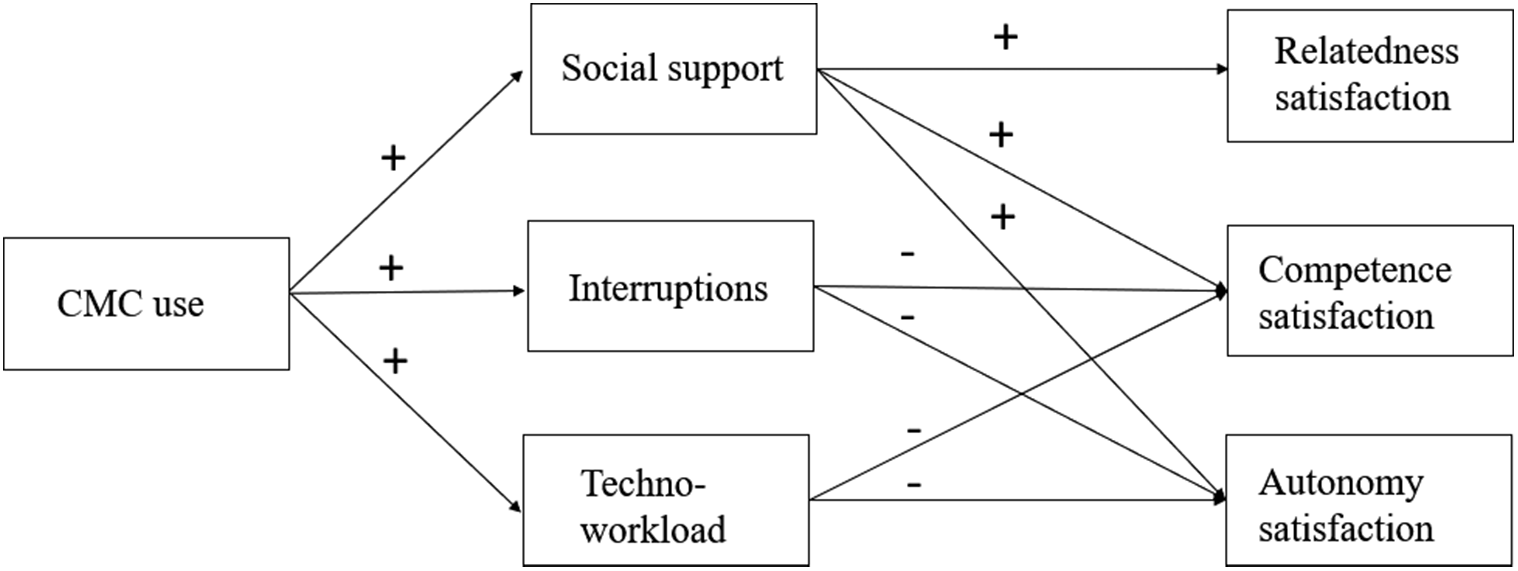
Our research model, therefore, examines the relationships between CMC use and basic need satisfaction via social support, interruptions, and techno-workload using a within-person daily diary approach. This approach builds on previous primary research on CMC use (Kroencke et al., Reference Kroencke, Harari, Back and Wagner2023; Meier et al., Reference Meier, Noel and Kaspar2021) but acknowledges that employee CMC use may vary across days within individuals, and expands emerging research on daily variations in psychological need satisfaction (Coxen et al., Reference Coxen, van der Vaart, Van den Broeck and Rothmann2021, Reference Coxen, van der Vaart, Van den Broeck, Rothmann and Schreurs2023). Daily measurements provide a more accurate understanding of employees’ experiences as they occur, providing insight into employees’ same-day fluctuations and associations instead of relying on overall average experiences, as is the case with cross-sectional analysis (Ohly et al., Reference Ohly, Sonnentag, Niessen and Zapf2010; Weiss & Rupp, Reference Weiss and Rupp2011). Therefore, this method may more closely capture the associations of CMC use with employees’ experiences of contemporary job resources and job demands and subsequent need satisfaction. Our research model is depicted in Figure 1.
Hypothesized research model.

In studying this model, this article aims to make significant contributions to the literature on CMC use and job design. First, given the significant increase in CMC use, it is crucial to understand its diverging impact on various employee outcomes. A particular strength of our study is its focus on basic psychological need satisfaction, given its key role in a wide array of such outcomes (Van den Broeck et al., Reference Van den Broeck, Ferris, Chang and Rosen2016). To advance knowledge, we explore CMC use on days when employees work from home, where colleagues are not physically present, and employees solely rely on CMC use for connectivity. While prior research has acknowledged CMC as a tool for facilitating work and examined its pros and cons separately, simultaneously unraveling the benefits and drawbacks of CMC use will help to understand the current and future landscape of work (Berg-Beckhoff et al., Reference Berg-Beckhoff, Nielsen and Ladekjær Larsen2017).
Second, this study further updates job design theory to align with flexible workplaces that adopt CMC use (Hill et al., Reference Hill, Axtell, Raghuram and Nurmi2022) and responds to calls for a deeper understanding of how technology-mediated interactions shape individual experiences of job design (Wang et al., Reference Wang, Liu and Parker2020). We specifically examine technology-specific aspects of job design, considering both resources and demands influenced by CMC use. Given that these technology-specific factors are now integral to many workplaces, our findings extend the current job design literature (Parker et al., Reference Parker, Andrei and Van den Broeck2019) and provide valuable recommendations to improve contemporary work quality.
Third, by adopting a within-person daily diary design, this study addresses the call for multilevel research on employees’ communication (Shockley et al., Reference Shockley, Allen, Dodd and Waiwood2021). While most prior studies have used cross-sectional designs focusing on between-person differences in employees’ CMC use, diary studies enable the examination of day-to-day fluctuations within individuals—revealing how CMC use, social support, interruptions, and techno-workload vary across days within individuals and shape their daily need satisfaction. This approach provides more nuanced and detailed insights into employees’ everyday experiences of technology-mediated work (Bolger et al., Reference Bolger, Davis and Rafaeli2003). By capturing within-person dynamics, our study offers a more accurate understanding of the daily processes through which CMC use relates to need satisfaction, thereby enhancing methodological precision in the study of contemporary digital work environments.
CMC Use and Basic Need Satisfaction
CMC technologies have enabled employees to partially or completely work from home (Vleeshouwers et al., Reference Vleeshouwers, Fløvik, Christensen, Johannessen, Bakke Finne, Mohr, Jørgensen and Lunde2022). The literature suggests that CMC is paradoxical in nature, having both positive and negative effects on employee well-being and performance (Kroencke et al., Reference Kroencke, Harari, Back and Wagner2023). On the one hand, CMC use is beneficial as it provides unlimited opportunities for communication, can facilitate efficient work processes, and foster a better work–life balance (Kroencke et al., Reference Kroencke, Harari, Back and Wagner2023; Sandoval-Reyes et al., Reference Sandoval-Reyes, Acosta-Prado and Sanchís-Pedregosa2019). It enhances employees’ ability to communicate efficiently with colleagues, share knowledge, and remain available when working from home, thereby improving employee well-being (ter Hoeven et al., Reference ter Hoeven, Van Zoonen and Fonner2016) as well as work performance (Nielsen & Koseoglu, Reference Nielsen and Koseoglu2007). On the other hand, however, CMC use can also be disadvantageous because it increases work to spill over to the non-work domain, leading to increased work–life conflict, which taxes employee well-being and reduces performance (Anderson et al., Reference Anderson, Coffey and Byerly2002; Boswell & Olson-Buchanan, Reference Boswell and Olson-Buchanan2007; Vanden Abeele et al., Reference Vanden Abeele, Vandebosch, Koster, de Leyn, Van Gaeveren, de Segovia Vicente, Van Bruyssel, van Timmeren, De Marez, Poels, DeSmet, De Wever, Verbruggen and Baillien2024). With the widespread integration of CMC in modern work environments, it becomes imperative to further understand how employees’ use of CMC relates to various aspects of their well-being and behavior.
A fundamental aspect that can shed light on such a wide array of outcomes can be found within the concept of basic need satisfaction as coined within SDT (Ryan & Deci, Reference Ryan and Deci2000, Reference Ryan and Deci2017). According to SDT, individuals possess three innate psychological needs: the needs for relatedness (i.e., feeling connected and interacting with others), competence (i.e., feeling effective in their actions), and autonomy (i.e., to experience a sense of volition and psychological freedom) (Van den Broeck et al., Reference Van den Broeck, Ferris, Chang and Rosen2016). When these three basic psychological needs are fulfilled or satisfied, individuals report, for example, well-being, job satisfaction, affective commitment, and performance, while low need satisfaction is associated with poor quality motivation, psychological distress, and suboptimal performance, even at a daily level (Coxen et al., Reference Coxen, van der Vaart, Van den Broeck, Rothmann and Schreurs2023; Van den Broeck et al., Reference Van den Broeck, Ferris, Chang and Rosen2016).
Studying the impact of using CMC on the basic needs is thus highly relevant, as it allows us to understand the relationship between CMC use and various outcomes simultaneously. The three basic psychological needs from the SDT—relatedness, competence, and autonomy—correspond well with three dimensions that are cited in the literature as paradoxical to the use of digital communication technologies, namely social connectivity, productivity, and autonomy (Day et al., Reference Day, Barber, Tonet and Landers2019). First, using digital communication technologies—as is the case in CMC use—yields social issues spanning from isolation to intrusion (Russell et al., Reference Russell, Jackson and Banks2021). Second, it may simultaneously enhance and hinder work task completion. Finally, while employees may gain freedom over how/when they conduct their work tasks using digital communication technologies and CMC, they may at the same time feel controlled by such communication (Day et al., Reference Day, Barber, Tonet and Landers2019; Mazmanian et al., Reference Mazmanian, Orlikowski and Yates2013).
Relying on the basic needs may also help to understand why CMC use may have paradoxical effects. Research highlights the significant role of job design in shaping basic need satisfaction (Van den Broeck et al., Reference Van den Broeck, Ferris, Chang and Rosen2016). While doing their work, employees may encounter job characteristics that are beneficial and satisfy their basic needs (i.e., job resources), but may also experience job characteristics that are demanding and hinder need satisfaction (i.e., job demands). This categorization of job characteristics (Bakker et al., Reference Bakker, Demerouti and Sanz-Vergel2023; Demerouti et al., Reference Demerouti, Bakker, Nachreiner and Schaufeli2001) aligns well with our objective of investigating both the resourceful and demanding effects of CMC use.
Technology-Specific Job Resources and Demands
We see three job characteristics specifically related to using CMC that may aid in understanding how such communication relates to employees’ need satisfaction (see Figure 1). First, CMC use serves as a valuable resource for employees by providing easy and fast opportunities to access social support from their colleagues at any time, from any location, and through a range of channels (High et al., Reference High, Ruppel, McEwan and Caughlin2023). Particularly in the context of working from home, where face-to-face interactions with colleagues are limited, CMC replaces traditional in-person contact and becomes the primary route to social support (Dawson-Howard et al., Reference Dawson-Howard, Standen and Omari2013; Kroencke et al., Reference Kroencke, Harari, Back and Wagner2023). CMC acts as an essential tool for connecting, coordinating, and enhancing communication within teams (Rains & Wright, Reference Rains and Wright2016; Xiaojuan Ou et al., Reference Xiaojuan Ou, Ling Sia and Kit Hui2013), thereby enabling employees to experience social support from their peers even when being physically distant from each other. In this respect, studies have revealed that CMC use is positively associated with social functioning (Pfeil et al., Reference Pfeil, Zaphiris and Wilson2009; Sinclair & Grieve, Reference Sinclair and Grieve2017) and mitigates feelings of isolation (Van Zoonen & Sivunen, Reference van Zoonen and Sivunen2022).
In line with this research, we argue that CMC use during a workday will boost the employees’ experience of social support on that day. In addition, the literature grounded in SDT has furthermore highlighted the significance of social support in satisfying psychological needs of relatedness, competence, and autonomy (Patterer et al., Reference Patterer, Yanagida, Kühnel and Korunka2023), as it facilitates building relationships, increases opportunities to learn from each other, and contributes to a sense of meaningfulness and control. In line with this, meta-analytical evidence by Van den Broeck et al. (Reference Van den Broeck, Ferris, Chang and Rosen2016) demonstrated robust and positive associations from social support to satisfaction of the needs for relatedness, competence, and autonomy. Notably, similar relations were found at the daily level (Coxen et al., Reference Coxen, van der Vaart, Van den Broeck and Rothmann2021). Therefore, combining the aforementioned evidence, we propose that using CMC on a particular day may foster daily experiences of social support, thereby contributing to the satisfaction of the needs for relatedness, competence, and autonomy during that day.
Hypothesis 1: Daily CMC use is positively related to employees’ daily satisfaction of the needs for relatedness, competence, and autonomy through daily social support from colleagues.
Second, beyond providing opportunities for social support, using CMC may also introduce demanding aspects. In this regard, CMC use is known for interrupting employees’ work routines, diverting their attention, and being mentally taxing (Day et al., Reference Day, Paquet, Scott and Hambley2012). This is because CMC enables message exchange at any time and from any location, meaning that communication can reach workers unexpectedly and at unforeseen moments, leading to a temporary pause in their ongoing work (Jett & George, Reference Jett and George2003; Sonnentag et al., Reference Sonnentag, Reinecke, Mata and Vorderer2018).
Research has highlighted interruptions as a common and prominent work stressor impacting well-being (Baethge et al., Reference Baethge, Rigotti and Roe2015; Chesley, Reference Chesley2014), and we posit that they may also negatively associate with employees’ daily need satisfaction, particularly in terms of the needs for competence and autonomy. Employees experiencing more interruptions are likely to experience less competence satisfaction as the ongoing task needs to be temporarily suspended to address alternative inquiries (Parker et al., Reference Parker, Pahor, Van den Broeck and Zacher2024). Consequently, employees have reduced time and energy at their disposal to complete the initial task (Vanden Abeele et al., Reference Vanden Abeele, Vandebosch, Koster, de Leyn, Van Gaeveren, de Segovia Vicente, Van Bruyssel, van Timmeren, De Marez, Poels, DeSmet, De Wever, Verbruggen and Baillien2024) and need to put in cognitive effort to reorient themselves back to the interrupted task after an interruption (Beal et al., Reference Beal, Weiss, Barros and MacDermid2005; ten Brummelhuis et al., Reference ten Brummelhuis, Bakker, Hetland and Keulemans2012). As employees are unable to fully concentrate on their current task, interruptions can substantially challenge feelings of being effective in one’s job, and—hence—negatively associate with satisfaction of the need for competence.
Moreover, interruptions stemming from CMC use are likely to diminish daily autonomy satisfaction as they restrict employees’ sense of psychological freedom, as they—by nature—create “unforeseen encounters” over which employees have limited control (Coates, Reference Coates1990). In summary, given the aforementioned relations, we posit that on days when employees use more CMC, they are likely to experience more interruptions, which subsequently associates negatively with employees’ daily need for competence and autonomy. We therefore expect:
Hypothesis 2: Daily CMC use is negatively related to employees’ daily satisfaction of the needs for competence and autonomy through the daily experience of interruptions.
Third, a final important demanding aspect of CMC use, techno-workload, which refers to the workload and time pressure resulting from the use of ICTs (Liu, Reference Liu, Du, Choi and Li2022). This phenomenon primarily arises from the unique characteristics of CMC that deviate from natural modes of communication; using CMC requires additional cognitive effort and time, and greater need to exert more effort, work at a faster pace, and cope with an overwhelming workload (Chesley, Reference Chesley2010; Tarafdar et al., Reference Tarafdar, Tu, Ragu-Nathan and Ragu-Nathan2011), leading to heightened cognitive activity compared to, for example, face-to-face interactions (Simon, Reference Simon2006). Such techno-workload has been associated with a decline in employee motivation (An et al., Reference An, Boyajian and O’Brien2016).
Similarly to interruptions, we again see links between techno-workload and the psychological needs for competence and autonomy, consistent with the idea of techno-workload as a demand (Sandoval-Reyes et al., Reference Sandoval-Reyes, Acosta-Prado and Sanchís-Pedregosa2019) and empirical evidence showing that demands predominantly hinder the satisfaction of the needs for competence and autonomy (Van den Broeck et al., Reference Van den Broeck, Ferris, Chang and Rosen2016). We thus argue that the more employees use CMC, the more they will experience techno-workload (i.e., a job demand), which subsequently negatively associates with their daily need for competence and autonomy. Techno-workload may impede competence satisfaction by creating the perception that employees are required to handle an excessive number of tasks within a limited timeframe, compromising their ability to perform their tasks in a satisfactory manner. In addition, techno-workload can also undermine the daily autonomy satisfaction by generating a sense of limited control for employees over the influx of information delivered through CMC. This stands in contrast with the inherent aspect of the satisfaction of the need for autonomy, which involves experiencing a sense of volition and psychological freedom. In summary, we argue that on days that employees use more CMC, they are likely to experience more techno-workload, which subsequently associates negatively with employees’ daily need for competence and autonomy.
Hypothesis 3: Daily CMC use is negatively related to employees’ daily satisfaction of the needs for competence and autonomy through the experience of daily techno-workload.
Method
Sample and Procedure
Our hypotheses were tested based on a diary study design. During a period of two work weeks (e.g., 10 workdays), respondents filled out our questionnaire on those days they were working from home (Ohly et al., Reference Ohly, Sonnentag, Niessen and Zapf2010). Only focusing on days working from home, when employees primarily rely on digital tools to stay connected, allowed us to study employees’ communication behavior without contamination from face-to-face interactions occurring in the office. This methodological choice ensured that we could examine work-related CMC use in a context where digital communication is the dominant mode of interaction with work. Respondents were recruited by flyers, posters, and social media. To be eligible to participate in the study, respondents had to be engaged in paid employment in Belgium, speak Dutch, and work from home at least 2 days during the 10-day period of the data collection. No monetary compensation was provided. Respondents first logged into the online pre-selection questionnaire, where they provided their informed consent, which explained that data confidentiality was ensured and that participation was voluntary. Then they addressed questions tapping into demographic factors. Finally, they were asked to share their email address for receiving the electronic daily questionnaires (i.e., duration of about 5 min) for 10 consecutive workdays. Two hundred and fifty-four participants were eligible and provided their email addresses to be included in the data collection. During data collection, the participants received a link to the daily survey at the end of the working day (i.e., around 3.30 pm). Each daily assessment commenced with assessing whether the respondent worked from home on that particular day. Only respondents indicating “yes” received access to the full questionnaire. Incomplete participations were excluded, and 143 employees (person-level response rate = 56.30%; day-level response rate = 38.41%) provided full information on at least 2 days working from home with a minimum of two observations and a maximum of 8 observations (M = 4.46), resulting in 530 observations.
Most employees were female (63.6%), and the participants’ age ranged from 23 to 63 years (M = 38.09, SD = 11.61). They worked at least 20 h per week, up to 42 h per week, with one exception of 48 h (M = 38.19, SD = 2.88). The participants were highly educated: more than half had obtained a masters’ degree (61.5%), followed by a bachelors’ degree (27.3%) and a secondary degree (6.3%), and were knowledge workers using CMC while working from home.
Measures
All study variables were assessed using self-reported measures rated on a five-point Likert scale (ranging from 1 “totally disagree” to 5 “totally agree”), unless mentioned otherwise. Items were adapted to a daily level by adding “today” to the items.
CMC use was formatively measured using four items of Stich et al. (Reference Stich, Tarafdar, Cooper and Stacey2017), indicating the extent to which participants used four different CMC channels for activities during the contractual working hours. The items were: “To what extent did you use email at work today?”; “To what extent did you use video conferencing at work today (e.g., via Teams, Zoom, Skype etc.)?”; “To what extent did you use audio conferencing or picture-less calling at work today?”; and “To what extent did you chat at work today via instant messaging (e.g. via WhatsApp, Signal, Skype, Teams, Messenger…)?”. Items were rated on a five-point Likert scale ranging from 1 “never” to 5 “very often.”
Social support from colleagues ( $ {\unicode{x03C9}}_w $
= .79) was measured using three items from the Short Inventory to Monitor Psychosocial Hazards (“SIMPH”; Notelaers et al., Reference Notelaers, De Witte, Van Veldhoven, Vermunt and Pelletier2007). An example item is: “Today I was able to rely on my colleagues when I was struggling.”
$ {\unicode{x03C9}}_w $
= .79) was measured using three items from the Short Inventory to Monitor Psychosocial Hazards (“SIMPH”; Notelaers et al., Reference Notelaers, De Witte, Van Veldhoven, Vermunt and Pelletier2007). An example item is: “Today I was able to rely on my colleagues when I was struggling.”
Interruptions ( $ {\unicode{x03C9}}_w $
= .94) were assessed with three items from Sonnentag et al. (Reference Sonnentag, Reinecke, Mata and Vorderer2018), such as “Today, incoming emails and other online messages prevented me from doing my job.”
$ {\unicode{x03C9}}_w $
= .94) were assessed with three items from Sonnentag et al. (Reference Sonnentag, Reinecke, Mata and Vorderer2018), such as “Today, incoming emails and other online messages prevented me from doing my job.”
Techno-workload ( $ {\unicode{x03C9}}_w $
= .94) was measured with four items from Liu and colleagues (Reference Liu, Du, Choi and Li2022). An example is “Today, I had a lot of work because of information and communication technology (ICT) requirements.”
$ {\unicode{x03C9}}_w $
= .94) was measured with four items from Liu and colleagues (Reference Liu, Du, Choi and Li2022). An example is “Today, I had a lot of work because of information and communication technology (ICT) requirements.”
Basic need satisfaction was measured with three items for each need from Van den Broeck et al. (Reference Van den Broeck, Vansteenkiste, De Witte, Soenens and Lens2010). Example items include “Today, I felt part of a work group” (relatedness satisfaction; $ {\unicode{x03C9}}_w $
= .84), “Today I felt competent in my work” (competence satisfaction;
$ {\unicode{x03C9}}_w $
= .84), “Today I felt competent in my work” (competence satisfaction; $ {\unicode{x03C9}}_w $
= .90), and “Today, I felt that I could be myself at my job” (autonomy satisfaction;
$ {\unicode{x03C9}}_w $
= .90), and “Today, I felt that I could be myself at my job” (autonomy satisfaction; $ {\unicode{x03C9}}_w $
= .82).
$ {\unicode{x03C9}}_w $
= .82).
Analysis
Our daily assessments entailed multi-level data with daily measurements (Level 1; N = 530 observations) nested within individuals (Level 2; N = 143 participants). We therefore performed a multilevel Confirmatory Factor Analysis (CFA). We tested the entire multilevel structural equations model (ML-SEM; Preacher et al., Reference Preacher, Zyphur and Zhang2010), as specified in Figure 1, by specifying all paths at the within-person level using the Lavaan package in R (Rosseel, Reference Rosseel2012). We modeled correlations between the job characteristics and the various psychological needs to account for shared variance (Kline, Reference Kline2015) and tested the model using fixed slopes and a random intercept (Bauer, Reference Bauer2003). Furthermore, reliability was assessed using Omega coefficients, indicating a good reliability when Omega is higher than 0.70 (McDonald, Reference McDonald1970).
Results
Descriptive Statistics, Correlations, ICCs, and Multilevel CFA
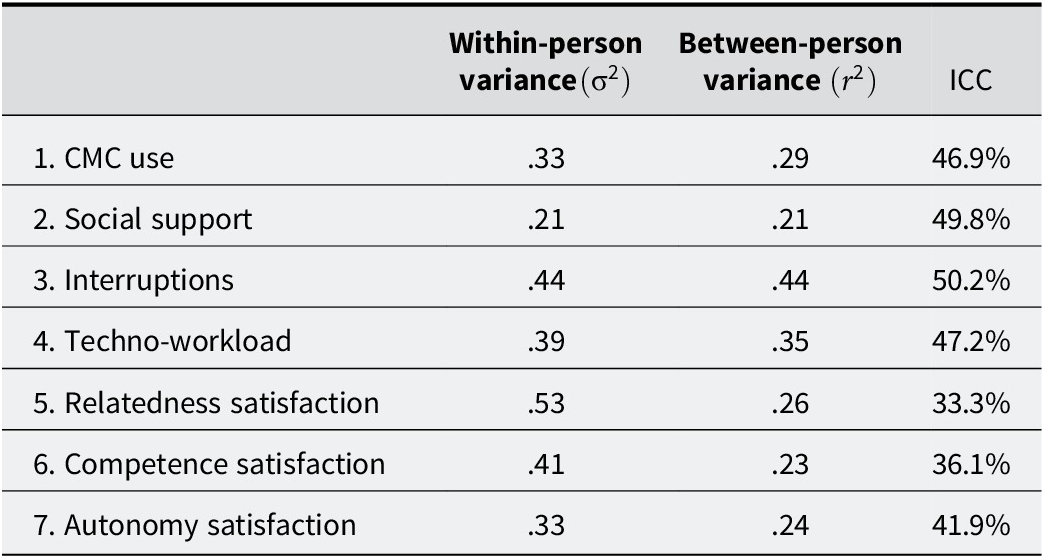
Table 1 presents the means, standard deviations, correlations, and Omega reliabilities (Hayes et al., Reference Hayes and Coutts2020; Lia et al., Reference Lai and Lai2020) of our study variables. We first calculated the intraclass correlation coefficient (ICC) using IBM SPSS Statistics 28.0 (Table 2). Results showed that within-person variations ranged from 33.3% (relatedness satisfaction) to 50.2% (interruptions). More than 5% of the total variance of the dependent variables can thus be explained by differences within individuals (Heck et al., Reference Heck, Thomas and Tabata2013), so interdependence of data must be taken into account, and grouping matters. This supports our choice to use a daily diary, multi-level design to test our hypotheses.
Means, standard deviations, correlations, and omega reliability coefficients

Note: N = 143 individuals and 530 observations.
Within-person correlations are depicted below the diagonal; between-person correlations for the Level 1 correlations were computed and aggregated to the person level.
On the diagonal, the within and between Omega reliability coefficients are reported.
***p < .001, **p < .01, *p < .05.
Intra-class correlation (ICC) of day-level variables

Note: The percentage of within-person variance was calculated as $ {\unicode{x03C3}}^2 $
/(
$ {\unicode{x03C3}}^2 $
/( $ {\unicode{x03C3}}^2 $
/
$ {\unicode{x03C3}}^2 $
/ $ {r}^2 $
).
$ {r}^2 $
).
Our hypothesized measurement model consisted of seven factors (CMC, social support, interruptions, techno-workload, relatedness satisfaction, competence satisfaction, and autonomy satisfaction) on both the within-person and between-person levels. This model showed a good fit ( $ {\unicode{x03C7}}^2 $
= 740.44,
$ {\unicode{x03C7}}^2 $
= 740.44, $ df $
= 472,
$ df $
= 472, $ p $
< .001,
$ p $
< .001, $ CFI $
= 0.95,
$ CFI $
= 0.95, $ TLI $
= 0.95,
$ TLI $
= 0.95, $ RMSEA $
= 0.03,
$ RMSEA $
= 0.03, $ {\mathrm{SRMR}}_{\mathrm{within}} $
= .05,
$ {\mathrm{SRMR}}_{\mathrm{within}} $
= .05, $ {\mathrm{SRMR}}_{\mathrm{between}} $
= .08), with all items loading significantly on the intended latent factor. Although both models showed comparable fit indices (see Table 3), we retained Factor Model A because it allows us to distinguish between the three basic psychological needs—relatedness, competence, and autonomy—as separate latent constructs, consistent with SDT (Ryan & Deci, Reference Ryan and Deci2000, Reference Ryan and Deci2017). This disaggregated structure provides more precise insight into the unique associations between the satisfaction of each basic psychological need and the job characteristics under study. While Factor Model B was slightly more parsimonious and showed a marginally better fit, it aggregates all needs into a single factor, which would limit our ability to test our differentiated hypotheses and interpret the results theoretically. For all models, the Maximum Likelihood (ML) estimator was employed due to its status as a widely adopted method for model estimators (Preacher et al., Reference Preacher, Zhang and Zyphur2011). This approach is particularly well-suited for multilevel structural equations modeling (MSEM; Preacher et al., Reference Preacher, Zhang and Zyphur2011) and permits simultaneous testing of paths (Rockwood, Reference Rockwood2020).
$ {\mathrm{SRMR}}_{\mathrm{between}} $
= .08), with all items loading significantly on the intended latent factor. Although both models showed comparable fit indices (see Table 3), we retained Factor Model A because it allows us to distinguish between the three basic psychological needs—relatedness, competence, and autonomy—as separate latent constructs, consistent with SDT (Ryan & Deci, Reference Ryan and Deci2000, Reference Ryan and Deci2017). This disaggregated structure provides more precise insight into the unique associations between the satisfaction of each basic psychological need and the job characteristics under study. While Factor Model B was slightly more parsimonious and showed a marginally better fit, it aggregates all needs into a single factor, which would limit our ability to test our differentiated hypotheses and interpret the results theoretically. For all models, the Maximum Likelihood (ML) estimator was employed due to its status as a widely adopted method for model estimators (Preacher et al., Reference Preacher, Zhang and Zyphur2011). This approach is particularly well-suited for multilevel structural equations modeling (MSEM; Preacher et al., Reference Preacher, Zhang and Zyphur2011) and permits simultaneous testing of paths (Rockwood, Reference Rockwood2020).
Multilevel CFA

Note: Factor model A has seven factors (computer-mediated communication use, social support, interruptions, techno-workload, relatedness satisfaction, competence satisfaction, and autonomy satisfaction) on the within-person level.
Factor model B has five factors (computer-mediated communication use, social support, interruptions, techno-workload, and basic need satisfaction) on the within-person level.
Hypothesis Testing
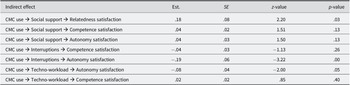
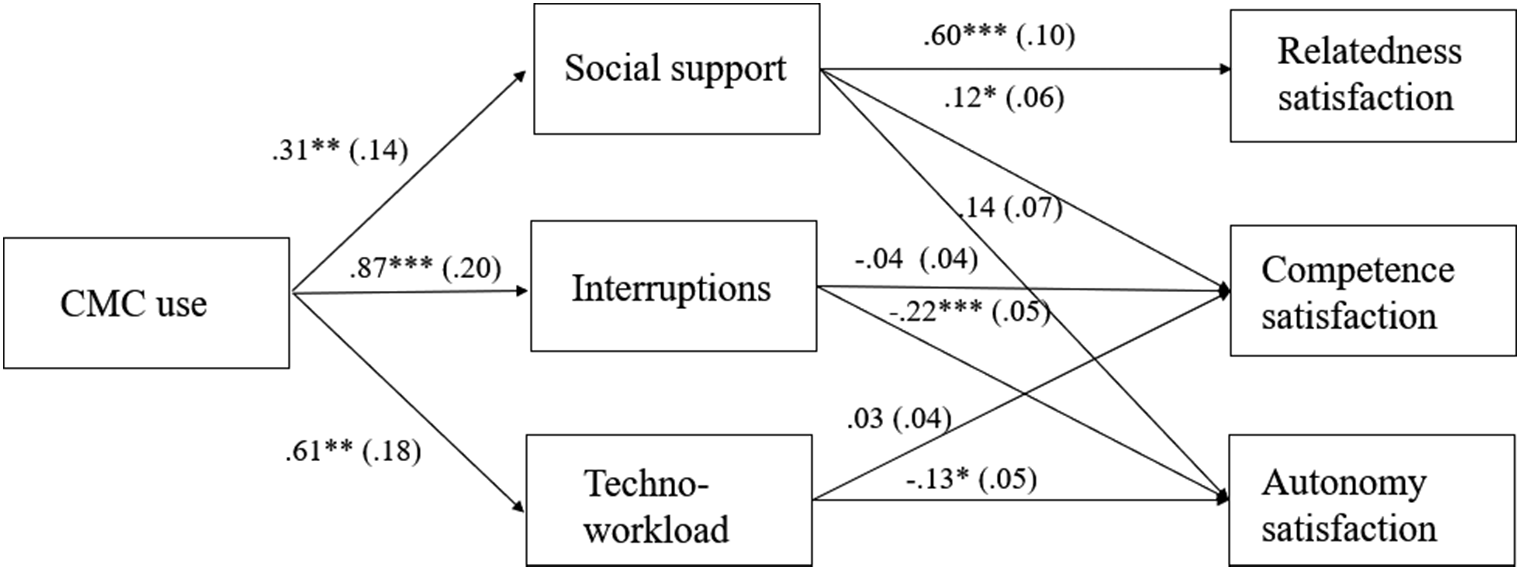
Table 4 presents the results of the indirect effects of CMC use on basic need satisfaction via social support, interruptions, and techno-workload in the multilevel mediation model. Figure 2 shows the standardized direct path coefficients and standard errors of the ML-SEM for the direct relationships. Hypothesis 1 stated that daily CMC use is positively associated with the satisfaction of the needs for relatedness, competence, and autonomy through daily social support from colleagues. Results supported an indirect effect of CMC use on relatedness satisfaction (ES = .18, SE = .08, p < .05) but there was no support for an indirect effect of CMC use on competence satisfaction (ES = .04, SE = .02, p = .13) and autonomy satisfaction via social support (ES = .04, SE = .03, p = .13). Hypothesis 1 is thus only partially supported.Footnote 1
Indirect effects of CMC use on relatedness, competence, and autonomy satisfaction

Note: Level 1 N = 530 (within-person level).
Est. = standardized coefficient. SE = standard error.
***p < .001, **p < .01, *p < .05.
Standardized direct path coefficients and standard errors of the structural equations model. ***p < .001, **p < .01, *p < .05.
Note: Within-person results. Level 1 (day-level) N = 530.

Hypothesis 2 stated that daily CMC use is negatively associated with the satisfaction of the needs for competence and autonomy through the daily experience of interruptions. Results indicated an indirect effect of CMC use on autonomy satisfaction (SE = −.19, SE = .06, p < .001), but there was no support for an indirect effect of CMC use on competence satisfaction (ES = −.04, SE = .03, p = .26) via interruptions. This provides partial support for Hypothesis 2.
Hypothesis 3 stated that daily CMC use is negatively associated with the satisfaction of the needs for competence and autonomy through the experience of daily techno-workload. Results supported an indirect effect of CMC use on autonomy satisfaction via techno-workload (SE = −.13, SE = .05, p < .05), but there was no support for an indirect effect of CMC use on competence satisfaction via techno-workload (SE = .02, SE = .02, p = .40). Hence, Hypothesis 3 was partially supported.
Discussion
Given the omnipresence of CMC, this article aimed to unravel the paradoxical role of CMC by examining how employees’ daily CMC use was associated with job design and basic need satisfaction. Drawing on job design theory, we focused on technology-specific job resources (social support) and demands (interruptions and techno-workload) as mechanisms explaining these relationships. Our findings generally confirmed that daily fluctuations in CMC use may have mixed effects on the employees’ same-day basic need satisfaction. Specifically, on days when employees used more CMC compared to other days, they reported experiencing more social support, but also more interruptions and techno-workload, which were, respectively, supportive and detrimental for need satisfaction. These findings add to our understanding of CMC use and further nuance the literature on job design and SDT.
First, our study provides insight into both the supportive and detrimental dynamics of within-person CMC use. Employees primarily rely on digital tools to perform their work and stay connected with colleagues, making our methodological focus on days working from home particularly suitable to capture their daily impact of CMC use. Our results show that employees’ CMC use varies across days (i.e., intra-individual variance), indicating that their use of CMC fluctuates substantially. These fluctuations reveal that the paradoxical nature of CMC use holds true at a within-person level. More specifically, our findings indicate that CMC use may enhance relatedness satisfaction but may, at the same time, adversely impact the satisfaction of autonomy on a daily basis. This highlights the complexity of CMC use, demonstrating that while it can be beneficial for some outcomes and detrimental for others, its effects may also be mixed depending on the specific outcome considered. Our results further suggest that, on a daily basis, CMC use may offset the loneliness that is often associated with working from home by increasing social support and relatedness satisfaction (Gajendran & Harrison, Reference Gajendran and Harrison2007), but may simultaneously put pressure on employees and decrease autonomy satisfaction through unwanted and uncontrollable interruptions and increased workload. This underscores that it is not merely the fact of working from home that determines employees’ daily experiences, but rather how intensively they use CMC during those home-working days. So, daily CMC use represents a critical mechanism that can either enhance or decrease need satisfaction. It thus becomes imperative to manage people’s disconnection and workload—even during days working from home—to safeguard their psychological need satisfaction (Verlinden et al., Reference Verlinden, Baillien, Notelaers and Verbruggen2024).
Second, this study adds to the literature on job design by answering the call to further our understanding of how the increased use of technology may shape employees’ experiences of their jobs (Wang et al., Reference Wang, Liu and Parker2020). Our research indicates that CMC use may operate through job design mechanisms, such as social support, interruptions, and techno-workload, even when employees do not have the possibility to interact face-to-face. At the same time, however, this aspect enabling flexible work induces relatively new demanding aspects of the job, such as interruptions and techno-workload. As such, our study indicates that new features of work may not univocally enhance or deteriorate job design, but that different pathways are possible, even simultaneously. This study adds to our insights on how contextual aspects may alter employees’ experiences, even though the content of their job might not have changed (Parker et al., Reference Parker, Van den Broeck and Holman2017), and calls for more research on how, for example, leaders and employees themselves may alter the implications of CMC use for job design (Parker et al., Reference Parker, Van den Broeck and Holman2017). Interestingly, our analyses also revealed a positive correlation between the demands associated with CMC use (i.e., interruptions and techno-workload); the more CMC use interrupted employees during their working day, the higher their experiences of technology-induced workload. This can be explained by interruptions typically leading to a temporary halt in the ongoing task, adding to a displacement of time (Vanden Abeele et al., Reference Vanden Abeele, Vandebosch, Koster, de Leyn, Van Gaeveren, de Segovia Vicente, Van Bruyssel, van Timmeren, De Marez, Poels, DeSmet, De Wever, Verbruggen and Baillien2024) and consuming the time needed to finish the task (Lin et al., Reference Lin, Kain and Fritz2013). The technology-related demands were not related to social support, confirming two distinct pathways of how CMC use may influence job design.
Third, our findings support the relevance of studying the daily diary within-person associations of CMC use. By adopting a within-person perspective, this study demonstrates that employees’ CMC use fluctuates from day to day, and that these fluctuations have same-day implications for their experiences of social support, interruptions, techno-workload, and need satisfaction. This offers a more fine-grained understanding of how CMC use shapes need satisfaction.
Fourth, this study confirmed the general principles of SDT, in showing that job characteristics such as social support matter for basic need satisfaction, also on a daily basis. Yet, this study also expands on the antecedents of need satisfaction by showing how new work practices, such as CMC use, and associated job characteristics, such as techno-workload and interruptions, may be associated with need satisfaction. Some expected relationships were confirmed, except for the relationship between CMC use and both competence and autonomy satisfaction through social support, and the relationship between CMC use and competence satisfaction via techno-workload and interruptions. Whereas earlier meta-analytical evidence (Van den Broeck et al., Reference Van den Broeck, Ferris, Chang and Rosen2016) has evidenced a strong association between social support and autonomy satisfaction, in our current study, the negative indirect effect of CMC use on autonomy satisfaction through interruptions and techno-workload seemed to outweigh the potential positive indirect effect through social support. Social support did, however, link CMC use to satisfaction of the need for relatedness, but we did not find evidence for the satisfaction of the need for competence through social support. This may signal the more explicit exchange component of employees connecting with each other through CMC use when working from home. In this context of communication, individuals may experience two forms of support: emotional and instrumental (Colbert et al., Reference Colbert, Bono and Purvanova2016). Both are associated with a sense of belonging and connection to a social group. Future research may explore in greater depth whether the differentiated forms of social support explain why social support may relate more strongly to satisfaction of the needs for relatedness than autonomy and competence.
Finally, our study offers a first step toward integrating insights from the telework literature by examining CMC use within the specific context of working from home. Rather than positioning telework as the main focus or antecedent, we treated it as a contextual condition that allowed us to study a work setting where employees primarily rely on digital tools to interact with others. Prior research indicated paradoxical effects of telework—fostering autonomy and flexibility but simultaneously increasing social isolation (Day et al., Reference Day, Barber, Tonet and Landers2019; Figueiredo et al., Reference Figueiredo, Margaça, Hernández-Sánchez and Sánchez-García2024; Gajendran et al., Reference Gajendran and Harrison2007; Metselaar et al., Reference Metselaar, den Dulk and Vermeeren2023). By focusing on CMC use, our study provides a more fine-grained perspective on these paradoxical findings, showing that the intensity of digital communication use shapes daily experiences of social support, interruptions, and techno-workload, which in turn differentially relate to basic need satisfaction. Hence, our findings contribute to a more nuanced understanding of telework contexts by identifying CMC use as one behavioral mechanism that can be associated with higher or lower basic need satisfaction. Furthermore, we expect that the implications of CMC use may differ for hybrid or office-based workers, as their CMC use may substitute for—or at times inhibit—face-to-face interactions. Future research may examine whether the effects of CMC use are less strong when working in the office, where employees can more easily turn to colleagues for advice, assistance, or just to have a chat, which increases their sense of social support (Morgeson & Humphrey, Reference Morgeson and Humphrey2006; Wang et al., Reference Wang, Liu, Qian and Parker2021). This may not only reduce the need for CMC use but also buffer its negative implications in terms of job demands. Furthermore, future studies could investigate how both in-person and virtual interactions, in an office-based or hybrid context, shape how CMC use relates to job characteristics, and thereby basic need satisfaction. In addition, it may be valuable to investigate whether CMC use replaces or complements face-to-face communication in these work contexts.
Limitations and Further Research
As is the case with any study, ours also holds limitations. First, as we used one measurement per day, our research design does not test the causality of the relationship in our model, nor is it possible to look at the fluctuations within 1 day or between days (Defour & Taamouti, Reference Dufour and Taamouti2010). However, limiting our measurements to once a day ensured that the frequency of the survey did not affect the results, for example, by increasing techno-workload and interruptions. Future research could, however, consider using multiple measurements per day to gain more fine-grained insights into the fluctuations of CMC use throughout the day, look at the spill-over effects on the next day, or take potential accumulating effects of previously experienced job characteristics into account. At the same time, our focus on days working from home, while methodologically useful to isolate digital work interactions, does not fully account for other social interactions in the home environment. It is possible that support from family members or partners during home-based work compensates for the reduced social interaction with colleagues. Such non-work support may complement work-based social connections by helping employees maintain a sense of relatedness on days when collegial contact is limited, although it may not fully substitute for the social support derived from work relationships. Exploring this interplay between non-work and work-related sources of support represents an important direction for future research. Additionally, future research could also employ a longitudinal approach and use (quasi-) experimental designs with interventions to test the causal nature of the relations in our model (Grant & Wall, Reference Grant and Wall2009).
Second, our daily diary design provides insight into same-day within-person fluctuations of CMC use and its implications for technology-specific job characteristics and basic need satisfaction that day, but it does not shed light on the underlying reasons why CMC use is experienced as either supportive or demanding. Future research could further explore why employees perceive CMC use differently across days. A qualitative approach could offer richer insight into these underlying mechanisms, potentially pointing to contextual factors such as team climate or physical work environment, or individual factors such as self-regulation or coping strategies.
Third, all measures in our study were self-reported. Research indicates that individuals may make errors in assessing their ICT use (Parry et al., Reference Parry, Davidson, Sewall, Fisher, Mieczkowski and Quintana2021). However, as individuals are more likely to underreport rather than overreport their CMC use, we expect that this may not have substantially altered the examined relationships. Future studies could, however, consider using objective measures, such as tracking the number of emails sent and received or the number of meetings attended per day, to address this issue. Alternatively, a combination of self-reported and objective measures could be used (de Segovia Vicente et al., Reference de Segovia Vicente, Van Gaeveren, Murphy and Vanden Abeele2024).
Fourth, CMC use was measured only by looking at the extent of use of different CMC channels without accounting for the content and purpose of the communication. While we are the first to specify the underpinnings of the paradoxical nature of CMC use during a day of working from home, the next step could be to include the content and purpose of communication, since employees may utilize the same technology for a variety of purposes, and this may affect need satisfaction differently. Furthermore, this measurement does not allow for reliable differentiation between the various forms of CMC use. Future research may further specify the communication, distinguishing between, for example, work-related queries, pleasant meetings, online humor, cyberbullying, stressful encounters, or formal or informal emails, as these are likely to differently effect the satisfaction of basic needs. For example, informal chitchat may contribute to relatedness satisfaction, while a discussion about a work-related topic may contribute to competence satisfaction. This may ease the understanding of the message sent via CMC (media richness theory; Huang et al., Reference Huang, Kahai and Jestice2010). In order to differentiate between the various forms of CMC use and examine how they are related to, for example, job characteristics and outcomes, future research could use an experience sampling method (ESM; Fisher & To, Reference Fisher and To2012) to capture data in real-time. Additionally, future research should employ a greater number of items to measure these distinct CMC methods, thereby enhancing the reliability of the measurement.
Fifth, despite explicitly stating that the questions related to work-related activities during the contractual working hours, it remains possible that respondents may have included the use of non-work-related CMC during working hours (Wang et al., Reference Wang, Liu and Parker2020). However, if respondents frequently reported on non-work-related CMC, this would have, at worst, weakened the observed effects, making the true effects of work-related CMC likely stronger than those observed.
Finally, we only looked at employees working from home. In doing so, we attempted to explicitly delineate the context of the study to examine how CMC use can assist employees in achieving an optimal job design, and consequently, psychological need satisfaction. However, it is crucial to acknowledge that the findings of this study are exclusively applicable to employees who work from home and use CMC. Furthermore, CMC use may exert a divergent effect on employees who do not work from home or when it impedes in-person communication. Future research could replicate this study among office-based employees, employees who do not (solely) work from home, and employees who telework in places other than home, in order to achieve a more in-depth and generalized understanding of the results.
Practical Implications
The insights from this study can assist employees in mitigating the negative aspects of CMC use, such as interruptions and increased workload, and enhance the positive aspects, such as experiencing social support. One way of addressing the overuse of CMC is digital disconnection (Verlinden et al., Reference Verlinden, Baillien, Notelaers and Verbruggen2024). Employees can display self-regulatory behavior and choose to consciously disconnect from online communication channels. This results in fewer interruptions and less techno-workload, while still allowing for social support during connected time. Standards and agreements within the company can facilitate this. For instance, organization policies can enable offline periods for all employees during a specific time in which employees can work without interruptions. Employees can also make clear arrangements with colleagues regarding their availability for CMC by using “online” or “offline” symbols on their communication channels. Colleagues should respect the “do not disturb” or “offline” indication. Similar agreements around availability and disconnection can be made within a team by adapting the agreements in place at the company level to the team’s needs.
Conclusion
As employees rely more heavily on CMC, it is crucial to understand how the use of CMC impacts employee’s basic need satisfaction and gain insight into the supporting and detrimental processes underlying this relation. We found that increased use of CMC positively relates to daily relatedness satisfaction through daily social support. However, daily use of CMC negatively relates to daily autonomy satisfaction through daily interruptions and negatively relates to autonomy satisfaction through daily techno-workload. We conclude that CMC use brings about double-edged effects on employees’ basic need satisfaction.
Data availability statement
The data supporting the findings of this study are available at the Open Science Framework and will be made publicly accessible upon acceptance.
Acknowledgement
We thank the action editor and the anonymous reviewers for their constructive and valuable feedback.
Author contribution
Conceptualization: E.V., E.B.; Data Curation: E.V.; Formal Analysis: E.V.; Investigation: E.V.; Methodology: E.V.; Project Administration: E.V.; Visualization: E.V.; Writing—Original Draft: E.V.; Writing—Review and Editing: E.V., E.B., S.D., M.V., A.V.
Funding statement
This work was supported by the KU Leuven under Grant [IMP/20/004] and Research Foundation Flanders, Belgium (FWO) under Grant [G052723N]. The project was approved by the Social Ethics Committee (SMEC) of KU Leuven [G-2021-4272-R2(MAR)].
Competing interests
No potential conflict of interest was reported by the authors.
Appendix
Computer-Mediated Communication Use
Which answer fits best? To what extent…
-
1. Did you use email at work today?
-
2. Did you use video conferencing (e.g. via Teams, Zoom, Skype…) at work today?
-
3. Did you use audio conferencing or picture-less calling at work today?
-
4. Did you chat at work today via instant messaging (e.g. via WhatsApp, Signal, Skype, Teams, Messenger…)?”
Social Support
Which answer fits best?
-
1. Today, I was able to rely on my colleagues when I was struggling.
-
2. Today, I was able to ask my colleagues for help when I needed it.
-
3. Today, I felt appreciated by my colleagues in my job.
Interruptions
Which answer fits best? Today…
-
1. Incoming emails and other online Messages prevented me from doing my job.
-
2. Emails and other online messages reached me at inconvenient times.
-
3. Emails and other online messages disturbed me while I was doing my job.
Techno-Workload
ICT (information and communication technology) refers to computers, smartphones, laptops, tablets, but also to the use of these devices (e.g. video calls instead of office meetings, electronic files instead of paper files, etc.). ICT can help us, but it can also make things more difficult. With the questions below, we would like to gauge how you experience ICT and the associated requirements (e.g. a lot of information comes in at once via ICT, I have to click through a lot before I find the right information, it is cumbersome to work with, there are a lot of extra meetings, etc.). What worked best today?
-
1. Today, I had a lot of work because of ICT requirements.
-
2. Today, I had to do more work than I can handle because of ICT requirements.
-
3. Today, I had little time to get things done because of ICT requirements in my work.
-
4. Today, my work required a lot of effort from me because of ICT requirements.
Relatedness Satisfaction
Which answer fits best?
-
1. Today, some colleagues were real friends to me.
-
2. Today, I felt part of a group at work.
-
3. Today, I was able to talk to colleagues at work about things that are important to me.
Competence Satisfaction
Which answer fits best?
-
1. Today, I felt competent in my work.
-
2. Today, I felt that I am good at my job.
-
3. Today, I felt that I could complete even the most difficult tasks at work.
Autonomy Satisfaction
Which answer fits best?
-
1. Today, I felt free to do my job the way I think it should be done.
-
2. Today, my tasks at work matched what I really want to do.
-
3. Today, I felt like I could be myself at work.



 Open access

