





Introduction
Blood culture (BCx) collection is the diagnostic cornerstone for the detection of bloodstream infections and the management of sepsis. Despite this, low value BCx ordering is common, including orders for fever work-ups in stable patients or as a prerequisite for hospital admission. In some clinical scenarios, such as postoperative fever, the pretest probability is lower than 5%. Reference Fabre, Sharara and Salinas1,Reference Vaughn, Szymczak, Newton and Fakih2 This “culture of culturing” is rooted in practical, daily workflows and institutional habits in which the perceived risk of missing bacteremia outweighs the collective burden of resource waste, laboratory over-utilization, and the clinical complications associated with false-positive results. Reference Fakih and Khatib3,Reference Acker and Poonawala4
In mid-2024, this clinical habit was forcibly interrupted by a global supply chain crisis. A significant shortage of Becton Dickinson BACTEC™ BCx bottles created an unprecedented supply shock, compelling healthcare systems worldwide to pivot rapidly from liberal ordering practices to restricting use via diagnostic stewardship. 5 In response to this shortage, our institution developed a multidisciplinary intervention that combined provider education with electronic medical record (EMR)-based restrictive checkpoints and resulted in a 60% reduction in BCx utilization without increasing sepsis-related mortality. Reference Yatziv, Lora and Gross6 Following the normalization of the supply chain in early 2025, we transitioned from acute crisis management to a sustainability model. While the acute-phase “hard stops” were removed, specific stewardship measures including a persistent EMR-based Our Practice Advisory (OPA) and ongoing education were deliberately maintained. This study evaluates the postshortage period to determine the impact of our intervention on sustained BCx utilization.
Methods
Study setting and design
This retrospective, interrupted time-series (ITS) study was conducted at the University of Illinois Hospital (UIH), a 438-bed tertiary care academic center. We evaluated BCx utilization across three distinct phases. Pre-intervention—Phase 1 (P1) representing the ordering baseline from January 1, 2023, to July 14, 2024. Phase 2 (P2) spanned the acute shortage from July 31 to December 31, 2024, during which nurse-driven automatic BCx orders were eliminated, OPA-based decision-support checkpoints (“hard stop”) and multidisciplinary education were implemented. Reference Yatziv, Lora and Gross6
Finally, the sustainability phase (Phase 3 – P3) began on January 1, 2025, following the normalization of the BCx bottle supply. In this phase, acute “hard stops“ were removed. The OPA (Supplementary Figure 1) continued to prompt ordering clinicians with evidence-based BCx appropriateness criteria. P3 education shifted to a maintenance model, with periodic electronic reminders sent to ordering providers—including emergency department, ICU, and inpatient ward teams — serving as the primary ongoing tool.
Data collection and outcomes
We retrieved EMR data for BCx orders, positivity, and contamination rates per our microbiology Standard Operating Procedure (see Supplement). Sepsis outcomes, defined by ICD-10 codes for sepsis or septic shock, included prevalence and in-hospital mortality (excluding ongoing admissions). Direct cost savings were estimated at $96 per two-bottle set, adopting the lower range of values from the cited literature without adjusting for inflation or additional operational costs. Reference Acker and Poonawala4,Reference Dempsey, Skoglund, Muldrew and Garey7
Statistical analysis
Segmented linear regression was used for the ITS analysis to estimate level shifts and trend changes between phases. Autocorrelation was assessed via the Durbin–Watson test. Mortality across periods was compared via Yates-corrected χ2 tests; we reported absolute risk differences (95% CI) and two-sided P-values. Statistical analyses were performed using R v4.3.3.
Ethics
This study was approved as IRB exempt by UIH IRB.
Results
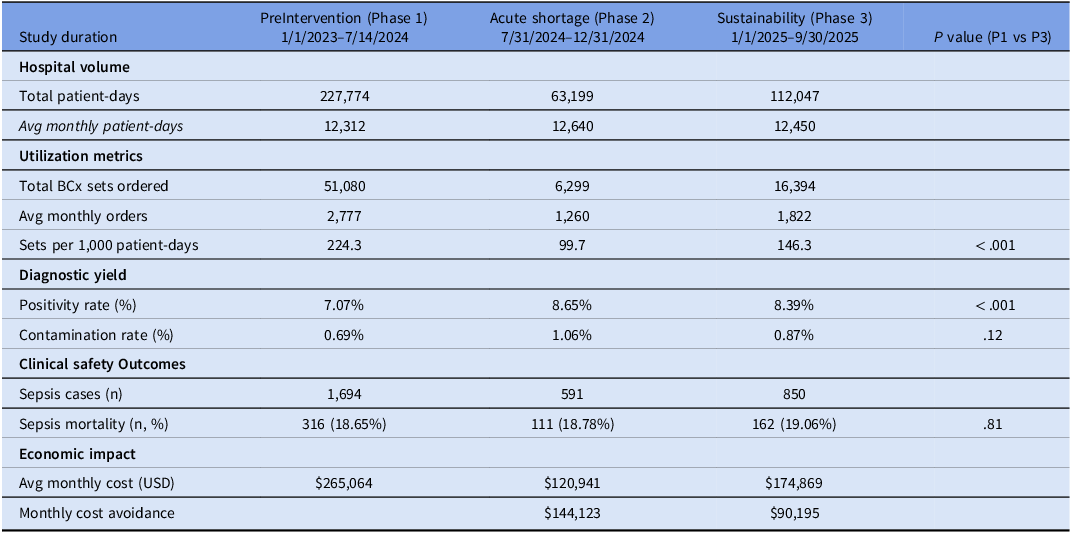
Outcomes are summarized in Table 1 and S1(supplementary). The study spanned 33 months across three phases: P1 (18.5 months; 227,774 patient-days), P2 (5 months; 63,199 patient-days), and P3 (9 months; 112,047 patient-days), with comparable average monthly census across all periods (∼12,300–12,640 patient-days/month). Total BCx sets ordered were 51,080 in P1, 6,299 in P2, and 16,394 in P3, with average monthly orders declining from 2,777 (P1) to 1,822 (P3). ITS demonstrated a durable 34.8% reduction in utilization density in P3 (146.3 vs 224.3 sets/1,000 patient-days; P < .001), and the postintervention trend (Figure 1) was statistically flat (β = +0.45; P = .81), confirming the absence of diagnostic creep.
Monthly blood culture set orders across interrupted time-series study phases. Horizontal lines represent period means. P1 = pre-intervention (January 2023–July 2024); P2 = acute shortage intervention (July–December 2024); P3 = sustained post-intervention (January–September 2025).

Positivity rate calculated as positive cultures/bottles used. Contamination rate calculated as contaminated bottles/bottles used. Cultures per 1,000 patient-days calculated as (Bottles used/total days of admission)* 1,000. In-hospital sepsis rate: calculated as sepsis deaths/cases with sepsis diagnosis. Spendings ($): values are in US dollars

Table 1. Long description
The table compares hospital metrics across three phases of a study: PreIntervention (Phase 1), Acute short-age (Phase 2), and Sustainability (Phase 3). It has 15 rows and 5 columns. The columns are Study duration, Hospital volume, Utilization metrics, Diagnostic yield, Clinical safety Outcomes, and Economic impact. The rows include Total patient-days, Avg monthly patient-days, Total BCx sets ordered, Avg monthly orders, Sets per 1,000 patient-days, Positivity rate (percent), Contamination rate (percent), Sepsis cases, Sepsis mortality (n, percent), Avg monthly cost (USD), and Monthly cost avoidance. Each phase shows different values for these metrics, highlighting trends and comparisons across the phases.
Comparing P1–P3, diagnostic yield improved with BCx positivity rising from 7.07% to 8.39% (P < .001), while contamination rates remained low and stable (0.69% vs. 0.87%; P = .12). Clinical safety was preserved: sepsis was identified in 1,694 (P1) and 850 (P3) admissions, with sepsis-related in-hospital mortality stable at 18.65% vs 19.06% (RD +0.41 pp; 95% CI –2.8 to +3.6; P = .81). Estimated average monthly direct supply cost declined from $265,064 (P1) to $174,869 (P3), yielding a monthly cost avoidance of $90,195.
Discussion
Our findings demonstrate that a diagnostic stewardship intervention born out of necessity can lead to long-term, durable shifts in clinical practice. The transition from P2 to P3 shows that while some “rebound” in ordering occurred, utilization did not return to the high-volume baseline of P1. Instead, the “new steady state” represents a 34.8% persistent reduction in utilization without compromising patient safety.
Changing clinical habits is a notoriously difficult and lengthy process. Reference Gupta, Boland and Aron8 In this case, the national BCx bottle shortage acted as an external catalyst that forced a rapid re-evaluation of ordering practices. Such acute resource constraints, while clinically challenging, provide a unique “natural experiment” to de-implement low-value practices that are otherwise resistant to change due to their integration into standard workflows. By addressing this crisis with a structured stewardship framework, we were able to modify long-standing clinical behaviors.
Crucially, the ultimate success of any stewardship effort is measured by its durability, as clinical practices often exhibit a marked elasticity, reverting to inefficient baselines once the external pressure of a resource shortage is removed. This phenomenon, commonly referred to as utilization drift, poses a significant barrier to long-term behavioral change. Reference Kieffer, Carlton and Adams9,Reference Chambers, Glasgow and Stange10
This behavioral shift addressed a central concern during any diagnostic stewardship: the risk of missing a diagnosis, such as occult bacteremia, potentially leading to delayed sepsis treatment. However, the increase in the positivity rate (7.07% in P1 vs 8.39% in P3) indicates improved diagnostic stewardship. It suggests that clinicians moved away from “reflexive” or “routine” ordering and toward a higher-pretest-probability model. The stability of sepsis mortality rates provides essential reassurance that this reduction in volume did not lead to missing clinical recognition of septic patients. This aligns with emerging literature suggesting that intensive BCx stewardship in non-neutropenic patients can be achieved safely when guided by clinical decision-making. Reference Fabre, Sharara and Salinas1
Furthermore, the supply cost savings are substantial, exceeding $90,000 monthly. This reflects direct supply costs only and likely underestimates the true economic impact. Additional cost categories not captured here, include laboratory processing of avoided orders, nursing time for phlebotomy, pharmacy costs for empiric treatment of false-positive results, and workup of contaminated cultures. Reference Acker and Poonawala4,Reference Dempsey, Skoglund, Muldrew and Garey7
Limitations and future directions
This report has several limitations. As a single-center, retrospective observational analysis, it is subject to uncontrolled confounding and cannot establish causality. We did not capture detailed patient demographic or clinical variables and relied exclusively on ICD-10 sepsis codes, which may lead to misclassification. Future research should investigate the specific clinician phenotypes most responsive to these interventions and whether similar “crisis-stewardship” models can be applied to other overutilized diagnostics, such as respiratory pathogen panels or C. difficile testing.
In summary, by leveraging an acute supply crisis as a catalyst for structured stewardship, we achieved a durable ∼35% reduction in BCx utilization without compromising patient safety. Maintaining EMR-based tools and ongoing education successfully prevented utilization drift, improved diagnostic yield, and established a lower-volume steady state. These findings suggest that acute supply shocks can be leveraged to achieve lasting behavioral change and resource sustainability.
Supplementary material
The supplementary material for this article can be found at https://doi.org/10.1017/ice.2026.10504.
Data availability statement
Data available upon reasonable request from the corresponding author.
Acknowledgments
We thank the University of Illinois antimicrobial stewardship team and hospital staff for their support.
AI USE STATEMENT AI-assisted language editing (Gemini, Google) was used for grammar and style refinement. All scientific content, analysis, and conclusions are the sole responsibility of the authors.
Financial support
None reported.
Competing interests
All authors report no conflicts of interest relevant to this article.



 Open access

