

Introduction
The earth is currently undergoing a global biodiversity crisis which necessitates not just habitat and species conservation, but active ecological restoration. One of the factors contributing to this global loss of biodiversity is the capture of animals for the illegal wildlife trade (Morton et al. Reference Morton, Scheffers, Haugaasen and Edwards2021; Romero-Vidal et al. Reference Romero-Vidal, Rojas, Herrera, Hiraldo, Díaz and Blanco2025). Psittaciformes (parrots and their allies) is one of the most endangered avian orders (Olah et al. Reference Olah, Butchart, Symes, Guzmán, Cunningham and Brightsmith2016) with over 25% of its 421species threatened with extinction (IUCN 2025). Even for common species, research suggests that most populations under study are declining (Berkunsky et al. Reference Berkunsky, Quillfeldt, Brightsmith, Abbud, Aguilar and Alemán-Zelaya2017). In addition, parrots are commonly threatened by the illegal wildlife trade and tens of thousands are surrendered or confiscated annually (Ambrogi et al. Reference Ambrogi, Cunha Neto, Andrade, Pereira and Teixeira2026; Buxton and Saulnier Reference Buxton, Saulnier, Duerr and Gage2020; IUCN 2025; Mendoza et al. Reference Mendoza, Shanee, Cavero, Lujan-Vega, Ibañez and Rynaby2022; Olah et al. Reference Olah, Butchart, Symes, Guzmán, Cunningham and Brightsmith2016). This high level of threat, coupled with the overabundance of confiscated birds, provides a mixture of challenges and conservation opportunities. The parrots from the wildlife trade are usually received by government agencies charged with their care or placement. While euthanasia is often recommended for confiscated animals (CITES 2010; Snyder et al. Reference Snyder, McGowan, Gilardi and Grajal2000), euthanasia of healthy animals is sometimes illegal, and rarely considered desirable due to the potential for bad public relations and lost opportunities to restore depauperate ecosystems (IUCN 2019; Julien et al. Reference Julien, Vantassel, Groepper and Hygnstrom2010; Zhou et al. Reference Zhou, Newman, Buesching, Macdonald and Zhou2016). However, in locations where thousands of parrots are confiscated annually, government agencies and private rescue and rehabilitation centres are unable to effectively care for the constant influx of animals as they must stop accepting animals or risk becoming overwhelmed logistically or financially (Rivera et al. Reference Rivera, Knight and McCulloch2021; Donald J. Brightsmith, personal observation). As a result, release of confiscated parrots, when done responsibly, can be a win–win situation where new populations of trafficked species are established and rehabilitation centres make room for additional confiscated individuals.
Unfortunately, release of captive animals, especially individuals from the wildlife trade, can be very challenging (Buxton and Saulnier Reference Buxton, Saulnier, Duerr and Gage2020; Cheyne Reference Cheyne, Whittaker and Lappan2009; Edwards et al. Reference Edwards, Ford, Hoy, FitzGibbon and Murray2021). Many animals raised in captivity, especially parrots, lack the basic skills needed to survive in the wild, including predator recognition, flight skills, flocking ability, group cohesion, and landscape navigation (Brightsmith et al. Reference Brightsmith, Hilburn, Del Campo, Boyd, Frisius and Frisius2005; Franzone et al. Reference Franzone, G.d.A.P, de Lima Kascher, de Azevedo and Sant’Anna2022; Snyder et al. Reference Snyder, Koenig, Koschmann, Snyder and Johnson1994; White et al. Reference White, Collazo and Vilella2005). Released captive parrots may also approach people, which can lead to high rates of capture or mortality (Evangelista-Fraga et al. Reference Evangelista Fraga, Rodrigues Santos, Soares Silva, Rocha Teixeira, Tomazi and Borba da Silva2023; Lopes et al. Reference Lopes, Rocha, Mesquita, Drumond, Ferreira and Camargos2018). These problems often result in low survival rates and make it difficult to establish new populations of released species (White et al. Reference White, Abreu, Benitez, Jhonson, Lopez and Ramirez2021).
Methods used in rehabilitation and release of confiscated animals vary widely among projects and include fostering chicks, simple hard release, holding individuals for months with conspecifics followed by soft release, extensive training to develop flight, foraging, predator recognition, and many other variations (Bedolla Reference Bedolla and Brightsmith2024; Buxton Reference Buxton and Brightsmith2024; Buxton and Saulnier Reference Buxton, Saulnier, Duerr and Gage2020; Estrada Reference Estrada2014; Rivera et al. Reference Rivera, Knight and McCulloch2021; Vigo-Trauco et al. Reference Vigo-Trauco, Garcia-Anleu and Brightsmith2021; Zimmerman Reference Zimmerman2007). However, there are few well-documented releases of parrots from the illegal trade (Massie et al. Reference Massie, Backstrom, Holland, Paterson and Fuller2025), and most that have been reported have had relatively low success rates (Evangelista-Fraga et al. Reference Evangelista Fraga, Rodrigues Santos, Soares Silva, Rocha Teixeira, Tomazi and Borba da Silva2023; Lopes et al. Reference Lopes, Rocha, Mesquita, Drumond, Ferreira and Camargos2018; Snyder et al. Reference Snyder, McGowan, Gilardi and Grajal2000), but see Sanz and Grajal (Reference Sanz and Grajal1998). In fact, the field of parrot release overall continues to face substantial challenges, as conservation translocations are still hindered by persistent issues including predation, limited site fidelity, and difficulties in maintaining social cohesion (Brightsmith et al. Reference Brightsmith, Hilburn, Del Campo, Boyd, Frisius and Frisius2005; Purchase et al. Reference Purchase, Lugarini, Purchase, Ferreira, Vercillo and Stafford2024; Tailor et al. Reference Tailor, Gordon, Carrasco, Vigo-Trauco and Brightsmith2026; White et al. Reference White, Collar, Moorhouse, Sanz, Stolen and Brightsmith2012, Reference White, Abreu, Benitez, Jhonson, Lopez and Ramirez2021). These findings suggest that there is a need for new and innovative ways to release captive animals to the wild.
Free-flight training is a method developed by parrot owners as a way to train hand-raised parrots to fly outdoors (Biro Reference Biro2000; Moser Reference Moser2004; Woodman et al. Reference Woodman, Biro and Brightsmith2021). Birds are encouraged to fly point to point in a controlled environment and then are gradually transitioned outside and given more freedom until they are able to remain in the wild on their own (Woodman et al. Reference Woodman, Biro and Brightsmith2021). Previous research has shown that nearly all of the 40+ young parrots raised with this method developed a broad array of essential survival skills including flight, flocking, group cohesion, predator recognition, predator avoidance, and landscape navigation (Brightsmith et al. Reference Brightsmith, Biro, Mendes and Woodman2024; Woodman et al. Reference Woodman, Biro and Brightsmith2021). Results from the only previous study using free-flight techniques for conservation release were very promising: six Blue-and-yellow Macaws Ara ararauna were released into their historic range in Brazil; 100% showed good flocking, site fidelity, and group cohesion; all avoided predators and survived >3 years and 83% avoided capture by humans (Brightsmith et al. Reference Brightsmith, Biro, Mendes and Woodman2024).
In this study, we use free-flight training to raise and release a cohort of 18 fledging-aged, Yellow-crowned Amazons Amazona ochrocephala that were confiscated from the illegal wildlife trade in Colombia. The overall objective was to test the general idea proposed by Woodman et al. (Reference Woodman, Biro and Brightsmith2021) and Brightsmith et al. (Reference Brightsmith, Biro, Mendes and Woodman2024) that free-flight training can be used to raise psittacines that have all the necessary skills to survive in the wild. Another objective was to create a flock of parrots that reliably remained at the release site to serve as a core flock to help facilitate the survival of future releases. We hypothesise that birds raised with free-flight techniques would (1) have high survival post release, (2) have high site fidelity and not get lost in the landscape, (3) have high group cohesion, (4) effectively avoid predators, and (5) avoid capture by local people.
Methods
Study site
The study took place on Finca El Paraiso and surrounding areas, a complex of 370 ha of private land in the municipality of Villanueva, Bolivar, Colombia. The site is at the border of the tropical dry and tropical very dry forest Holdridge life zones and spans ~115–330 m asl. The farm is located adjacent to the town of Villanueva (~22,000 inhabitants) and is crossed by two seasonal streams (Arroyo Arena and Arroyo Caribani). The surrounding area hosts a patchwork of different land uses including urbanised areas of Villanueva, low density rural housing, cattle pastures, agricultural fields (mostly cassava, maize, yams, and plantains), and small fruit orchards including papaya, mango, guava, coconut, Spanish lime Melicoccus bijugatus, sapodilla Manilkara zapota, soursop (guanábana) Annona muricata, caimito Chrysophyllum cainito, and sapote Pouteria sapota. Natural habitats include second growth forests and a few isolated patches of mature forests at the highest elevations. The site has a variety of predators capable of taking an adult Amazon parrot including raptors (Micrastrus semitorquatus, Buteogallus anthracinus, and Buteogallus urubitinga) and mammals (Leopardus pardalis, Procyon cancrivorus, Galictis vittata, and Eira barbara). Dogs and cats are also quite commonly kept in the areas around the release site and represent a risk to birds that approach homes.
Study background
Author AR took author CB’s free-flight training course and trained a pet Amazon parrot using free-flight techniques in 2020. In 2022, AR purchased Finca Paraiso, founded Fundacion Loros (FL), and obtained a permit from CARDIQUE (the regional environmental authority) to receive and rehabilitate parrots. This permit states that the birds remain in captivity or ‘semi-captivity’, which FL operationally defined as returning regularly to the release site and still using supplemental feeding stations. In 2023, author AR contacted CAR (Corporación Autónoma Regional) Cundinamarca and enquired about receiving young, confiscated parrots and arranged to receive 27 nestling Amazon parrots in June 2023. Author CB then flew to Colombia to conduct the training and release of these birds. Draft protocols for the release were developed by author CB in consultation with AR. This work was carried out under the auspices of FL and all decisions as to the procedures and protocols implemented with the birds were made by AR in the name of FL. As an aside, FL received other parrots for rehabilitation before and after June 2023, but they are not considered in this study.
Birds and basic care
The birds in this study were 27 Yellow-crowned Parrots confiscated in the far western portion of Colombia’s Department of Cundinamarca, within the Magdalena River Valley. In this region, the species is reported on approximately 10–25% of eBird checklists, indicating that it is relatively common and suggesting that the birds may have been trapped locally (eBird 2026). The confiscation site lies approximately 600 km south of our release area, and the species’ distribution is continuous between these locations, indicating an absence of major geographical barriers and making substantial genetic differentiation between the two areas unlikely (Collar et al. Reference Collar, Boesman, Kirwan, del Hoyo, Elliott, Sargatal, Christie and de Juana2020; eBird 2026). Government records suggest that the birds were confiscated in three separate groups (6 February 2023 16 birds, 14 March 2023 groups of two and nine). Two of the birds had been captured about 15 days before confiscation and the others were in captivity for an unknown time before confiscation. Upon confiscation the chicks were still quite young; their eyes had not yet opened and they had only down feathers. The birds were hand fed and held at CAR Cundinamarca in quarantine from confiscation until 8 June 2023 when they were brought to the release site by CAR Cundinamarca in collaboration with CARDIQUE (member of the network of friends of the Fauna of Cardique). For the purpose of this study 8 June is considered day 0. Upon arrival, the birds were docile and had their primary feathers intact, but all had minimum flight ability. Based on behaviour and physical appearance, we estimated that the birds were likely to be between fledging age (about 8–9 weeks) and weaning age (16–20 weeks; Supplementary material Figure S1) (Collar Reference Collar, del Hoyo, Elliott and Sargatal1997; Forshaw Reference Forshaw1989). They were not very afraid of people, but they did not seek out human contact, suggesting that they had been around humans but not handled very often. Upon arrival, the birds were able to eat fruits and seeds on their own and seemed comfortable being fed hand-feeding formula. All birds were given a collar of stainless-steel, vinyl-coated cable (49 strand 400 lb test) fixed with a metal crimp, with a uniquely numbered metal tag (1 inch diameter, round, anodised aluminium pet tag green with white lettering made by Providence Engraving; Figures S2 and S3). Each tag had a unique number on one side and FL and a phone number on the other side.
Throughout their time in captivity at FL the birds were usually fed twice per day. In the morning they were fed Psittacus brand hand-feeding formula (https://usa.psittacus.store/shop/psittacus/parrot/) mixed with fresh mango juice (powder to juice ratio 1: 2 or 3 approximately). Birds were only fed hand-feeding formula during training. When they engaged in training by flying between perches, they were rewarded with a squirt of formula from a 50 cc syringe with a metal gavage tip. The formula was placed into their mouths so the birds could swallow it (not gavaged directly into the crop). During daily training sessions, hand feeding ended when the birds lost interest in training or when their crops were visibly filling towards capacity.
On most afternoons, the birds were given a mix of chopped fruits and seeds that normally included 3–5 items. The most commonly given items were mango, guayaba, papaya, and sunflower seeds. Other items provided less commonly included bell peppers Capsicum annuum, sapodilla Manilkara zapota, tamarind Tamarindus indica, small bananas (likely Musa AA ‘Lady Finger’), star fruit Averrhoa carambola, and wild fruits including corozo Bactris guineensis, uvito Cordia alba, and guasimo Guazuma ulmifolia. Feeding was usually between noon and 14:00 and was only available to the birds for about 1–2 hours when it was then removed. Pulling the food in the afternoon ensured that the birds could not feed in the early morning before training and made sure that they would be food motivated for the morning training sessions. On some days, afternoon feeding was skipped due to logistical reasons or to ensure the birds would be very food motivated for important training sessions the following day.
Birds were kept in a round holding aviary (4 m diameter, 2.5 m tall) and then captured with short-handled nets, placed in carriers, and transferred to a training aviary every morning for the training sessions. After training they were returned to the holding aviary where they would spend the afternoon and overnight.
Pre-release evaluation
While in quarantine at CAV (Centro de Atencion y Valoracion Fauna Silvestre) in Tocaima (CAR Cundinamarca), the birds underwent a comprehensive health assessment, which included two rounds of faecal coprological examinations (pooled samples examined with parasitological Lugol’s iodine and saline solution), full external physical examinations assessing plumage condition, mucous membranes, heart rate, respiratory rate, temperature, and body condition score, as well as morphometric measurements and nutritional evaluations to track weight gain and dietary adaptation. Upon arrival at FL, additional evaluations were conducted by Dr Ana Ariza. The faecal analysis found no evidence of gastro-intestinal parasites, and the physical examinations showed that the birds were generally in good health. However, two of the birds had severely damaged upper mandibles and were considered permanently unreleasable. An additional two birds had damaged primaries and were considered unreleasable in the short term. During flight training, an additional five birds were categorised as weak fliers that were not considered ready for release during this study, suggesting that only 18 of 27 birds were suitable for the first release. Both birds with damaged feathers and all five weak fliers were released between 2 and 13 months later, but these birds and their releases are not considered further in this paper.
Training methods
The free-flight training approach used here is based on the principles and techniques of guided behaviour development or human-guided learning, sensu Woodman et al. (Reference Woodman, Biro and Brightsmith2021). This method is used to train pet parrots to fly in a wide range of complex environments globally and has been used to release Blue-and-yellow Macaws in Brazil (Brightsmith et al. Reference Brightsmith, Biro, Mendes and Woodman2024). In this study, we trained the released birds with less human handling than that used with pet birds and increased contact with the other release candidates. This reduced human socialisation was to encourage them to be feral and independent from the weaning stage onward. In this way, our release candidates were raised for permanent release to help create a core of birds to re-establish a wild population at the site. The plan was to train the birds from 1 June until 26 June (when author CB had to return home). However, the birds did not arrive until 8 June, so the total training duration was reduced by about one week.
The first training aviary was 15 m long × 3 m wide × 2.5 m high. On day 2 author CB began training the birds. Birds were trained once a day in the morning ~08.00–12.00. To encourage birds to fly from point to point, we placed individual birds on perches and had them walk the length of the perch to receive the hand-feeding formula. Then two perches were placed about 1 m apart inside the aviary and when the birds flew from one perch to the other, they were rewarded with hand-feeding formula as a form of positive reinforcement. The distance between perches was increased incrementally 1 m, 2 m, 3 m, 6 m, and 15 m as the birds improved. By the end of day 5, 20 of the 27 birds could complete the flights between perches placed 15 m apart (video link available in the Supplementary material). The birds were encouraged to fly between perches until the birds lost interest or their crop was visibly bulging and approaching capacity. For the first few training sessions (days 3–6) birds were trained individually, but after that most training was carried out in groups of 2–10 birds.
On day 13, the Amazons were transferred to the release aviary at the release site near the back of the reserve. The release aviary was 12 m long × 3 m wide × 2.5 m tall. While in this aviary the birds were fed from hanging platform feeders of the same design that was eventually used post release. At this point, fruits were given whole to the birds to ensure they were able to process whole fruits. We began training the birds outside the aviary on day 14. Perches were placed at about 2 m, 4 m, and 15 m from the back of the aviary. Birds were taken one at a time and encouraged to fly from the aviary to the perches at 2 m and 4 m from the aviary (and then back into the aviary as training ended). During the second training session that day, the birds were trained in small groups of up to four birds and encouraged to fly to the perches at 2 m, 4 m, and 15 m from the aviary (and then return to the aviary as training ended). Three birds failed to return to the aviary at the end of training and spent the night out in the trees around the release aviary but came down on their own and joined the training session the next morning. On each of the next two days, we conducted a single training session with birds flying from the aviary to perches up to 15 m from the aviary. On the second night only one bird did not return to the aviary and spent the night outside, but it too slept near the aviary and joined the remaining birds the next morning.
On day 17, two hanging platform feeders were set up at 2 m and 40 m from the back of the aviary. The feeders, square hanging platforms the same as ones used inside the pre-release aviary, were set at ~2 m and ~8 m above the ground hanging from tree branches. The release aviary was then opened and the birds allowed to fly out to feed. Some birds that did not depart the aviary on their own were picked up by hand and placed on the feeding station 2 m from the aviary. During the day, none of the birds flew more than 50–100 m from the aviary and feeding stations. In the late afternoon, a few birds (~5) returned to the aviary where they spent the night, and the remainder slept in the trees near the release aviary and feeders.
On day 18 (26 June 2023), the remaining birds were released from the aviary, the aviary door was closed, and no birds were returned to the aviary. For the rest of the paper, 26 June is considered the release date for these birds. At the time of the release, it was peak mango fruiting season and there were at least 10 large mango trees in fruit within 500 m of the release aviary. Since the birds were trained to consume mangos, this provided a very large food supply in the area immediately surrounding the release site.
During training, interactions with people were minimal other than the administering of the hand-feeding formula as a form of positive reinforcement for flying between perches. The birds were only touched by people to capture them and put in the carriers to move them between cages and, as the study progressed, it became more and more difficult to capture them for transfer. During training, if the birds attempted to land on the trainers, the trainers would push them away or otherwise discourage them. When the birds squabbled with each other near the trainer, the trainer would lightly swat at the birds to break up the interaction. However, no specific human aversion training was conducted fide Franzone et al. (Reference Franzone, G.d.A.P, de Lima Kascher, de Azevedo and Sant’Anna2022).
Post-release monitoring
Starting on release day and continuing until today (March 2025), project staff have provided food in the two feeding platforms that were used during the release (Figure S4). The food consists of a mixture of chopped fruits and seeds following approximately the same mixture as that given pre-release, but with additional foods including jobo Spondias mombin, ciruelo S. purpurea, guayuyo Muntingia calabura, matarratón Gliricidia sepium, aromo Acacia farnesiana, and lightly cooked garbanzo beans Cicer arietinum, given as a supplemental protein source. In the first few days post release, the fruits were given whole, but the birds dropped large amounts of fruit and some then went to the ground to feed on the fallen fruits. After this behaviour was observed, project staff gave only chopped fruits (to reduce the percentage of food dropped) and removed fruits from the ground after the birds fed to remove the incentive for the birds to go down to the ground. This technique was successful, and the birds were not seen going to the ground since.
From 27 June to 4 October 2023, the field technicians recorded which birds were seen coming to the feeders. These daily surveys were likely not exhaustive and under counted the total number of birds. Author DJB conducted a single morning feeder count in May 2024, and a local bird guide exhaustively photographed all the birds and their numbered tags as they came to the feeders from 3 to 5 July 2024. The birds were not systematically followed or tracked and foraging on wild fruits was recorded only anecdotally. Interactions between the birds and potential predators and human observers were not monitored systematically, but field crew members were interviewed on these topics during write-up (about 20 months post release). We estimated post-release survival and 95% confidence intervals (CIs) using Kaplan–Meier product-limit estimators for one month, three months, and one year post release using JMP Pro 19.0.1.
Community outreach
Community engagement was a critical component of this project. We engaged the community with the goal of helping the released parrots survive in this inhabited and highly human-modified landscape. The goal was to generate local awareness, reduce anthropogenic threats, foster territorial stewardship, and cultivate long-term conservation support among local people and other stakeholders within Villanueva and the 10 km radius surrounding the release site.
Work with local farmers and schools
In the months before the release, FL made an alliance with about 70 local farmers who had been farming the land of the reserve before it was purchased by author AR. Each farmer was given exclusive use of ~1 ha of land in ‘comodato’ (a Colombian term for a type of lease) for cassava cultivation on the reserve near the release site. Each farmer was allowed to use the land and keep or sell the crops they raised, but without clearing native forest cover. They were also informed about the parrots and asked to keep an eye out for outsiders on the property or problems with the parrots.
Outreach activities
Beginning about 10 weeks before the release and continuing through to the present, FL implemented a highly targeted, geo-referenced, digital outreach campaign using paid advertisements on Facebook and Instagram. Designed and executed by a digital marketing specialist and author AR, these campaigns were aimed at individuals living within a 10 km radius of the release site and each advertisement had a slightly different theme or angle on parrot release. Themes included the following.
-
• Maternal empathy: content framed the trauma experienced by parrot mothers when chicks are extracted from their nests in terms relatable to human motherhood, eliciting emotional identification and ethical reflection (example: https://www.instagram.com/p/CrMQv7UOkav/?img_index=1).
-
• Environmental legislation: educational materials were disseminated highlighting Colombian wildlife laws, with an emphasis on the illegality and ecological consequences of capturing and trading psittacines (example: https://www.instagram.com/p/CsWUZ1ILkfd/).
-
• Child and youth education: narratives targeting school-aged audiences, aiming to foster pro-conservation attitudes in future generations (example: https://www.instagram.com/p/Cs7isfKuP83/?img_index=1).
-
• Framing the release as a local milestone: messaging positioned the release event as a source of local pride and collective ecological responsibility (example: https://www.instagram.com/p/Ctfj0YiOXyF/?img_index=1).
Approximately three weeks prior to release, a public outreach event featuring ~250 local students was held in the central plaza of Villanueva, providing direct community interaction, visual education materials and free branded merchandise, and oral storytelling. These face-to-face interactions complemented the digital campaigns, helping to contextualise the rationale of the project for non-digital audiences and generated excitement around the upcoming release.
Within a window of five days before and after the release FL conducted additional media activities including scheduled segments on both national and regional television networks. These appearances were supported with additional social media advertisements geo-targeted exclusively to Villanueva. These targeted advertisements were designed to reinforce messaging within the zone around the release site.
On release day (26 June 2023), FL organised an on-site event about 500 m from the release aviary, inviting key actors such as local government representatives, military personnel, farmers, educators, and rural families. This gathering aimed to create a feeling of community ownership of the release flock. By bringing together all levels of society, this activity served to socially reinforce the acceptance of the project and foster a mentality of support and non-interference.
In the months following release (and continuing currently), FL has maintained consistent communication with the community within the 10 km radius of the release site through Instagram, Facebook, and WhatsApp groups that facilitate micro-targeted community updates on the activities of the parrots. Since these platforms greatly facilitate two-way communication, these regular updates keep the project fresh in the minds of the local people and encourage them to provide feedback on the birds. In the 10 months following the release, FL also visited two local schools in Villanueva and spoke directly to about 100 students.
Results
Upon release, all 18 birds used the feeders by the aviary and all but one (94%) showed good site fidelity and remained in the area around the release site. All birds (100%) showed very good flock cohesion. At one month post release 94% of the birds were still returning regularly to the feeders at the release site. By three months post release this number was at 89% and by one year post release, 72% were still returning to the feeders (Figure 1). The community outreach was also successful as local people regularly reported on the birds and informed project personnel three times about important problems impacting the released birds.
Cumulative Kaplan–Meier survival estimates for 18 Yellow-crowned Parrots still returning to the feeders at Fundacion Loro (FL), Villanueva, Colombia by day post release. The release was conducted on 26 June 2023 (day 0 on the graph).
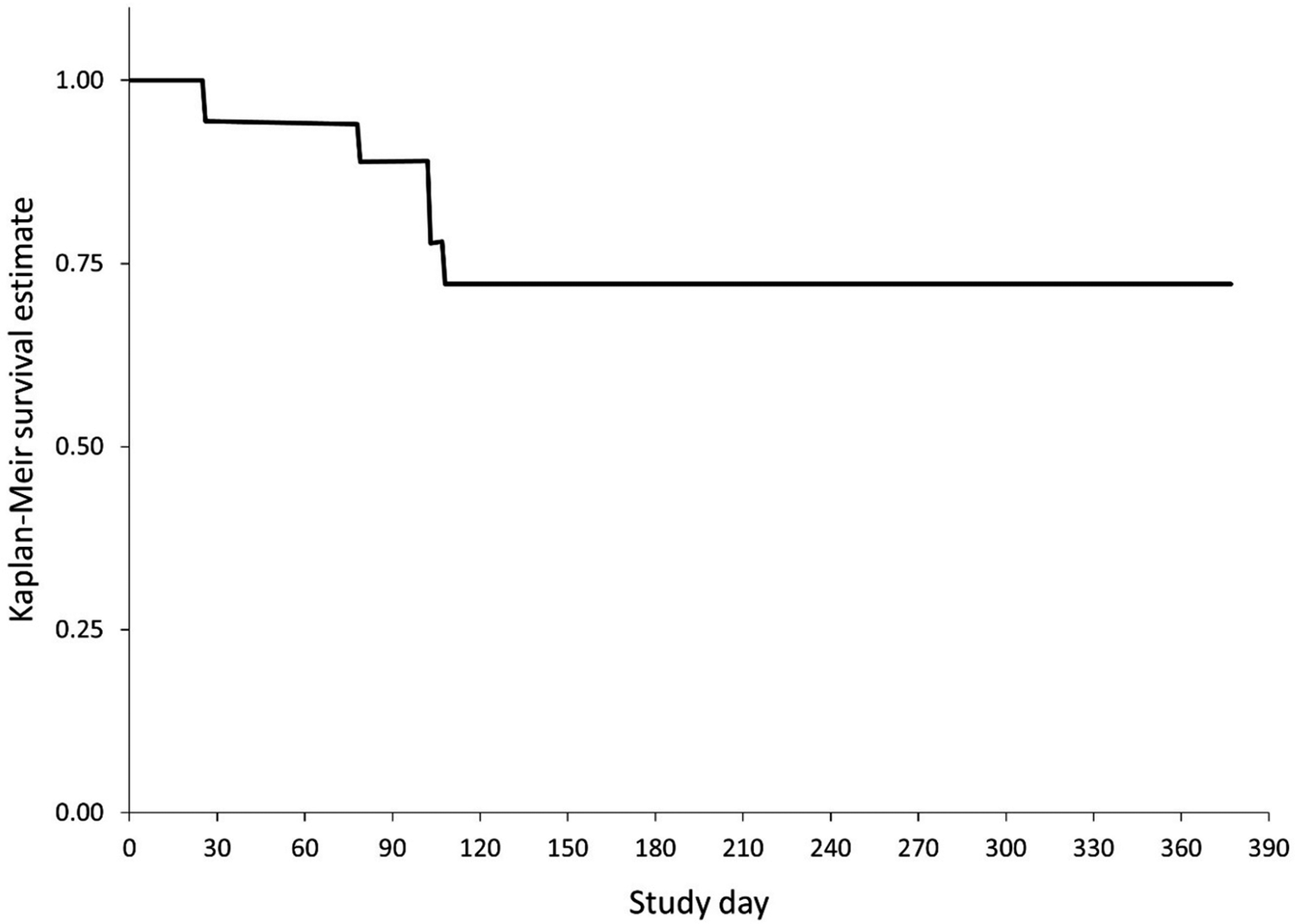
Figure 1. Long description
The x-axis is labeled Study day, ranging from 0 to 390 in increments of 30. The y-axis is labeled Kaplan-Meier survival estimate, ranging from 0.00 to 1.00 in increments of 0.25. The survival curve starts at 1.00 on day 0, remains flat for a short period, then drops in several stepwise declines between days 0 and approximately 120, reaching about 0.75. After this, the curve forms a horizontal plateau, maintaining a survival estimate of about 0.75 through to day 390. No further declines are observed after the initial period.
Survival
Of the 18 young Yellow-crowned Amazons released, five birds were lost or captured during the first-year post release, making the cumulative overall first-year survival 72% (CI: 48–88%). The one-month and three-month survival estimates were 94% (CI: 69–99%) and 89% (CI: 65–97%), respectively. Bird #32 apparently left the release site on day ± 2 or 3 post release and began spending time near a house about 1 km away from the release site. On day 5 post release, it was recaptured by project personnel, brought back to the release site and immediately rereleased into the group. It reintegrated successfully but was last seen 77 days post release and its fate is unknown. One bird (#49) was last seen 23 days post release. Before it disappeared, this bird was the most likely to approach people and would often try to land on the trainer during training (instead of the perch like all other birds). It seems likely that this bird was captured by local people, but this is unknown. Around 105 days post release, one bird (#29) was chased and captured by local children at a site about 2 km away from the release site and thanks to a notification from the neighbours, the bird was returned to the foundation within about ~24 hours. Unfortunately, the bird’s wings were clipped by the captors so it could not be immediately re-released. Two other individuals apparently disappeared between 100 days and 137 days post release and their fate is unknown.
Site fidelity and group cohesion
With this release we achieved our objective of establishing a flock of parrots that reliably remained at the release site. In the first 100 days post release, birds were counted at feeders 100 times on 95 different days. On most days, the high level of group cohesion was extremely obvious, as the vast majority of the birds moved as a single large flock, arriving and departing from the feeder area together (Figure S5). This supported our hypothesis that birds trained with free-flight techniques have high flock cohesion. The number of birds individually identified during each feeder count averaged 12.3 ± 3.0, which represents about 72% ± 20% of all birds known to be alive during the counts (Figure S6). Since total counts and numbers of unidentified birds were not recorded, group sizes were undoubtedly larger than those reported here.
Only one bird (#32), showed undesired dispersal from the release site within the first days post release. As described above, it approached a house about 1 km away from the release site and was recaptured by project personnel and reintegrated back into the group where it remained for at least another 70 days. All the rest were seen eating from the feeders on release day and then again within the first three days post release. On days 3, 4, and 7, three different individuals apparently left the feeder areas for a period of 3–4 days, but all returned to the feeders after their time away. This pattern of time away from the feeders was repeated with most of the birds during the first 100 days post release: on 38 occasions individuals were not recorded at feeder counts for three or more days in a row before returning. These time periods averaged 4.9 ± 2.8 days and lasted from 3 to 14 days. These absences were recorded for 16 of the 18 released individuals. These absences were much more common during the first 30 days (N = 24) versus days 31–100 (N = 14). These findings support our hypothesis that birds trained with free-flight techniques would show high fidelity to the release site and sufficient landscape navigation abilities to return to the release site.
Feeding
No systematic observations of feeding were made, but staff reports and observations of author AR suggested that within 1–2 months post release, the birds began foraging more extensively on wild fruits and reducing their dependency on the feeders.
Interactions with predators
None of the research team or caretakers have seen predators try to attack any of the released parrots pre or post release. However, caretakers have seen raptors (Micrastrus semitorquatus, Buteo albonotatus, Buteogallus anthracinus, and B. urubitinga) flying near the birds in the release area. When these raptors are detected by the birds, two different reactions have been noted: (1) one or more birds give alarm calls, and the entire group takes flight and flies as a single flock or (2) the entire group becomes very quiet and moves to the middle of the trees, presumably to avoid detection. This behaviour has been seen when some birds were on the supplemental feeding stations and other times when all were perched in trees. Caretakers have also seen the birds react to the presence of tayras Eira barbara. On one occasion three tayras were eating mangos in a large tree near the release site. When this happened, the parrots flew as a group and perched in a tree about 150 m away that had a clear view of the tree where the tayras were feeding.
Interactions with people
Immediately post release the birds showed little fear of humans, and observers at the feeding station could approach within 2 m or less. However, none of the birds have ever been seen trying to land on people post release. As described above, two birds were captured by people (one by project personnel and one run down by children) and we suspect that at least one more may have been captured. The birds did become more wary of people over time. By about two months post release the birds began to take flight rapidly when observers within 5–10 m moved rapidly or when observers approached within 3 m of the birds. However, the birds have never shown fear of the local caretaker who has fed them daily since their arrival. They do not land on him, and he does not touch them, but the birds will land on the feeders only a few centimetres from his hands while he is filling the feeders.
Around two months after release, a middle-class family that lived nearby began putting out watermelon for the birds who came down to the ground to consume it. The project staff spoke with the family who then stopped feeding the birds, and no birds were lost during this time. We know of no other instances where local people have fed the birds in this study.
Community outreach
As mentioned above, local residents informed project personnel three times about important problems that were impacting the released birds: #32 visiting a local house, #29 captured by local children, and local people feeding watermelon to the released flock. The reports on the individual birds allowed project personnel to recover the birds in question and the report of feeding allowed the project personnel to approach the people and convince them to stop feeding.
The 19 advertisements across Facebook and Instagram cost a total of $755 and have garnered about 1.1 million total views with a reach of about 4,000–59,000 people per advertisement. The FL Facebook page currently has ~7,000 followers and Instagram ~31,000, of which we estimate at least 700 are located within a 10 km radius of the release site. We suspect that these 700 residents concentrated in such a small area provide a great vigilance system that has helped the released birds not only in the three instances mentioned above, but in myriad other ways that are difficult to quantify.
The alliance with the 70 local farmers likely provided a variety of benefits to the project. While we do not know of any specific instances of farmers deterring outsiders from entering, we know that there were no break-ins on site and we have no evidence that birds were poached from the reserve. We suspect that the farmers’ presence throughout the property acted as a de facto security force deterring unauthorised access and thereby reducing the chances of poaching at the release site. Allowing farmers to continue to benefit from working the land also retained them as allies. We suspect that if we had displaced the farmers, we would have created hostility and many of these farmers and their allies may have become potential poachers or harmed the project in other ways.
Discussion
Our high survival rates, flock cohesion, and site fidelity lend support to the idea proposed by previous studies that free-flight training can be an effective tool to raise and release psittacines to the wild (Brightsmith et al. Reference Brightsmith, Biro, Mendes and Woodman2024; Woodman et al. Reference Woodman, Biro and Brightsmith2021).
Survival
Our finding that 72% of released birds were alive and returning regularly to the release site while encouraging, is even more noteworthy because this was a true reintroduction with no established population of parrots at the site. In addition, the release area included a mix of urban and rural inhabited areas where birds could easily come into contact with humans and anthropogenic threats.
Our survival rate compares very favourably with previous parrot release studies. In their comprehensive review of parrot releases, White et al. (Reference White, Collar, Moorhouse, Sanz, Stolen and Brightsmith2012) defined success as >50% survival in the first year but only 30 of the 47 releases reviewed (64%) reached this threshold. Our results also compare favourably with recent high-profile releases of Spix’s Macaws Cyanopsitta spixii and Puerto Rican Parrots Amazona vittata, which ranged from 40% to 70% success after one year (Purchase et al. Reference Purchase, Lugarini, Purchase, Ferreira, Vercillo and Stafford2024; White et al. Reference White, Abreu, Benitez, Jhonson, Lopez and Ramirez2021).
Releases of mixed age birds confiscated from the illegal trade in Brazil showed much lower survivorship (~35–50% confirmed alive about a year after release) than our release of young birds (Evangelista-Fraga et al. Reference Evangelista Fraga, Rodrigues Santos, Soares Silva, Rocha Teixeira, Tomazi and Borba da Silva2023; Lopes et al. Reference Lopes, Rocha, Mesquita, Drumond, Ferreira and Camargos2018). In these cases, some birds were captured by local people, a few were confirmed as taken by predators, and many birds just disappeared.
One Amazona parrot release that recorded higher survival rates than ours was of 12 Yellow-shouldered Amazons A. barbadensis released on Margarita Island, where 83% were confirmed as having survived the first year (Sanz and Grajal Reference Sanz and Grajal1998). However, on Margarita there was an established wild population and the released bird’s behaviour was very different: the released birds had low flock cohesion and site fidelity, instead, survival was apparently facilitated by rapid integration into groups of wild birds.
Fortunately, none of the birds showed signs of communicable disease before, during or after the releases. The time in quarantine (86–122 days) and health checks made by CAR Cundinamarca were sufficient to ensure birds were healthy before arrival and complied with national legal requirements. However, a variety of communicable diseases can be transmitted among parrots (Gonçalves Silva et al. Reference Gonçalves Silva, Raso, Costa, Marin Gómez and Martins2020; Romero-Vidal et al. Reference Romero‐Vidal, Blanco, Barbosa, Carrete, Hiraldo and Pacífico2024), which can also spread to wild populations (Vaz et al. Reference Vaz, Bastos Sipinski, Fernandes Seixas, Prestes, Martinez and Raso2021). As a result, health screening and general health vigilance are important to reduce the chance of spreading such communicable diseases from captive to wild populations.
Site fidelity and flock cohesion
Dispersal away from the release site has been a major problem for parrot-release projects. It leads to an increase in predation rates and other Allee effects that prevent the released population from growing and becoming self-sustaining (White et al. Reference White, Abreu, Benitez, Jhonson, Lopez and Ramirez2021). As a result, when trying to establish new populations, reducing dispersal away from the release site is very important. Immediate dispersal away from the release site has been seen in a variety of releases and may be related to fear levels when the birds are first released, lack of social attractants, and an inability to navigate back to the release site they have departed (Brightsmith et al. Reference Brightsmith, Hilburn, Del Campo, Boyd, Frisius and Frisius2005; Enkerlin and Clinton-Eitniear Reference Enkerlin and Clinton-Eitniear1993; Lopes et al. Reference Lopes, Rocha, Mesquita, Drumond, Ferreira and Camargos2018; White et al. Reference White, Abreu, Benitez, Jhonson, Lopez and Ramirez2021). Free-flight training has been suggested as a way to reduce these issues, by getting birds accustomed to flying calmly in strongly bonded social flocks and allowing them to learn about the landscape in the areas around the release site before they are definitively released (Brightsmith et al. Reference Brightsmith, Biro, Mendes and Woodman2024; Woodman et al. Reference Woodman, Biro and Brightsmith2021). Fortunately, the high survival, site fidelity, and flock cohesion rates from our study suggest that, even in its abbreviated form, free-flight training may help birds to develop flight ability, flocking ability, social bonds, and navigational acumen to keep them in a cohesive group tied to the release area.
While not specifically tested in our study, the continued provision of supplemental food has also likely contributed to the high levels of site fidelity. The birds in our study have frequently been seen consuming wild foods, but many still return to the feeding stations daily and it is uncertain what percentage of their total calories are obtained from wild sources versus feeders. This finding echoes that of previous work showing the importance of maintaining some level of supplemental feeding to help maintain release site fidelity and facilitate monitoring (Brightsmith et al. Reference Brightsmith, Hilburn, Del Campo, Boyd, Frisius and Frisius2005; Buxton and Saulnier Reference Buxton, Saulnier, Duerr and Gage2020; White et al. Reference White, Collar, Moorhouse, Sanz, Stolen and Brightsmith2012), but for possible negative impacts see Robb et al. (Reference Robb, McDonald, Chamberlain and Bearhop2008) and Snyder et al. (Reference Snyder, Koenig, Koschmann, Snyder and Johnson1994).
Given that our objective was to establish a stable core flock at the release site, we were pleased that the birds continued to return to the feeders at the release site almost daily for the duration of the study. This not only facilitated additional releases but also allowed the released birds to survive throughout one annual plant phenological cycle and see how natural food abundance varies seasonally. However, we suspect that supplemental feeding will also continue to play an important role. Many fully wild parrot populations show long-distance seasonal movements or mini migrations, presumably to track spatially heterogeneous food resources across the landscape (McReynolds Reference McReynolds2012; Renton Reference Renton2001). However, both tropical forest fruiting and these large-scale parrot movements can vary greatly between years (Brightsmith et al. Reference Brightsmith, Boyd, Hobson and Randel2021; Salinas-Melgoza Reference Salinas-Melgoza2003). Recently released parrots do not have the cultural knowledge of where to find distant food sources and how those sources vary among years. As the birds gradually learn about the multi-year changes in fruiting patterns in surrounding areas, supplemental feeding should help keep them from dispersing into the landscape where the Allee effects could slowly erode the population (White et al. Reference White, Abreu, Benitez, Jhonson, Lopez and Ramirez2021), reducing its chances of becoming self-sustaining.
The study of site fidelity is greatly facilitated by the use of tracking devices (Purchase et al. Reference Purchase, Lugarini, Purchase, Ferreira, Vercillo and Stafford2024; Sanz and Grajal Reference Sanz and Grajal1998; Snyder et al. Reference Snyder, Koenig, Koschmann, Snyder and Johnson1994; White et al. Reference White, Abreu, Benitez, Jhonson, Lopez and Ramirez2021). However, in studies without tracking devices like ours, it is often difficult to distinguish dispersal from mortality. Our observations suggest that all surviving individuals established stable activity areas around the release site and associated feeders and that site fidelity was 100% for at least the first 23 days when the first individual disappeared. By one year, we had no evidence that any birds had dispersed away from the group suggesting that site fidelity at that point may have been as high as 100%. However, four birds are missing and theoretically could have dispersed suggesting that fidelity could be as low as 78%. However, given the high site fidelity, high social attraction, and proven landscape navigation skills of our birds, we assumed that the four birds unaccounted for are dead or have been recaptured, so we report our site fidelity rate of 100%.
With our site fidelity probably at 100% our work compares extremely well to previous New World parrot reintroductions. Releases of Puerto Rican Parrots traditionally showed very low site fidelity (<40%), but with new soft releases at sites with large captive populations, site fidelity has improved to 67% (White et al. Reference White, Abreu, Benitez, Jhonson, Lopez and Ramirez2021). Similarly, recent releases of Spix’s Macaws had site fidelity of about 65% (Purchase et al. Reference Purchase, Lugarini, Purchase, Ferreira, Vercillo and Stafford2024). The site fidelity of our work is matched only by the one other release project that used free-flight training to release six Blue-and-yellow Macaws in Brazil where all six settled in the release area and have remained for nearly three years (Brightsmith et al. Reference Brightsmith, Biro, Mendes and Woodman2024; recent reports from H. Mendes).
Lack of landscape navigation skills is a typical problem as many released parrots leave release areas and seem unable to return (Brightsmith et al. Reference Brightsmith, Hilburn, Del Campo, Boyd, Frisius and Frisius2005; Lopes et al. Reference Lopes, Rocha, Mesquita, Drumond, Ferreira and Camargos2018; Purchase et al. Reference Purchase, Lugarini, Purchase, Ferreira, Vercillo and Stafford2024). Fortunately, it seems that few, if any, of our birds had navigation problems. The data from our feeder counts suggest that the majority of the birds may have spent multiple days away from the feeder and then returned. This suggests a good ability to navigate in the landscape, even in the first 30 days post release.
Interactions with predators
Predation pressure was apparently not very high at the site as no attacks were witnessed on the birds while being held in cages or after release. However, predation is known to be a major problem in parrot releases, including releases of Amazona parrots (White et al. Reference White, Collazo and Vilella2005, Reference White, Collar, Moorhouse, Sanz, Stolen and Brightsmith2012). It was encouraging that our released birds remained together in coherent flocks and showed other appropriate reactions to both avian and mammalian predators. These observed reactions, coupled with the high general survival of the cohort, suggest that the birds have not suffered from the inappropriate escape behaviours and high depredation rates that have plagued some release projects (Snyder et al. Reference Snyder, Koenig, Koschmann, Snyder and Johnson1994; White et al. Reference White, Collazo and Vilella2005). It is noteworthy that these behaviours developed in our birds using free-flight training, but without the use of specific predator aversion training.
Our finding that young birds raised in groups and released using free-flight training techniques can develop effective anti-predator behaviours is consistent with the findings of previous work on free-flight training (Brightsmith et al. Reference Brightsmith, Biro, Mendes and Woodman2024; Woodman et al. Reference Woodman, Biro and Brightsmith2021). However, in the previous papers, the young birds were given weeks of outdoor training, while the birds in our study flew in small groups inside the aviary for around seven days and were trained outside for only four days before definitive release. In addition, for the release of six macaws in Brazil, three volant adult birds participated in the free-flight training and modelled appropriate predator recognition and response. Studies in Puerto Rico that did not use free-flight training suggest that large group sizes and the presence of captive birds held on site helped to improve vigilance and reduce predation rates (White et al. Reference White, Abreu, Benitez, Jhonson, Lopez and Ramirez2021). The fact that our losses to predation were quite low even though there was no established wild population and no captive birds at the release site are encouraging. However, future studies should work with smaller species in higher predation environments to test our hypothesis that free-flight training successfully prepares parrots to flock effectively and avoid predators.
Interactions with people
Direct interactions with people can be a problem for parrot releases. These interactions can range from well-intentioned people feeding the birds to poachers capturing them for the illegal trade. Local people feeding released birds has been documented in our study and also in previous studies (Brightsmith et al. Reference Brightsmith, Hilburn, Del Campo, Boyd, Frisius and Frisius2005, Reference Brightsmith, Biro, Mendes and Woodman2024; Enkerlin and Clinton-Eitniear Reference Enkerlin and Clinton-Eitniear1993; R. Leon, personal communication). The impact of such feeding on released birds has not been studied in detail, but it presumably makes released birds more comfortable around people, which may result in higher recapture rates or human-related mortality. In releases of Amazona parrots confiscated from the illegal trade, confirmed recapture rates range widely with rates of 3–41% documented (Evangelista-Fraga et al. Reference Evangelista Fraga, Rodrigues Santos, Soares Silva, Rocha Teixeira, Tomazi and Borba da Silva2023; Lopes et al. Reference Lopes, Rocha, Mesquita, Drumond, Ferreira and Camargos2018; Tailor et al. Reference Tailor, Gordon, Carrasco, Vigo-Trauco and Brightsmith2026). However, confirming recaptures can be extremely difficult, as many people who catch released parrots may just keep the bird as a pet and not report the capture. As a result, capture rates for released birds may even be higher than those reported here (Lopes et al. Reference Lopes, Rocha, Mesquita, Drumond, Ferreira and Camargos2018; Tailor et al. Reference Tailor, Gordon, Carrasco, Vigo-Trauco and Brightsmith2026).
In our study, we confirmed 11% of our birds were captured after getting too close to people and suspect that a third bird may have also been captured (which would bring the recapture rate to ~17%). Our findings mirror those for the other release project using free-flight training, where one of six (17%) released Blue-and-yellow Macaws was captured by local people (Brightsmith et al. Reference Brightsmith, Biro, Mendes and Woodman2024). In addition, our birds and those released in Brazil with free-flight training showed relatively little fear of people upon release but became more wary over time.
Community outreach
Success of many wildlife conservation efforts often rely on effective support from local people (Dayer et al. Reference Dayer, Silva-Rodríguez, Albert, Chapman, Zukowski and Ibarra2020; Develey Reference Develey2021; Estrada Reference Estrada2014). This can be especially important for wildlife reintroductions (Martins et al. Reference F.d.C, Engel, Schulz and Martins2022). However, human dimensions have been traditionally overlooked in many release projects (Seddon et al. Reference Seddon, Armstrong and Maloney2007), and work with local people was not even considered in the classic published review of parrot releases (White et al. Reference White, Collar, Moorhouse, Sanz, Stolen and Brightsmith2012). Fortunately, work with local people is becoming more frequent in bird release projects (Martins et al. Reference F.d.C, Engel, Schulz and Martins2022).
Released parrots in particular often lack the well-developed fear of people needed to keep them far enough away from towns, farms, and houses to be safe from recapture or hunting (Brightsmith et al. Reference Brightsmith, Biro, Mendes and Woodman2024; Franzone et al. Reference Franzone, G.d.A.P, de Lima Kascher, de Azevedo and Sant’Anna2022; Lopes et al. Reference Lopes, Rocha, Mesquita, Drumond, Ferreira and Camargos2018; Purchase et al. Reference Purchase, Lugarini, Purchase, Ferreira, Vercillo and Stafford2024). As a result, gaining the support of local communities may be key to the success of psittacine releases, especially in the anthropogenically modified environments that dominate our modern world.
In our study, the use of geotargeted social media campaigns, local television, and in-person events were cost effective and helped to disseminate information to hundreds of people in the 10 km surrounding the release site. Working with farmers, instead of displacing them, also likely helped to protect the birds at the release site. These efforts prompted reports from local people that led to the direct recovery of 11% of the released birds and an intervention to stop local people from feeding the entire release flock. Our findings are mirrored by those from Spix’s Macaw releases in Brazil where a combination of WhatsApp, social media, and local radio led to reports from local people that facilitated the recovery of four birds (20% of the total released) that would have likely been lost in the landscape. These findings suggest that multi-pronged outreach campaigns can have important positive impacts on parrot release projects.
Free-flight training in parrot release
This research joins the growing body of evidence that parrots trained for release using free-flight training have high site fidelity, excellent group cohesion, and high survival rates (Brightsmith et al. Reference Brightsmith, Biro, Mendes and Woodman2024; Woodman et al. Reference Woodman, Biro and Brightsmith2021). The high success rates of this project in Colombia and our previous work in Brazil are noteworthy because they were true reintroduction projects where there were no established wild populations and where no additional birds were being held in captivity at the release site to act as social attractants as suggested by White et al. (Reference White, Abreu, Benitez, Jhonson, Lopez and Ramirez2021). As a result, this technique looks particularly promising for reintroduction projects like ours where the establishment of a spatially stable core flock around the release site is of paramount importance.
In this study, the fledging-aged Amazona parrots were trained and released only 18 days after they were received at the centre. This is a far cry from the one to two years that birds are often held. We should note that author and lead trainer CB felt that this time frame was too rushed and that it would be better to work with the birds for about 4–6 weeks. This would provide more time to improve flight and navigation skills and remove overly socialised birds at higher risk of recapture, which could lead to even higher success rates upon release. However, it is still important to recognise that the current, very positive results were obtained with fledging-age birds that were trained for only 17 days before release.
By releasing birds near fledging age, they could develop their natural survival and navigation skills during the same developmental time frame as wild chicks. One important aspect of the free-flight training protocol that we used to raise these young parrots is that it was the only type of training the birds received pre-release. The literature suggests many release projects use different specific pre-release trainings including food, predator, flight, aversion etc. (Buxton and Saulnier Reference Buxton, Saulnier, Duerr and Gage2020; de Azevedo et al. Reference de Azevedo, Rodrigues and Fontenelle2017; Estrada Reference Estrada2014; Tailor et al. Reference Tailor, Gordon, Carrasco, Vigo-Trauco and Brightsmith2026; Vilarta et al. Reference Vilarta, Wittkoff, Lobato, Oliveira, Pereira and Silveira2021; White et al. Reference White, Collazo and Vilella2005). In comparison, our work suggests that exposing the release candidates to the correct environment at the correct age through free-flight training allows the birds the chance to develop the entire suite of skills needed to survive in the specific environment of the release site (Brightsmith et al. Reference Brightsmith, Biro, Mendes and Woodman2024; Woodman et al. Reference Woodman, Biro and Brightsmith2021). In addition, releasing parrots near fledging age also has practical advantages by reducing the labour and financial costs associated with holding the birds in captivity.
To date, our two studies suggest that a minority of young birds raised and released using free-flight training may have had problems because they were too willing to approach people. In both projects this may have impacted about 17% of the released birds. Some of the affected birds were older or already more interested in people when they were obtained by the project and these may have contributed to the outcomes. However, it is noteworthy that the percentage of birds with an overdeveloped interest in humans was relatively low despite using hand feeding as the major reward in training. Free-flight techniques may be even more effective in protected landscapes or those with a well-educated and supportive public. Going forward, researchers and practitioners using free-flight training should be cognisant of the issues surrounding approaching people and work with young birds that have not been overly socialised before training begins. However, we suspect that future work will continue to show that the risks of free flight-trained birds approaching people will be outweighed by the advantages the birds gain in flight skills, site fidelity, landscape navigation, group cohesion, predator avoidance, and overall survival and that free-flight training will be a highly attractive option for quickly and effectively releasing young parrots.
Supplementary material
The supplementary material for this article can be found at http://doi.org/10.1017/S0959270926100537.
Acknowledgements
Thanks to the staff at FL (Lilibeth Pernett Ricardo, Alberto Martínez Nuñez, Israel Castro Simancas, and Ana Maria Ariza). Thanks also to Maicol González Guzmán for the photographs and work in the field. Thanks also to the staff of CARDIQUE and CAR Cundinamarca (especially Luis Pérez, Lina Guiliana Gil Maldonado, and Juan Esteban Ardila Torres) for their support. OpenAI’s ChatGPT (GPT-5 model, accessed via ChatGPT Pro) was used to assist with literature discovery, drafting this acknowledgement, and drafting the methods text summarising the community outreach work. The methods text was reviewed for accuracy, edited, integrated into the manuscript, edited for style, and approved by all authors. All funds to support this work were provided by FL. DJB was supported by the Pat Palmer Foundation and the Department of Veterinary Pathobiology, Texas A&M University. Competing interests: AR is the owner and director of FL. The authors declare no conflict of interest with this work. Ethical standards: the authors assert that all procedures contributing to this work complied with the ethical standards for work with confiscated wildlife in the nation of Colombia.


 Open access

