



According to the World Health Organization (WHO), there are around 55 million individuals with dementia worldwide. Alzheimer's disease contributes to 60–70% of dementia cases and is a debilitating and ultimately fatal disease with a survival time of about 3–6 years after diagnosis.1,Reference Scheltens, De Strooper, Kivipelto, Holstege, Chételat and Teunissen2 Addressing the potentially modifiable risk factors is essential for the prevention of Alzheimer's disease. Dietary fat intake, including saturated fat and polyunsaturated fat (PUF), has been increasing over the past few decades among Westerners.Reference Shan, Rehm, Rogers, Ruan, Wang and Hu3 The potential adverse effect of dietary fat intake on health is getting more and more attention.
Previous observational studies have produced conflicting findings on the relationship between fat intake and Alzheimer's disease. A meta-analysis of cohort studies up to 2018 reported that only saturated fat intake was associated with a higher risk of Alzheimer's disease: no association was observed between total fat and PUF intakes and Alzheimer's disease.Reference Cao, Li, Han, Tayie, Yao and Huang4 In a more recent study Mao et al reported a protective effect of higher PUF intake.Reference Mao, Yin, Guan, Xia, Yang and Zhou5 Owing to the nature of the observational study design, it was difficult to investigate the causal association between fat intake and Alzheimer's disease.
Considering that randomised controlled trials are expensive and time-consuming, Mendelian randomisation is an optimum choice to infer a causal effect. Genetic variants are applied as instrumental variables, which are relatively independent of confounders obtained during the lifetime and established well before the onset of disease. Thus, Mendelian randomisation could mitigate the possible reverse causation and confounding bias in conventional observational studies.Reference Burgess and Thompson6 Wang et al identified a protective effect of fat intake on Alzheimer's disease via Mendelian randomisation analysis.Reference Wang, Sun, Pan, Bai, Zhu and Zhang7 Given that the prevalence of Alzheimer's disease in Wang et al's study was much higher than that in the general population, it was probably influenced by selection bias when extending the causal estimation to a community-based population.Reference Wang, Sun, Pan, Bai, Zhu and Zhang7 Also, the previous study did not estimate the effects of saturated fat and PUF separately. In addition, protein and carbohydrate dietary intakes might be correlated with fat intake and Alzheimer's disease,Reference Mao, Yin, Guan, Xia, Yang and Zhou5 and dietary fat intake might share the genetic risk loci with other aspects of diet. The potential pleiotropy effects of other nutrients should be controlled for in the causal inference. Multivariable Mendelian randomisation (MVMR) is a suitable design to condition the confounders closely related to the exposures, by incorporating instrumental variables for both factors in the model.Reference Burgess and Thompson8
Aims
By applying both univariable Mendelian randomisation (UVMR) and MVMR, the present study aimed to (a) assess the causal associations between total fat, saturated fat and PUF intakes and Alzheimer's disease and (b) estimate the impacts of different types of fat intake independent of protein and carbohydrate intakes in a European population.
Method
Study design
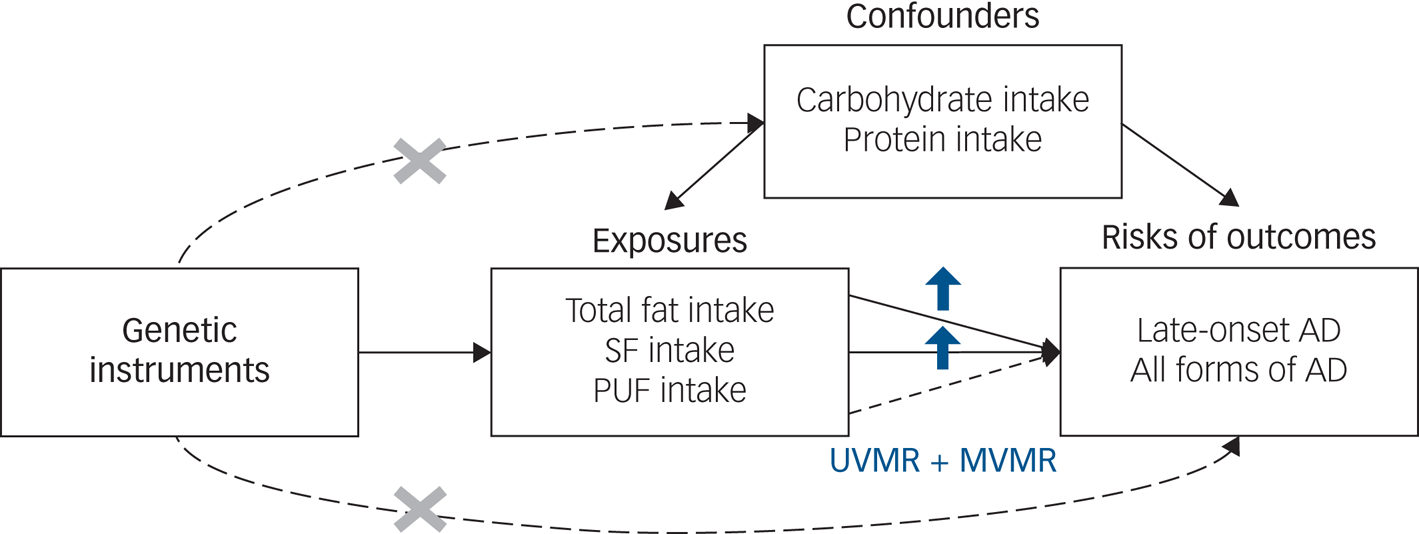
A two-sample Mendelian randomisation study design was applied using genetic variants associated with fat and other types of nutrient intakes from the UK BiobankReference Sudlow, Gallacher, Allen, Beral, Burton and Danesh9 and with late-onset Alzheimer's disease (LOAD) and all forms of Alzheimer's disease from the FinnGen consortium.Reference Kurki, Karjalainen, Palta, Sipilä, Kristiansson and Donner10 Bidirectional UVMR was used to assess the associations of total fat, saturated fat and PUF intakes with the risk of Alzheimer's disease. A complementary UVMR analysis was conducted between protein and carbohydrate intakes and Alzheimer's disease. MVMR was used to investigate the direct effect of different types of fat intake on Alzheimer's disease, with conditioning on protein and carbohydrate intakes (Fig. 1).
Addressing the association between dietary fat intake and Alzheimer's disease, with the use of genetic instruments and Mendelian randomisation analysis.
LOAD, late-onset Alzheimer's disease; MVMR, multivariable Mendelian randomisation; PUF, polyunsaturated fat; SF, saturated fat; AD, Alzheimer's disease; UVMR, univariable Mendelian randomisation.

Data sources and instruments
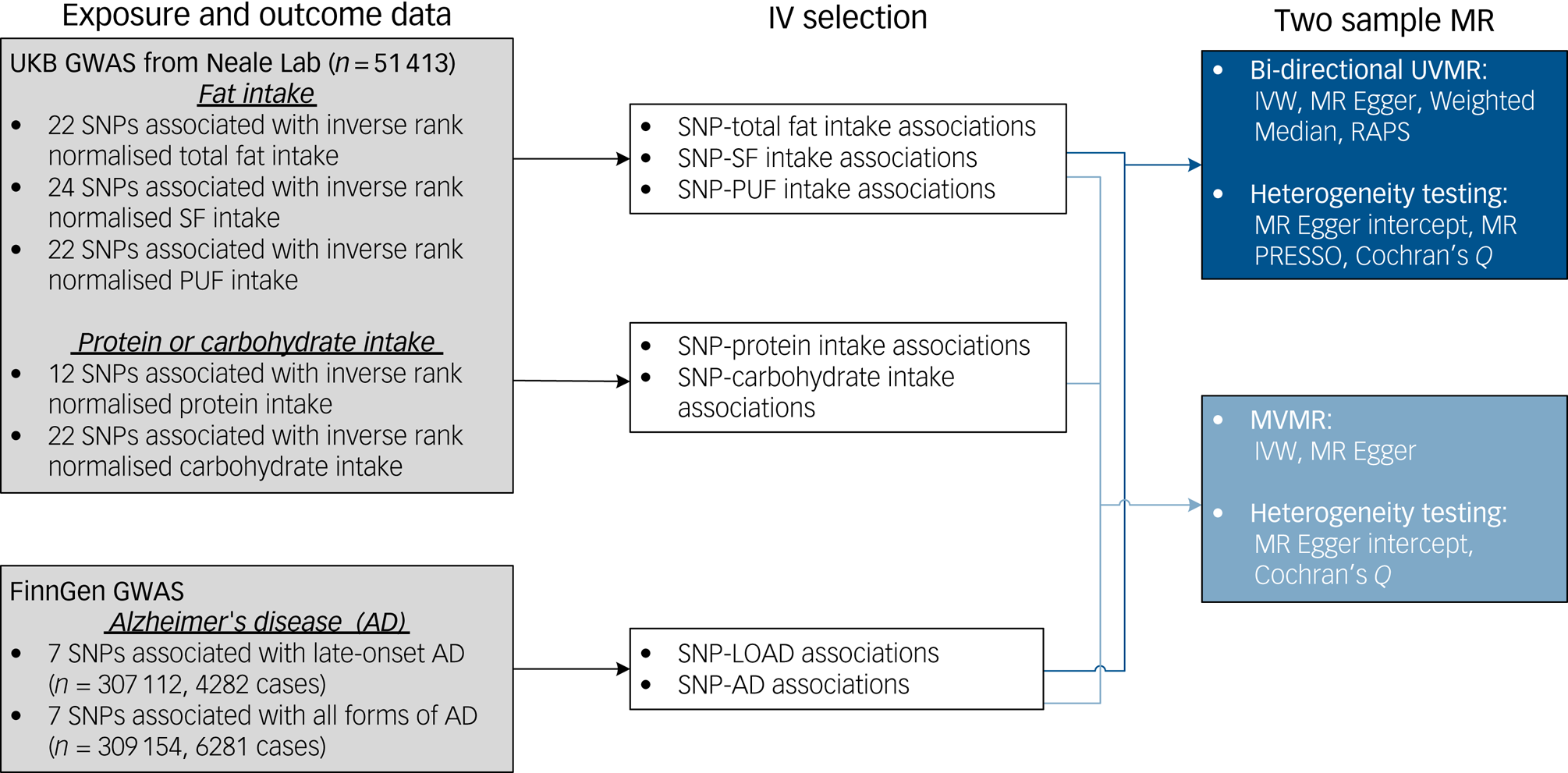
The study used genome-wide association study (GWAS) summary statistics derived from the UK Biobank and FinnGen consortium (Fig. 2). The study relied on publicly available GWAS summary statistics. All procedures contributing to this work comply with the ethical standards of the relevant national and institutional committees on human experimentation and the Helsinki Declaration of 1975, as revised in 2013. All procedures involving human subjects were approved by the Clinical Research Ethics Committee at each site of the public data. Written or verbal informed consent was obtained from all participants.
Flowchart of the Mendelian randomisation study design.
GWAS, genome-wide association study; IV, instrumental variables; IVW, inverse variance weighted; LOAD, late-onset Alzheimer's disease; MR, Mendelian randomisation; PUF, polyunsaturated fat; UKB, UK Biobank; RAPS, robust adjusted profile score; SNP, single nucleotide polymorphism; SF, saturated fat; total AD, Alzheimer's disease; UVMR, univariable Mendelian randomisation; MVMR, multivariable Mendelian randomisation with adjustment for protein and carbohydrate intakes.

Intake of fats and other types of nutrient
GWAS summary statistics associated with total fat intake (phenotype code: 100004), saturated fat intake (phenotype code: 100006), PUF intake (phenotype code: 100007), protein intake (phenotype code: 100003) and carbohydrate intake (phenotype code: 100005) were drawn from the Neale Lab based on the UK Biobank (http://www.nealelab.is/uk-biobank) (GWAS round 2). The UK Biobank study design has been described elsewhere.Reference Sudlow, Gallacher, Allen, Beral, Burton and Danesh9 Briefly, UK Biobank is a very large and detailed prospective study with over 500 000 participants aged 40–69 years when recruited in 2006–2010. The standard quality control for GWAS can be found at https://github.com/Nealelab/UK_Biobank_GWAS. A total of 51 413 UK Biobank participants of European ancestry were included. The dietary intake of each type of nutrient (g) was estimated from information collected using a web-based hybrid dietary assessment instrument (Oxford WebQ), a validated food frequency questionnaire covering a 24-h recall period.Reference Greenwood, Hardie, Frost, Alwan, Bradbury and Carter11 The dietary information was transformed with inverse rank normalised for GWAS analysis.
Alzheimer's disease
GWAS summary statistics for LOAD (phenocode: Alzheimer's disease_LO) and all forms of Alzheimer's disease (phenocode: G6_Alzheimer) were obtained from Release 7 of the FinnGen consortium. FinnGen is an ongoing research project collecting the genome and national health register data of Finns. Release 7 of FinnGen contained 224 737 participants with an average age of 63 (https://finngen.gitbook.io/documentation/data-download).Reference Kurki, Karjalainen, Palta, Sipilä, Kristiansson and Donner10 Alzheimer's disease cases were identified according to hospital discharge records and cause of death in Finland and were required to meet international consensus criteria. Cases were identified using ICD-10 criteria: F00.1 and G30.1*, F00.10*, F00.10*G30.1, G30.1 and G30.1 + F00.10 for LOAD; and G30 for Alzheimer's disease. In total, 4282 LOAD cases and 302 830 controls, and 6281 all forms of Alzheimer's disease cases and 302 873 controls were included in the GWAS analyses. All participants were of European ancestry and none overlapped with UK Biobank.
Mendelian randomization analysis
A detailed description of the selection of genetic instrumental variables can be found in the Supplementary methods, available at https://doi.org/10.1192/bjp.2024.163. For UVMR analysis, the inverse variance weighted (IVW)Reference Burgess, Butterworth and Thompson12 method was applied for the primary analysis, along with the weighted median,Reference Bowden, Davey Smith, Haycock and Burgess13 Mendelian randomisation-EggerReference Bowden, Davey Smith and Burgess14 and Mendelian randomisation-robust adjusted profile score (RAPS)Reference Zhao, Wang, Bowden and Small15 methods, as sensitivity analyses considering the violations of instrumental variable assumptions. The IVW method provided an unbiased causal estimate if there was no horizontal pleiotropy.Reference Burgess, Butterworth and Thompson12 The weighted median gave valid tests even if the prevalence of invalid single nucleotide polymorphisms (SNPs) was up to 50%.Reference Bowden, Davey Smith, Haycock and Burgess13 A test for intercepts of Mendelian randomisation-Egger regression was applied to indicate the degree of directional horizontal pleiotropy.Reference Bowden, Davey Smith and Burgess14 The RAPS method was robust to the systematic and idiosyncratic pleiotropy and gave a robust estimate for Mendelian randomisation analysis with weak instrumental variables.Reference Zhao, Wang, Bowden and Small15 Cochran's Q-test assessed the heterogeneity among SNPs, and a random-effects model in IVW was applied if heterogeneity existed (P < 0.05). An online tool was used to calculate the power of Mendelian randomisation analysis between dietary fat intake and the risk of Alzheimer's disease (https://shiny.cnsgenomics.com/mRnd)Reference Brion, Shakhbazov and Visscher16 (Supplementary Table 8).
Given that other types of nutrient intakes might have a relationship with fat intake, we also performed MVMR analysis to estimate the effect of fat intake on Alzheimer's disease, with conditioning on protein and carbohydrate intakes. The IVW method, based on a random-effects model, was used as the main analysis.Reference Burgess and Thompson8 The statistical methods used for the sensitivity analysis, tests of the potential heterogeneity and pleiotropy can be found in the Supplementary methods.
For LOAD and total Alzheimer's disease as the exposure, the causal estimates were scaled to the increase in the odds of an outcome per doubling of the odds of exposure (for example, an increase in the Alzheimer's disease probability from 10 to 20%) by multiplying the regressed β-value by 0.693 as described elsewhere.Reference Burgess and Thompson6 Analyses were carried out using R packages ‘TwoSampleMR’ (version 0.5.6),Reference Hemani, Zheng, Elsworth, Wade, Haberland and Baird17 ‘MR.RAPS’ (version 0.2)Reference Zhao, Wang, Bowden and Small15 and ‘MendelianRandomization’ (version 0.6.0) in the R environment (version 4.1.3 for macOS).
Results
Genetic instruments
After harmonisation of the SNP effect in the two summary statistics, 22 SNPs were used to instrument total fat intake, 24 SNPs were used to instrument saturated fat intake (rs4698932 was excluded for the relationship with intelligence and education in the Europeans), and 22 SNPs were used to instrument PUF intake. 7 SNPs were selected as instruments for LOAD and Aatotal Alzheimer's disease, and 12 and 22 SNPs were selected as instruments for protein and carbohydrate intakes. The F statistic of each SNP and the average F statistic were larger than 10, which indicated a small magnitude of weak instrumental variable bias (Supplementary Tables 1–7 and 9).
Causal effects between total fat intake and Alzheimer's disease
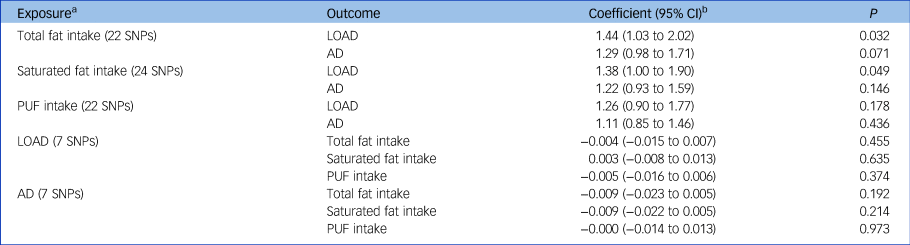
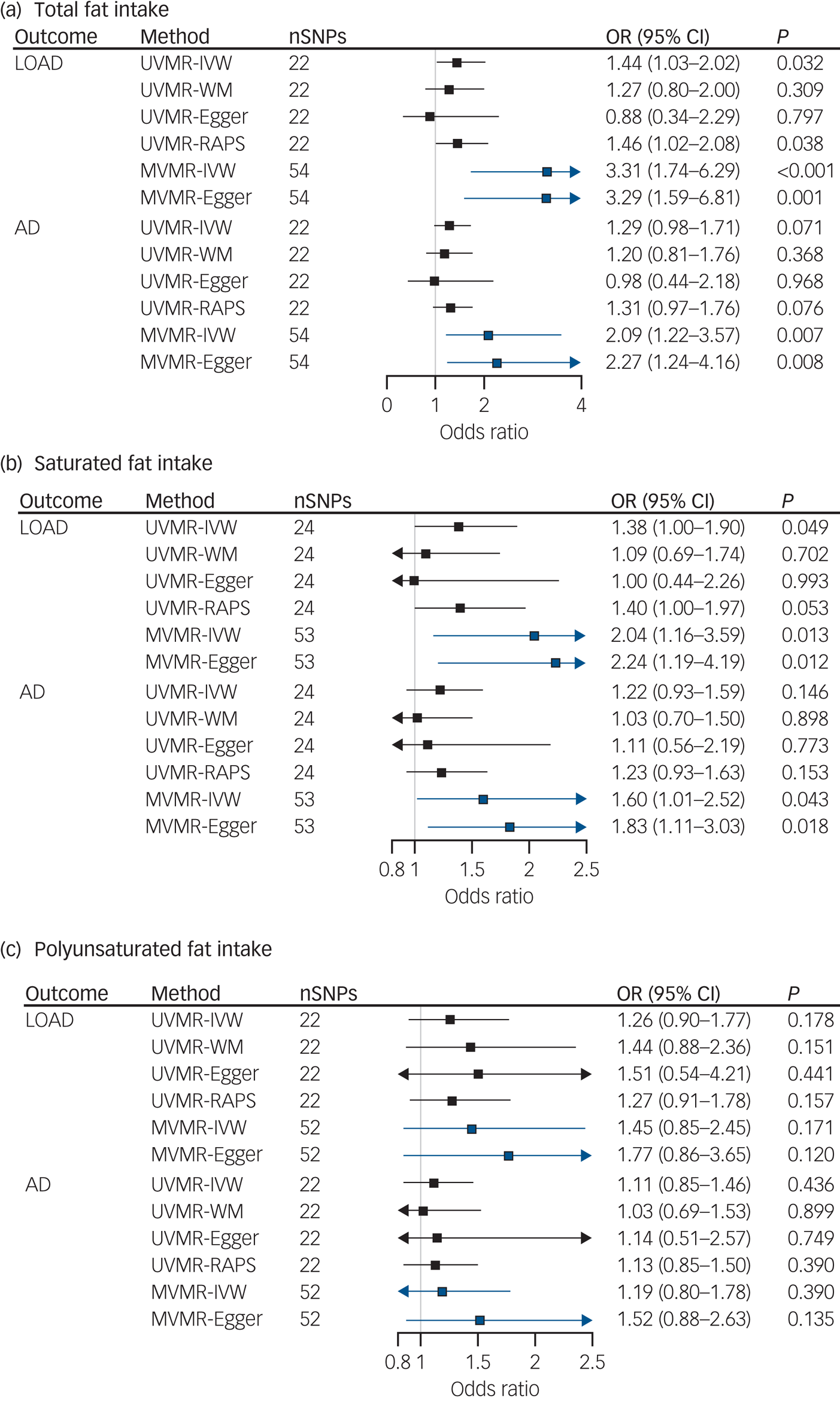
UVMR analysis showed a positive association between total fat intake and LOAD. One standard deviation (s.d.) increment in the genetically predicted total fat intake was associated with a 44% higher risk of LOAD (IVW odds ratio = 1.44, 95% CI 1.03–2.02). The causal effect of total fat intake on LOAD remained significant when adjusting for protein and carbohydrate intakes (IVW odds ratio = 3.31, 95% CI 1.74–6.29). Also, total fat intake was associated with a higher risk of total Alzheimer's disease in the MVMR analysis (odds ratio = 2.09, 95% CI 1.22–3.57) (Table 1, Fig. 3).
Bidirectional Mendelian randomisation of different types of fat intake on Alzheimer's disease under the inverse variance weighted Mendelian randomisation analysis

LOAD, late-onset Alzheimer's disease; PUF, polyunsaturated fat; AD, all forms of Alzheimer's disease.
a. Single nucleotide polymorphisms (SNPs) for LOAD and all forms of AD were extracted at P < 5 × 10⁻⁸; SNPs for total fat, saturated fat, PUF, carbohydrate and protein intake were extracted at P <1 × 10⁻⁵.
b. Odds ratios (ORs) are reported as the coefficients when total fat, saturated fat or PUF intake were the exposures, which meant the increase of AD risk for each standard deviation increased in the dietary fat intake. In the reverse direction, the coefficient was β, which meant the increase of dietary fat intake for one-fold increase in the odds of LOAD or all forms of AD.
Univariable and multivariable Mendelian randomisation analysis for the causal relationship of different types of fat intake on Alzheimer's disease.
IVW, inverse variance weighted; LOAD, late-onset Alzheimer's disease; RAPS, robust adjusted profile score; nSNPs, number of single nucleotide polymorphisms; AD, all forms of Alzheimer's disease; UVMR, univariable Mendelian randomisation; MVMR, multivariable Mendelian randomisation with adjustment for protein and carbohydrate intakes; OR, odds ratio per one-fold increase in the odds of all forms of Alzheimer's disease or LOAD, on the increase in the corresponding fat intake; WM, weighted median.

In the reverse direction, the genetic liability for LOAD or all forms of Alzheimer's disease was applied as the exposure. We found no causal effect of LOAD or all forms of Alzheimer's disease on total fat intake (Table 1, Fig. 3, Supplementary Tables 10 and 11).
The results of sensitivity analyses can be found in Supplementary Table 1.
Causal effects between different types of fat intake and Alzheimer's disease
Different types of fat intake showed different relationships with the risk of Alzheimer's disease. Higher saturated fat intake was associated with LOAD, but not associated with all forms of Alzheimer's disease (odds ratio = 1.38, 95% CI 1.002–1.90 (P = 0.049) and odds ratio = 1.22, 95% CI 0.93–1.59 respectively). The impact of saturated fat intake on LOAD remained after adjusting for other types of nutrient intake (IVW odds ratio = 2.04, 95% CI 1.16–3.59). Higher saturated fat intake was associated with the risk of all forms of Alzheimer's disease in the MVMR analysis (IVW odds ratio = 1.60, 95% CI 1.01–2.52).
PUF intake was not associated with all forms of Alzheimer's disease (IVW odds ratio = 1.11, 95% CI 0.85–1.46) or LOAD (IVW odds ratio = 1.26, 95% CI 0.90–1.77). The result of MVMR was consistent with that of UVMR. There was little evidence of the reverse associations. We found no causal effects of protein and carbohydrate intakes on the risk of Alzheimer's disease (Table 1, Fig. 3, Supplementary Tables 10 and 11).
Test of Mendelian randomisation analysis
In the UVMR, Mendelian randomisation-Egger analysis suggested that horizontal pleiotropy was limited (P for intercept >0.05). Cochran's Q-test indicated that the possibility of heterogeneity was relatively small (P > 0.05). Little evidence was found for the reverse causality across the analyses (P for Mendelian randomisation Steiger test <0.05) (Supplementary Table 9). A small magnitude of horizontal pleiotropy and heterogeneity was shown in the MVMR analysis (all P > 0.05) (Supplementary Table 12).
Discussion
Main findings
Based on the GWAS summary statistics derived from two independent large cohorts, UK Biobank and FinnGen, the present two-sample Mendelian randomisation analysis showed that, with conditioning on the protein and carbohydrate intakes, higher intakes of total fat and saturated fat were associated with increased risks of LOAD and all forms of Alzheimer's disease. Dietary intake of PUF was not associated with Alzheimer's disease in the present study.
Comparison with previous studies
A meta-analysis of four cohort studies (n = 530 576) did not find a putative association between saturated fat and PUF intakes and risk of Alzheimer's disease.Reference Nwaru, Dierkes, Ramel, Arnesen, Thorisdottir and Lamberg-Allardt18 Another meta-analysis that pooled nine cohort studies (n = 23 402) reported a detrimental association between saturated fat intake and cognitive impairment (relative risk = 1.40, 95% CI 1.02–1.91) and incident Alzheimer's disease (relative risk = 1.87, 95% CI 1.09–3.20); the total and unsaturated fat intakes were not associated with the cognitive outcomes.Reference Cao, Li, Han, Tayie, Yao and Huang4 However, the differences in the populations and study methods (e.g. the ranges of nutrition intakes, the definitions of the compared groups) among the individual studies made it difficult to identify the real associations in the combining meta-analysis.Reference Barnard, Willett and Ding19 Such heterogeneity among studies might be responsible for the inconsistent findings between the different meta-analyses.
Conventional observational studies are subject to the potential reverse and confounding bias. Even though participants diagnosed with Alzheimer's disease were excluded at baseline in a prospective study, those at the early stage of Alzheimer's disease might be included in the cohort, who would suffer from debilitation in late Alzheimer's disease and might reduce their food intake, skewing macronutrient patterns. In addition, potential confounders, such as sleep disturbance, could not be accurately measured before the studies.Reference Irwin and Vitiello20 The present Mendelian randomisation study design was probably a better choice for causal inference.Reference Burgess and Thompson6 Genetically predicted exposures are independent of such bias. Besides, the reverse Mendelian randomisation analysis was performed and indicated limited causal effects.
Only one previous Mendelian randomisation study estimated the causal association between macronutrient intakes and Alzheimer's disease.Reference Wang, Sun, Pan, Bai, Zhu and Zhang7 It reported a negative association between higher relative intake of fat and Alzheimer's disease (odds ratio = 0.22, 95% CI 0.06–0.86) based on the International Genomics of Alzheimer's Project, which reported a much higher prevalence of Alzheimer's disease than that in the general population. Thus, the present study using the FinnGen consortium could be a better choice to reduce potential ascertainment bias.
Comparison of UVMR and MVMR
The present study controlled for the impact of other nutrients in the MVMR analysis and produced a much stronger effect than the UVMR. It also found associations of genetically predicted higher intakes of total fat and saturated fat with elevated risks of all forms of Alzheimer's disease only in MVMR analysis. The effects of protein and carbohydrate intakes were in the opposite direction of fat intake in the present results, and a previous narrative review reported that both protein and carbohydrate intakes were beneficial to cognitive function.Reference Muth and Park21
Influencing patterns of saturated fat and PUF intakes on Alzheimer's disease
Notably, the pattern of influence of saturated fat and PUF intakes on Alzheimer's disease risk differed. In line with a meta-analysis published in 2019,Reference Cao, Li, Han, Tayie, Yao and Huang4 only a higher intake of saturated fat was harmful to the development of Alzheimer's disease, indicating a greater importance of reducing the dietary intake of saturated fat for Alzheimer's disease prevention and management. A recent study reported that moderate PUF intake benefits cognitive function,Reference Mao, Yin, Guan, Xia, Yang and Zhou5 so it is necessary to use individual-level data in future studies to explore the possible U-shape causal patterns of PUF intake on the risk of Alzheimer's disease. Additionally, the present study used LOAD and all forms of Alzheimer's disease as the outcomes, and the causal estimates were stronger for LOAD, meaning that fat intake might have a long-term and cumulative effect on cognitive decline.
Underlying biological mechanisms
The mechanisms underlying the causal linkage between fat intake and Alzheimer's disease may involve several pathways. Higher fat intake induces the release of inflammatory factors, such as tumour necrosis factor alpha (TNF-α) and interleukin 6 (IL-6), which could trigger gliosis and neuroinflammation, leading to neurologic illness.Reference Gupta, Knight, Gupta, Keller and Bruce-Keller22 Over-intake of fat also contributes to brain degeneration. The glycerophospholipids in the neuronal membrane are prone to lipid peroxidation.Reference Mao, Yin, Guan, Xia, Yang and Zhou5 Insulin resistance is another potential mediator connecting fat intake and Alzheimer's disease. Saturated fat intake can increase insulin resistance immediately,Reference Hernández, Kahl, Seelig, Begovatz, Irmler and Kupriyanova23 and brain insulin resistance is an early and common phenomenon of Alzheimer's disease that leads to cognitive decline.Reference Talbot, Wang, Kazi, Han, Bakshi and Stucky24
Strengths and limitations
The present study investigated the causal associations between fat intake and Alzheimer's disease using a Mendelian randomisation study design. Notably, our study is the first to estimate the impacts of saturated fat and PUF separately. MVMR was applied with conditioning on other nutrients, and fat intake retained its effect. Furthermore, previous studies were mainly conducted among older adults,Reference Cao, Li, Han, Tayie, Yao and Huang4,Reference Nwaru, Dierkes, Ramel, Arnesen, Thorisdottir and Lamberg-Allardt18 whereas the present study included both middle-aged and older adults. Considering that cognitive decline begins in early adulthood, our results could be more safely generated for middle-aged adults. However, several limitations should be mentioned. First, although a validated food frequency questionnaire was used, self-reported dietary intake is subject to measurement bias. Nevertheless, the present bias was non-differential, leading to results towards the null hypotheses.Reference Sorahan and Gilthorpe25 Second, the genetically instrumented fat intake might not comprehensively characterise the fat intake and its effect on Alzheimer's disease. Furthermore, the F-statistics were more than 10, which suggested that the probability of weak instrument bias was minimal. Third, the statistical power of PUF on the risk of all forms of Alzheimer's disease was relatively low due to the limited variances of exposures explained by the genetic variants and low proportion of Alzheimer's disease cases, which might lead to false-negative results. Fourth, the current summary-level Mendelian randomisation methods were poorly suited to assess the potentially non-linear relationship between fat intake and the risk of Alzheimer's disease, so future individual-level Mendelian randomisation studies are warranted. Fifth, owing to the lack of available GWAS summary statistics on insulin resistance and the function of nerve cells, the present study did not further investigate the precise mechanisms underlying the observed associations. In addition, we did not exclude the SNPs related to confounding factors. However, it would not necessarily differentiate between horizontal and vertical pleiotropy, where only the former could bias Mendelian randomisation studies,Reference Burgess and Thompson6 and the biological function of the genetic instrument was not clear. Also, tests of the intercept of the Mendelian randomisation-Egger regression did not find pleiotropy bias. Further replication based on large-scale general European populations independent of the UK Biobank and FinnGen consortium are necessary to improve the robustness of the present Mendelian randomisation results. Finally, the UK Biobank and FinnGen consortium did not represent the whole populations of the UK and Finland owing to low participation.Reference Sudlow, Gallacher, Allen, Beral, Burton and Danesh9,Reference Kurki, Karjalainen, Palta, Sipilä, Kristiansson and Donner10 The present Mendelian randomisation analyses were conducted among participants of European descent, which might also limit the generalisation of our findings to other ancestry groups.
Conclusions
In summary, the present two-sample Mendelian randomisation study suggests that higher fat intake, especially saturated fat intake, contributes to a higher risk of Alzheimer's disease, and the causal effects are independent of other types of nutrient intake. Our findings provide empirical support that reducing dietary saturated fat intake is beneficial for preventing and managing Alzheimer's disease.
Supplementary material
Supplementary material is available online at https://doi.org/10.1192/bjp.2024.163
Data availability
The study relied on publicly available summary statistics: GWAS summary statistics associated with dietary intakes of total fat, saturated fat, polyunsaturated fat, protein and carbohydrate can be obtained through the Neale Lab portal (http://www.nealelab.is/uk-biobank); GWAS summary statistics for all forms of Alzheimer's disease and late-onset Alzheimer's disease were obtained from the R7 release of the FinnGen consortium (https://finngen.gitbook.io/documentation/data-download).
Acknowledgements
We thank the participants and investigators of the FinnGen consortium and UK Biobank.
Author contributions
W.Y., C.Y. and Y.Z. designed the whole study. Y.Z. and Y.L. analyzed the data. Y.Z. drafted the manuscript. C.Y. and W.Y. helped interpret the results and contributed to the critical revision of the manuscript for important intellectual content. Y.Z., Y.L., J.L., D.S., L.L., D.Z., C.Y. and W.Y. reviewed and approved the final manuscript. C.Y. and W.Y. were the guarantors and supervised the whole study.
Funding
This study was supported by the STI2030-Major Projects-2022ZD0211800; the National Natural Science Foundation of China (81825009, 82192901, 82192904, 82192900, 81973125); National Key R&D Program of China (2021YFF1201103); Academy of Medical Sciences Research Unit (2019-I2M-5-006); the Chinese Institute for Brain Research at Beijing (2020-NKX-XM-12); the Fundamental Research Funds for the Central Universities (Peking University Medicine Fund for world's leading discipline or discipline cluster development, BMU2022DJXK007). Sponsors had no role in the study design, data collection, data analysis and interpretation, writing of the report, or the decision to submit the article for publication.
Declaration of interest
None.
Analytic code availability
The codes used for the data analyses in this study are available from the corresponding author.




eLetters
No eLetters have been published for this article.