

Introduction
Interdisciplinary research is often seen as essential to providing solutions to complex societal problemsReference Bridle, Vrieling, Cardillo, Araya and Hinojosa 1– Reference Brown, Deletic and Wong 3 and it has been predicted that the future of research is increasingly interdisciplinary.Reference Lyall and Meagher 4 While there are benefits of interdisciplinarity, there are also well recognized challenges and risks,Reference Darbellay 5 e.g. difficulties in communication, longer timescales to successful outputs, lack of peer support and feeling valued.Reference Bridle, Vrieling, Cardillo, Araya and Hinojosa 1 , Reference Brown, Deletic and Wong 3 , Reference de Ruiter and Gombert 6– Reference Mallaband, Wood, Buchanan, Staddon, Mogles and Gabe-Thomas 9
Early-career researchers are often motivated to participate in interdisciplinary projects due to the chance to address societal problems (e.g. personal motivation by the problem/topic and the feeling that the work is important to society) and the enjoyment of specific interdisciplinary collaborations.Reference Milman, Marston, Godsey, Bolson, Jones and Weiler 8 However, due to academic and reward systems often being aligned with disciplines, some of the risks of high time investment for initial little return limiting outputs, and lack of a disciplinary home for lectureship and funding applications are particularly problematic for early-career researchers trying to establish their careers.Reference Bridle, Vrieling, Cardillo, Araya and Hinojosa 1 , Reference de Ruiter and Gombert 6 , Reference Mallaband, Wood, Buchanan, Staddon, Mogles and Gabe-Thomas 9
Furthermore, it may be challenging for even those highly-motivated early-career researchers to engage in interdisciplinary projects due to a lack of extensive network or publication list to leverage collaborations.Reference de Ruiter and Gombert 6 Therefore, it has been concluded that there is an urgent need for formats to facilitate interdisciplinary interactions for early career researchers.Reference Bridle, Vrieling, Cardillo, Araya and Hinojosa 1, Reference de Ruiter and Gombert 3, Reference de Ruiter and Gombert 6, Reference Mallaband, Wood, Buchanan, Staddon, Mogles and Gabe-Thomas 9 Several of these types of encounter have been developed, focusing either on the cultivation of appropriate skills, or the direct development of interdisciplinary projects, or a combination of the two.Reference Bridle, Vrieling, Cardillo, Araya and Hinojosa 1 An overview of encounter types, not specific to early-career researchers, is given in Table 1, adapted from a presentation by Phil Ward entitled ‘Supporting Interdisciplinarity’ (see https://slideplayer.com/slide/4141854/), given at a British Academy Event in 2015. 10 Details, advantages and disadvantages of each approach are identified.
Overview of interdisciplinary encounter types: adapted from a presentation by Phil Ward entitled ‘Supporting Interdisciplinarity’ given at a British Academy Event in 2015. 10

Specific examples of the latter two encounter types, e.g. specific workshops or programmes, targeting early-career researchers, include Facing the Future,Reference de Ruiter and Gombert 6 Masterclasses,Reference Lyall and Meagher 4 Crucible,Reference Bridle, Vrieling, Cardillo, Araya and Hinojosa 1 the European Science Foundation (ESF) Junior SummitReference Bridle, Vrieling, Cardillo, Araya and Hinojosa 1 and Food Futures,Reference Rivera-Ferre, Pereira, Karpouzoglou, Nicholas, Onzere, Waterlander, Mahomoodally, Vrieling, Babalola, Ummenhofer, Dogra, de Conti, Baldermann, Evoh and Bollmohr 11 as well as postgraduate training programmes.Reference Brown, Deletic and Wong 3 , Reference Hedberg, Hesse, Baldwin, Bernhardt, Retchless and Shinn 12– Reference Graybill, Dooling, Shandas, Withey, Greve and Simon 14 Previous work has investigated the components necessary for successful design and delivery of such encounters, concluding that:
∙ Significant diversity in background, culture and discipline is beneficial, especially to target big interdisciplinarity (e.g. collaboration between distant disciplines) although more time might be necessary for relationship building.
∙ Mixed career stage encounters can be extremely beneficial, as early-career researchers found that ‘a valuable aspect of the summit was the opportunity to interact with senior academics’Reference Bridle, Vrieling, Cardillo, Araya and Hinojosa 1 and ‘it was particularly interesting when senior academics shared personal experiences, both positive and negative, on interdisciplinary collaboration.’Reference de Ruiter and Gombert 6
∙ Viewpoints on whether a theme is essential vary, with participants/organizers of the ESF Junior Summit and Facing the Future considering a theme vital,Reference Bridle, Vrieling, Cardillo, Araya and Hinojosa 1 , Reference de Ruiter 15 whereas Crucible and Masterclasses have been run successfully without a theme.Reference Bridle, Vrieling, Cardillo, Araya and Hinojosa 1 , Reference Lyall and Meagher 4
∙ Place is important, as collaboration levels have been linked to the rating of the physical environment, and stepping out of one’s comfort zone enhances creativity. In addition, a ‘new and inspiring place promotes relationship building and creativity’.Reference Bridle, Vrieling, Cardillo, Araya and Hinojosa 1 , Reference Lyall, Bruce, Marsden and Meagher 16– Reference Stokols, Misra, Moser, Hall and Taylor 18
∙ In terms of size, 20–40 participants is optimal, both for networking and idea generation,Reference Stokols, Misra, Moser, Hall and Taylor 18 , Reference Rhoten 19 e.g. ‘small enough to feel intimate and sufficient opportunity to interact with everyone’,Reference Bridle, Vrieling, Cardillo, Araya and Hinojosa 1 and practical considerations, e.g. ‘the main reason is scale. 50+ would require larger venues, more time to organize etc. Also, since we did “turbo talks” we did not want to have a very large group. This would hinder the informal atmosphere we wanted to create’.Reference Rhoten 15
Aspects of programme structure have also been considered. Typical activities include informal group discussions, seminars/lectures (by senior academics), turbo talks, speed dating, collaboration walls, informal and socializing time, breakout discussion groups and output-related activities (e.g. reports, films, seed-funding). Ensuring a communicative attitude of appreciative inquiry, e.g. listening to, being curious of, and understanding each other’s perspectives and potential contributions to joint efforts, is importantReference Graybill, Dooling, Shandas, Withey, Greve and Simon 14 and, with especially large groups, structured and facilitated approaches become essential. A recent Facing the Future report focused on aspects of programme structure, and found that keynotes from leading academics were useful since these ‘… helped to give the conference academic rigour and were highly appreciated by participants. In our view, keynotes can serve as an important bridge between the more traditional academic conference and more experimental workshops.’Reference de Ruiter and Gombert 6 Furthermore, the workshop trialled the use of ‘octasynthesis’ for generating interdisciplinary ideas and discussion, finding some benefits (‘by exploring synergies a more positive mindset was created that helped imagine what kind of future is possible if we work together’) although it was potentially not optimized for this setting since participants found that the method was time-consuming, exhaustive and resulted in a loss of detail as well as a failure to address practical solutions, e.g. ‘it did not take us far in considering the practical implications’ and that there would be a ‘…need to focus on a particular design problem to make outcomes more practice-oriented.’ 20 , 21
Additionally, informal social time to build relationships is important, especially since other work has concluded that trust and personal/intellectual chemistry is very important.Reference Lyall and Meagher 4 , Reference Bruce, Lyall and Meagher 7 Lyall et al. noted that pre-existing relationships can be an advantage for interdisciplinary collaboration and the lack of relationship building could be why partner search facilities have had a mixed response.Reference Bruce, Lyall and Meagher 7 Even if encounters don’t directly result in interdisciplinary projects, the relationships and network developed is useful for future potential projects.
Overall, encounters can enable early career researchers to build their research networks, expose them to new perspectives and ideas and enhance their communication skills. To maximize success, encounters should include components such as effective facilitation, a wide diversity of participants and clearly defined aims. Evaluation has shown the benefits of encounters. However, little work has evaluated the long-term impacts in terms of the number of interdisciplinary projects delivered and the impact upon the participants in terms of skills and career development.
Experimental Study
Data were gathered from two different encounters aimed at early-career researchers. The first was the UK Crucible programme (for details see Figure 1) and the second was the European Science Foundation (ESF) Junior Summit in Stresa, entitled Water: Unite and Divide (for more details see Figure 2). The encounters were selected as examples of different approaches, with Crucible more focused on development of new projects, although with a training component, and Stresa mainly focused on cultivation of early-career researchers’ interdisciplinary skills.
Overview and details of Scottish Crucible as an example of the UK Crucible programmes. Every year the programme involves three sets of 2-day workshops with an overnight stay and dinner for each one. During the final workshop, participants are encouraged to present potential interdisciplinary group projects from which a winning team is selected, although all teams, and other combinations of participants, are able to bid for a pot of seed funding, for which the interdisciplinary extent of the project is a key factor in success.

Overview and details of the ESF Junior Summit, on water.

In the UK, both Scottish and Welsh Crucibles were run, and different data were obtained for each of them. Scottish Crucible administered a questionnaire to 243 alumni (ex-participants in the programme) in November 2016, asking questions pertaining to personal and professional development, in addition to specific outputs directly attributed to participation in the Scottish Crucible. A participation rate of 25% was achieved with 61 respondents of 243 alumni. The majority of respondents (79%) represented 12 Scottish Higher Education Institutes, with the remaining respondents being from other UK universities, research institutes, or Small- and Medium-sized Enterprises. Five respondents had moved overseas, with 82% of respondents being still based in Scotland. The Welsh Crucible website contains six case studies of participants who described their experiences of undertaking the Welsh Crucible in 2011. 22 The text of these case studies was analysed, coding the data for mention of confidence, profile raising, generation and involvement in interdisciplinary projects and further funding being obtained. These topics were selected to align with the questions from the Scottish Crucible questionnaire. Additionally, relevant quotes were extracted relating to the selected topics.
With regard to the ESF Junior Summit, a questionnaire was distributed to all participants via Survey Monkey and email. Out of the 34 participants in the Stresa meeting, email contacts could be found for 32 of them (the PhD students had subsequently finished their doctorates but the majority had remained within academia and up-to-date details could be located). A participation rate of 47% was achieved with 15 respondents out of the 32 contacts. All responses were anonymous and the data were extracted directly from the Survey Monkey results analysis software.
The author of this publication participated in both Scottish Crucible and the ESF Junior Summit in 2012 but did not complete either questionnaire.
Results and Discussion
Data have been collected from participants in Crucible programmes and the European Science Foundation Junior Summit in Stresa. First, the results from the Crucible study are presented and discussed in terms of the levels of collaborative interdisciplinary projects generated and the wider benefits to participants. Second, the Stresa data are given and evaluated. Finally, conclusions are drawn from both sets of results and discussed with regard to the literature.
Crucible
The aim of Crucible is to provide leadership training, focusing on creativity and innovation, as well as forging new interdisciplinary research collaborations. Seed funding is available, on a competitive basis, as a means for participants to take forward new ideas. Evaluation of the Crucible programmes was based on two sets of data, one being a questionnaire distributed to alumni of Scottish Crucible, and the other being the six case studies of Welsh Crucible participants describing their experiences. In terms of the creation of interdisciplinary projects, the Crucible programme has been relatively successful, with the majority of Scottish Crucible survey respondents reporting participation in collaborative projects (Figure 3).
Responses to the question ‘Have you undertaken other collaborative research activity with colleagues you met through Scottish Crucible?’
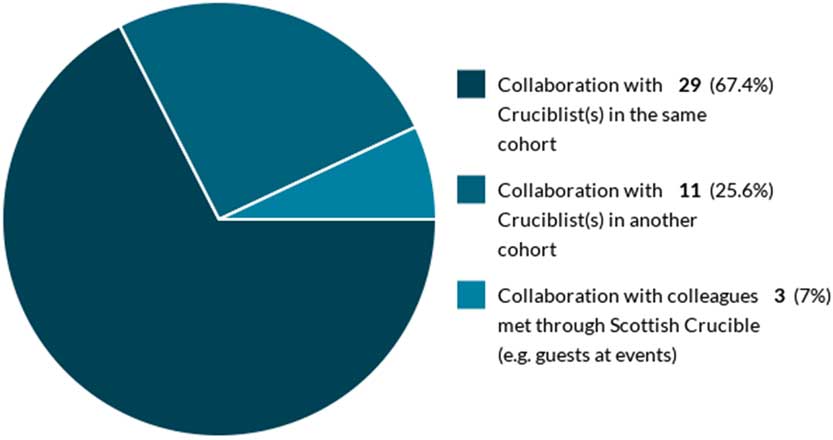
Crucible is run annually and 67% of participants collaborated with those from the same cohort. Alumni activities allow for mixing between cohorts, expanding the network of participants, and 26% of respondents reported this type of collaboration, not supported by direct seed-funding after the event. This shows the interest of the respondents in interdisciplinarity and the communication skills developed during Crucible to form these new partnerships. A few Crucibilists reported collaborating with other guests at Crucible events, e.g. senior academics and policy makers, agreeing with the literature that inclusion of such people is often beneficial to encounters.
Five out of the six Welsh Crucible participants also mentioned one or more projects that arose during or after Welsh Crucible, with 33% of these projects achieving additional funding. Scottish Crucible collaborative interdisciplinary outputs (Figure 4) included further research proposals with a reasonable proportion being awarded funding. In addition, there were research outputs such as conference presentations or paper publications as well as creation of an app, delivery of public engagement, working with industry, student projects, working with the media, and activity for the Scottish Parliament (the latter six covered by ‘other’ in Figure 4). The nature of the interdisciplinarity within these collaborations has not been specified but quotes from participants suggest that, in some cases, broad interdisciplinarity was achieved, since comments related to areas the participants had never previously considered working with:
Thanks to the Crucible I’ve spoken in depth to researchers working in areas I’d never even considered before, which has in itself changed the way I look at my own work.
…helped me to enhance my research portfolio, expand into new areas of interdisciplinary research collaboration with other academic colleagues across Wales.
[Scottish Crucible has] given me access through collaboration to areas that I hadn't before reached with my research.
Responses to the question ‘What outputs have arisen from Scottish Crucible-funded projects and other collaborations?’

Additionally, the interest of participants in interdisciplinary work seems to have been increased:
I've been more proactive at seeking out professional development opportunities and at initiating interdisciplinary collaborations.
Part of the Crucible experience is learning skills to enable interdisciplinary working (e.g. ‘I learned how to lead collaborative research projects professionally and fruitfully’). However, it appears that these skills have led to a number of other benefits (Figure 5) along with participants increasing their confidence (Figure 6) and raising their profile.
Responses to the question ‘Has your participation in Scottish Crucible enhanced your skills in any of these areas?’

Responses to the question ‘Has Scottish Crucible enhanced your confidence in exploring new research areas and opportunities?’

One particular benefit, perhaps specifically linked to the improved ability to communicate effectively with different audiences, was in terms of the knowledge exchange undertaken by Scottish Crucible participants (Figure 7) including organizing ‘a workshop at Scottish Government on behaviour change for health’, ‘providing evidence to Scottish Government and the Scottish Parliament in relation to planned or ongoing legal reform including land reform’ and public engagement, e.g. ‘set-up a 3D printing exhibition which was presented at Heriot-Watt Illuminations, Dunbar SciFest, Opening of the Scottish Parliament, and Midlothian Science Festival’.
Responses to the question ‘Have you undertaken any forms of knowledge exchange as a result of taking part in Scottish Crucible?’

Responses to the question ‘Are you in touch with or have worked with any of the ESF Stresa meeting participants since?’

With regards to confidence, comments included the following.
I’ve got a lot more confidence.
…given me the confidence to work with researchers in other disciplines, as well as the tools to develop these collaborations.
It was a fantastic experience which greatly increased my confidence in networking and interacting with policy makers.
Furthermore, a third of participants said that participation in Scottish Crucible had led to a raised profile, from local level (e.g. university news pages, local press), to national (e.g. radio interviews, national researcher networks). A Welsh Crucible alumni commented on how ‘it encouraged me to think more carefully about my own profile.’
ESF Junior Summit in Stresa
The aim of the ESF Junior Summit on Water: Unite and Divide, held in Stresa in 2012, was to invite young researchers from across Europe to participate in discussions regarding the opportunities and challenges of interdisciplinarity. As such, this encounter could be considered a cultivation encounter focusing on the skills needed for interdisciplinarity and for raising awareness of the challenges and benefits.Reference Bridle, Vrieling, Cardillo, Araya and Hinojosa 1 However, some output-related components were included, with a writing group being tasked with producing a publication, and a video group providing an audio-visual document. Furthermore, following the workshop, a special issue in the Journal of Water Resources and Protection, comprising journal articles written by Stresa participants, was proposed and published.
The direct outputs of the workshop resulted in 27% of the respondents having worked together on special issue articles and a further 13% having collaborated on the article or video. Furthermore, over five years later it was found that the workshop had been successful in building a research network among the early-career participants, with 40% having discussed potential funding applications and plans, with 13% having actually applied for joint funding and 27% having worked on research projects together (Figure 8). One identified challenge for early-career researchers is to access an appropriate network for engaging in interdisciplinarityReference de Ruiter and Gombert 6 and this type of encounter seems to have offered the opportunity to develop such a network, which has been exploited by a significant proportion of participants. Additionally, a further 33% have not yet utilized the network but consider it a potential source of collaborators if the right opportunity occurred as well as a way to keep up-to-date with developments in different areas, by following the work of other participants:
I really enjoyed the Stresa meeting and thought that it was quite pioneering in some respects (bringing us all together; the joint publication; the video) – it is a shame that, to my knowledge, there have not been further summits of this kind (or if there have been, they have not been in subject areas to which I could contribute!). Also, while I have not directly collaborated with anyone from the group (partly because I have not worked on water in a while), I have followed the work of various people with interest.
In addition, the relationship building seems to have worked well, with 40% of participants having been in touch, discussing matters other than direct research collaborations, e.g. challenges in undertaking interdisciplinarity projects, or other matters of shared research career issues, suggesting that development of peer support is one potential output of organizing encounters. This could be beneficial as the literature has shown one challenge for early-career researchers is a feeling of lack of peer support when they embark on interdisciplinary research.Reference Mallaband, Wood, Buchanan, Staddon, Mogles and Gabe-Thomas 9
Given that one of the aims of the summit was to develop interdisciplinary skills, the questionnaire asked whether participants felt better equipped to deal with interdisciplinary research and to what extent they had engaged in interdisciplinarity (Figure 9). Eighty-seven percent of respondents had subsequently undertaken interdisciplinary collaborations, with 67% reporting a general increased level of openness towards such participation. Furthermore, 40% of respondents felt better able to cope with the challenges of interdisciplinary research, and 73% reported increased confidence in talking with people from other disciplines.
Responses to the question ‘In terms of interdisciplinary (ID) research since Stresa have you (tick all that apply).’

One critique of the use of encounters is that such events are extremely time-consuming, necessitating a significant commitment from participating academics, amongst many other competing demands upon their time. 10 However, given that 40% of respondents had subsequently participated in similar meetings and 80% had recommended such events to colleagues, indicates that the participants found the time investment to be worthwhile. This conclusion was backed up by responses to another question, where all respondents confirmed that the meeting had been beneficial to their career, with 27% saying it was very beneficial (Figure 10).
Responses to the question: ‘To what extent do you feel the meeting has been beneficial to your career?’

Various career benefits to participating in the Stresa encounter were identified by respondents (Figure 11) including direct benefits such as publications and collaborative research projects, the outputs of which were beneficial to career progression. One participant commented that, following Stresa, she now has ‘…one of the first truly interdisciplinary Professorships in Germany’. The aims of the workshop were to broaden the perspectives of the participants in exposing them to other disciplines and for them to discuss the challenges and benefits of interdisciplinarity; 67% and 47% respectively found these factors helpful for their careers. As previously highlighted, a challenge for early career researchers in initiating interdisciplinary projects is finding appropriate collaborators,Reference de Ruiter and Gombert 6 and 33% of respondents found the building of a network of early-career researchers in the water area very helpful, with a total of 80% finding it useful to meet other early-career researchers, and especially those from other disciplines. Over 50% of participants found the opportunity to step away from day-to-day work and reflect upon their research direction a useful benefit of the event, and space for reflection represents an unintended bonus of such encounters.
Responses to the question: ‘Do you feel the meeting has been beneficial to your career through any of the following routes?’

Overall
Both sets of data confirm that the interest of early-career researchers in interdisciplinarity is high,Reference Bridle, Vrieling, Cardillo, Araya and Hinojosa 1 , Reference Milman, Marston, Godsey, Bolson, Jones and Weiler 8 as evidenced by the participation in these encounters themselves and the subsequent involvement in interdisciplinary projects. A total of 67% of Crucibilists had collaborated with fellow members of their annual cohort, with 26% having collaborated across cohorts, and up to 40% of Stresa participants having either applied for joint funding, worked on interdisciplinary projects or discussed potential plans. The higher rate observed for Crucible attendees could reflect the different focus of the encounters, with Stresa classified as a cultivation encounter, and Crucible as more of a development encounter. The results could also reflect the Crucible availability of seed-funding providing an incentive to develop collaborations and an enabler to deliver projects. Crucibles also organize alumni activities, allowing people the opportunity to meet participants from other cohorts and develop new ideas. The level of interaction, despite no funding or follow-up activities, for the Stresa meeting is also good. However, the issue of incentives was raised:
While Stresa was very interesting and good to meet other researchers across many disciplines (sensitization), it is hard to jointly define a research direction around a very broad theme like water. I would be a supporter for other targeted meetings around somewhat more narrow or focused themes (although not necessarily narrow in disciplinarity!), whereby funding is made available also for follow-up activities in terms of generating research proposals with small ID-teams or the like. Although my work inherently contains working across disciplines, it may need stronger incentives to embark on new challenging collaborations. Nonetheless, it was a nice experience!
The design of encounters should consider the focus and aims of the encounter and whether seed-funding or other incentives will be important to support follow-on activities. In addition to research outputs, and the career bonus of achieving funding, small funded projects also offer the chance to experience interdisciplinary working, further developing skills that might have been theoretically discussed during a meeting. Previous literature has noted a high level of motivation among early-career researchers in interdisciplinarityReference Bridle, Vrieling, Cardillo, Araya and Hinojosa 1 , Reference Milman, Marston, Godsey, Bolson, Jones and Weiler 8 , Reference Mallaband, Wood, Buchanan, Staddon, Mogles and Gabe-Thomas 9 (one of the responses to the ESF Stresa questionnaire was ‘I was hoping the email was about a new Stresa meeting! :)’) and it is clear that not only does the organization of encounters offer the opportunity for early-career researchers to engage in such collaborations, but that they fully take advantage of this, developing many new ideas and projects.
Beyond direct new collaborative interdisciplinary projects, encounters offer several other benefits to early-career researchers, including generation of a network of collaborators and peer-support, and development of skills such as confidence and communication as well as broadening perspectives and the opportunity to reflect upon their research direction. Trust and relationship building are key components of successful interdisciplinary research.Reference Lyall and Meagher 4 , Reference Bruce, Lyall and Meagher 7 The data clearly show an increase in confidence among encounter participants in discussing and engaging with others from different disciplines. This indirect benefit of encounter participation should increase the likelihood of future interdisciplinary collaboration since improved communication skills will enable early-career researchers to generate and explore potential collaborative ideas as well as build the strong relationships necessary to successfully deliver the interdisciplinary work. Many participants in both the encounter types surveyed here also report an increased openness towards interdisciplinarity.
One of the challenges raised for early-career researchers is the lack of an extensive network or publication list to leverage interdisciplinary collaborations.Reference de Ruiter and Gombert 6 Encounters clearly build strong relationships and allow participants to access researchers from widely different disciplines, helping to overcome this challenge. Crucible alumni activities enable the maintenance and expansion of this network, the advantage of which is evidenced by collaborations across cohorts, and encounters should consider methods of promoting and maintaining links. This is clearly easier within a country, as in the case of Scottish Crucible, compared with the Europe-wide ESF summit.
Finally, this study concentrated on following up the level of interdisciplinary engagement overall and measuring collaboration between encounter participants specifically, and in doing so identified several other benefits of encounter participation. However, one limitation was that any issues and challenges faced by participants in their interdisciplinary journeys were not investigated, and potentially those for whom these experiences were less positive may have been less likely to respond. Further work should concentrate on both the benefits experienced by encounter participants as well as the challenges faced, which could help tailor future encounters to try to equip participants with the skills to solve the potential problems, as well as raise awareness for policy makers and institutions of the current challenges faced by interdisciplinary early-career researchers, which might require adaption of existing funding and reward structures.
Conclusion
In summary, this article has evaluated the extent of interdisciplinary collaboration arising from two different types of encounter, targeting early-career researchers, demonstrating that encounters successfully result in many interdisciplinary projects, which often lead to tangible outputs such as publications, conference presentations, further research funding and public engagement. In addition, the article has considered wider, long-term benefits to early-career researchers resulting from encounter participation, with the participants themselves reporting increased confidence, raised profile, improved communication and interdisciplinary working skills along with career development benefits. The findings confirm previous literature that reports high motivation for early-career researchers towards interdisciplinarity and indicates how encounters can assist early-career researchers in overcoming some of the challenges identified in the literature. Therefore, it is concluded that further support should be made available for early-career researchers to access interdisciplinary encounters, as well as to offer seed-funding and follow-up activities. However, little focus was placed on the challenges faced by the early-career researchers during their interdisciplinary journeys and a deeper analysis of potential challenges would be beneficial to maximize the design and delivery of future encounters and to consider how the wider research environment impacts the experience of interdisciplinary early-career researchers.
Helen Bridle is an Associate Professor at Heriot-Watt University, and her main area of research lies at the interface of engineering and biology. Her specific interests are in the use of microfluidic systems to separate cells, e.g. for the concentration and detection of waterborne pathogens or the isolation and purification of stem cell products. In addition, Dr Bridle is interested in the design of structures and activities for the promotion of interdisciplinarity, especially for early-career researchers. She has participated in both the ESF Junior Summit and Scottish Crucible. Furthermore, public engagement is important to her work, which has been recognized by the receipt of the Royal Society of Edinburgh Innovator’s Prize for Public Engagement.


 Open access

