





Introduction
Cancer is a leading cause of death in developed countries (Sung et al. Reference Sung, Ferlay and Siegel2021), with annual cancer deaths projected to reach 17 million worldwide by 2030 (Boyle and Levin Reference Boyle and Levin2008). Bereaved relatives typically experience physical, emotional, and cognitive responses to the death, known as grief (Zisook and Shear Reference Zisook and Shear2009). This often involves distress (Kim et al. Reference Kim, Lucette and Loscalzo2013; Oechsle et al. Reference Oechsle, Ullrich and Marx2020) and guilt (bereavement guilt; Joa and Newberg Reference Joa and Newberg2023; Li et al. Reference Li, Stroebe and Chan2014); some bereaved relatives also experience prolonged and complicated grief reactions (Zordan et al. Reference Zordan, Bell and Price2019). For young adults (18–25 years) bereaved by a caregiver’s cancer, the co-occurrence of bereavement with developmental shifts (e.g. moving out, educational/career progression) present unique challenges, particularly if coping skills and flexibility are still evolving (Asselmann et al. Reference Asselmann, Wittchen and Lieb2015; Ing et al. Reference Ing, Patterson and Szabo2019; Karlsson et al. Reference Karlsson, Andersson and Ahlström2013). However, the experiences and needs of this population remain relatively understudied (Herberman Mash et al. Reference Herberman Mash, Fullerton and Shear2014; Kim et al. Reference Kim, Lucette and Loscalzo2013), and potential intervention strategies and programs are similarly lacking (Ing et al. Reference Ing, Patterson and Szabo2019). This paper focuses on the experiences of bereavement guilt among young adults bereaved by caregivers’ cancer, examining associations with attachment style, experiential avoidance, and psychological flexibility with the aim of informing psychosocial interventions for this population.
Young people’s experiences of bereavement
The death of a close relative is one of the most traumatic events a young person can experience (Stoppelbein and Greening Reference Stoppelbein and Greening2000); cancer-related deaths may carry additional psychosocial burden from witnessing a potentially protracted and traumatic period of illness and decline, and associated anticipatory grief (Hoffmann et al. Reference Hoffmann, Kaiser and Kersting2018; Zordan et al. Reference Zordan, Bell and Price2019). This is complicated by disrupted family communication and dynamics before and after bereavement, with families reporting uncertainty about if and how to discuss impending death, leaving young people unaware of or not expecting the death and still reconstructing the narrative of illness and loss years later (Lundberg et al. Reference Lundberg, Forinder and Olsson2018; Semple et al. Reference Semple, McCaughan and Beck2021; Varathakeyan et al. Reference Varathakeyan, McDonald and Patterson2017). While some studies evidence that young people bereaved by parental cancer are resilient and adjust to their loss (Angelhoff et al. Reference Angelhoff, Sveen and Alvariza2021; Hoffmann et al. Reference Hoffmann, Kaiser and Kersting2018), other work has indicated poor family cohesion (Birgisdóttir et al. Reference Birgisdóttir, Bylund-Grenklo and Kreicbergs2019), higher rates of self-injury (Bylund-Grenklo et al. Reference Bylund-Grenklo, Kreicbergs and Hauksdóttir2013), poorer self-esteem, depression, anxiety, and persistent unresolved grief (Bylund-Grenklo et al. Reference Bylund-Grenklo, Fürst and Nyberg2016; Lundberg et al. Reference Lundberg, Forinder and Olsson2018) following bereavement. Bereaved offspring report unmet needs for support and understanding from friends, family, educators, and those with similar experiences; help coping with feelings; time out or distraction; space and time to grieve; and help managing changing household responsibilities (McDonald et al. Reference McDonald, Patterson and Tindle2020; Patterson and Rangganadhan Reference Patterson and Rangganadhan2010). These unmet needs are associated with greater distress (McDonald et al. Reference McDonald, Patterson and Tindle2020). The psychosocial vulnerabilities of bereaved young people suggest a need for further research on factors associated with adjustment to bereavement to inform support services.
Grief and bereavement
The dual process model proposes that following bereavement, individuals oscillate between loss-oriented and restoration-oriented coping strategies (Stroebe and Schut Reference Stroebe and Schut1999). Loss-oriented strategies focus on thoughts and feelings about the loss, while restoration-oriented coping describes the process of adaptation to the death, including stressors such as role and identity changes (Fiore Reference Fiore2021). Oscillation between loss- and restoration-oriented states is thought to facilitate a more adaptive grieving experience; by contrast, complicated grief symptoms (including prolonged grief disorder and post-traumatic stress disorder) arise when individuals do not oscillate between states, or when this oscillation is disturbed (Burton et al. Reference Burton, Yan and Pat-Horenczyk2012; Stroebe et al. Reference Stroebe, Schut and Stroebe2005). The ability to oscillate between approaches can be understood in terms of psychological flexibility, which allows individuals to adjust their cognitions and behaviors to adapt to situational demands (Kashdan and Rottenberg Reference Kashdan and Rottenberg2010; Landstra et al. Reference Landstra, Ciarrochi and Deane2013). It may also be affected by factors relating to the bereaved person’s attachment and coping responses.
Bereavement guilt is defined as “a remorseful emotional reaction in grieving, with the recognition of having failed to live up to one’s own inner standards and expectations in relationship to the deceased and/or the death” (Li et al. Reference Li, Stroebe and Chan2014, p. 166). Guilt may center on the inability to prevent the death (responsibility guilt), hurting the deceased or their relationship, or living or enjoying life post-bereavement (survivor guilt; (Li et al. Reference Li, Tendeiro and Stroebe2019). Bereavement guilt has been estimated to affect anywhere between 7 and 90% of bereaved individuals; most studies estimating prevalence between 30 and 60% (Stroebe et al. Reference Stroebe, Stroebe and van de Shoot2014). These feelings are hypothesized to interfere with the grieving process by distracting the bereaved individual from confronting the reality of their loss (i.e. experiential avoidance; Camacho et al. Reference Camacho, Pérez-Nieto and Gordillo2018; Eisma et al. Reference Eisma, Stroebe and Schut2013), or being difficult to resolve, particularly if guilt relates to a transgression against the deceased (Camacho et al. Reference Camacho, Pérez-Nieto and Gordillo2018; LeBlanc et al. Reference LeBlanc, Toner and O’Day2020).
Accordingly, bereavement guilt is associated with complicated grief and poorer adjustment to loss (LeBlanc et al. Reference LeBlanc, Toner and O’Day2020; Li et al. Reference Li, Stroebe and Chan2014, Reference Li, Tendeiro and Stroebe2019; Stroebe et al. Reference Stroebe, Stroebe and van de Shoot2014). While previous research was not specific to young people or cancer-related bereavements, psychosocial workers supporting young people bereaved by parental cancer at Canteen Australia (a community support organization for young people impacted by cancer) have observed that bereavement guilt appeared associated with more complicated grief responses, inhibited processing of the loss, and slower therapeutic progress. It is therefore important to examine factors related to bereavement guilt to better understand this response and guide therapeutic interventions for this population.
Attachment
Bowlby (Reference Bowlby1969) and Ainsworth (Reference Ainsworth1989) define attachment as the deep, long-term connection between a child and their parent/guardian, which guides their beliefs and subsequent relationship formation. Attachment style (e.g. secure, avoidant, anxious) is proposed to shape individuals’ response to bereavement, particularly regarding the loss of their attachment figure. For example, avoidant attachment is characterized by a lack of trust in others, compulsive independence, and tendency to avoid attachment-related emotions; following bereavement, these individuals are likely to suppress grief in favor of restoration-oriented actions (Stroebe et al. Reference Stroebe, Schut and Stroebe2005). By contrast, anxiously attached individuals experience difficulty coping with attachment-related feelings, and tend to be loss-oriented, preoccupied and emotional in bereavement (Stroebe et al. Reference Stroebe, Schut and Stroebe2005). Both avoidant and anxiously attached individuals thus show less psychological flexibility than securely attached individuals (Cohen and Katz Reference Cohen and Katz2015), impeding oscillation between grief processes. Consequently, both attachment styles are associated with complicated grief reactions (Boelen and Klugkist Reference Boelen and Klugkist2011; Ho et al. Reference Ho, Chan and Ma2013; Meier et al. Reference Meier, Carr and Currier2013; Russ et al. Reference Russ, Stopa and Sivyer2022; Scheidt et al. Reference Scheidt, Hasenburg and Kunze2012; Schenck et al. Reference Schenck, Eberle and Rings2016; Wijngaards-de Meij et al. Reference Wijngaards-de Meij, Stroebe and Schut2007), including greater guilt following bereavement (Cohen and Katz Reference Cohen and Katz2015; Waskowic and Chartier Reference Waskowic and Chartier2003).
Experiential avoidance
Following bereavement, avoidance may support functioning by facilitating the processing of painful information about the loss and restoring capacity to pursue life satisfaction (Shear Reference Shear2010). However, longer-term avoidance is thought to impede acceptance of the loss (Shear Reference Shear2010; Shear et al. Reference Shear, Monk and Houck2007), stalling the bereaved individual in the loss-oriented stage of coping and impeding restorative processes. Experiential avoidance predicts complicated and prolonged grief among bereaved adults (Nam Reference Nam2016; Shear et al. Reference Shear, Monk and Houck2007), including parentally bereaved young adults (Murrell et al. Reference Murrell, Jackson and Lester2018). Avoidance behaviors have also been identified as a core process mediating the relationship between individual risk factors (such as attachment style) and the development of complicated grief (Boelen and Klugkist Reference Boelen and Klugkist2011; Boelen et al. Reference Boelen, van den Hout and van den Bout2006; Eisma et al. Reference Eisma, Stroebe and Schut2013). For example, insecurely attached individuals are thought to have more difficulties integrating and processing the loss and engage in avoidance behaviors to cope, which impedes their adaptation to the loss (Boelen and Klugkist Reference Boelen and Klugkist2011).
Psychological flexibility
Psychological flexibility describes the individual’s capacity to be open to and accepting of difficult internal experiences (thoughts/feelings), and to respond flexibly to different situational demands by shifting thinking patterns, behavior, and coping strategies (Kashdan and Rottenberg Reference Kashdan and Rottenberg2010; Landstra et al. Reference Landstra, Ciarrochi and Deane2013). It is associated with psychological well-being (Kashdan et al. Reference Kashdan, Barrios and Forsyth2006; Kashdan and Rottenberg Reference Kashdan and Rottenberg2010), and is also thought to influence adjustment to bereavement (Burton et al. Reference Burton, Yan and Pat-Horenczyk2012) by helping individuals shift between loss- and restoration-oriented coping. Consequently, individuals with low psychological flexibility are more likely to report self-judgement about their grief and engage in avoidance- or suppression-based coping strategies (Bonanno et al. Reference Bonanno, Papa and Lalande2004; Stroebe and Schut Reference Stroebe and Schut1999). Similarly, those who do not flexibly apply coping strategies are more likely to experience complicated grief and bereavement guilt (Prigerson and Jacobs Reference Prigerson, Jacobs, Stroebe, Hansson, Stroebe and Schut2001; Schenck et al. Reference Schenck, Eberle and Rings2016; Simon Reference Simon2012). Conversely, flexible coping is associated with milder grief reactions and improved adjustment to bereavement, including meaning making and accessing social support (Cohen and Katz Reference Cohen and Katz2015). Psychological flexibility may also mediate the relationship between attachment and bereavement outcomes: securely attached adults reported greater flexibility, which was associated with less grief and higher post-traumatic growth, after the death of a sibling (Cohen and Katz Reference Cohen and Katz2015).
Present study
Previous literature suggests that insecure attachments, experiential avoidance, and low psychological flexibility may contribute to bereaved adults’ vulnerability to developing complicated grief reactions. However, it is unclear to what extent findings from studies of middle to older adults will generalize to younger adults who have lost an attachment figure, who may still be developing coping abilities and flexibility. Additionally, the role of these processes in contributing to bereavement guilt specifically has yet to be investigated. Young adulthood is a particularly interesting developmental stage at which to study guilt, as it seems to mark a transition from largely adaptive guilt in childhood (e.g. as a driver of moral cognitions and behaviors) to the variably mal/adaptive guilt of adulthood (including, but not limited to, bereavement guilt; Luck and Luck-Sikorski Reference Luck and Luck-Sikorski2021). As young adults are typically moving from dependence on childhood attachment figures toward greater independence (Ribar and Wong Reference Ribar, Wong, Baxter, Lam, Povey, Lee and Zubrick2022), the loss of such an attachment figure at this stage may also produce different reactions compared to other ages.
The aim of this study is to examine associations between attachment style, experiential avoidance, psychological flexibility, and bereavement guilt among young adults bereaved by a caregiver’s cancer. As previous literature has suggested that experiential avoidance and psychological flexibility may be involved in the relationship between attachment style and bereavement outcomes, we also investigate the potential role of these factors as mediators. Research questions were as follows:
RQ1: Are attachment style (1a), experiential avoidance (1b), and psychological flexibility (1c) related to young adults’ experience of bereavement guilt following the death of a caregiver to cancer?
RQ2: Are the effects of attachment style on bereavement guilt mediated by experiential avoidance and psychological flexibility?
Based on previous literature, it was hypothesized that bereavement guilt would be positively associated with anxious attachment, avoidant attachment (RQ1a), and experiential avoidance (RQ1b), and negatively associated with psychological flexibility (RQ1c). It was additionally hypothesized that the negative relationships between attachment styles and bereavement guilt would be mediated by experiential avoidance and psychological flexibility (RQ2).
Method
Study design
Data was collected through an online survey hosted on Qualtrics. After indicating consent to participate, participants completed brief demographic and cancer questions, followed by study measures (ordered as follows: trait guilt, bereavement guilt, attachment style, psychological flexibility, and experiential avoidance). The survey took 20–30 minutes to complete. The study received ethical approval from Macquarie University.
Participants and recruitment
Participants were recruited to the study via an undergraduate psychology student research pool from an Australian university, and from Canteen Australia (a not-for-profit organization supporting young people impacted by cancer, including young adults bereaved by a parent/guardian’s cancer). To be eligible, participants had to: (a) be aged between 18 and 25 years; (b) be fluent in English; (c) have had at least 1 primary caregiver die from cancer; and (d) not be experiencing clinical levels of depression or anxiety. University participants received course credit while Canteen Australia recruits received a $10 online groceries voucher as compensation for their time.
Measures
Outcome: Bereavement guilt
Bereavement guilt was assessed using the 14-item Bereavement Guilt Scale (Li et al. Reference Li, Stroebe and Chan2017), covering 5 components: responsibility for death, hurting the deceased, survivor guilt, indebtedness guilt, and guilt feelings. Participants rate items on a 5-point Likert scale (does not describe me at all–describes me very well). Total scores range from 14 to 70 (higher scores indicate higher guilt). In this study, the scale had good internal consistency (Cronbach’s α = .84).
Attachment style
The Experience in Close Relationships-Revised questionnaire (Fraley et al. Reference Fraley, Waller and Brennan2000) comprises 2 subscales assessing attachment-related anxiety (18 items; Cronbach’s α = .89) and avoidance (18 items; Cronbach’s α = .91). Participants indicate the extent to which statements are characteristic of their relationship with the deceased using a 7-point Likert scale (disagree strongly–agree strongly). Total scores range from 18 to 126, with higher scores indicating greater anxiety or avoidance.
Experiential avoidance
The 7-item Acceptance and Action Questionnaire II (AAQ-II; Bond et al. Reference Bond, Hayes and Baer2011) assessed experiential avoidance. Participants rate the extent to which items are true of them on a 7-point scale (never true–always true), with total scores ranging from 7 to 49. The AAQ-II had good internal consistency in this study (Cronbach’s α = .86).
Psychological flexibility
The 20-item Psychological Flexibility Questionnaire (PFQ; Ben-Itzhak et al. Reference Ben-Itzhak, Bluvstein and Maor2014) assessed psychological flexibility. Participants rated the extent to which items characterized them on a scale from disagree strongly to agree strongly. Due to an administrative error, this rating was made using a 7-point scale rather than the originally intended 6-point scale (additional midpoint: neither agree nor disagree); however, scale anchors were the same. The PFQ had good internal consistency in this study (Cronbach’s α = .88).
Demographics and bereavement characteristics
Participants reported their gender, age, cultural background, relationship status, and education. They also reported which parent/carer had died, time since bereavement, if they lived with the deceased, the impact of the death on their life (1 = no effect–5 = extremely strong effect), and if they had received counseling or support related to the bereavement (yes/no).
Data cleaning and analysis
All data were downloaded into IBM’s Statistical Package for the Social Sciences v.27 (IBM Corp 2020) and checked. Of 131 responses, 35 were excluded due to insufficient measure completion (n = 26), being outliers on time since bereavement (greater than 2SD above the sample mean; n = 5), or repeat survey completion (only earlier survey retained; n = 4). Two participants had small amounts of missing data (1–2 items); these datapoints were imputed using mean substitution.
Bivariate correlations
Pearson’s bivariate correlations explored associations between attachment style, psychological flexibility, experiential avoidance, and bereavement guilt.
Mediation analyses
A series of mediation analyses were conducted to examine the association between attachment style (anxious, avoidant) and bereavement guilt, and whether these associations were mediated by psychological flexibility and experiential avoidance. Mediation effects were tested separately, given the limited sample size and the correlation between mediator variables (Preacher and Hayes Reference Preacher and Hayes2008). As perceived impact of bereavement (r = .314, p < .001) and engagement with bereavement counseling/support (r = −.222, p = .029) were significantly correlated with bereavement guilt, these factors were included as covariates in the analyses.
Results
Participant characteristics
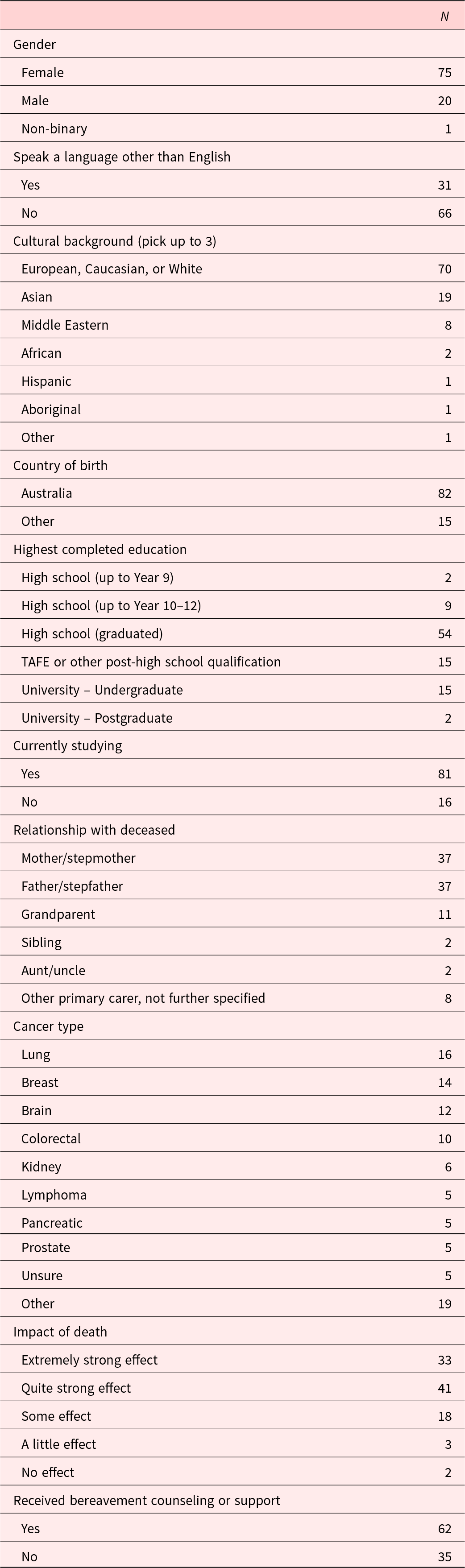
The final dataset included responses from 97 participants; most were female (77%), Caucasian (72%), and born in Australia (85%). Respondents were 20.2 years old (SD = 2.3 years, range: 17–25 years) and 4.1 years post-bereavement (SD = 3.2 years, range: 1 month–12 years), on average. Full demographic details and means for study measures are presented in Table 1.
Participant demographics, cancer, and bereavement characteristics

Bivariate correlations
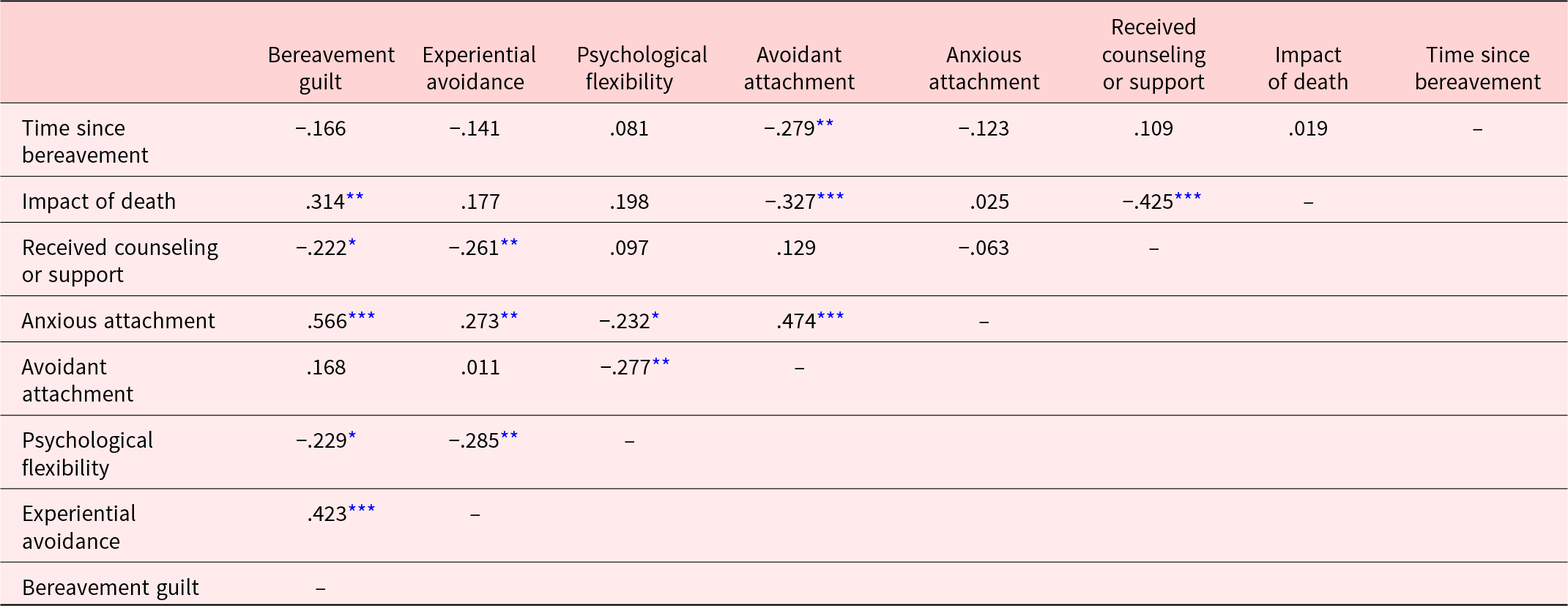
Table 2 displays correlations between key study variables. Anxious and avoidant attachment styles were significantly positively correlated with each other; both were negatively correlated with psychological flexibility, and anxious attachment was also positively correlated with experiential avoidance. Bereavement guilt was positively correlated with anxious attachment and experiential avoidance, and negatively correlated with psychological flexibility. Bereavement guilt was not significantly correlated with avoidant attachment. Time since bereavement was only significantly associated with avoidant attachment.
Correlations between study variables

* p ≤ .05; **p ≤ .01; ***p ≤ .001.
Mediation analyses
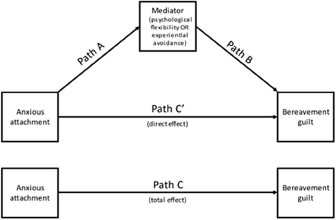
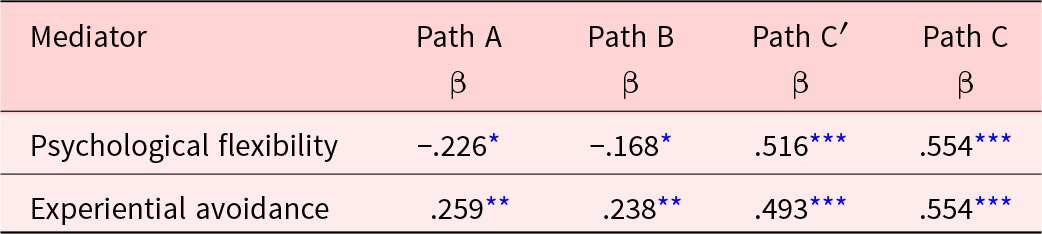
Figure 1 presents the path diagram for the mediation; Table 3 summarizes results of these analyses. The effect of anxious attachment on bereavement guilt was significantly mediated by experiential avoidance (β = .0617, 95% CI [.0060, .1554]): anxious attachment was associated with greater experiential avoidance (significant path A), which was in turn associated with greater bereavement guilt (significant path B). The overall association between anxious attachment and bereavement guilt (path C) was significantly altered after accounting for the indirect effect of experiential avoidance (path C′) but remained significant, indicating a partial mediation effect. Psychological flexibility did not significantly mediate the association between anxious attachment and bereavement guilt (β = .0381, 95% CI [−.0059, .1115]). Mediation analyses were not run for the association between avoidant attachment and bereavement guilt, as the bivariate correlation between these variables was not statistically significant.
Path diagram for mediation analyses.

Mediation of associations between anxious attachment and bereavement guilt

* p ≤ .05; **p ≤ .01; ***p ≤ .001.
Discussion
While many bereaved young adults are able to adapt to the death of a caregiver to cancer (Angelhoff et al. Reference Angelhoff, Sveen and Alvariza2021; Hoffmann et al. Reference Hoffmann, Kaiser and Kersting2018), a significant proportion experience persistent or complicated grief symptoms (Bylund-Grenklo et al. Reference Bylund-Grenklo, Fürst and Nyberg2016), including bereavement guilt. Attachment style (Russ et al. Reference Russ, Stopa and Sivyer2022), psychological flexibility (Bonanno et al. Reference Bonanno, Papa and Lalande2004), and experiential avoidance (Murrell et al. Reference Murrell, Jackson and Lester2018; Shear et al. Reference Shear, Monk and Houck2007) have been implicated in shaping bereaved individuals’ grief and adaptation to their loss. In this study, bereavement guilt was associated with anxious, but not avoidant attachment to the deceased; additionally, the association between anxious attachment and bereavement guilt was partially mediated by experiential avoidance. While psychological flexibility was not a mediator of the attachment–guilt relationship, it was negatively correlated with bereavement guilt, as was previous engagement with bereavement counseling. These findings offer insights into how bereavement interventions and support can be tailored for young adults experiencing more complicated forms of grief following the loss of a caregiver, particularly where guilt is involved.
Consistent with hypotheses and previous work (Boelen and Klugkist Reference Boelen and Klugkist2011; Cohen and Katz Reference Cohen and Katz2015; Meier et al. Reference Meier, Carr and Currier2013), anxious attachment was significantly and positively related to bereavement guilt. Bowlby’s (Reference Bowlby1969) attachment theory describes these individuals as investing more heavily and developing greater dependency within their relationships, which may predispose them to more pronounced and intense grief reactions following bereavement (Mikulincer and Shaver Reference Mikulincer, Shaver, Stroebe, Hansson, Schut and Stroebe2008; Stroebe and Schut Reference Stroebe and Schut1999). This may include failure to accept the loss, preoccupation with the bereavement, or maladaptive appraisals about their role in the death of the deceased (a component of bereavement guilt; Mikulincer and Shaver Reference Mikulincer, Shaver, Stroebe, Hansson, Schut and Stroebe2008; Stroebe et al. Reference Stroebe, Schut and Stroebe2005). Accordingly, research has shown that anxiously attached adults experience more complications in bereavement (Delespaux et al. Reference Delespaux, Ryckebosch-Dayez and Heeren2013; Fraley and Bonnano Reference Fraley and Bonnano2004). The findings from this study indicate the same is true of young adults, affirming anxious attachment style as a risk factor for bereavement guilt.
By contrast, avoidant attachment was not significantly associated with bereavement guilt for young adults in this study. Previous studies examining this relationship have also documented mixed evidence (Kho et al. Reference Kho, Kane and Priddis2015; Mikulincer and Shaver Reference Mikulincer, Shaver, Stroebe, Hansson, Schut and Stroebe2008). In fact, 1 study found avoidantly attached individuals reported less intense grief reactions following the death of a romantic partner, as well as more restoration-oriented (i.e. avoidant) strategies (Delespaux et al. Reference Delespaux, Ryckebosch-Dayez and Heeren2013). This outcome is consistent with attachment theory and the dual process model (Stroebe et al. Reference Stroebe, Schut and Stroebe2005); the tendency to avoid attachment-related emotions and maintain distance and independence in relationships may protect individuals from more complex manifestations of grief (Stroebe et al. Reference Stroebe, Schut and Stroebe2005), including bereavement guilt.
As hypothesized based on previous literature (Murrell et al. Reference Murrell, Jackson and Lester2018; Nam Reference Nam2016; Shear et al. Reference Shear, Monk and Houck2007), experiential avoidance was a significant partial mediator of the relationship between anxious attachment and bereavement guilt. While experiential avoidance may help to create emotional distance that is adaptive in the immediate wake of a loss, longer-term experiential avoidance appears to impede acceptance and adjustment to bereavement (Boelen and Klugkist Reference Boelen and Klugkist2011; Shear Reference Shear2010). For participants in this study, who were on average 4.1 years post-bereavement, the tendency to avoid difficult feelings and thoughts may have obstructed the processing of grief, and was associated with ongoing bereavement guilt, particularly among those who were anxiously attached to the deceased. This may also in part explain why greater time since bereavement was not significantly associated with lower bereavement guilt in this study. Longitudinal research tracking bereaved young adults in the wake of their loss may help to clarify how these processes unfold over time.
It is perhaps surprising that psychological flexibility did not significantly mediate the anxious attachment–guilt relationship, as hypothesized (Bonanno et al. Reference Bonanno, Papa and Lalande2004; Stroebe and Schut Reference Stroebe and Schut1999) and as was the case for experiential avoidance. The discrepancy between findings regarding psychological flexibility and experiential avoidance is particularly interesting as the experiential avoidance measure (AAQ-II) is often used to assess psychological flexibility (Cherry et al. Reference Cherry, Vander Hoeven and Patterson2021), although it has been argued to be more indicative of neuroticism and/or negative affect (e.g. Rochefort et al. Reference Rochefort, Baldwin and Chmielewski2018). Given that psychological flexibility was significantly correlated with both attachment styles and bereavement guilt, and the mediation by psychological flexibility approached significance, this study may have had insufficient statistical power to detect a significant effect. Future work may benefit from extended recruitment periods to ensure that a sufficient sample size can be obtained.
Clinical implications
This study’s findings identify potential risk (anxious attachment, experiential avoidance) and protective (psychological flexibility) factors that are implicated in the occurrence of bereavement guilt, which may be used to tailor supportive interventions for bereaved young adults. For example, psychological flexibility may be enhanced through acceptance and commitment therapy (ACT), which is increasingly applied in psycho-oncology (González-Fernández and Fernández-Rodríguez Reference González-Fernández and Fernández-Rodríguez2019), including with young adults (Allison et al. Reference Allison, Patterson and McDonald2022; Clarke et al. Reference Clarke, Patterson and McDonald2021; Patterson et al. Reference Patterson, McDonald and Bibby2022) and end-of-life carers (Davis et al. Reference Davis, Deane and Lyons2017). ACT-, mindfulness-, and self-compassion-based approaches may also be helpful in reducing experiential avoidance (Arch and Mitchell Reference Arch and Mitchell2015; Yela et al. Reference Yela, Crego and Buz2022). While attachment style tends to be relatively stable over time (Sutton Reference Sutton2019) and may be difficult to alter (particularly as it relates to attachment to the deceased), understanding bereaved young adults’ attachment styles may help to tailor interventions to better support their individual needs. For example, approaches such as interpersonal therapy, complicated grief therapy, and schema therapy have been suggested as potentially helpful approaches for bereaved individuals who are insecurely attached (Schenck et al. Reference Schenck, Eberle and Rings2016). However, few psychotherapeutic interventions have been developed for young people bereaved by familial cancer (Ing et al. Reference Ing, Patterson and Szabo2019), and more work is needed to develop and evaluate support services for this population. Promisingly, however, participants who had previously accessed bereavement counseling/support reported lower levels of bereavement guilt, suggesting that this outcome may be ameliorated through psychotherapeutic intervention. This is particularly notable given that time since bereavement was not significantly associated with lower bereavement guilt, suggesting that guilt does not necessarily resolve itself over time.
Strengths, limitations, and future research directions
A key strength of this work was the recruitment of almost 100 young adults bereaved by a caregiver’s death to cancer – a population that has historically been difficult to recruit. However, this necessitated including participants who were several years post-bereavement, by which time they may have better adjusted to the loss (regardless of attachment style and coping approach) – although interestingly, bereavement guilt was not significantly correlated with time since bereavement. The study was also underpowered to examine multiple mediators in the same statistical model, as well as to examine potential variations in experiences between subgroups (e.g. genders, relation to the deceased). Given that participants were predominantly Caucasian women, it is also unclear whether these findings would generalize to other demographic groups. The cross-sectional design means that causality cannot be conclusively determined, and further longitudinal research is needed to confirm the relationship between attachment style, experiential avoidance, psychological flexibility, and bereavement guilt. Subsequent work may also benefit from the use of alternative measures of experiential avoidance, given criticisms of the AAQ-II (Cherry et al. Reference Cherry, Vander Hoeven and Patterson2021; Rochefort et al. Reference Rochefort, Baldwin and Chmielewski2018), including measures which can delineate different aspects of experiential avoidance, psychological flexibility, and guilt. Finally, it must be noted that the erroneous inclusion of a seventh, “neither agree nor disagree” response option on the PFQ altered the nature of this scale, and findings drawing from this measure must therefore be interpreted with caution.
Conclusions
Given the limited literature on cancer-related bereavement in young adulthood, this study offers important theoretical and clinical insights into factors associated with more complex aspects of grief in this population. Specifically, this work identified that anxious attachment is associated with ongoing bereavement complications in the years following the death of a caregiver to cancer, with experiential avoidance partially mediating this relationship. While further research is needed to better understand the interaction between these factors and other related constructs, such as psychological flexibility, these findings may be helpful in selecting therapeutic approaches to use with this population.
Acknowledgments
We thank the young people who participated in this study for their contributions to this project. We also thank Agustina Himawan for her help in manuscript preparation. The authors have no conflicts of interest to disclose.
Funding
Three of the authors were employed by Canteen, a registered charity which receives funding from a variety of government and individual sources. This research received no specific grant from any funding agency, commercial or not-for-profit sectors.
Competing interests
There are no conflicts of interest to disclose.

 Open access

