

The unprecedented, excessive cost of the coronavirus disease-19 (COVID-19) pandemic to economies and human lives supports the case for conservation of biodiversity as a comparably cost-effective preventive measure against the emergence of zoonotic diseases and pandemic risk (Dobson et al., Reference Dobson, Pimm, Hannah, Kaufman, Ahumada, Ando, Bernstein, Busch, Daszak, Engelmann, Kinnaird, Li, Loch-Temzelides, Lovejoy, Nowak, Roehrdanz and Vale2020). Leading scientific experts of the Intergovernmental Science-Policy Platform on Biodiversity and Ecosystem Services (IPBES) demand the reduction of spillover opportunities of new pathogens from wildlife to humans by limiting human encroachment into biodiverse habitats, and suggest to couple financial stimulus in response to COVID-19 with biodiversity conservation measures (McElwee et al., Reference McElwee, Turnhout, Chiroleu-Assouline, Clapp, Isenhour, Jackson, Eszter, Miller, Rusch, Spangenberg, Waldron, Baumgartner, Bleys, Howard, Mungata, Ring and Santos2020; Settele et al., Reference Settele, Díaz, Brondizio and Daszak2020). The demand was taken up by other UN bodies (Andersen, Reference Andersen2020; UN News, 2020). In addition, implementing strict countermeasures against the exploitation of wildlife for food and medicine has become a major argument in the scientific and conservation community (Dobson et al., Reference Dobson, Pimm, Hannah, Kaufman, Ahumada, Ando, Bernstein, Busch, Daszak, Engelmann, Kinnaird, Li, Loch-Temzelides, Lovejoy, Nowak, Roehrdanz and Vale2020; Wildlife Conservation Society [WCS], 2020), with bans on wildlife consumption quickly taking effect in China in direct response to the pandemic (Yang et al., Reference Yang, Liu, Li and Zhang2020). The directors of WWF, CBD and WHO make a case for global wildlife protection to ‘create a healthier and more prosperous future for people and planet, and put us in a better position to prevent the next pandemic’ (Lambertini et al., Reference Lambertini, Maruma and Neira2020).
We wholeheartedly agree that efforts for biodiversity-related health risk prevention must be strengthened to diminish the cost of outbreak containment and curative measures for future generations. However, we caution that these calls for preventive action, as well-intentioned as they may be for raising awareness to the anthropogenic causes of zoonotic diseases in the face of the current crisis, and defending the urgent need for an economic recovery within sustainable boundaries, should not be missing a key point: the importance of societal relations to nature!
The capacity of a society to persist within the boundaries of sustainable use of natural resources depends on its potential to adjust societal practices and norms in the face of an ecological crisis and achieve social-ecological transformations towards a more sustainable trajectory (Hummel et al., Reference Hummel, Jahn, Keil, Liehr and Stieß2017). Ecological crises challenge individuals, groups as well as the whole society in which they are embedded in to develop new regulations of their relations to nature, that is, the social norms, patterns of consumption or technologies that define the interrelation and interdependencies between natural and societal structures and processes (Kramm et al., Reference Kramm, Pichler, Schaffartzik and Zimmermann2017). Consequently, we emphasize the importance of a social-ecological perspective in order to better contextualize the underlying social-ecological structures and processes of emergent zoonotic diseases and guide future decision-making on biodiversity conservation and wildlife protection in response to COVID-19.
1. Towards an integrative scientific approach
The COVID-19 pandemic has reinforced longstanding scientific debates on the complex link between biodiversity and the emergence of infectious diseases (Daszak et al., Reference Daszak, das Neves, Amuasi, Hayman, Kuiken, Roche, Zambrana-Torrelio, Buss, Dundarova, Feferholtz, Foldvari, Igbinosa, Junglen, Liu, Suzan, Uhart, Wannous, Woolaston, Mosig Reidl and Ngo2020; Johnson et al., Reference Johnson, Ostfeld and Keesing2015; Keesing et al., Reference Keesing, Belden, Daszak, Dobson, Harvell, Holt, Hudson, Jolles, Jones, Mitchell, Myers, Bogich and Ostfeld2010) as well as the factors driving the risk of disease spillover from wildlife into human populations (Han et al., Reference Han, Kramer and Drake2016). The IPBES workshop on biodiversity and pandemics has reviewed the scientific knowledge on the emergence of zoonotic diseases and concludes that ‘the underlying causes of pandemics are the same global environmental changes that drive biodiversity loss and climate change’ (Daszak et al., Reference Daszak, das Neves, Amuasi, Hayman, Kuiken, Roche, Zambrana-Torrelio, Buss, Dundarova, Feferholtz, Foldvari, Igbinosa, Junglen, Liu, Suzan, Uhart, Wannous, Woolaston, Mosig Reidl and Ngo2020). These factors notably include: accelerated urbanization (Ahmed et al., Reference Ahmed, Dávila, Allen, Haklay, Tacoli and Fèvre2019; Hassell et al., Reference Hassell, Begon, Ward and Fèvre2017), industrial agriculture (Jones et al., Reference Jones, Grace, Kock, Alonso, Rushton, Said, McKeever, Mutua, Young, McDermott and Pfeiffer2013), deforestation and land-use change (Gottdenker et al., Reference Gottdenker, Streicker, Faust and Carroll2014; Tucker Lima et al., Reference Tucker Lima, Vittor, Rifai and Valle2017), increased socio-economic inequality and poverty (Ahmed et al., Reference Ahmed, Dávila, Allen, Haklay, Tacoli and Fèvre2019; Garchitorena et al., Reference Garchitorena, Sokolow, Roche, Ngonghala, Jocque, Lund, Barry, Mordecai, Daily, Jones, Andrews, Bendavid, Luby, LaBeaud, Seetah, Guégan, Bonds and de Leo2017; Grace et al., Reference Grace, Mutua, Ochungo, Kruska, Jones, Brierley, Lapar, Said, Herrero, Phuc, Thao, Akuku and Ogutu2012) and ecotourism and global travel (Cascio et al., Reference Cascio, Bosilkovski, Rodriguez-Morales and Pappas2011). Most importantly, these factors are not restricted to regions and societal sectors but are strongly interdependent on spatial and temporal scales, which marks disease emergence as a ‘wicked problem’ without a straightforward problem definition and no definite solution (Ahmed et al., Reference Ahmed, Dávila, Allen, Haklay, Tacoli and Fèvre2019; Engler et al., Reference Engler, Abson and von Wehrden2020; van Woezik et al., Reference van Woezik, Braakman-Jansen, Kulyk, Siemons and van Gemert-Pijnen2016). Many scholars and practitioners claim that the reduction of infectious disease risk must be addressed in an interdisciplinary manner, not only integrating disease ecology, community ecology, epidemiology, veterinary medicine and agricultural science, but also a broad range of biodiversity and climate research into ‘One Health’ or ‘Ecohealth’ approaches (Daszak et al., Reference Daszak, das Neves, Amuasi, Hayman, Kuiken, Roche, Zambrana-Torrelio, Buss, Dundarova, Feferholtz, Foldvari, Igbinosa, Junglen, Liu, Suzan, Uhart, Wannous, Woolaston, Mosig Reidl and Ngo2020; FAO, OIE, WHO, 2019; Rohr et al., Reference Rohr, Civitello, Halliday, Hudson, Lafferty, Wood and Mordecai2020; Tollefson, Reference Tollefson2020; van Woezik et al., Reference van Woezik, Braakman-Jansen, Kulyk, Siemons and van Gemert-Pijnen2016).
This goes far beyond the challenge of finding science-based and technological solutions to environmental problems. Homo sapiens L. is not only a biological species, but also a social being embedded in communities and societies. Dealing with today's problems requires a thorough investigation of how they are caused by – and how they affect – society. This demands a broad integration of social sciences into biodiversity research. We become increasingly aware that problems of entangled patterns of nature and society are characteristic of the Anthropocene (Jahn et al., Reference Jahn, Hummel and Schramm2016). With humankind becoming a planetary geological force, we are facing the challenge to reconcile the local needs and plural notions of a ‘good life’ with the global dimension of the ecological crisis (Jahn et al., Reference Jahn, Hummel, Drees, Liehr, Lux, Mehring, Stieß, Völker, Winker and Zimmermann2020). Normative discourse and the integration of plural knowledge and practices, rather than authoritative approaches, will be required to achieve necessary social-ecological transformations.
2. Wildlife and livelihoods in the Global South
The COVID-19 pandemic had its origin in human encounters with wild mammals hunted and traded for consumption. The threat to health, livestock production and human well-being emerging from the increasing global market for wildlife pets and products and its legal and illegal supply chains is immense, even without accounting for COVID-19, as has been pointed out by the pandemics and biodiversity expert workshop of IPBES (Daszak et al., Reference Daszak, das Neves, Amuasi, Hayman, Kuiken, Roche, Zambrana-Torrelio, Buss, Dundarova, Feferholtz, Foldvari, Igbinosa, Junglen, Liu, Suzan, Uhart, Wannous, Woolaston, Mosig Reidl and Ngo2020). It is, thus, of great importance that measures are developed to reduce the opportunities for spillover of diseases from wildlife into human hosts. The limitation of global trade and supply chains for wildlife and wildlife products appears to be a valid course of action. However, regulation is not only a matter of legal frameworks and law enforcement. There is a high risk of assuming a Western-biased attitude when discussing the prevention of emergent zoonotic diseases in biodiverse regions, which are mostly located in the Global South (Pagani-Núñez, Reference Pagani-Núñez2020). Generally prescribed attempts on regulation, for example, on wildlife hunting and trading, may push local practices into bypassing the legal frameworks, if the rationale is not conclusive and livelihoods cannot be sustained without exercising the practice in question (Bonwitt et al., Reference Bonwitt, Dawson, Kandeh, Ansumana, Sahr, Brown and Kelly2018; Hinsley et al., Reference Hinsley, Challender, Veríssimo and Sas-Rolfes2020). The need for nutrition and traditional practices are duly acknowledged in the recent discussions around bans on wildlife trade and consumption in China, and subsidy schemes are suggested for phasing out harmful traditional practices of wildlife hunting and trade for medicinal use (Wang et al., Reference Wang, Shao, Luo, Chuai, Xu, Geng and Gao2020). However, beyond a mere mitigation of socio-economic hardship, effectively reducing the risk of emerging zoonoses will require a participatory consideration of the knowledge, cultural beliefs and heritages around food and biodiversity in indigenous and local communities (Matias et al., Reference Matias, Pinto, Ramnath and Jose2020). Future conservation research and policy making must heed the advice of the IPBES pandemics and biodiversity workshop to integrate indigenous engagement and knowledge into pandemic prevention programmes (Daszak et al., Reference Daszak, das Neves, Amuasi, Hayman, Kuiken, Roche, Zambrana-Torrelio, Buss, Dundarova, Feferholtz, Foldvari, Igbinosa, Junglen, Liu, Suzan, Uhart, Wannous, Woolaston, Mosig Reidl and Ngo2020).
3. Factory farming and disease vectors in the Global North
At the same time, we must not ignore the Western/European regional context for zoonotic disease emergence. For instance, game and deer hunting in Europe or North America seems not to be impugned in response to the COVID-19 pandemic. In Germany, public criticism on practices in industrial livestock production focused on the high infection rates among low-wage subcontractor workers, caused by the neglect of health and safety issues. The amplification of potential zoonotic diseases and antibiotic resistances emerging in factory farms, due to the constant increase of society's demand for low-price meat, are only marginal topics in the current discourse, although these have been longstanding recognized risk factors for emergent infectious diseases (Cascio et al., Reference Cascio, Bosilkovski, Rodriguez-Morales and Pappas2011; Daszak et al., Reference Daszak, das Neves, Amuasi, Hayman, Kuiken, Roche, Zambrana-Torrelio, Buss, Dundarova, Feferholtz, Foldvari, Igbinosa, Junglen, Liu, Suzan, Uhart, Wannous, Woolaston, Mosig Reidl and Ngo2020). This changed marginally, when in October 2020 a mutation of the coronavirus was spreading through Danish mink farms and was considered as a serious threat to the effectiveness of human vaccines against COVID-19 (Halabowski & Rzymski, Reference Halabowski and Rzymski2020; Oude Munnink et al., Reference Oude Munnink, Sikkema, Nieuwenhuijse, Molenaar, Munger, Molenkamp, van der Spek, Tolsma, Rietveld, Brouwer, Bouwmeester-Vincken, Harders, Hakze-van der Honing, Wegdam-Blans, Bouwstra, GeurtsvanKessel, van der Eijk, Velkers, Smit and Koopmans2020). Another neglected health issue related to climate change in the Global North is the shifting distribution range or new establishment of animal vectors for vector-borne diseases, such as ticks or the Asian bush mosquito (Mills et al., Reference Mills, Gage and Khan2010; Reuss et al., Reference Reuss, Kreß, Braun, Magdeburg, Pfenninger, Müller and Mehring2020; van Dijk et al., Reference van Dijk, Carss, Keune, Vikström, Flandroy, Rook, Haahtela, Mehring, Birzle-Harder, Reuss, Müller, Luque and Garcia Rodrigues2019). In central Europe, those become particularly relevant in (peri-)urban environments with their high diversity of ecological niches and high human population densities. Common preventive measures against the spread of the vector species often have harmful consequences for other insect species and entire ecosystems (e.g. the use of insecticides in wetlands of the upper Rhine floodplains to reduce mosquito populations). Instead, maintaining both, ecosystem integrity and human well-being, will require interventions in societal practices as well as the development of environmental-friendly technologies and regulations (Reuss et al., Reference Reuss, Kreß, Braun, Magdeburg, Pfenninger, Müller and Mehring2020; van Dijk et al., Reference van Dijk, Carss, Keune, Vikström, Flandroy, Rook, Haahtela, Mehring, Birzle-Harder, Reuss, Müller, Luque and Garcia Rodrigues2019).
Against the background of these very different regional examples, we notice that in the current discourse, the societal relations to nature with their specific regional and historical contexts are underrepresented, especially when it comes to drafting measures for reducing the risk of zoonotic and vector-borne diseases at a local level. It is important to acknowledge that, given the multitude of relations that societies have established with nature all across the world, there is not one single solution for the prevention of future pandemics. In addition to an interdisciplinary scientific perspective, the scope must be broadened to integrate the practical perspectives and plurality of values, as well as power relations present in communities and societies, in a fundamentally transdisciplinary approach.
4. A social-ecological perspective is essential
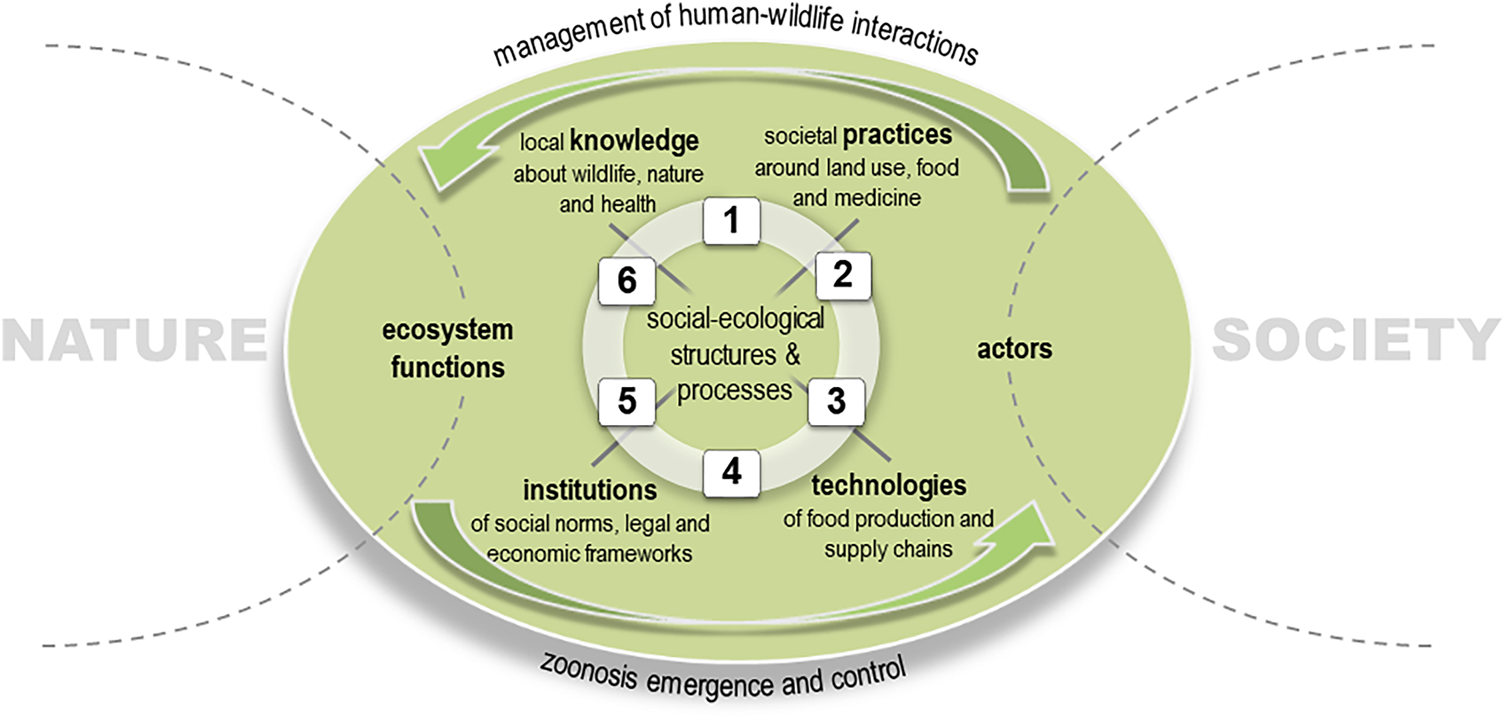
In this endeavour, a social-ecological perspective on biodiversity conservation is essential for setting the focus on the societal use of biodiversity as a linchpin for the emergence of zoonotic diseases and may offer opportunities to shape sustainable pathways for the benefit of ecosystems and human well-being. Formalizing the process of local problem framing into social-ecological systems (SES; Figure 1) makes both ecosystem functions as well as societal actors explicit and describes their reciprocal relationships through four mediating dimensions of (a) knowledge, (b) practices, (c) institutions and (d) technologies (Mehring et al., Reference Mehring, Bernard, Hummel, Liehr and Lux2017).
Analytical framework of social-ecological systems (SES) with four dimensions of knowledge, practices, institutions and technologies (modified from Mehring et al., Reference Mehring, Bernard, Hummel, Liehr and Lux2017). The six social-ecological principles for shaping transformations in the Anthropocene ((1) focusing on relations, (2) enabling coexistence, (3) defining and reflecting on limits, (4) dealing with complexity, (5) strengthening resilience, (6) participation of all actors) apply to the re-evaluation and adjustments of the social-ecological structures and processes, to leverage more sustainable options within the four SES dimensions.

In the case of wildlife consumption, an SES approach would cover these four dimensions by (Figure 1): (a) integrating knowledge that has not yet been formally incorporated into scientific frameworks, for example, by identifying local traditional and cultural values apart from a mere instrumental use of nature, and thereby contributing to the decolonization of Western scientific knowledge; (b) highlighting the societal practices around food and medicine that have high symbolic or traditional value for local communities, while identifying harmful practices as well as those that originate from external or systemic pressures and power relations, and particularly, from global trade and consumption patterns that drive the intensity of local practice of land-use and wildlife trade; (c) describing social norms and value systems as well as economic frameworks, legal norms and other manifested societal dependencies that constrain and enable people in their actions and shape local livelihoods; and identifying and exploring ways to transform these formal and informal institutions; (d) directing and refining the use of technologies that play a key role in the regulation of local food production and preventive health care, as well as in supply chains of global trade relations.
To mitigate the risk of new vector-borne diseases due to a range expansion of exotic disease vectors into peri-urban areas, the four dimensions of the approach would be framed as: (a) identifying knowledge gaps and translating scientific knowledge into practices to reduce vector populations that are environmentally friendly and easy to implement into everyday routines by households; (b) investigating the practices that drive a frequent encounter of humans and vector mosquitoes, for example, small water bodies in gardens or communal cemeteries; (c) developing and supporting institutions, for example, at municipalities and in civil society, to establish prevention campaigns and civic education on the drivers and practices causing disease vector range expansion; (d) identifying gaps in technological toolchains and building capacities for monitoring vector populations and pathogens, for example, via high throughput molecular analysis (Reuss et al., Reference Reuss, Kreß, Braun, Magdeburg, Pfenninger, Müller and Mehring2020).
These examples illustrate the specificity of the social-ecological approach to the local situation as well as the broad applicability of the SES concept (Liehr et al., Reference Liehr, Röhrig, Mehring and Kluge2017). The analytical methodology of SES outlined here serves to acquire specific system knowledge to understand the factors and interdependencies that underlie the problem and to gain orientation knowledge on possibilities and constraints for decision-making (Jahn et al., Reference Jahn, Bergmann and Keil2012). In a final step, a cooperative, transdisciplinary process leads to the production of transformation knowledge which provides practical opportunities and pathways to shape transformations of societal relations to nature (Becker, Reference Becker2002).
5. How to shape transformations in the Anthropocene?
Under the premises of the Anthropocene, the conclusion must be that no simple or globally applicable solutions for preventing zoonotic diseases can be found. Consequently, the focus should be on shaping societal relations to nature in a ‘collective, cooperative and experimental activity for a different today’, a continuous process of negotiating the plurality of ideas of a ‘good life’ and the possibilities of living on a finite planet (Jahn et al., Reference Jahn, Hummel, Drees, Liehr, Lux, Mehring, Stieß, Völker, Winker and Zimmermann2020). With the participatory production (and implementation) of transformation knowledge, social-ecological research thus goes beyond a mere system description and analyses of the status quo by facilitating the transformation of the processes and structures and providing orientation in order to steer the local system into a more sustainable trajectory. To guide such transdisciplinary research processes, Jahn et al. (Reference Jahn, Hummel, Drees, Liehr, Lux, Mehring, Stieß, Völker, Winker and Zimmermann2020) have developed six social-ecological principles for shaping transformations in the Anthropocene, which we apply to the challenge of biodiversity conservation as infectious disease prevention (Figure 1): (1) shifting the focus on relations between society and nature – as opposed to a framing of ‘nature as a resource’ – will reveal the benefits and harms that humans pose to nature – and vice versa! Just as relations between human beings have been put to a test in the face of COVID-19, we need to re-examine and readjust how we take responsibility for other species. (2) Enabling coexistence of different social groups, but also human and non-human subjects, is essential to overcome dominance and unequal power relations that drive harmful practices of biodiversity exploitation and displacement of wildlife and people, and to reinforce sustainable societal practices of stewardship and care, based on situated knowledge. (3) Defining and reflecting on limits, in terms of the spatial, temporal, social and ecological scales, will help us to clarify the subtle and multi-level boundaries within which the emergence of diseases takes place and at which opportunities of shaping transformations might be effective; thus, it can help bridge the scales from local, via regional to global disease prevention, for example, by raising awareness for the consequences that resource-intensive lifestyles and consumption patterns will have far beyond the immediate environment. (4) Dealing with complexity of social and natural entanglement requires acceptance of our limited degree of control: zoonotic diseases will continue to emerge, with fundamentally unpredictable impacts, and responsive and curative measures will have to be developed under conditions of uncertainty, lack of knowledge, but also rapidly evolving knowledge. However, preventive measures addressing the social-ecological perspective at a local scale can lower the frequency and hazard of epidemic and pandemic events globally; in contrast, uniform global prescriptions for prevention are likely to lead to unintended side effects on livelihoods, or to shifts in global supply chains that may be harmful in other local contexts. (5) Strengthening resilience of SES requires preserving and restoring high levels of biodiversity and thus, maintaining nature's regenerative processes and potential for pathogen regulation, but also the ability of people to act responsibly as stewards of the local environment while securing their livelihoods and traditional practices; reducing mandatory dependencies in provisioning systems, in supply chains or labour relations will provide alternative actions under the pressure of crises. (6) All these require participation of all actors – residents, businesses, practitioners, policy makers and diverse scientific disciplines – to enable legitimate and transparent intervention strategies that yield a high level of acceptance, but also reflect the plurality of ideas about a ‘good life’ as well as the capabilities to maintain or change rules, habits or traditions.
These six social-ecological principles for shaping transformations aim at creating novel research perspectives for biodiversity conservation and encouraging a transdisciplinary research mode on this topic. As a narrative, they also support integrating zoonotic disease prevention as a goal for conservation policy. We believe that the application of the social-ecological principles in research and decision-making will contribute to the development of a social-ecological biodiversity conservation approach: one that addresses plant, animal and ecosystem health alongside human health by integrating scientific disciplines as well as practical and local knowledge.
6. Conclusion
Biodiversity and emerging infectious diseases are interlinked via a multitude of social and ecological factors that are themselves coupled on multi-scale and cross-sectoral bases. It is mandatory that governments and decision makers acknowledge this interdependency and, thus, implement preventive strategies such as biodiversity conservation to reduce the opportunities for disease emergence. However, rather than viewing the COVID-19 pandemic and biodiversity loss as one single global crisis that needs to be addressed with global regulations, we suggest a stronger focus on the local scale. Preventive measures based on biodiversity and wildlife conservation will require strengthening interdisciplinary efforts, but also extending local, participatory approaches to include communities and their plural values, traditions and social norms regarding nature. We also highlight the need to employ this integrative approach not only to biodiverse regions of the Global South, but also to urban ecosystems and systems of food and animal product supply in the Global North. This is by no means a restriction to national concerns: patterns of consumption in the Global North must be better related to patterns of production and the interference with nature in the Global South to effectively reduce disease spillover in human–wildlife interactions. An SES approach explicitly identifies, analyses and offers opportunities for transforming these societal relations to nature in four mediating dimensions of knowledge, practices, institutions and technologies. Acknowledging societal relations to nature from a social-ecological perspective helps us to understand the complex interplay of the dynamics of biodiversity use, the underlying drivers and the emergence of zoonotic diseases in relation to biodiversity change. Furthermore, we propose six social-ecological principles for shaping transformations and setting communities on a more sustainable course. Implementing and operationalizing these social-ecological principles into efforts for biodiversity conservation, as preventive measures against infectious diseases, will have far-reaching effects on the risk reduction of future pandemics.
Acknowledgements
This paper resulted from discussions with members of the biodiversity working group at ISOE – Institute for Social-Ecological Research.
Author contributions
All authors contributed to the conceptualization of the paper and the revision of the original draft. F.D.S., D.M.M. and M.M. wrote the original draft.
Financial support
This research received no specific grant from any funding agency, commercial or not-for-profit sectors.
Conflict of interest
The authors declare no conflict of interest.

 Open access

