



INTRODUCTION
Dengue fever is an emerging acute mosquito-borne viral disease resulting in a great socioeconomic burden. It is prevalent in several tropical and subtropical regions of the world. The causative agent of the fever is dengue virus (DENV), which belongs to family Flaviviridae, genus Flavivirus. There are four (DENV-1 to DENV- 4) different antigenically distinct serotypes of dengue virus. Infection with one type of the serotype imparts lifelong immunity to that serotype. The four serotypes are further divided genotypically into 4–6 genotypes.
Recent studies have reported co-circulation of multiple serotypes in different geographical regions of the world including India [Reference Mishra1–Reference Bharaj3]. In addition, concurrent infections with more than one serotype of dengue virus have been documented in various studies [Reference Afreen2, Reference Gupta4–Reference Anoop6]. However, the true disease burden or collective severity due to dual infection remains unknown. Moreover, the information on correlation of disease severity with the serotypes or genotypes is also limited. Finally, there seems to be lack of information on the range of titre of a given serotype in different ethnic groups from different parts of the world. Information on these areas would provide a new dimension towards understanding the susceptibility or proneness of a population and possible triggering mechanism of the infection in the context of varying genotypes.
The present study was planned to detect dengue viruses by reverse transcriptase–polymerase chain reaction (RT–PCR) in blood samples collected from suspected patients during an outbreak in New Delhi in 2014. The concurrent infections were identified by RT–PCR. Further, the molecular characterization of dengue viruses was performed by DNA sequencing followed by phylogenetic analysis. The data provide information on the circulating dengue virus strains from New Delhi, India delineating evolutionary trajectory of the prevalent strain compared to other strains. The present study is envisaged to help in correlating outbreaks with various causative factors enabling effective control measures.
MATERIAL AND METHODS
Collection of clinical samples
The blood samples were collected from patients suspected of dengue virus infection attending the outpatient department of Dr. M. A. Ansari Health Centre, Jamia Millia Islamia, New Delhi. The health centre provides basic medical facilities to the 60 000 university students, employees and their dependants. Background information (age, sex, clinical symptoms) was collected in the profomas from the patients. Informed consent was obtained from each patient in English or Hindi. The Institutional Ethics Committee of Jamia Millia Islamia approved the study. Trained medical professionals collected about 2–3 ml of blood from each patient. The blood samples were transported to the virology laboratory within 2–3 h. Sera was separated from the samples and stored at −70 °C.
RNA extraction and cDNA synthesis
The RNA was extracted from 140 μl serum samples using QIAamp Viral RNA extraction kit (Qiagen, Germany) according to the manufacturer's instructions. RNA was eluted in 50 μl elution buffer and stored at −70 °C. The cDNA was synthesized from the extracted RNA using AMV–RT and random hexamer as described previously [Reference Afreen7].
Detection of dengue virus by PCR typing
Dengue virus was detected in the clinical samples by a nested PCR reaction using published primers and cycling conditions [Reference Lanciotti8]. The CprM region of the dengue virus genome was the target for amplification. The nested PCR was performed as described in our previous publication [Reference Afreen7]. Briefly the cDNA amplification was performed in 25 μl reaction volume, with Taq DNA polymerase (Genei, Bangalore), dNTPs (Promega, USA), forward (D1) and reverse (D2) primers [Reference Lanciotti8] in a thermal cycler (Applied Biosystems, USA). In the second round of semi-nested PCR, the external amplicon was amplified using published primers. Then 1 μl diluted amplicon was reamplified with serotype-specific primers for DENV-1, DENV-2, DENV-3 and DENV-4, respectively. The nested PCR reaction was set up with primers (TS1, TS2, TS3, TS4 and D1) [Reference Lanciotti8], dNTPs (Promega, USA), Taq polymerase (Genei, India), in a 25 μl reaction volume. The amplicons were resolved on 2% agarose gel by electrophoresis and were visualized under UV light on a gel documentation system (Wealtec, USA).
Sequencing PCR
Partial segments of domain III of the envelope gene of DENV-1 and DENV-2 was amplified with the published primers [Reference Wu9, Reference Rodriguez-Roche10]. An aliquot of 3 μl cDNA was amplified in a 25 μl reaction with forward primer, reverse primer, Taq DNA polymerase (Genei, India) and dNTPs (Promega, USA). Envelope protein gene regions of two different lengths, 448 bp and 574 bp, were amplified for DENV-1 and DENV-2, respectively. These two PCR reactions were performed as described previously [Reference Afreen7]. The required bands were excised from agarose gel. The DNA was extracted from gel using the QIAquick Gel Extraction kit (Qiagen, Germany) according to the manufacturer's instructions.
DNA sequencing and sequence analysis
Partial nucleotide sequences of the E protein gene of DENV-1 and DENV-2 were determined by commercial sequencing (Applied Biosystem, USA). The amplicons were sequenced in both forward and reverse directions. The sequences were confirmed by BLAST (http://blast.ncbi.nlm.nih.gov/Blast.cgi). The sequences were manually aligned and edited to resolve nucleotide ambiguities and to obtain consensus sequence using GeneDoc v. 2.7 (http://genedoc.software.informer.com/2.7/) and BioEdit v. 7.2 (http://bioedit.software.informer.com/7.2/). Multiple sequence alignment was conducted using CLUSTAL X2 (http://www.clustal.org/clustal2/).
Phylogenetic analysis
Phylogenetic trees were constructed by the maximum-likelihood method using MEGA 6·06 software (http://mega6.software.informer.com/). Genetic distances were calculated using the Tamura–Nei model of nucleotide substitution. The robustness of the tree was assessed with 1000 bootstrap replicates. The prototype strain used for DENV-1 was the Hawaii strain (GenBank accession no. EU848545) and Thailand strain, 16 681 (GenBank accession no. U87411) for DENV-2.
Selection pressure analysis
Selection pressure was studied in the codons of the envelope protein gene using a Datamonkey web-server (http://www.datamonkey.org/). The non-synonymous to synonymous mutations ratio (dN/dS) was estimated using three different approaches, including single likelihood ancestor counting (SLAC), fixed effects likelihood (FEL) and random effects likelihood (REL) by using the HKY85 and F81 models of nucleotide substitution. The positively selected sites were defined as the sites that were under positive selection by at least two different methods with P⩽0·1 for SLAC and FEL and Bayes factor ⩾50 for REL.
Ethical standards
The authors assert that all procedures contributing to this work comply with the ethical standards of the relevant national and institutional committees on human experimentation and with the Helsinki Declaration of 1975, as revised in 2008.
RESULTS
Patients’ characteristics
The symptomatic patients were recruited from the outpatient department of Dr. M. A. Ansari Health Centre, Jamia Millia Islamia over a period of 3 months from September to November 2014 during an outbreak in Delhi. A total of 60 blood samples were collected from suspected patients during the study. Supplementary Table S1 shows the details of patients enrolled for the current study with their age, gender, platelet count and number of days of fever. The mean age (±s.d.) of patients was 26·71 (±9·63) years. Mean days of illness was 4·91 (±2·61) days. The male:female ratio was 2·52:1.
Characteristics of co-infected vs. mono-infected patients
The samples collected from co-infected patients during the outbreak showed clinical symptoms of dengue viral infection like fever, headache, nausea, body-ache, weakness, etc. Fever was the most common symptom observed in all co-infected patients. The duration of fever ranged from 1 to 6 days. The mean age (±s.d.) of the co-infected patients was 20·04 (±12·36) years. Mean days of illness in co-infected patients was 3·80 (±1·72) days. The platelet count of the co-infected patients ranged from 0·6 to 3·5 lac/mm3. Three patients showed severe disease with mild haemorrhagic tendencies. One patient with severe disease (patient ID 70/14) had a platelet count of 1·8 lac/mm3 with 7 days of fever. The second patient (patient ID 73/14) had a platelet count of 1·8 lac/mm3 with 3 days of fever. The third patient was aged 15 years and had a low platelet count of 0·6 lac/mm3 with 4 days of fever. At the same time the mono-infected patients also showed similar clinical symptoms with fever being the most common symptom. The platelet count of mono-infected patients ranged from 1·8 to 3·7 lac/mm3. None of the mono-infected patient had haemorrhagic tendencies.
RT–PCR
All the samples collected during the outbreak were tested for dengue virus infection by RT–PCR. Forty-eight samples (80%) were positive for dengue virus out of 60 samples tested by RT–PCR. Multiplex nested PCR detected two different serotypes, DENV-1 and DENV-2 in the positive samples. A 482 bp and a 119 bp band were visualized on the agarose gel for DENV-1 and DENV-2, respectively. The male:female ratio for the dengue virus-positive sample was 2·69:1. Thirty-seven (77%) samples were positive for DENV-1 and 29 (60%) samples for DENV-2 including concurrent infections. Co-infection with more than one type of serotype was identified in 21 (43%) of the positive samples.
DNA sequencing
The dengue virus-positive samples for both serotypes identified during the outbreak were amplified with another set of published primers for domain III of the envelope protein gene for DNA sequencing. A total of ten samples, six for DENV-2 and four for DENV-1 were sequenced in both forward and reverse direction. All four DENV-1 and six DENV-2 sequences were confirmed by BLAST. The sequences of DENV-1 strains were submitted to GenBank (accession nos. KT355376–KT355379). The sequences of DENV-2 strains were submitted to GenBank (accession nos. KT355380–KT355385).
Phylogenetic analysis
Phylogenetic analysis of DENV-1
The aligned region was 312 bp (104 amino acids) corresponding to 991–1302 bp of E gene and 1926–2237 bp of the full genome of the prototype strain. The study sequences showed a nucleotide distance of 9–10% and an amino-acid distance of 4–6% with respect to the prototype strain. The study sequences showed nucleotide distances of 1% and amino-acid distances of 2% between themselves. Seventy-four sequences (including four study sequences) of different genotypes of DENV-1 were downloaded from GenBank and used to construct the phylogenetic tree. These included 15 sequences from India (11 published sequences and four study sequences). The accession numbers of the sequences that were used for the present study are given in Supplementary Table S2a. The study sequences clustered with the American African genotype by phylogenetic analysis (Fig. 1).
Maximum likelihood phylogenetic tree of DENV-1 strains. The list of 74 nucleotide sequences that were used to construct the tree is given in Supplementary Table S2a. The study sequences are indicated by a diamond symbol (◆). Bootstrap values are represented by the numbers on nodes generated by 1000 replications. Values >65% are shown in the tree.

The study sequences showed a total of 25 mutations at the nucleotide level in all the strains with respect to the prototype strain. One particular strain (DL/DENV-1/125/14) showed additional four mutations. Four common amino-acid mutations (F337I, A369T, V380I and L402F) were identified in all the study sequences that were reported earlier. Another strain (DL/DENV-1/125/14) showed additional two amino-acid mutations besides the common ones (F429N and V432F) (Table 1a ).
Amino-acid substitutions in the envelope protein sequences for (a) DENV-1 and (b) DENV-2 serotypes. The mutations are shown in comparison to the respective prototype strains

Phylogenetic analysis of DENV-2
The aligned region was 465 bp (155 amino acids) corresponding to 871–1335 bp of E gene and 1807–2271 bp of the full genome of the prototype strain. The study sequences showed nucleotide distance of 6–8% and amino-acid distance of 1–3% with respect to the prototype strain. The study sequences showed nucleotide distances of 1% and amino-acid distances of 3% between themselves. Sequences of 73 DENV-2 strains (including six study sequences) of different genotypes were downloaded from GenBank and used to construct the tree in the present study. These included 18 sequences from India (12 published sequences and six study sequences). The accession numbers of the sequences used in the present study are given in Supplementary Table S2b. The study sequences clustered with Cosmopolitan genotype by phylogenetic analysis (Fig. 2).
Maximum-likelihood phylogenetic tree of DENV-2 strains. The list of 73 nucleotide sequences that were used to construct the tree is given in Supplementary Table S2b. The study sequences are indicated by a diamond symbol (◆). Bootstrap values are represented by the numbers on nodes generated by 1000 replications. Values >65% are shown in the tree.

The study sequences had a total of 28 mutations at the nucleotide level in all the strains with respect to the prototype strain. Three strains (DL/DENV-2/69/14, DL/DENV-2/85/14 and DL/DENV-2/89/14) showed some additional mutations also. One common amino-acid mutation (N390S) was identified in all the sequences. Other amino-acid mutations were identified at different sites in the study sequences. Two different strains (DL/DENV-2/69/14 and DL/DENV-2/89/14) showed a common mutation, i.e. T404I. One particular strain (DL/DENV-2/85/14) showed four different mutations, i.e. A419P, L425P, Y444H and G445W (Table 1b ). All the mutations have been reported earlier.
Selection pressure analysis
The selection pressure analysis of DENV-1 strains revealed a low ratio of dN/dS (0·1–0·5) by using different methods suggesting that the codon positions are relatively conserved (Table 2a ). The first dataset, consisting of DENV-1 sequences of all the genotypes (n = 74), gave a dN/dS ratio of 0·105 by the SLAC method using the HKY85 method of nucleotide substitution. SLAC analysis further showed no positive selection in this dataset, but 20 negatively selected sites were observed (data not shown). FEL analysis revealed 42 negatively selected sites and one weak positively selected site (codon number 98), 36 negatively selected sites and two weak positively selected sites (codon numbers 56 and 98) were observed by REL analysis. The F81 nucleotide model of substitution also revealed two (codon numbers 9 and 98) and three weak positively selected sites (9, 56 and 98), respectively, by FEL and REL analysis. Another dataset comprising only the sequences of American African genotype (n = 49) also showed low dN/dS ratio (0·352) by SLAC analysis using the HKY85 method of nucleotide substitution. Further, this dataset showed seven and one negatively selected sites by SLAC and FEL, respectively. The F81 method of nucleotide substitution revealed two weak positively selected sites (codon numbers 9 and 98) by FEL analysis. One particular codon at position 98 was found to be positively selected by both FEL and REL analysis using two different methods of nucleotide substitution in both the datasets.
Selection pressure analysis of (a) DENV-1 and (b) DENV-2 of the envelope protein gene using the SLAC, FEL and REL methods
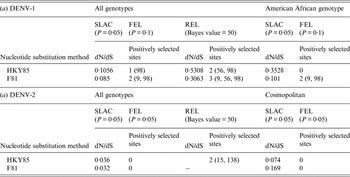
SLAC, Single likelihood ancestor counting; FEL, fixed effects likelihood; REL, random effects likelihood.
The DENV-2 strains also showed low dN/dS ratio (0·03–0·16) suggesting purifying selection (Table 2b ). The first dataset consisted of sequences of all genotypes of DENV-2 (n = 73). The SLAC analysis revealed a dN/dS ratio of 0·036 and 67 negatively selected sites. The FEL analysis revealed 71 negatively selected sites using the HKY85 model of nucleotide substitution. Two weak positively selected sites (codon numbers 15 and 138) were observed by REL analysis. The second dataset comprised of only the sequences of the Cosmopolitan genotype (n = 42). These sequences showed a dN/dS ratio of 0·074 and 17 negatively selected sites.
DISCUSSION
Dengue fever has emerged as a major health problem in India. Delhi, in the northern part of India, has become hyperendemic for dengue virus as all the four serotypes have been detected in Delhi. Numerous dengue fever outbreaks have been reported from Delhi including 1967, 1970, 1982, 1988, 1996, 2003, 2006, 2010 and 2013 [Reference Afreen2, Reference Balaya11–Reference Kumari18]. The samples in the present study were collected from the local health centre of Jamia Millia Islamia University in South East Delhi on the Yamuna river bank. Therfore, high humidity along with high temperature during the post-monsoon season favour mosquito breeding in this region. In addition, high population density and rapid urbanization also contribute to regular outbreaks of dengue fever in this region of Delhi [Reference Afreen7]. An outbreak of dengue fever occurred in south-eastern region of Delhi during the post-monsoon season in 2014.
Our work provides an overview of this dengue fever outbreak in Delhi, 2014. Dengue virus was detected in 80% of the samples collected during this outbreak by RT–PCR. Our earlier studies identified dengue virus in this region in 49% and 71% of samples during the outbreaks of 2011 and 2013, respectively [Reference Afreen2, Reference Afreen7]. An earlier investigation from Delhi identified dengue virus in 69% of the samples by RT–PCR [Reference Bharaj3]. Das and colleagues detected dengue virus in 54% of samples from Orissa [Reference Das19], and 49% each from Kerala [Reference Anoop6] and Madhya Pradesh [Reference Barde20]. Another investigation from Brazil reported a high percentage of dengue viral infection by PCR in 55% of symptomatic patients [Reference Heinen21]. DENV-1 (77%) was the predominant serotype followed by DENV-2 in the present investigation. Phylogenetic analysis clustered the study strains with other recently reported sequences from India and adjoining countries. The DENV-1 study sequences formed a separate cluster within the American African genotype with sequences from India [Reference Afreen2, Reference Huang22], Singapore and Pakistan (I. Hussain et al., GenBank, unpublished data). The DENV-2 study sequences formed a cluster within the Cosmopolitan genotype along with strains from India and Singapore [Reference Sharma23, Reference Lee24]. These two genotypes have already been reported from India [Reference Mishra1, Reference Afreen2, Reference Afreen7, Reference Dash25].
One of the marked features of this investigation was the high percentage (43%) of concurrent infection. The co-infected patients showed mild disease except three severe cases with no fatality. These three co-infected patients had mild haemorrhagic tendencies with one patient having a low platelet count. At the same time it is not possible to comment on the correlation of concurrent infection with disease severity due to limited samples size. However, future elaborate investigations on larger patient groups will determine the effect of concurrent infection on disease severity. However, it would be interesting to analyse the different circumstances that might contribute towards the understanding of concurrent infections. It has been suggested that concurrent infections with multiple serotypes of dengue virus occur due to co-circulation of these serotypes in the hyperendemic regions. Earlier studies have suggested that concurrent infections with multiple stereotypes along with their genotypes may affect the clinical presentation of the disease [Reference Bharaj3]. Moreover, it has been suggested that recombination in serotypes may occur in concurrent infections which might influence the emergence of more pathogenic and virulent strains [Reference Worobey26]. Furthermore, earlier studies have indicated that dual infection with more than one serotype can occur in the vector probably due to multiple bloodmeals of the mosquitoes during a gonotrophic cycle [Reference Thavara27, Reference Scott28]. Further, high vector density in the endemic region may also contribute to the concurrent infections [Reference Anoop6]. Nevertheless, additional investigations will determine the role of different parameters on concurrent infection with dengue virus serotypes.
Identification of the first case of concurrent infection with two dengue serotypes was reported in 1982 from Puerto Rico [Reference Gubler29]. Other investigations from different geographical regions have reported concurrent infections in a significant number of samples from Singapore (17%) [Reference Wilder-Smith30], Sri Lanka (15%), Indonesia (11%), Taiwan (9·5%) [Reference Huang22], Mexico, Puerto Rico and Indonesia together (5·5%) [Reference Lorono-Pino31] (Fig. 3). Concurrent infection was also reported from New Caledonia [Reference Laille32], Thailand [Reference Maneekarn33, Reference Chinnawirotpisan34], and Pakistan [Reference Fatima35]. Concurrent infections have also been reported in travellers from different geographical regions [Reference Cnops36, Reference Moi37]. Interestingly, co-infection with more than one serotype of dengue virus has been reported in several studies from India (Fig. 4). Concurrent infection with the two different serotypes, DENV-1 and DENV-2, was identified in 43% of the samples in the present study. Similarly 43% co-infection was reported from Davangere, Karnataka [Reference Vinodkumar5] and 57% from Thiruvananthapuram, Kerala [Reference Anoop6], 32·5% from Moreh, Manipur [Reference Khan38] and 19% from Delhi [Reference Bharaj3]. Our earlier work reported 9% co-infections during 2011 [Reference Afreen7], 14% during 2013 [Reference Afreen2] and 18% during 4 years of study from 2011–14 [Reference Afreen39] in Delhi. Dual infection was also reported in other investigations from Delhi [Reference Gupta4, Reference Gupta40, Reference Chahar41]. Thus, although perusal of the literature shows concurrent infections in several parts of the Indian subcontinent, the true disease burden and disease severity in concurrent infections remains unknown.
World map showing concurrent infections with dengue virus serotypes in different geographical regions. The hotspot regions are indicated by a star symbol (⋆) followed by country and year of detection of the concurrent infection. The freely available world map was downloaded from the presentationmagazine.com website (http://www.presentationmagazine.com/world-maps-vector-editable-507.htm). The map was created and edited in PowerPoint.

Map of India showing concurrent infections with dengue virus serotypes. The hotspot regions are indicated by a star symbol (⋆) followed by city and year of detection of the concurrent infection. The map was downloaded from the presentationmagazine.com website (http://www.presentationmagazine.com/world-maps-vector-editable-507.htm). The map was created and edited in PowerPoint.

Dengue virus proteins have adapted to alternative hosts by selection of synonymous mutations leading to purifying selection. However, the envelope protein of the dengue virus is under immune selection pressure and thus prone to mutations. The selection pressure analysis of the envelope protein of DENV-1 and DENV-2 strains revealed a strong purifying selection. Similarly, purifying selection in the E protein has been reported previously in various investigations [Reference Das19, Reference Patil42, Reference Singh43]. However, we were able to detect one codon in the American African genotype of DENV-1 viruses under weak positive selection pressure. Weak positive selection pressure in codons of the E protein have been reported previously [Reference Patil42]. Further detailed mutagenesis studies on this amino-acid change will define its role in the pathogenesis of dengue viral infection. The E protein of dengue virus is involved in attachment and fusion of the virion with the host cell. Domain III of the E protein was analysed, which is the putative receptor binding region. We identified a number of amino-acid mutations in this region. These mutations may alter the local secondary structure of the E protein which might affect the structure–function relationship [Reference Afreen44]. One such recently reported mutation (T404I) was identified in two study DENV-2 strains. This mutation may affect low pH-induced fusion of the virion. In addition, this mutation was also mapped to three different predicted T-cell epitopes that may affect the immunogenicity of the virus [Reference Afreen44]. Further detailed investigations on these mutations will define there role in viral life cycle.
We are acutely aware of the limited sample size and confined infection areas. It would be of relevance to find the target tissues/cells of these viruses, the number and type of genes involved/affected and their possible up-/down-regulation during the course of concurrent infection. Establishing a genetic basis and genotypic delineation in the context of infection caused by a specific serotype would uncover the likely mechanism that has remained hitherto undiscovered. Titrating the viruses from across the affected individuals and correlating with diseased severity in the context of ethnicity would be yet another dimension to augment the epidemiology and aetiology of this disease. Manifestation of concurrent infection provides compelling evidence that the two serotypes of dengue virus are probably following the path of co-evolution despite having antigenic variabilities. Clearly, additional work along this line is envisaged to provide intellectual enrichment on disease burden.
SUPPLEMENTARY MATERIAL
For supplementary material accompanying this paper visit http://dx.doi.org/10.1017/S0950268816001990.
ACKNOWLEDGEMENTS
A. Tazeen is supported by Research Fellowship of the University Grants Commission, Government of India. S. Ali acknowledges the award of J.C. Bose National Fellowship from DST-SERB, New Delhi, India. This study was supported by King Saud University, Deanship of Scientific Research, College of Science Research Centre.
The study was funded by University Grants Commission, Government of India (http://www.ugc.ac.in) [grant no. 41–1287/2012 (SR)]. The funders had no role in study design, datacollection and analysis, decision to publish, or preparation of the manuscript.
DECLARATION OF INTEREST
None.



