

Introduction
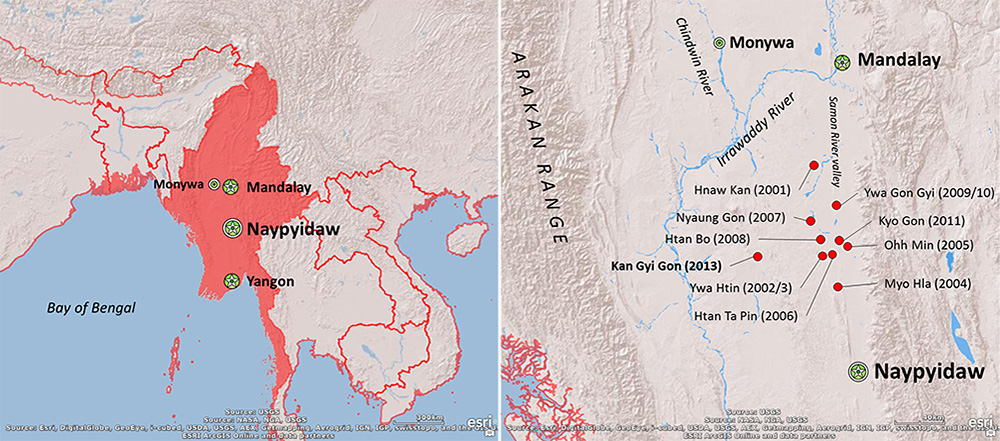
Regional map (left) and MAFM site locations 2001–2013 (right).

Many areas of the world claim to be 'cultural crossroads' and/or to be archaeological 'terrae incognitae'. Myanmar must surely rank among them—its location at the eastern terminus of the Himalayan Range constituting a natural and virtually unexplored bottleneck for longue durée social interaction between East and South Asia and the Pacific (Figure 1). Under the direction of Professor Jean-Pierre Pautreau (Centre National de la Recherche Scientifique) from 2001–2012, the Mission Archéologique Française au Myanmar (MAFM), in cooperation with partners from the Mandalay Department of Archaeology, was tasked with investigating the 'chronology and evolution of Bronze and Iron Age cultures of Myanmar and their anthropological and technological characteristics'. Over 11 field seasons, MAFM's efforts concentrated on excavating predominantly Iron Age (c. 500 BC–c. AD 500) cemetery sites in the central part of the country around the Samon River valley (Figure 1). The fruit of this Franco-Myanmar collaboration is the country's richest and most thoroughly documented late prehistoric archaeological dataset, facilitating the integration of Myanmar's deep past within synthetic interpretations of Southeast Asia's historical trajectory (Reference PautreauPautreau 2007; Pautreau et al. 2010).
2013 season
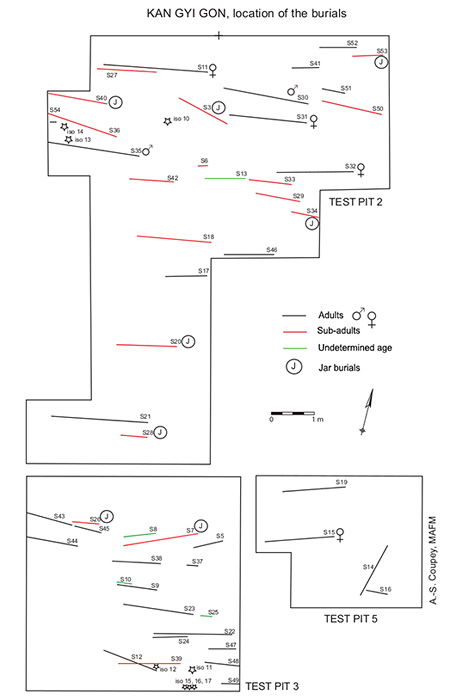
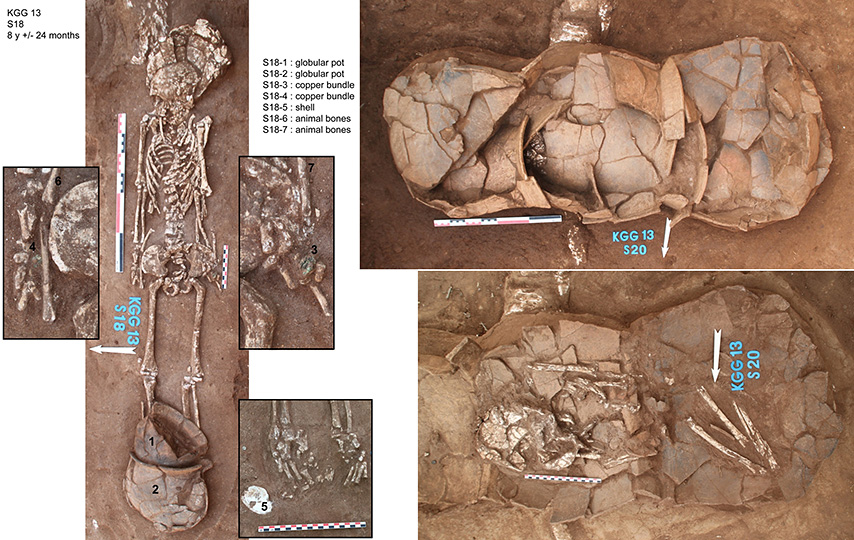
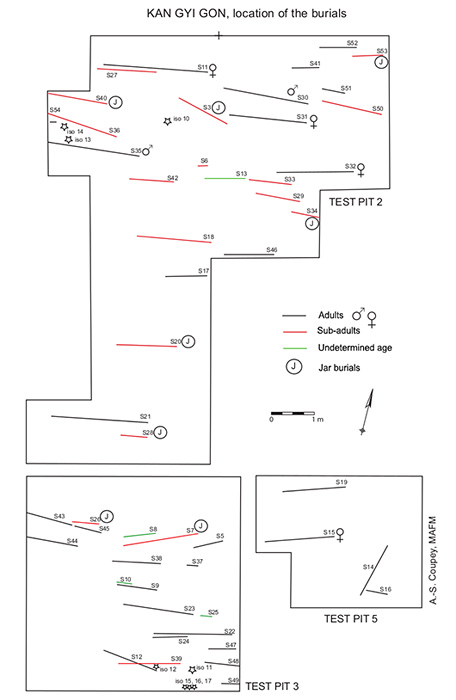
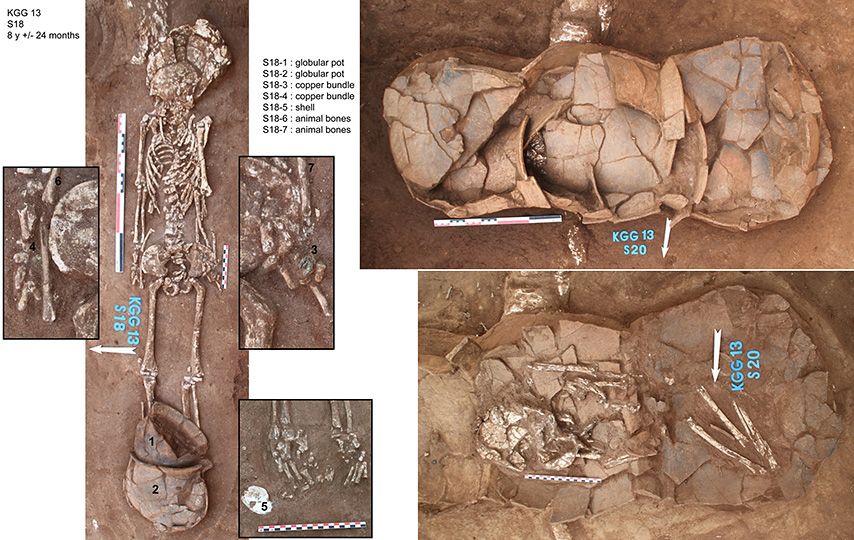
With Professor Pautreau's retirement, the directorship of MAFM has passed to T.O. Pryce, with Anne-Sophie Coupey providing strong and much-needed project continuity as deputy director. Motivated by a desire to push west away from the Samon and towards the Irrawaddy River, in February 2013 we investigated a site near Kan Gyi Gon in Magwe Division (Figure 1). The site is located approximately 1200m north-north-east of the present-day village, covering around 100m in diameter and gently sloping around 1.5m from north to south (95.4348° E, 20.5695° N). Extensive looting activity at Kan Gyi Gon had been recently reported to colleagues in Myanmar. Upon our arrival we found the site's integrity to have been severely compromised, with the surface pitted and scattered with large quantities of pottery and human bone. Of our five test pits, only three revealed in situ cemetery deposits (Figure 2). A total of 53 burials were excavated, of which 22 contained adults, 16 were immature and 15 were indeterminate due to poor preservation. The inhumations were all primary, with bodies extended on their backs with their heads towards the east. Coupey's anthropologie de terrain approach to skeletal positioning (Duday & Guillon 2006) indicates the presence of coffin and shroud burial traditions, in addition to the extant jar burials (rim-to-rim, as well as jars-in-series with the bases knocked through; Figure 3). The graves seem to be at the same stratigraphic level, with superposition rare (n = 8–10), and intercutting absent.
Plan of burials in Kan Gyi Gon testpits.
Kan Gyi Gon extended (#18, left) and jar (#20, exterior top right, interior bottom right) burials.
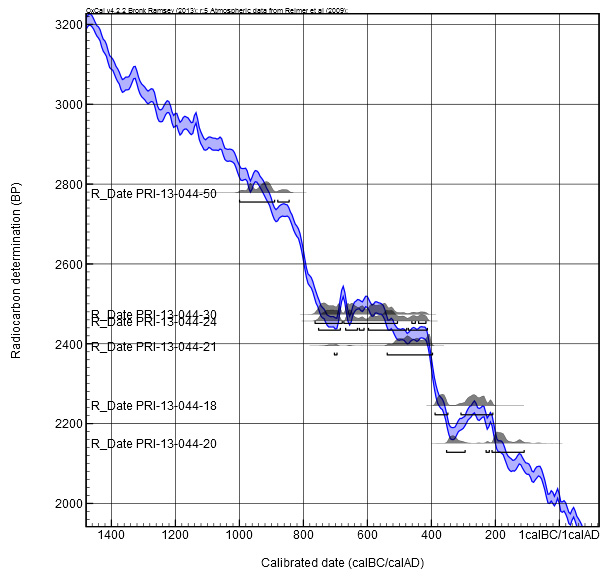
Kan Gyi Gon 14C dates (OxCal 4.2.2, Bronk Ramsey 2009; calibration curve from

In 2013, a first for MAFM was Leilani Lucas' use of archaeobotanical flotation techniques on all grave fill, abdominal areas and sealed pottery contents. Floating funerary contexts is generally risky and indeed no plant macroremains were identified, though phytolith studies are ongoing. Of great significance for the provision of a reliable Myanmar chronology, however, was the recovery of substantial quantities of charcoal—a find class that has proven elusive in previous MAFM seasons. Burials #18, 20, 21, 24, 30 and 50, containing adult and child skeletons and grave goods including pottery, glass, stone and copper-base materials, were selected for dating and six charcoal samples submitted for AMS 14C dating. All fragments were identified as of the Fabaceae family, which contains over 18 000 species ranging from shrubs to trees. We therefore risk some built-in age, but no more than a few centuries given the typical low longevity of Southeast Asian trees. The dates presented in Figure 4 indicate a probable (2σ) range of 500–200 BC for the Kan Gyi Gon burials; this corresponds to what is generally considered to be the Southeast Asian Early Iron Age. The exception was child burial #50, dated 1000–840 BC.
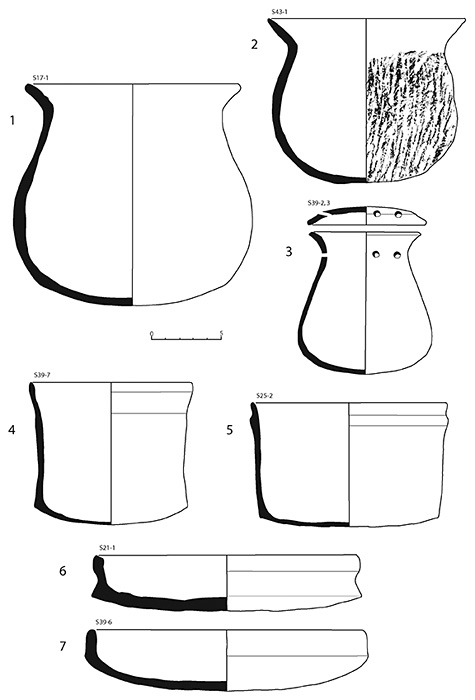
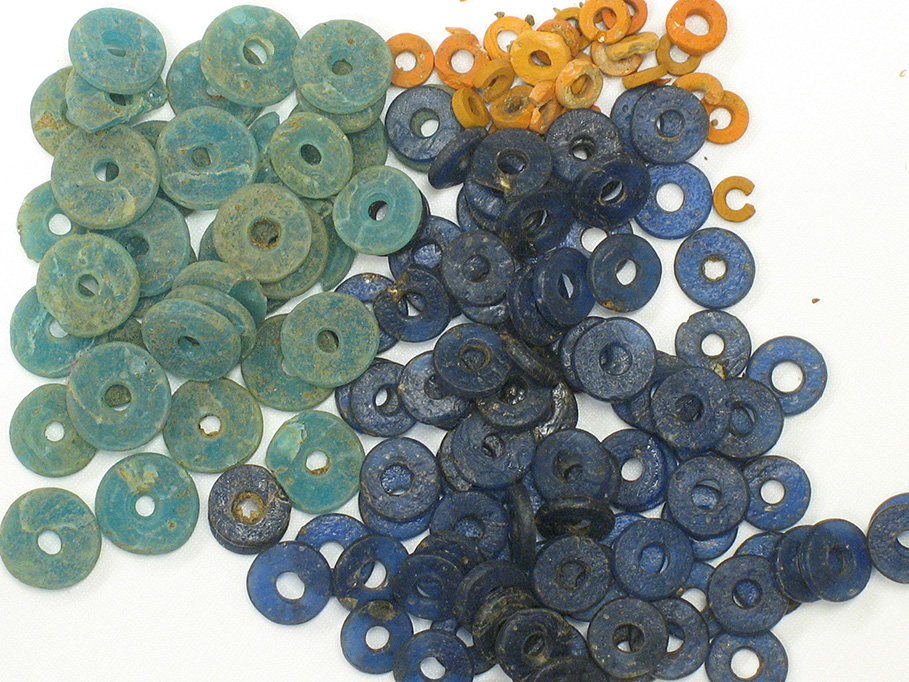
Technological and typological study of Kan Gyi Gon's pottery assemblage by Aude Favereau suggests the existence of a predominant ceramic tradition comparable to previous MAFM sites around 100km to the east: dishes and cylindrical and globular pots (Figure 5). Morpho-stylistic, elemental and isotopic analyses of Kan Gyi Gon's green and red glass beads, in addition to a re-evaluation of all previous MAFM glass assemblages (Figure 6), are ongoing by Laure Dussubieux, and a complementary programme on MAFM copper-base materials by Pryce is underway. The project portal at http://www.mafm.fr disseminates news and publications.
Principal Kan Gyi Gon pottery forms.

Typical glass bead types from prehistoric Myanmar.

Future directions
To date, MAFM's focus on late prehistoric cemeteries has been a necessary response to the widespread looting of such sites and the low visibility of contemporary non-cemetery loci. Our aim is thus to build upon MAFM's reputation for funerary archaeology with an increased emphasis on settlement and industrial sites. Of course, one cannot simply wish for these and we hope to conduct extensive surveys for such loci around Monywa near the junction of the Chindwin and Irrawaddy rivers—an area combining high potential for long range river networks with proximity to important mineral resources, especially copper (Figure 1). This would advance MAFM's long-term aim of offering a detailed account of Myanmar's rich national and regional culture history.
Acknowledgements
MAFM is financed by the French Ministry of Foreign and European Affairs, with additional contributions from UMR 6566 attached to the University of Rennes and UMR 7055 attached to the University of Paris West. MAFM's fieldwork would not have been possible without the support of the Myanmar Ministry of Culture and the French Embassy and French Institute in Yangon.