

1. INTRODUCTION
Please feel free to call us, the police, or do it yourself if you have the gun — you have my support. Shoot [the drug dealer] and I’ll give you a medal (President elect Rodrigo Duterte, 6 June 2016).Footnote 1
Hitler massacred three million Jews …. There’s three million drug addicts. There are. I’d be happy to slaughter them (President Rodrigo Duterte, 30 September 2016).Footnote 2
In the name of eliminating drug crime, President Rodrigo Duterte has plunged the Philippines into a nightmare of brutal slaughter. The police say that since July 1 [2016], they have killed more than 2000 people suspected of drug-related crimes. In addition, more than 3500 homicides remain unsolved, many at the hands of unknown vigilantes.Footnote 3
Labels such as “state killing” and “the killing state” are often used to describe the legally permitted judicial killing that occurs in systems of capital punishment.Footnote 4 But states kill extra-judicially too, and sometimes the scale so far exceeds the number of judicial executions that death-penalty reductions and abolitions seem like small potatoes.Footnote 5
This article focuses on extra-judicial killing in the Philippines during the first year and a half of President Rodrigo Duterte’s war on drugs (June 2016–January 2018), for three reasons. First, the Philippines is a large country whose systems of punishment have seldom been studied. With more than 100 million people, it is the thirteenth most populous country in the world, and it has more people than any country in Europe. Second, extra-judicial killing in the Philippines has attracted much attention because of its large scale and the impunity enjoyed by its perpetrators. In January 2018, Philippine police acknowledged that approximately 4,000 suspected drug users or sellers had been killed in the war on drugs, while Human Rights Watch put the number at 12,000Footnote 6 and Philippine human rights advocates claimed it was more than 16,000.Footnote 7 Despite thousands of slayings, only a handful of investigations have occurred, and not a single government official has been convicted. Third, we aim to focus attention on extra-judicial killing because it a neglected subject in scholarship on punishment. By our count, the journal Punishment & Society published 35 articles and 20 book reviews about capital punishment in its first 19 years, but only two articles on extra-judicial killing.Footnote 8 There has been a huge increase in the range and depth of scholarly work on the punishment of offenders who violate the criminal law.Footnote 9 There is also a growing literature on the so-called “justice cascade”—how offenders against human rights norms are increasingly punished and called to account.Footnote 10 But these two bodies of work “barely overlap”Footnote 11 and both of them neglect the ways in which politicians, police, and members of the military frequently construe their own violence as morally justified acts of punishment and social control.Footnote 12 For these reasons, we want to encourage research that will “expand criminology’s domain” to include a subject that is interesting, important, and marginalized.Footnote 13 In studies of law and society, too, extra-judicial killing has largely flown under the radar.Footnote 14
Some analysts argue that the “abolition of capital punishment in all countries of the world will ensure that the killing of citizens by the state will no longer have any legitimacy and so even more marginalize and stigmatize extra-judicial executions.”Footnote 15 Others claim that the abolition of capital punishment is “one of the great, albeit unfinished, triumphs of the post-Second World War human rights movement”Footnote 16 and that “abolition is a prerequisite for any regime aspiring to dissociate itself from those dark forces known for their hostility to democracy, equality and human dignity.”Footnote 17 This article suggests that these views are too sanguine. What is happening in the Philippines—thousands of executions in a country without capital punishment—represents a pattern that has been seen before and that will be seen again in polities with weak law, strong executives, and fearful and frustrated citizens. State killing often survives and sometimes thrives after capital punishment is abolished (see Mexico, Brazil, Nepal, and Cambodia). And in countries where capital punishment has not been abolished, extra-judicial executions have frequently been carried out after the number of judicial executions fell to near zero (as in Bangladesh, India, and Indonesia).
The rest of this article proceeds as follows. First, we summarize state killing in the Philippines—judicial and extra-judicial—from the time Ferdinand Marcos became president in 1965 until 2016, when Duterte was elected. During this half-century, capital punishment rose and fell while extra-judicial executions remained a regular feature of Philippine society. Then we describe extra-judicial killing during the first year of Duterte’s war on drugs and show its continuity with the practices of a “death squad” that was organized and orchestrated by Duterte when he was mayor of the city of Davao in the southern part of the country. In Section 4, we explain extra-judicial killing in the Philippines by presenting three main causes: the problem of impunity in Philippine criminal justice, which has frustrated large segments of the public; a Philippine form of penal populism in which governing through killing remains popular even though it is ineffective as crime control; and a form of democratic underdevelopment that is perpetuated by a narrow elite who rule Philippine society for their own benefit. In Section 5, we briefly summarize major developments in the first half of the second year of Duterte’s presidency, including a new offensive in his war on drugs, a pause in extra-judicial killing that was precipitated by public protests over the murder of a young man in Manila, and an announcement that Philippine police would conduct their renewed crackdown on drugs in accordance with a new set of guidelines designed to encourage compliance with laws and human rights norms. In the concluding section, we suggest five lessons that students of punishment and society should learn from this case-study. Foremost among them is the possibility that the decline of democracy in many parts of the world may encourage tolerance of executions in states that have capital punishment—and in some states that do not.
2. STATE KILLING IN THE PHILIPPINES BEFORE DUTERTE
The Philippines has abolished the death penalty twice: in 1987, after dictator Ferdinand Marcos fell from power, and then again (after the death penalty was reinstated in 1993) in 2006, following a push by the Roman Catholic Church and President Gloria Macapagal Arroyo. Under President Duterte in 2016–17, there was an effort in the Philippine Congress to resurrect the death penalty againFootnote 18 but, as of this writing (January 2018), no law had been enacted.
Under Marcos, who ruled the country from 1965 to 1986, the Philippines carried out 31 judicial executions and at least 3,000 extra-judicial executions—a ratio of 1 to 100.Footnote 19 Even under martial law (September 1972–January 1981), there were only 12 judicial executions in the Philippines, and there were no judicial executions at all during the last nine years of Marcos’s rule (1977–86). After Marcos was overthrown by the People Power Movement, the Constitution of 1987 abolished capital punishment “unless for compelling reasons involving heinous crimes, the Congress hereafter provides for it.” In 1993, the Philippine Congress reinstated the death penalty by passing one of the most expansive capital statutes in Asia and soon the Philippines had one of the largest death rows in Asia: more than 1,200 people were sentenced to death under the new death-penalty law, but only seven were executed. All were men and all were lethally injected between February 1999 and January 2000, during the administration of President Joseph Estrada, who was driven from power by a second “People Power” movement and subsequently convicted of plunder and sentenced to life in prison (later he was pardoned by President Arroyo). On Easter Sunday in 2006, President Arroyo commuted more than 1,200 death sentences in one of the largest mass death sentence commutations the world has ever seen. Two months later, she signed a Bill into law that abolished capital punishment in the Philippines for the second time in 20 years. The Bill had easily passed both chambers of Congress: 120 to 20 in the House and 16 to 0 in the Senate.Footnote 20
From 1993 to 2006, while death sentences were common and judicial executions were rare, extra-judicial executions continued to occur frequently in the Philippines, as they had throughout much of the twentieth century.Footnote 21 For example, the non-governmental organization (NGO) Karapatan found that, from 2001 to 2006, 819 people were victims of “extra-judicial, summary, or arbitrary execution” under the Arroyo government—an average of 137 non-judicial state killings per year during the first half of her presidency.Footnote 22 Arroyo pushed for the abolition of capital punishment, but she also stressed her own prerogatives of power, as when she asserted in her state of the nation address in 2007 that “From where I sit, I can tell you, a President is always as strong as she wants to be.”Footnote 23 After leaving office in 2010, Arroyo was arrested on charges of plunder. In 2016, the Supreme Court acquitted her by a vote of 11 to 4.
Extra-judicial killings in the Philippines seemed to decline under Arroyo’s successor, President Benigno Acquino III, but at least 300 leftist activists, human rights defenders, and alleged supporters of communist rebels were killed during his six-year term (2010–16). Those killings rarely resulted in criminal prosecution. Near the end of Acquino’s presidency, the deputy Asia director of Human Rights Watch warned that “while the number of serious violations has declined during Aquino’s administration, ongoing killings of prominent activists and the lack of successful prosecutions mean there’s nothing to prevent an upsurge of abuses in the future.”Footnote 24 This warning would prove to be prescient.
3. EXTRA-JUDICIAL KILLING IN DUTERTE’S WAR ON DRUGS
It is impossible to know how many people have been killed by police and other government officials in the first year of Duterte’s war on drugs, because the Philippine state is neither transparent nor consistent about how often it kills extra-legally.Footnote 25 There also are different degrees of state involvement, from (1) tolerating, condoning, and encouraging the killing of drug users and sellers, to (2) the fiction of buy-bust operations in which the targets of a sting resist arrest and are killed in a shoot-out, to (3) cold-blooded assassination as an act of governmental terrorism.Footnote 26 Moreover, some ordinary murders are staged to look like extra-judicial executions in order to prevent police investigation into the killing, thereby further complicating efforts to count. In many cases, there is little real distinction between a buy-bust killing and an extra-judicial one.Footnote 27 If the victim did not have a gun, one can be given to him after he is killed—and it frequently is.Footnote 28
Although accurate counts of extra-judicial killing are hard to come by, even the lowest estimates are large, and so are the figures provided by state officials. According to the Philippine National Police, as of 30 June 2017 (one year after Duterte took office), nearly 5,000 drug suspects had been killed, including 3,151 in reported gun battles with the police, and 1,847 others had been killed in drug-related attacks by masked gunmen on motorcycles and other vigilante assailants.Footnote 29 Non-governmental sources report much higher death tolls. According to one, in the first two months after Duterte became president, over 7,000 people were killed by police or by vigilantes encouraged to prosecute the war on drugs.Footnote 30 That would be more than 1,000 times the number of people judicially executed in the 13 years (1993–2006) that the Philippines had capital punishment before it abolished it the second time. Ten months into Duterte’s six-year presidency, the New York Times published an editorial reporting the number of dead at more than 9,400—an average of 32 per day. This is approximately three times more extra-judicial executions than the world’s leading judicial executing state (the People’s Republic of China, with a population 13 times that of the Philippines) executed in 2016.Footnote 31 Even by the most conservative estimates, the frequency of extra-judicial killing in Duterte’s war on drugs is far higher than the frequency of extra-judicial killing under the martial law imposed by Marcos in the 1970s (see Table 1).Footnote 32
Drug-related killings reported in the first year of the Philippine war on drugs
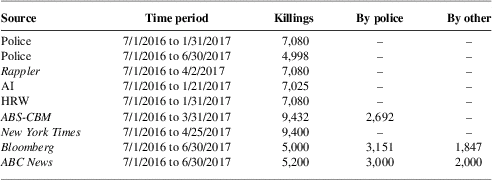
Sources: Philippine National Police, www.pnp.gov.ph; Rappler, 2 March 2017; Amnesty International (AI) (2017); Human Rights Watch (HRW) (2017); ABS-CBN, 5 May 2017; New York Times, 25 April 2017; Bloomberg, 30 June 2017; ABC News, 24 July 2017.
After Duterte became president, he began gathering the names of drug suspects from local police and elected officials. This is called a “watch list” and there are (in Duterte’s various tellings) anywhere from 600,000 to 1 million names on it, including at least 6,000 police officers, 5,000 local village leaders, and 23 mayors.Footnote 33 Most of the people on the list have been targeted by “Operation Knock & Plead” (Oplan Tokhang), which resulted in surrendering of 687,000 people across the country to police,Footnote 34 further burdening an already overburdened criminal justice system.Footnote 35 People who do not surrender are more likely to be targeted for extra-judicial execution, and many of the people who do surrender are made to sign a form pledging to stay off drugs. As reported by one man who was addicted to methamphetamines and who surrendered on the day Duterte took office, the form he signed said: “If you’re caught the first, second, and third time, there are warnings and conditions. If you’re caught a fourth time, we’ll have nothing to do with whatever happens to you.”Footnote 36
The war on drugs also employs “mass interrogations” (sona) in which tens or hundreds of (mostly poor) men are called out of their homes, lined up, arrested, and questioned. Some of them end up dead.Footnote 37
There is apparently “no certain or easy way to get off Duterte’s list,”Footnote 38 even for those who are powerful and well connected. Consider three examples. On 28 October 2016, a southern mayor named Samsudin Dimaukom was stopped at a checkpoint by police who claimed Dimaukom opened fire first. The mayor and all nine of his aides and guards were killed, and no police were injured. Twelve days later, on 5 November, police entered the jail cell of Albuera mayor Rolando Espinosa Sr, who had implicated police in the drug trade. Espinosa and his cellmate (Raul Yap) were shot dead in what the National Bureau of Investigation and a Senate investigation subsequently found to be murder.Footnote 39 Twenty-four police were arrested for these two killings, including Police Superintendent Marvin Marcos, but eight months later they were all reinstated on Duterte’s orders, perhaps because the president feared that “these policemen might rat out on him for what they know about his involvement in the Espinosa murder.”Footnote 40 On 30 July 2017, Ozamiz city mayor Reynaldo Parojinog, his wife, brother, sister, and 11 of their security personnel were killed after they allegedly opened fire on police—and after police had disabled CCTV in the mayor’s home and three nearby residences during their pre-dawn raid. No police were killed or injured in the encounter. Mayor Parojinog had denied any ties to illegal drugs, but he was widely believed to be a “narco-politician” involved in robbery, extortion, illegal gambling, and drug trafficking. Since some Ozamiz residents regarded the mayor’s ruling clan as Robin Hoods, there was mourning in the city for some of those who were slain but, outside the city, the most common reactions to the killings seemed to be “good riddance” and “why did it take so long?”.Footnote 41 To Duterte’s supporters, the elimination of politicians such as Dimaukom, Espinosa, and Parojinog demonstrates their president’s resolve to reform a country that some call “a gangster’s paradise.”Footnote 42
Duterte has made many pronouncements about how to prosecute the war on drugs. While campaigning for the presidency, he promised to rid the country of crime and drug use within 3–6 months. After he was elected, he compared himself to Hitler and said he would be “happy to slaughter 3 million drug addicts.”Footnote 43 On numerous occasions, he has publically encouraged police to “go ahead and kill them [drug users]” and promised to protect police killers from legal accountability. He has said: “Rich or poor, I do not give a shit. My order is to destroy.”Footnote 44 He has declared: “I don’t care about human rights, believe me. There is no due process in my mouth.”Footnote 45 He has promised that “the fish will grow fat” from the bodies dumped in Manila Bay.Footnote 46 He has taken aim at lawyers who defend drug suspects, threatening to include them in his drug war. He encouraged 19 police officers implicated in the death of an alleged drug lord to plead guilty so that he could pardon them.Footnote 47 And when US President Barack Obama cancelled a meeting with Duterte out of concerns over extra-judicial killing in the Philippines, Duterte called him a “son of a whore,” said “we have long ceased to be a colony,” and stressed that he is “only answerable to the Filipino people who elected me president.”Footnote 48
In addition to Duterte’s provocative pronouncements, there are other performative aspects of extra-judicial killing in the Philippines.Footnote 49 Abundant theatricality accompanies many things in the country, from karaoke and religious processions to the soap operas and melodramas on TV.Footnote 50 So, too, in the war on drugs. Corpses are found bearing cardboard signs that say “I am a pusher” or “I am a drug user, don’t be like me.” Victims have their heads mummified in packing tape, with cartoon expressions drawn on their faces. Dead bodies are posed in positions and places to maximize public viewing. And photojournalists who cover extra-judicial killing stage their own performances by chasing “The Shot”—an image powerful enough to capture the crackdown’s human costs. But in the first year of the war on drugs, even the most moving images of death did little to fuel public outrage. In fact, the crowds that form around victims of extra-judicial killing are “often festive, treating the whole scene as if it were entertainment.”Footnote 51 People laugh, mug for the cameras, make jokes, and take bets on whether they knew the victim. In some ways, the rompish atmosphere is reminiscent of public hangings in eighteenth-century EuropeFootnote 52 and lynching scenes in the Jim Crow south.Footnote 53
For his part, Duterte has frequently accused the media of “doing dramatics” and practising “yellow journalism” (reporting that relies on sensationalistic headlines instead of real research). He also has alleged that critical journalists are being paid by his enemies—and perhaps even by drug lords.Footnote 54 Since Marcos was overthrown in 1986, more than 170 journalists have been assassinated in the Philippines, and Duterte apparently believes many of them deserved to die. In a press conference shortly after he was elected, he said: “Most of those [journalists] killed, to be frank, have done something. You won’t be killed if you don’t do anything wrong. Just because you’re a journalist you are not exempted from assassination if you’re a son of a bitch.”Footnote 55
When one of Duterte’s fiercest critics, Senator Leila De Lima, called for an investigation of extra-judicial killing, Duterte threatened to throw her in jail—and then he had her arrested on three counts of drug trafficking with prisoners in the New Bilibid Prison on the outskirts of Manila, which holds more than 20,000 inmates.Footnote 56 She was jailed based on the testimony of prisoners, with no evidence of drugs. She is ineligible for bail, and Duterte has said that she should “just hang herself” and that he expects to “see her in hell.”Footnote 57 Duterte also revealed details of an affair between De Lima and her bodyguard/driver, who allegedly collected money from inmates to fund her senatorial campaign while she was secretary of the Department of Justice. Her attorneys have filed a case with the Supreme Court to prevent Duterte from further degrading her dignity. It is the first case to challenge a sitting president’s behaviour as “psychological violence, sexual harassment, and slut-shaming against women.”Footnote 58 One of her lawyers has wondered: “If this can happen to a senator, what more to an ordinary Filipino?”Footnote 59 Duterte has threatened and harassed other prominent women as well, including Ombudsman Conchita Carpio Morales, Rappler editor Maria Ressa, and Chief Justice of the Supreme Court Maria Lourdes Sereno.
Duterte has been called the “Donald Trump of the Philippines.”Footnote 60 Like his American counterpart (who hosted The Apprentice on NBC TV for 14 seasons), Duterte has a nose and knack for publicity. He also has his own TV shows. In Davao, From the Masses, for the Masses aired every Sunday on local TV while Duterte was mayor of that city, and the president recently launched his own national TV show with a similar name on government-owned People’s Television. The aim of both shows is “to communicate the policies of the Duterte administration to the masses” straight from the president himself.Footnote 61 If the new TV show is like the old one, Duterte will not only discuss his government’s programmes and policies; he will announce the names of people suspected to be involved in the drug trade—and some of them will then be killed.
Duterte ran for president against four other candidates and won handily, with 39% of the vote (more than 15% ahead of his nearest competitor). After he was elected, Time magazine featured a smiling Duterte on its cover under the title “The Punisher.” He also has been called “Duterte Harry.”Footnote 62 Despite criticism at home and abroad of the extra-judicial killing that has been perpetrated in his war on drugs, opinion polls in his first year consistently showed that he was liked, trusted, and supported by large majorities of the Filipino people (see Table 2). In fact, public support for Duterte is higher than for any previous Filipino president. His strongest support is among the poor, who also comprise the vast majority of victims in his war on drugs,Footnote 63 but he is also supported by majorities of the middle and upper classes.Footnote 64 In the last quarter of 2016, Duterte’s approval and trust ratings were both above 80%Footnote 65 and, in April 2017, 78% of Filipino adults said they were satisfied with the government’s crackdown on drugs, while only 12% said they were dissatisfied (see Table 2).Footnote 66
Public approval ratings for President Rodrigo Duterte, July 2016–June 2017
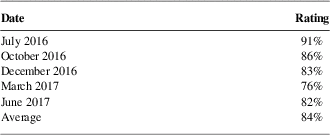
Source: Pulse Asia Research public opinion polls as reported in Rappler, www.rappler.com. Note: Pulse Asia Research’s Ulat ng Bayan survey is a nationwide public opinion poll for the Philippines that measures public approval of the Philippine president’s performance.
But there is also ambivalence in public attitudes toward Duterte’s war on drugs. In survey results released in December 2016, for example, 85% of respondents said they were satisfied with the administration’s campaign against legal drugs and 88% said that the drug problem had declined after Duterte became president, but 69% considered extra-judicial killing a serious problem, and 78% worried that they, or someone they know, would become a victim of extra-judicial killing.Footnote 67 These mixed feelings suggest that public opinion on this subject will vary considerably depending on the context and the wording of questions.Footnote 68 The ambivalence also reflects value conflicts within individuals who want to enjoy the benefits of crime control without being plagued by the knowledge or guilt that people are being killed extra-judicially.
Duterte has been called “a liberal’s worst nightmare”Footnote 69 and a “serial killer president”Footnote 70 but, in the country where he rules, he remains highly popular. His supporters, who are sometimes pejoratively called “Dutertardes,” are not simply ignorant prey for demagoguery and propaganda.Footnote 71 They sincerely believe he cares about their concernsFootnote 72 and they are pleased with his policies and moved by his stories.Footnote 73 Public support for Duterte is also rooted in the anger, frustration, and helplessness that people feel about the dysfunctions of Philippine criminal justice. As long as they believe the justice system is broken, they seem likely to support the president’s heavy-handed approach to threats to the social order.Footnote 74
In the courtroom of public opinion, the war on drugs is believed to be working even after Duterte suspended it for a month early in 2017 (30 January–27 February) following the revelations that Filipino police had kidnapped and strangled a South Korean businessman named Jee Ick-joo and then flushed his cremated ashes down a toilet in the national police headquarters.Footnote 75 This killing apparently occurred during an effort to obtain a USD 100,000 ransom from Jee’s family. National police chief Ronald dela Rosa said this death was not part of the war on drugs, but critics claimed police had been emboldened by Duterte’s promise to shield from prosecution those involved in the crackdown.Footnote 76 Following Jee’s murder, police chief dela Rosa was neither replaced nor reprimanded, and Duterte made many statements in support of the man who also had served as chief of police in Davao when Duterte ruled that city. A survey at the midpoint of Duterte’s first year in office found that 88% of Filipino adults perceived a decrease in the country’s drug problem since he became presidentFootnote 77 and, according to official statistics, crime in the country dropped by more than a quarter in Duterte’s first year. Drug abuse is a serious concern to many Filipinos. In a country that has failed to fix the circumstances that foster demand for drugs, Duterte’s harsh approach is widely considered a necessary evil.Footnote 78
The war on drugs that commenced in 2016 replayed on a national scale many of the policies that Duterte promoted while he was mayor of Davao (population 1.6 million) on the island of Mindanao. Duterte was elected mayor of that city seven times (he has never lost an election) and he served in the position for a total of 22 years. During his mayorship, the so-called Davao Death Squad killed at least 1,400 persons—an average of five people per month. Not a single person was successfully prosecuted for any of those killings. Duterte has been called “the Death Squad mayor”Footnote 79 and he has done little to deny the appropriateness of the appellation. While running for president, he declared: “Am I the Death Squad? Yes.” He also confessed to killing three kidnappers in Davao in 1988, the first year he was mayor. As he told the BBC: “I don’t know how many bullets from my gun went inside their bodies. It happened, and I said, I cannot lie about it.”Footnote 80 Some analysts believe there “has yet to be actionable evidence linking Duterte to the killings beyond his tolerance, if not support, for summary execution”Footnote 81 but, in our view, the available evidence strongly suggests that he organized the Davao Death Squad and ordered many of the extra-judicial killings it committed.
Two members of the Davao Death Squad have publicly described their own participation in extra-judicial killings while Duterte was mayor of that city. In September 2016, 57-year-old Edgar Matobato testified in the Philippine Senate that he had killed approximately 50 people in Davao, many at the direction of Duterte. And, in a press conference at the Philippine Senate in February 2017, a retired policeman named Arthur Lascanas confessed to killing 200 people while he was on the Davao Death Squad. Lascanas also reported that members of the Squad were typically paid 20,000–50,000 Philippine pesos (USD 400–1,000) for each killing, “depending on the status” of the target.Footnote 82 Two of his victims were his own drug-using brothers and a third was Jun Pala, whose critical radio commentaries angered Duterte.
Duterte has denied connections to Matobato and Lascanas and has refused responsibility for other extra-judicial killings in Davao. He also has denied claims of extra-judicial killing in his presidential war on drugs that were provided by 12 active and five former police officers in a 26-page report released to leaders of the Philippine Catholic Church and to the government-funded Commission on Human Rights in January 2017.Footnote 83 But Duterte is hardly a model of consistency, and he also has claimed credit for both killing campaigns on numerous occasions. In 2009, for example, he said:
If you are doing an illegal activity in my city [Davao], if you are a criminal or part of a syndicate that preys on the innocent people of the city, for as long as I am the mayor, you are a legitimate target of assassination.Footnote 84
And in a stump speech in front of 300,000 supporters in 2016, he said:
If I make it to the Presidential palace, I will do just what I did as mayor. All of you who are into drugs, you sons of bitches, I will really kill you. I have no patience, I have no middle ground, either you kill me or I will kill you idiots.Footnote 85
Before Duterte became mayor of Davao, it was known as “Murder City.”Footnote 86 Subsequently, many residents of Davao came to believe that governance Duterte-style brought safety and calm to a city that is “surrounded by areas where violence is rife.”Footnote 87 Nationally, “millions of Filipinos look at Davao’s transformation with envy—whatever the cost.”Footnote 88 They believe the Davao Death Squad helped deter crime and drug use, making the city one of the safest and most orderly in the Philippines. After 10 p.m., juveniles are not allowed on city streets unless an adult is accompanying them. Liquor cannot be sold after 1 a.m. Smoking is banned almost everywhere. Strict enforcement of low speed limits has reduced the number of motor vehicle accidents. Hundreds of closed-circuit TV cameras are constantly monitored at the city’s Public Safety and Security Command Center. Public works projects are often done on time and within budget—a rare achievement in the Philippines. And so on. Inside the city and out, Davao is seen as an “enclave of peace and relative prosperity” and a “blueprint” for taming the rest of the country.Footnote 89 It also has been named one of the Top 20 Most Liveable Cities in Asia.Footnote 90
But perception and reality can be two different things. We have found little solid evidence supporting the view that the Death Squad made Davao safer. In fact, according to police statistics, when Duterte became president in 2016, Davao had the highest murder rate and the second highest rape rate among 15 large Philippine cities.Footnote 91 Nonetheless, many people regard the city as an oasis of safety surrounded by a sea of violence, and public belief in the efficacy of Duterte’s policies in Davao—including governing through killing—helped propel him into the presidency.Footnote 92 While campaigning for that office, Duterte promised that thousands of criminals and drug users would be killed under his leadership. By all appearances, he has been trying to make good on that promise.Footnote 93
4. CAUSES
Like many penal practices, extra-judicial killing in the Philippines is “overdetermined” in the sense that it is shaped by a wide range of forces.Footnote 94 In this section, we take three passes at explaining this complex penal practice. First and most narrowly, we describe impunity in Philippine criminal justice in order to reveal some of the sources of public support for Duterte’s extra-legal policies. Then we step back to consider the politics of penal populism in the Philippines. Duterte realized long ago that governing through killing appeals to large segments of the public and wins votes, regardless of its effectiveness at reducing crime or deterring drug use. Our final pass takes a broad view of democratic underdevelopment in the Philippines in order to suggest that Duterte’s war on drugs is rooted in the economic and political failures that have plagued the country for decades. Since none of these causes is easy to change, extra-judicial killing could continue to occur long after Duterte leaves office.
4.1 Criminal Injustice
For decades before the slaughter that started in the summer of 2016, the Philippines had one of the highest rates of homicide in the world.Footnote 95 In 2014, it had the highest homicide rate among 51 countries in “Asia.”Footnote 96 With 9.8 homicides per 100,000 population, its homicide rate was twice as high as the rate for the US, three times higher than the average rate in Europe, and four times higher than the average rate for ten other countries in Southeast Asia. Because of underreporting and other data difficulties, it is hard to tell whether the Philippines has high rates for crimes such as theft, robbery, and rape but, in the years leading up to Duterte’s election in 2016, official crime rates soared, at least partly because of increased reporting by police.Footnote 97
The Philippines may also have higher rates of drug use and abuse than other countries in East and Southeast Asia, especially for methamphetamines (shabu). In 2014, 89% of drug seizures in the country involved methamphetamines, 8.9% involved marijuana, and 2.1% involved other drugs.Footnote 98 In 2011, the US State Department reported that 2.1% of Filipinos aged 16–64 abused methamphetamines.Footnote 99 It is hard to tell because the data are of poor quality, but there may be more than 1 million methamphetamine users in the country,Footnote 100 and Duterte and others have claimed there are more than 3 million.Footnote 101 Some methamphetamine users exhibit signs of addiction and acknowledge committing crimes in order to support their habit, but the best ethnographic work on this subject finds that most users remain functional and that the only crime many commit is taking drugs.Footnote 102
But, for some Filipinos, methamphetamine is personally destructive and criminogenic. Trafficking is organized and financed mainly by ethnic Chinese gangs. Because the Philippines is located near large nations such as China, Indonesia, and Japan, it is a major hub for methamphetamines in the region. The Catholic Bishops Conference of the Philippines 2015 Footnote 103 released a pastoral letter calling methamphetamine the “poor man’s cocaine” and warning that the drug is “dangerously ubiquitous” and “peddled openly in parks, bars, and street corners.” Years earlier, Filipino bishops described drug users as “mental and physical wrecks” who were the “worst saboteurs” and who deserved “the highest punishments”—views that are shared by many Filipinos.Footnote 104 There are few rehabilitation facilities in the country, and treatment is all but impossible to obtain for the vast majority of drug users and addicts.Footnote 105 To most Filipinos and many outside observers, the failure of Philippine drug policy is obvious.Footnote 106
Although methamphetamine often harms individuals, families, and communities, it also performs positive functions, especially for the poor.Footnote 107 It empowers manual labourers to work for long hours. It alleviates hunger. It provides emotional escape from the grinding conditions of daily life that millions of Filipinos endure.Footnote 108 And, as Clarke Jones of Australian National University observes, “A lot of the people involved in the [methamphetamine] drug market have no other opportunity for income, so a lot of [the drug] money [they earn] also goes to support families in communities.”Footnote 109 In a country that has failed to address the circumstances that generate demand for methamphetamine, Duterte’s war on drugs is considered a necessary evil by many Filipinos—including many who live in locations that are being targeted by this campaign. Unless the social and human sources of the country’s drug problems are addressed, reduced drug use seems unlikely.Footnote 110 The Philippines may well need a “war on drugs,” but the war it has been fighting under Duterte seems to be the wrong war, fought with the wrong weapons, and against the wrong enemies.Footnote 111 The root causes of the country’s drug problem are poverty and corruption.Footnote 112 If it does not reckon with the social and economic deficits that push people into drug use and trafficking, it will not be able to discourage demand for a substance that so many find appealing.
In addition to high rates of lethal violence, strong public demand for drugs, and deep public concern about drug-related problems, support for extra-judicial killing in the Philippines is fostered by the dysfunctions of its criminal justice system.Footnote 113 Countries such as the US and Japan have serious criminal justice problems but, in many respects, they pale in comparison to those found in the Philippines.Footnote 114 Most Filipinos believe there is little justice to be had from its “injustice system.”Footnote 115 Its criminal process proceeds at a glacial pace. Its judiciary has a backlog of 600,000 cases and at least 20% of the country’s trial courts lack judges. The average prosecutor handles 500 cases per year and the average public defender 5,000. The police are understaffed by about 50,000 officers and some analysts believe they are “the biggest criminal institution in the Philippines.”Footnote 116 Many persons accused of crime languish in jail for years, only to be released when police fail to testify or the evidence against them proves unreliable. Under Duterte’s predecessor as president, Benigno Aquino III, only about 25% of criminal cases in the country ended in conviction—and that was an improvement over the previous administration of Gloria Macapagal Arroyo. During Duterte’s war on drugs, Philippine courts—including the Supreme Court—have proved “incapable of asserting their independence and doing their work in a credible way,” which motivated prosecutors in the International Criminal Court (ICC) to initiate their own investigations.Footnote 117
In short, criminal justice in the Philippines is ineffective, inefficient, and corrupt. It is also toothless.Footnote 118 According to Mexico’s Center for Studies on Impunity and Justice, the Philippines has the highest Global Impunity Index of any country in the world—just above Mexico, where the drug trade and extra-judicial killing also flourish.Footnote 119 These failures of criminal justice seem to be “at the root of broad acceptance of Duterte’s draconian drug war.”Footnote 120 They also help explain why millions of Filipinos cheer extra-judicial killing or passively acquiesce to it, even though there is little evidence that it actually deters drug use.Footnote 121
4.2 Penal Populism
A sign in Davao reads: “Rody Duterte. The People’s last hope.” It is a message that resonates in the city and throughout many of the 7,000 islands in the Philippine archipelago. The country cannot kill its way out of its drug and crime crisis, but Duterte and associates can exploit it for their own ends and in ways that serve the interests of many Filipinos. They have been doing just that in a display of penal populism that is both familiar and unique.
At its core, “penal populism” consists of the pursuit of punishment policies based primarily on their anticipated popularity rather than their effectiveness.Footnote 122 Penal populism varies from place to place, but it also has qualities that are common in many countries, including the Philippines. Penal populism tends to be strongest when it is directed at an unpopular enemy—“others” who are defined as deviant and whose existence unites the public in indignation against them. In the Philippines, this group consists mainly of drug users and traffickers. Penal populism tends to be rooted in resentment against political elites and the existing political establishment. In the Philippines, there is little trust in the establishment to protect the interests or advance the wellbeing of ordinary people (two of the three presidents before Duterte were prosecuted for plunder). Penal populism tends to see the rights of offenders as favoured over those of victims and the law-abiding public. In the Philippines, criminal justice routinely fails to hold offenders accountable for their conduct. Penal populism turns the punishment of offenders into a spectacle for degrading them and for expressing the public’s vengeful impulses. In the Philippines, extra-judicial killing is often staged in these ways. Penal populism informs and misinforms the public by relying on media representations that privilege “commonsensical” understandings of crime and punishment. In the Philippines, the media routinely reflect and reinforce the prevailing common sense. Penal populism implies little faith in government to solve crime problems, making vigilantism an appealing alternative response. In the Philippines, the war on drugs blurs the line between killing by government and killing by vigilantes. And penal populism undermines the rule of law and the independence of the judiciary, thereby strengthening the executive’s hand. In the Philippines, these effects have been striking in Duterte’s war on drugs.Footnote 123
But if penal populism in the Philippines shares many qualities with penal populism in other countries, including its underlying causes,Footnote 124 it is also distinctive, in four ways. First, Duterte’s brand of penal populism is driven by both a politics of fear of crime and by a politics of hope that posits a better future once crime problems are under control.Footnote 125 Central to both of these appeals is a posture that Duterte packs with “hyper masculinity.”Footnote 126 He disdains formality, is given to profanity, is a confessed womanizer, and frequently “stands as the toughie ready to fight, kill, or die.”Footnote 127 All of these qualities make him seem “authentic,” in contrast to the duplicity of the “decent” politicians who have traditionally ruled the country.Footnote 128
Second, in countries such as Japan and the US, much populist anger is directed at immigrants who are said to pose a serious threat to the social order. In the Philippines, by contrast, immigration barely registers on the public radar. The presumed enemies of Philippine society are said to be internal: drug users and sellers, street criminals, and communist rebels. Emigration is a far more salient issue in the Philippines than immigration. Approximately 10 million people of Filipino descent work abroad and send back to their families tens of billions of dollars in remittances each year.Footnote 129
Third, in most countries, the central tool of penal populism is imprisonmentFootnote 130 but, in the Philippines under Duterte, extra-judicial killing has become its most salient feature. The Philippine imprisonment rate did increase in recent years, from 83 inmates per 100,000 population in 2002 to 140 in 2016. But almost all of this rise occurred before Duterte’s war on drugs started and, even after the rise, the country’s imprisonment rate remained lower than the average imprisonment rate (174) of the countries in Southeast Asia for which evidence is available, and it was less than one-third the imprisonment rate of Thailand (445), the leading incarcerator in the region.Footnote 131 At present, imprisonment in the Philippines is distinctive mainly because its seven national prisons and 1,130 local jails are operating at more than 300% of official capacity, making its correctional system far and away the most crowded one in the region. Prison and jail conditions in the country are brutalFootnote 132 but, in comparative perspective, what stand out in the Philippine form of penal populism are the frequency of its extra-judicial killing and the open acknowledgement of state acts that are clearly illegal (see Table 3).Footnote 133
Imprisonment rates and prison overcrowding in ten countries of Southeast Asia, 2017
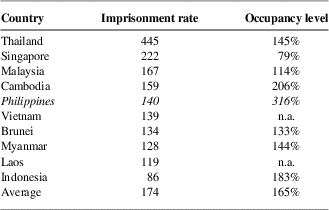
Source: World Prison Brief (2017), hosted by the Institute for Criminal Policy Research at Birkbeck, University of London, www.prisonstudies.org. Note: The imprisonment rate is the number of inmates in prison and jail per 100,000 population. The occupancy level is the total number of inmates in prison and jail divided by the official capacity of the prison and jail system. No figures are available for Timor-Leste.
The fourth Philippine distinctive is the connection between penal populism in the present and the long tradition of extra-judicial killing in the “local bossism” of the past.Footnote 134 Traditionally, who was targeted for extra-judicial killing (and for what activities) was largely determined by dynastic political bosses who ruled like feudal lords in “an anarchy of families.”Footnote 135 Local bosses and their extended families dominated their domains by engaging in predatory, kleptocratic, rent-seeking behaviour, and by committing murders with impunity.Footnote 136 Local bosses also resembled gang leaders in several ways. They engaged directly in crime. They provided protection for associates who were involved in criminal activities (including the drug trade). They practised passive non-interference in illegal activities—a form of tacit support that protected them from legal culpability. And they allowed the criminal and entrepreneurial activities of local police to go unchecked (blackmails, kidnaps, corruption, and so on). When Duterte was mayor of Davao, he played all of these local boss roles and, even after he left the second most populous city in the country to be governed by his daughter Sara and son Paolo (mayor and vice-mayor, respectively), Davao is still known as “Duterte city.”Footnote 137
Although the war on drugs in the Philippines seems singular in some ways, its commonalities with drug wars in other countries are especially significant. Indeed, in directing his war on drugs, Duterte—a former prosecutor—is “governing through crime” much as his American counterparts have done, albeit with far more lethality.Footnote 138 Three similarities are striking. First, when Duterte orders and condones extra-judicial killing, he is seen as acting legitimately because he claims to be trying to prevent crime and other bothersome behaviour. This is one hallmark of “governing through crime.”Footnote 139 Second, Duterte frequently deploys the problems of “crime” and “drug abuse” to legitimate governmental interventions (such as the arrest and killing of critics and rivals) that have other motivations. This, too, has been common in American efforts to govern through crime.Footnote 140 Most fundamentally, Duterte’s government fosters fear in Filipinos—fear of crime, fear of drugs, and fear of official responses to both—because he realizes that this emotion is an effective instrument of governance. In America, too, the lives of many citizens have been transformed not so much by crime per se as by fear of crime.Footnote 141 In short, the war on drugs in the Philippines may seem uniquely horrifying in its bloodiness and brutality but, in many of its essentials, it is surprisingly familiar.
4.3 Democratic Underdevelopment
The scale of extra-judicial killing in Duterte’s war on drugs reflects fundamental economic and political failures in Philippine society. The country is not a “failed state” like North Korea, Sierra Leone, or Zimbabwe, but it is dysfunctional in significant ways. In 2017, its GDP per capita (Purchasing Power Parity) of USD 7,700 placed Asia’s oldest democracy 154th out of the 230 countries in the CIA World Factbook—a little below Jamaica and Guatemala, and a little above India and the Republic of the Congo—to name four countries that also have had problems with extra-judicial executions. According to Freedom House,Footnote 142 the Philippines earns a score of only 4 out of 16 for the “Rule of Law” because the application of law and justice in the country are “haphazard” and “heavily favor ruling dynastic elites.”
In addition to the problems of economic and legal underdevelopment, there are also the legacies of colonialism. The Philippines is “America’s only major colonial experience”Footnote 143 and, before the half-century of repressive American rule (1898–1946), there was exploitation by the Spanish for nearly four centuries (1521–1898) and a brutal occupation by the Japanese during the Pacific War (1942–45). Few countries are more “shackled by the past.”Footnote 144 After one of the longest continuous periods of colonial rule in world history, the Philippines is now doubly dependent: on a colonial mentality produced by its experiences with America, Spain, and Japan; and on its own entrenched oligarchy.
The extent of dynastic rule in the Philippines is stunning, exceeding even those that are found in the countries of Latin America.Footnote 145 The Dutertes—father Rodrigo and eldest daughter Sara—have held the mayorship of Davao for the last 30 years and the dynastic share of governors in the rest of the country exceeds 80%. The dynastic shares for other elected positions are also high: 81% for vice-governors, 77% for the House of Representatives, 69% for mayors, and 57% for vice-mayors.Footnote 146 In many parts of the Philippines, only the rich and those with the correct last name enjoy the entitlement of leadership, and leaders routinely exercise their powers to feather their own nests rather than to promote the common good. As Alan Berlow observed in his trenchant analysis of murder and revenge on the island of Negros, the Philippines is a society
with no functioning system of law or justice, where government was either absent or irrelevant, and the rules regulating everyday life were dictated by a revolving cast of vigilantes, fanatical cultists, Communist revolutionaries, private armies, and the military. The Philippines may have proclaimed itself a democracy, but in Negros [and other parts of the country] almost everyone vying for power was equally committed to the subversion of democratic institutions.Footnote 147
Ultimately, the post-colonial Republic of the Philippines remains poor because it continues to be ruled by a narrow elite that organizes society for its own benefit, at the expense of the vast majority of its citizens. Part of this problem is corruption, which is so extensive that many leaders and local governments resemble glorified gangs.Footnote 148 In the Philippines, as in some other societies, “thieves of state” present grave threats to both development and security.Footnote 149 But the root of the country’s most serious problems is political. Economic institutions are critical for determining whether a country becomes poor or prosperous, but it is politics and political institutions that determine what economic institutions and incentives a country has.Footnote 150 Similarly, if one central conservative truth is that culture largely determines the success of a society, “the central liberal truth is that politics can change a culture and save it from itself.”Footnote 151 Politics also underlies the problem of extra-judicial killing in the Philippines. It is no coincidence that politics and state institutions are central in explanations for the trajectory of that other type of state killing known as “capital punishment.”Footnote 152
5. KILLING AND REFORM?
On 24 July 2017, in his second state of the nation address, President Duterte stressed that his war on drugs would be “unremitting” and “unrelenting”:
[P]rogress and development will sputter if criminals, illegal drugs, and illegal users of drugs are allowed to roam the streets freely, victimizing seemingly with impunity, the innocent and the helpless … I have learned that the economy surges only when there is peace and order prevailing in places where investors can pour in their capital and expertise. I have learned from my experience in Davao City that investor confidence is bolstered and fortified, only if, a potent force and mechanism for the protection of local and foreign investments are in place. That is why I have resolved that no matter how long it takes, the fight against illegal drugs will continue, because that is the root cause of so much evil and so much suffering that weakens the social fabric and deters foreign investments from pouring in. The fight will be as unremitting as it will be unrelenting. Despite international and local pressures, the fight will not stop until those who deal in it understand that they have to cease, they have to stop, because the alternatives are either jail or hell …. Neither will I be immobilized into inaction by the fear that I will commit an act that will expose me to public condemnation or legal prosecution. You harm the children in whose hands the future of this Republic is entrusted, and I will hound you to the very gates of hell … Do not try to scare me with prison or the International Court of Justice. I am willing to go to prison for the rest of my life.Footnote 153
Three weeks after this speech, Duterte’s war on drugs produced what may have been its “bloodiest days on record.”Footnote 154 In the province of Bulacan, seven miles north of Manila, 32 “drug suspects” were killed and 109 were arrested over a 24-hour period on 14 and 15 August. The next day in Manila, 26 people were killed in a crackdown that police called a “one-time, big-time” operation against illegal drugs, and Duterte declared that police should shoot human rights activists if they try to obstruct justice. National police chief Ronald dela Rosa said there would be no let-up in the war on drugs. “This is unrelenting,” he stated. “We will continue to operate until the end.”Footnote 155
We do not expect extra-judicial killing in the Philippines to end anytime soon, for it has been a prominent feature of the country’s political landscape for decades, and it has been a major source of Duterte’s popularity. But in the second year of Duterte’s presidency, there was a significant pause in governing through killing. The precipitating circumstance was the extra-judicial execution of 17-year-old Kian Loyd delos Santos in the 16 August crackdown in Caloocan City in metro Manila. Delos Santos had never been in trouble with the law and was not on any police watch list. According to family and friends, he wanted to become a police officer, he did not use or sell drugs, and he supported the war on drugs. After his execution, the police claimed that he had fled when they approached him and then had shot at them during the ensuing chase. The right-handed delos Santos was found dead in an alley with a 45-calibre pistol in his left hand and two sachets of methamphetamine on his person. He had three gunshot wounds: one in the back of his head, another behind his left ear, and a third inside his left ear. The usual police story—“we fired because we were fired upon”—might have prevailed if not for a CCTV video taken in the ward where delos Santos lived. It showed him being dragged away by two men in plainclothes at 8:24 p.m., just minutes before he was found dead. Several residents of the ward also came forward with eyewitness accounts that contradicted the police version of events. These revelations received intense coverage in the Philippine media (including Facebook and Twitter) and many public protests occurred in the weeks that followed, led by the Catholic Church and by activists who denounced Duterte’s drug crackdown.Footnote 156 Several senators publicly condemned the killing of delos Santos and the war on drugs, as did prominent Catholic priests. Opinion polls showed rising levels of public concern about police conduct in the war on drugs and falling levels of public support for Duterte. In October, domestic and international criticism prompted Duterte to announce that he was ending the war or drugs.Footnote 157 For the rest of 2017, while Duterte’s popularity rebounded, there was little clear evidence of extra-judicial killing, though the president did occasionally proclaim that his war on drugs would continue. In a speech on 8 December, he said:
I don’t care if you call me killer …. Who would not be a killer? So is it wrong to say now, “Do not destroy my country because I will destroy you?” …. There will be no drugs. I don’t care if I lose my job, the presidency, or if I get killed. I promised the Filipino people during the campaign and I will do it whether you like it or not. Sorry but I don’t care about your opinion about me.Footnote 158
On 29 January 2018, Philippine National Police Director General Ronald dela Rosa announced that the war on drugs would resume with a new and improved Operation Knock-and-Plead. He expressed hope that police operations would be less violent this time, but he stressed that he could not guarantee that the renewed campaign would be bloodless. The behaviour of police would depend on the reactions of the people they targeted. “Don’t fight back,” he said. “[We] have to preserve our own lives.”Footnote 159
Dela Rosa also emphasized that the new and improved war on drugs would respect human rights and be governed by the rule of law. He even released an instruction manual with guidelines describing how drug operations should proceed. Among other promised reforms, the drug watch list (the “Bible” of Knock-and-Plead) should be kept accurate and updated, police who participate in drug crackdowns should receive one day of training, anti-drug operations should be carried out only between 8:00 a.m. and 5:00 p.m. Mondays to Fridays, police should remember to wear their uniforms during these operations, and there should be “command responsibility” for the failures of subordinates that can be traced to the negligence or misconduct of police leaders.Footnote 160 Dela Rosa even invited the public to come along on the new Knock-and-Plead operations, saying that “anybody who wants to join” is welcome to do so because police “aren’t hiding anything.”Footnote 161 In support of this new approach to the war on drugs, presidential spokesperson Harry Roque said: “We are hoping it will be [less bloody] and we welcome the statement by the PNP as reaffirming [the police] commitment to the rule of law.”Footnote 162
Controversy about the war on drugs is undesirable, Roque observed, because it blurs the government’s real intention, which is “the fight against dangerous drugs.”Footnote 163 Romulo Valles, the Archbishop of Davao and the new president of the Catholic Bishops’ Conference of the Philippines—as well as a close friend of Duterte—stressed that police should “follow the prescribed steps” in the new guidelines so that “as much as possible we must make sure that we do not waste any lives.”Footnote 164
6. LESSONS
Time will tell how much extra-judicial killing occurs in the Philippines under new guidelines that purportedly leave “no space for possible abuse.”Footnote 165 Time will tell, too, whether capital punishment will be reinstated in the Philippines once again, as Duterte is trying to do. In his second state of the nation address, he stressed that death-penalty revival was his top legislative priorityFootnote 166 and he said he wants five or six legal executions carried out every day, by hanging.Footnote 167 Unless Duterte dies, is removed from office, or is able to change the term limit rule for presidents, his one and only presidential term will end in June 2022. There is also the ICC in The Hague, which, in February 2018, opened an investigation into accusations that Duterte and other Philippine officials had committed crimes against humanity during the government’s deadly crackdown on drugs.Footnote 168 This chapter in the history of state killing in the Philippines is far from finished, but we can identify five lessons from it that students of law and society should learn.
First, extra-judicial killing deserves more study than it has so far received. Compared with the number of studies of judicial killing through institutions of capital punishment, studies of extra-judicial killing are few and far between, especially in the field of punishment and society. In some ways, this imbalance resembles the extreme imbalance between the salience of capital punishment (high) and the salience of killings by police (low) in academic and media works about the US.Footnote 169 Historians, area studies scholars, and NGOs have frequently described extra-judicial killing, but their works have rarely informed thinking about extra-judicial killing as a form of social control or a type of punishment. The best sociological accounts of genocide and governmental violations of human rights tend to focus on judicial responses to such offences, not on the offences themselves.Footnote 170 If law is usefully conceived as “governmental social control,” as one classic account argues,Footnote 171 then the failure to connect with works in other fields is unfortunate for the study of law and society. Similarly, if studies of penality should be broad, both substantively and comparatively,Footnote 172 then the failure to connect with works in other fields is unfortunate for students of punishment and society too. The study of extra-judicial killing does face empirical and conceptual challenges.Footnote 173 For one thing, governments that kill extra-legally are seldom as brazen about it as Duterte has been.Footnote 174 For another, there are different types of “extra-judicial killing” that use of one broad label obscures.Footnote 175 We leave these and other challenges for future researchers to address. The subject is so interesting, important, and neglected that we hope the challenges will do more to spur further study than to discourage it.
Second, students of capital punishment should be less sanguine about the consequences of abolition. The authors of this article oppose capital punishment and want to see it abolished everywhere, but we are also realists about the effects of abolition. The record suggests that state killing does not necessarily decline after the death penalty is abolished—as the Philippines illustrates. One analysis of the second abolition of capital punishment in the Philippines was entitled “A Lesson Learned?”.Footnote 176 The authors’ answer to the titular question was “probably” and their prediction was that the Philippines would not attempt to reinstate capital punishment again. They were wrong. Their 43-page chapter also had little to say about extra-judicial killing. A similar form of death-penalty myopia can be seen in studies of India,Footnote 177 Indonesia,Footnote 178 China,Footnote 179 countries with majority Muslim populations,Footnote 180 and countries in AfricaFootnote 181 —just to name a few. More generally, the persistence of extra-judicial killing after death penalties are abolished or moratoria on judicial executions are declared suggests that there is reason to wonder whether “violence” has really declined as broadly and deeply as some scholars have argued.Footnote 182
Third, penal populism and governing through crime are common not only in developed societies, but also in those that are developing. Most studies that have employed these perspectives have focused on developed democracies in the West, and they have greatly improved our understanding of the politics of punishment.Footnote 183 But there are many less developed societies where penal populism is practised, and there are many more where leaders have realized that governing through crime brings large benefits.Footnote 184 In our view, students of punishment and society have much to learn about the politics of punishment in societies that are not WEIRD—not Western, educated, industrialized, rational, and democratic—much as students of moral psychology have gained new insights by analyzing the attitudes of people who are not WEIRD in these five ways.Footnote 185 Extending studies of penal populism to non-WEIRD societies will produce knowledge about how it differs from context to context, such as the finding that extra-judicial killing is a far more prominent feature of penal populism in the Philippines and Thailand than it is in (say) the US and Japan. At the same time, studies of non-WEIRD societies may replicate findings from the research on penal policy in modern and post-modern societies, such as the discovery that, in some Western societies, public concern about crime and media coverage of crime are closely connected to actual crime trends.Footnote 186
Fourth, scholars have long recognized that there are tensions and tradeoffs between crime-control values and due-process values,Footnote 187 but less appreciated is the fact that failures of crime control can motivate disregard for due process. The problem of impunity in Philippine criminal justice—the failure to catch and convict criminals—is so severe that many Filipinos believe ignoring rights is both justified and imperative.Footnote 188 This is the fertile ground of public opinion in which Duterte’s brand of penal populism finds root, and it can be found in other societies where extra-judicial killing is common, from India and Indonesia to Mexico and Honduras. Law and society is a large tent in which a wide variety of good research gets done but, in our view, the field would be enriched if more scholars took seriously the crime-control failures that help explain why violence is “far more serious, pervasive, and devastating in some places than others.”Footnote 189
Finally, the number of democracies in the world increased markedly after World War II, from 30 or so to more than 100. Since 2000, however, nation-states of major significance, including Russia, Turkey, Thailand, and the Philippines, have gone in the opposite, authoritarian direction.Footnote 190 More broadly, many analysts believe that liberal democracy is “retreating” in the West and elsewhereFootnote 191 and that authoritarianism is “going global.”Footnote 192 As democracy declines, so, too, might resistance to state killing, both judicial and extra-judicial. In the twentieth century, the “character of government” shaped death-penalty policy in three ways, especially in Europe. Fascist and totalitarian governments such as Germany, Italy, and the Soviet Union had obvious affection for high rates of execution. Europe’s remarkably rapid movement toward abolition occurred mainly during two political transitions: one following the defeat of the Axis powers in 1945 and the other following the fall of the Soviet Union in 1989. And shifts of government from right-of-centre to left-of-centre precipitated death-penalty decline in countries such as England, France, and Spain. We do not know whether the current “democratic recession” will turn into a “global depression”Footnote 193 but, if it does, there could be surges in state killing in various countries. In this context, the case of the Philippines illustrates two political truths of broad relevance: that it is difficult to make a real democratic revolution succeed and that nations do not shed their pasts like snakes their skins.Footnote 194 The Philippines is the only Christian nation in Asia—and the most Westernized one as well. Yet, in many ways, it remains a feudal society dominated by a small oligarchy.Footnote 195 Unless the country undergoes deeper democratic development than it has experienced since Marcos was overthrown three decades ago, eruptions of extra-judicial killing will probably continue to occur, and another revival of capital punishment could occur as well. In the rest of the world, the erosion of democracy may augur ill for people who believe states should not kill their own citizens.



