


11.1 Introduction
Decentralised autonomous organisations (DAOs) have emerged as an apparently new organisational form following the advent of blockchain technology. Blockchain technology was invented by the pseudonymous Satoshi Nakamoto to underpin an internet native money Bitcoin. At its core, blockchain operates as a distributed ledger that records transactions, across multiple computers (known as “nodes”), so as to ensure security, transparency, and immutability. Unlike traditional centralised databases, where a single entity has control, a blockchain is maintained by a network of participants who “validate” the blockchain. This decentralised structure eliminates the need for intermediaries, reduces the risk of fraud, and enhances the integrity of the data. The cryptographic principles that govern blockchain also ensure that once a transaction is recorded, it cannot be altered.
Davidson et al. (Reference Davidson, De Filippi and Potts2018) argue that blockchain technology is not a new general-purpose technology, but rather a new institutional technology. In particular, we argue that blockchain technology will facilitate the emergence of new institutional forms and new business practices. One possible consequence of that new institutional technology is that existing hierarchical organisational forms should become less hierarchical and that we should expect to see more markets where we now see hierarchy. That insight, however, is not new. The Electronic Markets Hypothesis, that makes similar predictions, had been posited by Malone et al. (Reference Malone, Yates and Benjamin1987, Reference Malone, Yates and Benjamin1989) and Malone and Rockart (Reference Malone and Rockart1991) in the late 1980s and early 1990s. I have argued elsewhere, however, that DAOs are not simply manifestations of the electronic markets hypothesis (see Davidson Reference Davidson2025).
In Davidson (Reference Davidson2025), I report several common features within the various definitions of DAO that I investigate. DAOs operate without a management hierarchy, underlining their decentralised nature. Their autonomy is a fundamental attribute, emphasised by the capability of DAOs to function independently based on preset rules that are typically encoded as smart contracts. The use of blockchain technology is a universal element across all definitions, as is the significant role of tokens in DAO governance structures, granting voting rights and organisational influence to their holders, thereby democratising the decision-making process.
It is important to note, however, that DAOs are more than just “labour-controlled” firms on the internet. Their emergence raises fundamental questions about corporate governance and the nature of the firm in the digital age. Traditional debates on corporate governance have focused on issues like shareholder primacy, stakeholder theory, and the separation of ownership and control (see Shleifer and Vishny Reference Andrei and Vishny1997). DAOs challenge these paradigms by introducing a new model where governance is embedded in code, “ownership” is often widely distributed through tokens, and decision-making is decentralised. This connects to broader discussions about whether corporations should be viewed and governed as commons (Deakin Reference Deakin2012). Just as Elinor Ostrom (Reference Ostrom1990) showed how communities can effectively manage shared resources without relying on markets or state control, DAOs represent an attempt to manage shared digital resources and decision-making through community governance rather than traditional corporate hierarchies and shareholder primacy.
Davidson et al. (Reference Davidson, De Filippi and Potts2018, 654) define DAOs as follows:
A [DAO] is a self-governing organisation with the coordination properties of a market, the governance properties of a commons and the constitutional, legal and monetary properties of a nation state. It is an organisation, but it is not hierarchical. It has the coordination properties of a market through the token systems that coordinate distributed action, but it is not a market because the predominant activity is production, not exchange.
Under this definition, DAOs are a combination of several existing organisational forms that are well known and used to pursue collective action in various domains. What is not clear, however, is whether DAOs as a novel organisational form are viable. The very first DAO, “The DAO,” collapsed in 2016 as a result of being hacked following a coding vulnerability. Blockchain technology, at the time of writing, is less than fifteen years old and DAOs as an organisational form are (much) less than ten years old. There is a very real possibility that DAOs – as envisaged – may not be viable or may have a small number of very specific use cases. To be fair, however, similar conclusions could have been drawn about the long-term viability of the joint-stock company after it first emerged (see Baskin and Miranti Reference Baskin and Miranti1997). Williamson himself was initially sceptical about the importance and value of hybrid forms of organisation, such as joint venture, franchising, and the like (Ménard Reference Ménard2022).
In this chapter, I investigate the idea that DAOs are best understood as being commons as opposed to being “firms,” as generally understood by economists (Coase Reference Coase1937; Alchian and Demsetz Reference Alchian and Demsetz1972; Williamson Reference Williamson1975, Reference Williamson1985). Ostrom, the 2009 economics Nobel laureate (joint with Oliver Williamson), has developed a body of knowledge (both theoretical and empirical) that identifies when commons (i.e. communal governance over common pool resources) will fail or succeed (see Ostrom Reference Ostrom1990, Reference Ostrom2003, Reference Ostrom2005, Reference Ostrom2010). This difference can be best explained as being the difference between “community” governance and “private” governance. Community governance is based on collective decision-making and sustainable resource management by a community, whereas private governance prioritises individual or corporate interests and profit maximisation in resource control (see Dekker and Kuchař 2023).
Building on Ostrom’s Institutional Analysis and Development (IAD) framework, as modified in Frischmann et al.’s (Reference Frischmann, Madison, Strandburg, Frischmann, Madison and Strandburg2014) Governing Knowledge Commons (GKC) framework, the chapter explores the internal dynamics of DAOs and their interaction with external variables, aiming to understand their potential to function effectively as commons. The chapter differentiates between on-chain and off-chain governance models within DAOs, discussing the advantages and challenges of each approach in promoting decentralisation and resolving conflicts. I also assess the viability of DAOs as robust institutions using Ostrom’s design principles. Specific attention is given to unique “exit” mechanisms (Hirschman Reference Hirschman1970), including forking and “rage-quitting,” understood as innovative solutions to governance challenges within DAOs. The overall finding of the analysis is that DAOs are well understood as being commons and they should be treated as such by researchers. But are DAOs are “just” commons?
11.2 Are DAOs “Just” Commons?
Ostrom (Reference Ostrom2005, 79) defined a common-pool resource as follows: “A common-pool resource, such as a lake, an ocean, an irrigation system, a fishing ground, a forest, the Internet, or the stratosphere, is a natural or man-made resource from which it is difficult to exclude or limit users once the resource is provided by nature or produced by humans.”
Hess and Ostrom (Reference Hess, Ostrom, Hess and Ostrom2007, 3) further define a “commons” as being a “complex system” where “a resource [is] shared by a group of people that is subject to social dilemmas.” These social dilemmas consist of those human behaviours that might undermine the viability of the shared resource, such as “competition for use, free riding, and overharvesting” (Hess and Ostrom Reference Hess, Ostrom, Hess and Ostrom2007, 5). Social dilemmas, such as the tragedy of the commons or congestion, involve what economists would generally describe as “negative externalities.” In the Pigouvian tradition, the solution to these sorts of problems is provided via government regulation and/or taxation or subsidy. Coase (Reference Coase1960) proposed a series of solutions to these sorts of problems that revolved around privatisation, vertical integration, government regulation, or simply doing nothing. Ostrom, by contrast, demonstrated that local institutions often emerge or evolve to solve what were (very often) local problems. Traditionally, this research framework has been applied to “subtractive resources.” But its extension to “non-subtractive” resources, such as knowledge, suggests that “the unifying thread in all commons resources is that they are jointly used, managed by groups of varying sizes and interests” (Hess and Ostrom Reference Hess, Ostrom, Hess and Ostrom2007, 5).
The notion that DAOs could be thought of as being a kind of a commons raises complications. Pre-existing natural resources are very likely different from digital resources. It is possible to differentiate between the existence of a naturally occurring resource pool and the governance of that naturally occurring resource pool. It is not clear, however, that the existence of a digital resource pool and the governance of that digital resource pool can be as clearly differentiated. Digital assets must be created through human action and human design. Presumably, the governance of those digital assets is simultaneously created when the digital asset is being created. Furthermore, a governance process to create the digital asset is required in addition to a governance process to manage the asset once created – there are mixed forms of governance (Dekker and Kuchař Reference Dekker and Kuchař2024) in adjacent action arenas (McGinnis Reference McGinnis2011). While DAOs can be thought of as being “social infrastructure” (Frischmann Reference Frischmann2012, 67–72), the nature of the resource being governed is very different to how economists usually conceptualise commons. For example, permissionless (i.e. non-excludability) is a feature for blockchains and is not a problem. Furthermore, goods are not just non-rival, they are intended to be “antirival” (Weber Reference Weber2004; Olleros Reference Olleros2018). The resource becomes more valuable as more users make use of it. Hess and Ostrom (Reference Hess, Ostrom, Hess and Ostrom2007, 5) made this point about knowledge: “the more people … share useful knowledge, the greater the common good.”
The idea being investigated in this section is that DAOs are a form of “software commons” or “knowledge commons,” which Schweik (Reference Schweik, Hess and Ostrom2007, 277) described as follows:
I argue that the collaborative ideals and principles applied in Free/Libre and Open Source Software (FOSS) projects could be applied to any collaboration built around intellectual property (not just software) and could potentially increase the speed at which innovations and new discoveries are made. In other words, we can conceive of a future where such “knowledge commons” are built not around software, but more generally any kind of work or “content.”
As Schweik argues, in open-source commons, individuals are producing a resource – in this case, software – and need to design institutions and practices that both facilitate the production of the resource and prevent the resource from being over-harvested. That is precisely the challenge facing DAOs – where the software is specifically focussed on blockchain usage and applications.
An important feature when evaluating open-source commons is to understand “the collaborative infrastructure that helps to coordinate and manage production” (Schweik Reference Schweik, Hess and Ostrom2007, 286). In the DAO context, that collaborative infrastructure is the series of smart contracts that underpin the DAO. Other important features include “established systems of rules, shared norms of behavior, voting systems, and monitoring and sanctioning systems” (Schweik Reference Schweik, Hess and Ostrom2007, 298).
Considering these features as a whole raises questions such as “Can DAOs scale?” Shared norms of behaviour, for example, can be enforced in small groups, but not necessarily in large groups. Then there is the question of participation rates in voting systems – if few people actually vote, that could be indicative of free-riding problems.
The management challenge, however, still remains. Schweik (Reference Schweik, Hess and Ostrom2007, 297–298) discusses commons governance structures and categorises them into four groups: a lead developer who maintains a centralised decision-making structure; a “benevolent dictator” model; an elected leadership model; and a consensus model. Decentralised Autonomous Organisations can only adopt the consensus model (and still be categorised as a DAO). Voting on major decisions is likely to be beneficial in promoting innovation and the like, but it can become burdensome when considering routine business decisions (Markus Reference Markus2007).
It is clear that DAOs are special cases of information or knowledge commons, but it is unclear whether those structures can handle management costs and agency costs better than centralised organisations can – this issue is an empirical question.
11.3 DAOs in the GKC Framework
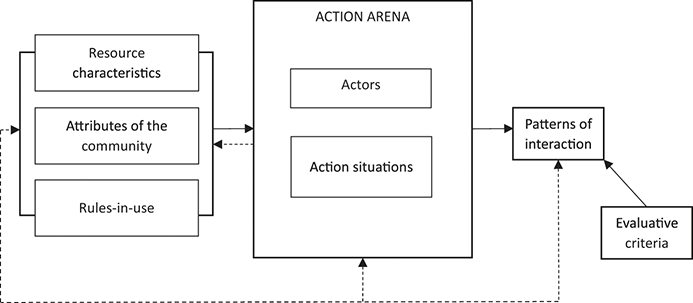
The IAD framework is a generalised tool for understanding how institutions operate and evolve in order to resolve various social dilemmas, particularly those involving common-pool resources like fisheries, forests, and water supplies. The framework breaks down the complexities of institutional arrangements into more manageable components. The framework assists in understanding how “actors” interact within an “action situation” to produce outcomes. These action situations are influenced by a variety of considerations, including the resource characteristics, attributes of the community, and the rules-in-use, which are referred to “external factors.” The patterns of interaction from the action situation are then evaluated by some criteria, such as efficiency, equity, and accountability. These assessments can then feed back into the exogenous factors or the action arena, leading to adjustments or adaptations in the rules-in-use, the actors’ strategies, or the community attributes.
Frischmann et al. (Reference Frischmann, Madison, Strandburg, Frischmann, Madison and Strandburg2014) argue that the IAD framework is more appropriate for natural and depletable resources, and needs to be modified to analyse knowledge and information commons, which include non-depletable resources. Indeed, the resources studied under the IAD framework are typically tangible, depletable resources, where overuse by one individual can diminish the availability for others. By contrast, the GKC framework analyses resources that are intangible, non-depletable, and often non-excludable. The challenge here is less about overuse per se and more about ensuring sustainable and equitable access, creation, and distribution of knowledge. The GKC framework is shown in Figure 11.1
Stylised GKC framework.
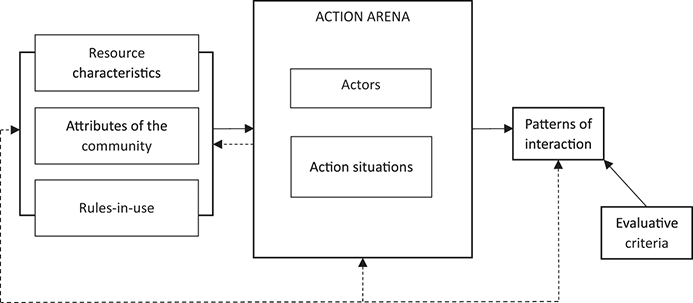
I now apply the GKC framework (Figure 11.1) to the analysis of blockchains and DAOs. I begin with the observation that the action arenas – blockchains and DAOs – are human constructs. They are not naturally occurring resource pools and that this difference is an important part of the analysis. What becomes particularly important is the notion of “adjacent action arenas” (McGinnis Reference McGinnis2011; Cole Reference Cole2017; Cole et al. Reference Cole, Epstein and McGinnis2019; Dekker and Kuchař Reference Dekker and Kuchař2024). McGinnis (Reference McGinnis2011, 52–53) describes an adjacent action situation as follows: “Two action situations are adjacent to each other when outcomes generated in one action situation help determine the rules under which interactions occur within the other action situation.” Indeed, “technically, an action situation Xi is adjacent to Y if the outcome of Xi directly influences the value of one or more of the working components of Y.”
The creation of an underlying blockchain and the creation of the governance mechanism for that blockchain must occur more or less simultaneously. Dekker and Kuchař (Reference Dekker and Kuchař2024) point to joint production in market governance where the rules of the exchange and the exchange itself co-evolve over time (the rules are endogenous). The argument I am proposing here is slightly different: the creation of blockchains and DAOs can be described as being private or market governance, while the operation of blockchains and DAOs constitutes community governance. The creators of the digital resource – the blockchain and the DAO – must make a series of choices. Following Ostrom (Reference Ostrom2005, 58), these rules operate at three levels: constitutional choice, collective choice, and operational rules. Where these choices and decisions are made is itself an action arena – perhaps it could be thought of as being a “meta-constitutional” action arena.
In the first instance, a series of constitutional choices must be made that define the blockchain itself (e.g. proof-of-work or proof-of-stake) and how that blockchain will be governed (e.g. which operational rules, i.e. smart contracts, are subject to collective choice rules, and which are not). Some blockchains include smart contracts that are themselves immutable, while others have smart contracts that can be updated. Then there is the question as to whether those collective choices rules are operated strictly on-chain or off-chain. It is possible to specify that some collective choice decisions can only occur on-chain, while others could occur off-chain. These constitutional choices will impact how the blockchain operates and how it is governed. Similarly, a series of constitutional choices need to be made as to how the performance of the blockchain and the DAO will be evaluated. The evaluative criteria for the blockchain itself could be technical in nature (e.g. bug-free smart contracts that perform as expected), while the evaluative criteria for the DAO could be a high level of participation, or that value accrues to the token (see the following section for more discussion). To the extent that the digital resources – the blockchain itself – and the governance of the blockchain – the DAO – can be thought of being adjacent action arenas, the first will be referred to as the blockchain action arena and the second the DAO action arena.
11.3.1 External Variables
The “external” variables discussed here are much the same as in a more traditional IAD analysis.
11.3.1.1 Resource Characteristics
Unlike naturally occurring commons or physical commons, the resource characteristics here consist of human capital, intangible capital, and non-specific capital. The human capital is somewhat unique in this context and is further discussed under the attributes of the community. I first discuss the characteristics of the so-called “digital economy.”
Menz et al. (Reference Menz, Kunisch and Birkinshaw2021, 1698) argue that the digital economy is “enabled by four technologies – computer hardware, software applications, internet and mobile communications, and artificial intelligence.” These technologies have had the effect of dramatically reducing transaction costs within the economy. The digital economy differs from the industrial economy by relying heavily on intangible capital and non-specific capital. Computer hardware, for example, is cheap and redeployable. It is human capital that is now expensive, rare, and valuable. Unlike the industrial economy, which relies heavily on (supply-side) economies of scale, the digital economy relies heavily on (demand-side) network effects. These network effects can be thought of as positive externalities, but they also often involve what Olleros (Reference Olleros2018) describes as antirival goods or what Weber (Reference Weber2004, 154) calls network goods, which gain value as they are shared and used by more people. It is well known in standard economic analysis that a free market is very likely going to under-invest in activities that generate positive externalities. That standard analysis does not hold in a digital economy. Rather, the challenge for entrepreneurs in the digital economy is to create products, and business models, that generate and capture those network effects (see Lerner and Tirole Reference Lerner and Tirole2001, Reference Lerner and Tirole2002). In the blockchain environment, with its emphasis on open-source software, this challenge is particularly difficult.
Haskel and Westlake (Reference Haskel and Westlake2018, 58–88) argue that intangible assets have four important characteristics: scalability, sunkenness, spillovers, and synergies. Intangible assets are highly scalable, meaning they can be used or reproduced multiple times at little or no additional cost. For example, the marginal cost of redistributing software is almost zero. This scalability allows firms with valuable intangible assets to grow rapidly and dominate markets, often leading to winner-takes-all dynamics. The costs associated with intangible assets, however, are often “sunk costs,” which means they are not easily recoverable. Unlike tangible assets, which can be sold or repurposed, intangible assets often have little to no resale value. This makes investments in intangibles riskier and can create barriers to entry for smaller firms.
Intangible assets frequently generate network effects and while this is beneficial for economic growth, it can also make it challenging for firms to capture the full value of their intangible assets, thereby affecting their incentives to invest in such assets in the first place. Finally, intangible assets often exhibit synergies when combined with other assets, either tangible or intangible. For example, a strong brand (an intangible asset) can enhance the value of a patented technology (another intangible asset), leading to a product that is greater than the sum of its parts. These synergies can create complex, interdependent relationships between assets, making them more valuable together than separately.
Tangible capital comprises physical assets such as machinery, buildings, and land. One of the key features of tangible assets is that they often depreciate over time, losing value due to factors like wear and tear or technological obsolescence. Additionally, these assets usually have a resale value and can be used as collateral for loans, which makes them less risky as investments. Unlike intangible assets, tangible assets are generally not scalable in the same way. For example, a factory has a production limit, and once that is reached, another factory needs to be built to increase production. The benefits of tangible assets are usually confined to the owner or the immediate environment; they do not naturally have the spillover effects commonly associated with intangible assets. Furthermore, tangible assets often have value in isolation; a machine or a piece of land has utility on its own, without the need for synergistic combinations with other assets.
Given those differences, it is (at least) plausible that very different governance mechanisms may be at work in a digital economy as compared to an industrial economy.
11.3.1.2 Attributes of the Community
Following Santana and Albareda (Reference Santana and Albareda2022, 5), I define a DAO community as including founders, investors, developers, and miners (or validators in a proof of stake blockchain system). To that list I also add users or customers of the DAO. A DAO community could be described as being “stakeholders” in other contexts, say, in the theory of the firm.
Founders are those individuals who launch the DAO, who have the initial entrepreneurial ideas that manifest themselves in a “whitepaper” that is used to attract investors. Importantly, founders “define governance and functioning rules, but machines apply them” (Santana and Albareda Reference Santana and Albareda2022, 5). Developers are those individuals who code and deploy smart contracts to a blockchain protocol. The miners or validators verify and validate the transactions that occur between users of the DAO by writing them to a blockchain.
Investors are those individuals who provide finance to the founders in return for native tokens that provide voting rights and either an explicit or implicit right to earn a return from the DAOs operations. Given the relative immaturity of DAOs as an organisational form, specialised capital markets that facilitate capital raising have not (yet) fully emerged or evolved. Current exchanges where DAO tokens and other cryptocurrencies are traded tend to be secondary markets. Current investors in DAOs are likely to be cryptocurrency enthusiasts, blockchain developers and technologists, venture capitalists with an interest in blockchain and cryptocurrencies, and highly knowledgeable professional investors. These investors are all more likely to be considered “strategic partners” to the DAO than passive investors who simply own the token for portfolio investment purposes. It is less likely that many DAO investors could be considered to be “retail” investors. The common thread among existing DAO investors would be an interest in, and commitment to, the principles of decentralisation, transparency, and innovation that DAOs embody. As such, investors may also provide managerial insights or act as mentors to the founders. Importantly, for our purposes, investors would more likely be active participants than passive recipients of income.
Weber (Reference Weber2004, 144–145) describes the open-source community as having “strong elements of shared identity and belief systems” (emphasis original). These elements include “[a]ccess to computers should be unlimited”; “[i]nformation should be free”; “[j]udge people only on the value of what they create, not who they are or what credentials they present”; “[p]eople can create art and beauty on computers”; and “[c]omputers can change human life for the better.” Most importantly for our discussion, one of the key belief systems is “[m]istrust authority and promote decentralisation.” Weber (Reference Weber2004, 144) describes this belief system as follows: “Hierarchies are good at controlling economic markets and more importantly computing power. Control stifles creativity, which is ultimately what information-processing ought to be about.”
The point to note is that individuals within open-source communities tend to be ideological. Individuals within these open-source communities exhibit a strict adherence to a specific belief system. These ideological values then manifest themselves in a series of cultural norms. These norms, in turn, support and maintain property rights (discussed in Section 11.3.1.3), along the lines outlined by Williamson (Reference Williamson1998, Reference Williamson2000). Weber (Reference Weber2004, 161–164) sets out three sets of open-source cultural norms: how ownership is acquired, how decision-making roles are allocated, and what is described as “technical rationality” – the assumption that there are “technical solutions to technical problems” (Weber Reference Weber2004, 164). Here I focus on the second set of norms that Weber identifies those that relate to hierarchy and decision-making roles.
Weber (Reference Weber2004, 163) poses the question: “Who has the legitimate right to make decisions about which pieces of code are included in public distributions of the software?” In small projects, Weber argues, decision-making authority follows ownership. This seems to be consistent with practices that occur in small business. In larger open-source projects, “[a]uthority follows and derives from responsibility”; in particular, “[t]he more work an individual contributes and the more she takes responsibility for a piece of the project, the more decision-making authority she gains” (Weber Reference Weber2004, 163). While Weber does not use this terminology, it is clear from his description that hierarchy emerges in practice from (successful) performance. As Weber (Reference Weber2004, 164) suggests: “If this sounds very much like a hierarchical decision structure, that is because it is one – albeit one in which participation is strictly voluntary.”
This notion of “voluntary hierarchy,” however, does also give rise to additional complexity in what is already a challenging issue. The creation of software is itself a demanding task in need of high-level cooperation and coordination. As Weber (Reference Weber2004, 186) argues: “All complex production processes need governance mechanisms to make them work.” In open-source projects there are two unique features: asynchronous communication and the lack of formal hierarchy.
That there is no hierarchy for the division of labor – that is, assigning tasks to particular individuals – lies at the heart of the open source process. There can be a hierarchy of decision-making, for vetting and incorporating the results of distributed work, yet participation in that decision-making hierarchy is voluntary and remains voluntary for any individual developer, because it is always possible to exit and fork.
It is important to note that there is nothing inherent in open-source production or working on the internet that resolves the problem of cooperation or the division of labour. If anything, as Weber (Reference Weber2004, 172) concedes, these problems are increased. Operational rules, according to Ostrom (Reference Ostrom1990, Reference Ostrom2005), relate to day-to-day decision-making. Yet the authority to make such operational rules within open-source projects appears to be informal. This forms part of what Ostrom (Reference Ostrom2005, 80) refers to as being the “commons dilemma”: “Joint users of a common-pool resource often face many other problems including assignment problems, technological externality problems, provision problems, and maintenance problems.”
In short, given the ideology of the community and the social norms that ideology produces, who decides what work should be done, who does the work, and to whose satisfaction? As Weber (Reference Weber2004, 130) asks: “How do these individuals work with each other, in a way that makes their contributions add up to a joint product?” An additional point is how do these ideological attributes and social norms contribute to the particular choices that inform which constitutional choices can be made within a blockchain–DAO ecosystem, which collective choices can be made, and which operational choices can be made? Some of these choices will be ideological, some will be technical, and some will reflect the rules-in-use.
11.3.1.3 Rules-in-Use
Rules-in-use refer to the “property rights” that govern a specific community (Ostrom Reference Ostrom2005, 16–22). Ostrom and Hess (Reference Ostrom, Hess, Hess and Ostrom2007, 50) define rules-in-use as: “Rules are shared normative understandings about what a participant in a position must, must not, or may do in a particular action situation, backed by at least a minimal sanctioning ability for noncompliance.”
Ostrom (Reference Ostrom2005) makes the argument that within any commons, it is important to understand the origins of the rules, what the rules are, and how predictable the rules are. In the blockchain space, it is easy to argue that bug-free smart contracts are 100 per cent predictable (which they are). Unfortunately, as I argue in Section 11.4, the actual situation is somewhat more complex. An impediment to predictability is bounded rationality (and opportunism) which remains a problem even in the blockchain space (see Davidson Reference Davidson2023, Reference Davidson2024).
Ostrom and Hess (Reference Ostrom, Hess, Hess and Ostrom2007, 52) identify seven different types of property rights in the case of digital knowledge commons: access, contribution, extraction, removal, management/participation, exclusion, and alienation. These in turn can be classified as ownership rights (access and contribution), control rights (management/participation and exclusion), and disposal rights (extraction, removal, and alienation). These categories would extend to the acquisition and use of resources; to the right to earn income from them; to exclude others from acquiring, using, or earning income them; as well as various rights to dispose of, or distribute, the resources, that is, sell it, give it away, abandon it, and so on. An important distinction between “traditional” property right regimes and open-source property right regimes is that the emphasis is not on exclusion, but rather on the distribution of property (Weber Reference Weber2004, 16).
Weber (Reference Weber2004, 161–162) observes that property rights within open-source projects appear to follow the principles of “Anglo-American common law,” that is, “Lockean property theory” (after the English philosopher John Locke). For example, ownership in open-source projects is acquired by initiating the project (the project is owned by the founder), by acquiring it from the founder, or by re-initiating an abandoned project. As Weber (Reference Weber2004, 162) observes: “Customs like these are relatively efficient in settings in which property is valuable, there is no authoritative allocation, and the expected returns from the resource exceed the expected costs of defending it.”
Economists would recognise this argument as being associated with theories proposed by Alchian (Reference Alchian1965) and Demsetz (Reference Demsetz1967), and Alchian and Demsetz (Reference Alchian and Demsetz1973) writing together. Demsetz (Reference Demsetz1967) – the classic paper in this area – argues that property rights emerge to internalise externalities in response to changes in technology and relative prices. Although Demsetz makes no attempt to model the social and political environment in which rights arise, and consequently Eggertsson (Reference Eggertsson1990) refers to this model as being “naı̈ve,” this approach is widely used and understood by economists. There is no a priori reason to suspect that it would not work well in the open-source context.
There is, however, an unanswered question, or challenge, that arises in the blockchain or DAO space. Presumably, the rules-in-use evolve into a mechanism that facilitates self-organisation. But as Weber (Reference Weber2004, 132) indicates, there are, at least, two problems with self-organisation as a concept. First, it is often used to denote ignorance of the mechanism at work. Secondly, and more importantly, “[s]elf-organization often evokes an optimistically tinged ‘state of nature’ narrative, a story about the good way things would ‘naturally’ evolve if the ‘meddling’ hands of corporations and lawyers and governments and bureaucracies would just stay away.”
This is what Demsetz (Reference Demsetz1969) labelled the “nirvana fallacy.” For our purposes, however, the problem is this: “There is no state of nature on the Internet” (Weber Reference Weber2004, 132, emphasis original). The rules-in-use that govern the creation of a blockchain or DAO and the rules-in-use to govern the operation of that blockchain or DAO are not the same rules. One set of rules evolves and adapts to local conditions (per Demsetz), corresponding to what Dekker and Kuchař (Reference Dekker and Kuchař2024) describe as private or market governance, but the rules-in-use in the DAO or on the blockchain – the blockchain action arena – must be created through human design and not human action – corresponding to what Dekker and Kuchař (Reference Dekker and Kuchař2024) describe as community governance. This insight is discussed in the next section.
11.3.2 Action Arena
Ostrom (Reference Ostrom2005, 13) defines an action arena where participants and action situations “interact as they are affected by exogenous variables … and produce outcomes that in turn affect the participants and the action situation.” She defines an action situation as “the social space where participants with diverse preferences interact, exchange goods and services, solve problems, dominate one another, or fight” (Ostrom Reference Ostrom2005, 14). As I have argued, however, the rules-in-use within the blockchain action arena and those outside the blockchain action arena are not the same rules; they may not have the same origins, and certainly do not co-evolve.
11.3.2.1 Actors
The actors within the action arena are the community that created the action arena. It is very likely that users play a far more important or prominent role in the action area than they do outside the action arena.
11.3.2.2 Community Rules-in-Use
Property rights within the blockchain action arena do not emerge and evolve as per Demsetz-type explanations; rather they must be created and encoded into smart contracts. In this sense, they are chosen by the community that is creating the blockchain and DAO ecosystem. Dekker and Kuchař (Reference Dekker and Kuchař2024) describe three elements of governance: “the formation and interpretation of rules, the administration of ownership claims and rules, and the enforcement of rules.” They further argue that to qualify as a knowledge commons, members or users must have governance rights over all three of these elements. In this section, I adapt a model first proposed by Riker and Sened (Reference Riker and Sened1991) and then expanded by Sened (Reference Sened1997) to explain the property rights (community rules-in-use) that exist within the blockchain action arena.
Riker and Sened (Reference Riker and Sened1991) and Sened (Reference Sened1997) propose a legal-centric origin of property rights. Their argument is that property rights cannot exist without centralised law enforcement and the state having a monopoly in violence. The argument is “governments must grant rights before they can protect them” (Sened Reference Sened1997, 6, emphasis original). In this model, property rights arise out of the interaction between political entrepreneurs who wish to internalise some opportunity and government officials. Four conditions are necessary and sufficient for rights to emerge: the right must be valuable, right holders must desire the right, rule-makers must desire to enforce the right, and some duty-bearers respect the right (Sened Reference Sened1997, 78–79). It could be argued that the Demsetz model of property rights is a special case of the Riker and Sened model. In the Demsetz argument, the right is valuable and right holders desire the right. Property rights then evolve and adapt such that right holders acquire the rights to the valuable property. This can be thought of as being a demand-side model, whereas the Riker and Sened model includes supply-side factors in the emergence of property rights.
Within the blockchain and DAO space, there is no state nor violence – there is, however, a community that can choose to participate or not. It is possible, however, to adapt the Riker and Sened model to blockchain and DAO conditions. For example, interaction within the action arena must create valuable opportunities for the community, and especially for the users of the action arena. The claimants desiring the right become the founders desiring a right, and the rule makers enforcing the right are the smart contracts operating within the action arena (bug-free smart contracts will always enforce the rights). Duty bearers respecting the rights are users and investors.
In summary, the founders propose an action situation that will generate value, that action situation is governed by a series of smart contracts, and users and investors believe that they can either participate in that value creation or capture some of the value creation.
11.3.3 Evaluative Criteria
Ostrom (Reference Ostrom2005, 66) suggested five criteria for evaluating commons performance: economic efficiency; equity or fiscal equivalence; adaptability, resilience, and robustness; accountability; and conformance to general morality. In the context of DAOs, the question then arises as to whether that DAO is economically efficient, whether costs and benefits of participation are equitably distributed, whether the activities of the DAO are sustainable, and, importantly, whether the DAO conforms to the moral expectations of the community – this often revolves around questions of appropriate levels decentralisation and community participation. Answers to these questions can be debated and reasonable individuals can disagree. There are, however, some evaluative criteria that are easier to observe.
Is “value” being created in the action arena? For users it means that their objectives are being met – they are maximising utility, or making successful and profitable trades, and so on. For investors, it means that they are either explicitly or implicitly earning a profit on their investment. For both the founders and the investors “success” is measured by the value of the native token increasing in value (assuming that the token is not intended to be a stable coin). “Wen moon” is something of a cliché in this space – asking the question when the native token will suddenly and dramatically increase in value.
It is also worth noting that in the basic IAD framework the evaluative criteria appear to be entirely independent of external variables and the action arena. There is no obvious interaction with either the external variables or the action arena. Within the blockchain DAO ecosystem, however, to the extent that the community selects the rules-in-use within the action arena, the community must also select the evaluative criteria whereby action within the arena is evaluated.
11.3.4 Summary of Discussion
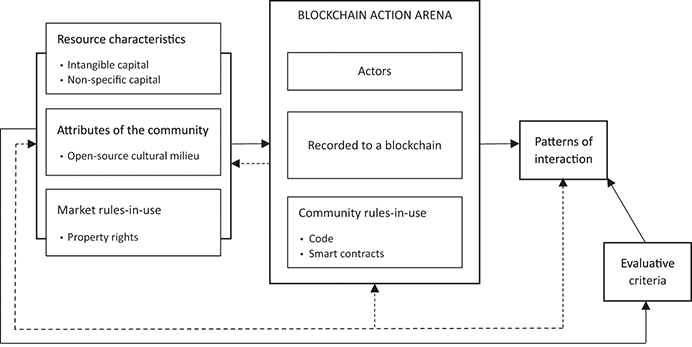
Based on the discussion so far, a more relevant version of the GKC framework should look something like Figure 11.2.
Blockchain as a commons.
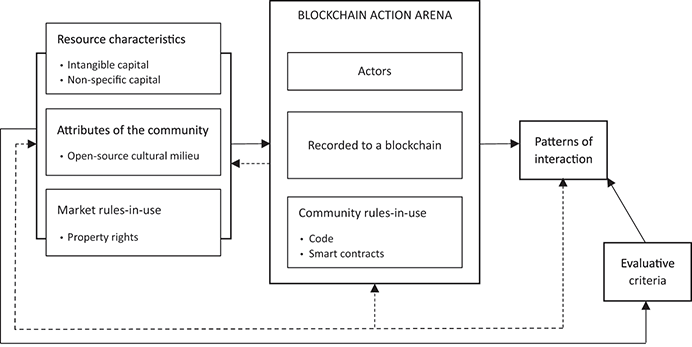
There are two important differences between Figure 11.1 and Figure 11.2. In the first instance, the evaluative criteria are determined by external variables – in particular, by the attributes of the community and resource characteristics. In other words, the community defines the evaluative criteria – these criteria are likely to be a mixture of economic and ideological considerations. The second important difference is that there are two sets of rules-in-use. The first set, “market rules-in-use,” is an external variable and very likely follows the tradition of the Anglo-American common law. The second set, “community rules-in-use,” is written into the action arena and encoded as smart contracts. These rules will not evolve through use, but rather are hard-coded into smart contracts and operate more like legislation than they do common law principles. The interesting question is to what extent these smart contracts can be modified by some sort of governance?
11.3.5 Where Do DAOs Fit into the Analysis?
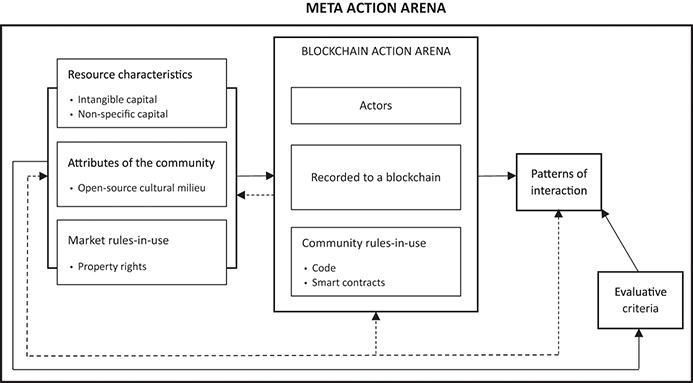
The creation of a blockchain and the DAO that governs that ecosystem itself requires an action arena. Figure 11.3 shows what that “meta action arena” may look like. Within this action arena, the constitutional rules, collective-choice rules, and operational rules for the blockchain–DAO system are selected and chosen. They themselves are a result of constitutional rules, collective-choice rules, and operational rules. The question is where does the DAO fit into the blockchain–DAO system that is created within this adjacent meta action arena?
Meta action arena.
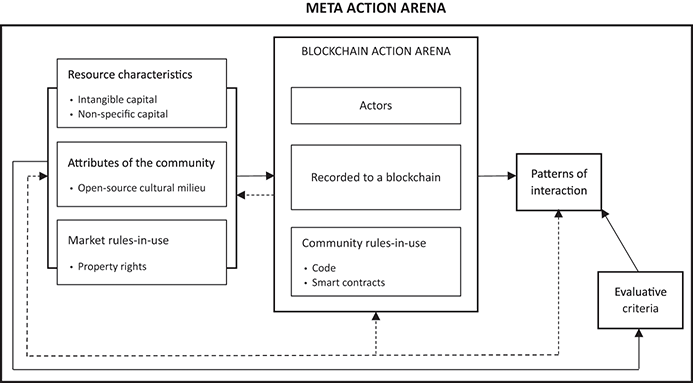
The most obvious place to locate a DAO is simply to wrap it around the entire enterprise – around the external variables (i.e. the original community) and the action arena – in effect, declaring the meta action arena to be the DAO.
While this may appear to be a logical, even easy, solution, it is not practical. This DAO model, by aiming to wrap around and integrate external variables directly into its governance mechanisms, risks diluting the participatory governance model. This could lead to scenarios where the DAO’s response to external pressures becomes more autocratic or less transparent, counter to the decentralised ethos. It also presupposes a level of sophistication in decision-making algorithms and governance protocols that can adaptively manage, not just internal operations but also external influences and changes.
A more “practical” approach is to differentiate DAOs in terms of “on-chain” and “off-chain” governance. These two models of governance are very distinctive, representing different approaches to how decisions are made, rules are enforced, and the overall direction of the DAO is steered.
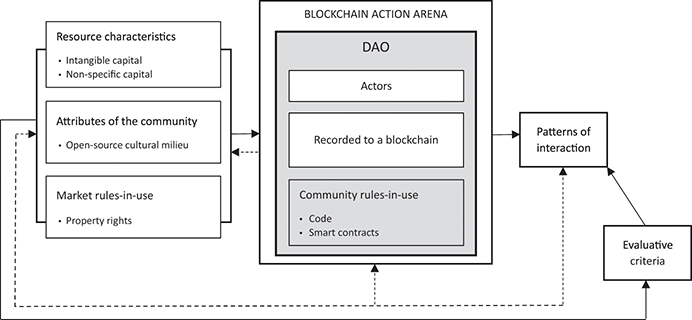
On-chain governance is characterised by decisions and rule changes being proposed, voted on, and implemented directly on the blockchain. In this instance, the DAO is located within the action arena, as shown in Figure 11.4. This is not an adjacent action arena; nonetheless, a series of prior (or meta) constitutional choices will have established what level of operational control the DAO would have over the blockchain itself. The operational choices that the DAO can make, however, are enforced on-chain by the blockchain. This model is suggestive of a “digital democracy,” where every action is transparent, verifiable, and immutable once executed. The underlying principle of on-chain governance is “decentralisation”: every member of the community (i.e. stakeholder) has a say in DAO governance, with votes being cast and tallied in a manner that is transparent and immutable.
On-chain governance DAO.
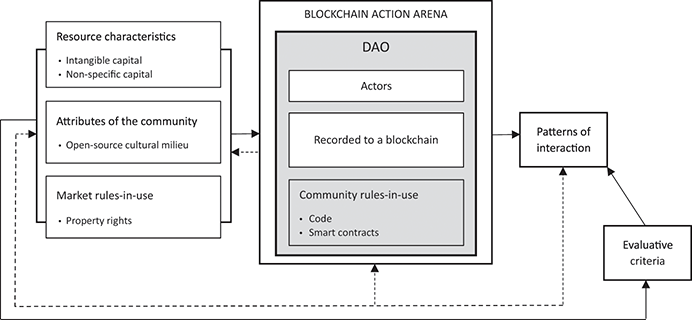
This transparency promotes trust among the community, as the rules of engagement are clear and the ledger of actions is immutable. This model, however, also introduces rigidity. Changing established protocols or smart contracts (if possible) or adapting swiftly to new circumstances can be cumbersome, requiring consensus that might be slow to achieve. Williamson (Reference Williamson1985) refers to this problem as being “maladaptation” – in the DAO context; it is not clear whether maladaptation costs are high or low. Furthermore, there is a “technical skill” barrier to entry that could inhibit some members of the community from fully engaging in voting or decision-making, potentially limiting the DAO’s accessibility. Nonetheless, if the arguments relating to the advantages of DAOs are to be believed (see Davidson Reference Davidson2025), then DAOs should be located within the action arena. Decentralised Autonomous Organisations with on-chain governance include MakerDAO, Compound, Aave, Uniswap, and Decred.
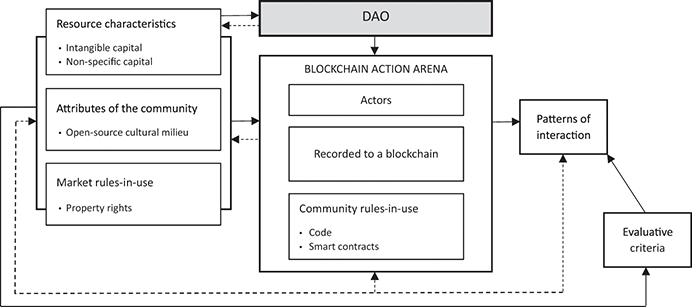
By contrast, Figure 11.5 shows the situation of off-chain governance. Decentralised Autonomous Organisations that fall into this category include MolochDAO, Kyber Network, and Curve Finance. Aragon is a platform that allows communities to launch DAOs, including options for off-chain governance. Snapshot offers a service that provides for off-chain voting for DAOs. In this configuration, the visualisation of an adjacent action arena that is the DAO is obvious. It could be useful to differentiate one action arena as being the “blockchain action arena” and the other as being the “DAO action arena.” A series of constitutional choices will have established which operational choices can be made by the DAO, but the collective choice will not be enforced on-chain by the blockchain. Demsetzian property rights systems, for example, could inform the operations of the DAO on an on-going basis, which in turn could inform the property rights that operate within the blockchain action arena also on an on-going basis.
Off-chain governance DAO.
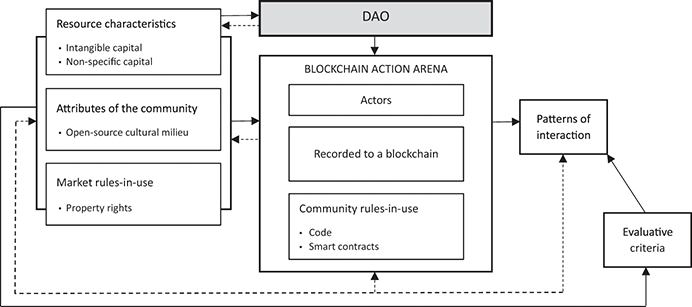
Off-chain governance manages decision-making and rule-setting outside of the blockchain action arena, using more traditional methods of communication and organisation, such as forums or chats (usually Discord). This approach allows for a more flexible and adaptive governance structure. Decisions can be made rapidly, and complex discussions can occur in more traditional formats. The trade-off here is that moving decisions off the blockchain can dilute the very decentralisation that makes DAOs revolutionary. It reintroduces the potential for opacity in decision-making processes and centralises control, potentially creating disparities in influence among participants. Moreover, the reliance on traditional communication methods reintroduces the risk of manipulation or fraud, as the immutable ledger of the blockchain is bypassed.
Each model, therefore, offers a different pathway to managing DAOs as knowledge commons, and the choice between them reflects the priorities of the DAO community, whether those be the security and immutability of on-chain processes or the (greater) adaptability and human judgement facilitated by off-chain governance. On-chain governance champions the ethos of blockchain technology, promoting a high level of transparency and security. Yet, its rigidity and the technical proficiency required can stifle adaptability and broad-based participation. Off-chain governance, conversely, offers flexibility and inclusivity, facilitating dynamic responses to challenges and easier engagement for those less technically inclined. These advantages, however, (may) come at the expense of trustlessness and decentralisation.
11.4 Can DAOs Endure as Commons?
Ostrom (Reference Ostrom2005, 256, emphasis original) suggests an impossibility theorem when she writes: “We cannot conduct full analyses of the consequences of changing all possible parts of a complex system interacting itself with a complex and changing environment.” Here she is following the insights of Herbert Simon (Reference Simon1962, and generally his insights on bounded rationality) and her own experience as a researcher. She goes on: “officials and policy analysts who presume that they have the right design can be dangerous.” While she does not reference Ludwig von Mises, her conclusions are very similar to those that he had made relating to the impossibility of a centrally planned economy, and the motivations that bureaucrats would have relative to entrepreneurs (see Mises Reference Mises1981, Reference Mises2007).
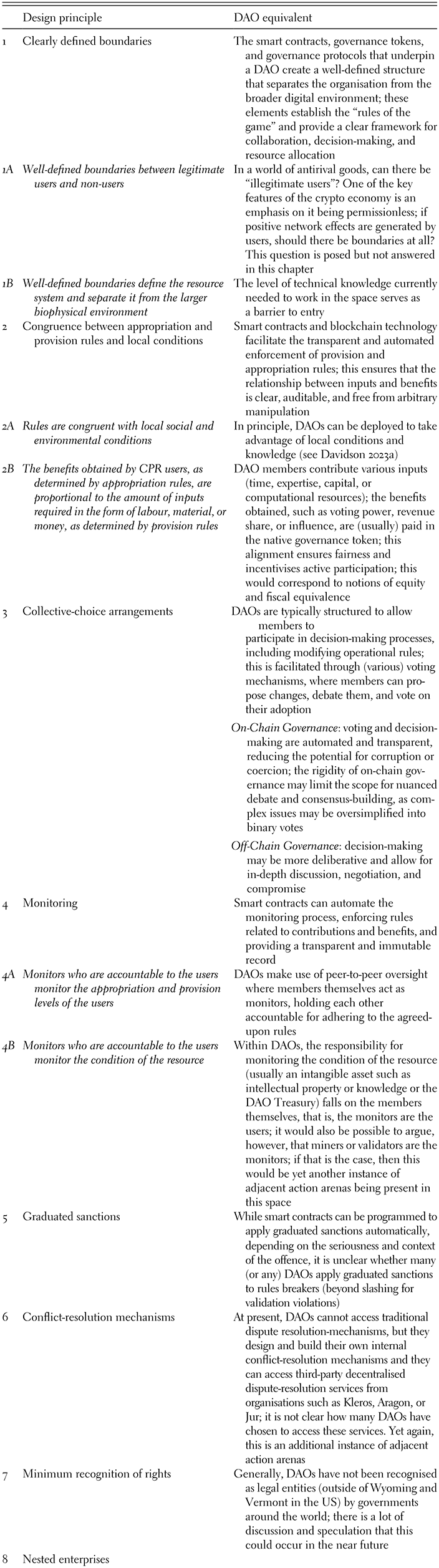
Importantly for our purposes, Ostrom (Reference Ostrom2005, 256) also argues: “We are not, however, helpless in finding ways to improve the performance of complex … systems.” To that end, she has distilled from her own research experience and that of others a set of “design principles” that describe “structural similarities” between those commons that have proven (so far) to have been robust to external disturbances and disruptions. These principles were first set out in Ostrom (Reference Ostrom1990), repeated in Ostrom (Reference Ostrom2005), and extended in Cox et al. (Reference Cox, Arnold and Tomás2010). In this section, these design principles are applied to DAOs (Table 11.1). The extended design principles are denoted as being “A” or “B” and are in italics.
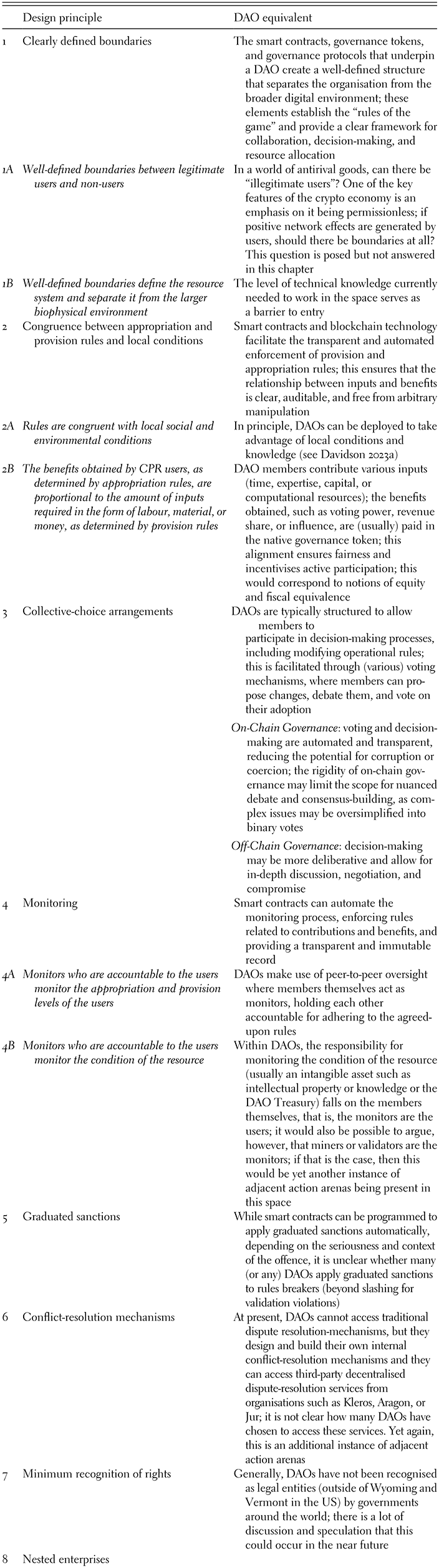
Table 11.1 Long description
The table consists of two columns: Design principle and DAO equivalent.
The rows read the following data.
Row 1. Clearly defined boundaries: The smart contracts, governance tokens, and governance protocols that underpin a DAO create a well-defined structure that separates the organisation from the broader digital environment; these elements establish the rules of the game and provide a clear framework for collaboration, decision-making, and resource allocation.
Row 1A. Well-defined boundaries between legitimate users and non-users: In a world of antirival goods, can there be illegitimate users? One of the key features of the crypto economy is an emphasis on it being permissionless; if positive network effects are generated by users, should there be boundaries at all? This question is posed but not answered in this chapter.
Row 1B. Well-defined boundaries define the resource system and separate it from the larger biophysical environment: The level of technical knowledge currently needed to work in the space serves as a barrier to entry.
Row 2. Congruence between appropriation and provision rules and local conditions: Smart contracts and blockchain technology facilitate the transparent and automated enforcement of provision and appropriation rules; this ensures that the relationship between inputs and benefits is clear, auditable, and free from arbitrary manipulation.
Row 2A. Rules are congruent with local social and environmental conditions: In principle, DAOs can be deployed to take advantage of local conditions and knowledge (see Davidson 2023a).
Row 2B. The benefits obtained by CPR users, as determined by appropriation rules, are proportional to the amount of inputs required in the form of labour, material, or money, as determined by provision rules: DAO members contribute various inputs (time, expertise, capital, or computational resources); the benefits obtained, such as voting power, revenue share, or influence, are (usually) paid in the native governance token; this alignment ensures fairness and incentivises active participation; this would correspond to notions of equity and fiscal equivalence.
Row 3. Collective-choice arrangements: DAOs are typically structured to allow members to participate in decision-making processes, including modifying operational rules; this is facilitated through (various) voting mechanisms, where members can propose changes, debate them, and vote on their adoption; On-Chain Governance: voting and decision making are automated and transparent, reducing the potential for corruption or coercion; the rigidity of on-chain governance may limit the scope for nuanced debate and consensus-building, as complex issues may be oversimplified into binary votes; Off-Chain Governance: decision-making may be more deliberative and allow for in-depth discussion, negotiation, and compromise.
Row 4. Monitoring: Smart contracts can automate the monitoring process, enforcing rules related to contributions and benefits, and providing a transparent and immutable record.
Row 4A. Monitors who are accountable to the users monitor the appropriation and provision levels of the users: DAOs make use of peer-to-peer oversight where members themselves act as monitors, holding each other accountable for adhering to the agreed-upon rules.
Row 4B. Monitors who are accountable to the users monitor the condition of the resource: Within DAOs, the responsibility for monitoring the condition of the resource (usually an intangible asset such as intellectual property or knowledge or the DAO Treasury) falls on the members themselves, that is, the monitors are the users; it would also be possible to argue, however, that miners or validators are the monitors; if that is the case, then this would be yet another instance of adjacent action arenas being present in this space.
Row 5. Graduated sanctions: While smart contracts can be programmed to apply graduated sanctions automatically, depending on the seriousness and context of the offence, it is unclear whether many (or any) DAOs apply graduated sanctions to rules breakers (beyond slashing for validation violations).
Row 6. Conflict-resolution mechanisms: At present, DAOs cannot access traditional dispute resolution-mechanisms, but they design and build their own internal conflict-resolution mechanisms and they can access third-party decentralised dispute-resolution services from organisations such as Kleros, Aragon, or Jur; it is not clear how many DAOs have chosen to access these services. Yet again, this is an additional instance of adjacent action arenas.
Row 7. Minimum recognition of rights: Generally, DAOs have not been recognised as legal entities (outside of Wyoming and Vermont in the US) by governments around the world; there is a lot of discussion and speculation that this could occur in the near future.
Row 8. Nested enterprises: DAOs can have a nested or hierarchical governance structure, and some DAOs have created sub-DAOs to manage specific projects, resources, or functions; these sub-DAOs operate within the broader framework of the main DAO but have autonomy in their specific domain; On-Chain Governance: nested DAOs (sub-DAOs) are often governed by separate smart contracts that interface with the main DAO; this ensures a high degree of autonomy but may create challenges in coordination and integration between layers; Off-Chain Governance: nested governance structures can be more fluid and adaptable, but this can also lead to complexities in managing different levels of authority and potential conflicts between layers.
As can be seen in Table 11.1, it is clear that DAOs, in theory, tend to meet the design principles, which would suggest that DAOs could be robust and survive external disturbance and disruption. Whether DAOs in practice meet these design principles remains to be seen and would form the basis for an empirical investigation. For example, does fiscal equivalence apply in practice – are contributors equitably remunerated? Do users actively monitor the on-going performance and sustainability of the DAO? Are graduated sanctions employed to punish violations? Is the notion of a sub-DAO consistent with a lack of hierarchy? These are all questions that can and should be pursued.
There is an additional feature of DAOs that could add to their robustness. DAOs have access to an additional conflict resolution mechanism that many other institutions either do not have or can only access at a very high cost. So-called “forking” (and the associated “rage-quit option”) presents innovative approaches to conflict resolution within the DAO space, offering paths to autonomy and self-determination not readily available in traditional organisations or societal governance models.
At its core, forking allows a DAO to split into two (or more) separate entities, as a result of irreconcilable differences within the DAO community. This process is akin to a digital form of secession, where part of a DAO community chooses a different path to that chosen by the rest of the DAO, while preserving the original codebase’s integrity. This is made possible by the transparent, open-source nature of blockchain technology.
The “rage-quit” option, as seen in some DAOs like MolochDAO, provides an additional mechanism for conflict resolution by allowing individuals to withdraw their portion of the DAO’s treasury and exit if they disagree with the direction or decisions being made. This feature ensures that members have a direct and immediate mechanism to dissociate from actions they consider misaligned with their values or expectations without resorting to complex legal or financial manoeuvres.
Comparing these mechanisms with traditional conflict resolution methods highlights several advantages. In conventional organisations, resolving disputes often involves selling shares, dissolving partnerships, or legal arbitration and even litigation, processes that can be time-consuming, costly, and emotionally taxing. These methods also typically require the intervention of external authorities or intermediaries, which can complicate the resolution process and may not always lead to satisfactory outcomes for all parties involved. At the nation-state level dispute resolution can be especially difficult – consider, for example, trade disputes at the World Trade Organization. Failure of dispute resolution at the nation-state level can result in armed conflict. Just as secession can result in the creation of new states or governance structures, forking enables the birth of new DAOs. Unlike the often violent and tumultuous processes of political upheaval or the expense of corporate break up, forking and rage-quitting provides an orderly and peaceful means for addressing irreconcilable differences within decentralised communities.
Forking and rage-quitting, however, are not costless mechanisms to facilitate exit. As argued in Section 11.3.1.1, network goods or antirival goods generate positive externalities, and a reduced community size could reduce the value of the platform. There is a literature in corporate finance that investigates the wealth effects of spin-offs (see Owers and Sergi Reference Owers and Sergi2021 for a recent survey). That literature suggests that spin-offs add substantial value to shareholders. The wealth effects of forking and rage-quits are yet to be empirically tested.
11.5 Conclusion
This chapter has examined DAOs using the IAD–GKC framework as if DAOs were “knowledge” or “software commons.” Following Dekker and Kuchař (Reference Dekker and Kuchař2024) there is a strong argument to be made that DAOs, being community-governed organisations, should be recognised as knowledge commons.
There are some important differences between naturally occurring resources and digital resources. At the most profound level, digital assets must be created. There is no “state of nature” in the digital economy. Everything in the digital economy is created by human design. As such, the governance of digital economies and institutions is likely to be very different from non-digital economies. Furthermore, the (market) rules-in-use that exist in the external variables of the IAD framework and (community) rules-in-use within the action arena are likely to be different from each other.
That further implies that the features of on-chain DAO governance are likely to be somewhat different from off-chain DAO governance. On-chain governance, characterised by its reliance on blockchain technology and smart contracts, offers a level of transparency and security that aligns with the core principles of decentralisation. This governance model embeds a set of predetermined rules within the DAOs technical infrastructure, ensuring that decisions and transactions are immutable and verifiable. This approach, however, introduces challenges related to the rigidity of governance structures and the technical barriers that may limit participation to those individuals with blockchain expertise.
Off-chain governance, by contrast, allows for a more flexible approach to decision-making, enabling DAOs to respond more swiftly to changes and challenges. This model facilitates governance decisions through conventional communication channels, such as online forums or meetings, potentially enhancing engagement and inclusivity. Yet, this flexibility may come at the cost of reducing transparency and increasing the potential for centralised control, thereby straying from the decentralised ethos that defines DAOs.
This distinction between the rules-in-use in on-chain and off-chain governance models is not a (minor) technical quibble but reflects broader theoretical and practical questions regarding the “optimal” structures for decentralised governance. This divergence raises important questions about the trade-off between automation and human discretion, the role of technology in facilitating democratic decision-making, and the potential for innovative governance mechanisms to address traditional organisational challenges.
The analysis undertaken in this chapter has occurred at a high level of abstraction. Understanding how DAOs actually function practice – as opposed to the theory set out here – is an important next step in better understanding how the digital economy is likely to evolve over time. Case studies of DAOs that explore the issues of joint and co-production that Dekker and Kuchař (Reference Dekker and Kuchař2024) identify are necessary to examine the internal operations of DAOs. These are questions for further research.

 Open access