


1. Introduction
Products need to be developed faster and more efficiently, therefore, in the context of digitalization and the Internet of Things, the digital twin (DT) is often of interest to companies, due to functionalities like predictive maintenance or automated product control. While these applications are beneficial, the DT also entails high costs. The development and operation of a DT requires a high amount of both physical and non-physical resources. Non-physical in the form of developers who develop and maintain the necessary software and interfaces for the DT and physical in the form of an IT infrastructure that is able to process and store the large volumes of data created by the DT. Therefore, the function of the DT should be optimized in all application areas including product design to increase the overall value of the DT. Consequently, the literature already addresses the possible applications and benefits of the DT along the product life cycle (PLC) (see Sec. 2 for examples). However, the DT is often viewed holistically or merely as a synonym for a simulation (Reference Stauss, Wawer, Wurst, Hamlaoui, Gooran Orimi and LachmayerStauss et al., 2025). It is thus useful to look at the individual components of the DT and highlight the benefits at each stage of the product lifecycle for product design to maximize the value of the development efforts of the DT. Regarding data availability from the usage phase, using the DT to improve product design is particularly useful for product-service-systems (PSS) that work with product fleets. In contrast to other business models, where stakeholders have no incentives to contribute to the feedback to design (Reference Riedelsheimer, Lindow and StarkRiedelsheimer et al., 2018), the usage data is often available in PSS. Based on the usage data, information can be fed back into product design and contribute to the improvement of the next product generation. Product fleets also offer the advantages that large amounts of data are available that can be statistically analyzed and that design improvements in subsequent generations can scale financial benefits due to the number of products.
For this reason, this paper presents possibilities for the use of the individual components of the DT along the PLC with a focus on improving product design. For this purpose, current uses of the DT for product design are first shown in section 2 and then a conceptual framework for the use of the individual components of the DT along the PLC is presented in section 3. Following in Section 4.1, the framework is illustrated using a practical case study of a fleet-based PSS, which was carried out in an industrial context. In Section 4.2 challenges encountered during the implementation are mentioned and key aspects to focus on in future works are derived.
2. State of the art
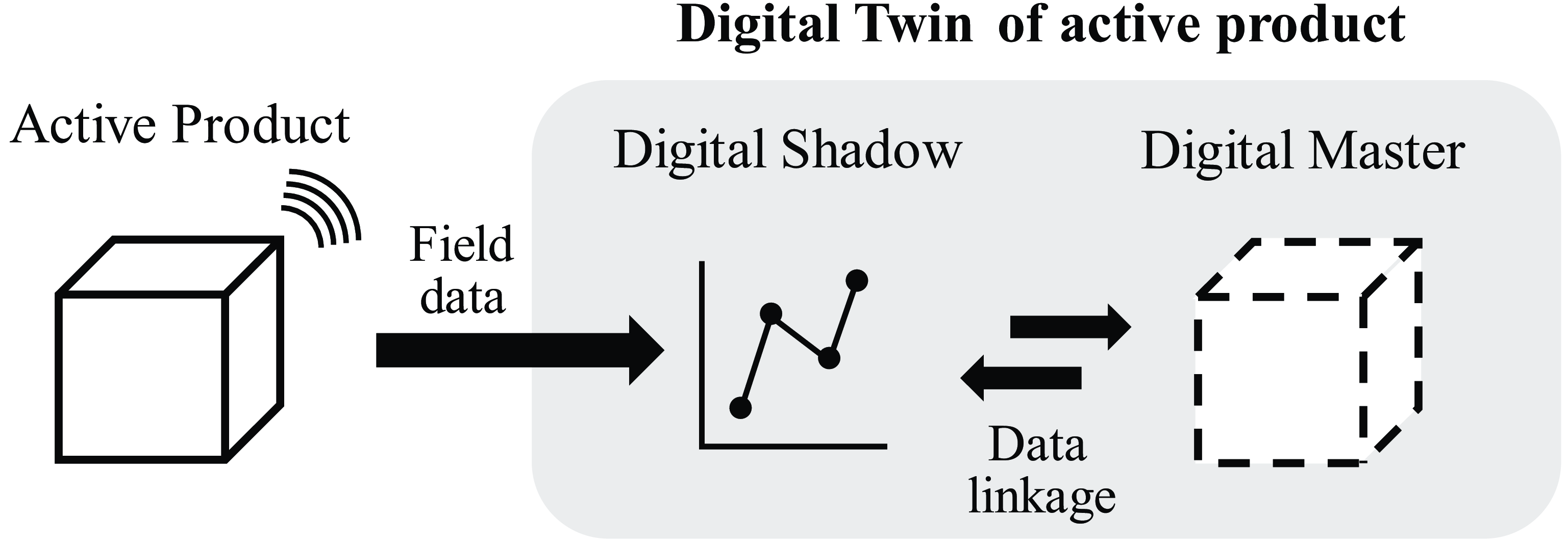
The digital twin concept was introduced by Michael Grieves in 2003 (Reference GrievesGrieves, 2015) and has since attracted a great deal of attention and associated developments. Due to the great attention and the different areas of application of the concept, there is also a correspondingly large number of different definitions (Reference Wilking, Schleich and WartzackWilking et al., 2021). In the context of product design, this paper utilizes Stark’s definition, which describes a DT as a digital representation of an active, unique product such as a real device, object, machine, service, or intangible asset or a unique product-service system. This representation includes selected characteristics, properties, conditions, and behaviors through models, information, and data across one or multiple life cycle phases (Reference Stark, Fresemann and LindowStark et al., 2019). According to this definition, the DT consists of a digital master, a digital shadow and the meaningful linkage between them (Figure 1).
Digital twin concept according to Stark (own illustration)

The digital master encompasses digital models of the product, such as geometry models or simulation models that describe the product’s behavior. The digital shadow contains all the data collected during the manufacturing and usage phase of the product, therefore it is a representation of the operating status and process data, which can be used to describe the current status of the real product instance. The meaningful linkage is achieved by integrating the data into corresponding algorithms or simulation models of the digital master. It should be noted that the DT is active at the earliest during the production phase, as no active product instance exists beforehand according to Starks definition (Reference Stark, Anderl, Thoben and WartzackStark et al., 2020). Therefore it can be derived, that it is not the DT, that accompanies the whole PLC, but rather the individual components of the DT (Reference Stauss, Wawer, Wurst, Hamlaoui, Gooran Orimi and Lachmayersee Stauss et al., 2025).
The digital master must be adapted to each product instance and the associated purpose so that each product instance has its own DT (Reference Stark, Damerau, Chatti and TolioStark & Damerau, 2019). If a DT is created for several product instances, the information from all product instances can ultimately be aggregated and collected in a DT Aggregate (Reference GrievesGrieves, 2023), which has particular advantages for product fleets (Reference Stark, Damerau, Chatti and TolioStark & Damerau, 2019). Whether the DT is intended for a single product or a fleet of products should be considered early in the design phase, as the DT needs to be tailored to the specific business context (Reference Stark, Anderl, Thoben and WartzackStark et al., 2020). Laukotka et al. (Reference Laukotka, Rennpferdt and Krause2022) have conducted a detailed analysis of the synergies and challenges between PSS and DT. They emphasize that it is much easier for fleet-based PSS such as aerospace companies, to collect field data compared to other companies because the operating conditions are well-known and sensors are already available. However, combining this advantage with the benefits of the DT is not straightforward, as there is no clear framework for implementing the DT in industry. With the additional challenges in implementing a DT (Reference Sharma, Kosasih, Zhang, Brintrup and CalinescuSharma et al., 2022), it is evident that DTs require a high level of development effort. For this reason, several studies have already investigated how a DT can be used along the PLC (Hlayel et al., Reference Hlayel, Jawad, Mahdin, Mostafa, Mohammed Alduais and Abd Wahab2021; Lutz et al., Reference Lutz, Münch, Turgut, Lucke, Palm, Braun and Ohlhausen2020; Massonet et al., Reference Massonet, Kiesel and Schmitt2020; Schleich et al., Reference Schleich, Dittrich, Clausmeyer, Damgrave, Erkoyuncu, Haefner, Lange, Plakhotnik, Scheidel and Wuest2019; Woitsch et al., Reference Woitsch, Sumereder and Falcioni2022) in order to maximize the benefits of the DT. However, these studies do not focus on product design or do not provide an in-depth analysis on how the DT supports product design. Bertoni and Bertoni (Reference Bertoni and Bertoni2022) come to a similar conclusion, stating that the DT receives hardly any attention for product design in the context of product-service-systems. Nonetheless, the know-how acquired through the DT should be used through active knowledge feedback in the sense of feedback to design in order to optimize the current and the following product generation.
Lachmayer et al. (Reference Lachmayer, Mozgova, Reimche, Colditz, Mroz and Gottwald2014) introduced the concept of technical inheritance which is inspired by biological evolution. A gentelligent product features abilities to load, store and process information, enabling it to collect data over the product life. Technical inheritance is then defined as a transfer of assembled and verified information from production and application to the next product generation (Reference Lachmayer, Mozgova, Reimche, Colditz, Mroz and GottwaldLachmayer et al., 2014). Although this concept enables an evolutionary improvement of the product based on collected data (Reference Mozgova, Barton, Demminger, Miebach, Taptimthong, Lachmayer, Nyhuis, Reimche and WurzMozgova et al., 2017), the capabilities of the DT are not yet taken into account here. In the context of feedback to Design, Riedelsheimer et al. (Reference Riedelsheimer, Lindow and Stark2018) presents a Digital Lifecycle Twin Concept, the idea of which is to collect system-individual insights from subsequent lifecycles and use them to provide designers with valuable information in order to optimize product quality, design processes and product-accompanying services. However, it does not explicitly gets addressed how this concept can be implemented in industry. Arnemann et al. (Reference Arnemann, Winter, Quernheim and Schleich2023) present a systematic approach for feeding DT data back into product design and supporting requirements design. Though, this article is focused on the technical implementation and data transport rather than giving guidance on how to derive product requirements in the product design. Lai et al. (Reference Lai, Wang, Ireland and Liu2020) discuss how a DT-driven virtual verification system can be used to assess design performance in a conceptual state. The product is virtually verified and iteratively optimized in each phase of the PLC. However, the article does not address how the DT can be used outside of the design phase.
In addition to the approaches presented, Tao et al. introduced the digital twin-driven product design framework (DTPD) (Reference Tao, Sui, Liu, Qi, Zhang, Song, Guo, Lu and NeeTao et al., 2019), illustrated in Figure 2. This framework uses the DT as an engine to convert big data to useful information that are used by designers to make informed decisions at different design phases. The framework is better suited for redesigns than new designs, as historical usage data is required for most activities. An n+1 product generation is therefore assumed. The framework can be divided into three phases: task clarification, conceptual design and virtual verification.
Product design under DTPD adapted from (Reference Tao, Sui, Liu, Qi, Zhang, Song, Guo, Lu and NeeTao et al., 2019)
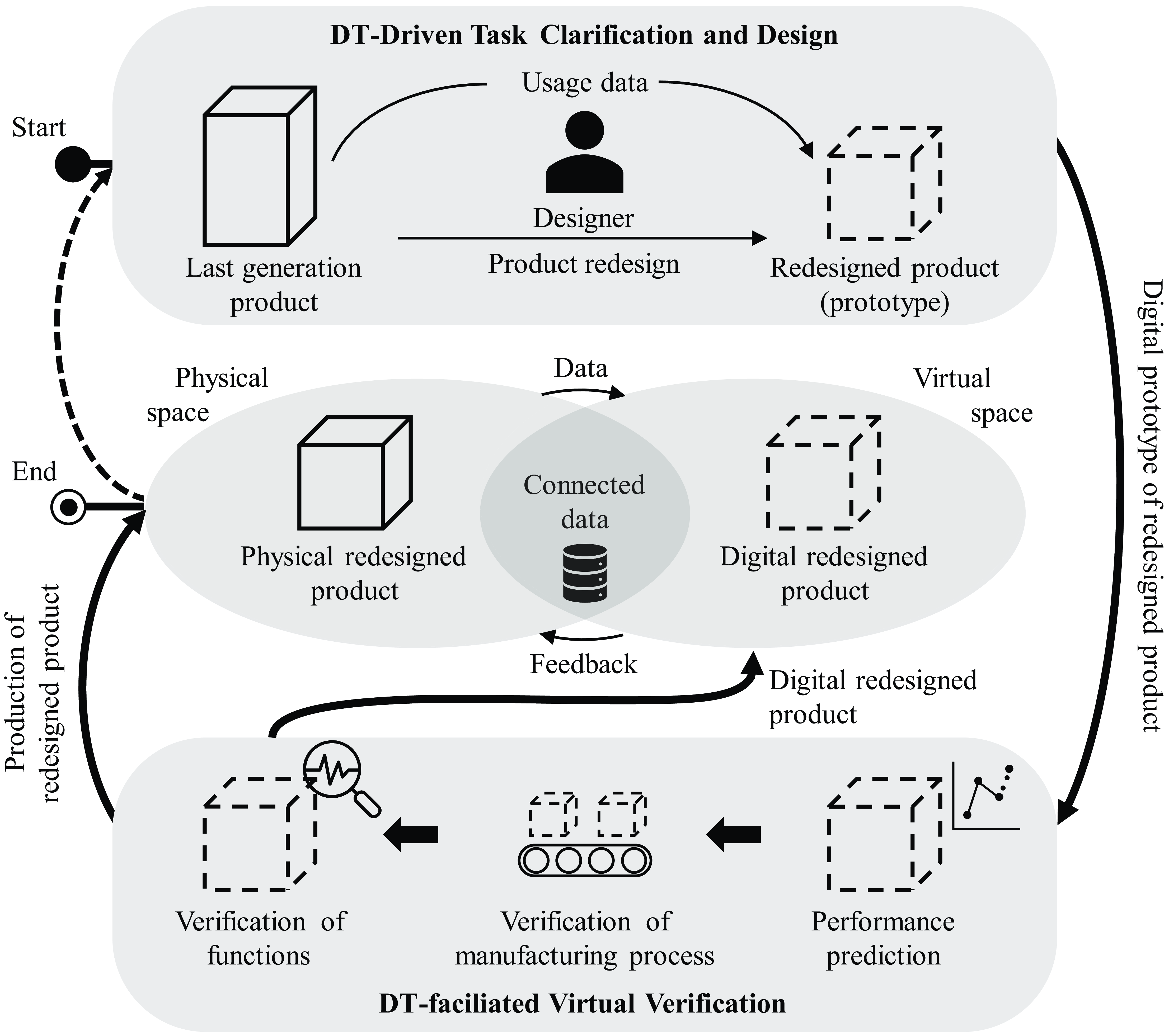
In the task clarification phase, the DT is used, among other things like clarifying imposed design constraints, to help designers deepen their knowledge of the target customers and clarify design constraints (see Tao et al., Reference Tao, Sui, Liu, Qi, Zhang, Song, Guo, Lu and Nee2019 for all use cases in task clarification). The DT therefore serves as an interpreter to translate customer needs into functional requirements. In the process, historical data from previous use phases is analyzed and conclusions are drawn.
In the conceptual design phase, the DT has the task of identifying design possibilities and evaluating new design concepts. A possible application is to incorporate contextual information from historical data into concept generation. In addition, uncertainties can be recorded during the usage phase and simulated in the virtual world to generate more robust designs and validate them against these uncertainties.
In virtual verification, the DT is used to predict the behavior of the product and thus reduce the number of physical prototypes or design cycles. Therefore historical data from the use phase gets used for vivid simulation scenarios, to predict the actual performance as accurately as possible (Reference Tao, Sui, Liu, Qi, Zhang, Song, Guo, Lu and NeeTao et al., 2019).
3. Concept of a DT-framework for data-driven product design
The state of the art shows that the DT has a use case throughout the entire life cycle, but that the descriptions are often too imprecise to be used in industry. In addition, according to Starks definition of the DT, it is not the DT that accompanies the whole PLC in every phase, but only distinct components of the DT (see Sec 2). Therefore, a framework is presented below that refines the benefits of the individual components of the DT along the PLC, focusing primarily on product design.
Visualisation of the DT-framework for data-driven product design

The PLC according to Verein Deutscher Ingenieure (Reference Ingenieure2019) is used for the framework, as the life cycle is viewed from a technical perspective, meaning from product creation to production/implementation and use until the end of the life cycle. For feedback to design it is essential that usage data is available. Therefore, the framework is described starting from a preceding product generation n. However, it is also possible to use parts of the framework in a first product generation or within a product generation itself for minor design updates.
Product design often begins with a design request resulting from product planning (Reference IngenieureVerein Deutscher Ingenieure, 2019). Digital models can already be used in product planning, but this is often not the case as no simulation or design is carried out at this stage. However, the digital shadow from the previous generation can be used to improve the design request. The historical field data from the usage phase contained in the digital shadow of the previous generation can be used to specify requirements for the second product generation or to create completely new product requirements. These requirements can be based on environmental data, load data or operating data, for example.
Once the design request has been received, the product design starts with the search for solution principles. During this search, usually no digital models are used. However, once initial solution concepts have been developed, digital models from the digital master of the first product generation can be used and modified to represent the solution concepts. By continuing to use and adapt the models from the first product generation, a second generation of the digital master is created. This modification reduces design time, as the geometric models do not need to be created from scratch. Furthermore, it is beneficial that any existing interfaces between models and data remain usable.
After multiple solution concepts have been generated as digital models, simulation models from the digital master can be used to select a solution concept. For example, new or modified product geometries can be used in connection with a behavior-describing simulation model to predict the performance of the digital prototypes. Generic boundary conditions for the simulations are usually sufficient at this state.
Upon selecting a solution concept, the digital model can be further developed in detail through an iterative process. Each adjustment can be validated using simulation models derived from the digital master. At this stage of the design process, it is useful to use historical field data such as environmental data, load data or operating data from the digital shadows of the use phase of the preceding product generation, to test the digital prototypes under realistic environmental and usage conditions in contrast to idealized boundary conditions. Additionally, this approach of using historical field data enables the representation of different usage scenarios, allowing for targeted optimization. When the detailed design is finalized, the simulation model from the digital master and realistic boundary conditions from the preceding digital shadow can be used, to validate the fulfilment of the requirements.
If the design of the prototype is finalized and the physical prototype is available, the digital shadow that is acquired during the use of the prototype can be linked to the digital master to create a complete DT, e.g. to control the physical prototype automatically.
In the manufacturing phase, the gathered data during the manufacturing process forms a new digital shadow, that is different from the digital shadow of the first generation. This data can be used to compare the as-manufactured product with the as-designed product, to evaluate the the product quality. In addition, it is also possible to use far more complex applications, such as real-time adjustment of machine parameters to increase product quality.
Next in the use phase, the digital shadow is enriched by usage data from the physical product. This data is then processed in the digital master to enable classic DT applications such as predictive maintenance, decision making or automated product control. These applications can contribute to increase the efficiency and service life of the product.
In the last phase of the PLC, the DT rarely receives attention (Reference Jones, Snider, Nassehi, Yon and HicksJones et al., 2020; Reference Lo, Chen and ZhongLo et al., 2021). According to Stark’s definition, it is no longer a DT at this stage, as the product is no longer active. However, in terms of product design, information can still be extracted from the product under certain circumstances. If the end-of-life of an individual product instance is reached prematurely due to failure or similar, a root cause analysis can be carried out in the form of simulations in conjunction with the historical field data and the digital models. Additionally, the predictive accuracy of the simulation model from the design process can be validated, by comparing the simulated forecast with empirical results. An examination of the physical product can also contribute to the root cause analysis and enrich the digital shadow with data. The information generated in this way can be fed back to products that are still in the utilization phase, for example in the form of usage boundary conditions or operational limits. In this way, premature failures in the usage phase can be prevented.
Beginning with the following PLC of the next product generation, the framework can be applied again. By using the same interfaces between digital model and digital shadow, which already entailed high development costs, throughout the PLC, the function of the components of the DT is increased, ultimately leading to a higher value of the DT. Through describing and emphasizing the benefits of this concept using the individual components of the DT, beyond the usage phase, the intention is to improve the design process, by increasing the understanding for the application of the DT components along the PLC.
4. Case study
4.1. Implementation
In the following, the introduced framework is demonstrated using a practice-oriented example from the oil- and gas industry. Since internal company field data was used for this case study, the data collection process cannot be explained in detail due to confidentiality reasons.
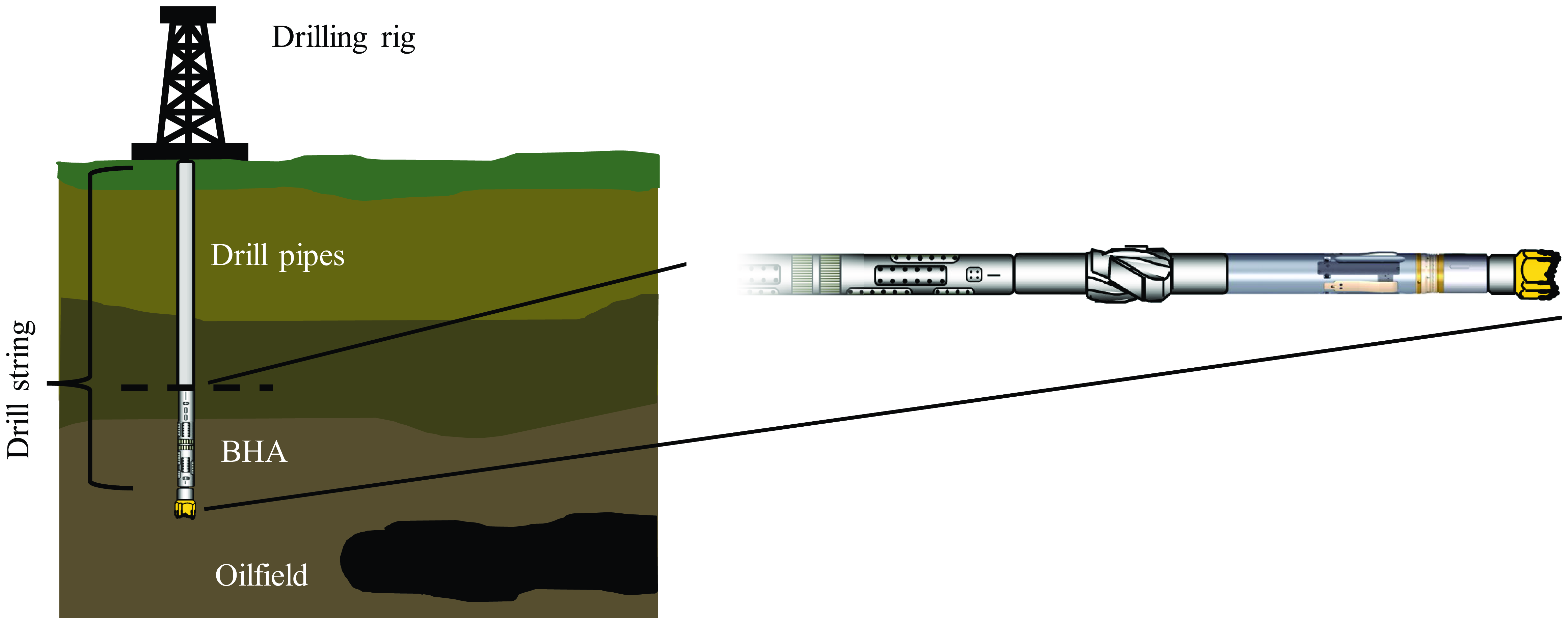
In the oil- and gas industry, product service companies exist to provide all the necessary services, from exploration for reservoirs, to the drilling of wells, as well as services for the extraction of resources (Reference Schneider, Gatzen and LachmayerSchneider et al., 2020). For drilling the wells, companies use specialized drilling tools that are part of an assembly called the bottom hole assembly (BHA), which is a component of the drill string (Figure 4). The drilling tools are available in fleets, making this type of company ideal for the use of the DT (see Section 2).
Principle of well drilling including a BHA
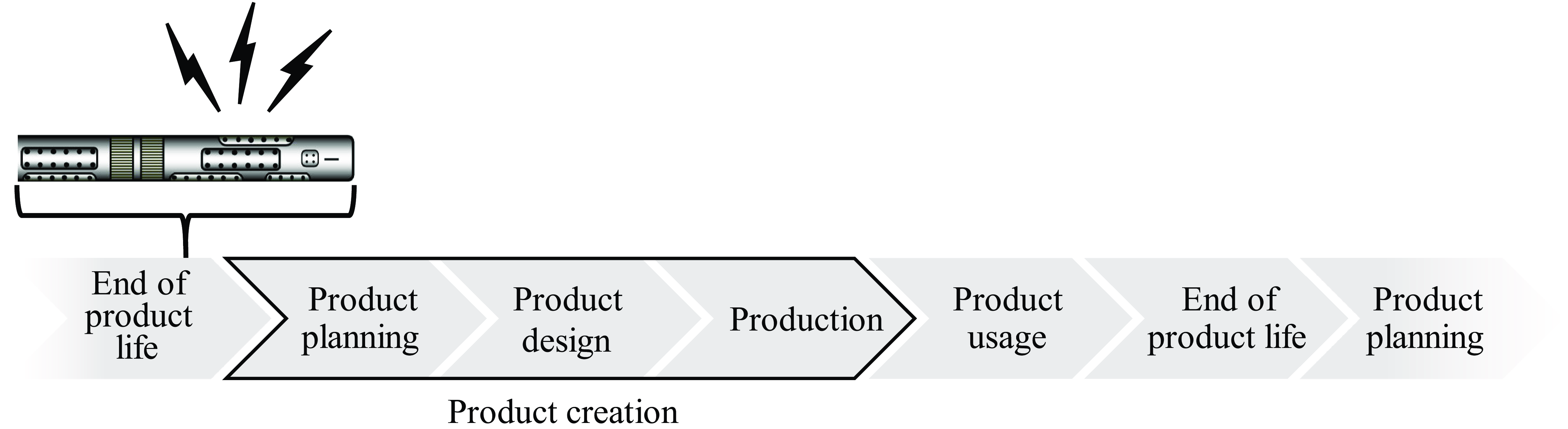
The drilling tools are often designed and produced in-house because of their unique operational requirements. Consequently, the design and use of the product are in control of the company. An advantage of this is that the usage data from the use phase can be fed back into the design process in the form of information and findings, which leads to subsequent generations of product design. The model presented in section 3 is intended to facilitate the feedback to design and will be illustrated in the following using a practice-oriented case study. Each phase of the framework was tested individually in the real world, albeit with different applications. For a better illustration, one mechanical example is used for all phases in the following. Whereby the end of product life and the product design were carried out in reality and the other phases were only carried out figuratively for this specific application. Although this case study focuses on a mechanical example, the model can also be applied to other disciplines. The case study begins with the end-of-life of the previous generation of a tool, referred to here as the first generation for simplicity, though it may also correspond to a n+1 generation.
For the end-of-life phase, a drilling tool is used as an example that was used in a BHA and reached the end-of-life prematurely due to mechanical failure (Figure 5). Physical analyses of the tool have shown, that the tool has experienced high wear on the outer diameter. This observation is equivalent to a data flow from the product into the digital shadow of this product generation, even though the product is not active anymore.
Start of the case study at the end of product life
However, no conclusions can be drawn based on this observation as the cause of wear is not known. The wear may be due to factors such as insufficient removal of debris from the hole through the drilling mud or excessive contact with the sides of the borehole. To close this knowledge gap, the digital shadow and digital master from this product generation are used. In this case, the drilling survey is used as historical field data from the digital shadow. From the digital master, digital models of the drilling tools and simulation models, that were created during the design of the first product generation, get used. By combining historical field data with digital models, a root cause analysis can be conducted. The model of the BHA is simulated with the historical process data at every point in the drilling survey in order to replicate the load on the BHA. The simulation results showed that there was above-average wall contact for the specific tool. It can be concluded from these results, that the wall contact is the cause for the high wear and appropriate measures can be taken.
In the product planning phase, the data from the digital shadows of multiple tools of the first product generation and, if necessary, digital models can now be used to refine requirements. In our case study, the average revolutions of the drilling tool in contact with the wall are calculated for several historical drilling jobs. Based on these average revolutions, the maximum number of wall contacts to be withstood can then be specified as a requirement for product design, taking into account the desired service life of the second generation.
During the subsequent product design phase, wear bands are applied to the housing of the drilling tool to avoid the high abrasion observed in the first product generation. Wear bands are an application of material intended to minimize the effect of the wall contact of the housing itself (Figure 6).
Rendering of a tool sleeve with wear bands (blue)

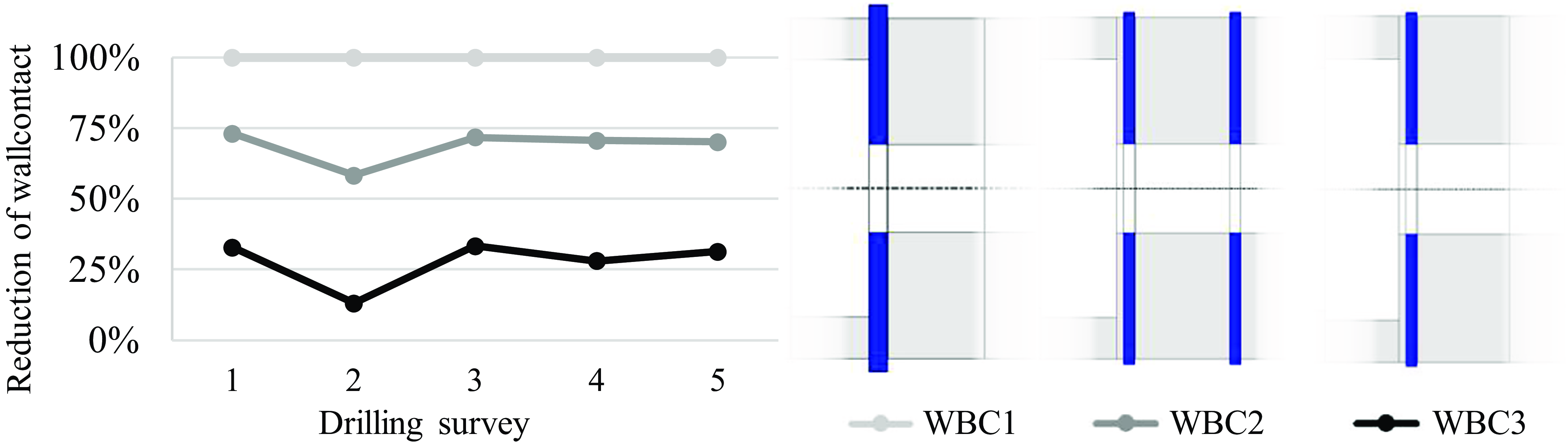
Digital master and digital shadow are used to test this product prototype virtually. The first-generation digital master, which already contains the relevant simulation models, is extended to include the new product geometries in the form of digital models. Therefore a new generation of the digital master is created. Due to the unknown behavior of the new product geometry, several wear band configurations are simulated to choose the best performing configuration. The aggregated digital shadow of the first generation is used to complete the data for the simulation. In this case, the new prototypes are simulated using historical field drilling data to achieve a realistic assessment of the functionality of the different configurations. Different drilling surveys are simulated with each wear band configuration to test the individual performance in different use scenarios. Figure 7 shows exemplary simulation results for the reduction in revolutions with wall contact and a section of the BHA with the corresponding wear band configurations (wear bands marked in blue). The best configuration can be identified through the analysis of the results. With the finalized design, the new product geometry can go into production.
Simulation results for the calculation of wall contact with the corresponding wear band configurations (WBC)
For the production phase, the components of the DT are used for quality assurance. By comparing the as-built geometry data from the digital shadow and the as-designed geometry from the digital master, the product quality can be verified.
In the use phase, the digital master gets used to simulate the current state of the entity. Therefore data acquired during the operations get used through the linkage between digital shadow and digital master. In the current example, information such as the rate of penetration, revolution per minute and the position and orientation of the drilling tool is used to simulate the revolutions, where the drilling tool is in contact with the wall due to the curvature of the borehole. With the help of the information provided by the simulation results, strategies such as predictive maintenance can be used by comparing the accumulated revolutions with operational limits, to monitor the wear of the tool.
If an individual product instance of the tool reaches the end-of-life phase prematurely due to mechanical failure, a root cause analysis can be carried out as described above. However, if there are still active product instances in the field, it is also possible to analyze the digital shadow of the failed product instance in order to adjust the operational limits and return them to the product instances that are still in use. In this way, further premature mechanical failures can be avoided by using the DT.
4.2. Challenges during realisation
In the following we mention the main challenges that we encountered during the realization of the case study, this list is however not exclusive. Firstly, the continuity of the components along the PLC was challenging, as different stakeholders are involved in each phase. In the future, the framework should therefore integrate which stakeholders are involved in each phase and how the data generated by the components of the DT should be processed and visualized to the individual stakeholders, to be effectively utilized in product design.
Along with the differences in the individual phases, interoperability between the software is also challenging. Although the interfaces between digital master and shadow remain the same in essence, additional software and boundary conditions lead to complications. These different software applications also make it hard to be consistent in data management. Therefore, in future works, efforts should be put into the differences of the interfaces between digital master and shadow in each phase and defining a standardized interface including data management.
Another major challenge was the selection of suitable simulation models, depending on the phase and system boundary under consideration. Depending on whether the whole BHA, a drilling tool or a component is considered, different simulation options are available, which differ in simulation accuracy and time. Available time for simulations also differs with the considered PLC phase. While in most phases, enough time is available for detailed simulations, the usage phase differs for each application. While some applications have update frequencies in the range of seconds and need corresponding fast feedback from the DT, some applications have update frequencies in the range of minutes or even weeks, leaving more time for detailed simulations. In the specific case of the BHA, the interface between the different system levels (BHA, drilling tool or component of a drilling tool) is also of interest and should be further explored in future works, to maximize the function of the DT.
5. Conclusion and outlook
This article presents a conceptual framework that highlights the individual usage of the components of the DT along the product lifecycle focusing on product design. The state-of-the-art shows that utilizing the DT along the PLC is beneficial, but the descriptions are often imprecise. Therefore, in this work, the usage of the DT components was refined with the terms digital shadow and digital master to make the concept of feedback to design more applicable. The digital master contains the necessary simulation and geometry models, while the digital shadow can be used for realistic boundary conditions for the simulations or the derivation of realistic requirements. By using the already developed interfaces between digital master and shadow of the DT beyond the usage phase of the product, the value of the DT is increased.
It has become apparent that the feedback to design is most useful for PSS where field data is available, and the components of the DT can be utilized in every phase. The framework presented was then illustrated in a practical example to demonstrate the benefits of the individual components. Additionally, the challenges encountered during the implementation are mentioned, with derived key aspects for future works. Major research areas include stakeholder involvement along the PLC including the visualization of data generated by the DT components, a uniform interface between digital model and digital shadow and the interfaces between different system levels. By addressing these research areas, the framework can be refined to be more applicable for the industry. Ultimately, this contribution is intended to facilitate the wider use of the DT, especially for product design.
Acknowledgment
The authors want to thank Baker Hughes for supporting the work and giving permission to publish this paper.


 Open access

