


Among the impulses inspiring sixteenth-century interest in the Mausoleum at Halicarnassus was curiosity about the form of the – no longer extant – Wonder, as witnessed by attempts to reconstruct it from ancient verbal descriptions.Footnote 1 Architects in the Sangallo circle, for example, exploring ideas for tombs and tomb chapels, attempted to plot out the structure,Footnote 2 while draughtsmen like Maarten van Heemskerck recreated it for printmakers to produce depictions of the ancient Wonders.Footnote 3 A different motivation, by those seeking prototypes to promote women rulers, prompted interest in the Mausoleum’s patron, Artemisia II of Caria (died c. 350 bc). Renaissance culture’s respect for the authority of Antiquity led poets, encomiasts and iconographers to seek suitable ancient exemplars that might be employed in power imagery for ruling elites. Classical and later writers had lauded Artemisia as the builder of the monumental structure at Halicarnassus honouring her deceased husband Mausolus, satrap of Caria (ruled 377–353 bc), whom she also succeeded. She regularly figured in anthologies of famous and virtuous women, written by Boccaccio and others. This queen – almost unique in her combined roles as inconsolable widow, ruler and builder – was therefore proposed as an ideal model for Renaissance women in, or seeking, positions of power.Footnote 4 Catherine de’ Medici (1519–1589) was one such woman for whom Artemisia served as a prototype, inspiring a lengthy manuscript biography composed by Nicolas Houel, accompanied by a series of drawings by Antoine Caron and other artists active at the French court in the 1560s and 1570s.
This chapter considers Houel’s narration and Caron’s illustrations of the planning and construction of the Mausoleum, emphasising Artemisia/Catherine as an actively engaged and ambitious architectural patron. It also examines the structure itself as described by Houel and imaged by Caron, although space does not permit an extensive analysis. Finally, it assesses the implications of what is perhaps the most dramatic episode associated with Artemisia, as recounted in the ancient sources, namely her rejection of the completed monument as repository for her husband’s ashes, in favour of her own body. Catherine was not the first female ruler to be likened to the ancient Queen. For instance, Antoine Dufour prepared a collection of biographies of virtuous women, including Artemisia, at the request of French Queen Anne de Bretagne (1477–1514).Footnote 5 Likewise, poet Jean Lemaire de Belges acclaimed Margaret of Austria (1480–1530) as a new Artemisia – after the 1504 death of her husband, Philibert II, Duke of Savoy – in his allegorical encomium La Couronne Margaritique (1505).Footnote 6 She was soon to fulfil both tenets of the role attributed to her by this eulogy, firstly by beginning construction of a church and tomb at Brou for her deceased spouse (1506), and secondly by obtaining an appointment as Governor of the Netherlands in 1507 from her father, Emperor Maximilian I Habsburg.Footnote 7
By far the most extensive Early Modern treatment of Artemisia as prototype for a woman ruler was that prepared for Catherine after her spouse, French King Henri II, died in 1559 in a freak accident sustained during a ceremonial joust. Their eldest son, François II, succeeded to the throne, but when he died in 1561, his heir, younger brother Charles IX, was a minor: the situation called for a regency. Although French law prohibited female succession and rule, women regularly served as regents.Footnote 8 Henri himself, when away at war, gave Catherine authority several times, but now with him dead and the prospect of a lengthy regency for Charles IX, she needed to assert herself in this role, within a factionalised France shaken by religious conflict. Like Margaret of Austria, shortly after Henri’s death, Catherine began construction of a tomb for Henri II (and eventually herself) as well as a dynastic chapel to contain it, the Valois Chapel appended to the French royal mortuary church at Saint-Denis.Footnote 9 Building imposing memorials as displays of undying devotion to deceased male rulers linked these widows to the ancient prototype, while such expressions of perpetual fidelity to the male ruler concurrently bolstered their authority while they lived.Footnote 10
The Artemisia imagery associated with Catherine consists of a biography to which are added illustrations accompanied by sonnets.Footnote 11 First, in 1562, Nicolas Houel (1520?–1587) composed a 106-folio manuscript, L’Histoire de la Royne Arthémise, dedicated to the widowed Queen Mother.Footnote 12 Houel, a successful apothecary, wrote pharmaceutical books and would have encountered Artemisia in the first instance in herbals (for example, Theophrastus, Pliny), as her name attaches to several species of medicinal plant.Footnote 13 The binding of the manuscript bears the Queen’s arms, but Catherine’s direct involvement in the commission remains unclear.Footnote 14 Houel acknowledged Xenophon’s Cyropedia – a biography of Cyrus the Great – as the model for his work, and Catherine possessed a copy of that famous exemplar of the ‘Mirror of Princes’ literary genre.Footnote 15 To boost his text’s authority, moreover, the writer cited eighty-seven sources he had consulted, including those few ancient, medieval and Early Modern writers who provided specifics about the ancient Queen. The latter was often conflated with the earlier Artemisia I of Caria (fl. 480 bc), whom Herodotus, Pausanius, Plutarch and others celebrated as a warrior.Footnote 16 This misperception permitted the manufacture of a greater variety of episodes, thus providing a more extensive portrayal of a heroic woman. Houel’s text reflects aspirations ranging beyond medicine: indeed, through this endeavour, he sought royal patronage for a charity of his own devising.Footnote 17 To that end, his text includes praise for Medici support of letters, and unsubtle aphorisms such as ‘history provides large profit to … great Women … who bear the responsibility for a kingdom and the government of a Republic’ or ‘Alexander Severus, very wise and virtuous Emperor … every time he had to consider a matter of importance … would call those who were renowned for their knowledge of histories’.Footnote 18 Thereby, Houel was promoting his own expertise in the humanities, which complemented the pharmaceutical capacity in which he accompanied Catherine on a long journey around France in the mid-1560s.
Houel’s marriages further explain his capacity to undertake this project. His first wife’s father was a member of the gentry, and an inventory reveals that the couple’s Paris residence contained pictures, maps, sculptures and engravings; another indicates that he possessed 129 books, but provides no titles.Footnote 19 Various literati had access to Catherine’s extensive library.Footnote 20 Among her many volumes were works by Alberti, Boccaccio, Philibert de l’Orme, Pliny, Serlio and Vitruvius, all important sources for information on Artemisia, the Mausoleum and architecture, which Houel may have consulted.Footnote 21 Significantly, his second spouse, Jeanne, brought him into kinship with the Le Breton family, key court architects and master masons who also possessed architectural books.Footnote 22 Her uncle Gilles, Maître général des œuvres de maçonnerie du roi between 1528 and 1547, directed works at Fontainebleau, then an active hub for works in architecture, sculpture and painting by an international coterie of artists, while her father, Jacques, was in charge of remodelling – for Francis I – the château of Villers-Cotterêts, where Catherine also spent some time.Footnote 23
It was with these extensive connections, training and ambition that Houel undertook the Histoire project. While depictions of Artemisia as exemplar generally consist of a single image (see, for example, Artemisia by the Master of the Story of Griselda, 1492),Footnote 24 what makes Houel’s ensemble exceptional is the portfolio of over fifty illustrations that complement his manuscript. The author additionally suggested that these serve as models for tapestries, the era’s medium of prestige for large-scale display. Some scenes were woven, but not during Catherine’s lifetime, and none of the illustrations pertaining to the planning and construction of the Mausoleum seem to have been made into tapestry. Painter and draughtsman Antoine Caron (1521–1599), who was recorded working at Fontainebleau in the 1540s and later as Catherine’s court painter (1560–1563), composed the lion’s share of these drawings, while Houel himself wrote sonnets to accompany individual illustrations, a further indication of his wish to stipulate the episodes that were to be depicted.Footnote 25
Houel first affirms the parallels between Artemisia’s era and the present, defining Catherine herself as exemplary.Footnote 26 The Histoire begins not with Artemisia’s own early life, but only with Mausolus’s funeral – also a key ritual in French royal ceremonial – for which Artemisia organises triumphal processions, funeral games and orations, as well as commissioning a temporary tomb for use while the large monument is under construction. The Queen then establishes her regency, followed by the coronation of her son (who was invented to correlate with Charles IX – the historical Artemisia was succeeded by her brother Idrieus, who was also Mausolus’s brother since the royal couple were siblings), and then proceeds to his education in various pursuits. Discussion of the Mausoleum itself begins at folio 48 recto. Houel states that the building represents Artemisia’s desire to make known her affection for Mausolus and to immortalise his memory, in a ‘work … so excellent and of such great enterprise, that it has bettered not only all the productions of its time, but the most ancient, and those … by Ninus [builder of Nineveh], Bellus [founder of Babylon and builder of the Ziggurat], and Semiramis [wife of Ninus, associated with the Hanging Gardens, another of the ancient Wonders]’.Footnote 27 One must simultaneously note his assertion that Artemisia herself sought fame, especially as a builder: ‘she wished to be seen as the first in the world’.Footnote 28 Houel makes the case for the ambition of a woman architectural patron, an endeavour that several of Catherine’s contemporaries, among them the poet Pierre de Ronsard and the lawyer Etienne Pasquier, roundly critiqued. The former advocated that she stop draining the treasury for buildings of doubtful use and the latter compared her expenditures to those of the pharaohs, interpreting her construction of the distinct Valois Chapel as motivated by her having deemed the venerable Saint-Denis, traditional burial place of French kings, ‘insufficiently capable of receiving either the body of the King her husband, or her own’.Footnote 29 Negative or positive assessments of Catherine’s architectural patronage tend to correlate with whether or not the writer himself had benefited from her largesse.Footnote 30
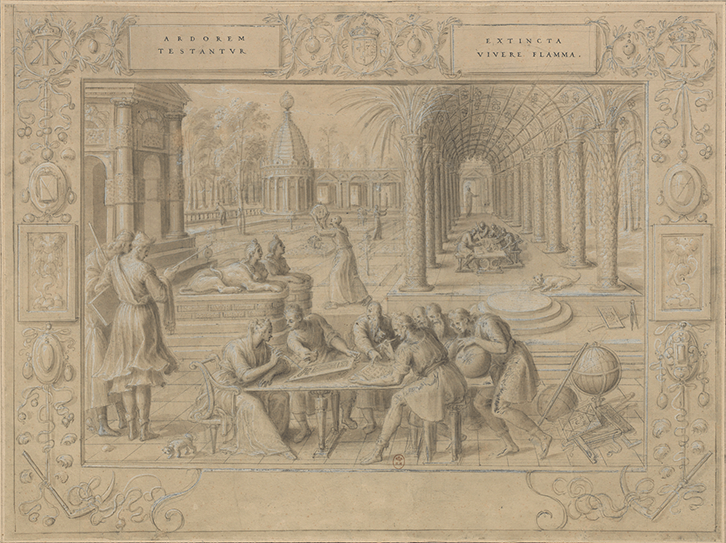
This context having been settled, it is possible to turn to the Mausoleum proper. The first of the six drawings in the series relating to the construction of the funerary monument depicts the Queen consulting with builders and astrologers, the requisite participants in launching the project (Fig. 5.1). In all the illustrations, the narrative occupies the centre while the borders include a motto, symbols and devices pertinent to Catherine as widow, and space for Houel’s sonnet at the base, since poems or inscriptions typically accompany book illustration and tapestry. To forge a simulacrum of an ancient world, a plethora of quotations from architectural treatises, triumphal entries and prints – to which Caron and Houel would presumably have had access – are apparent throughout the series.Footnote 31 Caron and his fellow artists, who also frequently designed or recorded the ephemeral decorations beloved of the Valois, typically load their products with the countless performative features of such events: fantastic architecture, elaborate sculptures and meaningful symbols. Thorough interpretation, consequently, lies beyond the scope of this chapter.
Antoine Caron (1560–1580). [Artemisia Consults with Architects and Mathematicians], ink on paper, 44 x 50 cm (1’5” x 1’8”).
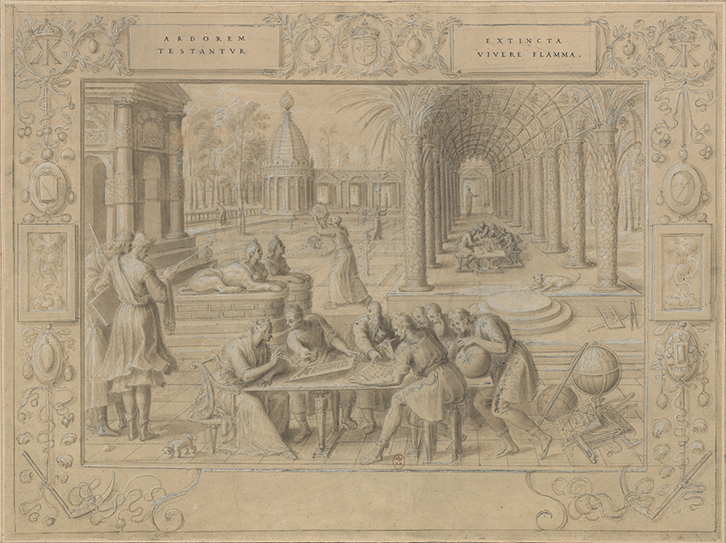
In making the case for Catherine’s enlightened patronage, Houel – following information provided by Pliny and echoed by Boccaccio – asserts that Artemisia wanted the best builders and sculptors, and that she thus brought from Greece ‘the most renowned … in the world’:Footnote 32 Scopas, Bryaxis, Timotheos and Leochares.Footnote 33 The best mathematicians and astrologers ‘of all Asia and Greece’ were also summoned to collaborate in the task.Footnote 34 This matches Catherine’s endeavour to assemble artists, architects and astrologers from several parts of Europe to work on her projects, an ideal to which many Early Modern patrons aspired. Houel moreover specifies that the experts, having deliberated at length in a building overlooking a garden, finally proposed a plan to the Queen: as if anticipating criticism, they calculated the expense down to the last obole (penny).Footnote 35 As one example of Caron’s use of motifs related to Catherine to create appropriate settings, in the garden where the creative team met, as specified by Houel, one sees a heavily rusticated doorway reminiscent of Philibert de l’Orme, who worked for the Queen Mother at the Tuileries and Saint-Maur, and dedicated his Premier tome de l’architecture to her.Footnote 36 Like the chairman at a meeting, Artemisia sits at the head of the foreground table and inspects a ground plan, while a man behind her gauges the horizon angle, echoing Houel’s note that it was imperative to establish a propitious time to commence the project.Footnote 37 Other men hold plumb bobs, and additional tools of the architectural trade are in evidence. The inclusion in the image of contributions to the project by both architects, artisans and astrologers – note the astrological chart at bottom right – heightens the Queen’s overall role in its coordination.
When devising new narratives, artists did not start anew each time, but often adapted formal models from a variety of sources. While the drawings defy precise dating, Valérie Auclair suggests c. 1570–1571, so Caron perhaps knew the frontispiece of Palladio’s Quattro libri (1570).Footnote 38 In this illustration, female figures hold implements associated with architecture, while a crowned seated female writing on a tablet sits within the broken pediment at the top. Contemporary audiences would have read such figures as allegories, however, not agents, due to the long tradition of personifying abstract qualities as female. A closer parallel for Caron’s queen appears in a print by Cornelis Cort after a lost series of paintings of the liberal arts by Frans Floris, which features an antique setting in which a personification of Arithmetic sits at a table, working on a tablet in front of her and engaging with other figures.Footnote 39 While seemingly a shortcut, seeing a potential Artemisia in the figure of Arithmetic is more than a formal expediency: arithmetic was an important component of the traditional liberal arts, as well as of architecture. Houel had emphasised Artemisia’s need for mathematicians as well as architects to plan the monument. Ronsard acclaimed Catherine’s knowledge of mathematics, among other things, and the Queen herself had supported the mathematician Pierre de la Ramée (Peter Ramus), providing him access to her library, for which he gave her praise in a treatise from 1567.Footnote 40
In the next episode, the designers of Mausolus’s tomb present a model to Artemisia.Footnote 41 The author or artisan proffering their creation to a patron is a trope, and multiple examples of authors presenting books to women exist, yet there is an important difference here: a book is a fait accompli, whereas the projected tomb awaits the patron’s authorisation. Among similar depictions showing patronal approval of models is Vasari’s illustration of Catherine’s ancestor Cosimo il Vecchio de’ Medici accepting Brunelleschi’s design for San Lorenzo in Florence (1556–1568),Footnote 42 part of a series of interior decorations extolling the accomplishments of the Medici dynasty. The inclusion of this episode in Houel’s manuscript further establishes Catherine’s direct participation in the entire endeavour.
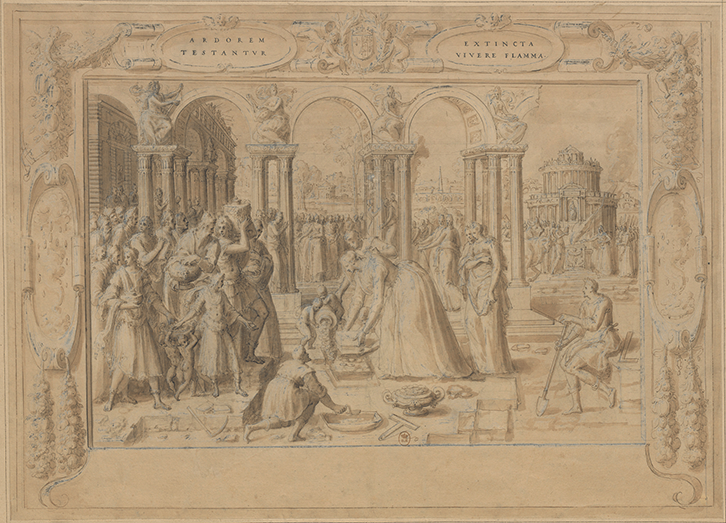
The next three illustrations emphasise the construction process. In the first one (Fig. 5.2), the Queen sets the first stone, and here again allegory and agency converge seamlessly. While this ceremony was an ancient practice, a notable French example of a woman so doing appears in Christine de Pizan’s treatise La Cité des Dames (1405), where, in the illustrated version in the British Library, women add stones to form a curved wall. Written to combat misogynistic discourse, this defence of women frames its allegory as a city built by and for women on the strength of exemplars including Artemisia. Louis XI’s consort and regent Charlotte de Savoie (1441/3–1483) owned a copy of the Cité and her daughter Anne de France (1461–1522), also a regent, had access to the library of the Duke de Berry, who owned the copy now in the British Library, formerly the possession of Queen Isabeau de Bavière (1385–1422), the book’s dedicatee.Footnote 43 Louise de Savoie (1476–1531), mother of the future Francis I, and Margaret of Austria, the dedicatee of Lemaire’s Couronne Margaritique discussed above, were raised in Anne’s court, and exposed to Pizan’s work.Footnote 44 Margaret, furthermore, inherited a copy of the Cité and bought another. Royal women clearly favoured the book and, significantly, Anne de Bretagne, mentioned earlier as the patron of Dufour’s collected lives of virtuous women, and twice queen of France, owned a six-piece set of Cité tapestries, while Margaret of Austria received a set as a gift: sadly, no tapestries remain.Footnote 45
Antoine Caron (1560–1580). [Artemisia Places the First Stone], ink on paper, 44 x 50 cm (1’5” x 1’8”).
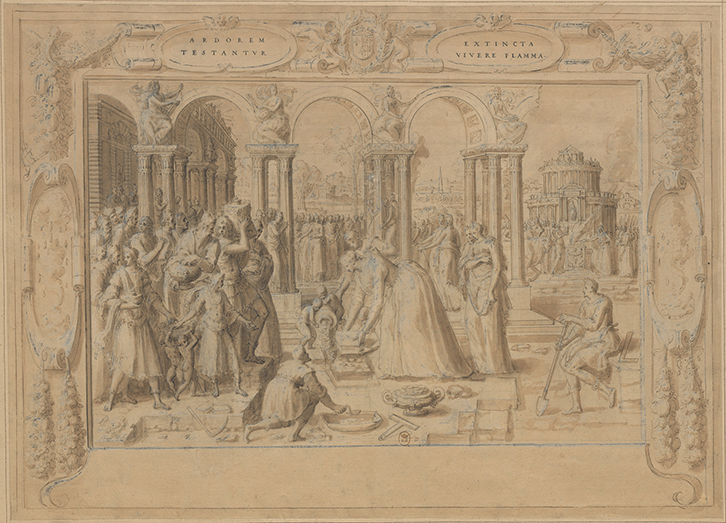
A 1533 inventory mentions Cité tapestries among others sent to Marseille for Catherine de’ Medici’s wedding to the Duc d’Orléans.Footnote 46 It is too much to expect that the images would have formed a lasting impression on the fourteen-year-old bride. Tapestries, regardless of subject matter, were often displayed together in great numbers to adorn an event simply by their colourful and imposing magnificence.Footnote 47 Nevertheless, Cité tapestries continue to appear in royal inventories, even in 1551, by which time Catherine was queen, and their age and worn condition are noted, indicating the frequent use of this series illustrating female claims to virtue.Footnote 48 Unfortunately, the specific subjects of the six tapestries are not recorded. Nor did Houel cite Pizan in his list of sources, but copies of Christine’s book were evidently in the royal collection and available to him and to Catherine. One of Houel’s acknowledged sources, François de Billon, wrote a treatise, Le fort inexpugnable de l’honneur du sexe feminin (1555), dedicated to Catherine. Like Pizan, Billon employed a building metaphor for his allegory promoting the virtues of women, this time evoking an impregnable stronghold, again buttressed by female exemplars including Artemisia.Footnote 49 So many unknowns prevent positing a clear relationship between the Cité des Dames and the Histoire d’Arthémise, but the connections are compelling, and at least signal the continuing value of the potential for oscillation between depicted females in allegory and in historical situations, a point to which I shall return.
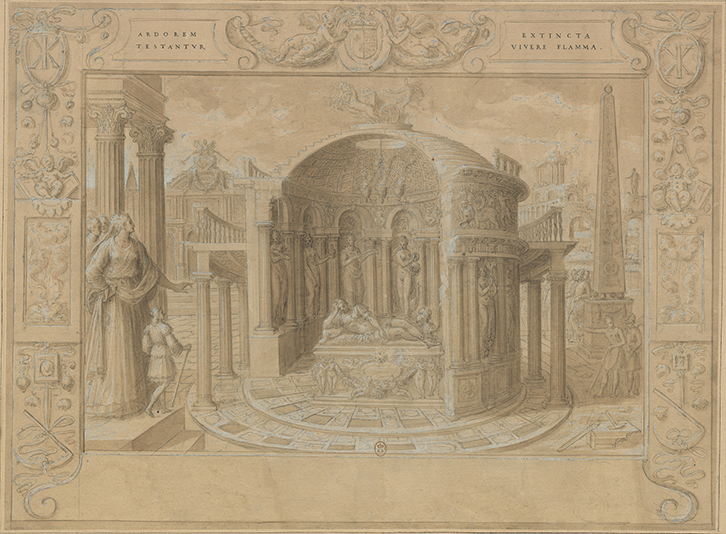
The next two drawings, not illustrated or discussed here, further elucidate the process of construction of the rising building, and finally, the viewer is to imagine that the Mausoleum, shown in a conventional cutaway, is complete as the Queen, accompanied by her young son, acknowledges it (Fig. 5.3). In the text and associated sonnet, Houel demonstrates his knowledge of the sources, providing dimensions that indicate a rectangular structure: ‘The building’s north and south faces [were] 63 feet wide, the other parts were a little narrower.’Footnote 50 Houel again cites the names of each sculptor, listed above, who carved his respective side, added a fifth master who raised the pyramid, and a sixth, Pythis, who made the marble chariot placed at the top.Footnote 51 Illustrations from earlier French Boccaccio anthologies only loosely follow the similar data he provides on the Mausoleum’s form. A fifteenth-century Boccaccio manuscript, for example, presents the Mausoleum under construction, together with episodes involving the earlier Artemisia I, but this funerary building reflects contemporary monuments with no antique allusions.Footnote 52 Caron, while not precisely adhering to the verbal descriptions, nevertheless makes a greater attempt to align his Mausoleum with Halicarnassus and other classical prototypes. Although there is ample evidence that Antoine Caron borrowed from prints, there is no guarantee that he knew Heemskerck’s rectangular rendition of the Mausoleum (Fig. 6.1) from his Seven Wonders series, as the dating of both images is imprecise. Strict replication, however, is not the point. Caron does not attempt a reconstruction: rather, as the title of the book aptly describes, his is a reconception. As ‘mausoleum’ had long been a generic term, with Strabo (64/63 bc–c. ad 24) calling the round tomb of Augustus in Rome a Mausoleum, it behoved Caron to refer to relevant funerary structures built in the intervening eras.Footnote 53
Antoine Caron (1560–1580). [Artemisia and Her Son View the Completed Mausoleum], ink on paper, 44 x 50 cm (1’5” x 1’8”).
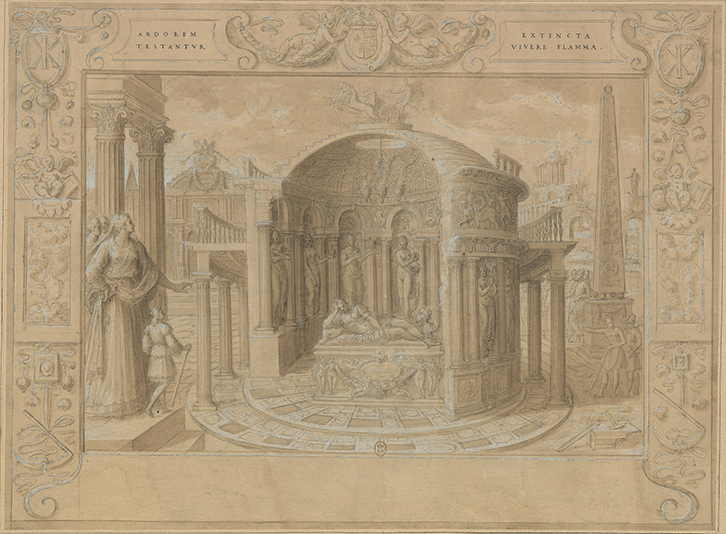
Caron clearly includes some features of the Halicarnassus structure – the stepped roof, the paramount quadriga and the exterior frieze, which, in this case, echoes antiquising prints like those by Étienne Delaune from the 1550s and 60s.Footnote 54 Most importantly, its round shape coincides with the Valois Chapel, Catherine de’ Medici’s primary patronage focus, no longer extant but known from engravings. That chapel, initially designed by Primaticcio but never completed, was a domed rotunda appended to the north transept of Saint-Denis, intended to house the double tomb of Henri and Catherine at its centre. Caron’s version plainly reflects the Roman Pantheon. It also calls to mind Serlio’s and Palladio’s renditions of Bramante’s Tempietto, in particular the exterior peristyle with balustrade above.Footnote 55 It also resonates with the late antique funerary rotunda attached to the transept of Old St Peter’s that later, notably, was designated the chapel of the kings of France.Footnote 56
Unlike Artemisia’s Mausoleum, the Pantheon had long since been transformed into a church and burial place: it was thus doubly important as representing a Christian antiquity, an increasing preoccupation in the later sixteenth century.Footnote 57 Caron’s painting of 1566, the Massacre of the Triumvirate,Footnote 58 confirms his knowledge of the appearance of the Pantheon as depicted in prints, such as those in Serlio.Footnote 59 For a more detailed interior, Beatrizet’s cutaway view provides the coffered ceiling and oculus in perspective.Footnote 60 Caron’s fictive structure also related to new buildings in France, such as the coffered dome in Philibert de l’Orme’s chapel at Anet, designed c. 1550, which in turn relates to designs by Antonio da Sangallo for a Medici tomb in Montecassino.Footnote 61 To promote Catherine de’ Medici as patron in an image intended for enlargement and public display, Caron needed to show her acumen in having erected a building that simultaneously recalled the famous ancient Wonder and its patron while actually surpassing it by accounting for the best in more modern attempts to rival Antiquity: the essence of Renaissance practice, as demonstrated, moreover, in her own Valois Chapel.
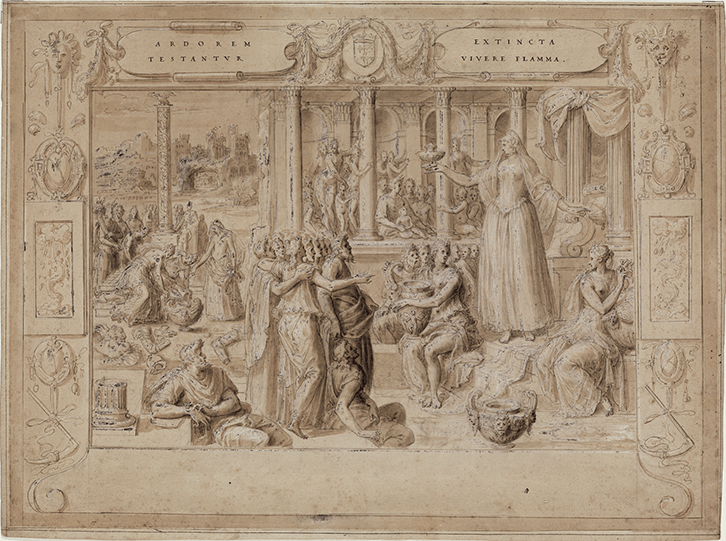
The completion of the monumental Mausoleum is not, however, the end of the story. Houel then narrates that Mausolus’s body is burnt and the Queen collects the ashes in a gold vase with the intention of imbibing them little by little.Footnote 62 For Houel, an apothecary, incorporating a substance into the body conformed to medical practice. This is not to suggest he would have precisely recommended ingesting human remains, but the notion, especially when considered metaphorically, would have fitted his mental world. The prime source for this episode is Valerius Maximus (fl. ad 14–34), who compiled a commonplace book of historical anecdotes, for use in schools of rhetoric, where pupils were trained to embellish speeches through the stylistic device of emulation and by including historical references. Most later writers on Artemisia repeated the story as testament to a woman’s undying love. As Jeanice Brooks has demonstrated, Houel’s acknowledged source, François de Billon, dramatises the incident, having Artemisia express her intentions in private to her deceased husband. Houel plagiarises him almost verbatim, although he turns this into a public event (Fig. 5.4).Footnote 63 Recalling models such as Raphael’s tapestry cartoon Paul Preaching at Athens (1515),Footnote 64 commissioned by Catherine’s great uncle Leo X and engraved almost contemporaneously by Marcantonio Raimondi,Footnote 65 Caron situates Artemisia standing alone on a raised platform and addressing a crowd. As Houel described,
Antoine Caron (1560–1580). [Artemisia Holds the King’s Ashes], ink and pencil on paper, 39.5 x 53.7 cm (1’4” x 1’9”).
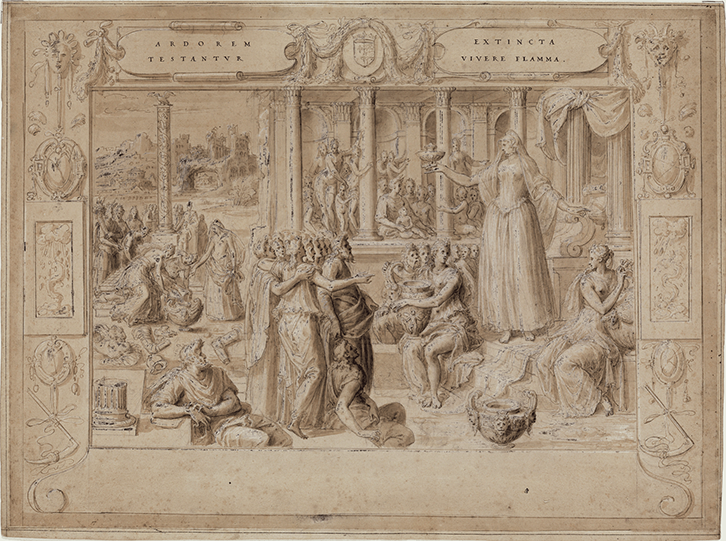
one day when the people and the nobility were assembled, taking some ashes and putting them into her wine, she said tenderly through her tears, ‘even though my body is not a worthy sepulchre for yours, my dear Mausolus, I can nevertheless little find a human place that deserves the favour of burying you, than my person, assuring myself at least that I will have contentment, to keep my only friend, not beside me or near me but in the middle of me’.Footnote 66
As scholars have noted, this incorporation permitted the Queen to acquire the requisite male body allowing her to behave in a conventionally masculine way.Footnote 67 And thus it serves appropriately as a prologue to the next episode in the Houel–Caron series, in which Artemisia, thus fortified, courageously leads her navy into the harbour at Rhodes (a prowess of the earlier Queen Artemisia I, often confounded with Mausolus’s widow), therefore relating ‘Artemisia’ to two of the ancient Wonders.
Georg Pencz’s engraving of Artemisia (c. 1539) sets the inconsolable widow, at the moment when she contemplates drinking her husband’s ashes, in an intimate environment.Footnote 68 Most Early Modern depictions of Artemisia postdating Caron adopt this same approach but increase the drama, as can be seen in works by Francesco Furini (c. 1630),Footnote 69 Gerard van Honthorst (c. 1635),Footnote 70 Rembrandt (1634)Footnote 71 and Domenico Fetti’s workshop (seventeenth century).Footnote 72 Like other themes, popular in the seventeenth century, representing actions that would have been considered female heroic behaviours, this anticipatory choice accentuates the emotional by selecting the key moment illustrating Artemisia’s resolve. Not all such Artemisia depictions include a Mausoleum, leading to confusion about which figure is intended – for example in Donato Creti’s Artemisia Drinking the Ashes of Mausolus (c. 1713)Footnote 73 – since there are other females who take decisive action by drinking from cups, for example the Carthaginian Sophonisba, also represented in graphic form and in literature during this period, who drank poison rather than be subject to being displayed in a Roman triumph. In fact, the episodes that feature Artemisia overseeing the construction of the building de-emphasise her drinking the ashes and vice versa. When concentrating on the ash-filled chalice, the Mausoleum building, if present, becomes an attribute. Heemskerck’s view is an exception, for here the chalice becomes the attribute, since the emphasis is on the Mausoleum itself as one of the Seven Wonders and not on Artemisia (Fig. 6.1). Apart from a painting by Simon Vouet (c. 1640s),Footnote 74 and possibly others to be located, most depictions de-emphasise Artemisia’s architectural patronage in favour of the more dramatic incorporation, which, while empowering, is simultaneously self-effacing.
Caron avoided this confusion by providing seven episodes for the Mausoleum sequence – portraying its planning, construction and then rejection as burial site. Contemplating the ingestion of ashes seems a more immediately perceptible, and appropriately female-gendered, demonstration of devotion than standing proudly beside an impressive monument, as seen in an image like Jean Fouquet’s Solomon Supervising the Building of the Temple at Jerusalem, from an edition of Flavius Josephus dated around 1465, in which the King examines an impressive building from a balcony.Footnote 75
The Artemisia series compiled by Houel and Caron seems unique in tracing a woman patron’s involvement in the planning and construction of a building through several episodes. Even if Catherine did not adopt Houel’s ensemble in its totality, her identification with Artemisia and the latter queen’s connection with the Mausoleum persisted in her imagery. In the Parisian triumphal entry honouring Charles IX in 1572, followed by the coronation of his wife, Elisabeth of Austria, Queen Mother Catherine was honoured by analogy with Artemisia, primarily as pious widow, but with specific mention of ‘that noble Mausoleum’.Footnote 76
*****
In the end, however, Houel’s Artemisia, in selecting her own body as repository, did not even claim that she herself surpassed the monument that she had striven to build. As she consumed his ashes, in Houel’s words, she acknowledged the lesser status assigned to the female body by proclaiming that she, as his human tomb, was not a worthy sepulchre for Mausolus. Catherine’s cousin and later French queen Marie de’ Medici (1575–1642) employed Artemisia iconography after the assassination of Henri IV, when she too acted as regent. Not in an extensive series of images, but in texts proclaiming her to be a ‘living tomb’; the metaphor persisted into the regency of her daughter in law, Queen Anne of Austria (1601–1666).Footnote 77 Thus in the final analysis, this imagery of power for women, who, as regents, occupy influential positions, does so by returning them to allegory, as the personification of a Mausoleum, rather than as agents of their own authority.

 Open access