


Introduction
There is a growing literature concerned with how individual politicians keep themselves informed about citizens' preferences (Petry, Reference Petry, Dobuzinskis, Howlett and Laycock2007; Walgrave et al., Reference Walgrave, Soontjens and Sevenans2022) and the difficulties political actors face in correctly perceiving these preferences (Broockman & Skovron, Reference Broockman and Skovron2018; Butler & Vis, Reference Butler and Vis2023; Hertel‐Fernandez et al., Reference Hertel‐Fernandez, Mildenberger and Stokes2019; Pilet et al., Reference Pilet, Sheffer, Helfer, Varone, Vliegenthart and Walgrave2023). However, little is known about how governments or heads of governments keep themselves informed about public opinion. While it is generally admitted that governments in most democracies make extensive use of public opinion research (Druckman & Jacobs, Reference Druckman and Jacobs2015), we do not know much about the way they mobilize this resource. It is thus high time to ask: When and why do governments want to learn about public opinion? What determines differences in the intensity of government polling in different phases of the electoral cycle? Are government opinion polls primarily a tool for testing the reception of government proposals or for learning more about issues that are important to citizens? And what does this tell us about the way political representation works?
What explains the lack of evidence? Empirical political science research often assumes that information supplied by public opinion polls is exogenous to governments' behaviour or communication (Hager & Hilbig, Reference Hager and Hilbig2020; Jones & Baumgartner, Reference Jones and Baumgartner2005). However, this assumption ignores the fact that governments actively participate in the production of public opinion. Existing research indeed shows that American presidents regularly commission polls (Druckman & Jacobs, Reference Druckman and Jacobs2015; Edwards, Reference Edwards2016; Rottinghaus, Reference Rottinghaus2010). The use of opinion polls by political elites has also become widespread in most Western democracies and beyond (Belot & Schnatterer, Reference Belot, Schnatterer, Jacob and Schiffino2021). For instance, the interest in opinion polls shown by former German Chancellor Angela Merkel (in office from 2009 to 2021) came to light when German Green Party member Malte Spitz sued the government under the German Freedom of Information Act and was granted access to several documents in 2012 (Becker & Hornig, Reference Becker and Hornig2014). French journalists recently revealed that French President Emmanuel Macron commissioned 300 polls between June 2017 and March 2021 (Januel et al., Reference Januel, Motet and Stromboni2022). While the existing literature usually considers governments as consumers of opinion polls, it is thus high time to consider them also as actors in the creation of public opinion measured by polls. This is all the more important in a competitive context where, in most contemporary liberal democracies, different statements of opinion are debated or opposed, notably through the use of various opinion surveys. We therefore assume, in line with Haverland et al. (Reference Haverland, Ruiter and Van de Walle2018), that elected officials' exposure to public opinion and information supply in the form of commissioned polls is also endogenous.
Why should we study government polls? If we consider that public opinion, at least in its surveyed form, is itself a social construction, it becomes necessary to begin by focusing on governments' polling activity. Put differently, while most research on the link between public opinion and public policy uses opinion polls as independent variables, this study asserts that we should also focus on commissioned polls as dependent variables since they need to be studied and explained in the first place. Since we ignore almost everything about when and why governments commission polls, it is essential to lift the veil on the factors that determine the intensity of government polling (that is the number of survey questions commissioned) at different points in the electoral cycle and to identify the different logics of representation behind this activity.
Until now, these fundamental questions concerning the functioning of contemporary representative democracies could not be answered for want of access to data. We construct and use a novel and unique dataset, containing all survey questions commissioned by former German Chancellor Angela Merkel between 2013 and 2021. The analysis of government surveys represents an innovative research strategy: so far, only a few studies have mobilized polling data collected by national governments, and most of them analyse surveys ordered by American presidents (Druckman & Jacobs, Reference Druckman and Jacobs2006, Reference Druckman and Jacobs2015; Edwards, Reference Edwards2016; Rottinghaus, Reference Rottinghaus2010), and, to the best of our knowledge, none systematically analyses all the survey questions asked by a national government. The central contribution of this paper is thus both empirical and theoretical: It examines the logic behind the commissioning of government polls, analyses whether the issues included in polls correspond more to the government's priorities or those of the general public and whether this varies across different stages of the electoral cycle and depending on whether the government ‘owns’ an issue or not.
Our results contribute to three related political science debates. First, we add to the growing literature on the way political actors learn about public opinion, the extent to which citizen's preferences are considered during the political decision‐making process and how their priorities get channelled into the political system (Traber et al., Reference Traber, Hänni, Giger and Breunig2022; Walgrave et al., Reference Walgrave, Soontjens and Sevenans2022). And linked to that, we add to the literature on public issue salience (Johns, Reference Johns2010; Wlezien, Reference Wlezien2005). Shedding light on the mechanism that determines when and why governments become interested in public opinion can also help to overcome difficulties in the existing literature on democratic responsiveness, addressing the challenge of survey availability. Second, our research offers a unique view of the role of government polling in the representation process. Mansbridge (Reference Mansbridge2003) raised the fundamental and important question of whether representatives focus mainly on their electoral promises (promissory representation) or on what they believe will be future voter preferences (anticipatory representation). Government polls can play an important role in both forms of representation: either as a decision‐making aid in determining which election promises should be implemented or as an ‘update instrument’ indicating (changing) voter preferences. Finding out which logic predominates in government polls at which point thus contributes to a better understanding of how political representation works. Third, this study also contributes to the literature on governments' and political parties' strategic behaviour during the electoral cycle (Pardos‐Prado & Sagarzazu, Reference Pardos‐Prado and Sagarzazu2019; Sagarzazu & Klüver, Reference Sagarzazu and Klüver2017; Seeberg, Reference Seeberg2022) by emphasizing the importance of theorizing the conditioning effect of its different stages and confirming the importance of the logic of issue ownership. Analysing polls commissioned during two government terms, our results show that the issues covered by the survey questions do follow government priorities: governments commission more survey questions on their own political priorities. Our findings further underline that the salience of issues also plays a major role: governments commission more questions on issues that are important in the eyes of the population. Overall, our results imply that governments use polls both proactively and reactively. Which of the two logics dominates depends on the specific point of the electoral cycle: the Merkel government commissions more questions about government policy priorities immediately after federal elections, but commissions more questions about salient issues in the months leading up to the next federal election. Thus, our findings underscore the importance of considering both representational logic and the influence of the electoral cycle in understanding governments' polling activities. They also help to clarify the conditions under which governments use their polls for either anticipatory or promissory representation. Moreover, we show that governments commission fewer questions on issues they ‘own’, which points in the same direction as previous studies showing that governments are less interested in public opinion on these issues (Egan, Reference Egan2013; Green & Jennings, Reference Green and Jennings2019).
The remainder of the article begins by situating our work in the literature before elaborating on our theoretical arguments and expectations. Subsequently, we provide background information about our novel dataset on government polling in Germany and further detail the coding of survey questions (our main dependent variable) as well as the general research design of this study. We then provide robust empirical evidence for the effects of issue‐ownership, government priorities, salience, the electoral cycle as well as their interactions with different points in the electoral cycle on the intensity of government polling by using fixed‐effect panel Poisson regression modelling with robust standard errors. We conclude by considering the general implications of this study and suggest avenues for future research.
Explaining governments' polling activity
How can we expect governments to think when it comes to ‘how many and what questions to poll and why’? In line with studies on political parties and their issue prioritization, we expect differences in a government's polling behaviour on issues that they ‘own’, defined as those issues on which voters perceive a party to be more ‘sincere and committed to do something’ (Petrocik, Reference Petrocik1996, p. 826).
Kriesi (Reference Kriesi2001) further distinguishes two ways of integrating polls into the policymaking process: one proactive and the other reactive. We argue that this distinction is actually relevant at an earlier stage when governments decide which representational logic nourishes the ordering of survey questions. Government polls can play an important role in promissory representation as well as in anticipatory representation (Mansbridge, Reference Mansbridge2003): mobilized in a proactive way as an aid to deciding which electoral promises should be implemented or in a reactive way as an ‘update instrument’ for (changing) voter preferences. Since incentives differ in the two forms of representation, we can also expect different mechanisms to decide which issues make it onto government polls' limited agenda.
Another important explanatory factor that is likely to influence governments' behaviour in seeking public opinion is the electoral cycle. The distance from or proximity to the next election is an important factor, as the timing of trade‐off considerations between policy, office and votes relative to the electoral cycle has been shown to affect the behaviour of governing parties (W. Müller & Strøm, Reference Müller, Strøm, Müller and Strøm1999). We can, therefore, assume that the electoral cycle has an impact on the intensity of polling as well as on the varying importance of promissory representation and anticipatory representation in modern democracies and the tensions and contradictory pressures that exist between them.
An issue ownership logic of government polling
Whether governments ‘own’ certain policy issues might be an important factor influencing government incentives to commission polls. Egan (Reference Egan2013) observes that US parties enjoy long‐term trust in their ability to handle certain issues and that representatives can use this ‘trust advantage’ to be less responsive to public opinion on those issues that their party ‘owns’. Similarly, Green and Jennings (Reference Green and Jennings2019) find that the responsiveness of UK and US government agendas is constrained by parties' desire to prioritize their ‘own issues’. A greater willingness to respond should therefore be reflected in a greater need for information about citizens' preferences on issues that parties do not ‘own’. Issues that are not ‘owned’ by the party in government, but by another party may also become the subject of more questions in government surveys for another reason. Seeberg (Reference Seeberg2020) shows how a mainstream party can counter another mainstream party's issue ownership by reframing the issue and blaming the other party for its performance. In this way, survey questions can also be used to gauge public opinion in order to engage in an issue competition. Thus, government polling could follow an issue ownership logic of public information seeking, but precisely on issues that it does not ‘own’, since it believes it is very well aware of public opinion about issues that it ‘owns’, but less so on issues that are ‘owned’ by its opponents. Consequently, we assume that
-
H1 Issue ownership hypothesis. Governments commission fewer survey questions about issues that they own.
Promissory representation
Elections confer a general mandate to elected political parties and their representatives (Manin, Reference Manin1997; Mansbridge, Reference Mansbridge2003; Stokes, Reference Stokes2001). The traditional model of promissory representation focuses on the idea that during campaigns representatives make promises to constituents, which they then keep or fail to keep (Aragonès et al., Reference Aragonès, Postlewaite and Palfrey2007; Corazzini et al., Reference Corazzini, Kube, Maréchal and Nicolò2014; Matthieß, Reference Matthieß2020; Naurin et al., Reference Naurin, Royed and Thomson2019; Thomson et al., Reference Thomson, Royed, Naurin, Artés, Costello, Ennser‐Jedenastik, Ferguson, Kostadinova, Moury, Pétry and Praprotnik2017; Werner, Reference Werner2019). We know furthermore that the incumbent government's record in terms of realizing its election promises plays a role in election campaigns. While governments differ in how many promises they fulfil (Duval & Pétry, Reference Duval and Pétry2019; I. Guinaudeau & Persico, Reference Guinaudeau and Persico2018; Thomson et al., Reference Thomson, Royed, Naurin, Artés, Costello, Ennser‐Jedenastik, Ferguson, Kostadinova, Moury, Pétry and Praprotnik2017), no government can implement everything it has announced. Governments' mandate responsiveness and policymaking capacity are shaped by institutional, operational and political conditions (B. Guinaudeau & Guinaudeau, Reference Guinaudeau and Guinaudeau2022). Polls could therefore play a role in deciding which electoral promises the government should focus on implementing and, more generally, be used in a proactive way by monitoring government priorities. For example, it has been shown that polls play an important role in a government's work of persuasion, allowing it to adjust its communication strategies (Hager & Hilbig, Reference Hager and Hilbig2020; Heith, Reference Heith2000) or to rekindle forgotten topics and /or to frame certain issues from a specific angle (Schaffner & Sellers, Reference Schaffner and Sellers2009). Finally, commissioning polls enables governments to actively participate in setting the public opinion agenda in a competitive context. The media and other actors regularly expose political actors to pressure from the public via polls that they commission. Commissioning their own surveys enables governments to counter this pressure with their own results and priorities.
Therefore, we assume that for the sake of maintaining government legitimacy (stemming from their electoral mandates), government priorities are an important force behind government's polling activity and the selection of issues covered by government poll survey questions.
-
H2 Government priorities hypothesis. Governments commission more survey questions addressing government priorities.
Anticipatory representation
Governments' general electoral mandate is, however, also subject to signs of ‘wear and tear’ over the course of a legislative term: elected representatives are confronted with contradictory and changing demands, they have to make concessions, compromises and issue‐specific coalitions, which can cost them approval (Kriesi, Reference Kriesi2001). Based on the observation that, during their term of office, representatives focus on what they think their constituents will approve at the next election, Jane Mansbridge introduced the concept of anticipatory representation: in her view, it is best conceived as one of reciprocal power and continuing mutual influence (Mansbridge, Reference Mansbridge2003, p. 518). According to the anticipatory representation model, representatives try to please future voters by anticipating their reactions. However, any attempt to anticipate voters' reactions is confronted with an information problem (Stimson et al., Reference Stimson, MacKuen and Erikson1995, p. 545) since preferences can shift or new ones emerge.
This difficulty in anticipating voter preferences has increased in most Western democracies in recent decades as a consequence of declining party loyalty (Dalton & Wattenberg, Reference Dalton and Wattenberg2002; Mair et al., Reference Mair, Muller and Plasser2004; Pennings & Lane, Reference Pennings, Lane, Pennings and Lane1998) and increasing voter volatility (Ersson & Lane, Reference Ersson, Lane, Pennings and Lane1998; Fieldhouse et al., Reference Fieldhouse, Green, Evans, Mellon, Prosser, Schmitt and Eijk2021). As a result, today's governments are more strongly exposed to exogenously determined political preferences which either arise spontaneously among the electorate or are produced by independent media or political entrepreneurs outside the parliamentary arena (Kitschelt, Reference Kitschelt2000; Seeberg, Reference Seeberg2023). It is therefore plausible to assume that political actors invest more and more resources in controlling the public arena. Representatives must therefore search for the most up‐to‐date information, which in turn means paying greater attention to public opinion polls or focus groups in order to get a better understanding of the preferences of the population as a whole (Stimson et al., Reference Stimson, MacKuen and Erikson1995, p. 544) or of certain target groups. Opinion polls inform governments about citizens' preferences concerning a wide range of policy issues, about the salience of different issues in the public mind as well as citizens' evaluation of public policies and the government itself (Belot & Schnatterer, Reference Belot, Schnatterer, Jacob and Schiffino2021). Polls thereby serve as an instrument facilitating anticipatory representation.
If we consider that governments try to anticipate voters' reactions, they have to adapt to changing demands. One of the most obvious mechanisms is how policy issues change in importance in citizens' eyes, that is (the volatility of) issue salience. Changes in salience (Geer, Reference Geer1996) not only imply variation in attention between policy domains but also in attention within a given domain over time. The political responsiveness literature has shown that the salience of political issues enhances – albeit to different degrees – the responsiveness of those who govern (Bromley‐Trujillo & Poe, Reference Bromley‐Trujillo and Poe2020; Lax & Phillips, Reference Lax and Phillips2012). The concept of issue salience refers to ‘the relative significance that an actor ascribes to a given issue’ (Wlezien, Reference Wlezien2005, pp. 556–561). Social‐psychological studies on the attitudes‐behaviour link underline the fact that strong attitudes are a better indicator than weak ones (Ajzen & Fishbein, Reference Ajzen and Fishbein1977; Krosnick, Reference Krosnick1988). Citizens are more likely to have strong opinions on salient policies and to hold their representatives accountable (B. I. Page & Shapiro, Reference Page and Shapiro1983) and public opinion is known to be less volatile for salient issues (Weaver, Reference Weaver1991). Consequently, there should be major differences between salient and non‐salient issues. If governments are attempting to anticipate voters' reactions, they would definitely like to know more about the issues that are important to their citizens and that might potentially influence their future voting choices.
-
H3 Issue salience hypothesis. Governments commission more survey questions on a given issue if this issue is important in the eyes of the general public.
Moreover, it seems plausible to expect a multiplication effect between issue salience and government priorities: governments could be particularly likely to commission more survey questions on issues which are government priorities and, at one and the same time, salient to the general public.
-
H4 Conditional salience and government priorities effect hypothesis. Governments commission more survey questions on issues which represent government priorities and are important to the general public.
Intensity of government polling and the varying importance of both forms of representation at different stages of the electoral cycle
As explained above, another major explanatory factor that could affect governments' behaviour in seeking public opinion is the length of time to the next federal elections. A government's attention to issues is torn between legislative priorities and outputs, changes in public opinion, external events, limited resources and backbench rebellions. This process occurs in cycles as policymaking is not continuous but rather structured around decision points where priorities are established (Bevan et al., Reference Bevan, John and Jennings2011). Existing research into governments' and parties' strategic political behaviour underscores the importance of differentiating between different stages of the electoral cycle (Pardos‐Prado & Sagarzazu, Reference Pardos‐Prado and Sagarzazu2019; Sagarzazu & Klüver, Reference Sagarzazu and Klüver2017; Seeberg, Reference Seeberg2022). Thus, we argue that the electoral cycle is likely to determine both the intensity of government polling and the dominant logic behind the selection of issues polled (promissory or anticipatory representation). Concretely, we distinguish three periods in the electoral cycle: the period immediately after an election, followed by a routine period and finally the last period at the end of the legislature, which corresponds to the campaign for the upcoming election.
As governments have a strong electoral mandate during the initial post‐electoral period, it can be assumed that they will mainly ask questions with a promissory representation logic. The literature on pledge realization identifies the beginning of the mandate as particularly favourable to the fulfilment of campaign pledges: the executive then benefits from honeymoon popularity, and budgetary constraints are weaker than at later points in the legislative period (Beckmann & Godfrey, Reference Beckmann and Godfrey2007; Dewan & Myatt, Reference Dewan and Myatt2012; Ponder, Reference Ponder2017).
In the routine period, which is characterized by the ‘wear and tear’ effect of the electoral mandate and upcoming events, we then expect a stronger focus on questions directed towards anticipatory representation.
This trend should be reinforced in the last period before the election, as this corresponds to the (preparation of the) election campaign and governments should have an interest in positioning themselves on salient issues. In other words, anticipatory representation becomes more prominent as governments move from predominantly policy‐seeking (fulfilling pledges) to predominantly vote‐seeking closer to elections to get re‐elected (Pardos‐Prado & Sagarzazu, Reference Pardos‐Prado and Sagarzazu2019; Sagarzazu & Klüver, Reference Sagarzazu and Klüver2017; Seeberg, Reference Seeberg2022). At the same time, we expect an increase in the total number of questions in polls commissioned by the government compared to the routine period. Moreover, the impact of the electoral cycle is likely to be amplified for coalition governments. Coalition parties have to reconcile two competing logics: they need to demonstrate unity to govern together but also have to emphasize their own profile to succeed in elections (Sagarzazu & Klüver, Reference Sagarzazu and Klüver2017).
Based on what we know about the electoral mandate and its ‘wear and tear’ effect discussed earlier and about the functioning of coalition governments as well as practical reasons for the planning of polls, we assume that the intensity of polling (number of questions commissioned) as well as the logic behind ordering polls (anticipatory or promissory) varies over the electoral cycle.
As a consequence, we assume that
-
H5 General electoral cycle hypothesis. Governments commission more survey questions just after or before an election than during routine times.
In addition, we suggest that this electoral cycle mechanism affects whether questions predominantly relate to issue salience or government priorities. Based on the assumptions on the direct effects of the three distinct stages of the electoral cycle described above, we further expect two conditional effects of the electoral cycle. First, we suggest that governments commission more survey questions which deal with government priorities at the beginning of the electoral cycle. Second, we assume that salient issues are more strongly represented by questions in government surveys during routine times than in the first year of a government's term after an election and even more so just before an upcoming election.
-
H6 Conditional government priorities and electoral cycle effect hypothesis. Governments commission more survey questions on their own political priorities directly after an election than during routine times or directly before the next election.
-
H7 Conditional salience and electoral cycle effect hypothesis. Governments ask more questions about salient issues in routine times than immediately after an election and even more so just before the next election.
Case selection, data and methods
Case selection
Angela Merkel, Germany's former Chancellor, was often credited with having a sixth sense for capturing the political mood of her population. On the one hand, despite the crises it had to face (the Eurozone crises, the so‐called refugee crises, the Covid‐19 pandemic) her government was extremely stable and long‐lasting (she worked with four US presidents, five British prime ministers and four French presidents). At the same time, she was responsible for some of the most important political U‐turns in post‐war Germany such as the nuclear phase‐out, the legal recognition of same‐sex marriage and the end of compulsory military service. Most of the time, these policy changes were in phase with public opinion. But, in fact, during the 19th legislative period (2013–2017) alone, the Chancellor's office conducted around 374 polls. Of course, conducting so many polls allows a government to be well‐informed about its population's mood. It makes Germany an interesting country to study.
Another reason why Germany is an appealing case to study is data availability. Systematically analysing the factors that determine why an issue enters the agenda of government polls requires access to all questions asked by a government during a given period. Access to data is an obvious barrier to studying government polling since in most countries government‐commissioned surveys are neither published nor even cited.Footnote 1 As far as we know, the only other country that has committed to publishing all surveys commissioned by government bodies is Canada.Footnote 2 Moreover, focusing on a single country to explore the different mechanisms that determine the intensity of government polling and the logic of representation behind this activity allows us to hold the general context, that is, the particularities of the political system, constant. Ultimately, given that we concentrate our analyses on two legislative periods that brought together exactly the same parties in a governing coalition allows us to hold constant the dimension of the political nature of the government.
Regarding the choice of the time period: since the 2010s, if not earlier, governments of most Western democracies have been confronted with crises of all kinds; in addition to the Covid pandemic and the so‐called immigration crises, we can mention the banking and debt crisis since 2008, the war in Ukraine, the energy crisis and inflation. In addition to these short‐term or unpredictable crises, there are also long‐term problems such as climate change. With two major crises, the so‐called refugee crisis and Covid‐19, the period analysed is therefore well suited to provide a better understanding of the government's strategy towards public opinion in times of multiple crises.
Data: A novel dataset on government polling
Since the 1950s, German Chancellors have been using public polls in order to make political decisions (Kaase, Reference Kaase1977; Kruke, Reference Kruke2007). According to the 1977 organizational decree, the task of opinion research in the Federal Press Office is ‘to research and present public opinion as a decision‐making aid for the political work of the Federal Government’. Footnote 3 Of course, as head of the government A. Merkel did not deal directly with the survey institutes, neither in terms of drafting questionnaires nor analysing results. These tasks are delegated, and it is therefore not easy to measure the extent to which the head of the government has really influenced individual questions.
We were able to identify two intermediaries between the polling institutes and the German Chancellor: the Public Opinion Department of the Federal Press Office and the government spokesperson. The government spokesperson communicates desired topics to the Federal Press Office. The latter discusses question formulations with the institutes. When the results are available, they follow the same path in the opposite direction. The institutes communicate the results in the form of summaries and datasets to the Federal Press Office, which forwards them to the government spokesperson who then writes summaries for the Chancellor. These mostly two‐page reports summarize the most important results of different surveys (commissioned by the Federal Press Office or other clients, mainly media) for the Chancellor every Friday.Footnote 4 However, there is always a to‐ing and fro‐ing, depending on the importance of the topic, for example, the Chancellor obviously has the opportunity to ask for more detailed results.
While these reports are thus important sources as they provide insights into how information from opinion polls is passed on to the head of government and can therefore serve as a basis for initial studies interested in the influence of the surveys on government action (Hager & Hilbig, Reference Hager and Hilbig2020), we cannot assume that this represents all the information available to the Chancellor. The aforementioned to‐ing and fro‐ing during the poll commissioning process, especially where important issues are concerned, also allows for an additional flow of information. Available reports therefore represent only the tip of the iceberg.
Systematically analysing the factors that determine why an issue is taken up by government polls necessities access to all questions asked by a government in a given period. We therefore constructed a novel dataset on government polling, containing all survey questions commissioned by the German Federal Press Office on behalf of the German Federal Government during the 18th and 19th legislative periods (22 October 2013–24 October 2017 and 24 October 2017–26 October 2021).Footnote 5 Since January 2016, surveys commissioned by the Federal Office have been available online (after an embargo period of a few months).Footnote 6 Surveys up to 2013 were provided by Malte Spitz who obtained access to the data following his 2014 request under the Freedom of Information Act. Surveys for the period from 2013 to 2016 were sent to us directly by the Federal Press Office on request.Footnote 7 For the purposes of this study, we excluded the following individual survey questions from our database: survey items concerning the socio‐demographic profile of respondents, questions assessing the salience of issues (see note 4 for a detailed explanation) and all items on non‐political issues. We therefore built a dataset where each observation corresponds to one survey question.
Most of the data we collected are dated at the weekly level. However, for statistical analysis purposes, we assigned all variables to a monthly level. There were three major reasons for this decision: first, initial qualitative elite and expert interviews carried out for our project showed that very short‐term changes in opinion (i.e., on a week‐to‐week basis) have little potential to influence policy decisions or reflections due to time constraints and the amount of time required for the opinion poll‐commissioning process. Second, performing analyses on a weekly rather than a monthly basis would generate too many observations with zeros (Freeman, Reference Freeman1989). Third, using a monthly rather than a weekly basis reduces the statistical noise in our empirical analyses and still allows us to get closer to the subtle temporal mechanisms at work than we could with quarterly observations.
The dependent variable
Our dependent variable is based on manual thematic coding of all survey questions from German government polls between October 2013 and September 2021 (18th and 19th legislative periods) according to the Comparative Agendas Project (CAP) coding scheme (Breunig & Schnatterer, Reference Breunig and Schnatterer2020; Breunig et al., Reference Breunig, Guinaudeau and Schnatterer2021).Footnote 8 The dependent variable of this study is the number of survey questions in German government polls within policy issues in a given month (unit of analysis). Questions in government surveys are either related to the policymaking process or to other aspects of representation. They cover the entire policy cycle, from problem definition to evaluation of enacted policies and include general questions about respondents’ life experiences and ideology, specific policy proposals and popularity of representatives, as well as questions monitoring their activities. Each survey question is assigned to a single topic category which makes it possible to count the number of questions on a given topic during each month. All survey questions were coded into 21 major topics and 232 subtopics. For the sake of parsimony, the topics were recoded into 11 macro policy issue areas (see also Bertelli & John, Reference Bertelli and John2013; Chaqués‐Bonafont et al., Reference Chaqués‐Bonafont, Palau and Baumgartner2015; Green‐Pedersen & Stubager, Reference Green‐Pedersen and Stubager2010). Some codes were grouped together, and two new categories were created for issues that were particularly important in Germany during the period under study but were not represented in the CAP codes: EU Affairs and Family Issues (see Online Appendix Table A.1). Hence, our data consist of a panel cross section with 11 policy topics observed for 96 months, which adds up to 1056 observations (11 policy topics * 96 months).Footnote 9
Explanatory variables
Our first explanatory variable is issue ownership. Following Seeberg (Reference Seeberg2017a), we collected information on issue ownership at the voter level in national election surveys via a question about the preferred party on an issue. More precisely, we measure issue ownership by the Chancellor's party (the CDU–CSU) by creating a dummy indicator for each legislative period.Footnote 10 This indicator shows which of the 11 policy issues were ‘owned’ or not ‘owned’ by the CDU–CSU.Footnote 11 The data for this come from the GLES post‐election studies of 2013 Footnote 12 and 2017. Footnote 13 As the GLES ‘long‐term panel’ data (2009–2013–2017) were not yet available for the period after 2017, we had to renounce to get an annual indicator of issue ownership for Germany for our study period. Issue ownership remains relatively stable over time (Seeberg, Reference Seeberg2017a); however, there is some fluctuation in the degree of association between parties and issues (Dahlberg & Martinsson, Reference Dahlberg and Martinsson2015). With only one indicator for each legislative period and in order to avoid overinterpretation of the precise degree of issue ownership at this juncture, we have chosen to employ a binary indicator of issue ownership.
Our second explanatory variable is government priorities as defined by the government programme for the third and fourth Merkel governments. We operationalize the government programme by using Angela Merkel's major speech at the beginning of each legislative period, in which she outlined the government's priorities for the coming legislative period. These speeches were also coded thematically according to the CAP schemeFootnote 14 (see Figure A.2 in the Online Appendix for a comparison of the contribution of the 11 policy issues to each of the two government programmes).
Our third explanatory variable is issue salience, more precisely personal issue salience. Most studies measuring the effect of public opinion on public policy – or on the political positioning of governments more generally – incorporate salience through an indicator of national salience. Nationally salient issues are usually measured through questions on the ‘most important problem’ (MIP) or the ‘most important issues’ a country is currently facing. However, issues may be salient because of their perceived importance on the national agenda or because of their personal importance to the individual (Lavine et al., Reference Lavine, Sullivan, Borgida and Thomsen1996). According to Moniz and Wlezien (Reference Moniz and Wlezien2020), most MIP questions represent a measure of ‘national salience’ because the question wording refers explicitly to the country as a whole and not to individuals, and responses therefore invoke national concerns rather than personal ones. Giger and Lefkofridi (Reference Giger and Lefkofridi2014) advocate the inclusion of personal salience in political representation models given that citizens tend to vote for political parties that are close to issues which are personally important to them. Including salience as an individual‐level concept is crucial since accessibility is more strongly linked to personal salience of attitudes than to nationally salient issues (Lavine et al., Reference Lavine, Sullivan, Borgida and Thomsen1996). Moreover, Johns (Reference Johns2010) finds that on matters of national importance, as opposed to personal importance, citizens are less knowledgeable, their opinions are less stable and their preferences have a reduced impact on their voting choice.
Another major reason why we use an indicator of personal rather than national salience is that this is the only indicator documented in the so‐called ‘weekly reports’ where the most important results of different polls are summarized for the German Chancellor every Friday. After 2018, the German government even stopped systematically asking the question about the most important national problem. Consistent with theory, this practice seems to confirm the importance of the personal salience indicator. Therefore, to measure personal salience we use data from the ‘Themenmonitor’, a weekly survey commissioned by the German government that asks respondents the following question: ‘If you think back over the last few days, what political, economic and social issue has been of most concern to you personally?'Footnote 15 The answers to the open question were summarized and assigned to the thematic codes of the CAP scheme by human coders.Footnote 16
In view of our hypotheses and the longitudinal nature of the data, we decided to enter our measure of personal salience into the model with lags. Choosing the duration of the lags is difficult, and there are few conclusive answers (Freeman, Reference Freeman1989). Our choice of lags rests principally on our knowledge of the polling procedure. Indeed, government‐commissioned polls must be planned well in advance and must undergo an official tendering process which might take several weeks. In the German case, it takes on average 1 or 2 weeks between the awarding of the contract of a commissioned survey and the start of the fieldwork.Footnote 17 It thus seems more than reasonable to expect the dissemination of previous public opinion results on the salience of issues to precede the selection of issue items in commissioned polls by at least 1 month in the analysis.
The fourth main explanatory variable of this study is the electoral cycle. We constructed a polytomous variable which divides the election cycle into three distinct phases. It captures the first 3 months after federal elections (1), the last 3 months before the upcoming federal elections (3) and periods of routine in between (2).
Control variables
We control for several variables, which might potentially confound the hypothesized effects of our main explanatory variables.
First, we control for government popularity as it can be assumed that when a government's popularity is low, the government might commission more survey questions which deal with issues that are salient to the general public. We operationalize this variable through aggregate assessments of the satisfaction with the performance of the federal government, as polled monthly by the DeutschlandTrend, a major German representative survey. More precisely, this survey asks respondents: ‘How satisfied are you with the work of the federal government? Are you very satisfied, satisfied, less satisfied or not at all satisfied with it?’ From these monthly evaluations, we extracted the monthly percentage of those who are satisfied to very satisfied with the performance of the German federal government.Footnote 18 We again use a 1‐month lag for this variable corresponding to the official tendering process for the commission of government polls in Germany.
Second, we add a control variable for the elapsed time by constructing a count variable, which measures the number of months expired since the initial period of this study (that is October 2013). This variable allows us to check whether we are studying a more or less homogeneous time period in terms of the commissioning of government polls, or whether there are major differences over time, as for example due to personnel changes in the Federal Press Office.
We further control for major events that particularly marked the time period of our study: the refugee crisis in 2016 and the Covid‐19 pandemic in 2020 and 2021. We measure the impact of the 2016 refugee crisis through monthly statistics on asylum applications Footnote 19 in Germany – which peaked notably in 2015–2016. We control for the impact of the Covid‐19 pandemic by using a continuous variable measuring hospital admissions for patients infected with Covid‐19 per million people in Germany.Footnote 20 We also control for annual growth in real gross domestic product to capture the short‐term economic context.Footnote 21 We again use a 1‐month lag for all three control variables. We also account for the two European elections (2014 and 2019) that occurred during the study period by designating the 3 months prior to the elections as the campaign period.
Ultimately, we control for media salience by using a novel news indicator. The topics addressed in the Tagesschau, the prime‐time broadcast of public service broadcaster ARD, were manually coded according to the Comparative Agendas Project coding scheme on the basis of the daily summary provided on the television channel's website. The main edition of Tagesschau at 8 PM is the most‐watched news programme in all age groups in Germany, with an average of 10.13 million people watching the Tagesschau in 2021.Footnote 22 Furthermore, the ARD is frequently regarded as the most reliable television station in opinion polls.Footnote 23
Methodology
As previously mentioned, we structure our data as a pooled time series with policy issues as a cross‐sectional unit varying over months. Our dependent variable is the number of survey questions in German government polls within a policy issue in a given month during the 18th and 19th legislative periods. Our aim is to model this data structure to examine how the nature of issues (in terms of salience and government priorities) as well as the timing (a stage in the electoral cycle) affect the monthly number of questions asked in government polls while controlling for other volatile factors such as government popularity, economic conditions and major societal events. Poisson and negative binomial regressions are best suited to model count data with a relatively skewed distribution (see Figure A.1 in the Online Appendix) (Cameron & Trivedi, Reference Cameron and Trivedi2013; Hilbe, Reference Hilbe2011). However, the ordinary Poisson model assumes a distribution in which the variance is roughly equal to the mean and our data violate this assumption since the variance is considerably greater than the mean (see Table A.2 in the Online Appendix). Therefore, negative binomial regression modelling would be more suitable for analysing our count data with overdispersion on the dependent variable and prevent underestimated standard errors (Hilbe, Reference Hilbe2011, p. 208). Yet, the nested structure of our data (within issues and within months) creates statistical dependence. We thus need to include fixed effects into the model to account for topic‐ and time‐related unobserved heterogeneity. However, when used in combination with fixed effects, negative binomial models can lead to inconsistent estimates due to incidental parameters (Allison & Waterman, Reference Allison and Waterman2002), whereas panel fixed‐effect Poisson models estimate consistent parameters no matter how the dependent variable is distributed (Wooldridge, Reference Wooldridge1999). Moreover, they allow for both over‐ and under‐dispersion and when used in combination with clustered standard errors, they are also robust to any type of serial correlation potentially affecting the dependent variable (Wooldridge, Reference Wooldridge1999, p. 95). For these reasons, we employ fixed‐effect panel Poisson regression with robust standard errors.Footnote 24 In other words, the analysis does not focus on variance across political issues, but on variance within issues over time. Nevertheless, for the sake of robustness, we also replicate our models by using negative binomial regression models with fixed effects for policy topics.
Discussion of results
In this section, we model the polling activity of two successive governments in Germany and analyse the different factors that influence this activity. More precisely, we evaluate the main effects of issue‐ownership, government priorities, issue salience and the electoral cycle as well as their conditional effects in our fixed‐effect panel Poisson regression models with robust standard errors.Table 1 shows the results from these regressions which predict monthly counts of survey questions of government polls within policy issues (unit of analysis). The log of the expected count is modelled as a function of the predictor variables in Poisson regression (Cameron & Trivedi, Reference Cameron and Trivedi2013; Hilbe, Reference Hilbe2014). The coefficients of each model thus indicate how, for a one‐unit change in the predictor variable, the difference in the logs of expected counts (number of survey questions) is expected to change for each month by the respective regression coefficient, everything else being held constant. In order to make the discussion of our Poisson regression coefficients more meaningful we interpret the latter in terms of incidence rate ratios (IRR).Footnote 25
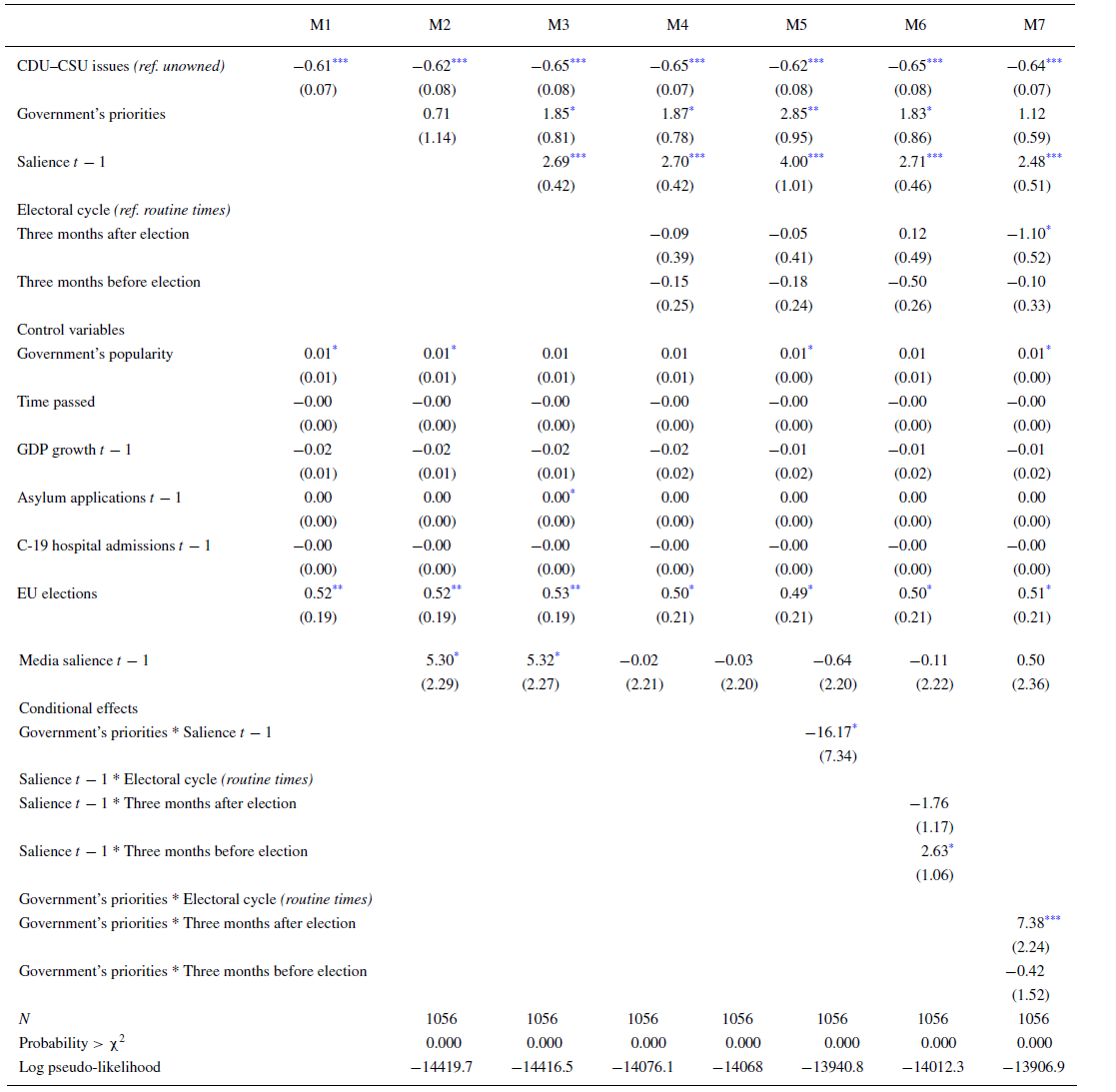
Fixed effects panel Poisson regressions of monthly counts of survey questions by policy issue

Note: Standard errors in parentheses.
* $p<0.05$, ** $p<0.01$, *** $p<0.001$.
Looking at the main explanatory variables of our regression models in Table 1, it may be quickly seen that most of them show their expected effects (H1, H2, H3). First of all, our results support the issue‐ownership hypothesis. Model 1 in Table 1 demonstrates that the German government asks fewer questions about issues ‘owned’ by the CDU/CSU (H1). If a policy issue is ‘owned’ by the Chancellor's party, the monthly rate of survey questions decreases by a factor of 0.5. Although the effect is not very strong, it remains quite stable and statistically significant when controlling for all other variables (Models 2–7).
The coefficient for governments’ priority issues (here measured through the proportion of A. Merkel's major government speech at the beginning of each legislative period given over to that issue) is, as suggested, positive and becomes statistically significant as soon as we introduce salience into the model (Model 3). This result indicates that at similar levels of issue salience, the survey questions in government polls cover the government's priority issues. Thus, controlling for issue salience, government's popularity, the time elapsed, GDP growth, asylum applications and Covid‐19 hospital admissions, EU elections and media salience, each one‐unit increase in the share of a policy issue among the government's policy priorities is associated with a 6.4‐fold increase in the monthly rate of survey questions.
In line with our hypothesis on the influence of issue salience (H3), German governments also clearly tend to commission more questions on issues that are salient in the eyes of the public. More precisely, a one‐unit increase in the share of the perceived personal salience of an issue increases the monthly rate of survey questions by a factor of 14.8. This effect is not sensitive to the inclusion of other variables. It is consistently positive and significant even when controlling for the electoral cycle, government popularity, the time elapsed since the beginning of the legislative period as well as for the economic context, EU elections, media salience and major events such as the refugee crisis and the Covid‐19 pandemic.
Contrary to our assumptions, we cannot confirm a direct effect of the electoral cycle (H5). Compared to routine periods, there is no significant difference between the number of survey questions ordered during the first or last 3 months of the election cycle (as shown by Model 4 in Table 1). A possible explanation could be that while the number of questions in government polls does not vary significantly between the different stages of the electoral cycle, the number of questions from other sources (such as the media) differs during these three periods. This is one of the limitations of the present work; future work needs to compare government polls with published surveys from other actors.
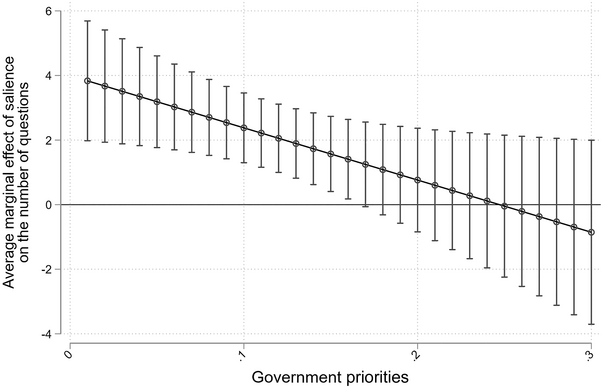
With respect to our control variables, only the European elections have a significant and persistently small positive effect: during their election campaigns, the monthly rate of survey questions increases by a factor of about 1.7. Media salience has a strong positive effect on the government's polling activity (a one‐unit increase in the share of media salience of a policy issue, augments the monthly rate of survey questions by a factor of 203). However, as soon as we introduce our indicator of personal issue salience into the model, the effect of media salience becomes negligible and is no longer statistically significant. It seems that German government polling is more strongly driven by the importance citizens attach to political issues than by the media. What is more, the impact of satisfaction with the government is significant for some models, however, the effect is extremely small and negligible: for each point of satisfaction with the government the monthly rate of survey questions increases by a factor of about 1. Most of our variables that capture major economic, political or social events or developments do not have any significant effect on the German government's polling activity. Let us now consider the findings regarding our conditional hypotheses. To test the conditional effect of issue salience and government priorities on the German government's polling activity (H4), we include an interaction term for these two variables in Model 5 (Table 1). Their interaction effect on the number of survey questions commissioned is indeed statistically significant, but not positive as expected, instead it is strongly negative. This pattern is more easily understood when looking at the average marginal effects in Figure 1 (Brambour et al., Reference Brambour, Clark and Golder2006).
Average marginal effect of salience on the monthly number of survey questions by policy issue, for an increasing share of an issue in government priorities.
Note: The figure is based on regression Model 5. The vertical bars represent 95 per cent confidence intervals. The x‐axis indicates the distribution of the moderating variable (government priorities). The y‐axis denotes the marginal effect of a variation by 1 per cent in personal issue salience on the probability of an additional survey question in a given month. Negative values indicate that the higher the share of a given issue among the government's priorities, the weaker the effect of public salience becomes on the commissioning of additional survey questions in a given month.

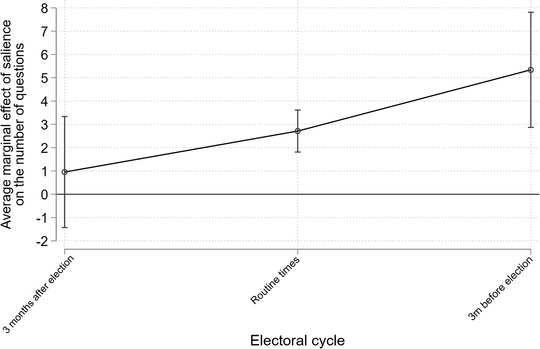
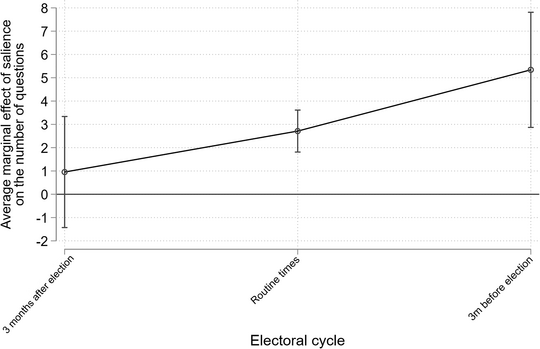
The average marginal effect of issue salience on the number of survey questions in government polls decreases with stronger government priorities. In other words, governments commission fewer survey questions on issues that are highly important to the general public and that are also top priorities for the government. One possible explanation for this result is that governments do not need more information about citizens’ preferences on salient issues if they are already of the highest priority for the government. Our findings also partly confirm the conditioning impact of salience on government polling activity at different stages of the electoral cycle (Model 6, Table 1). The average marginal effects plot (Figure 2) corroborates this hypothesis (H6) as it shows the higher positive effect of salience on government polling activity (number of survey questions commissioned) in the last 3 months before the next election, compared to routine times. In contrast to our theoretical assumptions, our results reveal that the first 3 months after an election differ not significantly from routine times in terms of the number of anticipatory survey questions commissioned.
Average marginal effect of salience on the monthly number of survey questions by policy issue at different stages in the electoral cycle.
Note: The figure is based on regression Model 6. The vertical bars represent 95 per cent confidence intervals. The x‐axis indicates the distribution of the moderating variable (i.e., stages of the electoral cycle). The y‐axis denotes the marginal effect of a variation by 1 per cent in issue salience on the probability of an additional survey question in a given month.
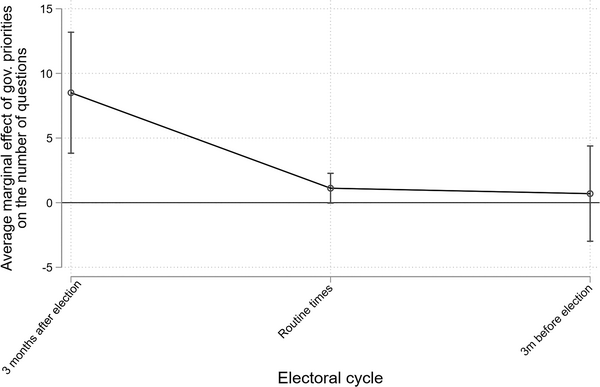
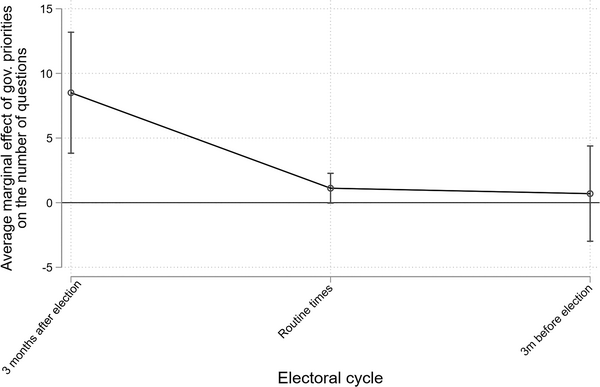
Finally, we examine whether governments commission more survey questions on their own priority issues at the beginning of the electoral cycle (H7). The coefficients linked to the interaction effects (Model 7, Table 1) as well as the average marginal effects presented in Figure 3 confirm this hypothesis for the first 3 months of a government's electoral mandate. We can clearly observe a higher number of such promissory questions in the 3 months following a federal election in comparison to all subsequent stages of the electoral cycle.
Average marginal effect of governments’ priority issues on the monthly number of survey questions by policy issue at different stages in the electoral cycle.
Note: The figure is based on regression Model 7.
Robustness checks
For the sake of the robustness of our results, we also re‐run all our fixed effects panel Poisson regression models with an alternative electoral cycle variable: distinguishing the first 2 months after the federal election, followed by routine times and the last 2 months before the next elections (compared to 3 months in the main models). The results are remarkably stable (see Table B.1 in the Online Appendix). The only important difference concerns the interaction between government priorities and the electoral cycle which is no longer significant in this model (see also Figure B.3 in the Online Appendix). However, the relationship between salience and the electoral cycle is even more pronounced. The reason for this could be that 8 weeks after the federal elections is simply too short a time period, during which the party that won the most votes in an election is too busy finding coalition partners to have enough time to order new polls on their own political priorities.
We further re‐run all our fixed effects panel Poisson regression models a measure of CDU/CSU supporters' personal issue salience.Footnote 26 The literature shows that mainstream parties (seeking office and votes) tend to follow the median voter, while niche parties tend to follow their own party's voters (Bischof & Wagner, Reference Bischof and Wagner2020; Ezrow et al., Reference Ezrow, Vries, Steenbergen and Edwards2011; Giger & Lefkofridi, Reference Giger and Lefkofridi2014). We therefore have good reason to believe that the Chancellor is attentive to issues which are important to the whole population. Nevertheless, given that the weekly reports that summarize the most important poll results for the Chancellor also contain information about the issues that are personally salient to the party's supporters, it seems crucial to control for these. However, since general personal issue salience and CDU/CSU supporters' personal issue salience are highly correlated during our period of research (see Figure B.4 in the Online Appendix), we could not introduce them jointly in our regression models.
The results from these analyses (see Table B.2 in the Online Appendix) largely confirm the findings based on the regression models including our measure of personal issue salience for the whole German population. This is of course not very surprising given the rather strong correlation between these two distinct measures of salience. There is, however, one noteworthy exception. The effect of government's priority policy issues is, in contrast to our original regression models, no longer statistically significant. Government priorities used to become statistically significant once we control for the salience of issues. One potential explanation of this diverging result might be that A. Merkel's decisions concerning the commission of survey questions for her government polls were somewhat less influenced by the issue salience of CDU/CSU supporters than by that of the median voter.
To capture the non‐linear effects of two important external events, we included squared measures of asylum applications and Covid‐19 hospital admissions (Table B.3 in the Online Appendix). The results of these models were very similar to those of our original models (Tables B.4 and B.5 in the Online Appendix). Yet, none of the variables associated with these major events shows any significant effect on the polling activity of German governments. Furthermore, we tested two alternative indicators of the intensity of the Covid‐19 pandemic in Germany in our regression models to assess its impact: the number of new Covid‐19 infection cases and the number of additional deaths caused by Covid‐19.Footnote 27 As we can see in the new Figure A.5 in the Online Appendix, the German government has commissioned many survey questions at the beginning of each new Covid wave (spring 2020, summer 2020, spring 2021 and, to a lesser extent, fall 2021) and especially at the beginning of the first wave, while the number of new cases, hospitalizations and deaths increased in the second wave. While there is undoubtedly a ‘Covid effect’, the progression of the pandemic in Germany does not account for the government's polling practices, regardless of the indicator tested. The salience of healthcare, which has remained consistently high throughout the pandemic, similarly does not provide a sufficient explanation on its own. These observations raise the question of how governments use surveys and at what point in the policy cycle. However, answering this question is beyond the scope of this article.
Moreover, to find out whether our results were biased or strongly influenced by the two major events that occurred during our study period, the so‐called refugee crises and the Covid‐19 pandemic, we also run all models without questions on health and immigration (see Table B.6 in the Online Appendix). Even though we have to be careful in interpreting these results as they simulate a world without major crisis which is far removed from today's reality, they largely confirm our main results. Most noteworthy, salience is still strongly positive and significant. The only exceptions concern government's priorities and media salience. Government's priorities do again not have a statistically significant effect on these alternative models. Most interestingly, in contrast to our main regression models, media salience does not have any significant impact at all in Models 1 and 2. This result seems to indicate that the effect of media salience in the main model (without controlling for personal issue salience) was mainly due to the intensive reporting on the Covid‐19 and asylum crises.
We also run all models using negative binomial regression (the results are displayed in Table B.8 in the Online Appendix). The findings partly confirm the results based on our fixed effects panel Poisson regression models. There are, however, three notable differences. The first concerns the conditional effect of issue salience on government polling activity at specific stages of the electoral cycle. This conditional effect is no longer statistically significant (see also the average marginal effects shown in Figure B.10 in the Online Appendix). The second relates to the conditional effect of government priority issues on government polling activity at specific points in the electoral cycle. As in the case of our fixed effects panel Poisson regression models, the average marginal effects (see Figure B.11 in the Online Appendix) display the pattern that the two successive German governments tended to commission more survey questions on government priority issues during the first 3 months of the electoral cycle compared to routine times. Yet, this effect is not statistically significant (see Table B.8 in the Online Appendix). Finally, the main effect of government's priority issues is again positive as soon as we control for public salience but is not statistically significant. The direct effect of government priorities appears, thus, to be less stable than other main explanatory variables across model specifications. However, its conditional effect at different points in the electoral cycle appears to be more robust. This may underscore the fact that government priorities do not affect the polling activity of German governments per se, but only at specific points in the electoral cycle. Ultimately, the effect of issue ownership, although negative as in the main Poisson regression models, is no longer significant in the negative binomial regression models.
Conclusion
Drawing on evidence from Germany (2013–2021), we provide findings that help to better understand the different logics of representation behind government polling. Overall, our findings thus contribute to a better comprehension of how political representation works in modern democracies.
While we could not observe any direct effects of the electoral cycle on the intensity of government polling, the interplay between the former and different types of policy issues proves to be much more insightful. Indeed, the parallel consideration of the intensity and logic behind the commissioning of government polls allows us to better understand the way this instrument is used. The transition from the post‐election period to the routine period and from the routine period to the pre‐election period corresponds to turning points in the way the German government uses this instrument: A. Merkel commissions significantly more survey questions on government priorities during the first 3 months in office than during routine times and significantly more survey questions on salient issues during the last 3 month of the term.
Overall, our results imply that German governments use polls both proactively and reactively in the sense of both promissory representation and anticipatory representation. Which of the two logics dominates depends on the specific point in the electoral cycle. Anticipatory representation becomes more prominent as governments move from predominantly policy‐seeking (fulfilling pledges) to predominantly vote‐seeking closer to elections to be reelected. The observation that the government asks slightly more questions in the 3 months before the European elections underlines the importance of electoral considerations when ordering survey questions. This finding has important implications for the literature on the impact of the electoral cycle since we confirm the importance of theorizing the conditioning effect of its different stages.
Moreover, this finding has implications for the literature on politicians' use and perceptions of public opinion. The fact that the German government polls differently at different points in the electoral cycle suggests that it uses this instrument in a strategic way, responding to different (vote/policy seeking) incentives. This underlines the importance of understanding governments as actors in, and not just consumers of, public opinion polls.
A second important finding concerns the impact of issue ownership and the observation that the government asks fewer questions on issues the CDU/CSU ‘owns’. This recalls findings from the responsiveness literature that representatives tend to be more inclined to follow public opinion on issues that they do not ‘own’. Just like the observation that issues that are both salient and government priorities are asked significantly less often, this could indicate that the government is asking fewer questions on topics where it feels it already has sufficient information. More qualitative studies are needed to test whether polls play a role in governments' attempts to take over issues that are ‘owned’ by other parties.
What are the lessons of this article for the study of contemporary democracies? Angela Merkel's intensive use of polls could be interpreted as a focus on elements of anticipatory representation. Indeed, she was known for a certain flexibility regarding electoral promises (e.g., the nuclear phase‐out, the abolition of compulsory military service, etc.) and for her receptiveness to (changing) public opinion especially with regard to crises and external events. This could be part of the explanation of the stability of her government as promissory representation ‘works badly in situations of rapid change’ (Mansbridge, Reference Mansbridge2003, p. 516). Conversely, the results of this study could also help explain the puzzle of certain governments that keep a lot of campaign promises but quickly become very unpopular. An example would be former French President François Hollande, who actually refrained from conducting his own polls.Footnote 28
Ultimately, we would like to highlight some potential and promising extensions of this study. First of all, more comparative studies are necessary in order to establish general patterns. The fact that hitherto there is so little knowledge of or research into the practice of governmental polling makes it difficult to make statements about the generalizability of our results beyond the Merkel's government. Germany is characterized by very strong institutionalization of poll commissioning by its governments. We believe that this leads to a certain path dependency and should result in smaller differences in polling practices between different German chancellors than is the case for leaders of countries with less institutionalized practices, but future work will have to verify this. In France, for example, former president F. Hollande made a very moderate use of polls, while both his predecessor (N. Sarkozy) and his successor (E. Macron) are known for their intensive recourse to polls. Given this presumed influence of the institutional context, we also assume that our results are more generalizable to countries with a similarly strong institutionalization of the practice, such as Canada.
It is also important to note that Angela Merkel was the head of a coalition governmentFootnote 29 and that this may amplify the impact of the electoral cycle on different representational logics. Coalition parties have to reconcile two competing logics: they have to demonstrate unity in order to govern together, but they also have to emphasize their own profile in order to succeed in elections (Sagarzazu & Klüver, Reference Sagarzazu and Klüver2017). The first period after an election thus corresponds to the time when the coalition agreement is being negotiated, and the Chancellor should be interested in testing what is included in it or not, which could explain an intense focus on government priorities in poll questions at this point of the electoral cycle. It will therefore be interesting to extend the analysis in future studies to single‐party governments in order to test whether or not the strong influence of promissory representation on government polling in the first stage of the electoral cycle is confirmed.
Another important extension of the questions examined in this article – the intensity of government polling and the representational logic behind this activity – concerns the more qualitative aspect of government polling – or, in other words, the question as to which specific policy issues are selected by government polls, when and why? This could, for example, reveal whether differences in issue coverage can be explained by the nature of policy issues or the way they are taken up by different political parties. This will also allow for a more detailed examination of the manner by which governments adopt their polling practices in response to external events, such as the Covid‐19 pandemic.
Furthermore, our analysis should be repeated with published surveys from other actors. As previously explained, governments commission surveys in a competitive context. It would therefore be interesting to analyse whether governments are influenced by existing polls conducted by other actors when deciding which issues to address in polls. Moreover, it would be interesting to apply our hypotheses to these surveys commissioned by other actors to see whether, for example, salience plays an equally important role in them. If our results are confirmed, this would have implications for responsiveness studies. The traditional approach in political science has been to measure democratic responsiveness as the degree of congruence between government action and public opinion, the latter being measured by responses to opinion polls (Binzer Hobolt & Klemmensen, Reference Binzer Hobolt and Klemmensen2008). By showing that the German Merkel government was guided by the salience of issues when commissioning survey questions, we confirm a fear that has already been voiced (Burstein, Reference Burstein2003; Barabas, Reference Barabas2016) but could not yet be proven due to a lack of empirical analyses: traditional responsiveness studies are likely to overestimate responsiveness since salience in turn seems to favour responsiveness (Burstein, Reference Burstein2014; B. Page, Reference Page, Manza, Cook and Page2002).
Acknowledgements
The authors would first like to thank the anonymous reviewers for their detailed comments, which significantly helped to improve the article. We would also like to thank Céline Belot, Camille Bedock, Enrico Borghetto, Christian Breunig, Christopher Butler, Elisa Deiss‐Helbig, Frédéric Gonthier, Christopher Green‐Pederson, Benjamin Guinaudeau, Isabelle Guinaudeau, Viviane Le Hay, Mickael Temporao and Stefaan Walgrave, as well as all participants of the 2022 Economics & Politics workshop at the University of Lille, the workshop Elites and Public Opinion of the 2022 ECPR Joint Sessions in Edinburgh, the thematic session Constructing and mobilizing public opinion through polling at the AFSP congress in Lille 2022, the Political Representation panel of the Conference of the Comparative Agendas Project in Antwerpen 2023 and the panel Elites and Public Opinion: Analysing the Interaction of Public Opinion, Policy‐Making and Party Strategy at the ECPR General Conference in Prag 2023 for their insightful comments on earlier drafts of this article. Finally, we would like to thank Ismael El‐Hadj, Anna Götz, Matthias Frey, Qixuan Yang and Janos Ziupka for their participation in data collection and coding. This research was supported by the French National Research Agency grant number: ANR‐19‐CE41‐0002(Project CosPo).
Conflict of interest statement
The authors declare no conflicts of interest in this research.
Data availability statement
Replication data for this article are available at https://doi.org/10.7910/DVN/TLXTBH.
Ethics approval statement
The authors declare no ethical issues in this research.
Online Appendix
Additional supporting information may be found in the Online Appendix section at the end of the article:
Appendix A Description of dependent and independent variables
Appendix B Robustness checks


 Open access

