





Introduction
Cancer is the second leading cause of death in the United States (Heron Reference Heron2019). With the increase in cancer survival rates over the past several decades due to improvements in treatment and earlier diagnoses, there has also been increasing awareness of the emotional burden of this condition (Cancer Treatment & Survivorship Facts & Figures 2022–2024 2022). Studies have reported overall depression prevalence rates in cancer patients between 13% and 30% with variability between different cancer categories as well as between certain risk factors (Erim et al. Reference Erim, Bensen and Mohler2019; Inhestern et al. Reference Inhestern, Beierlein and Bultmann2017; Zainal et al. Reference Zainal, Nik-Jaafar and Baharudin2013; Zhao et al. Reference Zhao, Okoro and Li2014). The gravity of cancer diagnoses and the psychosocial burden of subsequent chemotherapy or radiation may lead to increased anxiety and depression in cancer patients. Furthermore, the fear of recurrence, post-traumatic stress symptoms, anxiety, and depression have been shown to occur in many cancer-survivors after completing treatment (Yi and Syrjala Reference Yi and Syrjala2017). These emotional burdens may in turn result in negative physical manifestations. For example, in breast cancer patients, greater symptoms of anxiety and depression were correlated with worse physical functioning across 12 months (Faller et al. Reference Faller, Strahl and Richard2017).
While there has been increased awareness of the emotional burden of cancer in recent years, there is conflicting literature on the prevalence of depression in cancer patients compared to non-cancer patients. In a 2014 research study, Zhao et al. (Reference Zhao, Okoro and Li2014) found that adult cancer survivors had significantly higher rates of depression compared to adult patients without cancer. However, in a 2017 research study, Inhestern et al. (Reference Inhestern, Beierlein and Bultmann2017) found that working-age cancer survivors had a lower rate of depression compared to the general population.
Therefore, this study used responses from the Responses from the National Survey on Drug Use and Health (NSDUH) to investigate and further clarify the prevalence of major depression, associated treatments, and suicidal ideation in cancer survivors compared to a non-cancer cohort.
Materials and methods
Data source and population
The NSDUH, conducted by the Substance Abuse and Mental Health Data Archive, is a large national survey on the use of illicit drugs, alcohol, and tobacco as well as on mental health issues among US civilians aged 12 years or older (U.S. Department of Health and Human Services, Substance Abuse and Mental Health Services Administration 2023). Each year, approximately 70,000 individuals are randomly selected across the US to participate, excluding unhoused persons not in shelters, military personnel on active duty, and institutionalized residents (i.e., individuals in jails and hospitals). Data is collected via face-to-face household interviews and web-based interviews of participants. The NSDUH uses a stratified, multistage area probability design that provides estimates at both the state and national level using sample weights. Questions relating to cancer history were introduced in the 2015 version of the NSDUH. Therefore, survey data prior to 2015 were excluded from analysis. Due to the impact of the COVID-19 pandemic on mental health, survey data collected after 2019 were also excluded from analysis to limit confounding. This study followed Strengthening the Reporting of Observational Studies in Epidemiology (STROBE) reporting guideline for cross-sectional studies (von Elm et al. Reference von Elm, Altman and Egger2007). This study was granted institutional review board exemption and requirements for informed consent were waived because the data was publicly available and deidentified.
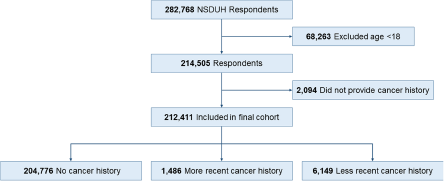
Given that this research utilized a deidentified publicly available dataset, it was deemed not to constitute human subjects research. Therefore, this research was considered exempt for ethical approval and did not require informed consent. By their participation in the survey, respondents did consent to their data being included in the published datasets, which could be used for research. The 2015–2019 NSDUH data sets were queried for all respondents aged 18 years or older. Respondents were asked whether they had ever been told they had cancer by a doctor or other health care professional. Participants responding yes were termed cancer survivors and were further divided by recency of cancer history into more recent (had cancer within 12 months of survey) and less recent (had cancer more than 12 months prior to survey) cancer history cohorts. For each cancer survivor, the type of cancer was recorded. A flow diagram depicting the inclusion and exclusion criteria is shown in Figure 1.
Flow diagram of inclusion and exclusion criteria for study.

Statistical analysis
Baseline sociodemographic and clinical characteristics were compared between cancer survivors and respondents without cancer using the Pearson χ2 test. Prevalence estimates of depression, depression treatment, and suicidal ideation were stratified by cancer type. Rates of depression, depression treatment, and suicidal ideation were compared between cancer survivors and participants without cancer using the Pearson χ2 test and multivariable logistic regression models. Multivariable models were also created to identify factors associated with depression, depression treatment, and suicidal ideation among cancer survivors. Models were adjusted for age, sex, race, survey year, education level, insurance status, income, urban/rural status, employment status, marital status, and self-reported health status rated from poor to excellent. Evaluation of depression history, suicidal ideation were limited to the 12 months prior to the survey. Data analysis was carried out using Python Version 3.10 (Python Software Foundation, Wilmington, DE).
Results
Baseline characteristics
Among the 212,411 survey respondents identified, 7,635 (3.6%) reported a cancer history, with 1,486 (0.7%) reporting a recent cancer history. Individuals with a recent cancer history represented 19.5% of respondents who reported a cancer history. Baseline characteristics of respondents with and without a cancer history are shown in Supplementary Table S1. A greater proportion of respondents with a cancer history were 65 years or older (41.2% vs 7.6%, p < 0.001), female (62.9% vs 53.2%, p < 0.001), non-Hispanic white (81.7% vs 59.6%, p < 0.001), married (11.4% vs 8.3%, p < 0.001), and college graduates (36.6% vs 26.7%, p < 0.001). Baseline characteristics of respondents with a cancer history, stratified by year of diagnosis, are shown in Supplementary Table S1. Among respondents with a cancer history, a greater proportion of respondents with a recent history were 65 years or older (45.5% vs 40.2%, p < 0.001), male (45.6% vs 35.0%, p < 0.001), and in “poor” health (12.1% vs 5.2%, p < 0.001). The most common cancer diagnoses were breast cancer (19.4%), non-melanoma skin cancer (15.5%), and prostate/testicular cancer (11.1%).
Clinical and sociodemographic determinants of depression and suicidal ideation
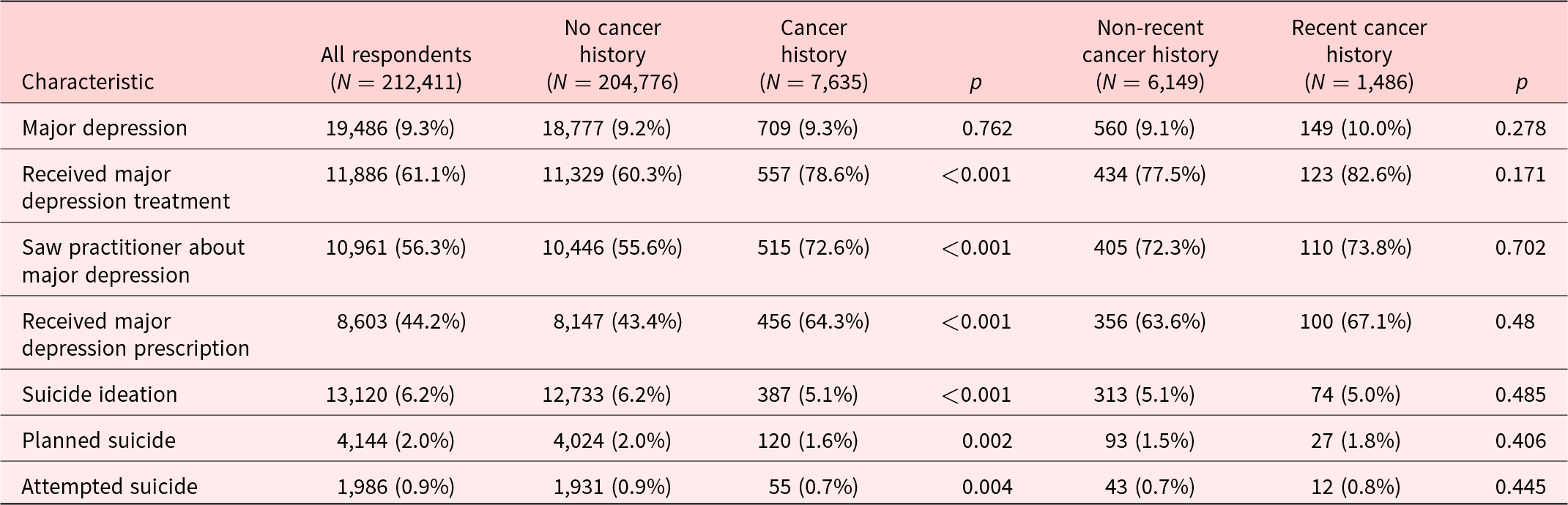
The prevalence of respondents with major depression, major depression treatment, and suicidal ideation are summarized in Table 1. There were no differences in the prevalence of major depression between cancer survivors and participants without cancer (9.3% vs 9.2%, p = 0.762), though the prevalence was slightly higher among recent cancer survivors (10.0% vs 9.2%, p = 0.259). Among respondents diagnosed with major depression, cancer survivors were significantly more likely to receive treatment for depression (78.6% vs 60.3%, p < 0.001), with 72.6% discussing depressive symptoms with a medical professional and 64.3% receiving prescription medication. There was no significant difference in receipt of treatment when comparing respondents with a recent or non-recent cancer history (82.6% vs 77.5%, p = 0.171).
Prevalence of major depression, major depression treatment, and suicidal ideation

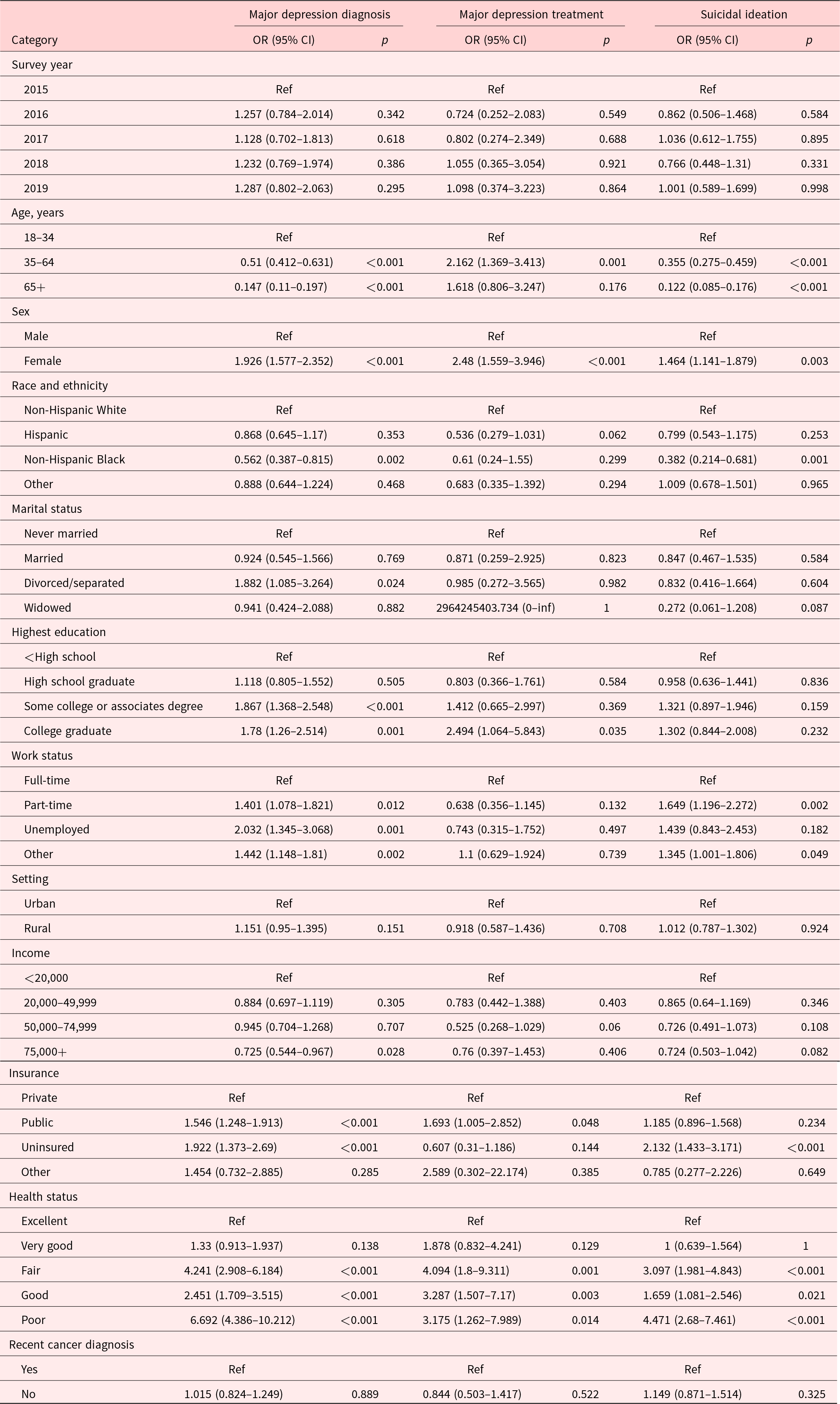
Multivariable logistic regression of characteristics predictive of major depression, major depression treatment, and suicidal ideation are shown in Table 2. Relative to cancer survivors aged 18–34, cancer survivors older than 65 were less likely to report major depression (OR: 0.147, p < 0.001). Female cancer survivors were more likely to report major depression (OR: 1.926, p < 0.001). Relative to cancer survivors with private insurance, uninsured cancer survivors were more likely to have major depression (OR: 1.922, p < 0.001). Cancer survivors reporting poor overall health status were also more likely to have major depression (OR: 6.692, p < 0.001).
Logistic regression of major depression, major depression treatment, and suicidal ideation

Relative to cancer survivors aged 18–34, cancer survivors 35–64 were more likely to receive treatment for major depression (OR: 2.162, p = 0.001). Female cancer survivors were more likely to receive treatment for major depression (OR: 2.48, p < 0.001). Relative to cancer survivors without a high school diploma, college graduates were more likely to receive treatment for major depression (OR: 2.494, p = 0.035). Cancer survivors reporting poor overall health status were also more likely to receive treatment for major depression (OR: 3.175, p < 0.001).
Suicidal ideation was significantly lower among cancer survivors (5.1% vs 6.2%, p < 0.001) including recent survivors (5.0% vs 6.2%, p < 0.001). Suicidal ideation was higher in respondents with underlying major depression in both cancer survivors and participants without cancer (30.6% vs 35.6%, p = 0.015). Relative to cancer survivors aged 18–34, cancer survivors older than 65 were less likely to report suicidal ideation (OR: 0.122, p < 0.001). Female cancer survivors were more likely to report suicidal ideation (OR: 1.464, p = 0.003). Relative to cancer survivors with private insurance, uninsured cancer survivors were more likely to have suicidal ideation (OR: 2.132, p < 0.001). Cancer survivors reporting poor overall health status were also more likely to have suicidal ideation (OR: 4.471, p < 0.001).
Major depression, major depression treatment, and suicidal ideation by cancer type
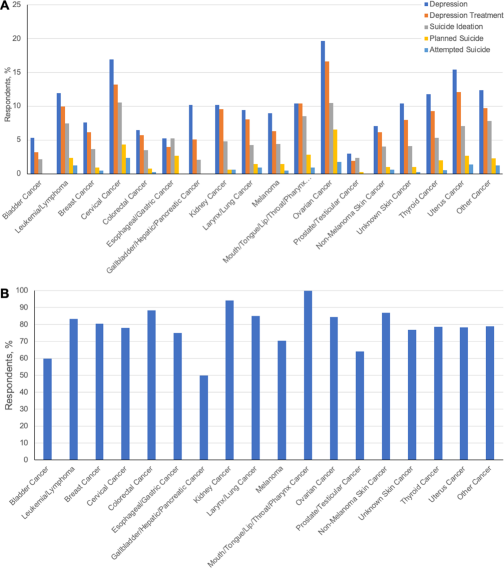
Incidence of major depression, major depression treatment, and suicidal ideation is shown in Figure 2. Cancer survivors with ovarian cancer had the greatest prevalence of major depression (19.7%) followed by cervical cancer (17.0%) and uterine cancer (15.4%). Cancer survivors with gallbladder/hepatic/pancreatic cancer had the smallest proportion of cancer survivors with major depression receiving treatment (50%), followed by bladder (60%) and prostate cancer (64%). Suicidal ideation was highest among cancer survivors with cervical (10.6%) and ovarian cancer (10.5%). These diagnoses also had the highest rates of planned suicides (6.6% for ovarian and 4.4% for cervical) and attempted suicides (1.7% for ovarian and 2.3% for cervical).
Prevalence of major depression, major depression treatment, and suicidal ideation by cancer type (A) and prevalence of major depression treatment among cancer survivors reporting major depression (B).

Temporal trends in major depression, major depression treatment, and suicidal ideation
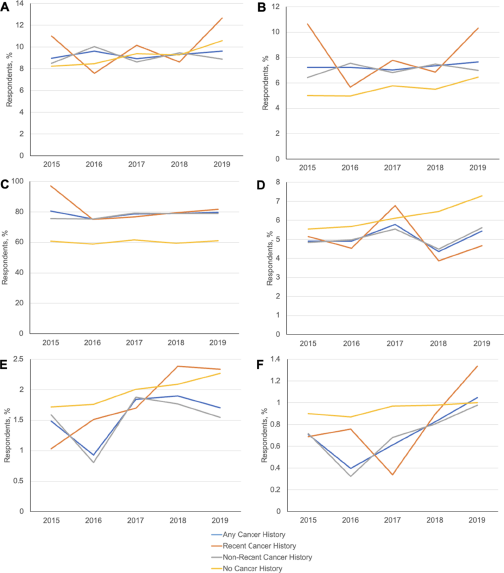
Temporal trends in major depression, major depression treatment, and suicidal ideation are shown in Figure 3. Among cancer survivors with a recent cancer history, the prevalence of major depression increased from 11.0% in 2015 to 12.7% in 2019. This corresponded to minimal change in overall suicidal ideation (5.2%–4.7%) but increases in planned suicides (1.0%–2.3%) and attempted suicides (0.7%–1.3%). Suicide attempts also increased in cancer survivors with a non-recent cancer history (0.7%–1.0%) and cancer history overall (0.7%–1.0%). This trend was not seen in cancer survivors with no cancer history (0.9%–1.0%).
Temporal trends in prevalence of major depression (A), major depression treatment (B), major depression treatment among individuals reporting major depression (C), prevalence of suicidal ideation (D), planned suicide (E), attempted suicide (F).

Discussion
In this study, we found that there was no significant overall difference in the prevalence of major depression between cancer survivors and individuals without cancer. The lack of discrepancy between the 2 cohorts in our study differs from previous literature in which there was a statistical difference between the cancer and non-cancer cohort (Inhestern et al. Reference Inhestern, Beierlein and Bultmann2017; Zhao et al. Reference Zhao, Okoro and Li2014).
Clinical implications
While we did not find a significant difference in the prevalence of major depression between the 2 cohorts, we did find a significant difference in treatment rates for depression. Among individuals diagnosed with major depression, cancer survivors were more likely to receive treatment for depression compared to their non-cancer counterparts. Despite these results, it is still important to consider the potential barriers that cancer survivors face when looking for mental health treatment. While many radiation oncology patients who meet the criteria for major depression express interest in obtaining psychosocial services, patients with preexisting barriers to care were found to be significantly less interested in psychosocial support services away from their cancer centers (Small et al. Reference Small, Pugh and Wagner2021). The most common barriers to mental health these patients experience include cost, debilitating symptoms, and time constraints (Small et al. Reference Small, Pugh and Wagner2021).
Common treatment modalities for depression in cancer patients are similar to management of depression in the general population, with the use of both pharmacologic and psychological interventions. In terms of psychological interventions, cognitive behavioral therapy has been shown to be effective in reducing depressive symptoms in breast cancer patients (Ye et al. Reference Ye, Du and Zhou2018; Yi and Syrjala Reference Yi and Syrjala2017). Mindfulness-based interventions is another psychological intervention used to treat depressive symptoms, however, these interventions have only shown small effects (Cillessen et al. Reference Cillessen, Johannsen and Speckens2019; Yi and Syrjala Reference Yi and Syrjala2017). Pharmacologic interventions include medications such as selective serotonin reuptake inhibitors and serotonin and norepinephrine reuptake inhibitors to treat depressive symptoms and gabapentin to treat anxiety (Yi and Syrjala Reference Yi and Syrjala2017). One drawback among the existing literature of management of depression in cancer patients is that the studies are disproportionately focused on breast cancer patients (Panjwani and Li Reference Panjwani and Li2021; Yi and Syrjala Reference Yi and Syrjala2017). Therefore, more research should be done on the management of depressive symptoms in patients with other cancers.
Despite the lack of difference in prevalence of major depression between cancer and non-cancer cohorts, we did find differences among different cancer groups. Cancer survivors with ovarian cancer, cervical cancer, and uterine cancer had the highest rates of major depression among all cancers, respectively. Suicidal ideation rates were also highest in cervical cancer and ovarian cancer survivors. The dominance of major depression and its associated consequences in cancer survivors of gynecologic malignancies raises concern for unmet needs of this sub-group of cancer patients. As these malignancies primarily affect the female population, factors associated with this demographic such as increased societal responsibilities and potential reproductive loss may potentiate symptoms of depression. Further investigation is warranted to determine what factors contribute to the increased prevalence of major depression in patients with gynecologic cancers.
It is important to highlight the possibility that instead of a true lack of difference in depression rates, the results actually reflect an underdiagnosis of major depression in cancer patients. Given the gravity of a cancer diagnosis and the complexities of subsequent treatment, depressive symptoms may be mistakenly attributed as grief over a new diagnosis or over the burden of treatment. The overlap between the diagnostic criteria of depression and symptoms attributed to cancer or the side effects of treatment makes it more difficult to recognize depression in cancer patients (Saracino et al. Reference Saracino, Rosenfeld and Nelson2016). Somatic symptoms of depression such as weight loss, insomnia, fatigue, and difficulty concentrating are all common manifestations of cancer or chemotherapy (Saracino et al. Reference Saracino, Rosenfeld and Nelson2016). In these cases, the difference between cancer patients with and without depression lies in the severity of the somatic symptoms, with cancer patients with depression exhibiting significantly higher rates of insomnia, pain, weight loss, and fatigue (Chen and Chang Reference Chen and Chang2004). Therefore, if special attention is not given to both the exhibiting symptoms and the severity of these symptoms, it is likely that a major depression diagnosis may be missed in cancer patients. Another possibility for underdiagnosis of depression in cancer patients is the potential for many patients to subsyndromal depression symptoms (Weinberger et al. Reference Weinberger, Roth and Nelson2009). While these patients would also benefit from proper treatment, they do not meet the DSM criteria for major depression and can often be overlooked. Furthermore, the survey relies on self-reported diagnoses of major depression. Therefore, underreporting from both cohorts due to normalization or fear of stigma associated with a mental health diagnosis is a factor to consider when interpreting the results of this study.
Study limitations
Our study has several other limitations. First, our study is retrospective in nature. Therefore, the results may be impacted by confounding variables that were not able to be controlled among the 2 cohorts. Furthermore, controls may be subject to selection bias and may not be completely representative of the general population.
Conclusions
In this study, there was no significant overall difference in the prevalence of major depression between cancer survivors and individuals without cancer. However, among individuals diagnosed with major depression, cancer survivors were more likely to receive treatment for depression. As cancer prognoses continue to improve, patients have a greater opportunity to develop psychological consequences of their treatment, and it is imperative that such burdens are acknowledged and practitioners know to be on the lookout for relevant symptoms. Our results highlight the importance of early depression assessment and treatment for cancer survivors.
Supplementary material
The supplementary material for this article can be found at https://doi.org/10.1017/S1478951524000944.
Data availability statement
The dataset used for this research is publically available.
Author contributions
Linda Ye and Colton Ladbury authors are contributed equally to this work and should be considered co-first authors.
Funding
None.
Competing interests
None.
Ethical approval
Because this research used publically availabledeidentified datasets, it was deemed except from full institutional review board review.


 Open access

