





Native to Europe, Eriocampa ovata (Linnaeus, 1760) (Hymenoptera: Tenthredinidae) is a specialist phytophagous insect with a restricted distribution across temperate regions of its native range in Europe and its introduced range of North America (Smith Reference Smith1979). In 1979, Smith reported E. ovata in Ontario, east of Sault Ste. Marie, to Québec, and in the Lower Mainland of British Columbia, Canada. The iNaturalist database includes recorded sightings across British Columbia and throughout eastern Canada but not in Manitoba or Saskatchewan, Canada (iNaturalist 2022). There is no published documentation of E. ovata in Manitoba nor in the Canadian Forest Service pest survey records. This short communication details a recent identification of E. ovata on six Alnus hirsuta ‘Harbin’ (Betulaceae) (Prairie HorizonTM Manchurian alder) in Manitoba.
In June 2023, three property owners in Winnipeg, Manitoba (49.895° N, 97.138° W; elevation: 239 m) and one in Victoria Beach, Manitoba (50.709° N, 96.540° W; elevation: 237 m) contacted the author concerning the defoliation of their A. hirsuta ‘Harbin’. The six alders were all young and less than 2 m tall. All six trees had originated from the same nursery source and had been planted by the property owners less than three weeks before the author’s observation. In concealing itself on the underside of the leaf and appearing like bird excrement (Fig. 1), the E. ovata larvae – the cause of the defoliation – had gone undetected by all four homeowners.
Woolly alder sawfly larvae inactive on the undersurface of an Alnus hirsuta leaf. Image by author.
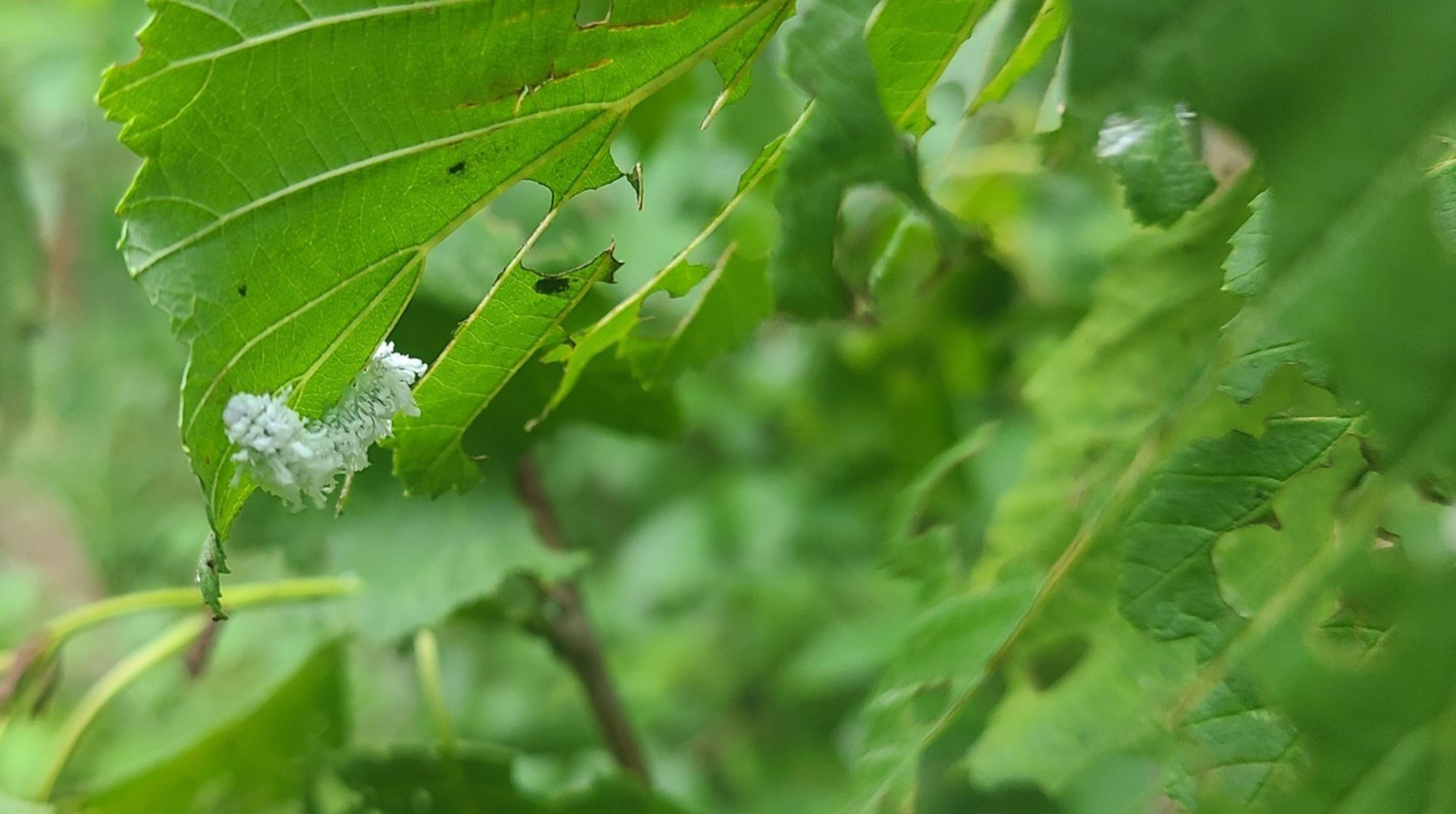
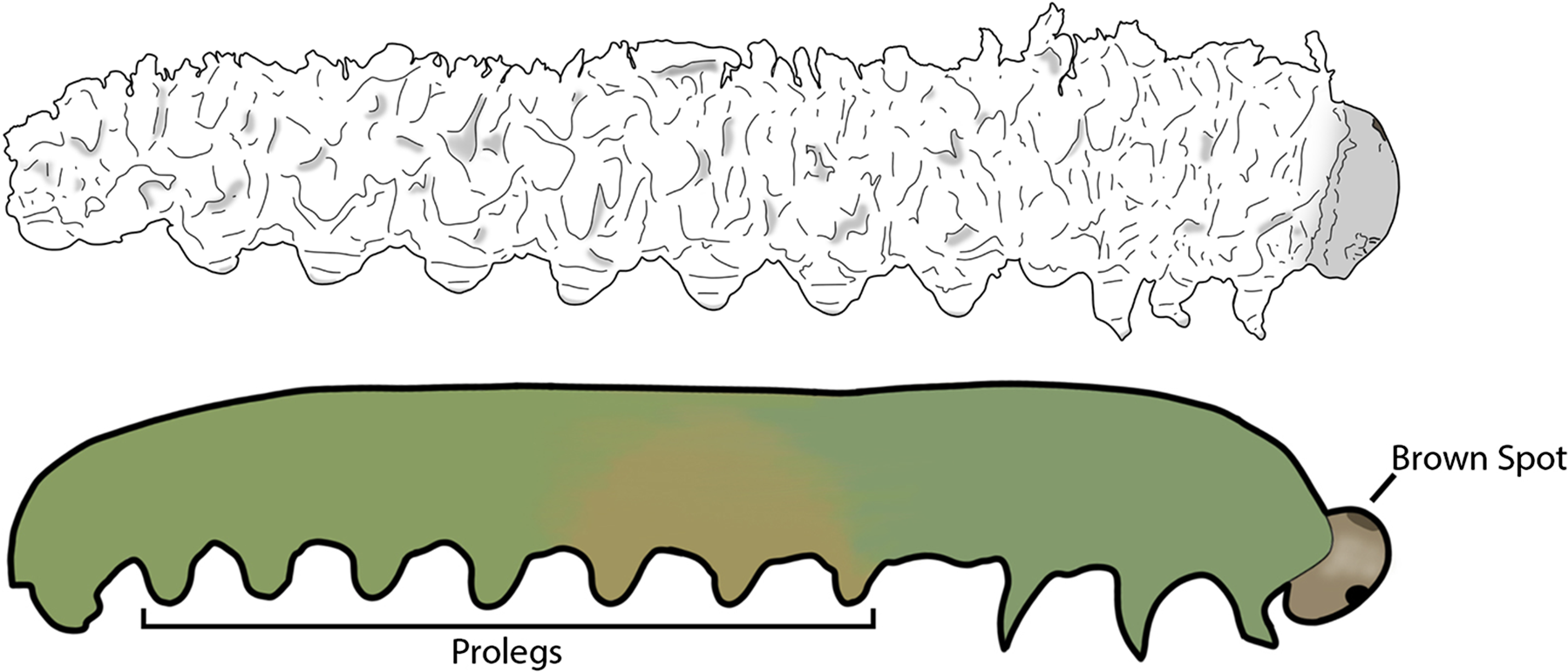
The E. ovata larvae’s appearance as bird excrement is owing to its production of a waxy secretion from epidermal glands, producing a wool-like outer coating around the larvae (Percy et al. Reference Percy, Blomquist and MacDonald1983) that protects them from predators (Eisner Reference Eisner1994). It is from this secretion that the insect’s primary common name, woolly alder sawfly, is derived. Other defining characteristics of the larvae include seven prolegs and a dark brown spot on the head at the vertex that is not found on E. juglandis, the other North American Eriocampa species (Smith Reference Smith1979). The larvae first feed on the upper surface of the leaf, then on the lower surface until fully matured (Bouchard Reference Bouchard1960). At this point, the larvae descend to the ground to overwinter and pupate in cocoons in the leaf litter (Bouchard Reference Bouchard1960). The emergent adult female E. ovata are approximately 6.8–7.2 mm in length and primarily black in colour, although the scutellum is red (Smith Reference Smith1979). The red scutellum is the source of the insect’s alternative common name, the red-backed sawfly. Adult females reproduce through parthenogenesis, ovipositing the eggs into the midrib of the leaf (Bouchard Reference Bouchard1960). Male specimens have not been identified in North American populations (Smith Reference Smith1979) and are considered rare in Europe (Benson Reference Benson1952).
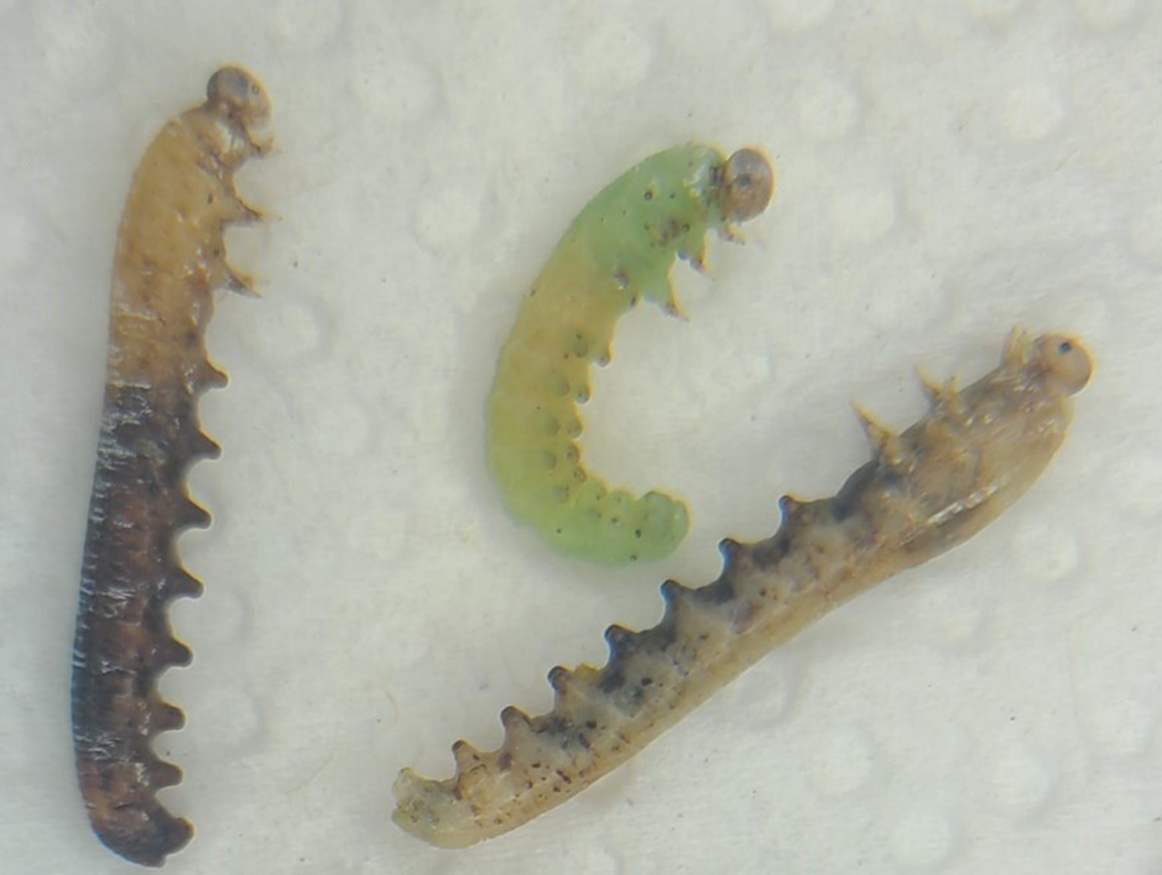
Because the Manitoban E. ovata were discovered as larvae, their identification was based on the wool-like coating, the dark brown spot, and the seven prolegs, per the identifying characteristics, taxonomic concepts, and taxonomic classification from Smith (Reference Smith1979). All the sampled sawfly larvae (n = 59) had seven prolegs and brown spots on the vertex of their heads (Figs. 2, 3). Although the prolegs were identified with the wool still on the larvae, the brown spot became visible only after the larvae were submerged in a 70% ethanol bath. For those storing E. ovata in a local collection, it should be noted that it was necessary to replace the ethanol three times before the wool no longer clouded the liquid solution. Following confirmation by entomologist H. Goulet, with the National Identification Service at the Canadian National Collection of Insects, Arachnids and Nematodes (Ottawa, Ontario, Canada), voucher specimens were deposited at the University of Manitoba (Winnipeg, Manitoba, Canada; WRME0520556).
Woolly alder sawfly with wool removed. Note the seven prolegs on the specimens. Image by author.
The woolly alder sawfly larvae, A, sketched with waxy wool-like secretions and, B, cleaned of wax secretion. The identifying characteristics unique to woolly alder sawfly (seven prolegs and brown spot on the vertex of head) are more easily visible after cleaning the wool from the body. Image by author.
In addition to this newfound occurrence of E. ovata in Manitoba, the detection of E. ovata on A. hirsuta (Spach) Ruprecht (Manchurian alder) presents a new host species identification of E. ovata. Existing literature on E. ovata host species include A. glutinosa (Linnaeus) Gaertner (common alder; black alder), A. incana (Linnaeus) Moench (grey alder; speckled alder), and A. rubra Bongard (red alder; Benson Reference Benson1952; Berland Reference Berland1947; Markham and Chanway Reference Markham and Chanway1998; Smith Reference Smith1979). In Europe, E. ovata has also been recorded on Ulmus spp. (elm) and Corylus spp. (hazel; Smith Reference Smith1979). No published cases of E. ovata on A. hirsuta were found through searches of Google Scholar, EBSCO Host, ProQuest, PubMed, Scopus, and Web of Science. Additionally, although A. hirsuta is sometimes treated as a subspecies of A. incana, no record of E. ovata on A. incana subsp. hirsuta was found.
Despite the lack of prior records of E. ovata on A. hirsuta, E. ovata was observed to be a considerable defoliator of the six trees. Using the percent crown missing measure, as per Nowak (Reference Nowak2020), two trees had moderate defoliation (26–50% defoliation), two had significant defoliation (51–75%), and two had severe defoliation (76–100%). The average larval population per tree was 56 larvae (standard deviation = 13.56). The most heavily infested tree had 73 larvae, and the least infested tree had 31 larvae. The extent of defoliation and the larval populations are concerning, especially since A. hirsuta is being used as a replacement tree for Fraxinus spp. (ash) and Ulmus spp. (elm) in the urban forests of the Canadian prairies (e.g., City of Winnipeg 2017). The severity of defoliation may be sufficient to cause tree mortality if infestation continues for multiple years (Borden and Dean Reference Borden and Dean1971; Wittwer Reference Wittwer2004) or when E. ovata predisposes the tree to cankers, such as Cryptosporella suffusa (Fries) L.C. Mejia and Castlebury (Gnomoniaceae) (Wittwer Reference Wittwer2004).
Repeat defoliation could be propagated by the concealed nature of the larvae, making it challenging for homeowners to detect the larvae before defoliation reaches noticeable levels unless larvae are observed transiting along the stem (Fig. 4). Consequently, homeowner-initiated action or reporting of the species may be too delayed to effectively manage the larvae on the basis of individual trees. Local arborists and foresters should be made aware of the species’ presence within Manitoba and on the host species A. hirsuta to assist in the sawfly’s detection on urban tree populations. Concurrently, E. ovata should be included in pest inventories conducted by local nurseries and municipalities.
Woolly alder sawfly larvae transiting along the stem of an Alnus hirsuta. Image by author.

Pointing to a broader concern, the detection of nonnative species – in this case, E. ovata – on trees sourced from the same location indicate a biosecurity issue that should be addressed. Given the life cycle of E. ovata, the delay from the female ovipositing the eggs into the leaf, egg maturation and hatching, and larval maturation (Borden and Dean Reference Borden and Dean1971; Mackay and Wellington Reference Mackay and Wellington1977), it is most likely that the trees had eggs in the foliage before their sale to the four customers. If this is indeed the case, it would further justify the involvement of community organisations in biosecurity prevention by specifying to their stock providers that trees meet the Canadian Nursery Stock Standard (Canadian Nursery Landscape Association 2017) and biosecurity controls (Brasier Reference Brasier2008; Dunn et al. Reference Dunn, Marzano and Forster2020; Marzano et al. Reference Marzano, Dunn and Green2021).
Genome sequencing of the E. ovata samples will be conducted to determine if they differ from existing genetic database records of E. ovata sufficiently to indicate a subspecies.
Funding statement
The author declares no specific funding for this work.
Data availability
Interested parties can contact the author for access to data.


 Open access

