

The wedding of Kim-Cho Kwangsu and Kim Seunghwan in 2013, the first public gay wedding in Korea, remains a sensation after several years.Footnote 2 In the wedding ceremony held outdoors in downtown Seoul as a protest against homophobia, a middle-aged Christian man raided the stage and threw a bucket of human faeces, declaring himself God's messenger against homosexuality. Human rights for sexual minorities are still ongoing issues in South Korea, including basic rights for marriage and forming a family. First founded in the mid-1990s, Korean gay and lesbian organizations have grown slowly. The Queer Culture Festival, which began in Seoul in the year 2000 with about fifty participants, celebrated its twentieth anniversary in 2019, with about 70,000 people participating in the Queer Parade. It has developed into mega-events held across the country, creating what Jo Soo-Mi dubs the ‘renaissance of Queer Culture Festival’.Footnote 3 Anti-queer movements by Christian organizations and conservative civic groups also intensified. Counterrallies against the festival and counteractions to stop the Queer Parade created scenes and attracted media attention, ironically giving visibility to the queer population in Korea. Queer Culture Festival marked one of the hottest issues in Korean society in 2018, as Ju Hyunshik notes.Footnote 4
Recent queer adaptations of Romeo and Juliet in Seoul reflect the increasing queer visibility and demand to be heard in South Korea, like Hamlet's ideal theatre, which shows ‘the time his form and pressure’. This article examines two lesbian adaptations of Romeo and Juliet that premiered in Seoul in 2018: Juliet and Juliet by The Creative Company LAS (dir. Lee Ki-Peum) and Romeo and Juliet by Yohangza Theatre Company (dir. Yang Jung-Ung). Romeo and Juliet has been performed in a wide range of theatrical styles and adaptations in Korea, but it had never been staged as a same-sex love story before. The two shows deserve critical attention as the first Shakespeare productions to foreground the issue of homosexuality in the Korean theatre, in a manner different from those that played with gay subtexts, transvestitism or gender bending, such as Theatre Gabyun's Trans Twelfth Night (dir. Park Jae-Wan, 2003) and Yohangza's all-male-cast Twelfth Night (dir. Yang Jung-Ung, 2011). The two also differ from commercially oriented queer-themed shows that have been prevalent in the Korean theatre since the success of the transgender musical Hedwig in 2005. Joe Calarco's Shakespeare's R & J, produced by ShowNote Company Inc. in 2018, represents this trend of ‘queer’ theatre, which arrogates queerness for novelty and spectacle rather than directly addressing sexual-minority issues.Footnote 5
The productions of LAS and Yohangza are noteworthy for their conscious engagement with queer discourses in the mainstream theatre.Footnote 6 During the research, what struck me as most remarkable was the opposite audience responses to the two shows, which took different approaches to the issue of homosexuality. LAS's Juliet and Juliet, which was rather conservative gay with its expression of modest sexual display and desire for monogamous marriage, was hailed as a rare ‘female queer theatre’; Yohangza's Romeo and Juliet, which approximated a queer theatre with its camp aesthetics defying sexual taboo, was denounced as a near-pornographic ‘anti-queer’ comic show. Furthermore, the dream of living an ordinary life in Juliet and Juliet would be subject to the charge of homonormativity, which is a highly problematized concept in current queer discourses for its complicity with neo-liberal politics as well as marginalization of other non-heteronormative sexualities. As a literary critic trained in Western theories, I found this reversed reception rather intriguing, which seems to reveal the gap between Korean gay reality and Western queer theory.
In his introduction to Queer Korea (2020), Todd A. Henry proposes to ‘provincialize’ queer studies, recognizing ‘a different narrative of queer life’ in post-colonial Korea that falls outside the ‘purview of a queer studies that continues to privilege North America and Western Europe’.Footnote 7 This essay also interrogates whether the Western-centric concept of homonormativity is adequate to explain the specific context of South Korean queers, who are subject to the ideology of familism that constantly puts them under erasure. I will focus on LAS's Juliet and Juliet, which adapts Shakespeare's play substantially to reflect Korean reality, while discussing Yohangza's Romeo and Juliet briefly in comparison. The homonormative dream in Juliet and Juliet, I will argue, is closer to Richard's Burt's concept of homonormativity as a ‘gay utopian fantasy’ than to Lisa Duggan's politicized new homonormativity mentioned above. I defend the two Juliets’ dream of a happy ordinary married life as a fantasy rooted in the predicament of Korean queers, who are barred from coming out due to familial governmentality, not to mention getting married. Finally, I call for the need to develop alternative concepts and positive vocabularies to give voice to the lived experience and aspiration of sexual minorities, who are not yet ‘enjoying’ the post-gay era.
Juliet and Juliet as a tragedy of homophobia
Directed by Lee Ki-Peum, Juliet and Juliet was staged by The Creative Company LAS, a young troupe regarded as one of the most promising theatre companies in Korea.Footnote 8 The production was conceived as a part of the 2018 Sanwoolim Classics Theatre, a project run by the prestigious Sanwoolim Theatre since 2013 ‘to make classics of high quality more accessible and appropriate to the audience through fresh, variated languages of young, passionate artists’.Footnote 9 Following the project agenda, Lee sets the principles to keep the structure and poetic language of Shakespeare's original and yet address current issues ‘to tell our story’.Footnote 10 LAS members, who have long been interested in the human rights issue of sexual minorities, transform Shakespeare's play into a tragedy of same-sex love to deal with homophobia and hate in Korean society. Rearranged in nine scenes with a cast of seven characters, Han Song-Hui's adaptation follows the plot of Shakespeare's tragedy in a streamlined version. Juliet Montague and Juliet Capulet meet at Capulet's masked ball and fall in love. Their love is forbidden not because of the familial feud but for the homophobia in ‘Verona, where people cannot accept same-sex love, and … homosexuals are punished with banishment by law’, as JulietM reminds JulietC in scene iv.Footnote 11
The suffocating homophobia comes into relief from the opening of the show, when both Juliets speak simultaneously: ‘Can't be erased’. The same phrase is repeated at the end of the play, underscoring the predicament of queer invisibility:
JULIETM: (simultaneously) Can't be erased.
JULIETC: (simultaneously) Can't be erased.
JULIETM: No matter how you refuse to see,
JULIETC: Our love.
While some audiences complained about the uncompromising homophobic words in the play, homophobia is forcibly challenged throughout the play, especially in the scene of the Juliets’ coming out.Footnote 12 In scene viii, JulietC's elder brother Tybalt visits JulietM, suspecting her relationship with JulietC. He asks JulietM threateningly, ‘It is painful that I should harbour this kind of thought. It's disgusting to speak it out of the mouth. I pray that it's all my silly imaginings, but I will ask just once. Is it you who gave her the ring? … Your life depends on your answer.’ JulietM ‘shudders with fear’, yet is about to answer, when her younger brother Romeo intervenes to lie that he is JulietC's lover. Greatly relieved, Tybalt relents, and promises to help Romeo for love of his sister. Romeo fakes laughter, saying Tybalt has a wild imagination. Tybalt also laughs it off, saying, ‘I should go and make confession about it.’ This complete denial of queer existence prompts JulietM to come out and to defend same-sex love as ‘the most noble act’ for her, the same as love of other ‘ordinary’ people. Tybalt's reaction to JulietM, denigrating her as dirty, ugly and crazy, represents a typical view about homosexuality of conservative Koreans. Likewise, when JulietC reveals her sexual identity to her family, Capulet first tries to pass it off as a joke or regard it as a friendship, until he finally says, ‘So what are you going to do? Live like that? If you got a disease, you should cure it … There is nothing impossible if you try. You should make it normal!’Footnote 13 Tybalt's response is similar: ‘You got some disease or something. Either you are possessed or you are insane. I will not forgive myself if I leave my dear sister like this.’
Although Juliet and Juliet follows the tragic trajectory of Shakespeare's original, Han adds an ingenious epilogue to highlight homophobia. People of Verona dance in a masked ball, later joined by the couple, invisible to them. They gossip about the origin of the feud between Montague and Capulet: it started after their son and daughter, who were lovers, died because of the families’ objection. ‘Why did the family object to their love?’ asks Person 1. When Person 4 and Person 5 say that they heard it was actually two girls who loved each other, the idea is rejected as nonsense or misrepresented rumour; had it been true, Person 6 says, the girls would ‘deserve stoning to death’. Finally, Person 2 suggests that it must be Romeo, the younger son, who was in love with Juliet, which is eagerly grasped as truth by the others. The epilogue critiques the ingrained homophobia in society by showing how the Juliets’ love is rejected and distorted even after their death. At the same time, it offers an alternative vision through the couple's dance, to which I will return later in the article.
Courage to be oneself
Against the restraint of such a homophobic, patriarchal society, Juliet and Juliet presents the growth of two women through love, thus highlighting feminist issues as well. As Lee Ki-Peum emphasizes in an interview, ‘Juliet and Juliet foregrounds the story about queers, but another theme in this story is a journey to self-discovery’.Footnote 14 JulietM, who has been ‘hiding [herself] to get along with people’, resigned to the fate of being closeted in homophobic Verona and just ‘content with looking at JulietC’ even though she marries another man, takes courage to come out for love: ‘And I don't want to hide. (laughing) You are a mystery. How do you make me think in this way?’ JulietC, who was ‘living in a glass prison’ without freedom to choose her own love, being ‘tender and obedient’, as Tybalt puts it, learns to be independent, with a clearer sense of identity. She ‘never heard that a woman loves a woman’, but she realizes her sexual identity through her love to say, ‘I got to love that person, I got to know who I am and where I stand’. She can refuse Tybalt's patriarchal ideology that ‘the best thing for a woman is to marry a nice man and to keep a happy home’, daring to be ‘a daughter her father denies, a sister her brother hates’, in order to be herself. She inspires JulietM to overcome her fear of breaching the norms and to marry her. It is ‘a bildungsroman for the two Juliets’, as Lee explains, adding that it is ‘a story of the minority and simultaneously a story of all people … a story all can relate to’.Footnote 15 Lee attributes the appeal of Juliet and Juliet to this relatability. While the theme of self-discovery is universal, as Lee believes, it is an issue more acutely experienced by sexual minorities, whose identity is constantly denied in society. The identity politics is integral in queer discourses.
From my own experience as an audience member, I would ascribe the power of the production to its engagement with urgent queer issues in Korea, which seems to be attested by the audience reception. Attending Juliet and Juliet was a unique experience in many years of theatre-going, for the intense audience engagement beyond compare: concentrated silence was broken only by occasional sobs in the blackouts during scene changes. Theatre scholar Kim Ok-Ran also mentions the intensity of the audience in Juliet and Juliet: ‘More than anything else, the concentration of the audience was impressive.’Footnote 16 On the day I attended during the revival in 2019, many in the audience, nearly all of whom were young women, came out red-eyed after the show. According to the director, Han Song-Hui and Kim Hui-Yeon, who performed JulietM and JulietC respectively, also cried a lot during rehearsals.Footnote 17
Hailed as ‘female queer theatre’, a marginalized genre even in fringe queer theatre in Korea, most performance dates were quickly sold out, both for the premier and for revivals. According to Interpark Ticket Service, the top ticket agent in Korea, over 95 per cent of bookings were made by women, mostly in their twenties and thirties.Footnote 18 Judging from the reviews on the Interpark Ticket website, not a few audiences wept during the show.Footnote 19 A large number in the audience were likely to be queer women, or women sympathetic to sexual minorities, although this is difficult to verify with statistics. As coming out is not common in Korea, those who leave reviews online tend to keep silent about their sexual identity. According to Han Song-Hui, many came up to Seoul from other parts of the country in order to see the rare staging of their ‘own story’.Footnote 20 This likely accounts for the unusual audience response to the show, which told their story and gave them visibility denied in reality.
Homonormativity as gay utopian fantasy
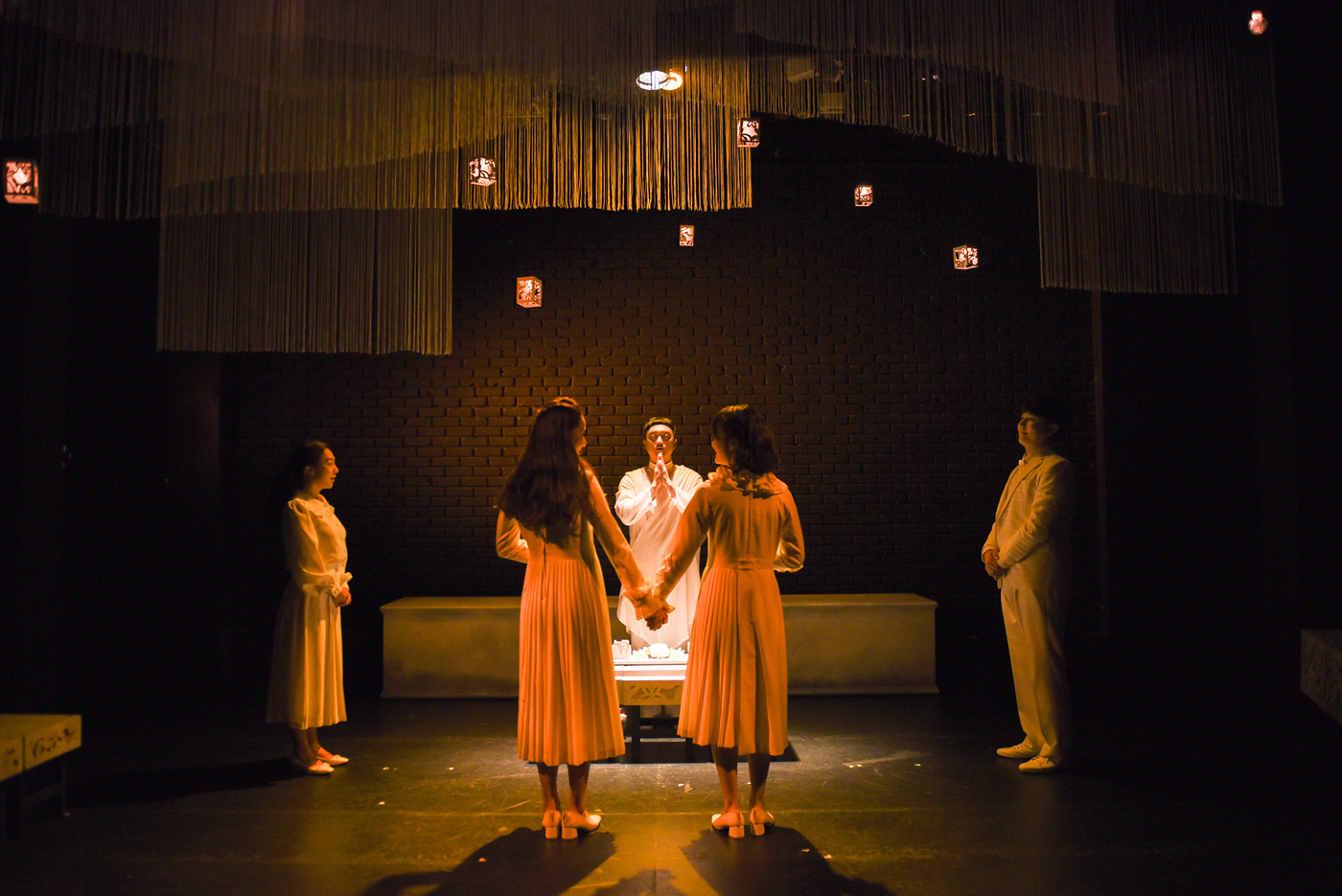
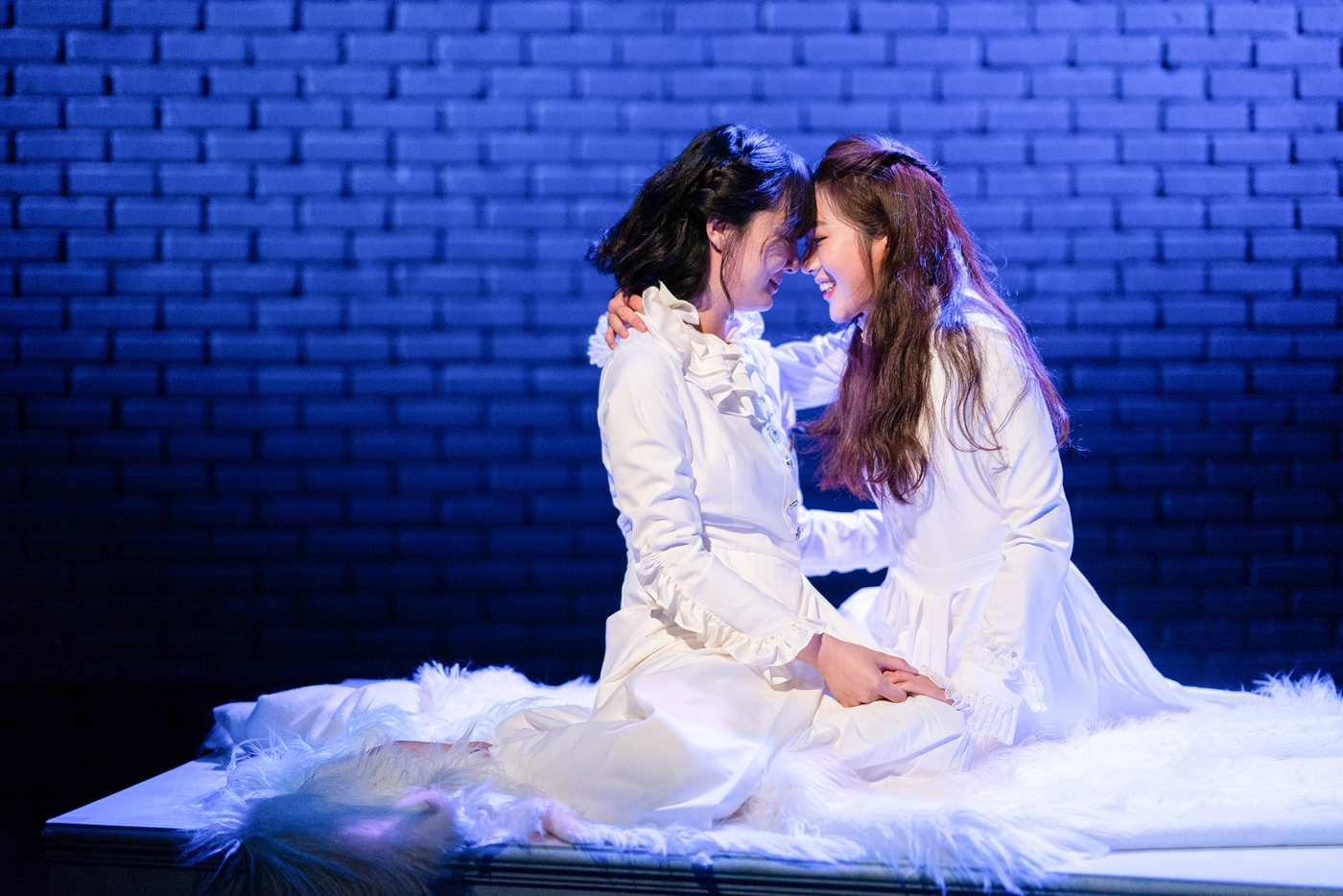
Despite the enormous sympathy shared by the audience, who praised it as ‘female queer theatre’, Juliet and Juliet leaves something to be desired as a queer work. It seems to ‘do exactly the reverse of what queer theory does’, as Richard Burt notes of some gay and lesbian spinoffs of Romeo and Juliet, which ‘take a heterosexual married couple to be the norm and measure of successful, happy same-sex erotic relations’ rather than destabilizing gender identity and subverting institutional marriage.Footnote 21 Burt reads in these adaptations ‘a gay utopian fantasy whereby a no longer forbidden practice of gay male or lesbian sex is represented as “normal”’: a dream of what he calls ‘homonormativity’.Footnote 22 Homonormativity, Burt points out, is often regarded as ‘antiqueer’: ‘queer theory celebrates public, anonymous sex and explicit representations of gay and lesbian sexuality, while liberal and conservative gay commentators celebrate gay marriage and prefer modest representations of gay and lesbian sex’.Footnote 23 In Juliet and Juliet the lovers long to get married and to stay together forever. JulietM swears to JulietC, ‘I will never leave you alone, never leave you with another person’. The two Juliets get married through the help of a Buddhist Monk, who says, ‘Buddha did not forbid same-sex love’.Footnote 24 In the wedding ceremony, the Monk prays to Buddha for the happiness of the couple, who ‘vow to keep a harmonious home for a hundred years to come, with strong faith’ (Fig. 1). After the wedding, they consummate their marriage, expressing love in a modest, lyrical way, without nudity (Fig. 2). The love in Juliet and Juliet replicates the ideology of heteronormative romantic love and monogamous marriage.
The Monk (Jang Sei-Hwan) officiates at the wedding ceremony of the two Juliets (Kim Hui-Yeon and Han Song-Hui), with Nerissa (Kim Ha-Ri) and Romeo (Jo Yong-Kyoung) attending as witnesses. Sanwoolim Theatre, 2018. Photograph by IRO Company. Courtesy of The Creative Company LAS.
Left to right: JulietM (Han Song-Hui) and JulietC (Kim Hui-Yeon) consummate their marriage. Sanwoolim Theatre, 2018. Photography by IRO Company. Courtesy of The Creative Company LAS.
Juliet and Juliet falls short of the classic queer interpretation of Romeo and Juliet as a critique of ‘modern myths about marriage, including its timeless heterosexuality and its permanent, happily-ever-after fixation of desire’.Footnote 25 Carla Freccero, in particular, points to the limitation of mere gender bending, which can still ‘leave intact the grand mystified romance of star-crossed lovers struggling (and failing) to surmount insuperable social impediments to their love’.Footnote 26 Instead, Freccero locates the queerness of the play in its celebration of the death drive, drawing on Lee Edelman's No Future: Queer Theory and the Death Drive: ‘In the face of every ideological apparatus – parents, the church, the law – striving to inculcate a politics of reproductive futurity, Romeo and Juliet insist that there is no time; the time is now; it is sonnet/lyric time, not narrative time; there is no future.’Footnote 27 Freccero's reading is in line with the queer theorists who alert us to the limitation of the marriage equality campaign. According to Judith Butler, the expansion of marriage rights to same-sex couples is not an ultimate solution, as it ‘would constitute a drastic curtailment of progressive sexual politics to allow marriage and family, or even kinship, to mark the exclusive parameters within which sexual life is thought’.Footnote 28 Lisa Duggan also criticizes right-wing support for gay marriage as ‘a strategy for privatizing gay politics and culture for the new neoliberal world order’, dubbing it the ‘new homonormativity’: it is ‘a politics that does not contest dominant heteronormative assumptions and institutions but upholds and sustains them while promising the possibility of a demobilized gay constituency and a privatized, depoliticized gay culture anchored in domesticity and consumption’.Footnote 29
The utopian fantasy of the couple in Juliet and Juliet seems to fit into Duggan's notion of the new homonormativity, although the correspondence is only partial, as I will elaborate later, due to the gap between the cultural contexts of South Korea and the United States. Like privatized gays in Duggan's criticism, the two Juliets dream of a future, longing to get married and live an ordinary life. To ‘keep [her] beloved forever to [her] side’, JulietM searches for a home where they can live together: ‘We really need our home. Now I'm searching for a small farm house’, which will be theirs ‘once the payment is made’. In their first and last night together in scene vii, the two Juliets dream of a happy life in this ‘small shabby house’. JulietC is willing to clean it, planting lilacs and roses. They will put in a fireplace, for which JulietC will also learn to cut wood for fuel. It is a vision of a happy domestic married life, undisturbed by the outside world.
Another problem in Juliet and Juliet is the assumption that posits sexual identity as a given rather than a construction. JulietM says to Romeo that she cannot force herself to love a man. When Capulet and Tybalt urge JulietC to cure her sexuality, she says, ‘This is not something that can be changed by efforts.’ Such views of sexual orientation as a given rather than a choice stand against the queer concept of fluid identity and gender performativity. Theatre scholar Ju Hyunshik criticizes this lack of ‘gender trouble’ in Korean queer theatre, which at present fails to move beyond the verisimilar representation of the reality of sexual minorities, often in a banal, realistic style without theatrical experiments.Footnote 30 Furthermore, Ju points out, it seldom problematizes the concept of identity in a serious sense, while queer discourses ultimately aim to destabilize identity. According to Ju, the Korean Queer Theatre Festival is only interested in promoting queer pride, taking the identity of homosexuals for granted as fixed. In short, it fails to create ‘performance trouble’ in a radical way.Footnote 31 Ju's critique of Korean queer theatre can be applied to Juliet and Juliet, with its non-experimental staging, belief in stable sexual identity, and naive idealization of monogamous marriage. As Han Song-Hui says in an interview, LAS is not really an innovative troupe, although it consists of young members: ‘the troupe does not protest to create a new theatrical vocabulary, and the character roles in their plays are rather traditional’.Footnote 32 Juliet and Juliet fails to be progressive enough in terms of theory and performance, despite its laudable efforts to engage with contemporary queer issues.
Yohangza's Romeo and Juliet: a queer tragedy in a ‘K-pop manner’
Yohangza Theatre Company's Romeo and Juliet, also staged in Seoul as well as in Heidelberg in 2018, provides a good point of comparison with Juliet and Juliet to highlight the gap between queer theory and South Korean reality. Yohangza is a leading theatre company founded by Yang Jung-Ung, a director internationally renowned for his Koreanized Shakespeare productions such as A Midsummer Night's Dream (2002) and Hamlet (2009). Yang's awareness of changing gender dynamics in Korea underlies his 2014 production of Romeo and Juliet, which questioned the stereotypical notion of femininity and masculinity by swapping the genders of the couple. In the 2018 version, Yang foregrounds homosexuality by changing Romeo into a woman, but in a style different from that of Juliet and Juliet. Yang's emphasis was on love in general, to which homosexuality was just one barrier: ‘Through these women [Romeo and Juliet], we will see, feel and think about “love”, the “unconditionality” of genuine love’, as the promotion poster puts it.Footnote 33 Michael Wolf reports from the panel discussion with the director in Heidelberg that Yang intended the play as a ‘life struggle for same-sex love’ in the country of homophobia.Footnote 34 However, identity politics was not the focus of the production. Instead, Yang emphasized physicality as a pure form of love beyond logic or calculation, as is voiced by Mercutio: ‘You don't love with your head. You do it with your body. Physical interaction, physical union’, or ‘Love is not a daydream. It's a vivid reality you dive in with your whole body.’Footnote 35
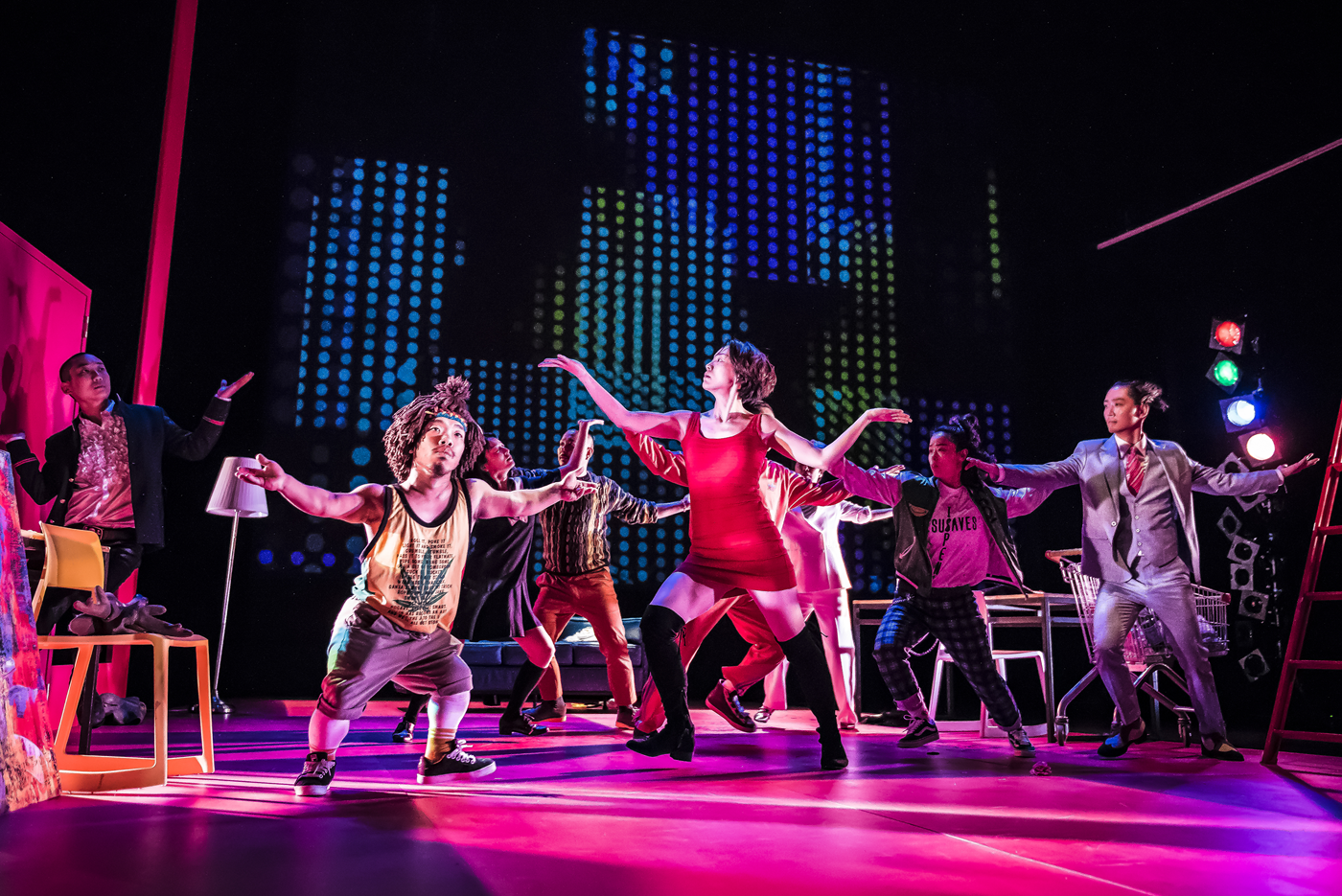
Highlighting the physicality of love was also a way of defying sexual taboo in Korea. The production was ‘X-rated’ in Seoul, with no one eighteen or under admitted. The adaptation included bawdy language and sexual innuendo, semi-nudity and erotic kissing scenes, which were sometimes projected on the screen, magnified. Mercutio, who was portrayed as gay, put his hand in his trousers, abruptly stole a kiss from Tybalt, and ran after Juliet's Uncle (the Nurse figure) for a kiss. The production was punctuated with flashy dance, for Romeo's gang as well as for Capulet's party (Fig. 3). Painted in hot pink, the stage evoked a club atmosphere, with punky dance music and gaudy lighting. There were frequent mood shifts, with music changing from rock to ballad: punky for the dance scenes and melodramatic for the lovers’ display of affection, exaggerated to the point of parody. Wolf wonders whether Yang's warning that ‘his version can be a shock to the audience’ was serious or ironic, for the production was ‘not threatening but rather pleasing: playful, colourful, gaudy and full of pop-culture references’: in short, it was a production in a ‘K-pop manner’.Footnote 36
The dance of Romeo (Lee Hwa-Jung, in the middle) and her gang, including Mercutio (Kim Bum-Jin) on the left. Kangdong Art Centre, 2018. Photograph by Lee Kang-Mool. Courtesy of Yohangza Theatre Company.
Performed at Kangdong Art Centre in Seoul for two days (6–7 April) before participating in the Heidelberger Stückemarkt (29 April), Yang's Romeo and Juliet was received negatively in Korea despite its advocacy of same-sex love. In the review section of the Interpark website, criticism was showered on the excessive sexual display as well as on the lack of gender sensitivity, for all its avowed queer adaptation.Footnote 37 For instance, user ID 3b3*** criticizes that ‘it reinterpreted Romeo and Juliet as a female queer, but it just rendered it violent and pornographic’. Similarly, user ID sara*** complains that ‘it simply changed Romeo into a woman and made pornography out of it’. The video projection was criticized for resembling ‘the voyeuristic gaze of pornography’ by user ID yoojin0***, who found it ‘really repulsive’: ‘I can't understand the intention at all. It seemed to represent a male fantasy about lesbian love, which made it more repulsive.’ Some audiences found the production full of parody, cheap laughs and gags, instead of engaging seriously with gender politics (user IDs hides***, 26775b***, skdp***, parksan***). User ID rlagkdud2*** asks ironically, ‘Was it a comic show? I went without knowing that it was one. It was comic overall, with some occasional serious scenes, so I couldn't concentrate.’ A theatre fan with Naver ID akmae castigates the production as ‘queer-hate’ for its prejudice about homosexuals as sex maniacs.Footnote 38
The overly hysterical reactions demonstrate the level of discomfort the audience felt about the excessive sexuality and the ‘queering’ of the genre in Yang's Romeo and Juliet. The audience demographic of Yang's Romeo and Juliet may differ slightly from that of Juliet and Juliet, although I found many theatre bloggers who saw both shows. For Yang's show in Seoul, 89.1 per cent of ticket buyers were women, and over 92 per cent were in their twenties and thirties, according to Interpark Ticket. The statistics are similar to that of LAS, as discussed earlier. Overall, Korean theatre is regarded as ‘women's culture’, for the majority of theatre-goers are women in their twenties and thirties. Generally, these young women are pro-feminist, and less prejudiced against sexual minorities, according to Jung Jiyoon's study.Footnote 39 Yang's Romeo and Juliet, unlike his other popular Shakespeare productions, failed to return for a revival, while LAS's Juliet and Juliet played to a packed house, followed by three more revivals.
I find the contrasting reception of the two shows intriguing, as it shows that Korean theatre-goers’ view of queerness is different from that espoused by queer theorists. In Burt's paradigm, discussed earlier, Yang's Romeo and Juliet would qualify as a queer work, with its near-pornographic sexuality (as some audiences saw it), emphasis on physical love, melodramatic love scenes, postmodern video projection and queering of the genre in a playful spirit. Juliet and Juliet would stand on the side of conservative gay, with its modest display of affection and romantic ideology of monogamous marriage. The reversed reception demonstrates ‘the importance of being earnest’ in Korea, at least for some people at the current moment in history.
Familism and Korean queers ‘under the radar’
Pointing to the gap between queer theory and gay reality, Gavin Brown takes issue with the ‘queer critique of homonormativity’, which he often finds ‘at odds with the lives and aspirations of many lesbians and gay men’.Footnote 40 The strong theorization of homonormativity as all-encompassing can overlook ‘the specific geographies of the social, political, and economic relations that shape gay lives’, Brown alerts us.Footnote 41 A similar question informs Queer Korea, a recent collection of essays which aims to ‘provincialize’ Western-centric approaches to examine the ‘geopolitics of queer studies’ in post-colonial Korea.Footnote 42 The new homonormativity of the United States and other countries is not the actuality in Korea yet. Despite the growth in LGBTQ+ organizations and increased queer visibility in mainstream culture, the actual life of Korean sexual minorities has not improved in any serious way. As Henry explains, ‘the increased visibility and heightened stakes of same-sex marriage have ironically diverted the attention of many non-normative communities away from public advocacy for liberal forms of inclusion, human rights protection, and identity-based politics’.Footnote 43 While the institution of family central to Korean culture prevents them from coming out, digital technologies endow them with ‘a wide range of self-oriented practices of intimacy, but without necessarily creating public personas that subject them to endangering forms of alienation from family, society, or nation’: they have occupied an ‘under-the-radar’ presence, different from the Western-centric concept of ‘closeted’.Footnote 44 Paradoxically, many ‘under-the-radar’ queers shy away from politics due to the increased visibility and tension.
Shin Layoung discusses the recent shift in Korean queer women, who show more gender conformity than in the early 2000s. They adopt invisibility as a survival strategy amid the social transformations, such as ‘the increased social recognition of homosexuality and the growth of homophobia; increased unemployment and a lack of job security among youth; and the retreat of the state from social welfare and its concomitant promotion of heterosexual families as the basis of economic security and survival’.Footnote 45 Shin argues that the concept of homonormativity developed in Western queer studies is insufficient to address the specific conditions of South Korea, where the inclusion of the middle-class gay and lesbian population in the legal category and the market system has not yet occurred.Footnote 46 Tracing the shift in gay identities in modern Korean history, John (Song Pae) Cho also notes a similar change. Korean neo-liberal gay men tend to retreat into ‘the heterosexual fold of their blood families’, as is revealed by a middle-aged gay man Cho interviewed: his only hope now is to get married, have a wife to look after him and live ‘an ordinary life like other people’.Footnote 47 Cho again emphasizes the specificity of Korean society and the need to distinguish ‘this desire for ordinariness as embodied by the heterosexual nuclear family and its normative life course’ from the ‘aspirational normalcy’ of neo-liberal life.Footnote 48 Many Korean queers ‘refuse to come out of the family in order to be gay’, due to the family governmentality of Korean society through what Cho terms ‘Confucian biopolitics’, which has ‘prioritized the collectivity of the family (and nation) as the primary manifestation of the social, to which individuals are expected to submit their personal will and desires’.Footnote 49 Seo Dong-Jin, the first gay activist to come out in Korea, also points to Korea's family-based society and the strong bonds between parents and children, which make Korean homosexuals ‘dread coming out’ in front of their families.Footnote 50
The homonormative fantasy in Juliet and Juliet should be understood in such a social context of familism that forces Korean queers to remain invisible. Han Song-Hui's decision not to portray JulietM as a butch figure may reflect this reality.Footnote 51 The desire of inclusiveness exerts its strongest hold on those who are denied access to it, Cho points out, as is common to all fantasy structures.Footnote 52 Poignantly, the importance of conforming to social norms is highlighted by families and friends in Juliet and Juliet. The two Juliets’ ‘allies’ – Romeo and Nerissa – accept the Juliets as they are, yet they do not dare to confront social norms. Romeo, who supports his sister emotionally, urges her to conform to the norms for her own happiness. Likewise, Nerissa (the Nurse) tries to persuade JulietC to marry Paris: ‘You don't know what it means to live differently. How painful it is to go against the norms of society.’ It is worth noting that Capulet and Tybalt love JulietC in their own way, as is described in the script: Capulet, ‘age 46. JulietC's father. He dotes on his daughter’, and Tybalt, ‘age 27, JulietC's brother. He dotes on his younger sister.’ Capulet begs JulietC to deny what she has said, repeating, ‘my dearest daughter cannot be so’. The homophobic Capulet family are not vilified as evil, but as victims of the heteronormative ideology that dominates Verona/Korea. The power of Juliet and Juliet, I believe, lies in the verisimilar representation of the plight of Korean queer women, who are rarely given visibility in mainstream culture. ‘It was the first time we saw our story on the stage’, some audiences told Han, for which reason many travelled long distances to Seoul to see the play.Footnote 53 In addition, Juliet and Juliet staged the courage to be different, to come out of the family to be gay and get married against all odds, even with a tragic ending, which allowed the audience to share a gay utopian fantasy, if briefly.
Towards queer optimism
The couple rush to their death in Juliet and Juliet, faithful to Shakespeare's original, yet they are ‘resurrected’ in the epilogue to suggest a vision of ‘happily ever after’. Now changed into colourful dress of green and yellow, the two Juliets dance joyfully among others still clothed all in white, as if to symbolize the paralysis of homophobic Verona (Fig. 4). Lee Ki-Peum at first thought of a happy ending for the two Juliets, to give hope to the queers around her who survive despite all discrimination, yet she was also aware of the harsh reality.Footnote 54 Initially, the adaptation ended with the couple's death, but Han Song-Hui changed it, ‘wishing them a moment of pure happiness’ when ‘they can dream of the future’.Footnote 55 The final outcome was a compromise between reality and dream, the lovers’ tragic suicide complemented with an optimistic vision of their joyful dance. Lee still ‘dreams of the Juliets living happily together in a home with a fence and a fireplace, having found their true self as well as their love of destiny’.Footnote 56
The joyful dance of JulietM (Han Song-Hui) and JulietC (Kim Hui-Yeon) in the epilogue. Contents Ground, 2019. Photograph by Yang Dong-Min. Courtesy of The Creative Company LAS.

Against a queer spirit it may be, but the compromised ending qualifies Juliet and Juliet as a good gay adaptation. Elliot James Smith, editor of Polari, an online newsletter ‘dedicated to UK LGBTQ+ writing’, asks whether queering Romeo and Juliet is ‘even a good idea’.Footnote 57 Reviewing the limitations of some recent queer versions of the play, ‘which simply don't edit much, switch the genders, watch as they die and call it “inclusive”’, Smith emphasizes that any meaningful adaptation of the play should make substantial changes to deal with the real issues of ‘teen suicide, parental rejection and homophobic attitudes’. One of Smith's handful of good examples, the 2016 Skybridge production of Romeo and Juliet staged by LGBTQ+ students, gives a happy ending for the couple: ‘Having faked their deaths, the boys run away together. Happily ever after.’ Will Stockton expresses a similar concern in his essay ‘The Fierce Urgency of Now’, informed by his ‘effort to tie queerness back to gayness’ as well as the ‘need to assert queerness as a viable mode of being in a present moment when queer teens kill themselves’.Footnote 58 Freccero's queer reading of Romeo and Juliet as an antisocial romance deprives queerness of ‘its ability to trope life-preserving and life-affirming expressions of hope and optimism, caution and patience’.Footnote 59 In Sassy Gay Friend, a Web mini-series that Stockton presents as an alternative, Sassy stops Shakespeare's heroines from committing suicide with the question, ‘What are you doing?! What, what, WHAT are you doing?!?’Footnote 60 Juliet and Juliet, too serious to assume such a camp tone, compensates the couple's suicide with the final dance, while tackling the issues of parental rejection and homophobia head-on.
Can one blame the two Juliets and those who wept with them for not being progressive enough and for dreaming of a happy married life? The homonormativity in Juliet and Juliet is closer to Burt's notion of designifying gender than to Duggan's new homonormativity as a neo-liberal politics. Admittedly, Burt's notion of homonormativity is naive and idealized, not anchored in real politics; it is, as he dubs it, a ‘gay utopian fantasy’. The Juliets’ dream is rooted in the predicament of Korean queers, who are ‘under the radar’, without legal rights, barred from coming out due to familial governmentality. I also want to defend their dream of happiness, drawing on the concept of ‘queer optimism’ proposed by Michael Snediker. Critiquing current queer theory's ‘gravitation toward negative affect and depersonation’, which he calls ‘queer pessimism’, Snediker finds ‘queer theory's habitation of this pessimistic field’ of melancholy, self-shattering, the death drive and shame a ‘cause for real concern’.Footnote 61 While such queer concepts depend on abstraction and metaphor, these models ‘seem less practicable in lived experience’ in Snediker's view.Footnote 62 Likewise, the ‘performance trouble’ that Ju Hyunshik deplores as missing in current Korean queer theatre may be less practicable under the Confucian biopolitics of familism looming over Korean subjects. To allow the two Juliets a gay utopian fantasy, a new ‘kind of thought-experiment’ in the direction of queer optimism would be required to ‘imagine happiness as theoretically mobilizable’.Footnote 63 This task, admittedly, is one beyond my capacity, lacking the authenticity of lived experience. Drawing attention to the cultural specificities that inform queer reality in countries like Korea, I wish to call for alternative concepts and theorization, like Lee Ki-Peum, who felt ‘way too wary’ not to misrepresent sexual minorities, pretending to ‘know the world [she] doesn't know about’, and yet had to find ‘a voice mandated by their predicament between ideal and reality’ through her theatre production.Footnote 64


 Open access

