

We are gathered in a circle, leaving an empty space in the middle of the dance floor to serve as the stage. We rave from one drag performance to another, but a collective anticipation for someone else’s arrival is palpable. With sweat dripping, my body touching a fellow genderqueer sinner, and my heart pumping from the dancing and drinking, finally, we witness Jesus “descend”—unless it is not the real Jesus himself but a queered replica of him.
The night I attended That Elephant Party’s after-Pride event titled Magandang Gabi, Bayot Footnote 1 on 24 July 2023 was the first time I saw Filipino drag artist Pura Luka Vega in Jesus the Nazarene drag. That Elephant Party, or Elephant, is an underground rave and queer space that originated in XX:XX, an electronic music club located in the hip district of Poblacion, Makati City. XX:XX closed down as a result of the Covid-19 pandemic, but as restrictions loosened, Elephant transitioned to a traveling nightlife scene and moved around Metro Manila. It found a home in multiple locations, one of which is Dirty Kitchen, an establishment that was formerly a Japanese restaurant and located below the artist-run Gravity Art Space. Dirty Kitchen sits at Mother Ignacia Avenue, off the main Timog-Morato strip, Quezon City’s entertainment area. I know of Luka as the bearded drag queen famous for their uncanny resemblance to the Catholic imaginary of Jesus—thin, long-haired, and bearded—and for their participation as a contestant in the first season of the Filipino reality drag competition, Drag Den, hosted by renowned international Filipinx drag artist Manila Luzon.
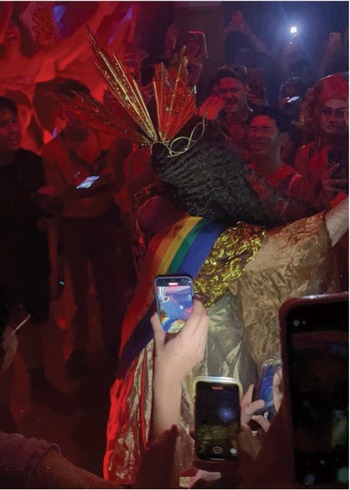
Pura Luka Vega enters the performance space as Jesus the Nazarene. Luka’s happy devotees surround them as they welcome everyone to church. That Elephant Party, Dirty Kitchen, Manila, 24 July 2023. (Photo by Ian Rafael Ramirez)

Back to the party. As I stand lost in the middle of the dance floor, a rock version of the gospel song “Papuri sa Diyos” (Praise the Lord) plays.Footnote 2 Jesus enters the makeshift stage, except it is Luka in a red and gold Nazarene ensemble with a crown on their head. They don an approachable smile as they extend their arms as Jesus does in movies and imagery. We, the crowd, go wild. From where I am, I notice how the thinning mass of the crowd regains its volume. Many who are taking cigarette breaks and those who were probably about to leave run back to the dance floor to witness the descent of Jesus. The crowd is intimately intertwined in pure admiration of Luka. Many bring their phones out to document the moment, cheering, gagging (queer-speak for stunned), and raving simultaneously. Some lip-synch the gospel song; others kneel to wipe their handkerchiefs on Luka. It resembles moments during the annual Feast of the Nazarene at the QuiapoFootnote 3 Church parade, when Catholic devotees would attend the procession and climb the caravan parading the Nazarene to wipe it with their hand towels. Luka had gathered us, their congregation. The song changes to an anime rock version of “Ama Namin” (Our Father), a gospel that even non-Catholics would probably know. Luka reveals a new outfit underneath their robes: a red top with gold appliqué details over a sheer silk organza dress. Someone in the audience then sashes Luka with a Pride flag. Luka turns around as if acknowledging the crowd’s presence. Embodying the song’s punk rock sound, Luka headbangs to the rest of the song, as we bob our heads up and down with them. As I reminisce about that moment now, the feeling of transporting to a different space and time lingers. I can hear the cheers of the crowd singing rock versions of “Papuri sa Diyos” and “Ama Namin,” screaming for salvation, as if saying, “We found acceptance in Jesus’s arms.”
The Philippines is a predominantly Catholic nation, a result of the Spanish colonial state’s Christianization of the archipelago. Growing up bakla (a local gender identity in the Tagalog-speaking regions often conflated with being an effeminate gay or transfeminine) in a conservative Christian family was a struggle, as homophobia is deeply entrenched in the Filipino psyche. Unsurprisingly, Catholicism and the rise of other (non-Catholic) Christian sects and megachurches in the Philippines have further enabled public conservatism, especially at present, as religious leaders are empowered by civil society to penetrate state government by obtaining seats in either the senate or congress. Luka’s performance offered me refuge and a glimpse that I have a chance at salvation. I knew that the conservative publics would see this as a mockery of their faith, but it felt like an extension of our religiosity, especially for some of us who believe in God but have felt excluded in places of worship. It was as if we had been folded into Almighty God’s congregation. We were blessed.
Luka’s performance continues, now in an outfit change and a rainbow Pride sash across their chest. (Photo by Ian Rafael Ramirez)

On 10 July 2023, Luka (@puralukavega) retweeted a clip of the performance on X (Twitter, at the time) with the caption, “Thank you for coming to church! .” The bigots, alters (cisgendered, often closeted homosexual men who engage in online sex work), and reputedly corrupt government officials all turned to X to lambast Luka and call their performance blasphemous. Senator JV Ejercito said, “This is blasphemy. This disrespects my faith. This went overboard” (in Philstar 2023). Senator Migz Zubiri responded similarly: “This is the height of misuse and abuse of our freedom of expression that borders on criminal activity. […] We are tracing the venue and studying the possible violations of law committed here” (in Philstar 2023). Even allies of the LGBTQIA+ community in both congress and the senate also called out Luka. Geraldine Roman, a transpinayFootnote 4 congresswoman representing Bataan, said,
Pura, please, do not use the gender card again because you are giving the community a bad name. This is simply a case of disrespect for religious feelings of other people. And now, because binabatikos ka ng marami sa lipunan [you are being lambasted by the public], you’re waving the queer card. Don’t be unfair kasi nga [because], you know what, ang masama dito magkamali ang isang member ng community, lalahatin na [what is wrong in the situation is when one member of the community commits a mistake, it will be the mistake of the entire community]. (in The Filipino Times 2023)
Senator Risa Hontiveros called the performance “regrettable,” fearing it might be used against the LGBTQIA+ rights struggle in the Philippines (in Philstar 2023).
The remarks of these government officials enraged me, but I was even more infuriated when I saw the online comments of those who wished Luka were dead or behind bars. Some online commenters insulted Luka by calling them “baklang kanal.” The Tagalog bakla plus kanal (canal or gutter)—the sewer, connoting filth, refuse, and mess—is literally, gutter faggot. This online insult is thrown at the bakla who are deemed trashy, loud, unrespectable, entitled, over-opinionated, and crass. On 15 November 2020, X user Davao Twinks (@alterversetwink), a supporter of the Duterte regime (2016–2022), used the term to antagonize progressive baklas on social media. As the post gained traction, the phrase was then “reclaimed” by a group of progressive baklas led by Francis Baraan IV (@MrFrankBaraan), who said “baklang kanal” was now “a term for empowered, brave, social justice warriors.” Social media content creators capitalized on the term by branding themselves as loud, crass, messy, and unbothered. Outside of social media, however, baklang kanal distinguishes crass transfeminine bakla from the other LGBTQIA+ folx (see Cabbuag and Benitez 2022; Vilog Reference Vilog2020). Many wished Luka annihilated; many viewed them as baklang kanal, unwanted garbage.
Why are people offended by a Jesus drag performance? Is their faith so fragile they can’t handle the sight of baklas in the presence of the “Lord Jesus Christ”? Or do their narrow minds only see Luka’s performance as a mockery of Christianity? Where were they when then-president Duterte called God “stupid” at an information technology summit held in Davao City in 2018?Footnote 5 They stood silent. As conservative Philippine state officials find a way to not pass the Sexual Orientation, Gender Identity, Expression, and Sexual Characteristics (SOGIESC) Equality Bill, a bill that would protect LGBTQIA+ rights, I could not help but think that the backlash against Luka’s performance was simply a front to push forward the agenda of macho-populist ideologues. Father and son duo Senator Joel Villanueva and Cibac (Citizens’ Battle Against Corruption) Representative Eddie Villanueva, both religious leaders of the Jesus Is Lord (JIL) megachurch, have been blocking the passing of the SOGIESC Equality Bill in recent plenary sessions. While Joel Villanueva contends that the bill is not a “priority” and would enable the legalization of same-sex unions (Gregorio Reference Gregorio2023; Pinlac Reference Pinlac2023), Eddie Villanueva, who founded JIL, claimed that the bill would threaten the freedom of speech of Bible believers (Cepeda Reference Cepeda2019).
Lest we forget, Luka’s case was not an isolated one. I have felt this rage before, especially at times when the denial of our human rights is turned into a national spectacle. This happened when transpinay Gretchen Diez was arrested in 2019 for entering the toilet designated for the gender with which she identifies. Diez’s words to the news reporters still fuel my rage against the state: “For me, it was like I was a shoplifter being dragged inside the mall, with people looking at me as I was being held… I could not understand how, in a supposedly gender-fair city, there’s a person who would treat me like I committed crime” (in Talabong Reference Talabong2019). Another instance was the case of Jennifer Laude, who was murdered by US Marine Joseph Scott Pemberton. My anger swelled when the court of public opinion online (especially so-called Christians) made transmisogynistic claims saying that Laude deserved to die because she “fooled” Pemberton into believing she was a woman (Talusan Reference Talusan2015a, 2015b). Cases of local LGBTQIA+ community leaders and queer activists being red-tagged—labeled as communists who pose terrorist threats to the public and should be imprisoned—further intensified my rage. These cases of state-justified violence against sexual minorities who are mostly bakla and transpinay show how conservative Christian dogma is being weaponized by the people and the state to deny us our human rights, and more glaringly, our humanness. We are being rendered kanal—wasted bodies who are made excess by civil society and made deserving of discrimination, imprisonment, and death.
I first met Luka at Pride Talks on 16 June 2023, Barefoot Theatre Collaborative’s initiative to bring queer scholars and artists to discuss queer theatre, queer spaces, drag, LGBTQIA+ rights, and queer representation in mainstream media. This was a few weeks before Elephant’s Magandang Gabi, Bayot party; they exuded warmth, kindness, and grace—qualities one might expect of Jesus. I did not see Luka as a baklang kanal, nor do they identify as one. They were, in my perception, a baklang banal (a bakla who is holy), a term that I and my friends use for a bakla who attends church, prays to God, and negotiates their being bakla with their Christian faith and Godliness. I listened to Luka’s talk during which they shared their humble beginnings growing up as a bakla in Dipolog City, in Western Mindanao, in the southernmost group of islands in the Philippine archipelago. They shared that they also faced expectations of (cis-heterosexual) respectability but drag offered them a way of accessing power amidst the state repression of LGBTQIA+ rights. Thinking back on this moment, I can’t help but ask: How could they survive the level of national humiliation leveled at them in those online comments? We were all in that “church” when it happened, yet Luka was the only person who had to face such blunt disparaging remarks from the public. We worshipped Luka as a representation of Jesus: doesn’t that also make us blasphemers?
A few days after the controversy surrounding Luka’s Jesus performance broke out, X account Philippine Drag Updates (@DragUpdate 2023) shared Pura Luka Vega’s response to everyone who called them out.
I won’t delete it nor will I apologize for doing it. To begin with, our mere existence as queer individuals already offends people. Drag is also queer and when I think about it, to me, it’s really just a yassified worship/lipsync of the Lord’s prayer. There’s a part of me that feels weird to explain my art when I don’t owe anyone an explanation of things. People are free to make interpretations of it. The way I see it, our reactions and perceptions reveal our values, which we need to reflect on.
Pura Luka Vega (@puralukavega 2023b) added, on a separate post:
I understand that people call my performance blasphemous, offensive, or regrettable. However, they shouldn’t tell me how I practice my faith or how I do my drag. That performance was not for you to begin with. It is my experience and my expression, of having been denied my rights. (emphasis added)
To date, Luka has been declared persona non grata in 17 cities and municipalities across the archipelago (ABS-CBN News 2023). The Christian groups who took offense to Luka’s performance brought their fragile cries to the courts citing that Luka breached Section 133 of the Revised Penal Code of the 1987 Philippine Constitution, which criminalizes acts “offensive to the feelings of the faithful” (Aljazeera 2023). On 4 October 2023, Luka was arrested at their home in Manila after an alleged failure to attend a court trial for which Luka had already appealed for an extension. Some protested in front of the jail where Luka was detained, crying “Drag is not a crime.” A donation drive to post bail for Luka was also initiated, alongside a fundraising event titled NKKLK (which reads as nakakaloka, or “it’s driving me crazy” in Filipino text-speak) that was slated for 7 October 2023. On that day, Luka was allowed to post bail. I watched videos of the fundraising show from my apartment. I cried when I saw the video of Luka performing Andrea Bocelli and Celine Dion’s “The Prayer” in a white gown with their mom also lip-synching beside them. At least they are free for now, I thought to myself. However, I could not help but think about how easy it was for the public, church, and state to wish for Luka’s annihilation. On 29 February 2024, Luka was arrested again by plainclothes police but was released on bail a few days later (Rappler 2024).
Luka was treated and tagged as an excess in the eyes of the church and state; a disposable unwanted body that could be easily thrown out based on an outdated provision in the Philippine constitution. Luka was rendered kanal in those moments: an emblem of everything the church and state consider blasphemous and in need of the sacraments—but Luka’s words, “That performance was not for you to begin with,” called upon me, whispering that wasted bodies—or bodies rendered as disposable by the church and state—perform an alternative way of doing worship.
Within the Anglocentric discourses of queer liberalism, religion is often pitted against queer liberation. Recent scholarship on queer subjects in the so-called Global South, however, argues otherwise.Footnote 6 Consider, for instance, anthropologist Moisés Lino e Silva’s (2022) ethnographic accounts on Brazilian travestis (a Latin American gender and sexual category often confused with transgenderism; see Pereira Reference Pereira2019 and Sacchi et al. Reference Sacchi, Curiel, Wayar and Hughson2021) living in Rocinha, a favela (slum) in Rio de Janeiro. He argues that religion, “be it through collective work (mutirões), exorcisms, or through trance and witchcraft,” plays a pivotal role in how travestis in the Brazilian favela enact minoritarian modes of liberalism, or the nonnormative minoritarian ways of being-in-the-world that manifest how they perceive freedom (2022:194). Exploring the entanglements of religiosity and queerness in Pakistan, cultural anthropologist Omar Kasmani (Reference Kasmani2022) asserts that fakirs (or those who have devoted their lives to the Sufi saint Lal Shahbaz Qalandar and reside at his shrine in Pakistan) illustrate forms of worldmaking via saintly intimacies that gesture towards the many relational possibilities of queerness and religiosity. The controversial Jesus the Nazarene “Ama Namin” drag performance of Pura Luka Vega also teaches us another way of thinking about the complicated relations between queerness and religiosity. The performance resignifies worship through queerness, and remains vulnerable to the deeply imbricated oppressive regimes of church and state despite the attempt to suture queerness with religiosity. In recentering drag as a community-based performative praxis, I hope to narrate how Pura Luka Vega, in becoming vulnerable to church and state power, makes visible how expendable bakla communities challenge the matrices of power that attempt to annihilate sexual minoritarian bodies.
When Luka Was Tagged Kanal
On the day of Luka’s arrest, the Manila Police District released Luka’s mugshot on Facebook. Luka stared straight at the camera, their hair still dishevelled, looking shocked at the injustice. They held a placard that bore their government name, drag name, and the lawsuit filed against them. Luka’s eyes pierced through the lens, expressing the rage of our community. Seeing them treated as a criminal only intensified my anger. What made it worse was how this image was presented to the public as a spectacle, allowing conservative critics to justify their moral high ground.
At that time, Luka became the focal point in the court of public opinion on social media as conservatives invoked morality to vindicate their position. Some said that Luka deserved to be imprisoned while some even wanted to assign Luka a death sentence. Several of these commenters insisted that Luka should have been murdered by the police. In their words, “dapat nanlaban ka na lang” (you should have just fought back). “Nanlaban” (literally “fought back”) was the common excuse policemen used during Duterte’s extrajudicial killings or EJK (which began when Duterte took office in 2016) to absolve themselves and avoid murder charges (see Gavilan Reference Gavilan2022 and Montalvan II 2024). Besides “baklang kanal,” others decried Luka as “baklang lapastangan sa Dios” (a bakla who is irreverent to God). These hateful remarks did not merely come from cis-heterosexual conservative sectors but also from within the LGBTQIA+ community. Scrolling the public forum on Luka of the online tabloid Fashion Pulis (Reference Pulis2023), I read a comment from an anonymous netizen that said: “May mga baklang kapatid tayo na well-mannered at edukado and at the same time, may mga kapwa bakla tayong produkto ng kanal gaya nitong acclahng ito” (We have bakla kin who are well-mannered and educated and at the same time, we have fellow baklas who are products of kanal like this one). The comment implied that Luka is kanal because they are immoral, ill-mannered, and uneducated.
I felt the residue of Duterte’s fascist regime in the tagging of Luka as kanal. This performative and rhetorical kanalization, or the tagging of someone as kanal, arrives at the turning point of Philippine necropolitics, when killing became the new norm for subjugating life and eradicating unwanted bodies (Mbembe Reference Mbembe2019). In the Philippines, the Duterte regime consolidated the state’s necropolitical power. Red-tagging, or the tagging of someone as a supporter of the communist insurgency, gave license for authorities to intimidate, harass, and persecute the red-tagged subjects under the Duterte-sponsored Anti-Terrorism Law (Human Rights Watch 2022). The necropolitics of Duterte’s populist regime was operational during his war on drugs, which in practice extended to community and political organizers, public officials, environmental defenders, and journalists upon the establishment of the NTF-ELCAC (National Task Force to End Local Communist Armed Conflict). While Duterte’s regime ended in 2022, the establishment of NTF-ELCAC remains one of his enduring legacies, especially as the crackdown on political organizers continues. The blacklisting of so-called baklang kanals on Twitter was also among the outcomes of media populism in the time of Duterte, driven by in-groups on social media that dehumanize government critics (Ragragio 2022). By tagging someone as “kanal,” as they did with these baklas, Duterte supporters assume they then have the license to persecute them. Tagging a person as kanal has the same impact as red-tagging; in anti-bakla rhetoric, someone tagged as kanal is justifiably deserving of extrajudicial killing, imprisonment, and other dehumanizing actions. As Arnisson Ortega (2020) asserts, necropolitics in the Philippines manifests not only in actual killings, but often, as a way of pushing certain lives toward death.
The release of Luka’s mugshot reflected how the church and state instrumentalize public affect to endorse kanalization, and subsequently, the disposability of baklang kanal bodies. The banal feasting over the visible precarity of a bakla body rendered kanal—as entertainment for the church, state, and conservative public—reveals how kanalization sustains the compounding everyday violence faced by unassimilable baklang kanal bodies. In the comments deriding Luka, kanalization manifests as the Christian fundamentalist form of symbolic cleansing: naming in order to eliminate the waste of civil society. In their vernacular, blasphemy requires severe punishment—imprisonment or even death. Kanalization is therefore their way of keeping a Christian-guided cis-heteronormative order in place. Luka’s alleged blasphemy was considered enough reason to punish them for their sins, driving them to the edge of contemporary Philippine necropolitics. The secular invocation of religious iconography in Luka’s drag required their moral cleansing in the eyes of the church, state, and conservative public. Here, unrespectability extends to the failure to conform to religious faith as dictated by cis-heteronormative civil society’s standards.
When Bakla Bodies Reconfigure the Kanal
While Luka has been made kanal by the church, state, and conversative publics, kanalization took on a different meaning on the night of the Elephant Party. Here I experienced a different kind of kanalization—one that is not violent and is produced by bakla bodies. Shaped differently by bakla communities, kanalization becomes opposed to exclusionary modalities: it is transformed into a tactic of a counter-public. Kanalization became an act of worldmaking that renders the cracks of anti-bakla regimes visible. Elephant, as a queer nightlife space, holds radical potential to build alternative lifeworlds via an unmaking of oppressive worlds. The works of Kareem Khubchandani (Reference Khubchandani2020), Kemi Adeyemi (Reference Adeyemi2022), Ramon Rivera-Servera (Reference Rivera-Servera2012), and Michael Tristano Jr. (2022) inform us that dancefloors are sites of possibility that enable queer-of-color folx to embody lifeworlds beyond the violence looming in their surroundings and the intermeshing oppressive regimes that operate towards their abjection, albeit remaining susceptible to failure.
When I entered the space of Dirty Kitchen, the site of Elephant’s Magandang Gabi, Bayot, I sensed its past life as a restaurant. At first glance, the space doesn’t appear as stereotypical for the baklang kanal. It is an abandoned restaurant on a major thoroughfare that is popular amongst city-goers. It is not located in the urban underbelly. Even the people gathering in the space cannot be easily categorized as kanal. As one of my friends once told me, the people who frequent Elephant are a different kind of bakla but they are allies of the baklang kanal.
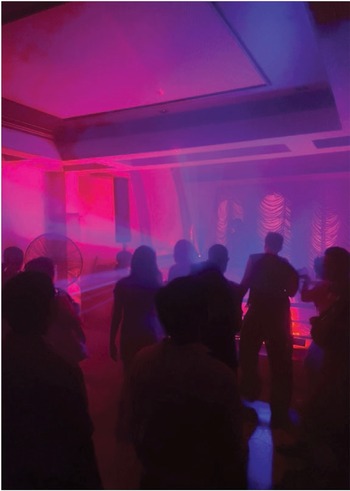
Upon entering Dirty Kitchen, long couches in areas that looked like where there were once tables were on the left. People sitting on the couches were either relaxing, seeking refuge after dancing, or chatting with friends. On the right, the dance floor and DJ booth appeared as larger extensions of the former dining area. It seemed to me that the space used to be a private function area of the former restaurant, especially with the posts, barricades, and steps separating the space. Now, people were dancing in those halls while holding their beer bottles. The imagery of the scene reminded me of a born-again Christian church worship where people stand, sway their bodies, and sing with their eyes closed in front of a band playing music—or in this case, a DJ remixing techno house music. At the end of the restaurant opposite the entrance was a doorway to where the former kitchen space was located. It had become a makeshift bar. Dirty Kitchen prompts a narrative of transformation, illustrating how something abandoned and useless can find life anew. Our bakla community’s occupation of an abandoned space shows how we ally ourselves with spaces that have been neglected, breathing life into halls that then became hallowed.
There were more moments of transformation as the night progressed. Electronic dance and house music are not my thing; I am not into loud music at all. But I stayed at Elephant because of the lineup of drag performances that night. After a series of DJs played house music, Celeste Lapida took the microphone, delivering some news:
Ito ang mga balita. Isang transgender sa Quezon City na-ospital matapos mauntog. Sabi ng mga kasama, tumalon daw ang transgender mula sa kama sabay sabing “Aim High, Transpinay!” Sa Pampanga, kinasuhan ang isang bading ng kanyang kaibigan ng libel. Ani ng may kaso, sinasabihan daw siya ng shit ito shit ito. Sabi ng kanyang kaibigan, iginiit lamang niya ang pronouns niya. She it ito. Sa Louisiana, dalawang kalbo ang natagpuang nagsasabunutan. Panoorin po natin ito. Emi lang. Happy Pride mga bading!
(This is the news. One transgender from Quezon City was hospitalized after bumping her head. According to her companion, the transgender jumped from her bed while saying, “Aim High, Transpinay!” In Pampanga, a trans woman filed libel charges against a bakla. The accused kept saying to the trans woman “she is shit, she is shit,” but the bakla rebutted that she was only reiterating the trans woman’s pronouns. “she is she/it, she is she/it.” In Louisiana, two bald men are found pulling each other’s hair. Let’s watch this video. [No video was shown.] Just kidding. Happy Pride, Faggots!)
A different energy took over my body. Celeste’s performance embodied a familiar humor one may easily recognize as kanal due to its “problematic” undertone, reminiscent of the marginalized humor found in Philippine comedy bars. In Celeste’s short skit, she poked fun at pronouns and trans-ness, delivering jokes that could easily be called out on X. After Celeste’s news performance, DJ obese.dogma777 took over the booth and played familiar beats, the budots, a type of local house music popular among the masses and the lower class that is typically dismissed by the elites as tacky (see Celera Reference Celera2019; Palumar Reference Palumar2023). DJ obese.dogma777 brought out the kanal in everyone dancing in the space. I say this because the music DJ obese.dogma777 played included budots and resembled what usually plays at street parties and festivals, and is categorized as masscult, or culture for the masses. I got into the moment upon hearing some of my favorite masscult music, including SexBomb Girls’ “The Spageti Song” and Toni Fowler’s “M.P.L.”
Elephant’s imagined alliance with kanal sensibilities manifested in Celeste’s short comedy skit and in how we danced to budots music without verbalizing or corporealizing disgust over a music that is considered masscult. Our embrace of music considered low-brow according to elitist perceptions indicates our allied-ness with kanal sensibilities. Some attendees that night also wore protest slogans and demands to increase the national minimum wage, such as “SAHOD Bonggahan! Php 750 PUSH NA!” (WAGE Increase! PUSH FOR PHP 750 NOW!) painted on their backs. These moments reminded me of Catherine Nash and Andrew Gorman-Murray’s (2017) work that suggests the viscosity of mobile queer bodies is imperative to understanding the formations of ephemeral events. Drawing from Arun Saldanha’s (2006:18) notion of viscosity, which signals how bodies can become sticky when they gather, enabling other bodies to adhere or flow with them, Nash and Gorman-Murray note that “there might be a multiplicity of gendered and sexual becomings emergent in various locations, increasingly unbounded from the categorical specificity of lesbian, gay, bisexual, trans, queer and/or sexuality and gender itself” (2017:1526). This assemblage modality of thinking about queer spaces and emergent sexual subjectivities in the contemporary context is useful in understanding how kanal spaces and bodies form in events like Elephant.
To revise Nash and Gorman-Murray, I posit that multiple kanal spaces may emerge across different locations from what can be considered visibly or visually kanal; kanalness in spaces moves, gathers, unfolds, and dissolves. This implies that the becoming kanal of such spaces as Elephant is not contingent on its proximity to the slums in terms of distance and character, nor is it about the self-proclaimed baklang kanal bodies congregating and coagulating therein. The formed coalition with what is popularly perceived as kanal through masscult music and pro–working class slogans enacts the kanalization produced by bakla bodies. It is through this aesthetic-political solidarity with the masses and the working class that kanalization can be understood as a modality of kanal embodiment. It is not, however, a simple case of temporarily inhabiting kanalness, but a corporealization of a deep-seated relation with kanalness that may thrive underneath one’s flesh. What we as baklas who gathered in Dirty Kitchen have exhibited is a political praxis of coalitional politics. Our openness to our working-class kin expands our capacity to build connections. The kanal have been suppressed by church-state apparatuses by rendering them as less-than-human and imbuing them with negative attachments. And yet, we found solace in inhabiting kanalness and allying ourselves with them. By being true to ourselves, we allowed our bodies to become kanal and related our oppression to the struggles of the masses and the working class—the lives of those who had similarly been made disposable. This solidarity enables us to embody kanalness and revel in it through dancing, partying, and being alongside one another.
When Jesus Delivered Us from Evil
When revisiting my ethnographic account of the night of Pura Luka Vega’s performance, I always rekindle the feeling of being blessed. I entered the space of Dirty Kitchen with no expectations, but I stumbled upon a scene of worship—from the bodies on the dance floor facing the DJ, looking like a religious congregation worshipping techno music, to being one with the people crying over Pura Luka Vega as Jesus the Nazarene. Thinking through affect and performance is crucial to understanding the political possibilities of bakla-produced kanalization on the night of Luka’s “Ama Namin” performance. Ann Pellegrini notes that one must turn away from belief-centric arguments and shift attention to the discomfort in the ways religion and queer communities commingle to make sense of the complexity of the intersections between queer religion and performance (Pellegrini Reference Pellegrini2005:94). Perceiving religion and queerness as coconstitutive is to assert that sexuality is not the enemy of faith and vice versa. In the Philippine context wherein LGBTQIA+ folx navigate “varying degrees of unfreedom within their families, communities, and themselves” (Cornelio and Dagle Reference Cornelio and Dagle2022:27), understanding how we negotiate our faith vis-à-vis our subject positions in the church and our religion is imperative. Returning to Elephant, perceiving Luka’s performance in religious terms, specifically as worship, allows us to make sense of what the performance does to its attendees and what it makes its attendees feel. Kanalization, in this sense, as a praxis of queer worldmaking, can be understood as resistance to polarized understandings of queer secularity as the progressive antithesis to conservative religious ideals. It functions, instead, as an instrumentalization of religious practices such as worship to afford bakla-bodies-made-kanal with humanness.
A scene in That Elephant Party. Elephant-goers stand in front of the DJ booth as if in a position of worship. (Photo by Ian Rafael Ramirez)

In my conversations with some friends days after the event, we reflected on how Elephant felt like worship: it was a congregation of bakla folks who were denied their basic human rights by the nation-state. It reminded me of the church congregations I attended as a child growing up with conservative Christian parents. There is a glaring parallel between how the congregating bakla bodies represent sinful Christian bodies (in the general sense) seeking forgiveness and mercy from the Lord. Our dance to budots and techno music manifests our devotion. It is our form of prayer, akin to the prayers offered by Roman Catholics during the offertory in a Catholic Mass. It is in the space of the dance floor that we feel safe enough to perform worship, much like the church is imagined as a space free from judgment for sinful Christian bodies.
While I was waiting for the drag performances to begin, I had a brief exchange—and felt a rapport—with Superstarlet XXX, one of the hosts of the party. When Serena, one of the crowd at the party, told me that my baptism into the church of Elephant was during that “interview” I realized it was then that I first felt blessed and cradled by a community who will look after me. Superstarlet XXX asked me what my name was, to which I responded Ganda (Pretty). I had always wanted to be called that, and that night felt like the right moment. Superstarlet XXX asked the audience to welcome me, Ganda. This shared feeling as if we were in a place of worship can be likened to what Tim Miller and David Román call a “state of conversion” (1995:177), which they posit is a state one encounters when entering a queer performance space. Miller and Román reconfigure the dismissive criticism that theatre critics deploy when viewing queer works—that they are “preaching to the converted” (1995:177). While conversion for the conservative critics means ideological propaganda, for Miller and Román, “to be among the converted is to be open to a series of conversions, it is a way of being that implies a constant state of negotiation” (178). The state of conversion implies the instability of identities. In the case of Elephant, my entrance to Dirty Kitchen was my arrival to the state of conversion, facilitated by my openness to be transformed by my encounters and be renewed by the space. Perhaps this also speaks to what I earlier described as the space and its attendees not being easily recognizable as kanal based on popular consciousness but rather becoming kanal in their alliance to kanal sensibilities. To some extent, in our congregation that night we were Miller and Román’s “converted,” a “dynamic assembly” that communally enacts “proactive resistance” to “hegemony’s own unending production of what does and does not constitute, in Judith Butler’s phrase, ‘bodies that matter’” (Miller and Román Reference Miller and Román1995:187; Butler Reference Butler1993). Elephant enabled our congregation to be worthy of enacting worship while still inhabiting our queer bodies, often deemed “sinful” elsewhere. In that time and space, we were afforded the freedom to occupy a moment where our religiosity met our queerness. I respond to Luka’s (Pura Luka Vega 2023a) now viral tweet, “Thank you for coming to church! ” with: Thank you for welcoming us to church.
It is this very scene of queer bodies enacting worship that offended conservative Christian fundamentalists. Their polarized thinking led them to instrumentalize kanalization to again deny us our right to assemble as queer bodies, and to try to force us again into a cis-heteronormative order of society. This further manifests the political potentialities of the kanalization I encountered at Elephant, especially during Luka’s performance. As the scene that Christian fundamentalists made a spectacle of, Luka’s “Ama Namin” performance was the epitome of the queer resignification of worship, or shall I say, worship’s kanalization. In this performance, Luka lip-synchs to the rock version of the gospel song “Ama Namin,” lifted from the words of the “Our Father”:
At patawarin mo kami sa aming mga sala
Para nang pagpapatawad namin sa nagkakasala sa amin;
At huwag Mo kaming ipahintuloy sa tukso
At iadya Mo kami sa lahat ng masama
(And forgive us our trespasses
As we forgive those who trespass against us;
And lead us not into temptation,
But deliver us from evil)
For the offended, these utterances coming out of bakla-bodies-made-kanal revealed that—contrary to their belief that to be bakla is a sin—queer bodies can, after all, be forgiven for their trespasses. Meanwhile, many of us who were there at that moment felt the blessedness that the Lord bestowed upon us via Luka. The words that Luka lip-synched served as reminders for us, religious or not, that we can touch our humanness through our collective existence. Such a scene confronted the conservative public with the message that even those who are kanal in their perception may have proximity to the God that they assume does not accept queerness.
The kanalization of worship here, then, also further revealed the paradox of the conservative publics’ faith and religiosity right in front of their eyes. As the video went viral, many bakla on social media reposted videos of Duterte saying God is stupid, a Catholic nun dancing a TikTok-famous choreography to the tune of “Papuri sa Diyos” (Praise to God), and people laughing at church and Jesus memes citing they will lose ligtas points (or “save” points needed for their soul to go to heaven). These videos elucidate how Luka’s performance revealed fissures in the fragile Christianity of the conservative public. In the videos listed, cis-heteronormative Christian subjects “perform” their faith in ways that are subjectively more “blasphemous” than Luka. The ligtas points memes, for instance, mock the Christian teaching of the Judgment by making their sins a laughingstock. The repertoire of these ligtas points videos extends from laughing at a failed choir singing to laughing at a priest’s sermon. Worse than these is then-president Duterte’s statement calling God “stupid,” which undermines the supernatural capacity of God as an all-knowing Being. The public reaction over Luka’s performance reveals the double standard of the conversative public: that a cis-heteronormative person mocking the Church is simply ludic and a queer person performing their faith is blasphemous. Moreover, the negative reactions to Luka’s performance show the prejudices of the conservative public toward unwanted queer bodies. Luka and their congregation reveal the fragility of Christian egos and how public conservatism serves the logic of anti–baklang kanal regimes. As Luka mentions in a performance after their “Ama Namin” video went viral (posted by TikTok user @jefflods24 on 19 July 2023), “I take inspiration from what Jesus truly represents and that is kindness. […] If Jesus were alive […] he would stand up to bigotry.” The negative response from the conservative public cannot possibly align with Jesus’s empathy for the oppressed and marginalized; the conservative public’s rhetoric only serves the necropolitics of anti-bakla regimes.
On the Third Day, Luka Rose Again
Most Christians would be aware that Jesus Christ rose again on the third day after crucifixion to meet with His disciples before finally ascending to heaven. Many LGBTQIA+ folx likened Luka’s release on the third day of their imprisonment to the biblical drama. Instead of meeting His disciples, Luka met with the community that had now grown exponentially from the night at Elephant to NKKLK, the fundraising event to raise bail for Luka. Luka performed “The Prayer” with their tearful mother alongside them. They shared the lyrics of the song: “Lead us to a place. Guide us with your grace. To a place where we’ll be safe” (@MxNoelle 2023). When I witnessed the performance, albeit only in a short video online, it touched my raging heart. Luka chose to display their faith rather than abandon it, even at what could possibly be one of the darkest moments of their life. What further warmed my heart as I watched from a distance was their mother’s embrace, holding Luka so dearly as she faced our community who supported her child. Our community performed kindness and empathy as we looked after each other and rallied behind our sister. However, in the eyes of a conservative public, this scene is an image of kanal subjects rejoicing amidst their alleged “blasphemy” and “sinfulness.” Reading through the comments on the video, many among the conservative public remarked that Luka was trying to appear like a victim and should have been executed (despite the death penalty no longer being constitutional). Luka’s words, “that performance was not for you to begin with,” came to me. Luka’s performance at Elephant and their rendition of “The Prayer” with their mother were not meant for the conservative public. They were Luka’s attempt to suture kabaklaan (or being bakla) with religion, to fold lives made excess into a life worth living, able to express queerness alongside their faith and religious freedom.
Kanalization serves as the language of the Philippine nation-state’s necropolitics—the disavowal of minoritarian lives by rendering them unworthy of living. This is further exacerbated by religious ideologies that sponsor a macho cis-heteronationalist mindset across conservative publics, or their belief that LGBTQIA+ people will burn in hell. They deploy kanalization, or the act of designating bakla bodies as kanal, to keep their cis-heteronormative order in place. However, our bakla community can also produce a reconfigured kanalization via our embodied and performed alliance to kanal sensibilities. The attendees of the Elephant Party’s Magandang Gabi, Bayot demonstrated this via the embodiment of recognizably kanal humor and dancing to kanal choreography and music. In so doing, the arrival of Pura Luka Vega as Jesus the Nazarene reconfigured the space of Elephant as a space for baklang kanal worship. Kanalization, as produced by bakla bodies, enacts the worldmaking project of resistance against the necropolitics of the church and the state. It reveals the paradox and hypocrisy of public conservatism: that the conservative publics’ feelings are driven by a desire to annihilate unwanted bodies, something that contradicts the Christian doctrine “thou shall not kill,” and the new commandment in John 13:34, “to love one another.” Furthermore, the baklang kanal manifests a critique of the anti-bakla regime by demonstrating that by inhabiting kanal, bakla bodies may fold themselves back into life, via, in one case, queer worship. Rather than be perceived as a mockery of Christianity, Luka’s “Ama Namin” performance demonstrated the capacities of the bakla to engender worship anew. The baklas, and Luka, elucidate the need to suture the relations between faith, religiosity, and queerness in the Philippine context. Their resignification of necropolitical devices also manifests new possible modalities of queering in the Philippines, and perhaps throughout the so-called Global South. They may be perceived as kanal but they will ultimately stand up to these regimes of power that deny them their humanity.


 Open access

