


1. Introduction
Designers play a pivotal role in shaping human environments, from automobiles and medical devices to everyday furniture. Artifacts influence how people interact with the world and each other, shaping perspectives and relationships (Reference Grant and FoxGrant & Fox, 1992). Through their decisions, designers determine the function, form, and broader impact of these objects (Reference Press and CooperPress & Cooper, 2016). While artifacts are designed primarily for function and safety, their influence extends far beyond—affecting behavior, health, and overall quality of life. Ultimately, the human-made environment, filled with these designed objects, continuously shapes our experiences and thus our well-being.
The study of well-being has expanded in recent years, leading to approaches and frameworks that capture its physical, emotional, and social dimensions (Reference Ni, Yao, Cheung, Wu, Schooling, Pang and LeungNi et al., 2020). Recently, a multi-dimensional analysis of well-being across 20 countries examined well-being categories to guide interventions and policy, concluding that well-being is a fundamental policy outcome (Reference Ruggeri, Garcia-Garzon, Maguire, Matz and HuppertRuggeri et al., 2020). Indeed, childhood well-being predicts well-being in adulthood (Reference Richards and HuppertRichards & Huppert, 2011), while positive well-being is linked to longevity, better physical health, and higher life satisfaction (Reference DeatonDeaton, 2008; Reference Diener, Pressman, Hunter and Delgadillo-ChaseDiener et al., 2017). As such, focusing on these factors in design is crucial for enhancing quality of life and mitigating potential harms from technology (Reference Petermans and CainPetermans & Cain, 2019).
Various design approaches aim to enhance well-being by involving multiple stakeholders and prioritizing quality of life (Reference TseklevesTsekleves, 2019). People-centered methods, such as human-centered design and participatory design, emphasize stakeholder engagement, empathy, and value creation (Reference Rodriguez, Burleson, Linnes and SienkoRodriguez et al., 2023). Frameworks, such as positive design, encourage designers to integrate emotional, social, and psychological factors into their processes (Reference Desmet and PohlmeyerDesmet & Pohlmeyer, 2013). However, these approaches are not without critique—poorly executed participatory methods can exploit vulnerable communities or reinforce existing inequalities (Reference KellyKelly, 2019). While participatory design can foster agency and community, adopting these methods does not guarantee improved well-being. There remains a need to understand better how specific design choices impact well-being outcomes across diverse populations.
Existing guidance for designers and engineers focuses on safety, functionality, and usability rather than well-being (Reference Myers, Mabey and BurlesonMyers et al., 2024). Standards and assessment tools to measure well-being outcomes are underdeveloped and unconventional to use (Reference VanderWeele, Trudel-Fitzgerald, Allin, Farrelly, Fletcher, Frederick, Hall, Helliwell, Kim, Lauinger, Lee, Lyubomirsky, Margolis, McNeely, Messer, Tay, Vish Viswanath, Węziak-Białowolska, Kubzansky, Lee, Kubzansky and VanderWeeleVanderWeele et al., 2021). Without specific methodologies to incorporate well-being, designers may ignore these critical considerations. Affordance-based design, which incorporates how different artifacts interact with users and those implications, may offer insight into a design process that we influence to produce specific outcomes. This study explores using affordance theory, specifically affordance mechanisms, to bridge the gap between design and well-being by analyzing interviews that uncover affordances of transportation artifacts and their implications for well-being outcomes. If affordance theory can be applied to methods to support designing for well-being, future artifacts could more effectively improve people’s daily lives. As such, the primary goal of this work was to explore the connection between affordance mechanisms and well-being outcomes, with the potential to create frameworks and approaches that support engineers’ design for well-being.
2. Background
Affordances refer to actionable properties between an environment and a person—outcomes that artifacts “enable and constrain” (Reference Evans, Pearce, Vitak and TreemEvans et al., 2017). A chair affords sitting and resting, a door handle affords the ability to travel between spaces, and a coin lock on a shopping cart affords theft prevention (Reference DavisDavis, 2020; Reference GibsonGibson, J.J., 1979). It is the interaction between the artifact and person and what that artifact provides during that interaction, whether real or perceived. Perceived affordances refer to an individual believing an action to be possible, while a real affordance correlates with the actual physical properties of an artifact, independent of the individual’s awareness (Reference NormanD. A. Norman, 1988). Current design approaches focus on the function of artifacts, limiting the scope of design problems and solutions (Reference Maier and FadelMaier & Fadel, 2009). By understanding and designing with affordances, designers may be able to create environments that encourage positive behaviors and interactions.
Affordance theory has been established for decades, and its integration into engineering design has been gradual. Traditionally, the functional goal of an artifact drives its design process. For the purpose of this paper, function is defined as what the artifact is intended to do or accomplish. However, focusing solely on function in design can constrain problem-solving and overlook potential issues that may arise once the artifact is out in the world (Reference Maier and FadelMaier & Fadel, 2009). A relational approach to design centers on affordances, with functions intentionally designed to support desired behaviors and outcomes. Unlike function-based design, affordance-based design prioritizes human interaction, aiming to enhance usability and encourage positive behaviors (Masoudi et al., Reference Masoudi, Fadel, Pagano and Elena2019; D. Norman, Reference Norman1987). As affordance theory focuses on the interaction between users and objects, it proves to be particularly effective in improving well-being since the results regarding well-being are co-created by both the user and the object. Current barriers to incorporating affordance theory are a lack of consistent integration methodology, partial integration (focusing on pure ergonomics that only address physical characteristics and interactions), and broad definitions and application ideas for the theory (Gibson, J.J., Reference Gibson1979; Masoudi et al., Reference Masoudi, Fadel, Pagano and Elena2019).
Most recently, an expanded definition of affordances has been proposed: Mechanisms and Conditions of Affordances (Reference DavisDavis, 2020). Rather than simply defining what objects afford, the mechanisms and conditions framework explores how affordances emerge. Under this framework, affordances require both mechanisms, i.e., the ways artifacts afford, and conditions, i.e., the diverse circumstances through which the mechanisms occur (Reference Davis and ChouinardDavis & Chouinard, 2016). While affordance theory has previously been applied in design to support positive outcomes, this updated framework offers new insights that can better equip designers to intentionally enhance well-being through their design choices.
3. Methods
This study is part of our team’s more extensive work to advance design for well-being through the integration of Davis’ mechanisms and conditions of affordances framework. Specifically, this study was guided by the following research question: How can mechanisms of affordances be used to support designers in considering the well-being outcomes of their solutions? In this work, we explored the applicability of affordance mechanisms, which include six levels: request, demand, allow, encourage, discourage, and refuse (Reference Davis and ChouinardDavis & Chouinard, 2016). We selected to study transportation technologies on a college campus in the U.S. because it allowed us to collect substantial data on various commonly used artifacts. By selecting a limited number of significant artifacts, each with diverse uses, we could more effectively identify different affordance mechanisms.
3.1. Study Design: Semi-structured interviews
To investigate affordance mechanisms and their links to well-being outcomes of transportation technologies, we conducted semi-structured interviews with 20 students from a large public university in the Western United States. We selected to conduct semi-structured interviews to give participants the flexibility to articulate their experiences. At the same time, ensuring discussions remained focused on key topics, specifically examining the relationship between transportation design and perceived well-being. The interview protocol was designed to elicit responses about different modes of transportation to campus and their relation to the participant’s perceived well-being across three dimensions: (1) mental/emotional, (2) social, and (3) physical. Prior to data collection, we piloted the interview protocol with four current students who commuted to the university using various forms of transportation. Due to the university’s location, weather temperament, and urban planning, many modes of transportation are accessible to students to commute to campus. Adjustments for the final study included adjusting questions to be more direct and lengthening the interview to increase the responses received. This study was classified as exempt by our university’s Institutional Review Board (Protocol #24-0329).
3.2. Participants
To recruit participants, we reached out to various campus groups through chat groups, hung flyers on campus-wide bulletin boards, and posted an announcement in the University’s weekly newsletter. Together, these recruitment strategies resulted in 44 students expressing interest in participating. From these responses, we selected 20 students that represented the University’s demographics, including gender (eleven female, nine male), academic year (fourteen undergraduate, six graduate), age (thirteen 18-22, six 23-29, one 30-40), race (ten White, six Asian, one African American, two Hispanic/White, one Native American/White), various uses of transportation mode (car, bus, scooter, bike, wheelchair, walking), and major (e.g., engineering, accounting and finance, atmospheric and oceanic sciences, chemistry, biology, economics, and communication).
3.3. Data Collection and analytic approach
A single research team member conducted all 20 semi-structured interviews, which were held either online (via video call) or in-person, depending on participant preference. Interviews averaged 24 minutes; most participants only discussed one or two modes of transportation. Each participant received a $10 gift card as compensation for their time. With participants’ consent, all sessions were audio-recorded. The audio files were transcribed and analyzed for affordance mechanisms and perceived well-being outcomes. We followed a directed approach to content analysis, which is recommended when examining the application of an existing theory or framework (Reference Hsieh and ShannonHsieh & Shannon, 2005). We created three codebooks: (1) transportation methods, (2) perceived well-being outcomes, and (3) affordance mechanisms. Due to these established coding goals, we followed a directed approach that is more structured compared to other qualitative analysis methods (Hickey & Kipping, Reference Hickey and Kipping1996; Hsieh & Shannon, Reference Hsieh and Shannon2005), which helped shape our interview questions to focus on uncovering relevant perspectives. Our methods are shown in Figure 1, which comprised of two analysis phases. In phase 1, we coded transcripts to identify correlations between well-being and transportation modes. Phase 2 evaluated affordance mechanisms that linked the transportation mode to the perceived well-being outcome. Since phase 2 required more evidence from participants, we eliminated eight instances that lacked sufficient description.
Overview of data collection, analysis, and study outcomes

3.3.1. Phase 1 Analysis: transportation modes and perceived well-being
Three members of the research team participated in coding and codebook validation. We followed a team-based qualitative analysis strategy (Reference Campbell, Quincy, Osserman and PedersenCampbell et al., 2013; Reference Cascio, Lee, Vaudrin and FreedmanCascio et al., 2019) and defined our unit of analysis as any instance in the transcripts where a participant described an experience or outcome related to a specific mode of transport or its function, accompanied by an explicit statement about a perceived well-being outcome—whether physical, social, or emotional—associated with that experience or outcome. For each unit identified, we coded one transportation mode and one perceived well-being category (physical, mental/emotional, or social). We also developed a positive/negative classification column within our codebook to differentiate between positive and negative instances. This was achieved through an analysis of each quote, which involved categorizing them based on their described experience. For instance, expressions such as, “I love walking,” were classified as positive, whereas statements like, “Parking stresses me out,” were categorized as negative. Further negative examples included being “annoyed, angry, sad, sick,” and while being “happy, excited, well-rested, physically fit” and other similar attributes were categorized as positives. We used our codebook and unit of analysis to aid in code comparison, ensuring that the codebook was clear and concise for any researcher attempting to use it.
First, two coders independently applied our initial codebook definitions for well-being to units identified in a subset of transcripts. We assessed agreement and interpretation of the codebook using the intercoder reliability (ICR) framework, which involved individuals independently coding the same transcript and then comparing their interpretations (Reference SaldañaSaldaña, 2013). We determined an ICR value for each transcript by calculating the number of agreements divided by the number of agreements plus disagreements (Reference O’Connor and JoffeO’Connor & Joffe, 2020). After each transcript comparison, any disagreements between coders were analyzed to identify the reasons for the difference. Disagreements were addressed by revising the codebook to clarify definitions and resolve ambiguities. This iterative process was repeated until the codebook provided clear, succinct definitions for each code. Once two coders achieved a high ICR average (0.8) across five transcripts (representing 25% of the full dataset), the codebook was considered validated (Reference Wilson-Lopez, Minichiello and GreenWilson-Lopez et al., 2019). Our final codes for transportation modes included cars, buses, bicycles, scooters, wheelchairs, and walking. Figure 2 presents the final definitions and examples of the well-being codes. Subsequently, one coder applied the validated codebook to the full dataset. At the end of Phase 1, we identified 241 units of analysis across our dataset.
Perceived well-being definitions and examples

3.3.2. Phase 2 Analysis: mechanisms of affordance
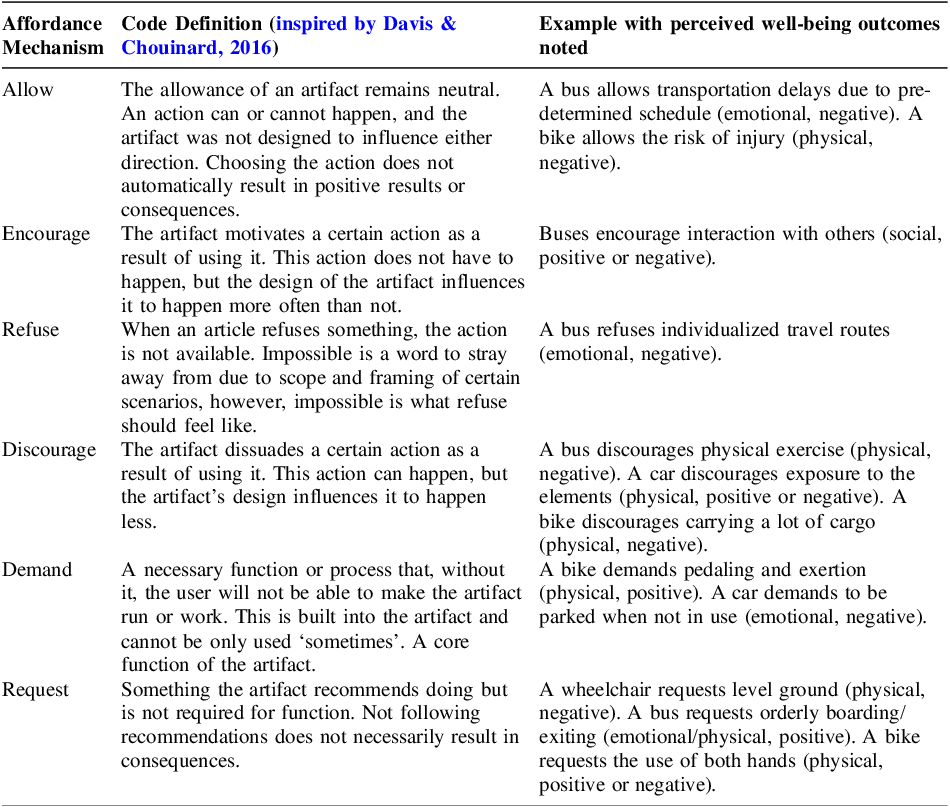
Phase 2 involved evaluating all units of analysis to identify mechanisms of affordance that linked the transportation mode to perceived well-being. Our codebook was inspired by Davis and Chouinard’s framework, which categorizes affordance mechanisms into request, demand, allow, encourage, discourage, and refuse (Reference Davis and ChouinardDavis & Chouinard, 2016). To identify these mechanisms of affordances, one coder went through each unit of analysis and analyzed the participant quote to identify the mechanism affording the well-being outcome. All codes were discussed by multiple study team members using a negotiated approach to decide which code represented the primary affordance mechanisms linking the transportation mode to the perceived well-being outcome. It is important to recognize that the mechanisms of affordance can be interpreted from different perspectives. For instance, a car may demand a key to start the engine, but it can also be seen as refusing to start without one. To address such nuances, we chose the mechanism based on the designer’s intent for the artifact (i.e., the goal of the function). A wall is designed with the intent to block you from going through, designed for refusal. While a car engine demands a key to start. This method helped designate which mechanism would be applied to different scenarios.
Out of 241 total instances, 8 units were removed from analysis due to the participant quote’s lack of detail. We started with the definitions outlined by Davis and Chouinard but modified and added detail as we applied them to our dataset. Table 1 provides definitions and examples of affordance mechanism definitions used in our analysis.
Mechanisms of affordance used in analysis

4. Results
Our analysis identified 233 instances of well-being outcomes linked to transportation methods via affordance mechanisms. All affordance mechanisms from Davis and Chouinard’s framework were present in our data, and no additional mechanisms were identified beyond those outlined in the framework. Demand and allow had the most negative instances totaling all the well-being categories and modes, with a tied total of 41 and 41 negative perceptions, respectively. For positive perceptions, encourage had 62 instances, including all transportation modes and outcomes, with the following highest mechanism being demand with 23 positive perceptions. Figure 3 illustrates how the affordance mechanisms appeared in our data, including the associated transportation methods and perceived well-being outcomes. The Y-axis represents the number of instances where a well-being instance occurred, with positive and negative outcomes characterized by descriptions from the transcripts. This graph displays mode-specific, mechanism-specific insights, and the relationship between modes and well-being outcomes. For example, the mechanism encourage with a positive emotional outcome shows the highest number of instances with various modes of transportation. Contrastingly, the mechanism allow shows many negative emotional instances using many modes of transportation. Importantly, Figure 3 does not intend to make any claims about specific transportation modes, but visually shows the connection between artifacts, affordance mechanisms, and well-being outcomes.
Results of analysis of affordance mechanisms as links between transportation modes and positive and negative well-being outcomes

5. Discussion
Our findings demonstrate that affordance mechanisms can be analyzed and identified in the design of artifacts and linked to well-being outcomes. As such, we propose a framework for supporting engineering designers by encouraging positive well-being outcomes while mitigating negative ones. Specific mechanisms, such as request, demand, and encourage, can be used to promote positive well-being. For instance, behaviors associated with positive well-being outcomes could be encouraged, demanded, or requested, motivating individuals toward those outcomes. As an example, encouraging interaction with others (through public transportation design, shared and accessible forms of transport, or others) could improve community and relationships, having a positive impact on social well-being. On the other hand, mechanisms like allow, discourage, and refuse can be used to mitigate negative well-being outcomes. If a particular artifact has a known negative consequence, discouraging or refusing that behavior through the design could help mitigate these adverse effects, ensuring that the artifact primarily produces positive or neutral results. It is important to note that the mechanism of allow is often associated with negative outcomes because it maintains a neutral stance, letting undesirable consequences to occur. By categorizing allow with negative outcomes, we emphasize the importance of recognizing what the designer is permitting and its implications for both the artifact and its well-being outcomes. Designers should continually evaluate any negative well-being outcomes their artifacts allow and identify design changes that could minimize potential negative outcomes. Prior research has identified key types of decisions that designers can adjust to influence broader outcomes within their engineering design process (Reference Burleson, Wojciechowski, Toyama and SienkoBurleson et al., 2024). These include the problem scope (e.g., identifying target market, context, and design criteria), detailed design (e.g., specific functions, materials, geometries), and implementation (e.g., user provision model, maintenance requirements).
Figure 4 presents the potential advantages of applying affordance mechanisms during design processes. The left-most image in the figure illustrates the concept of well-being, which is categorized into three specific areas included in this study. By positioning well-being as the initial focus, we emphasize its potential role in shaping both design outcomes and design choices. The proposed framework prioritizes well-being by demonstrating how affordance mechanisms can be intentionally selected to enhance it. When applied effectively, these mechanisms serve as strategic tools that guide design decisions, ultimately leading to outcomes that align with well-being goals and improve the overall human experience. This framework promotes a comprehensive approach to design, where the well-being of users is a primary consideration in the decision-making process. By doing so, we advocate for designs that not only fulfill functional and safety requirements, but also contribute positively to the health and quality of life of people.
Affordance mechanisms used to promote and mitigate positive and negative well-being outcomes, respectively; and their potential to influence different design decisions

Although affordance theory has existed since the late 1960s, its potential to proactively shape well-being outcomes during design practice remains underexplored compared to other theories. By applying the updated framework by Davis and Chouinard that includes affordance mechanisms, we extend this theory beyond user-object interactions to systematically analyze how design choices influence perceived well-being. Our results demonstrate that this framework can be used to evaluate well-being outcomes of artifacts and tie the well-being outcome to a specific design feature. Focusing on affordance mechanisms and their potential well-being outcomes could lead engineers to approach design with more knowledge of benefits and stressors.
Negative mechanisms (shown in red in Figure 4) can be altered if a designer fully understands their potential impact on well-being. For example, many negative instances from our data that were associated with allow were related to dangers on bikes and walking. Walking through a crosswalk allowed potential physical danger because of the proximity to cars and the inherent strength difference between humans and vehicles. The same argument was made for bikes. During the traditional bike design, function is valued with technical specifications on speed, efficiency, material, price, and more. Considering a more widespread scenario of a bike user and all the interactions the user faces when interacting with the bike, could open more solutions to other non-technical problems. Because we have seen that artifacts with clear affordances directly impact well-being, this could be used to assess current artifacts and, even more, used in the design process before an object is deployed. For example, by designing a bus that encourages positive outcomes by considering social outcomes (the public space experience), mental health outcomes (experience on the bus), and physical outcomes (accessibility and ergonomics) in the design process will be more tailored in influence well-being as a whole. Using these affordance mechanisms in design could lead to well-being outcomes being planned and influenced before they occur. For example, a common mechanism and well-being outcome in our data was a car demanding parking, causing negative emotional outcomes associated with frustration, anger, and annoyance. Although this paper does not study solutions for these outcomes, it is clear to speculate that considering parking in the design of cars and urban planning could alter or influence the well-being outcomes. As we interact with so many artifacts daily, controlling the outcome of well-being because of the object has not been studied much. By applying this theory in the design process, we could use it to design artifacts with outcomes we are aware of to promote well-being.
5.1. Future work
Conditions represent a critical second step in affordance theory (Reference Davis and ChouinardDavis & Chouinard, 2016), incorporating the diverse circumstances through which the mechanisms occur. Conditions shape how an affordance is perceived and experienced and are influenced by factors such as physical capability and cultural background. Indeed, individuals interact differently with artifacts based on their unique experiences and characteristics, resulting in variations in affordance realization. In future work, conditions can be applied in the analysis to understand the broader impact of artifacts depending on individual and contextual factors.
While this work holds potential for integration into design practice, certain mechanisms prove challenging to control, even with an understanding of their outcomes. A common drawback of riding a bike is the risk of collisions with others. Although improvements in bike lanes or safer routes can help mitigate encounters with vehicles, navigating around pedestrians and fellow cyclists, present bike users are not affected by that change and can become a significant challenge in bike-specific design. This constrains the extent to which design can influence various outcomes, especially when variables are linked to an artifact that is not necessarily the root cause. Future work is needed to explore the extent to which our findings can be used to support designers in improving outcomes.
5.2. Limitations
Our study analyzed transportation artifacts using affordance mechanisms to uncover relationships between design and well-being. Our investigation had a limited scope: the perception of well-being outcomes from transportation modes used by 20 U.S. university students at a single campus. Future work should explore the experiences of different populations and different designed artifacts and engineering domains. We did not validate the proposed framework; future work should investigate the process for designing mechanisms into technologies and its effect on individual and collective well-being.
6. Conclusion
We set out to investigate the potential for affordance mechanisms to be used in the design of artifacts to support well-being outcomes. As part of our larger efforts to develop methods and tools to support engineering designers, we also presented an initial framework for using affordance mechanisms to contribute to key design decisions to support positive well-being outcomes and mitigate negative ones. Applying affordance theory to future design standards could create better, more known well-being outcomes for users interacting with artifacts daily. As the artifacts we interact with daily influence us physically, mentally, and socially, they directly affect our well-being. Designing without considering the outcomes that reach past function may be one reason many technologies negatively impact people. Our study also highlights the value of integrating social science theories and methods into engineering design to better understand and address the complex interactions between technical artifacts and their society impacts. This interdisciplinary approach encourages the development of engineering solutions that extend beyond functionality to align with broader human and societal needs. By applying affordance theory within design processes, we promote a more human-centered approach that prioritizes equitable, sustainable, and contextually-informed engineering outcomes to produce intentional well-being outcomes.




 Open access

