


The goal of the Clinical and Translational Science Awards (CTSA) Consortium, in partnership with the National Center for Advancing Translational Science (NCATS), is to bring more treatments to all people more quickly. An emerging focus for NCATS is translational science (TS), the field that addresses longstanding scientific and operational challenges through innovations that transform the way research is conducted, making it faster, more efficient, and more impactful [Reference Austin1, 2]. Another key activity is translational research (TR), which is the endeavor to traverse a particular step of the translational process for a particular target or disease [Reference Rubio, Schoenbaum and Lee3]. Over the past few years there has been debate and confusion about the definition of these terms [Reference Kim, Marantz, Suadicani, Milman and Keller4].
To address these concerns, a session was held during the CTSA Administrators Consortium Committee’s annual meeting on November 13, 2024, to discuss ongoing efforts to better define TS and TR. Drawing on concepts of nominal group technique (5), Administrators summarized the current understanding, brainstormed about best practices, and discussed what kind of concrete products could be developed to clarify the differences between these concepts. The group split into approximately 10 tables and deliberated on what (1) educational resources, (2) written guides, (3) coaching and navigation, (4) directed tools and templates, and (5) other deliverables that may be helpful to elevating a shared understanding. Ideas were captured on sticky notes and compiled by session organizers.
After the annual meeting, a work group formed to analyze the information and to propose a useful product for the consortium. This analysis illustrated significant efforts across hubs in developing learning instruments and signaled the opportunity to coordinate such assets and make them discoverable. The group decided to create a database of educational materials that describe TS, translational research, and the differences between the two. The team briefed the CTSA Administrators on this effort and asked them to list educational resources and activities at their hubs related to TS and TR. An editable document was shared by email and discussed at the December 2024 and February 2025 Administrators meetings. Individuals were asked to provide a brief description of the asset, its purpose, relevant URL, utility or effectiveness to date, CTSA institution, contact person, and contact email.
Appreciating that other consortium groups were doing complementary work, sub-committee members leveraged existing roles and relationships to liaise with Evaluators, Workforce Development, and Quality Assurance/Quality Control (QA/QC) groups. This outreach was critical to avoid duplicate effort, allowing the team to discover what others were doing and how we could coordinate efforts. The crowdsourcing process was repeated with these groups between May and July 2025, which enhanced coverage and saturation of the list of resources and activities.
The initial response included 87 entries from 31 CTSA Hubs. Nine hubs were in the East, eight in the South, and seven each in the Midwest and West. Individual hubs contributed 1–14 resources to the database. A full list of participating institutions is found in column G of the Google sheet [Reference Hafer, Cielo and Duguid7]. Members of the committee reviewed and curated the entries for relevance, accuracy, duplication, and completeness. Committee members performed targeted outreach to hubs to complete or correct information. Once complete, committee members reviewed all entries and voted to include or remove items. Entries with a unanimous vote to remove were taken off the list. Committee members discussed and ultimately decided that this phase of work would focus on creating a compendium of educational resources that define TS, TR, and the differences between them. The group decided that a comprehensive evaluation of the content and perceived effectiveness was beyond the scope of this project.
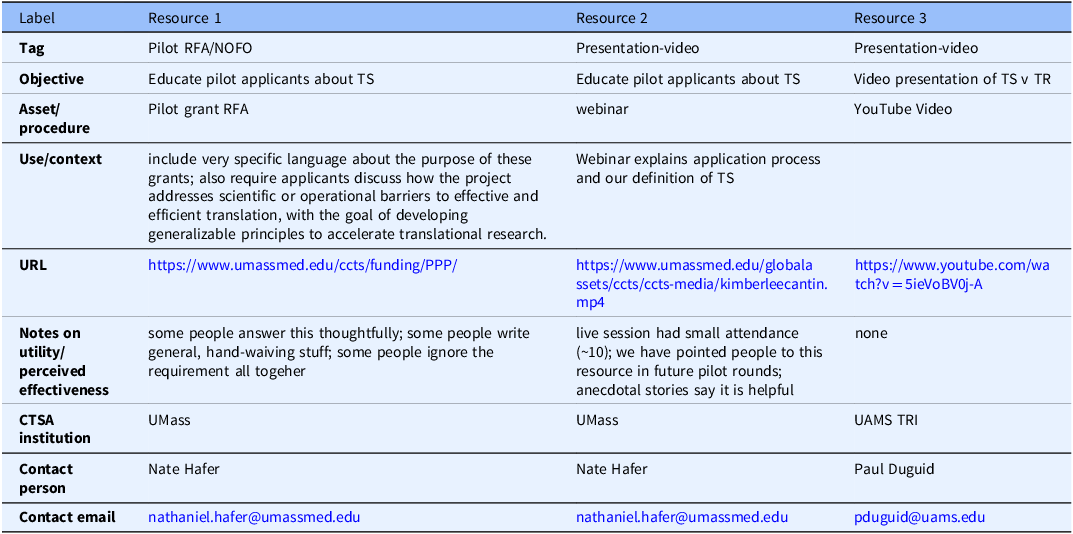
The final work product was deposited on the Coordination, Communication, and Operations Support (CCOS) website for long-term storage. The database and documents folder are also openly accessible via the internet (6–8, Table 1). The CCOS site provides a password protected, stable home for this resource. To help improve the usefulness of this resource, documents available as PDFs were downloaded into a database so they can be found even if their URLs change. In addition, the name of the institution, person, and email address contributing the resource was included with each item. The authors have further disseminated this resource by making presentations to CTSA consortium groups and the upcoming 2026 Association and Clinical and Translational Science meeting.
Sample content presented in the translational science/Translational research resource repository. The full table is available at https://docs.google.com/spreadsheets/d/1t5q53iCdUM2AXDne7Kk7oTWnogO8hOHj85q91WmwQZI/edit?gid=0#gid=0

Table 1. Long description
Resources in the research respository are tagged with the following information to help individuals locate relevant material: Tag, Objective, Asset/Procedure, Use/Context, URL, Notes on utility/perceived effectiveness, CTSA institution, Contact person, Contact email
The authors hope that this resource will provide the clinical and TS community, especially those involved in administration, evaluation, pilot grants, and educational programs, with materials to describe the meaning of TS and TR and how each contributes to scientific advances that improve health for everyone.
Author contributions
Nathaniel Hafer: Conceptualization, Formal analysis, Investigation, Methodology, Project administration, Supervision, Validation, Writing-original draft, Writing-review and editing: Karen Cielo: Investigation, Methodology: Paul Duguid: Investigation, Methodology: Mendy Dunn: Investigation, Methodology: Maryam Gholami: Formal analysis, Investigation, Methodology, Validation: Kristi Holmes: Investigation, Methodology: Joe Hunt: Investigation, Methodology: Cathleen Kane: Conceptualization, Investigation, Methodology: Patricia Moussatche: Investigation, Methodology, Validation, Writing-original draft: Christy Navarro: Investigation, Methodology, Validation: Brittney Patterson: Investigation, Methodology: Alfred Vitale: Investigation, Methodology: Jennifer Croker: Conceptualization, Investigation, Methodology, Project administration, Supervision, Validation, Writing-original draft, Writing-review and editing.
Funding statement
The authors report funding support from the National Institutes of Health grants UL1TR001445, UL1TR001453, UL1TR001860, UL1TR002377, UM1TR004402, UM1TR004771, UM1TR004909, UM1TR004921, UM1TR004929, UM1TR005121, UM1TR005128, UM1TR005438, and UM1TR005449. The funding agencies had no role in the conceptualization, design, data collection, analysis, decision to publish, or preparation of the manuscript.
Competing interests
None.

 Open access

