


Around 1814, Prussian architect and painter Karl Friedrich Schinkel (1781–1841) created an imaginary view of the Mausoleum of Halicarnassus, intended as the preliminary sketch for a large-scale painting that was to be publicly exhibited in Berlin as part of a Seven Wonder diorama entitled Zyklus der Sieben Weltwunder. The first exhibition of the series took place that same year in Carl Wilhelm Gropius’s so-called Optisch-Mechanisches Figurentheater in Berlin. Dioramas were primarily a commercial venture, serving purposes both of entertainment and public education. Very few of the numerous views created by Schinkel for these projects have survived, nor are any comments on these works by the architect known to us. Many motifs from the dioramas can, however, be reconstructed on the basis of descriptions as well as surviving preliminary drawings: fortunately, several contemporary copies of the large tableaux of the Zyklus der Sieben Weltwunder were found a few years ago in the Russian Academy of Arts Museum in St Petersburg, including the view of the tomb of King Mausolus in Caria based on Karl Friedrich Schinkel’s preparatory sketch.
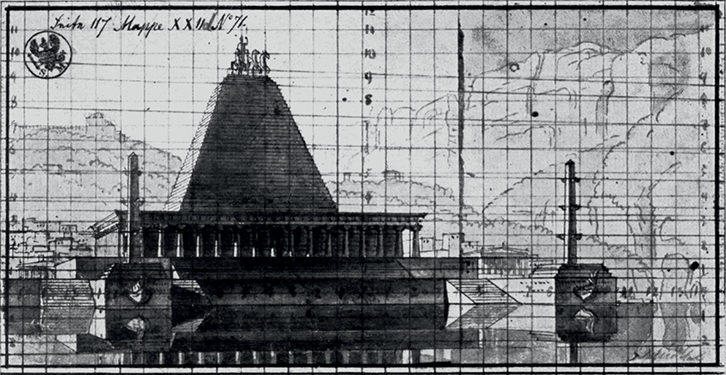
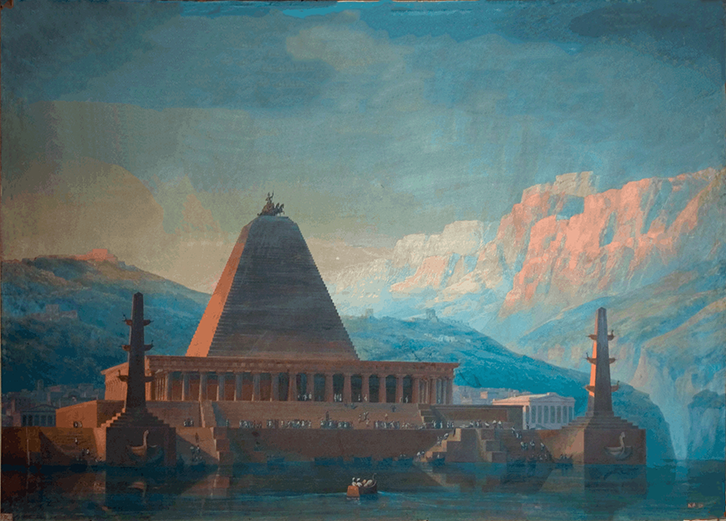
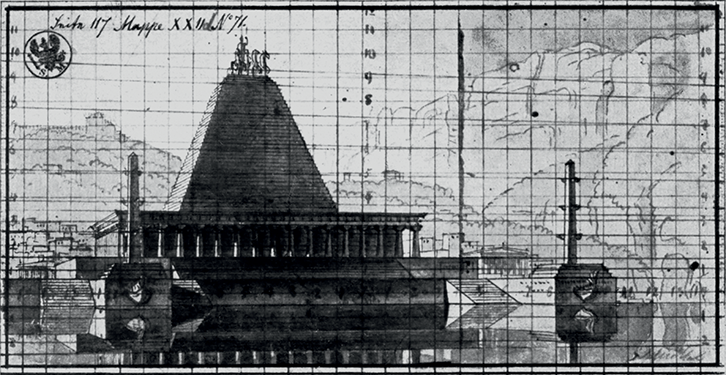
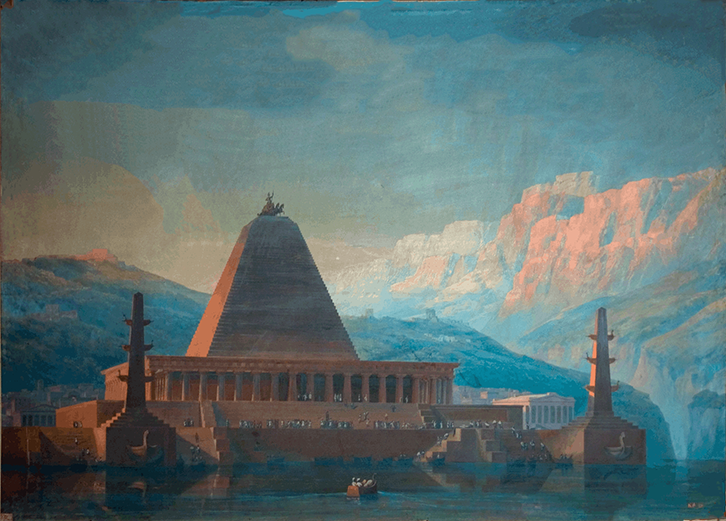
Schinkel made his preliminary sketch for a painting entitled Grabmal des Königs Maussollos in Karien around 1814 (Fig. 13.1). This sketch, as well as a painting by Carl Wilhelm Gropius based on Schinkel’s composition (Fig. 13.2; now in the Russian Academy of Arts, St Petersburg, Ж-2804), are the only surviving representations of his view of the Mausoleum that was presented to the Berlin public as part of a diorama on the Seven Wonders. The sketch – possibly from Schinkel’s hand – was lost during World War II and is only known to us today through a small photographic reproduction in a publication from 1939.Footnote 1 The Mausoleum’s reception, which had been defined by regal, aristocratic and religious strands during earlier centuries, had now been secularised: Mausolus’s tomb had become an object presented to the popular gaze. Although the notion of permanence had repeatedly been invoked throughout the Early Modern afterlife of the Mausoleum, the story of Schinkel’s sheet and its by-products – both through their initial purpose and ultimate fate – is instead characterised by transience and destruction. The present chapter will examine the complex life and reception of this group of works, themselves part of the broader afterlife of the tomb of Mausolus, as well as their architectural and pictorial design and significance. Firstly, Schinkel’s lost drawing must be discussed, examining both the circumstances of its creation and our knowledge of its content,Footnote 2 whereupon I would like to contribute observations, suggestions and speculative statements of my own.
Karl Friedrich Schinkel (c. 1814). Grabmal des Königs Maussollos in Karien.
Carl Wilhelm Gropius [after Karl Friedrich Schinkel] (1847). [The Mausoleum of Halicarnassus], from a diorama of the Seven Wonders, glue paint, paper on canvas, 302 x 231 cm (119” x 91”).
Schinkel’s view of Mausolus’s tomb was one of his preliminary drawings for a diorama consisting of large-format paintings showing a cycle of the Seven Wonders of the World. Dioramas had emerged from the presentation of shopwindow decorations, which had originated in the context of the so-called Christmas exhibitions that enjoyed great popularity in Berlin around 1800:Footnote 3 these attractions included large-format paintings, whose highly varied subject-matter was sometimes complemented by still or moving tri-dimensional figures, animals and so forth. The lighting of the scenes was also carefully arranged, although the technical details of their installation and of the movement of the figures remain unknown. These decorative scenes, mostly serving confectioners, booksellers and toy stores to stimulate Christmas trade, were not intended for permanent exhibition, nor was there any desire to preserve them. Therefore, the main historical sources available are mostly descriptions or advertisements in contemporary newspapers, which convey an overview of the subject-matter that was favoured and of the modalities according to which these images were viewed: interestingly, Christmas motifs were infrequent, despite the festive context. The shopkeepers’ decorations, of course, emerged contemporaneously with the presentation of painted prospects, picture cycles and panoramas as an independent business model, presented for a fee in selected rooms or even purpose-built structures. These spaces were then increasingly referred to as dioramas.Footnote 4
Schinkel was one of the very rare artists of distinction who participated in what has been described as a ‘harmless form of popular art’,Footnote 5 and many of his works in this medium have disappeared, therefore being presently known only through copies by other painters and occasional sketches by Schinkel himself. Much of our knowledge concerning his work on dioramas stems from contemporary textual descriptions. This circumstance is largely due to the ephemeral nature of the medium: paintings were usually executed using distemper on paper, and contemporary sources often mention damage to the works, additions, decay and the need to copy scenes in order to preserve them. Dioramas – thematically coherent series of large-format paintings – and panoramas – circular-planned paintings surrounding the beholders and offering them an immersive experience – were both closely related to the craft of set design. Together they formed a genre that provided a dramatic presentation of educational and documentary imagery, and it might be argued that they were among the precursors of cinema. Karl Friedrich Schinkel’s earliest attempts in this medium, which met with great success, date from 1808. Working together with his friend Gottfried Steinmeyer, he initially presented a cycle of four ‘perspective-optical pictures’ with ‘representations of remarkable buildings and natural features’,Footnote 6 which were later supplemented by two further panels. The subjects depicted were outstanding monuments and natural scenes conducive to intense experiences: the first four panels were The Swiss Valley at the Foot of Mont Blanc; The Cathedral of Milan; The Eruption of Mount Vesuvius near Naples; and The Illumination of the Dome of St Peter’s Church in Rome; to which were later added St Mark’s Square in Venice and The Sea Caves near Sorrento.Footnote 7
Presenting paintings in public for a fee was quite common in Berlin, but other aspects of the show were a novelty, such as the thematic arrangement of several large-format paintings and the introduction of lighting effects, hitherto known only from the aforementioned Christmas exhibitions. An unknown writer praised the exhibition in the Berlinische Nachrichten of 28 December 1808, crediting Schinkel with the invention of a new type of illusionary art – different from the more common circular panoramas – and emphasising that this type of presentation promoted the dissemination of ideas and knowledge.Footnote 8 The dioramas thus simultaneously served the purposes of pleasure, business and cultural education. This comment was merely one among the Berlin public’s many appreciative encounters with Schinkel’s diorama. Even the Prussian royal couple visited the exhibition, and Schinkel made his name as a painter in Berlin thanks to these installations whose invention had been ascribed to him (he was not, however, the actual inventor of the diorama: in 1801, Viennese painter Lorenz Schönberger had already presented six ‘optically moving paintings’Footnote 9 to the public). Yet the architect’s endeavours occasionally met with contempt, above all due to perceptions that he was wasting his talent. The famous poet Achim von Arnim thus wrote to his friend Clemens Brentano, a patron of Schinkel, about the diorama paintings: ‘[Schinkel] is hard-working, but unfortunately still does too much for Grophius [Carl Wilhelm Gropius, the director of the diorama exhibitions in which Schinkel partook] and similar filth.’Footnote 10 Little more is known about this first cycle, since the pictures and their preliminary sketches are now lost, and though Schinkel had visited the sites depicted in the cycle during his Italian journey, he did not include these scenes in his sketchbooks.Footnote 11
Architectural historian Helmut Börsch-Supan has noted Schinkel’s interest in the theatre, particularly in the production of stage sets, and argued that his first diorama cycle of Italian landscapes, as well as his numerous subsequent works in this genre, likely served to demonstrate his talent as a stage painter.Footnote 12 Schinkel was always drawn to the theatre: in 1813, for instance, he applied to the director of Berlin’s Nationaltheater, August Wilhelm Iffland, for the position of stage painter, despite his burgeoning career as an employee of the Technische Oberbaudeputation, the Prussian building authority. After his early success with the Italian landscape diorama, he created a popular circular panorama of Palermo and three more series of large-scale paintings, including the Seven Wonders group. The first exhibition of the Zyklus der Sieben Weltwunder (Cycle of the Seven Wonders) took place in 1814 in the Optisch-Mechanisches Figurentheater in Berlin. The founder of this purpose-built exhibition space, Carl Wilhelm Gropius, was a trained landscape and decorative painter. According to his own account, he was also involved in creating the paintings based on Schinkel’s drafts. Due to the rapid deterioration of the works, copies were made in the 1840s, and subsequently sold to St Petersburg, where they were exhibited in 1848. They were long believed to have been destroyed by fire, until some of the tableaux – including the Grabmal des Königs Maussollos in Karien (The Tomb of King Mausolus in Caria) – were identified only a few years ago in the Russian Academy of Arts Museum.
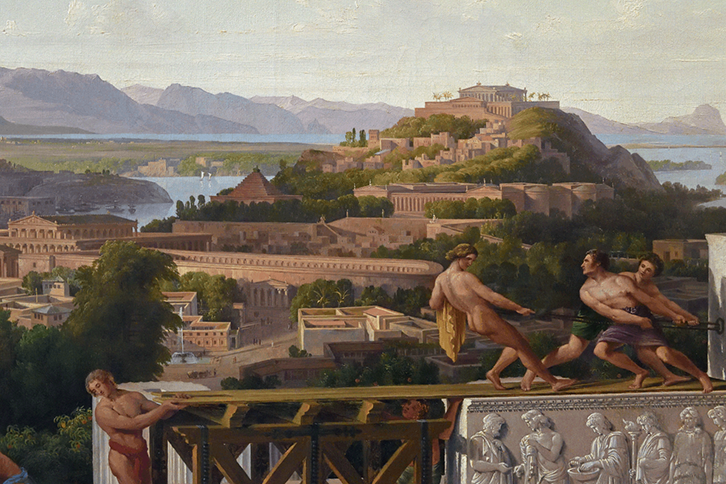
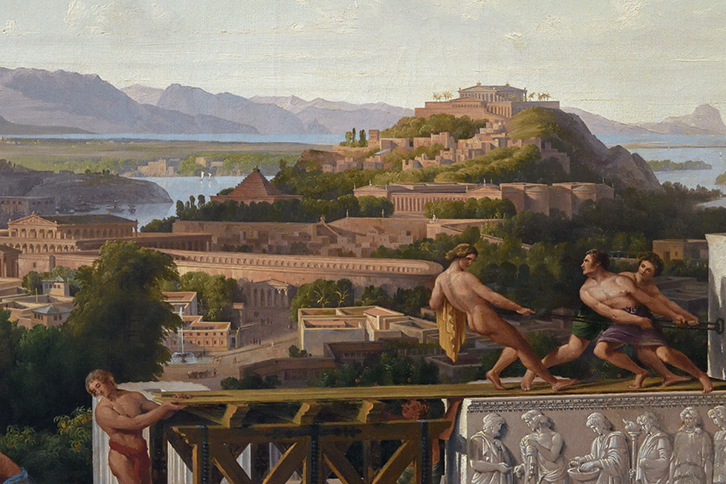
Schinkel’s preliminary drawing for the Mausoleum image was recorded in an early catalogue of his works by his son-in-law Alfred von Wolzogen,Footnote 13 and reproduced in art historian Carl von Lorck’s Reference von Lorck1939 biography of Schinkel.Footnote 14 These two sources contained the most detailed research on Schinkel’s Mausoleum until Ekaterina Skvortcova’s recent study on the rediscovered copies from the Russian Academy of Arts. Skvortcova attributes their execution to Carl Wilhelm Gropius, discusses the process of translation leading from Schinkel’s drawings to Gropius’s paintings, and makes compelling suggestions regarding the presentation of the diorama in St Petersburg.Footnote 15 Overall, however, the available sources regarding Schinkel’s vision of the Mausoleum remain scant: a low-quality photographic reproduction of the architect’s drawing, and a painted copy of this sketch (possibly a copy of a copy, if the St Petersburg painting is based on Gropius’s earlier diorama rather than on Schinkel’s original drawing). Despite the scarcity of these surviving records, Schinkel certainly entertained a lasting interest in the Mausoleum, for he also included it in another, much later painting: the monument, or at least its stepped pyramid, appears in his Blick in Griechenlands Blüte (1824–1825; Fig. 13.3), another large-format painting that has survived only as a copy, this time by painter August Wilhelm Julius Ahlborn (1836).Footnote 16
August Wilhelm Julius Ahlborn [copy after Karl Friedrich Schinkel] (1836). Blick in Griechenlands Blüte, oil on canvas, 94 x 235 cm (3’1” x 7’9”).
The circumstances, execution and remaining documentation concerning Schinkel’s vision of the Mausoleum thus having been established, the pictorial and architectural content of his image can now be examined. Since these early nineteenth-century works in ephemeral media functioned like stage sets rather than canvas paintings in their visual presentation, the perspective was usually constructed particularly accurately, with the purpose of drawing the beholder’s gaze into the fictional space of the picture. This entailed that close attention had to be paid to the level of the viewer’s eye in relation to the composition: in the view of the Mausoleum, the horizon is in the lower quarter of the picture, which indicates that the painting was probably placed at about 5 feet above floor level,Footnote 17 thus allowing the public to experience a visual immersion into the space created by the perspective. Moreover, these large-format paintings were often illuminated according to the light source present in the painting itself, an effect that would further contribute to the desired illusion. Such concerns, which aimed at dazzling a broad public of ticket buyers, are very different from contemporary scholarly investigations into the Mausoleum’s appearance and attempts to create an accurate representation of its form, which often resulted in sets of dry, orthogonal architectural drawings: Schinkel’s colourful perspective image should thus not be viewed primarily as a serious reconstruction of an ancient Wonder by one of the most gifted architects of the nineteenth century, but rather as a fantasy which draws inspiration from Antiquity in entirely different ways, as will be shown through a discussion of its architecture.
Although Schinkel’s representation of the Mausoleum consists of elements familiar from earlier reconstructions – a stepped pyramid on a colonnade – he has combined, into a compound composition, individual elements that appear largely independent from one another. A large peristasis surrounds the central pyramid on all sides, clearly standing as a separate architectural feature from the solid central block. In the drawing, each side has seventeen columns: this would have been unusual for an ancient Greek monument, since few original temples are fronted by an odd number of columns, an arrangement that necessarily implies the presence of a column in the central axis of a building, impeding movement. In fact, Gropius’s St Petersburg copy reveals that he added an eighteenth column to the colonnade, thus correcting what he may well have considered a mistake on Schinkel’s part. One might wonder whether this correction is a direct expression of contemporary debates on classicism, in which Schinkel was of course involved. However, further evidence remains lacking: one must not forget that the appearance of the original painting – on which the St Petersburg copy is perhaps based – remains unknown, and that the preliminary drawing presented here was not necessarily the only version that existed.
This discussion ultimately concerns Schinkel’s fidelity to accurate historical information: on this matter, it can be deduced from other sources that he did not conceive of ancient architecture as a repertoire of templates, but rather as the visible expression of underlying ideas that were far more important to his work. As he wrote in the so-called Hirt Polemik, simple copies of ancient buildings were of no interest to his pursuits: ‘The same building [copy] as the ancients cannot suit us. And one cannot understand the deep spirit of the ancients any worse … than by abasing oneself to mean imitation.’Footnote 18 Carl Wilhelm Gropius was certainly not more intent than Schinkel on seeking accuracy in the representation of ancient monuments; however, his reasons and outlook would have been different from the architect’s: being a painter and an entrepreneur, he chiefly wished to entertain a wide audience, since his income came from effect-laden displays rather than from the visual communication of academic discourse. His copy of Schinkel’s Mausoleum with an even number of columns was thus probably a simple response to the visual habits, common in his early-nineteenth-century public, which associated ancient architecture with symmetry and order.
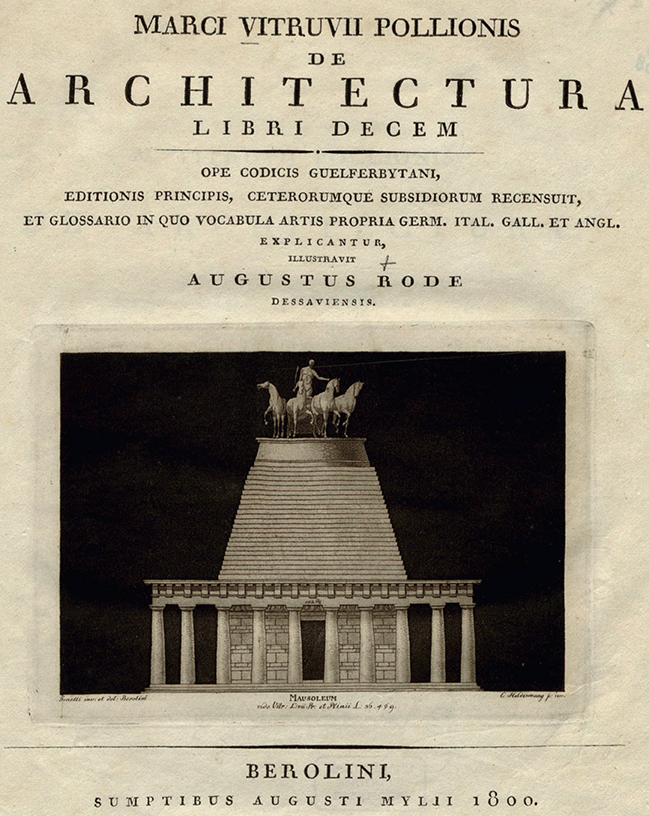
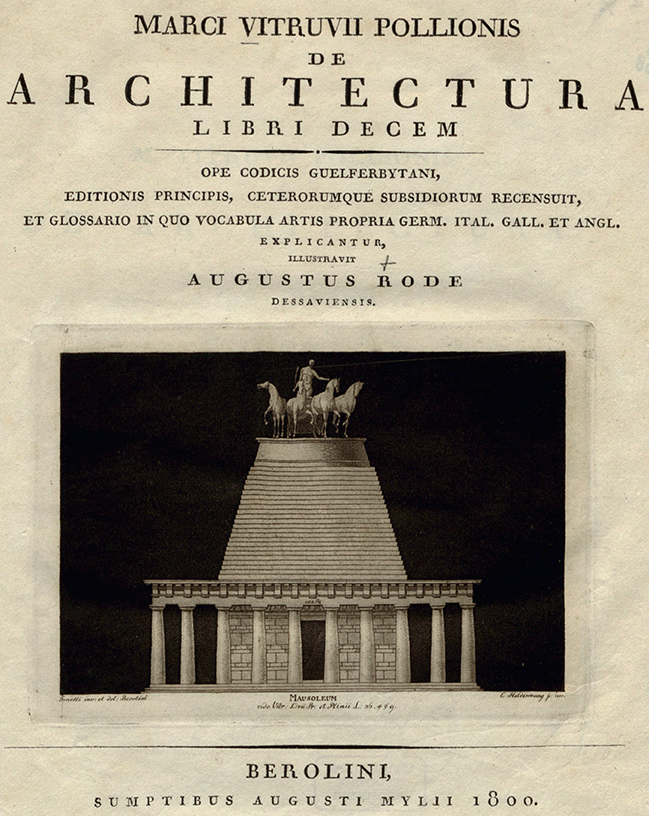
Despite Schinkel’s representation of the Mausoleum laying no claim to scholarly accuracy, its design does bear witness to the architect’s familiarity with a similar reconception of the ancient Wonder. This image features on the frontispiece to an edition of Vitruvius published by August Rode in 1800, which bears a vignette in which German architect and antiquarian Hans Christian Genelli depicted a Mausoleum that is clearly recalled by Schinkel’s painting (Fig. 13.4). This also applies to Friedrich Weinbrenner’s interpretation of the Carian tomb, which circulated among German antiquarians and artists in Rome in the early 1790s and seems to have provided the model for Genelli’s reconstruction (Fig. 12.5).Footnote 19 These instances reveal that a general idea of the Mausoleum as a prismatic and pyramidal structure – also followed by Schinkel – dominated several German-speaking architects’ reimaginings of the Mausoleum around 1800. Weinbrenner, Rode and Genelli clearly regarded their reconstructions as scientific, and hinted at the existence of a burial chamber or even made proposals regarding the latter’s possible plan.Footnote 20 If we assume that Schinkel used these models as a basis for his design, regardless of his rather free interpretation, we can also presume an accessible interior in Schinkel’s Mausoleum.
Hans Christian Genelli and Christian Haldenwang (1800). Mausoleum, in A. Rode (ed.), Marci Vitruvii Pollionis De architectura libri decem. Berlin: Augustus Mylius, frontispiece.
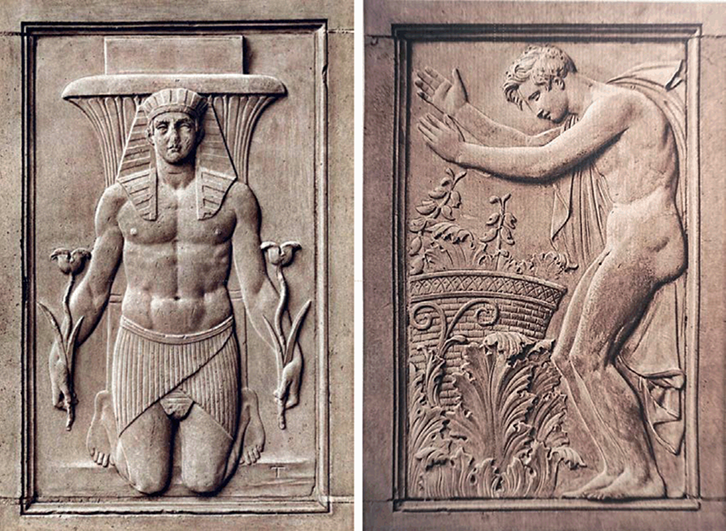
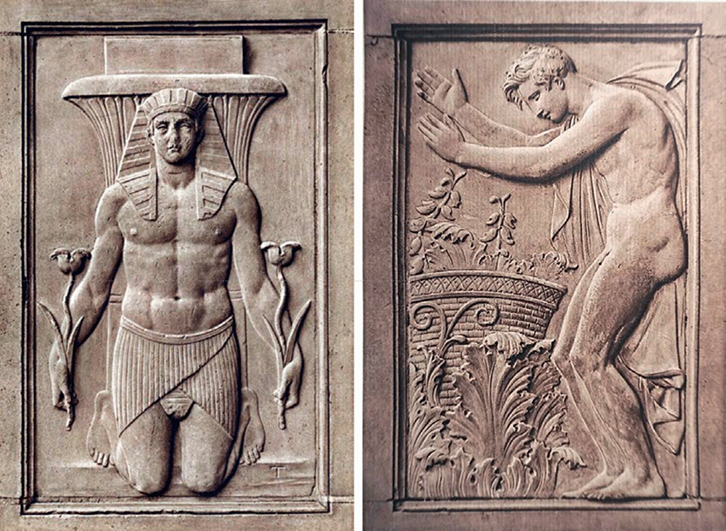
Contrary to his more scholarly colleagues, Schinkel did not follow Pliny’s and Vitruvius’s descriptions in his representation of the Mausoleum (for instance, the number of columns is wrong, and so is the position of the monument right beside the sea). Nevertheless, both his somewhat fantastical vision and the more accurate contemporary attempts reveal an interest in the symbiosis of the Greek peristasis and the Egyptian pyramid in the Mausoleum, to which Schinkel also adds two obelisks. Such a fusion of different building traditions is frequent in French and international neoclassical architecture of the previous decades. An important point of reference, combining obelisks, staircases, porticos and temples into a new composition, is Friedrich Gilly’s competition entry for the monument to Frederick the Great (1796),Footnote 21 which is said to have made a deep impression on Schinkel, greatly encouraging the young man’s desire to devote himself to architecture. The question of the Egyptian influence on the Mausoleum of Halicarnassus had already been asked and Schinkel’s answer is unequivocal, for his conception of the development of art closely followed the system formulated by art historian Christian Ludwig Stieglitz. The latter argued that the Egyptians were to be credited with the invention of raw, elementary forms, which acted upon the beholder through the sensual effect of their masses. The works of the Greeks, arriving on the scene at a later date, would ‘delight and brighten’ by awakening the beauty and sensual content of these forms.Footnote 22 Schinkel later produced a public display of this historical vision in the architectural decoration of two terracotta reliefs placed at the entrance to his Bauakademie (Fig. 13.5). Here, side by side, one could observe the strict symmetry and rigidity of a pharaoh kneeling in front of an Egyptian capital, and the movement, lightness and joy of the Greek sculptor Kallimachos inventing the Corinthian order.
Karl Friedrich Schinkel (1832–1836). [Terracotta Allegories of Egyptian and Greek Architecture]. Pre-World War II photographs of in-situ terracottas from a portal of the demolished Bauakademie building in Berlin; originally published in Reference RaveRave (1939) 10 and Reference Rave14.
This engagement with the idea of ancient Greece and its architectural expression, which was certainly an important aspect of Schinkel’s and his public’s interest in the Seven Wonders, also pervades the setting imagined for Mausolus’s tomb. Indeed, Schinkel placed the latter in an ideal landscape dotted with ancient architecture. In the background rises a dramatic mountainous environment featuring several scattered temples, and possibly a palace or acropolis on the hill on the left side of the sketch. Contrary to all historical descriptions (particularly Vitruvius; see Appendix i.ii), Schinkel situated the Mausoleum of Halicarnassus directly by the sea, with an imposing staircase forming a transition with the surface of the water, on which the viewer seems to be approaching the tomb. The Mausoleum’s significance as part of an ancient cultural landscape is the chief concern here, as is echoed in one of Schinkel’s major works in painting,Footnote 23 his aforementioned Blick in Griechenlands Blüte (‘A View of the Flowering of Greece’, Fig. 13.3Footnote 24), in which the stepped pyramid of the Mausoleum rises in the centre of the composition, on the side of a small hill. The viewer, standing atop the entablature of a temple construction site, overlooks a valley filled with supposedly Greek buildings: this fictitious Hellenic city, including the Mausoleum and the foreground temple being erected on a hilltop, is very similar in its topography to the town in Schinkel’s Halicarnassus picture.
The two obelisks in the foreground of the latter, standing on pedestals jutting out into the water, may also have recalled other geographical and historical references. The warship rams adorning these features – effectively turning them into rostral obelisks – are reminiscent of the speaker’s tribune on the Forum Romanum, named the Rostra. The rams displayed on the Roman structure had been looted during the Battle of Actium, and thus symbolised naval victory, which Schinkel may well have wished to signify in his view of the Mausoleum: indeed, Queen Artemisia, who built the Carian tomb for her husband Mausolus, was also famous for having captured the Rhodian fleet. The rostral columns, flanking a colonnaded building overlooking the water, also recall Jean-François Thomas de Thomon’s new stock exchange on the banks of the Neva in St Petersburg, erected in 1810 on the model of the Temple of Poseidon in Paestum.Footnote 25 It is possible that Schinkel conceived this as an allusion to Prussia’s Russian allies in the war against Napoleon, since a year earlier, in 1813, an official military pact had been signed by the two nations, pledging to join forces against France.
*****
This comparison, revealing a possible connection between Schinkel’s imaginary Mausoleum and a contemporary building, naturally raises the issue of the relation between Schinkel’s preoccupation with the Seven Wonders and his own architectural work. Throughout his career, he designed several tombs, including one whose programme was similar in some respects to that of the Mausoleum, despite its far smaller dimensions: a free-standing memorial to the widely admired Queen Louise of Prussia, who had died in 1810. Schinkel proposed a Neo-Gothic chapel, emanating a melancholic and hopeful atmosphere, and drawing once more upon his explorations of dramaturgy in stage sets, picture cycles and dioramas.Footnote 26 This, of course, is markedly different from the architect’s conception of the Mausoleum, and neither did his other tomb designs refer to this supposed prototype of all monumental memorials. In fact, although the Mausoleum had been freely adopted in Christian contexts over the past centuries,Footnote 27 Schinkel – precisely in his description of the tomb of Queen Louise – explicitly rejected the adoption of classical architecture for sepulchral designs, instead deeming Gothic architecture more suitable for Christian buildings.
Precisely, it is interesting to note that Schinkel’s cycle of the Seven Wonders falls into a creative period that is often referred to as his ‘Gothic Phase’. Yet the very subject of his diorama – as well as the creativity it reveals in the handling of antique architectural languages – means that this period of Schinkel’s career must be re-evaluated as one in which he designed and experimented with a multi-layered repertoire of architectural forms. These wide-ranging investigations, in turn, likely provided the basis for his ulterior classicist phase:Footnote 28 indeed, Schinkel’s continuing interest in the Mausoleum is evident on several further occasions,Footnote 29 for example, many years later, in a sketch of a tomb visibly inspired by the ancient monument.Footnote 30 Ultimately, however, Schinkel’s Halicarnassus images should not be regarded as coherent historical research, but rather as a projection, a playful synthesis of various themes, architectural motifs and political circumstances: his Mausoleum sketch, though it may have contributed nothing at all to the evolution of scholarly research on the monument, is thus significant for understanding his own development as an architect.

 Open access