





One summer afternoon in Tbilisi, my friends Elizbari and Malkhazi, both native Tbilisians, and I bought some beer from a local store near Malkhazi's home in the hillside residential Tbilisi neighborhood of K'rts’anisi. For various reasons I can no longer recall, it would not do for us to drink in his home, so we randomly chose a deserted spot nearby: a patch of gravel next to a decrepit building with a large fallen tree, which afforded us a place to sit. Malkhazi surveyed our abject drinking spot, raised his beer in a heroic pose, and proclaimed: “Ortach'alis baghshi mnakhe, vina var!” (In the gardens of Ortachala see me, who I am!).Footnote 1 We laughed at the absurd poetic reference. It was a famous line from a Persian-style Georgian poem by the noble romantic poet Grigol Orbeliani. It was a mukhambazi, a genre of poetry emblematic of “Old Tbilisi” city poetry associated with a nostalgic Georgian mythology of the nineteenth-century colonial city, centering on the island gardens of Ortachala, the site of drunken feasting of typical Tbilisian street peddlers called kintos (Georgian k'int’o). The stanza goes as such:
We were not actually in Ortachala, but it was nearby, down the hill by the river (Fig. 1). I should also add, however, that the gardens of Ortachala are no more; they have long since been turned into a residential neighborhood, with the only remaining trace being streets named after erstwhile garden paths (kheivani, from Persian khiyaban, usually means a tree-lined garden path). Nor is Ortachala an island anymore; it has long since been connected to the mainland.
The public gardens of Tbilisi in 1867: (top) the theatrical gardens of the Kolonia district on the left bank along Mikhailovsky Boulevard; (middle) the central Qabakhi or Alexander Garden on Golovinsky Boulevard on the right bank; and (bottom) the island garden of Ortachala (Krtsanisi is to the left). 1867 Map, “Tiflis with surroundings,” no publisher information.
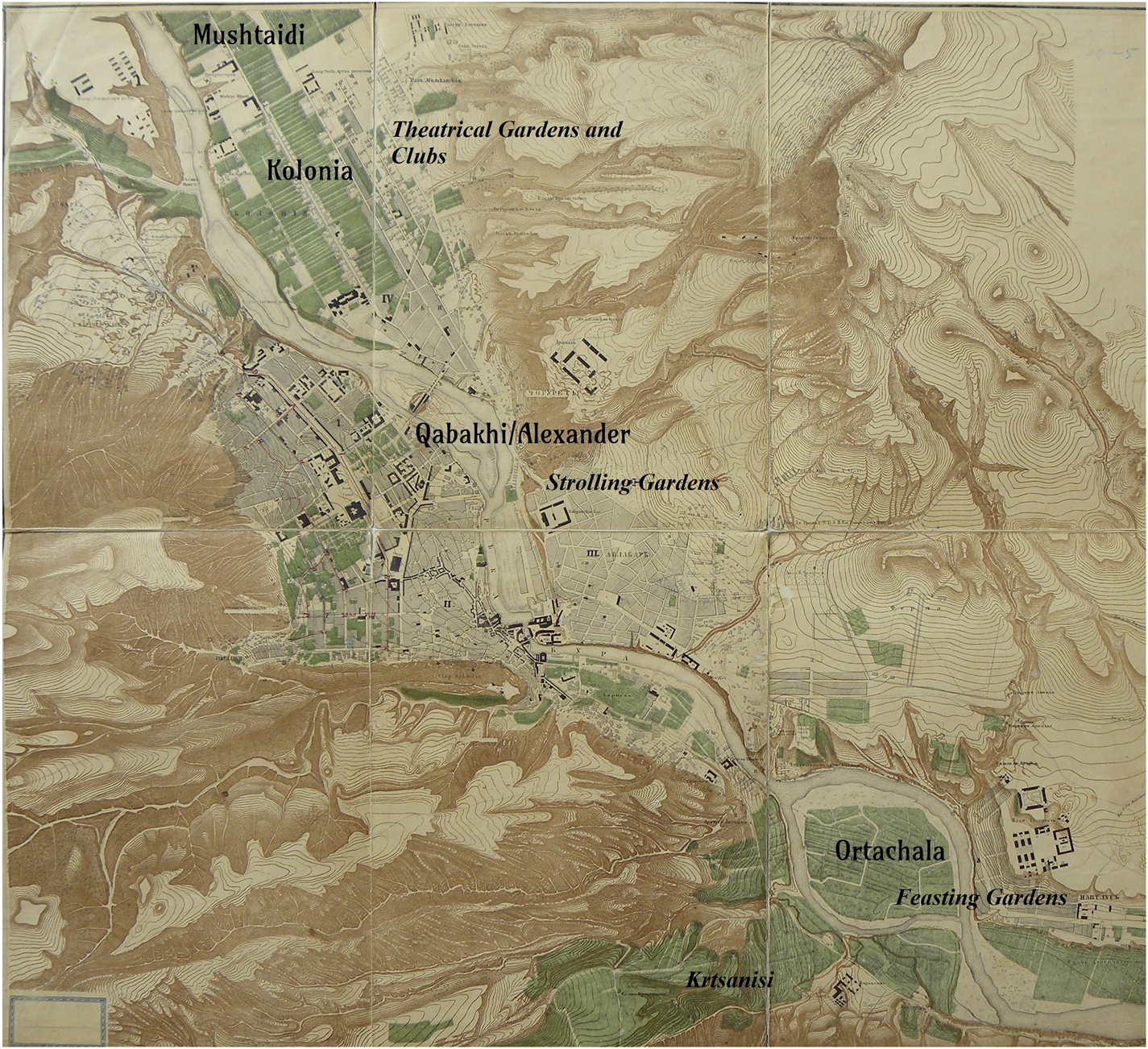
No longer a real place, the island gardens of Ortachala persist as a literary reference, a Bakhtinian chronotope, a bit of real space and time that has been assimilated into literature as a constitutive element of genre.Footnote 2 In its real and literary life in the nineteenth century, the island gardens of Ortachala represented, more than anything else, what Foucault suggestively called a heterotopia, which I take, following Robert Rotenberg, to be a real space (not a utopia) that stands in an indexical relation (a real connection or linkage) of “otherwise and elsewhere” (hetero) to the other ordinary spaces (-topia) of the city. What Rotenberg calls “green heterotopias,” the greenery of gardens is qualitatively other to usually non-green urban spaces: “planted spaces in cities signaled the intentional demarcation of heterotopic space.”Footnote 3
In nineteenth-century Tbilisi, as in many other cities, these new green garden heterotopias stood as spaces apart from ordinary urban spaces, and became the city's emblematic public places (in sharp contrast to the largely “private” suburban walled gardens of Safavid and Qajar-period Tbilisi). Different public gardens afforded real spaces for face-to-face sociability (embodied publics) between urban dwellers, each with their own characteristic face-to-face genres: from places of feasting and poetry (Ortachala), to places for strolling, sitting, and talking (Alexander Garden), to private clubs with summer theaters (Kolonia district gardens). These different genres were associated with different fragments of the city's heteroglossia, the voices of different stereotypical speakers: Ortachala was populated by the noisy antics of drunken lowlifes (kintos); Alexander Garden, adjacent to the viceroy's court, with the sedate conversations (seated or strolling) of more respectable Russian, Georgian, and Armenian tranches of Tbilisi “society”; and the private club gardens of the Kolonia district, a space apart for Georgian and Armenian summer theater. These real places, with their associated spoken genres and heteroglossia, were then taken up into a nascent, specifically urban, literature as emblematic chronotopes of public life in Tbilisi. The spoken feast (called in Georgian a supra) in Ortachala ended up in cheaply-printed booklets of mukhambazi poetry to recite at such feasts; images of intelligentsia-flaneurs strolling and talking in Alexander Garden were central to the newspaper feuilleton; and images of feasting in Ortachala were the basis for urban comedies printed in books or performed in the gardens of the Kolonia district all the way across town. Gardens, green heterotopias, thus served as a literal ground for the city's public life, both as real public spaces filled with urban crowds and as chronotopic images of the city circulated in print publics.
What I explore in this paper, then, is how Georgian urban face-to-face and print publics seem to grow from the city's real and imagined public gardens. Such green heterotopias also include a garden soundscape, a more-than-human heteroglossia, including voices of humans of various estates and the sounds of birds and musical instruments. Following John Hartigan, I ask: “If publics are decidedly human—composed of self-reflexive readers hailed by various nationally mediated cultural forms—then how do we account for the presence of so many multispecies arrangements [like public gardens] in their midst?”Footnote 4 In this article, I map out the oft-ignored relationship between genres, which belong to the purely human social world of face-to-face and print publics, and urban gardens, multispecies arrangements in which these genres and publics grow. As Hartigan argues, multispecies assemblages like gardens, urban green heterotopias, “are specifically constituted to carve out a domain of the nonhuman within urban spaces,” and this nonhuman domain serves as a literal ground for a heteroglossic system of urban voices and genres, a “plant public” or “multispecies public.”Footnote 5
As these public gardens and their associated genres and voices were appropriated into competing urban literatures (print publics) as chronotopes, the gardens themselves (and all the heteroglossia, including both the human voices of city-dwellers, alongside the speech genres they contained, and the nonhuman voices of garden-dwelling birds) were “dialogized,” each garden “casting a sideward glance” at the others, forming a system of self-consciously different and opposed but inter-animating green heterotopias and heteroglossias.Footnote 6 In the case of Ortachala, as it became unmoored from reality, its chronotope remained as a central space within the nostalgic imaginary of what the Tbilisi bard and urban folklorist Ioseb Grishashvili dubbed in 1927 “the Literary Bohemia of Old Tbilisi.”Footnote 7 Of the different green heterotopias that served to territorialize an emergent sense of urban public life and public genres, Ortachala played a central role: as the first “precolonial” garden, all new colonial gardens of the nineteenth century defined themselves by continuous (often comic or parodic) reference to this primordial green heterotopia and its poetic genres. This chronotopic image of Ortachala was inseparable from both its typical human and nonhuman inhabitants: drunken street peddlers (in whose vicarious voice all feasting poetry was cast) and nightingales serenading roses, whose voices the kintos in turn appropriated to express their drunken quasi-mystical love (Georgian eshkhi, from Persian `ishq). In its literary reception, the chronotope of Ortachala and its genres, which represent in their own terms a kind of Georgian version of a mystical “garden of love” suffused with sufi ethical principles that bind together humans and nonhumans, came instead to represent a kind of scandalous multispecies “poetic chaos.”
At worst, this represented a kind of unpleasant noise compared to the new “European” system of public gardens and related genres. Even more, its frequent use of tropes of anthropomorphism represented an almost animistic challenge to the stable ontological boundaries between humans and nonhumans of modern naturalist ontologies. At best, the heterotopic setting and noisy heteroglossia of Ortachala was appropriated in the comedy, satire, and parody of the urban writings of the feuilletonist-flaneur and writers of urban comedy. In the end, however, even portraying the noisy chaos of Ortachala in urban comedies on the stages of garden theaters elsewhere in the city came to be seen as a kind of transgression against respectable civilized comportment.
Heterotopia and Heteroglossia: the Poetic Chaos of Ortachala
The island gardens of Ortachala were the celebrated feasting grounds for the lower orders of society, typified by the drunken antics of street peddlers called kintos. Of all the gardens in the city, “Our Ortachala” and its associated poetry stood apart: the “oriental” counterpart to the “European” gardens of the divided colonial city. Ortachala was thus situated within an orientalist system of genres, each grounded in different garden heterotopias, through which the Georgian aristocracy and intelligentsia articulated different aspects of their colonial public selves in the city: from self-consciously self-orientalizing, and sometimes parodic, Persian-influenced feasting poetry (mukhambazis or “kinto poetry”) to Franco-Russian-style feuilletons and Georgian-Armenian comic urban theater.
This tendency to read different kinds of gardens as a shorthand for different spoken and written literary genres is pervasive. Here, in a typical feuilleton (a kind of urbanistic essay), a writer laments the fact that Tbilisi's public gardens (the respectable European Alexander Gardens), with their orderly arrangement of tree-lined garden paths (kheivani), are unlike the “poetic chaos” of the island garden of “our gardens of Ortachala,” dotted with scenes of feasting under fruit trees:
To tell you the truth, [resorting to the] the public gardens [to escape the summer heat] is for the most part a counsel of despair. It's true there are tamped-down paths and tree-lined allees [kheivani], the cleanliness and tidiness are exemplary, but it's totally unlike our gardens of Ortachala! Well, how can we compare these gardens to [Ortachala's] poetic chaos [p'oe’ti'kurs areul-dareulobas], disorder, vine-covered trellises, the pleasant odor of tall trees laden with green walnuts, different kinds of eye-pleasing and mouth-watering fruits…. [H]ow can this be compared to the aforementioned gardens and their allees with their trees laid out evenly and cleanly swept paths of tamped-down crushed brick…. In a garden we want to jump around, dance, sing, clown around.Footnote 8
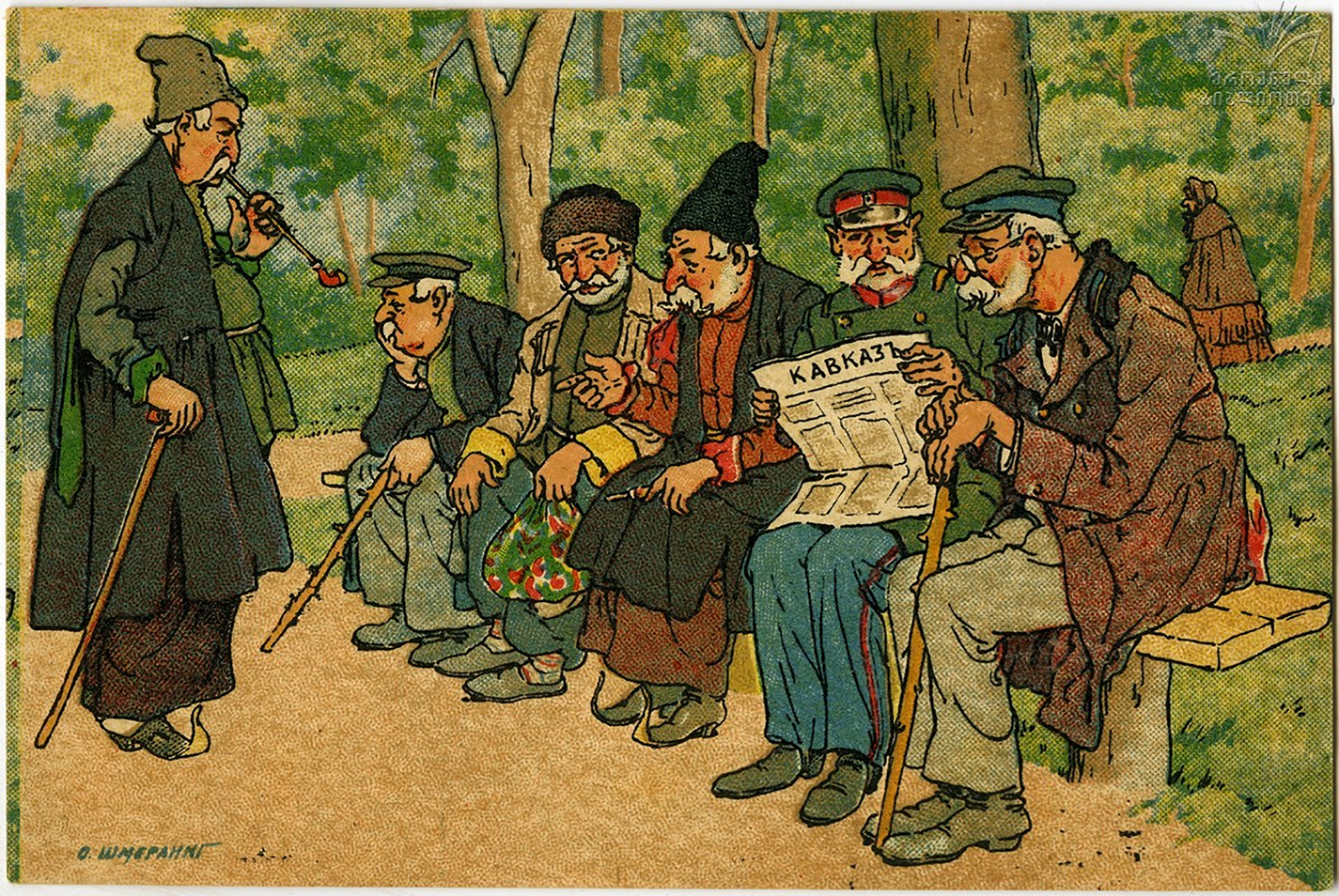
The pervasive opposition between orderly European gardens and chaotic Georgian ones—orderly places for strolling, reading newspapers, and talking (Fig. 2) versus the poetic chaos of drunken feasting (Fig. 3)—becomes a metaphor for the predicament of literature: the boring feuilletons Georgia has versus the amusing ones he claims Georgian literature lacks.
Old Tbilisi: In Alexander Garden. Oscar Schmerling, 1928; postcard, property of author.
Old Tbilisi: A [garden] feast. Oscar Schmerling 1928; postcard, property of author.
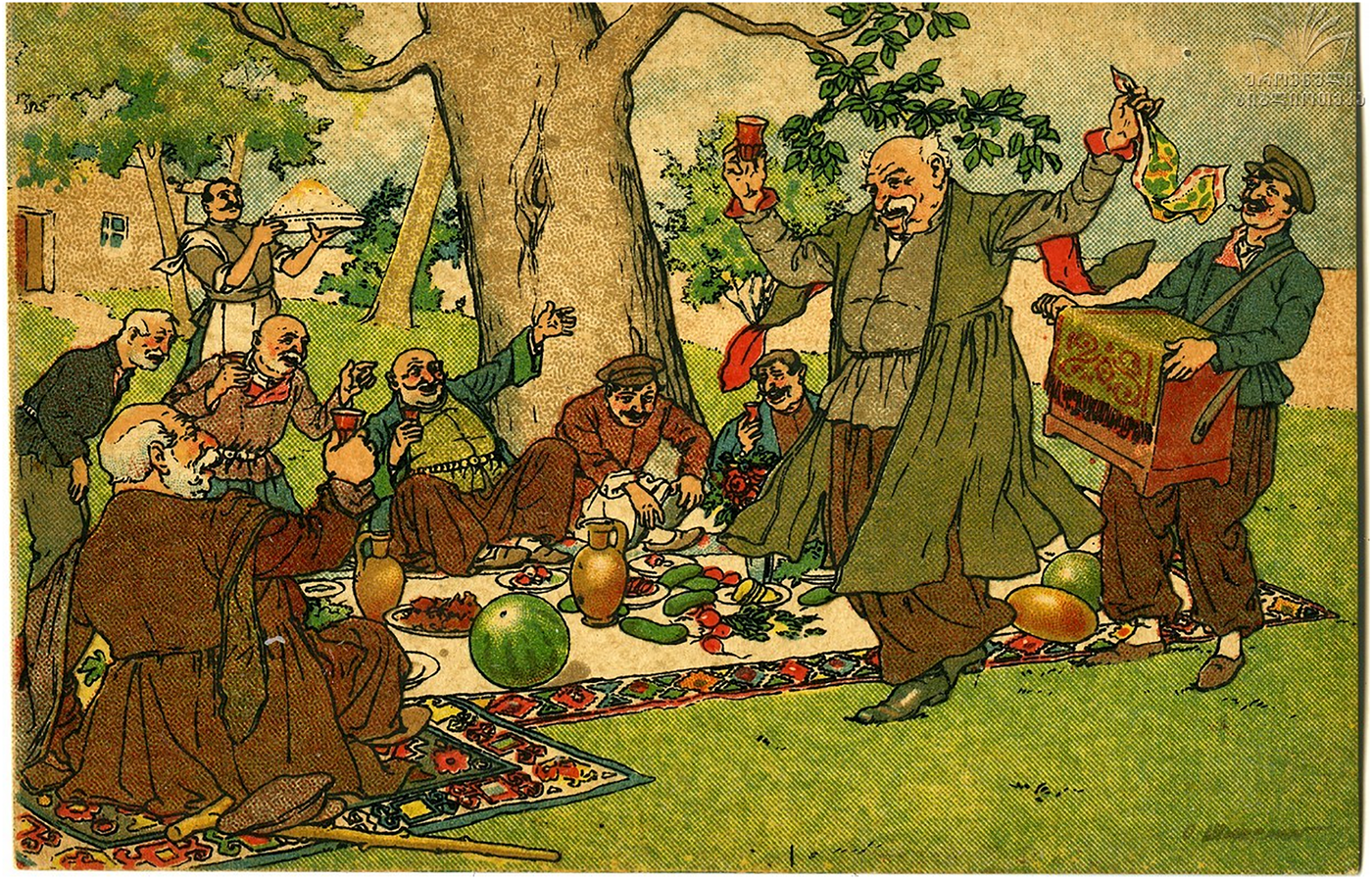
The “poetic chaos” hinted at here is epitomized in a garden poetry that both celebrates and is performed at drunken feasts in the shade of fruit trees on the island of Ortachala. In this poetry, Ortachala is both a real place and a literary chronotope; it is a garden and genre, a chronotopic place described in a specific form of poetry as well as the place this poetry is performed. The themes of such garden poetry, full of nightingales serenading roses, bear an obvious resemblance to a long list of Persian antecedents, in particular the real, metaphoric, and mystical gardens of Shiraz celebrated by Persian poets such as Hafiz.Footnote 9 Ortachala is like these poetic Persian gardens, which, as Julie Meisami argues, “must be seen, in the first instance, as real gardens… the gardens and pleasure-spots of Shiraz, which then become poetic icons, emblems of an ideal (real) state of conviviality and contentment.”Footnote 10
The “Poetic Chaos” of Kinto Poetry
These drunken celebrations on the island of Ortachala are associated with specific genres of feasting poetry. As noted, these poems could be called mukhambazis or, according to their stereotypical speaking subject, “kinto poetry.” However, such are called this not because they are authentic specimens of urban folklore composed by kintos; rather, this poetry is virtually always a form of ventriloquism, a poem written by a member of the intelligentsia in the appropriated voice of the lowest stratum of urban society. It is thus completely opposed to folkloric poetry, which is collected or transcribed by a member of the intelligentsia from a “folk” source.Footnote 11 Kintos were urban street peddlers specific to Tbilisi, representing the city's most humble occupation. Accordingly, different genres represented them differently. In news reports and anecdotes, kintos, as real ethnographic social others, were often presented as a social problem, the objects of a moral panic, engaged in hooliganism, robbing peasants, and prostitution. But kinto poetry (mukhambazis) appropriated the voice of the kinto, paradoxically, as an idealized ethical figure, different from the author of the poem, vicariously expounding an ethical philosophy of a humble, happy-go-lucky, live-for-today philosophy.
Kinto poetry thus involves a kind of ventriloquism: the authors and readers of such vicarious works often stood in complete opposition, the other end of the social spectrum, to the humble characters whose voice they appropriated. The heteroglossia of the city's divided voices were mapped to different fractions of the speaking subject, so that the “low” kinto voice became akin to the voice of a puppet animated by a human author and animator.Footnote 12 This disjuncture of authorial and animated voices became a standard feature of the genre in the early examples from the 1830s to 1860s authored by nobles like Grigol Orbeliani, cited above. As one Georgian scholar notes: “Gr. Orbeliani considered his mukhambazis to be the monologues or songs of his characters: the poet stifles himself, making [his characters] speak, abstracted away from them.”Footnote 13 Orbeliani's double-voiced mukhambazi poem thus embodied the opposed poles of the heteroglossia of the divided colonial city (a high-ranking noble author and a low-ranking animated kinto character); a heteroglossia that mirrored the colonial topology of the plebeian “Oriental” and respectable “European” garden heterotopias of the city. Orbeliani, and many authors following him, expressed his own ambivalent relation (as a self-confessed “Asiatic” noble entering Russian colonial service) to this divided colonial capital by developing an equally divided poetic repertoire.Footnote 14 A member of the Georgian romantic movement (the first literary movement in which Georgians participated alongside Europeans) and high-ranking noble in Russian imperial service, Orbeliani expressed his newfound public identity and voice as a modern European in the model of the unitary speaking subject par excellence, the lyric “I.”Footnote 15 By contrast, he expressed his underground, bohemian, “oriental” self as a fragmented voice in which the appropriated voice of the kinto was abjected, distanced from this lyric subject in the alterity of the mukhambazi, as “Not I.”Footnote 16
Not everyone liked this sort of poetry. The emergent European-educated proto-nationalist Georgian intelligentsia, many of whom were also nobles, often saw mukhambazis as an undesirable kind of “poetic chaos” similar to that of Ortachala itself: an anachronistic and abject “oriental” genre competing with the forms of serious “European” poetry expressing the modern lyric speaking subject. An early anonymous review of Georgian literature (“Anon.” written in 1870) treated these forms of poetry as holdovers from another time, alien to the Georgian soul, and destined to be replaced by a more “natural” and “national” Georgian poetry with a sound (k'ilo can mean any kind of distinctive sound, including tune, meter, or dialect,) consonant with the Georgian soul, a poetry adequate to the task of true literature and portraying serious social issues like the fate of “real people,” which in this period meant Georgian peasants:
As the themes of this period's poems are directed towards “festivity” and for singing, …they do not depict the fate of the people, where they were born—also the language too of these poems is bookish, composed, artificial and not originating from heart and soul of the real people, based on the poems and songs of the people—in a word the prosody does not have a national sound (k'ilo). It does not have a Georgian soul. The greater part of such poems are wan-colored and weak imitations of Persian poems, as in the singing sound (k'ilo), so too the charm and themes of the poetry…. In this century our writers began imitating Russia's people and other people of Europe. The aforementioned Persian sound (k'ilo) of poems was and remained only for aristocrats, as well as for urban merchants and traders. The real people as a whole, however, has its own poetry, singing sound (k'ilo) and meter.Footnote 17
The poetry of the mukhambazi was an abject, failed copy of a Persian original, characterized by bookish and artificial language, and “not originating from heart and soul of the real people.” Referentially, it is directed to frivolities like feasting rather than “depicting the fate of the people.” Part of the unnatural artificiality of this poetry was due to the fact that the authors (who came from various ranks and estates, some stereotypical Georgian [nobles] and others Armenian [urban merchants]) vicariously appropriated the stereotypical voice of the “lowest” representatives of Tbilisi society, the kinto. This produced a sense that the literature itself was “low,” “foreign,” “derivative,” “abject.”Footnote 18
Despite the intelligentsia's seemingly wholesale rejection of the mukhambazi as alien to the Georgian soul, this form of poetry continued to be very popular, written by both well-born aristocrats and low-born city-dwellers. Cheaply printed booklets of such poetry represented major competition in print culture to the new, relatively European modes of poetry advocated by the new Georgian intelligentsia. It simply refused to go away, debates raging over it from the 1870s to 1920s.Footnote 19 In 1884, for example, one aristocratic poet (Vakhtang Orbeliani, another Georgian service noble and romantic poet, and cousin to Grigol Orbeliani) composed a polemical poem (itself a mukhambazi) directed at Giorgi Skandarnova (real name Skandariani, he adopted this pseudonym as a tribute to the famous Tbilisi poet Saiat [Sayat] Nova), a plebeian Tbilisi Armenian poet associated with popular printed mukhambazi booklets. This polemical poem is suggestively entitled “I Do Not Like the Sound of the Mukhambazi,” and its clear message is that the poet addressed should stop writing mukhambazis. Regardless of its rhetorical objective, the poem nicely captures the world of the mukhambazi as a kind of soundscape, here again using the polysemy of the Georgian word k'ilo (translatable variously as dialect, sound, meter, tune, I keep this term in italics to show its range), drawing together the human and non-human aspects of the mukhambazi “sound,” which, as a performance genre, tends to be self-referential, reflexively describing the very kinds of scenes in which it is performed:
This poem epitomizes the typical referential content of the mukhambazi (wine, toastmasters, and kintos), which is also a fair description of the participants in its contexts of performance, as well as the concomitant aesthetic and contextual features of its performance (“oriental” musical instruments characteristic of this poetry performance) and typical milieu (the urban milieu of bazaars). All these different things somehow share a qualitatively specific sound he does not like, and he seems to propose that all these sounds together represent a kind of unpleasant noise: it lacks any uplifting or sublime thematic content that transcends the immediate festivities (“With this form what would you sing, poet, other than…”) and has no referential content at all (“meaningless buffoonery, whooping”). The rest of this anti-mukhambazi mukhambazi is dedicated didactically to recommending the equally hackneyed themes of European poetry: lyric poetry of nature and love, epic poetry of war and social issues like the plight of the peasant. The poem presents the mukhambazi as embedded within, and unable to move beyond, the multimodal soundscape of its own performance. The mukhambazi, thus, is noisy but not “poetic” chaos.
From Ethnographic to Ethical Kinto
Like the poetic chaos of the gardens of Ortachala themselves, kinto poetry, for Georgian intelligentsia, represented both a seductive and despised alternative to the orderly arrangements characteristic of both European gardens and European poetry. I wish to show how the intelligentsia's reception misread the role of the kinto and Ortachala, his island garden homeland, in the original cycle of poetry. As I demonstrate, the kinto is not comparable to, say, the peasant: he is neither a real life ethnographic or folkloric figure from the lower orders of society nor a heroic proletarian figure embodying productive labor. Instead, he is like the nightingales serenading the rose, an ethical figure whose revels in Ortachala embody an ethical philosophy.
Later would-be folklorists in the socialist period such as Grishashvili, seeking to create a Georgian urban folklore, also found the kinto to be a petty huckster of dubious morality; a poor representative of the ethnographic people. Thus, Grishashvili created a wholesale revision, a replacement for the ubiquitous kinto of nineteenth-century literature, in the form of guild craftsmen called qarachoghelis, respectable members of the truly productive working class. Indeed, Grishashvili spends the entire first part of his 1927 Literary Bohemia of Old Tbilisi making the argument that the kinto is simply a debased, lumpen version of the true ethnographic/folkloric “people” of the city, the qarachoghelis: “The kinto… was created in the mixed environs of the bazaar, when petty huckstering outstripped craftsmanship. He is the dregs of the family of the qarachoghelis, raised in the streets and at the backgammon tables….”Footnote 20
Grishashvili's revisionist position has become canon, even dogma (including in Shaqulashvili's otherwise magisterial 1987 synthesis), and, as such, whenever we see the word kinto in a nineteenth-century text, contemporary authors strike it out and write qarachogheli.
Grishashvili's position is based on mistaking vicarious kinto poetry for authentic folklore collected from real ethnographic kintos or qarachoghelis, analogous to folk poetry collected from peasants in villages. At a time (1860s–80s) when ethnographers and folklorists, representatives of the urban intelligentsia, were visiting villages in Georgia to collect authentic examples of the peasant voice and peasant poetry, mukhambazi poetry was never collected directly from the mouths of kintos. In fact, it never seemed to occur to anyone to do so.Footnote 21 Instead, the voice of the kinto was composed artificially by other city residents of varying ranks and ethnicities—from the highest Georgian nobility (Orbeliani) to lower-ranked Armenian urbanites (Skandarnova).
What all these texts have in common is that the poem's speaker is always, conventionally, a fragmented, serially-appropriated other; a stage character, not an expression of the soul of the authentic speaking subject (like truly “national” poetry). When these poems were printed in cheap booklets, as they often were, they could become performance texts for feast-going non-kinto members of the population. This cheaply-printed urban literature was a major competitor to the national literature of the emergent Georgian intelligentsia.Footnote 22 At the same time, however, many members of the Georgian intelligentsia also enjoyed this kinto literature or composed it themselves in their private, bohemian lives.
The kinto was strongly associated with a specific set of urban chronotopes we could call “the street and the garden.” Realist genres (news, novels, ethnography, folklore) place the ethnographic kinto, often depicted as a hooligan, in the environs of the market and street, while in non-realist genres (mukhambazi, feuilleton, comic theater) we find the ethical kinto feasting in the “elsewhere” of the island gardens of Ortachala with his “buddies,” including both humans (other kintos and qarachoghelis) and nonhumans (flowers and birds). In a review of Sandukiantsi's 1880 urban comedy Pepo (Geo. P'ep’o), the main kinto character, Kakuli, is described by writer Sergei Meskhi as a figure whose life is an ethical system writ large:
…this is the happy-go-lucky (udardeli), feast-loving, carefree (dardimandi), free as a bird (uzrunveli) kinto that we often encounter in our city. He likes feasts: if he has bread and wine, he is happy…. The gardens of Ortachala are his playing field. Only today let him have a bite of food and tomorrow – God is merciful!Footnote 23
The chronotopic “feast in Ortachala,” thus, appropriates a place (heterotopia) and figure (heteroglossia) from the real “ethnographic” life of Tbilisi and transforms it into a kind of antinomian ethical figure expressing the “live-for-today” ethics of Persian-influenced sufi ethical poetry. Moreover, the kinto embodies an ethical stance of being carefree or happy-go-lucky, coexisting within and mirroring the multispecies relational world of the garden; an ethical stance of interspecies care found among humans (kintos and anyone who feasts like a kinto) and nonhumans (the birds of the garden) alike. As Hartigan points out, gardens as “multispecies assemblages further expand conceptualizations of the public in that they are sites where relations with nonhumans are actively cultivated.”Footnote 24 The ethics of this garden poetry, then, are not only a scandalous antinomian inversion of social hierarchies, where lowlifes incarnate ethical ideals, they are also an ontologically scandalous blurring of boundaries between humans and nonhumans, kintos and birds.
As Shaqulashvili was perhaps the first to suggest, the “lowlife” characters of Tbilisi urban poetry are, like the rest of the poetry of which they are a part, distant echoes of a largely sufi-influenced ethical poetry also associated with gardens.Footnote 25 The kinto, then, is simply a local figure from Tbilisi urban society who most closely resembles the rind (“hooligan, lowlife, drunkard” in the pejorative sense and “enlightened libertine” in antinomian mystical and poetic usage) of Persian sufi poetry, who are, like the kintos of Tbilisi, actually thugs and hooligans running in gangs in charge of specific quarters of the city, ethnographically speaking.Footnote 26 But these figures with apparent uniformly negative ethical properties in realist chronotopes are appropriated (along with other taboo behaviors and places, like drinking wine and wine shops) paradoxically as positive ethical exemplars: “inspired libertines” who “repudiate all norms of society and reject the constraints of religious piety.”Footnote 27 Indeed, Shaqulashvili notes that the moral-normative sententiae associated with the kinto correspond precisely with those ascribed in sufi poetry to the Persian rind. Footnote 28 The antinomianism of this ethical system is that these positive virtues are associated with the ethical kinto/rind precisely because the kinto is a profane lowlife reprobate in reality, just as his debased behaviors—frequenting wine shops and drinking—are in this antinomian inversion paradoxically ethical or mystical practices, which court blame (Persian: malāmat).Footnote 29
The Kinto in the Garden
In realist representations of the city, the ethnographic kinto can be found in various places, such as at work in the central bazaar (This is also where Grishashvili puts him). The ethical figure of the kinto, on the other hand, is virtually always found at leisure in the gardens of Ortachala, as the paradigmatic chronotopic center of this ritual and ethical universe. One satirical kinto poem entitled “A Kinto's Homeland” begins this way:
The kinto's love of Ortachala is paradoxically tied to his ethical position as the lowest of the low. Like the Persian rind, the kinto becomes an antinomian-inspired libertine in the green heterotopia of Ortachala, one who virtuously courts and endures blame (malāmat) due to a drunk and a lover. I discuss these two paradoxical ethical themes in turn.
First, obviously, the kinto is a drunk. The gardens of Ortachala were, in the real world, the central feasting place for the lower orders of Tbilisi society, including kintos. This being Georgia, these were real feasts with real wine. Through drinking, the human and nonhuman soundscape of the garden feast becomes a mystical means of eliciting the love that animates and binds the universe together, reflecting the “metaphysical physical drunkenness pervading all levels of being, wine being a symbol for radiation of the Divine light and beauty—theophane—radiant within every atom of existence.”Footnote 31 The mystical role of drunkenness in Ortachala is described at length in the following apologia for drinking wine:
What makes me drink wine? … Love [eshkhi] aroused by the sweet sound of the duduki [a kind of wind instrument associated with this chronotope of Old Tbilisi] makes me drink. Try and get tipsy with two quarts of wine, then have Kupria [proper name of a musician] play the duduki at Ortachala on the banks of the Kura river, and you will understand what makes me drink. Listen how Kupria makes his duduki chirp and quaver more and more sweetly, how he raises its sound and takes you along with it into the air, and you will know what makes me drink. When your heart starts moaning like a chianuri [a three or four stringed viola] and the enchanting tune of the zurna [a woodwind instrument] soaks through your sides, your soul just about to reach your windpipe… you are holding a bowl [of wine] and your mind is flying up among the stars, remembering neither others, nor yourself.
What makes me drink? Why are you asking me on an empty stomach, when my heart and liver have turned moldy?! See me when I'm sitting bare-breasted on the bank of Kura river, with my shirt buttons torn off, next to a green tablecloth spread on the leaves and the moon shining brightly upon it; when dozens of candles flicker on each jar of wine and angels hover about me, dudukis moaning into both my ears; when one of my feet doesn't have a slipper on, a cucumber peel is cooling my forehead and I'm holding a quart jar of wine to my lips. See me then and you won't ask me anymore what makes me drink it…. Footnote 32
The kinto as a drunk is also a lover, because drinking elicits love (eshkhi, rarely eshqi, both from Persian `ishq). Footnote 33 Through drinking, the soundscape of the garden feast becomes a mystical means of eliciting this all-pervasive cosmological love. The unusual term eshkhi more explicitly situates this mystical bacchanalian poetry within the erotic spiritualism of the sufi “religion of love.” The Persian borrowing is not among the ordinary terms for love in Georgian; it is particularly associated with kinto poetry, where it is ubiquitous and carries strong mystical associations. Just as the rind is associated with mystical drunkenness and the lover (`āshiq) in Persian sufi poetry, and thence to mystical desire, so too is the kinto constantly pining with eshkhi for his beloved in gardens. The garden microcosm is a cosmogram of a universe animated by love:
The garden of love functions both as a setting for symbolic action and as a rich source of allegorical imagery that has its basis in analogical thought, and particularly in the belief in the universe as an ordered entity in which there is a continuity between man and the cosmos.Footnote 34
This eshkhi works by a kind of analogism that binds together multiple layers of the cosmos, between human and nonhuman species who all dwell in gardens. The kinto both invokes the ubiquitous image of the nightingale's pining after the rose and compares himself to, and imitates the plaintive song of, the nightingale. As in some sufi poetry, the kinto's garden is animated by love, “‘humanized,’ inhabited by flowers and other objects with human characteristics and engaging in human activities (and attributed) relating primarily to love.”Footnote 35 Through such pervasive quasi-Platonic analogism, love (Eros, `ishq, eshkhi) operates through all levels of the chain of being, binding together the lover (figured typically by the nightingale) and the beloved (figured by the rose):
…the religion of love is the universal faith of all existing beings. From a cosmological standpoint, all beings, from the tiniest atom up to the most complex of organisms, all things, whether animate or inanimate, are followers of the religion of love, and ultimately whatever they do is subservient to Love's command.Footnote 36
This animating love is reflected in and binds together the human and nonhuman macrocosm, alongside the microcosm of the human and nonhuman worlds of gardens as well. This is reflected in casual and pervasive anthropomorphism, where the kinto not only goes to the garden to meet his human drinking buddies, but all the nonhumans of the garden are also his buddies (dzma-bich'ebi) and his beloved (murazebi) at the same time:
In this poetry, the real gardens of Ortachala embody allegorical or mystical gardens of love. They are also the only Georgian gardens in which the nonhuman others of the garden, like roses and birds, are active and equal participants in the drama of love. The relationship is iconic and analogical; the drunken singing of the kintos imitates the voices of birds, some sing like nightingales and others like crows.
The kinto is the lover who pines for his beloved, the object of his desire (murazi), figured by flower buds, in precisely the same way that a nightingale, wounded by love, serenades the rose. As kintos become drunk in gardens, they borrow the voices of lovelorn birds:
If the garden-loving kinto embodies the dardimandi ethical ideal, then the metaphorical prototype for the kinto in the nonhuman world is another garden creature, the bird. Kakula—in the play Pepo, reviewed by Meskhi above, originally composed in Armenian and then translated into Georgian—announces: “When God made us, he made us like birds, today we earn, today we eat!”Footnote 39 The kinto is like the nightingale: his songs express the same one-sided burning love the nightingale expresses in his song for the rose.
Cosmological Chaos: Kinto Poetry as Ontological Embarrassment
Perhaps the most scandalous of all mukhambazi features was this rampant anthropomorphism in which humans and birds became comparable or interchangeable, resulting in part from eshkhi. The anthropomorphism of the nightingale and rose as figures for lover and beloved was problematic in two respects. From a nationalist perspective, like the word eshkhi itself, this trope was a Persian borrowing and thus “alien to the Georgian soul.” From another perspective, this anthropomorphic trope violated emergent canons of nineteenth-century European poetry that followed a strict dualistic naturalism separating human and nonhuman worlds and entailed an avoidance of animistic or analogistic tropes of animation and anthropomorphism of inanimate nature. Tropes that chaotically mixed-up humans and nonhumans were unacceptable, or rather, as Jonathan Culler puts it, “embarrassing” to this new naturalist aesthetics.Footnote 40 For example, one should write about the beauty of nonhuman nature using the aesthetics of the sublime, as an encounter of pure alterity between the irreducibly different human and nonhuman. Similarly, one should avoid anthropomorphic tropes that confuse the human and nonhuman by humanizing animals and animate objects or imputing human emotions to the nonhuman landscape. Indeed, it is this ontological embarrassment of the anthropomorphic tropes found in kinto poetry that might partially explain why the voice of the kinto must always be abjected from the self and recast as a comic, parodic, or satirized voice.
On the humanistic side of this dualism, the proper object of (heterosexual) love poetry (written by a male poet) would be human maidens, who might be compared figuratively to roses or flowers (as Vakhtang Orbeliani in his anti-mukhambazi mukhambazi recommends, “Let her be a rose, from rains pale, And a flower, by winds tussled”). But conflating them as intimately as the pervasive analogism of the ethical system of eshkhi represented a real problem. Accordingly, the fact that kinto poetry attended to flirtations between birds rather than the “proper” object of love poetry, a man's love for a woman, meant that all kinto poetry was to be read reductively as allegory: “if a poet sings about soulless and mindless things, when he has ‘lovers’ [mijnurebi] in mind, he is comparing them [things] to lovers… allegorically.”Footnote 41
Georgian critics of the mukhambazi, then, reductively treat the personification of birds and other aspects of what they called “soulless material nature” or “soulless and mindless things” as a simple metaphor for real, specifically heterosexual, love between real humans (the ethical implications are erased). Anon., our 1870 critic, echoing a famous episode of Greek philosophy in which humans are defined as “featherless bipeds,” reductively explains the analogism of kinto poetry as mere Aesopian allegorism:
In the same way are explained all such poems in this period: if …a quail coos to a quail and a nightingale chirps at a rose, then the poet has in mind a non-nightingale bipedal animal, which is called a human.Footnote 42
Part of this disdain is almost certainly the way eshkhi overflows the banks of heteronormative desire among humans, just as it permits ontological scandals like trans-species romance. For example, there is a pervasively stereotypical association of the kinto with prostitution and the kinto's feasts with homoeroticism. For Grishashvili, the productive, masculine qaraghogheli is a clearly heterosexual figure, while the effeminate, even transgendered, kinto is now explicitly associated with “the sin of sodomy,” which becomes a standard association henceforth.Footnote 43 But this reductionist reading misses the underlying ethical and cosmological logic of the parallelism of kintos and birds constituted by eshkhi, which, unlike human love, is shared between humans and nonhumans in this garden cosmology.
The Kinto in the Feuilleton
The European literary genre of the feuilleton became, by the 1880s, a defining urban newspaper genre in Georgia. As in Russia, the Georgian feuilleton was characterized by internal thematic heterogeneity and a satirical “smiling tone” “predicated on a certain social intimacy between author and reader.”Footnote 44 As a kind of urban epistemology, the feuilleton appropriated the city's spaces into a system of chronotopes linked together by the loose narrative transitions of talking and walking: “[the] feuilleton gradually became tied together by the loose and whimsical transitions of a digressive persona wandering from topic to topic—and sometimes, in the conventional role of flâneur, from place to place as well.”Footnote 45 Public gardens, therefore, were the kinds of places a feuilletonist went to collect tidbits from the swirl of public social life for the weekly feuilleton. For a feuilletonist-flaneur, any garden would do. We have seen above that one feuilletonist compared the poetic chaos of Ortachala to the dead orderliness of Alexander Garden, the usual strolling grounds of the feuilletonist-flaneur, as images of different kinds of feuilletons. What is interesting here is the way in which the intimate, appropriated voice of the kinto resembles the intimate voice of the feuilletonist in constituting a distinctively modern urban voice for conversations entre nous among the urban Georgian intelligentsia. Feuilletonists, after all, had a distinctively bohemian relationship to the city and, as professional writers, were not averse to drunken festivities. Indeed, the feuilleton as a genre is refractory to the truth: it is a genre that takes the ordinary world around us and turns it into a semi-fantastic “elsewhere,” a kind of literary heterotopia. Lastly, in early Georgian feuilletons, the process of “estranging” the ordinary world from dry factuality and turning it into the semi-fantastic urban world of the feuilleton often involved recruiting the character of the kinto, the stereotypical teller of fables and lies, as the appropriated proxy voice through which the dry newspaperly world of fact is alchemically transformed into a playful world of fantasy.Footnote 46
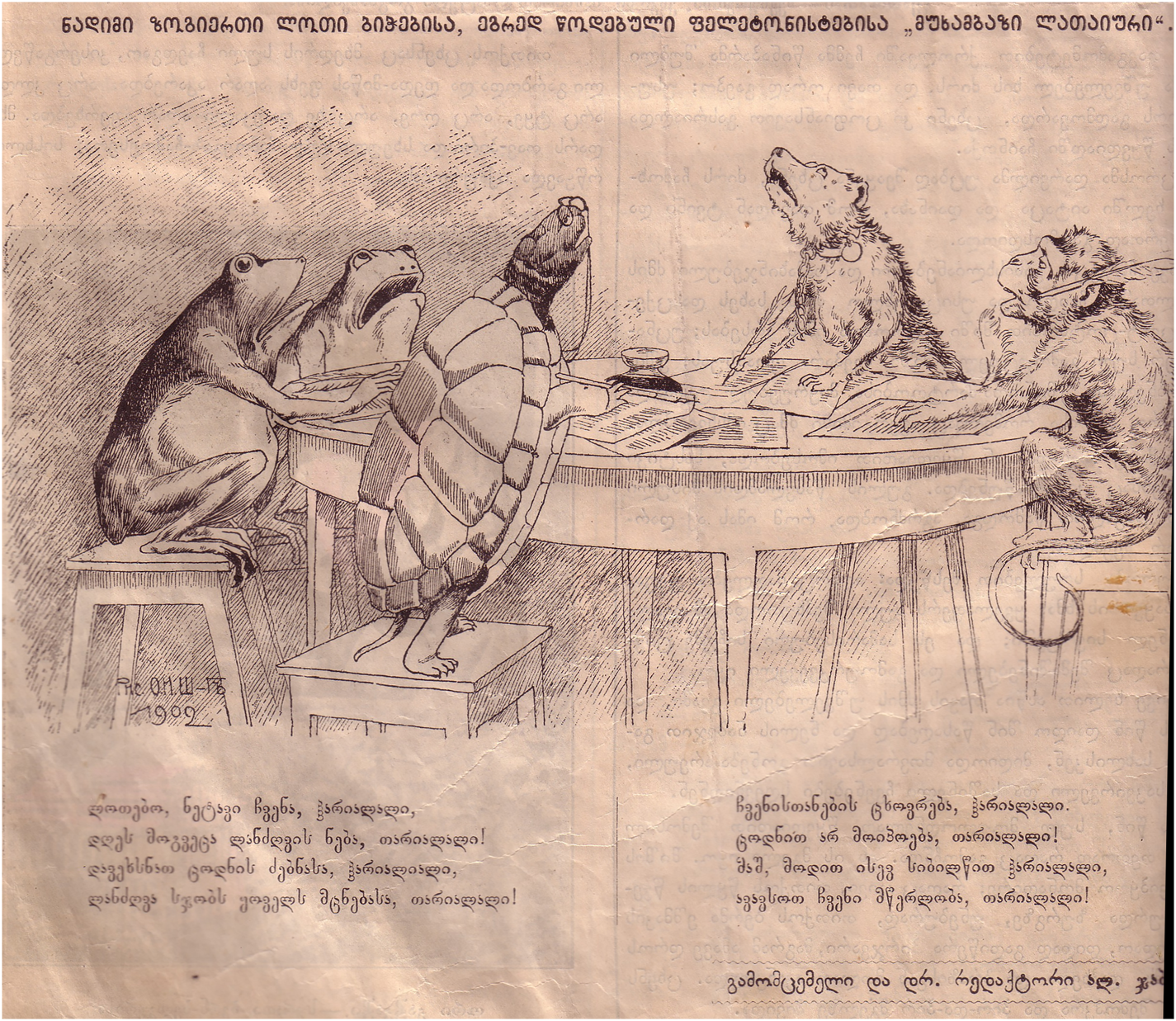
The implicit parallelism between these two distinctively urban voices—the feuilletonist-flaneur and his lowly doppelganger and partner in crime, the kinto—was made explicit in a 1902 cartoon satirizing feuilletonists by reducing them to the stature of drunken, scribbling animals singing a typical urban drinking song, a mukhambazi latiauri, associated with kintos (Fig 4):
The covert resemblance between these two urban voices is revealed not only in such parodies, which seek to abject the feuilletonist through comparison with animals and drunken kintos, but also, in some cases, the whole feuilleton is cast in the vicarious voice of the kinto. Thus, alongside kinto poetry, we also have kinto letters that include within them yet more kinto poetry. We find in the journal Theatre, once in 1885 and twice in 1886, such kinto letters, all composed pseudonymously by the prolific Art'em Akhnazarovi.Footnote 48 All of these are, in effect, urban feuilletons, but they are written entirely in the voice and accent of a kinto and hence analogous in all but meter to the vicarious voice of kinto poetry. They all begin with an intimate address form typical of kinto dialect: Dzmao Sosojan! (Brother Soso!, where –jan is an intimate address term derived from Armenian and Persian and extremely typical of urban kinto speech). In a manner paralleling the intimate dialog between a feuilleton's writer and reader, these letters speak intimately to local urban matters (complaining, for example, how a new bridge in Tbilisi's Vera district has “ruined our feasting place”).Footnote 49 These letters also contain poetry, but differing from other kinto poetry by rampant macaronic Russian-Georgian code-mixing. Here the vernacular urban voice of the kinto is superimposed over the intimate elite urban culture of the feuilleton; an experiment singled out for special criticism and censure by more respectable Georgian journals.Footnote 50
Oscar Schmerling, “A feast of some drunken lads, a ‘Mukhambazi Latiauri’ of the so-called Feuilletonists,” Tsnobis Purtseli Suratebiani Damat'eba 24 (1902): 4.
Conclusion: The Kinto in Garden Theatre
By way of conclusion, I explore a situation where Tbilisi's opposing gardens and genres are superimposed on the stage and come into outright conflict, encapsulating the problematic dialogue of gardens and genres. After kinto poetry and feuilletons cast as kinto letters, the theatrical voice of the kinto is the most familiar way this voice is heard in Georgian and Armenian urban literature from the 1880s, typically appropriated as a comic voice in urban comedies. What is interesting about the heteroglossia of these urban plays about kintos drinking in the gardens of Ortachala is that they were usually performed in different gardens: the “summer theaters” held in the gardens of the Kolonia district on the left bank of the Kura. After all, the garden and theater are both intrinsically heterotopic spaces that can be used as microcosms representing a larger macrocosm. In the case of the garden theaters of Tbilisi, these garden heterotopias were combined and came into conflict. The primary locale for the Tbilisi summer theater were the garden clubs of the Kolonia district: gardens that flanked Mikhailovsky, the second, Left Bank, boulevard of Tbilisi, and terminated in the Mushtaidi gardens. These gardens were as distant and different from the gardens of Ortachala as possible. Entry into these garden theaters was, unlike Ortachala and Alexander Garden, restricted by status and a fee; they were, in effect, private clubs for the respectable Georgian and Armenian members of Tbilisi society.
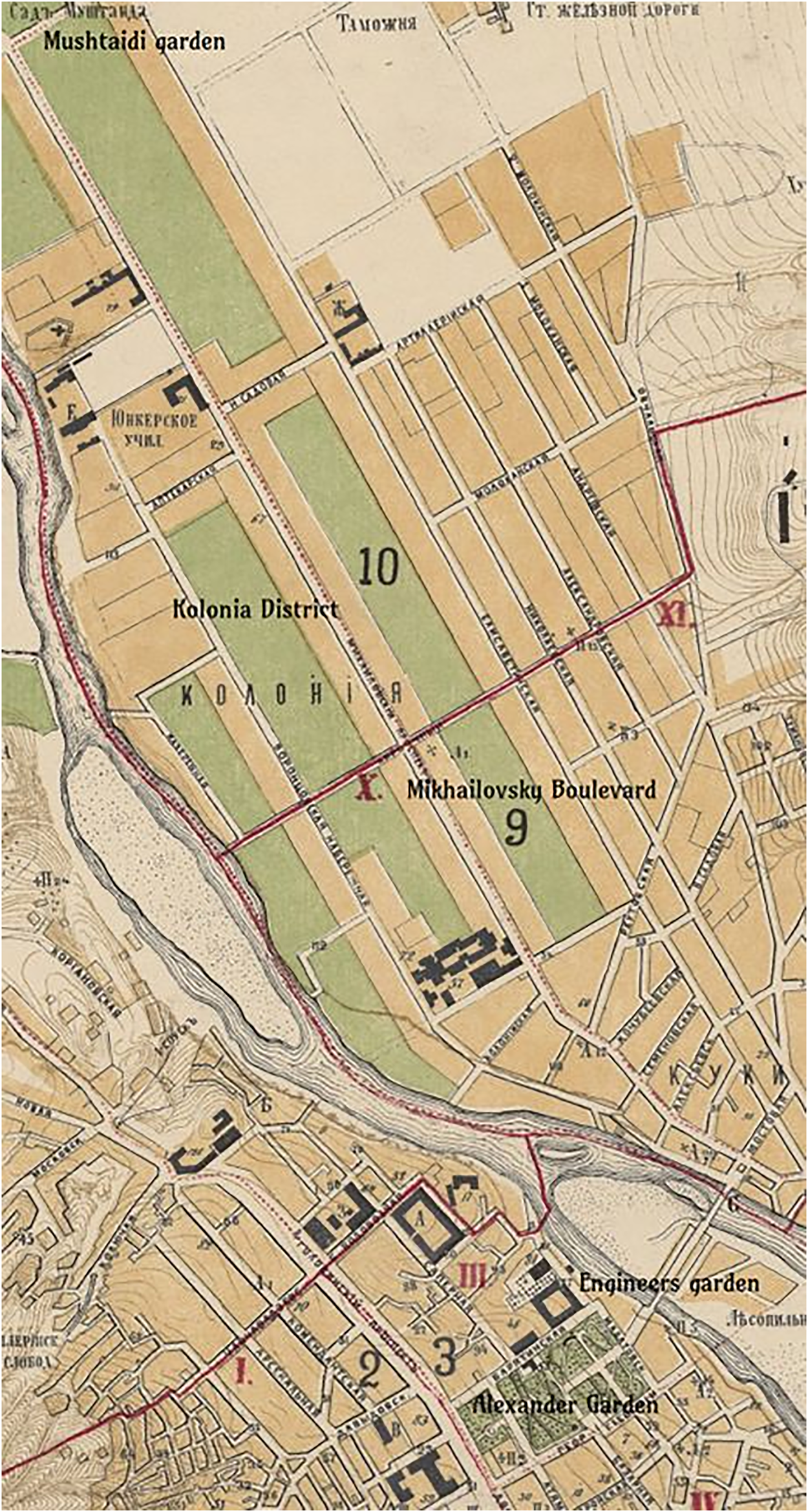
Of the various urban comedies featuring kintos (e.g., Pepo, discussed above) performed in these garden theaters, the most interesting is Akaki Tsereteli's 1880 comedy Kinto, which was first performed on January 9, 1880, in the “Summer Theater” located within the “Engineer's Garden,” directly across the street from Alexander Garden (Fig. 5).Footnote 51 It would be performed again and again in other garden theaters on the other side of the river, in the Kolonia district. Even more than the feuilleton, these garden-theater plays dialogized the city's different garden heterotopias to produce transgressive comic effect. If the Ortachala and Alexander gardens were dialogized by the feuilletonist above as opposing types of gardens and garden behaviors, these plays turned the respectable European garden settings of the Kolonia district into virtual proxies for the spatially and socially-distant Oriental gardens of Ortachala. This conflation of opposed and incompatible chronotopes, both in the diegesis and in reality, produced a sense of transgression, angering some among the theatrical public.
1878 map detail showing the location of the Engineer's Garden in relation to the adjacent Alexander Garden and the gardens of the Kolonia district across the river. 1878 “Map Of Tiflis,” no publication information.
Kinto is a romantic comedy and, like all other kinto genres, much of the comedy rests on the familiar appropriation of the kinto's voice. In theater, however, the kinto's appropriated voice is largely a comic, rather than ethical, voice (as in Pepo). In the play, Salome, a Georgian noblewoman, discovers that her alienated husband, Ilia, is staying out until all hours drinking with his friend Samson (who fancies Salome in actual fact, though when he confesses his love she rejects him and accuses him of being a false friend) and a number of kintos in Ortachala. Salome decides to try to win her husband back from the kintos through a ruse, by impersonating a kinto herself. Soon thereafter, as Ilia and his friends feast in Ortachala, singing kinto poetry composed by Tsereteli for the occasion, they encounter a mysterious kinto who brags of his noble lover, describing a woman who can only be Salome. Becoming suspicious, Ilia and his entourage arrive at his house and hear Salome and the kinto conversing intimately and kissing in her quarters. Ilia and his friends enter her room, and the mysterious kinto is revealed to be none other than Salome herself, which she proves by imitating his voice in front of them. The play ends happily, with Salome stipulating that Ilia bring his guests home to feast inside their house, as is fit and proper, and not in the gardens of Ortachala.Footnote 52
The play stages a comedy of errors about the transgression of boundaries: gender roles are swapped and social and spatial boundaries are crossed. As in other urban comedies, sometimes noble actors played “real” kintos. But on top of this, we also witness an amazing act of impersonation within the play, as the most cloistered and respectable exemplar of Georgian womanhood, a noblewoman like Salome, leaves her home and dresses and talks like the lowest and least respectable male possible. This transgression mirrors the way a noblewomen like Princess Nino Orbeliani would write kinto poetry, but unlike the vicarious adoption of the kinto's voice by urban nobility, male or female, this play takes the same process to a level of embodiment that shocked Georgian society.
This shocking double inversion (of both social position and gender) drew criticism from prominent nobles such as Raphiel Eristavi. In a lengthy review, Eristavi expressed outrage at both the transgressions of social and gender boundaries (Salome dressing as a kinto and dancing among kintos in Ortachala, and kintos barging into Salome's private quarters) and the aristocratic actress playing Salome (Gabunia) being dressed as a kinto for the part. It was not so much the portrayal of kintos in urban comedies that outraged Eristavi; kintos were fine “in their place,” that is, in Ortachala and not Salome's bedroom. According to Eristavi, the play's central problem was its lack of realism in the transgression of social and gender boundaries:
I will not be surprised and I understand, why there are kintos in the plays of Tsagareli and Antonov. There they are in their place and it befits them… but Salome being among the kintos and dressing up as a kinto—that surprises me and I don't understand it.Footnote 53
It is worth attending to the full extent of Eristavi's criticisms of the way the play transgresses social, spatial, and sexual boundaries of propriety. In fact, he listed a series of “respectable” spaces in the city that stand in antithetical heterotopic contrast to the gardens of Ortachala and would have been more realistic and respectable for Salome to visit:
Surely Salome is not a short-witted and inept woman, that she couldn't find another place and another company in which to trick her husband in the same way? Social circles, clubs, the Alexander gardens, and many other respectable places, those would not have been blocked off would they, either for the one [Salome] or the other [Ilia]? No. But apparently Akaki [Tsereteli] desired to show society the feasting of kintos, and even dress Salome up as a kinto, for the same impression…. Or what kind of impression did this act even produce? For good society I think—a bad, loathsome one.
In addition to the spatial transgressions, the “unrealistic” gender and sexual transgressions of the play drew equal ire:
Or who has even heard or seen of a princess dressing in the style of a kinto and going among kintos, even for the reasons that Akaki sent Salome among them, made her sing there, made her play there in the manner of kintos [dancing] with writhing shoulders and dragged her down to the level of snogging/kissing?!…No. Sir! This act has gone too far beyond the bounds and does not approach real life.Footnote 54
Considering the offstage sounds Salome makes “snogging” the kinto, Eristavi wondered “what kind of moral picture does that make for the unmarried women in the theatre?” His final outburst was a response to the third act, when Ilia not only invites kintos and zurna-players into his house and allows these strange plebeian men to rifle through Salome's room in a vain search for the nonexistent kinto.
For Eristavi, the scandal of this play was that Ortachala was somehow allowed to overflow its boundaries into the domains of respectable society, and he was not alone. A similar set of themes appeared in a review of the same play—performed in the Commercial Club in the Vasiliev gardens of the Kolonia district—in Iveria in 1887. The reviewer (signed A.) gave a generally favorable review of two kinto-themed urban plays, Tsereteli's Kinto and Sandukiantsi's Pepo, and then “reviewed” the Commercial Club's audience as follows:
Just a couple words for the club members. The members of the club announced that “playing the zurna is not permitted in the club, it is not appropriate, it would be a great disgrace for the members to permit the playing of a zurna.” We do not understand such behavior of the club members. First of all…. the zurna is a very common music among us and accepted everywhere. Secondly, if they wanted to forbid it, why didn't they tell the players earlier, when in the play itself the zurna is necessary and without a zurna Kinto cannot be staged…. Mr. Akhumovi, the duty officer… behaved very strangely when he announced: “The Commercial Club is not Ortachala, the whine of the zurna will not be allowed here,” as if only in Ortachala they play the zurna and nowhere else…. The members of the club are nearly all Georgians and Armenians, the zurna is also precisely their own national music, and the expulsion of the zurna by club members cannot be considered praiseworthy.Footnote 55
In the end, the final irony is that, as these gardens become dialogized heterotopias, merely staging a play about gardens of one kind, Ortachala, in a theater situated in the opposite kind of garden became a further transgression, similar to the many transgressions of social space that make up the matter of the comedy itself. The zurna, an emblematic musical instrument of the “poetic chaos” of the soundscape of Ortachala, is fine for Ortachala but becomes transgressive in the more respectable realm of the theatrical gardens clubs of the Kolonia district.
Acknowledgments
I would like to thank Lily Chumley, Bruce Grant, Ketevan Gurchiani, Anne Meneley, Teri Silvio, Davit Toklikishvili, and audiences at New York University and Ilia Chavchavadze University for comments on one or another version of this paper. Thanks also to the editors of IJMES and the anonymous reviewers provided by the journal. Some of the research for this paper was funded by the Social Sciences and Humanities Research Council of Canada.


 Open access

