


1. Introduction
Industrial manufacturing within the automotive industry is undergoing rapid transformations, driven by increasing demands for flexibility, responsiveness and technological integration. As companies continuously seek to develop production systems, they face challenges of developing and designing modular and adaptable systems capable of accommodating evolving product requirements and emerging technologies. Traditionally, the production system development process (PSDP) has been managed using sequential models such as stage-gate or waterfall. These are often combined with ad-hoc problem solving (Reference Koren, Gu and GuoKoren et al., 2018; Reference Säfsten and BellgranSäfsten, 2010). These models structure work into distinct phases with formal reviews and deliverables, offering clarity and traceability (Reference CooperCooper, 2013). However, their rigidity often results in longer lead times, exceeding budgets, documentation overload and limited possibility for flexibility (Reference PatilPatil, 2019; Reference YazdaniYazdani, 1999). These types of development processes are further complicated by high levels of uncertainty, especially in early project phases where decisions must be made with limited information and shifting conditions (Reference Pinto and SlevinPinto & Slevin, 1987; Reference Trolle, Fagerström and RösiöTrolle et al., 2020). The complexity of production system development and the need for cross-functional collaboration across functions and departments, requires coordinated efforts and shared understanding, which has also been highlighted by many researchers. In this context, traditional project management approaches could possibly fall short in addressing the dynamic and iterative nature of production system development. Agile project management, which is rooted in software development, promotes e.g. iterative progress and cross functional collaboration through its 12 agile principles. Its adaptability has proven to be effective to deal with these challenges in other contexts (Reference Fernandez and FernandezFernandez & Fernandez, 2008). Although agile principles and their adaptation in software and product development have been widely examined, there is limited empirical evidence regarding their consideration or application within PSDP. Existing studies focus primarily on theoretical frameworks or hybrid models in product development, leaving a gap in understanding how agile principles or various agile methods can be operationalized in production contexts (Reference Luna, Marinho and de MouraLuna et al., 2020; Reference Sommer, Hedegaard, Dukovska-Popovska and Steger-JensenSommer et al., 2015). This paper addresses a research gap by investigating how current PSDP align with agile principles in the automotive industry.
2. Methodology
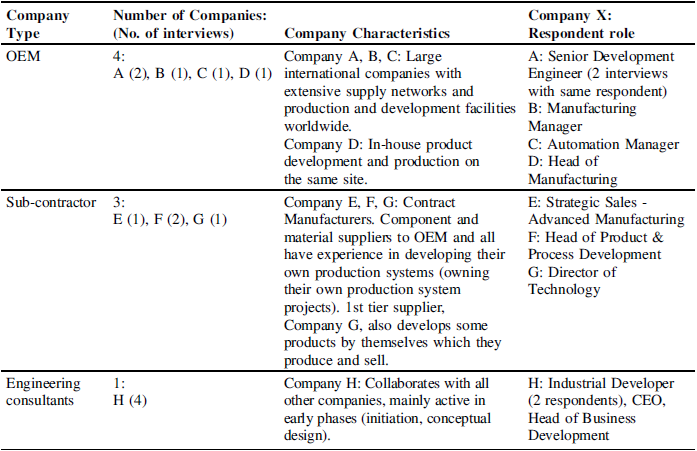
In this research, a multiple case study was carried out comprising eight companies within the automotive industry. The automotive industry operates in a dynamic environment with frequent technological and market changes. This makes it an ideal context for exploring agile principles in production system development. Furthermore, all companies were characterized by having high demands for customization. This research aligns with Reference YinYin’s (2018) definition of a case study, which involves an in-depth investigation of a contemporary phenomenon within its real-world context, particularly when the boundaries between the phenomenon and its context are unclear.
The selection of respondents was based on two main criteria’s: all respondents needed to have several years of experience in production system development to ensure relevant and high-quality insights and at least two Original Equipment Manufacturers (OEM) had to be included. OEMs manage both product and production development and the integration of these, providing a broader perspective and more comprehensive feedback. First tier subcontractors and an Engineering consultant involved in PSDP were also included to capture different viewpoints across the supply chain, which improved the generalizability of the findings. The multiple case study was carried out through a combination of questionnaires, semi-structured interviews and reviews of various internal documents. The questionnaire, distributed prior to interviews, provided initial insights into the production system development processes of each stakeholder and their familiarity to agile methodology. None of the subcontractors or engineering consultants had formally implemented Scrum, SAFe or other agile methodologies in their PSDP, but all respondents were familiar with the concept of agile methods. Although respondents varied in their level of familiarity with agile concepts: most had encountered agile in product or software development contexts, but none had received formal agile training specific to production system development. The OEM companies A, B, and C were more familiar with agile methodologies, particularly SAFe, which is used within their organizations today, but its application is focused on software and product development and has limited influence on production system development. The interview guide therefore included clarifying questions to ensure that responses, regardless of their prior agile knowledge, reflected actual practices rather than assumed knowledge. This context is important for interpreting findings, as low alignment with agile principles or methods does not necessarily imply resistance but may reflect limited exposure to agile frameworks in PSDP.
This study focuses on Scrum because it is the most widely recognized and clearly defined agile framework, and it is also the method most directly aligned with the Agile Manifesto and its twelve principles, making it a suitable basis for structured comparison with current PSDP practices. Concentrating on one framework avoids conceptual overlapping with other agile methods, such as Kanban or SAFe.
Twelve interviews were conducted with respondents from eight companies via both face-to-face and digital interview meetings. Internal documents, such as process charts, were reviewed to validate and enrich the findings.
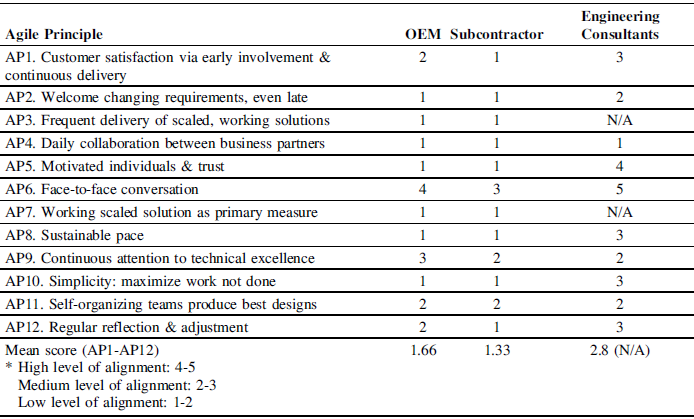
The empirical data was analysed through a structured comparative approach. The Likert scoring followed a structured analytic procedure. Evidence for each agile principle was first categorized and sorted from questionnaires, interviews and documents using directed content analysis. Scores were then assigned by triangulating whether at least two data sources supported the same pattern. To ensure consistency and reliability, codes and scores were revisited in a second review cycle and cross-checked across cases to maintain correct interpretations. The results were organized into matrices, while interview transcripts and notes were synthesized into summaries for each respondent. These summaries were systematically reviewed to identify patterns, similarities and deviations across cases. A 5-point Likert scale was later used to quantify the level of alignment to each agile principle for the three stakeholder groups. Likert scales are widely used in organizational and maturity assessments due to their simplicity, interpretability, and ability to convert qualitative judgments into ordinal numerical data (Reference Joshi, Kale, Chandel and PalJoshi et al., 2015). Each Agile principle was evaluated based on evidence from interviews and documentation. The scale was anchored in observable behaviours: a score of 1 indicates explicit non-alignment, while a score of 5 indicates consistent, systematic practice of the principle. The coding was performed through directed qualitative content analysis, ensuring that each score was grounded in empirical evidence. In addition to examining alignment with the twelve agile principles, the interview protocol also explored the use of agile mechanisms such as daily stand-ups, time-boxed iterations, sprint retrospectives and review activities and the presence of agile roles (e.g., product owner, scrum master).
Multiple case study overview

3. Theoretical background
3.1. Production system development process
Increasing market dynamics, customer demands for customization and shorter product life cycles are driving companies toward more flexible and sustainable production solutions. Reconfigurable production systems (RMS), built on modularity, are essential for enabling production systems to adapt to changing requirements while minimizing resource waste (Reference El MaraghyElMaraghy, 2008; Reference Koren, Gu and GuoKoren et al., 2018; Reference RösiöRösiö, 2012). The main goal is to combine efficiency of dedicated systems with flexibility of flexible manufacturing systems, making it ideal for industries facing e.g. frequent product changes (Reference Skärin, Rösiö and AndersenSkärin et al., 2023). To achieve this, the process and approach for production system development need to be updated (Reference Trolle, Raudberget and RösiöTrolle et al., 2021). Traditionally, production development projects in the automotive industry have relied on sequential models such as stage-gate and waterfall with elements of ad-hoc problem solving. These models divide projects into distinct phases such as initiation, preparatory design, conceptual design, detailed design and implementation as shown in Figure 1, that is including formal gates for decision-making and validation (Reference RösiöRösiö, 2012; Reference Bruch and BellgranBruch & Bellgran, 2013; Reference CooperCooper, 2013). While these approaches provide structure and traceability, they are criticized for rigidity, long lead times and limited adaptability for changes particularly as these new demands for flexibility and reconfigurability in production systems emerge. (Reference Ciric, Lalic, Gracanin, Tasic, Delic and MedicCiric et al., 2019; Reference PatilPatil, 2019)
Production development process (Reference RösiöRösiö, 2012)

A key challenge in many PSDP is the reliance on push-based planning and rigid scheduling which limits adaptability and delays performance improvements (Reference Koskela, Henrich, Owen and VrijhoefKoskela et al., 2006). Similarly, the concept of an operational performance-driven PSDP emphasizes embedding performance targets such as time-to-volume and OEE early in the design process rather than addressing them when the system is up and running. Combining these creates an approach that integrates agile principles with operational performance goals which in turn could enable faster ramp-up, higher efficiency and alignment with sustainability and reconfigurability requirements. Moving production development from static processes toward dynamic, performance-oriented strategies that support long-term competitiveness is essential (Reference Islam, Chavez, Birkie and BellgranIslam et al., 2022).
3.2. Agile principles and their transferability
Agile project management emerged in the software industry as a response to the limitations of sequential models and their inadaptability to the dynamic nature of software projects. The Agile Manifesto was introduced in 2001 and advocates four core values: (1) individuals and interactions over processes and tools, (2) working solutions over comprehensive documentation, (3) customer collaboration over contract negotiation and (4) responding to change over following a plan (Reference ManifestoManifesto, 2001). Out of these four core values 12 agile principles derived:
-
1. Focus on customer satisfaction through early involvement and continuous delivery. Deliver usable value often so customers see progress early.
-
2. Welcome changing requirements. Adapt even late in the project to maximize customer value.
-
3. Deliver working solutions frequently. Provide small, functional increments regularly.
-
4. Prioritize daily collaboration between business partners and developers.
-
5. Build projects around motivated individuals and inspire trust. Give teams autonomy, support and trust them to do the work well.
-
6. Encourage face-to-face conversations. Direct communication reduces misunderstandings and could help speed up processes.
-
7. Work with scaled solution as primary measure of progress. Real functionality matters more than documents or plans.
-
8. Promote a sustainable work pace. Teams should work at a rhythm they can maintain long-term.
-
9. Pay continuous attention to technical excellence. High-quality engineering enables adaptability and reduces rework.
-
10. Strive for simplicity and maximize work not done. Focus on what truly adds value and avoid unnecessary tasks.
-
11. Believe in that self-organizing teams produce the best results. Teams decide how they should work, improving ability for creativity and ownership.
-
12. Incorporate continuous reflections and adjustments. Teams frequently inspect their process and make improvements.
Agile methods, such as Scrum, operationalize these principles through iterative cycles, frequent feedback loops and self-organizing teams (Reference CervoneCervone, 2011; Reference Darrin and DevereuxDarrin & Devereux, 2017; Reference Fowler and HighsmithFowler & Highsmith, 2001). This absence of established agile structures further contextualizes the findings, as the organizations operate primarily within traditional stage–gate systems rather than hybrid or scaled-agile environments. Agile practices have demonstrated success in reducing cycle times and improving adaptability in software and various product development contexts (Reference Conforto and AmaralConforto & Amaral, 2016). However, investigating their transfer to production development remains limited (Reference Trolle, Fagerström and RösiöTrolle et al., 2020). Physical production environments introduce constraints such as equipment lead times, compliance requirements, and complex supply chains which may hinder direct adoption of agile methods. Literature suggests that hybrid models, combining agile principles with stage-gate governance, can offer a balanced approach for technology-based projects (Reference Conforto and AmaralConforto & Amaral, 2016; Reference Edwards, Cooper, Vedsmand and NardelliEdwards et al., 2019). Organizational culture and top management support are critical determinants of agile adoption. Resistance often stems from entrenched hierarchical structures, rigid performance metrics and fear of losing control. Transitioning to agile requires changes at multiple levels, including governance, resource allocation and team dynamics. Without executive sponsorship and cultural alignment agile initiatives risk failure or superficial implementation (Reference Mishra, Abdalhamid, Mishra and OstrovskaMishra et al., 2021; Reference TonnquistTonnquist, 2009).
4. Results
4.1. Use of agile methods in PSDP
While the results provide an overall view of agile principles, the cases also show to some extent how agile methods and its mechanisms are, or are not, used in current PSDP. None of the OEM or subcontractors applied formal agile roles or time-boxed sprints. Planning was constructed according to fixed phases with predefined deliverables. Daily and recurring stand-ups were not established, apart from informal morning meetings in engineering or maintenance functions, which were not part of PSDP or any cross-functional teams. Sprint mechanisms such as reviews or retrospectives were absent. Engineering consultants, however, facilitated iterative workshops in the fuzzy front-end that resembled early sprint practices but did not continue throughout the project. No product or system backlogs were used and the work was governed by checklists and gate documents. Some OEM teams did break down gate deliverables into smaller tasks, suggesting early signs of sprint-like iteration within sequential constraints.
4.2. Alignment of agile principles to production system development
Building on the theoretical insights, the following section presents empirical findings from the multiple case study, illustrating how these principles align with current practices in PSDP. Table 2 presents the results from the multiple case study. Each agile principle is summarized with descriptive insights derived from the case study. The table highlights differences in organizational practices, collaboration patterns and process adaptability across stakeholder types. OEMs generally exhibit structured, stage-gate-driven approaches. Subcontractors show reactive participation governed by OEM constraints while Engineering Consultants demonstrate more flexibility and early-phase involvement, although with limited engagement during later development stages.
Agile principles and their alignment with stakeholders in PSDP within the automotive industry

Table 3 uses the Likert scoring method for level of stakeholder alignment with the twelve agile principles. Every score is grounded directly on the case study findings and Table 2. The Likert scores are based on the following analysis:
Likert scoring table: agile principles and their alignment with PSDP for different stakeholders

1 = No alignment: The stakeholder’s practices contradict the agile principle. The process structure blocks alignment, and the practice is completely absent.
2 = Weak alignment: The practice occurs rarely or only under special conditions. Stakeholders may want to align but lack the means.
3 = Partial alignment: The principle is applied in some areas or phases but is not consistent or embedded in the organization.
4 = Good alignment: The principle is largely followed with structural support, though not fully continuous or integrated across all phases.
5 = Strong alignment: The principle is consistently present in both behaviour and processes, fully reflecting agile theory.
The findings present an indication of Subcontractors showing the lowest alignment with agile principles, heavily constrained by OEMs and Engineering consultants with the highest alignment. OEMs are rigid and stage-gate-driven, preventing agile alignment.
5. Discussion
PSDP within the automotive industry remain highly sequential with rigid gates and focus on heavy documentation. All eight case companies maintain and follow documented process phases for production system development which are typically integrated with product development workflows. These phases outline steps such as investigation, planning, preliminary design, detailed design, implementation and follow-up and follows a sequential approach. Each phase is associated with checklists and deliverables that must be completed before passing through a gate. These findings correspond with previous research (Reference Bruch and BellgranBruch & Bellgran, 2013; Reference Säfsten and BellgranSäfsten, 2010; Reference Trolle, Fagerström and RösiöTrolle et al., 2020). Some respondents described these processes as “straightforward” and “mature” emphasizing their clarity and suitability for large-scale projects. However, several respondents noted that the rigidity of these models often results in project delays and cost increases when unexpected changes occur, particularly after design freeze. While these models provide structure, they struggle with flexibility and responsiveness. Agile principles could offer solutions to some challenges but should not be applied directly due to physical constraints: like equipment lead times and system requirements. A direct transition to a fully agile model may pose significant risks. Adopting a gradual transition is advisable, starting with small changes and slow adaptations and alignments with some agile principles and progressing toward full agility as the organization matures. PSDP have phases with varying levels of uncertainty. Early phases are more uncertain and could benefit from agile flexibility while later phases require stability due to equipment lead times and quality requirements (Reference Säfsten and BellgranSäfsten, 2010). This is also proven by the case study results covering the engineering consultants, mainly involved in early stages of the project. A stage-gate hybrid model addresses this by combining iterative and sequential approaches. The limited use of agile methods suggests that PSDP teams do not reject agile thinking but lack method-level adaptations suited to physical system development. Some OEM respondents noted that gate reviews could act as high-level iteration boundaries, like sprint milestones, if broken into smaller planning cycles. Although formal backlogs are absent, early-phase workshops run by engineering consultants demonstrate iterative refinement and short feedback loops within stage–gate constraints. These findings indicate opportunities for hybrid approaches were selected agile ceremonies, such as brief daily coordination meetings, structured retrospectives or backlog-like prioritization, could be integrated without disrupting regulatory or hardware-dependent requirements. Implementing agile methods or even its principles, is not just about tools, it requires cultural change, top-management support and possibly new roles, like product owners. These changes take time (Reference GustavssonGustavsson, 2011). An initial step toward agility is to prioritize cultural aspects and soft values, such as team collaboration and reducing unnecessary documentation. The next step involves introducing structural changes, including iterative planning and the use of product backlogs in the early phases of PSDP. Once these foundations are in place and the organization has gained sufficient experience and confidence, it may be ready for full agile adoption. Education and training are critical to overcome misconceptions and resistance. A phased approach mitigates risk, supports learning and ensures operational performance goals are maintained. To improve the validity and reliability of this study, the data population should be expanded to include more companies and consultants, as well as system suppliers. System suppliers contribute distinct perspectives on design, integration and delivery processes, making their inclusion valuable for achieving broader coverage and stronger triangulation. This expanded and more diverse sample would enhance the robustness and generalizability of the study’s conclusions.
6. Conclusion
This study shows that production system development in the automotive industry remains largely sequential and rigid, limiting adaptability. Agile principles offer potential benefits, but direct adoption is impractical due to physical and regulatory constraints. Case findings indicate low overall alignment with agile principles but there is a need to adopt and align with them. OEMs and subcontractors remain constrained by stage-gate structures while engineering consultants show the highest agility in early phases. Transitioning requires cultural change, leadership support and gradual implementation through collaboration, reduced documentation and iterative planning. This study examines alignment with agile principles without evaluating whether such alignment improves project performance in a production system development context. Future research should explore hybrid models in practice and their impact on performance in PSDP.
Acknowledgement
The authors would like to thank the researchers and industry representatives who supported and contributed to this study. We are especially grateful for the time, insights and practical experiences generously shared during the case studies.



 Open access

