

Although seemingly simple, authorship ascription is complex. Given that not everyone who creates written works is credited as an author—think, for example, of those who draft legal contracts or write owner’s manuals—Michel Foucault (Reference Foucault, F. Bouchard, F. Bouchard and Simon1977:124) argued that “the function of an author is to characterize the existence, circulation, and operation of certain discourses within a society.” We thus need to consider which works are deemed worthy of authorship within social discourse. Additional complexities arise from academic authorship specifically. Unlike other creative compositions, academic texts require successful peer review for publication. Consequently, as Biagioli (Reference Biagioli, Biagioli and Galison2003) has argued, academic authors do not “have inherent rights in a scientific claim the way a ‘normal’ author has rights in the product of his or her personal expression.” For Biagioli (Reference Biagioli, Biagioli and Galison2003:254), scientific authorship is thus “not a right but a reward” and one “not bestowed by [a] specific nation (according to its law), but by an international community of peers (according to often tacit customs).” Such an understanding of academic authorship suggests the need to examine such customs and make them explicit. Doing so is especially critical given the importance of authorship metrics to academic advancement. As Smith and colleagues (Reference Smith, Williams-Jones, Master, Larivière, Sugimoto, Paul-Hus, Shi, Diller, Caudle and Resnik2020:1995) succinctly explain, “Authorship is commonly used as the basis for the measurement of research productivity. It influences career progression and rewards, making it a valued commodity in a competitive scientific environment.”
The increasing number and kinds of research collaborations—including between researchers; graduate students; and members of local, Indigenous, and descendant communities—have further complicated understandings of academic authorship and raised questions about how best to recognize and reward it. Although scientific collaboration has been common for more than 400 years, the number of academic publications with multiple authors has increased dramatically in recent decades (Fell and König Reference Fell and König2016:114). This increase is not surprising. Collaborations can bring together diverse voices and thereby improve scientific endeavors. As several have noted, a “science characterized by social homogeneity risks overlooking vital perspectives, leading to potential shortcomings in research outcomes” (Goyanes et al. Reference Goyanes, Demeter, Simeunović Bajić and de Zúñiga2025:2). Articles with multiple authors also provide tangible benefits to researchers. Multiauthored publications are, for example, more highly cited than single-authored publications (Gao et al. Reference Gao, Nyhan, Duke-Williams and Mahony2022:327; see also Fell and König Reference Fell and König2016:114). Research teams are generally able to produce more publications (Wutchty et al. Reference Wuchty, Jones and Uzzi2007), as well as publications with more data produced by individual team members (Cordero et al. Reference Cordero, de Leon-Rodriguez, Alvarado-Torres, Rodriguez and Casadevall2016; Fontanarosa et al. Reference Fontanarosa, Bauchner and Flanagin2017).
Despite the benefits of coauthorship teams, complexities also arise from increasing the numbers of coauthors, including how individuals should be credited (e.g., Broderick and Casadevall Reference Broderick and Casadevall2019; Moustafa Reference Moustafa2016; Tscharntke et al. Reference Tscharntke, Hochberg, Rand, Resh and Krauss2007). Women and members of other marginalized groups are less likely to be included as authors when part of research teams (Ross et al. Reference Ross, Glennon, Murciano-Goroff, Berkes, Weinberg and Lane2022). This exclusion, even when unintentional, can affect junior women scholars’ decisions to stay in their field of study (Ross et al. Reference Ross, Glennon, Murciano-Goroff, Berkes, Weinberg and Lane2022:141). As noted by Ouzman (Reference Ouzman2023:68), despite some existing guidelines—including those provided by the International Committee of Medical Journal Editors and the Committee on Publication Ethics—we nevertheless “find ourselves in a complex field with often contradictory instructions and rules to be negotiated.”
For disciplines such as archaeology, which could alternatively or simultaneously fall into the humanities, social sciences, and natural sciences, assignment of coauthorship may prove to be particularly complex (e.g., Kawa Reference Kawa2022; Lyman Reference Lyman2025; Ouzman Reference Ouzman2023). Certain contributors to archaeological knowledge, such as students, local workers, and in many instances wives of archaeologists, were and are regularly excluded from authorship lists (e.g., Heath-Stout Reference Heath-Stout2024a:170; Mickel and Byrd Reference Mickel and Byrd2021; Quinlan Reference Quinlan2023; see also Leighton Reference Leighton2015, Reference Leighton2016; Mickel Reference Mickel2019, Reference Mickel2021). Further, knowledge extraction from originating and descendant communities with minimal acknowledgment persists in archaeology and was extremely common in past work (see Laluk et al. Reference Laluk, Montgomery, Tsosie, McCleave, Miron, Carroll and Aguilar2022).
Building on previous studies of authorship and identity in archaeology (e.g., Bardolph Reference Bardolph2014; Heath-Stout Reference Heath-Stout2020a; Tushingham et al. Reference Tushingham, Fulkerson and Hill2017), we consider how coauthorship intersects with gender in peer-reviewed journal articles with five or more authors. After examining 900 articles published in 11 archaeology journals between 2013 and 2024, we analyzed trends in the perceived gender of first authors, last authors, and coauthors. Although there are many possible authorship systems including simply alphabetical, first-author positions generally receive the most credit for a published piece, whereas last authors may serve as an honorary position of importance denoting mentorship or lab leadership. For the archaeology journals analyzed here, gendered trends were remarkably consistent for both first and last authors, with men being more likely to hold both positions and to serve as a coauthor. Men in these positions were also far more likely to include higher proportions of men as coauthors.
Drawing on concepts of gender homophily—the “principle that contact between similar people occurs at a higher rate than among dissimilar people” (McPherson et al. Reference McPherson, Smith-Lovin and Cook2001:416)—and friendship networks (Leighton Reference Leighton2020), we consider the ways in which intentional or unintentional exclusion from coauthored papers may negatively affect the careers of women in archaeology. Numerous studies have documented that women and archaeologists with other marginalized identities publish and apply for funding less often, receive fewer or lower-tier academic positions, face greater rates of harassment, are cited less often, and receive less recognition as experts in the discipline (e.g., Bardolph Reference Bardolph2014; Goldstein et al. Reference Goldstein, Mills, Herr, Burkholder, Aiello and Thornton2018; Heath-Stout Reference Heath-Stout2020a, Reference Heath-Stout2020b, Reference Heath-Stout2024a, Reference Heath-Stout2024b; Hodgetts et al. Reference Hodgetts, Supernant, Lyons and Welch2020; Horowitz and Brouwer Burg Reference Horowitz and Burg2024; Hutson Reference Hutson2002, Reference Hutson2006; Hutson et al. Reference Hutson, Castro and Teruel2025; Meyers et al. Reference Meyers, Horton, Bourdreaux, Carmody, Wright and Dekle2018; Pope and Teather Reference Pope and Teather2025; Smith and Garrett-Scott Reference Smith and Garrett-Scott2021; Tushingham et al. Reference Tushingham, Fulkerson and Hill2017). Given these negative outcomes and the subsequent loss of diversity of thought in archaeological research, we make recommendations to begin to redress these issues with author ascription. Specifically, we advocate that archaeology societies create clear guidelines on authorship expectations and standards and that institutions adopt both total publication and fractional publication counts—that is, a paper with five authors results in 0.2 publication credit to each—as measures of individual productivity.
Coauthorship, Credit, and Intersectional Gender Identities
Conventionally, those studying multiauthored academic texts have used coauthorship as an index of research collaboration (e.g., Boschini and Sjögren Reference Sjögren2007). But, as many have noted, such studies rely on two sometimes problematic assumptions: that all named authors contribute meaningfully to the research collaboration and that all who contribute meaningfully are named as authors (e.g., Kovacs Reference Kovacs2017; Laudel Reference Laudel2002; Ponomariov and Boardman Reference Ponomariov and Boardman2016). These assumptions can be but are not always true. In some cases, and across multiple disciplines, studies of academic authorship have identified problematic practices, including ghost authorship, honorary authorship, and overinclusive authorship (e.g., Kovacs Reference Kovacs2017; Pruschak and Hopp Reference Pruschak and Hopp2022; Settles et al. Reference Settles, Brassel, Montgomery, Elliott, Soranno and Cheruvelil2018). In the first, “contributors are not listed as authors,” and in the second, “non-contributors are listed as authors” (Pruschak and Hopp Reference Pruschak and Hopp2022:1). In the third, scholars, often for moral reasons, “list individuals as authors who do not merit authorship . . . in the name of inclusion” (Settles et al. Reference Settles, Brassel, Montgomery, Elliott, Soranno and Cheruvelil2018:314). Although overinclusive authorship is based on ideals of inclusiveness and equity, honorary authorship is not. As Kovacs (Reference Kovacs2017:54) explains, a lead author might include as a coauthor someone who contributed little or nothing to the project or results “in the hope that this favour will be returned in the future.”
For these and other reasons, several have advocated studying coauthorship in numerous disciplines not as an index of intellectual or resource collaboration but as “a social phenomenon worthy of study in-and-of-itself” (Ponomariov and Boardman Reference Ponomariov and Boardman2016:1940). Ponomariov and Boardman (Reference Ponomariov and Boardman2016:1940; see also Kovacs Reference Kovacs2017) argue, “Though co-authorship may validly represent research collaboration . . . co-authorship may have numerous other meanings.” They thus suggest that coauthorship studies be reframed as studies of author ascription. Doing so allows such studies to consider factors other than collaboration, including the roles of friendship networks (e.g., Leighton Reference Leighton2020) and, often, gender-based homophily (e.g., Kwiek and Roszka Reference Kwiek and Roszka2021). Such a reframing thus allows scholars to question not only whether coauthorship occurs more often among those with similar or diverse identities but also how and why.
Given that academic authorship can be understood as a reward rather than a right, changing the focus of coauthorship studies from collaboration to authorship ascription also encourages reflection on the Matthew/Matilda effect. In the 1960s, Robert Merton (Reference Merton1968:58) observed what he termed a “complex pattern of the misallocation of credit for scientific work”: those with established reputations receive more credit than those without. Merton (Reference Merton1968:58) named this pattern the Matthew Effect after the Gospel According to Saint Matthew 13:12: “For unto every one that hath shall be given, and he shall have abundance: but from him that hath not shall be taken away even that which he hath” (see also Díaz-Andreu Reference Díaz-Andreu, Moen and Pedersen2025). Twenty-five years later, Margaret Rossiter (Reference Rossiter1993:326) noted that the Matthew Effect had come to refer only to the first half of this verse—the over-recognition of already known individuals—but that the second half “has wide application among the . . . have-nots of scientific history, including especially women.” She therefore coined this lack of recognition the Matilda Effect, after a nineteenth-century American suffragist, Matilda Joslyn Gage (Figure 1). These names are particularly fitting. Although Matthew ultimately received credit for the gospel bearing his name, he did not write it, whereas Matilda Joslyn Gage, despite her numerous achievements, remains virtually unknown (Rossiter Reference Rossiter1993:326, 335–337). Since the publication of Rossiter’s seminal article, several have considered whether and how “power dynamics related to social status (e.g., gender) may determine one’s authorship opportunities and authorship credit” (Settles et al. Reference Settles, Brassel, Montgomery, Elliott, Soranno and Cheruvelil2018:304).
Illustration of the Matthew and Matilda effects. Drawing by Sasha Buckser.

Figure 1 Long description
The illustration features six figures, each representing a scientist with their contributions. From left to right: Marthe Gautier and Jérôme Lejeune, discoverers of Down Syndrome; Jocelyn Bell, influenced by Martin Ryle and advisor Antony Hewish, discovered the first radio pulsar; Nettie Stevens, confirmed later by Thomas Hunt Morgan, discovered the XY sex-determination system. The top section states, ′People of all genders have contributed in important ways to our understanding of the world…′ The bottom section, in grayscale, reads, ′…academia and history often only remember or credit male scientists and scholars for their work.′ The illustration is signed by Sasha Buckser.
Previous Studies of Coauthorship
Existing studies of coauthorship across numerous disciplines, subjects, and nationalities do not reveal obvious patterns or trends in gendered authorship and are often difficult to compare. This lack of consistency reflects a wide range of theoretical and methodological approaches, as well as different demographic histories within disciplines and countries around the world. As a result, the relative representation of women within each field of study varies drastically, shifting expectations for parity (e.g., Bravo-Hermsdorff et al. Reference Bravo-Hermsdorff, Felso, Ray, Gunderson, Helander, Maria and Niv2019).
Scholars in some disciplines, including criminal justice (Eigenberg and Whalley Reference Eigenberg and Whalley2015), suggest men are more likely to lead coauthored publications. Studies in other disciplines, such as psychology (Fell and Konig Reference Fell and König2016), instead suggest that women coauthor more often. And still other studies, including one focused on economics, social sciences, and humanities in Italy, did not identify significant gendered differences in coauthorship practices (Gȅrxhani et al. Reference Gȅrxhani, Kulic and Liechti2023). Rates of participation in multiauthored publications may also be misleading. A study in digital humanities found that, although women do not coauthor at the same rate as men, when they do, they occupy central bridging roles in authorship networks (Gao et al. Reference Gao, Nyhan, Duke-Williams and Mahony2022).
Those studying multiauthored publications have sought to understand not only who coauthors but also who coauthors with whom, and specifically the role of gender homophily in authorship ascription (e.g., Jadidi et al. Reference Jadidi, Karimi, Lietz and Wagner2018; Sjögren Reference Sjögren2007). Women in organization science, for example, prefer coauthoring with other women (Karimi et al. Reference Karimi, Mayr and Momeni2018), whereas men in ecology and evolutionary biology tend to coauthor with other men (Frances et al. Reference Frances, Fitzpatrick, Koprivnikar and McCauley2020). In a broad study of more than 250,000 academics, Araújo and colleagues (Reference Araújo, Araújo, Moreira, Herrmann and Andrade2017) found that men were more likely to collaborate with other men, whereas women worked with both men and women to degrees at parity for their disciplines, whereas Kwiek and Roszka (Reference Kwiek and Roszka2021) noted that Polish university professors, regardless of gender, coauthor more often with men. In some disciplines, including public administration (Smith et al. Reference Smith, Riccucci, Isett, DeHart-Davis and Sims2024) and critical care (Vranas et al. Reference Vranas, Ouyang, Lin, Slatore, Sullivan, Kerlin and Liu2020), women lead authors are more likely than men lead authors to include other women as coauthors. In an expansive study of nearly 3,000 papers published between 1995 and 2017 with two or more authors credited as contributing equally (co-lead), mixed men-women pairs were the most common, although men in these positions were more likely to be named first and other patterns such as alphabetical listing could not explain this trend (Broderick and Casadevall Reference Broderick and Casadevall2019). Notably, papers coauthored or co-led by only men outnumber those by only women in several fields (e.g., Broderick and Casadevall Reference Broderick and Casadevall2019; Smith et al. Reference Smith, Riccucci, Isett, DeHart-Davis and Sims2024; Williams et al. Reference Williams, Kolek, Saunders, Remaly and Wells2018).
Some have gone beyond documenting who coauthors and with whom to consider different reasons for and consequences of coauthorship. Schmal and colleagues (Reference Schmal, Haucap and Knoke2023:1), for example, noted a tendency for women “to contribute more to the public good of open sciences [through open access journals], while their male colleagues focus on private reputation [through high-impact journals].” In economics, women have more insular (repeat) coauthorship relationships (Ductor et al. Reference Ductor, Goyal and Prumer2023) and are more likely to collaborate with peers who are less productive than themselves (Ghosh and Liu Reference Ghosh and Liu2020) and with students (Hussey et al. Reference Hussey, Murray and Stock2020). Compounding gendered approaches to coauthorship, Gȅrxhani and colleagues (Reference Gȅrxhani, Kulic and Liechti2023) noted a tendency for highly collaborative Italian women to be evaluated more negatively than equally qualified male peers. Put differently, women receive less credit or career benefits for coauthored publications and may prioritize credit less than men. But how does authorship ascription intersect with gender in the discipline of archaeology?
Studies of Authorship in Archaeology
Although studies examining authorship in archaeology are well established, authorship ascription in multiauthored publications has received comparatively little attention. Further complicating the picture, available baseline data on gender in archaeology are sporadic and present differing pictures of the field based on country, region, type of employment, and stage of career (e.g., Aitchison et al. Reference Aitchison, German and Rocks-Macqueen2021; Heath-Stout Reference Heath-Stout2020a; Lazar et al. Reference Lazar, Kompare, van Londen and Schenk2014). As such, it is difficult to make extrapolations about the relative proportions of men and women in the discipline. Most measures suggest that women make up an increasing proportion of the field, but exact data range from 40% to 65% of the discipline in the United States and Europe (e.g., Aitchison et al. Reference Aitchison, German and Rocks-Macqueen2021; Cramb et al. Reference Cramb, Ritchison, Hadden, Zhang, Alarcón-Tinajero and Xianyan Chen2022; Hutson et al. Reference Hutson, Castro and Teruel2025; Meyers et al. Reference Meyers, Horton, Bourdreaux, Carmody, Wright and Dekle2018; Speakman et al. Reference Speakman, Hadden, Colvin, Cramb, Jones, Jones and Lulewicz2018; VanDerwarker et al. Reference VanDerwarker, Brown, Gonzalez and Radde2018). This is further complicated by the fact that women are less likely to end up in academic positions with PhD programs that highly value research output, incentivize publications, and provide the time and support required to publish frequently (e.g., Hutson et al. Reference Hutson, Castro and Teruel2025).
Most studies of gendered authorship have focused on the identity of first authors because of their perceived responsibility for the work (e.g., Bardolph Reference Bardolph2014; Bardolph and Vanderwarker Reference Bardolph and Vanderwarker2016). Where coauthors are considered, they are most often analyzed en masse to understand the identities of authors and publishing trends more broadly (e.g., Hanscam and Witcher Reference Hanscam and Witcher2023; Heath-Stout Reference Heath-Stout2020a; Tushingham et al. Reference Tushingham, Fulkerson and Hill2017). Although the composition of authors on individual papers has yet to be explored, studies on authorship and gender in archaeology provide a crucial framework for this study.
Since the 1980s, researchers have largely found women to be underrepresented across archaeology journals, topics, and regions (e.g., Bardolph Reference Bardolph2014; Colwell-Chanthaphonh Reference Colwell-Chanthaphonh2004; Heath-Stout Reference Heath-Stout2020a; Gero Reference Gero1985; Victor and Beaudry Reference Victor, Beaudry and Claassen1992). In an extensive study of 11 journals published between 1990 and 2013, Bardolph (Reference Bardolph2014:534) found women were consistently published as lead authors at much lower rates than men and noted a “pernicious historical bias with regards to the visibility, recognition, and circulation of women’s writing.” Similarly, Heath-Stout (Reference Heath-Stout2020b) identified a problematic publication pattern for the Journal of Field Archaeology, in which men first-authored 72% of the articles published between 1974 and 2018. Similarly, in a study of publications between 2015 and 2020 in Antiquity, Hanscam and Witcher (Reference Hanscam and Witcher2023) found men published at twice the rate of women serving as solo, first, or coauthors, although there was some improvement through time. Interestingly, the authors also conducted geographic analyses and noted clear distinctions among countries: authors from Denmark and Russia were more likely to be women, whereas other countries and regions varied, with ratios ranging from 0.89 to a low of 0.15 for women:men authors (Hanscam and Witcher Reference Hanscam and Witcher2023:92–93).
Those focusing on publications in specific regions of the United States found similar patterns of underrepresentation of women compared to their membership in regional societies, although there was geographic variability (e.g., Bardolph Reference Bardolph2018; Bardolph and Vanderwarker Reference Bardolph and Vanderwarker2016; Classen et al. Reference Classen, O’Neal, Wilson, Arnold and Landsell1999). Such studies largely focused on journal publications, but an analysis of edited volumes in the Southeast by Bardolph and Vanderwarker (Reference Bardolph and Vanderwarker2016:180) identified an important pattern: women were more likely to be the first author of a chapter if a woman served as volume editor. Additional studies suggested that women were better represented as authors in non-peer-reviewed publications, although they were still underrepresented compared to their overall participation in the discipline (e.g., Colwell-Chanthaphonh Reference Colwell-Chanthaphonh2004; Fulkerson and Tushingham Reference Fulkerson and Tushingham2019; Tushingham et al. Reference Tushingham, Fulkerson and Hill2017).
Within anthropology more broadly, Smith and Garrett-Scott (Reference Smith and Garrett-Scott2021) found that Black women are not cited at a rate consistent with their scholarly output, especially by non-Black authors and in top-tier journals. Despite increasing calls to reconsider how we practice archaeology to be deliberately antiracist, anticolonial, feminist, and Indigenous (e.g., Agbe-Davies Reference Agbe-Davies2022; Brodkin et al. Reference Brodkin, Morgen and Hutchinson2011; Flewellen et al. Reference Flewellen, Dunnavant, Odewale, Jones, Wolde-Michael, Crossland and Franklin2021; Fong et al. Reference Fong, Ng, Lee, Peterson and Voss2022; Franklin Reference Franklin2001; Franklin et al. Reference Franklin, Dunnavant, Flewellen and Odewale2020; Laluk et al. Reference Laluk, Montgomery, Tsosie, McCleave, Miron, Carroll and Aguilar2022; Nicholas and Watkins Reference Nicholas and Watkins2024; Van Alst and Shield Chief Gover Reference Alst, Emily and Gover2024), explicit studies on intersectional identities in archaeological research and publications are rare. Recently, Heath-Stout (Reference Heath-Stout2020a, Reference Heath-Stout2024b; Heath-Stout et al. Reference Heath-Stout, Erny and Nakassis2023) used surveys and interviews to better understand how individuals’ identities and backgrounds may affect publication practices and thus knowledge production in archaeology. Using a survey of authors published in 21 archaeology journals between 2007 and 2016, Heath-Stout (Reference Heath-Stout2020a) found that gender continues to play a significant role in authorship, with women underrepresented in all but one journal, Archaeologies. Within this data, Heath-Stout (Reference Heath-Stout2020a) notes improvement over time, although the most prestigious journals (see Beck et al. [Reference Beck, Gjesfjeld and Chrisomalis2021] for a consideration of prestige) remain the most dominated by straight, white, cisgender men. She argues that “archaeological knowledge production is slowly approaching gender parity”; however, she remains concerned with the lack of diversity of authorship noting that “singly marginalized people . . . have had more success than their multiply marginalized peers” (Heath-Stout Reference Heath-Stout2020a:420).
Even though disparities in authorship ascription are clear, the reasons for such differences are less straightforward. Editors have consistently found that men submit more articles than do women (Heath-Stout Reference Heath-Stout2020b; Rautman Reference Rautman2012; see also Bardolph and Vanderwarker Reference Bardolph and Vanderwarker2016:184–185; Hanscam and Witcher Reference Hanscam and Witcher2023). Such a disparity in submission rates may be related to systemic issues of who is employed in academic positions that are likely to reward publications, increased time constraints placed on women both within and outside employment, and women’s potential lack of confidence and poor mentorship (e.g., Bardolph Reference Bardolph2014; Bardolph and Vanderwarker Reference Bardolph and Vanderwarker2016; Fulkerson and Tushingham Reference Fulkerson and Tushingham2019; Rautman Reference Rautman2012; Sonnet Reference Sonnet1995; Tushingham et al. Reference Tushingham, Fulkerson and Hill2017). A “chilly climate” for women in archaeology, including microaggressions and “paternalistic prejudice,” is viewed as a key barrier for women in publishing and attaining academic positions (e.g., Baxter Reference Baxter2005:8–9; Fulkerson and Tushingham Reference Fulkerson and Tushingham2019:389–390; Geller Reference Geller, Gero, Lacy and Blakey2016:162; Overholtzer and Jalbert Reference Overholtzer and Jalbert2021; Wylie Reference Wylie, Nelson, Nelson and Wylie1994:67–69).
Methodology
Building on these studies within and beyond archaeology, we examined the gender composition of coauthor groups on individual articles to understand credit and prestige in archaeology publications. Given the frequent focus on the number of publications and the documented heightened expectations in terms of quantity in academia (Cramb et al. Reference Cramb, Ritchison, Hadden, Zhang, Alarcón-Tinajero and Xianyan Chen2022), our goal was to understand how inclusion in publications with a large number of authors may provide disparate opportunities for some scholars. We analyzed articles with large coauthorship groups published between 2013 and 2024 and selected five authors as the threshold for inclusion. In a recent study, Lyman (Reference Lyman2025) documented a significant increase from an average of 1.2 authors per article in 1940 to 3.26 authors per article in 2023. His findings support using five authors as a threshold, because ranges for the mean number of authors per article between 2010 and 2023 extend to more than four authors (2025:Figure 1). Using five authors as the threshold thus ensures that we are capturing teams within the timeframe that are larger than normal for the discipline.
We included 11 journals in the analysis to capture regional (Kiva, Mexicon, Plains Anthropologist, and Southeastern Archaeology), Society for American Archaeology (SAA; American Antiquity, Advances in Archaeological Practice, and Latin American Antiquity), and international (Antiquity, Journal of Anthropological Archaeology, Journal of Archaeological Method and Theory, and Journal of Social Archaeology) publication outlets. There was a bias in journal selection toward the Americas, specifically North America and Mesoamerica, which was designed to align with a consideration of SAA journals, given their inclusion in substantial previous research on authorship (e.g., Bardolph Reference Bardolph2014, Reference Bardolph2018; Heath-Stout Reference Heath-Stout2020a), the SAA being the publication venue for this article, and the publishing experience and regional expertise of the authors. Antiquity, which included the largest number of articles by a substantial margin, was selected specifically to ensure that a more international picture could be included in the results.
We acknowledge the limitations to the selection and grouping of these journals and that several notable journals were not included in the analysis. Although SAA journals are an easily classified group, regional journals operate at different scales and with often discrete subsets of archaeologists. The demographies of these subsets of archaeological research vary in terms of diversity of identity. Additionally, the journals grouped under the label “international” vary substantially in their publication focus, rates of publication, and frequency of publishing papers with five or more authors. Although these groupings provide a convenient shorthand for discussion and simplification of many of the figures, we also include individualized data for journals in both tables and figures and discuss the distinctions within these categories throughout the data section to capture individualized variability. Future research would benefit from expansion of the journals included in an analysis and additional consideration of the ways in which topic, country of origin, and journal scope intersect with author ascription behaviors.
For recording purposes, we assigned each publication a unique identifier, and all authors were recorded with the perceived gender of the first and last authors delineated. Although archaeology typically uses the lead author to signify the point of prestige, the last author is commonly used to signify the leader of a lab group or team in the natural sciences and thus is also considered. Following Bardolph (Reference Bardolph2014), we used a combination of first name, personal familiarity with authors, and online searches to assess perceived gender. As discussed by Heath-Stout (Reference Heath-Stout2020a:409–411), assigning gender identity to authors based on their first name is inherently flawed, especially for authors without large web presences or whose web presences were difficult to access as English speakers in the United States (e.g., Bardolph Reference Bardolph2014:526, Fulkerson and Tushingham Reference Fulkerson and Tushingham2019:385; Heath-Stout Reference Heath-Stout2020a:410–411): this practice undoubtedly led to the misgendering of several individuals. The scope of the data collected, including 900 papers and 6,730 individual authors, helps mitigate these issues. In addition, studies of gender in archaeology have yielded useful data and meaningful results illustrating gender-based differences in the field (e.g., Hutson et al. Reference Hutson, Johnson, Price, Record, Rodriguez, Snow and Stocking2023:330)
We recognize the need for an explicitly intersectional and Black Feminist approach—one that considers the convergence of multiple forms of identity and oppression, including those related to race, class, sexual orientation, nationality, and many others (e.g., Crenshaw Reference Crenshaw1989; Franklin Reference Franklin2001; Grahn Reference Grahn2011; Heath-South Reference Heath-Stout2020a, Reference Heath-Stout2024b, Reference Heath-Stout2024a; Spencer-Wood and Trunzo Reference Spencer-Wood and Cantú Trunzo2022; Sterling Reference Sterling2015). Unfortunately, analyses such as the one we undertook are necessarily limited by the data made publicly available for articles. Because publications rarely include information about authors beyond their names, institutional affiliations, emails, and postal addresses, studies of the power dynamics of authorship ascription seldom include factors such as race and ethnicity, despite their critical importance. Heath-Stout’s (Reference Heath-Stout2020a, Reference Heath-Stout2024a) recent work suggests that intersectional identities undoubtedly affect authorship ascription.
Unfortunately, we were unable to include information about the intersectional identities of the authors. Further, although we recognize that gender is nonbinary and extends to include identities beyond man and woman, queer authors were rarely identified in this study due to a combination of methodological limitations and, we suspect, current political shifts that have made it more risky to reveal these identities publicly on web pages. Queer archaeologists bring an important perspective to the field (see Heath-Stout Reference Heath-Stout2020a, Reference Heath-Stout2024a), and we regret not being better situated to capture their experiences in coauthorship. As noted by Heath-Stout (Reference Heath-Stout2020a, Reference Heath-Stout2024a), archaeology’s moves toward greater inclusivity tend to privilege straight, cisgender, white women (see also Sterling Reference Sterling and Sterling2024). Results from this study will be contextualized with this information in mind, even though the lack of survey results prevents discussion of queer and intersectional identities directly.
Data Analysis
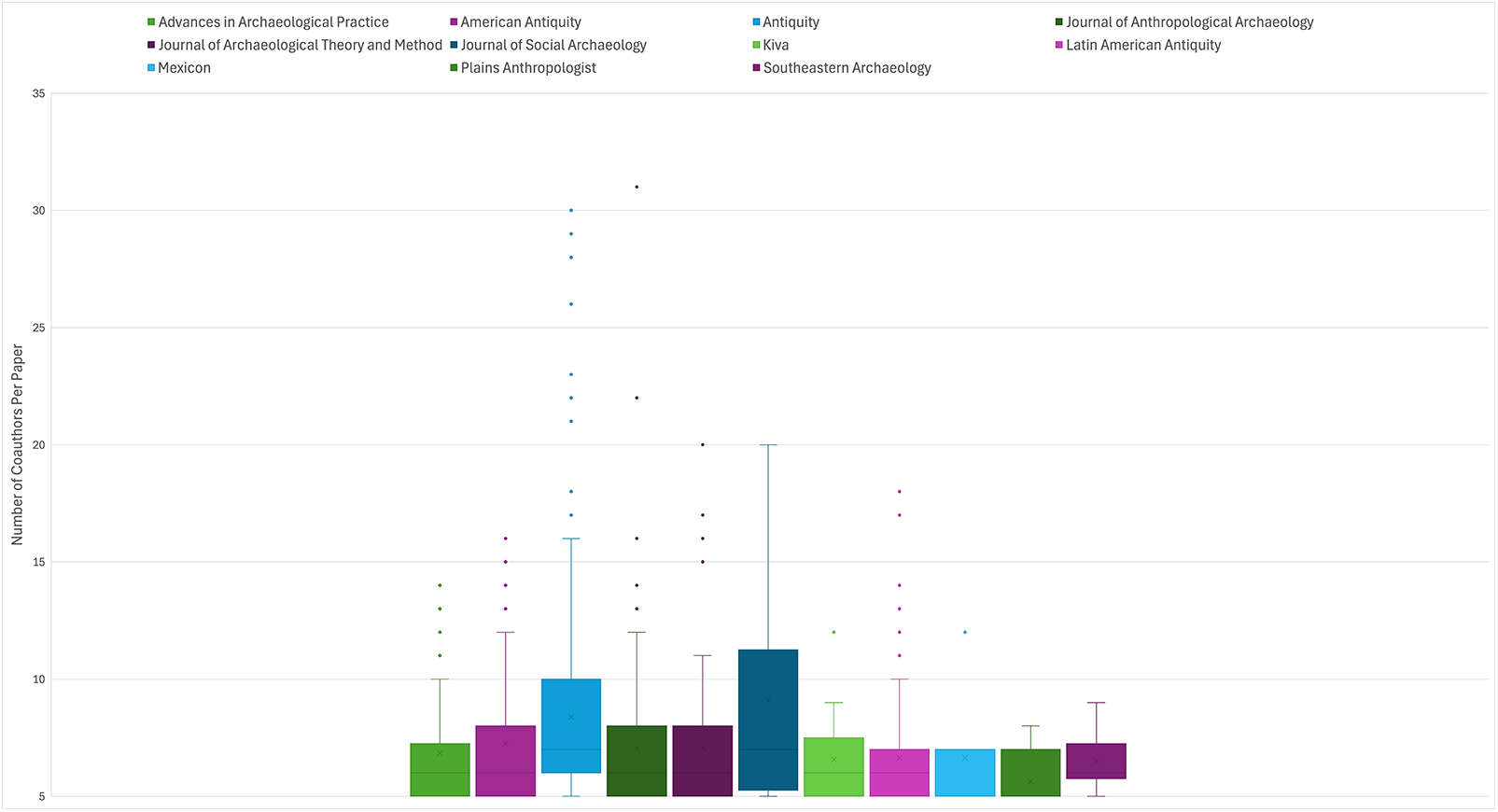
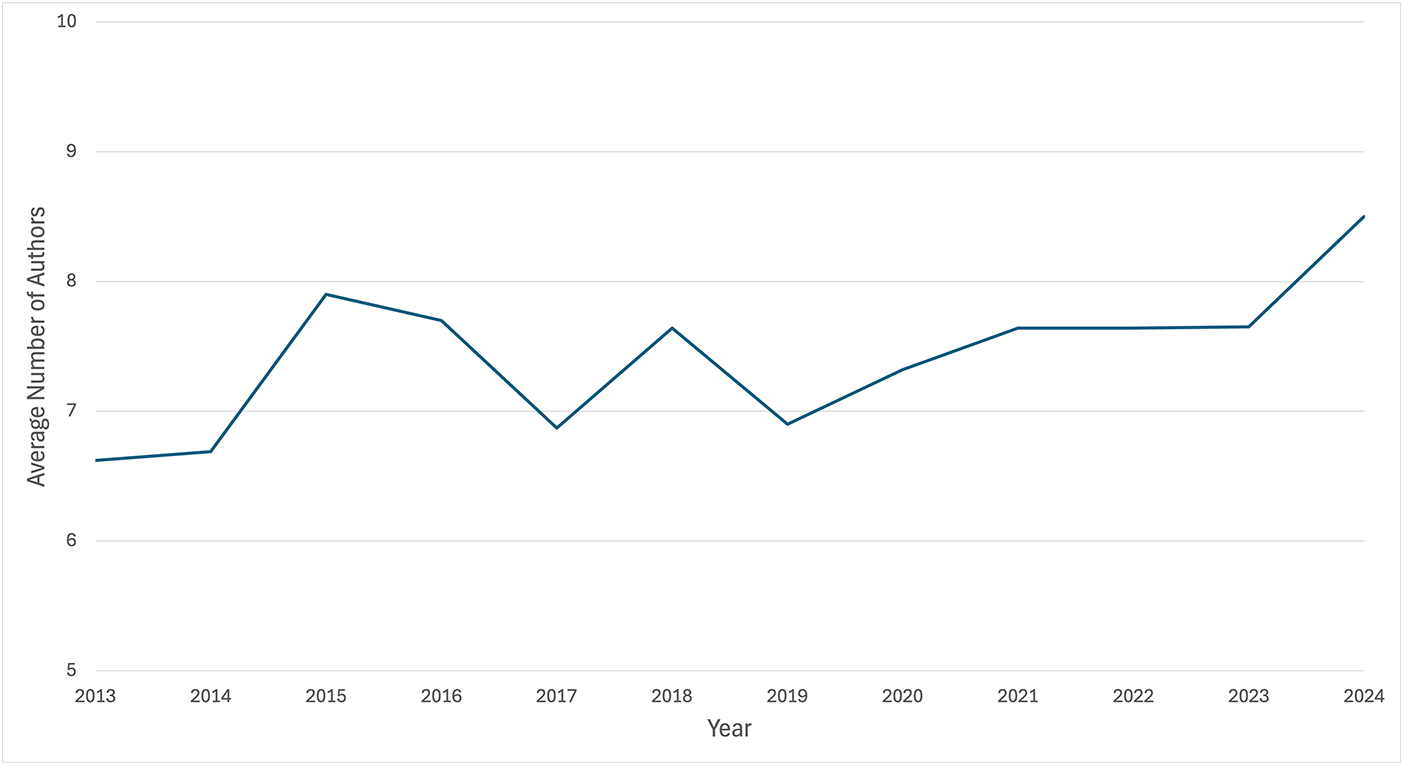
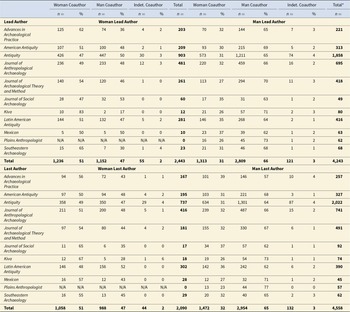
In total, we analyzed authorship on 900 articles. Individual papers contained between five and a maximum of 31 authors each, with most (66%) having between five and seven authors. Individual journals had similar distributions, although only Antiquity and Journal of Anthropological Archaeology included papers with more than 20 authors (Figure 2). Antiquity and Journal of Social Archaeology stand out for a slightly higher median number of authors. Further, data suggest that the number of coauthors is increasing over time, as was recently noted by Lyman (Reference Lyman2025), with the average number of individual authors increasing from 6.62 in 2013 to 8.5 in 2024. Importantly, the number of archaeological publications written by large teams has increased substantially between 2013 and 2024, with the total per year almost doubling from 2015 to 2016 and climbing again starting in 2019 (Table 1). This increase over time and relative similarity across journal venues suggest that understanding authorship ascription on coauthored papers will only grow in importance.
Box and whisker plot of the number of coauthors per article by journal.

Figure 2 Long description
Insufficient visual information to describe this element accurately.
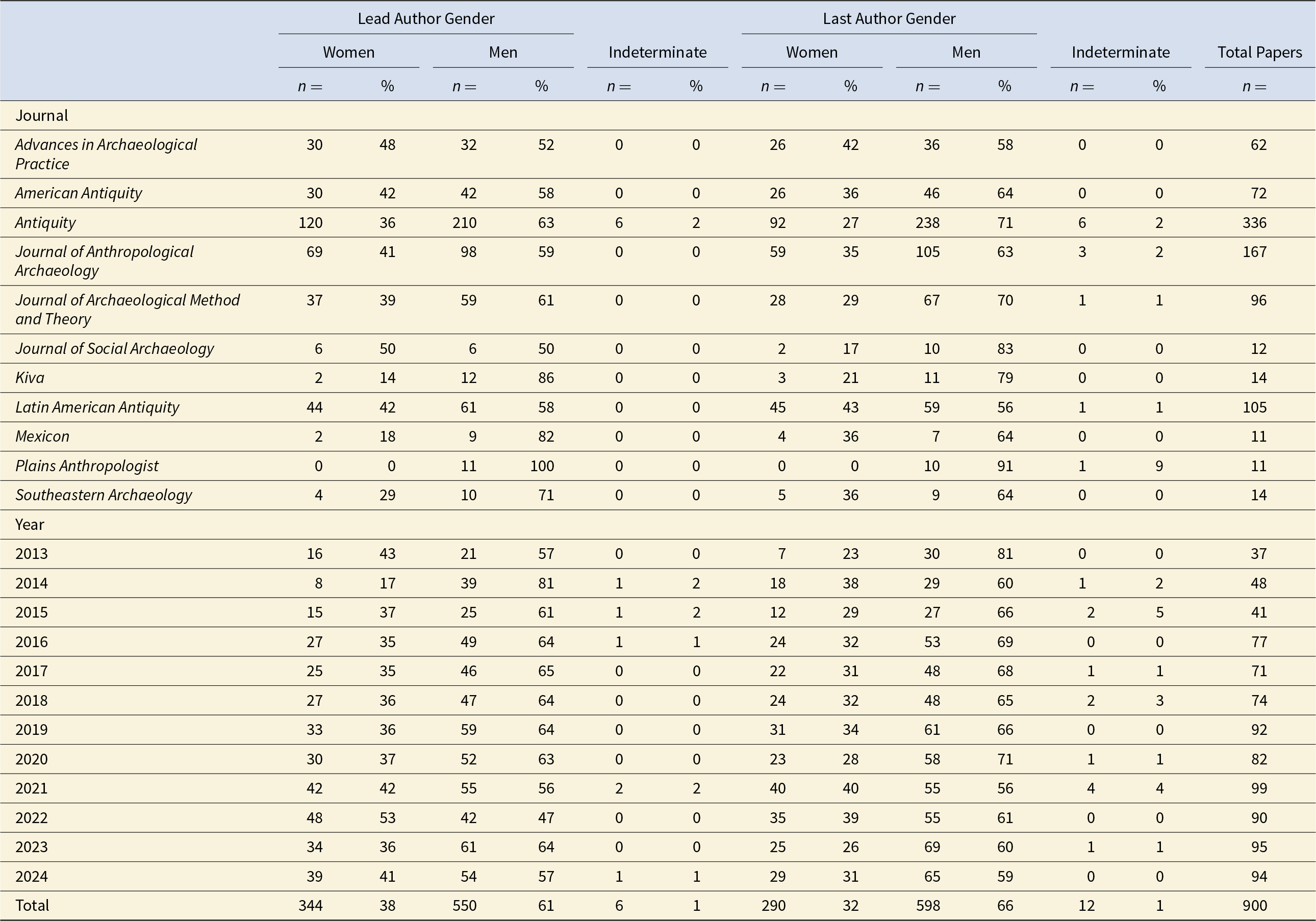
Counts and Percentages of the Gender of Lead and Last Authors by Journal and Year.

Table 1 Long description
The table is intended to report counts and percentages of lead and last authors by gender, organized by journal and year. It would allow comparison of gender representation for lead authors versus last authors within each journal and across time. It also includes a total papers column limited to articles with five or more authors, which affects what is counted. Because each article contributes both a lead and a last author, the total papers figure is derived from the row totals rather than representing an additional author category. No table values were provided, so specific journals, years, percentages, and trends cannot be described.
Note: Total papers refer to the total articles with five or more authors recorded for each journal. Because each article has both a lead and last author, this column is half the sum of the entire row.
In total, 6,741 authors were recorded, with 38% identified as women and 59% identified as men. Three percent of the authors (n = 208) could not be assigned a gender or were identified as queer: given the low number of queer-identified authors, they were grouped with indeterminate-gender authors to ensure their anonymity. Publications with indeterminate authors—111 of the 900 articles—were excluded from detailed analyses of demographic composition but were included when first or last author gender was identifiable. More than half (n = 60) of these articles were published in Antiquity, whose large sample size (n = 336) suggests their exclusion should not skew the data substantially. Only six articles, all from Antiquity, had first authors whose gender could not be assigned, whereas 12 articles had indeterminate final authors, largely from Antiquity and Journal of Anthropological Archaeology.
Average number of authors per article through time.

It is important to note that nonbinary, transgender, and other non-cisgender archaeologists are publishing and are certainly part of these groups. Vanderwaker and colleagues (Reference VanDerwarker, Brown, Gonzalez and Radde2018:Table 1) found that roughly 1% of their survey participants identified as transgender. Similarly, Heath-Stout (Reference Heath-Stout2020a:Table 4) and Aitchison and colleagues (Reference Aitchison, German and Rocks-Macqueen2021:Table 2.4.1) found that less than 1% of their survey sample of authors in major journals identified as non-cisgender. We could tentatively extrapolate to suggest that slightly less than 70 queer authors are missing within the study data. However, given what is known about the impacts of intersectional identities on academics, we wonder whether these authors are represented at the rates that they should be in coauthored articles. Further survey data would be required to assess whether inclusion in large coauthorship groups matches expectations for queer authors.
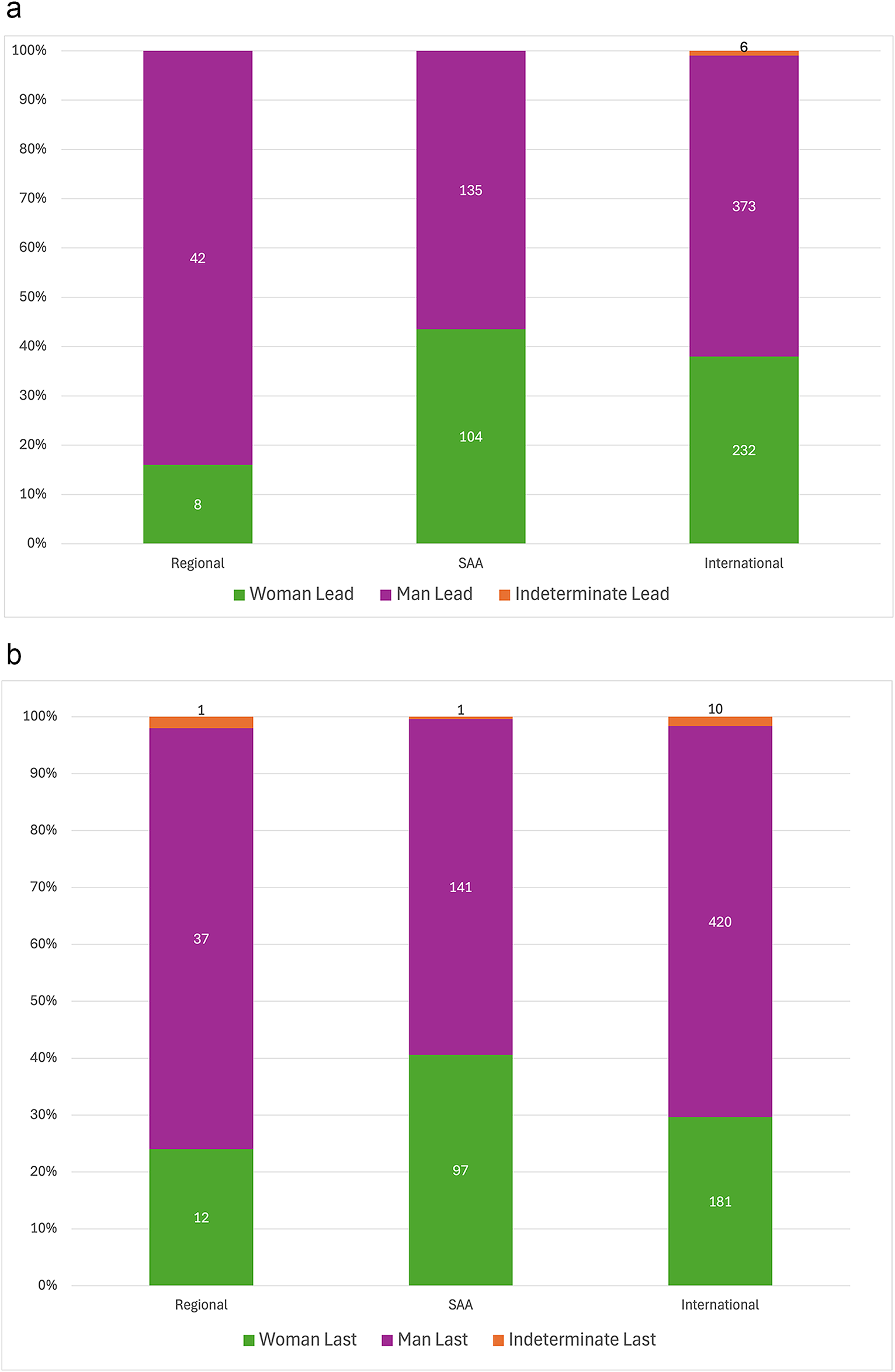
Within the years examined, individual journals contained between 11 (Mexicon and Plains Anthropologist) and 336 (Antiquity) articles with five or more authors (Table 1). Of these large coauthored articles, women led 38% (n = 344), whereas men led 61% (n = 550). Percentages of women as lead authors ranged by journal from a low of 0% (Plains Anthropologist) to a high of 50% (Journal of Social Archaeology). When considered based on the type of journals (regional, SAA, and international), a few trends appeared (Figure 4). Although the sample sizes are low, the regional journals included lower rates of women leading large coauthorship studies as first authors (Figure 4a) or serving as last authors (Figure 4b). Although this could suggest that the lack of gender parity is exacerbated in North America and Mesoamerica, international publications are shown to be less equitable than those led by the SAA, which averages more than 40% women in both lead and last author positions. Although the nearly equitable (48%) rate of women lead authors in Advances in Archaeological Practice certainly bolsters the numbers from the SAA journals slightly (Table 1), the journal does not stand out from the others in terms of last author gender. International journals, with the largest sample size at more than 600 articles, sit between the other groups in terms of inclusion of women in lead and last author positions. One important note about the grouping of these four journals is that the Journal of Social Archaeology is drowned out by the sample sizes from the others. However, although this journal is the only one to reach parity for first-author gender, it contains the lowest rate of women as last authors at 17% (Table 1).
Proportions of men and women as lead (a) and last (b) authors by journal type.

Figure 4 Long description
The image A showing a stacked bar graph with three vertical bars labeled Regional, SAA and International. The vertical axis is labeled percent, with tick labels 0 percent, 10 percent, 20 percent, 30 percent, 40 percent, 50 percent, 60 percent, 70 percent, 80 percent, 90 percent, 100 percent. The legend lists Woman Lead, Man Lead, Indeterminate Lead. Regional bar segment labels: Woman Lead 8; Man Lead 42. SAA bar segment labels: Woman Lead 104; Man Lead 135. International bar segment labels: Woman Lead 232; Man Lead 373; Indeterminate Lead 6. The image B showing a stacked bar graph with three vertical bars labeled Regional, SAA and International. The vertical axis is labeled percent, with tick labels 0 percent, 10 percent, 20 percent, 30 percent, 40 percent, 50 percent, 60 percent, 70 percent, 80 percent, 90 percent, 100 percent. The legend lists Woman Last, Man Last, Indeterminate Last. Regional bar segment labels: Woman Last 12; Man Last 37; Indeterminate Last 1. SAA bar segment labels: Woman Last 97; Man Last 141; Indeterminate Last 1. International bar segment labels: Woman Last 181; Man Last 420; Indeterminate Last 10.
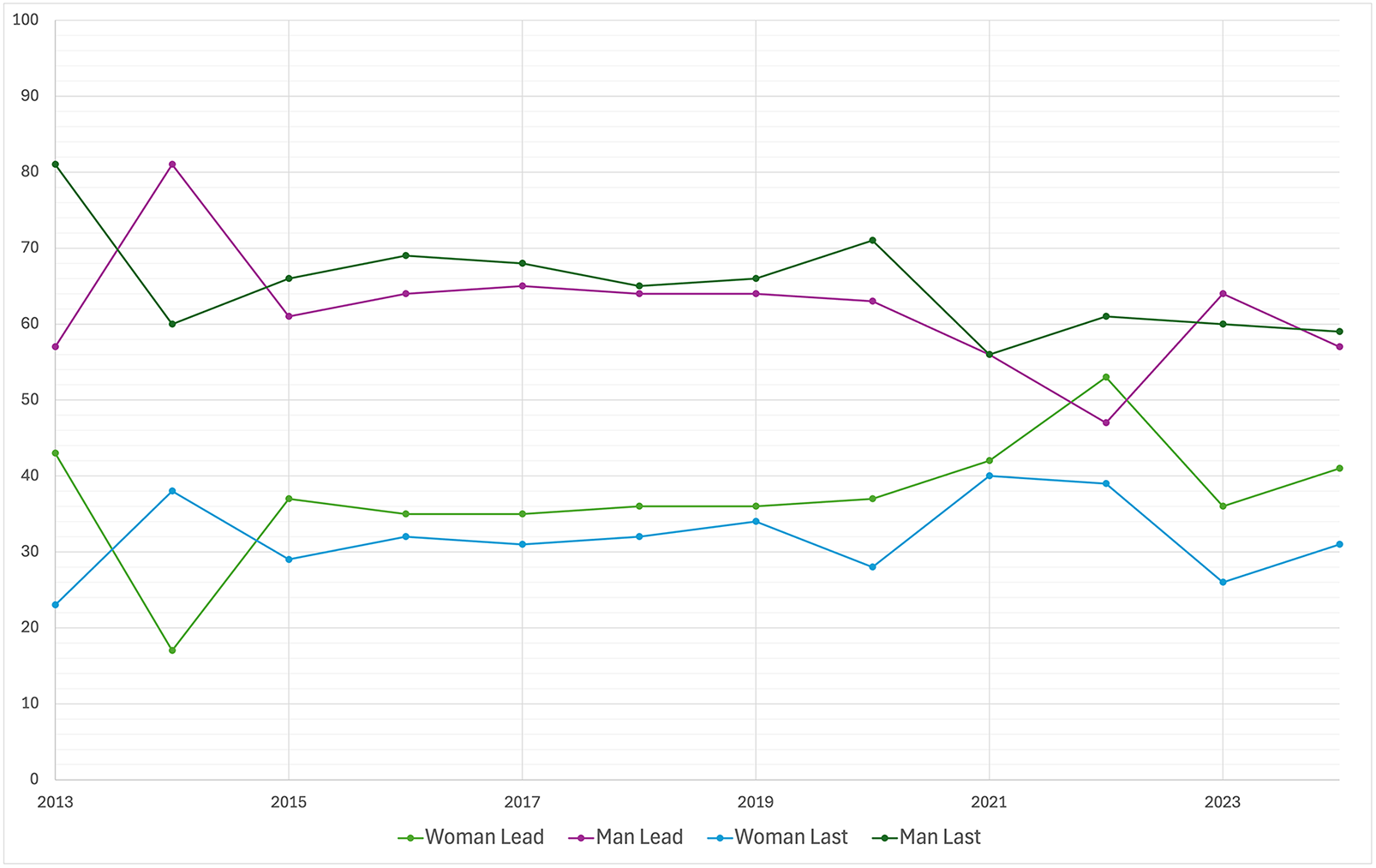
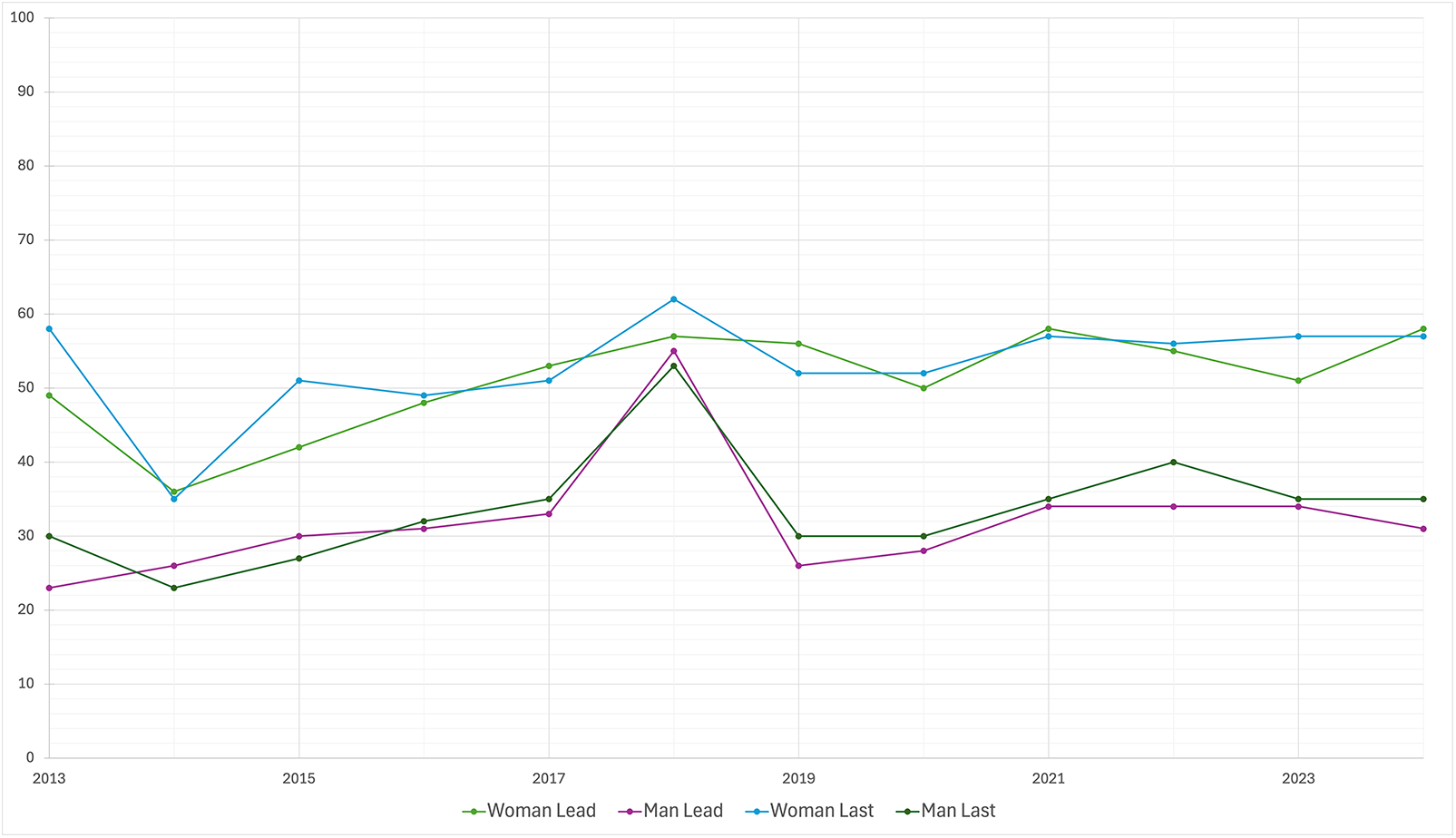
When considered through time, women first authored between 17% (2014) and 53% (2022) of the articles (Table 1; Figure 5). Most years, women led 35% to 43% of large, coauthored pieces with no clear temporal trend of improvement. Importantly, 2022 is the only year where women exceeded men as first authors. In terms of last authorship, women were found in this position on publications between 23% (7/37 in 2013) and 40% (40/99 in 2021) of the time (Figure 5). Again, no clear improvement through time is evident, although the lowest rates are found in the earliest year recorded. Notably, because last authorship can denote an honorary position signifying mentorship, articles with women as lead authors and men as last author may signify the increasing number of women archaeology students in the field. However, there also appears to be an increase in women as last authors and men as lead authors in 2014. Although they are not identical, the correlating trends for gender of lead and last authors suggest a relationship between these variables and gendered patterns in archaeology.
Proportions of men and women as lead and last authors through time.

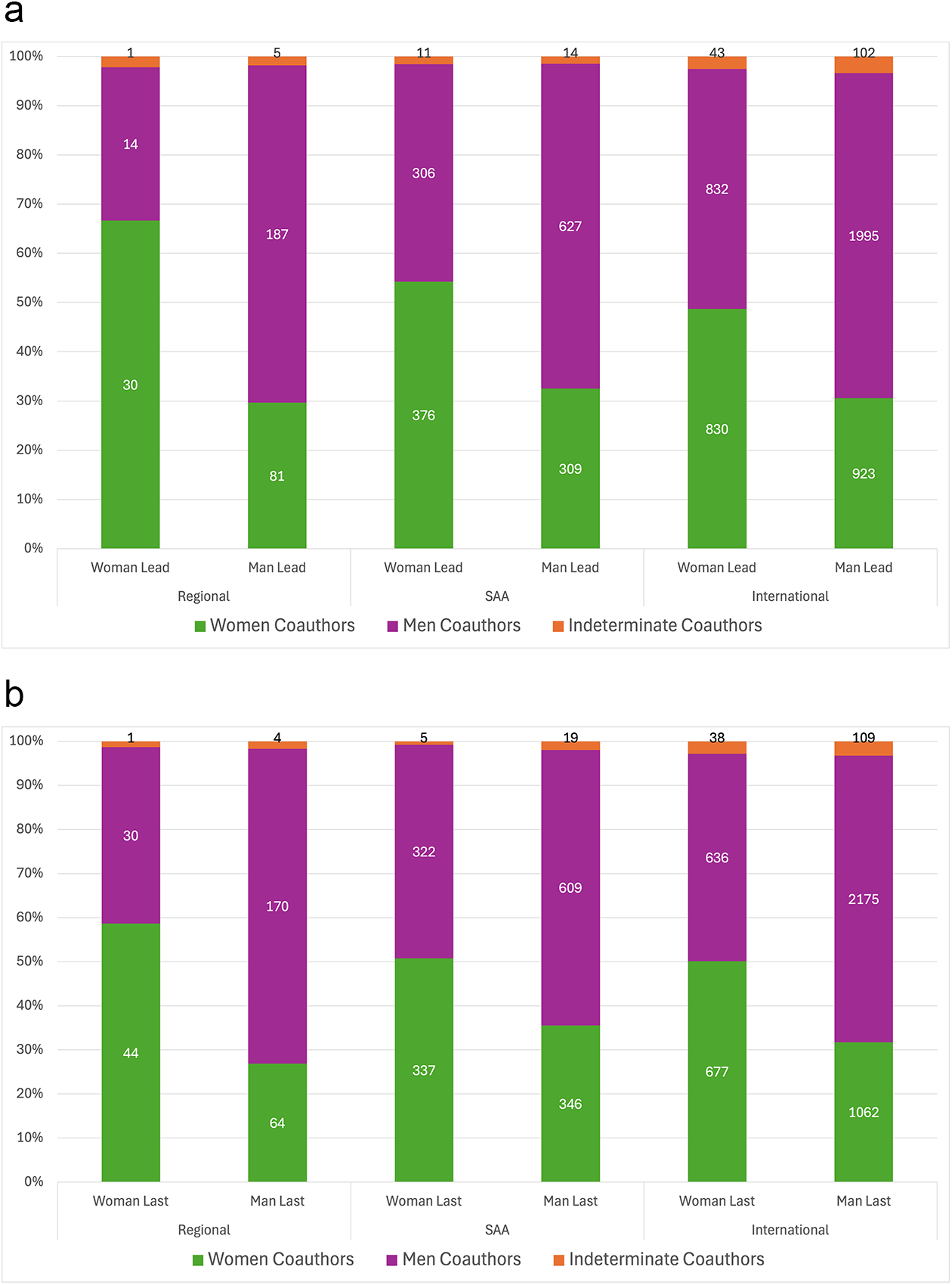
A key variable in understanding large coauthorship teams is the differential participation of men and women. Specifically, we questioned how the gender of lead and last authors influenced the gender of the included coauthors (Table 2). Again, the lead and last author data demonstrate remarkable correlation. Women lead and last authors coauthor with relatively equal proportions of men (47%) and women (51%). Alternatively, men lead and last authors coauthor with far more men (65%–66%) than women (31%–32%). Different journals demonstrate slightly different trends of coauthorship based on gender; however, the trend of women lead and last authors including a higher percentage of women as coauthors than men lead and last authors is consistent across all journals (Table 2). When different types of journals are considered, regional venues stand out as the most extreme, suggesting the strongest operation of gender homophily (Figure 6). For both SAA and international outlets, women lead and last authors demonstrate a slight preference for coauthoring with women but fall close to parity with their research teams, whereas men lead and last authors show much stronger preferences for men as coauthors.
Proportions of men and women coauthors based on gender of the lead (a) and last (b) author by journal type.

Figure 6 Long description
Insufficient visual information to describe this element accurately.
Coauthor Gender of Papers Based on the Gender of the Lead and Last Authors.
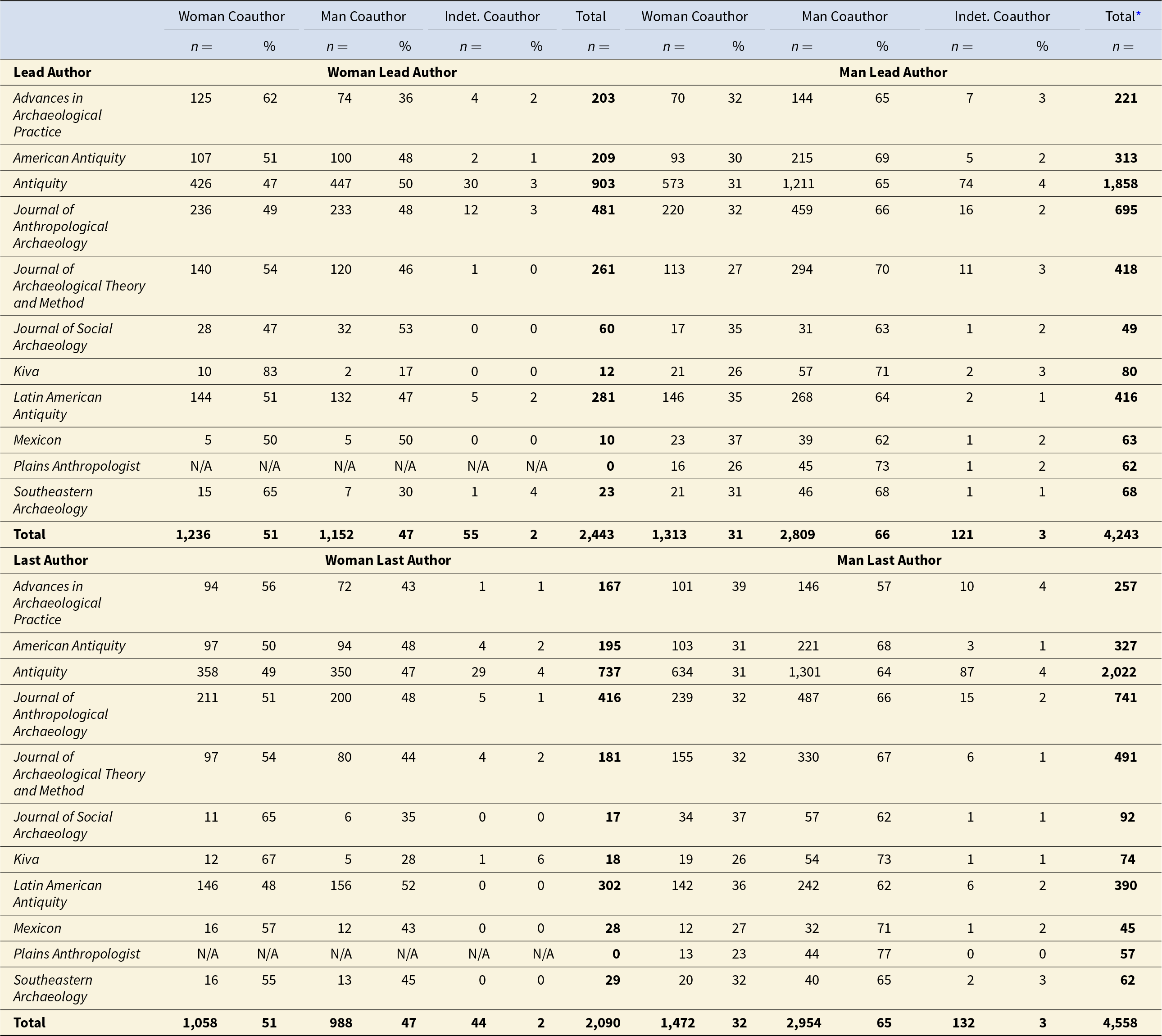
Table 2 Long description
The table is intended to report coauthor gender composition of papers, grouped by the gender of the lead author and the last author. No numeric entries or category counts were provided, so key values, comparisons, and trends cannot be described. With the data, an accessible summary would compare how often women and men appear as coauthors across the different lead and last author gender pairings. It would also note which pairing has the highest and lowest representation of women coauthors and whether mixed-gender leadership differs from same-gender leadership. A caveat would explain that some papers may be included even when one of the two author genders is unknown, and totals can differ across groupings because not every paper fits every combination.
Note: Indeterminate lead and last authors were not considered for this portion of the study, but articles were included if either a lead or last author gender was known in the appropriate category.
* Totals vary for all categories due to the different combinations of women and men lead and last authors on each paper.
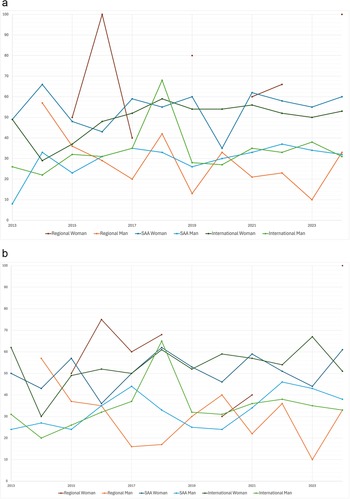
Temporally, there has been a very slight improvement for both men and women lead and last authors in the inclusion of women as coauthors through time (Figure 7). In 2014, women lead and last authors included fewer women as coauthors than expected, whereas women last authors and men lead and last authors all included higher proportions of women as coauthors in 2018. When broken down by journal type, it becomes clear that international journals are largely responsible for the variations in 2014 and 2018 (Figure 8). A further dip is noted among women lead authors’ inclusion of women coauthors for SAA journals in 2020 (Figure 8a). Except for these years, the international and SAA journals appear relatively similar in their rates of inclusion of women coauthors. Again, regional journals stand out as the most extreme for gender homophily.
Percentage of women coauthors based on gender of the lead and last authors through time.

Percentage of women coauthors by gender of the lead (a) and last (b) authors and journal type.

Figure 8 Long description
The image A showing a multi-line graph of percentage values by year for six legend groups: Regional Woman; Regional Man; SAA Woman; SAA Man; International Woman; International Man. The series are distinguished by different line colors in the legend. Horizontal axis label: 2013 to 2024. Vertical axis label: 0 to 100. Data points as coordinate pairs. Regional Woman: (2015, 50), (2016, 100), (2017, 40), (2021, 60), (2022, 66). Regional Man: (2014, 56), (2015, 36), (2017, 20), (2018, 42), (2019, 13), (2020, 33), (2021, 21), (2022, 23), (2023, 10), (2024, 33). SAA Woman: (2013, 49), (2014, 66), (2015, 48), (2016, 43), (2017, 59), (2018, 55), (2019, 60), (2020, 35), (2021, 62), (2022, 58), (2023, 55), (2024, 60). SAA Man: (2013, 8), (2014, 33), (2015, 23), (2016, 30), (2017, 35), (2018, 33), (2019, 26), (2020, 29), (2021, 33), (2022, 37), (2023, 34), (2024, 32). International Woman: (2013, 49), (2014, 28), (2015, 37), (2016, 48), (2017, 52), (2018, 58), (2019, 54), (2020, 54), (2021, 56), (2022, 52), (2023, 50), (2024, 53). International Man: (2013, 26), (2014, 22), (2015, 31), (2016, 31), (2017, 35), (2018, 68), (2019, 28), (2020, 27), (2021, 35), (2022, 33), (2023, 38), (2024, 31). Key extrema and comparisons from the listed points. Regional Woman maximum: 100 at 2016; minimum: 40 at 2017. Regional Man maximum: 56 at 2014; minimum: 10 at 2023. SAA Woman maximum: 66 at 2014; minimum: 35 at 2020. SAA Man maximum: 37 at 2022; minimum: 8 at 2013. International Woman maximum: 58 at 2018; minimum: 28 at 2014. International Man maximum: 68 at 2018; minimum: 22 at 2014. Across years where both are listed, SAA Woman values are higher than SAA Man values. International Woman values are higher than International Man values in most listed years except 2018 where International Man is 68 and International Woman is 58. The image B showing a multi-line graph of percentage values by year for the same six legend groups: Regional Woman; Regional Man; SAA Woman; SAA Man; International Woman; International Man. The series are distinguished by different line colors in the legend. Horizontal axis label: 2013 to 2024. Vertical axis label: 0 to 100. Data points as coordinate pairs. Regional Woman: (2015, 50), (2016, 75), (2017, 60), (2018, 68), (2020, 30), (2021, 40). Regional Man: (2014, 56), (2015, 37), (2017, 16), (2018, 17), (2020, 40), (2021, 22), (2022, 36), (2023, 10), (2024, 33). SAA Woman: (2013, 50), (2014, 43), (2015, 57), (2016, 35), (2017, 50), (2018, 62), (2019, 52), (2020, 46), (2021, 59), (2022, 50), (2023, 43), (2024, 61). SAA Man: (2013, 24), (2014, 27), (2015, 24), (2016, 35), (2017, 44), (2018, 33), (2019, 25), (2020, 24), (2021, 33), (2022, 46), (2023, 44), (2024, 38). International Woman: (2013, 62), (2014, 30), (2015, 49), (2016, 52), (2017, 50), (2018, 61), (2019, 53), (2020, 59), (2021, 57), (2022, 54), (2023, 67), (2024, 51). International Man: (2013, 31), (2014, 20), (2015, 25), (2016, 32), (2017, 37), (2018, 65), (2019, 32), (2020, 31), (2021, 36), (2022, 38), (2023, 35), (2024, 33). Key extrema and comparisons from the listed points. Regional Woman maximum: 75 at 2016; minimum: 30 at 2020. Regional Man maximum: 56 at 2014; minimum: 10 at 2023. SAA Woman maximum: 62 at 2018; minimum: 35 at 2016. SAA Man maximum: 46 at 2022; minimum: 24 at 2013, 2015 and 2020. International Woman maximum: 67 at 2023; minimum: 30 at 2014. International Man maximum: 65 at 2018; minimum: 20 at 2014. Across years where both are listed, International Woman values are higher than International Man values in all listed years. SAA Woman values are higher than SAA Man values in most listed years, with equal values at 2016 where both are 35. Panel-to-panel comparison using the listed points. Regional Woman reaches 100 at 2016 in image A and 75 at 2016 in image B. International Woman reaches 58 at 2018 in image A and 67 at 2023 in image B. International Man reaches 68 at 2018 in image A and 65 at 2018 in image B.
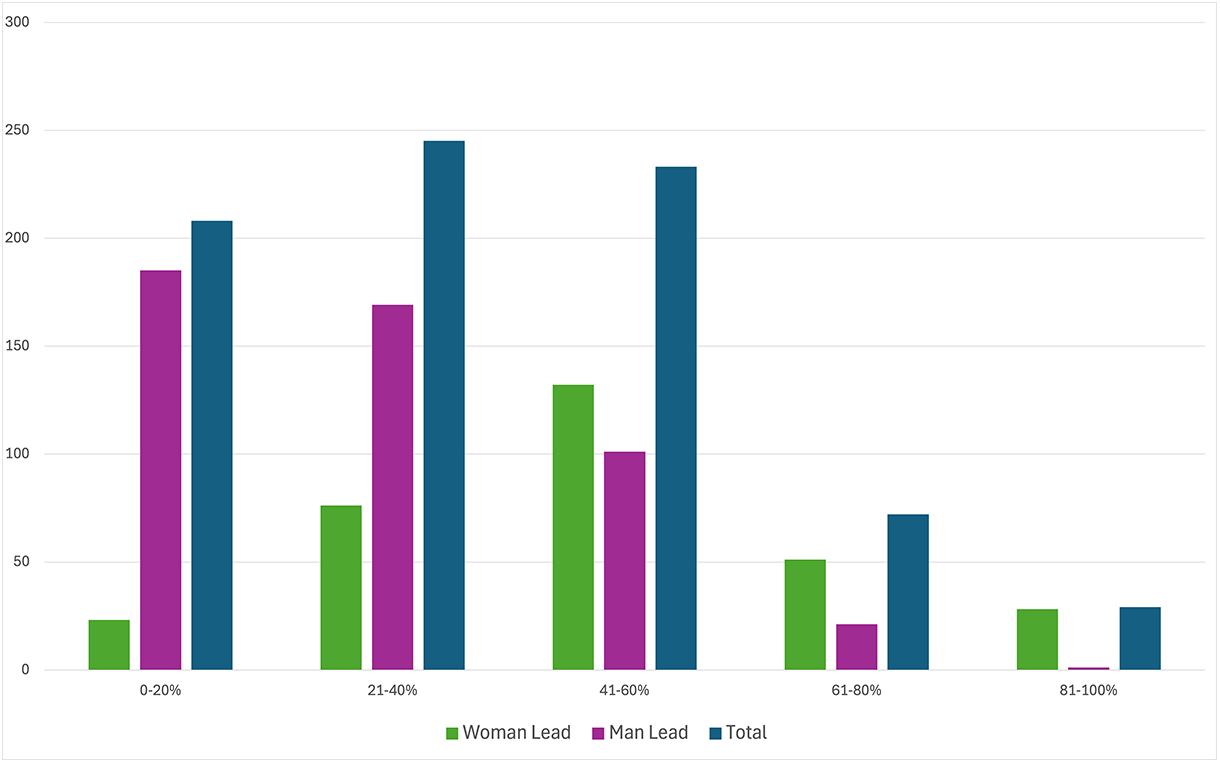
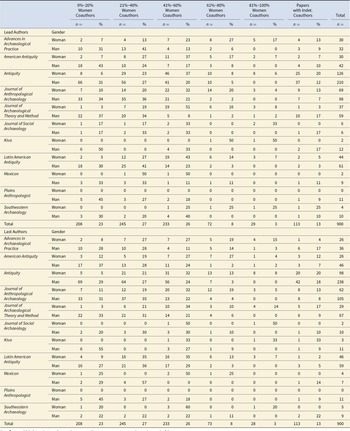
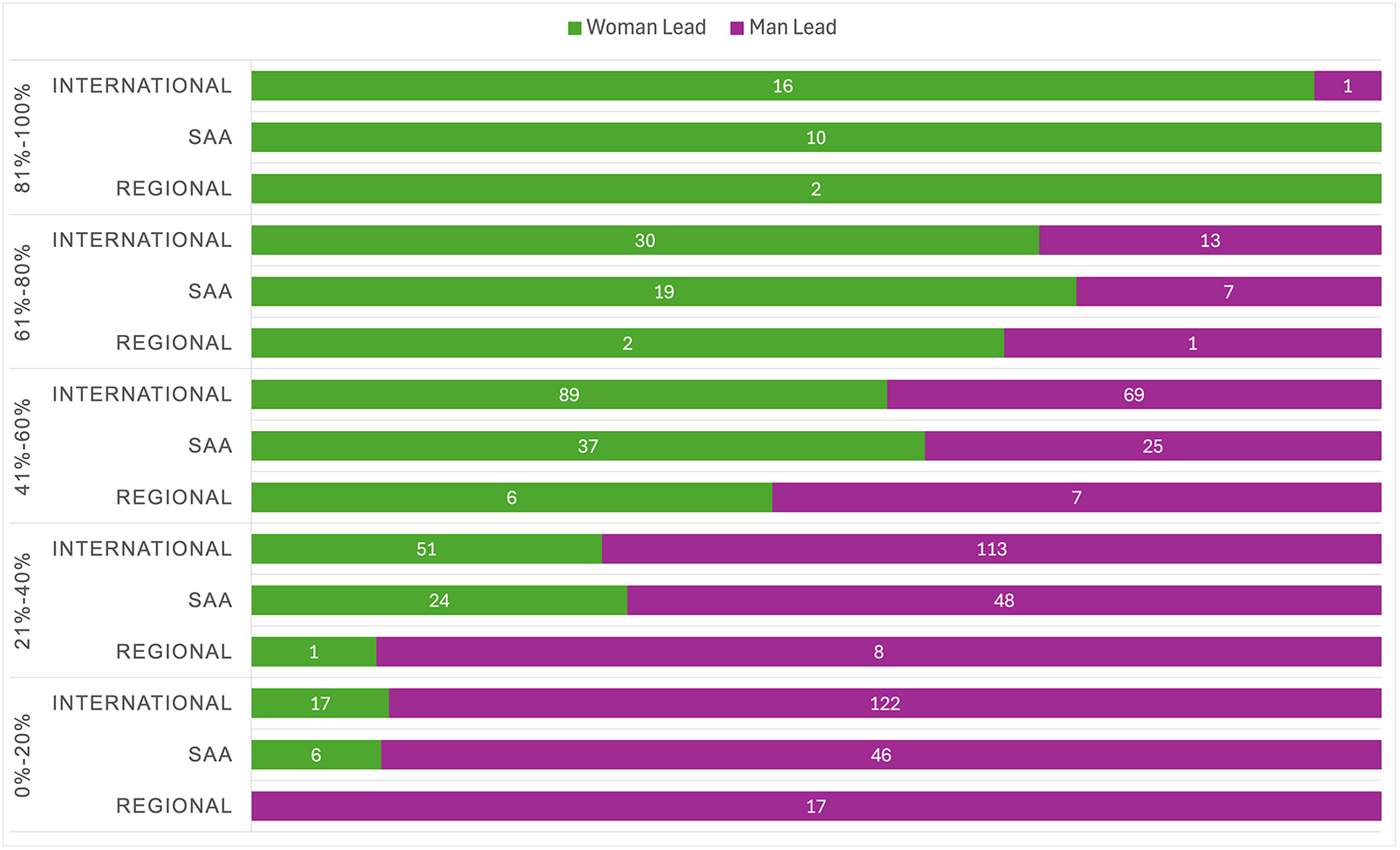
Also notable is the composition of groups on individual papers. We grouped papers into five categories based on the percentage of women coauthors per publication (Table 3). Because we used a minimum authorship count of five, we chose to use five rather than four groups, with each representing 20% of the authors being women; this division also allowed for a relative parity category for papers with between 41% and 60% women authorship. As shown in Table 3 and Figure 9, the vast majority of coauthored papers have 60% or fewer women. Notably, papers with men as first authors tend to peak in number at the 21%–40% women coauthor range, whereas those with men as first authors tend to peak in number at the 41%–60% women coauthor range. Whereas papers with women as lead authors often consist of large proportions of coauthors who are men, high rates of women coauthors are almost nonexistent for papers led by men, with the only example being a single paper from the Journal of Archaeological Method and Theory.
Number of articles falling into five categories based on the percentage of women coauthors.

Gender Composition of Papers Based on the Gender of the Lead and Last Authors.

Table 3 Long description
The table compares the gender composition of papers across groups defined by the gender of the lead author and the gender of the last author. Each group summarizes how papers are distributed by author gender categories within that lead and last author pairing. The intent is to highlight differences in paper gender makeup when leadership roles are held by different genders. Papers where one or more author genders cannot be determined are included and identified so that the percentage patterns across groups remain meaningful. No numeric values were provided here, so specific counts, percentages, and the strongest contrasts between groups cannot be described.
Note: Papers with indeterminate author genders are noted to ensure percentage trends remain meaningful.
The patterns found based on last author gender are generally consistent but slightly less extreme than the gendered divisions identified with first authors. When considered by journal type, the patterns remain consistent, with regional journals showing the most extreme patterns of gender homophily again (Figure 10). However, as shown in Table 3, there is substantial variation among the individual journals within this category. Kiva and Southeastern Archaeology, for instance, demonstrate greater gender homophily among women than Mexicon.
Proportion of articles by lead-author gender based on the percentage of women coauthors for each journal type.

Figure 10 Long description
A stacked horizontal bar graph with a legend listing Woman Lead and Man Lead. X axis label and unit: Insufficient visual information to describe this element accurately. X axis range: Insufficient visual information to describe this element accurately. Y axis label and unit: Insufficient visual information to describe this element accurately. Y axis categories shown in five grouped sections: 81 percent dash 100 percent, 61 percent dash 80 percent, 41 percent dash 60 percent, 21 percent dash 40 percent, 0 percent dash 20 percent. Each section lists INTERNATIONAL, SAA, REGIONAL. 81 percent dash 100 percent: INTERNATIONAL: Woman Lead 16, Man Lead 1. SAA: Woman Lead 10. REGIONAL: Woman Lead 2. 61 percent dash 80 percent: INTERNATIONAL: Woman Lead 30, Man Lead 13. SAA: Woman Lead 19, Man Lead 7. REGIONAL: Woman Lead 2, Man Lead 1. 41 percent dash 60 percent: INTERNATIONAL: Woman Lead 89, Man Lead 69. SAA: Woman Lead 37, Man Lead 25. REGIONAL: Woman Lead 6, Man Lead 7. 21 percent dash 40 percent: INTERNATIONAL: Woman Lead 51, Man Lead 113. SAA: Woman Lead 24, Man Lead 48. REGIONAL: Woman Lead 1, Man Lead 8. 0 percent dash 20 percent: INTERNATIONAL: Woman Lead 17, Man Lead 122. SAA: Woman Lead 6, Man Lead 46. REGIONAL: Man Lead 17.
Ultimately, the very low number of papers with women as first authors complicates interpretations. Notably, men are responsible for more papers in the parity category of coauthorship than women for regional journals, perhaps suggesting these papers may provide an avenue for publishing in regional journals for women. Among SAA journals, Advances in Archaeological Practice again stands out for the tendency for women lead authors to work with higher proportions of women. International journals generally follow the established trends. Papers led by men are most likely to contain 20% or fewer women as coauthors for both Antiquity and Journal of Archaeological Theory and Method, whereas the small sample size of Journal of Social Archaeology again makes trends difficult to assess.
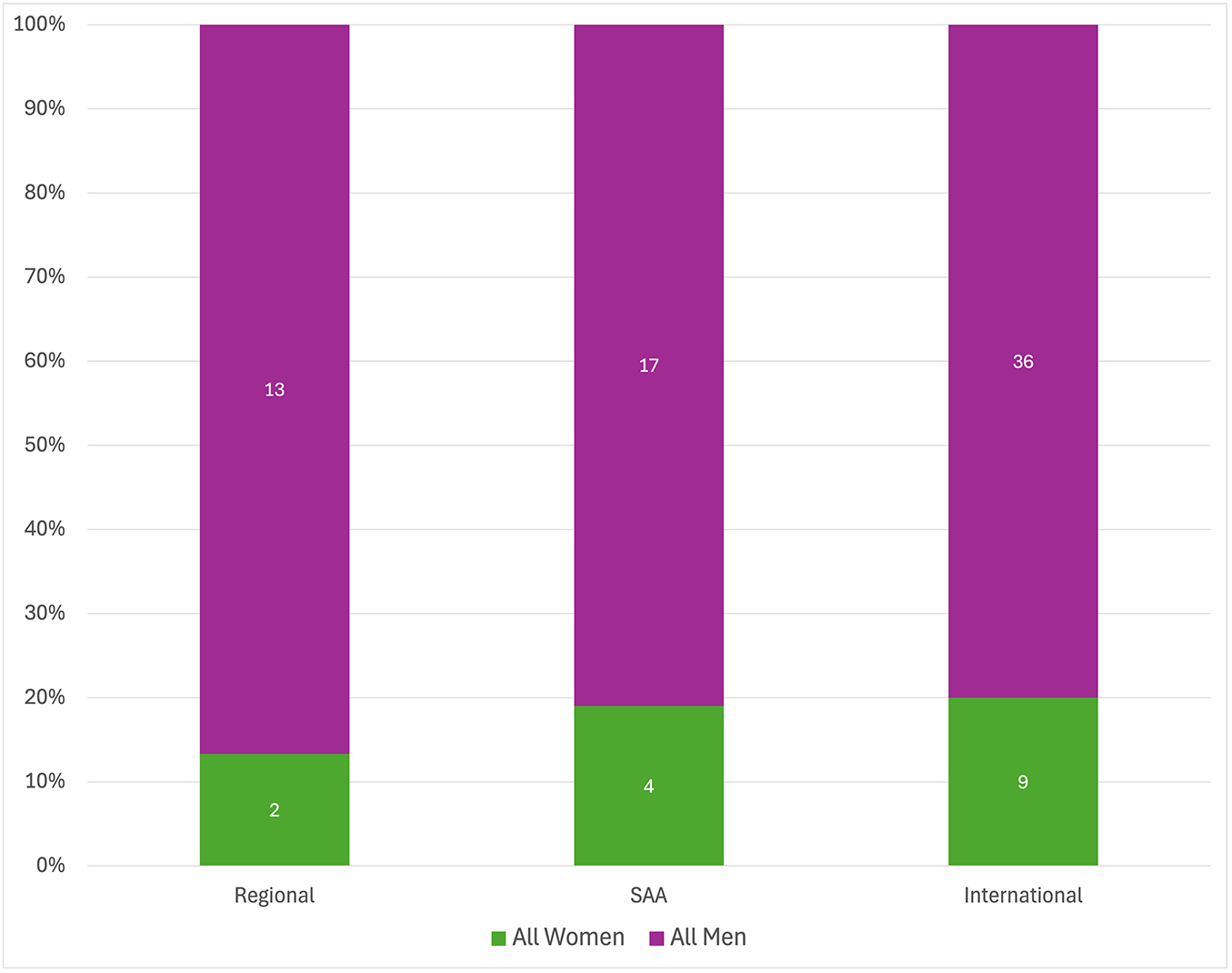
Finally, we considered all men and all women coauthorship teams, which arguably indicate the strongest forms of gender homophily. In total, men are responsible for 81% (n = 66) of these papers. When considered across journal types, regional journals again appear as the most prominent space for all-men teams, whereas SAA and International journals are more similar to one another (Figure 11). However, all types of journals demonstrate that all-men teams are more common than all-women teams, mirroring research in other disciplines (e.g., Smith et al. Reference Smith, Riccucci, Isett, DeHart-Davis and Sims2024; Williams et al. Reference Williams, Kolek, Saunders, Remaly and Wells2018).
Proportion of articles written by all women and all men coauthors by journal type.

Discussion
Our study thus suggests that, on peer-reviewed archaeology journal publications with five or more authors, men are more likely than women to be in leadership positions, whether denoted by lead or last authorship position. Although the rates of women as lead authors largely mirror or show slight improvements over previous studies (summarized in Heath-Stout Reference Heath-Stout2020a:Table 3), earlier studies rarely considered the effects of these trends on coauthorship opportunities. Our analysis suggests that gender homophily plays a substantial role in those opportunities and that these trends are more pronounced for men, echoing other disciplines’ findings (e.g., Araújo et al. Reference Araújo, Araújo, Moreira, Herrmann and Andrade2017; Frances et al. Reference Frances, Fitzpatrick, Koprivnikar and McCauley2020). Women publish about equally with men and other women, although there is variation across the individual journal outlets. When men are responsible for papers, less than one-third of the coauthors are women. This greater tendency for gender homophily by men is multiplied by the fact that men are responsible for 20% more large coauthorship studies, suggesting that women are not being given as many opportunities to be part of large collaborative teams in archaeology.
Although we unfortunately do not have the data to assess intersectional identities, our assumption based on Heath-Stout’s (Reference Heath-Stout2020a) findings is that the majority of men and women captured by this analysis are likely straight, white, and cisgender. The principles of homophily shown to operate in publishing suggest that people tend to coauthor with others who share their identities, and further survey work may be revealing as to how intersectional identities affect inclusion in large coauthorship teams. What is clear from this analysis is that, to date, men have benefited more from trends of increasing coauthorship than have women. Just as Black women’s work is undercited (Smith and Garrett-Scott Reference Smith and Garrett-Scott2021), we suspect the intersection of multiple marginalized identities—women of color, queer women, and so on—may result in lower likelihoods of being presented with opportunities to join these research teams.
Social networks have been shown to affect career trajectories in academic anthropology in the United States. Kawa and colleagues (Reference Kawa, Michelangeli, Clark, Ginsberg and McCarty2019), for instance, found that more than half of tenured and tenure-track anthropology professors came from only 15 graduate programs. In this study, individuals tied into large coauthorship networks—who are likely overwhelmingly men in archaeology given the findings from this study—are provided with opportunities to publish in higher quantities than scholars largely working on their own or with small groups of collaborators (Lee and Bozeman Reference Lee and Bozeman2005), a practice that has been considered by some (Kovacs Reference Kovacs2017) as a form of “symbolic violence” (sensu Bourdieu Reference Bourdieu and Nice1977). What remains unclear is how and why women are excluded from large authorship teams, particularly in smaller, regional-scale archaeological publications. Given the noted importance of friendship networks (Leighton Reference Leighton2020) in the discipline, women may not be considered in initial team formation. Alternatively, they may be left off authorship lists more often than men, as has been found to be the case in scientific research more broadly (Ross et al. Reference Ross, Glennon, Murciano-Goroff, Berkes, Weinberg and Lane2022), or women may be more likely to be included in certain aspects of research, such as performing experiments, that are not always credited with authorship in archaeology (Macaluso et al. Reference Macaluso, Lariviere, Sugimoto and Sugimoto2016). Although there is certainly a bureaucratic and service component to leading such large scholarly teams (e.g., coordinating, emailing, etc.), leadership of these teams potentially leads to greater personal benefit than most service work, which disproportionately falls to women and especially women of color (e.g., Ahmad Reference Ahmad, Johnstone and Momani2024; Domingo et al. Reference Domingo, Gerber, Harris, Mamo, Pasion, Rebanal and Rosser2022; Misra et al. Reference Misra, Lundquist, Holmes and Agiomavritis2011). Given the clearly gendered trends in archaeology coauthorship, how can we reimagine authorship ascription in archaeology to be more equitable?
Recommendations and Future Directions
Collaboration in archaeology undoubtedly benefits the discipline and is likely to increase in the future. If the purpose of authorship is to “characterize the existence, circulation, and operation of certain discourses,” as noted by Foucault (Reference Foucault, F. Bouchard, F. Bouchard and Simon1977:124), there is a critical need for more equitable practices of authorship ascription. We encourage individual authors to be more cognizant of the gendered trends laid out in this study. We also recognize that the issues are largely systemic and will require changes in how institutions assign and interpret credit. As such, our main recommendations focus on suggestions for archaeology organizations that sponsor journals and institutions.
As has been noted broadly, existing guidelines “determining scientific attribution are not well-known or understood by all parties” (Ross et al. Reference Ross, Glennon, Murciano-Goroff, Berkes, Weinberg and Lane2022:141). In wide-ranging fields like archaeology, standards for authorship ascription are particularly unclear (see also Ouzman Reference Ouzman2023). Discipline-specific organizations, such as the European Association of Archaeologists (EAA) and SAA, should clearly outline expectations for authorship ascription for their members (see also Pruschak and Hopp Reference Pruschak and Hopp2022:15–16). Such a move would align well with already established guidelines for promoting equality and inclusion, such as the Code of Practice developed by the EAA in 2022. Although defining authorship standards across a discipline with such breadth will undoubtedly be difficult, clear guidelines would provide a framework to both justify the decisions of leaders on a paper and allow for individuals to potentially advocate for their inclusion as an author. Clear guidelines would also remind archaeologists about expectations for authorship, potentially avoiding the unintentional exclusion of an individual from a publication due to misunderstandings regarding the threshold for inclusion. Further, regional organizations whose journals often display the greatest degrees of gender homophily can develop more specific guidelines tailored to the practice of archaeology in their areas. We encourage a consideration not only of how authorship itself can be more equitable in these regions but also of how and why the demography of archaeologists working there may be contributing to the disparity in authorship teams. Editor pieces critically examining their own practice in accepting submissions, selecting reviewers, and soliciting papers seem to be more common or at least more visible for larger-scale journals (e.g., Hanscam and Witcher Reference Hanscam and Witcher2023; Heath-Stout Reference Heath-Stout2020b; Rautman Reference Rautman2012). Editors of regional journals could take an important step toward greater equity by assessing and publishing their own data on potential reviewer bias, submission rates, and publication rates. They could seek out contributions from women and other underrepresented groups and encourage greater self-awareness within their region of authorship trends and patterns of intentional or unintentional exclusion.
Archaeology journals can more uniformly adopt a way to measure inclusion. Although some argue that academic journals should jettison the concept of authorship and replace it with contributors and guarantors (Rennie et al. Reference Rennie, Yank and Emanuel1997), several publishers have adopted a modified solution by requiring contributor statements or disclosures for individual papers (see Allen et al. Reference Allen, O’Connell and Kiermer2019; Biagioli Reference Biagioli, Biagioli and Galison2003; Brand et al. Reference Brand, Allen, Altman, Hlava and Scott2015). The CRediT (Contributor Role Taxonomy) system is particularly noteworthy (see also Lyman Reference Lyman2025). Introduced in 2014 and now widely adopted by numerous academic journals, including Advances in Archaeological Practice, CRediT “responds to calls for greater transparency and recognition of author contributions” by asking coauthors to characterize their contribution using a 14-role taxonomy. This taxonomy includes not only tasks such as conceptualization but also data curation and funding acquisition (Allen et al. Reference Allen, O’Connell and Kiermer2019:71), although it does not provide a clear way to capture community contributions that are key to collaborative work in archaeology (see also Lyman Reference Lyman2025; Ouzman Reference Ouzman2023). Although not “a panacea for the problems of authorship” (Larivière et al. Reference Larivière, Pontille and Sugimoto2021:124), broad adoption of CRediT or a related system by archaeology journals would begin to address authorship issues.
Despite the improvements offered by contributor statements, additional interventions are needed. Archaeology would benefit from a way to denote contributors who are not responsible for or even agree with the entirety of a publication for the work they produced. Although these contributors are generally included in the acknowledgments sections, credit is not ascribed to those found in those sections. Vasilevsky and colleagues (Reference Vasilevsky, Hosseini, Teplitzky, Ilik, Mohammadi, Schneider and Kern2021) suggest the adoption of “badges” as are used by the Open Science Foundation (Kidwell et al. Reference Kidwell, Lazarevic, Baranski, Hardwicke, Piechowski, Falkenberg and Kennett2016) to signify specific contributions to a paper. For archaeology, this could include categories such as fieldwork, lab analyses, community knowledge/guidance, museum access, translation, and figure making. In addition to providing recognition of those involved in the direct production of archaeological data (Heath-Stout Reference Heath-Stout2024a:170; Leighton Reference Leighton2015, Reference Leighton2016; Mickel Reference Mickel2019, Reference Mickel2021; Mickel and Byrd Reference Mickel and Byrd2021; Quinlan Reference Quinlan2023), such a shift could also support greater acknowledgment of the labor involved in good mentorship and other service activities that often fall disproportionately to women and especially women of color (e.g., Ahmad Reference Ahmad, Johnstone and Momani2024; Brodkin et al. Reference Brodkin, Morgen and Hutchinson2011; Domingo et al. Reference Domingo, Gerber, Harris, Mamo, Pasion, Rebanal and Rosser2022; El-Alayli et al. Reference El-Alayli, Hansen-Brown and Ceynar2018; Misra et al. Reference Misra, Lundquist, Holmes and Agiomavritis2011; Reid Reference Reid2021; Ross et al. Reference Ross, Glennon, Murciano-Goroff, Berkes, Weinberg and Lane2022). If badges or other recognitions of contributions become widely recognized by the discipline of archaeology, they could become a regular fixture on CVs and resumes and be factored into hiring, retention, and promotion decisions. Reconceptualizing how we recognize contributions to publications could have cascading effects on the apportionment of value in our field, increasing the recognition of scholars who uplift the field as good citizens and mentors, as well as those following less traditional publication paths.
Finally, institutions could and should reconsider how authorship credit is allocated within the discipline. As Street and colleagues (Reference Street, Rogers, Israel and Braunack-Mayer2010:1464) explain, the “story of authorship with respect to scientific publications can be couched in terms of individual responsibility. Yet, there is an alternative story,” one focused on institutional incentives. They and others (e.g., Pruschak and Hopp Reference Pruschak and Hopp2022) thus encourage universities and other institutions to revise their hiring and promotion criteria and no longer consider the number of publications as the sole or most prominent criterion for research excellence. Recognizing that long-standing authorship ascription practices may be difficult to change, scholars have questioned whether each coauthor should receive full or perhaps only partial credit for a publication. As Boyer and colleagues (Reference Boyer, Ikeda, Lefort, Malumbres-Olarte and Schmidt2017) summarize, “Quantifying the amount of work provided by different co-authors of a particular paper has been a recurrent problem” in academia, and researchers have proposed numerous ways of dividing credit, ranging from “simple calculations based on the rank of the authors such as . . . fractional authorship credit . . . to more complex credits, some even taking into account the controversial journal impact factor.”
Boyer and colleagues (Reference Boyer, Ikeda, Lefort, Malumbres-Olarte and Schmidt2017) propose the Author Contribution Index (ACI), a numerical value “based on contribution percentages provided by the authors, preferably at the time of submission.” Because the ACI would be difficult to apply to previously published articles, we suggest that archaeology make use of two different measures: overall publication count and fractional authorship publication count. The first would provide a raw measure of productivity, regardless of the number of coauthors, whereas the second would standardize credit based on the number of authors on a paper (sensu Lee and Bozeman Reference Lee and Bozeman2005). For instance, an individual who published five papers with four coauthors each would be assessed both as having five publications and as having contributed to 1.25 papers. When taken together, institutions would be in a better position to assess both the relative productivity of individuals who frequently collaborate with large teams and of those who most often publish individually, thereby making appropriate hiring, promotion, and other decisions regarding credit for work.
Large multiauthored papers in archaeology are only growing in prominence in the field. As these forms of scholarship continue to become more common, we also need to be aware of the ways inclusivity goals are supported or, in the case of gender equity, hindered. Greater awareness of the composition of coauthorship teams should allow for emerging issues to be addressed early and encourage scholars to think twice about both the formation of research teams and the assessment of others’ productivity.
Acknowledgments
We thank Nicholas Puente for translating the abstract and keywords into Spanish. We also greatly appreciate the anonymous comments provided by three reviewers whose insights greatly enhanced the quality of this article.
Funding Statement
This research received no specific grant funding from any funding agency, commercial, or not-for-profit sectors.
Data Availability Statement
Data included in this article are publicly available in tables of contents found online for each journal included in the analysis. A summary of the collected information is available in Supplementary Material 1.
Competing Interests
The authors declare none.
Supplementary Material
The supplementary material for this article can be found at https://doi.org/10.1017/aap.2025.10141.
Supplementary Material 1. Raw data collected on multiauthored publications used for analysis (table).



 Open access

