

Introduction
On the occasion of the twentieth (1955) and twenty-fifth anniversary (1960), the Italian news magazine Epoca remembered the ‘adventure’ of the Ethiopian war through two photographic commemorations. This paper aims to analyse these two iconotexts (Wagner Reference Wagner1996, 16) in order to show the ways in which the largest war waged by unified Italy (except for the two world wars), the only international war won by Fascism (Labanca Reference Labanca2005, 7) and, all in all, the last enterprise of Italian colonialism during its last phase, was memorialised by one of the most heavily illustrated Italian weekly magazines (Volli Reference Volli, Castronovo and Tranfaglia1994, 297). By scrutinising all the issues published by the news magazine during the decade 1950–60, in addition to the two photographic commemorations of the Ethiopian war, my aim is to display the interplay between images and words to transmit a rhetoric, an expression of selective and codified memory (Baratieri Reference Baratieri2010, 286), which moved from an indistinct nostalgia to a sense of pride in the efforts of Italian soldiers overseas. This is a path characterised by the complete rejection of the feeling of shame, which appeared and was established in Epoca only in the long term, when, on its sixtieth anniversary (1995), the 1935–6 war became one of the main symbols of Italian colonial war crimes.
Epoca as a vantage point for the visual memory of Italian colonialism
Several scholars have explored the reverberations of the colonial collective imagination in postwar Italy (Castelli Reference Castelli2000; Palumbo Reference Palumbo2003; Andall and Duncan Reference Andall and Duncan2005; Ben-Ghiat and Fuller Reference Ben-Ghiat and Fuller2005; Deplano and Pes Reference Deplano and Pes2014; Bertella Farnetti and Dau Novelli Reference Farnetti, and C and Novelli2017), but not many have dealt with the illustrated press. In this area, a pioneering analysis – both quantitatively and qualitatively – was conducted by Nicola Labanca (Reference Labanca2000), Daniela Baratieri and Giuseppe Finaldi (Reference Baratieri and Finaldi2000), who collected and examined the representations of Africa and Africans published around the Year of Africa (1960). Daniela Baratieri too dedicated an entire chapter of her Memories and Silences Haunted by Fascism (Reference Baratieri2010) specifically to illustrated news magazines, showing ‘the fallacy of […] the total silence hypothesis’, that is, the absence of what Nicola Labanca, along with other peers in the field, previously defined ‘as an interlude of “embarrassed silence” about the Italian involvement in Africa’ (Baratieri Reference Baratieri2010, 26; 161). Epoca, in particular, has been recently investigated by Gabriele Proglio (Reference Proglio, Bertella Farnetti and Dau Novelli2017), who contributed to challenging the paradigm of memory repression concerning Italian colonialism, revealing how this theme was present well before 1960 in the news magazine.
Drawing on Baratieri's work (Reference Baratieri2010, 17), which offered an analysis of ‘how five different magazines treated the anniversaries of the 1935 Italian assault on Ethiopia’, the aim of this article is to delve further into the specific context of Epoca as the richest Italian weekly in the terms of illustrated reportage (Volli Reference Volli, Castronovo and Tranfaglia1994, 297), to which Baratieri devoted limited attention. This will be carried out both through a deeper contextualisation of the sources, and through full consideration of the iconographic apparatus – therefore analysed from an iconographic and iconological point of view – as an essential part of these iconotexts. This will allow us to visually analyse the common characteristics of the memory of the Ethiopian war already described by Baratieri, and at the same time to highlight the subtle differences between the images that appeared in 1955 and 1960.
The ‘settimanale politico di grande informazione [political news magazine of great information] – Epoca’ – founded by Arnoldo Mondadori Editore in the same year as the establishment of the Trust Territory of Somaliland under Italian administration (1950), printed in US tabloid format and modelled on the US magazine Life – played the role of a modern ‘visual atlas’ within the weekly news magazines national market (Ajello Reference Ajello, Castronovo and Tranfaglia1976, 205–206; Aveto Reference Aveto and Contorbia2009a; Andreani Reference Andreani, Menduni and Marmo2018). In this perspective, Epoca is a privileged point of observation to probe Italian visual culture (Serena Reference Serena, Cinelli, Fergonzi, Messina and Negri2013): reaching a circulation of 500.000 copies in 1955 (Ajello Reference Ajello, Castronovo and Tranfaglia1976, 208), it served both as an acting subject to shape public opinion, and as a mirror of the collective imaginary. Moreover, Epoca was characterised by an unceasing attention to the past, to the point that, during the 1960s, it proved to be the most attentive news magazine regarding an articulated historical past (Pizzetti Reference Pizzetti1982, 53).
From a political point of view, Epoca was a centrist and Atlanticist magazine (Decleva Reference Decleva1993, 404; Aveto Reference Aveto and Contorbia2009a, Reference Aveto and Contorbia2009b), which aimed to become the reference point for a forward-looking European country, by following the formula ‘anticommunist, but objective and democratic’ (Mondadori Reference Mondadori1950, 13).Footnote 1
In 1955, when the first commemoration of the Ethiopian war was published, the news magazine's co-director was journalist Enzo Biagi, who, together with Arnoldo Mondadori (1955–6), took over from Renzo Segàla. This replacement led to an attenuation of the anticommunist propaganda together with the emergence of antifascism as a fundamental value of the Italian Republic: while Segàla had been a convinced Fascist, Biagi instead had taken part in the Resistance in the ‘Giustizia e Libertà’ brigade, even though he had begun his journalistic work during the Fascist regime (Piazza Reference Piazza1993–1994, 11–12). When the second commemoration appeared in October 1960, Biagi had recently been removed from his position of director (the role entrusted to him in 1956) because of his public condemnation of the ‘neofascist brashness’Footnote 2 of the Tambroni crisis the previous June. The next director was Nando Sampietro, who also served in the same role on the magazine Storia Illustrata (launched in 1957). After that, the relative autonomy in judgement and criticism that had characterised Biagi's directorship made way for a more conservative and conformist path (Pizzetti Reference Pizzetti1982, 51).
As discussed below, these different political orientations did not greatly affect the representations of the Ethiopian war, which continued to be framed by Epoca as being somewhat unrelated to the considerations of Italian national history in general. As a matter of fact, the persistence of the ‘colonial dream’ throughout the postwar period and across the spectrum of Italian politics suggests that imperial legacies were embedded in Italian consciousness rather than being the prerogative of one political tendency.
Nostalgia: the longing for the colonies and the African endeavour
Some images from the former Italian Empire appeared in Epoca from its first issues, but an actual commemoration of the Ethiopian war appeared only in 1955. The first photographic commemoration, published in two parts, was assigned to journalist Guido Capra (Reference Capra1955a, Reference Capra1955b), who had been a Corriere della Sera editor since 1942 and for the entire period of the Italian Social Republic, taking up the role of war correspondent in March 1944 for Valerio Borghese's X Mas (Licata Reference Licata1976, 304).
The first part was published on 9 October, on the twentieth anniversary of the war of aggression of the Italian Fascist state against the independent state of Ethiopia. The aim was to illustrate events, protagonists, and manners that characterised ‘our third “African endeavour”’ (Capra Reference Capra1955a, 66), presenting them through a story composed of historical photographs and illustrations.
The narrative of the Ethiopian war transmitted by this first commemoration properly reflects the rhetoric – typical of the postwar period – concerning Italian colonialism, which has been theorised by Angelo Del Boca (Reference Del Boca1984) as nostalgia delle colonie. It was a widely shared perspective among Italian journalists, as throughout the period that immediately followed the formal loss of the colonies most of the ‘descriptions of the colonial past were permeated by a sense of loss’ (Baratieri Reference Baratieri2010, 139).
During the 1950s, in Epoca, this colonial nostalgia was intertwined with the celebration of the latest Italian colonial enterprise in Somalia: at the beginning of its life, the news magazine published in the same issue an article by Paolo Monelli (Reference Monelli1950) entitled ‘Rimpianto dell'Africa perduta. “Costruimmo con pena paesi e città”’ (‘Longing for lost Africa. “We toiled to build towns and cities”) and a contribution on the ‘return of the Tricolour flag’ (Epoca 1950) in Somalia to celebrate the beginning of the Trust Territory of Somaliland. Moreover, this latter article seems to conclude a series that started three issues before, concerning the former empire of Italian East Africa (Demby and Collins Reference Demby and Collins1950a, Reference Demby and Collins1950b). With these articles, Epoca seeks to demonstrate a chronological continuity, and confirms this by welcoming the inauguration of the Trust Territory of Somaliland with these words: ‘without parades, without fanfares, Italy resumed the work of civilisation it began around 1890, which was interrupted nine years ago because of the war’ (Epoca 1950, 25).
From an iconographical point of view, such colonial nostalgia was reflected in Capra's commemoration with a prevalence of pictures concerning anything but actual battlegrounds. The second part of this first article – published the following week – was indeed entirely dedicated to the 1935 economic sanctions against Italy and to the Empire, in a predictable paradigm that still followed the main topoi of Fascist propaganda. In this context, Baratieri (Reference Baratieri2010, 26) has observed that ‘cultural change was not completely synchronised with the change of political regime, that is, stories on Italian colonialism were canonised during the Fascist regime and those canons remained in place until the mid-sixties’. Because of this, a photograph of the major campaign of Italian internal mobilisation, that of the oro alla patria, could not be absent from Epoca's pages. Nonetheless, what is even more significant is that several pictures were basically dedicated to just evoking ‘the life of that time’ (depicting for example Gino Bartali, Luigi Pirandello, or a frame from the 1935 movie Casta Diva by Carmine Gallone). To some extent, the feeling of nostalgia concerning the last Italian colonial adventure was then entangled with sentimentality for its specific historic period, despite referring to the Fascist regime. Those days, indeed, were the last during which, according to Capra (Reference Capra1955b, 39), ‘we loved each other’: ‘the skies of Europe were starting to darken’, shortly afterwards the Second World War would break out.
In this revivalist sequence, the photographs chosen to illustrate the Italian army mainly depict soldiers in the guise of pioneers, as shown by the picture entitled ‘The departure of the troops’ (Figure 1, upper photograph). This image represents a ‘metropolitan division destined for Italian East Africa embarking at the port of Naples’; even though the caption does not specify it, the subjects are Blackshirts legionaries waiting to embark for Ethiopia, as noted by the Istituto Luce, the conservation archive to which the original photograph belongs.Footnote 3 As was common practice, probably drawing on the news magazine's own photographic archive, Epoca's editorial staff reframed a historical photograph that originally came from archive of the Istituto Luce's Reparto Attualità (1927–56), whose purpose during the ventennio was to officially document the ‘national news’ with shots authorised by the Duce specifically addressed to the Italian and foreign press.
Capra, G. Reference Capra1955a. ‘Vent'anni fa la guerra d'Etiopia’. Epoca, 9 October: 70; Mondadori Portfolio, Milan (upper photograph: Archivio Storico Istituto Luce, Rome).
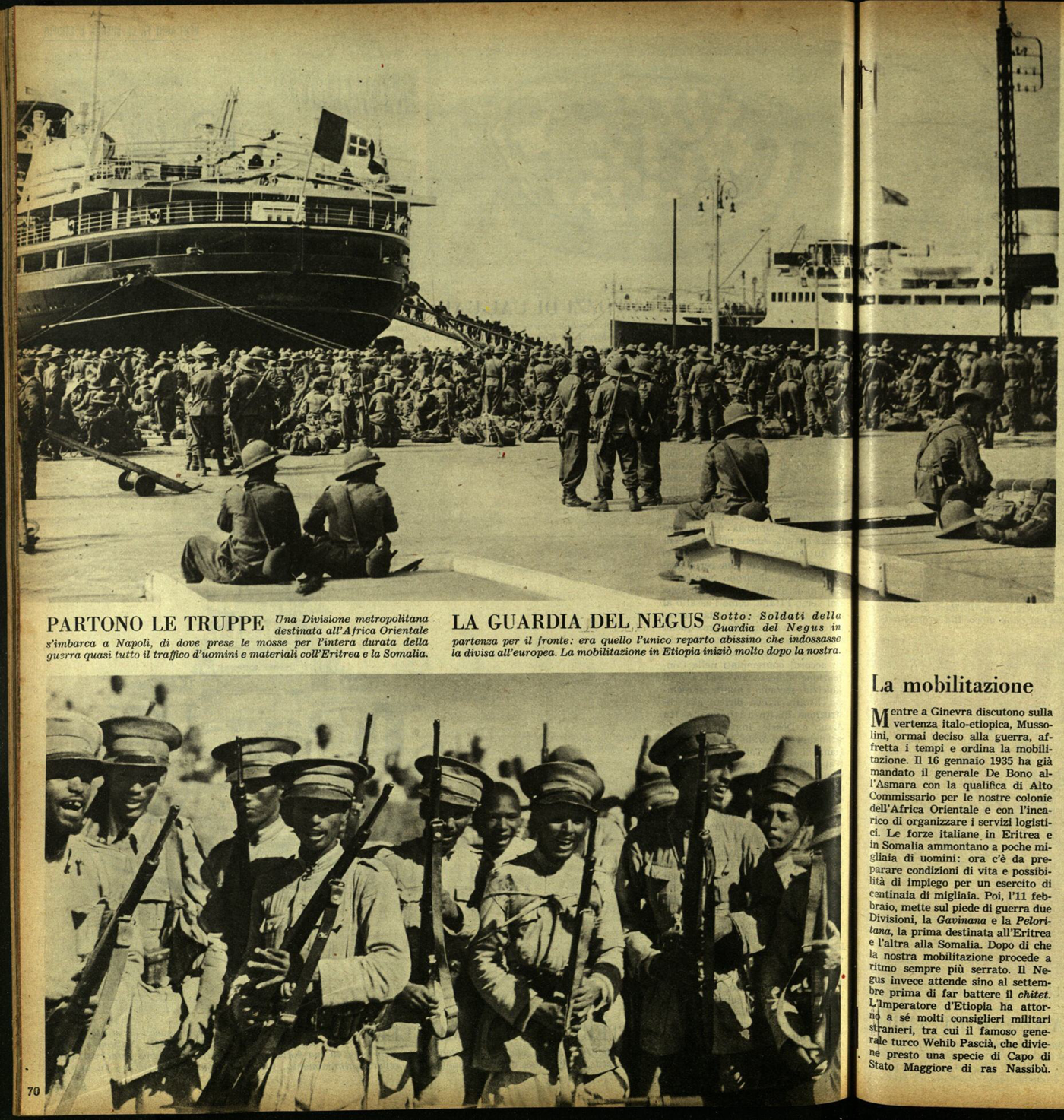
In Capra's article itself there is no mention of the originally propagandistic – by its very nature – intent of the image: the latter is simply reassembled together with some other coeval sources and other maps and illustrations, with the aim of visually translating Capra's text, whose intent was indeed to remember the Ethiopian war mainly as an adventure, as a march of pioneers. It is precisely through this – to some extent, asynchronous – juxtaposition of textual and visual sources belonging to different contexts of production, that the specific sense of nostalgia with which this iconotext is permeated can be generated. In this perspective, looking at this picture taken at the port of Naples, if it were not for the few visible guns, the relaxed and chatting soldiers could look like Italian emigrants on the dock waiting to embark on an ocean liner. The general image conveyed of Italian soldiers is as harmless and innocuous: a perfect picture for mirroring the image of those who, according to Capra (Reference Capra1955a, 67), ‘left a trail of good, rather than a bloodied grove’, to the point that ‘the enemy of that time neither wanted, nor was able to hate us’.
However, by analysing not only the single photograph but also the composition of the entire article, one can see how, just below the photograph of the departure of the troops, Epoca decided to insert a shot (Figure 1, bottom photograph) of Ethiopian soldiers belonging to the Negus guard (in this case, it was not possible to trace the origin of the photograph). Unlike the Italian soldiers, Ethiopians are represented in a typical military pose, standing by each other, holding up their guns with both hands in front of them.
In 1935, the Abyssinian military organisation was quite similar to that during the time of the 1896 Battle of Adwa; in that period, the Addis Ababa imperial guard (a few thousand men) together with other smaller contingents were the only components of the army to be equipped with ‘modern’ uniforms and weaponry (Rochat Reference Rochat2019, 37). Despite these facts, Epoca decided to display a picture of the most well-equipped unit of the Ethiopian army, and this is the only image representing Ethiopians in these two parts of the first commemoration: the Ethiopian soldiers end up looking more ‘military’ and aggressive than the Italian ones and they could therefore be recognised by Italian readers as enemies in a fair fight – even when the military forces were actually completely unequal, as historians have shown. This iconographic choice was entirely consistent with Fascist rhetoric since, close to the Ethiopian war, pictures devaluing the efficiency of the Abyssinian army had to be limited, as they would have diminished the following (and certain) Italian victory (Righettoni Reference Righettoni2018).
In this perspective, the iconographic apparatus of the article appears to be a step behind the text – though that is still nostalgic and controversial – in which at least it was noted that, at the beginning of the war, ‘the Negus mobilised 400,000 people’, whilst ‘we mobilised about a million’ (Capra Reference Capra1955a, 75). It is impossible to know if the modest merit for including this detail should be given to Capra or the editorial staff, since this information appears in the photographs’ caption.
In this context of nostalgic memories, the feeling of shame associated with the Ethiopian war was rejected. The conflict indeed was described as a memory that ‘does not humiliate us, but that it is not fair to forget’ (Capra Reference Capra1955a, 66). In Capra's words, the reasons why Italians should not feel ashamed of their invasion of Ethiopia are primarily two. The first revolves around the memory of Fascism, which, according to the journalist, has to be left aside and forgotten:
Political passion may have erased the memory of the Ethiopian war from the memory of many Italians […]. This is a bad thing because, regardless of the historical and political judgement on Fascism, which wanted the war, it remains as a testimony of the Italian people's virtues. (Capra Reference Capra1955a, 67)
In the atmosphere of political and personal reinvention of those who had been involved in Fascism – just as Capra himself was – this is an expression of the haste with which Italians shook off the memory of those who bore the historical responsibility for that conflict (Labanca Reference Labanca2005, 7). In this sense, it is significant that the subjects of the first photograph were described as Italians, without reporting the fact that they were Blackshirts legionaries.
The second reason lies, on the other hand, in the memory of Italian colonialism and the army. In Capra's words (Reference Capra1955a, 66–67), well-attuned to Fascist propaganda, this ‘third African Enterprise’ (after Adwa and Libya) was the one that proved wrong – once and for all – the slanders concerning Italian soldiers’ inclinations to colonial wars from Adwa onwards.
Although this first commemoration in Epoca is indeed mostly focused on a nostalgic representation of allegedly innocuous constructor pioneers ‘who alternated the shotgun with the spade’ (Capra Reference Capra1955a, 67), the presence of a general sense of pride in the Ethiopian invasion, symbolising the Italian ‘civilising mission’, cannot be denied. This image, divested of its nostalgic overtones, was to gather strength in 1960: the desire to disassociate the colonial wars from the regime behind them and the faculty to focus almost exclusively on the allegedly good fighting reputation of the Italian army will allow Epoca to commemorate the Ethiopian war by concentrating on the ‘heroic’ Italian military and civil values.
Pride: remembering the Ethiopian war as evidence of Italian military and civil values
The second commemoration of the Ethiopian war appeared in Epoca on 2 October 1960, with the title ‘Faccetta nera’ (Epoca 1960). Without any explicit signature, it was probably the work of the editorial staff of the news magazine, which at that point had just begun to be directed by Nando Sampietro, whose general editorial line reflected a keen interest in military history (Pizzetti Reference Pizzetti1982, 213–214).
Epoca usually worked on its editorial plan well in advance of publication: for example, the articles on current events were requested from journalists at least a week before they were published.Footnote 4 It is therefore plausible that the calendar of commemorations was planned significantly earlier. In this context, it is interesting to note that, in the same year, journalist Enzo Biagi together with Sergio Zavoli (Reference Biagi and Zavoli1960) signed a text entitled Dieci anni della nostra vita 1935–1945 (‘Ten Years of Our Life’), a vinyl disc-book aimed at describing the biography of a generation, whose starting point was precisely the Ethiopian war (Faccetta nera was one of the first songs to appear on vinyl). Even if this is not an indication of Biagi's direct involvement in the planning of the article in Epoca, it could, however, constitute proof of a common sensitivity in terms of historical events.
This second commemoration of the Ethiopian war was presented as a family album. In the article examined in the previous section photographs had a fundamental role, but they were quite simple illustrations to an authorial text: the narrative thread was primarily traced by the words of Capra. By contrast, the presentation of this second article as a photo album reverses the importance given to words and images, and places them on the same level: the interplay of sources that characterises iconotexts makes it arguable whether it is the text that illustrates the images or the images that comment on the text (Cometa and Coglitore Reference Cometa and Coglitore2016, 83).
On the first page, Epoca affirms its intention to remember the Ethiopian war ‘without nostalgia, but also without shame’. The first photographs in the sequence reconnect to the visual legacy of the previous commemoration: the historical picture representing the Italian soldiers entering Mekelle (playing instruments) was used in 1955 to conclude the first part of the article, occupying almost a whole page; in 1960, the shot was reused, in this case at the beginning of the piece, but taking up considerably less space in terms of layout (Figure 2). Meaningfully, it is placed just above the title ‘Faccetta nera’, once again evoking nostalgic memories through the sounds of the regime's colonial enterprise. If interpreted with today's eyes, one might expect the article to address such themes as sexuality and racism in the colony, but actually, it does nothing more than evoke a time of celebration and consensus through a compact composition of internal references.
Epoca 1960. ‘Faccetta nera’. 2 October: 67; Mondadori Portfolio, Milan.
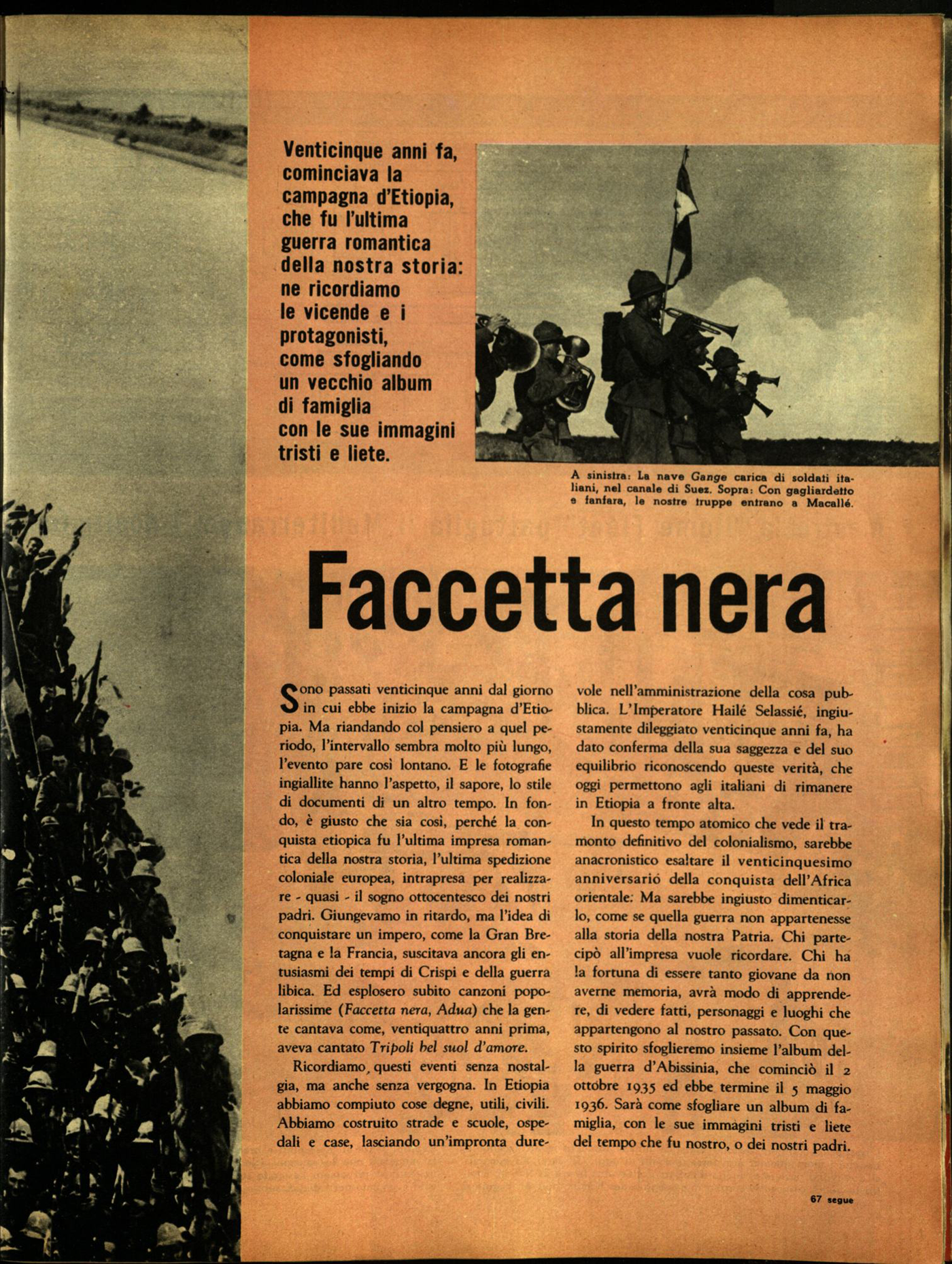
Except for these first images, the intention of representing the Ethiopian war ‘without nostalgia’ becomes more evident in the article's following pages: photographs evoking the image of the pioneers and the Italian interwar cultural background are mainly replaced by shots of the Italian and Ethiopian military context. No facet of this visual memory archive concerning the Ethiopian war disappears, but the proportions have changed and, with them, their meanings. A general feeling of pride was present also in Capra's aforementioned article: the stereotype of the colonial enterprise as a civilising mission, as well as some brief references to road construction, have been already mentioned. However, in 1960 they find an iconographic dimension through two photographs included below the heading ‘Our soldiers had to build themselves the road along which they moved forward’ (Epoca 1960, 72–73).
The diffused feeling of pride is conveyed in this second commemoration also by the image of Italian heroism within the military context. However, despite the pictures concerning the battlefield being quantitatively more than in the 1955 article, even here the image of Italian soldiers is never visually ‘militarised’ in the sense of portraying them as battle-hardened and ready for a war. In so doing, besides the feeling of pride, a further narrative key emerges, well expressed by the adjective ‘romantic’ used by the editorial staff at the very opening of this iconotext (Epoca 1960, 67). This contributes to emphasising the process through which the colonial enterprise gradually faded into the past, entering into that ‘family history’ of which this ‘photo album’ constitutes a crucial chapter.
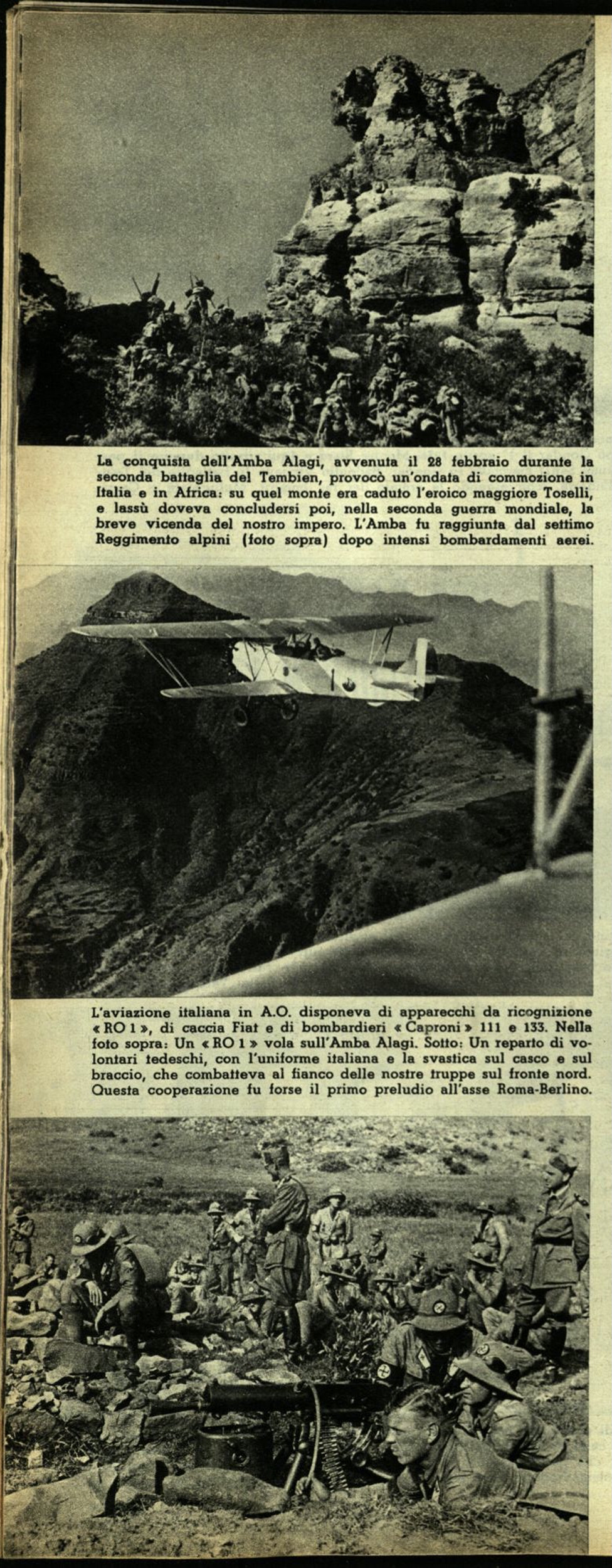
With this perspective, it is significant to analyse a recurring iconographic pattern chosen by Epoca to illustrate different war stages, exemplified by the photograph of ‘the Amba Alagi conquest’ (Figure 3, top photograph). This visual model appears twice in 1960 and – as an aside – it will be central in Reference Colombo1966, when journalist Ezio Colombo penned the third photographic commemoration published by Epoca (Colombo Reference Colombo1966). The original picture reprinted here belongs to the Istituto Luce too: in this case, however, to the Reparto Africa Orientale archival collection (the photographic department aimed at documenting the Ethiopian campaign).Footnote 5 It shows some Italian soldiers scrambling up a rocky path but, apart from the temporal location in 1935–6, the archival data does not provide further details. Epoca instead describes the picture with these words:
The Amba Alagi conquest occurred on 28 February during the second battle of Tembien, caused an emotional wave in Italy and Africa: on that mountain, the heroic major Toselli fell in battle, and then up there, during the Second World War, our empire's short history was to end. The Amba was reached by the 7th Alpini Regiment [the subject of the photograph] after intense aerial bombings. (Epoca 1960, 74)
Epoca 1960. ‘Faccetta nera’. 2 October: 74; Mondadori Portfolio, Milan (top photograph: Archivio Storico Istituto Luce, Rome; middle photograph: Mondadori Portfolio, Milan).
Although this image might have been the only one available to illustrate this step of the conflict, it must nevertheless be considered in terms of the visual reverberations it may have caused in the readers’ imaginary. Leaving aside, then, its actual truthfulness and the correlation between text and image, the choice to represent such an extremely important event through this specific picture is very significant from a rhetorical point of view.
The fortieth anniversary of the Adwa defeat occurred on 1 March 1936 (right after the Amba Alagi conquest). This coincidence allowed the Fascist state to glorify itself as the only one capable of avenging the fallen of both Adwa and Amba Alagi (Del Boca Reference Del Boca1965, 132), where in 1895 Toselli and his men died under circumstances that the colonial public discourse significantly described as a ‘new Thermopylae’ (Labanca Reference Labanca2002, 80). From an iconographic point of view, no reference appears to the war circumstances just summarised: in this perspective, the Amba Alagi conquest turns out to be a mere Alpine conquest, which could be a metaphor for the scramble for Africa itself but also for the Ethiopian war seen as a conflict between Italian soldiers and African nature. It is not merely an unequal representation in terms of power relations, it is something even more radical: in this photograph, the agency of the Ethiopians has been completely elided, and their army disappears and dissolves in the mountain ascents.
This is an iconographic theme that merges with the previous representation of Italian soldiers as pioneers, since the very first shot of the 1955 commemoration was captioned with these words: ‘the hardest fight was not against men, but against nature’ (Capra Reference Capra1955a, 67). While earlier in this analysis it was pointed out that the Ethiopian empire's army was visually overestimated, here we see the opposite: the vanishing of the Ethiopian enemy. This may seem inconsistent with the fact that in the 1960 commemoration the Ethiopian army had been actually represented more than in the previous article and, most importantly, an Ethiopian resistance was mentioned. However, it is just another piece in the overall mosaic. While in Capra's article it was the most ‘modern’ section of the army that was portrayed, here the few pictures depicting Ethiopian soldiers show them in a stereotypical representation of their alleged primitiveness – having guns but being barefoot or dressed in tunics and wielding spears, for example – which brings them closer to the ‘natural’ world than to the ‘civilised’ one.
Gradually abandoning the nostalgic veneer, this second article shows instead a growing interest in the ‘heroic’ efforts of Italian soldiers, alongside the emergence of some figures considered prominent. The memory thus seems to polarise around the more properly military image of war, represented in this case by the portraits of generals and commanders. This path may find a reason in the fragmented memory around the Italian wars: as stated by Rochat (Reference Rochat2019, 4), the postwar difficulty in coming to terms with the Fascist regime meant that ‘the memory of these wars was actually delegated to the armed forces, who cannot forget their battles and their fallen, then it would be “neutralised” by a political point of view’. In the previous article, Epoca had already attempted to remove the Fascist ‘parentheses’ from the narrative; in this article the regime is not even mentioned in the main text, although the subjects of a couple of images are identified as Fascists.
This is what keeps together the ‘family’ to which the photo album belongs: by forgetting the Fascist past and evoking the eternal ‘romantic’ national-patriotic rhetoric, it is possible therefore to re-establish a connection with national history. In this context, all the national wars – the Fascist ones included – have been absorbed by the memory of the Second World War which became predominant through the representations, especially, of El Alamein and of the Russian campaign (Rochat Reference Rochat2019, 4). Therefore, it is a significant fact that the Second World War events were mentioned in the ‘Amba Alagi conquest’ caption. Amba Alagi indeed also recalls the defeat of 1941 and the figure of Amedeo d'Aosta, who represented the last ‘heroic’ resistance in defence of the Italian Empire (Labanca Reference Labanca2002, 210): he was one of the key subjects constantly remembered by Epoca, part of a new ‘patriotic pantheon’ which the news magazine contributed to creating. This is a trend noted by Baratieri (Reference Baratieri2010, 27) in the general illustrated press, according to which the North African campaign served as a ‘screen memory’ to rehabilitate the entire colonial enterprise.
Consequently, what allows Epoca to commemorate the Ethiopian war in this second article ‘without nostalgia, but also without shame’ turns out to be the alleged Italian military value. The rejection of the sense of nostalgia, although it could suggest a limited awareness of what the Ethiopian war was truly like, actually has almost nothing to do with the events of the war itself. This different positioning actually concerns world history in its entirety. Epoca writes that it has been 25 years since the day when the Ethiopian campaign started, but thinking back to this event, it looks further: 1960 was the Year of Africa and Epoca takes note of the final demise of colonialism, so ‘it would be anachronistic to exalt the twenty-fifth anniversary of the Italian conquest of East Africa’ (Epoca 1960, 67). This is an awareness that can also be found in other articles in Epoca concerning Somalia, especially those signed by Massimo Mauri (alias of Mino Monicelli): in 1954, in his inquiry into the Trust Territory of Somaliland, Mauri (pondering the term ‘nostalgia’) unmasks the very nature of Italian colonialism, showing how this feeling instead was hiding specific events and concrete facts that translated into material advantages (Mauri Reference Mauri1954).
Now absorbed by the military memory of the army and disconnected from its links with colonialism, the image of the Ethiopian war seems not to be affected by the recent events of history. In this sense, it is significant to consider that in these two commemorations in Epoca the remembered anniversary is that of the outbreak of war and not that of the proclamation of the Italian empire.
The denial of shame: silenced signals of (im)possible counter-narratives
The shadow of shame represents a constant theme in these two commemorations: the reasons for the strict rejection of this feeling changed over time, moving from nostalgia to pride, with the common result of preserving a mellowed and ‘romantic’ (Epoca 1960, 67) image of the Ethiopian war. This applies also to the other sources analysed by Baratieri (Reference Baratieri2010, 162), who noted the total lack of counter-narratives in the same period. What is relevant to consider is that this image was not undermined even by the sporadic references to those elements that, in the long-term, would be considered the tangible evidence of the brutality of Italy's colonial enterprise.
Considering the last analysed photograph, ‘the conquest of Amba Alagi’, it must be noted that in the caption the use of ‘intense aerial bombings’ was mentioned and that, just below, another historical shot representing a ‘RO 1’ – a reconnaissance plane – flying over the same area was included (Figure 3, central photograph).Footnote 6 Even though this photograph does not depict a proper bombing action, at least it visually attests to the use of aviation forces for bombing purposes on the part of Italians.
The extensive use of bombing actions by the Italian army in the context of the Ethiopian campaign was not something new for Epoca's readers. As early as 1953 the news magazine had published an article in three parts concerning the ‘secret telegrams’ transmitted by Mussolini to the military commanders in Africa – Emilio De Bono, Pietro Badoglio, Rodolfo Graziani – between 29 March 1935 and 8 July 1936 (Epoca 1953a, 1953b, 1953c). This is a selection of the same documents published by Angelo Del Boca in 1996 (Del Boca Reference Del Boca and Del Boca2007a), with the significant exception that, in Epoca, telegrams with direct references to the use of gas were avoided. The selection of telegrams that were published by Epoca refers on several occasions to aerial bombings, as well as to other crimes such as reprisals and summary executions, but no testimony seems to be perceived as problematic. Even one of the telegrams used by Del Boca (Reference Del Boca and Del Boca2007a, 37) to highlight the violent nature of the Ethiopian campaign – the dispatch sent by Mussolini on 3 May 1936 ordering Badoglio, who was about to enter the Ethiopian capital, to put Addis Ababa to fire and sword, summarily shooting every opponent – when published in the news magazine raised no specific concerns.
The editorial path of this series of around 120 documents belonging to the Ministry of Italian Africa, contained in a folder labelled Lessona (Del Boca Reference Del Boca and Del Boca2007b, 203), is complex: journalist and historian Del Boca published them as early as 1968, when an anonymous person sold them to the newspaper Il Giorno, but actually they had already been published before (Del Boca Reference Del Boca1968). In 1947–8 the illustrated magazine Oggi published some of them (Lalli Reference Lalli1947–1948), selecting the actual telegrams from Mussolini on the use of gases, without however raising any particular scandal. The reason behind this, according to Rochat (Reference Rochat and Del Boca2007, 100–101), lies in the fact that among the ex-soldiers (and therefore in their families) there were already both rumours and photographic evidence about the use of gas, so the use of chemical weapons was not unheard of for Italian soldiers. Moreover, chemical weapons warfare was considered then a completely normal and expected aspect of modern warfare (Rochat Reference Rochat and Del Boca2007, 77): even though it became the symbol of the horror of modern warfare and the use of gas was banned by an international treaty ratified by Italy in 1928, all the main armies were prepared to use them in the Second World War, choosing not to do so for the fear of reaction by public opinion (Rochat Reference Rochat2019, 69–70).
Although photographic evidence of the use of poison gas in Ethiopia was already circulating (Mignemi Reference Mignemi1984), not one of the above-mentioned articles – to some extent, a form of exposé – provided correspondence between text and iconographic apparatus. As a matter of fact, the editorial staff of the different magazines did not choose to include pictures documenting the facts described in the telegrams and, therefore, the violence carried out by the Italian army in the colonial territory.
Looking specifically at the case of Epoca, it is relevant that the themes represented by the photographs published in 1953 are basically the same as in the two commemorations examined in this article. What deserves special attention in this context is the shot of an Ethiopian soldier directing an Oerlikon anti-aircraft gun (Epoca 1953a, 24): in a chronicle of the many Italian war actions, the most visually militarised are once again the Ethiopians, mostly presenting them as if they were properly and fully equipped, and as worthy opponents in a war of equals.
Baratieri (Reference Baratieri2010, 154–155) had already found that ‘the publication of evidence of Italian atrocities against African people does not in itself tear aside the veil of a seeming discourse to disclose the essential reality’, ‘the power of the conventional framework’ presents indeed ‘all the characteristics of a mythological, discursive structure’. What is missing from this equation, however, is the photographic proof of the crimes: although present at the textual level, it was completely absent from the visual framework. In this context, Susan Sontag has stated:
What is written about a person or an event is frankly an interpretation, as are handmade visual statements, like paintings and drawings. Photographed images do not seem to be statements about the world so much as pieces of it, miniatures of reality that anyone can make or acquire. (Sontag Reference Sontag and Capriolo2004, 4)
Photography does not reminisce about the past. Its effect is indeed to attest that what is seen has actually been (Barthes Reference Barthes and Guidieri2003, 83): the lack of visual counter-evidence of what is reported in the text besides the presence of images related to the main topoi of Fascist rhetoric did not, therefore, contribute to allowing a counternarrative on the Ethiopian invasion to take root.
In the 1955 Epoca commemoration, within the second part of Capra's article, a visual sign of the use of bombs was included beside other pictures depicting Italian weaponry. Like the Italian soldiers who never appeared fully militarised, these few photographs never represent means and weapons in the actual act of war: the shot ‘the planes and the bombs’ provides an example of this since both subjects are placed on the ground (Figure 4, upper photograph). Moreover, their representation is weakened by the supporting text, which defines the weapons and the means as outdated and inappropriate. The photograph caption indeed reports:
One of our bombing planes, loading up at the airport of Mekelle. The planes were equipped with a not very powerful engine, so their range was not exceptional. […] The bombs certainly did not have the technical perfection of the modern ones: they often did not explode, especially on sandy soil.
Capra, G. Reference Capra1955b. ‘Vent'anni fa la guerra d'Etiopia. Le sanzioni e l'impero’. Epoca, 16 October: 36; Mondadori Portfolio, Milan.
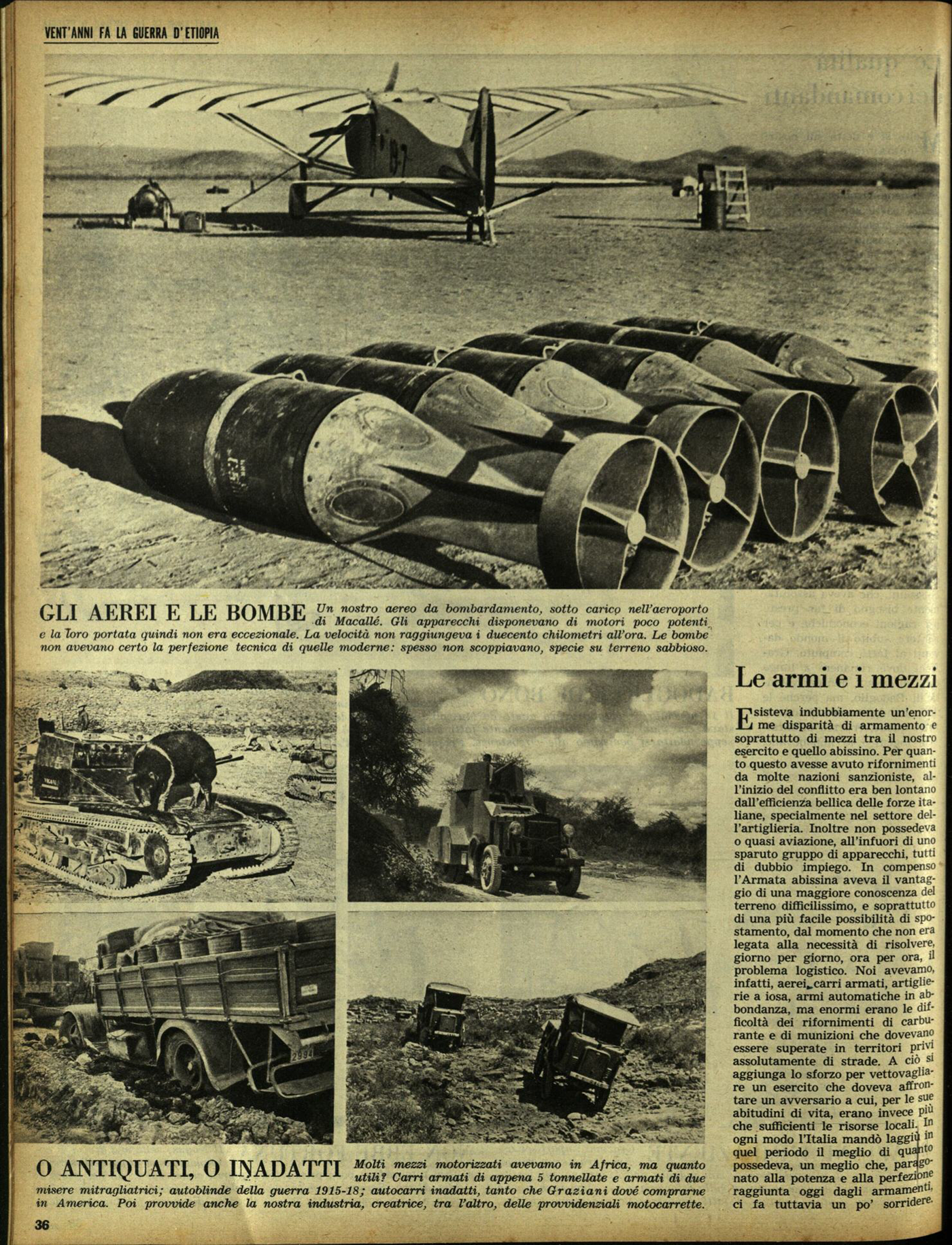
Leaving aside these specific evaluations regarding military history which are not the topic of this article, it is important to notice the misleading general image conveyed by Epoca, since there is no mention of – nor visual representation of – the disparity of military forces, given that the Ethiopian army completely lacked an airforce (Labanca Reference Labanca2005, 198).
The mention of some equipment issues could be justified by the intention of dismantling the mythologised image of war inherited from the Fascist regime; however, when considering the overall balance of the selected and reframed photographs, even this supposed positive purpose fails. Mussolini, in fact, had waged a modern war against Ethiopia, wherein the technological superiority was overwhelming (Labanca Reference Labanca2005, 40; 164). The composition of four photographs representing some means of warfare (Figure 4), all apparently rather weak, transmits a sense of inadequacy that is rather distant from this reality. The shot of the pig on top of the tank – upper left quadrant of the composition – could appear quite comical, if it did not contribute to conveying a general image that is frighteningly detached from the real context of Italy's war of aggression.
In this context, the most militarised image published in these two commemorations concerns some German volunteers wearing Italian uniforms with swastikas lying behind a machine gun (Figure 3, bottom photograph). This photograph is the last one of the vertical sequence starting with ‘the Amba Alagi conquest’: the interplay between these three shots seems to offer a visual anchor for the myth of the bravo italiano (‘good Italian’) against the cattivo tedesco (‘bad German’) stereotype (Focardi Reference Focardi2013). From the top to the bottom, indeed, one moves from the picture of Italian soldiers as rock climbers, passing through the use of the Italian air force exemplified by a mere reconnaissance plane, to end up with a shot which actually, at last, represents the actual war, but driven solely by the Nazi army. In this perspective, Nazism ‘serves as a foil’, casting Italian totalitarianism – and, therefore, colonialism – in an almost positive light (Finaldi Reference Finaldi2019, 36).
Unfortunately, most of the photographs I have examined in this article could not be traced back to their original source. Given the reuse of some of them in 1953, 1955 and 1960, the news magazine's photographic archive seems rather static regarding the Ethiopian war. Most probably, very few appropriate photographs were available; it was thus not easy to find an iconographic apparatus adequate to the text (and this was not necessarily the intent or deemed appropriate for the magazine's audience). In addition, some of these pictures belonged to the Istituto Luce, so, certainly, they could not provide any evidence of Italian colonial crimes (Del Boca and Labanca Reference Del Boca and Labanca2002, 12).
Even what would later constitute unequivocal visual evidence of Italian crimes in Ethiopia might have been interpreted differently at the time of the two commemorations, since context conditions the response to images (Freedberg Reference Freedberg, Perini and Marchesi2009, XLVII). When in 1995, on the sixtieth anniversary of the African campaign, Epoca published an article by journalist Mario Lombardo entitled ‘Faccetta nera dalla vergogna’ (‘Little Black Face of Shame’) reporting on Italian colonial crimes, the editorial staff showed the use of gas by inserting, alongside other pictures, a shot depicting some Italian soldiers wearing gas masks, from the Istituto Luce's Reparto Africa Orientale archival collection (Lombardo Reference Lombardo1995).Footnote 7 As Rochat (Reference Rochat2019, 70–71) has observed, in 1935 all the main armies considered gas as a possible weapon to use, to the point that Italy delivered several gas masks as defence against the Abyssinians, which had never been used because the Ethiopian army had no gas. It is possible, then, that the same photograph of the chemical platoon's legionaries could have been perceived not as a proof of the Italian war crimes in Ethiopia, but rather, as evidence of the hard conditions that the ‘heroic’ Italian soldiers had to face to defend themselves from the enemy.
The lack of iconographic anchorage of the signals that could have undermined the mythologised image of the Ethiopian war possibly influenced the transmission of this type of memory. However, in Biagi and Zavoli's generation-biography – published by Mondadori in Reference Biagi and Zavoli1960 using photographs from archives including that of Epoca – the first shot used was an aerial photo of a bombing action in Ethiopia, but nevertheless the general rhetoric around the campaign did not change. According to recent research such as that undertaken by Ian Campbell (Reference Campbell, Cesa and Pomilio2018), it must be noted that photographic evidence of Italian brutalities in colonial territories had already been brought to light in the extra-national context, but these pictures did not circulate in the Italian illustrated press. Even as late as 1960, the overall image of the 1935–6 war was still apparently impervious to any critical voice.
Conclusion
As stated by Nicola Labanca (Reference Labanca2002, 448), a discussion around the colonial national past did not develop in the 1950s–1960s because of the particular Italian experience of decolonisation. The Empire had been relatively small and lost through the war: even though some voices were raised in criticism, only a few people listened in the middle of the reconstruction and economic boom of Republican Italy. Italian people soon forgot (or consciously ignored) the very nature of the Ethiopian campaign: at first because they were isolated by the censorship and propaganda of the regime, then because the tragedy of the Second World War made any other event or national responsibility fade into the background (Labanca Reference Labanca2005, 396). In addition, the refusal to conduct legal proceedings against Italian criminals of the Ethiopian war represented an ennoblement and a justification of the entire national colonial past (Labanca Reference Labanca2005, 286–288).
In this context, it is relevant to note the fact that Epoca's 1953 articles were primarily addressed to determining who was actually in command in the Ethiopian campaign, whether it was Mussolini or his many commanders (Epoca 1953a, 23). The release of the aforementioned telegrams, therefore, was intended to demonstrate the actual and full responsibility of Mussolini regarding these actions (Del Boca Reference Del Boca and Del Boca2007a, 35) and not to point out Italian colonial crimes. However, this legitimate process against Mussolini – in which Epoca took part – might not have facilitated a true collective awareness about the events of the Ethiopian war.
Several questions remain at the end of this analysis: firstly, from a visual point of view, it could be asked to what extent the lack of iconographic sources has actually limited their use in opposition to Fascist rhetoric; in this perspective, the question also arises as to how much the very assembly of visual and textual sources – the montage, in the words of Walter Benjamin (Reference Benjamin and Ganni2000) – affected this entire process. Secondly, in those rare cases where the text refers to a context that is more in line with the historical record, one might wonder if the reason why the pictures remain a step behind the words lies in the necessity to always draw on the same photographic archive of the news magazine, or in the intentional choice to select some pictures to the detriment of others.
An answer to these questions should study the audience reception and the editorial paths of the journal in a more thorough way than has been possible in this article. My analysis was carried out from an iconographic and iconological point of view due to the fact that the editorial archives of Epoca have almost disappeared (Giacomini Reference Giacomini2010–2011, 4). The traces that remain are few and mainly concern the epistolary activity between the publishing house and the news magazine's contributors. Some gaps, therefore, will probably never be filled.
Nevertheless, illustrated magazines continue to provide answers and generate further questions in exploring the construction of the collective visual archives of Italian colonialism in Republican Italy. It is also important to consider that the memory offered by Epoca constitutes only one of the facets of the multiple memories (Labanca Reference Labanca2015, 224) that were built around the Ethiopian war. This study could therefore be further deepened in order to understand how the different imaginaries actually interacted, examining too to what extent the historical photographic archives were composed of similar images (and therefore taking into consideration the circulation of iconographic sources), as well as examining how the reframing process of some specific war photographs during Republican Italy impacted the creation of the collective imaginary on Italian colonialism and on the development of a public debate around Italian violence and crimes in colonial territories.
To conclude, the representation provided by Epoca in the two commemorations is consistent with the general trend that moved between silencing and reducing in importance, forgetting the global echoes and meanings of the Ethiopian conflict (Labanca Reference Labanca2015, 232). It was such a solid depiction that apparently has not been affected even by explicit references to colonial crimes and violence, which had not been removed but rather silenced, misrecognised, and not truly comprehended, preventing a sense of shame from taking root in Epoca until 1995: even if anti-colonial sentiments were already present in the national context after 1945, they were not directly linked to Italy's own colonial history (Srivastava Reference Srivastava2018). The causes may well be multifactorial, but the interpretative category of ‘colonial aphasia’ could provide some answers (Stoler Reference Stoler2011; De Cesari Reference De Cesari2012; Mancosu Reference Mancosu2021). In this context, the last and fundamental issue to consider is the racist legacy with which these images are imbued. If the silencing of these signals was possible it was also due to the fact that the former colonial subjects underwent a process of dehumanisation on multiple fronts (Baratieri Reference Baratieri2010, 291). It is, therefore, through a larger survey of the representation of the Ethiopian – and, more generally, African – population in the news magazine that this analysis could be completed.
Acknowledgements
I would like to thank the Department of Antiquities, Philosophy and History (DAFIST) at the University of Genoa, for supporting the research that made this article possible, and the Biblioteca di Storia Moderna e Contemporanea in Rome, for allowing me to access the digitalised copy of the news magazine. My very first thanks go to Guri Schwarz for helping me define the boundaries of this study, and also to Francesco Cassata and Paola Valenti for their guidance throughout the research work that underpins this analysis. I also want to thank Simon Levis Sullam for his useful feedback on an earlier version of this paper and Patrizia Cacciani for having granted me permission to use Istituto Luce's photographs. Last and most important, I am grateful to the editors of this special issue, Laura Moure Cecchini and Carmen Belmonte, for their constant support and insightful comments in preparing this article, and to the anonymous readers who commented on the current version of the text.
Competing interests
The author declares none.
Elena Cadamuro is a PhD student in the Department of Antiquities, Philosophy and History (DAFIST) at the University of Genoa, and a member of the Centre for the History of Racism and Anti-Racism in Modern Italy (CENTRA). Her PhD research revolves around the visual colonial and racist legacies in Italian illustrated magazines (1950–1989). Recently, she has published the article ‘Rappresentare, esibire, dominare. La fotografia coloniale nelle collezioni De Reali e Puccioni’ (Italia contemporanea, 2020: 294). The article was also published in July 2021 in the Italia contemporanea 2020 Yearbook under the title ‘Colonial Heritage, Colonial Legacy: the Cases of Giuseppe De Reali's and Nello Puccioni's Photographic Collections’.


 Open access

