





1. Introduction
This paper concerns the computation of stable commutator length (scl) in fundamental groups of closed orientable surfaces. It is of considerable interest to know whether scl is always rational in these groups, or more generally, whether the scl norm is piecewise rational linear (in the sense of [Reference Calegari4]).
In more concrete terms, let $\Sigma$ be a closed orientable surface and $\gamma \colon \thinspace S^1 \to \Sigma$
 a null-homologous loop. We are interested in identifying efficient maps of surfaces into $\Sigma$
 , with boundary mapping to a positive power of $\gamma$
 . ‘Efficient’ means that the ratio of the topological complexity of the surface to the power of $\gamma$
 on the boundary is as small as possible. The infimal value of this ratio is the stable commutator length of $\gamma$
 . In some cases, there may be a surface realizing this infimal value; these are called extremal surfaces for scl, and when they exist scl is rational.
Calegari [Reference Calegari2] has shown that one can always find an immersed surface with boundary a power of $\gamma$ , and such surfaces are the most efficient among those in their relative homology classes. However, there are infinitely many relative classes, and one cannot draw any immediate conclusions about the existence of an extremal surface for $\gamma$
 .
.
In the present paper, we give a new proof the following theorem of Calegari, which establishes rationality in the special case of curves $\gamma$ that do not fill $\Sigma$
 . It appears as Example 4.51 in [Reference Calegari3], as an application of Theorem 4.47. We state the result here for integral $1$
 –chains, i.e. immersed multicurves.
Theorem 1.1 (Calegari)
Let $\Sigma$ be a closed orientable surface of genus $> 1$
 and $\gamma \colon \thinspace \coprod S^1 \to \Sigma$
 a null-homologous integral $1$
 -chain which does not fill $\Sigma$
 . Then, the stable commutator length of $\gamma$
 is rational and computable. Moreover, there exists an extremal surface for $\gamma$
 .
.
It follows immediately that rational $1$ –chains supported on non-filling multicurves also have rational stable commutator length. Indeed, we find that scl is piecewise rational linear on ‘non-filling’ rational subspaces of the space of $1$
 –chains; that is, subspaces spanned by rational $1$
 –chains $c_1,\, \dotsc,\, c_k$
 such that the union of their supports is a non-filling multicurve.
Other rationality results
The list of groups known to have rational scl, excluding those with $\operatorname {scl} \equiv 0$ , is fairly short. Such groups include:
• free groups [Reference Calegari4]
• fundamental groups of non-compact Seifert fibred $3$
 –manifolds [Reference Calegari4]
• free products of free abelian groups [Reference Calegari5]
• free products of cyclic groups [Reference Walker13]
• amalgamated products of free abelian groups [Reference Susse12]
• Baumslag–Solitar groups, alternating elements only [Reference Clay, Forester and Louwsma7]
• free products of groups in which $\operatorname {scl} \equiv 0$
[Reference Chen8]• generalized Baumslag–Solitar groups [Reference Chen9]


Surface groups are conspicuously absent from this list, despite being among the simplest and most well-understood one-relator groups.
It is worth noting that finitely presented groups do not always have rational scl; a counterexample was given by Zhuang in [Reference Zhuang14]. If one allows non-finitely presented groups, then in fact every non-negative real number occurs as scl of some element of a small cancellation group [Reference Heuer11].
Methods
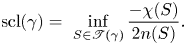
The general outline of the argument is similar to the case of free groups as presented in [Reference Brady, Clay and Forester1]. The stable commutator length of $\gamma$ is the infimum of ${-\chi (S)}/{2n(S)}$
 over all admissible surfaces $S$
 mapping to $\Sigma$
 . First, we show that the infimum can be taken over the much smaller subset ${\mathscr T}(\gamma )$
 of ‘taut’ admissible surfaces—these will be described below and defined precisely in § 3.
Taut surfaces can be encoded as integer vectors via a map $v\colon \thinspace {\mathscr T}(\gamma ) \to {\mathbb {R}}^k$ , and the function ${-\chi (S)}/{2n(S)}$
 factors through this map as ${\mathscr T}(\gamma ) \overset {v}{\to } {\mathbb {R}}^k \to {\mathbb {R}}$
 where the second map is a ratio $A(v)/B(v)$
 of linear functions. The computation of $\operatorname {scl}(\gamma )$
 is then reduced to a linear programming problem after showing that the image of $v$
 in ${\mathbb {R}}^k$
 fills (in a suitable sense) the integer points of a finite-sided rational polyhedron in ${\mathbb {R}}^k$
 .
.
The two main steps are encoding, which entails defining ${\mathscr T}(\gamma )$ and the function $v$
 ; and reassembly, in which specific vectors are shown to be in the image of $v$
 . Our main assumption throughout the paper is that $\Sigma$
 contains a subsurface $\Sigma _1$
 with non-trivial topology that is disjoint from the image of $\gamma$
 . This property is needed for both steps.
To make a surface $S$ taut, one needs to put it into a normal form that can be encoded as a finite integer vector. Following Gabai [Reference Gabai10], we arrange that away from a region containing the double points of $\gamma$
 , the preimage in $S$
 maps by a branched immersion. We arrange further that the remaining parts of $S$
 fall into finitely many configurations, and all branch points lie above $\Sigma _1$
 . The branch points are now the main obstacle to having a finite encoding, but these can be removed by passing to finite-sheeted covers, using the non-trivial topology of $\Sigma _1$
 .
.
For reassembly we show that every integer vector in the rational polyhedron has a multiple that encodes a taut surface. When building this surface out of pieces, a phenomenon involving branch points arises. A taut surface cannot be built directly, but one can build one with branch points. The presence of branch points means that the linear functional on ${\mathbb {R}}^k$ reporting $\chi (S)$
 does not report this number correctly. Once again, using finite coverings of $\Sigma _1$
 , we are able to eliminate these branch points and construct a taut surface with the desired encoding.
In contrast, Calegari's approach is quite different. He proves theorem 1.1 by viewing surface groups as fundamental groups of graphs of groups in which vertex groups are free and edge groups are cyclic. If $\gamma$ is non-filling then it avoids an essential annulus, and one may encode $\Sigma$
 as a graph of groups with one edge. The proof then proceeds by reducing the computation of $\operatorname {scl}$
 to computing $\operatorname {scl}$
 in each vertex group, using the assumption that $\gamma$
 is supported in the vertex groups.
2. Preliminaries
Stable commutator length
We start with basic working definitions for stable commutator length of group elements and of $1$ –chains. See [Reference Calegari3, Chapter 2] for more information.
Definition 2.1 (scl of integral $1$ –chains)
Let $X$ be a space with fundamental group $G$
 . An integral $1$
 –chain over $G$
 is a finite formal sum $c = \sum _i g_i$
 with $g_i \in G$
 . Let $\gamma _i \colon \thinspace S^1 \to X$
 be a loop representing $g_i$
 for each $i$
 and let $\gamma \colon \thinspace \coprod _i S^1 \to X$
 be the map given by $\coprod _i \gamma _i$
 . An admissible surface for $\gamma$
 (or for $c$
 ) is a compact oriented surface $S$
 together with a map $f \colon \thinspace S \to X$
 such that
• $\partial S \not = \emptyset$
and $S$ has no sphere or disk components• the restriction $f \vert _{\partial S}$
factors through $\gamma$; that is, there is a commutative diagram
• the restriction of the map $\partial S \to \coprod _i S^1$
to each connected component of $\partial S$ is a map of positive degree• there is a positive integer $n(S)$
such that for each component of $\coprod _i S^1$, the preimage in $\partial S$ maps to it by total degree $n(S)$.


The stable commutator length (scl) of $c$ is defined by
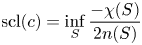
where the infimum is taken over all admissible surfaces for $\gamma$ . If no admissible surface exists, we define $\operatorname {scl}(c) = \infty$
 .
.
Note: the third bullet is not included in Calegari's definition of admissible surface in [Reference Calegari3]. However, Proposition 2.13 of [Reference Calegari3] shows that including it does not change the meaning of scl.
Using homogeneity properties of $\operatorname {scl}$ , the definition extends to rational chains. If $c = \sum _i c_i g_i$
 with $c_i \in {\mathbb {Q}}$
 then $mc$
 is integral for some $m$
 , and we may define $\operatorname {scl}(c) = {1}/{m}\operatorname {scl}(mc)$
 . Extending by continuity, it is also defined for real chains. See [Reference Calegari3, Section 2.6].
Definition 2.2 (scl of group elements)
For any $g\in G$ we define $\operatorname {scl}(g)$
 by considering $g$
 as an integral $1$
 –chain consisting of one element. The above definition, in this case, specializes to the standard definition of $\operatorname {scl}(g)$
 . Note that admissible surfaces for $g$
 exist if and only if $g^k \in [G,\,G]$
 for some $k\not = 0$
 , and so $\operatorname {scl}(g)$
 is finite exactly when the latter occurs.
Definition 2.3 Let $c$ be an integral $1$
 –chain over $G$
 . An extremal surface for $c$
 is an admissible surface $S$
 for $c$
 that realizes the infimum in the definition of $\operatorname {scl}(c)$
 . If $c$
 is a rational $1$
 –chain, an extremal surface for $c$
 is just an extremal surface for any $mc$
 that is integral. Extremal surfaces need not exist, but when they do, $\operatorname {scl}(c)$
 must of course be rational.
Let $C_1(G)$ be the space of $1$
 –chains, which is a vector space over ${\mathbb {R}}$
 with basis $G$
 . Let $B_1(G) \subset C_1(G)$
 be the subspace of boundaries of $2$
 –chains, i.e. the kernel of the quotient map $C_1(G) \to H_1(G;{\mathbb {R}})$
 . Let $B_1^H(G)$
 be the quotient of $B_1(G)$
 by the subspace $H$
 spanned by elements of the form $g^n - ng$
 and $g - hgh^{-1}$
 for all $g,\,h \in G$
 , $n \in {\mathbb {Z}}$
 . Then the function $\operatorname {scl}$
 is a pseudo-norm on $B_1^H(G)$
 . Moreover, whenever $G$
 is hyperbolic, $\operatorname {scl}$
 is a geniune norm on $B_1^H(G)$
 [Reference Calegari and Fujiwara6].
Surfaces
Let $\Sigma$ be a closed surface. We say that a multicurve $\gamma \colon \thinspace \coprod S^1 \to \Sigma$
 is non-filling if it is homotopic to an immersion in general position such that some component of the complement of the image is not a disk (or equivalently, $\Sigma$
 contains an essential simple closed curve disjoint from the image of $\gamma$
 ). Correspondingly, an integral $1$
 –chain or group element in $G = \pi _1(\Sigma )$
 is non-filling if it is represented by a non-filling multicurve.
Definition 2.4 A map $f \colon \thinspace S \to \Sigma$ of orientable surfaces is compressible if there is an essential simple closed curve $C \subset S$
 such that $f(C)$
 is nullhomotopic in $\Sigma$
 . If $f$
 is not compressible it is called incompressible.
When $f$ is compressible, one can replace an annular neighbourhood of $C$
 by two disks and extend $f$
 over these disks, thus obtaining $f' \colon \thinspace S' \to \Sigma$
 of smaller complexity.
Coverings
Throughout this paper curves and surfaces typically have orientations, and by the degree of a map we always mean the homological degree.
Suppose $p \colon \thinspace X \to Y$ is a finite-sheeted covering of oriented manifolds. Partition the connected components of $X$
 as $X^+ \sqcup X^-$
 such that $p$
 is orientation-preserving on $X^+$
 and orientation-reversing on $X^-$
 . We define the positive degree of $p$
 to be the number of sheets of $X^+$
 and the negative degree of $p$
 to be the number of sheets of $X^-$
 . Thus the sum of these numbers is the total number of sheets of $p$
 and their difference is the homological degree.
Next we record some basic covering lemmas for surfaces.
Lemma 2.5 Let $S$ be a compact connected oriented surface having $p\geqslant 1$
 boundary components, with $S \not \cong D^2$
 .
.
(1) For any $q< p$
boundary components $C_1,\, \dotsc,\, C_{q}$ of $S$ and integers $n_1,\, \dotsc,\, n_{q} \geqslant 1$, there is a connected regular finite-sheeted cover $S' \to S$ such that every component of $\partial S'$ mapping to $C_i$ covers with degree $n_i$.(2) For any integer $n \geqslant 1$
there is a connected finite-sheeted cover $S' \to S$ such that every component of $\partial S'$ covers its image with degree $n$.


Proof. For (1), let $x_i \in H_1(S)$ be the element represented by $C_i$
 , for $1 \leqslant i \leqslant q$
 . This set extends to a basis $\{x_1,\, \dotsc,\, x_n\}$
 of $H_1(S)$
 , because $q< p$
 . Let $N$
 be the least common multiple of the numbers $n_i$
 . Let $\varphi \colon \thinspace H_1(S) \to {\mathbb {Z}}/N{\mathbb {Z}}$
 send $x_i$
 to $N/n_i$
 for $1 \leqslant i \leqslant q$
 (the values on the other basis elements are irrelevant). Now $S'\to S$
 is the cover corresponding to the kernel of the composition $\pi _1(S) \to H_1(S) \to {\mathbb {Z}}/N{\mathbb {Z}}$
 . Since $\varphi (x_i)$
 has order $n_i$
 in ${\mathbb {Z}}/N{\mathbb {Z}}$
 and the cover is regular, the boundary $\partial S'$
 behaves as desired.
For (2), suppose first that $p > 1$ . Choose boundary components $C_1,\, \dotsc,\, C_{p-1}$
 of $\partial S$
 and a basis $\{x_i\}$
 of $H_1(S)$
 as before. Let $\varphi \colon \thinspace H_1(S) \to ({\mathbb {Z}}/n{\mathbb {Z}})^{p-1}$
 send $x_i$
 to the $i$
 th generator $(0,\, \dotsc,\, 1,\, \dotsc,\, 0)$
 for $1 \leqslant i \leqslant p-1$
 . Then $\varphi$
 sends the class represented by the last boundary component of $S$
 to $(-1,\, \dotsc,\, -1)$
 . Since every boundary component maps to an element of order $n$
 , the cover $S' \to S$
 corresponding to the kernel of $\pi _1(S) \to H_1(S) \to ({\mathbb {Z}}/n{\mathbb {Z}})^{p-1}$
 has the desired property.
If $\partial S$ has one component, first let $S'' \to S$
 be any connected $2$
 –sheeted cover (which exists since $S \not \cong D^2$
 ). It will have $2$
 boundary components, each mapping by degree $1$
 , because $\chi (S'')$
 is even. Apply the preceding case to get $S' \to S''$
 , and take the composition $S' \to S'' \to S$
 .
.
It will be convenient to have a version of this lemma for disconnected surfaces. By a finite-sheeted cover of a disconnected surface, we mean a cover for which the number of sheets is the same over every component.
Lemma 2.6 Let $S$ be a compact oriented surface where each component has at least $1$
 boundary component and no component is homeomorphic to $D^2$
 . For any set of boundary components $C_1,\, \dotsc,\, C_{q}$
 of $S$
 which does not contain all the boundary components of any component of $S$
 and integers $n_1,\, \dotsc,\, n_{q} \geqslant 1$
 , there is a finite-sheeted cover $S' \to S$
 such that every component of $\partial S'$
 mapping to $C_i$
 covers with degree $n_i$
 .
.
Proof. Let $S_1,\, \dots,\, S_m$ be the components of $S$
 . We first apply lemma 2.5(1) to each $S_i$
 to obtain an $N_i$
 -fold cover $S_i' \to S_i$
 with the correct degree on boundary components. Let $N = \operatorname {lcm}(N_1,\, \dots,\, N_m)$
 . Then the cover of $S$
 consisting of $N/N_i$
 copies of $S_i$
 has the desired properties.
We are also interested in the case where we allow branched covers with prescribed degrees on the boundaries. The flexibility of degrees on boundaries is much larger for branched covers.
Lemma 2.7 Let $S$ be a compact connected oriented surface having $p\geqslant 1$
 boundary components. Let $C_1,\, \dots,\, C_p$
 be the boundary components of $S$
 , let $n$
 be a natural number, and let $\lambda _1,\, \dots,\, \lambda _p$
 be partitions of $n$
 . Then there is an $n$
 -fold branched cover $S' \to S$
 such that the degrees of the components over $C_i$
 are precisely the values in the partition $\lambda _i$
 .
.
Note that $S'$ is not necessarily connected.
Proof. We start with the cover $S'' \to S$ where $S''$
 is $n$
 copies of $S$
 . Let $A,\, B$
 be distinct copies of $C_i$
 in $S''$
 . Let $\alpha,\, \beta$
 be copies of the same small arc from a point on $C_i$
 into the interior of $S$
 . Cut $S''$
 along $\alpha$
 and $\beta$
 and glue the right side of $\beta$
 to the left side of $\alpha$
 and vice versa. This new surface, in a canonical way, admits a branched cover to $S$
 where the degrees over $C_i$
 are $2,\, 1,\, 1,\, \dots,\, 1$
 . By using this kind of surgery to connect boundary components of $S''$
 , it is clear that we can construct a branched cover $S' \to S$
 where the degrees over $C_i$
 are an arbitrary partition of $n$
 .
.
3. Mapping surfaces to surfaces
Setup
Let $\Sigma$ be a closed oriented surface of genus greater than one. Let $\gamma \colon \thinspace \coprod S^1 \to \Sigma$
 be a null-homologous $1$
 –chain that does not fill $\Sigma$
 . We can put $\gamma$
 into general position (smoothly immersed, transverse intersections, no triple points) such that at least one complementary component is not a disk.
Let $\Sigma _0$ be one such complementary component. Let $B\subset \Sigma _0$
 be an embedded closed disk and let $\lambda _1,\, \dotsc,\, \lambda _k$
 be disjoint properly embedded arcs in $\Sigma _0 - \operatorname {int}(B)$
 with endpoints on $\partial B$
 such that the inclusion of $B \cup \bigcup _i \lambda _i$
 into $\Sigma _0$
 is a homotopy equivalence. Let $L \subset (\Sigma _0 - \operatorname {int}(B))$
 be the closure of a tubular neighbourhood of $\bigcup _i \lambda _i$
 , so that $\Sigma _1 = B \cup L$
 is compact subsurface homotopy equivalent to $\Sigma _0$
 .
.
Next let $\mu _1,\, \dotsc,\, \mu _{\ell }$ be disjoint properly embedded arcs in $\Sigma - \operatorname {int}(\Sigma _1)$
 with endpoints on $\partial B - L$
 such that the $\mu _i$
 cut each component of $\Sigma - \Sigma _1$
 into a single disk and the $\mu _i$
 do not cross any double points of $\gamma$
 . We also require that the arcs $\mu _i$
 are transverse to the immersed submanifold $\gamma (\coprod S^1)$
 . Let $M \subset (\Sigma - \operatorname {int}(\Sigma _1))$
 be the closure of a tubular neighbourhood of $\bigcup _i \mu _i$
 , disjoint from $L$
 , so that $\Sigma _2 = \Sigma _1 \cup M$
 contains no double point of $\gamma$
 and $\gamma (\coprod S^1) \cap M$
 consists of fibres of $M$
 . Let $D$
 be the closure of $\Sigma - \Sigma _2$
 ; this is a disjoint union of embedded closed disks. Finally, define $\Sigma _3 = \Sigma - \operatorname {int}(\Sigma _1) = D \cup M$
 .
.
Each component of $\coprod S^1$ maps by $\gamma$
 to a path which alternates between embedded oriented arcs in $D$
 , called turn arcs, and arcs crossing $M$
 . Let $\tau _1,\, \dotsc,\, \tau _m$
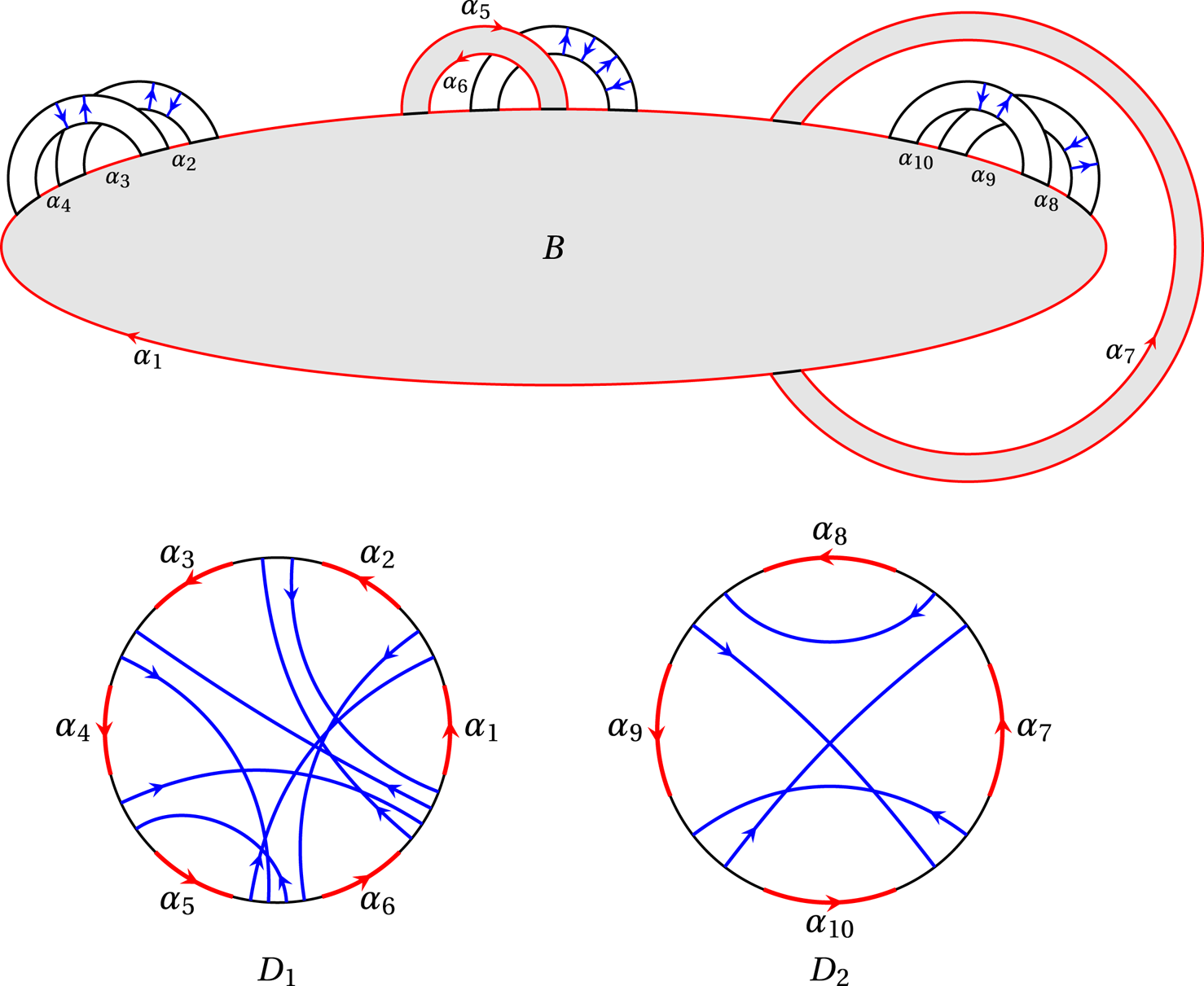
 be the turn arcs. See figure 1.
Definition 3.1 (Turn paths)
A turn path is a loop $S^1 \to D$ which is a concatenation of paths, alternating between turn arcs and immersed paths in $\partial D$
 . Immersions $S^1 \to \partial D$
 are included. We consider two turn paths to be the same if they differ by an orientation-preserving reparametrization of $S^1$
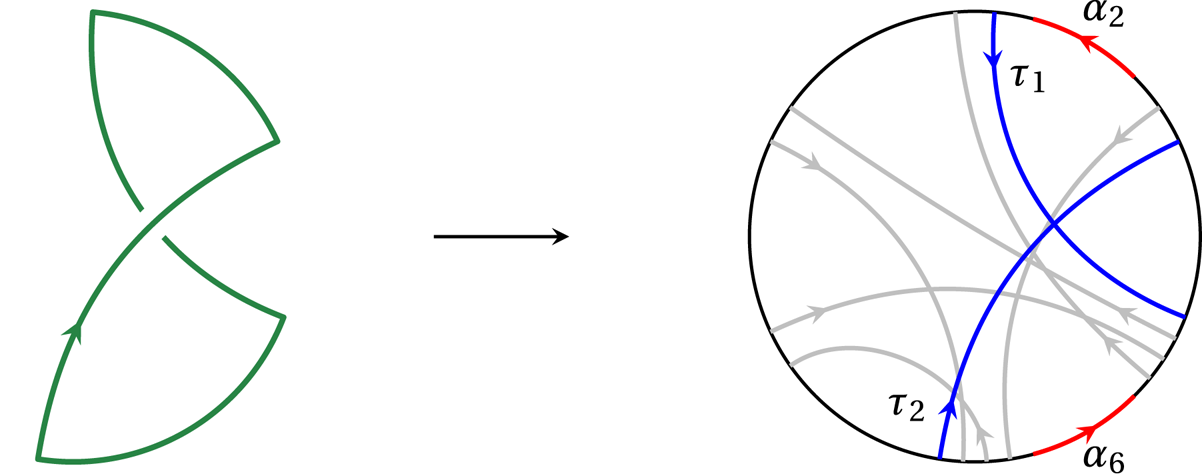
 . See figure 2.
A surface $\Sigma$ and its handle decomposition $\Sigma = B \cup (L \cup M) \cup D$
 . The shaded part is the subsurface $\Sigma _1 = B \cup L$
 . The null-homologous $1$
 –cycle $\gamma$
 is shown in blue. All self-intersections of $\gamma$
 lie inside $D = D_1 \cup D_2$
 . Outside of $D$
 , $\gamma$
 meets only the $1$
 –handles $M$
 and crosses them transversely. The arcs of $\gamma$
 crossing $D$
 are called turn arcs. The arcs $\alpha _i$
 are the maximal sub-arcs of $\partial D$
 that meet $\partial \Sigma _1$
 .
.
A taut turn path in $D_1$ which runs over $\tau _1$
 , $\overline {\alpha }_6$
 , $\tau _2$
 , and $\alpha _2$
 . Every turn path extends to a map of a disk; in this case the disk is twisted.
Each component of the oriented boundary of $D$ is a concatenation of arcs, alternating between arcs in the boundary of $M$
 and arcs in the boundary of $\Sigma _1$
 . Let $\alpha _1,\, \dotsc,\, \alpha _n$
 be the arcs of $\partial D$
 which lie in the boundary of $\Sigma _1$
 .
.
A turn path is taut if it uses each turn arc at most once and each arc from $\{\alpha _i\} \cup \{\overline {\alpha }_i\}$ at most once (where $\overline {\alpha }_i$
 is the reverse of $\alpha _i$
 ). Note that there are only finitely many taut turn paths.
Definition 3.2 An admissible map $f\colon \thinspace S \to \Sigma$ is taut if
(1) $f \colon \thinspace f^{-1}(\Sigma _2) \to \Sigma _2$
is an immersion(2) $f^{-1}(D)$
is a disjoint union of disks,(3) for each component $E$
of $f^{-1}(D)$, the boundary map $f|_{\partial E}$ is a taut turn path.


The set of taut admissible maps for $\gamma$ will be denoted by ${\mathscr T}(\gamma )$
 . The disks in (2) and (3) will be called turn disks.
The main result of this section is the following.
Proposition 3.3 Suppose $f\colon \thinspace S \to \Sigma$ is an admissible map. Then there exists a taut admissible map $f'\colon \thinspace S' \to \Sigma$
 such that ${-\chi (S')}/{2n(S')} \leqslant {-\chi (S)}/{2n(S)}$
 .
.
Corollary 3.4 There is an equality
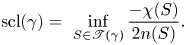
The next lemma provides the first step towards proposition 3.3. It achieves all the desired properties except for tautness of the turn paths in item (3).
Lemma 3.5 Suppose $f\colon \thinspace S \to \Sigma$ is an admissible map which is incompressible. Then $f$
 is homotopic to an admissible map $g\colon \thinspace S \to \Sigma$
 such that
(1) $g \colon \thinspace g^{-1}(\Sigma _2) \to \Sigma _2$
is an immersion(2) $g^{-1}(D)$
is a disjoint union of disks,(3) for each component $E$
of $g^{-1}(D)$, the boundary map $g|_{\partial E}$ is a turn path.


The boundary maps $f\vert _{\partial S}$ and $g\vert _{\partial S}$
 differ only by reparametrization.
Proof. We proceed as in Step 1 of [Reference Gabai10, Theorem 2.1]. Homotope $f$ rel boundary to $f_1$
 which is transverse to the disk $B$
 . We then have that each component of $f_1^{-1}(B)$
 is a disk mapping homeomorphically onto $B$
 . Next, let $T = S - \operatorname {int}(f_1^{-1}(B))$
 . Since $f_1\vert _{\partial T}$
 is transverse to the arcs $\lambda _i$
 and $\mu _i$
 , we may homotope $f_1$
 rel $\partial S \cup f_1^{-1}(B)$
 to be transverse to these arcs. Among all maps $f_2$
 homotopic to $f$
 rel $\partial S$
 that are transverse to $B$
 and transverse to the arcs $\lambda _i$
 and $\mu _i$
 on $S - \operatorname {int}(f_2^{-1}(B))$
 , let $f_2$
 minimize the complexity, which is the pair $(\left \lvert {\pi _0\bigl (f_2^{-1}\bigl (B\bigr )\bigr ) } \right \rvert,\, \left \lvert { \pi _0\bigl (f_2^{-1}\bigl (\bigcup _i \lambda _i \cup \bigcup _i \mu _i\bigr )\bigr )} \right \rvert )$
 ordered lexicographically.
Since $f_2$ is incompressible, no component of $f_2^{-1}(\lambda _i)$
 or $f_2^{-1}(\mu _i)$
 is an essential closed curve. No component is an inessential closed curve either. Suppose $C$
 is such a curve mapping to $\lambda _i$
 , say. For a sufficiently close arc $\lambda _i'$
 that is parallel to $\lambda _i$
 , there is a curve $C'$
 parallel to $C$
 mapping to $\lambda _i'$
 that bounds a disk $E \subset S$
 , with $C$
 in the interior of $E$
 . By re-defining the map on $\operatorname {int}(E)$
 to map into $\lambda _i'$
 one obtains a map of smaller complexity; the new map is homotopic to $f_2$
 rel $\partial S$
 because $\pi _2(\Sigma )=0$
 .
.
Thus each component of $f_2^{-1}(\lambda _i)$ is an arc with endpoints mapping to $\partial \lambda _i$
 , and each component of $f_2^{-1}(\mu _i)$
 is an arc with endpoints mapping to $\partial \mu _i \cup \{\mu _i \cap \gamma (\coprod S^1)\}$
 . Note that in the second case, both endpoints cannot map to the same point $z \in \{\mu _i \cap \gamma (\coprod S^1)\}$
 , by orientation considerations. There is a consistent transverse orientation on $f_2^{-1}(\mu _i)$
 , but $f_2\vert _{\partial S}$
 always passes through $z$
 in the same direction, being a positive power of $\gamma$
 .
.
Since complexity is minimized, both endpoints cannot map to the same point of $\partial \mu _i$ ; otherwise, $\left \lvert {\pi _0\bigl (f_2^{-1}\bigl (\bigcup _i \lambda _i \cup \bigcup _i \mu _i\bigr )\bigr )} \right \rvert$
 could be reduced, and then $\left \lvert {\pi _0\bigl (f_2^{-1}\bigl (B\bigr )\bigr )} \right \rvert$
 as well by homotopy rel $\partial S$
 to a new map which is still transverse to $B \cup \{\mu _i\} \cup \{\lambda _i\}$
 . Hence the endpoints map to distinct points. The same reasoning applies to components of $f_2^{-1}(\lambda _i)$
 . Hence the endpoints of every arc in $f_2^{-1}(\lambda _i)$
 or $f_2^{-1}(\mu _i)$
 map to distinct points.
Now, by a further homotopy rel $\partial S \cup f_2^{-1}(B)$ , the components of $f_2^{-1}(\lambda _i)$
 and $f_2^{-1}(\mu _i)$
 can be tightened so that each maps by an immersion; let $f_3$
 be the resulting map. There are compatible tubular neighbourhoods on which $f_3$
 is a bundle map, and by another homotopy to $f_4$
 (which expands along fibres of the tubular neighbourhoods $L$
 and $M$
 ) we can ensure that each component of $f_4^{-1}(L)$
 and $f_4^{-1}(M)$
 maps by an immersion. Now $f_4 \colon \thinspace f_4^{-1}(\Sigma _2) \to \Sigma _2$
 is an immersion, and $f_4$
 satisfies (1).
Next consider a component $E$ of $f_4^{-1}(D)$
 . Each boundary component of $\partial E$
 maps by a concatenation of paths that alternate between turn arcs and paths in $\partial D$
 ; moreover these latter paths are part of the boundary map of $f_4 \colon \thinspace f_4^{-1}(\Sigma _2) \to \Sigma _2$
 and hence are immersions. Thus $\partial E$
 maps to $D$
 by turn paths and $f_4$
 satisfies (3).
Next, suppose some component $E$ of $f_4^{-1}(D)$
 is not a disk. Then there is a simple closed curve $C \subset \operatorname {int}(E)$
 which is essential in $E$
 . Since $f_4(C)$
 is nullhomotopic in $\Sigma$
 , we have that $C$
 bounds a disk $E' \subset S$
 . Since $\pi _2(\Sigma )=0$
 there is a homotopy rel $S - \operatorname {int}(E')$
 from $f_4$
 to $f_5$
 such that $f_5(E') \subset D$
 . By performing finitely many homotopies of this type, we arrive at $g$
 such that each component of $g^{-1}(D)$
 is a disk and $g$
 agrees with $f_4$
 on $g^{-1}(\Sigma - \operatorname {int}(D)) = g^{-1}(\Sigma _2)$
 . In particular, $g$
 satisfies (1) and (2).
Lastly, $f_4^{-1}(\partial D) \supseteq g^{-1}(\partial D)$ and $f_4$
 and $g$
 agree on $g^{-1}(\partial D)$
 (and on $\partial S$
 ), so the boundary paths of $g^{-1}(D)$
 are unchanged and $g$
 satisfies (3). For the last statement, note that $f\vert _{\partial S} = f_3\vert _{\partial S}$
 and $f_4\vert _{\partial S} = g\vert _{\partial S}$
 , and the change from $f_3\vert _{\partial S}$
 to $f_4\vert _{\partial S}$
 simply reparametrizes along $\partial S$
 .
.
The map $g$ given by the previous lemma may be quite badly behaved on $g^{-1}(D)$
 , with branch points, folding, twisting, etc. This will mostly not be a concern for us; what matters most is the boundary maps on $g^{-1}(D)$
 . The next lemma achieves tautness of these boundary maps at the expense of creating branch points over $\Sigma _1$
 .
.
Lemma 3.6 Suppose $g\colon \thinspace S \to \Sigma$ is an admissible map which satisfies the conclusions of lemma 3.5. Then there is an admissible map $g_1\colon \thinspace S_1 \to \Sigma$
 with $n(S_1) = n(S)$
 and $\chi (S) \leqslant \chi (S_1)$
 such that
(1) $g_1 \colon \thinspace g_1^{-1}(\Sigma _2) \to \Sigma _2$
is a branched immersion with all branch points in the interior of $g_1^{-1}(\Sigma _1)$,(2) $g_1^{-1}(D)$
is a disjoint union of disks,(3) for each component $E$
of $g_1^{-1}(D)$, the boundary map $g_1|_{\partial E}$ is a taut turn path,(4) $g_1$
is an immersion on every component of $g_1^{-1}(\Sigma _3)$ that does not meet $\partial S_1$.


Proof. Let $E$ be a component of $g^{-1}(D)$
 . There are two types of moves we will use to achieve tautness in item (3). Suppose first that $\partial E$
 contains two or more instances of the turn arc $\tau _i$
 . Delete the interior of $E$
 , cut the midpoints of the two instances of $\tau _i$
 and glue the first half of one to the second half of the other and vice versa. This splits $\partial E$
 into two components, which can be filled by two disks mapping to $D$
 , increasing $\chi (S)$
 . After finitely many moves of this type, there are no repeated instances of turn arcs in components of $\partial g^{-1}(D)$
 . The new boundary of $S$
 still maps by positive powers of $\gamma$
 with degree $n(S)$
 .
.
Now suppose that the arc $\alpha \in \{\alpha _i\} \cup \{ \overline {\alpha }_i\}$ appears two or more times in $\partial E$
 . These two occurrences are also part of $\partial g^{-1}(\Sigma _1)$
 ; denote them by $\alpha '$
 and $\alpha ''$
 . Let $U$
 be an open neighbourhood of $\alpha$
 in $\Sigma _1$
 that is evenly covered by $g$
 , and let $U'$
 , $U''$
 be the corresponding neighbourhoods of $\alpha '$
 and $\alpha ''$
 in $g^{-1}(\Sigma _1)$
 . Let $\beta$
 be a small arc in $U$
 from the midpoint of $\alpha$
 to an interior point of $U$
 . Let $\beta '$
 , $\beta ''$
 be the lifts of $\beta$
 to $U'$
 and $U''$
 respectively. Now delete the interior of $E$
 and cut along $\beta '$
 and $\beta ''$
 . Rejoin the left side of $\beta '$
 to the right side of $\beta ''$
 and vice versa. This creates an index two branch point in $g^{-1}(\Sigma _1)$
 and splits $\partial E$
 into two components, which can be filled with two disks mapping to $D$
 . The Euler characteristic $\chi (S)$
 does not change, and neither does $n(S)$
 , because this move takes place in the interior of $S$
 . After finitely many moves of this second type, we arrive at $g_0 \colon \thinspace S_1 \to \Sigma$
 satisfying (1)–(3).
Let $E$ be a component of $g_0^{-1}(D)$
 which does not meet $\partial S$
 . Then the map $g_0\vert _{\partial E}$
 is a homeomorphism to $\partial D'$
 for some component $D'$
 of $D$
 by (3). For each such $E$
 , we replace $g_0\vert _E$
 by a homeomorphism $E \to D'$
 extending $g_0\vert _{\partial E}$
 to get a new map $g_1 \colon \thinspace S_1 \to \Sigma$
 . Note that $g_1$
 still satisfies (1)–(3). By (1) and the above, $g_1$
 also satisfies (4).
For the last step of the argument, we use finite covers to eliminate the branch points over $\Sigma _1$ . This step depends on $\Sigma _1$
 having non-trivial topology. Note that conclusions (1) and (2) of this lemma are not required for proposition 3.3 but will be useful in a later section.
Lemma 3.7 Suppose $g_1\colon \thinspace S_1 \to \Sigma$ is an admissible map which satisfies the conclusions of lemma 3.6. Let $r$
 be the number of sheets of the branched cover $g_1 \colon \thinspace g_1^{-1}(\Sigma _1) \to \Sigma _1$
 . Then there is a taut admissible map $g_2\colon \thinspace S_2 \to \Sigma$
 and a positive integer $N$
 such that
(1) $n(S_2) = N n(S_1)$
,(2) $\chi (g_2^{-1}(\Sigma _3)) = N \chi (g_1^{-1}(\Sigma _3))$
and $\chi (g_2^{-1}(\Sigma _1)) = N r \chi (\Sigma _1)$,(3) ${-\chi (S_2)}/{2n(S_2)} \leqslant {-\chi (S_1)}/{2n(S_1)}$
.


Proof. Let $T_3''$ be the union of all components of $g_1^{-1}(\Sigma _3)$
 which meet $\partial S_1$
 . Let
. Let

By lemma 2.6, there is a finite-sheeted cover $T_3' \to T_3''$ such that every component of $\partial T_3'$
 covers a component of $\partial \Sigma _3$
 with degree $\pm d$
 under the composition $T_3' \to T_3'' \overset {g_1}{\to } \Sigma _3$
 . (The orientation of a covering surface will be induced by the base unless indicated otherwise.) Let $\Sigma _{3, 1},\, \dots,\, \Sigma _{3, \ell }$
 be the components of $\Sigma _3$
 . By lemma 2.5(2), there are connected finite-sheeted covers $T_{3, i}' \to \Sigma _{3, i}$
 and $T_1' \to \Sigma _1$
 such that every component of $\partial T_{3, i}'$
 and $\partial T_1'$
 covers a component of $\partial \Sigma _3$
 with degree $\pm d$
 .
.
Let $s_i^+,\, s_i^-$ be the positive and negative degrees by which $g_1^{-1}(\Sigma _{3, i}) - T_3''$
 covers $\Sigma _{3, i}$
 . Let $r^+$
 and $r^-$
 be the positive and negative degrees respectively of the branched cover $g_1 \colon \thinspace g_1^{-1}(\Sigma _1) \to \Sigma _1$
 . By taking multiple copies of $T_{3, i}'$
 for all $i$
 and multiple copies of $T_3'$
 and $T_1'$
 , and by orienting the copies of $T_{3, i}'$
 and $T_1'$
 appropriately, we can find covers $h_3 \colon \thinspace T_3 \to T_3''$
 , $h_{3, i} \colon \thinspace T_{3, i} \to \Sigma _{3, i},$
 and $h_1 \colon \thinspace T_1 \to \Sigma _1$
 such that, for some positive integer $N$
 ,
,
• the positive (resp. negative) degree of $h_{3, i}$
is $N s_i^+$ (resp. $N s_i^-$),• $h_3$
has degree $N$,• $h_1$
has positive degree $N r^+$ and negative degree $N r^-$.


We now show that we can glue the above pieces together to get a taut admissible surface $S_2$ . Note that every component of $\partial \Sigma _{3, i}$
 is covered by $\partial T_3''$
 with positive and negative degrees $r^+ - s_i^+$
 and $r^- - s_i^-$
 respectively. Thus, under $g_1 \circ h_3$
 , every component of $\partial \Sigma _{3, i}$
 is covered by ${N(r^+ - s_i^+)}/{d}$
 curves by degree $d$
 and ${N(r^- - s_i^-)}/{d}$
 curves by degree $-d$
 . Each component of $\partial \Sigma _{3, i}$
 , under $h_{3, i}$
 , is covered by ${Ns_i^+}/{d}$
 curves by degree $d$
 and ${Ns_i^-}/{d}$
 curves by degree $-d$
 . Each component of $\partial \Sigma _{3, i}$
 , under $h_1$
 , is covered by ${Nr^+}/{d}$
 curves by degree $-d$
 and ${Nr^-}/{d}$
 curves by degree $d$
 . Thus, by gluing $T_1$
 to $T_3 \cup \bigcup _i T_{3, i}$
 along the preimage of $\partial \Sigma _3$
 appropriately respecting orientations, we obtain an oriented compact surface $S_2$
 and a map $g_2 \colon \thinspace S_2 \to \Sigma$
 , which, by construction, is a taut admissible map.
It is clear that $n(S_2) = N n(S_1)$ , so it remains to compute the Euler characteristic of various surfaces.
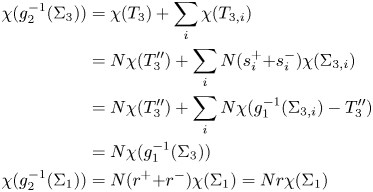
Finally, note that $\chi (g_1^{-1}(\Sigma _1)) \leqslant r \chi (\Sigma _1)$ since $g_1 \colon \thinspace g_1^{-1}(\Sigma _1) \to \Sigma _1$
 is a branched cover, and so



4. Encoding surfaces
Let $\operatorname {TP}$ denote the set of all taut turn paths. For each taut turn path $p \in \operatorname {TP}$
 , we define the sides of $p$
 . Recall that $p\colon \thinspace S^1 \to D$
 is an immersed path which alternates between turn arcs and immersed paths in $\partial D$
 . Since the intersection of $\gamma$
 with $\Sigma _2$
 lies in $M$
 , the turn path $p$
 alternates between arcs from $\{\tau _i\} \cup \{\alpha _i\} \cup \{\overline {\alpha }_i\}$
 and arcs in $\partial M - \Sigma _1$
 . A side of $p$
 is an ordered pair $s \in (\{\tau _i\} \cup \{\alpha _i\{\cup \{\overline {\alpha }_i\})^2$
 such that $p$
 traverses the first arc in the ordered pair, then a part of $\partial M - \Sigma _1$
 , and then the second arc in the ordered pair. For any side $s$
 , we let $m_s \subseteq \partial M$
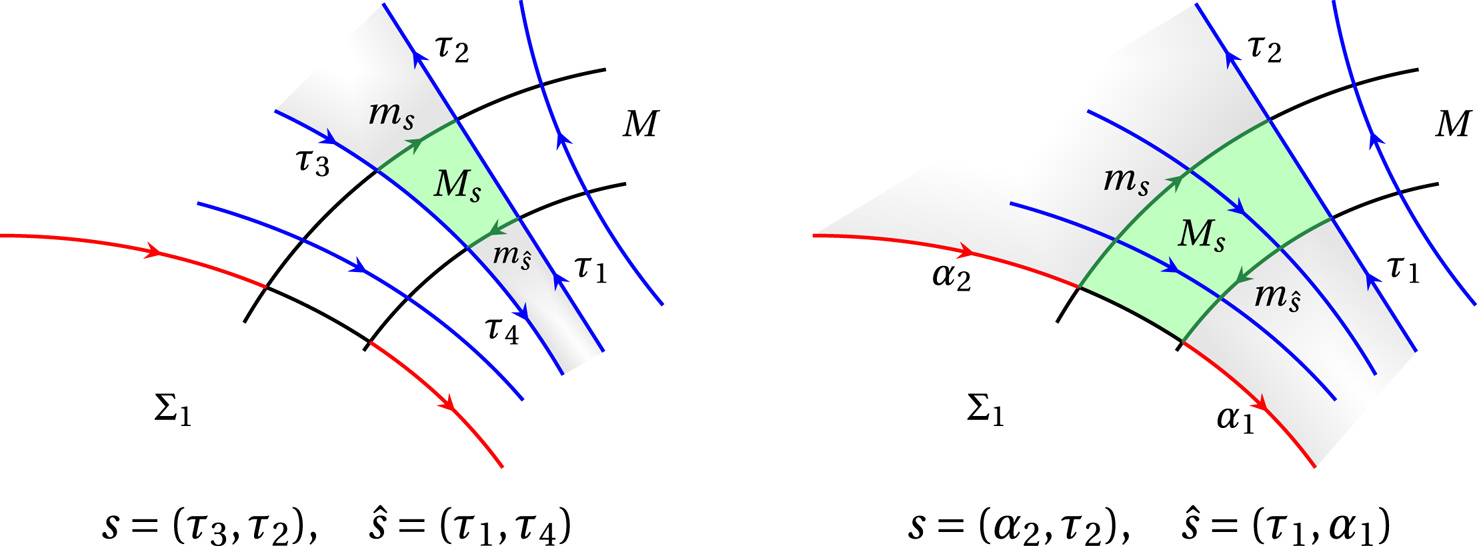
 denote the middle arc. See figure 3. Note that since $p$
 is taut, it traverses any side at most once.
Two examples of dual pairs of sides $(s,\, \hat {s})$ . Geometrically, each side encodes a portion of the boundary of a possible turn disk (shaded grey in the figure) mapping to $D$
 .
.
Let $\mathcal {S}$ denote the set of all ordered pairs of arcs from $\{\tau _i\} \cup \{\alpha _i\} \cup \{\overline {\alpha }_i\}$
 which are a side for some taut turn path $p$
 . Note that $\mathcal {S}$
 does not contain all ordered pairs. E.g., $\mathcal {S}$
 cannot contain any pairs of the form $(\alpha _i,\, \overline {\alpha }_j)$
 since a taut turn path maps as an immersion to $\partial D$
 . E.g., any pair $(\tau _i,\, \tau _j) \in \mathcal {S}$
 must have one arc oriented into $M$
 and one oriented out from $M$
 on the same side of $M$
 .
.
For any side $s \in \mathcal {S}$ , there is a unique side $\hat s \in \mathcal {S}$
 such that $m_s,\, m_{\hat s}$
 and two unique arcs from $(\gamma \cup \partial \Sigma _1) \cap M$
 bound a subrectangle of $M$
 . Call $\hat s$
 the dual side of $s$
 , and let $M_s \subseteq M$
 be the bounded subrectangle. Note that, here, we are using the fact that $M$
 contains no self-intersections of $\gamma$
 . Also, note that $M_s = M_{\hat s}$
 . See figure 3 again.
The encoding
Let $V = {\mathbb {R}}^{\operatorname {TP}} \oplus {\mathbb {R}}^2$ with coordinates $\{x_p\},\, \{r^+,\, r^-\}$
 . We define a function

as follows. Let $f\colon \thinspace S \to \Sigma$ be a taut admissible map. For each $p \in \operatorname {TP}$
 , define $x_p(S)$
 to be the number of components $E$
 of $f^{-1}(D)$
 such that $f|_{\partial E} = p$
 . Let $S_1 = f^{-1}(\Sigma _1)$
 . As mentioned above, since $f(\partial S) \cap \Sigma _1 = \emptyset$
 , the map $f|_{S_1}\colon \thinspace S_1 \to \Sigma _1$
 is a covering map. Define $r^+(S)$
 to be the positive degree of $f\vert _{S_1}$
 and $r^-(S)$
 the negative degree. Finally let $v(S) = ((x_p(S)),\, r^+(S),\, r^-(S))$
 .
.
Matching equations
The vector $v(S)$ will satisfy two kinds of equations. Broadly speaking, for each turn path $p$
 with a side $s$
 , there must be a corresponding turn path $p'$
 (possibly equal to $p$
 ) with a matching dual side $\hat s$
 . Moreover, $r^+$
 and $r^-$
 should match with the number of $\alpha _i$
 's and $\overline {\alpha }_i$
 's appearing in turn paths of $S$
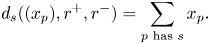
 . We define some linear maps. For each side $s \in \mathcal {S}$
 , we define $d_s\colon \thinspace V \to {\mathbb {R}}$
 as
as
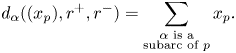
For each $\alpha \in \{\alpha _i\} \cup \{\overline {\alpha }_i\}$ , define $d_{\alpha }\colon \thinspace V \to {\mathbb {R}}$
 as
as
For each $\tau _i$ , define $d_{\tau _i}\colon \thinspace V \to {\mathbb {R}}$
 by
by
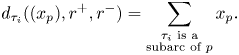
Lemma 4.1 Let $(f,\, S)$ be a taut admissible surface. Then, $((x_p),\, r^+,\, r^-) = v(S)$
 satisfies the following matching equations:
(1) $d_s((x_p),\, r^+,\, r^-) = d_{\hat s}((x_p),\, r^+,\, r^-)$
for all $s \in \mathcal {S}$.(2) $d_{\alpha _i}((x_p),\, r^+,\, r^-) = r^+$
for all $i$.(3) $d_{\overline {\alpha }_i}((x_p),\, r^+,\, r^-) = r^-$
for all $i$.(4) $d_{\tau _i}((x_p),\, r^+,\, r^-) = d_{\tau _j}((x_p),\, r^+,\, r^-)$
for all $i,\, j$.


Proof. Let $M'$ be a component of $M$
 and let $N'$
 be a component of $N = f^{-1}(M)$
 mapping to $M'$
 . By tautness, the map $f\colon \thinspace N' \to M'$
 is an immersion. Since $M'$
 is simply connected, $N'$
 is compact, and $\partial S$
 maps exclusively to $\gamma$
 , the surface $N'$
 is a topological rectangle with two edges mapping to $\partial D$
 and two edges mapping to $(\gamma \cup \partial \Sigma _1) \cap M$
 . The map $f\vert _{N'}$
 may be orientation reversing or preserving.
Let $E',\, E''$ be the two components of $f^{-1}(D)$
 bordering $N'$
 . Then $N'$
 borders $E',\, E''$
 of $E$
 in the middle of sides in $f|_{\partial E'},\, f|_{\partial E''}$
 . Since $f$
 is an immersion from $f^{-1}(\Sigma _2)$
 to $\Sigma _2$
 and from $\partial S$
 to $\Sigma$
 (as a $1$
 -manifold), the map $f|_{\partial E'}$
 (resp. $f|_{\partial E''}$
 ) is determined near the intersection of $\partial N'$
 and $\partial E'$
 (resp. $\partial N'$
 and $\partial E''$
 ). Thus, $f|_{N'}$
 determines precisely one side each of the turn paths $f|_{\partial E'},\, f|_{\partial E''}$
 and those sides must be dual. Conversely, the side of $f|_{\partial E'}$
 at $\partial E' \cap \partial N'$
 determines the image of $f(N')$
 and the side of $f|_{\partial E''}$
 at $\partial E'' \cap \partial N'$
 which must be dual. Since $f|_{\partial E}$
 is taut for any component $E$
 of $f^{-1}(D)$
 , each arc $\tau _i,\, \alpha _j,\, \overline {\alpha }_j$
 is traversed at most once and thus each side appears in $f|_{\partial E}$
 at most once. Thus, $d_s(v(S))$
 is the total number of times $s$
 appears as a side in $f$
 , and the above argument shows this is equal to the total number of times $\hat s$
 appears as a side in $f$
 which is $d_{\hat s}(v(S))$
 .
.
For the second equality, first note that $r^+(S)$ equals the positive degree of the map $f \colon \thinspace f^{-1}(\alpha _i) \to \alpha _i$
 where we view $f^{-1}(\alpha _i)$
 as a subarc of the boundary of $f^{-1}(\Sigma _3)$
 . This is equal to the number of times that the boundary of $f^{-1}(D)$
 traverses $\alpha _i$
 , and since $f$
 is taut, this is $d_{\alpha _i}(v(S))$
 . The argument for the third equation is similar. Again by tautness, $d_{\tau _i}(v(S)) = n(S)$
 for all $i$
 , and the last equality holds.
Degree and Euler characteristic
Recall from the preceding proof that $d_{\tau _i}(v(S)) = \ n(S)$ for each turn arc $\tau _i$
 and all taut admissible surfaces $S$
 . Thus we have the factorization
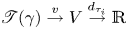
of the degree function $n(S)$ through $v$
 via any of the linear maps $d_{\tau _i}$
 .
.
The Euler characteristic $\chi (S)$ also factors through $v$
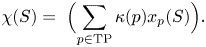
 in a similar fashion. First we need a formula for $\chi (S)$
 based on the combinatorics of turn disks.
Definition 4.2 For $p \in \operatorname {TP}$ let
let

Let $F_\chi \colon \thinspace {\mathbb {R}}^{\operatorname {TP}} \oplus {\mathbb {R}}^2 \to {\mathbb {R}}$ be the linear map

Lemma 4.3 If $S$ is a taut admissible surface, then $\chi (S) = F_\chi (v(S))$
 .
.
Proof. Given a taut admissible surface $f\colon \thinspace S \to \Sigma$ , the subsurface $S_3 = f^{-1}(\Sigma _2 - \operatorname {int}(\Sigma _1))$
 consists of turn disks mapping to $D$
 and $1$
 -handles mapping by immersions to $M$
 where each $1$
 -handle attaches to the middle arcs of a dual pair of sides. It is clear then that
Let $S_1 = f^{-1}(\Sigma _1)$ . By definition of taut surface, $S_1$
 maps to $\Sigma _1$
 by an immersion and since $S_1 \cap \partial S = \emptyset$
 , the map is a covering map. Therefore $\chi (S_1) = \chi (\Sigma _1)(r^+(S) + r^-(S))$
 . Since $S = S_1 \cup S_3$
 and $S_1,\, S_3$
 meet along full boundary components of $S_1$
 and $S_3$
 , we have $\chi (S) = \chi (S_1) + \chi (S_3)$
 and the lemma follows.
Remark 4.4 Having explained our encoding of surfaces, we can relate this encoding to that used to determine stable commutator length in a free group. Our $1$ –chain $\gamma$
 lies in the union of the $D_i$
 and bands $M$
 . If we collapse each $D_i$
 to a point and the bands in $M$
 to edges, we obtain a $1$
 –chain in a graph. However, only the turn paths which traverse no $\alpha _i$
 correspond to turn circuits as defined in [Reference Brady, Clay and Forester1], and of course, there is nothing analogous to the role of $\Sigma _1$
 and its matching equations with turn paths.
5. Reassembly
Given a taut admissible surface, we associate the vector $v(S)$ which encodes it and satisfies matching equations. Now, we would like to show that we can construct a taut admissible surface with the right Euler characteristic and degree ($n(S)$
 ) from a vector satisfying the matching equations. In general, it's not clear that this is possible for arbitrary positive integral vectors satisfying the matching equations. However, it is possible after multiplying the vector by a sufficiently large integer. In fact, we make the statement for positive rational vectors.
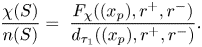
Lemma 5.1 Suppose a nonzero, nonnegative vector $((x_p),\, r^+,\, r^-) \in {\mathbb {Q}}^{\operatorname {TP}} \oplus {\mathbb {Q}}^2$ satisfies the matching equations (1)–(4) in lemma 4.1. Then, there is a taut admissible surface $S$
 such that
Proof. We can, without loss of generality, assume that the vector is integral. The basic idea is as follows. We take $x_p$ turn disks for each $p$
 whose boundary will map to the turn path $p$
 . We then attach $1$
 -handles to dual sides. This surface, call it say $S_3$
 , then has boundary components some of which map to powers of components of $\gamma$
 and some to components of $\partial \Sigma _3$
 with varying degrees. We then want to glue in a (probably disconnected) surface to latter boundary components which will map to $\Sigma _1$
 by a covering map. The difficulty is that the part of $\partial S_3$
 mapping to $\partial \Sigma _3 = \partial \Sigma _1$
 may not extend to a covering map of $\Sigma _1$
 depending on the topology of $\Sigma _1$
 and the degrees of the maps from components of $\partial S_3$
 to components of $\partial \Sigma _1$
 . Lemmas 2.7 and 3.7 will fix this problem at the cost of scaling $((x_p),\, r^+,\, r^-)$
 by some positive integer.
For each turn path $p \in \operatorname {TP}$ , we let $E_p$
 be an oriented disk and $f_p\colon \thinspace E_p \to D$
 a map such that $f_{\partial E_p} = p$
 (where $\partial E_p$
 has its boundary orientation). If $p$
 does not traverse any turn arcs, then $p\colon \thinspace S^1 \to \partial D$
 is an immersion; in this case, we insist $f_p$
 is a homeomorphism. Note that if $p$
 traverses $\overline {\alpha }_i$
 's, then $f_p$
 is orientation-reversing. For each side $s \in \mathcal {S}$
 , we let $N_s$
 be an oriented disk which is a copy of $M_s$
 and $f_s \colon \thinspace N_s \to M_s$
 the canonical homeomorphism. We orient $N_s$
 as follows. If $s$
 has a turn $\tau _i$
 , then we orient $N_s$
 so that the boundary orientation is consistent with the orientation of $\tau _i$
 . If $s$
 has an $\alpha _i$
 , then we orient $N_s$
 such that $f_s$
 is orientation-preserving and if $s$
 has an $\overline {\alpha }_i$
 , then we orient $N_s$
 such that $f_s$
 is orientation-reversing.
Now, we construct our initial surface. We take $x_p$ copies of $E_p$
 and $d_s((x_p),\, r^+,\, r^-)$
 copies of $N_t$
 . (Recall that $M_s = M_{\hat s}$
 and thus $N_s = N_{\hat s}$
 . By the matching equations, we are taking a well-defined number of copies of $N_s$
 .) We attach the $E_p$
 together using the $N_s$
 in the obvious way such that $f_p$
 and $f_s$
 extend to a map on the oriented surface constructed. Call this surface $S_3$
 and the map $f_3$
 . Some boundary components of $S_3$
 map to $\gamma$
 and others to $\partial \Sigma _3 = \partial \Sigma _1$
 . By the matching equations, the positive degree of the map $\partial S_3$
 to any component of $\partial \Sigma _3$
 is $r^+$
 and the negative degree is $r^-$
 . By applying lemma 2.7 separately to the positive and negative degrees, there is a branched cover $S_1 \to \Sigma _1$
 such that the degree partition over any component of $\partial \Sigma _3$
 is precisely the negative of that of $S_3$
 . By gluing boundary components of $S_3$
 to $S_1$
 which map to the same component of $\partial \Sigma _3$
 with matching degrees (i.e. equal but opposite), we obtain a surface $S'$
 and a map $g' \colon \thinspace S' \to \Sigma$
 satisfying the hypotheses of lemma 3.6.
By lemma 3.7, there is a positive integer $N$ and a taut admissible surface $g \colon \thinspace S \to \Sigma$
 satisfying $n(S) = N n(S') = N d_{\tau _1}((x_p),\, r^+,\, r^-)$
 and $\chi (g^{-1}(\Sigma _3)) = N \chi (S_3)$
 and $\chi (g^{-1}(\Sigma _1)) = N(r^+ + r^-) \chi (\Sigma _1)$
 . We then have

The lemma follows.
6. Linear programming and scl
We are now ready to prove that the stable commutator length of the nonfilling $1$ -chain is the solution of a linear programme. We define the region $R \subseteq {\mathbb {R}}^{\operatorname {TP}} \oplus {\mathbb {R}}^2$
 to be the subset defined by the following linear equations and inequalities.
• the matching equations from lemma 4.1
• $d_{\tau _1}((x_p),\, r^+,\, r^-) = 1$
• $x_p \geqslant 0$
for all $p \in \operatorname {TP}$ and $r^+ \geqslant 0$ and $r^- \geqslant 0$


Lemma 6.1 The stable commutator length of $\gamma$ is equal to

Proof. Recall from corollary 3.4 that
Let $S$ be a taut admissible surface. Then, by lemma 4.1, $v(S) \in {\mathbb {Z}}^{\operatorname {TP}}\oplus {\mathbb {Z}}^2$
 satisfies the matching equations. Moreover, $n(S) = d_{\tau _1}(v(S))$
 and, by lemma 4.3, $\chi (S) = F_\chi (v(S))$
 . By linearity, $d_{\tau _1}({v(S)}/{n(S)}) = 1$
 and
and

Thus, $\operatorname {scl}(\gamma ) \geqslant$ (6.1). On the other hand, by lemma 5.1, for any vector $((x_p),\, r^+,\, r^-)$
 satisfying the matching equations and $d_{\tau _1}((x_p),\, r^+,\, r^-) = 1$
 , there is a taut admissible surface $S$
 such that

Thus (6.1) $\geqslant \operatorname {scl}(\gamma )$ .
.
We are now ready to prove the main theorem.
Proof of theorem 1.1 Since $v(S) \in R$ for any taut admissible surface $S$
 , the region $R$
 is non-empty. Since $R$
 is defined by equations and inequalities with rational coefficients, $R \cap {\mathbb {Q}}^{\operatorname {TP}}\oplus {\mathbb {Q}}^2$
 is dense in $R$
 . By lemma 6.1 and the fact that stable commutator length is nonnegative, $-{1}/{2} F_\chi$
 is bounded below on $R$
 . Since $R$
 is finite-dimensional and defined by finitely many equations, minimizing the linear function $-{1}/{2} F_\chi$
 on $R$
 is a linear programme and therefore has an optimal solution at a vertex of $R$
 . Since $R$
 is defined by equations with rational coefficients, all vertices are rational points, and so by lemma 6.1, $\operatorname {scl}(\gamma )$
 is rational.

Acknowledgements
The authors were partially supported by Simons Foundation awards #638026 (MF) and #713006 (JM). They thank the referee for making helpful suggestions.


 Open access

