




Introduction
Since antiquity, outdoor noncommercial slogans have been prevalent in China and continue to enjoy remarkable levels of popularity and diversity in both urban and rural settings, addressing a wide range of topics, such as politics, society, culture, etc. In China, these slogans, which are often concise and eye-catching, are frequently employed by the government, enterprises, or individuals for noncommercial purposes in public space, including public welfare, politics, and society (Hu et al. Reference Hu, Nie, Chen and Zhang2004; Zhang Reference Zhang2005). They represent one type of the most pervasive and salient linguistic signs in Chinese society. This phenomenon serves to illustrate the physical-spatial semiotic arrangements that have emerged within the context of socialist China. Such slogans fulfill both informational and symbolic functions (Landry and Bourhis Reference Landry and Bourhis1997, 25), including information-giving and identity-expressing (Zhang Reference Zhang2020; Zhang Reference Zhang2022).
It is worthwhile to examine in depth the Chinese noncommercial slogans. First, their pervasive presence in China and the breadth of their themes render them a valuable lens for observing China’s social and linguistic dynamics. Second, unlike commercial slogans that prioritize profit, noncommercial slogans are primarily authored by official or semi-official entities for social governance, offering a window into the top-down interaction of such sign-creators or owners with the public. In addition, in China, these slogans apparently exhibit a dual function: both informational conveyors and symbolic representations (Landry and Bourhis Reference Landry and Bourhis1997, 25). It is initially observed that such slogans are particularly notable for their capacity to symbolize and characterize different identities; for instance, frequently incorporating personal pronouns (“we”) and adverbs (“together”) fosters a sense of unity and collective identity (Zhang Reference Zhang2022). The analysis of these slogans thus not only reveals the surface-level information, but also allows the elucidation of ideological stances and identity constructions. Consequently, further issues emerge from these preliminary observations and remain to be addressed, such as what identities are constructed and how they are constructed.
The majority of current research on Chinese noncommercial slogans is limited to a narrow range of specific types, such as anti-epidemic and environmental slogans (Zhou Reference Zhou2016; Liu and Li Reference Liu and Li2020). They primarily concentrate on their forms, functions, or information from the perspectives of discourse frames, pragmatics, or news communication; nevertheless, there is a notable absence of systematic studies that focus on their symbolic function of identity behind such slogans (Hu et al. Reference Hu, Nie, Chen and Zhang2004; Nie Reference Nie2004; Zhang and Chen Reference Zhang and Chen2004; Zhang Reference Zhang2005; Zhang Reference Zhang2022; Han Reference Han2008; Zhou Reference Zhou2016; Liu and Li Reference Liu and Li2020). Thereupon, this article seeks to address this research gap.
To summarize, this article aims to explore the identities embodied in outdoor noncommercial slogans in contemporary Chinese society, with an additional focus on the contexts from which they emerge. It employs a case study approach, encompassing rural and urban contexts in Zhengzhou City, Henan Province. It applies and extends the stance triangle theory (Du Bois Reference Du Bois and Englebretson2007) to the sign identity research detailed in the “Theoretical framework” section. The remaining is structured as follows: “Methods”, “Findings and discussions”, and “Conclusion”.
Theoretical framework
Theoretical foundation
The term “identity” encapsulates individuals’ self-perception (Ivanic Reference Ivanic1998) and social belonging (Tajfel Reference Tajfel1981), embracing both uniqueness and shared characteristics (Buckingham Reference Buckingham2008). According to the tenets of social constructivism, which asserts the mutually constitutive relationship between individual and social world, identity is not a concept existing exclusively within individuals’ mind (De Fina Reference De Fina and Van Dijk2011). Especially in postmodern society, it is no longer fixed, but rather dynamically changing and liquid (Hall Reference Hall and Rutherford1990; Giddens Reference Giddens1991; Bauman Reference Bauman, Hall and du Gay1996, Reference Bauman2000, Reference Bauman2004, Reference Bauman2005). Furthermore, it is a process of construction centered on human actions and social interactions (De Fina Reference De Fina and Van Dijk2011). The embodiment of identity and the interpretation thereof are paramount in the existence and functioning of linguistic signs (Joseph Reference Joseph2004). The sign-identity nexus has been a topic of research for scholars for centuries within several fields of sociolinguistics, social and linguistic anthropology, semiotics, and linguistic landscape (Bell Reference Bell2002; Joseph Reference Joseph2004; De Fina Reference De Fina and Van Dijk2011; Bauer Reference Bauer2013; Blackwood, Lanza, and Woldemariam Reference Blackwood, Lanza and Woldemariam2016; Burdick Reference Burdick2016; Kelly-Holmes Reference Kelly-Holmes2016; Calvi and Uberti-Bona Reference Calvi and Uberti-Bona2020; Dong Reference Dong2020; Liu Reference Liu2020; Savski Reference Savski2021; An and Zhang Reference An and Zhang2024; Huang et al. Reference Huang, Han, Ran, Yang and Yang2024; Morlan and Byrne Reference Morlan and Byrne2024). Identity is not solely reflected in linguistic signs; rather, it is actively, ongoingly, dynamically constituted in them (Benwell and Stokoe Reference Benwell and Stokoe2006). In this manner, apart from integrating perspectives from adjacent disciplines, such as social identity theory and communication theory of identity, identity can also be approached through traditional linguistic and discursive analysis, such as discursive psychology, critical discourse analysis, narrative analysis, language variation, network theory, communities of practice, and stance theory (Joseph Reference Joseph2004; Benwell and Stokoe Reference Benwell and Stokoe2006; Englebretson Reference Englebretson2007).
The aforementioned final four terms represent distinct sociolinguistic research approaches that significantly contribute to language–identity interconnections, centering on social practices (De Fina Reference De Fina and Van Dijk2011). Early sociolinguistic waves emphasize language variation, social network, and communities of practice (Eckert Reference Eckert2012; Wardhaugh and Fuller Reference Wardhaugh and Fuller2021). The third wave introduces stance as a pivotal concept (Eckert Reference Eckert2012). A recent trend has been to recognize and orient to the sociocultural dimensions of stance (Englebretson Reference Englebretson2007). As Ochs (Reference Ochs, Gumperz and Levinson1996) posits, linguistic structures indexing epistemological and affective stances are the fundamental linguistic resources for the construction and realization of “social acts and social identities” (p. 420). In other words, stance is usually employed to construct language style and social identity (Ochs Reference Ochs, Gumperz and Levinson1996), and constitutes a fundamental component of social behavior and social identity (Fang and Le Reference Fang and Le2017). Consequently, stance emerges as an effective tool for identity investigation in sociolinguistics (Englebretson Reference Englebretson2007; Jaffe Reference Jaffe2009). A number of studies have been conducted to examine the construction and indexicality of social identities through stance (Thompson and Hopper Reference Thompson, Hopper, Bybee and Hopper2001; Bucholtz and Hall Reference Bucholtz and Hall2005; Matoesian Reference Matoesian2005; Benwell and Stokoe Reference Benwell and Stokoe2006; Kärkkäinen Reference Kärkkäinen2006; Du Bois Reference Du Bois and Englebretson2007; Englebretson Reference Englebretson2007; Johnstone Reference Johnstone and Englebretson2007; Abrar Reference Abrar2020).
Some scholars have also applied the theoretical perspective of stance to the investigation of linguistic signs, including their identity (Lyons Reference Lyons2019; Strange Reference Strange2023; Zhao and Lou Reference Zhao and Lou2023). At present, the number of such studies remains relatively limited. However, this trend should not be overlooked, as linguistic signs can be essentially regarded as stance objects (Zhao and Lou Reference Zhao and Lou2023), which thus merits specialized and in-depth analysis of signs and the identities from the theoretical perspective of stance.
The stance triangle
The conceptualizations of stance are as broad and diverse as personal backgrounds and interests of scholars, resulting in a lack of a consistent definition. It is often related with subjectivity, dialogicity, evaluation, and so forth (Englebretson Reference Englebretson2007), and has been defined and approached from a variety of perspectives by different scholars, such as interactional linguistics (Du Bois Reference Du Bois and Englebretson2007; Englebretson Reference Englebretson2007), sociolinguistics (Jaffe Reference Jaffe2009), corpus linguistics (Biber and Finegan Reference Biber and Finegan1988), systemic functional linguistics (Martin and White Reference Martin and White2005). Du Bois (Reference Du Bois and Englebretson2007) defines stance as “a public act by a social actor, achieved dialogically through overt communicative means, of simultaneously evaluating objects, positioning subjects (self and others), and aligning with other subjects, with respect to any salient dimension of the sociocultural field” (p. 163). He conceptualizes stance within a larger context of interaction and proceeds to develop the stance triangle model (see Figure 1) (Du Bois Reference Du Bois and Englebretson2007).
The stance triangle (Du Bois Reference Du Bois and Englebretson2007, 163).

The model comprises three elements: subject 1, subject 2, and object, situated at the triangle’s vertices. The triangle’s sides and arrows represent three stance types formed between any two elements: evaluation, position, and alignment. They are defined as follows (Du Bois Reference Du Bois and Englebretson2007): (1) the evaluative stance is “the process whereby a stancetaker orients to an object of stance and characterizes it as having some specific quality or value” (p. 143); (2) the positioning stance refers to “the act of situating a social actor with respect to responsibility for stance and for invoking sociocultural value” (p. 143), encompassing affective and epistemic stances. The affective stance indicates emotional positions on a scale (e.g., “glad” to “so glad”), whereas the epistemic stance reflects self-presentation as either knowledgeable or ignorant, or confidence in information or sources (Du Bois Reference Du Bois and Englebretson2007); (3) the alignment stance is defined as “the act of calibrating the relationship between two stances, and by implication between two stancetakers” (p. 144). The model is applicable to identity research across disciplines, like education and discourse analysis (Evans Reference Evans2016; Abrar Reference Abrar2020; Delli and Dumanig Reference Delli and Perlas Dumanig2022; Marino Reference Marino2023), and is further extended here to the field of signs.
Signs can be viewed as a kind of semiotic practice through which interaction occurs between sign owners and readers (Liu Reference Liu2020). There are three primary elements involved in this semiotic behavior: two types of subjects, namely the sign-owner and the sign-reader, and the pertinent object, which is the content expressed by them. The three elements are in exact correspondence with the three vertices in the stance triangle model. As a result, the model can be effectively applied to the analysis of signs. Building upon the original model, this paper further develops an extended version of the stance triangle model that aligns more closely with the actual context of signs (see Figure 2).
The stance triangle with the involvement of sign. Source: Adapted from Du Bois (Reference Du Bois and Englebretson2007: 163).

In this model, “subject 1” and “subject 2” represent the sign-owner and the sign-reader, respectively, and “object” denotes the content expressed between them through specific tools. The original model identifies three distinct stances among these elements, here differentiated by color: “Evaluate” is indicated by green, “Position” by orange, and “Align” by purple. The “sign-owner” engages with the “sign-reader” through the tool “sign,” serving as the carrier for the “object.” The arrows illustrate their relationships, with those starting from the “sign-owner” and pointing to the tool “sign,” and then to the “object.” The “sign-owner” and “sign” are inextricably connected, thereby uniformly denoted by pink boxes. In contrast, the “sign-reader” can communicate “object” with the “sign-owner” through multiple “alternative means.” To illustrate, if a phone number is visible on a sign, the “sign-reader” can call the “sign-owner”; similarly, upon seeing a store sign, he or she may enter the store for direct interaction with the “sign-owner.” The connection among the “sign-reader,” “alternative means” and “object” is thus represented by arrows starting from “sign-reader” to “alternative means,” and finally to “object.” The “sign-reader” and “alternative means” are closely linked, therefore displayed by unified blue boxes.
In this model, a sign is primarily a tool for sign-owners to interact and convey their stances and identities to their readers. By taking the sign as a research entry point, it is potential to mainly explore stances that sign-owners express to their readers and identities they construct through the sign. For instance, top-down signs typically reflect the stances and identities of the government (Shang and Zhao Reference Shang and Zhao2014). In order to facilitate distinction, in Figure 2, the elements and stances related to “sign-owner” and “sign” are represented by solid lines, while those related to “sign-reader” are represented by dotted lines. This paper concentrates on the solid lines, primarily examining the stances and identities of slogan-owners in public spaces.
Methods
Research questions
Drawing from the stance triangle model (Du Bois Reference Du Bois and Englebretson2007), this article aims to address three questions:
1. What types of stances are taken by these noncommercial slogans in China?
2. What identities are emerging from these stances?
3. From what context are these identities emerging?
Research areas
China consists of 34 provincial administrative regions,Footnote 1 with this paper focusing on Henan Province in central China. Noncommercial slogans are pervasive in urban and rural areas across the country, and those in Henan Province have gained significant acclaim online for their rhyming and catchy features, attracting extensive media attention (see Figure 3). Examples include “油菜韭菜大白菜 不打疫苗你最菜” (literally “Rape, chives, and cabbage. Without vaccination, you suck!”) and “黄瓜西瓜大冬瓜 防疫到位顶呱呱” (literally “Cucumber, pumpkin, and winter melon, with effective epidemic prevention, are top-notch!”) (see the coverage in Figure 3). The diversity, popularity, and representativeness of these slogans render Henan Province an optimal research arena.
Media coverage on slogans in Henan Province.Footnote 2

Henan Province comprises 17 prefecture-level and 21 county-level cities across 167,000 km2 with 98.15 million inhabitants.Footnote 3 Due to practical limitations, this study selects Zhengzhou City, the provincial capital (population: 13.008 million; area: 7,567 km2; urbanization: 80%)Footnote 4 as a case study. It examines the representative business streets in the chosen urban areas: Erqi District and Xinmi City (two streets each), and rural areas: Chaohua Town and Shengdimiao Village (one street each). Six streets are selected in total: Erqi Road and Erma Road in Erqi District (see Figures 4 and 5), East/West Street and Agriculture Road in Xinmi City (see Figures 6 and 7), Jinhua Road in Chaohua Town (see Figure 8), and Township Road 010 in Shengdimiao Village (see Figure 9).Footnote 5
Erqi Road, Erqi District, Zhengzhou City.

Erma Road, Erqi District, Zhengzhou City.

East and West Street, Xinmi City.

Agriculture Road, Xinmi City.

Jinhua Road, Chaohua Town.

Township Road 010, Shengdimiao Village.

Erqi District is of particular interest due to its central location in Zhengzhou, covering 156.2 km2 with 1,065,100 residents and key landmarks like Erqi Tower and China’s second largest rail hub, Zhengzhou Railway Station.Footnote 6 Xinmi City (1,001 km2, 827,800 residents) is a county-level city under the jurisdiction of Zhengzhou City.Footnote 7 Chaohua Town in Xinmi City occupies 78.6 km2 with 82,912 residents.Footnote 8 Shengdimiao Village falls under Chaohua Town. Initial fieldwork identifies numerous noncommercial slogans within these areas, exhibiting a diverse range of content and types, thereby rendering them suitable for inclusion in the study.
Data collection
Three data collection visits were conducted between 2021 and 2024. The study counts each sign as an item, irrespective of size, with the analytical unit being “any piece of text within a spatially definable frame” (Backhaus Reference Backhaus2007, 66). Over 700 noncommercial slogans were collected, subsequently reduced to 406 after removing duplicates (247 from urban areas and 159 from rural). The corpus comprises 400 Chinese slogans, 5 Chinese-English slogans, and 1 Chinese-Pinyin slogan. They are grouped into five categories: policies and regulations, ethical guidelines, behavioral norms, precautionary warnings, and image propaganda. Display formats range from traditional banners and posters to electronic displays. This study does not focus on the slogans’ ontological information due to word limit; for detailed information, please refer to Zhang (Reference Zhang2022).
Data analysis
This study employs both qualitative and quantitative methods. BFSU Qualitative Coder 1.2 softwareFootnote 9 is utilized for qualitative annotation of slogan stances (see Figure 10). Based on the stance triangle theory (Du Bois Reference Du Bois and Englebretson2007), an annotation scheme is developed, encompassing three primary stance types with further subdivisions (e.g., evaluative stance into positive and negative). Stance categories are represented by abbreviations (e.g., “Ev-P” for positive evaluation stance). The final annotation scheme is shown in Table 1, with detailed explanations of sub-stances in the “Findings and discussions” section. Quantitative analysis is conducted using the software’s statistical function to calculate the frequency and proportion of identified stances. Thereafter, a qualitative investigation of relevant literature is performed to explore the underlying identities associated with these stances.
BFSU Qualitative Coder 1.2 work page.

Annotation scheme and examples

Findings and discussions
Stance taken by noncommercial slogans
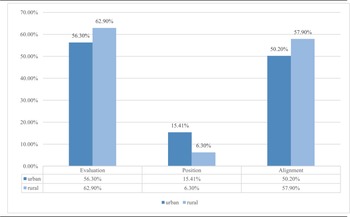
This study analyzes 247 urban and 159 rural slogans, categorizing them by stance type. Their distribution and proportions are presented in Table 2 below.
The proportions of different stances taken by noncommercial slogans in the surveyed urban and rural areas

The data presented in Table 2 indicate a high prevalence of evaluative and alignment stances in both urban and rural areas, with positioning stance being least prevalent, particularly in rural contexts. The proportions are calculated relative to the total number of slogans in each area. Notably, a slogan may exhibit multiple stances, resulting in categorization under different types; conversely, a slogan may demonstrate none of these stances at all, resulting in no categorization under any one type. The following sections will illustrate these stances with specific examples.
Evaluative stance
Evaluative stance predominates in both urban (56.3%) and rural (62.9%) areas, indicating a balanced distribution (see Table 2). The majority of these slogans adopt this stance, addressing and evaluating specific objects. Evaluative stance can be further categorized as positive or negative. Positive evaluation offers favorable and affirmative assessment, while negative evaluation presents a less favorable or often critical perspective (Wang Reference Wang2003).
Positive evaluation slogans predominantly feature neutral or positive stance objects, employing expressions like “good,” “beautiful,” “benefit,” and “praise” to convey affirmative assessments. These slogans reflect positive attitude and aim to promote positive energy and a harmonious social environment. To illustrate, the slogan “低碳出行 为您点赞” (Low-carbon Travel, Kudos to You!) directly commends the behavior object, low-carbon travel, through the verb “点赞” (kudos) and a green “thumb up” gesture (see Figure 11). The Chinese honorific form of the second person singular pronoun, “您” (You), expresses respect for adherents to this behavior. Green-colored bicycle and tree images symbolize eco-friendly transportation. This example demonstrates a multimodal approach to conveying affirmation and appreciation, combining linguistic, visual, and color-based elements to reinforce its positive evaluative stance.
A sign in Erqi District, Zhengzhou City.

In addition, some evaluation slogans typically address and criticize negative entities. For instance, “网络兼职有风险 淘宝刷单都是骗” (Internet part-time job is risky; Taobao faked order is a scam) employs terms like “风险” (risky) and “骗” (scam) to negatively assess illicit activities (as illustrated in the top banner of Figure 12). This approach aims to heighten public awareness and vigilance against such potentially risky objects by explicitly identifying and condemning them.
Banners in Shengdimiao Village.

Both urban and rural areas exhibit a preponderance of positive evaluations, accompanied by a complement of negative evaluations. Negative evaluations are more prevalent in rural areas, reflecting the evident urban–rural disparities. This is largely attributable to the discrepancy in educational attainment between urban and rural areas in China. Lower average levels of education in rural areas potentially increase susceptibility to deception, explaining the higher proportion of negative, prohibitive, and preventive slogans in these regions (Zhang Reference Zhang2022).
Positioning stance
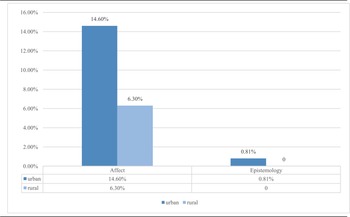
Positioning stance is less prevalent than evaluative and alignment stances, comprising 15.41 percent in urban and 6.3 percent in rural areas (see Table 2). It is further categorized into affective and epistemic subtypes (Du Bois Reference Du Bois and Englebretson2007), with their proportions illustrated below.
The results indicate that affective stance predominates over epistemic stance in both urban and rural areas, with higher proportions in urban settings (14.6% affective, 0.81% epistemic) compared to rural areas (6.3% affective, 0% epistemic). It is evident that these slogans are less frequently utilized to convey subjective emotions or perceptions, with emotional expression exhibiting slightly more prevalence than epistemic ones.
Affective stance prevalence is higher in urban (14.6%) than rural (6.3%) areas (see Table 3), primarily due to the increased use of multimodal emotional expressions in urban settings. These expressions incorporate multimodal visual cues, like facial movements, to convey affective states. An exemplary graffiti slogan, “小心触电” (Beware of Electrocution), illustrates this trend, depicting a boy touching an electric switch with a panicked expression (see Figure 13). The slogan’s image conveys fear and nervousness, effectively evoking public concern about electrical safety. The urban–rural disparity in multimodal affective stance usage largely stems from economic factors (Zhang Reference Zhang2022). Implementing multimodal signs necessitates significant financial investment, which is more feasible in economically advanced urban areas in China. Rural regions, typically characterized by lower economic levels, often opt for more cost-effective alternatives like banners in lieu of multimodal means (see Figure 12).
Graffiti in Xinmi City.

The proportions of two subtypes of positioning stance taken by noncommercial slogans in the surveyed urban and rural areas

Furthermore, affect can be classified into optimistic and pessimistic types (Chen and Zhang Reference Chen and Zhang2004). This paper identifies and classifies the affective stance of slogans into these categories. Pessimistic affect indicates negativity, whereas optimistic affect signifies positivity, as displayed in Figures 13 and 14, respectively. Figure 14 employs the adverb “热烈” (warmly) to convey the elevated emotion of “celebrating the 100th anniversary of the founding of the Communist Party of China.”
A banner in Shengdimiao Village.

In urban areas, epistemic stance slogans constitute 0.81 percent of the total, while in townships, this is 0 percent (see Table 3). This suggests that such positioning stance slogans predominantly convey affect rather than provide information accuracy or sources. Only two epistemic slogans are observed in the surveyed urban district in Zhengzhou, including “强化联防联控 依法落实疫情防控责任” (Strengthen joint prevention and control, and implement epidemic prevention and control responsibilities according to law) (see Figure 15). The prepositional phrase “依法” (according to law) serves to convey knowledge and awareness of epidemic prevention and control and an affirmation of their legitimacy under the law, thereby reinforcing the credibility and authority of the slogan in question.
A banner in Erqi District, Zhengzhou City.

Alignment stance
The proportions of alignment stance are notably high, with 50.2 percent in urban areas and 57.9 percent in rural areas, indicating an even distribution (see Table 2). These slogans primarily function to adjust and maintain stances between subjects, bringing the stance closer or farther away between different subjects in the public space. The degree of alignment expressed by different stance markers varies considerably, conceptualized into two extremes: alignment and disalignment (Du Bois Reference Du Bois and Englebretson2007; Fang and Le Reference Fang and Le2017). The alignment stance indicates a synergistic effect of convergence, defined as the tendency to maintain a unified stance toward the object under discussion across subjects; conversely, the disalignment stance suggests a synergistic effect of disconvergence, maintaining disparate positions among subjects (Du Bois Reference Du Bois and Englebretson2007; Fang and Le Reference Fang and Le2017). Slogans in both urban and rural areas predominantly assume an alignment stance, complemented by a disalignment stance.
In slogans adopting an alignment stance, objects are typically presented neutrally or positively, whereas stance markers often include personal pronouns and collective terms such as “我们” (we), “你” (you), “我” (I), “你我” (You and I), “你我他” (You, I and he/she), “所有” (all), “大家” (all of the people), “共同” (together), “齐” (jointly) to maintain a consistent stance among subjects (Zhang Reference Zhang2022). To illustrate, the slogan “文明健康 有你有我” (Civilization and health have you and me) (see Figure 16) employs second-person “你” (you) and first-person “我” (me) pronouns to refer to the subject parties. These pronouns can convey specific actual meanings referring to two individuals “you and me” or, more commonly in China, express virtual meanings encompassing all individuals within a given public context. In this case it is the virtual meaning. The stance object refers to “civilization and health,” including practices like using public chopsticks, ventilating, handwashing, and mask-wearing. These behaviors are represented by specific multimodal images. The combination of personal pronouns and images enables diverse subjects to comprehend the object’s specific connotation, establishing proximity and encouraging collective participation in the civilized and healthy practices.
A billboard in Erqi District, Zhengzhou City.

In disalignment contexts, slogans typically target negative entities, employing stance markers like “不” (not) and “禁止” (prohibit) to maintain inconsistent stances among subjects. For instance, the slogan “有钱多尽孝 丧葬不铺张” (Be more filial when having money; Don’t be extravagant in funerals) (see Figure 17) employs the negative adverb “不” (not) to negate extravagant funeral behavior. It serves to negate the objective behavior of the extravagant funeral, thereby distancing the speaker from subjects supporting such behavior while simultaneously aligning with those opposing it.
A banner in Shengdimiao Village.

Identity and context behind the stances
In the stance triangle model, three kinds of stances—evaluation, position, and alignment—represent the sociocognitive relationship between three elements: subject 1, subject 2, and object (Du Bois Reference Du Bois and Englebretson2007). These three categories of stances encompass three corresponding sociocognitive relations of objective, subjective, and intersubjective intentionality (ibid.). Consequently, this model can assist in elucidating the sociocognitive relations in interactions, calibrating and regulating convergence or divergence in stance, and providing criteria for analyzing the identity relations between stance takers (Du Bois Reference Du Bois and Englebretson2007; Fang and Le Reference Fang and Le2017).
Object-centered identity emerging out of the administrative context
The evaluative and positioning stances represent the subject-object relationship (see Figure 1) (Du Bois Reference Du Bois and Englebretson2007). Regarding the signs, it primarily reflects the interconnection between Subject 1 (i.e., the sign-owner) and the Object (i.e., the content of the sign) (see Figure 2). In this manner, these stances mirror the sociocognitive tendencies and social identities of Subject 1. In the context of this paper, “Subject 1” refers broadly to actors involved in the ownership, creation, establishment, or management of the slogans in question, with their specific identity information typically located in the marginal areas of the signs. These slogan-actors often occupy top-down authority positions, thereby affording them the right to create or manage slogans in public space. Examples of such authorities include municipal government, propaganda department of the municipal party committee, traffic management department of urban roads, city administration bureau, procurator’s office, civilization office, community committee, and village committee. The objects of such slogans frequently address matters of public concern, such as environmental protection, population censuses, and fireworks bans.
An evaluative stance, directed from the subject to the object, closely aligns with objectivity and constitutes an object-centered act, while a positioning stance, directed from the object to the subject, indicates subjectivity and subject-centered behaviors (Du Bois Reference Du Bois and Englebretson2007). The results demonstrate that in China, both urban and rural slogans exhibit a significantly higher proportion of evaluative stance than positioning stance (see Table 2). This suggests that these slogans primarily represent the objective-centered act, with the subject initiating the action and the object at the center. The primary focus is on object assessment, with minimal indication of subjective sentiments or epistemic perspectives. Consequently, regarding the sociocognitive connection with the object, the subject primarily establishes the identity as an evaluator with an object-centered focus, as opposed to a subject-centered emotional or epistemic communicator.
This phenomenon is closely attributable to the prevailing workflow and approach of the Chinese administrative system. In China, the majority of noncommercial slogans are established by relevant governmental units and personnel, reflecting a top-down approach. Typically, when the relevant work must be carried out, the pertinent slogans are established, which serve to advance the work and promote the relevant initiatives, such as the banning of littering, the construction of civilized cities, and the population census (Zhang Reference Zhang2022). In other words, these noncommercial slogans constitute a means of carrying out the relevant work and are an integral part of the work process. Accordingly, the subjects of these stances in these slogans are primarily administrative units and their personnel, while the objects are the content of their work. Thereupon, their identity as an objective evaluator usually emerges out of the Chinese administrative context. By evaluating the object, i.e. their work, through the lens of such slogans and certain stance markers, they shape their identity as an objective evaluator, thereby enhancing the objectivity and credibility of the object. This, in turn, increases the effectiveness of the slogan and advances the work process.
To illustrate, the slogan “普查依靠人民 普查惠及人民” (The census relies on the people; The census benefits the people) (see Figure 18) is established by the Chaohua Village Committee during the national census. The use of the verb “惠及” (benefit) constructs their identity as the primary evaluators in the census, who have provided a positive assessment and affirmation of the census. This is undertaken with the intention of publicizing and completing the work of the census, enhancing public identical recognition, and achieving the purpose of publicity.
A banner in Chaohua Town.

Intersubjectivity-centered collective identity emerging out of the cultural context
The alignment stance represents the relationship between two subjects (see Figure 1), thus corresponding to the sociocognitive relation of intersubjectivity and falling within the realm of intersubjectivity-centered behavior (Du Bois Reference Du Bois and Englebretson2007). With regard to the sign, the alignment stance mainly reflects the relationship between Subject 1 (i.e., the sign-owner) and Subject 2 (i.e., the sign-reader) (see Figure 2). In the context of this paper, the alignment stance of slogans specifically refers to the Subject 1’s act of calibrating the relationship with Subject 2. As previously stated, Subject 1 mainly refers to the slogan-owners, such as those addressed in the first person pronouns “我” (I) and “我们” (we) within the sign text. Furthermore, Subject 2 broadly refers to the slogan-readers, passersby, or residents, such as those addressed in the second person pronouns “你” (you), and “你们” (you) within the signage. The two types of subjects above appear to refer only to a subset of individuals, such as “你” (you) and “我” (me). However, in practice, these personal pronouns within the signage serve as a virtual reference in the Chinese context, encompassing all individuals within the given context. Consequently, the alignment stance slogans in China can serve to maintain not only the stance and identity between the two subjects, you and I, but also the collective identity of all individuals through, among other things, the virtual referential function of personal pronouns.
As demonstrated in Table 2, the result of this study indicates that both urban and rural slogans demonstrate a notable prevalence of the alignment stance. It can thus be concluded that the slogans primarily represent an intersubjectivity-centered act, with Subject 1 situated at the beginning of the act and Subject 2 positioned at the center. In addition, it can be posited that, in terms of the sociocognitive connection with Subject 2, Subject 1 establishes the collective identity as an intersubjectivity-centered aligner. By virtue of the slogans, they facilitate the calibration and regulation of convergence or divergence in terms of objects between different subjects, thereby enabling the subjects to converge or maintain their stances and increasing the collective identity of the subjects (Du Bois Reference Du Bois and Englebretson2007; Fang and Le Reference Fang and Le2017).
As illustrated in the slogan, “自觉遵守行为规范 主动维护公共秩序 积极争当文明市民 你我共建文明郑州” (Consciously abide by behavioral norms, actively maintain public order, actively strive to be a civilized citizen, and you and I jointly build a civilized Zhengzhou City) (see Figure 19), it employs the personal pronouns “you” and “I” and the adverb “jointly,” which are stance markers here. In this context, the personal pronouns virtually refer to all people, and the adverb “jointly” serves to emphasize collective action. They are used to maintain a unified stance among all the relevant subjects on the endeavor of building a civilized Zhengzhou, and the related behaviors that accompany it. This, in turn, facilitates the construction of a collective identity among them.
A billboard in Erqi District, Zhengzhou City.

The social and ideological worldviews, such as liberalism, conservatism, and socialism, hold disparate interpretations and evaluations of the physical-spatial developments and types of “wilderness,” “rural space,” “suburbium,” and “city” (Kirchhoff and Trepl Reference Kirchhoff and Trepl2009; Vicenzotti Reference Vicenzotti2011; Kühne Reference Kühne2019). On this basis, this paper further corroborates the assertion that disparate social systems and cultural orientations exert a profound influence on the signs in space, encompassing its semiotic expression, stance-taking, and identity construction. As a socialist country, China adheres to collectivism, which constitutes the fundamental tenet of Chinese culture (Liu Reference Liu2014). The result also demonstrates that there are a multitude of slogans espousing an alignment stance, thereby collectively reinforcing a collectivist identity across subjects. The intersubjectivity-centered collective identity, thus, emerges out of Chinese cultural context. In contrast to Chinese collectivism, many Western countries place a greater emphasis on individualism (Oyserman, Coon, and Kemmelmeier Reference Oyserman, Coon and Kemmelmeier2002; Triandis Reference Triandis2018). Consequently, in comparison to the collectivist identity expressed in Chinese slogans, many Western countries are more inclined toward the construction of individualistic identities, which can be tentatively confirmed by the following examples (see Figures 20 and 21):
A sign in Aukland, New Zealand.

A slogan in Aukland, New Zealand.

The aforementioned two signs were found and recorded by one of the authors on Queen Street in Auckland, New Zealand, in 2024. At that time, the road was undergoing construction as part of an Aukland council project. In these slogans, the pronouns “we,” “you,” and possessive pronoun “your” are employed. In light of the given context, it is evident that at this juncture, the pronoun “we” is clearly indicative of the municipal or construction team, namely the city builders, while “you” and “your” are in reference to the readers, passersby, or citizens. In these slogans, they are unambiguously and explicitly separated into the two groups: one group is identified as the builders of the city, while the other is positioned as the beneficiaries of the urban development. Their identities and roles in relation to the construction process are clearly distinct. It is evident that this situation differs significantly from that observed in China (see Figure 19). If the slogan in Figure 21 had been created in China, the “your city” would most likely have become “our city,” thus placing both groups—the builders and the citizens—within the city as a collective and emphasizing that all groups are part of the city’s collective identity.
Self-local/translocal identity emerging out of the social context
It is observed that a considerable number of noncommercial slogans contain subject matter or references to objects that are associated with the region in question. Such elements include the name of the region itself, administrative divisions, and representative landmarks, such as “郑州” (Zhengzhou), “二七” (Erqi), “城市” (city), “乡村” (village). In consequence, these slogans serve to construct a sense of local identity. In particular, urban and rural slogans manifest local identity in two distinct ways. The first comprises the use of identity markers closely related to the region in which the slogans are located. This is referred to as self-local identity. The second is the use of identity markers pertaining to other regions, which are not the geographical locations of the slogans. This is an illustration of translocality (Greiner and Sakdapolrak Reference Greiner and Sakdapolrak2013), and is referred to as translocal identity.
Both urban and rural areas exhibit the predominantly self-local identity, supplemented by the translocal identity. The slogan, “你我多一分文明 城市多一分美丽 郑州多一分精彩” (More civilization for you and me, more beauty for the city, more excitement for Zhengzhou), reflects the self-local identity (see Figure 22). This slogan is located in Zhengzhou City, wherein the noun “城市” (city) and the proper noun “郑州” (Zhengzhou) are used to refer to its location. These expressions are distinguished and emphasized by the color red, and the identity of Zhengzhou is also reflected in the image of the metro station, “郑州火车站” (Zhengzhou Railway Station). These multimodal means are mutually reinforcing, and serving to demonstrate the identity of the region in which the slogan is situated and to preserve a unified stance and collective identity among the diverse subjects of “你我” (You and I) in terms of adherence to and practice of the “Regulations on the Promotion of Civilized Behavior in Zhengzhou City.”
A billboard in Erqi District, Zhengzhou City.

Translocal identity slogans are primarily concerned with the interconnectivity of urban and township spaces. In the social sciences and humanities, the concept of translocality offers a comprehensive lens through which to examine mobility, movement, and the intricate interconnections across different scales, which can be utilized to elucidate the multifaceted socio-spatial interrelationships (Greiner and Sakdapolrak Reference Greiner and Sakdapolrak2013; Blommaert and Maly Reference Blommaert and Maly2019; Rosendal et al. Reference Rosendal, Lykke Nielsen, Järlehed, Milani and Löfdahl2023). In the context of this study, the term “translocality” indicates that identities linked to urban areas emerge in townships and vice versa, thereby demonstrating that their identities transcend geographical boundaries and coexist within the same context. These identities are expressed through noncommercial slogans that serve to manifest the interconnectedness of the two areas. To illustrate, the slogan in Chaohua Town, “美丽村庄是我家 农村不比城里差” (The beautiful village is my home, and the countryside is no worse than the city) employs the translocal identifier “city,” thereby introducing the physical space of the urban area into the current rural space (see Figure 23). Additionally, it utilizes the comparative expression “..不比..差” (..no worse than..) to compare the rural area with the urban area, so as to evaluate the positive aspects of the countryside, as well as express high sense of identity of the rural area.
A sign in Chaohua Town.

The advent of translocal identities in rural China is inextricably linked to the country’s ongoing social transformation and the implementation of pertinent policies. In China, urban areas are typically characterized by superior conditions in comparison to rural areas, such as their economic, social, and infrastructural aspects. In order to narrow the gap between urban and rural areas, China begins to implement a development strategy of new-type urbanization in 2014.Footnote 10 The concept of “new-type urbanization” encompasses a set of fundamental characteristics, including urban–rural integration, conservation and intensification, ecological livability, and harmonious development.Footnote 11 It also entails the coordinated growth of diverse urban and rural settlements, including large, medium, and small cities, small towns, and new rural communities, which collectively facilitate each other’s advancement.Footnote 12 In 2016, Xinmi City, located in Zhengzhou City, was selected as one of the third batch of national comprehensive pilot areas for new urbanization.Footnote 13 Additionally, Chaohua Town, located in Xinmi City, is designated as one of the four central townships in Xinmi City for the construction of new urbanization.Footnote 14 During this period of construction, the township area gradually develops in accordance with the principles of urbanization, and the standard of living generally improves. In light of the new development, an analysis of the slogans indicates the subsequent emergence of a novel local identity for the township. It can be concluded that the novel local identity, thus, emerges out of Chinese social and political context. This identity is distinguished by the incorporation of translocal elements, such as the name of urban areas, and the comparison of the local rural area with urban areas, which serves to underscore the recognition and identification with the rural area.
Conclusion
This study primarily draws upon the stance triangle model (Du Bois Reference Du Bois and Englebretson2007) to examine noncommercial slogans in depth, and the principal findings can be summarized as follows. First, the statistical analysis indicates that in both urban and rural China, evaluative and alignment stances significantly outnumber positioning stance, encompassing affective and epistemic stances. Notably, a considerable discrepancy in the proportion of positioning stance exists between urban and rural areas, with the latter exhibiting a relatively lower proportion, which is closely correlated with their economic disparities. Second, these stances demonstrate a multiplicity of identity constructions, primarily characterized as the object-centered evaluator, the collectively intersubjectivity-centered aligner, as well as the self-local/translocal identity. These are frequently represented through specific linguistic or nonlinguistic elements, such as the first-person pronouns “we” and “I.” Third, the paper reveals the multidimensional contexts contributing to the emergence of these identities, spanning China’s economic, administrative, cultural, social, and political dimensions. For instance, the prevalence of the alignment stance and the intersubjectivity-centered collective identity are intricately tied to China’s strong cultural backdrop of collectivism.
In short, it builds upon the sociolinguistic stance triangle model (Du Bois Reference Du Bois and Englebretson2007) to examine identity within the field of signs or semiotics. The original model is slightly adapted for use in the context of signs, and its application is demonstrated through the case study of noncommercial slogans in China. The present study validates the adapted model’s effectiveness, enriches the application of stance theory to the field of sociolinguistics, and contributes to the theoretical advancement of the field. Furthermore, this paper effectively investigates the stances taken by and identities emerging from the Chinese noncommercial slogans, thereby expanding the scope of sign research and providing concrete illustrations for global comprehension of China’s linguistic life. In addition, it identifies a correlation between the stance/identities of slogans and the contextual factors of economy, administration, culture, society, and policy. Consequently, such an analysis of slogans or signs can facilitate the elucidation of the interrelationship between the evolving identities of a given country or region and its shifting economic, administrative, cultural, social, and political contexts. This approach greatly enables the perception and detection of newly constructed identities emerging in response to new social circumstances, transformations, and changes. As a result, the timely prevention and resolution of potential conflicts between established and emerging identities can be achieved, and disparate identities can be balanced to circumvent social contradictions.
Due to the limited scope of this study, the focus is on the stance and identity of slogan owners, not including those of slogan readers with respect to the slogans, so this could be a topic for subsequent research. Furthermore, noncommercial slogans in China and other countries are distinct due to cultural and social differences. Therefore, it would be valuable to investigate the situation in other countries and compare it with that in China.
Author contributions
The author, Mengli Zhang, confirms responsibility for data collection, analysis and draft of the manuscript. The author, Tianwei Zhang, confirms responsibility for the guidance, supervision and review of the manuscript. All authors read and approve the final manuscript.
Funding statement
This work was supported by “Research on the National Foreign Language Capacity and Foreign Language Education Policy” [grant number: 22JJD740013], a major project of Key Research Institutes of Humanities and Social Sciences under the Ministry of Education.
Competing interests
The authors declare none.






 Open access

