





Introduction
In the crystalline waters off Sardinia’s northwestern coast, where the Mediterranean meets the shores of Stintino, stands an unexpected monument to historical memory and women’s rights. The bronze figure of a young Korean girl seated on a chair, her clenched fists and bare feet telling a story of resilience in the face of unimaginable suffering, has become both a symbol of solidarity and a source of diplomatic tension. This is Italy’s first “Statue of Peace” (평화의 소녀상, pyeonghwaui sonyeosang), a memorial to the victims of the Japanese Empire’s military sexual slavery system euphemistically known as “comfort women.”
The statue’s presence in Stintino—a town of barely 1600 winter residents known primarily for its pristine beaches and tourism—raises compelling questions about how transnational memory travels, how local communities engage with distant historical traumas, and how grassroots activism can challenge state-level diplomatic relations. This article traces the remarkable journey that brought this Korean memorial to an Italian fishing village, examining the key actors, community responses, and ongoing controversies that have made Stintino an unlikely site of international memory politics.
The story begins not with diplomatic negotiations or institutional initiatives but with the friendship between two women: Rosamaria Caiazza, a retired elementary school teacher from Sassari who fell in love with Korean culture, and Rita Limbania Vallebella, Stintino’s first female mayor and a lawyer dedicated to combating gender violence and defending human rights. Their collaboration transformed a small Sardinian town into a focal point for debates about historical justice, women’s rights, and the politics of memory in the contemporary Mediterranean.
Literature review, methodology, and contribution to the field
Situating the study within existing scholarship
The euphemistic term “comfort women” (慰安婦, ianfu) refers to the women and girls forced to provide sexual services in “comfort stations” (慰安所, ianjo) across Japanese-occupied territories from the early 1930s until the end of World War II. Although the term was the one used in official Japanese military documents, it obscures the reality of coercion, deception, and violence that characterized the system. There is no definitive estimate of the total number of individuals subjected to military sexual slavery under the Japanese Empire. Historians such as Yoshimi Yoshiaki have suggested that between 50,000 and 200,000 individuals were subjected to military sexual slavery, with “comfort stations” confirmed across East and Southeast Asia, the Pacific Islands, and other territories under Japanese control (Yoshimi Reference Yoshimi2000: 91–97). However, subsequent scholarship suggests that these figures may significantly underrepresent the scale of the system. In Chinese Comfort Women: Testimonies from Imperial Japan’s Sex Slaves, Peipei Qiu, with Su Zhiliang and Chen Lifei, argues that in northern China alone the number of Chinese sex slaves may have ranged between 100,000 and 200,000 (Qiu, Su, and Chen Reference Qiu, Su and Chen2014: 37–41). While Korean and Chinese women were the most numerous, victims included people of various genders and nationalities, including some who today might identify as queer (Portes Reference Portes2000; Dempster Reference Dempster2006).
Existing scholarship has approached the “comfort women” system from multiple angles: historical reconstruction of the military sexual slavery network and its administration (Yoshimi Reference Yoshimi2000, Reference Yoshimi2019; Fujime Reference Fujime2015; Nishino and Onozawa Reference Nishino and Onozawa2015); legal redress and international human rights frameworks (Coomaraswamy Reference Coomaraswamy1996; McDougall Reference McDougall1998); survivor testimony collection, analysis, and memory activism in both local and transnational contexts (Qiu, Su, and Chen Reference Qiu, Su and Chen2014; Chung 2018a, 2018b; Lee Reference Lee, Rooney, Senie and Wingate2021; Blackburn Reference Blackburn2022; McGregor Reference McGregor2023); political debates, silencing, revisionism, and nationalist discourses (Yang Reference Yang, Kim and Choi1998; Kimura Reference Kimura2016; Morita Reference Morita2017; Nishino, Kim, and Onozawa Reference Nishino, Kim and Onozawa2018).Footnote 1
While a growing body of work has addressed memorials to “comfort women” in South Korea, North America, and parts of Asia, studies focusing on European contexts remain rare. Notable exceptions include Mladenova’s (Reference Mladenova2022) analysis of the 2020 Berlin Statue of Peace and Ah-hyun Angela Lee’s (Reference Lee2023) examination of “comfort women” memorials in Germany. Mladenova explores how the Berlin statue became a contested site shaped by the tension between nationalist framings (casting the memorial as anti-Japanese) and transnational feminist interpretations (framing it as a universal symbol against wartime sexual violence). Similarly, Lee analyzes the role of the Korean diaspora in collaborating with local German communities to establish these memorials as transnational memory spaces, highlighting how particular and universal identifications with the issue coexist amid political resistance, including opposition from the Japanese government. Taken together, these studies demonstrate that “comfort women” memorials in Germany acquire locally specific meanings shaped by community actors, political climates, and activist networks, while also operating as cosmopolitan sites of memory that extend beyond their original contexts to address broader issues of sexual violence, racism, and historical memory.
However, beyond Berlin and Germany, there is almost no academic analysis of “comfort women” memorials in Europe, and, at the time of writing, there is no scholarly work—whether in English, Italian, Japanese, or Korean—on the 2024 Stintino installation, making this article the first in-depth study of its origins, local reception, and political implications. This absence is notable given that the Stintino statue is only the second bronze Statue of Peace installed on public ground in Europe.Footnote 2
Methodology
This study is grounded in qualitative research methods, primarily semi-structured interviews with the individuals most directly responsible for the memorial’s installation—most notably Mayor Rita Limbania Vallebella and project initiator Rosamaria Caiazza. These interviews, conducted in May–June 2025, provided crucial insights into motivations, decision-making processes, community responses, and ongoing challenges faced by memorial advocates.
Interview data were triangulated with additional sources in Korean, Italian, Japanese, and English, including media coverage, NGO reports, and other documents. Tourist interviews also provided data on awareness levels and emotional responses to the memorial among national and international visitors.
My analysis also draws upon prior fieldwork and archival research on the history of the Japanese Empire, the “comfort women” issue, and related memorial activism, as well as primary and secondary sources documenting survivor testimonies and global memory politics. This combination of localized field research and engagement with transnational scholarship enables a deeper contextualization of the Stintino installation within broader debates on historical memory, colonial history, and feminist activism.
Translation and cultural mediation emerged as crucial themes in the research, reflecting their importance in the memorial installation process itself. The study’s methodology thus mirrors its subject matter in demonstrating how transnational solidarity requires sustained engagement across linguistic and cultural boundaries.
Contribution to the field
This article makes three key contributions. First, it fills a major gap in the literature by providing the first scholarly account of the “comfort women” memorial in Italy, situating it as the second Statue of Peace to be installed on public ground in Europe after Berlin. Together, the Berlin and Stintino cases constitute the only two European examples of the Statue of Peace erected in a public space, distinguishing them from earlier installations on private property. Second, the article expands the scope of research on “comfort women” memorials by examining how grassroots activism, feminist leadership, and local historical memory intersect to enable the reception of a transnational memorial in a small Mediterranean town. Third, it demonstrates how the Stintino statue’s framing as a universal condemnation of wartime sexual violence—rather than a bilateral Korea–Japan dispute—aligns with broader global feminist movements and connects historical injustices to contemporary struggles, both locally and internationally.
The Stintino case offers unique insights into several under-explored aspects of transnational memory activism. It demonstrates how “comfort women” memorials can find receptive contexts in communities without significant Korean diaspora populations or direct historical connections to Japanese wartime violence. Additionally, it reveals the crucial role of individuals in facilitating transnational memory projects, expanding understanding of how global historical consciousness develops through grassroots networks rather than institutional channels.
By analyzing this case, the article contributes to comparative scholarship on the politics of memory, the dynamics of transnational solidarity, and the capacity of small communities to engage in global human rights discourse. It also offers insights into how locally embedded actors can reframe contentious heritage into inclusive narratives that resonate across cultural and political boundaries.
Historical context: the origins of the Statue of Peace
The “comfort women” system and survivor testimonies
To understand the significance of the Stintino memorial, it is essential to first understand the historical trauma it commemorates. “Comfort women” were systematically recruited, deceived, or forcibly taken by the Japanese military to serve as sex slaves throughout the Asia-Pacific region. The recruitment methods varied according to time, location, and the vulnerability of the targeted populations. Many victims were deceived with promises of legitimate employment. Kim Bok-dong, a South Korean survivor who testified until her death in 2019, described how she was told she would work in a factory making soldiers’ uniforms. As she recounted in interviews, “Because we were under Japanese rule, they could do whatever they wanted with us… Even though we didn’t want to go, they forced us. When I asked my mom where I was going, she told me that because of World War II I was going to a factory that made soldiers’ uniforms” (Asian Boss, 2018). The deception was reinforced by coercion: families understood that refusal could result in exile and confiscation of all their possessions.
Other women were kidnapped directly from their homes, schools, or streets. The case of Pilar Frias from the Philippines illustrates the brutal reality of such abductions. As documented in Kim Dong-won’s documentary “63 Years On,” Pilar Frias described how “Five Japanese soldiers came to our house at 10:00 a.m., I had no idea what to do and just kept silent. Then a soldier burnt my face twice with a burning cigarette. I screamed, then the soldier drew a knife and stabbed me on the nose… Later, as the bleeding stopped, they took me to a Jackfruit tree and tied me there. The two soldiers began raping me” (Kim Dong-Won 2014).
The system also exploited women already trapped in prostitution, leveraging their desperate economic circumstances. The stories of Tuminah from Indonesia and Suzumoto Aya from Japan reveal how poverty and patriarchal family structures made women particularly vulnerable to military exploitation. Tuminah, born in 1927 in Solo (Surakarta), began working in prostitution at age 15 to prevent her 10 siblings from starving. Her father had sold her virginity to a Dutch man for five rupiahs, and when the Japanese arrived, they immediately began recruiting “street girls” from the hotels they frequented (McGregor Reference McGregor2023).
Similarly, Suzumoto Aya (pseudonym) was sold by her parents at age 7 and ultimately agreed to go to a “comfort station” overseas at 18 to repay her debt and escape a life of abuse (Hirota Reference Hirota2009). Her testimony, recorded by journalist Hirota Kazuko in 1975, reveals how the 2000 yen debt she carried was astronomical—equivalent to approximately 50 years’ worth of rice at the time. These cases demonstrate how the “comfort women” system was not merely about wartime sexual violence but represented the intersection of militarism, colonialism, patriarchy, and economic exploitation.
The birth of the Statue of Peace
The original Statue of Peace (평화의 소녀상, lit. “the girl statue of peace”) was created in 2011 by artists Kim Un-seong and Kim Seo-gyeong to commemorate the 1000th Wednesday Demonstration held in front of the Japanese Embassy in Seoul. These weekly protests, which began in 1992, have become the world’s longest-running protest for women’s rights, demanding official acknowledgment, apology, and reparations from the Japanese government for the military sexual slavery system.
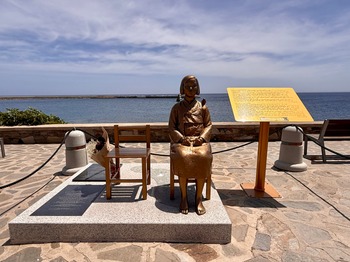
The statue’s symbolism is carefully crafted to convey both the trauma experienced by victims and their enduring strength. The girl’s cut hair represents the violent abduction of women and girls from their homes and communities. Her clenched fists and raised heels convey a life marked by shame and isolation, yet also demonstrate the unwavering resolve to persevere despite unbearable humiliation. A bird perched on her shoulder represents peace, freedom, and the enduring connection between the living and the deceased survivors (The Korean Council for Justice and Remembrance for the Issues of Military Sexual Slavery by Japan and Stintino, Italy 2024).
The statue’s shadow, depicted in a mosaic embedded in the floor, portrays the silhouette of an elderly woman, symbolizing the passage of time and emphasizing the prolonged quest for justice that has consumed the survivors’ entire lives. A white butterfly, a symbol of rebirth, embodies hope for a sincere apology from those responsible. Perhaps most powerfully, an empty chair beside the girl invites viewers to sit with her, empathizing with the victims’ emotions and committing to the promise made by future generations to never forget, and work toward a peaceful world.
Since 2011, the Statue of Peace has become a global symbol, with installations in numerous countries including Germany, the United States, Canada, Australia, China, Hong Kong, Taiwan, and the Philippines. According to the Korean Council for Justice and Remembrance for the Issues of Military Sexual Slavery by Japan, 148 statues have been installed within South Korea, while 31 have been established internationally (The Korean Council for Justice and Remembrance for the Issues of Military Sexual Slavery by Japan and Stintino, Italy 2024). However, these figures should be understood as provisional rather than fixed. While some memorials are intended as permanent installations, others are explicitly temporary, and still others have been relocated or removed following social, legal, or political opposition.
The Berlin Statue of Peace illustrates this instability particularly clearly. Installed in August 2020 in the Mitte district of Berlin, at the intersection of Bremer Straße and Birkenstraße in Berlin-Moabit, the statue was erected as a temporary artwork on public land. Following sustained pressure from the district authorities, legal challenges, and diplomatic controversy, the statue was removed on October 17, 2025, five years after its installation (KBS 2025). Its removal underscores the contested nature of the Statue of Peace as a memorial form and highlights how its presence in public space remains subject to shifting political, legal, and institutional constraints. At the same time, such removals do not negate the symbolic or mobilizing power of the memorial; rather, they reveal how the Statue of Peace continues to function as a focal point for debates over historical responsibility, sexual violence, and transnational memory.
Stintino: a town born from displacement
The historical context of forced migration
To understand why the Statue of Peace found a receptive home in Stintino, it is crucial to examine the town’s own history of displacement and forced migration. Stintino itself is a relatively recent settlement, born from a traumatic act of state-imposed relocation. The story begins on June 22, 1885—exactly 139 years before the statue’s inauguration—when King Umberto I of Savoy issued a decree establishing a quarantine station and penal colony on Asinara Island. This decision displaced numerous families who had lived for generations as shepherds and fishermen on the island, leading simple lives sustained by the sea and land. The eviction was swift and absolute: families were given no choice but to abandon their homes and their way of life.
Forty-five of these displaced families established Stintino on the mainland, founding the settlement as a fishing village in 1885. The town’s name itself reflects its geography and perhaps its precarious origins—“Stintino” derives from the dialect word “isthintìni,” meaning “intestines,” referring to the narrow strip of land between two inlets where the refugees created their new home. This linguistic detail is poignant: the very name of the town embodies the vulnerability and displacement that characterized its founding.
The connection between Asinara and Stintino remained central to the community’s identity. Many current residents, including Mayor Rita Limbania Vallebella, trace their family histories back to the original displaced families. As she explained in interviews, her family comes from Asinara and was relocated to Stintino. She was born and raised there, then moved away for studies and for work, and even worked abroad. Then she decided to come back to Stintino, to start a career in politics, “to give back to the town that raised me and try to contribute as much as I can” (Vallebella, personal communication, June 2025).
Contemporary Stintino: between tourism and memory
Modern Stintino exists as a town caught between its working-class fishing heritage and its contemporary role as a premier tourist destination. With only around 1600 permanent residents in winter, the population swells to thousands during the summer months as visitors come to experience La Pelosa beach, renowned for its white sand and crystalline blue waters. The town’s location on the northwestern tip of Sardinia offers spectacular views of Isola Piana (“flat island”) and the protected Asinara National Park, which now covers the entire island from which the town’s founders were expelled.
While Stintino is firmly established as a tourist destination and economy, it simultaneously places strong emphasis on the preservation and public display of its historical memory, an effort that also contributes to sustaining visitors’ engagement with the town. Walking through the town center, visitors encounter interpretive panels recounting local history, including photographs of fishermen at work in the historic tonnara (tuna fishing station) that operated from the sixteenth century until the 1970s. In the harbor, preserved vele latine (lateen sails), some of which are more than a century old, serve as tangible connections to Stintino’s maritime heritage.
This attention to historical preservation creates what residents describe as a sense of history being preserved, celebrated, and exposed for everyone to see and appreciate, even during a simple walk. It is within this context of active memory work and historical consciousness that the Statue of Peace found its home, representing not an alien intrusion but a continuation of the community’s commitment to bearing witness to historical trauma and displacement.
Women’s rights and the Red Bench initiative
Even before the arrival of the Statue of Peace, Stintino had established itself as a community committed to women’s rights and gender equality initiatives. Throughout the town center, visitors encounter “PanchineRosse™” (Red Benches), part of an international project by Stati Generali delle Donne HUB Association designed as “a symbol of the rejection of violence against women.” These striking red benches carry a powerful message: “My seat is empty but I AM HERE, I am this Red Bench, red like my blood spilled. I am here to remind you that femicide and violence against women (physical, psychological, economic, and stalking) must no longer exist” (Stati Generali delle Donne HUB n.d.).
The presence of multiple red benches in the town center reflects the deep commitment of Mayor Vallebella to combating gender violence (Figure 1). This commitment extends beyond symbolic gestures to concrete policy initiatives. In 2023, the Stintino town hall adopted the Charter for Little Girl’s Rights, originally submitted and approved during the 1997 European Congress in Reykjavik by BPW Europe, part of Business & Professional Women (BPW) International. This charter, inspired by the UN Convention on the Rights of the Child, specifically addresses the distinct challenges and needs faced by girls (BPW Europe n.d.).
One of the Panchine Rosse (“Red Benches”) placed around Stintino as part of the PanchineRosse™ initiative. This bench is located near the harbor, with traditional “vele latine” (lateen sails) visible in the background.
Source: Photograph by the author.

Additionally, Stintino hosted the GenS (Gender Studies) International Conference in collaboration with Sapienza University of Rome in September 2024 and will host it again in September 2025, establishing the town as a center for academic and activist discussions about gender equality and women’s rights. These initiatives created a cultural and political context in which the Statue of Peace could be understood not as a foreign element but as a natural extension of the community’s existing commitments to justice and equality.
The architect of memory: Rosamaria Caiazza’s journey to historical consciousness
The story of how the Statue of Peace came to Stintino begins with an unlikely cultural bridge: a retired elementary school teacher’s fascination with Korean popular culture. Rosamaria Caiazza represents the growing global phenomenon of non-Korean individuals who develop deep connections to Korean culture through media, eventually pursuing more profound engagement with Korean history and social issues.
Caiazza’s journey began, like that of many international Korea enthusiasts, with exposure to Korean culture. Despite not speaking Korean and having no prior connection to Korea, she found herself drawn to Korean traditional clothing, architecture, and culture more broadly through watching videos online. Coupled with her love of traveling, this initial curiosity gradually deepened, evolving into something far more substantial: a commitment to learning about Korean history, particularly the experiences of colonized populations during Japanese rule.
Her discovery of the “comfort women” issue proved transformative. As she explained to the Korean newspaper Kyunghyang Shinmun, her connection with Korea deepened in 2022 when she began studying Korean history and discovered the existence of the “comfort women” victims. This was not casual learning but intensive research: Caiazza sought out academic papers, interviews, and other sources about the survivors (Yoon Reference Yoon2024).
One testimony particularly affected her: that of Kim Bok-dong, whose story she encountered through academic sources and interviews. Caiazza reflected on her experience: “She was denied freedom as a woman, the right to learn, and so much more. No woman should ever have to suffer such inhumane sexual abuse for the rest of her life” (Yoon Reference Yoon2024). This encounter with individual testimonies transformed her abstract interest in Korean culture into a concrete commitment to historical justice and women’s rights.
Caiazza’s engagement with Korean history and culture soon extended beyond individual study to direct experience. In 2023, she traveled twice to Seoul, in April and October. These visits were not merely touristic but explicitly educational, with particular attention to the War and Women’s Human Rights Museum in Mapo-gu. Reflecting on the museum, she described the emotional impact of encountering “the historical photographs, the belongings of young women, and the artwork they created,” which she found deeply moving (Yoon Reference Yoon2024).
During these visits, Caiazza began building relationships with Korean academics and activists engaged with the history of military sexual slavery. At an early stage, she sought informal advice from Peck Kwangyul, a Korean academic and personal friend with longstanding involvement in the “comfort women” issue. Peck played a supportive role by helping Caiazza navigate initial contacts in South Korea and facilitating communication with relevant institutions, including the Korean Council for Justice and Remembrance for the Issues of Military Sexual Slavery by Japan (hereafter Korean Council).
It was within this expanding network of relationships that the idea of bringing a statue of peace to Italy took shape. As Caiazza explained in follow-up interviews, the proposal emerged as a personal reflection after learning about the history of the “comfort women” and encountering existing memorials dedicated to this violence. She conceived the installation as an intimate yet public act of remembrance, aimed at extending recognition of this history beyond East Asia and into a European setting (Caiazza, personal communication, December 2025).
Before formally approaching the Korean Council, Caiazza first contacted the mayor of Stintino, Rita Limbania Vallebella, to assess the municipality’s openness to hosting such a memorial. Receiving support at this preliminary stage proved crucial, as it established local political willingness prior to any international coordination.
Following this initial endorsement, Caiazza formally engaged with the Korean Council. As a non-governmental organization funded by citizen donations, the Council possessed the flexibility to support grassroots, transnational initiatives. Its collaboration proved essential in providing institutional backing and practical resources for the production and transportation of the statue from Seoul to Sardinia.
Caiazza’s role throughout this process extended well beyond cultural interest or symbolic advocacy. She conceived the idea of installing the Statue of Peace, initiated contact with relevant institutions, coordinated its transnational realization, and oversaw every practical stage of its installation. In this sense, she functioned as the principal architect of the memorial process, shaping how a geographically distant historical injustice was translated into a permanent site of memory within a local Italian context. The Statue of Peace was inaugurated in Stintino in June 2024.
In the months following the installation, Caiazza sought to give institutional continuity to the transnational relationships and cultural exchanges that had emerged through the project. In early 2025, she founded a non-profit cultural association called the ShardHan Project, of which she is president. The name symbolically combines “Shard,” referencing the Shardana, an ancient Sardinian seafaring people’s symbol of strength and identity, and 한 han, a Korean concept associated with collective memory, suffering, and resilience, reflecting the association’s aim to create dialogue between Sardinian and Korean cultural sensibilities. While the Statue of Peace remains an important symbolic point of connection, ShardHan is conceived more broadly as a platform for cultural exchange through art, music, storytelling, and other creative encounters (Caiazza, personal communication, June and December 2025).Footnote 3
Mayor Rita Limbania Vallebella: feminism and leadership in practice
Mayor Rita Limbania Vallebella brings to the Statue of Peace project a personal and professional history deeply rooted in human rights advocacy and feminist legal practice. Her family’s connection to Stintino traces back to the displacement from Asinara Island, giving her both intimate knowledge of the community and personal understanding of historical injustice and forced migration.
After leaving Stintino for education and professional development, Vallebella established herself as a lawyer specializing in defending vulnerable people. Her legal practice prioritized cases involving women facing abuse or domestic violence, even accepting clients who could not afford standard legal fees. This commitment sometimes placed her at personal risk, as she represented women in dangerous situations involving violent partners or family members.
Vallebella’s approach to legal advocacy reflects a broader understanding of how multiple forms of oppression intersect in women’s lives. As she explained in interviews, “women pay double the price in conflicts,” whether in armed conflicts or in civilian daily life (Vallebella, personal communication, June 2025). This perspective shaped her understanding of the “comfort women” issue not as a distant historical problem but as part of a continuum of gender-based violence that connects past and present, local and global experiences.
As Stintino’s first female mayor, elected in 2022 for a term lasting until 2027, Vallebella navigates the challenges of feminist leadership in a small community. Her approach has been to build coalitions rather than impose change from above. Significantly, she assembled a town council that is “made up by mostly women, most of them are also young and very passionate” (Vallebella, personal communication, June 2025).
After preliminary discussions between Caiazza and the mayor, the proposal to install the Statue of Peace was formally introduced into the town’s institutional decision-making process. The installation was discussed within the town council and approved collectively, in line with Vallebella’s emphasis on shared governance and coalition-building. As the mayor later emphasized, she would not have proceeded without full council support.
Local residents interviewed during fieldwork consistently praised Vallebella’s leadership, describing her as “a woman with a strong personality, that cares deeply about the town and is always working hard trying to improve it and to have more resources available for the inhabitants.” This reputation for effective governance provided political capital that proved essential when facing external pressure regarding the statue.
Vallebella’s acceptance of the Statue of Peace was not an isolated decision but part of a broader vision for Stintino’s role in promoting peace and human rights. Her goals for the town include creating an active community, prioritizing the environment, and strengthening the sociocultural aspects of community life. The statue fits within this framework as both a cultural asset and a statement of values.
More ambitiously, Vallebella envisions Stintino as a “town for peace”: a destination that would host multiple memorials and educational initiatives focused on combating violence. She has expressed willingness to accept additional statues from different countries, creating what she describes as a street for peace where visitors could encounter various memorials serving as symbols against violence.
This vision extends to reconciliation as well as condemnation. Vallebella has indicated willingness to accept a statue created by Japanese artists representing a Japanese victim of gender violence, demonstrating an understanding that transcends nationalist frameworks and focuses on universal principles of women’s rights and historical justice.
Her commitment to this vision has proven costly both personally and politically. She describes herself as dedicating her life to Stintino, caring deeply about the community and willingly sacrificing personal time for what she sees as her chosen mission. The ongoing diplomatic pressure and criticism, as will be discussed below, have not deterred her from what she views as both a moral and political necessity.
The journey to installation: logistics and symbolism
Fundraising and production
The practical realization of the Stintino Statue of Peace required substantial financial resources and complex international coordination. The Korean Council, as a non-governmental organization, relied on citizen donations to fund the project. The Korean Council handled payment for the statue, its shipment, and funding for the commemorative plaque. The total cost of producing and shipping the statue reached approximately 100,000 euros, demonstrating the significant financial commitment required for such transnational memory projects.
The statue itself was created by the original artists, Kim Un-seong and Kim Seo-gyeong, ensuring consistency with other installations worldwide. This artistic continuity is crucial to the statue’s function as part of a global network of memorials, allowing local installations to participate in a larger movement while maintaining recognizable symbolism and meaning.
While the Korean Council handled payment for the statue, its shipment, and funding for the commemorative plaque, Caiazza coordinated the practical implementation of the project. This included managing the seven to eight months of coordinating the statue’s maritime journey, personally retrieving it upon arrival at Porto Torres in Sardinia, and organizing the logistical aspects of the installation and inauguration ceremony. This work was undertaken as unpaid volunteer labor, requiring significant personal investment of time, energy, and financial resources, particularly for frequent travel between her home city and Stintino.
While the Municipality of Stintino fulfilled its institutional role—approving the installation, managing administrative procedures, liaising with the Superintendency of Fine Arts, and providing municipal staff for the final installation and inauguration—the conception, coordination, and material realization of the project remained Caiazza’s individual responsibility (Caiazza, personal communication, June and December 2025). This division of labor underscores the grassroots nature of the initiative, driven by personal commitment rather than organizational infrastructure.
Additional elements were produced locally, including the commemorative plaque installed on a stand next to the statue (Figure 2). This plaque, costing 10,000 euros and funded by Korean donations, was commissioned by Caiazza from Ditta Solinas, an Italian company in Sassari (Caiazza, personal communication, June 2025). The use of stainless brass for the plaque ensures durability in the Mediterranean coastal environment while providing a permanent record of the statue’s significance and the community’s commitment to its message.
Statue of Peace installed in Stintino on June 22, 2024, positioned along the coastline with the sea in the background. Visible in the image are the inscriptions in Korean carved in marble on the bottom left, as well as the stand on the right side of the statue, which bears a stainless brass plaque with text in Italian and English and the QR code.
Source: Photograph by the author.

Textual mediation and translation
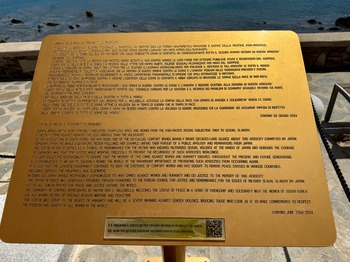
The installation includes multiple textual elements that required careful translation and adaptation. The main plaque features text in both Italian and English, making the memorial accessible to both local residents and international tourists. The text was originally drafted by the Korean Council, then given to Caiazza, who passed it to Mayor Vallebella for review and modification.
Significantly, Vallebella added the final sentence emphasizing that the statue should function as “a statue universally condemning gender violence.” This addition reflects the mayor’s understanding of the memorial’s significance and her commitment to framing the “comfort women” issue within broader contexts of women’s rights and social justice.
Additional textual elements include Korean inscriptions and a QR code linking to a website created by the Korean Council (Figure 3). This website provides comprehensive information about the statue’s symbolism, the history of the “comfort women” system, and the global network of similar memorials. The multilingual website ensures that visitors can access detailed information regardless of their linguistic background.
Close-up of the plaque on top of the stand beside the Statue of Peace, showing the text in Italian and English along with the QR code. For the full transcription of the English text, see the appendix at the end.
Source: Photograph by the author.

Two marble pedestals on the left side of the statue feature Korean text providing additional context: one explains the statue’s story and symbolism, while the other, titled “A Testimony of Memory,” presents the Korean version of the text found on the commemorative plaque.
Symbolic timing and historical resonance
The choice of June 22, 2024, for the statue’s inauguration carries profound symbolic significance that connects Korean historical trauma with local Stintino history. This date marks the exact anniversary—139 years later—of King Umberto I’s 1885 decree establishing the quarantine station and penal colony on Asinara Island, beginning the process that led to the forced eviction of families and the founding of Stintino.
This temporal alignment reflects the deep historical consciousness that characterizes both the Korean memorial movement and Stintino’s approach to community memory. By linking the “comfort women” memorial to local experiences of displacement and state-imposed trauma, the installation becomes not just an expression of international solidarity but a meditation on the recurring patterns of institutional violence and community resilience.
The historical resonance extends beyond dates to structural parallels. Both the “comfort women” system and the Asinara displacement involved state decisions that prioritized perceived institutional needs over individual and community welfare. Both created lasting trauma and displacement that affected multiple generations. Both required communities to rebuild their lives and identities in new geographical and social contexts.
The inauguration: ceremony and symbolism
The inauguration ceremony required months of careful planning to reconcile the commemorative gravity of the memorial with forms of community participation that could foster collective engagement. As part of this effort, Caiazza contacted the director of the Juvenes Cantores Gioacchino Rossini choir in Sassari, whom she knew personally, with the intention of anchoring the ceremony in a reflective musical performance. The choir director and the singers kindly accepted, offering their performance completely free of charge. Caiazza also took it upon herself to give the young performers an introductory lesson on the history of the “comfort women.” She coordinated with the choir to perform the Korean folk song Arirang using music scores sent by the Korean Council (Caiazza, personal communication, June 2025).
The choice of Arirang as the ceremonial song carries deep significance beyond its recognition as a Korean cultural symbol. As the Korean Council explained, Arirang “symbolizes the deep longing for home felt by the victims of Japanese military sexual slavery who were taken abroad and never returned” (The Korean Council for Justice and Remembrance for the Issues of Military Sexual Slavery by Japan 2024). The song’s association with displacement and loss resonated powerfully with Stintino’s own history of forced migration from Asinara Island.
The June 22, 2024, inauguration drew approximately 200 attendees, including local residents, Sardinian politicians, civil society activists, and international journalists. The diversity of participants reflected both the memorial’s local significance and its connection to broader networks of human rights advocacy and historical memory (Figure 4).
Inauguration ceremony of the Statue of Peace in Stintino, June 22, 2024. Mayor Rita Vallebella speaks at the podium, with Lee Na-young, Chair of the Board of the Korean Council, on her left, and Rosamaria Caiazza standing second to Lee’s left.
Source: Courtesy of Rosamaria Caiazza.

Key speakers included Mayor Vallebella, mayors from neighboring towns, Lee Na-young (Chair of the Board of the Korean Council), and Caiazza. The speeches emphasized themes of universal women’s rights, historical justice, and the ongoing relevance of the “comfort women” issue to contemporary struggles against gender-based violence.
Lee Na-young’s remarks positioned the statue as representing “not merely a Korea–Japan issue, but one that reflects the voices and experiences of countless women across the Asia-Pacific,” symbolizing “the global fight against gender-based violence and the hope for peace.” This framing helped local audiences understand their participation in a transnational movement rather than a bilateral Korean–Japanese dispute.
Mayor Vallebella’s speech emphasized continuity between historical and contemporary violence: “wartime sexual violence is not an issue of the past, but one that still persists today in conflict zones like Palestine and Ukraine.” By establishing the Statue of Peace, she argued, “we are standing in solidarity with the cries of all women who have suffered the tragedies of war” (The Korean Council for Justice and Remembrance for the Issues of Military Sexual Slavery by Japan, 2024).
Beyond the formal program, Caiazza managed numerous logistical details with meticulous personal attention (Figure 5). She purchased approximately 30 butterfly-shaped jewelry pins, and gave them to the mayor, Korean Council representatives, the choir director, and all female singers. For the male singers, she purchased enamel pins with white ribbons. Additionally, she hand-made over 300 yellow paper butterflies—the Korean Council’s symbol of solidarity—which were distributed to attendees, and prepared white satin ribbons for all the men present at the ceremony, including institutional representatives and members of the public. The white ribbon—an established symbol of opposition to violence against women—was accompanied by a short written note inviting recipients to consider it a personal commitment not to commit, tolerate, or remain silent in the face of gender-based violence. Wearing the ribbon was entirely voluntary; nevertheless, every man who received it spontaneously chose to wear it, transforming the gesture into a shared and publicly affirmed act of responsibility (Caiazza, personal communication, June and December 2025).
Official poster for the inauguration of the Statue of Peace in Stintino, created by Rosamaria Caiazza with the collaboration of her son. The artwork, painted by surrealist artist Ettore Aldo del Vigo, depicts a young “comfort woman” and features the quotation by Kim Bok-dong, “I was born a woman but I have never lived as a woman”.
Source: Courtesy of Rosamaria Caiazza.

Media coverage and community response
The inauguration received significant coverage in Korean media, with MBC News sending reporter Byeon Yun-jae to document the ceremony. The television coverage emphasized several key points: Stintino’s identity as “a small town on the island of Sardinia, known for its beautiful beaches and as a popular tourist destination”; the statue’s strategic placement “by the seaside, where many tourists pass through”; and the significance of this being “the first time the Statue of Peace has been installed in Italy, and the fourteenth installation overseas” (Byeon Reference Byeon2024).
The MBC News coverage also noted the diplomatic tensions surrounding the installation, reporting that “Japanese diplomatic authorities visited the city of Stintino shortly before the unveiling ceremony and lodged a protest, claiming that the inscription reflects a one-sided assertion by a Korean civic group.” The reporter highlighted Mayor Vallebella’s firm response, quoting her statement that “attempts to erase historical truth amount to yet another crime” (Byeon Reference Byeon2024).
Italian media coverage was more limited, reflecting the potentially controversial nature of the memorial. Local responses to the inauguration were generally positive, particularly among women residents. As mentioned, the presence of numerous red benches throughout the town had already established a community discourse about gender violence, making the “comfort women” memorial comprehensible within existing local frameworks of women’s rights advocacy.
However, some residents expressed concerns about the statue’s visibility and potential for controversy. During fieldwork, one resident referred to it as “the statue of discord,” citing the backlash and diplomatic tensions it has generated. This ambivalence reflects broader tensions between Stintino’s identity as a peaceful tourist destination and its emerging role as a site of international political controversy. Male residents appear more skeptical. While many female residents view the statue favorably, some men expressed concerns about its appropriateness and prominent placement.
Diplomatic tensions and resistance
The diplomatic response to the Stintino statue began before the inauguration ceremony and has continued throughout the memorial’s first year. According to Mayor Vallebella, she received calls from Italian authorities shortly before the June 22 ceremony inquiring about the statue. Her response was firm: she had already officially accepted the statue and would not go back on her decision unless forced to (Vallebella, personal communication, June 2025).
Following the inauguration, diplomatic pressure intensified significantly. Over the course of one year, Mayor Vallebella was visited three times by Japanese diplomatic figures who protested the statue’s installation and expressed concerns that it would potentially tarnish Japan’s image and could lead to a rise in anti-Japanese sentiment.
Vallebella’s responses to these diplomatic visits reveal both her commitment to the memorial and her understanding of the issues at stake. She assured the diplomatic representatives that she would “never tolerate any such form of disrespect or hate,” and if such a thing were to happen, she would take action immediately.
More fundamentally, Vallebella used these diplomatic encounters to articulate her understanding of the statue’s significance. She explained that her acceptance of the memorial stemmed from its role as a universal symbol representing gender violence, emphasizing that she embraced it to condemn war and all its atrocities universally, beginning with gender-based violence. This framing positions the memorial as addressing universal human rights issues rather than targeting Japan specifically.
The most recent diplomatic visit occurred in May 2025, protesting Stintino’s inclusion of the Statue of Peace in “Monumenti Aperti” (Open Monuments), an annual national initiative where historical sites and monuments are opened to the public with volunteer guides providing educational tours. The statue had been added to this program following a request by Marta Diana, the town council member for culture.Footnote 4
The original plan involved students from Liceo Magistrale Margherita di Castelvì, a linguistic high school in Sassari, serving as volunteer guides stationed near the statue to explain its significance to visitors. Given the school’s language programs, students could have provided information to international tourists in multiple languages. However, the school’s principal withdrew from the program shortly before the May 24–25 event dates. Despite the school’s withdrawal, the program proceeded with Caiazza and other volunteers, including council members like Marta Diana, serving as guides. This adaptation demonstrates the community’s resilience and commitment to public education.
Beyond formal diplomatic protests, the Stintino town hall has received a continuous stream of emails, postcards, and letters in various languages protesting against the presence of the statue in the town. Special secretary to the mayor Vincenzo Vallebella showed these materials during fieldwork interviews, describing how they ranged from well-articulated arguments to simple complaints.
Some of the correspondence reveals the sophisticated nature of the opposition campaign. Materials include documents purporting to prove how “comfort women” statues harm Japan’s image by showing images of anti-Japan protests in South Korea and in Berlin or articles by right-wing academics. Other correspondence appears designed more to harass than persuade. Examples include anonymous messages stating “boycott Italy, boycott Gucci, buy Louis Vuitton instead” accompanied by luxury handbag images. The volume of negative correspondence became so overwhelming that secretary Vallebella eventually stopped printing and filing the materials (Vallebella, personal communication, June 2025).
Visitor responses and engagement
The Statue of Peace’s location along Stintino’s coastline, close to the lighthouse and city center, ensures high visibility among both residents and tourists. Numerous tourists from Italy and other European countries can be observed stopping to read the commemorative plaque and examine the statue.
When asked about their familiarity with the history commemorated by the memorial, interviewed tourists consistently responded that they had no prior knowledge of the “comfort women” issue. This lack of awareness underscores the educational value of the memorial’s presence in a high-traffic tourist location, potentially reaching audiences who might never encounter this history through other channels.
A particularly striking aspect of tourist engagement involves the empty chair beside the statue. Many visitors expressed curiosity about its purpose, asking “what the empty chair is for.” When informed that it invites people to sit and show solidarity with the victims, many female tourists responded by sitting and instinctively grasping the statue’s hand. This physical gesture of connection demonstrates how the memorial’s design successfully facilitates emotional engagement across cultural and linguistic barriers.
Male tourists showed notably less inclination to sit with the statue or engage in physical gestures of solidarity, reflecting how different audiences relate to memorials addressing gender-based violence. However, the gendered differences in response do not necessarily indicate a lack of impact—many male visitors spent considerable time reading the plaque and examining the statue’s details.
The statue’s integration into international networks of remembrance became particularly evident during the May 2025 “Monumenti Aperti” event. In a remarkable coincidence, Caiazza encountered representatives from the Gyeonggi-do Women and Family Foundation (경기도여성가족재단), who had been assigned responsibility for bringing flowers to the Statues of Peace in Europe as part of the annual commemoration efforts coordinated by Korean organizations. Founded on June 19, 2005, the foundation was celebrating its 20th anniversary in 2025, making their visit particularly significant (Gyeonggi-do Women and Family Foundation n.d.).
The foundation representatives had been specifically tasked with the European installations, taking them first to Germany before arriving in Stintino precisely during the open monument days. The Korean representatives were surprised and moved to discover the bustling educational activity around the statue, with numerous volunteers and visitors engaging with the memorial. Their encounter with Caiazza proved especially meaningful as she was wearing a hanbok that had been gifted to her by a Korean acquaintance in recognition of her advocacy efforts, creating a powerful visual symbol of cross-cultural solidarity (Caiazza, personal communication, June 2025).
Caiazza took the opportunity to explain the “Monumenti Aperti” project to the Korean visitors. Together, they took photographs with a banner the foundation had prepared, written in Italian, which they subsequently gifted to Caiazza as a gesture of gratitude. The banner now holds a place of honor in her home, serving as a tangible reminder of the transnational connections the statue has fostered.
Future memorial projects and network expansion
The international significance of the Stintino project was formalized when Rosa Caiazza was invited to attend the 1674th Wednesday Demonstration in Seoul on November 13, 2024. Her participation in this historic weekly protest, which has continued since 1992, represents formal recognition of her contribution to international “comfort women” advocacy.
Caiazza’s solidarity message, delivered in Italian at the demonstration, articulated themes that connect local experiences with global struggles for justice and recognition. She declared, “We will not be silent. We must stand beside victims in solidarity. We will walk this road together, hoping that justice will bring those who suffered the recognition and respect that they deserve” (Choi and Park Reference Choi and Park2024).
Her presence at the Wednesday Demonstration also provided an opportunity to report on the statue’s reception in Italy. She told the assembled activists and survivors, “Every day, countless Italians and tourists visit the statue, take photos, and are touched by its message. The citizens of Stintino have welcomed the statue with deep warmth and sincere friendship.” Perhaps most importantly, Caiazza used her Seoul platform to emphasize the contemporary relevance of the “comfort women” issue. She observed that “even today, many women around the world continue to suffer wartime sexual violence similar to that endured by the Japanese military’s victims. We must show solidarity and care for both past and present victims” (Choi and Park Reference Choi and Park2024).
Caiazza’s involvement with the Korean Council and international advocacy networks has led to discussions about additional Statue of Peace installations in Europe. According to Hankyoreh reporting, she is “discussing further Statue of Peace installations in Greece and Switzerland,” suggesting that the Stintino project may serve as a model for additional European memorials.
Caiazza is also “seeking to establish a sister city agreement with her home, Sassari, and a South Korean city overseeing the sea” (Choi and Park Reference Choi and Park2024). This initiative would formalize the cultural and educational exchanges that began with her individual interest in Korean culture, potentially creating institutional frameworks for ongoing cooperation and exchange.
Historical trauma as a universal concern
One of the most significant aspects of the Stintino Statue of Peace project is how local actors have framed the “comfort women” issue as a universal human rights concern rather than a bilateral Korea–Japan dispute. This framing strategy has been crucial to building local support and deflecting criticism that the memorial represents inappropriate interference in foreign diplomatic relations.
Mayor Vallebella’s consistent emphasis on a “universal symbol condemning gender violence” positions the statue within broader frameworks of women’s rights advocacy that resonate with Italian and European audiences. Vallebella’s references to ongoing conflicts in Palestine and Ukraine during the inauguration ceremony illustrate this approach. By noting that “wartime sexual violence is not an issue of the past, but one that still persists today in conflict zones,” she acknowledged the specific historical trauma experienced by victims in the Asia-Pacific in the early twentieth century while connecting their experiences to ongoing human rights violations and struggles against gender-based violence worldwide (Vallebella, personal communication, June 2025).
The mayor’s vision of creating “a street for peace” with memorials from multiple countries further develops this universalist approach. By expressing willingness to host memorials addressing various historical traumas, including those involving Italian or European crimes, she positions Stintino as a site for general historical education and human rights advocacy.
The presence of red benches throughout Stintino reinforces a local context for understanding how historical and contemporary violence intersect. The benches specifically address femicide and domestic violence in contemporary Italy, providing a framework for understanding how militarized sexual violence during wartime connects to gender-based violence in peacetime.
This approach to historical memory as contemporary relevance reflects broader trends in how communities engage with difficult histories. Rather than treating historical trauma as safely contained in the past, effective memory activism demonstrates ongoing patterns and contemporary manifestations of similar violence and oppression.
Conclusion: memory, resistance, and transnational solidarity
The story of the Statue of Peace in Stintino illuminates the complex dynamics of transnational memory activism in the contemporary world. The memorial’s presence in Stintino demonstrates how local communities can become sites of global historical consciousness, connecting distant traumas to immediate concerns and universal principles. The town’s own history of displacement and forced migration provided a foundation for understanding and solidarity that transcended cultural and linguistic differences. The community’s existing commitment to women’s rights created a context in which the “comfort women” memorial could be understood as a natural extension of local values rather than a foreign element.
The key roles played by Rosamaria Caiazza and Mayor Rita Limbania Vallebella illustrate how individual agency and institutional support must combine to realize successful memory activism. Caiazza’s personal journey from cultural enthusiasm to historical advocacy demonstrates the potential for ordinary citizens to become effective international advocates when they combine passion with knowledge and sustained commitment. Mayor Vallebella’s willingness to accept the memorial despite anticipated controversy reflects an understanding of political leadership that prioritizes moral principles over convenience or conflict avoidance.
The memorial’s successful installation and continued presence also demonstrate the resilience of civil society actors and local democratic institutions when they are committed to principles of historical justice and women’s rights. The community’s ability to proceed with the installation, despite diplomatic pressure, suggests that grassroots memory activism can be effective even when it lacks official governmental support. When viewed alongside the 2020 Berlin installation, Stintino’s experience underscores how the Statue of Peace can adapt to different European contexts while retaining its transnational message. Both cases reveal that the statue’s meaning is not fixed but evolves through local engagement, political negotiation, and the creative reframing of contested heritage into inclusive narratives.
The tourist encounters and educational impact documented around the memorial provide evidence of its effectiveness as a site for historical education and consciousness-raising. The emotional responses of visitors, particularly women who sit in the empty chair and grasp the statue’s hand, suggest that the memorial successfully facilitates empathy and solidarity across cultural boundaries (Figure 6).
Close-up of the Statue of Peace in Stintino, highlighting the girl’s features and her vivid eyes.
Source: Photograph by the author.

The Stintino project’s significance extends beyond its immediate impact to its demonstration of how transnational memory networks can operate through civil society channels. Additionally, the memorial’s framing as a universal symbol against gender-based violence provides a model for how specific historical traumas can be understood within broader frameworks of human rights and social justice. This approach makes historical memory activism relevant to contemporary audiences while honoring the specific experiences of historical victims.
The memorial’s future depends on maintaining the personal commitments and institutional support that made its installation possible, while building broader frameworks that can outlast individual advocates and survive changing political circumstances. Nevertheless, the Statue of Peace in Stintino stands as a powerful example of how local communities can engage with global historical consciousness and contribute to ongoing struggles for justice and recognition. In the crystalline waters off Sardinia’s coast, where the Mediterranean meets the shores of a town born from displacement, the bronze figure of a Korean girl continues to bear witness to historical trauma while inspiring contemporary solidarity. Her presence transforms Stintino from a famous tourist destination into a site of international memory, resistance, and hope.
The memorial’s empty chair continues to invite visitors to sit in solidarity, to grasp the statue’s hand, and to commit themselves to the promise that such atrocities should never be repeated. In this gesture of invitation and the responses it generates, the specific trauma of “comfort women” becomes connected to universal struggles against violence and oppression, demonstrating the potential for historical memory to transcend national boundaries and inspire contemporary action for justice and human rights.
Acknowledgments
I wish to express my profound respect, admiration, and gratitude to all the remarkable individuals who participated in this research, particularly Mayor Rita Vallebella and Rosamaria Caiazza, who generously devoted a significant amount of their time and whose commitment I greatly appreciate. I am also thankful to the other members of the town council who kindly engaged in conversation with me, as well as to the local residents of Stintino who shared their invaluable insights.
Financial support
This research received no specific grant funding from any funding agency, commercial or not-for-profit sectors.
Competing interests
None.
Appendix
Statue of Peace: A Testament to Remember
During World War II, Japan forcibly abducted countless girls and women from the Asia-Pacific region, subjecting them to sexual slavery.
A military crime against humanity no less heinous than the Holocaust.
On 14th August 1991, in South Korea, Kim Hak-soon, one of the so-called comfort women, bravely broke decades-long silence about this atrocity committed by Japan.
Survivors from the whole Asia-Pacific region followed her example, uniting their pursuit of a public apology and reparations from Japan.
This Statue of Peace serves as a symbol of remembrance for the victims who endured militarized sexual violence at the hands of Japan and honours the courage of survivors who fight for justice while working tirelessly to prevent the recurrence of such atrocities worldwide.
It is our collective responsibility to ensure that the memory of this crime against women and humanity endures throughout the present and future generations.
By acknowledging it, we aim to solemnly remind the world of the paramount importance of preventing such atrocities from occurring again.
It is sad that the Japanese government continues to deny the existence of comfort women and has sought to remove peace statues in various countries, including Germany, the Philippines, and elsewhere.
In doing so, Japan should responsibly acknowledge its war crimes against women and humanity and do justice to the memory of this atrocity.
This Statue of Peace was generously provided through donations to the Korean Council for Justice and Remembrance for the Issues of Military Sexual Slavery by Japan.
Let us all join in prayer for peace and justice around the world.
The community of Stintino, represented by Mayor Rita L. Vallebella, welcomes the Statue of Peace in a spirit of friendship and solidarity with the women of South Korea and all women victims of violence in both wartime and peacetime.
“This statue will speak to the hearts of humanity and will be a severe warning against gender violence, inducing those who look at it to make commitments to respect the freedom and dignity of all women in the world.”
Stintino June 22nd 2024
Author Biography
Agnese Dionisio earned her PhD from Waseda University, Japan, in March 2025. She was awarded a Japan Society for the Promotion of Science Postdoctoral Fellowship and began her research at Sophia University in October 2025. Her research interests include modern Japanese history, feminist historiography, feminist art, and, more specifically, the study of civilian and military sexual slavery in the Asia-Pacific region, with a focus on Micronesia.



 Open access

