




1. Introduction
Crop-production systems must increase productivity while preserving natural capital to ensure sustainable global food security (Foley et al., Reference Foley, Ramankutty, Brauman, Cassidy, Gerber, Johnston, Mueller, O'Connell, Ray, West, Balzer, Bennett, Carpenter, Hill, Monfreda, Polasky, Rockstrom, Sheehan, Siebert and Zaks2011). Agricultural research and development (AgR&D) offer opportunities to achieve this challenging objective (Kristkova et al., Reference Kristkova, Van Dijk and Van Meijl2017). Moreover, AgR&D drives long-term agricultural productivity and innovation with high returns on investments (Alston, Reference Alston2010; Alston et al., Reference Alston, Marra, Pardey and Wyatt2000; Heisey & Fuglie, Reference Heisey and Fuglie2007; Hurley et al., Reference Hurley, Rao and Pardey2014).
Traditionally, AgR&D has addressed most issues along single disciplines, which has led to unintended consequences and trade-offs. For example, the Green Revolution of the late 1960s led to significant crop yield and food-production increases but also had several negative social, economic, and ecological outcomes (Borlaug, Reference Borlaug2007; Renkow & Byerlee, Reference Renkow and Byerlee2010; Stevenson et al., Reference Stevenson, Villoria, Byerlee, Kelley and Maredia2013). The Green Revolution primarily benefited large-scale commercial farmers and unintentionally neglected small-scale farmers and rural communities (Davis et al., Reference Davis, Dalin, Kummu, Marston, Pingali and Tuninetti2022; Gollin et al., Reference Gollin, Hansen and Wingender2021; Pingali, Reference Pingali2012). In addition, the Green Revolution relied heavily on synthetic fertilizers and pesticides and focused on a few high-yielding varieties and crops, resulting in decreased crop diversity, increased vulnerability to pests and diseases, and environmental degradation. Hence, while the Green Revolution was instrumental in averting hunger and generating wealth for many countries, it resulted in fragile agricultural systems (Bhatt et al., Reference Bhatt, Singh, Hossain and Timsina2021; Brainerd & Menon, Reference Brainerd and Menon2014; Chand & Haque, Reference Chand and Haque1998; Chauhan et al., Reference Chauhan, Mahajan, Sardana, Timsina and Jat2012; Gupta et al., Reference Gupta, Naresh, Hobbs, Jiaguo and Ladha2015).
A more integrated and interdisciplinary approach to AgR&D will reduce unintended consequences and trade-offs. Such an approach considers the complex interactions among agriculture, the environment, and farming communities. This results in sustainable agricultural systems that are resilient to climate change and promote food security, biodiversity, and social, cultural, and economic well-being (Pingali et al., Reference Pingali, Aiyar, Abraham and Rahman2019; Sachs et al., Reference Sachs, Remans, Smukler, Winowiecki, Andelman, Cassman, Castle, DeFries, Denning, Fanzo, Jackson, Leemans, Lehmann, Milder, Naeem, Nziguheba, Palm, Pingali, Reganold and Sanchez2010).
Research gaps must be identified and prioritized by considering research topics, locations, and methods (MacMillan & Benton, Reference MacMillan and Benton2014; Pardey et al., Reference Pardey, Chan-Kang, Dehmer and Beddow2016). This research-priority setting requires foresight to identify future trends, challenges, and opportunities (van Rij, Reference van Rij2010). One such foresight activity is horizon scanning, which can anticipate and plan for change (Cuhls, Reference Cuhls2020). Horizon scanning identifies novel ideas at the margins of current knowledge (Sutherland et al., Reference Sutherland, Fleishman, Clout, Gibbons, Lickorish, Peck, Pretty, Spalding and Ockendon2019). It also captures signals of emerging trends with potential future impacts that involve threats and opportunities (Esmail et al., Reference Esmail, Wintle, t Sas-Rolfes, Athanas, Beale, Bending, Dai, Fabinyi, Gluszek, Haenlein, Harrington, Hinsley, Kariuki, Lam, Markus, Paudel, Shukhova, Sutherland, Verissimo and Milner-Gulland2020). Horizon scanning in AgR&D can help funding agencies and policymakers identify important research gaps and enable them to allocate resources effectively and efficiently (National Academies of Sciences, 2020).
Given the importance of AgR&D and the usefulness of horizon scanning in AgR&D to sustainable agricultural systems, we conducted a horizon-scanning activity with a global and diverse panel of rice-related research experts to identify gaps that should be prioritized to achieve sustainable rice systems by 2050.
2. Rice agriculture and research
Rice cultivation and research have a long history, which dates to ancient civilizations (Fuller, Reference Fuller2011; Sweeney & McCouch, Reference Sweeney and McCouch2007). For example, early records in China describe seed selection and irrigation to improve rice yields (Anderson, Reference Anderson1988). In the 19th and early 20th centuries, scientists began studying rice and improved its productivity through breeding. Later, politics, ecology, and genetic research heralded the Green Revolution (Baranski, Reference Baranski2022; Perkins, Reference Perkins1997). Increased productivity was the leading research innovation that drove rice production growth, especially in Asia.
Researchers are nowadays concerned that increases in global (Yuan et al., Reference Yuan, Linquist, Wilson, Cassman, Stuart, Pede, Miro, Saito, Agustiani, Aristya, Krisnadi, Zanon, Heinemann, Carracelas, Subash, Brahmanand, Li, Peng and Grassini2021) and regional rice yields (van Oort et al., Reference van Oort, Saito, Tanaka, Amovin-Assagba, Van Bussel, van Wart, de Groot, van Ittersum, Cassman and Wopereis2015) have stabilized and that investment in rice research has stagnated (Mohanty et al., Reference Mohanty, Wailes and Chavez2010; Zeigler & Barclay, Reference Zeigler and Barclay2008). For these reasons, we argue that rice research gaps must be identified and prioritized to increase production, productivity, and sustainability in rice systems by 2050. In addition, we highlight some of the importance of rice below.
First, rice plays an important role in global food security. Rice is a staple food for over half of the world's population. It is grown in more than 150 countries (Brooks & Place, Reference Brooks and Place2019; Seck et al., Reference Seck, Diagne, Mohanty and Wopereis2012), in areas that extend from latitude 39 °S to 50 °N, and in environments encompassing temperate to sub-humid and humid climatic conditions. Rice production needs to increase to meet increasing global demands (Samal et al., Reference Samal, Babu, Mondal and Mishra2022; Timmer et al., Reference Timmer, Block and Dawe2010). However, rice production systems face many challenges in achieving sustainable growth related to environmental factors (soil quality and water and nutrient availability), national and international policy initiatives, labor scarcity and increased competition for arable land.
Second, climate change exacerbates challenges in rice production systems. Increasing intensity and frequency of extreme climatic events such as droughts and floods will reduce rice yield (Hatfield et al., Reference Hatfield, Boote, Kimball, Ziska, Izaurralde, Ort, Thomson and Wolfe2011; Singh et al., Reference Singh, McClean, Büker, Hartley and Hill2017; Wassmann et al., Reference Wassmann, Jagadish, Heuer, Ismail, Redona, Serraj, Singh, Howell, Pathak and Sumfleth2009). More so, rice is mainly produced by small-holder farmers with limited ability to adapt to climate change (Ho et al., Reference Ho, Kuwornu and Tsusaka2022; Misra, Reference Misra2017; Nyadzi et al., Reference Nyadzi, Saskia Werners, Biesbroek, Long, Franssen and Ludwig2019; Ojo & Baiyegunhi, Reference Ojo and Baiyegunhi2020; Redfern et al., Reference Redfern, Azzu and Binamira2012). Climate change also inhibits sustainable management practices. For example, practicing alternate wetting and drying, which reduces water use and methane emissions, is determined by climatic conditions (Nelson et al., Reference Nelson, Wassmann, Sander and Palao2015; Sander et al., Reference Sander, Wassmann, Palao and Nelson2017).
Third, rice production is affected by climate change, but it also contributes to climate change through greenhouse gas emissions. Rice contributes more to agricultural greenhouse gas emissions than other major cereals (Linquist et al., Reference Linquist, Groenigen, Adviento-Borbe, Pittelkow and Kessel2012; Tubiello et al., Reference Tubiello, Salvatore, Rossi, Ferrara, Fitton and Smith2013). In addition, rice production is often associated with groundwater depletion, soil degradation, and widespread biodiversity decline (Bhatt et al., Reference Bhatt, Singh, Hossain and Timsina2021; Brainerd & Menon, Reference Brainerd and Menon2014; Gupta et al., Reference Gupta, Naresh, Hobbs, Jiaguo and Ladha2015).
3. Methods
Our study follows a Delphi technique with two rounds (Mukherjee et al., Reference Mukherjee, Hugé, Sutherland, McNeill, Van Opstal, Dahdouh-Guebas and Koedam2015; Rowe & Wright, Reference Rowe and Wright1999), involving a global and diverse set of rice experts. (In Supplementary material A we introduce the horizon scanning method and give more details of how we carried out our horizon scan. We also provide information on the demographics of participants including their geographical location, research domain, and years of research experience.). In Round 1, experts answered open-ended questions on the macro-drivers that enable or constrain sustainable rice systems and the research needs. The responses were analyzed and classified into seven issues and 54 research gaps that formed the basis of Round 2.
In Round 2, a subset of the experts rated the research gaps on relevance and novelty. Relevance ratings for sustainable rice systems had four levels: ‘high relevance’, ‘moderate relevance’, ‘little relevance’, and ‘no idea’. High, moderate, and low relevance reflect the importance of the research gap in achieving sustainable rice systems, whereas ‘no idea’ indicated that the issue fell outside the expert's knowledge. Novelty ratings had three levels: ‘novel’ (available knowledge is limited), ‘not novel’ (sufficient knowledge exists), and ‘new to me’ (unfamiliar subject) (The questionnaires of Rounds 1 and 2 are provided in Supplementary material B).
To analyze the results from Round 2, we assessed the level of agreement among participants. A consensus was reached when at least 50% of the participants gave the same rating. If there was no consensus on any rating, we selected the most frequently given rating (even if it was less than 50%). To prioritize the research gaps, we assigned scores based on the rating and the level of consensus, with higher scores given to research gaps with consensus. The top 25 research gaps were then selected in order of their rank.
4. Results
4.1 Drivers
The drivers were listed under present and future times and categorized under social, technological, economic, environmental, and political. Environmental drivers were identified as the most important category for present and future rice systems, with political drivers as the lowest (Figure 1). Other driver categories such as economic, were considered more important now than in the future, whereas technological drivers more important in the future than now. Climate change and technology emerged as important drivers in present and future times (see Figures SC1 and SC2 in Supplementary material C).
Relative importance of driver categories in the present and future times.

4.2 Projections, opportunities, and challenges
The analysis of future projections, opportunities, and challenges resulted in the identification of seven key issues: climate change, changes in consumer profiles, urbanization, market and policy shifts, changes in labor demographics, constraints on natural resources, and technological advancements (All projections mentioned by participants are provided in Supplementary material C). These issues are interconnected; for example, urbanization is linked to both changes in labor demographics and consumer preferences.
4.3 Research techniques
Proposed research techniques to meet research needs included rice-vegetable systems modeling, digitalization of value chains, spatial data analytics, stakeholder engagement, lowland development, inter- and transdisciplinary research, remote sensing, water accounting, climate finance, and low-emission business models (All research techniques mentioned are provided in Supplementary material E).
Experts also proposed that more research techniques should be applied to achieve sustainable rice systems. These include digital agriculture, multi-stakeholder engagement, social impact research, satellite imagery, crop insurance, space applications, machine learning, automated crop monitoring, nature-based solutions, and systems thinking. In addition, they advocated for shifts in research focus, for example, from crop genetics and plot-level research to farming systems research.
Experts called for ‘out-of-the-box’ thinking and proposed more inter- and trans-disciplinary research. However, some experts wanted basic research that applies critical core expertise. A few other experts called for a long-term vision and funding, while others advocated for rapid technology development and quick R&D cycles.
5. The top 25 rice research gaps
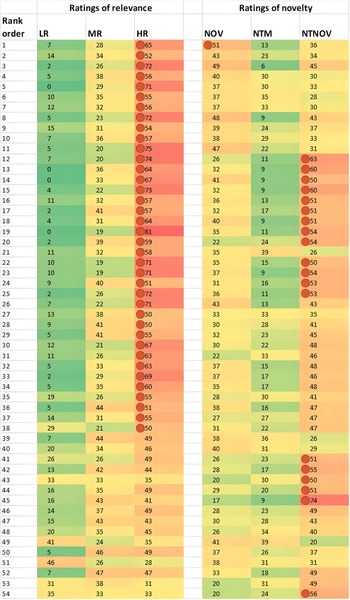
Fifty-four research gaps from Round 1 were rated by experts and ranked in order of their relevance, novelty, and consensus among experts (Table 1). The agreement between experts on the ratings of each research gap is shown in Figure 2, with a higher consensus for relevance ratings (70%, n = 54) compared to novelty ratings (37%, n = 54). All relevance ratings with consensus were for ‘highly relevant’ whereas all but one novelty ratings with consensus were for ‘not novel’ ratings. The exception is the research gap rank 1 (see Table 1) related to the trade-offs between mitigating rice greenhouse gas emissions and local food security, rated ‘highly relevant’ and ‘novel’ with consensus (see Figure 2). The top 25 rice research gaps are discussed below under four themes.
Research gaps ordered by rank

Heat map visualizing the percentage of experts who chose a rating. A green-yellow-red gradient is used, indicating increasing agreement on the rating. The red circle icons represent ratings with majority agreement (⩾50%). LR stands for low relevance, MR for moderate relevance, HR for high relevance, NOV for novel, NTM for new to me, and NTNOV for not novel.

5.1 Theme 1: sustainability interactions
In achieving sustainable rice systems, differences in views often arise between objectives such as food security and environmental protection (Klapwijk et al., Reference Klapwijk, van Wijk, Rosenstock, van Asten, Thornton and Giller2014). Balancing these competing objectives and finding trade-offs requires research that considers the interdependencies between different components of rice production systems and involves stakeholders in the decision-making process.
Climate-change impacts generally lead to a decline in rice production (Hatfield et al., Reference Hatfield, Boote, Kimball, Ziska, Izaurralde, Ort, Thomson and Wolfe2011; Singh et al., Reference Singh, McClean, Büker, Hartley and Hill2017; Wassmann et al., Reference Wassmann, Jagadish, Heuer, Ismail, Redona, Serraj, Singh, Howell, Pathak and Sumfleth2009). However, some studies indeed show that climate change could benefit rice production through increased temperatures (Waha et al., Reference Waha, Dietrich, Portmann, Siebert, Thornton, Bondeau and Herrero2020; Yang et al., Reference Yang, Chen, Lin, Liu, Zhang, Zhao, Li, Ye, Li, Lv, Yang, Wu, Li, Lal and Tang2015). Therefore, a comprehensive analysis of climate-change impacts is important for innovation in rice production systems.
Research on sustainability interactions includes:
(1) Understanding the potential trade-offs between mitigating rice greenhouse gas emissions and local food security;
(2) Maximizing higher CO2 levels to improve rice-crop ecology and productivity;
(3) Integration of regenerative and agro-ecosystem approaches in rice systems to optimize productivity and resource-use efficiency;
(4) Quantifying the local effects on and responses of rice cultivation to abiotic stresses;
(5) Developing innovative agro-ecological fertilizers to improve soil fertility; and
(6) Utilizing by-products from rice production for other purposes (e.g. rice straw for biofuels and fertilizers).
5.2 Theme 2: agricultural development
Agricultural developments and their impacts on social, economic, and ecological factors must be thoroughly analyzed as they can have far-reaching implications. For example, small-holder farmers grow most of the rice produced and play a substantial role in rice-food security (Pandey et al., Reference Pandey, Byerlee, Dawe, Dobermann, Mohanty, Rozelle and Hardy2010) but often receive little monetary benefits from rice production despite rice system expansion. Small-holder farmers receive as little as 4% of the consumer price (Alliot & Fechner, Reference Alliot and Fechner2018). This trend counteracts the vision of equitable and sustainable agriculture. Relevant research on agricultural development includes:
(7) The replacement of manual, in-person monitoring, reporting, and verification with remote sensing and satellite technologies;
(8) Monitoring and assessing environmental impacts of new rice technology;
(9) Impacts of increasing rice production on Africa's food-crop production and diversity;
(10) Expanding dryland and upland rice production;
(11) Socio-economic drivers of rice-yield gaps across the world;
(12) Understanding farmers' actual conditions to bridge the profit-loss margin;
(13) Understanding the process of farmers' transformation to sustainable management practices;
(14) The effect of increased food insecurity and food prices on farmers' practices of sustainable methods;
(15) The potential socio-economic impact of technological change on small-scale farmers; and
(16) Developing accurate climate and water information at local scales.
5.3 Theme 3: genetics, breeding and physiology
Rice is one of the first crops to have had its complete genome sequenced (Jackson, Reference Jackson2016; Sasaki et al., Reference Sasaki, Matsumoto, Yamamoto, Sakata, Baba, Katayose, Wu, Niimura, Cheng, Nagamura, Antonio, Kanamori, Hosokawa, Masukawa, Arikawa, Chiden, Hayashi, Okamoto, Ando and Gojobori2002). This advancement marked a milestone in rice research and opened new opportunities for genetic research for rice and other crops (Izawa & Shimamoto, Reference Izawa and Shimamoto1996; Rezvi et al., Reference Rezvi, Tahjib-Ul-Arif, Azim, Tumpa, Tipu, Najnine, Dawood, Skalicky and Brestič2022). Despite the tremendous success recorded in rice-genetics research (Bajaj & Mohanty, Reference Bajaj and Mohanty2005; Hossain et al., Reference Hossain, Bennett, Datta, Leung and Khush2000), much rice genetic and breeding research is still in a developmental stage (Mohd Hanafiah et al., Reference Mohd Hanafiah, Mispan, Lim, Baisakh and Cheng2020). Bottlenecks in high-throughput phenotyping of physiological traits have also limited the extent to which advances in genomics can be exploited in breeding (Rebetzke et al., Reference Rebetzke, Jimenez-Berni, Fischer, Deery and Smith2019; Song et al., Reference Song, Wang, Guo, Yang and Zhao2021; Yang et al., Reference Yang, Feng, Zhang, Zhang, Doonan, Batchelor, Xiong and Yan2020). With the increasing impact of stressors, genetic and physiological research needs to be accelerated (Gregorio et al., Reference Gregorio, Senadhira, Mendoza, Manigbas, Roxas and Guerta2002; Hasanuzzaman et al., Reference Hasanuzzaman, Fujita, Nahar and Biswas2018; Jagadish et al., Reference Jagadish, Septiningsih, Kohli, Thomson, Ye, Redona, Kumar, Gregorio, Wassmann, Ismail and Singh2012; Lesk et al., Reference Lesk, Anderson, Rigden, Coast, Jägermeyr, McDermid, Davis and Konar2022). The research gaps list the directions for rice genetic research on developing:
(17) Rice varieties that are more efficient in capturing and using environmental resources such as solar energy and aerobic rice that use less water;
(18) Perennial (i.e. can be harvested season in and season out) rice varieties;
(19) Climate-resilient varieties that can thrive under harsh conditions (e.g. varieties with better stress avoidance traits, highly developed root systems, and the ability to grow in saline conditions);
(20) Varieties with improved grain qualities (such as high milling recovery, head rice, and length-to-width ration); and
(21) Methanogenic inhibitors to reduce methane emissions from rice production systems.
5.4 Theme 4: governance and policies
Policies and equitable governance support agriculture in achieving diverse objectives, offering the opportunity to minimize losses and maximize synergies across scales. For example, persistent transboundary policy-practice mismatches in the international Mekong Delta's management have led to lower agricultural production and poor water management (Sithirith, Reference Sithirith2021; Thu & Wehn, Reference Thu and Wehn2016; Tran & Tortajada, Reference Tran and Tortajada2022). Effective policies must integrate knowledge from multiple fields and scales (Sterner et al., Reference Sterner, Barbier, Bateman, van den Bijgaart, Crépin, Edenhofer, Fischer, Habla, Hassler, Johansson-Stenman, Lange, Polasky, Rockström, Smith, Steffen, Wagner, Wilen, Alpízar, Azar and Robinson2019). The research gaps under this theme relate to the science-policy-practice gap and the implementation of effective policies to resolve sustainability issues. Research on governance and policies include:
(22) The governance of surface water use as a collective regional resource and for a balanced supply of rice in a region;
(23) The policy options to mitigate the envisaged rice production loss in some parts of the world, such as Asia;
(24) Translating science to practice (e.g. the application and adoption of genetic advancements); and
(25) The policy options needed to boost rice productivity, sustainability and inclusive transformation in lagging regions.
6. Synthesis
We conducted a horizon scanning activity to identify research gaps that must be prioritized for sustainable rice systems by 2050. The horizon scanning involved a global panel of rice experts in a two-round Delphi-technique. The activity resulted in the identification of drivers, projections, opportunities, challenges, research gaps, and techniques.
Most research gaps were considered ‘highly relevant’ and ‘not novel’, revealing that research is needed to tackle persistent issues. Further research should build upon existing findings and help end-users utilize research results. Our study aligns with Dalton's notion of horizon scanning (Dalton, Reference Dalton2002), which identifies both novel and persistent research gaps. A sustainability transition is described as a shift toward a sustainable state in response to the persistent issues facing modern societies (Grin et al., Reference Grin, Rotmans and Schot2010). Hence, it is important to address the persistent issues identified in our study to achieve sustainable rice systems.
The top 25 rice-research gaps have different degrees of agreement among the global panel of experts and this shows a diverging consensus on several issues. Research gaps that are future-oriented and at the margins of our current thinking are rarely a product of consensus (Kramer et al., Reference Kramer, Hartter, Boag, Jain, Stevens, Nicholas, McConnell and Liu2017). Also, little conformity in knowledge is expected when experts come from diverse research and cultural backgrounds. However, consensus serves as evidence to support the ranking of the horizon-scan output (Hines et al., Reference Hines, Hiu Yu, Guy, Brand and Papaluca-Amati2019).
Horizon scanning is a crucial first step in the foresight process, as it identifies emerging trends and potential challenges (Cuhls, Reference Cuhls2020; National Academies of Sciences, 2020) and thus should be conducted regularly to keep track of changes over time (van Rij, Reference van Rij2010). The success of horizon scanning can be seen in examples such as the yearly scans on global conservation issues (Sutherland et al., Reference Sutherland, Fleishman, Clout, Gibbons, Lickorish, Peck, Pretty, Spalding and Ockendon2019). In this context, our study could be considered the first phase in a long-term foresight process, which can help track the progress of rice research over time. We are cautious that only 101 experts from 31 countries contributed to this horizon scan and as such, the research gaps identified are limited. However, some other horizon scans of global significance with smaller number of contributors, for example, Sutherland et al. (Reference Sutherland, Fleishman, Clout, Gibbons, Lickorish, Peck, Pretty, Spalding and Ockendon2019; global scan on conservation, with n = 28), Kennicutt et al. (Reference Kennicutt, Chown, Cassano, Liggett, Massom, Peck, Rintoul, Storey, Vaughan, Wilson and Sutherland2014; Antarctic Science Horizon scan, n = 75), have had meaningful impacts on scientific research (Esmail et al., Reference Esmail, Wintle, t Sas-Rolfes, Athanas, Beale, Bending, Dai, Fabinyi, Gluszek, Haenlein, Harrington, Hinsley, Kariuki, Lam, Markus, Paudel, Shukhova, Sutherland, Verissimo and Milner-Gulland2020).
Our study involved experts from the broad domain of rice research, but further research can take the same approach to different groups of experts or stakeholders. The research gaps could be further categorized based on location to allow for more locally relevant research gaps to be highlighted. Results could be compared to see where results align or differ between stakeholder groups, increasing the results' applicability to policy and practice. Further research could, for example, engage farmers who apply research results (MacMillan & Benton, Reference MacMillan and Benton2014); government funding agencies who are the key investors in AgR&D (Alston et al., Reference Alston, Andersen, James and Pardey2012); and businesses in the agriculture or private sector that increasingly invest in research (Pardey et al., Reference Pardey, Chan-Kang, Dehmer and Beddow2016).
Our study also contributes to the research priority setting by being conducted worldwide. Research priority setting for rice is often regional or national (e.g. Barker & Herdt, Reference Barker and Herdt2019; Evenson et al., Reference Evenson, Herdt and Hossain1996) or focused on sub-domains of rice research (Hossain et al., Reference Hossain, Bennett, Datta, Leung and Khush2000; Willocquet et al., Reference Willocquet, Elazegui, Castilla, Fernandez, Fischer, Peng, Teng, Srivastava, Singh, Zhu and Savary2004). Furthermore, a few worldwide studies have been conducted, but these relied on bibliometric analysis to prioritize research (Bin Rahman & Zhang, Reference Bin Rahman and Zhang2022; Pandey et al., Reference Pandey, Byerlee, Dawe, Dobermann, Mohanty, Rozelle and Hardy2010). In contrast to the bibliometric-based studies, our study capitalizes on knowledge from a global panel of rice experts. Hence, research gaps are relevant to global food security and sustainability. By presenting the top 25 rice research gaps, experts can focus on the areas of need and collaborate, leading to more effective and impactful research outcomes. In addition, our study acts as a bridge among researchers, funding agencies, policymakers, and end users by highlighting a set of research to be prioritized.
Supplementary material
The supplementary material for this article can be found at https://doi.org/10.1017/sus.2024.17.
Acknowledgements
We appreciate the 101 experts who took the time to participate in the study. OC acknowledges and recognizes the Nganyaywana (Anaiwan) people as the traditional owners and custodians of the land on which he works and lives, and he pays respect to their Elders past and present. He also extends his respect to all Aboriginal and Torres Strait Islander peoples. Prof. Rik Leemans gave suggestions on earlier versions of the manuscript and these are highly appreciated. Thank you also to the anonymous reviewers who provided helpful comments to improve the manuscript during the peer-review process.
Author contributions
GIE conceived the idea. GIE, KN, SL, and KK jointly designed the study. All authors invited participants, pretested and improved the surveys. GIE wrote the first draft of the manuscript. GIE, KN, SL, OC, LT, KF, and KK discussed the results and edited the manuscript. All authors approved the final version of the manuscript.
Funding statement
This research was supported by Mitigate+: Research for Low Emissions Food Systems and the Global Research Alliance on Agricultural Greenhouse Gases (GRA) through their CLIFF-GRADS programme. Funding for Mitigate+comes from the CGIAR Trust Fund and the Government of New Zealand. In addition, we thank the International Rice Research Institute, Hanoi, Vietnam for hosting GIE.
Open access is provided by Wageningen University and Research, the Netherlands.
Competing interests
The authors declare that they have no known competing financial interests or personal relationships that could have appeared to influence the work reported in this paper. The Social Sciences Ethics Committee of Wageningen University granted ethics approval for research involving human participants.
Research transparency and reproducibility
Additional data and information are available in the Supplementary material. Further requests for data and information should be directed to the corresponding author.




 Open access

