

INTRODUCTION
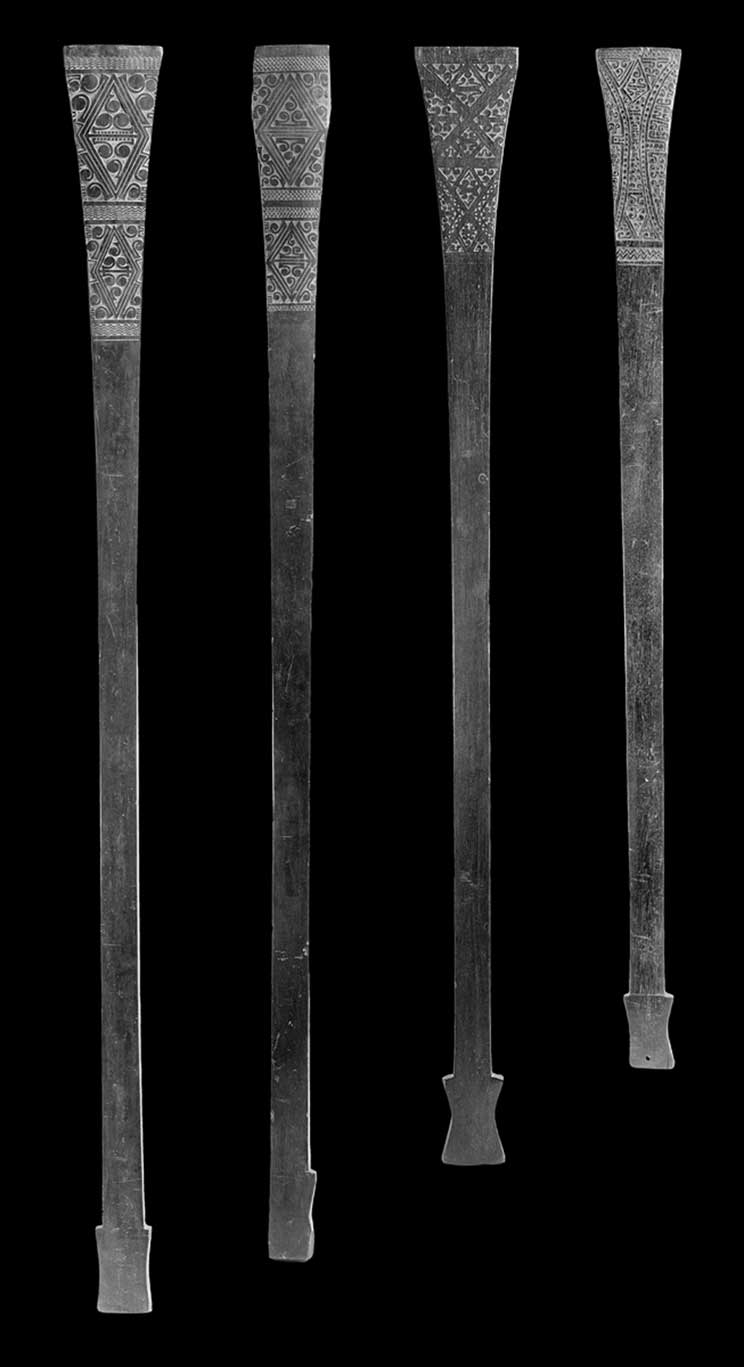
Among the materials presented by Elias Ashmole to the University of Oxford to form the founding collection of the Ashmolean Museum (the first modern public museum in Europe, opened in 1683) were four large, highly decorated wooden clubs (figs 1 and 2). Originally forming part of a group of five clubs (one of which was transferred to the British Museum in 1866), they were listed in the museum’s first catalogue as:
Quinque instrumenta
ex India occidentali
bellica, ex ligno brasiliano confecta, quae vulgò Tamahack appellantur
(Five weapons,
from the West Indies,
made of Brazil wood, commonly known as tomahawks)Footnote 1
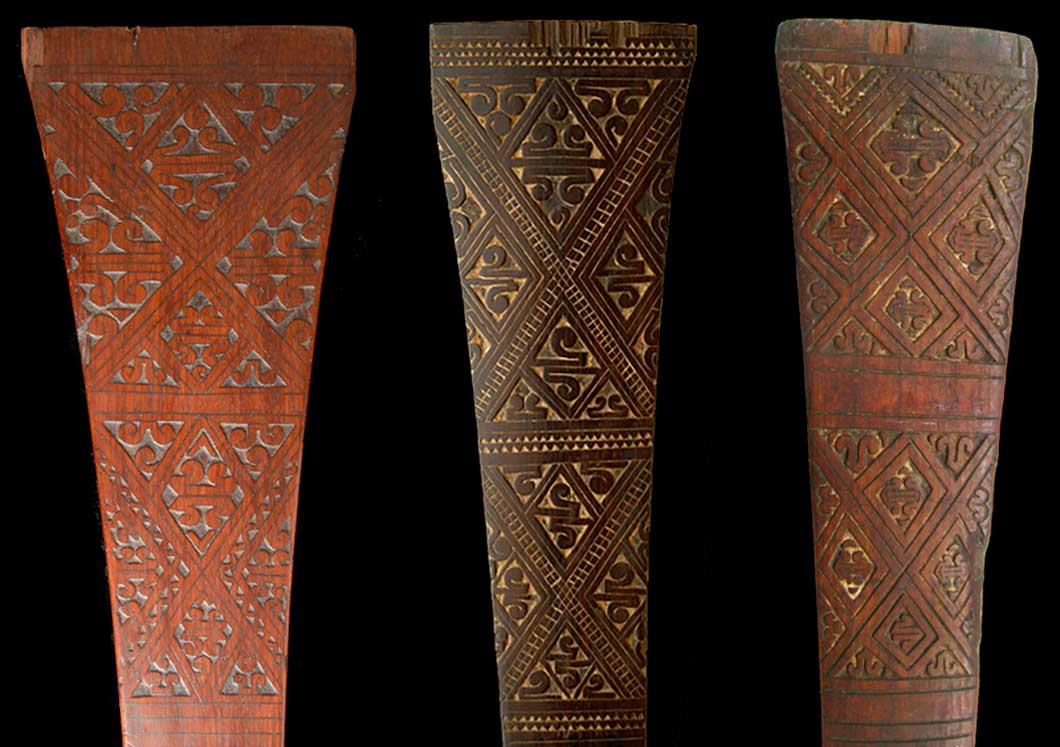
The Ashmolean’s Tradescant clubs, roughly to scale; archival photos c early 1980s, designs enhanced with white infill for photography (MacGregor Reference MacGregor1983, fig 1). Left to right: Club 1, AN1685 B.128, L: 140cm; W: 11cm; D: 2.5cm; ad 1311–1421 (95.4%); Club 2, AN1685 B.129, L: 135cm; W: 9cm; D: 2.2cm; ad 1325–1441 (95.4%); Club 3, AN1685 B.130, L: 124cm; W: 12cm (max), D: 2.1cm; ad 1458–1638 (95.4%); Club 4, AN1685 B.131, L: 114cm; W: 9.8cm; D: 2.4cm, ad 1315–1432. Source: Images reworked as a group in PhotoshopTM by J Ostapkowicz; © Ashmolean Museum, University of Oxford
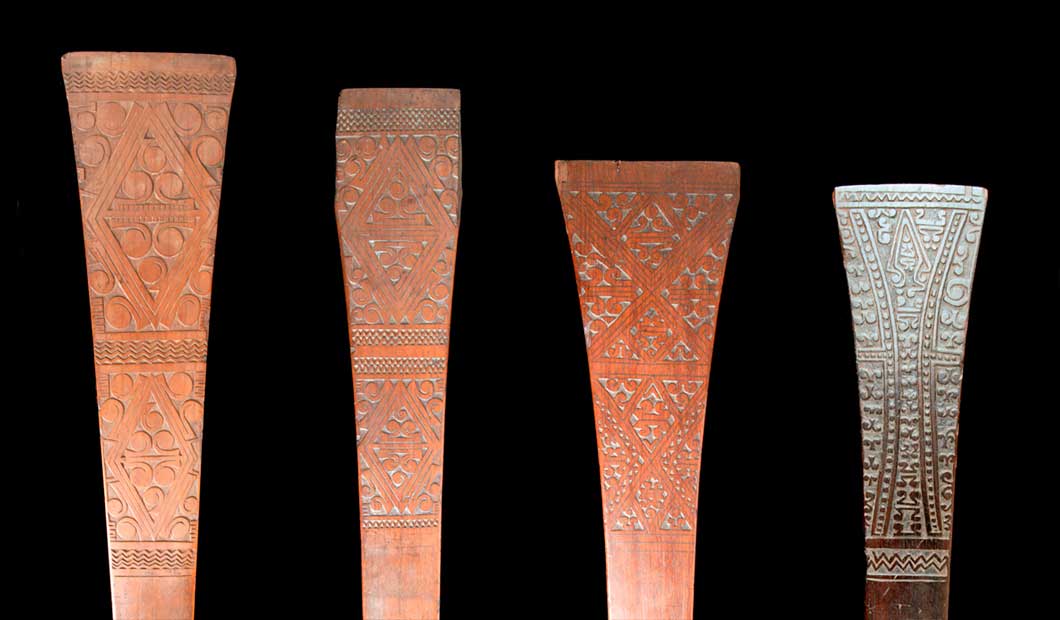
Terminal ends of the Tradescant clubs (left to right: Club 1 to 4), roughly to scale, showing the variety of wood colour and finish of the individual clubs. The shallowly excavated geometric design panels would originally have been infilled with white powder for added contrast, as replicated with modern white powder in fig 1. Image: Photograph by J Ostapkowicz; courtesy of the Ashmolean Museum
14C AMS results from the four Tradescant clubs (AN1685 B.128–131). The ORAU lab numbers (OxA) are provided, with age in 14C yrs and calibrations at 95.4% listed and the most likely calibration ranges highlighted in bold. All dates are calibrated using the IntCal13 dataset (Reimer et al Reference Reimer, Bard, Bayliss, Beck, Blackwell, Bronk Ramsey, Buck, Cheng, Edwards, Friedrich, Grootes, Guilderson, Haflidason, Hajdas, Hatté, Heaton, Hoffmann, Hogg, Hughen, Kaiser, Kromer, Manning, Niu, Reimer, Richards, Scott, Southon, Staff, Turney and van der Plicht2013) and OxCal v4.2.2 (Bronk Ramsey Reference Bronk Ramsey2013). Wood identifications were carried out by Alex Wiedenhoeft, Center for Wood Anatomy Research

These large clubs (114–140cm in length) are carved from tropical hardwoods and embellished with curvilinear and geometric two-dimensional designs on the broad faces of their terminal ends. The clubs’ size and the complexity of their two-dimensional design panels distinguish this rare style, of which there are some forty extant examples, held largely in European museums.Footnote 2 Where information exists, most of the clubs are documented as entering their respective collections prior to 1700; the earliest examples are illustrated c 1586,Footnote 3 and two were recovered from the San Pedro shipwreck of 1596, found off the coast of Bermuda.Footnote 4
Despite the well-documented institutional history of the Ashmolean clubs, extending back to at least 1685, and probably to the early/mid-seventeenth century, neither the provenance nor the indigenous context of these artefacts is known. They currently resonate more with the legends of ‘savage’ encounters and the challenges of colonial enterprise (which attained their own mythic statusFootnote 5 ) than with indigenous sources, referents and meanings. Indeed, one of the main questions concerning this group of objects is their provenance: what is the distribution area of this style of club and where within this area do the Ashmolean clubs originate? The Ashmolean clubs are attributed only to ‘India occidentali’, a term literarily translating as ‘West Indies’, but which was coined in the years of early European colonial expansion to denote more generally the lands to the west of Europe (that is, the Americas) rather than those in the East (East Indies/‘India orientale’). Most scholars have assumed that the long clubs originated from the mainland coast of South America – from Venezuela to the Guianas (Guyana, Surinam and French Guiana).Footnote 6 In part, this is based on better documented clubs from the eighteenth century onwards, but these take a very different form, being about half the size of the long clubs, with a different cross-section and generally featuring carved two-dimensional anthropomorphic figures or plain, undecorated surfaces, rather than the abstract ‘diamond and curl’ motifs of the long examples.Footnote 7 Moreover, as detailed below, some of the earliest ethnohistorical accounts of their use come from the Caribbean Lesser Antilles, raising the possibility that the long style of club may derive from these islands.Footnote 8 At the period of European contact, the Lesser Antilles and the coast of north-east South America were occupied by closely related Carib-speaking peoples, with widely shared material culture. Thus, similar styles of objects may have had quite broad distributions. If, however, a specific attribution to the Lesser Antilles could be made, it would go some way towards reinstating a part of the artistic heritage of these islands, which has generally been downplayed, overshadowed both by the unfounded Euro-centric labelling of Island Carib/Kalinago culture as ‘primitive’ and ‘savage’, and hence without artistic expression,Footnote 9 and because of the paucity of material culture that can be firmly attributed to them.Footnote 10
One means of establishing the context of these objects is through their embodied histories: their age and provenance, the materials from which they were constructed and the way they were carved. Here, we report the results of new analyses of the four Ashmolean clubs, focusing on chronology, material identifications (wood and pigments) and provenance (strontium isotope analysis). The main aims are to place the clubs chronologically, and to use the wood species identification and strontium isotope analysis to investigate the possibility that the clubs may derive from, or were imported into, the Lesser Antilles.
THE ASHMOLEAN CLUBS: COLLECTION HISTORY AND CULTURAL BACKGROUND
While the clearest documentation for the presence of the four clubs in the Ashmolean collection comes from the 1685 catalogue, they are understood to have an earlier collection history.Footnote 11 In 1678, Ashmole took possession of the famous Tradescant collection, brought together by John Tradescant the elder (c 1570s–1638) and his son John (1608–62), and long displayed in their house, ‘The Ark’, in Lambeth, London.Footnote 12 Both Tradescants were gardeners for members of the English nobility and royalty, including Charles i, and were able to travel in order to acquire botanical specimens for their patrons’ gardens. The younger Tradescant, for example, travelled to the colony of Virginia in 1637–8, and perhaps on another occasionFootnote 13 – visits that undoubtedly provided opportunities for collecting other natural history material, as well as ‘curiosities’. Tradescant the elder was also commissioned by George Villiers, Duke of Buckingham (1592–1628), to acquire specimens for the duke’s collections. In 1625, Tradescant’s letter to the secretary of the Navy, Edward Nicholas, requested that, in acquiring specimens for the duke’s collection, Nicholas:
… should … Dealle withe All Merchants from All Places But Espetially the Virgine & Bermewde & Newfownd … Also to Captain Northe to the New Plantation towards the Amasonians …Footnote 14
To the letter, he attached a more detailed list of requirements that specifically identifies ‘weapons & Instruments’ and ‘Any thing that Is strang’.Footnote 15 In addition, the recorded histories of plants introduced by the Tradescants make it clear that they received many gifts on a personal basis from overseas patrons – a fact confirmed by the list of benefactors appended to the catalogue of their museum, Musaeum Tradescantianum (1656).
Among the material from the Americas listed in the 1656 catalogue are items specified as coming from Brazil, Virginia, Amazonia, Canada and Barbados, as well as material more generically assigned to the ‘West Indies’. Indeed, the ‘warlike instruments’ section of the 1656 Musaeum Tradescantianum catalogue lists ‘Tamahacks, 6 sorts’. The Algonquin term ‘tamahacks’, today most often associated with North American weapons (particularly those of the north-eastern Woodlands), was more broadly applied in the seventeenth century to any clubs from the Americas. Six varieties of ‘tamahacks’ are listed in the Ashmolean Museum’s original 1685 catalogues, including the entry for the four India occidentali clubs under discussion. There has been a strong presumption historically that the clubs reviewed here formed part of the original Tradescant collection and so pre-date 1656. Given that the elder Tradescant appears to have been the main collector of the ‘artificial curiosities’ in the collection, it seems entirely possible that they were acquired before his death in 1638. On the other hand, Tradescant the younger’s reference to ‘those Rarities which my Father had scedulously collected, and my selfe with continued diligence have augmented’Footnote 16 warns against too ready acceptance of such an assumption.
Clubs of this sort are described and illustrated in historical accounts of the seventeenth-century indigenous circum-Caribbean, particularly the Lesser Antilles, inhabited at this time by the Kalinago, or Island Carib. The Kalinago of Martinique, Guadeloupe, Dominica and St Vincent fiercely resisted European encroachment, and so were rarely depicted or described without their arsenal of weapons, particularly the boutou. The missionary and cleric Sieur de la Borde, stationed in Dominica and St Vincent in the mid-1660s, described these clearly:
… the Boutou is a sort of club of … hard Brazil-wood, massive, heavy, two or three feet long [60–90cm], three fingers wide, and towards the end flat like the hand, an inch thick, and carved according to their custom.Footnote 17
The ‘Brazil wood’ both in this reference and other early documents probably referred to the presumed origin of the wood rather than to the specific species commonly known as Brazil wood (Caesalpinia echinata). Early descriptions suggest that club sizes ranged from 60 to 140cm in length, depending in part on the age and status of the owner,Footnote 18 and were carved from a heavy, hard wood, described by some, such as Bouton and du Tertre, as a redwood or letter wood (Brosimum cf guianense).Footnote 19 With them, ‘… they [crush] the head of their enemies’ (‘… dont ils écrasent la tête de leurs ennemis’) wrote the Martinique missionary Jacque Bouton in 1640.Footnote 20
Yet, these lethal weapons were elaborately decorated. According to Jean-Baptiste Labat, a Dominican missionary visiting Martinique and Guadeloupe between 1694 and 1696:
… the head is flat, and the sides carved into divisions which are painted with designs in various colours. The Indians use this weapon with great strength and skill. One blow from it is quite sufficient to break an arm or a leg, or split [the] head.Footnote 21
Du Tertre, a missionary in Dominica between 1641–51, wrote that ‘they carve a figure with a knife and fill [the crevices?] with fine, wetted cassava flour, which is nice enough’.Footnote 22 This was all part of a potent display; the warriors, too, were adorned for battle:
They smear their bodies all over with different colours to show they are warriors, and to frighten the enemy, they paint their faces in a terrifying way with black, red lead and chalk.Footnote 23
The weapon was a direct reflection of a warrior’s status – indeed the name, boutou, served as the basis for honorary titles given to war leaders, such as Ouboutou (‘Commander in chief’).Footnote 24
The illustrations that accompany these early records are quite explicit in depicting this specific style of club. The earliest images thus far known feature in the Histoire Naturelle des Indes, or the ‘Drake Manuscript’ (c 1586): one clearly shows a club in use, as a warrior wields it to deliver the coup de grâce to his victim, who lies on the ground, already bleeding from a gaping wound to his head (fig 3). It is captioned, ‘Indians of Ihona’ and describes the violence and purported cannibalistic preferences of the inhabitants, although it is not clear exactly where the illustration was done (the manuscript images are generally thought to be of ‘Caribbean’ subject matter, but this could be anywhere from the Lesser Antilles to the Guianas of north-east South America). Without doubt, there is more than an element of representing the male Carib in the classical terms of sixteenth-century European art, with the Grecian torso in a contrapposto pose. Despite this idealised depiction, the representation of the club appears genuine, apparently based on close inspection, featuring its graceful proportions and with the design panels of the terminal end clearly indicated. The same style of club features in three other instances in the manuscript, one of which is particularly noteworthy in this context, depicting a battle between warriors in pirogues (a form of canoe) from Trinidad and Margarita, an island in the Caribbean Sea just off the coast of Venezuela (fig 4). The general shape and size of the clubs in this image are in keeping with the one so clearly depicted in the ‘Indians of Ihona’ illustration (see fig 3) and, given the clear reference to Trinidad and Margarita in the illustration, this suggests an island, rather than mainland, provenance.
A club in use, as depicted in the Histoire Naturelle des Indes, or the ‘Drake Manuscript’ (c 1586). The original title and caption are translated as follows: ‘Indians of Ihona. When the Indians have defeated their enemies, they make them lie down on the ground, then pound on them and, after that, give them a blow on the head with their sword. When the blood starts flowing, they hold it back promptly, thinking that by this means the body will make a better roast for a solemn feast, calling this a deed of prowess.’ Source: © The Morgan Library and Museum, Bequest of Clara S. Peck, 1983, MA 3900 (fol. 85r)

Clubs in the hands of warriors in pirogues (canoes) from Margarita Island and Trinidad. The original caption for the illustration notes: ‘These canoes are fighting each other and when the enemy has been caught, he is a prisoner all his life. When waging war, they take their women with them; they pull the oar while their husbands fight.’ Source: © The Morgan Library and Museum, Bequest of Clara S. Peck, 1983, MA 3900 (fol. 56r)

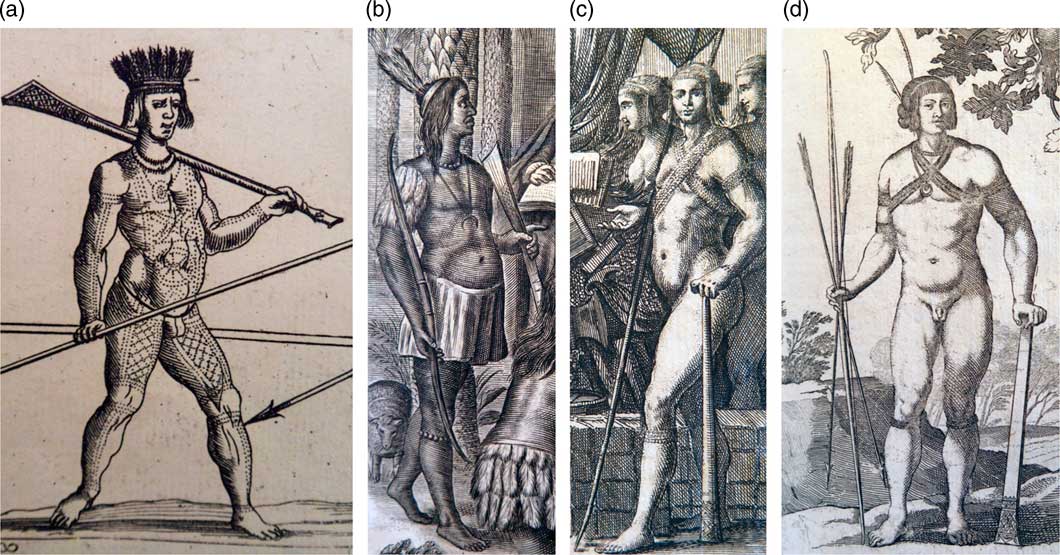
By the mid-seventeenth century, the classical pose, coupled with the stylistically accurate depiction of the club, was featured in the contemporary accounts of travellers such as Dudley (1646–Reference Dudley7), Rochefort (Reference Rochefort1658) and du Tertre (Reference du Tertre1667), all of whom travelled in the Caribbean – both Rochefort and du Tertre living for some time in the Lesser Antilles (fig 5). The illustrations featured in du Tertre (see fig 5c–d) were especially influential on subsequent publications,Footnote 25 so that the club is recorded well into the eighteenth century, though it is not clear whether it was still in use among the indigenous populations. The last glimpse of this style of club (outside of retrospective documentsFootnote 26 ) appears in Ferrario,Footnote 27 which draws largely on previous studies. Ferrario’s work is – surprisingly, given the length of time that separated him from the events documented in the seventeenth century – one of the few sources to document the artistic legacy of the Island Carib. Some researchers consider the Carib to have made no distinctive artistic contribution, particularly in comparison with their Greater Antillean neighbours, the Taíno (‘Taíno’ being an umbrella term for the various indigenous cultures inhabiting the Greater Antilles at the time of European contact).Footnote 28
Clubs featured in seventeenth-century illustrations. a) Detail of a warrior with a long club depicted on a map of the Guianas (British Guiana south to Amapá, Brazil) in Robert Dudley’s Dell’arcano del Mare (1646–7); source: Bodl, Map Res 107, pl. xiiii. b) Warrior with bow and club in Rochefort’s Histoire naturelle et morale des iles Antilles de l’Amerique (1658); source: Bodl, BOD 4 H 8 Art, frontispiece. c–d) Details from 1667 edition of du Tertre’s Histoire générale des Antilles Habitées par les François; source: Bodl, BB 121 Art., Vol. 1, frontispiece and BB 122 Art. Vol. 2, between pages 356 and 357
In contrast to the relatively well-documented clubs of the Lesser Antilles, there is little information on Greater Antillean clubs, perhaps intentionally so – the trope of the ‘peaceful’ Taíno versus the bellicose Island Carib being part of Spanish propaganda to justify the Island Carib’s enslavement, purportedly for the protection of the Taíno. Indeed, so successful were the Spanish in obscuring the presence of weapons among the Taíno that Lovén, a meticulous historian writing in the mid-1930s, noted that:
…weapons were exceedingly undeveloped among the Taínos. Indeed, a superficial comparison with the Island Caribs, Trinidad, Venezuela and Guiana shows at once how far behind the development in South America the Taínos had remained as regards their weapons.Footnote 29
Yet they were not absent: Oviedo notes that the Hispaniolan macanas were
…as broad as three fingers or a little less, and as long as the stature of a man, with somewhat sharp edges; and at the end of the macana a handle; and they use them as if they were two-handed battle axes; they are made of very solid palm wood and of other trees.Footnote 30
Las Casas supplies a more dramatic description:
… a spade of palm wood, which is extremely hard and very heavy, made in the following way: not sharp, but with a flat handle and uniformly thick, with which, since it is very hard and heavy like iron, although a man wears a helmet on his head, one blow will sink his skull into his brains.Footnote 31
Conrad, Foster and Beeker suggest that two club-like objects recovered from the waterlogged site of Manantial de la Aleta, in what is now the Dominican Republic, may be macanas; these are roughly hewn with bulbous ends, the largest measuring 79 cm in length.Footnote 32 If these surviving artefacts are, indeed, Taíno clubs, then they differ markedly from the elaborate examples seen in the representations attributed to the Lesser Antilles, and indeed the cronista descriptions, which document very large (‘as long as the stature of a man’Footnote 33 ), flat-handled and uniformly thick weapons with parallels to those in the Lesser Antilles.
Returning to the Island Carib boutou, although some of the earliest records describing these formidable weapons come from the Lesser Antillean area, it is not clear whether this style of long club can be provenanced solely to this region. Despite the Caribbean being the earliest part of the Americas explored by Europeans, and despite their subsequent sustained history of settlement and colonialism, no artefacts bearing a sixteenth- or seventeenth-century Lesser Antillean provenance have been documented in museum collections.Footnote 34 This in itself is surprising, particularly given the detailed and methodical descriptions of the histories of these islands and the keen interest that many European countries had in their resources, both natural and ‘artificial’. Of the clubs accessioned in the seventeenth century into European museum collections, none bear an explicitly Caribbean provenance, despite being attributed to ‘India occidentali’ (‘West Indies’). It was not until the mid-nineteenth century that they first began to be attributed to a wider range of sources, based on perceived stylistic affinities to more recent, though significantly smaller, indigenous clubs from Brazil, Venezuela and the Guianas.Footnote 35 Indeed, the Tradescant clubs were first attributed to Guyana in a manuscript catalogue of the Ashmolean collections (c 1870s), compiled by under-keeper George Rowell. This was later amended by his successor, Edward Evans, in a catalogue of c 1886, where they were described as coming ‘from British Guiana’ and ‘used by the Caribs and called Potu’.Footnote 36 This appears to be largely based on George Wood’s attribution of a similar club (in the Christy collection, and eventually to enter the British Museum) to the Carib of Guiana, though Wood’s attribution of this club was itself on tenuous grounds as it had no specific provenance when it entered the British Museum.Footnote 37 The ‘British Guiana’ link for the Ashmolean clubs is, therefore, speculative.
Many of the smaller, later clubs in museum collections frequently attributed to the Guianas occasionally feature the ‘diamond and curl’ designs first encountered in the late sixteenth- and early seventeenth-century club depictions.Footnote 38 The logical assumption would be that these smaller versions were an in situ development from the longer clubs featuring these design elements. The problem, of course, is that most such attributions were based on, at best, vague information – often to extensive regions (for example, ‘Brazil’, ‘British Guiana’, ‘Amazon’, etc) – and, at worst, misattribution, making the identification of a potential source for this distinctive style of club extremely difficult.
PREVIOUS ANALYSIS
For the purposes of this paper, the clubs are here identified as clubs 1 to 4, following the number sequence in the museum’s manuscript catalogue of c 1685 (table 1). Previous scientific analysis of the Ashmolean clubs has been limited to wood identification, undertaken by Dorothy Catling for the catalogue raisonné of the Tradescant collection.Footnote 39 A sample extracted from club 2 was identified as Brosimum sp. – ‘almost certainly B. caloxylon Standl’, according to Catling.Footnote 40 The other clubs were deemed suitably similar superficially to also warrant identification as Brosimum sp. However, the variation in the wood grain and colour seen in the clubs suggests the potential use of different woods. Indeed, a more recent visual (non-invasive, surface inspection only) assessment tentatively identified two clubs (clubs 1 and 2) as being carved of Tabebuia sp., another of Haematoxylon sp. (club 3) and another of Guaiacum sp. or Pimento sp. (club 4).Footnote 41 Given the discrepancies between these identifications, it was decided to take samples in order to more firmly document via microscopic analysis the woods from which the clubs were carved.
METHODS: 14C DATING, WOOD AND PIGMENT IDENTIFICATION AND STRONTIUM ISOTOPE ANALYSIS
The four Ashmolean clubs each underwent sampling for radiocarbon dating, wood identification and strontium isotope analysis to establish baseline data for this style of artefact, specifically in terms of chronology, materials and provenance. Prior to sampling, sections of endgrain on each club were exposed for microscopic examination. In each case, the exposed wood surface was significantly lighter in colour, raising the question of whether this was natural patination or an intentional modification. While the surfaces of some woods do darken with exposure to light, the possibility of surface colorants must also be considered.
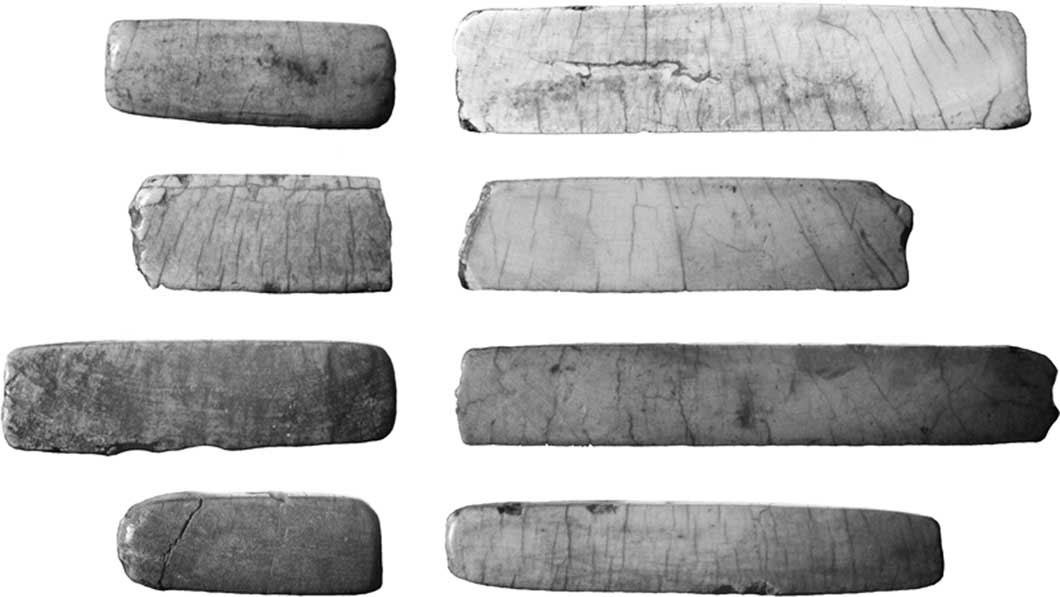
Black and white images of the endgrain were taken using a 950nm (infrared) filter on a converted Lumix GX1 camera (fig 6). These proved useful in identifying the growth rings otherwise obscured by surface coatings. Radiocarbon samples were taken from areas furthest from the pith, after wood identification samples had been taken from the same area: this was done to minimise contamination from unknown surface coatings that might affect the dating. Splinters and shavings intended for strontium isotope analysis were extracted from cleaned surfaces. Further samples were taken from other locations on the clubs to examine possible coatings, pigments and residues. For example, archival images show the clubs to have had white infill within the design panels (see fig 1),Footnote 42 though it is thought that this was added in the 1980s for photography, and so would overlay any original infill. Very little remains of this material now. A small sample (<1 mm diameter) of the white pigment from club 1 was taken for scanning electronic microscopy (SEM) and energy dispersive X-ray (EDX) analysis, as were samples of the black surface coating from all the clubs.
Black and white images of the endgrains of the four clubs taken with a 950 nm (infrared) filter, in sequential accession number from top to bottom (that is, AN1685 B.128 at top; AN1685 B.131, bottom). Image: J Thistlewood, courtesy of the Ashmolean Museum, Oxford
For radiocarbon dating, samples consisted of small shavings of wood weighing between 23 and 36mg. These underwent an extensive solvent extraction process, necessary because museum conservation records indicated that in the 1980s three of the clubs (clubs 1, 2 and 4) were cleaned with ‘violin oil’. This conservation treatment is likely to have included boiled linseed oil, turpentine, white vinegar and IMS (industrial methylated spirits, also known as de-natured alcohol, comprising approximately 95 per cent ethanol with 5 per cent methanol, isopropyl alcohol, acetone or methyl ethyl ketone). This targeted treatment was necessary given that incomplete removal of these substances prior to dating could have resulted in an erroneous date.
Samples were treated with sequential washes as follows: ultrapure Milli-Q™ water at 45°C, 3 hours; acetone at 45°C for 1 hour × 3, and left to air-dry overnight after the last acetone had been decanted off; ultrapure Milli-Q™ water at 45°C, 8 hours before freeze-drying; methanol at 45°C for 1 hour × 3; chloroform for 1 hour at room temperature, and then left to air-dry.
The samples then underwent the routine pre-treatment for wood applied at the Oxford Radiocarbon Accelerator Unit (ORAU), as described by Brock et al.Footnote 43 Briefly, this consisted of sequential washes with 1M hydrochloric acid (80°C, 20 min), 0.2M sodium hydroxide (80°C, 20 min), 1M hydrochloric acid (80°C, 1 hour), 5 per cent w/v sodium chlorite at pH 3 (80°C, 30 min), with thorough rinsing with ultrapure water in between each step. The samples were then freeze-dried and combusted, and the resultant CO2 cryogenically trapped before being converted to graphite for AMS radiocarbon dating.Footnote 44 The δ13C stable isotope ratio for each sample was measured by mass spectrometry during the combustion process.
Wood anatomy samples were trimmed with a razor blade to expose the transverse surface and then observed with a 14×loupe. Thin sections were cut from the radial and tangential (and sometimes transverse) surfaces of the specimen, when possible, and placed into a small pool of 1:1 glycerine: 95 per cent ethanol mounting medium on a slide labelled with the specimen designator. A coverslip was placed atop the sections and mounting medium, and the whole slide was transferred to a hot plate (105–150ºC) where it was heated until air bubbles ceased to exit the sections. The slide was then cooled and either stored horizontally in a covered slide case or observed immediately. Identifications were based on observation of cells and cell features, and comparison of those patterns and features to information in published keys, online databasesFootnote 45 and, ultimately, to specimens in the MADw-SJRw xylarium housed in the Center for Wood Anatomy Research at the Forest Products Laboratory in Madison, Wisconsin.
Due to possible contamination by water and preservatives, samples for strontium isotope analysis were also pre-treated following the protocols noted above for radiocarbon dating, but omitting the acid-base-acid (ABA) and bleach steps, which have unwanted effects on the strontium isotope composition of the samples.Footnote 46 Samples were then digested to enable strontium extraction for isotope analysis.Footnote 47
The purified strontium samples were evaporated, and the dried residues dissolved in 100µl of concentrated HNO3, evaporated and finally dissolved in 1.5mL of 0.05M HNO3. Strontium isotope compositions were measured on a Nu Plasma MC-ICP Mass Spectrometer (Nu015 from Nu Instruments, Wrexham, UK) at ULB. Particular attention was paid to the purity of the Ar gas used inside the spectrometer in order to avoid any interference (from Kr for instance) on Sr isotope masses. All Sr isotopes (84, 86, 87, 88) were measured, while the masses 85 (Rb) and 83 (Kr) were simultaneously monitored, allowing for interference corrections on masses 84, 86 (Kr) and 87 (Rb). All the data were corrected for mass fractionation by internal normalisation to 86Sr/88Sr=0.1194. In addition, after the measurements, all the raw data were normalised using a standard-sample bracketing method with the recommended value of 87Sr/86Sr=0.710248.Footnote 48 For each sample, the 87Sr/86Sr value is reported with a 2σ error (absolute error value of the individual sample analysis – internal error).
RESULTS
14C dating
The results of the 14C dating and wood identification are presented in table 1. Dates are calibrated in OxCal 4.2.2, using the IntCal13 curve.Footnote 49 Three clubs (1, 2 and 4) fall within the range c ad 1310–1440; while one (club 3) is later, dating to ad 1458–1638 (fig 7).
OxCal 4.2 plot of the 14C AMS results for the Tradescant clubs. Their estimated collection date is the mid-seventeenth century.

In light of the results, some caveats are necessary. It is difficult to demonstrate unequivocally that all carbon applied to the clubs since carving has been removed. Records detail the potential application of substances including linseed oil, turpentine and de-natured alcohol to the clubs over time. However, many of these substances (such as linseed oil and turpentine) would have dated to the time of application, or very close to it. Other treatments, such as IMS, and some that may not have been recorded, may have had petroleum origins, and hence may have potentially resulted in erroneously old dates if not removed from the wood prior to dating. It is likely that any ethanol (within IMS) would have evaporated during application, and the extensive organic solvent pre-treatment was designed to remove many substances unless they were cross-linked with the wood itself. Given that three of the four clubs provided similar dates (which can be combined statistically), it would appear unlikely that they were significantly more recent and all contained the same amount of contaminant to result in such similar dates.
The sampling for 14C was confined to the outermost tree rings identified on each club, so that the results are as close as possible to the felling date of the tree/bole/branch as can be achieved within the confines of the carving. While there is no indication of sapwood on any of the four carvings – and so it is not possible to say conclusively exactly how close to the outside of the bole the dating samples were taken – there are several mitigating factors when working such woods as Brosimum sp. that would favour a more pragmatic and labour-efficient wood carving approach, including the size of the tree and the density of its wood (see next section). If this were the case, we can be reasonably confident that the radiocarbon results are close to the terminus (that is, felling and manufacture) dates for the carvings.
The selected woods are extremely hard and dense and were likely carved either when green or after a short period of seasoning. Among some Central American groups, Brosimum caloxylon, which is a relatively small tree (averaging 12m in height and 30cm in diameterFootnote 50 ), was not used in a green state, but seasoned on the forest floor, where insects and natural decay stripped the sapwood from the heartwood.Footnote 51 However, this seasoning period is unlikely to be more than a few years, given the quick deterioration of organic matter when in contact with the forest floor, particularly in the humid tropics. Further, on average, Brosimum cf guianense (as opposed to B. caloxylon) is a substantial tree, with an average diameter range of 40–70cm, given the hardness and brittle nature of the wood,Footnote 52 so, considering the lack of metal tools, it is reasonable to assume that the carving sequence involved selecting young trees or straight branches of a sufficiently narrow diameter for the carving, minimising the amount of wood to be removed.
As Brosimum cf guianense is considered a long-lived tree, it is necessary to establish that the radiocarbon dates accurately reflect the clubs’ chronological range, and are not a result skewed by the ‘old wood’ problem. A Brosimum with a diameter at breast height of 58.8 cm is estimated to have a mean age of 477 years.Footnote 53 Of course, a multitude of variables, from soil nutrients to the amount of light from which a given tree benefits, affect the growth rate of that tree, so that considerable variability would be expected. The wood is extremely dense, brittle and splinters easily when worked; it blunts metal tools. Hence, reducing even a 40 cm Brosimum log’s diameter with stone and shell tools to create clubs ranging in width between 9 and 12 cm would result in a significant – and quite likely impractical – amount of work, even if fire-assisted reduction were involved. Further, the degree of curvature of the growth rings on each club’s endgrain would suggest that they were carved some distance from the pith (indeed, there is no advantage, in terms of wood strength, of carving a club from the pith versus the outer rings), which means that the preference was to work on the outer rings within a given branch or log (fig 8). This may have been for a variety of reasons: from ease of working to efforts in managing the typical warping that accompanies working green wood, given that the pith retains water longer as the outer edges of the bole dry out.
A hypothetical reconstruction of the position of club AN1685 B.129 within the originating bole/branch, based on the checks and angle of the growth rings visible on the club’s endgrain (note: the growth rings in tropical trees are often poorly developed, frequently absent and highly variable (Laurance et al Reference Laurance, Nascimento, Laurance, Condit, D’Angelo and Andrade2004, 131); those represented in the illustration are completely arbitrary and do not account for variables such as eccentric growth). The maximum width of the club is 9cm, and it is placed here within a 20cm bole. Based on the estimated mean age of Brosimum cf guianense (59cm=c 477 years; Laurance et al Reference Laurance, Nascimento, Laurance, Condit, D’Angelo and Andrade2004, table 1), this diameter would equate to c 150 years and, in this position, the club’s rings would equate to the last heartwood growth ring. Within this context, the 14C sampling position (marked with black dot) is within a relatively short period of the tree’s felling time. Image: J Ostapkowicz
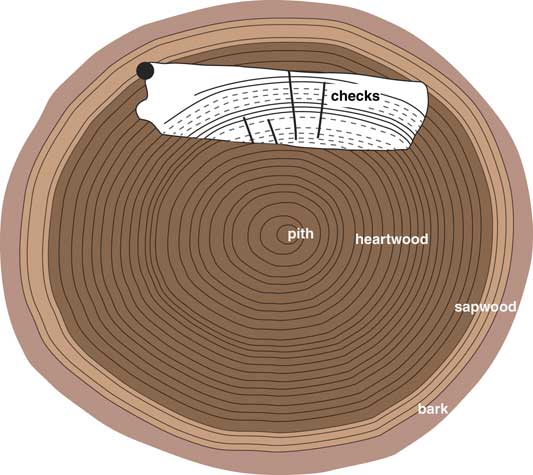
Several other features suggest that the woods were carved fresh. There are twists along the length of the clubs – some more noticeable than others – suggestive of shrinkage and warping, which is a common result of working green woods. Checks are also evident on the endgrain – these ruptures, which extend across growth rings (rather than parallel to them), are an indication of drying defects, though these are ambiguous in terms of their timing.Footnote 54 However, it seems reasonable to posit that the woods were carved when freshly felled and that, given the densities of the materials, a minimum amount of labour was more desirable and time efficient than working the wood down to the pith to create a club. This would suggest that the radiocarbon ranges encompass the clubs’ period of manufacture.
Materials identification: wood and pigment
The woods identified confirm Brosimum sp. (though favouring B. guianense rather than B. caloxylon, as originally proposed by D. Catling) as the material used for three of the clubs (clubs 1, 2 and 4), while one (club 3) is carved of Platymiscium sp. (see table 1).
The Brosimum cf guianense specimens are extremely dense and hard, even with imperfect preservation. This in and of itself eliminates the majority of species from any given area, including the tropics. Based on the proportion of fibres and the fibre wall thickness, it was estimated that the specific gravity of the wood was easily greater than 0.70, the threshold in The International Association of Wood Anatomists (IAWA) list of characters for hardwood identification for a ‘high density’ wood. Observed anatomical features used in identification include: aliform paratracheal parenchyma; very thick-walled fibres; abundant sclerotic tyloses; non-storied, mostly biseriate rays with marginal ray cells upright; prismatic crystals in the upright cells; and small non-vestured intervessel pits (fig 9).
Micrographs of wood ID samples taken from the clubs. Image: A C Wiedenhoeft Club 1: AN1685 B.128 1. Transverse section showing a vessel with sclerotic tyloses, thick-walled fibres, and aliform paratracheal parenchyma; 100um. 2. Radial section showing heterocellular rays with crystalliferous upright cells and a vessel with sclerotic tyloses; 100um. 3. Tangential section showing mostly biseriate heterocellular rays and sclerotic tyloses in the vessel; 100um. Club 2: AN1685 B.129 4. Tangential section showing mostly biseriate heterocellular rays; 100um. 5. Radial section showing heterocellular rays with crystalliferous upright cells; 100um. 6. Radial section showing extremely faint small intervessel pits; 50um. Club 4: AN1685 B.131 7. Transverse section showing a vessel with sclerotic tyloses and thick-walled fibres; 100um. 8. Radial section showing sclerotic tyloses; 100um. 9. Tangential section showing mostly biseriate heterocellular rays; 100um. Brosimum guianense, SJRw 4947 10. Transverse section showing vessels with sclerotic tyloses, thick-walled fibres, and aliform to confluent paratracheal parenchyma; 200um. 11. Radial section showing heterocellular rays with crystalliferous upright cells and a vessel with sclerotic tyloses; 100um. 12. Tangential section showing mostly biseriate heterocellular rays and sclerotic tyloses in the vessels; 100um. Club 3: AN1685 B.130 13. Radial section showing homocellular rays and small but abundant fibre pits; 100um. 14. Tangential section showing storied uniseriate rays and crystalliferous axial parenchyma; 100um. 15. Tangential section showing large vestured vessel-parenchyma pits; 25um. Platymsicium dimorphandrum, MADw 15709 16. Transverse section showing lozenge aliform parenchyma, narrow rays, and thick-walled fibres; 100um. 17. Radial section showing homocellular rays, crystals in chambered axial parenchyma, and abundant small fibre pits; 100um. 18. Tangential section showing storied mostly uniseriate rays; 100um.

As a tree, B. guianense ranges in height to c 30m with a diameter of 40–70cm,Footnote 55 and grows from southern Mexico and the eastern coast of Mesoamerica (Belize, Costa Rica, Guatemala, Nicaragua and Panama) to north-east South America (for example, Guyana, Surinam, Venezuela), including many Caribbean islands in between (for example, Jamaica, Antigua and Trinidad). It was apparently used to carve seats in the Lesser Antilles, as described by de la Borde,Footnote 56 who mentions a seat carved of a single piece of bois de lettre (‘letter wood’ or Brosimum guianense),Footnote 57 though the genus has not been identified in previous research on pre-Columbian carvings from both the Greater and Lesser Antilles.Footnote 58 The Carib of Guyana call it paila, and use it to make bows of ‘extraordinary quality’;Footnote 59 and the characteristic snake-skin pattern figuring undoubtedly carried symbolic weight, particularly for weapons.Footnote 60 Other common names in the Guianas (Guyana, Surinam and French Guiana) include: Aberemou; Amap purubumnak; E-mo-yik; Paira; Pileya; Pui-yik; Tibolkushi; Timeri; Tukwanru kamwi.Footnote 61
The variation in colour and finish on the three clubs carved from the same species – particularly the differences between the warm reds of clubs 1 and 2 and the dark brown-black of club 4 – is striking. However, B. guianense is itself known to be quite variable in colour, ranging from dark brown to strong reddish brown, with characteristic multiple narrow black streaks that give it the name ‘snakewood’.
The sample taken from club 3 showed a reddish colour on its interior surfaces, indicating the natural wood tone. This is consistent with, but not by itself indicative of, Platymiscium sp. Observed anatomical features included: storied and exclusively uniseriate, low and homocellular rays; prismatic crystals in chambered axial parenchyma cells; abundant and evident but small fibre pits; and medium to large vestured intervessel pits. The physical condition of the Platymiscium specimen was excellent, and the wood appeared sound and essentially unaffected by the passage of time. Given the condition of the wood, a water-soluble fluorescent extract test was performed and the result was a bright blue water fluorescence, which is one of the hallmarks of the genus. This, in conjunction with the anatomical characteristics, gives rise to the determination that the wood can be confidently attributed to the genus Platymiscium sp.
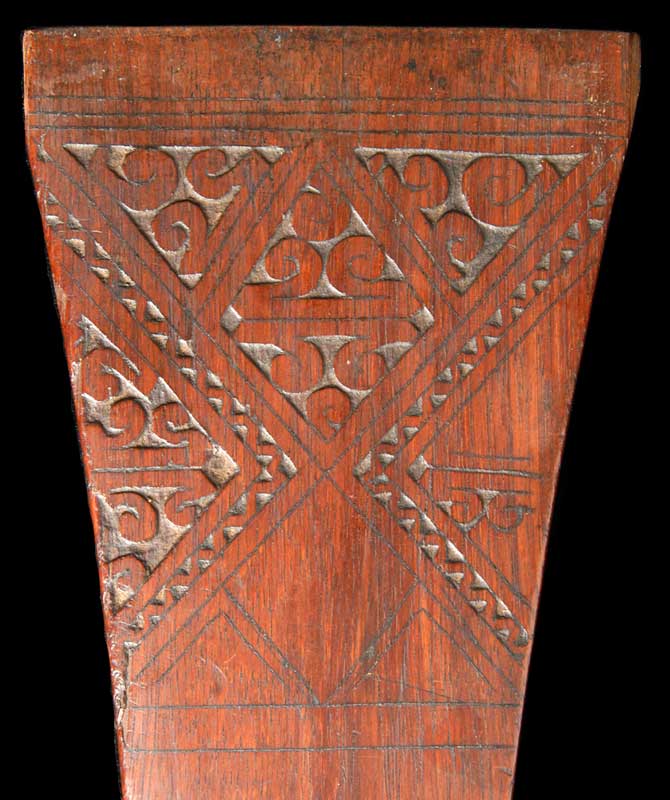
Platymiscium trees can reach up to 32m in height with a trunk diameter of up to 120cm, and their distribution spans northern Mexico to the northern half of South America and Trinidad.Footnote 62 Indeed, Trinidad’s Pitch Lake has yielded another Platymiscium carving: a paddle dating to ad 422–538.Footnote 63 The genus, however, is not reported for the rest of the Caribbean. The heartwood, which is a bright red to reddish brown with distinct stripes, is very heavy and dense, with an irregular and interlocked grain. Club 3 does, indeed, have a deeper reddish tone to the surface in comparison to clubs 1 and 2, and, unlike the other clubs, does not appear to have had additional dark pigments applied to its surface (apart from the designs outlined in the unfinished two-dimensional panel; fig 10).
Club 3 (AN1685 B.130) featuring the design outlined in black pigment in preparation for carving. Top design panel: H: 116mm; max W: 114mm, narrowing to 77mm. Image: J Ostapkowicz, courtesy of the Ashmolean Museum, Oxford
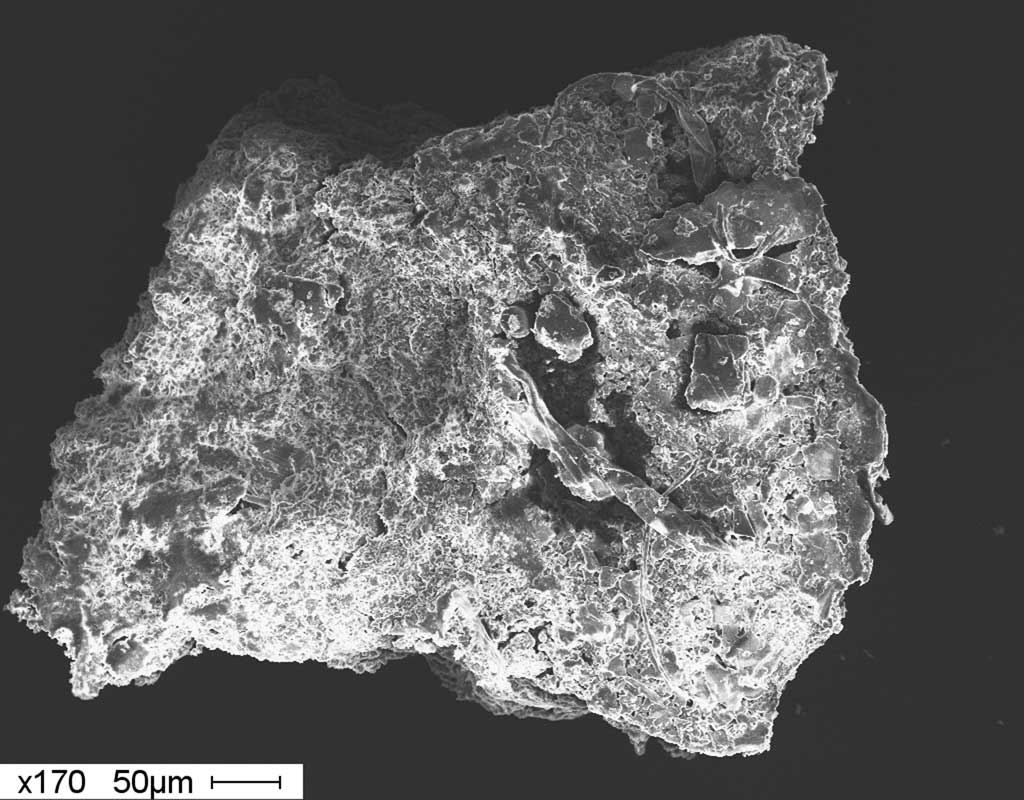
The white pigment sample from the recessed design panel of club 1 underwent SEM with EDX analysis. The SEM image (fig 11) shows a heterogeneous mix of closely packed materials, including at least one natural fibre and several different crystalline and non-crystalline structures. No bacteria or starch grains were visible, which means that the use of cassava flour – noted by du TertreFootnote 64 and some South American ethnohistories as a source of the white pigment on clubs – can be excluded for this particular example.
SEM image of the white powder sample from club 1 (AN1685 B.128), showing a heterogeneous mix of closely packed materials. Image: F Brock
EDX analysis indicated the presence of three distinct individual components:
1. Mg and Si, with low levels of Al, suggest the presence of magnesium silicates (likely talc or similar) and also some aluminosilicate material.
2. Calcium carbonate, which could have come from various geological sources (for example, chalk or limestone) as well as crushed shells.
3. Ca and S – possible calcium sulphide, sulphate or sulphite. Calcium sulphate and calcium carbonate are often found together in geological samples, and this may be the most likely source of the three compounds.
C and O were also detected, but not in discrete particles, suggesting the presence of organic materials, which may include material applied when the club was covered with another inorganic white powder applied at a later date; for example, for photography. It is highly possible that this could be a range of substances, rather than a single compound, and may include natural resins from the wood, substances applied at the point of carving or materials such as beeswax or linseed oil applied during more recent conservation treatment.
Strontium isotope analysis
The 87Sr/86Sr results range from 0.7093 to 0.7125 (table 2). The four samples differ sufficiently from one another that they must represent trees growing in different locations, though this need not equate to great distances given the geological and hence isotopic variability across part of the region.
Strontium isotope values

DISCUSSION
The radiocarbon results for clubs 1, 2 and 4 overlap, suggesting that they are at least approximately contemporary within the period c ad 1310–1440. All three dates can be successfully combined to c ad 1325–1425 in OxCal 4.2 (548±15 bp: ad 1324–45 (21.3 per cent) or ad 1392–1425 (74.1 per cent)) (χ2, df=2, T=1.5 (5 per cent 6.0)), which would not discount the possibility of their being carved at the same time. Stylistically, clubs 1 and 2 have strong parallels in their tightly geometric, two-dimensional designs, and possibly represent a unique village style, or potentially the work of a single carver, or closely related group of carvers. In contrast, club 4 differs not only in the looser treatment of the designs, but in the finish of material, although it is carved of the same wood (Brosimum cf guianense) as clubs 1 and 2, despite the tonal differences in colour. This suggests that, perhaps not surprisingly, a diverse range of club designs and treatments were contemporaneous.
Club 3 provides a significantly later date of ad 1458–1638. This club differs stylistically from the others, and is of added interest due to its unfinished design panel as well as in the choice of wood selected to carve it, identified as Platymiscium sp. Comparable designs can be found in early collections of Florence, Copenhagen and Munich (fig 12): that in Florence first appears in the inventory of Ferdinand ii de Medici in 1631.Footnote 65 If the Florence club had been acquired by 1631, there is every possibility that the similarly styled club 3 is its contemporary, and so its history must precede 1631. It is anticipated that further work – both in the archives and through dating a wider range of such early clubs – will refine the stylistic chronologies.
Stylistic similarities between early clubs: the Ashmolean’s Club 3 (AN1685 B.130) (left), and a club in the collections of the Museo di Storia Naturale (Sezione di Antropologia e Etnologia) in Florence (centre, Inv. 287), documented in 1631, and a club from the Museum Fünf Kontinente, Munich (right). Images: (left) photograph by J Ostapkowicz, courtesy of the Ashmolean Museum, Oxford; (centre) reproduced courtesy of the Museo di Storia Naturale (Sezione di Antropologia e Etnologia), Florence; (right) photograph by R Schulting; courtesy of the Museum Fünf Kontinente, Munich
Given what is currently known of the collection histories, the greatest likelihood is that all the India occidentali ‘tamahacks’ were acquired by John Tradescant the elder prior to his death in 1638. This just encompasses the date range for club 3, placed at ad 1458–1638. The Tradescants were at the height of their collecting in 1625–8. Tradescant the elder was negotiating with Buckingham’s contacts for curiosities, while Tradescant the younger travelled to Virginia in 1637–8. The seventeenth century was also an active period in the emergence of the British colonial enterprise, when no less than eleven islands (primarily in the Lesser Antilles) were settled, and the Guianas began to be explored, including Sir Walter Raleigh’s visit to the region in 1595.Footnote 66
While this style of club was first documented in seventeenth-century museum collections and illustrated in contemporaneous publications relating primarily to the Lesser Antilles, it is clear from various sources, and the radiocarbon results of this study, that their currency extends much earlier than this. Illustrations from voyages in the circum-Caribbean region suggest that this style was in use certainly by the 1580s,Footnote 67 with the first surviving examples documented from the shipwreck of the San Pedro of 1596.Footnote 68 While the sixteenth-century stylistic horizon was expected, given the independent documentary evidence, the dates from three of the Ashmolean clubs (1, 2 and 4) potentially extend this back to the late fourteenth/early fifteenth centuries, with the greatest likelihood of their combined ranges in the period ad 1392–1425 (74.1 per cent). This would mean that this style of club was in vogue for more than three centuries. Given that traditional arts among South American/Caribbean cultures do have centuries-long horizons,Footnote 69 this in itself is not unusual. What is perhaps initially surprising is the fact that organic artefacts, apparently used in actual conflict (and so susceptible to damage, breakage and loss), initially survived so long: they were made, collected and/or circulated c 200 years prior to being acquired by the Tradescants. Even accounting for the absence of sapwood, representing some years or even a few decades of growth, the dates would still fall within the mid-fifteenth century, implying at least a century or more of use/curation. This goes against the standard perceptions of the longevity of wooden artefacts, which are often perceived as ephemeral. But there is nothing ephemeral about these finely crafted, heavy pieces of personal weaponry: large, sleek and ornately decorated, they were elaborated above and beyond a functional weapon, and were undoubtedly created with strength and durability in mind. That a few may have been kept as prized regalia would be fitting, given their semantic weight.
The dating results suggest the intriguing possibility that there may have been an element of curation to at least three of the clubs spanning several generations. Rare references in the ethnographies indicate that they were prized and well cared for: in Hispaniola, for example, one macana was acquired via ransom, entering Columbus’ Inventario of 1495,Footnote 70 while others, belonging to a powerful cacique, were brought to him wrapped in yagua leaves (Oreodoxa).Footnote 71 In the Lesser Antilles, the boutou was the sine qua non of the warrior, and was carried into battle, but was also evident during other important and ceremonial events and, as such, an element of formal regalia.Footnote 72 That it would have been well cared for and maintained – its deeds potentially recounted by subsequent custodians – has resonance with elaborate weapons in many cultures. However, it would appear that by the beginning of the eighteenth century, clubs were beginning to be superseded by European imports: Adrien Le Breton, who lived in Martinique and St Vincent between 1693 and 1701, noted that some Carib now carried a sword instead of a boutou.Footnote 73
In terms of the white pigments used to enhance the two-dimensional design panels, cassava flour can be ruled out, at least in this particular instance. However, the use of ‘lime’ (CaCO3) as a design filler has been mentioned by other ethnohistorians,Footnote 74 and remains a possibility for future investigation.
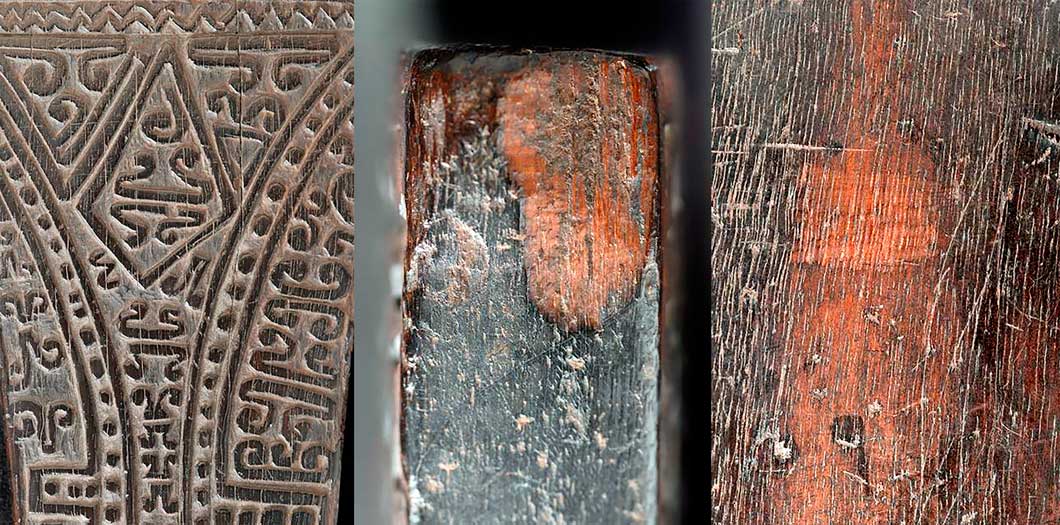
It is also possible that the significant colour differences between clubs 1, 2 and 4 were enhanced by pigments/colorants added to the surface of club 4, and these were perhaps oil-based materials to appreciably penetrate this dense wood. Club 4 has an almost uniform black/dark brown finish, even in the excavated two-dimensional design panels. But certain areas of the club, especially the damaged edges (fig 13), expose a reddish tone that is reminiscent of the colours of clubs 1 and 2. Black woods may have had a special significance in the circum-Caribbean region,Footnote 75 being made into items of chiefly prestige (such as ceremonial chairs), and it is possible that rather than a specific black-hued wood being consistently chosen, a variety of woods were used and simply finished with a darker stain. This is seen in some pre-Hispanic Caribbean sculptures,Footnote 76 and may well have been a practice in northern South America. Samples of what may be a black pigment have been taken for analysis, and work is underway to determine the source.
Three detailed views of club 4 (AN1685 B.131): (left) showing the dark surface covering even the recesses of the engraved areas; (centre) damaged area on one of the terminal end’s edges, exposing the red-toned inner wood in contrast to the much darker surface; (right) an area that either did not take to the darker stain originally, or was later rubbed/cleaned, exposing the lighter tone of the wood beneath. Source: photograph by J Ostapkowicz; courtesy of the Ashmolean Museum, Oxford
The 87Sr/86Sr results for the clubs are consistent with a range of geologies found in parts of Trinidad, Venezuela and the Guianas of north-east South American (fig 14). An origin in the volcanic islands of the Lesser Antilles north of Trinidad can be excluded, as 87Sr/86Sr values there would generally be less than 0.7080, with the notable exception of the limestone islands of Grand Terre and Marie-Galante with values of c 0.7092.Footnote 77 In addition, trees growing immediately along the coast of any island could be influenced by sea spray, leading to values close to 0.7092 for the modern ocean.Footnote 78 While it is conceivable that one club (with a value of 0.7093) could derive from a tree growing in the Lesser Antilles, the other three clearly derive from the older, more radiogenic, geological formations of Trinidad (and, to a lesser extent, the adjacent island of Tobago) or the South American mainland.
Boxplots of 87Sr/86Sr values on the Ashmolean clubs compared with biologically available values from the circum-Caribbean region (for sources, see text). River water values from French Guiana (not shown) are considerably more variable than suggested by the three plant values plotted here, ranging from 0.705 to 0.743, averaging 0.7012±0.009 (Négrel and Lachassagne Reference Négrel and Lachassagne2000).
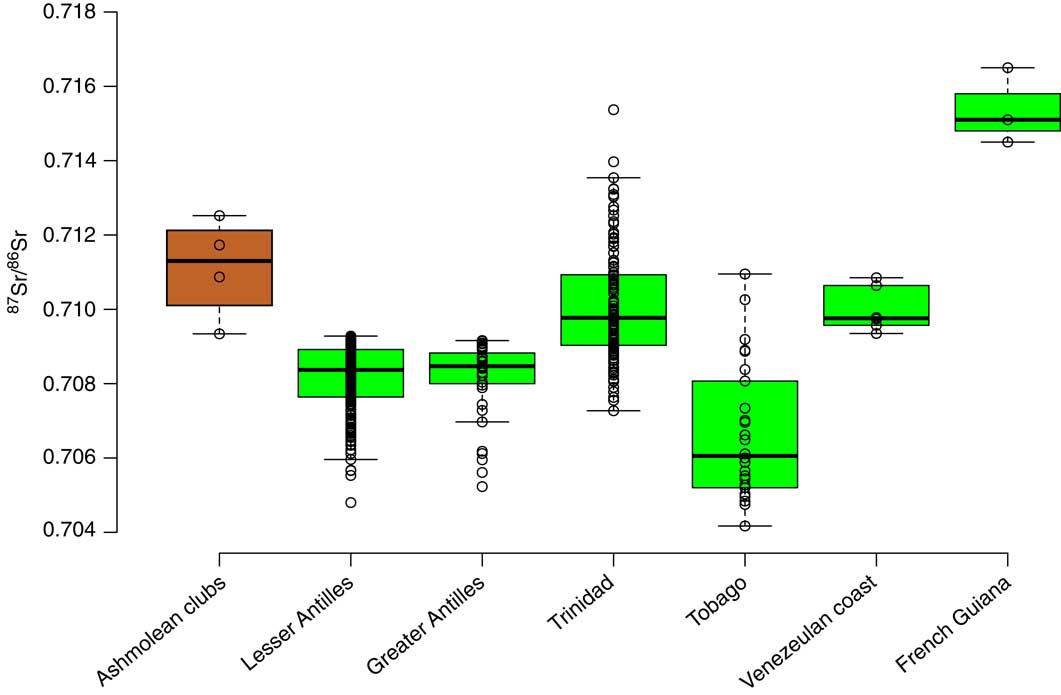
One study of bioavailable strontium isotope values (on modern plants and snails) from Trinidad average 0.7095±0.0009 (n=16), with the highest value falling at c 0.7115.Footnote 79 Another more recent study of modern tree species as part of a project on Trinidad’s Pitch Lake has produced 130 fully geo-referenced measurements.Footnote 80 The results show considerable variation across the island, with some regions exhibiting relatively low average values of c 0.7091, while other areas, particularly in the north of the island, have higher values of c 0.7116, with the highest individual value observed extending to 0.7154. Thus, the range of values from Trinidad alone is potentially compatible with all four Tradescant clubs. With the exception of the lowest value of 0.7093, they exceed the known biologically available strontium values from the Greater Antilles, which further excludes that region as a potential source of the clubs.Footnote 81
Plant 87Sr/86Sr values from the Guianas can be significantly higher, for example averaging 0.744±0.017 (n=23, only reported to three decimals) at Nouragues Reserve, French Guiana, on Precambrian geology.Footnote 82 At another location nearer the coast, plant values average 0.7154±0.0010 (n=3).Footnote 83 While these are higher than those of the Tradescant clubs, it is very likely that comparable values of c 0.711–0.712 can be found along the coast, given the presence of a band of Quaternary sedimentary deposits there.Footnote 84 French Guiana is far removed from the Caribbean proper, but the country’s geology is shared along much of the north-eastern South America. The clubs could, therefore, have originated from a long coastal zone stretching from Trinidad and eastern Venezuela to French Guiana. This is supported by club 3’s identification as Platymiscium sp., a genus not known in the Caribbean north of Trinidad. An origin in the mainland interior is excluded, given that this comprises the Precambrian rock of the Guiana Shield,Footnote 85 with elevated 87Sr/86Sr values typified by those noted for the Nouragues Reserve.Footnote 86 That the clubs are likely to have originated from along the coastal strip is not surprising, given that this is the area of more concentrated early European exploration.Footnote 87 Unfortunately, it is not possible at present to be any more specific based on the strontium isotope results alone. Further research may exclude some regions, but this is unlikely given the high variability in 87Sr/86Sr values expected at the junction of the Shield and the coastal geology.
An important point to emphasise in relation to the strontium isotope results is that they refer to the place where the trees, from which the clubs were carved, grew. They say nothing about the clubs’ subsequent movements, which may have been considerable, particularly in light of their long histories, as evidenced by the dating results. Moreover, as detailed below, the mainland and Island Carib maintained frequent contact, which certainly involved exchanges of materials and objects.Footnote 88
The dating results also indicate that a variety of panel designs are approximately contemporaneous; these may reflect regional or village styles. Three stylistic varieties are seen in the Ashmolean clubs, and additional combinations of design elements are seen in other early clubs.Footnote 89 The elegant, elongated shape of the club, and its significant size, remain fairly consistent across the corpus, again suggesting a recognisable style, the regional extent of which requires investigation, given the wide exchange networks and movements among the populations of north-eastern South America and the Caribbean islands. And it is, indeed, the thorny issue of provenance that still poses the greatest challenge with these clubs: while the strontium results suggest sources ranging from Trinidad south to French Guiana, the seventeenth-century images appear to emphasise the islands north of Trinidad. The only seventeenth-century illustration thus far encountered showing this style of club in the hands of a South American native appears within Robert Dudley’s Dell’arcano del Mare (1646–7),Footnote 90 on a map illustrating British Guiana south to Amapá, Brazil (see fig 5a). It is clear that artistic licence may have played a part in such early illustrations – when the regions and cultures were so poorly known, and artists rarely ventured beyond Europe – and so misattributions could easily enter into the composition.Footnote 91 A club sourced from the Guianas may have been deemed suitable for any generic, classical depiction of an ‘Island Carib’ warrior in a book plate – were it not for the fact that the authors of the books had spent years in residence on the islands, and may have brought back the clubs that were to feature in their volumes. Sébestian la Clerc, the illustrator of du Terte’s volume, was an exceptional draughtsman, and it is clear from his illustrations that he handled an original club, capturing its style in meticulous detail. The same cannot be said for every image of American material culture: indeed, some early illustrations of Caribbean natives are, at worse, complete fantasy and, at best, a failed attempt to capture the completely foreign iconography through a European, baroque-inspired lens.Footnote 92 The images of the clubs in Dudley, Rochefort and du Tertre, however, are clearly and accurately depicted, matching in detail the descriptions in the accompanying texts of the latter two.
While it will take time to untangle these details and explore the histories of these depictions, one intriguing, though entirely speculative, possibility is that these clubs were, in fact, highly prized items that were traded or acquired as war booty by the Island Carib from the South American mainland. There were not only healthy trade networks that bound the Guianas to the Lesser Antilles, but also well-documented animosities that fuelled wars and raids. As noted by Arie Boomert:
In these societies, exchange and war [were] merely two different expressions of the same reciprocal pattern of social interaction.Footnote 93
For example, the Island Carib maintained close trading relationships with both the Lokono (Arawak), who dominated trade routes between the Lower Orinoco Valley, the Paria and western Guiana coasts, as well as the Kalína (mainland Carib), who controlled trade in the eastern Guiana coastal zone.Footnote 94 Trinidad was the major gateway through which mainland goods, such as karakoli ornaments (thin, crescent-shaped nose and chest ornaments in a gold-copper alloy) and green stone tácaoua frog pendants, travelled into the Lesser Antilles.Footnote 95 Such long-distance trade between different language groups led to the development of trade jargons; indeed, Kalína pidgin was the lingua franca spanning the eastern Guianas to the Lesser Antilles.Footnote 96 The clubs, then, may provide tangible material manifestations of these links.
Moreover, the history of the Island Carib/Kalinago within the Lesser Antilles was first established – according to their own oral histories – by migrations of settlers from the mainland shortly before European contact.Footnote 97 The missionary Raymond Breton, who settled in Guadeloupe from 1635 to 1654, noted:
… they are descended from … peoples … who come from the mainland. This is completely certain. The friendship that they have with them and the trade of the one with the other are some indication as well as the uniformity of the name by which they both call themselves, namely kallinago.Footnote 98
Although different communities in the Lesser Antillean chain of islands had their own variations of this origin myth, the single common element in all of them is the migration of Kalína peoples from coastal Guiana into the Windwards (Trinidad north to Martinique).Footnote 99 This late phenomenon, which is still poorly understood, can be documented to some degree archaeologically: Island Carib/Kalinago pottery (termed ‘Cayo’) is thought to derive from the Koriabo ceramic tradition, which characterises the Guianas throughout the late prehistoric period, and is thought to have been introduced to the Windward islands around ad 1250.Footnote 100 If island styles were influenced by mainland precursors, and a lively trade of mainland material culture had been sustained during the protohistoric period, could the same be said for the import of other objects – such as clubs?
CONCLUSIONS
This study has focused on the dating and analysis of the materials used in construction of the four clubs known as Tradescant’s ‘India occidentali’ clubs, establishing key points of reference for this category of object.Footnote 101 While they represent only 10 per cent of the known examples of this early style of club, results presented here begin to provide a better understanding of the group as a whole. It is planned that the study will be extended to include other early examples in European collections, to further explore the main findings of the initial results of the project.
Radiocarbon dating places three of the clubs unexpectedly early, suggesting curation over at least two centuries prior to their acquisition by Europeans in the early to mid seventeenth century. An important caveat, however, is the assumption, albeit a not unreasonable one, that a small trunk or a branch would be selected for the making of a club, given the density of the wood and the difficulty of working it with stone and shell tools. These characteristics also make it unlikely that the wood was carved after a long period of seasoning, since it would then become even harder and more unpredictable to work. That the wood was carved green is consistent with the twisting and endgrain fissuring observed on the clubs.
The wood identification confirms that three of the clubs were made of Brosimum sp., which is widely distributed throughout the circum-Caribbean. Club 3, however, was identified as Platymiscium sp., which does not occur in the insular Caribbean, with the exception of Trinidad. Further research is needed to identify the white material used to highlight the two-dimensional design panels, and the possible darkening pigments applied to the woods’ surfaces.
The results of the strontium isotope analysis are unequivocal in placing the trees from which three of the clubs were carved on older, relatively radiogenic geological formations, such as occur on Trinidad and the near-coastal zone of Venezuela and the Guianas. Placing the remaining club 1 is far more difficult, since it essentially presents a ‘coastal’ 87Sr/86Sr value that could be found almost anywhere along the circum-Caribbean coast. However, it shares a strong stylistic similarity to club 2, but the scale over which this can inform on cultural affinity is unclear, given the clear evidence for widespread and frequent contacts between the mainland and Island communities. Again, this requires more research on a larger body of material.
The scientific techniques applied here can illuminate some aspects of the histories of important objects in early museum collections that would otherwise remain elusive. This is particularly germane for the early style of wooden club discussed here, for which there are no known parallels. They ceased to be made in the seventeenth century, and it is difficult to trace their histories without engaging with the evidence they materially embody. The analytical methods employed here provide us with the tools to pose and potentially answer new questions.
ACKNOWLEDGEMENTS
The radiocarbon dates were supported by a NRCF grant (NF/2014/2/0). The authors thank Mark Norman, Head of Conservation, Ashmolean Museum, for his support of this study, and Jon Painter (Cranfield Forensic Institute, Cranfield University) for SEM–EDX analysis. The authors would also like to thank Arie Boomert and the journal’s anonymous reviewers for their comments on the manuscript.
ABBREVIATIONS AND BIBLIOGRAPHY
Abbreviations
- Bodl
Bodleian Library, Oxford



