


1. Introduction
In 1992, the international community adopted the United Nations Framework Convention on Climate Change (UNFCCC), aimed at stabilizing atmospheric greenhouse gas (GHG) concentrations ‘at a level that would prevent dangerous anthropogenic interference with the climate system’.Footnote 1 While the convention offered some guidance on what constitutes dangerous interference, it did not establish a consensus on the variables needed to define such a threshold. What level of anthropogenic global warming threatens global food production? Which degree of warming sufficiently disrupts ecosystem equilibrium? Which threshold ensures economic development proceeds sustainably?Footnote 2
It took more than two decades of political negotiations and incremental progress to finally reach a meaningful agreement.Footnote 3 In 2015, one of the most significant contributions of the Paris Agreement was its capacity to operationalize the UNFCCC’s temperature stabilization goal. Building on the Intergovernmental Panel on Climate Change’s (IPCC) scientific insights, as well as the previous work of the Conference of the Parties (COP),Footnote 4 the international community established a long-term temperature objective, aiming to restrict global temperature increases to 1.5–2°C.Footnote 5 However, the adoption of the agreement raised critical questions about the precise interpretation of its objective. For the last ten years, extensive debates have surrounded the legal implications of Article 2 and whether the target should prioritize the 1.5°C or the 2°C temperature limit. The recent Advisory Opinion of the International Court of Justice (ICJ) has not remained indifferent to these questions.
This article seeks to contribute to this ongoing discussion by proposing a novel argument: since the 1.5°C temperature goal represents the object and purpose of the Paris Agreement, parties have a legal obligation to refrain from acts that would defeat it. As this commitment is best characterized as a due diligence obligation, the article also examines the factors that determine its standard of conduct.
To support this claim, the article adopts a legal doctrinal approach, recognizing that many elements of the law are context-dependent and must be interpretedFootnote 6 using the legal system as the primary source of categories, concepts, and criteria.Footnote 7 However, given the centrality of science in international environmental law,Footnote 8 the analysis also draws on the most authoritative scientific knowledge available, particularly from the IPCC and the World Meteorological Organization. This interpretative process employs deductive legal reasoning to develop general principles that can subsequently be applied to, and refined within, different branches of international law,Footnote 9 including, in particular, international climate change law.
To clarify the argument, the article is divided into three parts. The first examines the historical evolution of the Paris Agreement’s long-term temperature goal (Section 2). Starting with the adoption of the UNFCCC in 1992, it explores how the 1.5°C–2°C goal came to concretize the Convention’s objective. The second part analyses the content of the temperature goal, focusing on the differences between the 1.5°C and 2°C targets and assessing which of these represents the preferential goal of the Paris Agreement (Section 3). Finally, the third part explores the legal nature of the long-term temperature objective. It begins by outlining the legal consequences that flow from the object and purpose of a treaty and then applies those conclusions to Article 2(1)(a) of the Paris Agreement (Section 4).
2. The long path to the long-term temperature goal
The first attempts to operationalize the UNFCCC stabilization goal were geographically limited and focused on emissions reductions rather than temperature limits. The UNFCCC, for example, aimed to stabilize Annex I parties’ emissions to their 1990 levels by 2000.Footnote 10 Similarly, the Kyoto Protocol included a collective goal to reduce the overall emissions of Annex I parties by 5% below 1990 levels during the commitment period 2008–12.Footnote 11 However, the shortcomings of the Kyoto Protocol highlighted the limitations of partial objectives, opening the door to new approaches. It was the moment to try new formulas.
The first steps in this direction emerged in 2009. In July 2009, the Group of Eight (G8) adopted the Declaration on Responsible Leadership for a Sustainable Future. Supported by growing evidence from the IPCC, the declaration is the first major international political accord recognizing that ‘the increase in global average temperature above preindustrial levels ought not to exceed 2°C’.Footnote 12
This new perspective quickly gained traction in other forums. Only a few months after the G8 summit in December 2009, the Copenhagen Accord proposed an even more ambitious limit. To understand this shift, it is important to note that a 2°C increase already poses existential threats to many UNFCCC parties.Footnote 13 Therefore, during the intense negotiations of the Copenhagen Accord, several parties questioned the adequacy of this temperature target. Ultimately, the parties agreed on a single 2°C goal while acknowledging the possibility of ‘strengthening the long-term goal referencing various matters presented by the science, including in relation to temperature rises of 1.5 degrees Celsius’.Footnote 14
Despite the Copenhagen Accord’s significance in introducing a precise temperature target, it failed to achieve the consensus necessary to become a decision of the Conference of the Parties (COP); instead, the conference merely ‘took note’ of its content.Footnote 15 Nonetheless, this represented a critical first step, marking the beginning of the long journey toward the recognition of a temperature target.
One year later, in 2010, intense negotiations and a flexible interpretation of the COP rulesFootnote 16 culminated in the adoption of the Cancun Agreement. For the first time, a COP decision included the long-term temperature goal. Mirroring the Copenhagen model, the Cancun Agreement only recognized a 2°C goal but mentioned the possibility of strengthening it in the future.Footnote 17
While the Cancun Agreement represented a significant political achievement, it fell short for many parties, particularly the Alliance of Small Island States (AOSIS), Least Developed Countries (LDCs), and the African Group.Footnote 18 In the subsequent years, numerous actors – including the aforementioned coalitions, additional states, scientists, and NGOsFootnote 19 – advocated for a literal recognition of a 1.5°C threshold and sought to elevate its legal status to that of a treaty norm.
In line with these demands, the Paris Agreement fulfils both objectives. Article 2 states that the Agreement, an international treaty, aims to limit the Global Mean Surface Temperature (GMST) increase ‘to well below 2°C’, while ‘pursuing efforts to limit the temperature increase to 1.5°C above preindustrial levels’.Footnote 20 As noted by the ICJ, this objective constitutes ‘an important concretization of the Framework Convention’s overall objective of averting dangerous concentrations of GHGs in the atmosphere’.Footnote 21
However, Article 2 did not resolve the debates regarding the exact content and legal nature of the long-term temperature goal. The adoption of the Agreement triggered vigorous discussions over whether the reference threshold should be at 1.5°C or 2°C.Footnote 22 Additionally, critical debates emerged over whether the temperature objective constitutes an obligation or merely a political aspiration.Footnote 23 Given the critical importance of these debates, the following two sections address these questions. Section 3 explores why international law prioritizes the 1.5°C target over the 2°C goal. Section 4 examines why it is not merely a political goal, but rather a provision that entails legal consequences.
3. The 1.5°C as the reference goal
Since global warming is a gradual event, its biophysical consequences vary with every tenth of a degree of temperature increase.Footnote 24 Similarly, defining a temperature threshold also has a significant impact on the parties’ obligations, especially those involving a standard of diligence, such as the obligation to prepare, communicate and maintain ambitious Nationally Determined Contributions (NDCs).Footnote 25 In this context, following the adoption of the Paris Agreement, the debates on the temperature reference threshold gained significant importance. Rajamani and Werksman argued that Article 2(1)(a) consists of a single goal with two elements. On the one hand, the parties prioritized the ‘well below 2°C target’ in the first place and framed it in normative terms. By contrast, the 1.5°C goal is stated as the second option and defined as an objective pursued by the Agreement.Footnote 26 As a result, the authors contend that the prominence given to the 2°C establishes it as the reference goal.
By contrast, Voigt invoked Article 31(3)(a) of the Vienna Convention on the Law of Treaties (VCLT) to argue that the temperature goals should be interpreted in light of subsequent decisions of the COP and the Conference of the Parties serving as the meeting of the Parties to the Paris Agreement (CMA).Footnote 27 In this context, CMA3,Footnote 28 CMA4,Footnote 29 and CMA5Footnote 30 recognize ‘that the impacts of climate change will be much lower at the temperature increase of 1.5°C compared with 2°C’ and resolve ‘to pursue efforts to limit the temperature increase to 1.5°C’. While Voigt acknowledged that the conferences cannot rewrite the Paris Agreement, she asserted that the evolution of the CMA’s consensus-based process put ‘a stronger normative weight on the efforts to limit the temperature increase to 1.5°C compared with “well below 2°C”’.Footnote 31 Consistently, she gave prominence to the 1.5°C goal.
This debate has also been addressed in recent advisory opinions and judgments issued by the ICJ, the International Tribunal for the Law of the Sea (ITLOS), the Inter-American Court of Human Rights (IACtHR), and the European Court of Human Rights (ECtHR). All four tribunals adopt 1.5°C as the temperature reference threshold.Footnote 32 Both the ICJ and ITLOS follow a similar reasoning to that proposed by Voigt. As the ICJ states:
[COP] decisions express the agreement in substance between the parties regarding the interpretation of Articles 2 and 4 of the Paris Agreement, and thus constitute subsequent agreements in relation to the interpretation of the Paris Agreement within the meaning of Article 31, paragraph 3 (a), of the Vienna Convention on the Law of Treaties (see paragraph 184 above). Accordingly, the Court considers the 1.5°C threshold to be the parties’ agreed primary temperature goal for limiting the global average temperature increase under the Paris Agreement.Footnote 33
Likewise, in the Advisory Opinion submitted by the Commission of Small Island States on Climate Change and International Law, ITLOS states that the ‘dual temperature goal stipulated in the Paris Agreement has been further strengthened by the successive decisions of the Parties to the Paris Agreement’.Footnote 34 ITLOS notes that Decision 1/CP.27 interprets Article 2 and resolves ‘to pursue further efforts to limit the temperature increase to 1.5°C’.Footnote 35 Similarly, in the Verein Klimaseniorinnen Schweiz and others v. Switzerland case, the ECtHR also contextualizes its analysis of Article 2(1)(a) with the consensus expressed by the subsequent COP Decisions 1/CP.26 and 1/CP.27.Footnote 36
The ICJ and the ECtHR also base their analysis of Article 2 on a second element: the scientific knowledge produced after the adoption of the treaty. The ICJ notes that ‘1.5°C has become the scientifically based consensus under the Paris Agreement’Footnote 37 and adds that recognizing the 1.5°C threshold as the agreed primary temperature goal is consistent with the requirement that mitigation measures be based on the best available science.Footnote 38
The ECtHR further develops this analysis. However, before exploring the European Court’s perspective, it is important to note that, in 2015, the UNFCCC Structured Expert Dialogue report highlighted the scarce and less robust nature of the literature on the impacts of 1.5°C warming.Footnote 39 Similarly, the report noted that, for many sectors, the differences between a 1.5°C and a 2°C temperature increase were difficult to assess.Footnote 40 In response, the same Decision 1/CP.21 that adopted the Paris Agreement invited the IPCC to prepare a special report on the impacts of global warming of 1.5°C.Footnote 41
In this context, the ECtHR’s judgment highlights that the 2018 IPCC Special Report found that any increase in global temperature adversely affects human health, with primarily negative consequences, and that lower risks are projected at 1.5°C compared to 2°C.Footnote 42 The Court also notes that subsequent IPCC Assessment Reports have reached the same conclusion.Footnote 43 Accordingly, the ECtHR acknowledges that, since the adoption of the Paris Agreement, scientific understanding has developed further,Footnote 44 leading to a cogent scientific evidence on, inter alia, the progressively increasing risks associated with higher levels of warming.Footnote 45
Apart from the political consensus expressed in the CMA decisions and the emergence of new scientific knowledge informing the interpretation of the Paris Agreement, this article supports Voigt’s perspective with a third argument: the 1.5°C goal aligns more closely with other relevant rules of international law.
According to the general rule of interpretation under the VCLT, treaty provisions shall be interpreted in good faith and in accordance with the ordinary meaning of their terms.Footnote 46 However, in this case, the ordinary meaning of Article 2 does not resolve the issue. While the parties aim to hold the increase in GMST to well below 2°C, they also express a clear intention to pursue efforts to limit it to 1.5°C. Accordingly, a priori, both targets could serve as the interpretive reference point.
In this context, Article 2 of the Paris Agreement cannot be interpreted in isolation, as if it were a provision suspended in a vacuum. Pursuant to Article 31 of the VCLT, treaty provisions must also be interpreted in light of the treaty’s context, any subsequent agreements between the parties regarding the application or interpretation of the Paris Agreement, the parties’ subsequent practice, and other relevant rules of international law.Footnote 47 As noted above, subsequent agreements – such as the CMA Decisions – and the prevailing scientific and political context have prioritized the 1.5°C goal.
As advanced above, the same conclusion is reached when analysing other relevant rules of international law. As the ICJ and ITLOS recognize, climate-related obligations extend beyond the UNFCCC and the Agreement.Footnote 48 Particularly, any interpretation must be consistent with general international law and the principles of international environmental law.Footnote 49 Given the gradual nature of climate change and the critical differences between 1.5°C and 2°C of global warming, the principles of precaution and prevention – both enshrined in the UNFCCC –Footnote 50 support the 1.5°C target as the preferential goal.
As the ICJ has stated, the duty to prevent requires states to use all means at their disposal to avoid activities within their territory or jurisdiction that cause significant harm to the climate system.Footnote 51 Similarly, the ILC has recognized that where such harm cannot be entirely avoided, it must at least be minimized.Footnote 52 In this context, the above-mentioned 2018 IPCC report demonstrated that the 0.5°C difference between these two targets is significant for the frequency, intensity, and geographic extent of droughts,Footnote 53 floods,Footnote 54 heatwaves,Footnote 55 sea-level rise,Footnote 56 or biodiversity loss.Footnote 57 Moreover, these impacts will also affect several general interests of the international community, including global food security,Footnote 58 extreme poverty eradication,Footnote 59 and the full enjoyment of human rights.Footnote 60 Thus, in case of doubt, the principle of prevention also directs attention to the 1.5°C target.
Moreover, there remains considerable uncertainty regarding the behavior of tipping points,Footnote 61 but the IPCC recognizes that ‘their occurrence cannot be excluded, and their chances increase with warming levels’.Footnote 62 As the Dutch Supreme Court puts it, in this context of uncertainty, ‘the precautionary principle means that more far-reaching measures should be taken to reduce greenhouse gas emissions, rather than less far-reaching measures’.Footnote 63
Accordingly, the political consensus expressed through COP and CMA Decisions, the scientific knowledge produced after the adoption of the Paris Agreement, the jurisprudence of international courts, and an interpretation of Article 2 consistent with the principles of international environmental law confirms that the Agreement prioritizes the 1.5°C temperature goal.
This preponderance of the lower limit has significant implications for the interpretation and implementation of the entire regime.Footnote 64 According to IPCC data, each GMST increase is associated with a specific remaining global carbon budget. While achieving the 2°C target – with a 67% likelihood – limits global CO2 emissions to 1,150 Gt starting from the beginning of 2020, achieving the 1.5°C target – with a 50% likelihood – means humanity can only emit 500 Gt (see Figure 1).
Remaining Carbon budgets from the beginning of 2020
Source: Figure 3.5 in IPCC, 2023: Climate Change 2023: Synthesis Report. Contribution of Working Groups I, II and III to the Sixth Assessment Report of the Intergovernmental Panel on Climate Change [Core Writing Team, H. Lee and J. Romero (eds.)]. IPCC, Geneva, Switzerland, pp. 35–115, doi: 10.59327/IPCC/AR6-9789291691647.

Figure 1: Long description
The bar graph compares cumulative carbon dioxide emissions and remaining carbon budgets from 1850 to 2020. The x-axis represents cumulative CO2 emissions in gigatonnes of CO2 (GtCO2), ranging from 0 to 2000. The y-axis lists different categories: Historical emissions from 1850 to 2019, remaining carbon budgets for 1.5°C and 2°C warming scenarios, 2020 to 2030 CO2 emissions assuming constant levels, and lifetime emissions from existing and planned fossil fuel infrastructure. The graph features horizontal bars indicating the amount of CO2 emissions for each category. Historical emissions are shown in dark gray, remaining carbon budgets in green, and future emissions in various shades of gray. Key labels include the remaining carbon budgets for 1.5°C with a 50% chance, 2°C with an 83% chance, and 2°C with a 67% chance. Annotations indicate the maximum emissions to stay within a 2°C warming scenario with an 83% chance. The graph highlights the significant implications for interpreting and implementing climate targets based on IPCC data. All values are approximated.
That notwithstanding, this prioritization does not imply that, if the 1.5°C threshold is surpassed, the parties can simply pursue a 2°C scenario. Following the reasoning outlined above, in a 1.5°C world the next limit is set at 1.51°C. As the ICJ and ITLOSFootnote 65 establish, ‘the best available science indicates that the “[r]isks and projected adverse impacts and related losses and damages from climate change escalate with every increment of global warming”’.Footnote 66
Similarly, ECtHR’s Judge Eicke states in his partly concurring, partly dissenting opinion:
After all, every tenth of a degree increase has an immediate impact and leads to an increase in the damage and danger created by climate change and, in fact, we all need to take immediate and effective steps to avoid any further increase.Footnote 67
Finally, many experts who contributed to the 2018 Special Report on 1.5°C have emphasized this same message.Footnote 68 Accordingly, Article 2 must be interpreted as reflecting the gradual nature of global warming, rather than implying a binary choice between 1.5°C and 2°C. In this context, the same reasoning that supports prioritizing the 1.5°C goal also favours selecting the lowest degree of warming within the subsequent agreed range of 1.51°C to 2°C. The scientific and political consensus established since the adoption of the Agreement, together with the principles of prevention and precaution, consistently advocate for minimizing climate risks by aiming for the least dangerous level of warming.
4. The legal nature of the long-term temperature goal
If the temperature threshold generates discussion, the debate over its legal nature is even more contentious. On the one hand, authors like NiggolFootnote 69 and Singh Ghaleigh describe the long-term temperature target as ‘a collective goal, framed in aspirational language, and as such does not impose binding obligations in State Parties’.Footnote 70 Similarly, Mayer acknowledges that Article 2 serves a critical interpretative function but does not impose any concrete commitment.Footnote 71 The author argues that the long-term temperature goal is too vague to guide the parties’ mitigation commitments, and that post-Paris Agreement state practice suggests there is no international obligation to act in accordance with the temperature targets.Footnote 72
Likewise, Rajamani and Werksman analyse Article 2 by examining its location, precision, and wording. They recognize that the parties placed the article in the operational part of the treaty and that it is sufficiently precise to construct a global carbon budget and emissions pathways. However, they argue that the wording ‘aims to’ suggests that the article merely sets an aspiration. Therefore, they contend that Article 2 serves a critical interpretative function but does not create distinct individual or collective commitments.Footnote 73
By contrast, Maiko Meguro upholds that the long-term temperature goal declares a collective obligation.Footnote 74 However, she cautions that its justiciability is questionable. Through an analysis of the drafting process of climate treaties, Meguro concludes that Article 2 creates an indivisible commitment.Footnote 75 She therefore contends that the obligation is attributable to all states, together as one, with no party held individually responsible for failing to contribute to the 2°C trajectory.Footnote 76
Alexander Zahar sustains a similar position. He interprets Article 2 in conjunction with Articles 3 and 4(2) of the Paris Agreement. Since both provisions are mandatory and the parties must implement them to achieve the Agreement’s goal, Zahar concludes that ‘achieving the purpose of Article 2.1 is also mandatory, notwithstanding the legally neutral wording of Article 2.1 when read in isolation’.Footnote 77 However, in analysing the nature of the commitment, Zahar argues that it would constitute a collective obligation held by the international community as a whole. According to the author, the breach of such an obligation would entail collective cumulative shared responsibility – lying with the international community as such and not allowing for proportionate attribution of individual state responsibility. Given that this type of obligation would be unprecedented and unique, the author contends that the parties should have explicitly expressed their intention to create it. Nevertheless, during the drafting process, no reference was made to the emergence of a new type of commitment. Accordingly, Zahar maintains that the Paris Agreement ‘does create a collective obligation in form, but does not make it a legal obligation with legally binding force in substance. It therefore subsists at the level of an aspiration, albeit a very important one’.Footnote 78
Finally, Voigt does not consider Article 2 among the legally binding obligations of the Paris Agreement.Footnote 79 However, she also asserts that the long-term temperature goal produces important legal effects. In particular, the author upholds that the objective sets the international standard for assessing the parties’ level of mitigation ambition.Footnote 80
This debate is of critical importance in assessing the parties’ observance of the Paris Agreement. Accordingly, it has also been addressed by the ICJ in its recent Advisory Opinion. In this case, the Court provides a succinct analysis of Article 2 in conjunction with Article 4(1) of the Paris Agreement. Contrary to some of the authors mentioned above:
The Court observes that the achievement of the temperature goal set out in Article 2, which is referenced in Article 4, paragraph 1, as well as the aim to reach a global peaking of GHG emissions as soon as possible, are obligations addressed to all parties as a whole. Thus, the temperature goal contained in Article 2 and referenced in Article 4, paragraph 1, constitutes, in addition to the object and purpose of the Agreement, the ‘context’ relevant for the interpretation of other obligations found elsewhere in the Paris Agreement, such as the mitigation obligations under Article 4.Footnote 81
Unfortunately, the Court does not elaborate on the reasoning by which this collective obligation emerges from Articles 2 and 4(1), nor on the specific content of such a duty. Moreover, the latter part of the paragraph appears to suggest that its only consequence – albeit, as Section 3.2 examines, a highly significant one – is interpretative in nature.Footnote 82
In any case, while this article agrees with the Court that Article 2 may entail certain legal consequences, it aligns with Niggol,Footnote 83 Singh Ghaleigh,Footnote 84 Rajamani, and WerksmanFootnote 85 in defending that the wording of a political objective cannot be equated with that of legal ‘obligations addressed to all parties as a whole’ Footnote 86 – even where its effects are limited to interpretative consequences.
In this regard, the Court’s use of the category obligation to refer to Articles 2 and 4(1) runs contrary to the provisions of the VCLT. As noted above, Article 31 establishes that treaty provisions must be interpreted in good faith and according to the ordinary meaning of their terms.Footnote 87 In this case, neither Article 2 nor Article 4(1) is expressed in legally binding terms. While the parties could have used formulations such as ‘shall’ or ‘must’, Article 2(1) sets out what the Agreement ‘aims’ to achieve, and Article 4(1) specifies what the parties ‘aim’ to do. Moreover, as the sections below demonstrate, although Article 2(1)(a) expresses the object and purpose of the Paris Agreement, public international law does not impose a legal obligation to achieve a treaty’s raison d’être.
Furthermore, the Court’s perspective may prove counterproductive. Political goals and standards may help interpret the content of a regime’s provisions,Footnote 88 especially, but not exclusively, when they constitute the object and purpose of a treaty.Footnote 89 If, following the Court’s recent Advisory Opinion, such goals automatically become commitments, parties may be discouraged from including them in future treaties, thereby complicating the task of legal operators in interpreting international obligations.
As mentioned above, the Court’s analysis of this obligation is very succinct and, despite its novelty, does not incorporate a reasoning why such aspirational wording entails a collective obligation. In this context, the present article seeks to contribute to the discussion on the legal nature of Article 2(1)(a). Its perspective broadly aligns with those of several authors referenced earlier, acknowledging that Article 2(1), when read in isolation, does not establish a mandatory commitment. However, insofar as it expresses the object and purpose of the Paris Agreement, it entails a legal obligation to refrain from acts that would defeat the 1.5°C goal.
4.1. The long-term temperature goal as the purpose of the Paris Agreement
Linderfalk defines the object and purpose of a treaty as the reason for its existence, the treaty’s ratio legis or raison d’être.Footnote 90 Similarly, Pons,Footnote 91 Jonas, and SaundersFootnote 92 define it as the treaty’s goal. Accordingly, the object and purpose reflect the common motivations and interests that drive the parties to adopt the treaty.
Before analysing whether Article 2 constitutes the Paris Agreement’s object and purpose, it must be examined whether the terms object and purpose express different concepts or refer to the same notion. In this sense, in 1951, the ICJ distinguished between the objects of the Genocide Convention – protecting the very existence of certain human groups and endorsing the most elementary principles of morality – and its ‘humanitarian and civilizing’ purpose.Footnote 93 However, the Court never explained the reasons behind this distinction nor the different legal consequences of each category. Indeed, the ICJ has not used this separate approach anymore.Footnote 94 Moreover, the ordinary meanings of both concepts are quite similar, and they are often used interchangeably. As a result, most contemporary scholars consider that ‘object’ and ‘purpose’ represent a unitary expression.Footnote 95
Once it is established that both concepts refer to the same legal institution, the next step is to analyse why the long-term temperature goal constitutes the object and purpose of the Paris Agreement. Unlike other treaties, the Parties chose not to title the Agreement’s articles, so determining its purpose requires interpretative effort. In this regard, the ICJ observes that the UNFCCC’s stabilization goal constitutes the Paris Agreement’s object and purpose, ‘with the temperature goal providing a means for achieving this object and purpose’.Footnote 96 In a subsequent paragraph, however, the Court refers to the long-term temperature goal as an example of the ‘object and purpose of the Agreement’.Footnote 97 In this article, two arguments are advanced to show that Article 2 of the Agreement constitutes the treaty’s raison d’être.
First, the wording of Article 2 clearly specifies that it expresses the Agreement’s aim to strengthen the global response to the threat of climate change by limiting the global temperature increase. In this sense, the reference to the Agreement’s purpose is clear. The article does not merely establish the goal of a specific provision; rather, it sets forth the treaty’s overall objective – the very reasons that justify its existence. This interpretation is reinforced by the equally authentic Spanish version of the treaty,Footnote 98 which provides that the Paris Agreement ‘tiene por objeto’Footnote 99 strengthening the global response to climate change.
Second, Article 3 resolves any remaining doubts. This provision, which focuses on the NDCs, establishes that the parties will communicate ambitious efforts ‘with the view to achieving the purpose of this Agreement as set out in Article 2’.Footnote 100 The drafters could have chosen to refer directly to Article 2 of the UNFCCC; instead, they deliberately referred to Article 2 of the Paris Agreement itself. Thus, this reference confirms that the 1.5–2°C goal – together with the adaptation and finance objectives, and as the concretization of the stabilization goal – defines the ratio legis of the treaty.
Considering the drafting process of the Paris Agreement, the decision to define Article 2 as the treaty’s purpose takes on critical importance. As Meguro explains, during the negotiations, the parties intensely debated the need to balance the temperature goal, as a top-down approach, with the NDCs, which represent a bottom-up model.Footnote 101 In the context of this debate, the parties could have easily clarified that the long-term goal was merely aspirational by relegating it to the preamble. However, they not only chose not to do so, but also placed it in an article and explicitly recognized it as the Agreement’s purpose.
Now that Article 2 is established as the purpose of the Paris Agreement, the following two sections analyse its legal implications. Section 4.2 examines the legal status of an object and purpose in international law. Section 4.3 explores the legal consequences of considering Article 2(1) as the object and purpose of the Paris Agreement.
4.2. The legal status of the object and purpose
There are two main legal consequences emerging from the object and purpose of a treaty that are relevant to this article.Footnote 102 First, there is a broad international consensus on the critical interpretative function of this institution. Despite the initial disparity in perspectives,Footnote 103 Article 31 of the VCLT ultimately established that a treaty must be interpreted ‘in the light of’ its object and purpose.Footnote 104 Accordingly, as the ICJ has recently affirmed, the object and purpose of a treaty provide essential context for interpreting the obligations set out in a given treaty, including those set out in the Paris Agreement.Footnote 105 In particular, it influences the standard of diligence of the obligations to mitigate, determining the reference threshold against which parties’ NDCs are assessed. As the Court puts it:
a party’s NDCs must reflect “its highest possible ambition”. While this term is not defined in the Paris Agreement, the Court considers that the level of ambition to be reflected in a party’s NDCs has not been left entirely to the discretion of the parties. The provision, when interpreted in its context and in light of its object and purpose and the customary obligation to prevent significant harm to the environment, reveals that the content of a party’s NDCs must, in fulfilment of its obligations under the Paris Agreement, be capable of making an adequate contribution to the achievement of the temperature goal.Footnote 106
However, public international law recognizes that the parties negotiate and agree to the provisions of a treaty because they share the treaty’s objective. As such, the international legal order does not merely view the object and purpose as an interpretative device. It acknowledges other legal consequences to protect this collective ratio legis. Drawing inspiration from Articles 18 and 26 of the VCLT, this section argues that the parties must refrain from acts that would defeat the object and purpose of a treaty.
While this obligation is explicitly acknowledged in Article 18 of the VCLT, the provision limits its temporal scope to the period before a treaty enters into force. Paragraph (a) applies to signatory states, unless they have clearly expressed an intention not to become a party. Paragraph (b), extends the obligation to states that ratify, accede to, accept, or approve a treaty, where there is an interval before the treaty enters into force.Footnote 107
Although this obligation was initially viewed as moral rather than legal in nature,Footnote 108 it has since evolved into a core principle of treaty law. As the ILC recognized in 1966, it constitutes a generally accepted rule of international law,Footnote 109 reflecting customary legal principles.Footnote 110
Despite its importance, it is clear from Article 18 that the obligation not to defeat the object and purpose is temporally limited. Scholars such as Dörr and SchmalenbachFootnote 111 or Gargl and Fitzmaurice have thus characterized it as an ‘interim obligation’Footnote 112 that ‘ceases once a State ratified the treaty or made clear its intention not to become a party’, or when the treaty enters into force.Footnote 113
Different from these interpretations, this article proposes an alternative approach. It contends that this commitment applies not only prior to the treaty’s entry into force but also continues for as long as the treaty remains legally effective. Four distinct arguments support this perspective: (i) the consistency argument, (ii) the jurisprudence argument, (iii) the free-consent argument, and (iv) the reservations argument.
First, interpreting Article 18 as imposing a temporal limit on the application of the obligation is logically and legally inconsistent. The provision explicitly acknowledges the critical role of the object and purpose by offering extraordinary protection even before the treaty begins to produce any legal effects. As a general rule,Footnote 114 no other provision of a treaty enjoys such interim protection during this preliminary phase. All other commitments fail to generate legal consequences during this period. Therefore, it is not merely that the VCLT protects the object and purpose before a treaty becomes legally binding – rather, as Crnic-Grotic aptly puts it, the Convention safeguards this institution ‘even before its entry into force’.Footnote 115 In this context, it would be inconsistent to affirm that an institution so fundamental that deserves protection before a treaty enters into force loses this protection once a treaty unfolds all its legal effects.
From a legal standpoint, such an interpretation would also be inconsistent with the principle of good faith in treaty interpretation. The commentaries of the International Law Commission (ILC) to the Draft Articles on the Law of Treaties already link Article 18 to this principle.Footnote 116 This connection is similarly emphasized by scholars such as McRae,Footnote 117 Dörr, Schmalenbach,Footnote 118 Gragl, and Fitzmaurice. As the former authors observe:
It is evident that the common enterprise of an international agreement between or among States creates a mutual bond of trust, requiring that none of those States should attempt to defeat the object and purpose of the treaty before it enters into force. If a State no longer wishes to participate in this common endeavour, it is free to withdraw its signature or ratification, depending on the stage of treaty formation. It follows from this, conversely, that a State contemplating withdrawal should not be free to “torpedo” the treaty by undertaking disloyal acts. The issue is, therefore, one of protecting legitimate expectations and of ensuring minimally loyal behaviour, or of acting in good faith.Footnote 119
Since the principle of good faith underpins all stages of a treaty’s life cycle, authors such as Lukashuk have rightly argued that the obligation not to defeat a treaty’s object and purpose should not be confined to the pre-entry-into-force stage.Footnote 120 In fact, the VCLT itself contains at least two provisions – Articles 26 and 72(2) – that link the ongoing application of this obligation to the continuous operation of the principle of good faith.
The ILC commentary on Article 26 – the principle of pacta sunt servanda – makes this connection explicit:
Some members felt that there would be advantage in also stating that a party must abstain from acts calculated to frustrate the object and purpose of the treaty. The Commission, however, considered that this was clearly implicit in the obligation to perform the treaty in good faith and preferred to state the pacta sunt servanda rule in as simple a form as possible.Footnote 121
This relationship is also reflected in Article 72(2) of the VCLT, which concerns the legal consequences of the suspension of a treaty. It provides that: ‘During the period of the suspension the parties shall refrain from acts tending to obstruct the resumption of the operation of the treaty’.Footnote 122 As noted by the ILC, this obligation is likewise ‘imposed on the parties by their obligation under pacta sunt servanda rule … to perform the treaty in good faith’.Footnote 123 Importantly, the standard of an act ‘tending to obstruct the resumption of the treaty’ is notably less stringent than that of an act ‘defeating its object and purpose’. Therefore, if parties are bound by this lesser standard during a treaty’s suspension, it follows a fortiori that the more robust obligation not to defeat the object and purpose remains applicable once the treaty enters into force.
Second, as Kritsiotis highlights, this continuous application of the obligation has also been recognized by the ICJ.Footnote 124 In its judgment in the Military and Paramilitary Activities in and against Nicaragua case, the Court analysed whether acts undertaken by the United States between 1981 and 1985 – including the imposition of a trade embargo and the mining of Nicaraguan ports – constituted a breach of the obligation not to defeat the object and purpose of the 1956 Treaty of Friendship, Commerce and Navigation.Footnote 125 Significantly, this treaty had entered into force on 24 May 1958.Footnote 126 Thus, the Court’s assessment of acts committed three decades after the treaty’s entry into force demonstrates that the obligation in question is not temporally limited to the pre-ratification or pre-entry-into-force phase. Rather, it suggests a continuing duty that persists for as long as the treaty remains in effect.
Third, understanding the importance of the object and purpose requires recognizing the significance of the principle of free consent in treaty law.Footnote 127 As the ICJ notes, it is a well-established general rule that a state can only be bound by the provisions of a treaty as long as it has consented to it.Footnote 128 Applying an a fortiori reasoning, what applies to signatory states that have not yet consented to the treaty should also apply to those parties already bound by it. Therefore, it is reasonable to conclude that the parties are obligated, throughout the life of the treaty, to refrain from acts that would defeat its object and purpose.
Fourth, a similar conclusion can be reached by reading Articles 18 and 26 in conjunction with Article 19 of the VCLT. Article 19 establishes that parties cannot formulate reservations that are incompatible with the object and purpose of a treaty.Footnote 129 In this regard, the ICJ established in its Advisory Opinion on Reservations to the Convention on the Prevention and Punishment of the Crime of Genocide that reservations only become effective after the treaty enters into force.Footnote 130 Accordingly, Article 19 also affirms that rules incompatible with the object and purpose are not legitimate once the treaty has deployed its legal effects. In line with this reasoning, if international law does not permit reservations that contradict the object and purpose after the treaty enters into force, it follows that it cannot permit any other actions that would defeat the same goal.
To reinforce this fourth argument, it is important to consider that Article 19 of the VCLT defines the object and purpose as a limit to the principle of national sovereignty. As the ICJ stated in the Advisory Opinion on the Reservations to the Convention on the Prevention and Punishment of the Crime of Genocide:
It has nevertheless been argued that any State entitled to become a party to the Genocide Convention may do so while making any reservation it chooses by virtue of its sovereignty. The Court cannot share this view. It is obvious that so extreme an application of the idea of State sovereignty could lead to a complete disregard of the object and purpose of the Convention.Footnote 131
Public international law assigns a central role to the principle of sovereignty. The United Nations General Assembly’s Resolution 2625/XXV elevates state sovereignty to the status of a fundamental principle of international law.Footnote 132 Given the prominence of this principle, only legal institutions at the core of the international legal system can place limitations on national sovereignty. Respect for Human Rights and International Humanitarian Law are prime examples of such limits. As the previous paragraph illustrates, the ICJ has also included the object and purpose of treaties in this list.
Therefore, it cannot be argued that, after a treaty enters into force, the object and purpose of the treaty is merely a political aspiration without legal consequences. If that were the case, how could it limit a principle of international law? If, after the treaty enters into force, its object and purpose were reduced to a merely rhetorical or interpretative tool, then limiting the parties’ freedom to adopt and adapt international treaties in accordance with their interests would be both unnecessary and legally unjustifiable. Consequently, the relative position of the object and purpose in relation to other institutions of international law further strengthens the ongoing application of the duty not to defeat them.
At this point, two further considerations must be analysed. First, as will be explored in the following section, the obligation to refrain from acts that would defeat a treaty’s object and purpose is not an obligation to achieve the collective goal. Rather, it is an obligation of due diligence. Second, while the duty not to defeat the object and purpose applies to every treaty, this does not mean that the legal nature of this obligation is the same in all cases. Instead, to determine the object, subjects, and structure of this commitment, it is necessary to analyse, on a case-by-case basis, the content of each agreement’s raison d’être.
4.3. Article 2 as a collective obligation of due diligence
Once it is established that the parties have an obligation not to defeat the long-term temperature goal, this section will determine the nature of this commitment. It will do so by analysing the subjects, structure, and object of Article 2(1)(a) of the Paris Agreement. In terms of its subjects, international obligations can be categorized into individual and collective duties. Regarding its structure, a distinction can be made between bilateral, interdependent, and integral commitments. Finally, based on its object, obligations may be classified as obligations of result and obligations of due diligence.
4.3.1. The subjects and structure of Article 2: A collective and integral obligation
Classifying obligations according to their subjects requires analysing their two main actors: the duty-bearers and the beneficiaries of the commitment. When both subjects are individual parties, the obligation is considered individual. In contrast, collective obligations involve one of the subjects being a group of parties acting as one. As a result, collective obligations display greater variety. These can include a collective duty-holder with an individual beneficiary, an individual duty-holder with a collective beneficiary, or a combination of collective duty-holders and beneficiaries. Each combination influences the obligation in different ways. Therefore, this section analyses both subjects separately.
Regarding the duty-bearer, Article 18 of the VCLT clearly establishes that the obligation not to defeat the object and purpose of a treaty is incumbent upon each state individually.Footnote 133 Since Article 2(1)(a) sets a collective goal, the individual character of the duty-bearer may seem contradictory at first glance. However, as discussed in Section 4.3.4 below, international jurisprudence has already recognized the possibility of translating collective goals into multiple individual commitments. In this regard, while the ICJ acknowledges the global dimension of global warming,Footnote 134 it affirms that ‘the specific character of climate change requires to take individual measures in co-operation with other States’ and that ‘States have obligations to make individual contributions to collective effort’.Footnote 135
A similar perspective is upheld by authors like Nollkaemper or Messineo. According to them, even in situations of joint responsibility where multiple states, together as one, commit a single wrongful act,Footnote 136 the courts must apply the principle of independent responsibility.Footnote 137
However, what about the beneficiary of the obligation? In this case, since the object and purpose protect a collective interest of the parties, the obligation has a collective beneficiary.Footnote 138 Examining the subjects of the obligation does not fully capture the implications of such a characterization. The analysis must also consider the obligation’s structure, that is to say, the legal relations it creates. In this sense, the collective dimension of the beneficiary will give rise to integral obligations.Footnote 139 The ICJ defines them as obligations:
owed by any State party to all the other States parties to the Convention. All the States parties “have a legal interest” in the protection of the rights involved … each State party has an interest in compliance with them in any given case.Footnote 140
Two legal consequences emerge from this characterization. First, since the parties share an interest in ensuring compliance in any given case, integral obligations are not based on reciprocity. As the ILC points out, ‘their principal purpose will be to foster a common interest, over and above any interests of the States concerned’.Footnote 141 Thus, a party’s breach of the obligation does not justify non-performance by its counterparts.
Second, and most importantly, collective beneficiaries also broaden the ius standi to invoke international responsibility. As these obligations protect the common interest of the parties, they expand the scope of legitimate interestFootnote 142 and acquire an erga omnes,Footnote 143 or an erga omnes partes Footnote 144 character. Accordingly, as Figure 2 illustrates, each party holds this obligation individually and, in the event of a breach, all its counterparts may invoke its international responsibility.
Subjects and structure of the obligation not to defeat Article 2(1) of the Paris Agreement
Source: Made by the author.
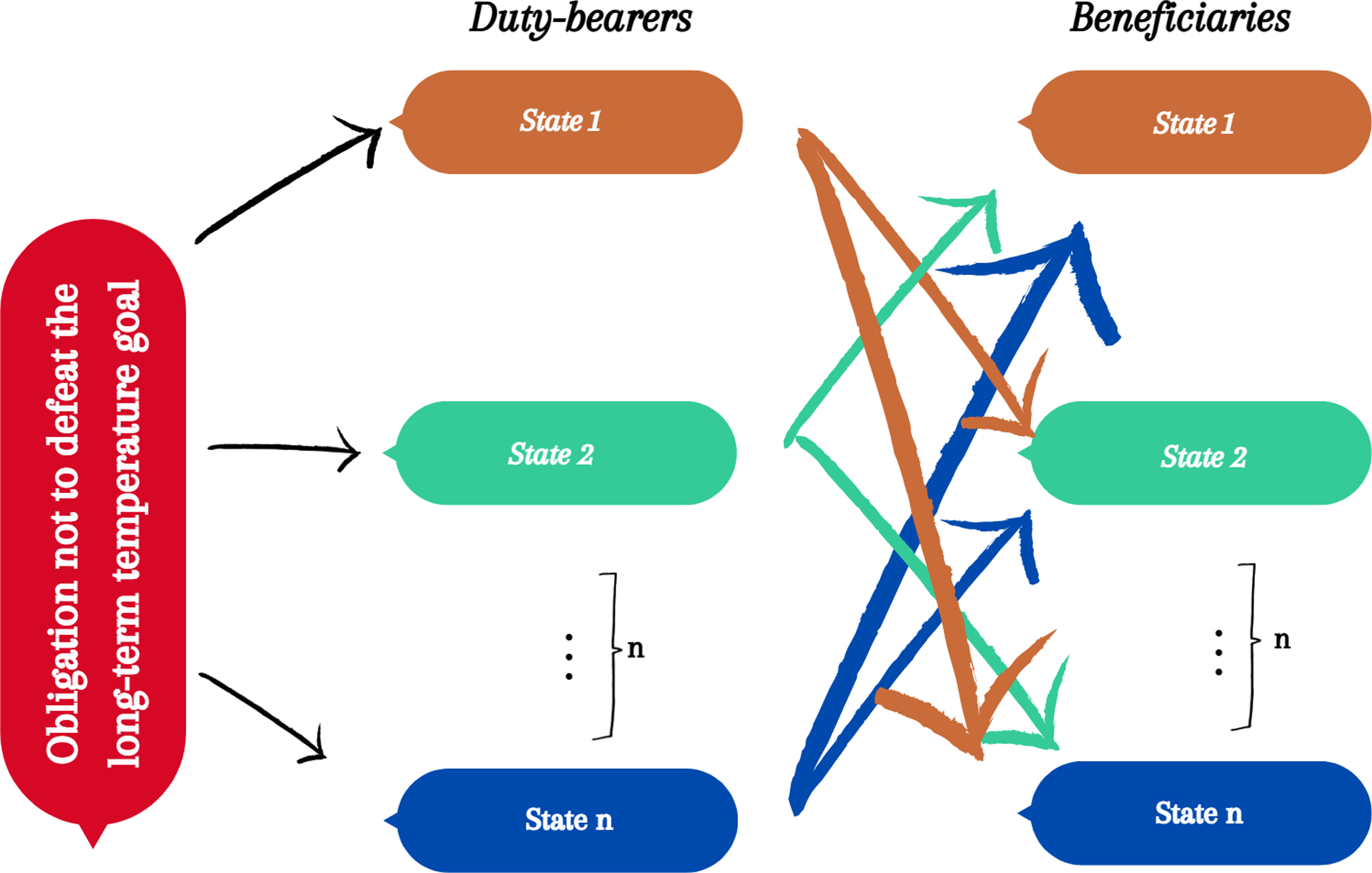
Figure 2: Long description
The diagram illustrates the structure of the obligation not to defeat the long-term temperature goal, as outlined in Article 2(1) of the Paris Agreement. It features two main columns labeled 'Duty-bearers' and 'Beneficiaries,' each containing three states: State 1, State 2, and State n. Arrows connect these states, indicating interactions and transitions between them. The left column represents the duty-bearers' progression through different states, while the right column represents the beneficiaries' corresponding states. The arrows between the columns show the complex relationships and potential impacts between duty-bearers and beneficiaries across various states.
There are at least two reasons to assert that the obligation to refrain from acts that would defeat Article 2(1) has an integral nature. First, as mentioned earlier, the object and purpose express the ratio legis of a treaty and, therefore, reflect the collective interest of the parties in regulating a specific issue and protecting certain legal goods. This characterization of the object and purpose as a common interest has already been recognized by the ICJ in the case concerning Questions relating to the Obligation to Prosecute or Extradite.Footnote 145 As previously stated, a common interest implies that the obligations safeguarding it have an integral structure and an erga omnes partes character.Footnote 146
The second argument supporting the collective nature of the beneficiaries lies in the description of climate change as a common concern of humankind.Footnote 147 As discussed earlier, identifying a common interest implies that the obligation is owed to all other parties of a treaty.Footnote 148 What could more succinctly express a common interest than labelling a matter as a common concern of humankind? Indeed, this status works as a shortcut for identifying global public interests.Footnote 149 Consequently, authors like Shelton, Cottier, Ahmad, or Amat uphold that obligations directly tied to such a common concern will have an erga omnes or erga omnes partes character.Footnote 150 Along the same lines, the ICJ has recently recognized that:
the UNFCCC and Paris Agreement acknowledge that climate change is “a common concern of humankind” (UNFCCC, first preambular paragraph; Paris Agreement, eleventh preambular paragraph), requiring “a global response” (Paris Agreement, Article 2). They seek to protect the essential interest of all States in the safeguarding of the climate system, which benefits the international community as a whole. As such, the Court considers that the obligations of States under these treaties are obligations erga omnes partes.Footnote 151
In this case, the obligation not to defeat the object and purpose of the Paris Agreement cannot be treated as an exception. All the parties have a legitimate interest in ensuring its compliance in any given case.
To summarize, this section has argued that the obligation not to defeat the long-term temperature goal lies individually with each party. However, because it reflects the collective ratio legis of the treaty and is intrinsically linked to a common concern of humanity, each party has a legitimate interest in ensuring its compliance in any given case. Consequently, the obligation will have an erga omnes partes character, meaning that each state owes this duty to all its counterparts.
4.3.2. The object of Article 2: An obligation of due diligence
The previous sections have explored why the obligation not to defeat the long-term temperature goal is an integral obligation with individual duty-holders. This one will categorize this commitment according to its object, arguing that it constitutes an obligation of due diligence. As d’Argent defines them, these obligations are commitments that ‘imposent à leur débiteur de s’efforcer d’assurer la réalisation de l’objectif de l’obligation’.Footnote 152 Accordingly, Mayer notes that, in the context of an obligation of due diligence, ‘the judge is to assess compliance not on the basis of what has been achieved but on the basis of what the debtor has done. The responsibility of the debtor is engaged by a failure to carry out the requisite efforts, notwithstanding the end result’.Footnote 153 Three key arguments support the classification of this obligation within that category: the presence of qualifying clauses, the variable content of the obligation not to defeat, and the interdependence required for its achievement.
Firstly, Article 18 of the VCLT describes the obligation emerging from the object and purpose as one ‘to refrain from acts which would defeat’ this collective goal.Footnote 154 By focusing on ‘acts’, Article 18 does not prescribe an obligation to achieve a specific result. Instead, drawing from Ago’s traditional division of obligations,Footnote 155 it establishes a duty of conduct, requiring parties to act or, in this case, to abstain from certain actions. However, it is not merely a procedural obligation. It requires parties to conduct themselves according to a specific standard of effort or endeavour, thereby reducing their margin of discretion. As Alice Ollino points out, the lawmaker provides concreteness to the required behavior.Footnote 156
In the case of the Paris Agreement, Article 2, along with other provisions of the agreement and relevant case law, provides several qualification clauses that help define the required standard of effort. For instance, Article 2(1) specifies that the achievement of the long-term temperature goal must align with the sustainable development paradigm and include efforts to eradicate poverty.Footnote 157 As the ICJ has recently recognized, such clauses cannot be disregarded; rather, they contribute to setting the standard of diligence required for certain climate mitigation obligations.Footnote 158 Therefore, the following section will analyse in deep how these qualification clauses interact with the 1.5°C goal to define the level of effort required.
Second, the obligation to refrain from acts that would defeat the 1.5°C goal exhibits another characteristic of due diligence obligations. As the ICJ and the ITLOS point out, the content of such commitments is variable,Footnote 159 adapting over time to contextual and subjective elements.Footnote 160 This variability allows flexibility for the international community to pursue ambitious objectives while accommodating its valuable diversity and harmful inequalities. In the case of the obligation not to defeat the 1.5°C target, Article 2(2) explicitly acknowledges that the implementation of the Paris Agreement must reflect the principle of Common but Differentiated Responsibilities and Respective Capabilities (CBDR-RC), in the light of different national circumstances.Footnote 161 Furthermore, what constitutes an act that defeats the 1.5°C objective must be assessed considering, inter alia, the availability of scientific information,Footnote 162 access to technology,Footnote 163 or the economic structure of each country.Footnote 164 Since these elements evolve over time, so too will the content of each party’s duty. Therefore, assessing which actions defeat the 1.5°C goal requires the flexible, evolving lens of due diligence obligations.
Finally, the third argument that reinforces the due diligence nature of the obligation relates to the interdependence of climate governance. As previously mentioned, scientific data clearly indicates that no single party can control or prevent global temperature increase on its own. Even if one party undertakes actions reflecting its highest possible ambition, the goal could still be undermined if all its counterparts fail to contribute their own efforts.Footnote 165
Moreover, even if all the parties contribute, the goal may still be unachievable. As the IPCC points out, not all climate variables depend on the international community anymore.Footnote 166 The unpredictability of tipping points is a prime example of this uncertainty. In similar situations, where the parties cannot guarantee the result by themselves, case law has considered the obligations in question to be obligations to behave diligently. As the ITLOS put it:
This obligation of due diligence is particularly relevant in a situation in which the activities in question are mostly carried out by private persons or entities. The obligation to regulate marine pollution from anthropogenic GHG emissions is a primary example in this respect. In that situation, it would not be reasonable to hold a State, which has acted with due diligence, responsible simply because such pollution has occurred.Footnote 167
Accordingly, determining whether a party has observed the obligation to refrain from acts that would defeat the 1.5°C goal requires analysing the extent to which it has acted diligently. To do so, the next section examines the elements that define the standard of diligence.
4.3.3. The standard of due diligence of Article 2(1)(a) of the Paris Agreement
Once it has been established that the duty derived from Article 2(1)(a) possesses a collective nature, an integral structure, and a due diligence approach, the next step is to analyse the content of the obligation. Specifically, this entails examining the standard of diligence upon which the parties’ conduct is assessed.
As mentioned above, both the ICJFootnote 168 and ITLOS emphasize that ‘the standard of due diligence varies depending on the particular circumstances to which an obligation of due diligence applies… [the standard] may change over time, given that those factors constantly evolve’.Footnote 169 In line with this perspective, the content of the standard will be both variable and dynamic. This evolving nature is particularly significant in the context of the Paris Agreement’s mitigation commitments, which are deeply rooted in the principle of progression over time.Footnote 170 What may not defeat the long-term temperature goal today could be insufficient to meet this standard in a decade. Therefore, it is not meaningful to pinpoint the exact location of the standard for a particular state at present. Instead, this section analyses the main factors that set this standard.
Before turning to those elements, however, two important preliminary considerations must be addressed. First, it should be noted that the obligation ‘to refrain from acts’ is not necessarily a purely negative obligation – that is, it does not merely require states to abstain from certain conduct. As several scholars have noted, under certain circumstances, this duty may also entail the adoption of positive measures necessary to preserve the object and purpose of the treaty.Footnote 171 In this regard, both the best available science and the CMA decisions recognize that limiting global warming to 1.5°C requires a 43% reduction in global GHG emissions by 2030, relative to 2019 levels.Footnote 172 Moreover, the Paris Agreement explicitly requires Parties to undertake ‘ambitious efforts’ toward achieving the long-term temperature goal.Footnote 173 Accordingly, it is evident that mere omissions are insufficient to protect the object and purpose of the treaty; in many cases, proactive and affirmative steps will be necessary.
Second, environmental jurisprudence establishes that the standard of due diligence must be higher for riskier activities.Footnote 174 In the case of climate change, the risks associated with global warming are well-documented and widely disseminated by the IPCCFootnote 175 and other scientific bodies.Footnote 176 Based on this evidence, the Paris Agreement already established that the parties’ contributions to global mitigation will reflect their ‘highest possible ambition’.Footnote 177 As Voigt puts it, such a standard demands that ‘the increase in ambition needs to be commensurate with the best efforts a party can possibly make, meaning that no stone should be left unturned’.Footnote 178
Similarly, both the ICJ and ITLOS have recognized that the standard of diligence in climate-related matters needs to be ‘stringent’.Footnote 179 The ICJ appears to equate this stringency with a requirement to ‘do the utmost’,Footnote 180 while ITLOS has gone even further. The tribunal held that the exceptional and critical nature of climate change requires the parties to move beyond the traditional ‘best efforts’ approach and set the standard at its most demanding level.Footnote 181 Therefore, it asserts that each party must do ‘whatever it can in accordance with its capabilities and available resources’.Footnote 182
With respect to the elements that shape this standard, the ICJ’s recent Advisory Opinion offers relevant insight. Although the Court did not expressly define the standard of due diligence applicable to the obligation to refrain from acts that defeat the object and purpose of the Paris Agreement, it did assess the due diligence standard in relation to two key obligations: (i) the duty to prepare NDCs aligned with the 1.5°C goalFootnote 183 and (ii) the duty to prevent activities within a state’s jurisdiction or control from causing significant harm to the climate system.Footnote 184 Naturally, the specific content of these obligations cannot be directly transposed to the obligation not to defeat the 1.5°C objective, as the Court itself emphasized that the scope of each obligation is decisive in determining the applicable standard of diligence.Footnote 185 Nonetheless, the Court’s analytical framework for evaluating due diligence in these climate-related obligations provides valuable guidance for interpreting the content and requirements of the duty arising from the object and purpose of the Paris Agreement.
In this context, Article 2 itself includes qualification clauses that help set the standard of diligence by which states’ conduct is assessed. The first paragraph of this provision clarifies that the parties must strengthen their global mitigation efforts ‘in the context of sustainable development and efforts to eradicate poverty’.Footnote 186 As previously mentioned, Article 2(2) emphasizes that the standard of diligence must also take into account the principles of CBDR-RC and equity.Footnote 187
As both the ICJ and ITLOS have recognized in their recent jurisprudence, these principles do not exempt any party from participating in the global effort. Instead, all states are required to take action ‘to protect the climate system in accordance with its capabilities and available resources’.Footnote 188 However, the principle of CBDR-RC modifies the standard of diligence, making it more stringent for those countries with greater economic and technological capacities.Footnote 189 For example, a developing country planning to increase its emissions by 10% by 2030 to contribute to poverty eradication may not defeat the global mitigation effort if it deviates from its Business as Usual (BAU) emissions. By contrast, if a developed country makes the same pledge, it would likely breach the obligation to refrain from acts that defeat the global mitigation goal.
However, the distinction between developed and developing parties is insufficient to fully capture the standard of diligence. As the ICJ has emphasized, the evolving capabilities of each state form an integral part of the CBDR-RC framework and play a central role in shaping this standard.Footnote 190 Though not without criticism,Footnote 191 the Court has acknowledged the dynamic and non-binary nature of development, noting that ‘as States develop economically and their capacity increases, so too are the requirements of diligence heightened’.Footnote 192 In this regard, particular emphasis is placed on the availability of safe and appropriate technological means of each state.Footnote 193
Moreover, the climate regime itself recognises that additional subjective factors can influence the applicable standard beyond the broad categories of developed and developing countries. One of the most critical factors is a country’s dependence on fossil fuels. Both the UNFCCCFootnote 194 and the Paris Agreement include provisions that take into account ‘the concerns of Parties with economies most affected by the impacts of response measures’.Footnote 195 While this does not exempt oil-producing countries from the obligation to refrain from actions that would defeat the 1.5°C goal,Footnote 196 it does acknowledge the need for these countries to transition from fossil-fuel-dependent economies to decarbonized models in a gradual manner.
Secondly, given the environmental nature of climate risks, case law also considers the available scientific and technical information when setting the standard of diligence.Footnote 197 Authors like Rajamani and Werksman observe that Article 2(1)(a) is sufficiently precise and tied to a specific carbon budget.Footnote 198 As illustrated in Figure 1 above, by reading Article 2(1)(a) in conjunction with the IPCC studies, it becomes clear that limiting global warming to 1.5°C reduces the post-2020 global carbon budget to 500 GT of CO2 (with a 50% likelihood).Footnote 199 Accordingly, any evaluation of a party’s alignment with the temperature target must consider the impact of its actions on this science-based carbon budget.
Thirdly, relevant international rules and standards, including other obligations within the International Climate Change Regime and certain COP decisions, must also be taken into account.Footnote 200 In this regard, one of the particularities of this obligation of due diligence is that a party cannot defeat the object and purpose of the Paris Agreement by acting in a manner that is prescribed or permitted by another provision within the regime. As Richard Gardiner points out, the object and purpose of a treaty does not typically override the specific provisions of the treaty itself.Footnote 201 Therefore, an action required or permitted under other provisions of the Paris Agreement or the UNFCCC cannot, by itself, constitute a breach of the standard of diligence established by Article 2(1)(a).
Finally, as Kritsiotis, Gargl, and Fitzmaurice observe, the word ‘defeat’ is strong,Footnote 202 and ‘not every deviation from the provisions of a treaty … will automatically result in its object and purpose being defeated’.Footnote 203 As they argue, the ‘threshold for violating the interim obligation is consequently much higher than that for violating the treaty itself’.Footnote 204 In this regard, the ICJ offers some clarification by equating the notion of defeating a treaty’s object and purpose with depriving it of its ratio legis.Footnote 205 Accordingly – and unlike the other obligations mentioned above – for a state’s conduct to defeat the long-term temperature goal, it must represent a clear departure from behaviour aligned with the 1.5°C objective.
4.3.4. Utility of the standard of diligence
At this point, one might argue that setting the standard of diligence is futile. Since Article 2 sets a collective objective and no party can defeat the 1.5°C goal alone, the obligation to refrain from acts that would defeat the long-term temperature goal may seem to lack legal significance.
However, collective climate goals can be divided into multiple individual commitments.Footnote 206 Three arguments support this approach. First, as Nollkaemper argues, shared responsibility ‘by definition, is a responsibility that rests on individual actors for their contribution to a harm’.Footnote 207 As mentioned above, international jurisprudence aligns with this perspective and has already established that each state has its share of responsibilities in tackling climate change.Footnote 208 Moreover, the legal architecture of the Paris Agreement reinforces this jurisprudence by recognizing that parties must individually contribute to the global response to climate change. According to Article 3, all parties are to undertake ambitious efforts with a view to achieving the agreement’s purpose.Footnote 209
Second, the IPCC has recognized that climate-resilient development pathways require strengthened and timely action from all countries.Footnote 210 In line with this, the UNFCCC aims to stabilize atmospheric greenhouse gas concentrations by requiring all parties to formulate and implement national programs with mitigation measures.Footnote 211 Thus, both scientific evidence and international law make it clear that, to achieve the long-term temperature goal, every party must actively participate in the collective efforts.
Finally, as mentioned above, the stringency of the climate standard of diligence requires each state to ‘do the utmost’.Footnote 212 This expression serves as a clear indicator of the urgency and gravity of the climate situation, emphasizing the necessity for each state to contribute to the collective mitigation efforts, even if their counterparts do not duly participate.
Therefore, it can be concluded that certain actions taken by a single state can defeat the object and purpose of the Paris Agreement if they undermine the state’s contribution to achieving the collective goal. For example, presenting mitigation plans that are manifestly inconsistent with the 1.5°C pathway, or approving oil infrastructure with significant extraction capacity, may breach the obligation to refrain from acts that would defeat the 1.5°C goal. Moreover, unlike the commitment arising from Article 4 of the Paris Agreement, the obligation not to defeat the 1.5°C goal does not apply solely to conduct related to the preparation or implementation of NDCs. It applies to any act undertaken by a state, irrespective of whether it is included in its national contribution. Accordingly, this finding provides new elements for assessing climate performance and opens avenues for novel litigation strategies.
That said, it is important to remember that the obligation not to defeat the temperature goal is not an obligation of result. It should not be confused with a commitment to achieve the goal, nor should it be seen as a duty for each party to do its fair share. As mentioned earlier, it is sufficient for a party to do its utmost to refrain from acts that would defeat its contribution to the 1.5°C target.
5. Conclusions
In 2015, the international community enthusiastically celebrated the ambition of the climate goals established by the Paris Agreement. Secretary-General Ban Ki-moon defined the Paris Agreement as a ‘peace pact with the planet’.Footnote 213 Since then, the commitment to limit long-term temperature increases to 1.5°C–2°C has become a central emblem of the International Climate Change Regime.
However, a decade after the adoption of the Paris Agreement, debates persist regarding the content and legal consequences of its long-term temperature objective. Most scholars maintain that Article 2 sets out a political aspiration that, while playing a significant interpretative role, does not create binding legal obligations. This article contributes to the ongoing discussions by offering a novel interpretation.
Since Article 2(1)(a) sets out the object and purpose of the Paris Agreement, it gives rise to two significant legal consequences. Beyond requiring the Paris Agreement to be interpreted in light of its object and purpose, parties must also refrain from acts that would defeat the long-term temperature goal. In contrast to traditional interpretations, this paper argues that this obligation applies both before and after the treaty’s entry into force offering new elements for assessing climate performance and paving the way for new litigation strategies. Particularly, the obligation can be characterized as an integral obligation of due diligence: while each party individually bears the duty, all its counterparts collectively benefit from it. As such, the obligation has an erga omnes partes character.
Moreover, this paper provides additional arguments to demonstrate that 1.5°C – rather than 2°C – should serve as the appropriate reference temperature target. This conclusion is supported by the consistent prioritization of the 1.5°C goal in subsequent COP and CMA decisions, robust scientific evidence, the principles of prevention and precaution, and recent jurisprudence from the ICJ, ITLOS, IACtHR, and ECtHR.
This article cannot conclude without acknowledging that the world remains off track to meet the Paris Agreement’s 1.5°C goal. Global temperatures have already risen by more than 1.3°C,Footnote 214 and GHG emissions continue to increase year after year.Footnote 215 As Her Excellency Ms. Mia Amor Mottley, Prime Minister of Barbados, aptly warned, this trajectory constitutes a death sentence for many developing nations.Footnote 216 Yet, the IPCC maintains that the 1.5°C target remains achievable. At this critical juncture, one fundamental question arises: what actions defeat the 1.5°C objective?

 Open access

