




Tracing itinerant female performers in South Asia
The image of the tawa’if in South Asian history is intimately tied to travel.Footnote 1 Some of the most profound moments in these women’s lives are revealed in stories where they assert their unique roles within society through mobility. One such example is Gauhar Jan (1873–1930), who famously flouted colonial laws that prevented commoners from publicly riding in horse carriages, readily paying hefty fines to be driven across colonial Calcutta in her four-horse drawn phaeton. Another is Mah Laqa Bai ‘Chañda’ (1768–1824), who was painted with her private retinue, including two cheetahs, travelling alongside the Nizam of Hyderabad on a hunting party.Footnote 2 A third example is Nainsukh’s famous Pahari painting of a beautiful young performer named Amal, who was shown travelling on horseback, journeying through the Punjab Hills with the powerful young nobleman Mian Mukund Dev of Jasrota (1720–1770).Footnote 3 All three scenes establish that movement was a key feature of the lives of tawa’ifs for most of South Asian history.
The term tawai’f itself has etymological roots in the Arabic ‘ţawāf’, referring to the circumambulations around the holy Ka’ba at Mecca. This sense of movement has therefore been key to conceptualising female performers in North India. But even beyond tawa’ifs, the wide range and categories of female performers in the subcontinent’s history have been closely associated with travel. Female performers like devadāsī, mīrāsan, kañchanī and kañjrī, the naṭnī and nāchwālī, have all historically been peripatetic communities. This special issue explores connections between travel, mobility, and power for female performers in South Asia’s broad colonial period (1760–1940) to facilitate a discussion across disciplines such as history, ethnomusicology, literature, politics, and art history. Female performers—both professional and non-professional—travelled across many patronage sites. These ranged from the courts and salons of Indian rulers, East India Company (EIC) ‘nabobs’, and zamindars in small town qaşbās, to the proscenium stage, which extended to recording studios for gramophone and film, and new schools for music and dance that emerged in the early twentieth century.
While hereditary performers increasingly faced social ostracism, the early twentieth century also saw upper-caste middle-class women enter a sanitised version of their performance spaces. Despite their moral censure, did the hereditary performers also participate in nationalist and reformist movements? Did female performers articulate their agency through travel and mobility? How did travel help them negotiate their position vis-à-vis powerful structures of patronage?
Articles in this special issue will answer some of these questions by looking at both the transnational and local, and the spectacular and quotidian circuits of these performers’ travels. These cover journeys to religious sites such as temples and Sufi shrines, and participation within rites of passage like weddings and pilgrimages, but also move beyond South Asia into the theatre spectacles, exhibitions, and expositions of Europe. In the context of empire, this volume maps not just how female performers travelled in local, regional, and transnational contexts, but also whether they were able to transcend the hypersexualised colonial trope of the ‘nautch girl’.
Reframing colonial transition through courtesans’ mobility, 1760–1940
‘In our field, phenomena that would constitute separate subfields in other fields are hardly even recognized … anyone in South Asian studies will be the first person to produce serious scholarly work on his or her chosen topic.’Footnote 4
Andrew Ollett’s observations on South Asian studies could equally apply to the subfield of research on South Asian courtesans. Despite the expansion of research on courtesans in recent times, there has been no notable attempt at a critical and comprehensive historiography on courtesans alone, unmoored from passing glimpses of them in studies of music and dance history, female authorship, or princely courts. Within this larger gap in the field, the specific connections between travel, mobility, and female performers in South Asia have not been explored or adequately theorised, despite some of the exciting research on histories of itinerant performers and nomadic communities more broadly.Footnote 5 The only exception here is the recent award-winning work by Shailaja Paik on the critical labour of the ‘sex–gender–caste complex’ in shaping the modern lives of Dalit women performers of tamasha, the travelling secular public theatre of Maharashtra.Footnote 6
Another self-evident reason for the lack of scholarship on courtesans is the lingering baggage of colonial middle-class morality. Razak Khan articulates this paradox in scholarship when he highlights how ‘scholars have never quite known whether to embrace or shrink from’ the famed Nawabi ‘decadence’ implied in the princely patronage of courtesans.Footnote 7 Seeking inspiration from Ollett’s call to ‘double South Asian studies’, and by making a critical intervention into the historiography of courtesans, we hope to aid in the definitive establishment of what could be termed ‘South Asian courtesan studies’ as a recognised field of scholarship in its own right. This special issue therefore offers a sample of the new, and we believe, exciting developments in this growing field to catalyse its further expansion. It connects with other fields as well, such as the histories of migration, histories of materiality, histories of the marginalised, subaltern studies, ethnomusicology, and regional histories of South Asia.
For the purposes of this Introduction, we will consider the term ‘tawai’f’ beyond its historically specific usage, as a whole category of female performance and labour. In other words, we consider the term ‘tawa’if’ as a heuristic category, as emblematic of public female performers from both hereditary backgrounds and professional guilds. Although most of the articles in this special issue are situated within North India, we also go beyond, to follow their journeys across transnational contexts. By doing this, we do not intend to disregard or homogenise the variety of historical terms (beyond tawa’if) that were used for these performers both within and beyond North India.Footnote 8 The diversity of these terms tells us something about caste, local hierarchies, and regional specificities. Thus, our usage of ‘female performer’, ‘courtesan’, and ‘tawa’if’ here covers a wide range of hierarchies and terms and deliberately approaches this diverse group of performers as a larger entity. Doing so helps us to pull out insights across archives and fields in a way that would not be possible otherwise.
This brief rumination on the terminologies of the tawa’if raises more fundamental questions about representation in history: How do we look at histories of female performers through various axes of representation? How do we read tawa’ifs and their mobilities across different historical contexts between 1760 and 1940? The primary frame for the representation of tawa’ifs during this period has understandably been that of colonialism.
Grand histories of India’s colonial period, often written concomitantly to the events they covered, imposed fully formed narratives that have, until recently, escaped sustained scrutiny. In such histories, female performers, if they appeared, were minor characters within this dominant body of colonial knowledge, occasionally appearing in patchwork fashion amongst oral histories and missionary archives. There are many surprising sources beyond these grand histories of empire that are waiting to be tapped into, which can bring the histories of female performers to life. Ethnomusicology is one such area.Footnote 9 Beyond presenting histories of musical genres, this discipline uncovers rich histories of musicians and dancers as well. However, prioritising ethnography as the dominant method for studying South Asian performers can often mean that the histories of courtesans appear as fragments.Footnote 10 Female performers only briefly feature in canonical genealogies—whether textual or oral. Katherine Butler Schofield’s recent book recontextualises genealogies of male gharana-based musicians in musical treatises to argue that beyond hereditary lineage alone, genealogies offer evidence for musicians’ social movements and the dynamism of musical cultures in late Mughal India.Footnote 11 While this reframing is important, how do we make sense, conceptually, of the absence in these genealogies of female performers and pedagogues, baijis, tawa’ifs, and ustanis?
Given this characteristic absence, it is difficult to rely on the genealogical approach when researching female performers, since the tracing of genealogy is patrilineal, especially in the patriarchal context of Hindustani music. A historian of female performers might then have to seek their genealogies in unconventional locations: whether property records, sale deeds, or legal documents.Footnote 12 Tawa’ifs’ genealogies can more productively be theorised through the concept of the ‘trace’.Footnote 13 Mobility—both physical and social—relates to this as well, since tracing genealogies is a useful way to ascertain the journeys undertaken by performers. Shweta Sachdeva Jha argues that female performers changed their names, erasing their pasts as a means of self-fashioning new professional identities into existence.Footnote 14 Extending this argument in her conceptually driven intervention in this issue, she argues that the fragmentation of tawa’ifs’ genealogies was partially abetted by the need for female performers to reinvent themselves when they entered new centres of patronage and new regional locations, a feature linked with their need to travel.
As historians, then, we are interested in highlighting how the historical lens can reveal new insights when studying the lives and mobilities of female performers that may be unavailable from the reliance on oral histories, a key mode for writing and researching musicians and dancers in the subcontinent. In other words, we must ask: What can the historical method do that a reliance on ethnography alone cannot? While courtesans have always been featured in the subcontinent’s literary narratives (whether ancient Sanskrit or Tamil poetry, Persian poetry in the medieval centuries, or more recently, the novel in Urdu, Hindi, and English),Footnote 15 more recently the historical method has also begun permeating popular contemporary writing on courtesans, where the archive has emerged as a key resource for both historical non-fiction and fiction.Footnote 16
Foregrounding the historical method for research into courtesans, the articles in this volume show that beyond conventional ethnographic sources, there is a rich textual, visual, and material archive, which, until recently, we were largely unaware of. Indeed, associated with almost all performer-groups in South Asia is a rich corpus of documents, often unconventional in form, embodying what Anjali Arondekar has recently theorised as archival ‘abundance’.Footnote 17 Given the abundance of such archival material on performer’s lives, one wonders why scholarly excursions into rewriting the familiar narrative of courtesans in South Asian history has taken this long.
Earlier histories of tawa’ifs focused more on the disruption that ensued with the Rebellion of 1857 and the annexation of Awadh.Footnote 18 However, more recent scholarship on courtly life in places such as Baroda,Footnote 19 Bengal,Footnote 20 and Lahore and PatialaFootnote 21 has not just revealed the vibrant musical cultures of the late nineteenth century but has raised fundamental questions about the relationship between performers and colonialism. These new studies point to a more complex story than simply a narrative of disruption and destruction. Richard Williams argues that colonialism reshaped North Indian musical life less by ‘replacing’ courtly culture with colonial modernity than by reconfiguring the social geographies, moral regimes, and media through which music and performance, and performers circulated.Footnote 22 In a related way, Schofield tackles the concurrent nature of these parallel worlds by borrowing Stephanie Newell’s concept of ‘paracolonialism’. Schofield argues that music-making and knowledge during this period did not simply ‘become colonial’; instead, multiple pre-existing lineages—whether courtly, hereditary, artisanal, or reformist—continued, overlapped, adapted, and sometimes disappeared alongside the colonial state, often intersecting with Europeans but not structured by colonial epistemologies.Footnote 23
The cultural resilience of South Asian musical production implied in these new studies helps us view the histories of tawa’ifs as existing beyond the familiar narrative of loss of patronage under colonialism, to reveal a more complex story of transformation, travel, and performance.Footnote 24 The scope of travel for female performers was both local (as discussed in the articles by Shrivastava, Hansen, Sachdeva Jha, Kapuria and Fatemi, Sievers, and Gogoi in this issue) and transnational (as covered by Nair and Priyambada). Equally, female performers relied on a range of modes of travel: from horse and camelback to ox-driven carts and tongas, on ships, and—with the arrival of Western modes of travel following colonialism—trains and motorcars. These articles therefore move beyond the standard conversation between coloniser and colonised to add nuance and restore connections with the regions, languages, and traditions that impacted the lives of female performers. Whilst some articles focus on colonial encounters with travelling female performers in the imperial metropole (Nair and Priyambada), others regard colonialism more peripherally, dealing instead with the broader impact of modernism (Hansen, Sachdeva Jha, Gogoi). Still others regard pre-colonial trajectories of courtesan lives (Shrivastava, Kapuria and Fatemi, and Shaikh).
Across the various routes mapped in this special issue, then, courtesans’ mobility appears not as marginal or exceptional but as foundational, even infrastructural, to colonial-era cultural economies—sustaining festivals, courts, imperial exhibitions, and middle-class publics. Courtesans’ livelihoods had always been attuned to the risks of reputational volatility and visible ageing. However, now these were additionally threatened by state surveillance and dispossession, making them vulnerable in ways that were both gendered and historically unprecedented when compared to their male counterparts.
In contrast to male performers, who could convert mobility into reputational capital that travelled independently of them, the value of female performers was tethered to their embodied presence, making mobility itself a gendered risk. Before colonialism, courtesans’ travels were buffered by durable courtly guarantees such as stipends, residences, and protection. The usual risks associated with courtesan’s mobility—ageing, shifting tastes, failed patronage, and seasonal hardships—were absorbed by their protection under pre-colonial courts.Footnote 25 In other words, as the articles in this special issue demonstrate, the so-called ‘decline’ of the courtesan tradition under colonial rule can be more precisely understood as a redistribution of cultural risk onto mobility itself. As courtesans’ livelihoods came to depend on increasingly frequent and speculative movement across festivals, courts, and cities, without the institutional guarantees they had once received, the colonial transition reorganised such circulation, making female performer’s lives more precarious than in pre-colonial times.Footnote 26
Female performers were key to the political ritual and cultural lives of several pre-colonial courts in the eighteenth and early nineteenth centuries—whether the Rajput courts, the Mysore Sultanate, or the Sikh court at Lahore.Footnote 27 Jennifer Howes’s deep dive into the EIC’s records shows that the short-lived Mysore Sultanate (1761–1799) supported a vast entourage of female performers who came to Srirangapatna from other corners of Persianate South Asia.Footnote 28 Princely states were also known to exchange female performers as gifts. For instance, in this special issue, Gianni Sievers studies the princely state of Rampur to meticulously reveal court petitions, letters, and poems that become sources to write a nuanced history of the tawa’ifs’ travels.Footnote 29 Revealing the dynamic yet hierarchical world of Muslim women performers, Sievers documents the role of middlemen and alerts us to the strategic aspects of negotiation employed by the tawa’ifs to improve their conditions of employment. The journeys of these female performers, he reveals, could range from travels across regional courts to those as far as Constantinople to Rampur.
Not all tawa’ifs had the agency or choice to take up these travels though; in many cases, slave networks and trade in young girls shaped the harsh reality of their lives. Delving into 60 fascinating legal documents at the National Archives in Delhi, Noble Shrivastava’s article in this special issue reveals tawa’if life from the prism of business transactions in eighteenth-century Allahabad. She examines some of these documents, which record the sale of slave girls to the women who operated koṭhās. Slave ownership was an indicator of affluence, so the public transactions recorded in the documents indicate that these female purchasers were successful businesswomen. The transactions date between 1720 and 1784, when the instability following Aurangzeb’s death (1707), the poverty following the sacking of Delhi (1739), and the subsequent Afghan invasions known as the hañgāmā (turmoil) most likely forced families to sell their children into slavery.Footnote 30 This same moment of instability brought about a reconfiguration of Mughal power, allowing non-royal female performers, such as the purchasers recorded in these documents, to increase their participation in important matters of state. Both the slaves and the buyers were bound by lives within the koṭhās. The documents give important insights into a transactional corner of their existence, when senior performers and the newly initiated came into contact. Concurrent to the evidence in the Allahabad documents, Prashant has demonstrated how during the late eighteenth century, dancing women in western India under the Maratha empire enjoyed a range of privileges in the form of land grants, salaries, and others, while also pointing to the exploitative attributes of powerful dancing women ‘adopting’ (in effect, purchasing) younger women to induct them into the profession.Footnote 31
Beyond this pre-colonial context, probing the relationship between female performers and the EIC in colonial archives also yields unexpected data. In his study of circuits of travel in which female performers found themselves during the immense socio-cultural change of post-1857 North India, Sievers demonstrates that despite this disruption, and contrary to the conventional wisdom, Lucknow remained a key centre for the employment, instruction, and trade of tawa’ifs. Detailing a range of tawa’ifs’ responses to changing patrons, he argues that far from being static, patronage of courtesans adapted to the constraints of colonial modernity and wider pan-regional transformations, and travel often became a key mode of survival and an economic necessity during this period.
Tawa’ifs’ negotiations with their aristocratic employers, in many cases very successful, also continued with the transition to colonialism. This is detailed in Nadhra Khan’s research on how Gul Begum, Maharaja Ranjit Singh’s only courtesan-widow, negotiated with the EIC to receive among the highest pensions of all from the posthumous ruler’s family;Footnote 32 Howes’s work on Tipu Sultan’s female entourage, who were relocated by EIC officials from Mysore to Vellore after the fall of Srirangapatna in 1799;Footnote 33 and Katherine Butler Schofield’s research on Mayalee ‘dancing girl’ in connection with the salt revenues at Lake Sambhar, Rajasthan.Footnote 34 Whether in Lahore, Vellore, or Jaipur, this research highlights how performer women used similar strategies to carve out spaces for themselves in the encounter with colonial officials bent upon reducing their emoluments.
Howes’s research on the performing women in Tipu Sultan’s entourage also gleans crucial information from the EIC records. One case that relates to their migrations is the EIC reports on the Mysore Sultanate, compiled after Tipu Sultan’s death. These reports reveal that over 600 women lived inside the palace at Srirangapatna in 1800, and about a third of them were either performers or the female servants and slaves of those performers.Footnote 35 The EIC’s records were obsessively concerned with Tipu Sultan’s sons, the potential heirs to the sultanate throne, and yield biographical information about their mothers. Through these reports, we know that Roshani Begum, the mother of Tipu’s eldest son, was a dancer who travelled to Srirangapatna from Adoni (in present-day Kurnool district), and that Dur Dana Begum, the mother to Tipu’s third eldest son, was a performer who the sultan’s envoys purchased at Shahjahanabad, along with 20 other women.Footnote 36 Travel across fairly long distances was thus key to performers’ lives at pre-colonial courts.
In contrast to the autonomy and agency implied in the migrations and travels of women like Roshani Begum, some female performers discussed in Sievers’s article, or in the later examples like Gauhar Jan or Malka Pukhraj considered by Sachdeva Jha, Ranjini Nair’s article focuses on a moment of coerced travel in the context of colonialism and racialisation. Revisiting the history of the famed troupe of South Indian hereditary temple dancers who toured France and Britain in 1838, Nair examines a varied archive to argue for the force applied to these dancers and their unwillingness to travel. In doing so, Nair revises the conventional historiography on the dancers that emphasises the predominant notes of cultural exchange, dialogue, translation, and interaction between colony and metropole.
Instead, through evidence gleaned from a range of sources including newspapers, memoirs, and lithographs, Nair establishes the resistance embedded in the actions of the performers against the tropes and narratives of sexualisation, fetishisation, and the Otherisation peddled by European spectators. In a refreshing interweaving of the historical method with insights from dance scholarship (informed by her own training as a dance practitioner), she uses visual representations of the dancers in the European press to highlight, across these many representations, their ‘fuzzy fingers’ and ‘languid arms’. These features are in direct contradistinction to the importance of hand mudras in these dance forms, and especially their modern versions (whether Bharatanatyam or Kuchipudi), which emphasise the rigidity and geometry of the arms. Nair argues that the ‘indolence’ or ‘languidity’ displayed by the so-called bayadères may signify not only their resistance and agency through a deliberately lacklustre performance but also a reflection of physical weakness brought on by hostile climates and inadequate food—serving as an implicit critique of their treatment by their European hosts.
Given the scant archival traces that remain around members of the 1838 travelling troupe, it is difficult to surmise their ultimate destiny. Unlike their story, the more tragic outcome of two female performers who similarly visited London’s ‘imperial exhibitionary spaces’ some six decades later is mapped out by Pratichi Priyambada. Priyambada analyses the petitions written about the death and disappearance respectively, of Begum Jehan and Vajir Jehan, while on tour in late nineteenth-century England by their grandmother Piaree Jehan, based in colonial Bombay. Pointing to the violence embedded in the racialisation and sexualisation of these dancers, like Nair, Priyambada details the ‘politics of convenience’ adopted by the imperial British government in its interaction with these performers.
Priyambada reveals the multiple ways in which the imperial state benefited both culturally and economically from the overseas labour performed by women like Begum Jehan and Vajir Jehan, without meeting the dancers’ own demands for better working conditions. The article highlights how the travelling female performers from India to Europe found themselves at the intersections of gendered, racial, and sexual politics of empire in the everyday precarity and vulnerability they faced. Equally, though, Priyambada also traces autonomy and resistance in the actions of the two women’s grandmother, the courtesan Piaree Jehan, who left an abundant archival trail through her letters of petition to the British imperial state, revealing a deft use of the colonial legal apparatus to demand justice for the death of her granddaughters in England.Footnote 37
Sachdeva Jha, too, focuses in part on performers’ transnational travel in the exploitative circuits of European exhibitions, highlighting the vulnerability they faced. She follows the archival trail that survives in the India Office Records from 1899, of a Sikh man named Bhar Singh, and his wife Bachhini, who travelled from rural Punjab to Singapore, and onwards to Europe in search of employment. They end up as part of a travelling exhibit on India, which also included three unnamed nautch girls from Madras. The troupe was formed in London and traversed various cities in continental Europe, pointing to the peripatetic nature of employment and the contemporary pan-European appetite for imperial displays from the ‘East’. Whereas the archival trail simply goes cold for Bhar Singh and Bacchini, with no further information available on their fate; for the nautch girls and their families, the story ends in unemployment and destitution in London, similar to some of the stories detailed by Nair and Priyambada. The struggle of the nautch girls to secure the means to return home—often facing long sea journeys with little money or food—highlights the particular hardships of maritime travel undertaken by destitute performers in the nineteenth and early twentieth centuries. Ships, however, were just one among the many modes of travel used by courtesans from the subcontinent.
Regimes of mobility: courtesans’ modes of travel
Tawa’ifs were known to have travelled in carriages, carts, or howdahs, but the coming of the railways marked a significant shift, the implications of which become visible in encounters such as the following from Rudyard Kipling’s Kim (1901). In this story, a money-lender complains about the breaking down of caste barriers on a train, and the gossipy cultivator’s wife from ‘Jullundur’ registers disapproval towards her wealthy co-passenger, the ‘Amritzar courtezan’.
‘I say,’ began the money-lender, pursing his lips, ‘that there is not one rule of right living which these te-rains do not cause us to break. We sit, for example, side by side with all castes and peoples.’
‘Yea, and with most outrageously shameless ones,’ said the wife, scowling at the Amritzar girl making eyes at the young sepoy.
—Rudyard Kipling, Kim (London, 1915), p. 46.
This excerpt reveals how the railways were a socially transformative mode of travel that brought people from diverse backgrounds in contact with one another. Shifting temporalities, trains made a range of mobilities possible, thus creating new social realities and shaping colonial modernity.Footnote 38 In fact, ‘tawa’ifs on trains’ is an entire literary (and later, cinematic) theme in itself, evident in a range of notable examples from the Urdu, Hindi, and English literature of the colonial period. While we have already noted Kipling’s writings, a range of other colonial and postcolonial writers like Premchand, Mohan Rakesh, etc., also wrote stories that connected tawa’ifs to modernity, travel, and in some instances the railways. The work of Ian Kerr and Vasudha Dalmia is particularly useful in this regard.Footnote 39 Turning to cinema, the most iconic scene from Pakeezah (1972), the courtesan film par excellence, features a chance meeting between the tawa’if protagonist and a stranger on a train, which changes the course of her life.Footnote 40 However, not all encounters were marked by exciting new possibilities. Often, railways reinforced in-built hierarchies and practices of segregation. The brief discussion below helps us foreground the relationship between technologies like the railways with changing modes of travel, inherent to the livelihoods of performers who travelled to perform during weddings, royal coronation ceremonies, and other rituals.
As Ritika Prasad points out, despite the discourse of respectability built around elite female seclusion in the zenana, most Indian women travelled in ordinary female-only compartments similar to those used elsewhere in the world.Footnote 41 Raising questions about new modes of travel and the ensuing social implications of the journeys undertaken by tawa’ifs, Sachdeva Jha writes a conceptual article exploring the multiple aspects of travel in this issue. She argues that for travelling female performers, the railways marked a new avenue of transport that reaffirmed older routes of travel while at the same time offering exciting opportunities for patronage, and sometimes an actual performance on a railway platform! Gathering a rich archive of courtesans’ mobilities that points to different modes of travel—from bullock carts to trains and cars—used by these peripatetic female performers, Sachdeva Jha points to the complex interplay between the different modes of travel and upward social mobility. Her case studies unite a wide range of performers over a vast swathe of time, from Mah Laqa Bai ‘Chañda’ in the late eighteenth century to late nineteenth- and early twentieth-century figures like Malka Jan ‘Banaraswali’, her daughter Gauhar Jaan, Allah Rakhi Bai of Fatehpur, and Malka Pukhraj, among others. Sachdeva Jha argues that performers have always led itinerant lifestyles, moving from one location to another in search of better patronage opportunities, with colonialism being just one facet in this history and not the only disrupting force. With colonialism, then, the railways also became a means for autonomous tawa’ifs travelling in search of patronage and new employment opportunities.
However, and concurrently, in the specifically disruptive context of colonialism, the implementation of the Contagious Diseases Act (CDA) implied constant surveillance and loss of patronage; with the result that the railways also became a tool for the displacement of tawa’ifs. In response to the ubiquity of tawa’ifs on trains in the colonial period, railway authorities were called upon to ‘warn station masters against permitting bad women to sit in the special carriages … expressly reserved for the accommodation of respectable native females.’Footnote 42 Despite this surveillance, for some female performers trains were also a means of escape from enforcement of harsh colonial policies such as lock hospital surveillance and the CDA. For instance, Zoya Sameen reveals that in response to the strict enforcement of CDA regulations and the establishment of a lock hospital in Lahore in 1871, several women (female performers but also prostitutes and other women of ‘ill-repute’) likely to be surveilled by the colonial state fled. They fled to nearby Amritsar for refuge.Footnote 43 The equally strict surveillance of railway routes between major cities like Lahore, Amritsar, and Delhi also meant that, based on information in colonial reports, many of these so-called ‘suspicious’ women chose to travel between dusk and dawn. The use of nighttime hours for such travel connects to Prasad’s larger argument about the shifting temporalities of everyday life that the railways induced, introducing a new standardised ‘time-sense’.Footnote 44 Further, the appearance of courtesans and other female performers in third-class railway carriages and compartments, as discussed by Sameen and Prasad, also raises questions around what the particular types of travel might reveal about class differences within communities of performers. The examples mentioned above are a mere sample, and this special issue was conceptualised to create new arenas for research that connected tawa’ifs, travel, communication, and colonial modernities.
Pursuing the journeys of women actors who travelled as part of Parsi theatre companies, Kathryn Hansen’s article in this issue begins with the travels of the Victoria Theatrical Company of Bombay from Hyderabad in 1872, their use of the southern railway to reach towns and cities across the subcontinent, and the subsequent journeys undertaken via steamships to the port cities of London, Rangoon, and Singapore. Hansen focuses on Parsi drama companies that emerged as profit-making establishments by the 1870s, had big troupes, and toured Madras and Ceylon, Calcutta and Rangoon, Peshawar and Sind. Although seeking authentic information can be a challenge, Hansen uses autobiographical and biographical accounts, court cases, official records, and oral histories to reconstruct their lives. Similarly, Sukrity Gogoi’s work examines the modern Assamese mobile theatre. This tradition began as a spin-off of touring Bengali Jatra (yatra) performances. When the Assamese tradition emerged in the second half of the nineteenth century, women didn’t play female roles. It wasn’t until the 1930s that women first appeared on the Assamese stage. Their emergence corresponded with the release of the first Assamese movie to feature a female lead. Directed by Jyoti Prasad Agarwala, Joymoti (1935) starred Adieu Handique, Assamese cinema’s first lead actress. Through a range of twentieth-century sources, including an exploration of a museum dedicated to Handique, interviews with contemporary Assamese stage actresses, and still images from recorded performances, Gogoi contrasts this living tradition’s idealisations of modern femininity with the gendered politics of mobility in Assam.
Tawa’ifs’ travels in the visual and literary archive
This issue began with an attempt to imagine new avenues of research and contributions in the field. Contributors discussed thus far make tawa’ifs’ journeys, trajectories of migration, and travels in search of patronage visible while arguing for a more nuanced methodology and new sources. Among these new sources, the ‘abundant collections of images of dancing girls, baijis, tawa’if, who are increasingly recognised as significant artists and musicians’,Footnote 45 constitute a particularly compelling archive for research on female performers. Photographs, prints, paintings, and sketches provide important descriptions of these women, but how far do illustrations extend our knowledge of the travelling female performer in particular? Images are powerful records of outward appearances, but they usually provide little information about performers as individuals. In nineteenth-century Delhi, patrons of dance performances commissioned detailed paintings of tawa’ifs posing alongside supporting musicians, which were then distributed to attendees as souvenirs.
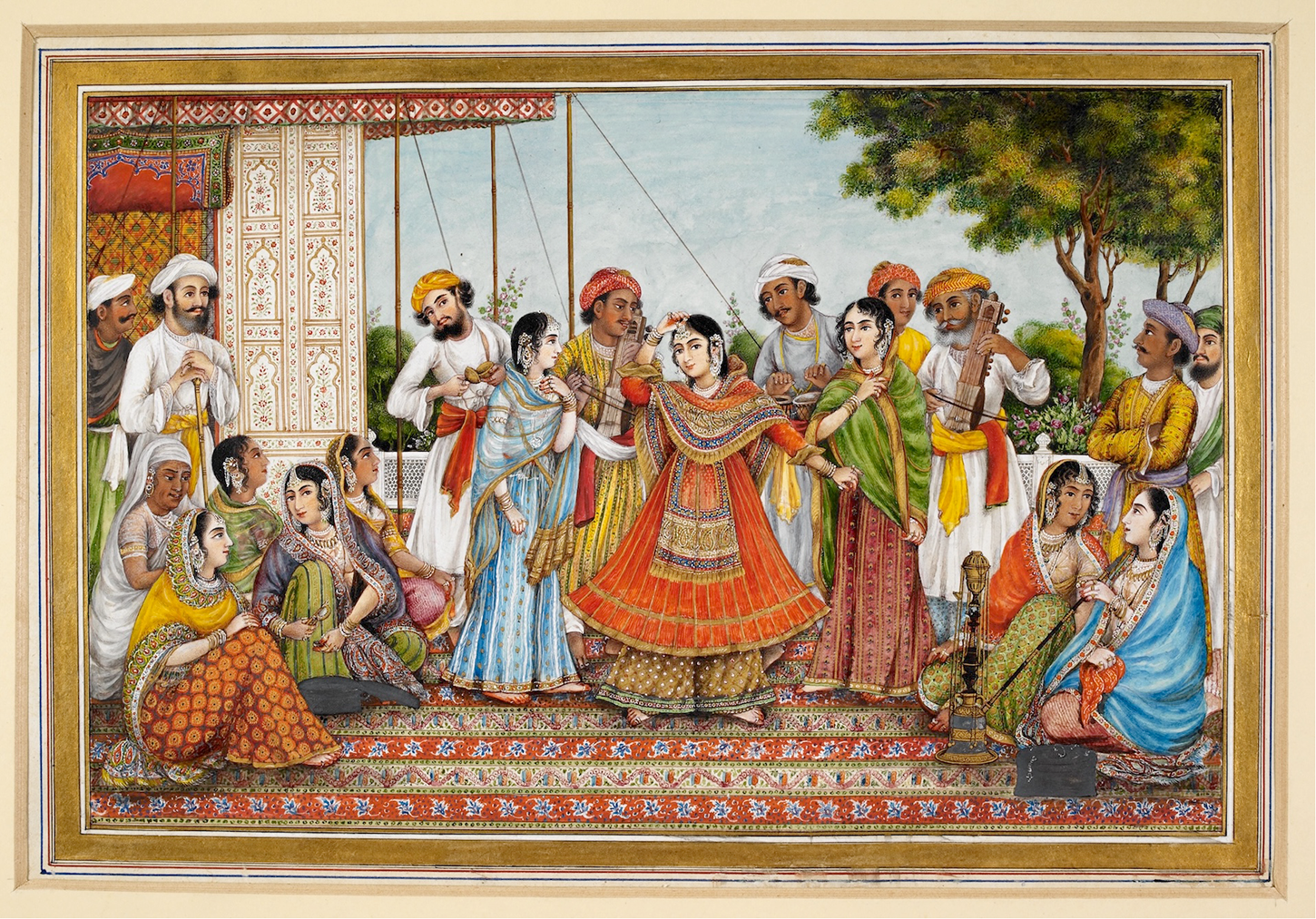
These pictures typically identify the performance’s patron, but not the performers. For example, a painting from Delhi titled, ‘A nautch at Colonel Skinner’s given to me by himself, 1838’ (Figure 1), extends our knowledge of Colonel James Skinner (1778–1841) by showing the importance he placed on maintaining an entourage of skilled performers in late Mughal Delhi. The unnamed performers—most likely an itinerant troupe—and their surroundings were proof of the patron’s knowledge and refinement. The young woman who stands proudly at the centre of the painting is unidentified, whether by personal name or geographical location. In contrast, Nainsukh of Guler’s famous painting of Mian Mukund Dev travelling through a mustard field, painted in the 1740s, features an extraordinarily beautiful singer, who is clearly named as ‘Amal’, seated on a black horse. Her presence in Mian Mukund Dev’s retinue during this springtime journey signifies her patron’s refinement, but—apart from her name—we know little else about her.Footnote 46 Given that the main narrative behind these images is the patron’s refinement, what does the ‘abundant’ archive of paintings featuring courtesans reveal about the travelling female performer?
Painting of nautch performers at the home of Colonel James Skinner, by a Delhi artist, circa 1898. Inscribed, ‘A nautch at Col. Skinner’s given to me by himself, 1838.’ Source: ©British Library Board, Add.Or.2598.

Figure 1 Long description
The painting shows a lively scene with a group of performers at Colonel James Skinner's home. At the center, a woman is dancing, wearing elaborate traditional attire. She is surrounded by men and women, all dressed in colorful traditional clothing. The men are standing and sitting, some playing musical instruments, while the women are seated and watching the performance. The background includes a decorative structure and trees, creating a festive atmosphere. The scene captures the cultural richness and social gatherings of the time.
Occasionally, images are paired with other detailed sources to expose unusual details about their subjects. One such example is the 36 miniature paintings in the Jaur-o-Jafa, a memoir from the Punjab composed in 1806. In Radha Kapuria and Asad Fatemi’s article on the travels of the performer Murad Bakhsh, this Persian narrative documents her pursuit by a Durrani aristocrat, first as a love interest, and then later as an enemy who obsessively punishes her. The memoir’s paintings are a tool for understanding the role of mobility in this twisted patron/performer relationship.Footnote 47 Likewise, in Sievers’s article on princely patronage of tawa’ifs at Rampur, an Urdu source compares and contrasts the personalities of two performers from Lucknow, the immature and quick-witted Haingan, alongside the graceful, cultivated Bande Jan. Alongside these written descriptions are stunning images of the two tawa’ifs.
The nineteenth century gave rise to new sound and image technologies such as printmaking, photography, and the recording studio, processes that targeted vast public audiences. Images from popular print culture are explored in Ranjini Nair’s work, which creatively connects the agency of a South Indian dance troupe that toured Europe in the late 1830s with images of the same performers that were published in newspapers. Rather than sidelining the images as exotica that helped sell more papers, Nair upholds them as valuable primary sources. Her interpretations may feel tenuous to some, but these printed images undeniably trace the abuse of South Indian performers in Europe nearly 200 years ago. Likewise, photography is used to reveal overlooked aspects of performers’ lives in Kathryn Hansen’s article. Through a picture taken by Maharaja Sawai Ram Singh II of Jaipur of the dancers Nanhi Jan and Munni Jan, Hansen expertly shows that the imbalance between patron and performer can change.
Apart from the visual, literary representation is another source which can enrich our understanding of mobility. Two articles—one on south-western Punjab by Radha Kapuria and Asad Fatemi, and one on Hyderabad and the Deccan by Sabeena Shaikh—reveal new courtesan characters from the margins of history in literary texts, characters whose identity is primarily defined by their mobility. Kapuria and Fatemi study the fascinating Persian manuscript Jaur o-Jafa (Cruelty and oppression, or Cruelty and spite in love, 1806) to open up a dynamic but till now unknown world of female performers in the cities of Multan, Dera Ghazi Khan, and Bahawalpur. Chiefly a ‘love–hate story’ between Durrani aristocrat Muhammad Raza Khan and Multani courtesan Murad Baksh, the illustrated manuscript features a range of historical characters, although Raza Khan’s own historical identity is uncertain, given that he is not mentioned in other contemporary accounts. Situated within the much longer tradition in South Asian poetry where men use a feminine voice—a convention that became increasingly popular in a range of contemporaneous eighteenth-century literary compositions by men in Persian and Urdu—Kapuria and Fatemi argue for the need to read the narrative in Jaur-o-Jafa as a conflated biography. They trace the ways in which the literary narrative combines the Persian qissa with the prose waqi’at court chronicles to provide critical insight into the lives of the two protagonists, connecting these to wider debates on justice and morality in the region. They detail the Multan-based courtesan Murad Bakhsh’s multiple journeys to, and away from, her lover-turned-enemy Raza Khan in Dera Ghazi Khan, along with her troupe of musicians and dancers, to argue for the centrality of this physical mobility in defining her autonomy and power. The attempted curbs on both—her travel and her association with her band of performers—coincide in the tale’s climax to indicate the complete loss of her autonomy. Kapuria and Fatemi’s analysis of the miniature paintings further asserts the need to include visual sources to probe deeper into cultural practices of the tawa’if, even though they rightly point towards the challenges of reading the text against the grain in the hope of tracing agency.
In contrast, Sabeena Shaikh pursues her search for agency and courtesanly mobility of the tawa’ifs through her reading of Lutf un-Nisa Imtiyāz’s maṣnavī as an autobiographical narrative. Locating Imtiyāz as the first published female şāḩib-e dīvān poet in Urdu, Shaikh argues that the maṣnavī reveals historical traces of Imtiyāz’s life.Footnote 48 Using close reading, she points towards the interplay between historical reality and literary imagination in the maṣnavī and challenges the erstwhile understanding of Mah Laqa Bai Chañda as the first şāḩib-e dīvān Urdu poet, since Imtiyaz’s work predated Chañda’s. Although scholars read Chañdā’s works as imitative and expressive of masculine modes of imperial self-fashioning, Shaikh alerts us to the possibilities of reading Imityāz’s kulliyat in terms of its feminine voice and courtesanly agency. Reading the maṣnavī as a memoir, Shaikh proposes a life-history of Imtiyāz that begins in Aurangabad with the death of her mother, goes on to document her father’s journey and his return, followed by her early marriage and leading up to her husband’s death and her life in Hyderabad, having traversed a considerable distance from the place of her birth. Shaikh’s reading of Imtiyāz’s literary composition as an act of self-representation and identity-shaping foregrounds the significance of tawa’ifs as poets and historians of their own lives.Footnote 49
Conclusion
To close this Introduction, we would like to jump forward dramatically in time and space, from pre-colonial Multan and Hyderabad to postcolonial India. Manish Gaekwad’s recent account of his mother Rekha Bai, the so-called ‘last courtesan’ in India, intimately details her life story, moving from the outskirts of Pune to the koṭhās of Bombay and Calcutta during the 1980s and 1990s. Gaekwad narrates a poignant moment when Rekha Bai is taken to Delhi airport for her first-ever flight to Ahmedabad, despite having expressed a preference to her patron for the more familiar mode of rail travel.Footnote 50 While initially anxious about air travel, after the flight, she retrospectively cast this first journey by air as symbolic of belonging, confidence, and a newly acquired autonomy. For Rekha Bai, therefore, air travel emerged as an initiation into a modern, middle-class mobility that contrasted with her earlier movements via road and rail as a trafficked child and itinerant female performer.
How, then, did the very modes of travel work in shaping courtesans’ identities and agency? Beyond financial status and wealth, did travelling by car alter conceptions of autonomy for figures like Gauhar Jan and Janki Bai Allahabadi, many years before Rekha Bai’s flight? These anecdotes signal how courtesan mobilities and the story of the travelling tawa’if need more focused research and scholarly intervention. The research showcased in this volume is a first step in that direction.
Not long ago, the sources explored by this special issue’s contributors were ignored or largely thought not to exist. Some sources are in overlooked corners of colonial archives (Sievers, Shrivastava), while others lie segmented, awaiting to be pieced together, inside vast sprawls of printed media (Hansen, Nair, Sachdeva Jha). There are literary works that have been cloaked from study by underexplored languages (Kapuria and Fatemi, Shaikh). Others stem from storylines that are familiar to many but have been stigmatised as unimportant within history’s larger narratives (Gogoi). Through these sources, this volume reveals a multitude of biographies, geographies, histories, and literary evocations of different travelling female performers from South Asia.
This special issue has traced not just mobility but also the successes and pitfalls of performers, their vulnerabilities and achievements. Ultimately, it has positioned female performers as historically mobile actors, whose movements across regions, performance circuits, political networks, and cultural regimes help us shed new light on the uneven transition to colonialism.
Acknowledgements
We are grateful to the organisers of the European Conference on South Asian Studies (ECSAS) 2023 and for the valuable comments offered by the discussants for each session, especially Kathryn Hansen, Richard Williams, Debanjali Biswas, and Kavita Bhanot. At the Journal of the Royal Asiatic Society, we would like to thank Professor Daud Ali and Matty Bradley for their valuable guidance and unfailing support throughout the editorial process, especially on matters of style, transliteration, and presentation. We would also like to thank the anonymous reviewers for their careful and constructive reports, which significantly sharpened the arguments presented in each article and strengthened the overall coherence of the issue. Finally, we are grateful to Asad Fatemi for his guidance on all matters relating to transliteration, to Avarna Ojha for helping with the footnotes, to Gianni Sievers for a careful readthrough, and to Cheryl Hutty for copy-editing support.
Conflicts of interest
None.

 Open access

