





INTRODUCTION
Soundscapes and Urban Spaces of the Ancient Mediterranean Program
In 2012, three Écoles françaises à l’étranger (École française d’Athènes, École française de Rome and Institut français d’archéologie orientale du Caire) established a common research program titled Soundscapes and Urban Spaces of the Ancient Mediterranean (Paysages sonores et espaces urbains de la Méditerranée ancienne). This research program aims to develop a dialogue between specialists of different cultures of antiquity around a common theme: sound perception, sound production, and the use of sounds in ancient societies. Three aspects are taken into account: lexicography, instrument making, and sound in context.
Issues surrounding instrument making seek to get a better understanding of the ancient musical instrument handicraft, to identify the materials used in their manufacture, and the geographical provenance of the raw materials. Due to exceptional climatic conditions that allow their preservation, archaeological remains of musical instruments discovered in Egypt are relatively numerous and in an excellent state of conservation compared to those of other ancient civilizations. To this day, only one musical instrument found in Egypt has been studied with modern scientific archaeological standards; the lute of Antinoopolis, today exhibited in the musée de Grenoble in France. Discovered by Albert Gayet in 1909 it was thought to date from the Roman Period, but a radiocarbon (14C) analysis made in 2012 has indicated that the lute belongs to the Byzantine Period (Richardin et al. Reference Richardin, Moignard, Langlois, Calament, Eichmann and Vendries2012). This lute was built with three different types of wood (Mimusops cf. laurifolia (Forssk.) Friis, Buxus sempervirens L., and Capparis decidua (Forssk.) Edgew. (see Asensi Amorós Reference Asensi Amorós, Calament, Eichmann and Vendries2012)) clearly chosen for their specific qualities of resistance, flexibility, and acoustic abilities.
In the field of archaeometry, various types of investigations must be conducted to identify the types of wood, leather, bone, binder, and bronze used for making musical instruments in ancient Egypt. This paper is focused on the application of 14C analyses for restituting ancient musical instruments’ history.
From Excavation to Museum Collections
Between 2002 and 2005, the discovery of three harps at the necropolis of Dra’ Abu el-Naga in Luxor by the Deutsches Archäologisches Institut in Kairo was the starting point of the Egyptian Musical Instruments’ Handicraft Study (Emerit and Polz Reference Emerit, Polz, Eichmann and Koch2016). Two of them belong to the portable naviform harp type (Hickmann 1954) and date from the end of the Second Intermediate Period to the beginning of the New Kingdom. The archaeological context of musical instruments held in museum collections is often unknown and information about their dates is also lost. The idea was to compare the harps of Dra’ Abu el-Naga with similar musical instruments preserved in museum collections. The Louvre Museum (musée du Louvre) holds in its collection two similar artefacts and one of the issues was to determine if all the harps belong to the same period (Emerit Reference Emerit2017; Emerit et al. Reference Emerit2017). Both harps entered the collection during the 19th century, and no information on any possible past restoration is available. As such, the curator in charge of musical instruments was keenly interested to obtain more knowledge of the harps’ biotic condition in order to decide how to best exhibit such objects.
In addition, the Louvre Department of Egyptian Antiquities (Département des Antiquités égyptiennes, musée du Louvre) preserves around 130 musical instruments including harps, lyres, lutes, drums, and clappers from the Early Dynastic Period (ca. 3100–2700 BCE) to the Byzantine Period, most of which are made from copper alloy. The objects’ selection has been based on chrono-historical issues linked with each instrument. This first collection was then completed by four cordophones, one oboe, and three crotales preserved at the Lyon Museum of Fine Arts (musée des Beaux-Arts de Lyon).
Why Do We 14C Date Ancient Musical Instruments?
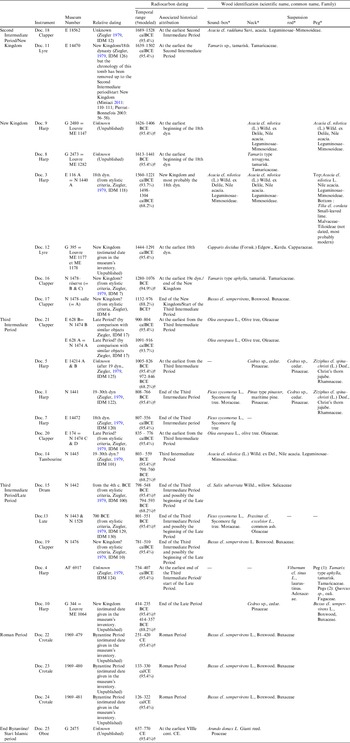
The interest of using 14C dating for studying a corpus of ancient instruments held in museums is multiple. Firstly, it makes it possible to date objects for which no information is available, for instance fragments of the stringed instruments and the oboe from the Lyon Museum of Fine Arts (doc. 8, 9, 10, 12 and 25, see Table 1). Secondly, it provides additional evidence regarding the archaeological contexts of several objects, some of which may have been found together. The discovery of some instruments is also very rare, which makes them very precious and of high scientific interest. For instance, only around 10 fragments of Egyptian membranophones have been uncovered until now (Manniche Reference Manniche1975: 1–2, 5, 6–7, 10), so very little is known about their manufacture and their use.
14C results obtained from 25 musical instruments held at the Louvre Museum (Louvre-DAE) and the Lyon Museum of Fine Arts (Lyon Beaux-arts). For each nature of instruments, objects are presented following the order of sampling process, no classification has been done regarding their chronological attribution.
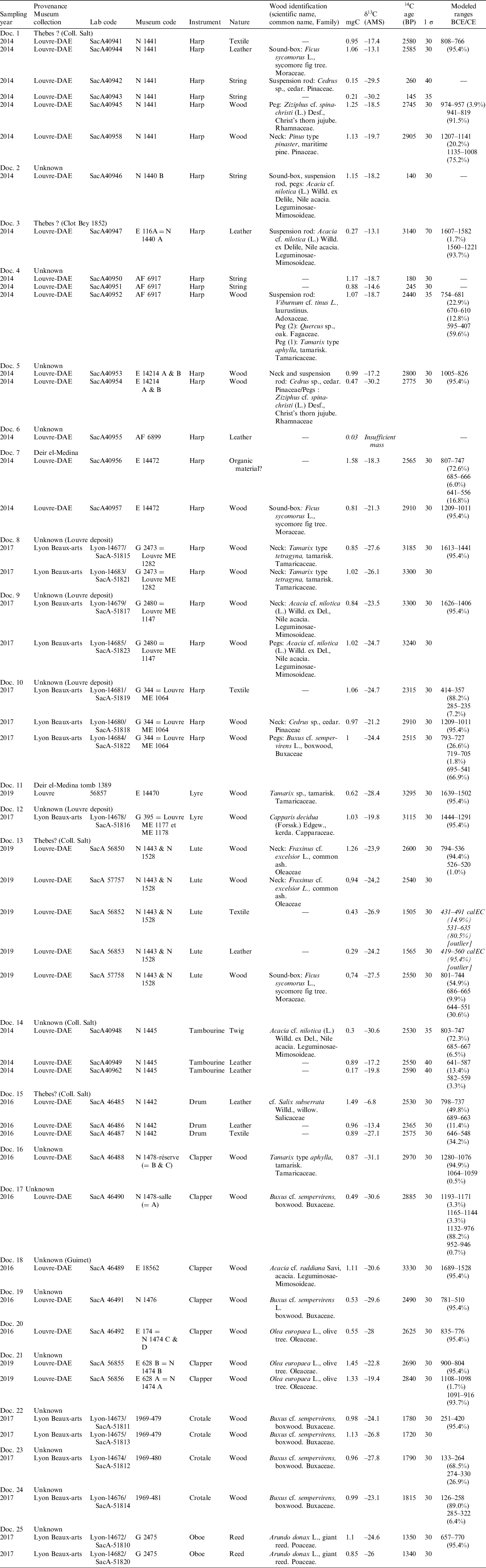
14C dating has also been applied as a way to identify objects that have possibly undergone restoration, or parts of different objects brought together to achieve a complete instrument (N 1443 & N 1528, doc. 13). These instruments entered the Louvre Museum collections during the 19th century and no information about possible conservation work is available. As an example, the neck, ropes, and tether pompoms of the angular harp (N 1441, doc. 1) appeared suspiciously modern to the naked eye.
14C investigations on ancient musical instruments also raise methodological questions with regard to sampling process and interpretation of results. The dating of wind instruments and idiophones appears more challenging than composite artefacts such as cordophones consisting of long living and short living organic materials, as only wood samples can be analyzed. It is well-known that the choice of different wood species is essential for manufacturing musical instruments, according to the part of the object (neck, sound-box, pegs, etc.). Various types and imported woods, and sometimes woods had been felled long before the manufacturing of the piece, could have been used, which makes their dating confusing; and as such, they can only be considered as termini post quos to the objects’ making (Dee and Bronk Ramsey 2014). For cordophones, if short-lived materials like string, leather and textile are producing younger dates than the main part of the instrument (wooden sound-box), this does not necessarily mean that the whole instrument was produced at the latest attested period. From ethnomusicological context it is well known that the membrane (sound-board) of stringed instruments, animal hide, could have been replaced several times. Conducting studies that include 14C analyses, challenges archaeo-metrical knowledge with historical data and stylistic criteria; therefore, widening such comparisons to a large corpus of instruments. Likewise, comprehensive archaeo-organological analyses would be necessary to better evaluate the 14C based chronological attribution.
MATERIAL AND METHODS
Archaeological Samples from Museum Collections
A collection of 49 samples have been taken from 25 musical instruments held in two museum collections: 35 from the Louvre Museum, and 14 from the Lyon Museum of Fine Arts. Organic material samples of about 1.0 mg were collected from objects using sterile scalpels following standard protocols. When possible, we prioritized the collection of short-lived samples such as strings, fibers, textiles or leather (18 samples), and made cross-sampling to compare results from different materials. Some instruments like clappers are wholly made of wood, and others like harps are composed of several wood pieces (neck, sound-box, pegs, and suspension rods). They have been collected separately in order to compare wood species and to identify possible restoration works. From 2014 to 2019 and after four sampling campaigns, ten harps, six clappers, three crotales, two lyres, one tambourine, one drum, one oboe, and one lute have been sampled for this study.
Wood Identification
From 2015 to 2019, 43 wood samples were collected from 25 musical instruments held at the Louvre Museum and the Lyon Museum of Fine Arts. The Louvre lyre E 14470 (doc. 11) was identified by the CTFT-Centre Technique Forestier Tropical (Ziegler Reference Ziegler1979: 4). Very thin wood slats (less than 30 μm thick) oriented in the three directions of wood structure were cut (transverse, tangential and radial sections). The analyses were made with a C. Zeiss optical microscope and a Nikon digital camera following the international codes of IAWA (The International Association of Woods Anatomists) for description and identification. In the text, the scientific name in Latin has been used to name the species. The scientific name (genus and species), the English vernacular and the family to which the species belongs are in the identification section in the table.
14C Dating
The Louvre samples underwent preparation steps at the LMC14 laboratory, as described in Dumoulin et al. (Reference Dumoulin, Comby-Zerbino, Delqué-Koliç, Moreau, Caffy, Hain, Perron, Thellier, Setti, Berthier and Beck2017). Lyon Museum of Fine Arts samples were pretreated at the Centre de datation par le Radiocarbon de Lyon. All have been subjected to series of acid and basic solutions to eliminate contaminations derived from carbonates and humic materials, rinsed with ultra-pure water, dried and then burned in the presence of copper oxide at 835°C for 5 hr in order to produce about 1 mg of carbon in the form of carbon dioxide. The CO2 gas was reduced by hydrogen at 600°C in the presence of iron powder to form graphite, at the LMC14 lab. Once compacted into aluminium targets they have been measured on the Artemis NEC-3MV Pelletron Accelerator.
The 14C contents of the samples were obtained by measuring 14C, 13C, and 12C beam intensities, then compared with the 14C contents of international oxalic acid standard samples (OxII, SRM 4990C) measured together. Concentration ratios were then corrected both from 13C isotopic fractionation (AMS measurement) and 14C background noise triggered from chemical steps. Calculations were done following Mook and van der Plicht (Reference Mook and van der Plicht1999).
Modeling
14C ages were calibrated by OxCal4.3 software (Bronk Ramsey Reference Bronk Ramsey2009a), using the IntCal13 calibration curve (Reimer et al. Reference Reimer, Bard, Bayliss, Beck, Blackwell, Bronk Ramsey, Buck, Cheng, Edwards, Friedrich, Grootes, Guilderson, Haflidason, Hajdas, Hatté, Heaton, Hoffmann, Hogg, Hughen, Kaiser, Kromer, Manning, Niu, Reimer, Richards, Scott, Southon, Staff, Turney and van der Plicht2013). Bayesian statistics were applied to the set of results related to each instrument to get a more accurate temporal density associated with the age of the musical instrument.
For each object, modeling was adapted according to the number and type of samples. In this way, wood sample densities were down-weighted compared to the more accurate temporal distributions from short-lived samples. This modeling allows for considering both old wood effects and the possibility of reused material. The modeled temporal densities of objects that have been analyzed using only wood samples have to be considered as the oldest plausible ages of the object’s manufacturing.
Outlier models were added according to the samples’ material (Bronk Ramsey Reference Bronk Ramsey2009b) and the number of analyses. In particular:
A symmetrical Normal distribution’s law centered to zero, with a standard deviation of 2 was applied to the 14C measurement of short-lived samples from the same objects or the same wood fragment analyzed twice, when being modeled in a Combine tool (Outlier_Model(“Combine”, N(0,2), 0, “s”);). Outlier prior probability was set to 5%.
An exponential law running from –1 to 1 and a time constant of 1, with a shift scaling spanning uniformly anywhere between 10 and 1000 years was applied to the 14C measurement of wood samples from the same object, when being modeled in a Combine tool (Outlier_Model(“CharcoalCombine”,Exp(1,-1,1),U(0,3),"s”)). Outlier’s prior probability was set to 100%.
Objects investigated using several kinds of materials were modeled according to the number of analyses.
When at least 2 analyses were available on short-lived and wood samples, the whole was put in a Sequence using Tau_Boundary function, and the combination of short-lived samples results were integrated as the final Boundary distribution law of this Sequence. No outlier model was applied to wood samples. The encoding could be sum-up as follows (example for object N 1441, doc. 1):
Outlier_Model(“Combine”, N(0,2), 0, “s”); Sequence(“N 1441”){ Tau_Boundary(“StartI”); Phase(“I_N1441”) {R_Date(“SacA40945”, 2745, 30);R_Date(“SacA40958”, 2905, 30);};
Boundary (“End I_N1441”){R_Combine(“N 1441”,8) {R_Date(“SacA40941_fiber”, 2580, 30) {Outlier(“Combine”,0.05);};R_Date(“SacA40944_skin”, 2585, 30) {Outlier(“Combine”,0.05); }; };};
When only one short-lived or wood sample analysis was available, the wood sample distribution has been enclosed within an After function to be integrated as a termini post quem to the object’s making. The encoding could be summed up as follows (example E 14472, doc. 7):
Outlier_Model(“Charcoal”, Exp(1,0,1), U(0,3), “t”);Phase(“E 14472”){R_Date(“SacA40956”, 2565, 30);After(“E14472”){R_Date(“SacA40957”, 2910, 30);};};
RESULTS
Cordophones
Harps
Twenty-three samples were collected from ten harp instruments kept in the Louvre Museum (seven), and the Lyon Museum of Fine Arts (three), among which were six short-lived samples (textile, leather). Results of eight instruments extend from 3300 ± 30 BP to 2315 ± 30 BP (Figure 2, Table 1), being chronologically spread as follows:
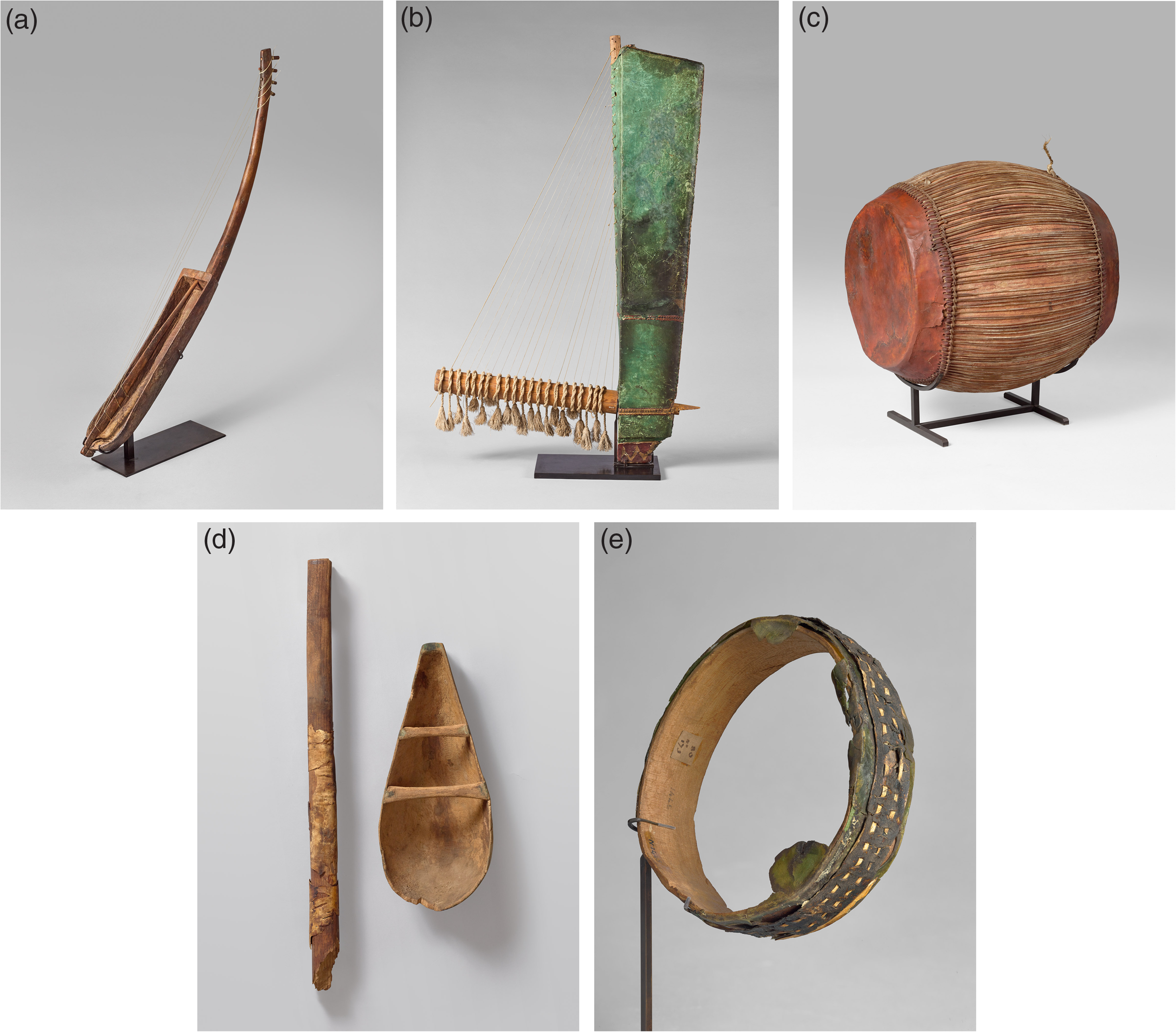
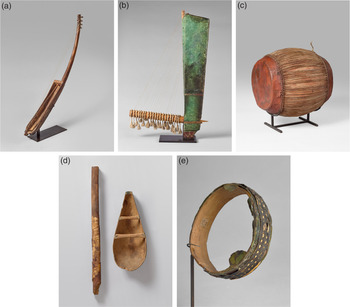
Masterpieces of the Louvre collection: (a) Harp N 1440 B; (b) Harp N 1441; (c) Tambourine N 1442; (d) Lute N 1443 & N 1528; (e) Tambourine N 1445. © Musée du Louvre, dist. RMN-GP/Hervé Lewandowski.
Modeled results for the eight analyzed harps held at the Louvre Museum (E116 A = N 1440 A, E 14214 A & B, N 1441, E 14472, AF 6917) and the Lyon Museum of Fine Arts (G 2480, 2473, G 344).
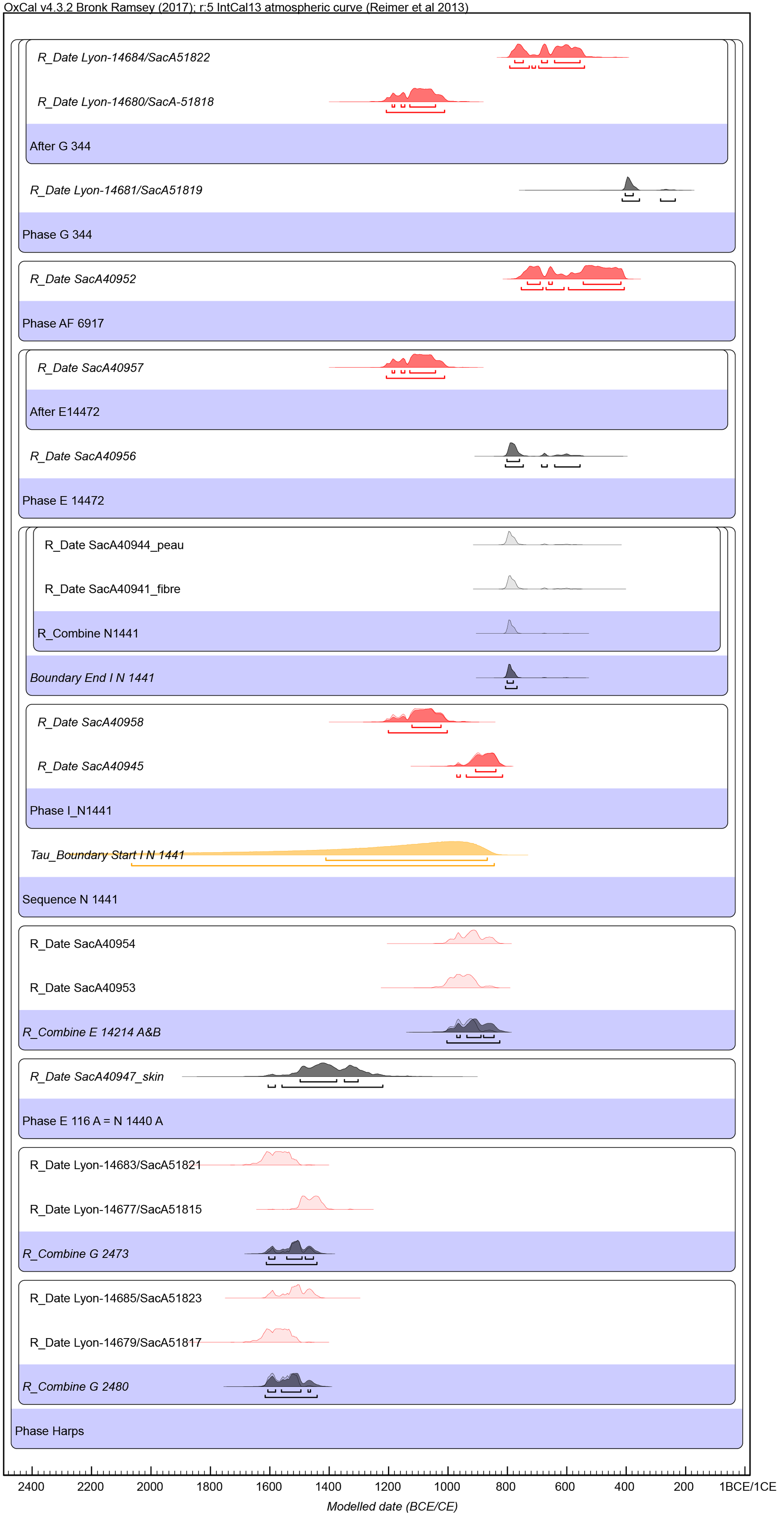
Harp G 2480 (doc. 9): two wood samples were collected from the neck and a peg; both wood species are Acacia cf. nilotica (L.) Willd ex Del. They have provided consistent results with a modeled combined range from 1626–1406 BCE (95.4%); this harp could have been manufacturing at the earliest at the beginning of the 18th Dynasty.
Harp G 2473 (doc. 8): two wood samples, identified as Tamarix type tetragyna, were collected from the neck, provided consistent results. They were combined using a “Combine” outlier model as described above, because these samples come from exactly the same wood fragment. They provide temporal range of 1613–1441 BCE (95.4%), thus this harp could have been made at the earliest at the beginning of the 18th Dynasty.
Harp E 116 A = N 1440 A (doc. 3): the analyses of a leather sample provide an age of 3140 ± 70 BP. The large uncertainty is due to the complexity of sampling process since it was possible to analyze only 0.27 mgC. This instrument is clearly from the New Kingdom (1560–1221 calBCE, 93.7%), most probably from the 18th Dynasty (1498–1304 calBCE, 68.2%). The analyzed string is modern. One peg identified as Tilia cf. cordata has not been 14C dated, but most likely seems to be modern.
Harp N 1441 (doc. 1, Figure 1b): six samples were collected from this almost complete harp. The two strings analyzed are modern; therefore, the result of restoration works. Wood samples from the neck and the peg have been identified as respectively as Pinus type pinaster and Ziziphus cf. spina-christi (L.) Desf. and provided ages of respectively 2905 ± 30 BP and 2745 ± 30 BP, older than the short-lived samples. The sound-box made of Ficus sycomorus L. was dated by a leather sample to 2585 ± 30 BP, consistent with the textile pompom of 2580 ± 30 BP. These two last samples provide a combined age for the manufacturing of this harp between 808 and 766 BCE (95.4%), representing the end of the Third Intermediate Period.
Harp E 14214 A & B (doc. 5): the two wood fragments from the neck (A) and the suspension rod (B), identified as Cedrus sp., have provided consistent results of 2800 ± 30 and 2775 ± 30 BP, thus given a modeled combined density ranging from 1005 to 826 BCE (95.4%) and most probably from 972 to 846 BCE (68.2%). This harp could have been made during the Third Intermediate Period.
Harp AF 6917 (doc. 4): three samples were collected from this instrument and the two strings gave modern ages, so are the result of restoration work. The age of a wooden fragment from the suspension rod is set from 754 to 407 calBCE (95.4%), indicating that this harp was made, at the earliest, at the end of the Third Intermediate Period/beginning of the Late Period.
Harp E 14472 (doc. 7): a wood sample identified as Ficus sycomorus L. was taken from a fragment of this instrument, as well as one organic sample. They provide non-consistent results of respectively 2910 ± 30 BP and 2565 ± 30 BP. The short-lived sample, which gives the manufacturing age of the instrument, is from 807 to 556 calBCE (95.4%), and most probably 802–769 calBCE (68.2%). The wood sample age ranges from 1209–1011 calBCE. Therefore, this instrument was made during the end of the Third Intermediate Period.
Harp G 344 (doc. 10): two wooden and one textile sample were collected from the neck (wood and textile), and from a peg of this instrument. The neck has been identified as Cedrus sp., whereas the peg is Buxus cf. sempervirens L. The three samples have given different results ranging from 2910 ± 30 BP to 2315 ± 30 BP, the youngest being textile, which temporal density spans from 414 to 235 BCE (95.4%), most probably from 414 to 357 BCE (88.2%). This indicates that this harp was made at the end of the Late Period.
All analyzed strings (five from three different harps) have provided modern ages; therefore, are restoration strings. The sample collected on the harp AF 6899 (doc. 6) was not large enough to be analyzed, and therefore it was only possible to date harp N 1440 B (doc. 2, Figure 1a) using a string sample, which provided a modern date.
Lyres
Two wood samples were collected, one from the sound-box of the lyre E 14470 (Louvre Museum, doc. 11) and one from the yoke of the lyre G 395 (Lyon Museum of Fine Arts, doc. 12). The first has been identified as Tamarix sp. and the second as Capparis decidua (Forssk.) Edgew. They provided results of 3295 ± 30 BP and 3115 ± 30 BP (Table 1, Figure 3), respectively, thus calibrated densities of 1639–1502 calBCE (95.4%) and 1444–1291 (95.4%). At the earliest, the lyre E 14470 was made during the Second Intermediate Period and G 395 during the 18th Dynasty.
Modeled results for the analyses of lyres G 395 and E 14470 and lute N 1443 & N 1528 (cordophones) held at the Lyon Museum of Fine Arts and the Louvre Museum.

Lute
The lute N 1443 & N 1528 (doc. 13, Figure 1d) has been analyzed using five samples, three wood (two from the neck N 1528 and one from the sound-box N 1443), and two short-lived samples of leather and fiber from the neck. Results extend from 2600 ± 30 BP to 1505 ± 30 BP (Table 1, Figure 3). The wood samples provide consistent results from 2600 to 2540 ± 30 BP. Those from the neck have been identified as Fraxinus cf. excelsior L. and provide a modeled combined range from 794 to 536 BCE (94.5%), and the Ficus sycomorus L. sample’s age from the sound-box is calibrated from 801 to 551 calBCE (95.4%). The short-lived samples (leather and textile) are coherent with each other (1505 ± 30 BP and 1565 ± 30 BP), but 1000 14C-years younger than the wood samples. Calibrated ranges lead to the 5th–6th centuries CE, which for historical reasons is clearly not possible for this instrument’s manufacture. These last two samples were collected alongside the lute’s neck, which clearly emphasizes this part of the instrument has undergone conservation work in modern times to prevent any risk of tearing. The restoration product used has certainly distorts the dating. We can therefore conclude that the lute has been made between the end of the Third Intermediate Period and the first part of the Late Period. Furthermore, the sound-box and the neck samples are contemporary, so they can belong to the same object.
Membranophones
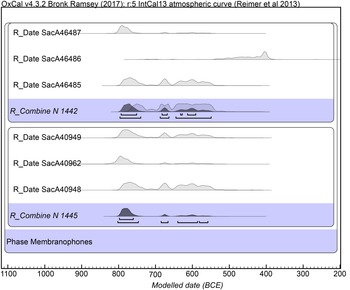
Two membranophones held at the Louvre Museum were analyzed from short-lived samples (leather, textile, and twig). The results are consistent, extending from 2590 ± 35 BP to 2530 ± 30 BP (Table 1, Figure 4).
Modeled results for the analyses of membranophones tambourine N 1445 and drum N 1442, held at the musée du Louvre.
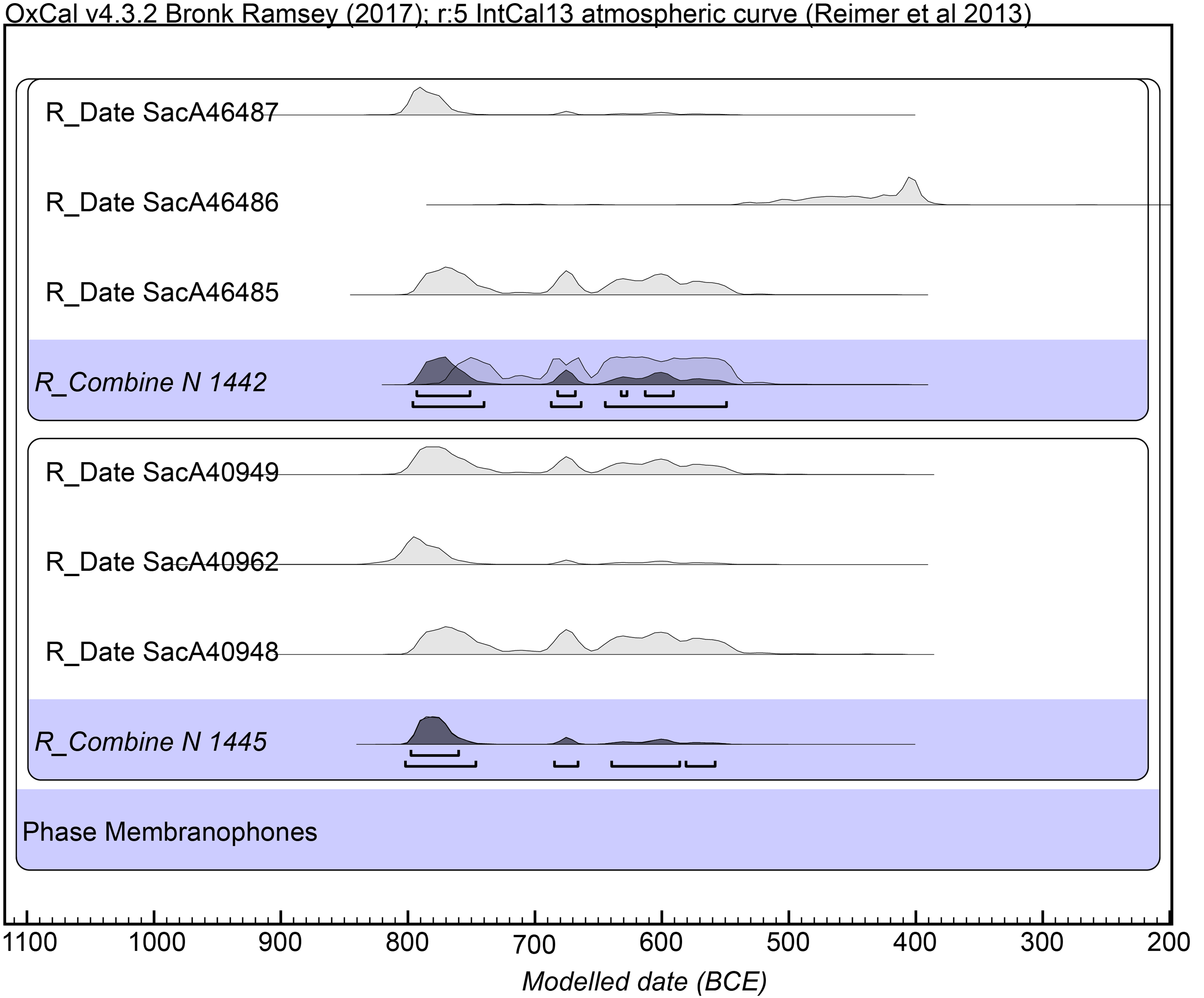
The combined probability density of the two analyzed short-lived samples from tambourine N 1445 (doc. 14, Figure 1e) ranges from 803 to 559 BCE (95.4%), most probably from 798 to 760 BCE (68.2%). Such a wide date range is due to the Hallstatt Plateau, but this instrument has clearly been made during the Third Intermediate Period.
Drum N 1442 (doc. 15, Figure 1c) was analyzed by three short-lived samples (fiber and two leather pieces), one of which provided a slightly younger age. The three have been combined using an outlier model as described above, and the resulting temporal density ranges from 798 to 548 BCE (95.4%). The date of this object corresponds to the Third Intermediate Period as with the previous one (N 1445, doc. 14).
Idiophones
Seven wood samples have been collected from five clappers held at the Louvre Museum. Results range from 3300 ± 30 BP to 2490 ± 30 BP (Table 1, Figure 5).
Modeled results for the analyses of idiophones (clappers E 18562, N 1478-res, E 628 A & B = N 1474 A & B, N 1476) and crotales (1969–479, 1969–480, and 1969–481) held at the Louvre Museum and the Lyon Museum of Fine Arts.

Clapper E 18562 (doc. 18) has provided the oldest age, whose calibrated density runs from 1689 to 1528 calBCE (95.4%). It could have been made during the Second Intermediate Period.
Clappers N 1478 “reserve” (= B & C, doc. 16) and N 1478 “salle” (= A, doc. 17) have each been analyzed from one wood sample whose calibrated temporal distributions range respectively from 1280 to 1076 BCE (94.9%), thus coming from the New Kingdom and most probably the 19th dyn. for the first one, and from 1132 to 976 BCE (88.2%), therefore the end of the New Kingdom/Start of the Third Intermediate Period for the second one.
A pair of clappers is linked with Louvre number E 628 A & B (= N 1474 A & B, doc. 21), each piece having been identified as Olea europaea L. and provided close results of 900–804 calBCE (95.4%), and 1091–916 calBCE (92.9%), respectively. They were not combined as these two samples are coming from two separate pieces. But as they are likely one set, we can consider this object as being made at the earliest at the beginning of the Third Intermediate Period. The pair of clappers E 174 = N 1474 C & D (doc. 20) was dated from one wood sample, identified as Olea europaea L. The associated temporal density is from 835 to 776 calBCE (95.4%), thus linked with the Third Intermediate Period like the previous one (doc. 21).
Finally, clapper N 1476 (doc. 19) was dated from a wood sample being identified as Buxus cf. sempervirens L. The associated temporal densities are from 781 to 510 calBCE (95.4%), thus linked with the Third Intermediate Period and possibly the start of the Late Period.
Four analyses have been performed on three wood crotales from the Lyon Museum of Fine Arts (1969-479, 1969-480, 1969-481, doc. 22, 23, 24), all having been identified as Buxus cf. sempervirens L. 14C ages are strongly consistent from 1815 ± 30 BP to 1720 ± 30 BP (Figure 5, Table 1), ranging from 133–330 calCE (1969–480, 95.4%) respectively, 126–322 calCE (1969–481, 95.4%), and 251–410 CE (combined density, 1969–479, 95.4%), which indicates that the three crotales were made at the earliest during the Roman Period (3rd–4th century CE).
Aerophone
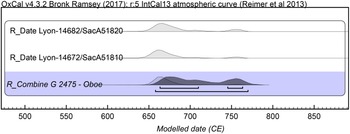
Two wood samples identified as Arundo donax L. Roseau. have been collected from the oboe G 2475 (doc. 25) from the Lyon Museum of Fine Arts. Consistent results of 1350 ± 30 BP and 1340 ± 30 BP have been combined using CharcoalCombine outlier model, providing a modeled distribution ranging from 657 to 770 CE (95.4%). At the earliest this instrument has been manufactured during the 7th–8th century CE (Table 1, Figure 6).
Modeled results for the analyses of one wind instrument (oboe G 2475 from the Lyon Museum of Fine Arts).

INTERPRETATION AND DISCUSSION
These results draw a general overview of the manufacturing periods of the musical instruments kept at the Egyptian department of the Louvre Museum and at the Lyon Museum of Fine Arts. These collections hold very well-preserved objects extending over 2500 years, from the Second Intermediate Period until the Islamic Period. As detailed in Table 2, this time span is quite homogeneously covered. In addition with a clapper (doc. 18) and a lyre (doc. 11) most probably from the Second Intermediate Period, six objects are from the New Kingdom (three harps [doc. 9, 8, 3], one lyre [doc. 12], and two clappers [doc. 16, 17]); six from the Third Intermediate Period [three harps (doc. 5, 1, 7), two pair of clappers (doc. 20, 21), and one tambourine (doc. 14)], whereas a drum (doc. 15) as well as a lute (doc. 13) could have been made between at the end of the Third Intermediate Period as well as the start of the Late Period. Three other instruments are from the Third Intermediate Period to the Late Period (two harps (doc. 4, 10) and a clapper (doc. 19)); three crotales from the Roman Period; and one Oboe from the beginning of the Islamic Period.
Chronological attribution for each instrument according to radiocarbon results. Temporal ranges from calibrated densities are provided in calBCE or calCE, whereas temporal ranges deduced from modeling are in BCE or CE (†). For wood identification, *attributions are only related to harp instruments and lute, which were made in with several parts, otherwise the identification refers to the whole piece. Temporal ranges suggested for instruments analyzed only by wood samples should be considered as the oldest possible ages of the object (their manufacturing is thus contemporaneous or younger than the wood age).

Woods Selection
To our knowledge, apart from the instruments mentioned in this article, there is only one other wood identification published on this category of objects. It is the sound-box of a harp dated to the New Kingdom (without more precision) and preserved at the Berlin Botanical Museum (Schoske et al. Reference Schoske, Kreibl and Germer1992) made of Ficus sycomorus L. We cannot therefore draw definitive conclusions on the woods used for musical instruments in ancient Egypt, but some outcomes resulting from the work are presented here.
During the Second Intermediate Period and the New Kingdom the species used, Acacia, Tamarix and Capparis, are all native to the flora of Egypt. First imports of non-Egyptian species appeared during the Third Intermediate Period. In the case of harps, and even if local species such as Ficus sycomorus L. or Ziziphus were still used, conifers such as Cedrus sp. or Pinus sp. were introduced for specific parts of the instrument, such as the neck and suspension rod; and the clappers were made of Olea sp. or Buxus sp. wood. This same trend of imported wood seems to continue from the end of the Third Intermediate Period and during the Late Period for clappers (on Buxus sp.); and harps and lutes (woods from Fraxinus sp., Viburnum sp., Quercus sp., and Buxus sp. are added to Cedrus sp.); the tambourines dating from this period use local species such as Acacia sp. and Salix sp. All instruments dating from the Roman Period are made of Buxus sp.
Some hard woods were used for clappers and crotales, such as Acacia sp. and especially Buxus sp. and Olea sp. woods, which seem well suited to percussion instruments. Tamarix sp. is used to a lesser degree because although a hard wood, it has brittle properties that may cause it to break. Solid and flexible woods such Viburnum sp. or Fraxinus sp. is used in some parts of lutes and harps, as Cedrus sp. or Pinus sp., which is more tender, but durable.
Corresponding live span of all the wood identified species can be widely different. Indigenous species like Acacia sp. or Capparis sp. can reach 60/70 years, whereas Ficus sp., Tamarix sp., or Ziziphus sp. can be higher than 150 years. Imported species like Buxus sp., Pinus pinaster sp., and Quercus sp. have higher live span of several centuries, and Cedrus sp. can reach up to 2000 years. Potential offset between wood date and the manufacturing of the instrument can thus be really large and has to be discussed for each object individually. Therefore, result of 14C analysis on a wood instrument cannot be safely interpreted without identification of the wood species.
Redrawing Original Archaeological Contexts
Over the 25 studied objects, the provenance and archaeological context of only two instruments was known with certainty prior being dated: the lyre of Deir el-Medina (E 14470, doc. 11), and the sound-box of a harp (E 14472, doc. 7), which was mentioned in the Bruyère excavation reports, without any indication on its discovery’s location on the site (Emerit and Elwart Reference Emerit, Elwart, Gaber, Bazin and Servajean2017: 133).
First attributed between the beginning of the New Kingdom and the reign of Thutmosis III by Bruyère (Reference Bruyère1937: 6–8), a review of the material from the tomb 1389 where the lyre E 14470 was found, has recently shown this tomb’s occupation was more likely from the end of the Second Intermediate Period (Pierrat-Bonnefois Reference Pierrat-Bonnefois and Andreu2003: 56–58; Miniaci Reference Miniaci2011: 110–111). This new chronological attribution is clearly confirmed by 14C results, and it also proves this instrument wasn’t manufactured using old wood.
If 14C results of this first instrument are consistent with our prior information, the dating of the harp’s sound-box E 14472 (doc. 7) does not attribute this object’s making to the New Kingdom, but rather to the end of the Third Intermediate Period, contrary to the author’s statement. Therefore, this harp cannot be linked to the other musical instruments found in the so-called Eastern Cemetery of Deir el Medina whose tombs have the same facies (Bruyère Reference Bruyère1937: 111, fig. 53). Does it come from a reused grave of this Cemetery? Unfortunately, Bruyère did not record the precise location where this instrument was found.
The origin of other objects can sometimes be deduced from additional information. For example, the harp N 1440 A (doc. 3) is assumed to be of Theban origin because of the hieroglyphic text it holds on its neck. The epigraphy also invites us to date it to the 18th Dynasty, as does the shape of the instrument. This is definitively confirmed by the 14C temporal range taken from a leather sample, clearly associated with the 18th Dynasty (1498–1304 calBCE, 68.2%).
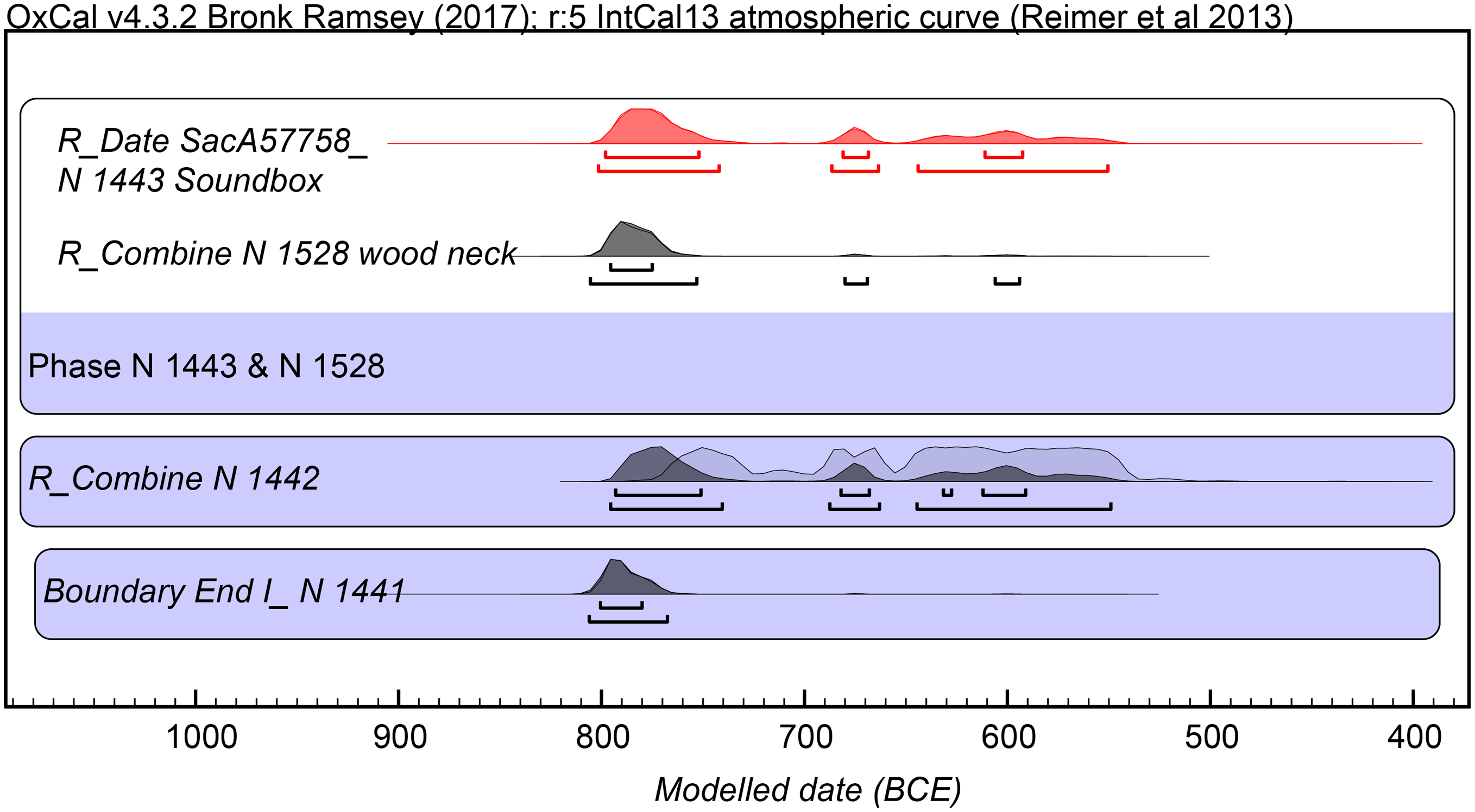
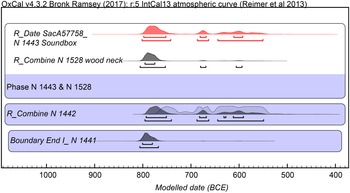
The study of the 19th century excavation reports also offers the opportunity for comparing objects currently held at the Louvre Museum, with those described in such documents. Wilkinson provides drawings of a drum (Wilkinson Reference Wilkinson1837: 269–270, fig. 204); a harp (Wilkinson Reference Wilkinson1837: 283–284, fig. 215/3: 287); and a lute (Wilkinson Reference Wilkinson1837: 303, fig. 224.), which are most probably those now in the Louvre and mentioned by d’Athanasi in his excavation report (d’Athanasi 1839: 61–63). Given the scarcity of such instruments, it seemed obviously very tempting to recognize these as the three objects in the Louvre (N 1441, N 1442, and N 1443 & N 1528, doc. 1, doc. 15, and doc. 13). However, their dating remains quite confused, as it is based on very broad stylistic criteria (between the 19th and 30th Dynasties for the harp), or too reduced in criteria (from the 4th c. BCE. for the drum and around 700 BCE for the lute), and it was not possible to definitively demonstrate that they came from the same tomb. Nonetheless, the 14C dates of these three objects demonstrate the plausible contemporaneous nature of their manufacture, all being compatible with an age from the second part of the Third Intermediate Period (Figure 7). These new results revive the assumption of a common origin (Emerit Reference S.2020: 219–220).
Modeled temporal densities obtained on the three N 1441, N 1442, and N 1443 & N 1528 instruments. N1443 & N 1528 was integrated using the three non-outliers densities. The two first ones from the neck were combined within an After() function, as well as the sound-box temporal density. We clearly observe that the three instruments provide consistent results around 800–700 BCE, thus the end of the Third Intermediate Period.
14C Dating versus Stylistic Criteria
Regarding other musical instruments, their provenances are unknown and their chronological attributions were mostly based on stylistic criteria. As detailed in Table 2, instruments are now dated more accurately and some consistency has been found for a couple of objects such as the harp N 1440 A (doc. 3, 18th Dynasty); lyre G 395 (doc. 12, 18th Dynasty); the lute N 1443 & N 1528 (doc. 13, 700 BC); or the clapper N 1478 B & C (doc. 16, 19th Dynasty/end of the New Kingdom). However, for the majority of instruments, their chronological attribution has to be revised. The shape of the clapper N 1478 A (doc. 17) looks like the previous one (doc. 16) but its date seems slightly younger than expected (end of the New Kingdom/Start of the Third Intermediate Period) despite both remain consistent. The two pair of clappers N 1474 A & B (doc. 21), N 1474 C & D (doc. 20) and harp E 14214 A & B (doc. 5) were thought to be from the Late Period; whereas, they have been made using Olea sp. and Cedrus sp. wood respectively and thus could have been made as early as the Third Intermediate Period. It should be pointed out that the shape of the two pair of clappers is very similar and the 14C dates give very close results. The stylistic criteria might have worked in this case.
The harp N 1441 (doc. 1), and tambourine N 1445 (doc. 14), roughly attributed from between the 19th and 30th Dynasties, are also from the Third Intermediate Period; and drum N 1442 (doc. 15, from the 4th century BC) is much older than expected. Clapper N 1476 (doc. 19), and harp G 344 (doc. 10), were stylistically attributed to the New Kingdom, but have most probably been manufactured during the Late Period. All crotales (doc. 22–24), which were thought to be from the Byzantine Period, have been manufactured using Buxus sp. wood, indicating a Roman Period date (2nd–3rd century CE).
Finally, we had absolutely no idea about the chronological attribution for the four remaining instruments prior to achieving their 14C dates. Clapper E 18562 (doc. 18) dates at the earliest to the Second Intermediate Period; harps G 2480 (doc. 9) and G 2473 (doc. 8) are from the 18th Dynasty; harp AF 6917 (doc. 4) is either from the Third Intermediate Period nor from the start of the Late Period. The oboe G 2475 (doc. 25), was the only wind instrument analyzed and is attributed to the 7th–8th century EC (Table 2).
Identifying Conservation Work
14C dating was also used as a tool to enable us to distinguish old and modern parts of a whole instrument. Some objects within the sample seemed suspicious and two deserved special attention.
Broadly speaking and contrary to what was previously thought, only harp strings provided modern results, indicating they had been added during restoration work in the 19th–20th centuries. The wood pieces that seemed to be modern, such as some harps’ pegs or neck, have provided ancient and consistent results with other pieces of the same instruments. This emphasizes the exceptional preservation state of these objects: except strings that are as they were in ancient times.
Pompoms, strings, and the neck of harp N 1441 (doc. 1, Table 1, Figure 1b) appeared to be a modern addition; the identification of the neck’s wood as Pinus type pinaster, a non-Egyptian species, suggested that this object could have been restored during the 19th century. Furthermore, the Salt inventory emphasizes the strings were old; however, the 14C results draw a drastically different picture. The pompoms and neck are clearly from the Third Intermediate Period, whereas the strings are modern and must have been added when the object was discovered.
The issue of strings in antiquity also arose for the harp N 1440 B (doc. 2, Table 1, Figure 1a), because they are made of animal gut. This material was known during antiquity and still commonly used in the 19th century for the strings of musical instruments. The way of hanging the strings around the neck and how they were fixed to the suspension rod was not in accordance with the available sources and gave a false image to the public. However, there was no question of withdrawing them if they were found to be ancient. The 14C analyses confirmed that these strings are modern and can therefore be removed from the instrument to provide a more realistic restoration for visitors (Emerit et al. Reference Emerit2017: 329, n° 376).
CONCLUSION
This project represents an extensive dating program undertaken on 25 ancient Egyptian musical instruments, cordophones (harps, lyres, lute), membranophones (drum, tambourine), idiophones (clappers, crotales) as well as wind instruments (oboe). All instruments are currently held at the Louvre Museum and the Lyon Museum of Fine Arts; all are exceptionally preserved and constitute an incredible archaeological treasure. They all entered the museum collections during the 19th century, and as a result their original archaeological contexts are mostly poorly known. They may also have undergone restoration work prior to exhibiting, of which no information is available.
The manufacturing dates of the 25 instruments extend along a very broad time range of roughly 2500 years, from the Second Intermediate Period (ca. 1700 BCE) to the start of the Islamic Period (8th century CE). A wide variety of wood material has been identified (different indigenous species of Acacia, Capparis, Ficus, Salix, Tamarix, Ziziphus, and imported species such as Buxus, Cedrus, Fraxinus, Olea, Pinus, Quercus, and Viburnum). The results indicate that native Egyptian species of flora were used until the Third Intermediate Period when the first imports of non-native woods can be identified. The 14C results are not always consistent with relative dates previously thought, mainly based on stylistic criteria. In addition, the stylistic criteria provide ranges that are sometimes much too wide and require finer dating thanks to 14C. As some forms of musical instruments are documented over long periods of Egyptian history, the dating of these objects by 14C helps to assign a much more precise date. Specific examples include the angular harp, tambourine, and barrel-shaped drum, which were used between the New Kingdom and the Roman Period according to iconography. Wind instruments are the most difficult objects to date according to stylistic criteria, because their shapes are often very simple, consisting of a reed without any decoration used from the Dynastic Period until today in Egypt. This highlights the need of studying ancient musical instrument using an interdisciplinary approach. It also makes it possible to identify modern restorations, and thus to restore objects as they were when discovered.
The use of 14C and wood analysis has provided important results that have added to our understanding of ancient Egyptian musical instrument crafts. The results obtained encourage us to continue this work on a larger scale in order to have a better overview of a priceless and rare corpus for the history of music. To complete the data already collected, this kind of study must be extended to the other objects preserved in museums around the world.
ACKNOWLEDGMENTS
We would like to express our sincere gratitude to the musée du Louvre and the musée des Beaux-Arts de Lyon for their support in this project. We would also like to acknowledge Bernard Berthier and Genevieve Galliano for their strong support, the Centre de Datation par le Radiocarbone de Lyon, which carried out part of the analyses (Artemis CNRS), as well as the Institut français d’archéologie orientale du Caire for supporting the Paysage sonores et espaces urbains de la Méditerranée ancienne program since its inception.





 Open access

