


Little is known about the cross-national general population prevalence or correlates of personality disorders. The most extensive data come from ten epidemiological surveys in the USA Reference Black, Noyes, Pfohl, Goldstein and Blum1–Reference Zimmerman and Coryell10 and four in Europe Reference Casey and Tyrer11–Reference Torgersen, Kringlen and Cramer14 that reported prevalence estimates using DSM–III, DSM–III–R or DSM–IV 15 criteria. Prevalence estimates for any personality disorder in these studies are in the range of 3.9–15.7%, other than one study based on a sample of volunteers with obsessive–compulsive disorder and their relatives. Reference Black, Noyes, Pfohl, Goldstein and Blum1 A number of these studies were limited to a particular city, Reference Samuels, Eaton, Bienvenu, Brown and Costa9,Reference Torgersen, Kringlen and Cramer14 county Reference Crawford, Cohen, Johnson, Kasen, First and Gordon2 or subpopulation. Reference Lenzenweger, Loranger, Korfine and Neff6 Median sample size was small (less than 500 respondents) by the standards of epidemiological studies. The aim of the present study is to address these limitations by estimating prevalence and basic correlates of DSM–IV personality disorder clusters from screening questions included in epidemiological surveys in 13 countries that participated in the World Health Organization (WHO) World Mental Health (WMH) Survey Initiative. Reference Kessler and Üstün16
Method
Sample
The countries are widely distributed, including one in Asia (China), two in Africa (Nigeria, South Africa), three in the Americas (Colombia, Mexico, USA), one in the Middle East (Lebanon), and six in Western Europe (Belgium, France, Germany, Italy, The Netherlands, Spain) (online Table DS1). Six of the countries are classified by the World Bank as less developed (China, Colombia, Lebanon, Mexico, Nigeria, South Africa), 17 and the others as developed.
All 13 surveys were conducted face to face by trained lay interviewers using consistent procedures. The WMH interviewer training materials, interview schedule and respondent visual aids were all translated from the original English version using standardised WHO translation, back-translation and harmonisation protocols. Consistent interviewer training procedures and quality control procedures were used in all surveys. Informed consent was obtained with procedures approved by the institutional review board of the collaborating organisation in each country. Detailed discussions of translation Reference Harkness, Pennell, Villar, Gebler, Aguilar-Gaxiola, Bilgen, Kessler and Üstün18 and field procedures Reference Pennell, Mneimneh, Bowers, Chardoul, Wells, Viana, Kessler and Üstün19 are presented elsewhere.
Respondents were selected from multi-stage household probability samples. Nine were nationally representative. The others were representative of urban areas (Colombia, Mexico, China) or regions (Nigeria). The weighted average response rate was 71.2%, ranging between 45.9% (France) and 87.7 % (Colombia). Detailed discussion of sampling procedures is presented elsewhere. Reference Heeringa, Wells, Hubbard, Mneimneh, Chiu, Sampson, Kessler and Üstün20
The WMH interview schedule was in two parts. All respondents completed Part I, which contained core diagnostic assessments. All Part I respondents who met criteria for any of these anxiety, mood, externalising or substance use disorders, in addition to a probability subsample of other Part I respondents, were administered Part II, which assessed disorders of secondary interest and a wide range of correlates. Questions on personality disorders were included in Part II. These questions were further restricted in the Western European surveys to a subsample of married respondents who participated in a special ‘couples’ sample in which husbands and wives in the same family were independently interviewed. Only one respondent was interviewed per household in other cases.
Questions on personality disorders were administered to 21 162 respondents across the 13 surveys. Cases of personality disorders were weighted within each sample to adjust for differential probability of selection and residual discrepancies between sample and population sociodemographic/geographic distributions (based on government census data). These weighted data were used for the current analyses. Detailed discussion of weighting procedures is presented elsewhere. Reference Heeringa, Wells, Hubbard, Mneimneh, Chiu, Sampson, Kessler and Üstün20
Assessment of DSM–IV personality disorders
Personality disorders were assessed with 33 screening questions from the International Personality Disorder Examination (IPDE). Reference Loranger21,Reference Loranger, Sartorius, Andreoli, Berger, Buchheim and Channabasavanna22 These were selected in analyses of prior data Reference Lenzenweger, Lane, Loranger and Kessler5 as significant predictors of either one or more of the three DSM–IV personality disorder clusters (A, B and C) or the overall diagnosis of any personality disorders (including personality disorders not otherwise specified) assessed by a clinician-administered IPDE.
Responses to the questions were combined to create diagnoses based on a calibration study of Part II respondents (n = 214) in the US WMH survey, oversampling positive screens, who received a clinician-administered IPDE over the telephone. Interviewers were masked to screening question responses. An experienced IPDE supervisor monitored tape-recordings of interviews and gave feedback to prevent drift. Prior research shows that the IPDE generates valid personality disorder diagnoses when administered by telephone. Reference Rohde, Lewinsohn and Seeley23 DSM–IV diagnoses based on the clinical interviews were generated for Clusters A, B, C and any personality disorder. Predicted probabilities of these four diagnoses were then assigned to each respondent based on responses to the screening question using results of stepwise logistic regression in the clinical reappraisal sample to generate predicted probabilities of each diagnosis. Predictors included the screening questions, information about respondent age and gender, and information about other variables in the survey significantly related to the IPDE diagnoses.
Prediction accuracy in the calibration sample was excellent in all the equations, with area under the receiver operating characteristic curve (AUC), a prevalence-free measure of classification accuracy with a 0.5–1.0 range, of 0.94 for Cluster A, 0.92 for Cluster B, 0.90 for Cluster C and 0.88 for any personality disorder. These results are somewhat better than in an earlier analysis of US data Reference Lenzenweger, Lane, Loranger and Kessler5 because a larger set of predictors were used in the WMH equations. These predicted probabilities formed the basis of further analyses, as described in more detail in the subsection on analysis methods.
DSM–IV Axis I disorders
The WHO Composite International Diagnostic Interview (CIDI) version 3.0 Reference Kessler and Üstün24 was used to assess Axis I DSM–IV disorders. The CIDI is a fully structured lay-administered diagnostic interview. Axis I disorders assessed included anxiety disorders (panic disorder with or without agoraphobia, generalised anxiety disorder, specific phobia, social phobia, agoraphobia without a history of panic disorder, obsessive–compulsive disorder, post-traumatic stress disorder, separation anxiety disorder); mood disorders (major depressive disorder, bipolar disorder I or II, dysthymic disorder); externalising disorders (oppositional–defiant disorder, conduct disorder, attention-deficit hyperactivity disorder, intermittent explosive disorder); and substance use disorders (alcohol and illicit drug use with or without dependence, nicotine dependence). Organic exclusion rules and diagnostic hierarchy rules were used in making diagnoses. Masked clinical reappraisal interviews using the Structured Clinical Interview for DSM–IV Reference First, Spitzer, Gibbon and Williams25 with probability subsamples of respondents in several countries found generally good concordance between DSM–IV/CIDI diagnoses and diagnoses based on masked clinical reappraisal interviews. Reference Haro, Arbabzadeh-Bouchez, Brugha, de Girolamo, Guyer and Jin26
Other correlates of personality disorders
Data on three other sets of variables are presented here: sociodemographics, impairments in activities of daily living, and treatment. Sociodemographics included gender, age (standardised to a mean of 0 and variance of 1.0 in each country), education (standardised the same way as age), employment status (employed, retired, student, homemaker, other), income (standardised the same way as age and education), and marital status (married or cohabitating, previously married, never married).
Impairments were assessed with the WHO Disability Assessment Schedule (WHO–DAS), Reference Chwastiak and Von Korff27 which evaluates functioning in three domains of basic activities (self-care, mobility, cognition) and two domains of instrumental activities (quality of productive role performance, quality of social role performance) over a 30-day recall period. Each WHO–DAS dimension is scored on a 0–100 scale where 0 represents no impairment and 100 represents complete impairment (i.e. unable to carry out the activity). To facilitate interpretation, WHO–DAS scores were standardised to a mean of 0 and variance of 1.0 in each country.
Treatment was assessed by asking each respondent if they had sought professional help in the past 12 months for problems with their emotions, nerves or substance use from a psychiatrist, other mental health professional (e.g. clinical psychologist, psychiatric social worker), general medical healthcare provider, human services professional (e.g. religious counsellor, social worker seen in at a social services agency), or a professional from the complementary/alternative medicine sector (either receiving treatment or participating in a self-help group). A visual list of provider types was presented to respondents when asking this question. Respondents were classified as seeking treatment if they reported making at least one visit to any of these providers within 12 months of the interview.
Analysis methods
Multiple imputation Reference Rubin28 was used to analyse predicted personality disorder scores with a three-part simulation. First, ten pseudo-samples (each n = 214) were selected using stratified random sampling with replacement from the 214 clinical reappraisal interviews. Predicted probabilities for each personality disorder outcome were estimated separately in each pseudo-sample, resulting in each respondent having ten predicted probabilities of each outcome.
Second, a random number between 0 and 1 was generated for each predicted probability for each respondent. If the random number was greater than the predicted probability, the individual was classified as having the diagnosis. Reappraisal sample participants had the same diagnostic classifications (either 0 or 1, depending on whether or not they had an IPDE diagnosis) in each data-set.
Third, substantive analyses were carried out independently in each pseudo-sample. The resulting ten sets of parameter estimates (i.e. prevalence estimates, estimates of regression coefficients) were averaged to obtain a best estimate of the parameters. The multiple imputation variance of each averaged parameter estimate was obtained by combining the mean of the variance across the ten replications (i.e. the average within-replication variance) with the variance of the parameter estimate across the replications (i.e. the between-replication variance). The standard error of the parameter estimate was calculated by taking the square root of this sum.
Multiple imputation prevalence estimates are unbiased to the extent that the clinical reappraisal sample is representative. Estimates of correlates are conservative to the extent that the predictors in the imputation equations fail to capture the full effects of the substantive correlates. When imputations are precise (i.e. the AUC value is high), as in the current case, the precision of the parameter estimates will approach the precision that would have been achieved if personality disorder had been directly assessed with IPDE interviews in the total sample. It is also important to realise, however, that this approach assumes the validity of the DSM–IV three-cluster model of personality disorders. This model has not been supported in all empirical studies, Reference Durrett and Westen29,Reference Nestadt, Hsu, Samuels, Bienvenu, Reti and Costa30 although it has in some. Reference Blais, McCann, Benedict and Norman31,Reference Cox, Sareen, Enns, Clara and Grant32
Personality disorder prevalence estimates and estimates of treatment prevalence were calculated as the means of the ten multiple imputation prevalence estimates. Associations of personality disorders with sociodemographics, measures of impairment and DSM–IV Axis I disorders were estimated using logistic regression analysis, again with parameter estimates averaged over the ten multiple imputation replications. Logistic regression coefficients and their standard errors were exponentiated and are reported as odds ratios and their 95% confidence intervals.
Because the WMH sample design features weighting and clustering, all parameter estimates were estimated using the design-based Taylor series linearisation method Reference Wolter33 implemented in the SUDAAN software system for UNIX (Research Triangle Park, North Caroline, USA). Significance tests of sets of coefficients were made using Wald χ2-tests based on design-corrected multiple imputation coefficient variance–covariance matrices. Statistical significance was consistently evaluated using two-sided design-based multiple imputation tests at the 0.05 level of significance.
Results
Prevalence estimates
The mean multiple imputation prevalence estimate of any DSM–IV/IPDE personality disorder across samples (based on sample sizes, not population sizes) is 6.1% (Table 1). These estimates are lowest in Nigeria (2.7%) and Western Europe (2.4%), and between 4.1% (e.g. China) and 7.9% (e.g. Colombia) in other countries. Prevalence estimates for personality disorder clusters average 3.6% for Cluster A, 1.5% for Cluster B and 2.7% for Cluster C. Cluster B is estimated to be the least prevalent cluster in each survey, and Cluster A is estimated to be the most prevalent in all countries other than Western Europe and the USA.
Table 1 Prevalence estimates of DSM–IV/IPDE personality disorders in the WMH Surveys

| Cluster A % (s.e.) | Cluster B % (s.e.) | Cluster C % (s.e.) | Any personality disorder, % (s.e.) | n | |
|---|---|---|---|---|---|
| Colombia | 5.3 (0.6) | 2.1 (0.4) | 3.6 (0.5) | 7.9 (1.1) | 2381 |
| Lebanon | 4.2 (1.7) | 1.7 (0.9) | 2.9 (0.8) | 6.2 (1.7) | 1031 |
| Mexico | 4.6 (0.7) | 1.6 (0.4) | 2.4 (0.5) | 6.1 (0.8) | 2362 |
| Nigeria | 1.6 (0.5) | 0.3 (0.2) | 0.9 (0.3) | 2.7 (0.7) | 2143 |
| People's Republic of China | 3.1 (0.7) | 1.3 (0.7) | 1.4 (0.6) | 4.1 (1.1) | 1628 |
| South Africa | 3.4 (0.5) | 1.5 (0.3) | 2.5 (0.5) | 6.8 (0.7) | 4315 |
| USA | 4.0 (0.4) | 2.0 (0.3) | 4.2 (0.4) | 7.6b (0.5) | 5692 |
| Western Europea | 1.1 (0.6) | 0.4 (0.3) | 1.2 (0.5) | 2.4 (0.9) | 1610 |
| Total | 3.6 (0.3) | 1.5 (0.1) | 2.7 (0.2) | 6.1 (0.3) | 21 162 |
A consistent pattern of between-country differences holds for all three clusters, with the lowest prevalence estimates in Nigeria and Western Europe for Clusters A (1.6–1.1%), B (0.3–0.4%) and C (0.9–1.2%). Co-occurrence between clusters is common, especially between Clusters A and B, where the pooled (across countries) odds ratio is 21.0 (95% CI 13.0–34.0). Odds ratios for Clusters A–C and B–C are OR = 12.0 (95% CI 8.7–16.7) and OR = 12.1 (95% CI 7.9–18.5) respectively. This high co-occurrence accounts for the sum of the prevalence estimates across clusters substantially exceeding the prevalence of any personality disorder in each country.
Sociodemographic correlates
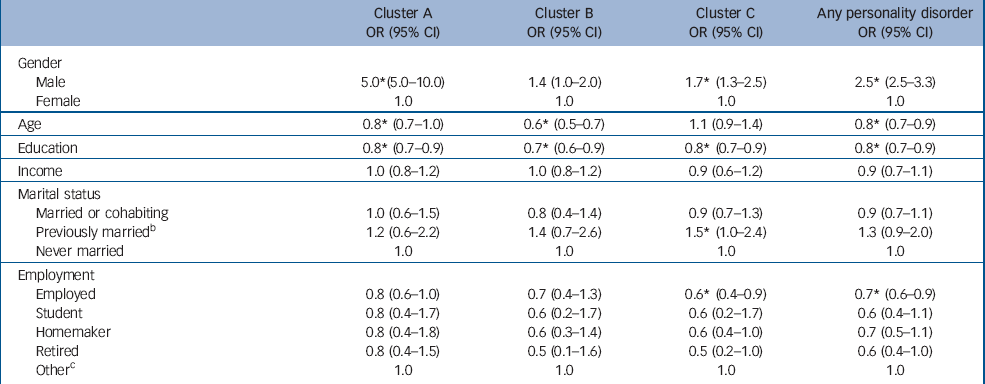
Clusters A and C are significantly more prevalent among men than women (Table 2). Clusters A and B are inversely related to age. All three clusters are significantly and inversely related to education. Employment status and marital status are significantly related only to Cluster C (elevated among the previously married and those who are either unemployed or disabled). Most significant ORs are relatively modest in substantive terms with the exception of OR = 5.0 between gender and Cluster A. Within-country associations are generally consistent with those in the pooled data. (Detailed results are available on request.)
Table 2 Associations (ORs) of sociodemographic variables with DSM–IV/IPDE personality disorders pooled across the 13 WMH surveysa (n = 21 161)
| Cluster A OR (95% CI) | Cluster B OR (95% CI) | Cluster C OR (95% CI) | Any personality disorder OR (95% CI) | |
|---|---|---|---|---|
| Gender | ||||
| Male | 5.0* (5.0-10.0) | 1.4 (1.0-2.0) | 1.7* (1.3-2.5) | 2.5* (2.5-3.3) |
| Female | 1.0 | 1.0 | 1.0 | 1.0 |
| Age | 0.8* (0.7-1.0) | 0.6* (0.5-0.7) | 1.1 (0.9-1.4) | 0.8* (0.7-0.9) |
| Education | 0.8* (0.7-0.9) | 0.7* (0.6-0.9) | 0.8* (0.7-0.9) | 0.8* (0.7-0.9) |
| Income | 1.0 (0.8-1.2) | 1.0 (0.8-1.2) | 0.9 (0.6-1.2) | 0.9 (0.7-1.1) |
| Marital status | ||||
| Married or cohabiting | 1.0 (0.6-1.5) | 0.8 (0.4-1.4) | 0.9 (0.7-1.3) | 0.9 (0.7-1.1) |
| Previously marriedb | 1.2 (0.6-2.2) | 1.4 (0.7-2.6) | 1.5* (1.0-2.4) | 1.3 (0.9-2.0) |
| Never married | 1.0 | 1.0 | 1.0 | 1.0 |
| Employment | ||||
| Employed | 0.8 (0.6-1.0) | 0.7 (0.4-1.3) | 0.6* (0.4-0.9) | 0.7* (0.6-0.9) |
| Student | 0.8 (0.4-1.7) | 0.6 (0.2-1.7) | 0.6 (0.2-1.7) | 0.6 (0.4-1.1) |
| Homemaker | 0.8 (0.4-1.8) | 0.6 (0.3-1.4) | 0.6 (0.4-1.0) | 0.7 (0.5-1.1) |
| Retired | 0.8 (0.4-1.5) | 0.5 (0.1-1.6) | 0.5 (0.2-1.0) | 0.6 (0.4-1.0) |
| Otherc | 1.0 | 1.0 | 1.0 | 1.0 |
Comorbidity with DSM–IV Axis I disorders
Each cluster is estimated to be positively and significantly associated with each of the four classes of 12-month DSM–IV Axis I disorders assessed in the WMH Surveys (Table 3). Odds ratios are in the range of 2.8–14.5. The highest ORs involving anxiety and mood disorders are with Cluster C (OR = 11.4 and OR = 9.3 respectively). The highest ORs involving externalising and substance use disorders are with Cluster B (OR = 9.4 and OR = 14.5 respectively). Even stronger associations exist between personality disorders and number of Axis I disorders, with a consistent dose–response relationship between the number of Axis I disorders and personality disorders. The ORs between having three or more Axis I disorders (v. none) and a personality disorder are 9.7 for Cluster A, 49.3 for Cluster B, 34.8 for Cluster C and 21.1 for any personality disorder. Within-country associations are generally consistent with those in the pooled data. (Detailed results are available on request.)
Table 3 Associations (ORs) of DSM–IV/IPDE personality disorders with 12-month DSM–IV/CIDI Axis I disorders pooled across the 13 WMH surveysa (n = 21 161)

| Cluster A OR (95% CI) | Cluster B OR (95% CI) | Cluster C OR (95% CI) | Any personality disorder OR (95% CI) | |
|---|---|---|---|---|
| Any anxiety disorder | 3.9* (2.9-5.3) | 6.5* (4.3-9.6) | 11.4* (8.4-15.5) | 6.6* (5.3-8.2) |
| Any mood disorder | 3.8* (2.9-4.9) | 7.1* (5.0-10.0) | 9.3* (7.1-12.2) | 6.5* (4.9-8.6) |
| Any externalising disorder | 5.2* (3.7-7.3) | 9.4* (6.0-14.7) | 5.9* (3.6-9.8) | 5.2* (3.8-7.1) |
| Any substance use disorder | 2.8* (2.0-3.9) | 14.5* (8.5-24.7) | 3.2* (2.3-4.4) | 3.2* (2.3-4.4) |
| Any disorder | 3.8* (2.9-4.9) | 12.7* (7.3-21.9) | 8.7* (6.3-12.0) | 5.3* (4.4-6.4) |
| Number of Axis I disorders | ||||
| Exactly one | 2.7* (1.9-3.7) | 6.2* (3.3-11.6) | 4.6* (3.1-6.7) | 3.1* (2.4-3.9) |
| Exactly two | 4.4* (2.9-6.5) | 17.8* (9.1-34.8) | 11.8* (7.7-18.1) | 6.8* (5.1-9.1) |
| Three or more | 9.7* (6.2-15.1) | 49.3* (24.1-101.0) | 34.8* (22.2-54.5) | 21.1* (16.0-27.9) |
Over half (51.2%) of people with a personality disorder also meet criteria for at least one Axis I disorder. This overlap is higher for Clusters B (74.1%) and C (64.3%) than A (44.1%) (more detailed results are available on request). About a sixth (16.5%) of respondents with Axis I disorders, in comparison, are estimated to meet criteria for one or more personality disorders. This overlap is somewhat higher for externalising (27.6%) and mood (23.6%) disorders than for anxiety (19.9%) or substance use (18.8%) disorders (detailed results are available on request).
Impairments
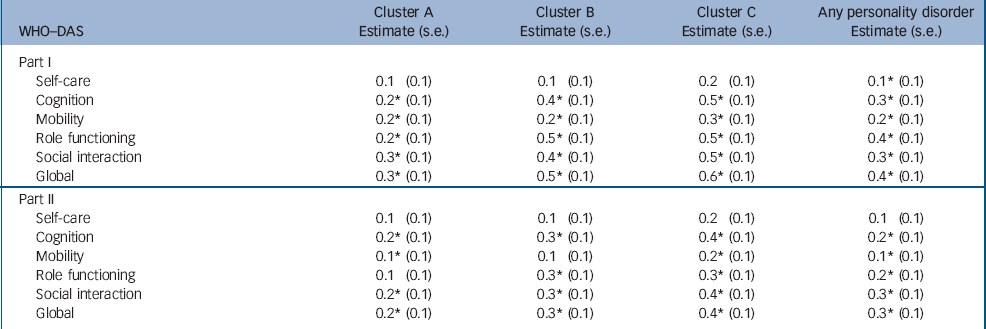
Respondents with personality disorders have a significantly elevated impairment in each of the WHO–DAS dimensions, with effect sizes of 0.1–0.5 on standardised impairment scales (Table 4). Associations of this size would be considered small to medium using conventional criteria. Reference Lenzenweger35 The associations involving each cluster are weakest with impairments in self-care (non-significant associations of 0.1) and mobility (0.2–0.3) and stronger with impairments in other domains (0.2–0.5). The latter associations are strongest with Cluster C (all 0.5), less with Cluster B (0.4–0.5) and least with Cluster A (0.2–0.3). The associations become somewhat weaker (25–40% reduction in coefficients) when controlled for comorbid Axis I disorders (detailed results are available on request).
Table 4 Mean differences in impairments in daily activities in the 30 days before interview as assessed by the WHO–DAS among respondents with DSM–IV/IPDE personality disorders compared with other respondents without (Part I) and with (Part II) comorbid 12-month DSM–IV/CIDI Axis I disorders pooled across 13 WMH surveysa (n=16 846)
| WHO—DAS | Cluster A Estimate (s.e.) | Cluster B Estimate (s.e.) | Cluster C Estimate (s.e.) | Any personality disorder Estimate (s.e.) |
|---|---|---|---|---|
| Part I | ||||
| Self-care | 0.1 (0.1) | 0.1 (0.1) | 0.2 (0.1) | 0.1* (0.1) |
| Cognition | 0.2* (0.1) | 0.4* (0.1) | 0.5* (0.1) | 0.3* (0.1) |
| Mobility | 0.2* (0.1) | 0.2* (0.1) | 0.3* (0.1) | 0.2* (0.1) |
| Role functioning | 0.2* (0.1) | 0.5* (0.1) | 0.5* (0.1) | 0.4* (0.1) |
| Social interaction | 0.3* (0.1) | 0.4* (0.1) | 0.5* (0.1) | 0.3* (0.1) |
| Global | 0.3* (0.1) | 0.5* (0.1) | 0.6* (0.1) | 0.4* (0.1) |
| Part II | ||||
| Self-care | 0.1 (0.1) | 0.1 (0.1) | 0.2 (0.1) | 0.1 (0.1) |
| Cognition | 0.2* (0.1) | 0.3* (0.1) | 0.4* (0.1) | 0.2* (0.1) |
| Mobility | 0.1* (0.1) | 0.1 (0.1) | 0.2* (0.1) | 0.1* (0.1) |
| Role functioning | 0.1 (0.1) | 0.3* (0.1) | 0.3* (0.1) | 0.2* (0.1) |
| Social interaction | 0.2* (0.1) | 0.3* (0.1) | 0.4* (0.1) | 0.3* (0.1) |
| Global | 0.2* (0.1) | 0.3* (0.1) | 0.4* (0.1) | 0.3* (0.1) |
12-Month treatment
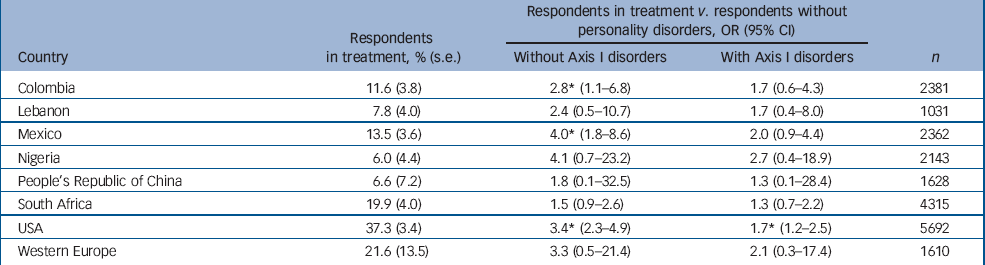
The proportion of people with personality disorders who received treatment for mental disorders in the year before interview varies substantially across countries, from 6.0% in Nigeria to 37.3% in the USA (Table 5). Compared with respondents without personality disorders, those with personality disorders had elevated odds of treatment in every country (OR = 1.5–4.1), although only three ORs are significant at the 0.05 level. Controls for comorbid Axis I disorders consistently reduce the ORs (1.3–2.7), suggesting that treatment is often obtained for Axis I disorders.
Table 5 Treatment of emotional problems in the 12 months before interview among respondents with DSM–IV/IPDE personality disorders in the WMH Surveysa
| Respondents in treatment v. respondents without personality disorders, OR (95% CI) | ||||
|---|---|---|---|---|
| Country | Respondents in treatment, % (s.e.) | Without Axis I disorders | With Axis I disorders | n |
| Colombia | 11.6 (3.8) | 2.8* (1.1-6.8) | 1.7 (0.6-4.3) | 2381 |
| Lebanon | 7.8 (4.0) | 2.4 (0.5-10.7) | 1.7 (0.4-8.0) | 1031 |
| Mexico | 13.5 (3.6) | 4.0* (1.8-8.6) | 2.0 (0.9-4.4) | 2362 |
| Nigeria | 6.0 (4.4) | 4.1 (0.7-23.2) | 2.7 (0.4-18.9) | 2143 |
| People's Republic of China | 6.6 (7.2) | 1.8 (0.1-32.5) | 1.3 (0.1-28.4) | 1628 |
| South Africa | 19.9 (4.0) | 1.5 (0.9-2.6) | 1.3 (0.7-2.2) | 4315 |
| USA | 37.3 (3.4) | 3.4* (2.3-4.9) | 1.7* (1.2-2.5) | 5692 |
| Western Europe | 21.6 (13.5) | 3.3 (0.5-21.4) | 2.1 (0.3-17.4) | 1610 |
Discussion
Cross-national prevalence estimates of personality disorders
The prevalence estimates reported here are lower than in most previous studies that assessed personality disorders with structured assessment instruments, where the median prevalence of any personality disorder is 10.6%. Reference Lenzenweger35 However, two studies Reference Lenzenweger, Loranger, Korfine and Neff6,Reference Coid, Yang, Tyrer, Roberts and Ullrich12 reported only modestly lower estimates than the WMH Surveys and a third study Reference Moldin, Rice, Erlenmeyer-Kimling and Squires-Wheeler7 found an overall prevalence estimate (7.3%) only slightly higher than the 6.1% WMH estimate. The low WMH estimate might reflect the fact that the IPDE generally yields conservative estimates of personality disorder prevalence. Reference Lenzenweger, Lane, Loranger and Kessler5 Our finding that personality disorders, although significantly associated with role impairment, are not associated with extreme role impairment, argues against the possibility that the IPDE picked up only severe cases and underestimated less severe cases of personality disorders.
Another issue in comparing our results is that only a minority of previous studies were based on relatively unrestricted probability samples of the community. Reference Reich, Yates and Nduaguba8,Reference Samuels, Eaton, Bienvenu, Brown and Costa9,Reference Coid, Yang, Tyrer, Roberts and Ullrich12,Reference Torgersen, Kringlen and Cramer14 Most previous personality disorder studies were opportunistic, assessing prevalence in groups from local communities that had been included in other studies. Some included controls, or even the relatives of patients from the original study. The latter would be expected to have a high prevalence of psychiatric morbidity, including personality disorders. As noted in the last paragraph, differences in prevalence estimates could also be due to differences in instruments. Surveys using the Structured Interview for DSM–III–R Personality (SIDP), Reference Pfohl, Blum, Zimmerman and Stangl36 for example, found consistently high prevalence estimates for all personality disorders (13.4–22.3%). This instrument effect raises currently unresolved questions about the appropriate diagnostic thresholds for personality disorders.
The multiple imputation method, which we used to estimate prevalence, might have yielded downwardly biased prevalence estimates. As multiple imputation is unbiased in estimating prevalence when applied to a single population, Reference Rubin28 the possibility of bias implies that the imputation rules, which were based on clinical calibration in the USA, might not be accurate in the other WMH countries. To address this possibility, future cross-national epidemiological surveys need to go beyond the exclusive use of screening questions to administer full personality disorder clinical interviews in community samples in multiple countries and to carry out clinical reappraisal interviews in a substantial subsample in each country.
The estimated cross-national variation in personality disorder prevalence estimates also might reflect methodological factors. The low prevalence estimates in Western Europe might additionally be due to personality disorders being assessed exclusively in married couples, although these prevalence estimates were only marginally lower among married respondents in the remaining surveys. The comparatively low prevalence estimates in China and Nigeria, in comparison, are consistent with low prevalence estimates across a wide range of disorders, raising the possibility of broad downward bias in these surveys. In the remaining surveys, overall personality disorder prevalence estimates were quite consistent: between 6.1 and 7.9%.
Prevalence estimates were highest in Cluster C in the USA and Western Europe, and highest in Cluster A in the other surveys. Previous epidemiological surveys have, like the WMH Surveys, been inconsistent in their estimates of the relative prevalence of personality disorder clusters, but have generally found higher estimates for Cluster B than in the WMH Surveys. The Cluster B prevalence estimate is 1.5% overall and exceeds 2.0% only in one country (Colombia) compared with a median prevalence estimate of 5.1% in previous surveys. Reference Guzzetta, de Girolamo, Gelder, Lopez-Ibor and Andreasen37 It might be that measurement bias either in the IPDE screening questions or in the multiple imputation procedure account for the comparatively low Cluster B estimates.
Sociodemographic correlates of personality disorders
Our strongest finding, that Cluster A personality disorders are much more common among men than women, is consistent with the suggestion in the DSM–IV 15 that all three Cluster A personality disorders (paranoid, schizoid and schizotypal) are most common among men. The insignificant association between gender and Cluster B personality disorders, in comparison, is indirectly consistent with the suggestion in the DSM–IV that some Cluster B personality disorders are more common among women (histrionic and borderline), whereas others are more common among men (antisocial, narcissistic), with these opposite-sign patterns possibly cancelling out in analyses at the level of the cluster. The DSM–IV also suggests that some Cluster C personality disorders are more common among men (obsessive–compulsive disorder) and others among women (avoidant, dependent), raising the possibility that our finding of a somewhat higher prevalence of Cluster C personality disorders among men than women reflects the former pattern dominating the latter pattern.
However, in all these cases, empirical confirmation is impossible because too few IPDE screening questions on personality disorders were included in the WMH Surveys to generate reliable prevalence estimates for individual personality disorders. This makes it difficult to compare our results with previous studies that examined individual disorders. The fact that neither of two recent and comparatively large community surveys Reference Lenzenweger, Lane, Loranger and Kessler5,Reference Coid, Yang, Tyrer, Roberts and Ullrich12 found the relatively common (compared with other Cluster B personality disorders) category of borderline personality disorder to be more common among women than men raises concerns about our suggestion that opposite-sign gender differences might cancel out in the overall prevalence of any Cluster B personality disorder.
In comparison, our findings that young and poorly educated people have the highest prevalence of Cluster A and B personality disorders are consistent with a number of previous studies. Reference Zimmerman and Coryell10,Reference Morizot and Le Blanc38 Our failure to find significant inverse associations of employment or income with personality disorders, however, is inconsistent with the results of clinical studies. Reference Matsunaga, Kiriike, Matsui, Miyata, Iwasaki and Fujimoto39,Reference Skinstad and Swain40 These discrepancies might be due to ascertainment bias, base-rate differences or systematic differences in help-seeking related to sociodemographic factors in the clinical samples. Reference Corbitt and Widiger41,Reference Loranger42
Our finding of high comorbidity between personality disorders and Axis I disorders isconsistent withmuchclinicalresearch. Reference Skinstad and Swain40 The finding that an especially strong association exists between Cluster B and substance use disorders is also consistent with the notion that low impulse control is a core feature of Cluster B personality disorders, Reference Mataix-Cols, Baer, Rauch and Jenike43 and the finding of an especially strong association between Cluster C and anxiety disorders is consistent with the notion that characterological anxiety is the hallmark of Cluster C personality disorders. Reference Fogel and Westlake44 Although we found low ORs of Cluster A with Axis I disorders, stronger associations would presumably have been found if non-affective psychoses had been assessed in the WMH Surveys. The fact that the ORs found between clusters and Axis I disorders are comparable in magnitude to the ORs found between pairs of Axis I disorders Reference Kessler, Üstün, Kessler and Üstün45 raises the possibility that personality disorders have been somewhat arbitrarily separated from Axis I disorders in the DSM nomenclature. Reference Siever and Davis46,Reference Widiger47
The finding that personality disorders are associated with a wide range of functional impairments is consistent with previous studies, Reference Casey, Tyrer and Platt48–Reference Skodol, Gunderson, McGlashan, Dyck, Stout and Bender51 as is the finding that these associations are not accounted for by comorbid Axis I disorders, Reference Bender, Dolan, Skodol, Sanislow, Dyck and McGlashan52,Reference Grilo, Sanislow, Shea, Skodol, Stout and Gunderson53 although an earlier report of the US WMH Survey found that Axis I comorbidity does account for the associations of personality disorders with impairments in the USA. Reference Lenzenweger, Lane, Loranger and Kessler5 It is interesting that the associations of personality disorders with elevated odds of help-seeking are much more substantially reduced by controls for Axis I comorbidity than are the ORs for measures of impairment. This suggests that people with personality disorders seek help largely for Axis I disorders even though most of the impairments associated with personality disorders are not due to comorbid Axis I disorders. Strong effects of Axis I disorders on help-seeking presumably mean that help-seeking is based on symptoms rather than on traits. Axis I disorders are also much more easily recognised as illnesses needing treatment than are personality disorders because lay illness representations exist for common Axis I disorders but not for personality disorders. Reference Schomerus, Matschinger, Kenzin, Breier and Angermeyer54,Reference Stuart55
Limitations
A number of the above results are surprising, such as the findings that Cluster A is most prevalent, that Cluster B is least prevalent and that only Cluster C is associated with role impairment despite being considered the least impairing cluster. These unexpected findings raise concerns that the IPDE screening questions are not valid in all the countries studied. We have no way to evaluate this possibility because clinical reappraisal interviews were administered only in the USA. Another possibility is that concordance of screening questions with clinical diagnoses varies across countries. Yet another possibility is that the three-cluster model does not characterise personality disorders equally in all countries and that a more complex specification is needed to study these disorders cross-culturally. Reference Widiger and Mullins-Sweatt56 The results reported here have to be interpreted in light of these uncertainties. Future cross-national epidemiological studies need to address these uncertainties by including more comprehensive assessments of personality disorders and carrying out rigorous clinical reappraisal interviews in parallel in all participating countries.
Funding
This study was supported by the US National Institute of Mental Health (NIMH) (R01-MH070884), the John D. and Catherine T. MacArthur Foundation, the Pfizer Foundation, the US Public Health Service (R13-MH066849, R01-MH069864 and R01-DA016558), the Fogarty International Center (FIRCA R03-TW006481), the Pan American Health Organization, the Eli Lilly & Company Foundation, Ortho-McNeil Pharmaceutical Inc, GlaxoSmithKline and Bristol-Myers Squibb. A complete list of WMH publications can be found at www.hcp.med.harvard.edu/wmh/.
The Chinese World Mental Health Survey Initiative is supported by the Pfizer Foundation. The Colombian National Study of Mental Health (NSMH) is supported by the Ministry of Social Protection. The ESEMeD project is funded by the European Commission (Contracts QLG5-1999-01042; SANCO 2004123), the Piedmont Region (Italy), Fondo de Investigación Sanitaria, Instituto de Salud Carlos III, Spain (FIS 00/0028), Ministerio de Ciencia y Tecnología, Spain (SAF 2000-158-CE), Departament de Salut, Generalitat de Catalunya, Spain, Instituto de Salud Carlos III (CIBER CB06/02/0046, RETICS RD06/0011 REM-TAP), and other local agencies and by an unrestricted educational grant from GlaxoSmithKline. The Lebanese National Mental Health Survey (LEBANON) is supported by the Lebanese Ministry of Public Health, the WHO (Lebanon), Fogarty International, Act for Lebanon, anonymous private donations to IDRAAC, Lebanon, and unrestricted grants from Janssen Cilag, Eli Lilly, GlaxoSmithKline, Roche and Novartis. The Mexican National Comorbidity Survey (MNCS) is supported by the National Institute of Psychiatry Ramon de la Fuente (INPRFMDIES 4280) and by the National Council on Science and Technology (CONACyT-G30544-H), with supplemental support from the Pan American Health Organization (PAHO). The Nigerian Survey of Mental Health and Wellbeing (NSMHW) is supported by the WHO (Geneva), the WHO (Nigeria) and the Federal Ministry of Health, Abuja, Nigeria. The South Africa Stress and Health Study (SASH) is supported by the US NIMH (R01-MH059575) and National Institute of Drug Abuse (NIDA) with supplemental funding from the South African Department of Health and the University of Michigan. The US National Comorbidity Survey Replication (NCS–R) is supported by the NIMH (U01-MH60220) with supplemental support from NIDA, the Substance Abuse and Mental Health Services Administration (SAMHSA), the Robert Wood Johnson Foundation (Grant 044708), and the John W. Alden Trust.
Acknowledgements
The surveys discussed in this article were carried out in conjunction with the World Health Organization (WHO) World Mental Health (WMH) Survey Initiative. We thank the WMH staff for assistance with instrumentation, fieldwork and data analysis.




eLetters
No eLetters have been published for this article.